


Abstract
This systematic review focuses on all the gambling addiction prevention programs carried out in schools, with the intention of making their effectiveness known and encouraging the creation of more such programs. During the third quarter of 2021, an exhaustive search was conducted using the databases of Scopus, Medline (via Pubmed), WOS, and PsycINFO. The search strategy was based on a combination of specific search terms: “Gambling Disorder [Mesh]”, “Online Gambling Disorder [Mesh]”, and “Prevention Programs [Mesh]”. A total of 15 articles were chosen for systematic review. All the programs analyzed show effective results, although there are several methodological shortcomings in the way they are conducted. Effective programs need to focus more on long-term results and the emotional aspects of gambling. We need professionals who can convey the causal nature of the problem the youth are facing.
1. Introduction
Play has always been one of the most important educational processes in people’s lives. In fact, our cognitive and personal development is based on a game of constant exploration of our surrounding environment [1], allowing us to experience different situations for continuous learning throughout life. This is why play is considered an unparalleled pedagogical tool. However, any game must be guided by a controlled procedure to prevent it from reaching an obsessive or pathological extent. Although this is not common in the case of most leisure activities, there is a high percentage of risk involved in certain activities, such as video games and, especially in recent years, gambling.
Recently, pathological gambling was classified within the Substance-Related Disorders section of the DSM-5 and was renamed gambling disorders [2] because the number of people addicted to gambling is so high. However, the term “gambling disorder” is commonly used for adults; the authors in the studied literature preferred to talk of “problem gambling” when referring to this type of situation with teenagers. In this sense, there is a high percentage of adolescents who, at some point in their lives, have gambled and/or continue to do so, which highlights a worrying trend.
Data collected by the Ministry of Culture and Sport (MCD) from Spain indicate that 25% of young people aged 15–17 years are habitual gamblers and that 4.5% of young adults aged 18–25 years would be considered pathological gamblers as well [3]. On the other hand, the Spanish Observatory on Drugs and Addictions noted in 2019 that 0.5% of the population who were aged 15–64 years had a pathological gambling disorder or a gambling problem [4]. The increasingly frequent use of mobile devices in the daily lives of students, the great ease of access to gambling opportunities, and the normalization in society of these types of activities have turned adolescents or young adults into the main risk group prone to pathological gambling. Spain witnesses a yearly progressive expansion of gambling as an economic and social activity [5], mainly due to the emergence of new forms of online gambling, as stated in reports by the Directorate General of Gambling Regulation [6]. In 2020, the Spanish population spent EUR 851 million on online gambling alone, which is 13.7% more than in 2019. This contributed almost 36% of the Gross Gaming Revenue (GGR), an indicator that reveals the gross amount of money obtained by a particular operator in the gambling sector in a given period [6].
1.1. Online Problem Gambling in Adolescents
Internet use on mobile devices has increased considerably in recent years. The universal use of smartphones and computers in adolescents increases the accessibility of gambling, as well as increasing its intensity and the immediate reinforcement of the concept of reward while making it difficult for guardians and parents to control its use. Contributing to the problems of its availability, immediacy, and accessibility are the mode of online problem gambling through any device [7] and, in the case of minors, anonymity [8].
The Internet and the modernization of devices have meant that classic gambling opportunities, such as lotteries, cards, and casinos, have been replaced by what is now known as online gambling [9]. This concept is new and is not yet accepted by some authors, although recent data reported by González-Cabrera et al. showed that almost 1% of Spanish adolescents had a clinical problem related to online gambling, while more than 6% were at risk [10].
Recent studies have shown that cell phones are the main means of access and addiction to online gambling [10]. There are many factors that cause teenagers to show more prevalence of online gambling use and the subsequent possible addiction.
Lloret-Irles, Cabrera-Perona and Castaños-Monreal [11] group these factors into three different levels. However, it should be noted that there are cultural differences between countries, so there will be bidding factors listed below that may not match a particular region or may not match at all. These are just a few examples from the research carried out by the authors mentioned above:
- (1)
- The individual level, which would include: (a) personality traits. These are understood as the values that define a person. Some authors have observed that high levels of impulsivity correlate positively with a high predisposition toward gambling and correlate negatively with emotional intelligence [12]. (b) Risk perception: these are defined as the ability to perceive gambling and betting as an action with possible negative consequences. Several studies have observed that those adolescents with a higher risk perception toward online gambling would have a lesser intention to gamble [13]. (c) Illusion of control: these are cognitive distortions generated by the gambling companies themselves, which bias the probability of winning beliefs, encouraging the gambler’s fallacy. Increased knowledge of probability calculations in teenagers has been found to be associated with lower risk-taking behavior in gambling [14].
- (2)
- The microsocial level, which would include: (a) family. Parental permissiveness toward gambling indicates that poor parental supervision is associated with the emergence and consolidation of gambling behavior in children [15]. (b) Peer pressure: this is understood as the influence on a person exerted by close individuals with similar characteristics. Adolescents would be directly influenced by their close friends who have already placed some kind of bet.
- (3)
- The macrosocial level, which would include: (a) publicity. Adolescents’ access to the Internet leads to an influx of excessive advertising, causing both positive and negative attitudes toward gambling [16]. (b) Accessibility: closely related to the previous point, it has been shown by many authors that a high percentage of accessibility correlates with a risky attitude toward online gambling [17].
Consequently, the repercussions of gambling reach all levels of the student’s life. It has been predicted that students with a greater predisposition to gambling would have a high probability of suffering problems derived from low levels of self-esteem, such as anxiety or depression [18]. Many authors have tried to demonstrate the negative implications of gambling addiction in teenagers, but it is important to know that, in this case, it is very difficult to differentiate between cause and effect. However, we can show the comorbidity that this type of disorder presents by using other problems. For example, pathological gambling and problem gambling have high comorbidity with a large number of other mental health disorders, particularly substance-use disorders [19]. Other studies show that pathological online gambling has high comorbidity with delinquency and criminality, even if we do not know whether it is the cause or the effect [20].
1.2. Online Gambling: Educational Preventive Intervention
Despite the evidence, there is no common preventive intervention framework in the educational system that aims to reduce the proportion of adolescents who are attracted to gambling. It is worth noting that in recent years, some progress has been made in this regard with the prohibition of gambling advertisements, for example, such as the prohibition in Spain of establishing betting shops within 500 m of schools [21].
It is important to note that the prevention of gambling addiction is carried out within the framework of the prevention of drugs, be they psychoactive substances (alcohol, tobacco, inhalants or modern psychoactive substances, or “smart drugs”) or gambling itself, and should, therefore, be approached from a holistic point of view, i.e., sharing the same common objective: to help people in general to avoid or delay the use of these activities and, if they have started to use them, to work with them to prevent further addiction [22]. In this regard, the UNODC (United Nations Office on Drugs and Crime) points out that the drastic changes that occur in the adolescent brain make them particularly vulnerable to gambling [23]. For example, they state that one of the key elements that should not be forgotten in school-based prevention is the training of teachers, who will later hold the key to motivating their students to participate, ultimately achieving the objectives of the intervention itself. They also advise that socio-emotional educational competencies should be included at all times.
On the other hand, SAMHSA (the Substance Abuse and Mental Health Services Administration) presents “A Guide to SAMHSA’s Strategic Prevention Framework”, which sets out what the strategy for developing a prevention intervention should be: (1) the assessment of local prevention needs; (2) the capacity to create resources to prevent the need; (3) planning an action guide that works in the specific setting; (4) the implementation of the workshops or programs that have been created; and finally, (5) the evaluation of the results of the intervention [24].
The schools in which this strategy was not adhered to were significantly affected. There is no framework for action within the margins of the educational legislative law that focuses on alleviating the problem of gambling within the classroom environment. This is concerning, especially since several preventive interventions in other countries of the European Union have proved the effectiveness of such programs. For example, a prevention program against gambling was conducted by Dodig-Hundric et al. [25], involving 629 students of school-going age, with an average age = 15.67 years. Nine workshops were conducted, focusing on the awareness of all aspects related to gambling. Significant results were observed in terms of knowledge, cognitive distortions, and the frequency of gambling.
The creation of prevention interventions in the field of addiction is of vital importance. As indicated above, the percentage of the adolescent population that is engaging in this type of activity is increasing every day, so one of the ways to act would be through prevention. As pointed out by Larry Cohen [26], an intervention should consist of a spectrum composed of six levels: (1) strengthening individual knowledge and skills, (2) promoting community education, (3) educating the providers, (4) fostering coalitions and networks, (5) changing organizational practices, and (6) influencing policy and legislation [27].
When it comes to developing a preventive intervention in the educational setting, there are some types of difference according to their final objective. For example, St-Pierre and Derevensky [28] state that these programs are differentiated into (1) psychoeducational pre-intervention programs and (2) comprehensive psychoeducational prevention and skills training programs. Both types of intervention aim to increase knowledge about the use of gambling and all that is related to it, such as erroneous beliefs or associated probabilities, among others. The second type of intervention, unlike the first one, includes topics such as self-esteem, interpersonal skills, and problem-solving, among others. The latter type is understood to be somewhat more comprehensive as it includes risk and the protective factors associated with gambling and adolescent behaviors.
In addition, this intervention can have two levels, depending on what type of target population is being addressed, either: (1) universal—aimed at the entire population; (2) selective—aimed at groups with above-average risk factors [29].
The effectiveness of preventive interventions or programs for addictions is an issue that generates a great deal of discussion among the professionals who deal with it. While it is true that the vast majority of studies are universal, i.e., such intervention only covers a population that does not meet specific risk criteria, this means that the long-term effects are limited [30]. In addition, these programs are often characterized by a short intervention duration, further reducing the likelihood of longer-term effects. In this sense, it is recommended that more longitudinal studies are conducted to observe the real effects in adolescents of gambling behavior [30].
1.3. Objectives
Thus, this systematic review focuses on all the online gambling preventive interventions that are carried out in schools, with the aim of observing whether they are effective in reducing problem gambling in a sample of students in primary and secondary education. This study aims to observe the effectiveness of preventive interventions that reinforce the knowledge and individual skills of primary and secondary school students.
2. Materials and Methods
A literature review was conducted following the PRISMA (Preferred Reporting Items for Systematic reviews and Meta-Analyses) recommendations for descriptive and systematic reviews.
2.1. Search Strategy
During the third quarter of 2021, an exhaustive search was conducted using the databases of Scopus, Medline (via Pubmed), WOS, and PsycINFO. The search strategy was based on a combination of specific search terms: “Gambling Disorder [Mesh]”, “Online Gambling Disorder [Mesh]”, and “Prevention Programs [Mesh]”.
2.2. Data Extraction
Data extraction was conducted using a standard data-extraction form developed by the Joanna Briggs Institute Reviewers’ Manual for the Systematic Review of Prevalence and Incidence Data [25].
2.3. Inclusion Criteria
Studies were included according to the following criteria: (a) empirical studies; (b) preventive interventions; (c) articles about online problem gambling; (d) articles with a sample of young people attending as students of primary or secondary education; (e) articles published between 2010 and 2021 (at the date the literature search ends); (f) articles published in Spanish or English; (g) the chosen articles should evaluate the effectiveness/non-effectiveness of prevention programs using standardized instruments. Articles of an informative nature, experts’ opinions published in editorials, and letters to the editor were excluded (Figure 1).
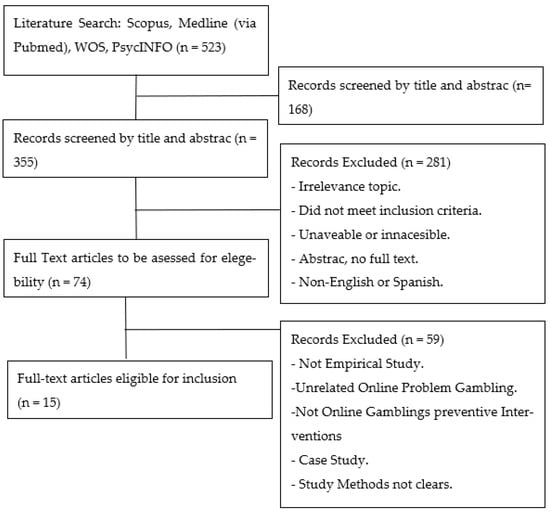
Figure 1.
Flow Chart.
2.4. Selection of Studies
The main search yielded 523 publications. A total of 168 duplicate publications were eliminated, giving a final result for the first selection of 355. The first selection of studies was made by reading the titles and abstracts. A total of 74 articles were retained for the reading and final selection. Studies that were not empirical studies, that were not published after 2010, that were not written in Spanish or English, that were not on the topic of gambling prevention in students in primary or secondary education, and wherein the evaluation was qualitative, were excluded. Finally, a total of 15 articles were chosen for systematic review.
2.5. Analysis of Selected Data
All information and variables were extracted from the studies analyzed. The results of the literature search and data extraction were summarized descriptively. To exclude duplicate articles, Endnote was used for the manual selection. A summary of efficacy results was presented, based on the different outcome measures, controls, and interventions. Therefore, a narrative synthesis was generated, taking into account the total number of studies reporting the results, the methodological quality, and the quality of evidence of the results to derive the final conclusions. The general characteristics of the extracted systematic reviews were used as an exploratory variable for PRISMA scores. The variables included were: authors, country, school-based intervention types, intervention types (universal vs. selective), the objective of the intervention, the number of participants, mean age of the participants, assessment instruments, and outcomes (Table 1).

Table 1.
Results of selected studies.
3. Results
Table 1 shows the results of the final selection of studies. The total number of participants evaluated in the computation of all studies was 25,119, of whom 33 were teachers [44]. The rest were all primary, secondary, or high-school students. The average age, excluding teachers, was 14.15 years (Mean = 14.15).
The provenance of the gambling addiction prevention programs analyzed was very varied: three were from Italy [40,42,44], two from the United States [31,43], two from Canada [38,39], two from Spain [34,35,36,37], two from Romania [32,33,34,35], one from Switzerland [36], one from Croatia [25], one from Portugal [41], and one from Germany [33].
The characteristics of the studies were very similar. Half (n = 7) of the studies analyzed the effectiveness of the programs through a quasi-experimental pre-post evaluation [36]. For example, Ramona-Todirita and Viorel Lupu [32] conducted a quasi-experimental study with three groups: a control group; another group that was only given just the prevention information related to gambling; the last group, in addition to being given the relevant information, was given an interactive game created to reduce gambling addictions: “Amazing Chateau”. Similarly, Turner, Macdonal, and Somerset [35] evaluated the effectiveness of a program that seeks to reduce the myths related to gambling by creating an experimental group and a control group.
Of the fourteen studies reviewed, only two are from a selective perspective [38,41]. The programs are usually characterized by being purely informative. Although following different ways of proceeding, most of the studies analyzed were intended to test the effectiveness of prevention programs based on informative sessions. For example, Pérez-García, Sánchez-Valenzuel, and Pantoja-Vallejo [37] evaluated the effectiveness of the “Cubilete” program. This program consists of four sessions, taught by experts, that aim to reduce the success of false myths, stereotypes, and strategies that companies use to attract more customers, by showing videos of real cases or creating debates. On the other hand, Choliz, Marcos, and Bueno [34] observed the effectiveness of the Ludens program, which only has two sessions and helps students to understand the operating procedures of gambling companies and how they make the customer believe that they are in control when the opposite is true.
The materials the programs work with range from participatory activities or discussions [38] to an interactive game called “Amazing Chateau”: this is a game that gives students the opportunity to distinguish between games of chance and games of skill. They also become familiar with important concepts related to gambling, such as luck, independent events, myths, and facts as well as concepts such as risk-taking, the consequences of addiction, and making responsible choices. It is not possible to give a specific estimate regarding the assessment materials used, since they are very varied.
Most studies obtained similar results. For example, the authors of [33] observed that by participating in the program, students increased their knowledge about gambling and showed a significantly decreased inclination toward gambling. Dogic-Hundric, Mandic, and Ricijas [25] reduced the cognitive distortions about gambling and the knowledge of gambling, in turn, reducing their subsequent addiction to it. No effects were observed in terms of their socio-emotional skills. Turner, Macdonal, and Somerset [34] observed a reduction in students’ addiction, which significantly increased their self-control and coping skills. However, Canale et al. [40] found no significant differences in the variables evaluated after the program, compared to the control group.
4. Discussion
The aim of this systematic review was to consider the effectiveness of gambling addiction prevention programs for elementary, middle, and high school students.
Attempting to elucidate the effectiveness of programs is difficult because of challenges that cannot be easily controlled for in the research design process. The most important indicator that determines the effectiveness of a program, however, is long-term behavior change. However, most of the studies did not measure long-term effects, so it is somewhat difficult to identify the real efficacy of reducing gambling addiction among children and adolescents. As for the design of the prevention interventions analyzed, it is very varied. These studies limited their outcome measures to cognitive changes, mainly in the short term [33,37]. In this sense, some authors claim that preventive interventions only have a short-term effect, but the real problems related to online gambling addiction are still present in the person, in this case, the child or adolescent; therefore, another type of intervention would be necessary [45]. On the other hand, Canale et al. [40] found that there were no significant differences between the control and experimental groups in their study. In this sense, there are some authors who found that the main drawback faced by a preventive intervention of this type is the small sample of the population at risk available, and that to obtain statistically significant results, a very large sample and the certainty of having at-risk players in the population should be taken into account [45].
It is observed that of the fourteen studies analyzed, only two approached the subject from a selective perspective [38,41]; the rest approached it from a universal perspective. In this sense, no statistically significant differences are observed among the rest of the interventions with a universal approach. For example, in the intervention carried out by Calado, Alexandre, Rosenfeld, Pereira, and Griffiths [41], a pre–post intervention was carried out with students, with a duration of 6 weeks of intervention and with the aim of reducing false beliefs, the frequency of gambling, etc. A variety of methods and techniques were used to deliver the activities to the students, including interactive methods, such as live discussions and real-life situations where students could practice newly learned skills, learning in teams, in pairs, in threes, and in small groups, or by creating a positive environment for students to express themselves freely [46]. The results collected through various questionnaires show that the intervention is significant in the short term on some of the variables assessed, such as the reduction of hours of access to online gambling per week, false beliefs, and an increase in related knowledge. However, no significant results were found on other variables, such as the amount of money spent or sensation-seeking. These results are shared with the related research. Stautz and Cooper [47] observed that a reduction in these variables, especially sensation-seeking, correlates significantly with a reduction in the percentage of gambling experiences.
All the preventive interventions focused on known cognitive aspects of pathological gambling, including gambling fallacies and misconceptions, among other variables specific to each study. Despite the variability of the heterogeneity of the studies analyzed (duration, methodology, and number of samples), similar results were observed in the vast majority of preventive interventions. These results are often characterized by an increased awareness of personal components, such as impulsivity or the predisposition toward gambling [42], or the reduction of false beliefs surrounding online gambling [41]. It is possible that this improvement in cognitive values, as in assessment tools such as the Gambling-Related Cognitive Distortions test [9], is due to the effects of testing rather than cognitive development.
Regarding the assessment tools, the most widely used is the South Oaks Gambling Screen, revised for adolescents (SOGS-RA) [25,38,40,42]. In this sense, there is no consensus on the use of a common assessment instrument, as there are many scales used by the various interventions. Most studies disaggregated the amount of money spent by students or problem gamblers. This makes the level of harm experienced by those categorized as “problem gamblers” still questionable. In addition, the average amounts of money wagered are low. This makes it difficult to detect and interpret reductions in average spending over time.
Analyzing the results, depending on their point of view, we found that (n = 12) preventive interventions were psychoeducational pre-intervention programs, while (n = 3) were comprehensive psychoeducational prevention and skills training programs. These results coincide with other research that has been carried out, in which the type of study, focused exclusively on cognitive factors, tends to predominate, leaving aside the more emotional aspects [48]. There is not much data on which type of program is best, although some argue that the emotional aspects are a key factor in addiction prevention in general [49]. Reducing false beliefs or increasing awareness of the risks involved in gambling, as performed in psychoeducational pre-intervention programs, is a good way forward and should not be neglected, but we must not forget the emotional (and social) aspects that this problem entails. In a study by Jara-Rizzo, Navas, Catena, and Perales [50], they observed that cognitive distortions related to gambling addiction had a statistically significant correlation with the emotional regulation of gamblers.
The results of this study have important implications. This systematic review provides an objective viewpoint, with the aim of integrating into the educational system various methodological and procedural interventions aimed at promoting more responsible play within the curricula and syllabi of both primary and secondary grades. As Oh et al. [51] point out, in adolescence, risk behaviors increase due to a constant search for sensations, together with cognitive development that has not reached the peak of its maturity, which is why this age group is more vulnerable to this type of gambling game. However, he points out that action should not be limited to adolescents. By carrying out preventive interventions with the youngest children, it has been shown that they avoid later access to these games.
5. Conclusions
Despite the variability of the programs analyzed, all of them reported significant results. It is important to emphasize that the vast majority of the studies reviewed make a short-term assessment, so the results should be viewed from that perspective.
Emphasis should be placed on the need for prevention models that evaluate their long-term effectiveness. Moreover, programs in administrations or schools do not require expensive or hard-to-find materials. They only need professionals who can convey the causal nature of the problem they are facing. In addition, an effort should be made to carry out real prevention programs, with subjects at real risk of falling into addiction and with techniques and objectives that are adapted to their needs, based on evidence and not on facilities.
However, considering the seriousness of the situation related to gambling and the high prevalence in adolescents, this systematic review found only 14 studies that analyzed the effectiveness of preventive interventions. This is a very low number if we look at the data previously provided about the percentage of adolescents who place a bet daily via mobile phones. It is, therefore, necessary to make more efforts in this regard. Institutions must create such programs and incorporate them into the students’ curriculum.
In conclusion, the results of this study provide an important contribution to the emerging body of literature on youth problem gambling prevention programs. However, we must bear in mind that interventions or programs must reflect their effects beyond the short term, as it is in the long-term effects where the importance of the intervention lies.
6. Limitations
The limitation encountered in this systematic review is the impossibility of creating a single set of information and data collected. This is due to the great variety of procedures and methodologies that characterize these programs and interventions. We recommend that in subsequent studies, we try to collect information and data from programs and interventions that are similar in their methodological process.
Although the aim of this systematic review was not to evaluate the quality of the programs, it is recommended that future studies should evaluate the quality of interventions and programs.
Author Contributions
Formal analysis, J.M.G.L. and F.M.M.R.; investigation, J.M.G.L. and F.M.M.R.; project administration, F.M.M.R.; resources, F.M.M.R.; software, F.M.M.R.; supervision, F.M.M.R.; writing—original draft, J.M.G.L. All authors have read and agreed to the published version of the manuscript.
Funding
This research received no external funding.
Data Availability Statement
Not applicable.
Conflicts of Interest
The authors declare no conflict of interest.
References
- Perdomo, I.R.; Pinzón, O.H.; Prieto, M.A. Juego exploratorio e inferencia temprana: Un estudio descriptivo de las habilidades exploratorias y su relación con la edad. Rev. Colomb. De Psicol. 2007, 16, 57–63. [Google Scholar]
- American Psychiatric Association. Diagnostic and Statistical Manual of Mental Disorders, 5th ed.; American Psychiatric Association: Washington, DC, USA, 2013. [Google Scholar]
- Ministerio de Cultura y Deporte. Encuestas de Hábitos y Prácticas Culturales en España 2018–2019. 2019. Available online: https://www.culturaydeporte.gob.es/servicios-al-ciudadano/estadisticas/cultura/mc/ehc/portada.html (accessed on 2 August 2021).
- Observatorio Español de las Drogas y las Adicciones y Delegación del Gobierno para el Plan Nacional Sobre Drogas. Adicciones Comportamentales. Juego con Dinero, uso de Videojuegos y uso Compulsivo de Internet en las Encuestas de Drogas y Otras Adicciones en España EDADES y ESTUDES. 2019. Available online: https://pnsd.sanidad.gob.es/eu/profesionales/sistemasInformacion/sistemaInformacion/pdf/2019_Informe_adicciones_comportamentales_2.pdf (accessed on 2 August 2021).
- Gervilla-García, E.; Cabrera-Perona, V.; Lloret-Irles, D. Spanish adaptation of the Gambling Advertising Impact Scale in adolescents. Aten. Primaria 2021, 54, 102230. [Google Scholar] [PubMed]
- DGOJ, Directorate General for the Regulation of Gambling. Annual Report 2020. 2021 Ministry of Finance. Available online: https://www.ordenacionjuego.es/es/memorias-informe-anual (accessed on 19 February 2022).
- Gainsbury, S.M.; Russell, A.; Hing, N.; Wood, R.; Lubman, D.; Blaszczynski, A. How the Internet is Changing Gambling: Findings from an Australian Prevalence Survey. J. Gambl. Stud. 2015, 31, 1–15. [Google Scholar] [CrossRef] [PubMed]
- McCormack, A.; Shorter, G.W.; Griffith, M.D. Characteristics and predictors of problem gambling on the internet. Int. J. Ment. Health Addict. 2013, 11, 634–657. [Google Scholar] [CrossRef]
- Marmet, S.; Studer, J.; Wicki, M.; Khazaal, Y.; Gmel, G. Online Gambling’s Associations with Gambling Disorder and Related Problems in a Representative Sample of Young Swiss Men. Front. Psychiatry 2021, 12, 703118. [Google Scholar] [CrossRef]
- Sales-Triguero, I.; Cloquell-Lozano, A. La adicción al juego online entre los adolescentes españoles propuestas de prevención en el marco educativo. Edetania 2021, 59, 85–103. [Google Scholar] [CrossRef]
- Lloret-Irles, D.; Cabrear-Perona, V. Prevención del juego de apuestas en adolescentes: Ensayo piloto de la eficacia de un programa escolar. Rev. De Psicol. Clínica Con Niños Y Adolesc. 2019, 6, 55–61. [Google Scholar]
- Dussault, F.; Brendgen, M.; Vitaro, F.; Wanner, B.; Tremblay, R.E. Longitudinal links between impulsivity, gambling problems and depressive symptoms: A transactional model from adolescence to early adulthood. J. Child Psychol. Psychiatry 2011, 52, 130–138. [Google Scholar] [CrossRef]
- Spurrier, M.; Blaszczynski, A.; Rhodes, P. Gambler Risk Perception: A Mental Model and Grounded Theory Analysis. J. Gambl. Stud. 2015, 31, 887–906. [Google Scholar] [CrossRef]
- Floyd, K.; Whelan, J.P.; Meyers, A.W. Use of warning messages to modify gambling beliefs and behavior in a laboratory investigation. Psychol. Addict. Behav. 2016, 20, 69–74. [Google Scholar] [CrossRef]
- Molinaro, S.; Canale, N.; Vieno, A.; Lenzi, M.; Siciliano, V.; Gori, M.; Santinello, M. Country and individual-level determinants of probable problematic gambling in adolescence: A multi-level cross-national comparison. Addiction 2014, 109, 2089–2097. [Google Scholar] [CrossRef] [PubMed]
- Pitt, H.; Thomas, S.L.; Bestman, A.; Stoneham, M.; Daube, M. “It’s just everywhere!” Children and parents discuss the marketing of sports wagering in Australia. Aust. N. Z. J. Public Health 2016, 40, 480–486. [Google Scholar] [CrossRef] [PubMed]
- Drakeford, B.P.; Hudson, M. Mobile Gambling: Implications of Accessibility. J. Res. Stud. Bus. Manag. 2015, 1, 3–28. [Google Scholar]
- Romo-Avilés, N.; Marcos-Marcos, J.; Gil-García, E.; Marquina-Márquez, A.; Tarragona-Camacho, A. Bebiendo como chicos: Consumo compartido de alcohol y rupturas de género en poblaciones adolescentes. Rev. Española De Drogodepend. 2015, 40, 13–28. Available online: http://www.aesed.com/descargas/revistas/v40n1_1.pdf (accessed on 2 August 2021).
- Rash, C.J.; Weinstock, J.; Patten, R.V. A review of gambling disorder and substance use disorders. Subst. Abus. Rehabil. 2016, 7, 3–13. [Google Scholar] [CrossRef]
- Abbott, M. Gambling and gambling harm in New Zealand: A 28-year case study. Int. J. Ment. Health Addict. 2017, 15, 1221–1241. [Google Scholar] [CrossRef]
- Mestre-Bach, G.; Granero, R.; Vintró-Alcaraz, C.; Juvé-Segura, G.; Marimon-Escudero, M.; Rivas-Pérez, S.; Jiménez-Murcia, S. Youth and gambling disorder: What about criminal behavior? Addict. Behav. 2021, 113, 106684. [Google Scholar] [CrossRef]
- Rey-Brandariz, J.; Pérez-Ríos, M.; Santiago-Pérez, M.I.; Lorenzo, M.; Malvar, A.; Hervada, X. Caracterización del juego de azar en Galicia: Un problema de Salud Pública. Adicciones 2021, 184, 21–45. Available online: https://www.adicciones.es/index.php/adicciones/article/view/1613 (accessed on 2 August 2021). [CrossRef]
- UNODC; WHO. International Standards on Drug Use Prevention: Second Updated Edition; UNODC: Vienna, Austria; WHO: Geneva, Switzerland, 2018.
- Substance Abuse and Mental Health Services Administration (SAMHSA). A Guide to SAMHSA’s Strategic Prevention Framework; Center for Substance Abuse Prevention. Substance Abuse and Mental Health Services Administration: Rockville, MD, USA, 2019.
- Dodig Hundric, D.; Mandic, S.; Ricijas, N. Short-Term Effectiveness of the Youth Gambling Prevention Program "Who Really Wins?"-Results from the First National Implementation. Int. J. Environ. Res. Public Health 2021, 18, 10100. [Google Scholar] [CrossRef]
- Cohen, L.; Baer, N.; Satterwhite, P. Developing eVective coalitions: An eight-step guide. Inj. Aware. Prev. Cent. News 1991, 4, 10. [Google Scholar]
- Cohen, L.; Swift, S. The spectrum of prevention: Developing a comprehensive approach to injury prevention. Inj. Prev. 1999, 5, 203–207. [Google Scholar] [CrossRef] [PubMed]
- St-Pierre, R.A.; Derevensky, J.L. Youth gambling behavior: Novel approaches to prevention and intervention. Curr. Addict. Rep. 2016, 3, 157–165. [Google Scholar] [CrossRef]
- Amaro, J.H.; García-Altés, A.; López, J.; Bartoll, X.; Nebot, M.; Ariza, C. Análisis de coste-beneficio de un programa de prevención del tabaquismo en escolares. Gac. Sanit. 2009, 23, 311–314. [Google Scholar] [CrossRef]
- Munn, Z.; Moola, S.; Lisy, K.; Riitano, D.; Tufanaru, C. Methodological guidance for systematic reviews of observational epidemiological studies reporting prevalence and cumulative incidence data. Int. J. Evid. Based Healthc. 2015, 13, 147–153. [Google Scholar] [CrossRef] [PubMed]
- Williams, R.J.; Wood, R.T.; Currie, S.R. Stacked deck: An effective, school-based program for the prevention of problem gambling. J. Prim. Prev. 2010, 31, 109–125. [Google Scholar] [CrossRef]
- Lupu, I.R.; Lupu, V. Gambling Prevention Program for Teenagers. J. Cogn. Behav. Psychother. 2013, 13, 575–584. [Google Scholar]
- Walther, B.; Hanewinkel, R.; Morgenstern, M. Short-term effects of a school-based program on gambling prevention in adolescents. J. Adolesc. Health 2013, 52, 599–605. [Google Scholar] [CrossRef]
- Chóliz, M.; Marcos, M.; Bueno, F. Ludens: A Gambling Addiction Prevention Program Based on the Principles of Ethical Gambling. J. Gambl. Stud. 2021, 23, 1–16. [Google Scholar] [CrossRef]
- Todirita, I.R.; Lupu, V. Gambling prevention program among children. J. Gambl Stud. 2013, 29, 161–169. [Google Scholar] [CrossRef]
- Tomei, A.; Richter, M. Social Representations of People with Gambling Problems: The Influence of Prevention Classes on Non-gamblers. J. Gambl. Stud. 2020, 36, 1123–1132. [Google Scholar] [CrossRef]
- Berrios-Aguayo, B.; Pérez-García, B.; Sánchez-Valenzuela, F.; Pantoja-Vallejo, A. Análisis del programa educativo “Cubilete” para la prevención de adicciones a TIC en adolescentes. Caso específico de juegos de azar y apuestas online. REOP Rev. Española De Orientación Y Psicopedag. 2021, 31, 26–42. [Google Scholar] [CrossRef][Green Version]
- Turner, N.E.; Macdonald, J.; Somerset, M. Life Skills, Mathematical Reasoning and Critical Thinking: A Curriculum for the Prevention of Problem Gambling. J. Gambl. Stud. 2010, 24, 367–380. [Google Scholar] [CrossRef] [PubMed]
- Wohl, M.J.; Christie, K.; Matheson, K.; Anisman, H. Animation-based education as a gambling prevention tool: Correcting erroneous cognitions and reducing the frequency of exceeding limits among slot players. J. Gambl. Stud. 2010, 26, 469–486. [Google Scholar] [CrossRef] [PubMed]
- Canale, N.; Vieno, A.; Griffiths, M.D.; Marino, C.; Santinello, M. The efficacy of a web-based gambling intervention program for high school students: A preliminary randomized study. Comput. Hum. Behav. 2016, 55, 946–954. [Google Scholar] [CrossRef]
- Calado, F.; Alexandre, J.; Rosenfeld, L.; Pereira, R.; Griffiths, M.D. The efficacy of a gambling prevention program among high-school students. J. Gambl. Stud. 2020, 36, 573–595. [Google Scholar] [CrossRef] [PubMed]
- Donati, M.A.; Primi, C.; Chiesi, F. Prevention of problematic gambling behavior among adolescents: Testing the efficacy of an integrative intervention. J. Gambl. Stud. 2014, 30, 803–818. [Google Scholar] [CrossRef]
- Ren, J.; Moberg, K.; Scuffham, H.; Guan, D.; Asche, C.V. Long-term effectiveness of a gambling intervention program among children in central Illinois. PLoS ONE 2019, 14, e0212087. [Google Scholar] [CrossRef]
- Tani, F.; Ponti, L.; Ghinassi, S.; Smorti, M.A. Gambling primary prevention program for students through teacher training: An evidence-based study. Int. Gambl. Stud. 2021, 21, 272–294. [Google Scholar] [CrossRef]
- Ladouceur, R.; Goulet, A.; Vitaro, F. Prevention programmes for youth gambling: A review of the empirical evidence. Int. Gambl. Stud. 2013, 13, 141–159. [Google Scholar] [CrossRef]
- Keen, B.; Blaszczynski, A.; Anjoul, F. Systematic review of empirically evaluated school-based gambling education programs. J. Gambl. Stud. 2017, 33, 301–325. [Google Scholar] [CrossRef]
- Stautz, K.; Cooper, A. Impulsivity-related personality traits and adolescent alcohol use: A metaanalytic review. Clin. Psychol. Rev. 2013, 33, 574–592. [Google Scholar] [CrossRef] [PubMed]
- Ferland, F.; Ladouceur, R.; Vitaro, F. Prevention of problem gambling: Modifying misconceptions and increasing knowledge. J. Gambl. Stud. 2022, 18, 19–29. [Google Scholar] [CrossRef] [PubMed]
- Garcia del Castillo, J.A.; Castillo-López, Á.G.; Gázquez-Pertusa, M.; Marzo-Campos, J.C. La Inteligencia Emocional como estrategia de prevención de las adicciones. Salud Y Drog. 2013, 13, 89–97. [Google Scholar] [CrossRef][Green Version]
- Jara-Rizzo, M.F.; Navas, J.F.; Catena, A.; Perales, J.C. Types of emotion regulation and their associations with gambling: A cross-sectional study with disordered and non-problem Ecuadorian gamblers. J. Gambl. Stud. 2019, 35, 997–1013. [Google Scholar] [CrossRef] [PubMed]
- Oh, B.C.; Ong, Y.J.; Loo, J.M. A review of educational-based gambling prevention programs for adolescents. Asian J. Gambl. Issues Public Health 2017, 7, 4. [Google Scholar] [CrossRef] [PubMed]
Publisher’s Note: MDPI stays neutral with regard to jurisdictional claims in published maps and institutional affiliations. |
© 2022 by the authors. Licensee MDPI, Basel, Switzerland. This article is an open access article distributed under the terms and conditions of the Creative Commons Attribution (CC BY) license (https://creativecommons.org/licenses/by/4.0/).