


Abstract
Scientometric studies have become very important within the scientific environment in general, and in the family firm area in particular. This study aims at conducting a bibliometric analysis of socioemotional wealth within family firms. To this end, a background search of the terms family firm and socioemotional wealth has been carried out in the Web of Science, specifically in specialized journals published between 1975 and 2019 in the Science Citation Index. The resulting scientometric analyses are of the number of papers and citations, the main authors and journals, the WoS categories, the institutions, the countries and the word co-occurrence. One of the main conclusions of this paper is the abundance of studies that have been conducted on socioemotional wealth in family firms, which is reflected in the number of publications (501) and of citations of these studies (12,090). Another significant revelation is the copious number of authors, with Gómez-Mejía being the most relevant one and De Massis the one with the highest number of publications. Also noteworthy are the many USA-based institutions, with the Mississippi State University and the University of North Carolina being the two most prominent. In addition, studies have been carried out about family firms’ focus, mainly, on performance and ownership.
1. Introduction
Several reports and authors declare that family firms are globally the most common form of business structure [1,2,3]. In fact, family firms generate between 70% and 90% of the world GDP, they create most of the wealth and employment and are therefore responsible for a large part of the welfare of the majority of countries. Moreover, 85% of start-ups are family based [4,5,6,7]. All in all, family firms play a leading role in many economic sectors [8,9].
This fact has led many researchers to become interested in analyzing how these organizations work, especially in the field of business management [10,11,12,13,14,15]. From a strategic perspective, family firms have been studied by using different theories and approaches, for instance, the resource-based view [16,17,18,19,20], the dynamic capability approach [21,22,23,24] and the agency theory [25,26,27].
However, in the last few years, there has been a surge of research based on behavioral theories. These theories focus on the analysis of those family firm resources that are difficult to imitate and that influence business behavior [28]. Studies that analyze the non-economic goals of family firms [29], their capital stock [30,31,32] and socioemotional wealth [2] follow this line of research.
This paper focuses on socioemotional wealth as it is one of the distinctive attributes of family firms [32], which sets them apart from other types of businesses [33]. Moreover, we agree with Brigham and Payne [34] and Swab et al. [35] when they state that, to some extent, the rise and consolidation of the research on family firms are due to the appearance of the concept of socioemotional wealth, especially considering the definition by Gómez-Mejía et al. [2] and their measurement based on the model proposed by Berrone et al. [33]. According to Gómez-Mejía et al. [2], socioemotional wealth relates to the “non-financial aspects of the firm that meet the family’s affective needs, such as identity, the ability to exercise family influence, and the perpetuation of the family dynasty” (p. 106). Furthermore, Swab et al. [35] state that the model proposed by Berrone et al. [33], that is, the FIBER model (Family, Identification, Binding, Emotional and Renewal) has been the most used one to measure socioemotional wealth. Indeed, the academia now recognizes socioemotional wealth as an essential factor both for the identity of family firms [36] and of the family itself [37] and its performance [38].
This research is carried out using a longitudinal causal conclusion methodology [39]. The methodology is based on scientometric analysis [40] focusing on the researchers’ scientific activity and production, on their impact and on the network of relationships between the papers published in the Web of Science (WoS) [41], this being one of the most influential sources of scientific information [42].
One of the opportunities of this work is that, to our knowledge, scientometric analysis has not been used in the field of socioemotional wealth. There are, as we have pointed out, very relevant literature reviews. The advantage of this type of study is that it allows us to make a “map” of the research on socioemotional wealth, indicating the most prominent authors, which countries they are from, which institutions they work in, with which other authors they collaborate, what fields of development they have, etc. The justification that has led us to opt for bibliometric analysis is that it is a rigorous, less biased method and allows a pleasant view of research in the field of socioemotional wealth by using scientific research metadata [43,44,45].
On the other hand, socioemotional wealth contributes to the sustainability of family businesses. Specifically, it would comply with the eighth Sustainable Development Goal, since through socioemotional wealth the performance of family businesses is improved, thereby generating wealth and well-being in society and creating employment [36] and the ninth Sustainable Development Goal, since socioemotional wealth fosters the innovation capacity of family businesses through its effect on entrepreneurial orientation [46].
The WoS database consists of 68 fields of information for each record, which makes it possible to analyze the papers selected for the scientific activity under investigation on the basis of fundamental bibliometric principles. Thus, the first step will be to assess the expectation of exponential growth of science and the existence of critical mass [47] and then to establish the possible geographic, organizational and author concentrations and/or the possible application environment [48].
The bibliometric analysis is of descriptive nature [49], resulting in a detailed and organized source of information on scientific production on a specific subject [50]. However, within the scientific community, structural aspects are studied through scientometrics, where cases of associations are dealt with through the following: collaboration in publications (co-authorship), which allows one to identify the level of cooperation between countries, organizations and/or authors; common references (bibliographic coupling), relating authors or scientific groups and invisible schools; as well as common keywords (co-words), to identify if they belong to a specific area of knowledge [51].
By adopting this approach as a reference framework, a search vector based on keywords, sentence connectors and word proximity restrictions [48,52]. was applied to the papers indexed between 1975 and 2019 in the Science Citation Index Expanded (SCI-E) and in the Social Science Citation Index (SSCI), as sources of “certified knowledge” [53] 1975 was considered the starting point, as it was the year when the Arts and Humanities Citation Index was first published.
For the analysis, the basic concept of Socioemotional Wealth and its intersection with the concept of Family Firms, established and recognized in the Education Resource Information Center [54] thesaurus, were combined and studied through an analysis of social networks based on graph theory [52] using the VOSviewer software 1.6.15 [55].
The main methodological contribution of this paper is the use of both a bibliometric analysis [56] and a scientometric analysis [56,57,58] in order to organize and synthesize the scientific publications on family firms and socioemotional wealth. This double analysis will allow other studies to use the findings obtained in this paper to keep on researching family firms [45].
This work will allow researchers interested in the analysis of socioemotional wealth to find the most relevant authors, the journals in which they publish their work, the institutions in which they work, the research networks in which they participate and even where they can direct future research.
2. Methodology
The methodology of this paper is based, on the one hand, on the bibliometric analysis, by applying mathematical and statistical techniques to study the patterns that emerge from the publication and the use of documents [56]. On the other hand, the research uses the scientometric method which applies bibliometric techniques to science [56,57].
The analysis we propose in this work is exploratory [59]. To carry it out, we followed the phases proposed by Velt et al. [44]: formulation, identification, selection, confirmation, analysis and thematic synthesis.
Firstly, in the formulation phase, we posed the following research questions, bearing in mind that the aim of this work is to analyze research on socioemotional wealth:
- Which are the most relevant scholars in the field of socioemotional wealth?
- In which countries and institutions do the most relevant researchers studying socioemotional wealth work?
- In which research networks do the main authors on socioemotional wealth participate?
- Which scientific journals generate the most knowledge on socioemotional wealth?
- What research topics are related to socioemotional wealth?
The second stage proposed by Velt et al. [44] is the identification stage. In this stage, the search patterns [60] were established on the basis of the identification keywords and the search time horizon was also determined. Following Vega-Muñoz et al. [48], a search vector, its logical conjunction connectors and proximity restrictions were established for the keywords “Family Firms” and “Socio-emotional wealth” in the Web of Science (WoS). Following the recommendations of Velt et al. [44], the most relevant WoS categories in the field of socio-emotional wealth research were selected, such as the Social Science Citation Index (SCI-E), Social Science Citation Index (SSCI) and Emerging Sources Citation Index (ESCI).
The WoS data query was performed on 17 July 2020, is as follows:
(TS = (“Family Firms” and “Socioemotional Wealth”)) AND DOCUMENT TYPES: (Paper) Indexes=SCI-EXPANDED, SSCI, AandHCI, ESCI Timespan = 1975–2019.
The use of the keyword “family business” did not take into account the different definitions of a family business, as there is great controversy in the specialized literature about what is understood by family business [36], nor about certain characteristics and/or contextual characteristics that affect the family business, such as size, type of ownership, country of origin, etc. as some of them, such as size, sector or age, have no influence on the performance of the family business [61].
When using research indexed in the WoS, only peer-reviewed papers were considered [44,62,63,64]. With this choice, we focused on research that has the greatest significance for the advancement of knowledge on socioemotional wealth [6]. Therefore, books, book chapters, abstracts, conferences, etc. were excluded.
The third stage coincided with the selection. Following the aforementioned criteria, the result was 501 articles published between 1975 and 2019 in the WoS. These are works of great relevance published in high-impact journals, which means that as a whole the works analyzed have given rise to 12,090 citations.
The fourth stage consisted of the verification of the dataset. This process was carried out by three of the authors, as they have papers on family business and socioemotional wealth published in high-impact journals indexed in the Journal Citation Reports JCR and WoS. Some of them are: Hernández-Perlines et al. [36]; Hernández-Perlines et al. [65] and Hernández-Perlines et al. [46].
The fifth stage focuses on the analysis of the data through the appropriate tools according to the proposed objectives and the research questions posed. The scientometric indicators used for the analysis were articles, citations, journals, institutions, authors and countries. A bibliometric mapping analysis was also carried out with the concept of family businesses and socioemotional wealth. In this way, it was possible to draw a detailed map of the key concepts from the frequency data and their respective clusters. The results were studied by means of a social network analysis based on graph theory using the software VOSviewer, version 1.6.15 [55].
Finally, we included the identification of clusters to determine the interrelation of scientific production. To do this, we used direct citations or cross-citations obtained through the VOSviewer program [44,66].
3. Results
In this section, we will highlight the main results obtained in the scientometric study applied to socioemotional wealth in family businesses based on the application of the VOSviewer software [54].
3.1. Papers and Citations in the Field under Study
First, we identified the most influential articles on socioemotional wealth, who authored them and which journals they were published in. The application of the above-mentioned search vector on the period between 1975 and 2019 yields a total of 501 papers spanning the years 2007 to 2019. As the first paper was published in 2007 by Luis Gómez-Mejía, Katalin Takács, Manuel Núñez, Kathyrn Jacobson and José Moyano, it was decided not to publish any paper written before this date in the journals indexed in the WoS. The published papers yield a total of 12,090 citations, with a linear growth of ART(YEAR) = 111,016(YEAR)—22138 with an R² = 85.46%. This result suggests an exponential growth of the publications during the last decade, highlighting the growth of critical mass in this field of study (see Figure 1).
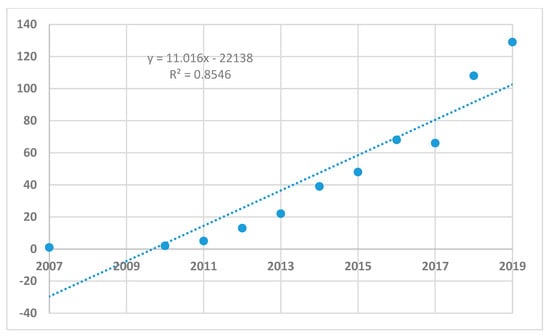
Figure 1.
Growth in scientific production.
Figure 1 shows a weak linear growth from 2007 to 2011; however, 2012 shows a strong growth tripling the number of papers as compared to the previous year and reaching its maximum scientific output in 2019 with a total of 129 papers. It is worth highlighting that 91.4% of the papers were published in the last five years.
Figure 2 shows the number of citations per year in the literature on Family Firms and Socioemotional Wealth. As opposed to the published papers, the trend in the number of quotes is heterogeneous. The majority of the citations took place in 2012 (1953 quotes), while the last two years show a significant decrease, with the yearly citations averaging 1008.
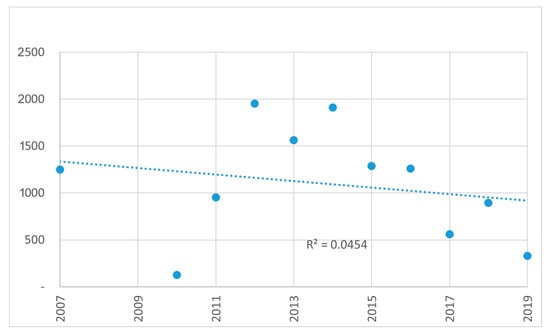
Figure 2.
Total number of citations per year.
Table 1 provides the citation rate of the papers considering that the total number of citations reaches 12,090. The first detail that stands out is that 47 papers have never been cited, that is, 9.38% of the total. Furthermore, 399 papers have less than 50 citations in the WoS (which corresponds to 79.64% of the published studies). Additionally, 35 papers have more than 50 but less than 100 citations (6.99%), 14 papers have more than 100 but less than 200 citations (2.79%) and, finally, 6 papers have more than 200 citations each, representing 1.2% of the published studies.

Table 1.
General citation structure.
With regard to the Hirsch impact index or h-Index [58], 54 papers had over 54 citations, making them the publications with the highest impact in the entire sample under study. Amongst them, it is worth mentioning the one by Gómez-Mejía et al. [2], published in Administrative Science Quarterly (Q1) of SAGE Publications Inc. which accounts for 10.3% of the total number of citations on the subject (1249 citations) (see Table 2). This paper challenges the prevalent notion that family-owned firms are more risk averse than publicly owned firms. Using behavioral theory, the authors argue that for family firms, the primary reference point is the loss of their socioemotional wealth, and to avoid those losses, family firms are willing to accept a significant risk to their performance; yet, at the same time, they avoid risky business decisions that might aggravate that risk. The second most cited paper is by Pascual Berrone (644, 5.3% of the total), published in 2012 in the journal Family Business Review (Q1) of SAGE Publications Inc (see Table 2). This paper makes the case for the socioemotional wealth (SEW) approach as the potential dominant paradigm in the family firm field. Berrone et al. [33] state that socioemotional wealth is the most important differentiator of the family firm as a unique entity and, as such, helps explain its distinctive behavior.
Table 2.
Most cited papers within scientific production/output.
As we can see, the concern for socioemotional wealth is recent, the first paper dates back to 2007. Moreover, this first paper is the one that has received the highest number of citations. On the other hand, it is an emerging field of research, which has grown dramatically, as socioemotional wealth has received a great deal of attention from researchers in the field of family business. On the other hand, there is a widespread network of collaboration between authors, which is reflected in the co-authorship of most of the papers analyzed. The minimum number of authors per published paper is 2 in the 20 most cited articles. Within the 20 most cited papers, there are no single-authored papers.
3.2. Main Authors
Within the 501 selected papers on the topic of Family Firms and Socioemotional Wealth, as many as 918 authors have researched this subject, either as sole authors or as co-authors. Table 3 shows a high concentration, as 10 authors provide almost half of the total citations (45.3%). According to the information detailed in Table 3, Luis Gómez-Mejía can be considered as the reference researcher. This professor at the Arizona State University has published 10 papers related to search vectors that have been cited 2754 times, which corresponds to 22.8% of the total number of citations. Furthermore, four of his papers are among the 54 most influential ones, according to the h-index search vector. The second most influential author is James Chrisman, of the Mississippi State University, who has published 16 papers that have resulted in 1527 citations. It is also worth mentioning that eight of his papers are ranked within the 54 most influential ones of all time, twice as many as any other author. A breakdown of the other eight most influential authors of all time on the subject of Family Firms and Socioemotional Wealth can be found in Table 3. It should be noted that the most influential authors are from developed countries such as the United States, Spain and Italy. It coincides that in these countries, the family business is of great importance and has managed to create collaboration networks with the main universities in these countries. In the case of the United States through the Family Firms Foundation and, in the case of Spain, through the Institute of Family Business.
Table 3.
Most influential authors on Family Firms and Socioemotional Wealth.
The number of papers written and published is a metric to determine the contribution of each author to the formation of knowledge based on search vectors. The influence of these authors is not always recognized. However, they are important for their contribution to the development of this field in different scenarios and approaches. For this reason, Table 4 mentions the authors who have published more than 10 papers related to the terms Family Firms and Socioemotional Wealth. The table summarizes the number of published papers, the number of citations received, the average of citations for each paper, the percentage of the total amount of papers published on the subject, the author’s h-index, the total number of publications registered on the WoS platform and the total amount of citations of the author calculated on his/her publications in the WoS as of July 2020.
Table 4.
Most productive authors.
Table 4 shows the 10 authors who have published 10 or more papers related to the subject of this work. It also reveals that five of these 10 authors are among the most influential in terms of the number of citations. This might be due to the fact that, although this is a subject that, in the last decade, has become more and more popular as a research topic, there are still very few authors who include it in their research agenda. It is noteworthy that Gómez-Mejía drops to seventh place in terms of the number of articles published (7 in total), while he is in first place in terms of most-cited authors, with four of his articles among the 54 most influential of all time. De Massis is ranked as the most productive author, but he is the sixth most influential author. In any case, there is a strong relationship between the most influential and the most productive authors, as these authors are found in both lists.
The following step was a co-authorship analysis. For this purpose, the analysis was restricted to those authors who had published at least three articles, which reduces the number of authors to 109. The Figure 3 below shows a graphical representation of the co-authorship. We note that collaboration between authors from different countries and institutions is widespread in this field.
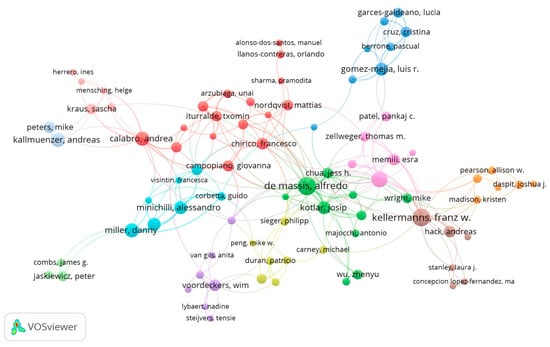
Figure 3.
Graph on joint co-authorship for scientific production.
The papers were loaded on the VOSviewer software to group the authors into clusters (see Table 5) and 12 different clusters were obtained in total. These can be viewed in Table 5, as well as in Table 3, highlighted with a specific color. To be able to understand and interpret them better, it is worth mentioning that the higher the co-authorship, the larger the circumference that represents them. As an example, cluster 1 identified in red, consists of 16 authors, with the circumference corresponding to Calabro being the largest, thus showing that this author is the most prolific one in terms of co-authorship participation within this cluster. In addition, many authors of Spanish and Italian origin stand out in this cluster.
Table 5.
Clusters on co-authorship for scientific production.
As additional information, Figure 4 graphically displays the citations among the 109 previously selected authors. The graph depicted in Figure 4 shows a higher number of citations according to the size of the circumference assigned to each author. In this context, authors such as De Massis (light blue), Miller (yellow), Cruz (green), Kellermanss (purple), among others, stand out.
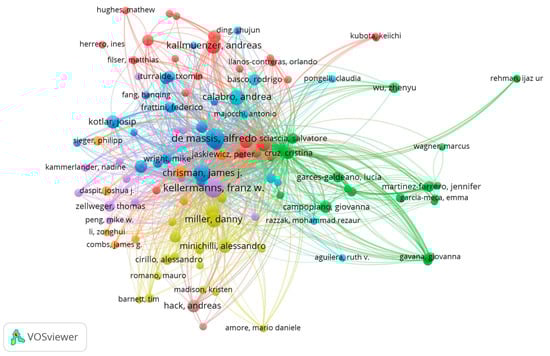
Figure 4.
Graph of joint bibliography for the most cited scientific publications.
What stands out in this section is that the most influential author (Gómez-Mejía) is not the most productive (De Massis). Moreover, the published papers are usually signed by several authors, with the cluster around Calabrò being the one with the largest number of co-authors.
3.3. Main Journals
With reference to the main publication sources, it can be observed that the 501 articles under study were published in 153 journals indexed in the WoS. The degree of concentration could be described as medium, as 10 journals have published 226 papers which means 45.1% of the publications on the subject, with an average of 24.85 citations per paper, a total of 5615 citations and an h-index of 41. A breakdown of the 10 journals that have published at least 10 papers is shown in Table 6.
Table 6.
Web of Science journals that generate scientific publications.
The Journal of Family Business Strategy published by Elsevier (the Netherlands) has the largest number of papers (62); nevertheless, the most influential one is Family Business Strategy published by SAGE Publications Inc. (United States), whose papers are cited the most, with 1665 citations from a total of 12,090. However, the highest average number of citations can be found in the Strategic Management Journal, published by Wiley. Finally, Entrepreneurship Theory and Practice has the highest h-index (20) and the highest impact factor of the last five years (11,035).
In the journals analyzed, the works published are peer-reviewed, which indicates their scientific quality, and they have a high impact factor. These are journals that have become a reference for studies on socioemotional wealth. Moreover, the first four are considered key journals in the field of family business.
3.4. WoS Categories
The analysis by WoS categories shows that the 501 papers analyzed have been published in journals belonging to 28 different categories, either exclusively or in several of them. These 28 categories have an h-index of 54, with a total of 12,111 citations and 24.42 citations per paper that have been referenced 3738 times by other papers. As Table 7 shows, the largest contribution is generated in the Business category which accounts for 64.1% of the total number of publications. This category also has the highest h-index (49), as well as the highest number of citations (10,423), the highest number of references by other papers (3319) and the highest average number of citations, with 32.47 citations per paper. This information is detailed in Table 7 for the 10 WoS categories most relevant to the subject of this research.
Table 7.
Web of Science categories associated with scientific production.
As we can see, the three WoS categories that generate the greatest contribution to the analysis of socioemotional wealth are confined to the field of business (business, management and business finance). This result can be explained by the fact that socioemotional wealth is considered to be a distinctive feature of family businesses, and therefore an internal characteristic of the company.
3.5. Institutions
In relation to the main affiliated organizations, the results obtained indicate a high institutional concentration. The 501 identified authors are affiliated with 553 organizations and 13 of them contribute at least 16 papers related to the subject matter analyzed. The breakdown of these institutions is summarized in Table 8, which is ordered by their influence on the subject according to the number of papers, their h-index, the average number of citations, the total number of citations based on the search vectors and the number of papers citing them.
Table 8.
Web of Science categories associated with scientific production.
The information in this table shows that the 13 institutions that have published more than 15 papers related to the search concepts account for 29.94% of the total number of papers published. Furthermore, in total, the h-index is 43, with a citation average of 38.49 and the total citations adding up to 5774 based on the search vectors used. Another peculiarity is that papers involving more than one institution are cited in over 2237 papers.
Seemingly, the two most productive institutions are the Mississippi State University in the United States (32 papers and an h-index of 18) and the University of North Carolina, also in the USA, with 32 papers and an h-index of 15. However, the most influential institution is possibly the one in third place, the University of Alberta in Canada, as it has the highest impact factor (20), the highest number of citations on the subject (2336), the highest average number of citations (75.35) and the highest number of papers citing it (1.311).
Table 9 shows a bibliometric analysis of the citations related to these institutions, with eight clusters that take into account a minimum of four documents per organization. Following this criterion, the eight clusters include 72 institutions out of a total of 556 institutions that have been cited at least once. In addition, the graph in Figure 4 shows the connections between the different institutions included in the eight clusters.
Table 9.
Inter-institutional citation graph.
Figure 5 graph shows eight clusters in different colors. The first cluster includes 18 institutions and is shown in red, with Concordia University as the main player (15 papers with 710 citations). The second cluster incorporates 16 institutions shown in green. The leading institution in this cluster is HEC Montréal (18 papers and 707 citations). Cluster 3 is in blue and comprises 12 institutions, the leader being the Mississippi State University of Science and Technology (32 papers and 1837 citations).
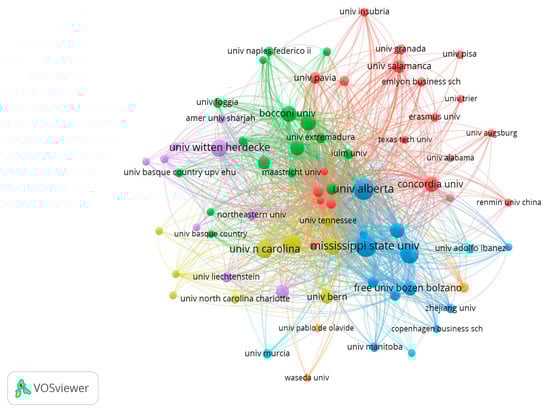
Figure 5.
Graph of most cited institutions.
The most relevant aspect of this section is that research in the field of socioemotional wealth is carried out by universities in different countries which, in addition, maintain connections between authors from these universities.
3.6. Countries
The country-by-country analysis reveals a high geographical concentration. A total of 51 countries have produced at least one paper on this topic, however, 83.8% of the papers are concentrated in only 10 countries. Table 10 lists the 10 countries that have developed and published more than 28 articles related to Family Firms and Socioemotional Wealth. These 10 countries have a combined h-index of 52, with an average of 27.41 citations per paper, a total of 11,512 citations and 3619 papers citing this set of countries.
Table 10.
Countries/regions associated with scientific productions according to the authors’ affiliation
The data shown in Table 10 reveal that the United States is the most productive and influential country, having generated a total of 149 papers. Moreover, it has the highest number of citations (7158), the highest h-index (37) and 2664 papers with citations. Canada should also be highlighted with its 64 papers, making it the geographical area with the highest average number of citations per paper, 50.27.
The graph in Figure 6 displays the co-authorships between countries, showing that 41 of the 56 countries have at least two co-authored papers, grouped in 10 different clusters (see Table 11 and Figure 6).
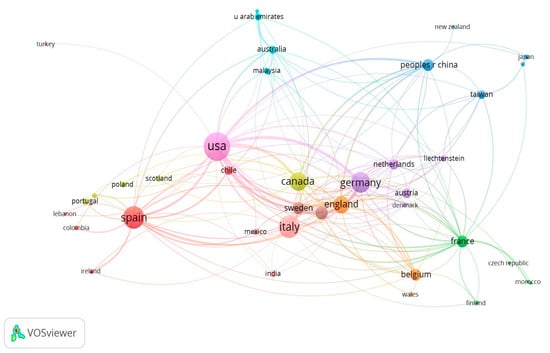
Figure 6.
Co-authorship between countries.
Table 11.
Cross-country co-authorship clusters.
It so occurs that the countries with the highest scientific production coincide with the countries where business is most important, such as the United States, Italy and Spain.
3.7. Bibliometric Analysis of Keywords
The bibliometric keyword analysis shows that, out of the 922 keywords plus (KWP) included in the articles published in the Web of Science, 153 occur more than five times and are used concurrently (see Figure 7). This generates up to nine clusters, broken down as detailed in the Appendix A in Table A1.
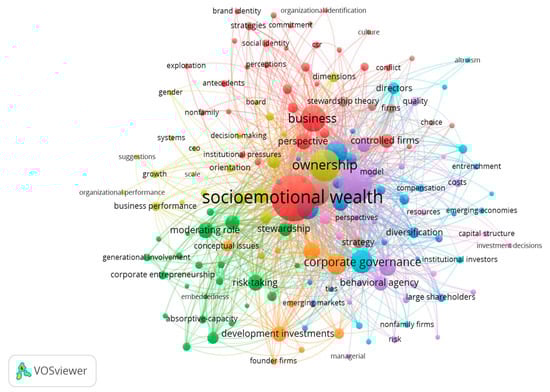
Figure 7.
Bibliometric map of the research on Family Firms and Socioemotional Wealth.
From the different analyses, it can be concluded that the term socioemotional wealth is the most used term, with 427 occurrences corresponding to cluster 1, followed by performance with 234 occurrences corresponding to cluster 5 (in green) and in the third position, the keyword ownership with 200 occurrences corresponding to cluster 4 (in blue). These three terms are interconnected with most of the other keywords. To conclude this analysis, Table 12 shows the 10 keywords with the highest level of occurrence.
Table 12.
Co-occurrence clusters in the use of keywords plus.
4. Discussion and Conclusions
This paper performed a bibliometric and scientometric analysis focusing on socioemotional wealth in family firms. This type of analysis does not seek to explain the causality of scientific production with other variables but provides a basis for studying the development and evolution of academic literature in a given scientific area, in our case family firms and socioemotional wealth. To the best of our knowledge, this is the first scientometric study that focuses on socioemotional richness. As we pointed out in the introduction, the aim of this study was to analyze the most relevant aspects of the scientific literature on socioemotional richness. To this end, we posed several research questions that were adequately answered. The most relevant academics in the field of socioemotional wealth, the countries and institutions in which they carry out their research, the research networks in which they participate, the scientific journals that generate the most knowledge in which they publish their work and the research topics linked to socioemotional wealth were all studied. In this sense, with this type of analysis, it is possible to establish future lines of research derived from the scientific impact and the relationships that can be established between different aspects linked to the behavior of family businesses.
The first conclusion that can be drawn is the extraordinary scientific production in journals indexed in the WoS that focuses on socioemotional wealth, especially since the work of Gómez-Mejía et al. [2] undoubtedly the starting point of an incredibly fruitful new line of research. This is a very recent field of research, which has experienced exponential growth in the number of contributions in recent years. As such, the papers on socioemotional wealth analyzed in this research have been quoted more than 12,000 times. The Gómez-Mejía et al. paper [2] entitled “Socioemotional Wealth and Business Risks in Family-Controlled Firms: Evidence from Spanish Olive Oil Mills” and published in Administrative Science Quarterly has received over 1249 citations, and the work of Berrone et al. [33] entitled “Socioemotional Wealth in Family Firms: Theoretical Dimensions, Assessment Approaches, and Agenda for Future Research”, published in Family Business Review received over 650 citations. All in all, it is can be stated that the growth of scientific production in the family firm area is due, to some extent, to the appearance of the concept of socioemotional wealth. We, therefore, agree with Brigham and Payne [34] and Swab et al. [35] when they state that the onset of socioemotional wealth on the agenda of many researchers has led to progress in the analysis of family firms’ behavior. As can be observed, the researchers’ preoccupation focuses more on the analysis of internal aspects than on other factors external to this type of business [36]. In conclusion, research on family firms is focusing more on the elements that define the essence of a family business than on external factors, which can also affect other types of businesses, whether or not they are family firms.
Another relevant finding is the high concentration of authors, whether working alone or with others. Also, 10 out of 918 authors have written 45.3% of all publications. With four of his papers among the most cited publications, Gómez-Mejía, a professor at the Arizona State University, is the most cited author. Also, the most influential authors are those who have also generated the greatest amount of knowledge, as they are the authors who have published the largest number of papers (10 or more).
The co-authorship analysis reveals 109 authors who have participated in three or more papers, with Calabró leading the cluster with the highest number of co-authorships. As for the citations among authors, the three most relevant ones are De Massis, Miller and Cruz.
As for the journals, it can be established that 10 journals account for 45.1% of the publications on the subject of this research, with an average of 24.8% per paper and an h-index of 41. The journal with the highest number of publications is Family Business Strategy by Elsevier with 62 papers, even though the most influential journal for the number of citations is Family Business Review by SAGE Publications. Furthermore, the Strategic Management Journal by Wiley has the highest citation average and Entrepreneurship Theory and Practice the highest h-index, that is, 20, and the highest impact index, 10,035 in the last five years.
Another noteworthy finding is that the two WoS categories with the highest number of citations are Business and Management, with an h-index of 49 and 38, respectively. These areas are aimed at analyzing the internal characteristics and behavior of the company.
With regard to the institutions, it is worth noting that the majority of the authors analyzed are affiliated with institutions, with Mississippi State University and the University of North Carolina—both in the United States—standing out as the most productive in terms of the number of papers published and citations received. A high geographical concentration can also be observed, with the United States, Italy and Spain being the countries with the highest number of authors and co-authorships. This ranking should also include Canada as the country with the highest number of citations per published paper (50.27).
Finally, of the 922 keywords plus of the papers published in the WoS, 153 words appear more than five times, where the most repeated terms with the highest number of interconnections are socioemotional wealth, performance and ownership.
This work has limitations that can provide future lines of research. The first limitation stems from one of the main characteristics of scientometric analysis: its sensitivity to the type of databases used. This research has focused on the WoS database, so papers of limited impact were not considered, even if they represent interesting contributions. The second limitation is a direct consequence of the application of scientometric analysis: it must be used as a complement to a complete and in-depth analysis of different works. Future lines of research could be papers that combine scientometric analysis with literature review. The third limitation stems from the conceptualization of family firms and socioemotional wealth: neither the heterogeneity in the definition of family firms nor the evolution of the concept of socioemotional wealth were taken into account.
It is also possible to extend the analysis by considering other types of papers included in databases other than the WoS.
Author Contributions
All of the authors contributed to conceptualization, formal analysis, investigation, methodology and writing and editing the original draft. All authors have read and agreed to the published version of the manuscript.
Funding
This research received no external funding.
Institutional Review Board Statement
Informed consent was obtained from the respondents of the survey.
Informed Consent Statement
Not applicable.
Data Availability Statement
The data will be made available on request from the corresponding author.
Conflicts of Interest
The authors declare no conflict of interest.
Appendix A
Table A1.
Co-occurrence clusters in the use of keywords plus.
Table A1.
Co-occurrence clusters in the use of keywords plus.
| Cluster 1 33 items (red) | Antecedents—brand identify—business—commitment—conflict—consequences—controlled firms—corporate social-responsibility—csr—culture—engagement—entrepreneurs—exploration—familiness—heterogeneity—identify—image—institutional pressures—integration—justice—nonfamily—organization—organizational identification—organisations—perceptions—perspective—reputation—responsibility—satisfaction—social identity—socioemotional wealth—strategies—work. |
| Cluster 2 23 items (green) | Absorptive-capacity—business research—competitive advantage—corporate entrepreneurs—dynamic capabilities—embeddedness—empirical-examination—entrepreneurial orientation—family firms—future—generational involvement—knowledge—mediating role—moderating role—resource-based view—risk-taking Smes—stewardship—strategic management—top management team—tops management teams—unified systems perspective—value creation. |
| Cluster 3 22 items (blue) | Agency—behaviour—board composition—companies—compensation—corporate-ownership—decisions—determinants—diversification—emerging markets—entrenchment—executive-compensations—financial performance—governance—incentives—institutional ownership—internationalization—investor protection—large shareholders—legitimacy—responses –ties. |
| Cluster 4 20 items (yellow) | Board—business performance—businesses—ceo—cost—decision-making—dimensions—entrepreneurship—gender—growth—human-resource management—innovation—involvement—organizational performance—orientation—ownership—productivity—scale—suggestions—systems—validation. |
| Cluster 5 18 items (purple) | Behavioural agency—corporate diversification—costs—impact—information—initial public offerings—loss aversion—managerial - market—mergers—model—ownership structure—performance—perspectives—prospect-theory—quality—risk—valuation. |
| Cluster 6 11 items (light blue) | Altruism - Business groups - Corporate governance—Directors - Earnings management—emerging economies—family-controlled firms—future-research—institutional investors—long-term orientation—non-family firms. |
| Cluster 7 10 items (orange) | Agency costs—conceptual issues—development investment—empirical-evidence—firm performance—founder firms—professional management—research-and-development—technological-innovation—upper echelons. |
| Cluster 8 8 items (coffee) | Choice—firms—industry—management - social-responsibility—stewardship theory—strategy—sustainability. |
| Cluster 9 7 items (pink) | Capabilities—capital structure—empirical-analysis—intentions—investment decisions—resources—succession. |
Source: Data from Web of Science (2020).
References
- Gedajlovic, E.; Carney, M.; Chrisman, J.J.; Kellermanns, F.W. The adolescence of family firm research: Taking stock and planning for the future. J. Manag. 2012, 38, 1010–1037. [Google Scholar] [CrossRef]
- Gómez-Mejía, L.R.; Haynes, K.T.; Nunez-Nickel, M.; Jacobson, K.J.; Moyano-Fuentes, J. Socioemotional wealth and business risks in family-controlled firms: Evidence from Spanish olive oil mills. Adm. Sci. Q. 2007, 52, 106–137. [Google Scholar] [CrossRef]
- Masulis, R.W.; Pham, P.K.; Zein, J. Family business groups around the world: Financing advantages, control motivations, and organizational choices. Rev. Financ. Stud. 2011, 24, 3556–3600. [Google Scholar] [CrossRef]
- Family Firm Institute. Global Data Points. 2017. Available online: http://www.ffi.org/page/globaldatapoints (accessed on 3 January 2021).
- Tharawat Magazine. The Economic Impact of Family Business. Tharawat Magazine. Available online: https://www.tharawat-magazine.com/magazine/issue-22-economic-impact-family-business/ (accessed on 1 May 2014).
- Bettinelli, C. Boards of directors in family firms: An exploratory study of structure and group process. Fam. Bus. Rev. 2011, 24, 151–169. [Google Scholar] [CrossRef]
- Matthews, C.H.; Hechavarria, D.; Schenkel, M.T. Family business: A global perspective from the Panel Study of Entrepreneurial Dynamics and the Global Entrepreneurship Monitor. In Understanding Family Businesses; Carsrud, A.L., Br€annback, M., Eds.; Springer: New York, NY, USA, 2012; pp. 9–26. [Google Scholar]
- Credit Suisse. Instituto de Investigación. La familia CS 1000 en 2018; Credit Suisse Grupo A6: Zúrich, Switzerland, 2018. [Google Scholar]
- PwC. Global Family Business Survey. The Values Effect. How to Build a Lasting Competitive Advantage through Your Values and Purpose in a Digital Age. 2018. Available online: www.pwc.com/fambizsurvey2018 (accessed on 5 January 2021).
- Rogoff, E.G.; Heck RK, Z. Evolving research in entrepreneurship and family business: Recognizing family as the oxygen that feeds the fire of entrepreneurship. J. Bus. Ventur. 2003, 18, 559–566. [Google Scholar] [CrossRef]
- Chrisman, J.J.; Steier, L.P.; Chua, J.H. Toward a theoretical basis for understanding the dynamics of strategic performance in family firms. Entrep. Theory Pract. 2008, 32, 935–947. [Google Scholar] [CrossRef]
- Debicki, B.J.; Matherne, C.F., III; Kellermanns, F.W.; Chrisman, J.J. Family business research in the new millennium: An overview of the who, the where, the what, and the why. Fam. Bus. Rev. 2009, 22, 151–166. [Google Scholar] [CrossRef]
- Velasco CA, B.; Parra VF, G.; García, C.Q. Evolución de la literatura sobre empresa familiar como disciplina científica. Cuadernos de Economía y Dirección de la Empresa 2011, 14, 78–90. [Google Scholar] [CrossRef]
- Sharma, P.; Carney, M. Value Creation and Performance in Private Family Firms: Measurement and Methodological Issues. Fam. Bus. Rev. 2012, 25, 233–242. [Google Scholar] [CrossRef]
- Tàpies, J. Empresa familiar: Un enfoque multidisciplinar. Univ. Bus. Rev. 2011, 32, 12–25. [Google Scholar]
- Wernerfelt, B. The resource-based view of the firm: Ten years after. Strateg. Manag. J. 1995, 16, 171–174. [Google Scholar] [CrossRef]
- Hoopes, D.G.; Madsen, T.L.; Walker, G. Guest editors’ introduction to the special issue: Why is there a resource-based view? Toward a theory of competitive heterogeneity. Strateg. Manag. J. 2003, 24, 889–902. [Google Scholar] [CrossRef]
- Pearson, A.W.; Carr, J.C.; Shaw, J.C. Toward a theory of familiness: A social capital perspective. Entrep. Theory Pract. 2008, 32, 949–969. [Google Scholar] [CrossRef]
- Carney, M. Corporate governance and competitive advantage in family–controlled firms. Entrep. Theory Pract. 2005, 29, 249–265. [Google Scholar] [CrossRef]
- Miller, D.; Le Breton-Miller, I. Family governance and firm performance: Agency, stewardship, and capabilities. Fam. Bus. Rev. 2006, 19, 73–87. [Google Scholar] [CrossRef]
- Teece, D.J.; Pisano, G.; Shuen, A. Dynamic capabilities and strategic management. Strateg. Manag. J. 1997, 18, 509–533. [Google Scholar] [CrossRef]
- Teece, D.J. Explicating dynamic capabilities: The nature and microfoundations of (sustainable) enterprise performance. Strateg. Manag. J. 2007, 28, 1319–1350. [Google Scholar] [CrossRef]
- Habbershon, T.G.; Williams, M.; MacMillan, I.C. A unified systems perspective of family firm performance. J. Bus. Ventur. 2003, 18, 451–465. [Google Scholar] [CrossRef]
- Chrisman, J.J.; Chua, J.H.; Sharma, P. Trends and directions in the development of a strategic management theory of the family firm. Entrep. Theory Pract. 2005, 29, 555–576. [Google Scholar] [CrossRef]
- Schulze, W.S.; Lubatkin, M.H.; Dino, R.N. Toward a theory of agency and altruism in family firms. J. Bus. Ventur. 2003, 18, 473–490. [Google Scholar] [CrossRef]
- Gómez-Mejía, L.R.; Nunez-Nickel, M.; Gutierrez, I. The role of family ties in agency contracts. Acad. Manag. J. 2001, 44, 81–95. [Google Scholar] [CrossRef]
- Basu, N.; Dimitrova, L.; Paeglis, I. Family control and dilution in mergers. J. Bank. Financ. 2009, 33, 829–841. [Google Scholar] [CrossRef]
- Zahra, S.A.; Hayton, J.C.; Salvato, C. Entrepreneurship in family vs. non-family firms: A resource-based analysis of the effect of organizational culture. Entrep. Theory Pract. 2004, 28, 363–381. [Google Scholar] [CrossRef]
- Miller, D.; Le Breton-Miller, I. Deconstructing socioemotional wealth. Entrep. Theory Pract. 2014, 38, 713–720. [Google Scholar] [CrossRef]
- Arregle, J.L.; Hitt, M.A.; Sirmon, D.G.; Very, P. The development of organizational social capital: Attributes of family firms. J. Manag. Stud. 2007, 44, 73–95. [Google Scholar] [CrossRef]
- Gedajlovic, E.; Carney, M. Markets, hierarchies, and families: Toward a transaction cost theory of the family firm. Entrep. Theory Pract. 2010, 34, 1145–1172. [Google Scholar] [CrossRef]
- Holt, D.T.; Pearson, A.W.; Payne, G.T.; Sharma, P. Family Business Research as a Boundary-Spanning Platform. Fam. Bus. Rev. 2018, 31, 14–31. [Google Scholar] [CrossRef]
- Berrone, P.; Cruz, C.; Gómez-Mejía, L.R. Socioemotional wealth in family firms: Theoretical dimensions, assessment approaches, and agenda for future research. Fam. Bus. Rev. 2012, 25, 258–279. [Google Scholar] [CrossRef]
- Brigham, K.H.; Payne, G.T. Socioemotional Wealth (SEW): Questions on Construct Validity. Fam. Bus. Rev. 2019, 32, 326–329. [Google Scholar] [CrossRef]
- Swab, R.G.; Sherlock, C.; Markin, E.; Dibrell, C. “SEW” What Do We Know and Where Do We Go? A Review of Socioemotional Wealth and a Way Forward. Fam. Bus. Rev. 2020, 33, 424–445. [Google Scholar] [CrossRef]
- Hernández-Perlines, F.; Covin, J.G.; Ribeiro-Soriano, D.E. Entrepreneurial orientation, concern for socioemotional wealth preservation, and family firm performance. J. Bus. Res. 2021, 126, 197–208. [Google Scholar] [CrossRef]
- Barros, I.; Hernangómez, J.; Martin-Cruz, N. Familiness and socioemotional wealth in Spanish family firms: An empirical examination. Eur. J. Fam. Bus. 2017, 7, 14–24. [Google Scholar] [CrossRef]
- Alonso-Dos-Santos, M.; Llanos-Contreras, O. Family business performance in a post-disaster scenario: The influence of socioemotional wealth importance and entrepreneurial orientation. J. Bus. Res. 2019, 101, 492–498. [Google Scholar] [CrossRef]
- Malhotra, N.K. Investigación De Mercados: Un Enfoque Aplicado; Pearson educación: London, UK, 2004. [Google Scholar]
- Meneghini, R.; Packer, A. The extent of multidisciplinary authorship of articles on scientometrics and bibliometrics in Brazil. Interciencia 2010, 35, 510–514. [Google Scholar]
- Vega, A.; Salinas, C.M. Scientific production analysis in public affairs of Chile and Peru. Challenges for a better public management. Lex 2017, 15, 463–478. [Google Scholar]
- Granda-Orive, J.; Alonso, A.; García, F.; Solano, S.; Jiménez, C.; Aleixandre, R. Ciertas ventajas de Scopus sobre Web of Science en un análisis bibliométrico sobre tabaquismo. Revista Española de Documentación Científica 2013, 36, 1–9. [Google Scholar] [CrossRef]
- Osareh, F. Bibliometrics, Citation Analysis and Co-Citation Analysis: A Review of Literature I. Libri 1996, 46, 149–158. [Google Scholar] [CrossRef]
- Velt, H.; Torkkeli, L.; Laine, I. Entrepreneurial Ecosystem Research: Bibliometric Mapping of the Domain. J. Bus. Ecosyst. 2020, 1, 1–31. [Google Scholar] [CrossRef]
- Zupic, I.; Čater, T. Bibliometric Methods in Management and Organization. Organ. Res. Methods 2015, 18, 429–472. [Google Scholar] [CrossRef]
- Hernández-Perlines, F.; Moreno-García, J.; Yáñez-Araque, B. The influence of socioemotional wealth in the entrepreneurial orientation of family businesses. Int. Entrep. Manag. J. 2019, 152, 523–544. [Google Scholar] [CrossRef]
- Dobrov, G.M.; Randolph, R.H.; Rauch, W.D. New options for team research via international computer networks. Scientometrics 1979, 1, 387–404. [Google Scholar] [CrossRef]
- Vega-Muñoz, A.; Arjona-Fuentes, J.M.; Ariza-Montes, A.; Han, H.; Law, R. In search of ‘a research front’ in cruise tourism studies. Int. J. Hosp. Manag. 2020, 85, 102353. [Google Scholar] [CrossRef]
- Vicencio-Ríos, G.; Araya-Castillo, L.; Millán-Toledo, C.; Flores, Y.R. Desarrollo de la investigación en personalidad de marca. Rev. Venez. de Gerenc. 2020, 25, 1583–1599. [Google Scholar]
- Merigó, J.M.; Mas-Tur, A.; Roig-Tierno, N.; Ribeiro-Soriano, D. A bibliometric overview of the Journal of Business Research between 1973 and 2014. J. Bus. Res. 2015, 68, 2645–2653. [Google Scholar] [CrossRef]
- Jiménez-Bucarey, C.G.; Araya-Castillo, L.; Rojas-Vallejos, J. Calidad de servicio como área de investigación en educación superior. Interciencia 2020, 45, 329–337. [Google Scholar]
- Vega-Muñoz, A.; Arjona-Fuentes, J.M. Social networks and graph theory in the search for distant knowledge in the field of industrial engineering. Cap. 17. In Handbook of Research on Advanced Applications of Graph Theory in Modern Society; Pal, M., Samanta, S., Pal, A., Eds.; IGI-Global: Hershey, PA, USA, 2020; pp. 397–418. [Google Scholar]
- Serrano, L.; Sianes, A.; Ariza-Montes, A. Using bibliometric methods to shed light on the concept of sustainable tourism. Sustainability 2019, 11, 6964. [Google Scholar] [CrossRef]
- ERIC. Thesaurus, Institute for Education Sciences. 2019. Available online: https://eric.ed.gov/ (accessed on 8 January 2021).
- Van Eck, N.J.; Waltman, L. Software survey: VOSviewer, a computer program for bibliometric mapping. Scientometrics 2010, 84, 523–538. [Google Scholar] [CrossRef]
- Diodato, V.; Gellaty, P. Dictionary of Bibliometrics; Routledge: Oxfordshire, UK, 2013. [Google Scholar]
- Vanti, N. Métodos cuantitativos de evaluación de la ciencia: Bibliometría, cienciometría e informetría. Investig. Bibliotecol. Arch. Bibliotecol. Inf. 2000, 14. [Google Scholar] [CrossRef][Green Version]
- Frenken, K.; Hardeman, S.; Hoekman, J. Spatial scientometrics: Towards a cumulative research program. J. Informetr. 2009, 3, 222–232. [Google Scholar] [CrossRef]
- Denyer, D.; Tranfield, D. Producing a systematic review. In The Sage Handbook of Organizational Research Methods; Buchanan, D., Bryman, A., Eds.; SAGE Publications Ltd.: Thousand Oaks, CA, USA, 2009; pp. 671–689. [Google Scholar]
- Wang, C.L.; Chugh, H. Entrepreneurial learning: Past research and future challenges. Int. J. Manag. Rev. 2014, 16, 24–61. [Google Scholar] [CrossRef]
- Hernández-Perlines, F.; Rung-Hoch, N. Sustainable entrepreneurial orientation in family firms. Sustainability 2017, 9, 1212. [Google Scholar] [CrossRef]
- Dada, O.L. A Model of Entrepreneurial Autonomy in Franchised Outlets: A Systematic Review of the Empirical Evidence. Int. J. Manag. Rev. 2018, 20, 206–226. [Google Scholar] [CrossRef]
- Kauppi, K.; Salmi, A.; You, W. Sourcing from Africa: A Systematic Review and a Research Agenda. Int. J. Manag. Rev. 2018, 20, 627–650. [Google Scholar] [CrossRef]
- Keupp, M.M.; Palmié, M.; Gassmann, O. The Strategic Management of Innovation: A Systematic Review and Paths for Future Research. Int. J. Manag. Rev. 2012, 14, 367–390. [Google Scholar] [CrossRef]
- Hernández-Perlines, F.; Ariza-Montes, A.; Araya-Castillo, L. Socioemotional wealth, entrepreneurial orientation and international performance of family firms. Econ. Res.-Ekon. Istraž. 2020, 331, 3125–3145. [Google Scholar] [CrossRef]
- Klavans, R.; Boyack, K.W. Which Type of Citation Analysis Generates the Most Accurate Taxonomy of Scientific and Technical Knowledge? J. Assoc. Inf. Sci. Technol. 2017, 684, 984–998. [Google Scholar] [CrossRef]
Publisher’s Note: MDPI stays neutral with regard to jurisdictional claims in published maps and institutional affiliations. |
© 2021 by the authors. Licensee MDPI, Basel, Switzerland. This article is an open access article distributed under the terms and conditions of the Creative Commons Attribution (CC BY) license (http://creativecommons.org/licenses/by/4.0/).