Abstract
The purpose of this study was to propose an extension model that integrated a technology acceptance model (TAM) with dockless bike-sharing (DLBS) features in order to investigate acceptable behavior when using DLBS. In total, 412 participants from China participated in the study. We used a structural equation model to test our research hypotheses. The research results showed that the extended TAM model provided a more comprehensive understanding of the behavior associated with this context. We observed that perceived usefulness, perceived ease of use, subjective norms, and facilitating conditions played an important role in the intention to use DLBS. Moreover, DLBS features played an important role in perceived usefulness and perceived ease of use. The use intention also had an important effect on use behavior. Surprisingly, the three traits of perceived usefulness did not affect perceived usefulness. As such, this study explored, from a consumer’s perspective, why sharing products are accepted. This study offers significant contributions to the relevant literature of the sharing economy. The research results offer enlightening findings for enterprises, as they encourage consumers to adopt the DLBS.
1. Introduction
The Internet has opened up a new era in sharing [1], wherein a large number of sharing economic models have been created. A series of books, articles, and web discussions on the topic have also emerged [1]. The sharing economy has experienced unprecedented growth in the global economy, especially in China [2]. Among the sharing economy models, the dockless bike-sharing (DLBS) system has grown rapidly and become popular in major Chinese cities. The DLBS is considered to be an online travel innovation that has recently been carried out in a network-enhanced traffic commuting environment. The escalating technology promotes an acceptance of the DLBS system based on mobile smart devices. Compared with traditional bicycles, DLBS shows prominent differences and represents the latest stage in evolving world’s economic forms and resource allocation.
First, due to different levels of technological development and different management purposes, there are two distinct stages in the development of DLBS: sharing bicycles with piles (piled sharing bicycle) and bicycles without piles (DLBS). In the literature, piled DLBS operated by the government has often been discussed. Data shows that the DLBS at the city level has gradually decreased over the past few years [3]. For a long time, scholars have explored various ways to solve DLBS challenges. By rationally arranging the location of DLBS stations [4], we can setup the best path for balanced DLBS transportation vehicles [5] and match vehicles that have the ability to transport stacked bicycles [6].
DLBS operates on a large-scale and is open to self-organization. Without the limitation of stations, DLBS is more easily used to fill the last kilometer of consumer public transportation. Several urban metropolitan areas have established a public bicycle-sharing system as a viable transportation alternative that could supplement existing long-distance passenger cars and subway transportation systems [7]. On the one hand, DLBS provides consumers with a fast and convenient transportation experience. On the other hand, DLBS reduces traffic congestion in urban areas and provides possibilities for biking from different locations [7], which attracts more users than conventional bicycles. At the same time, along with consumers’ growing awareness of health, environmental awareness, and the pursuit of distinctive consumer attitudes, DLBS are more attractive [8].
However, the reason why DLBS is widely accepted is rarely discussed, which is the focus of this study. The technology acceptance model (TAM) and expanded TAM are used to explain the acceptance of new technologies and new systems. In previous studies of extended TAM, there have been few secondary constructions abstracted from perceived usefulness and perceived ease of use to explore new technologies. Moreover, there have been few studies that have examined sharing products from a consumer’s perspective. Based on these research gaps, this paper aimed to establish a comprehensive conceptual framework that explored the acceptance of non-pile DLBS from a consumer’s perspective, introducing economic value, environmental value, traffic value, health value, social label value, and perceived ease of use as antecedents to consumers’ acceptance. Further, we provided empirical evidence in an enterprise marketing environment. Therefore, we proposed a research framework that integrated TAM, DLBS traits, subjective norms, and facilitating conditions.
The rest of this article is organized as follows. First, we reviewed the literature on the sharing economy, DLBS, and TAM. Then, we developed the conceptual model and clarified our research hypotheses. Next, we outlined the study design and statistical results. Finally, we discussed the conclusions and related management implications, as well as the limitations and future research directions.
2. Theoretical Background
2.1. Sharing Economy
As Belk [9] pointed out, sharing is a fundamental consumer behavior as old as humankind [1]. It is impossible to understand consumer behavior without first understanding the consumer’s understanding of property [10]. The current sharing economy, originally developed in applied economics, is an emerging economic form [11], which refers to the participation of one or more people in the consumption of economic goods or services [12]. Scholars have benefited from the explanation of the relationship between people and things [13], conducting much research on this universal phenomenon. Scholars have defined the sharing economy of the present era by proposing what the difference is between ownership and access [14]. Mair and Reischauer [15] have also focused the definition on the organizational level, regarding the organization as the provider of infrastructure and helping evaluate the form and diversity of these organizations.
The sharing economy affects human life in various ways. People share possessions and resources with other family members, and when they participate in various Internet bulletin board systems (BBS), they share things with a virtual community of strangers [16]. Therefore, in this study, we consider why the sharing economy is likely to result in a long-term shift in consumer behavior. Further, we consider how this change affects a company’s business model [17]. Thus, sharing can foster community, save resources, and create certain synergies [18].
Ravenelle [19] indicated that the sharing economy claims to bring entrepreneurial romance to the public. The sharing economy and the diversity of the sharing economy companies have contributed to the growth of entrepreneurs. Recently, many platform companies that provide the “sharing economy” have emerged. Scholars have offered a theoretical overview and comparative analysis of the main sharing platforms [20]. Among them, the peer-to-peer platform is based on the most popular form of the sharing economy. With the help of peer-to-peer technology, employees can share residences, resources, time, and skills to obtain revenue, such as Airbnb. Parguel, Lunardo [21] explored the trend of consumers tending to second-hand peer-to-peer (P2P) platforms. Further, Priporas, Stylos [22] explained customers’ perceptions of the quality of Airbnb accommodation services. For another form of the sharing economy, the collaborative consumption (CC) business model, as an embodiment of the bilateral market of the sharing economy, can better understand its positive and negative effects on key stakeholders [23].
In addition, from a practical perspective, Habibi, Davidson [24] evidenced that sharing applications is one of the ways to encourage consumers to adopt the sharing economy. At the same time, Harvey, Smith [25] stressed how digital technology can regulate consumer behavior in online systems, thereby promoting offline gifting and sharing. For example, in car travel, Zoepf and Keith [26] indicated how car sharing users perceive prices, distance from them, timetables, and vehicle types. Similarly, based on the social cognition theory, scholars have elaborated on the important factors that influence the adoption of carpooling applications [27]. Therefore, we posited that the sharing economy could lead to long-term changes in consumer behavior and how this change could affect business models [17].
2.2. Sharing-Bicycle
As a means of transportation, bicycles play an important role in people’s daily life. People choose to use bicycles for different purposes. In 1965, the world’s first public sharing bicycle system with no deposit, no rent, and no fixed points appeared in the Netherlands. In the following decades, DLBS systems emerged in many countries to solve complex and changeable traffic conditions, many of which enriched the diversity of people’s travel. Some large cities have used public bicycle-sharing systems as an alternative option to complement existing public transportation and subway systems [7].
As Frade and Ribeiro [28] suggested, among the challenges faced by DLBS, one of the main challenges is the location of DLBS, i.e., the non-optimal positioning of bicycle-sharing has affected its success. In other words, the bicycle-sharing system needs to respond to fluctuations in bicycle demand and vacant piles at each station, which directly affects the level of service provided to users [29]. Facing this challenge, Erdogan, Battarra [4] put forward an accurate algorithm to calculate test problems and results, and studied the problem of static bicycle repositioning [30]. They also discussed the problem of static bicycle relocation and the demand range. Studies have shown that carpooling alone (or better yet, bicycle-sharing) or supporting and using public transportation can significantly improve practical difficulties [18]. Similarly, the optimization method for designing a bicycle-sharing system proposes to maximize the coverage and minimize the total cost subject to the available budget [28]. Dell’Amico, Hadjicostantinou [6] discussed the bicycle-sharing rebalancing (BRP) as a more capable car that could redistribute bicycles. Under static conditions, the problem of rebalancing the vehicle path has been studied, and several lower and upper bounds have been proposed in the form of an algorithm [5]. In addition, a dynamic bicycle relocation method that considers inventory level prediction, user arrival prediction, bicycle relocation, and unified vehicle path has been proposed [7]. Discussing the problem of bicycle relocation, scholars have proposed a hybrid large-scale neighborhood search method to solve this problem [31].
The DLBS of Chinese brands has entered more than 200 cities in over 20 countries. In China, DLBS has changed the way people travel [32], and the first and last mile connections to public transportation (such as subway and light rail stations) can be improved. The DLBS system completes the itinerary chain by connecting subway stations and attractions to enhance the sustainability of urban transportation [33]. The development of DLBS in China is divided into the pre-sharing era and the post-sharing era. Scholars have used the conditional Logit model to explore the important factors that influence consumers to choose DLBS brands [34]. The present study explored the key factors that impact the sustainable development of the DLBS from the network’s perspective [35], using the random forest method to explore the frequency of each factor’s use of DLBS in different regions impact. We found that the residential area, park green area, and population size were the three most influential factors [36]. Based on the data of the DLBS in Beijing and New York, we found that the DLBS did not balance characteristics, and that the imbalance index of the DLBS mobile network nodes was different in different time periods [37].
2.3. TAM
Ever since the TAM model was proposed by Davis [38], scholars have done a great deal of research on various emerging technologies and information technologies based on TAM and extended TAM [39,40,41]. For example, Mohammadi [42] carried research in personal learning, wherein the authors studied the integrated model of TAM and DeLone and McLean’s model (D&M) to explore quality characteristics, perceived ease of use, perceived user impact on user intent and satisfaction, and the mediating effect of usability on e-learning. Moreover, scholars have used the TAM to measure the acceptability of the educational technology product [43]. Meanwhile, scholars have integrated new variables such as user interface, personal innovation, and satisfaction into Davis’s TAM and tests learners’ willingness to adopt mobile learning [44]. As for the digital library, scholars proposed a new model in order to enhance the user’s positive use attitude, customer satisfaction is the key to improving the service level of the digital library [45].
Secondly, Kim and Woo [46] used TAM to explain people’s accepting new technical aspects of daily life: in terms of diet, based on TAM scholars use QR codes to determine the moderating effect of food participation on the relationship between perceived information and perceived usefulness. In terms of travel, authors use TAM to study the influencing factors of driver acceptance an Advanced Driver Assistance System [47]. In terms of communication technology, scholars examine the determinants of the user’s intent to use short message service [48].
3. Conceptual Model and Hypotheses Development
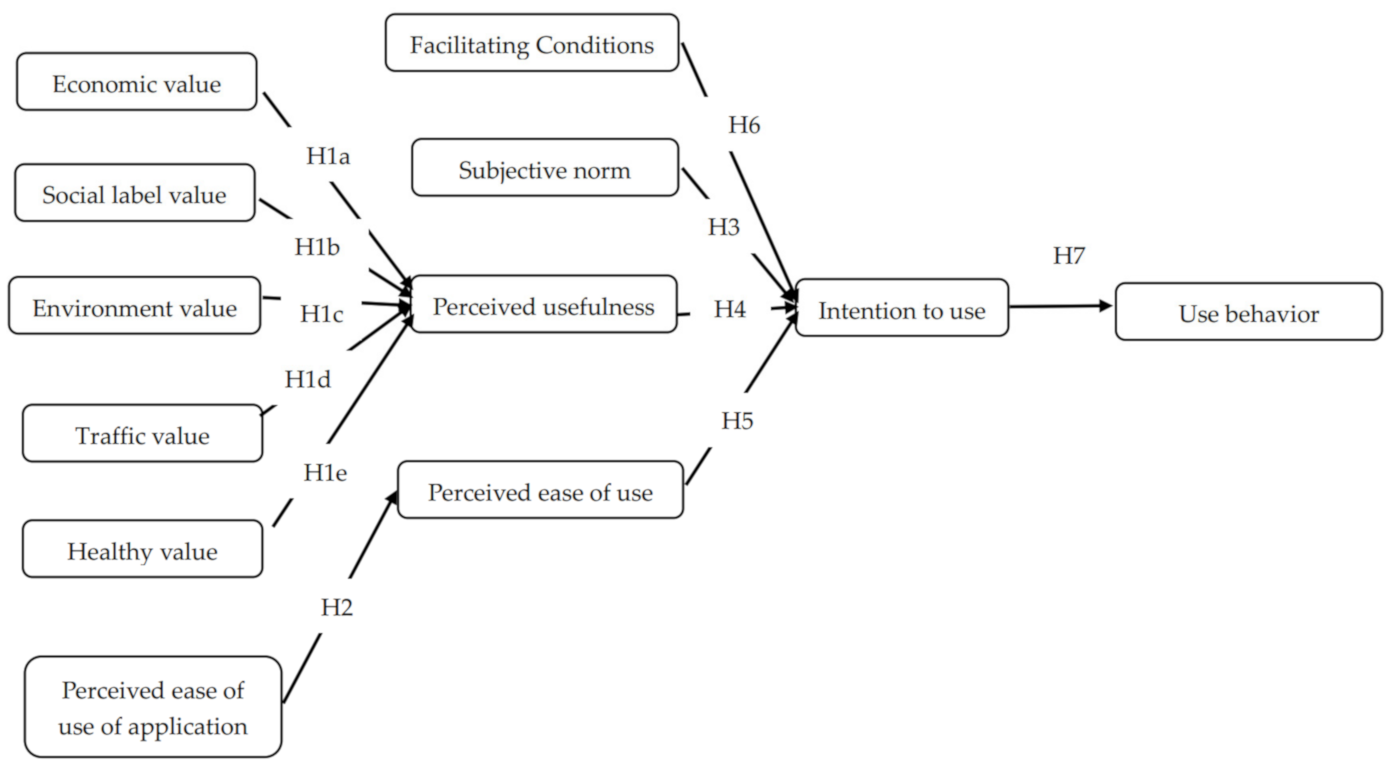
Using the theoretical background of the TAM, TAM2, and DLBS features, we proposed an extended research model that integrated several sub-constructs that were attributed as predictors of DLBS’s use behavior. The relationships between these constructs are integrated in the theoretical model shown in Figure 1.
Figure 1.
Proposed research model.
The basic assumption was that DLBS’s use behavior is determined by intention to use, which is determined by subjective norm, perceived useful, and perceived ease of use. Initially, the latter two constructs were functions of DLBS features. First, taking into account the uniqueness of DLBS and combining with the existing literature, we developed constructs of DLBS features as economic value, social label value, environment value traffic value, healthy value, and perceived ease of use of application. Lastly, we added subjective norm into the fundamental TAM, as the simplified TAM2.
3.1. Values
A particular system improves one’s job performance [38]. In this research, the perceived usefulness was described as the extent to which a person considered that DLBS could be a driving force towards achieving traveling goals. As such, perceived usefulness consists five sub-constructs, as stated below.
3.1.1. Economic Value (EV)
The important difference between consumer usage contexts and organizational use contexts is that consumers usually have to consider the monetary cost of this use, and employees do not need to [49]. Meanwhile, although market price theory demonstrates that there is no absolute high price or low price, consumers have subjective assessments of prices [48]. When people make a purchasing decision, they usually compare their costs and benefits with some alternative goods [48]. Indeed, price factors may have an important impact on the choice of travel options for ordinary consumers. When the benefits of perceived use of technology outweigh the cost of money, the price value is positive and the price value has a positive effect on the intention [49]. For example, at the last distance between your residence and the bus station or metro station, it takes less than one yuan to use a bicycle, and taxis cost more than 10 yuan. Thus, we added economic value as a predictor of perceived usefulness to use with DLBS, and we proposed the following research hypothesis.
Hypothesis 1 (H1a).
Economic value has a positive effect on perceived usefulness of DLBS.
3.1.2. Social Label Value (SLV)
The social label value is a self-assessment in a particular social environment. According to the existing literature, attractiveness, originality, and subcultural appeal are important components [8]. Individuals tend to decorate themselves with social tags to show the impression they want to show to people in certain situations. For instance, people like to buy wearables, and tend to buy branded goods and equipment. Thus, we added social label value as a predictor of perceived usefulness to use a DLBS, and we proposed the following research hypothesis:
Hypothesis 1 (H1b).
Social label value has a positive effect on perceived usefulness of DLBS.
3.1.3. Environmental Value (EnV), Traffic Value(TV), and Healthy Value(HV)
According to scholars’ research, Shangyu Chen proposed the definition of the environmental value of DLBS. This is a set of attributes related to perceived usefulness, which can create positive word-of-mouth and increase reuse intentions [41]. Environment value is considered to be the degree to which individuals believe that using DLBS improves the environmental performance in certain parts of their lives in an organizational context, and includes efficiency, value, and productivity to address the value of self-care, transportation improvement, and green use [41,50]. Similarly, we believe that the traffic value is the extent to which individual use of DLBS improves the traffic performance of their lives; we believe that the healthy value is the extent to which individual use of DLBS improves the healthy performance of their lives. Thus, we added environmental value, traffic value, and healthy value as predictors of perceived usefulness to use a DLBS. Then, we proposed the following research hypotheses:
Hypothesis 1 (H1c).
Environmental value has a positive effect on perceived usefulness of DLBS.
Hypothesis 1 (H1d).
Traffic value has a positive effect on perceived usefulness of DLBS.
Hypothesis 1 (H1e).
Healthy value has a positive effect on perceived usefulness of DLBS.
3.2. Perceived Ease of Use of Application (PEoUA)
In this paper, perceived ease of use of application was defined as the extent to which a person believes that using DLBS is free of effort. Given the specific usage environment for DLBS based on smartphones, the internet, and software-provided platforms, consumers not only feel the hardware experience but also experience services with the help of software. Hence, we proposed the following research hypothesis:
Hypothesis 2 (H2).
Perceived ease of use of application has a positive effect on Perceived ease of use.
3.3. Perceived Usefulness (PU)
Furthermore, perceived usefulness is a construct that has been repeatedly revealed to affect attitudes and is a direct determinant of continued e-learning usage intentions [42] and continued Massive Open Online Courses (MOOCs) usage intentions [51]. Similarly, in addition, perceived usefulness regulates the impact of perceived ease of use on behavioral intentions, and this relationship has been supported by many empirical studies [51]. Thus, we proposed the following research hypothesis:
Hypothesis 3 (H3).
Perceived usefulness has a positive effect on intention to use.
3.4. Perceived Ease of Use (PEoU)
Perceived ease of use is the degree of ease associated with consumers’ use of technology [38,49]. Hence, we proposed the following research hypothesis:
Hypothesis 4 (H4).
Perceived ease of use has a positive effect on intention to use.
3.5. Subjective Norm
Subjective norms refer to the person’s perception that most people who are important think that he should or should not perform the behavior in question [52]. In other words, individuals may adopt specific technologies not because of their own personal persuasion but because of the opinions of others [53]. Subjective norms can influence PEoU and PU in technology acceptance [54]. Moreover, recent research suggests that subjective norms affect PEOU and PU of e-book adoption [40]. In this context, subjective norms mean the degree to which consumers recognize that important people (such as family and friends) think they should use a DLBS [49]. Thus, we cited subjective norms and proposed the following research hypothesis:
Hypothesis 5 (H5).
Subjective norm has a positive effect on intention to use.
3.6. Facilitating Conditions (FC)
Facilitating conditions are defined as the degree to which an individual believes that the organization and technical infrastructure exists to support the use of the system. This definition includes three different concepts: perceived behavior control; promotion condition and compatibility [49]. The main factors that influence the adoption of e-learning systems by college students have increased the adoption of e-learning in developed countries, but not in developing countries [55]. The results collected from SEM in the research on the factors affecting restaurant search and/or reservation (MARSR) by users using mobile applications show that convenience conditions are significantly related to usage behavior [56]. Therefore, we proposed the following research hypothesis:
Hypothesis 6 (H6).
Facilitating conditions has a positive effect on intention to use.
3.7. Intention to Use (IU)
The relationship between intention to use and use behavior in the TAM suggests that intention serves as an evaluative predisposition to behavior. We believe that the intention to use DLBS is the degree to which a person’s emotional use of a DLBS system is positive or not. Innovation diffusion theory and TAM provides a suitable model to explain the intention of consumer participation; this intention in turn has a positive effect [57]. Therefore, we propose the following research hypothesis:
Hypothesis 7 (H7).
Intention to use has a positive effect on use behavior (UB).
4. Methods
4.1. Data Collection
To test these research hypotheses, we conducted a questionnaire survey in a face-to-head and Internet-based manner in Wuhan. Wuhan is the largest city in central China, with a large number of young people who are often influenced and changed their lives by science and technology.
We issued questionnaires at schools, train stations, shopping centers, and most respondents were required to finish the questionnaires on-site. Moroever, we sent online surveys by www.wjx.cn. We collected data from July to September in 2017; considering the feasibility, convenience, and economic efficiency of this research among people with different backgrounds, 412 valid surveys were collected, representing a response rate of 87.3%. All respondents lived in Chinese cities where DLBS are widely spread.
Our questionnaire was designed and administered to respondents by trained interviewers. Considering the characteristics of the bicycle-sharing system, the research model consisted of 12 constructs, as shown in the note. Since 2015, entrepreneurs opened up a new business model, non-pile DLBS, which influences human life. Table 1 summarizes the demographics of the respondents. We used the seven-point Likert scale to measure each questionnaire that corresponded to the constructs, anchored on “1 = strongly disagree” and “7 = strongly agree”.
Table 1.
Demographics characteristics of the respondents.
The profile is shown in the Table 1. The sample covers respondents of different gender, age, and experience. Respondents and non-respondents did not have significant differences in demographic characteristics (gender, age, experience, etc.), so non-response bias was not a possible threat to our hypothetical analysis.
4.2. Measurement Scales
In order to make the research structure operational, the scale development process was guided by existing scaling literature [58]. By reviewing the previous literature, we selected the project most suitable for the operation of the construct, used the data from the navigation study for exploratory factor analysis, and used the 412 final survey data for confirmatory factor analysis. All of the purification measures were seven-point Likert scales anchored by “strongly disagree” and “strongly agree.” The source and description of all measures are explained below.
Perceived usefulness was measured with a scale developed by Venkatesh, Thong [49], which captured the subjective assessment of whether a person’s use of a particular system improved his or her work or life performance. The scale consisted of 4 items.
Economic value was measured with a scale developed by Venkatesh, Thong [49], defined as consumers’ cognitive tradeoff between the perceived benefits of the applications and the monetary cost for using them [59]. The scale consisted of 3 items.
Social label value is measured with a scale developed by Kim and Shin [8], defined as consumer perception of the expected social benefits of the application. The scale consisted of 4 items.
Environment value was measured with a scale developed by Chen [41], which captured the degree to which individuals believe that using DLBS improved the environmental performance in certain parts of their lives in an organizational context. The scale consisted of 5 items.
According to these scales, we proposed two new constructs, i.e., traffic value captured the degree to which individuals believe that using DLBS improved the traffic performance in certain parts of their lives. The scale consisted of 5 items.
Healthy value captured the degree to which individuals believe that using DLBS improved their physical exercise performance in certain parts of their lives. The scale consisted of 3 items.
The perceived ease of use scale was developed by Venkatesh, Thong [49], and it captured the subjective assessment of the ease with which consumers used technology. The scale consisted of 3 items.
According to this study special scenario, we proposed perceived ease of use of application, which captured the subjective assessment of the ease with consumers used the DLBS application. The scale consisted of 5 items.
The subjective norm was measured with a scale developed by Venkatesh, Thong [49] and Chen [41], which covered the extent to which consumers recognized that important people (such as family and friends) believed they should use a particular technology. The scale consisted of 5 items.
Use behavior was measured with a scale developed by Venkatesh, Thong [49] [60], which captured the consumer’s ultimate choice of use behavior. The scale consisted of 3 items.
Intention to use was measured with a scale developed by Venkatesh, Thong [49] and Chang, Fu [61]. The scale consisted of 4 items.
5. Results
5.1. Scale Reliabilities, Validities, and Common Method Bias
We assessed the structural reliability and effectiveness of all measures through a confirmatory factor analysis (CFA). Table 2 shows the mean, standard deviation, correlation, and reliability estimates of all six constructs such as Cronbach’s alpha, composite reliability (CR), average variances extracted (AVE), and discriminant validity assessment. Table 3 reports the results of the CFA, including the loading and fitting index of all measurements.
Table 2.
Descriptive analysis, correlations, reliabilities, and discriminant validities of measurements.
Table 3.
Measurement scale items and confirmatory factor analysis (CFA) results.
We used the confirmatory factor analysis (CFA) to assess the reliability and validity of all constructs. As shown in Table 2, the mean, standard deviation, correlation, and reliability estimates for all 11 constructs are listed, such as Cronbach’s alpha, compound reliability (CR), average variance extraction (AVE), and discriminant effect. At the same time, Table 3 reports the results of the CFA for this study, including the loading and fitting index of all measurements.
Firstly, the Cronbach alpha coefficients (ranging from 0.833 to 0.941) and composite reliability (ranging from 0.840 to 0.951) for all structures listed in Table 2 indicate that each exceeds the accepted reliability threshold in statistics (0.70). In addition, the average absolute value (AVE) of all extractions listed in Table 2 is greater than the cut-off value of 0.50 (range 0.636 to 0.866), indicating that all measures show sufficient reliability.
Secondly, as shown in the Table 3, the models produced via CFA were in good agreement with NNFI, CFI, IFI, and RFI, all exceeding 0.90, and at the same time, RMSEA did not exceed 0.100. The result was as follows: (X2/df = 2.19, NNFI = 0.98, CFI = 0.98, IFI = 0.98, RFI = 0.98, GFI = 0.83, RMSEA = 0.053). In addition, as shown in Table 3, all project loads were significant at the 1% level from 0.71 to 0.90, indicating that the convergence effectiveness of all measures was acceptable.
Thirdly, likewise, all the diagonal elements of the square root of the AVE listed in Table 3 were larger than any other corresponding row or column entry value, which means that each construction was sufficiently different from other constructions. Therefore, the determination of the establishment of all measurements had validity.
5.2. Research Hypothesis Test
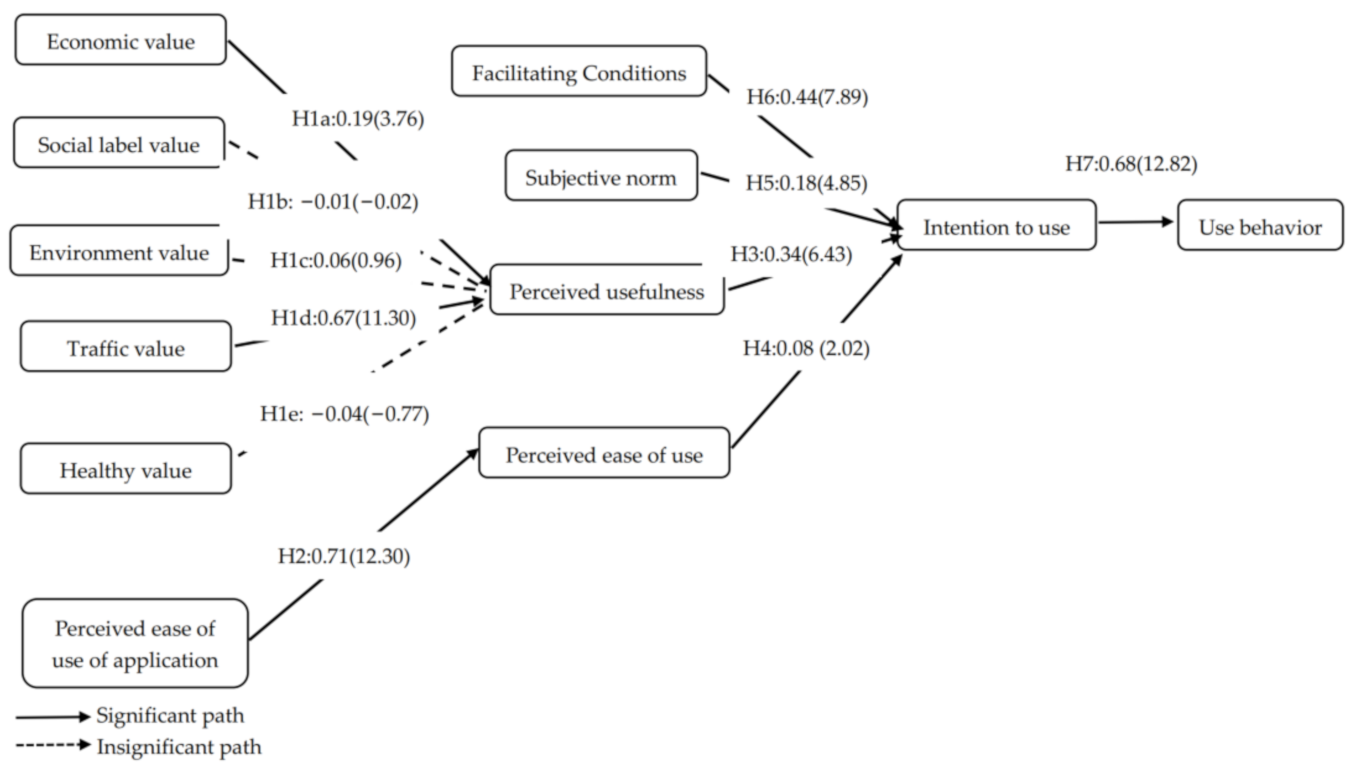
In this article, the software LISREL 8.7 was used to apply the structural equation modeling (SEM) technique needed to test the effectiveness of our proposed conceptual model and research hypothesis. The result is shown in Figure 2.
Figure 2.
Structural model and parameter estimates.
The model was effective in exploring the acceptance of DLBS based on smartphone platforms.
Firstly, the fitting model of this study had acceptable goodness of fit (X2/df = 2.36, NNFI = 0.97, CFI = 0.98, IFI = 0.98, RFI = 0.96, GFI = 0.81, RMSEA = 0.057). Secondly, the study calculated the advantages and significance of the individual pathways to provide results for hypothesis testing. Figure 2 reports normalized path coefficients and t values (in brackets). In statistics, the value of t is the ratio between the estimated value and the standard error. A critical value with a t value greater than 1.96 means statistically significant at the 0.05 level. In H1, the five values were expected to have a positive effect on perceived usefulness. The results supported 0.05 levels of H1a (β = 0.19, t = 3.76) and H1d (β = 0.67, t = 11.30), while H1b was not supported (β = −0.01, t = −0.02), and H1c as not supported (β = 0.06, t = 0.96) and was not supported (β = −0.04, t = −0.77), indicating that economic value and traffic value were significantly positive, while social label value, environmental value and healthy value had no direct impact on perceived usefulness. In H2, the perceived ease of use of application was expected to have a positive effect on perceived ease of use. Results supported the 0.05 level of H2 (β = 0.71, t = 12.30), indicating that perceived ease of use of application was significantly positive. Finally, the path coefficients from subjective norm to intention to use (β = 0.18, t = 4.85), from facilitating conditions to intention to use (β = 0.44, t = 7.89), from perceived usefulness to intention to use (β = 0.34, t = 6.43), from perceived ease of use to intention to use (β = 0.08, t = 2.02), and from intention to use to use behavior (β = 0.68, t = 12.82) were significant at the 0.05 level. Thus, H3, H4, H5, H6, and H7 were supported. In general, all assumptions (except H1b, H1c and H1e) were fully supported on an exponential basis. In this context, perceived usefulness, perceived ease of use, subjective norms, and facilitating conditions promoted customer use behaviors positively through the use of intentions. Perceived usefulness and perceived ease of use had two secondary constructs, respectively, that positively affected the ultimate use behavior.
6. Conclusions
6.1. Research Results
In the new platform and sharing economy context, from a consumer’s perspective, we explored why this business model was accepted by users. As such, this article enriches the widely accepted literature on the emergence of new technologies and products. We developed new scales based on the original research. The paper expands the secondary structures based on the original TAM and examines how values and the ease of use of the application affected perceived usefulness, perceived ease of use, and use intention that influences consumer behavior. At the same time, we explored how subjective norms and facilitating conditions influenced the intention to use and affected consumer behavior. We found that perceived usefulness, perceived ease of use, subjective norms, and facilitating conditions influenced consumer behavior via intention to use. Among the values, economic value and traffic value had a positive impact on perceived usefulness. Moreover, perceived ease of use of application had a positive impact on perceived ease of use.
What surprised us in the results was that the social label value, environmental value, and health value did not have a positive effect on perceived usefulness. In other words, consumers were aware of the usefulness of DLBS in two ways: economic value and traffic value. Firstly, the date of questionnaire distribution in this paper was dated after DLBS systems were put into the market. Therefore, according to previous studies, DLBS were no longer as attractive, cool, and unique as they were when they were first introduced into the market [60]. The assumption of social label value was not established. Secondly, DLBS did not exceed the original environmental value and health value of bicycles. Therefore, when consumers no longer worried about bicycle safety, remote access problems, and maintenance issues, their choices became obvious. Thus, the assumption of the three values was not established.
Perceived ease of use of the application had significant effects in promoting the consumers’ perceived ease of use of the new technology products, and, in turn, enhanced consumers’ intention to use. On the one hand, in the era of products based on smartphones, whether the software products are easy to use actually affects consumer experiences. On the other hand, as a traditional means of transport, whether the bicycle itself is identifiable and whether the riding is effortless also affects a consumer’s experience. In addition, subjective norms and facilitating conditions also have a significant impact on a consumer’s intention to use.
6.2. Managerial Implications
The study provided practical implications for emerging Internet-based B2C companies on how to enhance consumers’ intentions of using DLBS systems by improving the perceived ease of use, perceived usefulness, facilitating conditions, and subjective norms.
First, the evidence provided by this research showed that economic value and transportation value were the main aspects that consumers used to identify DLBS. From the perspective of the research process, consumers are price-sensitive and concerned about the traffic value provided by DLBS. Therefore, companies need to carry out a large number of price promotions in the early stage of attracting consumers and arrange bicycles in places with high traffic demand. Secondly, companies need to continuously optimize applications in order to better serve a wider user base. Thirdly, research shows that subjective norms can also affect consumer intentions. In this regard, this requires companies to increase the publicity and advocacy of social values at the level of subjective cognition. This measure is similar to word-of-mouth communication and will profoundly affect consumers’ green health and environmental protection concepts. Fourth, companies need to continuously improve the facilitating conditions, such as increasing the compatibility of shared bicycles. In addition, relevant government agencies other than enterprises should improve DLBS supervision to provide convenience for enterprises and consumers. In general, as a supplement to people’s travel, DLBS needs to be combined with medium- and long-distance travel in order to seamlessly connect. For example, to provide consumers with a comprehensive and smooth travel experience, they should combine with the traditional automobile industry to adopt new measures. Enterprises should expand the scope of sharing and improve the quality of sharing.
This measure will also contribute to the safety, smoothness, and energy savings with regard to urban traffic.
6.3. Limitations and Future Research Directions
This study has some theoretical and methodological limitations that could provide meaningful directions and suggestions for future research.
Firstly, our study did not start rapidly enough and thus did not anticipate the impact of the sharing economy and DLBS on consumers. According to Jeong et al. (Jeong et al., 2016), novelty and technical appearances of products are very attractive to consumers. As such, we should have carried out the investigation in the future. Secondly, besides the perspective of consumers, we could also have discussed the adoption of DLBS from the perspective of city managers, major traffic participants, traditional bicycle suppliers, dealers, and even other competitors. Thirdly, companies and consumers need to actively participate in the creation of co-creative values. How consumers, businesses, and their employees interact should also be incorporated into the conceptual model of future work. In future research, we could explore the factors that influence the creation of co-creative value by enterprises and consumers in the sharing economy. In addition, due to the excessively strong functionality of bicycle products, how to macroscopically explore the sharing economy instead of a single business model requires a breakthrough in future research.
Author Contributions
Conceptualization, J.L. and J.Z.; methodology, J.L. and J.Z.; writing, J.L.; supervision, J.Z. All authors have read and agreed to the published version of the manuscript.
Funding
This research was supported by the National Natural Science Foundation of China under Grant No. 71672068 and 72072064.
Institutional Review Board Statement
Not applicable.
Informed Consent Statement
Not applicable.
Data Availability Statement
Not applicable.
Conflicts of Interest
The authors declare no conflict of interest.
References
- Belk, R. You are what you can access: Sharing and collaborative consumption online. J. Bus. Res. 2014, 67, 1595–1600. [Google Scholar] [CrossRef]
- Chan, L.; Chan, R.K.; Wang, M.; Yang, Z.J.S. Mapping the Sharing Economy in China. Sustainability 2020, 12, 6333. [Google Scholar]
- Li, Z.B.; Wang, W.; Yang, C.; Ding, H.Y. Bicycle mode share in China: A city-level analysis of long term trends. Transportation 2017, 44, 773–788. [Google Scholar] [CrossRef]
- Erdogan, G.; Battarra, M.; Calvo, R.W. An exact algorithm for the static rebalancing problem arising in bicycle sharing systems. Eur. J. Oper. Res. 2015, 245, 667–679. [Google Scholar] [CrossRef]
- Kadri, A.A.; Kacem, I.; Labadi, K. A branch-and-bound algorithm for solving the static rebalancing problem in bicycle-sharing systems. Comput. Ind. Eng. 2016, 95, 41–52. [Google Scholar] [CrossRef]
- Dell’Amico, M.; Hadjicostantinou, E.; Iori, M.; Novellani, S. The bike sharing rebalancing problem: Mathematical formulations and benchmark instances. Omega-Int. J. Manag. Sci. 2014, 45, 7–19. [Google Scholar] [CrossRef]
- Cao, X.Z.; Zhang, J.W.; Ye, C.Q. The Development of China’s Bike-Sharing Business Model—A Case Study About OFO; St Plum-Blossom Press Pty Ltd.: Hawthorn East, Australia, 2017. [Google Scholar]
- Kim, K.J.; Shin, D.H. An acceptance model for smart watches Implications for the adoption of future wearable technology. Internet Res. 2015, 25, 527–541. [Google Scholar] [CrossRef]
- Belk, R. Sharing. J. Consum. Res. 2010, 36, 715–734. [Google Scholar] [CrossRef]
- Belk, R. Possessions and the extended self. J. Consum. Res. 1988, 15, 139–168. [Google Scholar] [CrossRef]
- Liu, X.; Chen, H.J.S. Sharing Economy: Promote Its Potential to Sustainability by Regulation. Sustainability 2020, 12, 919. [Google Scholar] [CrossRef]
- Felson, M.; Spaeth, J.L. Community structure and collaborative consumption: A routine activity approach. Am. Behav. Sci. 1978, 21, 614–624. [Google Scholar] [CrossRef]
- Snare, F.J.A. The concept of property. Am. Philos. Q. 1972, 9, 200–206. [Google Scholar]
- Bardhi, F.; Eckhardt, G.M. Access-Based Consumption: The Case of Car Sharing. J. Consum. Res. 2012, 39, 881–898. [Google Scholar] [CrossRef]
- Mair, J.; Reischauer, G. Capturing the dynamics of the sharing economy: Institutional research on the plural forms and practices of sharing economy organizations. Technol. Forecast. Soc. Chang. 2017, 125, 11–20. [Google Scholar] [CrossRef]
- Llamas, R.; Belk, R. Shangri-La: Messing with a Myth. J. Macromark. 2011, 31, 257–275. [Google Scholar] [CrossRef]
- Kathan, W.; Matzler, K.; Veider, V. The sharing economy: Your business model’s friend or foe? Bus. Horiz. 2016, 59, 663–672. [Google Scholar] [CrossRef]
- Belk, R. Why not share rather than own? Ann. Am. Acad. Political Soc. Sci. 2007, 611, 126–140. [Google Scholar] [CrossRef]
- Ravenelle, A.J. Sharing economy workers: Selling, not sharing. Camb. J. Reg. Econ. Soc. 2017, 10, 281–295. [Google Scholar] [CrossRef]
- Celata, F.; Hendrickson, C.Y.; Sanna, V.S. The sharing economy as community marketplace? Trust, reciprocity and belonging in peer-to-peer accommodation platforms. Camb. J. Reg. Econ. Soc. 2017, 10, 349–363. [Google Scholar] [CrossRef]
- Parguel, B.; Lunardo, R.; Benoit-Moreau, F. Sustainability of the sharing economy in question: When second-hand peer-to-peer platforms stimulate indulgent consumption. Technol. Forecast. Soc. Chang. 2017, 125, 48–57. [Google Scholar] [CrossRef]
- Priporas, C.V.; Stylos, N.; Rahimi, R.; Vedanthachari, L.N. Unraveling the diverse nature of service quality in a sharing economy A social exchange theory perspective of Airbnb accommodation. Int. J. Contemp. Hosp. Manag. 2017, 29, 2279–2301. [Google Scholar] [CrossRef]
- Dreyer, B.; Ludeke-Freund, F.; Hamann, R.; Faccer, K. Upsides and downsides of the sharing economy: Collaborative consumption business models’ stakeholder value impacts and their relationship to context. Technol. Forecast. Soc. Chang. 2017, 125, 87–104. [Google Scholar] [CrossRef]
- Habibi, M.R.; Davidson, A.; Laroche, M. What managers should know about the sharing economy. Bus. Horiz. 2017, 60, 113–121. [Google Scholar] [CrossRef]
- Harvey, J.; Smith, A.; Golightly, D. Giving and sharing in the computer-mediated economy. J. Consum. Behav. 2017, 16, 363–371. [Google Scholar] [CrossRef]
- Zoepf, S.M.; Keith, D.R. User decision-making and technology choices in the US carsharing market. Transp. Policy 2016, 51, 150–157. [Google Scholar] [CrossRef]
- Zhu, G.; So, K.K.F.; Hudson, S. Inside the sharing economy Understanding consumer motivations behind the adoption of mobile applications. Int. J. Contemp. Hosp. Manag. 2017, 29, 2218–2239. [Google Scholar] [CrossRef]
- Frade, I.; Ribeiro, A. Bike-sharing stations: A maximal covering location approach. Transp. Res. Part A Policy Pract. 2015, 82, 216–227. [Google Scholar] [CrossRef]
- Forma, I.A.; Raviv, T.; Tzur, M. A 3-step math heuristic for the static repositioning problem in bike-sharing systems. Transp. Res. Part B Methodol. 2015, 71, 230–247. [Google Scholar] [CrossRef]
- Ho, S.C.; Szeto, W.Y. Solving a static repositioning problem in bike-sharing systems using iterated tabu search. Transp. Res. Part E Logist. Transp. Rev. 2014, 69, 180–198. [Google Scholar] [CrossRef]
- Ho, S.C.; Szeto, W.Y. A hybrid large neighborhood search for the static multi-vehicle bike-repositioning problem. Transp. Res. Part B Methodol. 2017, 95, 340–363. [Google Scholar] [CrossRef]
- Yang, T.; Li, Y.; Zhou, S.J.S. System Dynamics Modeling of Dockless Bike-Sharing Program Operations: A Case Study of Mobike in Beijing, China. Sustainability 2019, 11, 1601. [Google Scholar] [CrossRef]
- Li, Y.; Zhu, Z.; Guo, X.J.S. Operating characteristics of dockless bike-sharing systems near metro stations: Case study in Nanjing city, China. Sustainability 2019, 11, 2256. [Google Scholar] [CrossRef]
- Xiao, G.; Wang, Z.J.S. Empirical Study on Bikesharing Brand Selection in China in the Post-Sharing Era. Sustainability 2020, 12, 3125. [Google Scholar] [CrossRef]
- Shi, J.-G.; Si, H.; Wu, G.; Su, Y.; Lan, J.J.S. Critical factors to achieve dockless bike-sharing sustainability in China: A stakeholder-oriented network perspective. Sustainability 2018, 10, 2090. [Google Scholar] [CrossRef]
- Du, Y.; Deng, F.; Liao, F. A model framework for discovering the spatio-temporal usage patterns of public free-floating bike-sharing system. Transp. Res. Part C Emerg. Technol. 2019, 103, 39–55. [Google Scholar] [CrossRef]
- Zheng, Z.; Chen, Y.; Zhu, D.; Sun, H.; Wu, J.; Pan, X.; Daqing, L. Extreme unbalanced mobility network in bike sharing system. Phys. A Stat. Mech. Its Appl. 2021, 563, 125444. [Google Scholar] [CrossRef]
- Davis, F.D. Perceived usefulness, perceived ease of use, and user acceptance of information technology. MIS Q. 1989, 13, 319–340. [Google Scholar] [CrossRef]
- Ben Mansour, K. An analysis of business’ acceptance of internet banking: An integration of e-trust to the TAM. J. Bus. Ind. Mark. 2016, 31, 982–994. [Google Scholar] [CrossRef]
- Jin, C.H. Adoption of e-book among college students: The perspective of an integrated TAM. Comput. Hum. Behav. 2014, 41, 471–477. [Google Scholar] [CrossRef]
- Chen, S.Y. Using the sustainable modified TAM and TPB to analyze the effects of perceived green value on loyalty to a public bike system. Transp. Res. Part A Policy Pract. 2016, 88, 58–72. [Google Scholar] [CrossRef]
- Mohammadi, H. Investigating users’ perspectives on e-learning: An integration of TAM and IS success model. Comput. Hum. Behav. 2015, 45, 359–374. [Google Scholar] [CrossRef]
- Lorenzo, C.M.; Lezcano, L.; Sanchez-Alonso, S. Language Learning in Educational Virtual Worlds—A TAM Based Assessment. J. Univ. Comput. Sci. 2013, 19, 1615–1637. [Google Scholar]
- Joo, Y.J.; Lee, H.W.; Ham, Y. Integrating user interface and personal innovativeness into the TAM for mobile learning in Cyber University. J. Comput. High. Educ. 2014, 26, 143–158. [Google Scholar] [CrossRef]
- Chen, J.F.; Chang, J.F.; Kao, C.W.; Huang, Y.M. Integrating ISSM into TAM to enhance digital library services A case study of the Taiwan Digital Meta-Library. Electron. Libr. 2016, 34, 58–73. [Google Scholar] [CrossRef]
- Kim, Y.G.; Woo, E. Consumer acceptance of a quick response (QR) code for the food traceability system: Application of an extended technology acceptance model (TAM). Food Res. Int. 2016, 85, 266–272. [Google Scholar] [CrossRef]
- Rahman, M.M.; Lesch, M.F.; Horrey, W.J.; Strawderman, L. Assessing the utility of TAM, TPB, and UTAUT for advanced driver assistance systems. Accid. Anal. Prev. 2017, 108, 361–373. [Google Scholar] [CrossRef] [PubMed]
- Chan, K.Y.; Gong, M.; Xu, Y.; Thong, J.Y.L. Examining User Acceptance of Sms: An Empirical Study in China and Hong Kong. In Proceedings of the PACIS 2008 Proceedings, Suzhou, China, 3 July 2008. [Google Scholar]
- Venkatesh, V.; Thong, J.Y.L.; Xu, X. Consumer Acceptance and Use of Information Technology: Extending The Unified Theory of Acceptance and Use of Technology. Mis. Q. 2012, 36, 157–178. [Google Scholar] [CrossRef]
- Chen, S.Y.; Lu, C.C. A Model of Green Acceptance and Intentions to Use Bike-Sharing: YouBike Users in Taiwan. Netw. Spat. Econ. 2016, 16, 1103–1124. [Google Scholar] [CrossRef]
- Wu, B.; Chen, X.H. Continuance intention to use MOOCs: Integrating the technology acceptance model (TAM) and task technology fit (TTF) model. Comput. Hum. Behav. 2017, 67, 221–232. [Google Scholar] [CrossRef]
- Fishbein, M.; Ajzen, I. Belief, Attitude, Intention, and Behavior: An Introduction to Theory and Research; Elsevier: New York, NY, USA, 1977. [Google Scholar]
- Ifinedo, P. Applying uses and gratifications theory and social influence processes to understand students’ pervasive adoption of social networking sites: Perspectives from the Americas. Int. J. Inf. Manag. 2016, 36, 192–206. [Google Scholar] [CrossRef]
- Venkatesh, V.; Davis, F.D. A theoretical extension of the Technology Acceptance Model: Four longitudinal field studies. Manag. Sci. 2000, 46, 186–204. [Google Scholar] [CrossRef]
- Mikalef, P.; Pateli, A.J. Information technology-enabled dynamic capabilities and their indirect effect on competitive performance: Findings from PLS-SEM and fsQCA. J. Bus. Res. 2017, 70, 1–16. [Google Scholar] [CrossRef]
- Palau-Saumell, R.; Forgas-Coll, S.; Sánchez-García, J.; Robres, E.J.S. User acceptance of mobile apps for restaurants: An expanded and extended UTAUT-2. Sustainability 2019, 11, 1210. [Google Scholar] [CrossRef]
- Agag, G.; El-Masry, A.A. Understanding consumer intention to participate in online travel community and effects on consumer intention to purchase travel online and WOM: An integration of innovation diffusion theory and TAM with trust. Comput. Hum. Behav. 2016, 60, 97–111. [Google Scholar] [CrossRef]
- Churchill, G.A., Jr. A paradigm for developing better measures of marketing constructs. J. Mark. Res. 1979, 16, 64–73. [Google Scholar] [CrossRef]
- Dodds, W.B.; Monroe, K.B.; Grewal, D.J.J. Effects of price, brand, and store information on buyers’ product evaluations. J. Mark. Res. 1991, 28, 307–319. [Google Scholar]
- Jeong, S.C.; Kim, S.H.; Park, J.Y.; Choi, B. Domain-specific innovativeness and new product adoption: A case of wearable devices. Telemat. Inform. 2017, 34, 399–412. [Google Scholar] [CrossRef]
- Chang, H.H.; Fu, C.S.; Jain, H.T. Modifying UTAUT and innovation diffusion theory to reveal online shopping behavior: Familiarity and perceived risk as mediators. Inf. Dev. 2016, 32, 1757–1773. [Google Scholar] [CrossRef]
- Chen, S.Y.; Lu, C.C. Exploring the relationships of green perceived value, the diffusion of innovations, and the technology acceptance model of green transportation. Transportation 2016, 55, 51–77. [Google Scholar] [CrossRef]
Publisher’s Note: MDPI stays neutral with regard to jurisdictional claims in published maps and institutional affiliations. |
© 2021 by the authors. Licensee MDPI, Basel, Switzerland. This article is an open access article distributed under the terms and conditions of the Creative Commons Attribution (CC BY) license (http://creativecommons.org/licenses/by/4.0/).