


Abstract
The communal pastures of the Natural Park Sierra de Grazalema are grazed by a total of 23 extensive herds, of which 75% are certified as organic, although only 39% are subsidized for being organic. In a previous research work, these farms were characterized and classified into four typologies: group 1 (farms of intermediate size and without sheep), group 2 (large and very extensive farms), group 3 (farms with sheep suitable for both meat and milk) and group 4 (farms with dairy goat milk and without cattle). In this article, the sustainability of these farms is evaluated and compared based on their organic orientation (whether they are organic or conventional) and their typology (the four typologies indicated), as a tool for decision-making in the management of this natural protected area. To do so, 49 sustainability indexes have been generated, grouped into five attributes: adaptability, self-management, equity, stability, and productivity. The results indicate that, at the global level, there are no significant differences in sustainability between the organic and conventional farms studied. In contrast, depending on the typologies, the results indicate that group 3 is the most sustainable, followed by groups 1 and 4, with group 2 being the one with the lowest level of sustainability. Taking into account that there are a reduced number of herds grazing in this natural park, it is essential to solve the weaknesses of these farms in order to guarantee that they continue to maintain environmental equilibrium in the grasslands.
Keywords:
organic farming; eco-schemes; adaptation; resilience; subsidies; adaptability; self-management; equity; stability; productivity 1. Introduction
The delicate balance that allows the conservation of natural protected areas (NPAs) generates the need for management tools to evaluate the sustainability of the system [1]. It is generally accepted that sustainability encompasses three basic components (environmental, social, and economic), but there is no single evaluation methodology; however, its evaluation is mostly based on the definition of indicators that facilitate the development of strategies [1].
The environmental component of sustainability is the most interesting for the managers of NPAs, and the socioeconomic component is the most important for the farmers. Hence, one of the keys to managing NPAs is their sustainability, from the environmental component, which is the main reason for their administrative protection, and from the economic component, which is the objective of the farmers’ productive activities. The environmental awareness and know-how of the farmers has been critical for the conservation of these environmentally valuable territories since before the current protection figures were created. According to Broom et al. [2], production must be sustainable and occur in environments that meet the needs of the animals, resulting in good welfare and allowing coexistence with a wide diversity of autochthonous species in the area, while minimizing the carbon footprint as well as providing a fair standard of living for the people who work there, which is especially suited to NPAs.
This would be the case for most of the NPAs in Andalusia (a region in southern Spain), which has 24 Natural Parks and a total protected land area of 2,825,347.20 ha [3]. Some of these have been studied [4,5], such as the Natural Park Sierra de Grazalema (NPSG), which was the first Spanish UNESCO Biosphere reserve (declared in 1977) and the first Andalusian Natural Park (declared in 1984); this is the model under study in the present work. Additionally, the NPSG was included as a Place of Community Importance (known by the acronym LIC) in 2006 and, together with other NPAs in Andalusia and Morocco, is part of the Mediterranean Intercontinental Biosphere Reserve. The ecological importance of this area is based on the existence of fir forests of endemic pinsapo (Abies Pinsapo) and a high floristic diversity. Extensive livestock farming represents the main primary productive activity in the NPSG [6] and it is necessary to maintain its grasslands in equilibrium.
Most of the authors who have worked on the sustainability of systems (e.g., Smythand Dumansky [7], López-Ridauraet al. [8], Gaspar et al. [9], Mata [10], Franco et al. [11]) agree that their evaluation should be done based on certain attributes that serve as a guide for the analysis of the main aspects of the system. These attributes derive from definite indicators based on expert opinions, which are those that provide the key information about the system to evaluate, including questions of physical, economic, and social factors [12].
The use of simple and practical indicators is of vital importance to offer clear and reliable information for the decision-making of producers, technicians, and politicians [13]. Furthermore, these indicators are key to evaluating the sustainability of agroecosystems [14]; therefore, these are increasingly being recognized as a useful tool for the formulation of public policies as a means of transmitting information on the behavior of territories in aspects such as the environment, the economy, society, or technological development [15].
Although each author decides which sustainability attributes are the most useful to carry out their evaluation, there are five basic ones to evaluate extensive livestock farms: adaptability, self-management, equity, stability, and productivity [9,16,17]. From these attributes, the critical aspects of the system are identified, to promote both general and specific changes that allow the attainment of the highest productivity with the greatest equity in the distribution of what is produced and the suppression of the rate of environmental deterioration [18].
The objective of this article is to evaluate the sustainability of all the extensive livestock farms on the common grasslands of the NPSG to establish comparisons between the four different types of farms described in a previous article by Díaz-Gaona et al. [4]. With this evaluation, it will be possible to show the weaknesses of these farms in order to know what should be done to avoid a further reduction in the number of herds that graze on these communal pastures, since livestock grazing is necessary to maintain their equilibrium. That paper studied all the NPSG livestock farms using its communal pastures (n = 23, 100% of the population) and by means of a principal components analysis and its subsequent cluster analysis classified the farms into four groups or typologies: 1, “farms of intermediate size and without sheep” (30% of the farms); 2, “large and very extensive farms” (26% of the farms); 3, “farms with sheep suitable for both meat and milk” (22% of the farms); and 4, “farms oriented to the production of goat’s milk and without cattle” (22% of the farms). The present paper studies the sustainability of those farms and compares them depending on whether they are organic or conventional.
2. Materials and Methods
2.1. Study Area and Data Collection
This study was conducted in the Natural Park Sierra de Grazalema (NPSG) (Cadiz, Southern Spain) on all the farms (n = 23, 100% of population) with livestock grazing on its communal pastures. This equated to a studied area of 13,919 ha (26.1% of the NPSG surface) of which 69.9% were communal pastures and the rest (30.1%) privately owned grasslands. A total of 74% of these farms were certified as organic farms (OF) at the time of this study and were producing in accordance with the Council of the European Union regulations [19]; however, for different reasons, only 39% were receiving a subsidy for this concept.
The NPSG has been briefly described by Díaz Gaona et al. [4]. Its climate is Mediterranean, humid with mild temperatures and seasonal rainfall, which ranges from 700 to 2300 mm per year. The annual temperature variation is moderate (about 20 °C); in winter, the average minimum temperatures are recorded at between 4 and 11 °C and average maximum summer temperatures reach values above 25 °C.
The equilibrium of some areas of the NPSG has an important dependency on livestock grazing, and there is a high degree of understanding between the Park Administration and the farmers. In addition, in 2006, the Park Administration made the decision to give preference for the use of its communal pastures to farmers whose farms were registered as organic [20].
The information necessary to develop this work was obtained through the collection of primary data from direct interviews with the farmers. The interview questionnaire included 303 questions [4] relative to the three following aspects: sociology (27), exploitation systems (224), and economy (52). Some of the questions to the farmers were about information that cannot be directly measured (i.e., the date of purchase of a piece of machinery or date of construction of facilities). For more information, see the previous study by Díaz-Gaona et al. [4].
2.2. Sustainability Evaluation: Attributes and Indicators
The evaluation of the sustainability of the livestock farms that have animals grazing on the common pastures of the NPSG has been based on the Methodology for the Evaluation of Management Systems Incorporating Sustainability Indicators (known by the acronym MESMIS) [21], which offers guidelines in the selection of specific environmental, social, technical, and economic indicators to evaluate the sustainability attributes (Table 1 and Table 2), focusing on the important characteristics that steer system performance [8] and show their critical points. An indicator is a feasible measure of the observable part of a phenomenon that allows assessing another unobservable portion of that phenomenon [22]; that is, the synthetic expression of a large amount of data, maintaining the essential form [23]. There are no fixed sustainability indicators, because these depend on the problem under study and the characteristics of the system. This same methodology has been used by different authors, e.g., [11,16,24].

Table 1.
Basic attributes and critical points in the evaluation of the sustainability of extensive livestock farms.
Table 2.
Optimal values, criteria for their determination, and evaluation area of the proposed sustainability indicators for the extensive livestock farms of the Natural Park Sierra de Grazalema.
The indicators used have been selected with the help of expert professionals (experienced veterinarians and researchers with knowledge of this topic), who have, in turn, established optimal reference values for each indicator based on criteria (maximum, minimum, or percentiles of the sample). Table 2 shows the indicators for each attribute and their units. Other authors, such as Gaspar et al. [16], Franco et al. [11], Ripoll-Bosch et al. [28], and Escribano et al. [1], who have also studied sustainability on extensive livestock farms in the southwest of the Iberian Peninsula, have already used the majority of the selected indicators.
Following Nahed et al. [25] and other researchers [9,16,17], those indicators were classified according to the following general sustainability attributes: adaptability, self-management, equity, stability, and productivity (Table 1); these attributes are general properties that systems must have in order to be sustainable [29].
2.3. Obtaining Sustainability Indexes
An index is a numerical expression of the relation between two figures and serves to give meaning to the value of an indicator, allowing its comparison.
In this work, the transformation of the original values of the selected indicators into percentage sustainability indexes (which can be applied to each farm) has been carried out following the methodology of Gaspar et al. [9], from an adaptation of the AMOEBA Method [30], which is a general method of agroecosystem description and assessment. Depending on the optimal value chosen in each case, a different expression was used to obtain the index, as shown in Table 3. These sustainability indexes were finally used to evaluate the farming typologies of the NPSG and to compare the studied farms by means of a global value of sustainability.
Table 3.
Transformation of the original values of the indicators into sustainability indexes.
2.4. Sustainability As a Function of Typing Variables
To obtain results that can be interpreted in a coherent way, sustainability has been evaluated by studying the indicators and indexes based on two typification variables: organic orientation, according to Mata [10]; and NPSG farms typologies, previously stablished by Díaz-Gaona et al. [4].
2.4.1. Classification According to the Organic Orientation of the Farms
In accordance with the compliance with Commission Regulation (EC) No 889/2008 [31], two groups of farms have been established depending on whether they meet all the administrative requirements to have the right to receive a subsidy for this concept (organic or not organic).
2.4.2. Classification According to Established Types of Farming
As has been previously mentioned, all the farms with livestock grazing on the common pastures of the NPSG were classified according to the four groups established by Díaz-Gaona et al. [4] for these same farms:
- Group 1: Farms of intermediate size and without sheep.
- Group 2: Large and very extensive farms.
- Group 3: Farms with sheep suitable for both meat and milk.
- Group 4: Farms oriented to the production of goat’s milk and without cattle.
Following the methodology of Gaspar et al. [9], the result of the evaluation has been graphically represented (radar chart) based on the typification variables; so that the closer the “amoeba” approaches the diameter of the circle, the greater the sustainability of the system [32].
The sustainability evaluation of the five main attributes has also been presented, for which, according to Nahed et al. [25], the average value of the indicators of each attribute has been previously calculated.
2.5. Statistical Analysis
Descriptive statistics (mean and standard deviation) have been calculated to describe the basic features of the indicators and indexes of each group of farms. The Kruskal–Wallis nonparametric test has been used to compare the sustainability indexes and indicators between those groups of farms, after verifying that the distribution of those figures was atypical.
2.6. Analysis of Strengths and Weaknesses
The threshold used to determine a weakness versus a strength was the distance from 100 for every indicator, considering 100 as the target figure for the highest strength possible.
3. Results and Discussion
3.1. Sustainability Based on the Organic Orientation of the Farms
Table 4 shows the mean values of the sustainability indicators and indexes for each attribute studied (adaptability, self-management, equity, stability, and productivity) depending on whether the farms were recognized as organic or not.
Table 4.
Mean values and standard deviation (SD) of the sustainability indicators and indexes according to the organic orientation of the livestock farms of the Natural Park Sierra de Grazalema.
The comparison of the sustainability indicators indicates that five of these show significant differences (p < 0.05) between organic and non-organic farms; however, when these indicators are transformed into indexes, only three show significant differences: percentage of livestock units (LU) of sheep for adaptability, net operating surplus, and profit for productivity. Nevertheless, at a global level, although organic farms apparently seem to be more profitable (due to the reception of specific subsidies), the differences found in the Sustainability Indexes are not significant (Table 5 and Figure 1). This result contrasts with the study by Mata [10], which indicated significant differences (p < 0.05) in the dairy cattle farms in northwestern Spain for adaptability and productivity (higher in non-organic farms), and stability and self-management (higher in organic ones). It also contrasts with the results of Escribano et al. [27], who indicate that the group of organic farms presents a higher level of sustainability than the rest of the farms for all attributes except for self-management.
Table 5.
Indexes of global sustainability and its attributes according to the organic orientation of the livestock farms of the Natural Park Sierra de Grazalema.
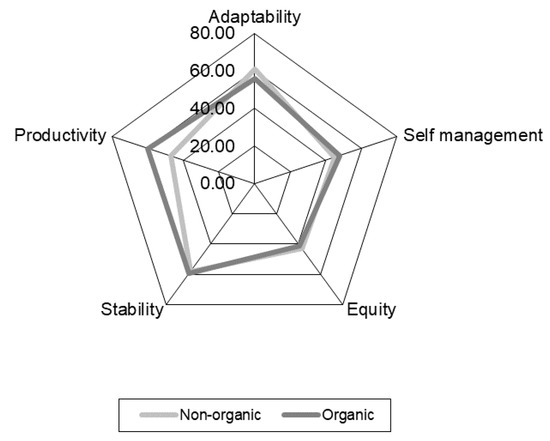
Figure 1.
Global assessment of sustainability indexes according to organic orientation of the extensive livestock farms of the Natural Park Sierra de Grazalema.
The explanation for this result is that, in this NP, both types of farms are managed as extensive with a high dependence on grazing for animal diet; therefore, there are very few differences present between them. For this reason, PNSG farms are very easy to convert to organic. In accordance with this, Escribano et al. [33] found similar results in the context of the extensive beef cattle farms. They (Escribano et al.) [27] point out that organic beef pastures are more sustainable, although these should improve their self-management, and although conventional farms are less sustainable globally, they are more productive. Similarly, for the organic dairy sheep farms in the Spanish region of Castilla-La Mancha, Toro-Mujica et al. [34] pointed out that these require an increase in productivity and a better balance between the use of food supplements and the productive capacity of the sheep.
In any case, if consumers have more training and environmental awareness, the sustainability of organic farms would be reinforced, since organic products have a certified differentiation for their sale [35].
3.2. Sustainability Based on Farm Types
Table 6 shows the mean values of the sustainability indicators and indexes for each attribute studied (adaptability, self-management, equity, stability, and productivity) based on the four types of farms previously established by Díaz-Gaona et al. [4].
Table 6.
Mean values and standard deviation (SD) of the sustainability indicators and indexes according to the types of the livestock farms of the Natural Park Sierra de Grazalema (this typology comes from a previous study by Díaz-Gaona et al. [4]), and optimal values considered for the calculation of the indexes.
3.2.1. Sustainability for the Adaptability Attribute
When comparing the adaptability indicators according to their typologies, significant differences (p < 0.01) related to the presence of each livestock species were observed; the highest number of species being found in groups 2 (“Large and very extensive farms”) and 3 (“farms with sheep suitable for both meat and milk”), and the lowest in group 4 (“farms oriented to the production of goat milk and without beef”) (Table 6). In this regard, group 4 does not have cattle, and group 1 has very few sheep. On the other hand, goats do appear in all groups, but the percentage of goats is significantly higher (p < 0.001) in groups 1 (“Medium-sized farms and without sheep”) and 4 (“Farms oriented to the production of goat’s milk and without cattle”).
When these indicators are transformed into indexes, practically the same pattern is shown (Table 6), so that the highest levels of adaptability are found in groups 2 and 3, as these are the ones with a more balanced presence of the different livestock species (Figure 2a). In this regard, Franco et al. [11] pointed out that for extensive farms in Extremadura the most diversified farms were the most sustainable. Gaspar et al. [16] also pointed out that for extensive farms of the dehesa agroecosystem, the mixed system (beef cattle—sheep—Iberian pigs) had been found to be the most sustainable in general. Animal selection should be designed to reinforce, in a sustainable manner, the relationship between animals and the environment [36].
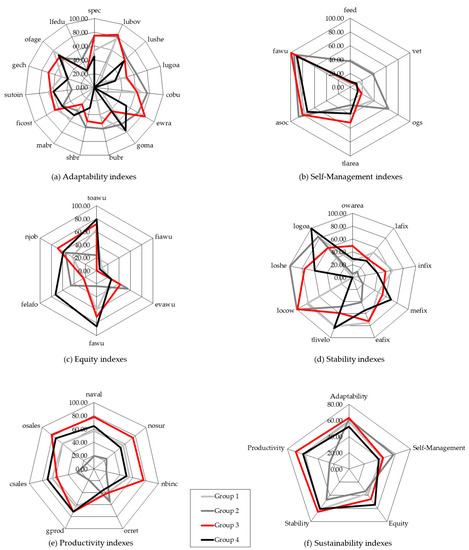
Figure 2.
Sustainability indexes according to the type of farms (this typology comes from a previous study by Díaz-Gaona et al. [4]). Group 1: medium-sized farms without sheep; group 2: large and very extensive farms; group 3: farms with sheep suitable for both meat and milk; group 4: farms oriented to the production of goat’s milk and without cattle. (a) Adaptability indexes: raised species (spec), LU bovine/LU total (lubov), LU sheep/LU total (lushe), LU goat/LU total (lugoa), cows per bull (cobu), ewes per ram (ewra), goats per male (goma), number of bull breeds (bubr), number of sheep breeds (shbr), number of male breeds (mabr), fixed cost percentage (ficost), subsidies/total income ratio (sutoin), generational change (gech), farm owner’s age (ofage), level of formal education (lfedu). (b) Self-Management indexes: cattle feed (feed), veterinary expenses (vet), other goods and services (ogs), percentage of total leased area (tlarea), associationism (asoc), family labour (fawu). (c) Equity indexes: total AWU/100 ha (toawu), fixed AWU/100 ha (fiawu), eventual AWU/100 ha (evawu), family AWU/100 ha (fawu), female labour force (felafo), number of jobs (njob). (d) Stability indexes: percentage of own area (owarea), land fixed capital (lafix), infrastructure fixed capital (infix), machinery fixed capital (mefix), earned fixed capital (eafix), total livestock load (tlivelo), local cow percentage (locow), percentage of local sheep (loshe), percentage of local goats (logoa). (e) productivity indexes: net added value (naval), net operating surplus (nosur), net business income (nbinc), operating rate of return (orret), gross production (gprod), cattle sales (csales), other sales (osales). (f) Sustainability indexes.
In dairy farms in the northeast of the Pampa (Argentina), the most extensive farms presented the lower adaptability, the medium-sized semi-extensive farms being the ones that showed a higher level of adaptability [26].
According to Ripoll-Bosch et al. [37], in Mediterranean countries, sheep farms have trade-offs or tensions between their sustainability attributes, particularly between productivity and adaptability, that need to be researched further.
3.2.2. Sustainability for the Self-Management Attribute
When self-management indicators are compared, it is found that group 2 (“Large and very extensive farms”) has fewer expenses due to livestock feeding, animal health and other goods and services; however, these differences are only significant for the last indicator (p < 0.001) (Table 6). This occurs because it groups together the most extensive farms, which are those that need fewer inputs. Furthermore, this group presents a higher level of sustainability for the attribute of self-management (Figure 2b), the differences found for livestock feeding (p < 0.05) and other goods and services (p < 0.01) being significant.
The global assessment shows a significantly higher level of self-management (p < 0.01) for the farms in group 2 (Table 7 and Figure 2b,f).
Table 7.
Indexes of global sustainability and its attributes according to the types of livestock farms of the Natural Park Sierra de Grazalema (this typology comes from a previous study by Díaz-Gaona et al. [4]).
Other authors have also found a higher level of self-management, e.g., extensive dairy cow farms in the northeast of the Pampa [26], and extensive farms for the production of meat in pastures of southwestern Spain and Portugal [33]. Ripoll-Bosch et al. [28], when studying a group of Teruel Ojinegra sheep herds in an unfavorable area of northeastern Spain, indicated that a high level of self-management improves the economic result. Ruiz et al. [38], for livestock in protected mountainous areas of the Mediterranean, indicated that an increase in self-management has a positive impact on profitability.
3.2.3. Sustainability for the Equity Attribute
When the equity indicators are compared between the different groups of farms (Table 6), significant differences (p < 0.001) are found for family and total labor per surface. When these indicators are transformed into indexes, these offer significantly lower levels of sustainability for group 2 (“Large and very extensive farms”), since the farms in this group, being more extensive, have lower labor needs; therefore, these contribute to a lesser extent to the distribution of income.
For the remaining indexes there are no significant differences, although groups 2 and 3 (“Farms with sheep suitable for both meat and milk”) appear to be the most equitable for temporary labor and the least equitable for non-family fixed labor.
Globally, the farms belonging to group 4 (“Farms oriented to the production of goat’s milk and without beef”) seem to be the most equitable (Figure 2c,f), although their differences are not significant (Table 7).
Gaspar et al. [16] found high levels of equity in extensive and semi-extensive pasture farms with the highest level of diversification for beef, sheep, and pig meat production. In contrast, a lower level of equity was observed in extensive and semi-extensive dairy cattle farms in the northeast of the Pampa [26]. Regarding equity due to labor, Morgan-Davies et al. [39], studying extensive livestock systems in marginal mountainous areas of western Scotland, pointed out that, in general, it is difficult to increase on-farm labor demand, and although greater flexibility in farm labor was found to be essential, labor scarcity in these marginal mountain areas remained a problem.
3.2.4. Sustainability for the Stability Attribute
The total livestock load and fixed capital earned (Table 6) are significantly higher in group 3 (“Farms with sheep suitable for both meat and milk”), since these are the least extensive. Group 4 (“Farms oriented to the production of goat’s milk and without cattle”) does not have cows, and group 1 (“Medium-sized farms and without sheep”) practically does not have sheep, and these are not autochthonous. The percentage of surface area owned and the remaining fixed capital (land, infrastructure, and machinery) are lower for group 2 (“Large and very extensive farms”) as this is the group with the largest leasing of grasslands, where no investments are generally made. This lower level of stability has also been observed in extensive dairy cattle farms in the northeast of the Pampa [26]. Lurette et al. [40] point out that the diversity of agricultural and livestock activities offers farms a higher level of economic and environmental stability, which, extrapolating to the present work, would mean that groups 2 and 3 present a stability reinforced by the greater variety of animal species they have. However, although multispecies farms improve sustainability in their environmental, social, and economic dimensions, if the appropriate practices are not carried out, undesirable effects could be caused by competition for pasture, cross-infections, and peak workloads [41].
When these values are transformed into indexes (Table 6), it is found that the farms in group 2 are those that show a significantly lower stability compared to the total stocking rate (p < 0.01) and the indicators of fixed capital of the infrastructures (p < 0.01), machinery (p < 0.05), and livestock (p < 0.05).
3.2.5. Sustainability for the Productivity Attribute
Except for the profitability rate, all the productivity indicators show significant differences between the different farm groups (Table 6). Group 2 (“Large and very extensive farms”) has lower values, while group 3 (“ Farms with sheep suitable for both meat and milk”) has higher values for these indicators, except for the sale of milk, which, logically, is higher in group 4 (“ Farms oriented to the production of goat’s milk and without beef”). This is because group 2 has the lowest intensification level and group 3 the highest.
Similarly, all productivity indexes (except the profitability rate) show significant differences (p < 0.001) for net added value, gross production, and milk sales (Table 6), which, at a global level, indicates that the farms in group 2 are significantly the least sustainable for the productivity attribute (p < 0.01) (Table 7 and Figure 2e,f). In this regard, Escribano et al. [42], studying beef cattle in protected agroforestry systems, pointed out that the least productive farms are the most extensive ones. However, in other systems, like those with cattle and sheep farms in marginal areas of southern Chile, where the system is based on grazing, the largest farms have the highest level of productivity [43]. Nevertheless, according to Mena et al. [5], on extensive farms it is possible to obtain a satisfactory level of productivity and profitability while minimizing the amount of feed purchased. Thus, including sustainability as a condition for receiving subsidies from the CAP, policies can contribute to improving the economic results of traditional extensive farms [11]; besides this, it could be an incentive for the more intensive farms to reinvest part of their earnings in improvements to reduce their impact and the degradation of their natural resources, recovering pasture equilibrium, which would be in the direction of the policies of the eco-schemes [44,45].
Gaspar et al. [16] point out that the dehesa farms with highly stocked sheep flocks are the least sustainable, although these are the most profitable. Rodríguez-Ortega et al. [46] indicate that in Mediterranean sheep production systems, those that are based on grazing (specialized sheep mountain-pasture systems) are less productive and present around half of the production than those partially integrated in areas of herbaceous crops (partially-integrated mixed sheep-arable crops), although these have 5 times more sustainability. According to Ripoll-Bosch et al. [37], a clear trade-off between economic and environmental indicators is observed on Mediterranean sheep farms; i.e., the higher the economic sustainability, the lower the environmental sustainability.
In addition, farms with several livestock species have benefits compared to general sustainability; however, their profitability is not necessarily higher [41], although their economic results tend to be more stable, which improves their resistance to economic or climate problems [47].
Finally, Waterhouse [48] points out that, in general, intensification improves farm productivity, but decreases animal welfare.
3.2.6. Global Assessment of Sustainability
There are only significant differences (p < 0.01) for sustainability in the self-management and productivity indexes (Table 7). Group 2 (“Large and very extensive farms”) is the most self-manageable (self-sufficient) and group 3 (“Farms with sheep suitable for both meat and milk”) is the most productive (efficient from an economic point of view). The least self-sufficient is group 4 (“Farms oriented to the production of goat’s milk and without cattle”) and the least productive is group 2. Group 1 (“Farms of intermediate size and without sheep”) does not stand out for any of these attributes.
4. Weaknesses and Strengths of Farms
The above results show the weaknesses and strengths of these farms for their sustainability, which differs depending on the organic certification (Table 8) and their typology (Table 9).
Table 8.
Weaknesses and strengths of extensive livestock farms of the common grasslands of the Natural Park Sierra de Grazalema regarding their sustainability and according to their organic orientation.
Table 9.
Weaknesses and strengths of extensive livestock farms of the common grasslands of the Natural Park Sierra de Grazalema regarding their sustainability and according to their typology 1.
5. Conclusions
The reason that the organic certification of the studied farms does not influence their levels of sustainability is that their extensive management styles are very similar and meet organic farming requirements.
According to the four established typologies, the farms with the greatest sustainability are those with sheep suitable for both meat and milk, which are also the most productive. However, these present a great need for inputs and a high stocking rate. On the contrary, large and very extensive farms are the least sustainable because their productivity is very low, although these are the most self-sufficient. Farms of intermediate size and without sheep, and farms oriented to the production of goat’s milk and without cattle show intermediate sustainability, the latter being the ones that show greater equity. However, although all of the herds grazing on communal pastures of the natural park have been studied, the sample size is small; therefore, one of the main limitations of this study is that results should be interpreted with caution, since the impact of one or two outliers can affect the overall outcomes.
The global sustainability of organic farms, and large, very extensive farms would be reinforced if their productivity was improved, which could be achieved if the conditions and criteria to obtain the European Common Agricultural Policy (CAP) subsidies were modified in favor of environmental conservation, following the aims of the eco-schemes. This aspect is very important to the natural park authorities because the livestock grazing is considered necessary for the equilibrium of the Natural Park Sierra de Grazalema. Nevertheless, with the current uncertainty about the CAP subsidies, the objective of these farms should be the diversification of production, the optimal use of the forage resources and the reduction of dependence on those subsidies.
Finally, the main weaknesses of the Natural Park Sierra de Grazalema farms shown is the old age of the farmers and the lack of successors; the lack of marketing, certification, and labeling strategies for a distinct market; and the lack of rational grazing of pastures. Therefore, taking into account that there are already a reduced number of herds grazing on the communal pastures of this natural park, it is essential to solve these weaknesses in order to guarantee that they continue to maintain the equilibrium of these grasslands.
Author Contributions
Conceptualization, C.D.-G. and V.R.-E.; methodology, C.D.-G., M.S.-R. and V.R.-E.; validation, C.D.-G.; formal analysis, C.D.-G. and V.R.-E.; investigation, C.D.-G. and V.R.-E.; resources, M.S.-R. and V.R.-E.; data curation, C.D.-G. and V.R.-E.; writing—original draft preparation, C.D.-G., M.S.-R. and V.R.-E.; writing—review and editing, C.D.-G. and V.R.-E.; funding acquisition, C.D.-G., M.S.-R. and V.R.-E. All authors have read and agreed to the published version of the manuscript.
Funding
This research was funded by Consejería de Medio Ambiente (Junta de Andalucía, Spain) and AsociaciónValor Ecológico CAAE (Ecovalia).
Institutional Review Board Statement
Not applicable.
Informed Consent Statement
Not applicable
Data Availability Statement
Data not available to the public. The data presented in this study are available only on reasonable request from the corresponding author.
Acknowledgments
The authors are grateful to Consejería de Medio Ambiente, Junta de Andalucía, Spain, for funding this research, to the Natural Park Sierra de Grazalema authorities for their technical support and to organic farmers for their collaboration and for preserving and enhancing the legacy of the traditional farming systems while conserving and reshaping the natural park future every day.
Conflicts of Interest
The authors declare no conflict of interest. The funders had no role in the design of the study; in the collection, analyses, or interpretation of data; in the writing of the manuscript, or in the decision to publish the results.
References
- Escribano, M.; Diaz-Caro, C.; Mesias, F.J. A participative approach to develop sustainability indicators for dehesa agroforestry farms. Sci. Total Environ. 2018, 640, 89–97. [Google Scholar] [CrossRef]
- Broom, D.M.; Galindo, F.A.; Murgueitio, E. Sustainable, efficient livestock production with high biodiversity and good welfare for animals. Proc. R. Soc. B Biol. Sci. 2013, 280, 9. [Google Scholar] [CrossRef]
- Superficie de la Red de Espacios Naturales Protegidos de Andalucía. Consejería de Agricultura, Ganadería, Pesca y Desarrollo Sostenible de la Junta de Andalucía. Available online: http://www.juntadeandalucia.es/medioambiente/site/portalweb/menuitem.7e1cf46ddf59bb227a9ebe205510e1ca/?vgnextoid=88686520205ca510VgnVCM2000000624e50aRCRD&vgnextchannel=007fee9b421f4310VgnVCM2000000624e50aRCRD (accessed on 11 September 2020).
- Diaz-Gaona, C.; Sanchez-Rodriguez, M.; Rucabado-Palomar, T.; Rodriguez-Estevez, V. A Typological Characterization of Organic Livestock Farms in the Natural Park Sierra de Grazalema Based on Technical and Economic Variables. Sustainability 2019, 11, 6002. [Google Scholar] [CrossRef]
- Mena, Y.; Gutierrez-Pena, R.; Ruiz, F.A.; Delgado-Pertinez, M. Can dairy goat farms in mountain areas reach a satisfactory level of profitability without intensification? A case study in Andalusia (Spain). Agroecol. Sustain. Food Syst. 2017, 41, 614–634. [Google Scholar] [CrossRef]
- Jiménez, Y.; Caballero, A.; Porcel, L. Conservation-Development duality: The Biosphere Reserve Sierra de Grazalema after 40 years in the MAB Programme. Eur. J. Geogr. 2017, 8, 35–54. [Google Scholar]
- Smyth, A.; Dumanski, J.; Spendjian, G.; Swift, M. FESLM: An International Framework for Evaluating Sustainable Land Management; FAO: Rome, Italy, 1993. [Google Scholar]
- López-Ridaura, S.; Masera, O.; Astier, M. Evaluating the sustainability of complex socio-environmental systems. The MESMIS framework. Ecol. Indic. 2002, 2, 135–148. [Google Scholar] [CrossRef]
- Gaspar García, P.; Mesías Díaz, F.; Escribano Sánchez, M.; Pulido García, A. Evaluación de la sostenibilidad en explotaciones de dehesa en función de su tamaño y orientación ganadera. Información Técnica Económica Agraria 2009, 105, 117–141. [Google Scholar]
- Mata, H.T. Caracterización y viabilidad de la producción ecológica en el noroeste de España. Ph.D. Thesis, Universidad de Córdoba, Córdoba, Spain, 2011. [Google Scholar]
- Franco, J.A.; Gaspar, P.; Mesias, F.J. Economic analysis of scenarios for the sustainability of extensive livestock farming in Spain under the CAP. Ecol. Econ. 2012, 74, 120–129. [Google Scholar] [CrossRef]
- Veleva, V.; Ellenbecker, M. Indicators of sustainable production: Framework and methodology. J. Clean. Prod. 2001, 9, 519–549. [Google Scholar] [CrossRef]
- Sarandón, S.J.; Flores, C.C. Evaluación de la sustentabilidad en agroecosistemas: Una propuesta metodológica. Agroecología 2009, 4, 19–28. [Google Scholar]
- Sarandón, S. La agricultura como actividad transformadora del ambiente. El impacto de la agricultura intensiva de la Revolución Verde. In Agroecología: El Camino Hacia una Agricultura Sustentable; Sarandón, S., Ed.; Ediciones Científicas Americanas: La Plata, Argentina, 2002. [Google Scholar]
- Singh, R.K.; Murty, H.R.; Gupta, S.K.; Dikshit, A.K. An overview of sustainability assessment methodologies. Ecol. Indic. 2009, 9, 189–212. [Google Scholar] [CrossRef]
- Gaspar, P.; Mesias, F.J.; Escribano, M.; Pulido, F. Sustainability in Spanish Extensive Farms (Dehesas): An Economic and Management Indicator-Based Evaluation. Rangel. Ecol. Manag. 2009, 62, 153–162. [Google Scholar] [CrossRef]
- Cruz, J.F.; Mena, Y.; Rodríguez-Estévez, V. Methodologies for Assessing Sustainability in Farming Systems. Assess. Rep. 2018, 3, 33–58. [Google Scholar]
- Salminis, J.; Demo, C.; Geymonat, M. Estudio comparativo de la sustentabilidad socioeconómica y ambiental en sistemas agrícolas y agrícola-ganaderos; Universidad Nacional de Río Cuarto: Córdoba, Spain, 2007. [Google Scholar]
- Regulation, C. No 834/2007 of 28 June 2007 on organic production and labelling of organic products and repealing Regulation (EEC) No 2092/91. Off. J. Eur. Union L 2007, 189, 1–23. [Google Scholar]
- Consejería de Medio Ambiente. Decreto 90/2006, de 18 de abril, por el que se aprueban el Plan de Ordenación de los Recursos Naturales y el Plan Rector de Uso y Gestión del Parque Natural Sierra de Grazalema. Boletín Oficial de la Junta de Anadalucía. 2006, 114, 31–109. [Google Scholar]
- Masera, O.; Astier, M.; López-Ridaura, S. Sustentabilidad y manejo de recursos naturales: El marco de evaluación MESMIS; Mundiprensa GIRA UNAM: Patzcuaro, Mexico, 2000. [Google Scholar]
- Chevalier, S.; Choiniere, R.; Bernier, L.; Sauvageau, Y.; Masson, I.; Cadieux, E. User Guide to 40 Community Health Indicators; Health and Welfare Canada: Ottawa, ON, Canada, 1992. [Google Scholar]
- Padua, J. Técnicas de investigación aplicadas a las Ciencias Sociales; Fondo de Cultura Económica: México City, México, 1979. [Google Scholar]
- Arnés, E.; Antonio, J.; del Val, E.; Astier, M. Sustainability and climate variability in low-input peasant maize systems in the central Mexican highlands. Agric. Ecosyst. Environ. 2013, 181, 195–205. [Google Scholar] [CrossRef]
- Nahed, J.; Castel, J.M.; Mena, Y.; Caravaca, F. Appraisal of the sustainability of dairy goat systems in Southern Spain according to their degree of intensification. Livest. Sci. 2006, 101, 10–23. [Google Scholar] [CrossRef]
- Larrea, Á.T. Caracterización y eficiencia de la producción lechera en el Noreste de La Pampa (Argentina). Doctoral Thesis, Universidad de Córdob, Córdoba, Spain, 2011. [Google Scholar]
- Escribano, A.; Gaspar, P.; Mesías Díaz, F.; Pulido García, A.; Escribano, M. Evaluación de la sostenibilidad de explotaciones de vacuno de carne ecológicas y convencionales en sistemas agroforestales: Estudio del caso de las dehesas. Información Técnica Económica Agraria 2014, 110, 343–367. [Google Scholar] [CrossRef]
- Ripoll Bosch, R.; Joy Torrens, M.; Bernués Jal, A. Role of self-sufficiency, productivity and diversification on the economic sustainability of farming systems with autochthonous sheep breeds in less favoured areas in Southern Europe. Animal 2014, 8, 1229–1237. [Google Scholar] [CrossRef] [PubMed]
- Nahed, T. Aspectos metodológicos en la evaluación de la sostenibilidad de sistemas agrosilvopastoriles. Av. Investig. Agropecu. 2008, 12, 3–20. [Google Scholar]
- Ten Brink, B.; Hosper, S.; Colijn, F. A quantitative method for description & assessment of ecosystems: The AMOEBA-approach. Mar. Pollut. Bull. 1991, 23, 265–270. [Google Scholar]
- Commission Regulation (EC) 889/2008 of 5 September 2008 laying down detailed rules for the implementation of Council Regulation (EC) No 834/2007 on organic production and labelling of organic products with regard to organic production, labeling and control. Off. J. Eur. Union 2008, 250, 1–84.
- Altieri, M.A.; Nicholls, C.I. Un método agroecológico rápido para la evaluación de la sostenibilidad de cafetales. Manejo Integrado de Plagas y Agroecología 2002, 64, 17–24. [Google Scholar]
- Escribano, A. Beef Cattle Farms’ Conversion to the Organic System. Recommendations for Success in the Face of Future Changes in a Global Context. Sustainability 2016, 8, 572. [Google Scholar] [CrossRef]
- Toro-Mujica, P.; Garcia, A.; Gomez-Castro, A.G.; Acero, R.; Perea, J.; Rodriguez-Estevez, V.; Aguilar, C.; Vera, R. Technical efficiency and viability of organic dairy sheep farming systems in a traditional area for sheep production in Spain. Small Rumin. Res. 2011, 100, 89–95. [Google Scholar] [CrossRef]
- Cerri, J.; Testa, F.; Rizzi, F. The more I care, the less I will listen to you: How information, environmental concern and ethical production influence consumers’ attitudes and the purchasing of sustainable products. J. Clean. Prod. 2018, 175, 343–353. [Google Scholar] [CrossRef]
- Nardone, A.; Zervas, G.; Ronchi, B. Sustainability of small ruminant organic systems of production. Livest. Prod. Sci. 2004, 90, 27–39. [Google Scholar] [CrossRef]
- Ripoll-Bosch, R.; Diez-Unquera, B.; Ruiz, R.; Villalba, D.; Molina, E.; Joy, M.; Olaizola, A.; Bernues, A. An integrated sustainability assessment of mediterranean sheep farms with different degrees of intensification. Agric. Syst. 2012, 105, 46–56. [Google Scholar] [CrossRef]
- Ruiz, F.A.; Vazquez, M.; Camunez, J.A.; Castel, J.M.; Mena, Y. Characterization and challenges of livestock farming in Mediterranean protected mountain areas (Sierra Nevada, Spain). Span. J. Agric. Res. 2020, 18, 14. [Google Scholar] [CrossRef]
- Morgan-Davies, C.; Wilson, R.; Waterhouse, T. Impacts of farmers’ management styles on income and labour under alternative extensive land use scenarios. Agric. Syst. 2017, 155, 168–178. [Google Scholar] [CrossRef]
- Lurette, A.; Stark, F.; Lecomte, L.; Lasseur, J.; Moulin, C.H. A model to explore which diversity is needed to design sustainable agricultural systems at the territorial level. Agron. Sustain. Dev. 2020, 40, 14. [Google Scholar] [CrossRef]
- Martin, G.; Barth, K.; Benoit, M.; Brock, C.; Destruel, M.; Dumont, B.; Grillot, M.; Hubner, S.; Magne, M.A.; Moerman, M.; et al. Potential of multi-species livestock farming to improve the sustainability of livestock farms: A review. Agric. Syst. 2020, 181, 12. [Google Scholar] [CrossRef]
- Escribano, A.J.; Gaspar, P.; Mesias, F.J.; Escribano, M. The role of the level of intensification, productive orientation and self-reliance in extensive beef cattle farms. Livest. Sci. 2016, 193, 8–19. [Google Scholar] [CrossRef]
- Avilez, J.P.; Meyer, J.; Nahed, J.; Ruiz, F.A.; Mena, Y.; Castel, J.M. Classification, characterisation and strategies for improvement of cattle and sheep pasture systems in marginal areas of Southern Chile. Rev. Mex. Cienc. Pecu. 2018, 9, 240–262. [Google Scholar] [CrossRef]
- European Commission. EU budget: The Common Agricultural Policy beyond 2020. Available online: https://ec.europa.eu/commission/presscorner/detail/en/MEMO_18_3974 (accessed on 24 November 2020).
- Lampkin, N.; Stolze, M.; Meredith, S.; de Porras, M.; Haller, L.; Mészáros, D. Using Eco-schemes in the New CAP: A Guide for Managing Authorities; IFOAM UE: Brussels, Belgium, 2020; p. 76. [Google Scholar]
- Rodriguez-Ortega, T.; Bernues, A.; Olaizola, A.M.; Brown, M.T. Does intensification result in higher efficiency and sustainability? An emergy analysis of Mediterranean sheep-crop farming systems. J. Clean. Prod. 2017, 144, 171–179. [Google Scholar] [CrossRef]
- Mischler, P. Effects of livestock species diversity on the economic performance of commercial farms compared to specialized ruminant farms. Available online: https://orgprints.org/36705/ (accessed on 17 July 2020).
- Waterhouse, A. Animal welfare and sustainability of production under extensive conditions—A European perspective. Appl. Anim. Behav. Sci. 1996, 49, 29–40. [Google Scholar] [CrossRef]
Publisher’s Note: MDPI stays neutral with regard to jurisdictional claims in published maps and institutional affiliations. |
© 2021 by the authors. Licensee MDPI, Basel, Switzerland. This article is an open access article distributed under the terms and conditions of the Creative Commons Attribution (CC BY) license (http://creativecommons.org/licenses/by/4.0/).