


Towards Explaining Knowledge Hiding through Relationship Conflict, Frustration, and Irritability: The Case of Public Sector Teaching Hospitals
 , ,
, , 
Abstract
1. Introduction
2. Theoretical Framework and Hypotheses
2.1. Definition of Variables
2.1.1. Relationship Conflict
2.1.2. Frustration
2.1.3. Irritability
2.1.4. Knowledge Hiding
2.2. Hypotheses
3. Methods
3.1. Measures
3.1.1. Knowledge Hiding
3.1.2. Relationship Conflict
3.1.3. Frustration
3.1.4. Irritability
4. Results
4.1. Demographic Information
4.2. Reliability Measures
4.3. Validity
4.4. Correlations
4.5. Hypothesis Testing
5. Discussion
6. Conclusions
6.1. Implications
- Knowledge hiding does exist in hospitals and is partially caused by relationship conflicts, frustration, and irritability. Knowledge hiding becomes dangerous in hospitals when such behavior affects human lives, and it becomes more dangerous when the hospital is affiliated with a medical education institution for teaching and training purposes;
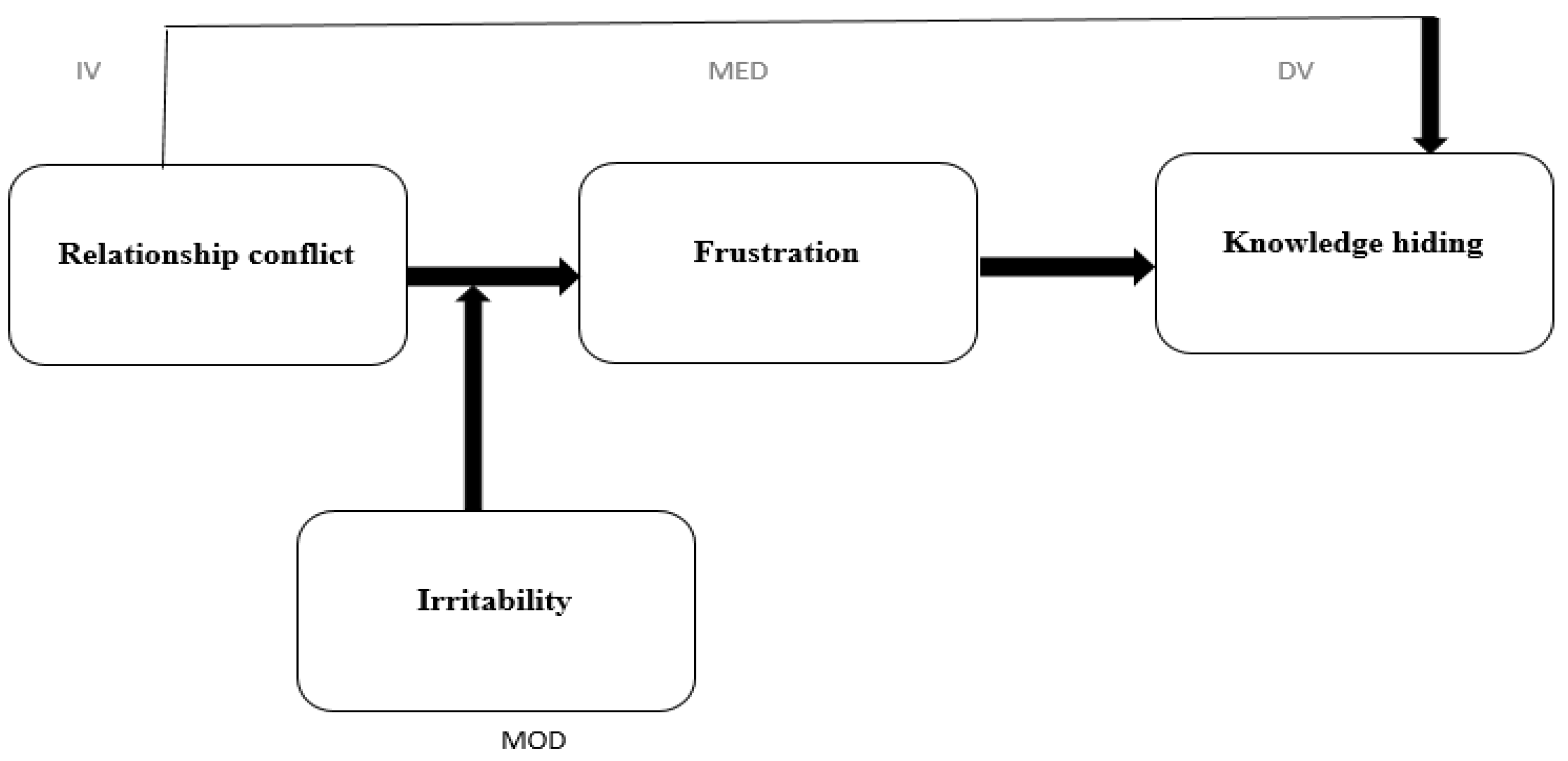
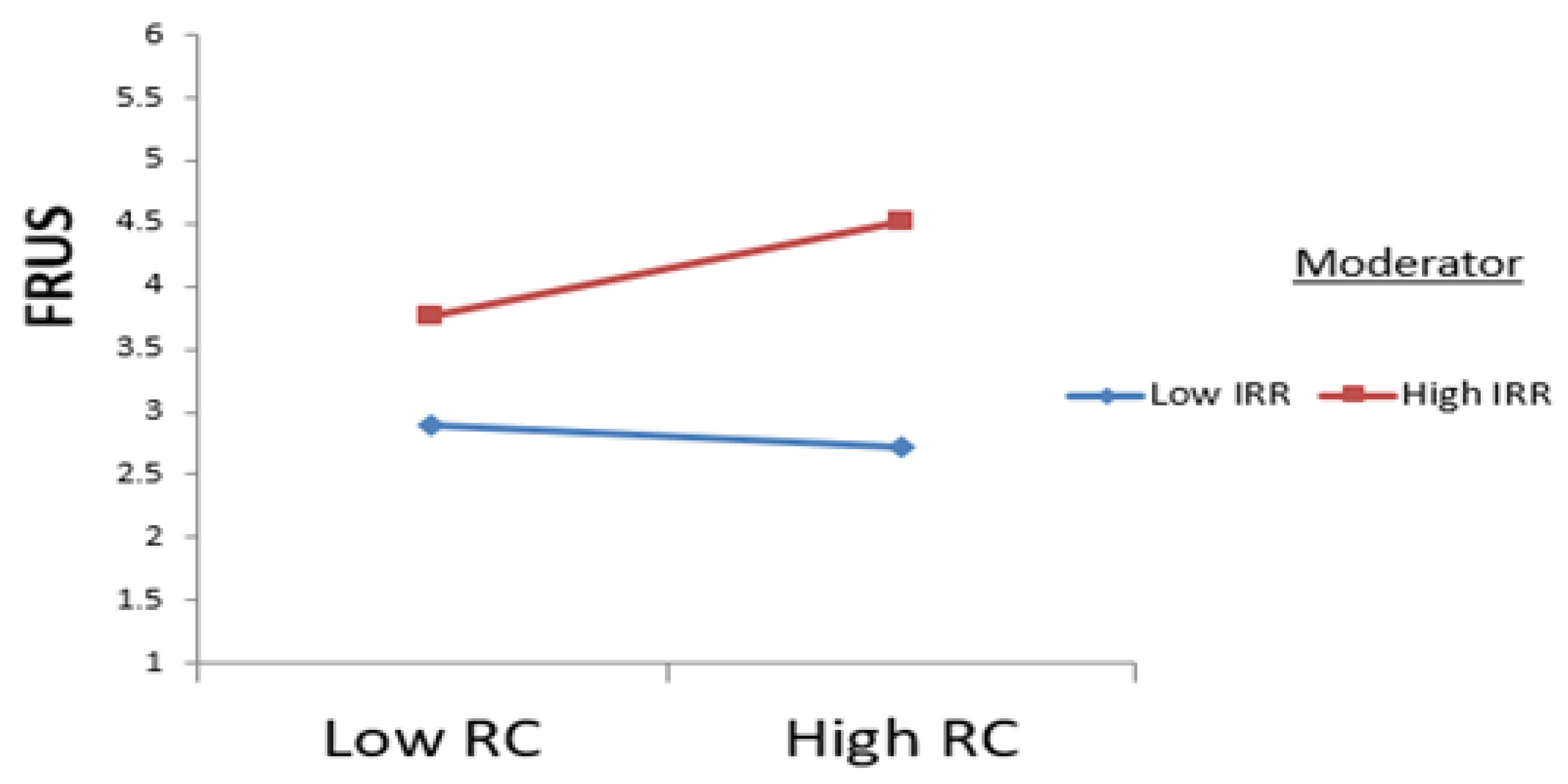
- Previous researchers admit that employees tend to hide knowledge due to interpersonal conflicts and frustration. However, the role of frustration as a mediator between interpersonal conflicts and knowledge hiding is newly illuminated through this study. Similarly, the moderating effect of irritability on the relationship between relationship problems and frustration is another addition to the literature;
- This study invites researchers to investigate the causes and consequences of knowledge hiding in healthcare settings. To the best of our understanding, studies investigating the bearings of knowledge hiding on patient outcomes and the learning of medical students are scant;
- The study guides hospital administrators to focus on relationship problems in order to reduce knowledge hiding. Ensuring a friendly and conducive environment will improve the quality of relations at the workplace, which in return will reduce frustrations and irritability in employees. As such friendly workplace relations will enhance the knowledge sharing culture within the organization.
6.2. Limitations and Future Research
Author Contributions
Funding
Institutional Review Board Statement
Informed Consent Statement
Data Availability Statement
Conflicts of Interest
References
- Ghobadi, S. What drives knowledge sharing in software development teams: A literature review and classification framework. Inf. Manag. 2015, 52, 82–97. [Google Scholar] [CrossRef] [Scilit]
- Despres, C.; Hiltrop, J.M. Human resource management in the knowledge age: Current practice and perspectives on the future. Empl. Relat. 1995, 17, 9–23. [Google Scholar] [CrossRef] [Scilit]
- Connelly, C.E.; Zweig, D.; Webster, J.; Trougakos, J.P. Knowledge hiding in organizations. J. Organ. Behav. 2012, 33, 64–88. [Google Scholar] [CrossRef] [Scilit]
- Arain, G.A.; Bhatti, Z.A.; Ashraf, N.; Fang, Y.-H. Top-down knowledge hiding in organizations: An empirical study of the consequences of supervisor knowledge hiding among local and foreign workers in the Middle East. J. Bus. Ethics 2020, 164, 611–625. [Google Scholar] [CrossRef] [Scilit]
- Zahedi, M.; Shahin, M.; Babar, M.A. A systematic review of knowledge sharing challenges and practices in global software development. Int. J. Inf. Manag. 2016, 36, 995–1019. [Google Scholar] [CrossRef] [Scilit]
- Hislop, D. Linking human resource management and knowledge management via commitment: A review and research agenda. Empl. Relat. 2003, 25, 182–202. [Google Scholar] [CrossRef] [Scilit]
- Gosselin, P.A.; Gagné, J.-P. Use of a dual-task paradigm to measure listening effort utilisation d’un paradigme de double tâche pour mesurer l’attention auditive. Inscr. Répert. 2010, 34, 43. [Google Scholar]
- Anand, P.; Hassan, Y. Knowledge hiding in organizations: Everything that managers need to know. Dev. Learn. Organ. Int. J. 2019, 33, 12–15. [Google Scholar] [CrossRef] [Scilit]
- Semerci, A.B. Examination of knowledge hiding with conflict, competition and personal values. Int. J. Confl. Manag. 2019, 30, 111–131. [Google Scholar] [CrossRef] [Scilit]
- Jahanzeb, S.; De Clercq, D.; Fatima, T. Organizational injustice and knowledge hiding: The roles of organizational dis-identification and benevolence. Manag. Decis. 2020, 59, 446–462. [Google Scholar] [CrossRef] [Scilit]
- Anand, P.; Jain, K.K. Big five personality types & knowledge hiding behaviour: A theoretical framework. Arch. Bus. Res. 2014, 2, 47–56. [Google Scholar]
- Pan, W.; Zhang, Q.; Teo, T.S.; Lim, V.K. The dark triad and knowledge hiding. Int. J. Inf. Manag. 2018, 42, 36–48. [Google Scholar] [CrossRef] [Scilit]
- Issac, A.C.; Baral, R.; Bednall, T.C. Don’t play the odds, play the man: Estimating the driving potency of factors engendering knowledge hiding behaviour in stakeholders. Eur. Bus. Rev. 2020, 32, 531–551. [Google Scholar] [CrossRef] [Scilit]
- Shafi, S.; Saeed, H.; Zaigham, S.; Jahangir, S.; Ahmed, H.R.; Ullah, Z. Relationship of communication, mentoring and socialization with employee engagement. Eur. J. Bus. Soc. Sci. 2013, 2, 17–36. [Google Scholar]
- GÜRLEK, M. Antecedents of knowledge hiding in organizations: A study on knowledge workers. Econ. Bus. Organ. Res. 2020, 3, 20–32. [Google Scholar]
- Saif-ur-Rehman, M.A.K. The Psychometric Impacts of Karasek’s Demands and Control Scale on Employees’ Job Dissatisfaction. Afr. J. Bus. Manag. 2011, 5, 3794–3806. [Google Scholar]
- Shrivastava, S.; Pazzaglia, F.; Sonpar, K. The role of nature of knowledge and knowledge creating processes in knowledge hiding: Reframing knowledge hiding. J. Bus. Res. 2021, 136, 644–651. [Google Scholar] [CrossRef] [Scilit]
- Bavik, A. A systematic review of the servant leadership literature in management and hospitality. Int. J. Contemp. Hosp. Manag. 2020, 32, 347–382. [Google Scholar] [CrossRef] [Scilit]
- Škerlavaj, M.; Connelly, C.E.; Cerne, M.; Dysvik, A. Tell me if you can: Time pressure, prosocial motivation, perspective taking, and knowledge hiding. J. Knowl. Manag. 2018, 22, 1489–1509. [Google Scholar] [CrossRef] [Scilit]
- Huo, W.; Cai, Z.; Luo, J.; Men, C.; Jia, R. Antecedents and intervention mechanisms: A multi-level study of R&D team’s knowledge hiding behavior. J. Knowl. Manag. 2016, 20, 880–897. [Google Scholar]
- Serenko, A.; Bontis, N. Understanding counterproductive knowledge behavior: Antecedents and consequences of intra-organizational knowledge hiding. J. Knowl. Manag. 2016, 20, 1199–1224. [Google Scholar] [CrossRef] [Scilit]
- Issac, A.C.; Baral, R. Knowledge hiding in two contrasting cultural contexts: A relational analysis of the antecedents using TISM and MICMAC. VINE J. Inf. Knowl. Manag. Syst. 2019, 50, 455–475. [Google Scholar] [CrossRef] [Scilit]
- Ma, L.; Zhang, X.; Ding, X. Enterprise social media usage and knowledge hiding: A motivation theory perspective. J. Knowl. Manag. 2020, 24, 2149–2169. [Google Scholar] [CrossRef] [Scilit]
- Arain, G.A.; Hameed, I.; Umrani, W.A.; Khan, A.K.; Sheikh, A.Z. Consequences of supervisor knowledge hiding in organizations: A multilevel mediation analysis. Appl. Psychol. 2021, 70, 1242–1266. [Google Scholar] [CrossRef] [Scilit]
- Abdullah, M.I.; Dechun, H.; Ali, M.; Usman, M. Ethical leadership and knowledge hiding: A moderated mediation model of relational social capital, and instrumental thinking. Front. Psychol. 2019, 10, 2403. [Google Scholar] [CrossRef] [Scilit]
- Abubakar, A.M.; Behravesh, E.; Rezapouraghdam, H.; Yildiz, S.B. Applying artificial intelligence technique to predict knowledge hiding behavior. Int. J. Inf. Manag. 2019, 49, 45–57. [Google Scholar] [CrossRef] [Scilit]
- Aljawarneh, N.M.S.; Atan, T. Linking tolerance to workplace incivility, service innovative, knowledge hiding, and job search behavior: The mediating role of employee cynicism. Negot. Confl. Manag. Res. 2018, 11, 298–320. [Google Scholar] [CrossRef] [Scilit]
- Jiang, Z.; Hu, X.; Wang, Z.; Jiang, X. Knowledge hiding as a barrier to thriving: The mediating role of psychological safety and moderating role of organizational cynicism. J. Organ. Behav. 2019, 40, 800–818. [Google Scholar] [CrossRef] [Scilit]
- Connelly, C.E.; Kelloway, E.K. Predictors of employees’ perceptions of knowledge sharing cultures. Leadersh. Organ. Dev. J. 2003, 24, 294–301. [Google Scholar] [CrossRef] [Scilit]
- Feng, J.; Wang, C. Does abusive supervision always promote employees to hide knowledge? From both reactance and COR perspectives. J. Knowl. Manag. 2019, 23, 1455–1474. [Google Scholar] [CrossRef] [Scilit]
- Jha, J.K.; Varkkey, B. Are you a cistern or a channel? Exploring factors triggering knowledge-hiding behavior at the workplace: Evidence from the Indian R&D professionals. J. Knowl. Manag. 2018, 23, 1455–1474. [Google Scholar]
- Khalid, M.; Gulzar, A.; Khan, A.K. When and how the psychologically entitled employees hide more knowledge? Int. J. Hosp. Manag. 2020, 89, 102413. [Google Scholar] [CrossRef] [Scilit]
- Moh’d, S.S.; Černe, M.; Zhang, P. An exploratory configurational analysis of knowledge hiding antecedents in project teams. Proj. Manag. J. 2021, 52, 31–44. [Google Scholar] [CrossRef] [Scilit]
- Riaz, S.; Xu, Y.; Hussain, S. Workplace ostracism and knowledge hiding: The mediating role of job tension. Sustainability 2019, 11, 5547. [Google Scholar] [CrossRef] [Scilit]
- Davenport, T.H.; Prusak, L. Information Ecology: Mastering the Information and Knowledge Environment; Oxford University Press on Demand: Oxford, UK, 1997. [Google Scholar]
- Weiss, H.M.; Beal, D.J. Reflections on affective events theory. In The Effect of Affect in Organizational Settings; Emerald Group Publishing Limited: Bingley, UK, 2005. [Google Scholar]
- Weiss, H.M.; Cropanzano, R. Affective events theory. Res. Organ. Behav. 1996, 18, 1–74. [Google Scholar]
- Ashton-James, C.E.; Ashkanasy, N.M. Affective events theory: A strategic perspective. In Emotions, Ethics and Decision-Making; Emerald Group Publishing Limited: Bingley, UK, 2008. [Google Scholar]
- Glasø, L.; Vie, T.L.; Holmdal, G.R.; Einarsen, S. An application of affective events theory to workplace bullying. Eur. Psychol. 2010, 16, 198–208. [Google Scholar] [CrossRef] [Scilit]
- Wegge, J.; Dick, R.v.; Fisher, G.K.; West, M.A.; Dawson, J.F. A test of basic assumptions of Affective Events Theory (AET) in call centre work 1. Br. J. Manag. 2006, 17, 237–254. [Google Scholar] [CrossRef] [Scilit]
- Caprara, G.V.; Renzi, P.; Alcini, P.; Imperio, G.D.; Travaglia, G. Instigation to aggress and escalation of aggression examined from a personological perspective: The role of irritability and of emotional susceptibility. Aggress. Behav. 1983, 9, 345–351. [Google Scholar] [CrossRef] [Scilit]
- Barata, P.C.; Holtzman, S.; Cunningham, S.; O’Connor, B.P.; Stewart, D.E. Building a definition of irritability from academic definitions and lay descriptions. Emot. Rev. 2016, 8, 164–172. [Google Scholar] [CrossRef] [Scilit] [PubMed]
- Toohey, M.J.; DiGiuseppe, R. Defining and measuring irritability: Construct clarification and differentiation. Clin. Psychol. Rev. 2017, 53, 93–108. [Google Scholar] [CrossRef] [Scilit]
- Vidal-Ribas, P.; Brotman, M.A.; Valdivieso, I.; Leibenluft, E.; Stringaris, A. The status of irritability in psychiatry: A conceptual and quantitative review. J. Am. Acad. Child Adolesc. Psychiatry 2016, 55, 556–570. [Google Scholar] [CrossRef] [Scilit] [PubMed]
- Rodionova, V.I.; Shvachkina, L.A.; Kuznetsova, L.E. Family psychological violence influence on adolescent aggressive behavior formation. Mod. J. Lang. Teach. Methods 2018, 8, 217–231. [Google Scholar]
- Jehn, K.A. A multimethod examination of the benefits and detriments of intragroup conflict. Adm. Sci. Q. 1995, 40, 256–282. [Google Scholar] [CrossRef] [Scilit]
- Bushman, B.J. Does venting anger feed or extinguish the flame? Catharsis, rumination, distraction, anger, and aggressive responding. Personal. Soc. Psychol. Bull. 2002, 28, 724–731. [Google Scholar] [CrossRef] [Scilit]
- Holtzman, S.; O’Connor, B.P.; Barata, P.C.; Stewart, D.E. The brief irritability test (BITe) A measure of irritability for use among men and women. Assessment 2015, 22, 101–115. [Google Scholar] [CrossRef] [Scilit]
- Zutshi, A.; Creed, A.; Bhattacharya, A.; Bavik, A.; Sohal, A.; Bavik, Y.L. Demystifying knowledge hiding in academic roles in higher education. J. Bus. Res. 2021, 137, 206–221. [Google Scholar] [CrossRef] [Scilit]
- O’Neill, T.A.; McLarnon, M.J.; Hoffart, G.C.; Woodley, H.J.; Allen, N.J. The structure and function of team conflict state profiles. J. Manag. 2018, 44, 811–836. [Google Scholar] [CrossRef] [Scilit]
- Benitez, M.; Medina, F.J.; Munduate, L. Buffering relationship conflict consequences in teams working in real organizations. Int. J. Confl. Manag. 2018, 29, 279–297. [Google Scholar] [CrossRef] [Scilit]
- Gomes, A.M. Influencing Factors of Consumer Behaviour in Retail Shops. 2018, pp. 1–18. Available online: https://papers.ssrn.com/sol3/papers.cfm?abstract_id=3151879 (accessed on 4 October 2021). [CrossRef] [Scilit]
- Ullah, Z.; Khan, M.Z.; Khan, M.A. Towards service quality measurement mechanism of teaching hospitals. Int. J. Healthc. Manag. 2020, 14, 1435–1440. [Google Scholar] [CrossRef] [Scilit]
- Anderson, J.C.; Gerbing, D.W. Structural equation modeling in practice: A review and recommended two-step approach. Psychol. Bull. 1988, 103, 411. [Google Scholar] [CrossRef]
- Idrees, N.; Ullah, Z.; Khan, M.Z. Impact of ethical conflict on job performance: The mediating role of proactive behavior. Asian J. Bus. Ethics 2018, 7, 103–116. [Google Scholar] [CrossRef] [Scilit]
- Williams, R.D. Managing Conflict in the Workplace. In Women in Ophthalmology: A Comprehensive Guide for Career and Life; Springer: Berlin/Heidelberg, Germany, 2021; pp. 149–155. [Google Scholar]
- Başoğul, C. Conflict management and teamwork in workplace from the perspective of nurses. Perspect. Psychiatr. Care 2021, 57, 610–619. [Google Scholar] [CrossRef] [Scilit] [PubMed]
- Ullah, Z.; Khan, M.Z.; Siddique, M. Analysis of employees’ perception of workplace support and level of motivation in public sector healthcare organization. Bus. Econ. Rev. 2017, 9, 240–257. [Google Scholar] [CrossRef] [Scilit]
- Venz, L.; Shoshan, H.N. Be smart, play dumb? A transactional perspective on day-specific knowledge hiding, interpersonal conflict, and psychological strain. Hum. Relat. 2021, 1–26. [Google Scholar] [CrossRef] [Scilit]
- Oguegbe, T.M.; Ezeh, L.N.; Iloke, S.E. Organisational based frustration in manufacturing companies: A correlational study of innovative behaviour and work family conflict. Br. Int. J. Educ. Soc. Sci. 2020, 7, 33–40. [Google Scholar]
- Marineau, J.E.; Hood, A.C.; Labianca, G. Multiplex conflict: Examining the effects of overlapping task and relationship conflict on advice seeking in organizations. J. Bus. Psychol. 2018, 33, 595–610. [Google Scholar] [CrossRef] [Scilit]
- Onedibe, G. Perceived organizational support and role conflict as predictors on organizational frustration among health workers in imo state. Nnadiebube J. Soc. Sci. 2019, 2, 1–57. [Google Scholar]
- Zakariya, R.; Bashir, S. Can knowledge hiding promote creativity among IT professionals. VINE J. Inf. Knowl. Manag. Syst. 2020, 51, 693–712. [Google Scholar] [CrossRef] [Scilit]
- Jahanzeb, S.; Clercq, D.D.; Fatima, T. Bridging the breach: Using positive affectivity to overcome knowledge hiding after contract breaches. J. Psychol. 2020, 154, 249–272. [Google Scholar] [CrossRef] [Scilit]
- Jahanzeb, S.; Fatima, T.; Bouckenooghe, D.; Bashir, F. The knowledge hiding link: A moderated mediation model of how abusive supervision affects employee creativity. Eur. J. Work. Organ. Psychol. 2019, 28, 810–819. [Google Scholar] [CrossRef] [Scilit]
- Kamaşak, R.; Bulutlar, F. The influence of knowledge sharing on innovation. Eur. Bus. Rev. 2010, 22, 306–317. [Google Scholar] [CrossRef] [Scilit]

| Author(s) | Title | Variables | Purpose and Hypotheses | Findings |
|---|---|---|---|---|
| Abdullah et. al. [25] | Ethical leadership and knowledge hiding: a moderated mediation model of relational social capital and instrumental thinking | KH, ethical leadership, relational social capital, instrumental thinking | The purpose of this study was to examine the direct and indirect (via relational social capital) relationships between supervisors’ ethical leadership and knowledge hiding. It also tested the moderating role of instrumental thinking in the relationship between supervisors’ ethical leadership and knowledge hiding and the relationship between supervisors’ ethical leadership and relational social capital. | Ethical leadership negatively impacts KH. Instrumental thinking moderates the relationship. |
| Abubakar, Behravesh [26] | Applying artificial intelligence technique to predict knowledge hiding behavior | KH, artificial intelligence, procedural and interactional justice | This study aims at understanding employee reactions to distributive, procedural, and interactional (in)justice—three crucial bases of employees’ feelings of social self-worth. The hypotheses tested were related to the relationship of distributive, procedural, and interactional (in)justice with higher levels of knowledge hiding behavior. | AI through procedural justice and interactional justice influences KH. |
| Aljawarneh and Atan [27] | Linking tolerance to workplace incivility, service innovative, knowledge hiding, and job search behavior: the mediating role of employee cynicism | KH, tolerance of workplace incivility, service innovation, knowledge hiding, and job search behavior | The purpose of the study is to see how workplace incivility effects knowledge hiding. Drawing on conservation of resources and psychological ownership theory, this article investigates the mediating role of employee cynicism in the relationship between tolerance of workplace incivility and outcome variables (i.e., service innovative behavior, knowledge hiding behavior, and job search behavior) in the hospitality industry. | Tolerance of workplace incivility influences KH while cynicism mediates the relationship. |
| Arain et. al [4] | Top-Down Knowledge Hiding in Organizations: An Empirical Study of the Consequences of Supervisor Knowledge Hiding Among Local and Foreign Workers in the Middle East | Knowledge hiding, cognitive job demand and job autonomy | The purpose of the study was to explore the consequences of knowledge hiding. The hypothesized relationship between supervisor knowledge hiding and subordinate organizational citizenship behavior and the direct and indirect role of employee trust in supervisor were tested. | Job characteristics and task interdependence are linked with knowledge hiding. |
| Jiang, Hu [28] | Knowledge hiding as a barrier to thriving: The mediating role of psychological safety and moderating role of organizational cynicism | Psychological safety, cynicism, knowledge hiding and thriving | The study sought to understand the impact of knowledge hiding on the knowledge hider himself or herself. The study tested how knowledge hiding negatively influences employees’ thriving through psychological safety, and this influence is contingent on organizational cynicism. | The study explained the roles of psychological safety and organizational cynicism in the relationship between an employee’s knowledge hiding and his or her thriving as an employee. |
| Connelly and Kelloway [29] | Predictors of employees’ perceptions of knowledge sharing cultures | Social interaction culture, organization size, knowledge sharing technology, KH | The purpose was to study organizational factors that influence knowledge sharing. The hypotheses tested were related to the impact of employees’ perceptions of management’s support for knowledge sharing, their perceptions of the organization’s social interaction culture, the organization’s size, and the organization’s available knowledge sharing technology, as well as whether individual factors such as age, gender, and the effects of organizational tenure on employees’ perceptions of a knowledge sharing culture. | All these variables discourage knowledge hiding behavior in organizations. |
| Feng and Wang [30] | Does abusive supervision always promote employees to hide knowledge? From both reactance and COR perspectives | Abusive supervision, KH, job insecurity | The purpose of the study is to investigate knowledge hiding in the presence of abusive supervision. The study tested a moderated mediation framework to examine the effects of abusive supervision on knowledge hiding via job insecurity and under moderation of motivational climate. | Abusive supervision is not significantly related to knowledge hiding directly but indirectly via job insecurity. |
| Jha and Varkkey [31] | Are you a cistern or a channel? Exploring factors triggering knowledge-hiding behavior at the workplace: evidence from the Indian R&D professionals | distrust, competitive work environment, perceived career insecurity, lack of recognition, lack of reciprocation and lack of confidence in own knowledge. | This study aims to focus on factors triggering knowledge hiding behavior among R&D employees, thus disrupting the knowledge creation in the organization. The authors hypothesized that distrust, a competitive work environment, perceived career insecurity, lack of recognition, lack of reciprocation and lack of confidence in own knowledge would lead to knowledge hiding. | These factors have been identified as factors triggering knowledge hiding. |
| Khalid, Gulzar [32] | When and how the psychologically entitled employees hide more knowledge? | Psychological entitlement, abusive supervision, knowledge hiding, hostile attribution bias | The purpose of this study is to examine how psychological entitlement is associated with knowledge hiding behaviors. The hypotheses of the study include the positive relationship between psychological entitlement and knowledge hiding. This relationship is expected to be mediated by abusive supervision. | Psychological entitlement is positively associated with knowledge hiding behaviors and this relationship is mediated by abusive supervision perceptions. |
| Moh’d, Černe [33] | An exploratory configurational analysis of knowledge hiding antecedents in project teams | Achievement goal orientation, knowledge hiding | The study aimed at the configuration of certain antecedents that trigger knowledge hiding behavior in project management teammates. The authors adopted a configurational inductive analytic approach and performed fuzzy-set qualitative comparative analysis to explore the configurations of conditions of different levels of antecedents. | There is a relationship between achievement goal orientation (learning goals, performance display/performance–avoidance goal orientation) and knowledge hiding. |
| Riaz, Xu [34] | Workplace ostracism and knowledge hiding: the mediating role of job tension | Workplace ostracism; knowledge hiding; evasive hiding; playing dumb; rationalized hiding; job tension; employee loyalty | The purpose of the study was to see the impact of workplace ostracism on knowledge hiding. The hypotheses include job tension as mediator and employee loyalty as moderator in the relationship between workplace ostracism and knowledge hiding. | Workplace ostracism influences knowledge hiding behavior. More specifically, workplace ostracism increases the feeling of job tension, while job tension mediates the relationship between workplace ostracism and knowledge hiding. |
| Davenport and Prusak [35] | Information ecology: Mastering the information and knowledge environment | Culture, behavior and work process | The purpose of this book is to discuss organizational aspects that hinder knowledge sharing. The authors have focused on lack of trust, culture, behaviors and work processes, differences in language and the lack of tolerance of mistakes that possibly hinder knowledge sharing. | The organizational aspects that hinder knowledge sharing, such as lack of trust, different languages (very important in hospital settings), and the lack of tolerance of mistakes. |
| Demographics | Frequency | Percentage (%) |
|---|---|---|
| Gender | ||
| Male | 162 | 56 |
| Female | 128 | 44 |
| Age (in years) | ||
| 18–25 | 61 | 21 |
| 26–32 | 70 | 24 |
| 33–40 | 75 | 26 |
| 41–50 | 49 | 17 |
| 51 and above | 35 | 12 |
| Experience (in years) | ||
| 1–5 | 58 | 20 |
| 6–10 | 73 | 25 |
| 11–20 | 81 | 28 |
| 21–29 | 55 | 19 |
| 30 and above | 23 | 8 |
| Occupation | ||
| Doctors | 125 | 43 |
| Nurses | 128 | 44 |
| Others | 37 | 13 |
| Designation | N | Minimum | Maximum | Mean | Std. Deviation | |
|---|---|---|---|---|---|---|
| Doctor | MeanKH | 125 | 1.00 | 4.17 | 2.8601 | 0.77215 |
| Valid N (listwise) | 125 | |||||
| Nurse | MeanKH | 128 | 1.00 | 4.67 | 2.7811 | 0.76170 |
| Valid N (listwise) | 128 | |||||
| Parmedics | MeanKH | 37 | 1.00 | 4.50 | 2.7778 | 0.81902 |
| Valid N (listwise) | 37 | |||||
| S. No. | Variable | Items | Author | Reliability | Sample Item |
|---|---|---|---|---|---|
| 1 | Relationship conflict | 4 | Jehn’s (1994) | 0.77 | There is friction between you and the people you work with? |
| 2 | Frustration | 9 | Neil Harrington (2012) | 0.84 | I feel I am prevented from choosing the way I carry out tasks. |
| 3 | Irritability | 20 | Caprar (1985) | 0.90 | I am often in a bad mood. |
| 4 | Knowledge hiding | 12 | Connelly et al. (2015) | 0.88 | 1–Agreed to help him/her but never really intended to. 2–Pretended that I did not know the information. |
| Variables | Mean | SD | RC | FRUS | IRR | KH | |
|---|---|---|---|---|---|---|---|
| 1 | Mean RC | 3.11 | 0.95 | (0.77) | |||
| 2 | Mean FRUS | 3.24 | 0.96 | 0.222 ** | (0.84) | ||
| 3 | Mean IRR | 2.63 | 0.71 | 0.216 ** | 0.533 ** | (0.90) | |
| 4 | Mean KH | 2.748 | 0.77 | 0.255 ** | 0.374 ** | 0.359 ** | (0.88) |
| β | S.E | t | p | LLCI | ULCI | |
|---|---|---|---|---|---|---|
| RC→KH | 0.210 | 0.0469 | 4.48 | 0.000 | 0.1180 | 0.3026 |
| FRUS→KH | 0.240 | 0.05 | 5.27 | 0.001 | 0.1506 | 0.3301 |
| RC→FRUS | 0.217 | 0.07 | 3.69 | 0.0003 | 0.1017 | 0.3328 |
| Indirect Effect | ||||||
| β | S.E | LLCI | ULCI | |||
| RC→FRUS→KH | 0.1581 | 0.04 | 0.0678 | 0.2484 | ||
| Normal Theory Test for Indirect Effect | ||||||
| Effect | S.E | Z | p | |||
| 0.05 | 0.017 | 2.99 | 0.0028 | |||
| Moderator: IRR to RC (IV) and to KH (DV) | ||||
|---|---|---|---|---|
| β | S.E | t | p | |
| Constant | 3.46 | 0.6450 | 5.3780 | 0.000 |
| RC | 0.1439 | 0.0524 | 2.7444 | 0.065 |
| IRR | 0.6634 | 0.0693 | 9.5793 | 0.000 |
| RC × IRR | 0.2331 | 0.0672 | 3.4718 | 0.006 |
Publisher’s Note: MDPI stays neutral with regard to jurisdictional claims in published maps and institutional affiliations. |
© 2021 by the authors. Licensee MDPI, Basel, Switzerland. This article is an open access article distributed under the terms and conditions of the Creative Commons Attribution (CC BY) license (https://creativecommons.org/licenses/by/4.0/).
Share and Cite
Alam, T.; Ullah, Z.; AlDhaen, F.S.; AlDhaen, E.; Ahmad, N.; Scholz, M. Towards Explaining Knowledge Hiding through Relationship Conflict, Frustration, and Irritability: The Case of Public Sector Teaching Hospitals. Sustainability 2021, 13, 12598. https://doi.org/10.3390/su132212598
Alam T, Ullah Z, AlDhaen FS, AlDhaen E, Ahmad N, Scholz M. Towards Explaining Knowledge Hiding through Relationship Conflict, Frustration, and Irritability: The Case of Public Sector Teaching Hospitals. Sustainability. 2021; 13(22):12598. https://doi.org/10.3390/su132212598
Chicago/Turabian StyleAlam, Tahira, Zia Ullah, Fatima Saleh AlDhaen, Esra AlDhaen, Naveed Ahmad, and Miklas Scholz. 2021. "Towards Explaining Knowledge Hiding through Relationship Conflict, Frustration, and Irritability: The Case of Public Sector Teaching Hospitals" Sustainability 13, no. 22: 12598. https://doi.org/10.3390/su132212598
APA StyleAlam, T., Ullah, Z., AlDhaen, F. S., AlDhaen, E., Ahmad, N., & Scholz, M. (2021). Towards Explaining Knowledge Hiding through Relationship Conflict, Frustration, and Irritability: The Case of Public Sector Teaching Hospitals. Sustainability, 13(22), 12598. https://doi.org/10.3390/su132212598

