Article

Risk Assessment and Air Quality Study during Different Phases of COVID-19 Lockdown in an Urban Area of Klang Valley, Malaysia

by
Mohd Shahrul Mohd Nadzir
1,2,*,
Mohd Zaim Mohd Nor
3,
Mohd Fadzil Firdzaus Mohd Nor
4,
Muhamad Ikram A Wahab
5,
Sawal Hamid Md Ali
6,
Muhsin Kolapo Otuyo
1,
Mohd Aftar Abu Bakar
7,
Lip Huat Saw
8,
Shubhankar Majumdar
9,
Maggie Chel Gee Ooi
10,
Faizal Mohamed
11,
Badrul Akmal Hisham
12,
Haris Hafizal Abd Hamid
1,
Zaki Khaslan
1,
Noratiqah Mohd Ariff
7,
Johary Anuar
13,
Gee Ren Tok
1,
Nurul Asyikin Ya’akop
1 and
Mai’izzati Mohd Meswan
1
1
Department of Earth Sciences and Environment, Faculty of Science and Technology, Universiti Kebangsaan Malaysia, Bangi 43600, Selangor, Malaysia
2
Centre for Tropical System and Climate Change (IKLIM), Institute of Climate Change, Universiti Kebangsaan Malaysia, Bangi 43600, Selangor, Malaysia
3
Petaling Jaya City Council, Jalan Yong Shook Lin, Petaling Jaya 46675, Selangor, Malaysia
4
Institute of Ocean & Earth Sciences, C308 IAS Building, University Malaya, Kuala Lumpur 50603, Malaysia
5
Environmental Health and Industrial Safety Program, Faculty of Health Sciences, School of Diagnostic Science and Applied Health, Universiti Kebangsaan Malaysia, Jalan Raja Muda Abdul Aziz, Kuala Lumpur 50300, Malaysia
6
Department of Electrical, Electronic and Systems Engineering, Faculty of Engineering and Built Environment, Universiti Kebangsaan Malaysia, Bangi 43600, Selangor, Malaysia
7
Department of Mathematical Sciences, Faculty of Science and Technology, Universiti Kebangsaan Malaysia, Bangi 43600, Selangor, Malaysia
8
Lee Kong Chian, Faculty of Engineering and Science, Universiti Tunku Abdul Rahman, Kajang 43000, Selangor, Malaysia
9
Department of Electronics and Communication Engineering, National Institute of Technology Meghalaya, Shillong 793003, India
10
Earth Observatory Center, Institute of Climate Change, Universiti Kebangsaan Malaysia, Bangi 43600, Selangor, Malaysia
11
Faculty of Science and Technology, School of Applied Physics, Universiti Kebangsaan Malaysia, Bangi 43600, Selangor, Malaysia
12
Department of Orthopedics & Traumatology, Faculty of Medicine, Universiti Kebangsaan Malaysia, Jalan Yaacob Latif, Bandar Tun Razak, Cheras, Kuala Lumpur 56000, Malaysia
13
Petaling District and Land Office Complex Shah, Shah Alam 40150, Selangor, Malaysia
*
Author to whom correspondence should be addressed.
Sustainability 2021, 13(21), 12217; https://doi.org/10.3390/su132112217
Submission received: 9 August 2021 / Revised: 20 October 2021 / Accepted: 22 October 2021 / Published: 5 November 2021
(This article belongs to the Special Issue Air Quality: Sustainability of Human Society)

Abstract

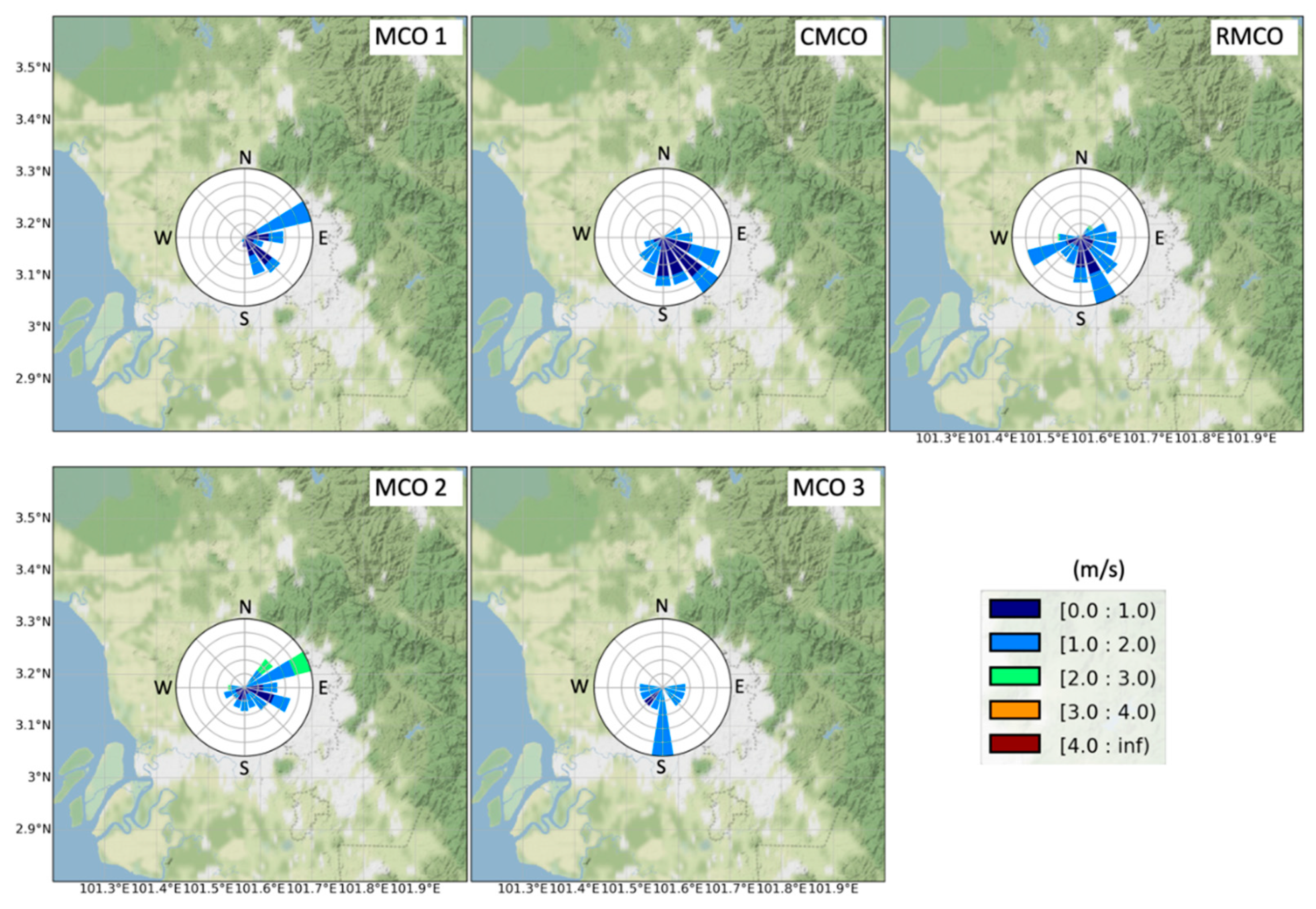
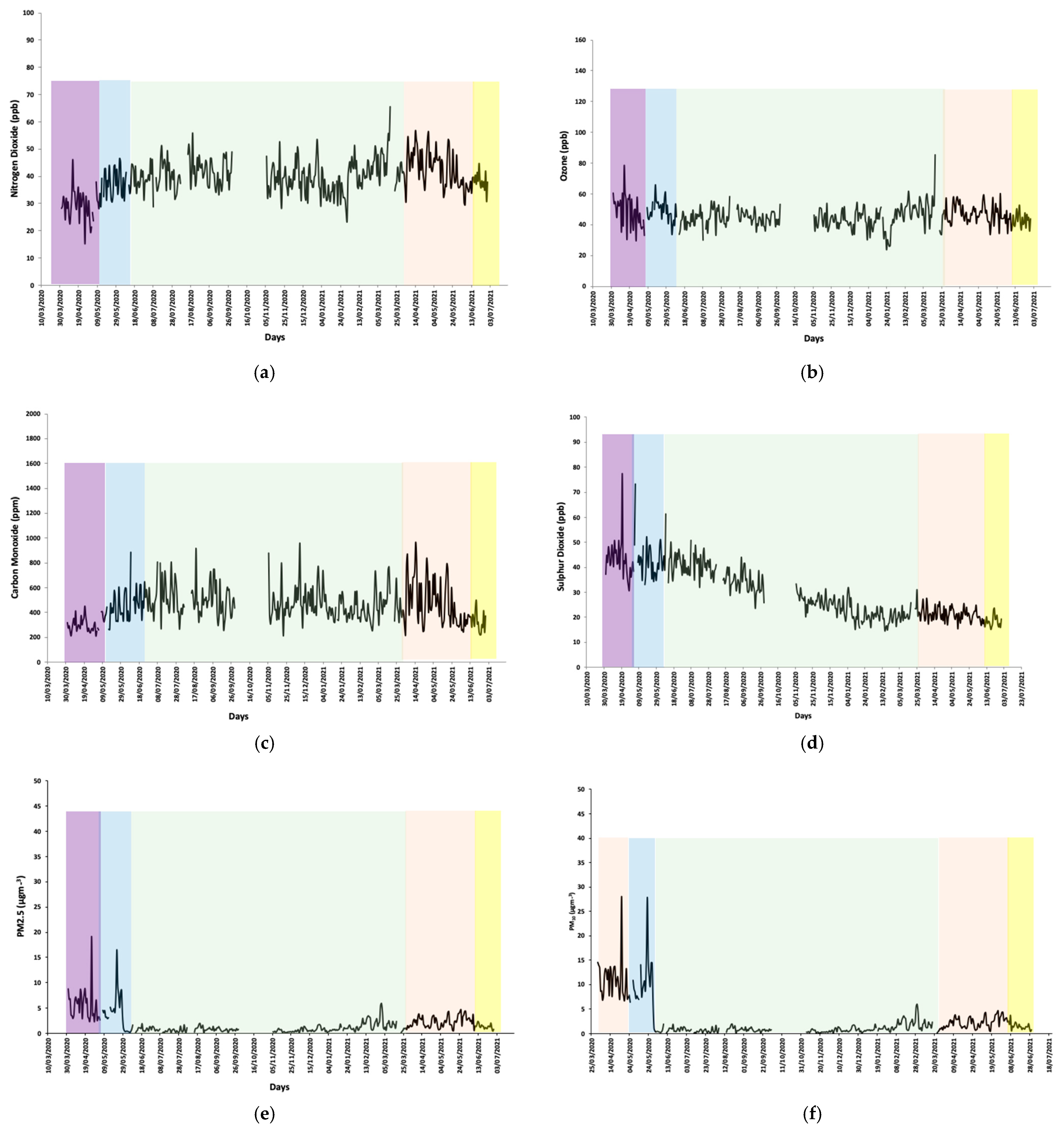
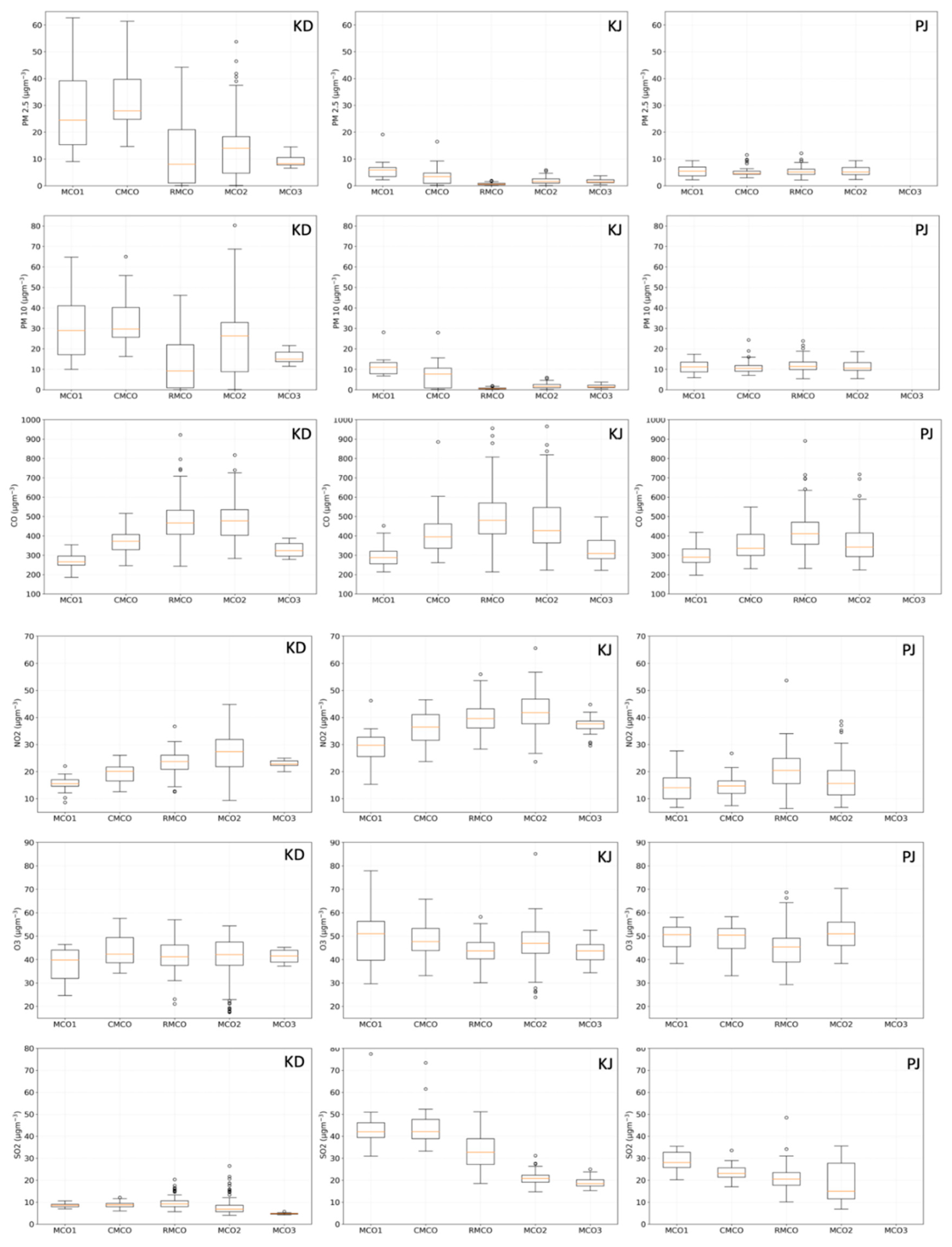
Globally, the COVID-19 pandemic has had both positive and negative impacts on humans and the environment. In general, a positive impact can be seen on the environment, especially in regard to air quality. This positive impact on air quality around the world is a result of movement control orders (MCO) or lockdowns, which were carried out to reduce the cases of COVID-19 around the world. Nevertheless, data on the effects on air quality both during and post lockdown at local scales are still sparse. Here, we investigate changes in air quality during normal days, the MCOs (MCO 1, 2 and 3) and post MCOs, namely the Conditional Movement Control Order (CMCO) and the Recovery Movement Control Order (RMCO) in the Klang Valley region. In this study, we used the air sensor network AiRBOXSense that measures carbon monoxide (CO), nitrogen dioxide (NO2), sulfur dioxide (SO2) and particulate matter (PM2.5 and PM10) at Petaling Jaya South (PJS), Kelana Jaya (KJ) and Kota Damansara (KD). The results showed that the daily average concentrations of CO and NO2 mostly decreased in the order of normal days > MCO (MCO 1, 2 and 3) > CMCO > RMCO. PM10, PM2.5, SO2 and O3 showed a decrease from the MCO to RMCO. PJS showed that air pollutant concentrations decreased from normal days to the lockdown phases. This clearly shows the effects of ‘work from home’ orders at all places in the PJS city. The greatest percentage reductions in air pollutants were observed during the change from normal days to MCO 1 (24% to 64%), while during MCO 1 to MCO 2, the concentrations were slightly increased during the changes of the lockdown phase, except for SO2 and NO2 over PJS. In KJ, most of the air pollutants decreased from MCO 1 to MCO 3 except for CO. However, the percentage reduction and increments of the gas pollutants were not consistent during the different phases of lockdown, and this effect was due to the sensor location—only 20 m from the main highway (vehicle emissions). The patterns of air pollutant concentrations over the KD site were similar to the PJS site; however, the percentage reduction and increases of PM2.5, O3, SO2 and CO were not consistent. We believe that local burning was the main contribution to these unstable patterns during the lockdown period. The cause of these different changes in concentrations may be due to the relaxation phases during the lockdown at each station, where most of the common activities, such as commuting and industrial activities changed in frequency from the MCO, CMCO and RMCO. Wind direction also affected the concentrations, for example, during the CMCO and RMCO, most of the pollutants were blowing in from the Southeast region, which mostly consists of a city center and industrial areas. There was a weak correlation between air pollutants and the temperature and relative humidity at all stations. Health risk assessment analysis showed that non-carcinogenic risk health quotient (HQ) values for the pollutants at all stations were less than 1, suggesting unlikely non-carcinogenic effects, except for SO2 (HQ > 1) in KJ. The air quality information showed that reductions in air pollutants can be achieved if traffic and industry emissions are strictly controlled.
Keywords: movement control orders (MCO) phases; air quality; low-cost air quality sensor (LAQS) movement control orders (MCO) phases; air quality; low-cost air quality sensor (LAQS)