


Abstract
This research focuses on the production and construction stages of the life cycle analysis (LCA) of asphalt mixtures modified with industrial waste and by-products, based on the quantification of methane (CH4), carbon monoxide (CO) and carbon dioxide (CO2) emissions produced during these processes. A laboratory-designed and calibrated gas measurement system with a microcontroller and MQ sensors is used to compare the emissions (GHG) of a “conventional” asphalt mix with those emitted by waste-modified asphalt mixes (polyethylene terephthalate and nylon fibres) and industrial by-products (copper slag and cellulose ash). The results obtained show that the gases emitted by each type of material can influence the design criteria from an environmental perspective. Methane gas emissions for asphalt mixes made with polymeric materials increase compared to the production phase of a conventional mix (M1) by 21% for PET and 14% for nylon. In contrast, for mixtures made with copper slag and cellulose ash, this emission is reduced by 12%. In addition, the use of copper slag and cellulose ash to replace natural aggregates reduces greenhouse gas emissions by 15% during the production phase and contributes to the creation of photochemical ozone for a shorter period of time. Regarding carbon dioxide emission, it increases considerably for all asphalt mixes, by 26% and 44.5% for cellulose ash and copper slag, respectively. For asphalt mixtures made of polymeric materials, the increase in carbon dioxide emission is significant, 130% for PET and 53% for nylon. In addition, it is noted that for this type of material, not only the emission of the gas must be taken into consideration, but also the time that the volatile particles spend in the atmosphere, affecting climate change and photochemical ozone (smog). The carbon monoxide gases emitted in the production phase of all the asphalt mixes analysed is similar among them.
1. Introduction
One of the main sectors contributing to the increase of environmental impact in the world is the construction industry. Most of the damage caused is focused on water and energy consumption, emissions of polluting gases into the atmosphere and the exploitation of natural resources [1]. The construction of infrastructures and their subsequent operation depend on the use of large amounts of energy and electricity, which involves the production of elements that help to increase environmental damage [2]. Therefore, it is relevant to develop new studies and techniques that help to reduce the ecological footprint during the life cycle of the materials that form an asphalt mix [3]. In 2017, the Paris Agreement ratified the commitment to develop policies and activities that can address climate change on a global scale. As an example, one of the agreed commitments (including the transport sector) is that by 2050, at least 70% of electricity should be generated from renewable energy sources in the signing countries [4].
Based on the problems generated by the exploitation of natural resources in the road sector, it is relevant to point out that approximately 30,000 tonnes of natural aggregates are used to build 1 kilometre of pavement, which corresponds to a total of 1,350 million tonnes per year [5]. In addition, 100 million tonnes of bitumen are produced annually, 95% of which is used in road construction and maintenance [6,7]. The environmental impact generated by the use of these natural resources is also associated with an economic impact. For the construction of 1 km of new pavement, a cost of approximately $870,000 is generated [8,9], without adding the cost to road users of delays during the construction of the infrastructure. In 2017, the UK government estimated this cost to be more than $5.5 billion per year [10].
Chile is a country that concentrates the largest number of people in its capital city (Santiago de Chile), around 40% of the national population. The urban area has grown in recent decades, concentrating a major source of air pollution emissions [11,12,13]. The Chilean vehicle fleet has increased by 85% in recent years, which has negatively affected the existing road infrastructure, as pavements were not originally designed to withstand this increased load [14]. New energy and environmental models have now been developed in Chile to help forecast future energy demand and transport emissions, based on national and international commitments [15,16,17]. However, it is necessary to establish new alternatives based on the design and construction of pavements that help not only to reduce the gas emissions produced in the phases, but also to increase their durability.
Since 2002, innovative techniques such as “cold recycling with foamed bitumen” have been used to rehabilitate deteriorated asphalt pavements [18]. This technology is based on the recovery of the pavement material by means of a recycling machine that generates a new layer, without heating the aggregates, which reduces energy consumption [19]. However, the high temperatures required for the manufacture of conventional hot mix asphalt (HMA) are obtained by burning fossil fuels, which involves high energy consumption and GHG emissions [20]. Estimates of energy use and CO2 emitted to the atmosphere per tonne of HMA are 300 MJ and 28.8 kg, respectively. The asphalt industry has developed other types of asphalt mixes that are manufactured at lower temperatures (WMA) and use reclaimed asphalt pavement (RAP), reducing the environmental impact [21]. In 2019, an environmental assessment of a traditional pavement rehabilitation technique (with hot mix asphalt), based on the extraction of raw materials (natural resources) and the manufacture of processed materials, was carried out in Spain. It was shown that the use of reclaimed asphalt pavement (RAP) in an appropriate percentage is advisable to reduce the total environmental impact produced. Furthermore, it was concluded that the production of the bituminous binder with lower temperature techniques (hot or cold mixed asphalt) improves the results of the environmental impact, maintaining the structural and functional quality of the pavement, as well as its life cycle [22]. On the other hand, climate change and the improvement of sustainability have increased the search for alternatives in road engineering that help minimise the disposal of waste and industrial by-products in the environment and reduce the extraction of natural resources. Among the various materials that have been used are reclaimed asphalt pavement (RAP), copper slag, steel slag, blast furnace slag (BFS), cellulose ash, plastic bottles, end-of-life tyres (crumb rubber), fishing nets, cellulose fibre and construction and demolition waste [23,24,25,26,27,28,29,30,31]. However, although the replacement of traditional asphalt mix materials with these wastes and by-products helps to reduce the environmental impact of over-exploitation of raw materials, the actual reduction of the global environmental impact must consider whether the use of these materials implies a higher energy consumption or whether the pollutant gases emitted in the process increase, causing the environmental benefit to be reduced, especially when plastic wastes are used.
In this research, the use of industrial by-products (copper slag and cellulose ash) and polymeric wastes (nylon and polyethylene terephthalate) is combined in the manufacture of hot mix asphalt (HAM) to evaluate their advantages in terms of environmental impact. The asphalt mixtures used were selected on the basis of the results obtained in previous mechanical tests (Marshall stability and flow, stiffness, resilient modulus and fatigue life), including a conventional asphalt mixture. An LCI has been performed based on two main phases: (1) production, considering the extraction and production phases of raw materials and manufacturing; (2) construction, considering the paving and compaction stages. This study is based on the life cycle inventory (LCI), based on the requirements of the ISO 14,040 series, as a stand-alone study supported by full LCA studies [32,33]. The regulation provides for traceability of reuse, waste and/or industrial by-products, reincorporating these materials in other construction activities, minimising their disposal in landfills [34]. The measurement of gas emissions (methane, carbon monoxide and carbon dioxide) for the production phase is performed in the laboratory using sensors (MQ-4, MQ7 and MQ135) calibrated for each gas which are similar to those used in other research associated with gas emissions and air re-circulation [35]. Life cycle inventory data for the initial construction and material production stages were obtained from different literature sources.
2. Materials and Methods
2.1. Research Overview
Figure 1 shows the scheme of the proposed research. The study is divided into four steps: the first is the preparation of the materials before dosing. Natural aggregates and copper slag are processed in the same manner (screening and washing) before calculating their bulk density. The cellulose ashes, which have been incinerated, are screened to remove the largest proportion of impurities before bulk density is calculated. The polymeric materials (PET and nylon) come from storage sites, so they must be washed and dried before being cut into fibres for their use in asphalt mixtures. The second step is based on the manufacture of asphalt mixtures by heating the aggregates, binder and additional material at different temperatures and subsequent compaction of the samples. The third step is the measurement of greenhouse gases from sensors controlled by a condenser. different sensor is used for each type of gas, which must be previously calibrated. The fourth step is performed once methane, carbon dioxide and carbon monoxide have been measured. This step consists of determining the global warming potential (GWP) from the CO2 equivalent amount. Subsequently, the period (in years) that smog can be maintained in the atmosphere is calculated depending on the type of material used in the asphalt mixes.
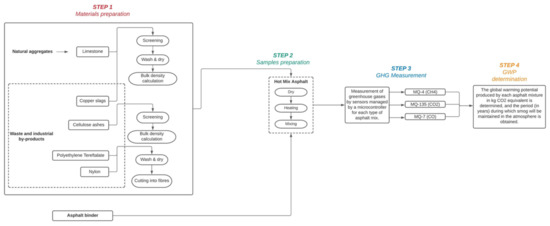
Figure 1.
Research diagram of the proposed experimental study.
2.2. Aggregates and Bitumen
The aggregates used in the research come from the crushing of natural gravel obtained from a quarry located in the south of Chile. The particle size distribution of the mixture (IV-A-12) is shown in Table 1.

Table 1.
Particle size distribution of the materials.
Table 2 shows the characteristics of the asphalt binder CA-24. It is indicated that 5.20% of the binder is used in the manufacture of the mixes as a percentage of the total mass of the mix.
Table 2.
Properties of bitumen.
2.3. Waste and Industrial By-Products
2.3.1. Copper Slags
The copper slag used in this research comes from a deposit located in the north of Chile and is generated in metallurgical mining processes. It is a slag with a density equivalent to 2802,93 kg/m3. The particle size distribution of the copper slag is shown in Table 2.
2.3.2. Polyethylene Terephthalate (PET)
Polyethylene terephthalate (PET) is a transparent, thermoplastic polyester with good mechanical properties and good dimensional stability under varying loads. It is a material used in clothing, food and other consumer products. For this research, beverage bottles cut into small sheets and reduced to their final size using a shredder are used.
Table 2 shows the particle size distribution of the natural and additional materials used for the manufacture of the asphalt mixes.
2.3.3. Cellulose Ashes
Cellulose ashes are classified as an industrial by-product and come from the process of burning wood debarking and chipping for energy generation, due to the high-pressure steam generated in biomass boilers [36]. These ashes are currently disposed of in authorised industrial solid waste (ISW) landfills. For this research, the ash is sifted through the N°200 sieve (0.08 mm) because, by its nature, it is mixed with other solid wastes, such as coal, sand and wood chips. This material has a density equivalent to 2.48 g/cm3.
2.3.4. Nylon Fibres
Nylon fibres are obtained from recycled fishing nets and nets deposited on the beaches of southern Chile. The nets are made of nylon 6 and have a density of 1.14 g/cm3 and a melting point of 215 °C. For this study, the fishing nets are cut into fibres with sizes close to 63.00 mm.
2.4. Dosing and Manufacturing of Asphalt Mixes
For this research, a total of five mixtures were manufactured according to the UNE 12697-30 standard, with the conventional mixture being denominated as (M1). M1 does not contain recycled materials and the filler used is material recovered from the screening of natural aggregate in a proportion of 4% to 8% of the total mass of aggregates.
Table 3 shows the dosages for each type of mix, considering that the following materials are replaced for all mixes: (M2) replaces part of the stone aggregate with copper slag; (M3) the original amount of aggregate and binder is maintained and 14% PET is added with respect to the binder.; (M4) the filler is replaced with cellulose ash; (M5) 10% of the asphalt binder is replaced with nylon.
Table 3.
Dosage of the asphalt mixes produced.
These material combinations have been selected based on the results obtained in previous investigations where the mechanical behaviour of asphalt mixtures developed with different proportions of each of the materials under analysis was analysed. The combinations selected for this research were those that obtained the best overall results in Marshall stability and flow, resilient modulus and fatigue life tests, which are shown in Table 4.
Table 4.
Results of mechanical test.
For manufacture, the aggregates, ash and copper slag (when applicable) are conditioned in an oven at 180 °C and the asphalt binder at a temperature of 158 °C for a period of 4 h. The rest of the recycled aggregates are included without prior thermal conditioning, being added dry at room temperature. Subsequently, the materials are homogeneously mixed with an automated mixer until all the stone material is enveloped and recycled with the asphalt binder.
The density is considering the mass per unit volume of the specimen, including the volume of accessible and inaccessible voids at a known temperature. The void content of the mix is obtained according to UNE-EN-12697-8, considering the difference between the actual volume of the asphalt specimen and the theoretical volume occupied by the asphalt binder and aggregates.
2.5. Gas Measuring System
In order to measure the gases, it is necessary to develop a system capable of recording the measured data, using accessible sensors that are applicable in the laboratory. In this case, it is necessary to measure the emissions of methane (CH4), carbon monoxide (CO) and carbon dioxide (CO2), since these are the most harmful gases that appear in the actual process of manufacturing the asphalt mixture.
MQ Gas Sensors
MQ gas sensors consist of a steel exoskeleton containing a current-carrying sensor. In this way, gases approaching the sensor are ionized and absorbed by the sensor, modifying its resistance and altering the value of the output current.
The measurement system consists of a sealed polycarbonate chamber, with each sensor positioned at the upper edges. The sensors are connected to the I/O block through electrical circuits and fittings. The I/O block is linked to the microcontroller, which, in turn, is connected to a computer that serves as the power supply and programming of the system.
The first stage is intended to remove any remaining moisture or contamination from the manufacturing process. For this, the MQ-4 and MQ-135 sensors are connected to the power supply for an uninterrupted period of 24 h, while the MQ-7 sensor is connected for a period of 48 h.
The second stage focuses on more detailed calibration. For MQ-4, it is recommended to calibrate for 5000 ppm methane (CH4) concentration in air and to use a load resistance value over 20 KΩ. For MQ-7, it is recommended to calibrate for 200 ppm CO concentration in air and to use a load resistance value of 20 KΩ. For MQ-135, it is recommended to calibrate for 100 ppm CO2 in clean air and to use a load resistance value of 20 KΩ. The data sheets show the characteristic curves of each gas for each sensor and they are used to convert the analogue output reading of the sensor to particles per million (ppm).
Regarding the specific calibration of the sensors, the sensitivity curve is adjusted to a power function according to the following expression (1):
where Rs is the sensor resistance to various gas concentrations, R0 is the sensor resistance at a gas concentration, is a scale factor, ppm is part per million and b is the exponential factor.
Several points are taken from the curve of the graph corresponding to the analysed gas and making an approximation by least squares, the scale factor (a) and the exponent (b) are obtained for each of the gases.
2.6. Life Cycle Inventory
The life cycle analysis (LCA) used in this research focuses on quantifying and comparing the environmental impacts of materials reused in asphalt mixtures, such as copper slag, polyethylene terephthalate coarse particles, cellulose ash and nylon fibres.
The analysis contains the manufacturing and construction phases of the asphalt mix, limited to methane (CH4), carbon monoxide (CO) and carbon dioxide (CO2) emissions. The life cycle inventory data for the material production and initial construction stages were obtained from a thorough literature review of online databases, peer-reviewed journals, papers and reports published by government agencies or academic institutions.
2.6.1. Production Phase
Phase 1 includes the production of materials (aggregates and asphalt binder) used for the manufacture of the asphalt mix. In this case, the production of recycled materials and industrial by-products is not contemplated since their production has another initial purpose.
Table 5 shows the data related to the LCA material used in this process. The manufacture of the mixture is produced in the laboratory, so each CH4, CO and CO2 emission is quantified with the gas measurement system described.
Table 5.
Emissions produced in the production stage of the basic materials.
The impact produced in the production process and the equivalence of gases must be taken into account: for example, 1 kg of methane (CH4) is equivalent to 28 kg of carbon dioxide (CO2); 1 kg of carbon monoxide (CO) is equivalent to 0.027 kg of ethylene; 1 kg of methane (CH4) is equivalent to 0.06 kg of ethylene [37].
2.6.2. Construction Phase
During the construction stage, the environmental impact is caused by the combustion of the fuel used by the different equipment. The amount of materials (Table 6) required must be estimated according to the total square meters (m2) of road to be built. In this research, a total length of 1 km of road and a roadway width of 3.5 m is taken as a reference and a total construction of 3500 m2 is estimated.
Table 6.
Material required for road construction (Tons).
Table 7 shows the equivalent emissions in the paving and compaction stages [38].
Table 7.
Gas emissions generated in the paving and rolling states for 1 tonne of asphalt mixes.
3. Results
3.1. Production Phase
The results on the emission of greenhouse gases (methane, carbon dioxide and carbon monoxide) during the manufacturing stage of the asphalt mixes with recycled industrial wastes and by-products were obtained through the MQ-4, MQ-7 and MQ-135 sensors calibrated in the laboratory.
Figure 2 shows the methane gas records obtained from the MQ-4 sensor at the manufacturing stage of each asphalt mix, including the conventional mix (M1). It can be seen that for mixes M3 and M5, an increase in methane gas (CH4) emission with respect to the conventional mix (M1) of 25.64% and 18.83%, respectively, is observed. The mixture with cellulose (M4) increases its methane gas emission by 6.02%, although this increase is not constant, as is the case with mixtures M3 and M5. All the mixtures (with the exception of M2) present a similar behaviour after 180 s of the measurement, where a continuous methane gas emission is observed. However, the methane emission for the mixture (M2) is reduced by 13.9% after the indicated period.
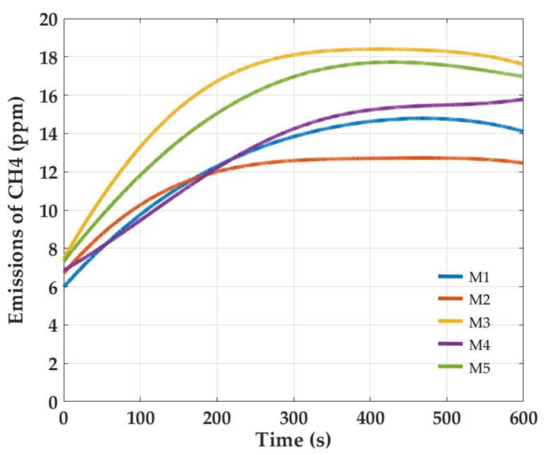
Figure 2.
Methane (CH4) emissions produced in the production phase.
The carbon dioxide (CO2) emissions for the manufacture of each mixture are shown in Figure 3. The results show that the highest emissions are recorded in the M3 mixture manufactured with PET, followed by nylon (M5). It is observed that the increase in this CO2 emission reaches more than 100% for PET, with respect to the conventional mixture (M1). The environmental problem generated by plastic production is well known. For every kilogram of PET produced, about 1.7 kg of CO2 are emitted into the atmosphere. It is logical that the increase in temperature in the mixing phase degrades the material to the point where CO2 emissions increase, compared to the rest of the mixtures. However, the degradation point is not so high that the physical properties of the plastic material are lost, so they still play a role in improving the durability and mechanical strength of the mixture.
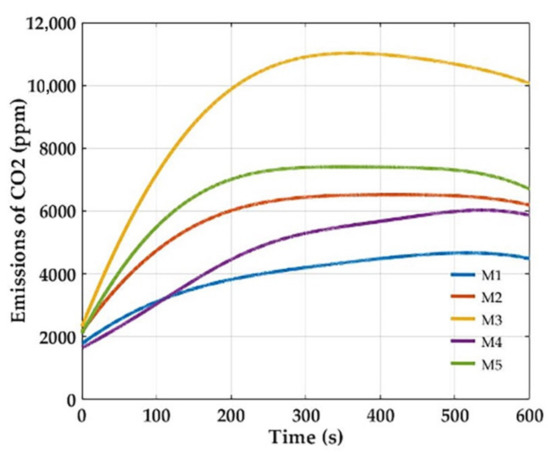
Figure 3.
Carbon dioxide (CO2) emissions produced in the production phase.
The samples with industrial by-products (M2 and M4) present CO2 emissions below 6000 ppm, showing differences of 33% with respect to the conventional mixture (M1). However, the trend of both mixtures shows a reduction of carbon dioxide over time.
Figure 4 shows the results obtained on carbon monoxide (CO) emissions for all the mixtures in the manufacturing process. It is evident that carbon monoxide (CO) emissions for the polymeric mixtures (M3 and M5) increase considerably with respect to the conventional mixture (M1), as is the case with CO2. In addition, an erratic curve is observed for the mixture with nylon (M5) due to the fact that its homogenization capacity is not continuous with the other materials in the mixing process. In the mixtures with copper slag and cellulose (M2 and M4), there is a reduction in the number of particles per million (ppm) of carbon monoxide (CO) emitted, where M2 shows an “abnormal” behaviour in the last minutes with respect to its previous state. This may be due to a calibration error.
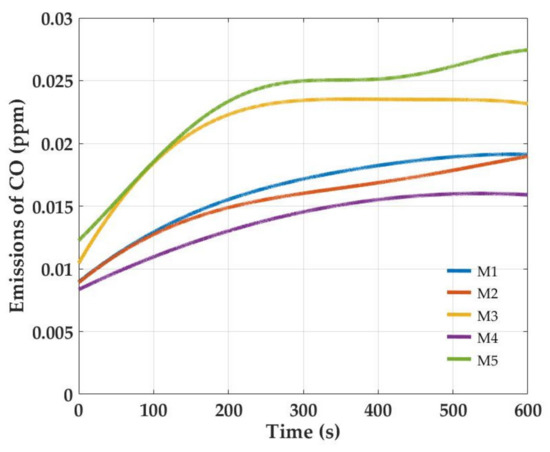
Figure 4.
Carbon monoxide (CO) emissions produced in the production phase.
To estimate the total gas emissions generated in phase 1 (production), it is necessary to take into account (1) emissions in the extraction stage of raw materials (aggregates and bituminous binder) and (2) emissions in the mixing stage. Table 8 shows the results obtained for methane gas (CH4) emissions.
Table 8.
Tons of methane (CH4) emitted during production phase.
The results show that the highest recorded methane emissions occur in the polymeric mixtures (M3 and M5). In a way, this is logical since this increase is due to the heating of their chemical compounds. Both are polymers consisting of molecules of hundreds of thousands of atoms. As their temperature increases, these molecules break down into small fragments, such as free radicals, free ions, H2 and CO. This is mainly due to covalent bonds and limited resistance that is overcome by heat [39,40]. In addition, carbon atoms easily establish double or triple bonds with each other (or with atoms of other species), giving rise to a large number of simple organic molecules called monomers. Smaller molecules are obtained from polymerization, which end up forming macromolecules.
Table 9 shows that the phase in which the greatest amount of carbon monoxide (CO) is emitted is binder production. However, the production of aggregates and the production of the asphalt mix are also relevant in phase 1.
Table 9.
Tons of carbon monoxide (CO) emitted during production phase.
Table 10 shows the results obtained on carbon dioxide (CO2) emissions in the production stage. The polymeric mixtures (M3 and M5) present a clear difference with the rest, even of almost 40% in the mixture with PET. This increase in CO2 in the atmosphere is due to the behaviour of the bonds of polymeric materials under the effect of temperature. Regarding the sample with copper slag (M2), there is an increase in emissions in the mixing stage. This is due to the fact that in the mixing stage, a greater energy is needed than in the conventional mixture (M1) because the copper slag absorbs a greater amount of binder.
Table 10.
Tons of carbon dioxide (CO2) emitted during production phase.
3.2. Construction Phase
In the construction phase, the total gases emitted into the atmosphere calculated from the tons of asphalt mixture used for the construction of 1 km of road and the emissions generated during the paving and compaction stage are considered.
Table 11 shows that all the mixtures show a similar trend. The predominant gas is carbon dioxide (CO2), exceeding the limit of 1.4 tons of carbon dioxide (CO2). It is observed that the mixtures with copper slag (M2) are those that emit a greater amount of CO2, although without departing from the conventional mixture.
Table 11.
Greenhouse gas emissions during construction phase.
In the production phase, the highest emissions of polluting gases into the atmosphere are recorded, based on the different types of mixtures manufactured in the laboratory. It is evident that the manufacturing process is very relevant when it comes to quantifying greenhouse gases to estimate the life cycle of a pavement. Once the production and construction phases are known, the global warming potential of the greenhouse gases obtained must be indicated. To do this, the carbon dioxide equivalent (CO2 equivalent) is calculated. This unit is recommended by the Intergovernmental Panel on Climate Change in its publication IPCC Guidelines for National Greenhouse Gas Inventories.
4. Discussion
The results obtained confirm that it is necessary to perform previous research studies for some recycling alternatives for polymeric materials such as PET and nylon. It has been found in our research that the greenhouse gases emitted into the atmosphere could cause increased environmental problems. For instance, the emission of carbon dioxide into the atmosphere triples compared to other recycled materials used for the same purpose. With regard to industrial by-products such as copper slag and cellulose ash, the opposite is observed. From the results obtained, it can be seen that the use of these materials minimises the impact caused by their disposal in the environment and the greenhouse gas emissions produced in the different phases are lower than those generated by conventional mixtures. Furthermore, the addition of these materials improves the durability of asphalt mixes and their mechanical properties, reducing permanent deformations and increasing their resistance to external conditions. However, in order to perform a complete analysis of the possible use of these industrial wastes and by-products in asphalt mixes, it is necessary to determine the potential impact on climate change and the time period for the gases to remain in the atmosphere. It will then be possible to ensure that the use of these materials is a real benefit or a disadvantage as a solution to the environmental impact.
Global Warming Potential (GWP)
The global warming impact is expressed as GHG emissions in kg of CO2 equivalent. The global warming potential (GWP) is a relative measure of how much heat can be trapped by a greenhouse gas in a given period of time compared to CO2. This magnitude takes into account the radiative efficiencies of different substances and their lifetime in the atmosphere. For example, the GWP of methane (CH4) for a 20-year horizon is 72, which means that if the same mass of carbon dioxide (CO2) and methane (CH4) is placed in the atmosphere, it will trap 72 times more heat than CO2 in the 20-year period considered [41]. Figure 5 shows the kilograms of carbon dioxide (CO2) equivalent obtained for each mixture during the life cycle analysis (LCA). The results show that asphalt mixtures with polyethylene terephthalate (PET) have great potential to affect climate change. The use of recycled materials or industrial by-products appears to have little effect on the global warming potential for phase 2 (construction). In fact, it could happen that for relatively long transport distances (in this case, 1500 km for copper slag), the use of these alternative materials could be unfavourable for the environment.
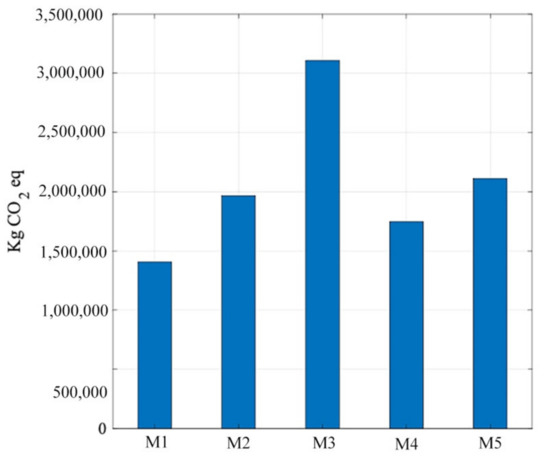
Figure 5.
Potential impact on climate change.
Photochemical ozone is a highly oxidizing substance; each ozone molecule is composed of three oxygen atoms and is highly toxic when found in large concentrations. This gas is one of those responsible for the greenhouse effect, which generates heat retention that has increased in recent times [42]. Photochemical smog appears in the form of a brownish haze that remains stationary when the weather is stable, since the air does not circulate and the pollution does not dissipate [43]. This is aggravated in valley areas or when the air in the upper layers is warmer than in the lower layers, since in these circumstances it tends to remain stagnant (thermal inversion). Pollution haze causes serious cardiorespiratory problems and it is believed that deaths from pollution-related problems exceed deaths due to road accidents [44].
Figure 6 shows the kilograms of ethylene equivalent (photochemical ozone) obtained for each mixture during the analysed stages of the life cycle. It is observed that mixtures that contain polyethylene terephthalate (M6) and nylon (M5) present the greatest potential for deterioration of the ozone layer since they emit more carbon monoxide (CO) and methane (CH4) compared to the other mixtures.
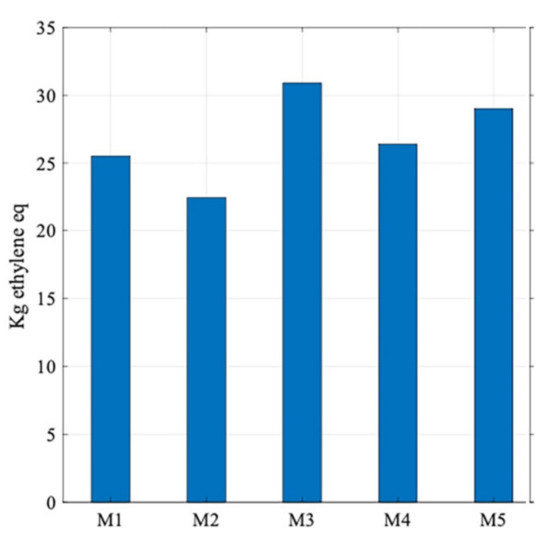
Figure 6.
Potential impact of photochemical ozone creation.
The emissions of polluting gases generated in the stages analysed will affect climate change and the production of smog. Pollutant gases remain in the atmosphere for a specified period at the rate of decomposition [37].
To determine the relevance of the impacts as a function of time, Figure 7 shows the normalized results of the number of years that climate change and smog (in air) will be affected according to the emissions of each mixture.
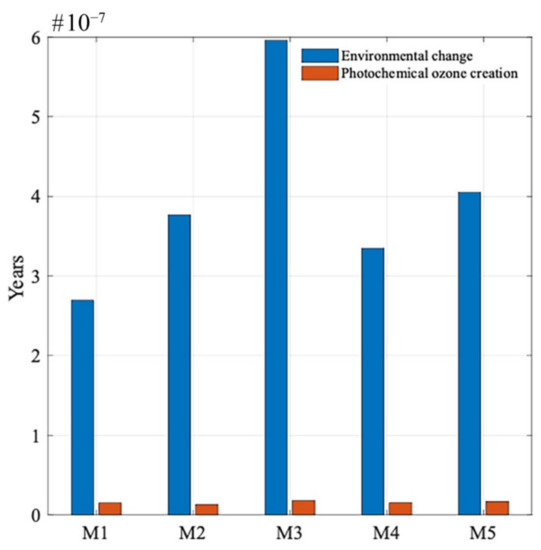
Figure 7.
Period of impact climate change and photochemical ozone creation (smog).
It is observed that the gases emitted into the atmosphere from mixtures with polymers (M3 and M5) will take longer to disappear. The mixtures made with industrial by-products (M2 and M4) do not present great differences with the conventional mixture (M1). This is due to the organic nature of the materials and their lower emission of polluting gases due to the effect of temperature. However, the emission of any polluting gas into the atmosphere will affect global warming, contributing to the increase in temperature of the planet and causing climate change. 10−7
5. Conclusions
The environmental impact generated in the production and construction phases of an asphalt pavement is analysed in this research. Five asphalt mixes made from different types of industrial waste and by-products are analysed. From the results obtained, it can be concluded that in the production phase, emissions of methane gas, carbon dioxide and carbon monoxide are increased and reduced, depending on the materials used in the asphalt mix. Regarding methane gas (CH4), mixtures with polymers have the highest emissions into the atmosphere: 21% for mixtures with PET and 14% for mixtures with nylon. On the other hand, the mixtures with copper slag and cellulose ash show a decrease in methane emissions of 12% compared to the conventional mixture. With regard to carbon dioxide emission, this increases considerably in all asphalt mixes. For the samples with copper slag, the CO2 increases by 44.5%. This is due to the fact that more energy is required, as the copper slag absorbs more bituminous binder than the conventional mix. For the mixes with cellulose ash, the lowest increase occurs (26%), while for the mixes with PET and nylon, the increase is significant (130% and 53%, respectively). In addition, CO2 from these polymer mixtures remains in the atmosphere for a longer period of time, negatively affecting climate change and the creation of photochemical ozone (smog). Therefore, it is concluded that their use is subject to their life cycle being longer than that of the rest of the modified and conventional mixes, as otherwise, they could cause greater damage to the environment compared to other possible alternatives. Finally, it was determined that the emission of carbon monoxide into the atmosphere during the production phase is similar in all the asphalt mixes analysed.
Author Contributions
Conceptualization, D.M.-Q., M.L.-V. and A.C.R.; methodology, D.M.-Q., M.L.-V. and A.C.R.; software, M.L.-V. and C.A.-V.; validation, D.M.-Q., M.L.-V. and A.C.R.; formal analysis; investigation, C.A.-V.; resources, D.M.-Q.; data curation, O.M.-C., V.C.A.-V.; writing—original draft preparation, D.M.-Q.; writing—review and editing, D.M.-Q.; visualization, O.M.-C. and V.C.A.-V.; supervision, D.M.-Q., A.C.R., M.L.-V., O.M.-C. and V.C.A.-V.; project administration, D.M.-Q.; funding acquisition, D.M.-Q. All authors have read and agreed to the published version of the manuscript.
Funding
This research was funded by FONDECYT Regular 2020, grant number 1201029 supported by the National Research and Development Agency (ANID) of Chile.
Institutional Review Board Statement
Not applicable.
Informed Consent Statement
Not applicable.
Acknowledgments
The authors gratefully acknowledge the institutional support provided by the Vice-Rectory for Research, Development and Artistic Creation of the University Austral of Chile (VIDCA UACh) and the pavements lab of the Faculty of Engineering Sciences UACh.
Conflicts of Interest
The authors declare no conflict of interest.
References
- Landi, D.; Marconi, M.; Bocci, E.; Germani, M. Comparative life cycle assessment of standard, cellulose-reinforced and end of life tires fiber-reinforced hot mix asphalt mixtures. J. Clean. Prod. 2020, 248, 119295. [Google Scholar] [CrossRef]
- Gonzalo-Orden, H.; Linares-Unamunzaga, A.; Pérez-Acebo, H.; Díaz-Minguela, J. Advances in the study of the behavior of Full-Depth Reclamation (FDR) with cement. Appl. Sci. 2019, 9, 3055. [Google Scholar] [CrossRef] [Green Version]
- Park, K.; Hwang, Y.; Seo, S.; Seo, H. Quantitative assessment of environmental impacts on life cycle of highways. J. Constr. Eng. Manag. 2003, 129, 25–31. [Google Scholar] [CrossRef]
- Ghezloun, A.; Saidane, A.; Merabet, H. The COP 22 New commitments in support of the Paris Agreement. Energy Procedia 2017, 119, 10–16. [Google Scholar] [CrossRef]
- Mallick, R.B.; Radzicki, M.J.; Zaumanis, M.; Frank, R. Use of system dynamics for proper conservation and recycling of aggregates for sustainable road construction. Resour. Conserv. Recycl. 2014, 86, 61–73. [Google Scholar] [CrossRef]
- Su, J.-F.; Qiu, J.; Schlangen, E.; Wang, Y.-Y. Investigation the possibility of a new approach of using microcapsules containing waste cooking oil: In situ rejuvenation for aged bitumen. Constr. Build. Mater. 2015, 74, 83–92. [Google Scholar] [CrossRef]
- Lesueur, D. The colloidal structure of bitumen: Consequences on the rheology and on the mechanisms of bitumen modification. Adv. Colloid Interface Sci. 2009, 145, 42–82. [Google Scholar] [CrossRef]
- Lizasoain-Arteaga, E.; Indacoechea-Vega, I.; Pascual-Muñoz, P.; Castro-Fresno, D. Environmental impact assessment of induction-healed asphalt mixtures. J. Clean. Prod. 2019, 208, 1546–1556. [Google Scholar] [CrossRef]
- Archondo-Callao, R. Roads Works Costs per km; World Bank Report: Washington, DC, USA, 2000. [Google Scholar]
- King, D.; Manville, M.; Shoup, D. The political calculus of congestion pricing. Transp. Policy 2007, 14, 111–123. [Google Scholar] [CrossRef] [Green Version]
- Jorquera, H. Ambient particulate matter in Santiago, Chile: 1989–2018: A tale of two size fractions. J. Environ. Manag. 2020, 258, 110035. [Google Scholar] [CrossRef]
- Romero, H.; Ihl, M.; Rivera, A.; Zalazar, P.; Azocar, P. Rapid urban growth, land-use changes and air pollution in Santiago, Chile. Atmos. Environ. 1999, 33, 4039–4047. [Google Scholar] [CrossRef]
- Mazzeo, A.; Huneeus, N.; Ordoñez, C.; Orfanoz-Cheuquelaf, A.; Menut, L.; Mailler, S.; Valari, M.; van der Gon, H.D.; Gallardo, L.; Muñoz, R. Impact of residential combustion and transport emissions on air pollution in Santiago during winter. Atmos. Environ. 2018, 190, 195–208. [Google Scholar] [CrossRef]
- Grassi, Y.S.; Brignole, N.B.; Díaz, M.F. Vehicular fleet characterisation and assessment of the on-road mobile source emission inventory of a Latin American intermediate city. Sci. Total Environ. 2021, 792, 148255. [Google Scholar] [CrossRef]
- Simsek, Y.; Sahin, H.; Lorca, Á.; Santika, W.G.; Urmee, T.; Escobar, R. Comparison of energy scenario alternatives for Chile: Towards low-carbon energy transition by 2030. Energy 2020, 206, 118021. [Google Scholar] [CrossRef]
- Mardones, C. Analysis on complementarity between a CO2 tax and an emissions trading system to reduce industrial emissions in Chile. Energy Environ. 2020. [Google Scholar] [CrossRef]
- Flores-Fernández, C. The Chilean energy “transition”: Between successful policy and the assimilation of a post-political energy condition. Innov. Eur. J. Soc. Sci. Res. 2020, 33, 173–193. [Google Scholar] [CrossRef]
- Salas, M.Á.; Pérez-Acebo, H.; Calderón, V.; Gonzalo-Orden, H. Bitumen modified with recycled polyurethane foam for employment in hot mix asphalt. Ing. Investig. 2018, 38, 60–66. [Google Scholar] [CrossRef]
- Thenoux, G.; Gonzalez, A.; Dowling, R. Energy consumption comparison for different asphalt pavements rehabilitation techniques used in Chile. Resour. Conserv. Recycl. 2007, 49, 325–339. [Google Scholar] [CrossRef]
- Goldemberg, J. The promise of clean energy. Energy Policy 2006, 34, 2185–2190. [Google Scholar] [CrossRef]
- Jahanbakhsh, H.; Karimi, M.M.; Naseri, H.; Nejad, F.M. Sustainable asphalt concrete containing high reclaimed asphalt pavements and recycling agents: Performance assessment, cost analysis, and environmental impact. J. Clean. Prod. 2020, 244, 118837. [Google Scholar] [CrossRef]
- Garraín, D.; Lechón, Y. Environmental footprint of a road pavement rehabilitation service in Spain. J. Environ. Manag. 2019, 252, 109646. [Google Scholar] [CrossRef]
- Carpenter, A.C.; Gardner, K.H.; Fopiano, J.; Benson, C.H.; Edil, T.B. Life cycle based risk assessment of recycled materials in roadway construction. Waste Manag. 2007, 27, 1458–1464. [Google Scholar] [CrossRef]
- Chiu, C.-T.; Hsu, T.-H.; Yang, W.-F. Life cycle assessment on using recycled materials for rehabilitating asphalt pavements. Resour. Conserv. Recycl. 2008, 52, 545–556. [Google Scholar] [CrossRef]
- Farina, A.; Zanetti, M.C.; Santagata, E.; Blengini, G.A. Life cycle assessment applied to bituminous mixtures containing recycled materials: Crumb rubber and reclaimed asphalt pavement. Resour. Conserv. Recycl. 2017, 117, 204–212. [Google Scholar] [CrossRef]
- Ferreira, V.J.; Vilaplana, A.S.-D.-G.; García-Armingol, T.; Aranda-Usón, A.; Lausín-González, C.; López-Sabirón, A.M.; Ferreira, G. Evaluation of the steel slag incorporation as coarse aggregate for road construction: Technical requirements and environmental impact assessment. J. Clean. Prod. 2016, 130, 175–186. [Google Scholar] [CrossRef]
- Marinković, S.B.; Ignjatović, I.; Radonjanin, V. Life-cycle assessment (LCA) of concrete with recycled aggregates (RAs). In Handbook of Recycled Concrete and Demolition Waste; Elsevier: Philadelphia, PA, USA, 2013; pp. 569–604. [Google Scholar]
- Mroueh, U.-M.; Eskola, P.; Laine-Ylijoki, J. Life-cycle impacts of the use of industrial by-products in road and earth construction. Waste Manag. 2001, 21, 271–277. [Google Scholar] [CrossRef]
- Movilla-Quesada, D.; Raposeiras, A.C.; Olavarría, J. Effects of Recycled Polyethylene Terephthalate (PET) on Stiffness of Hot Asphalt Mixtures. Adv. Civ. Eng. 2019, 2019. [Google Scholar] [CrossRef]
- Movilla-Quesada, D.; Raposeiras, A.C.; Silva-Klein, L.T.; Lastra-González, P.; Castro-Fresno, D. Use of plastic scrap in asphalt mixtures added by dry method as a partial substitute for bitumen. Waste Manag. 2019, 87. [Google Scholar] [CrossRef]
- Mohajerani, A.; Burnett, L.; Smith, J.V.; Markovski, S.; Rodwell, G.; Rahman, M.T.; Kurmus, H.; Mirzababaei, M.; Arulrajah, A.; Horpibulsuk, S. Recycling waste rubber tyres in construction materials and associated environmental considerations: A review. Resour. Conserv. Recycl. 2020, 155, 104679. [Google Scholar] [CrossRef]
- ISO. Environmental Management: Life Cycle Assessment; Requirements and Guidelines; ISO:14044; ISO: Madrid, Spain, 2006. [Google Scholar]
- ISO. Environmental Management—Life Cycle Assessment—Principles and Framework; ISO: 14040; ISO: Madrid, Spain, 2006. [Google Scholar]
- AzariJafari, H.; Yahia, A.; Amor, M. Ben Life cycle assessment of pavements: Reviewing research challenges and opportunities. J. Clean. Prod. 2016, 112, 2187–2197. [Google Scholar] [CrossRef]
- Ren, C.; Cao, S.-J. Implementation and visualization of artificial intelligent ventilation control system using fast prediction models and limited monitoring data. Sustain. Cities Soc. 2020, 52, 101860. [Google Scholar] [CrossRef]
- Movilla-Quesada, D.; Muñoz, O.; Raposeiras, A.C.; Castro-Fresno, D. Thermal suspectability analysis of the reuse of fly ash from cellulose industry as contribution filler in bituminous mixtures. Constr. Build. Mater. 2018, 160. [Google Scholar] [CrossRef] [Green Version]
- Naser, H.M.; Nagata, O.; Sultana, S.; Hatano, R. Carbon sequestration and contribution of CO2, CH4 and N2O fluxes to global warming potential from paddy-fallow fields on mineral soil beneath peat in Central Hokkaido, Japan. Agriculture 2020, 10, 6. [Google Scholar] [CrossRef] [Green Version]
- Ma, F.; Sha, A.; Lin, R.; Huang, Y.; Wang, C. Greenhouse gas emissions from asphalt pavement construction: A case study in China. Int. J. Environ. Res. Public Health 2016, 13, 351. [Google Scholar] [CrossRef]
- Arkhireyeva, A.; Hashemi, S. Effect of temperature on fracture properties of an amorphous poly (ethylene terephthalate) (PET) film. J. Mater. Sci. 2002, 37, 3675–3683. [Google Scholar] [CrossRef]
- Watanabe, M.; Yamaguchi, H. The friction and wear properties of nylon. Wear 1986, 110, 379–388. [Google Scholar] [CrossRef]
- IPCC. Cambio climático: Bases Físicas. Guía Resumida del Quinto Informe de Evaluación del IPCC; Grupo de Trabajo I; IPCC: Madrid, Spain, 2013. [Google Scholar]
- Derwent, R.G.; Jenkin, M.E.; Saunders, S.M.; Pilling, M.J.; Simmonds, P.G.; Passant, N.R.; Dollard, G.J.; Dumitrean, P.; Kent, A. Photochemical ozone formation in north west Europe and its control. Atmos. Environ. 2003, 37, 1983–1991. [Google Scholar] [CrossRef]
- Zhang, J.; Chen, Q.; Wang, Q.; Ding, Z.; Sun, H.; Xu, Y. The acute health effects of ozone and PM2. 5 on daily cardiovascular disease mortality: A multi-center time series study in China. Ecotoxicol. Environ. Saf. 2019, 174, 218–223. [Google Scholar] [CrossRef] [PubMed]
- Manisalidis, I.; Stavropoulou, E.; Stavropoulos, A.; Bezirtzoglou, E. Environmental and health impacts of air pollution: A review. Front. Public Health 2020, 8, 44. [Google Scholar] [CrossRef] [PubMed] [Green Version]
Publisher’s Note: MDPI stays neutral with regard to jurisdictional claims in published maps and institutional affiliations. |
© 2021 by the authors. Licensee MDPI, Basel, Switzerland. This article is an open access article distributed under the terms and conditions of the Creative Commons Attribution (CC BY) license (https://creativecommons.org/licenses/by/4.0/).