Abstract
This paper examines interlinkages and hedging opportunities between nine major cryptocurrencies from 30 September 2015 to 4 June 2020, a period which notably includes the COVID-19 outbreak lasting from early 2020 to the end of the sample period. Estimated time-varying correlation coefficients that are based on a TVP-VAR show a high degree of interconnectedness among cryptocurrencies throughout the sample period. Notably, the correlations reach their joint minimum during the COVID-19 pandemic indicating that cryptocurrencies acted as a hedge or safe haven during the stressful period of the COVID-19 pandemic. The cryptocurrency weights of the minimum connectedness portfolio were significantly reduced and their hedging effectiveness varied greatly during the pandemic, implying that investors’ preferences changed during the COVID-19 period.
JEL Classification:
F21; F65; G11; G15
1. Introduction
In recent years, cryptocurrencies have emerged as a new asset class and become an integral part of global financial markets [1]. Exponential growth has been observed in both its market capitalization and the number of digital coins available. Its market capitalization increased from around 128.8 billion USD in 2018 to 237.1 billion USD in 2019. At the start of 2015, the market capitalization shares of Bitcoin, the first cryptocurrency, was over 85% of the cryptocurrency market. Since the introduction of new cryptocurrencies such as Ethereum, Ripple, Steller, Dash, and Litecoin, Bitcoin’s market capitalization share started gradually decreasing, thus providing an insight into investors’ preferences for alternative cryptocurrencies. Today, over 1000 cryptocurrencies have attracted substantial academic interest in both theoretical and empirical fields. As a consequence, a number of studies have emerged that analyze the main characteristics of these newly created digital currencies, including their market efficiency [2,3,4,5,6,7], risk and returns [1,8,9,10,11,12], and diversification or hedging properties [13,14,15,16,17,18,19,20,21].
The outbreak of the COVID-19 pandemic created a strong contagion effect across global financial markets, leading to an immediate economic downturn and unprecedented levels of economic uncertainty. It currently poses exceptional health, economic, and financial stability challenges worldwide. Financial markets have witnessed a sharp decline in prices of numerous financial assets, as well as a deterioration in market liquidity and volatility spikes [22]. Consequently, academic literature examining the responses of various financial assets and markets to the pandemic is rapidly emerging [16,23,24,25,26,27,28,29,30].
The impact of COVID-19 is an unprecedented shock to the relatively new cryptocurrency market. Thus, cryptocurrency as a financial asset has not yet been proven to exhibit safe haven properties during periods of stress or crisis. Initial evidence suggests that cryptocurrencies have failed to present safe haven properties and hedging opportunities during the stressful COVID-19 pandemic period [24,31]. Given these findings, the effect of COVID-19 on cryptocurrency can be considered to have had a so-called ‘black swan effect’, triggering behavioral anomalies such as conditional and unconditional herding. Cryptocurrency markets are also closely linked to sustainability issues. The cryptocurrency market depends on the amount of energy used in the mining process and how environmentally friendly the asset is. For example, Ripple is known to be more energy-efficient than Bitcoin. These energy and environmental sustainability issues have greatly increased the volatility of cryptocurrency prices during the COVID-19 pandemic period.
Knowledge about cryptocurrencies their interlinkages is imperative for risk management, portfolio diversification, and hedging opportunities. Investors are interested in learning the degree of contagion risk when trading cryptocurrencies and choosing the best cryptocurrency to diversify their portfolio according to their risk preferences [32]. The major focus of long-term investors is on long-run market connectedness; speculators are concerned about the short-run market volatility, whereas hedgers are concerned about the highest degree of correlation in the medium to long term. With these goals in mind, this paper contributes to the literature on financial contagion by examining the impact of the COVID-19 pandemic on the interrelationship between the major cryptocurrencies and its implications on portfolio design.
This paper contributes to the existing literature in several ways. First, to the best of our knowledge, this is the first attempt to investigate the diversification/hedging properties of cryptocurrencies during the COVID-19 pandemic. Second, this paper discusses both the full sample results as well as the COVID-19 period results to enrich the analysis and identify changes in investor behavior attributable to the pandemic. Third, the current connectedness literature is refined and extended by employing a time-varying parameter vector autoregression (TVP-VAR) approach, which has advantages over the rolling-window connectedness approach proposed by Diebold and Yilmaz’s [33] in terms of size and power. Finally, this paper constructs both bivariate and multivariate dynamic portfolios by employing bivariate dynamic portfolios [34] and the recently developed minimum connectedness portfolio [35].
Empirical evidence using the TVP-VAR analysis demonstrates a high value of correlation between cryptocurrencies in early 2018 due to market uncertainty. Cryptocurrencies became more volatile during the COVID-19 period and have functioned like a safe haven during the pandemic. The weight of cryptocurrencies has been significantly reduced during the pandemic, indicating a change in investor preferences due to the COVID-19 period.
2. Materials and Methods
2.1. Data
We used daily data from nine cryptocurrencies—namely, Bitcoin (BTC), Ethereum (ETH), Stellar (XLM), Nem/New Economy Movement (XEM); Ripple (XRP), Litecoin (LTC), Dash (DASH), Monero (XMR), and Bitshares (BTS)—for the period between 30 September 2015 and 4 June 2020, including the COVID-19 pandemic period that started in early 2020 until the end of the sample period. The main reason for selecting this period was to ensure the availability of a balanced dataset without any missing observations. On 6 June 2020, the cryptocurrency market’s total capitalization was 276.1 billion USD; these nine cryptocurrencies cover 81.38% of the total market capitalization. We use cryptocurrency returns for empirical analysis because the prices exhibit non-stationary behavior [36]. The summary statistics of returns presented in Table 1 show that the mean returns vary between 0.075% (BTS) and 0.341% (ETH), and that all coins, except for ETH and BTC, exhibited a left-skewed tail. Interestingly, both the lowest and highest returns are observed in the case of XRP. In addition, the returns of selected cryptocurrencies follow a leptokurtic distribution.
Table 1.
Summary statistics.
2.2. Econometric Methods
In this paper, we explore the time-varying measures of portfolio diversification using a minimum connectedness approach [35]. The dynamic connectedness method was originally proposed by Diebold and Yilmaz [33,37] and is widely used by practitioners and researchers as it provides both static and dynamic spillover results due to a predetermined network. Under this approach, the vector autoregression (VAR) model is employed for static analysis while the rolling-window VAR approach is used for dynamic analysis. Antonakakis et al. [36] intensively discussed the setting of this framework and proposed the TVP-VAR-based dynamic connectedness. This framework highlights several advantages such as the fact that (i) no arbitrarily chosen window size needs to be selected, (ii) the network dynamics are estimated more accurately, (iii) it is less outlier sensitive, (iv) there is no loss of information, and (v) it can be employed for low-frequency datasets. We are employing a TVP-VAR model with a lag length of order one, as suggested by the Bayesian information criterion. This model can be outlined as follows:
where and are dimensional vectors, and are dimensional matrices, and are dimensional vectors, and is an dimensional matrix.
According to Wold representation theorem, the TVP-VAR model can be transformed to a time-varying parameter-vector moving average model (TVP-VMA) by using following equality: . This is essential as the time-varying VMA coefficients () of the TVP-VMA model are the cornerstone of Diebold and Yilmaz’s [37] connectedness approach which used -step-ahead (scaled) generalized forecast error variance decomposition (GFEVD) and proposed by Koop et al. [38] and Pesaran and Shin [39]. Hence, the GFEVD represents the influence that variable has on variable in terms of its forecast error variance share, which can be computed as follows:
where is a zero vector with unity on the th position. With and . The total directional connectedness of variable To (From) other variables is defined as
The net total directional connectedness illustrates the net transmitting ability of variable and is the difference between the total directional connectedness To and From others:
A net total directional connectedness that is positive implies that variable is a transmitter of shocks, whereas a negative value indicates that it is a net receiver of shocks.
The minimum connectedness portfolio [35] is based on the adjusted total connectedness index of [40,41] who have shown, using Monte Carlo simulations, that the original total connectedness index is within 0 and (m−1)/m and not within 0 and 1 as it should be. Hence, the adjusted —which is an indicator for market connectedness—is calculated by the following formula
If the is low (high) then the network interconnectedness, and hence the degree of shock spillovers, is low (high). High values are associated with high market risk and vice versa.
Finally, we compute the pairwise connectedness index which illustrates the bilateral connectedness between variable and using the following equation:
This value can be interpreted like the ; however, in this case, we specifically focus on the interconnectedness between two variables.
Following Broadstock et al. [35] the minimum connectedness portfolio is constructed as follows:
where illustrates the identity matrix.
An optimal portfolio weight that minimises risk without lowering expected returns is constructed using Kroner and Ng’s [34] approach. The optimal portfolio weight, , between cryptocurrency and is constructed using conditional covariance (), as follows:
where can be greater than one or less than zero. The following restrictions are imposed to overcome this disadvantage:
where is the weight of asset in a 1-USD portfolio based on two assets, and , at time . The second weight regarding asset is .
Following Kroner and Sultan [42], to minimise risk the optimal hedge ratio of two cryptocurrencies and is computed as follows:
where is a hedge ratio with a 1-USD long position in cryptocurrency and a 1-USD short position in cryptocurrency at time . is the conditional covariance between the returns on cryptocurrencies and , and is the conditional variance of cryptocurrency .
The hedge effectiveness index proposed by Ederington [43] is used to evaluate the performance of a hedged portfolio. is a comparison of risk between a hedged and an unhedged portfolio and can be written as:
where indicates the variance of the unhedged position of asset and is the variance of a hedged portfolio either from the optimal dynamic hedge ratio or the optimal dynamic portfolio weight strategy. A higher illustrates a larger reduction in the risk of the portfolio. Furthermore, we provide the level of significance using the test statistics suggested by Antonakakis et al. [44].
3. Discussion
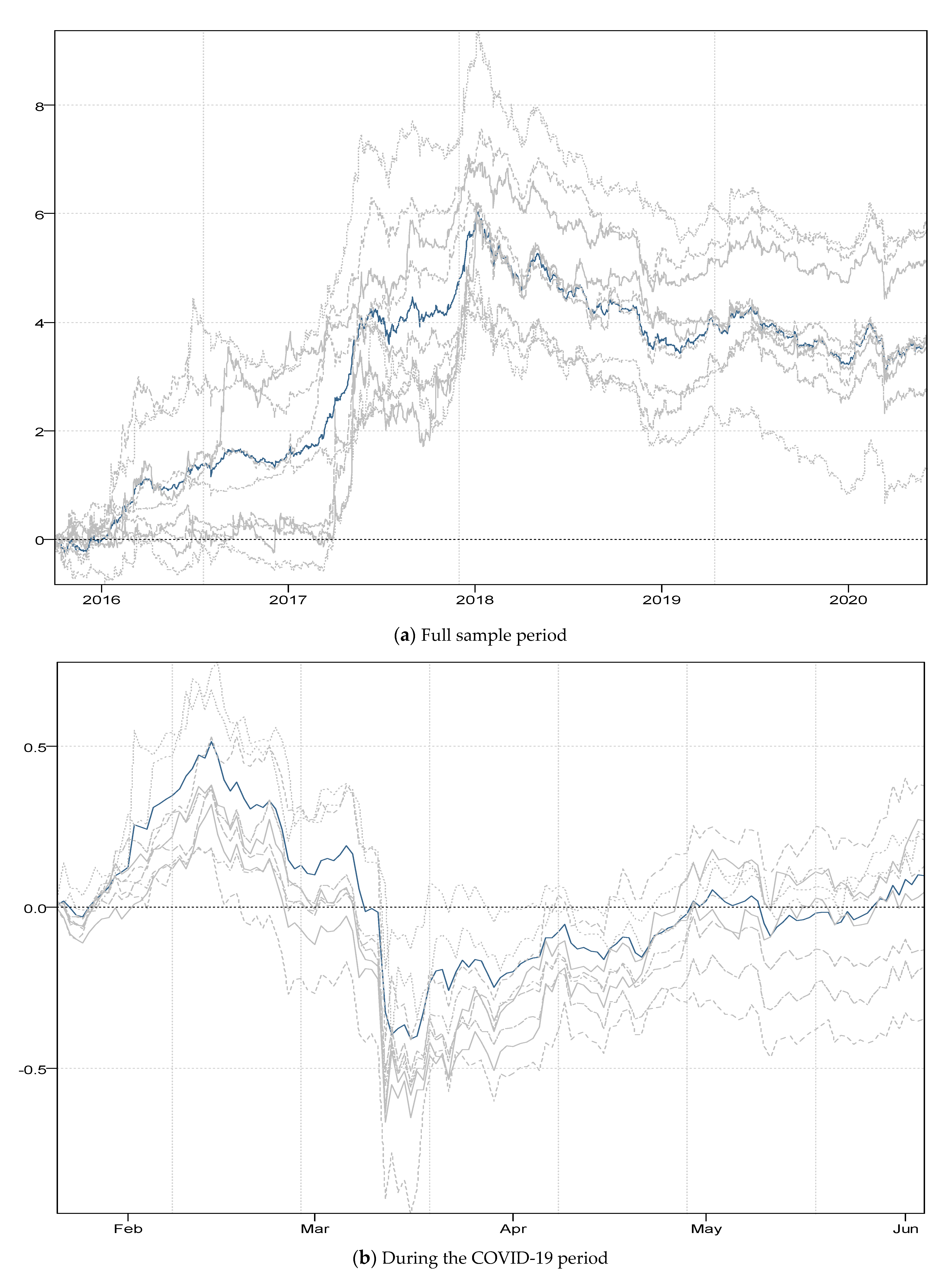
Given that the aim of this study is to examine the connectedness and hedging benefits of cryptocurrencies and investigate financial contagion due to the COVID-19 outbreak, it is imperative to examine the time-varying correlations based on the TVP-VAR method between the selected cryptocurrencies. The results for the full sample period, as well as for the COVID-19 pandemic period only, are presented in Figure 1. From Figure 1a, the time-varying correlation results clearly demonstrate the high value of correlations between cryptocurrencies in early 2018. The reason for this more pronounced connectedness between cryptocurrencies is market uncertainty that arose in early 2018 in response to the sharp collapse of Bitcoin. These findings are in line with Antonakakis et al. [36], who posited that market uncertainty was the main factor for increasing interdependence between cryptocurrencies. From Figure 1b, some interesting facts can be observed: (1) correlations between cryptocurrencies are positive from February to March 2020, with the highest values reached in mid-February 2020; (2) from March to June 2020, the correlations between most cryptocurrencies were negative; and (3) correlations reached minimum values in mid-March 2020. In other words, initially there were positive interdependence between cryptocurrencies but, with the increase in the number of reported COVID-19 cases and deaths, the interdependence became negative. This evidence implies that, at the beginning, cryptocurrencies functioned like a traditional asset but, after the increase in the negative effects of COVID-19, they began acting like a hedge. This evidence is similar to the findings of Demir et al. [16] who argued that cryptocurrencies act like a hedge during periods of uncertainty, but contradicts the findings of Conlon and McGee [31] and Corbet et al. [24] who asserted that cryptocurrencies do not act as hedges or safe havens during periods of economic and financial turmoil but rather function as amplifiers of contagion.
Figure 1.
Time-varying correlations.
Next, we estimate the optimal weights created by the minimum connectedness portfolio. The results are shown in Table 2. The weights assigned to cryptocurrencies show considerable volatility over the sample period. For example, the highest average weight is observed for BTS (17%) and the lowest average weight for Ethereum (6%). The highest value of hedging effectiveness is observed for the New Economy Movement (NEM) (73%), followed by Steller (72%) and BTS (69%). Similarly, during the COVID-19 period, the highest average weight and HE values of 29% and 69%, respectively, are observed for BTS.
Table 2.
Summary statistics of weights based on a minimum connectedness portfolio, September 2015–June 2020.
For additional clarity, we computed the bilateral portfolio weights and hedge ratios in the spirit of Kroner and Ng [34] and Kroner and Sultan [42]. The results are displayed in Table 3 and Table 4. From Table 3, for the full sample period, the lowest average weight (0.12) is observed for the XMR/BTC portfolio, indicating that investors preferred to hold BTC more than XMR. The highest average weight (0.88) is noted for BTC/XMR, demonstrating that, for a 1-USD portfolio, investors preferred to invest 0.88 cents in BTC and the remaining 0.12 cents in XMR. The highest HE of 72% is obtained for a portfolio composed of XLM/BTC, indicating that the introduction of BTC into a portfolio of cryptocurrencies significantly improves its risk return characteristics. Furthermore, the optimal weights are found to be time-varying throughout the sample period, implying that active portfolio management is required when investing in the cryptocurrency market. However, during the COVID-19 period, the cryptocurrencies become more volatile, as can be seen in the average optimal portfolio weights between pairs of cryptocurrencies which vary between 0.03 (ETH/XRP) and 0.97 (XRP/ETH), indicating that XRP has the highest optimal portfolio weight during the COVID-19 period. Thus, increased volatility within the bivariate portfolio weight during the COVID-19 period supports the argument that interconnectedness between cryptocurrencies facilitates portfolio and risk management techniques [36].
Table 3.
Summary statistics of bilateral portfolio weights, September 2015–June 2020.
Table 4.
Summary statistics of bilateral hedge ratios, September 2015–June 2020.
The optimal hedge ratios for both the full sample period and the COVID-19 period are presented in Table 4, demonstrating some interesting insights for portfolio design as most of the optimal hedge ratios changed significantly during the COVID-19 period. Some increased while others decreased. For example, the average hedge ratio for ETH/XLM increased from 0.45 during the full sample period to 1.05 during the COVID-19 period. Similarly, the average hedge ratio for BTS/XLM decreased from 0.22 in the full sample period to −0.02 in the COVID-19 period. A negative hedge ratio occurs when investors take either a long or short position in both cryptocurrencies [45]. Likewise, the volatility of HE increased during the COVID-19 period, supporting our previous results estimated by applying a minimum connectedness portfolio. This evidence is consistent with empirical studies that show higher hedge ratios during distress periods [23,36,46].
4. Conclusions
Investment in cryptocurrencies was considered to be a safe haven before the outbreak of the COVID-19 pandemic because previous empirical research on the adequacy of cryptocurrency lacked a significant period of financial turmoil in the global equities market to form an informed conclusion regarding its hedging qualities. This paper examined the interlinkages and hedging opportunities between nine cryptocurrencies—Bitcoin, Ethereum, Stellar, Nem/New Economy Movement, Ripple, Litecoin, Dash, Monero, and BTS—between 30 September 2015 and 4 June 2020. The study period notably included the COVID-19 outbreak period, which lasted from early 2020 to the end of the sample period. Thus, our paper sheds new light on the safe haven and diversification properties of cryptocurrencies for global investors.
The findings show a significant correlation between cryptocurrencies throughout the sample period and that cryptocurrencies do, in fact, function as hedges or safe havens during the stressful period of the COVID-19 pandemic. In addition, the weight of cryptocurrencies was significantly reduced, and their hedging effectiveness varied greatly during the pandemic, which indicates a change in investor preferences during the COVID-19 period. Finally, there is plenty of room for future research on the behavior of cryptocurrencies, especially during stress periods, because this is a promising field of study with ample applications that might influence contemporary financial markets. We can extend our study to involve the inclusion of other assets, such as equities, oils, and precious metals, with the cryptocurrencies to ensure a diversified portfolio.
Author Contributions
All the authors contributed to the entire process of writing this paper. S.N. and A.K.T. conceived the idea and designed the structure of this paper, S.N. collected and examined the data and A.K.T. devised the methodology, A.K.T. wrote the draft of Section 1, S.N. wrote Section 2 and Section 3, S.-M.Y. wrote Section 4, and S.-M.Y. reviewed and edited the manuscript and performed a final revision of the entire paper. All authors have read and agreed to the published version of the manuscript.
Funding
This work was supported by the Ministry of Education of the Republic of Korea and the National Research Foundation of Korea (NRF-2020S1A5B8103268).
Institutional Review Board Statement
Not applicable.
Informed Consent Statement
Not applicable.
Data Availability Statement
All sample data sets have been downloaded from Thompson Reuters Eikon. Restrictions apply to the availability of these data, which were used under license for this study. Data are available at (https://eikon.thomsonreuters.com, accessed on 10 June 2020) with the permission of Thomson Reuters Eikon.
Conflicts of Interest
The authors declare no conflict of interest.
Abbreviations
| USD | US dollars |
| TVP-VAR | time-varying parameter vector autoregression |
| COVID-19 | coronavirus disease 2019 |
| HE | hedge effectiveness index |
References
- Ji, Q.; Bouri, E.; Keung, C.; Lau, M.; Rauboud, D. Dynamic connectedness and integration in cryptocurrency markets. Int. Rev. Financ. Anal. 2019, 63, 257–272. [Google Scholar] [CrossRef]
- Brauneis, A.; Mestel, R. Price discovery of cryptocurrencies: Bitcoin and beyond. Econ. Lett. 2018, 165, 58–61. [Google Scholar] [CrossRef]
- Aggarwal, M.D. Do bitcoins follow a random walk model? Res. Econ. 2019, 73, 15–22. [Google Scholar] [CrossRef]
- Bundi, N.; Wildi, M. Bitcoin and market-(in)efficiency: A systematic time series approach. Digit. Financ. 2019, 1, 47–65. [Google Scholar] [CrossRef] [Green Version]
- Chaim, P.; Laurini, M. Is bitcoin a bubble? Phys. A 2019, 517, 222–232. [Google Scholar] [CrossRef]
- Zargar, F.N.; Kumar, D. Informational inefficiency of bitcoin: A study based on high-frequency data. Res. Int. Bus. Financ. 2019, 47, 344–353. [Google Scholar] [CrossRef]
- Tran, V.; Leirvik, T. Efficiency in the markets of crypto-currencies. Financ. Res. Lett. 2020, 35, 101382. [Google Scholar] [CrossRef]
- Ahelegbey, D.F.; Giudici, P.; Mojtahedi, F. Tail risk measurement in crypto-asset markets. Int. Rev. Financ. Anal. 2021, 73, 101604. [Google Scholar] [CrossRef]
- Caporale, G.M.; Zekokh, T. Modelling volatility of cryptocurrencies using Markov-switching GARCH models. Res. Int. Bus. Financ. 2019, 48, 143–155. [Google Scholar] [CrossRef]
- Katsiampa, P.; Corbet, S.; Lucey, B. Volatility spillover effects in leading cryptocurrencies: A BEKK-MGARCH analysis. Financ. Res. Lett. 2019, 29, 68–74. [Google Scholar] [CrossRef] [Green Version]
- Palamalai, S.; Maity, B. Return and volatility spillover effects in leading cryptocurrencies. Glob. Econ. J. 2019, 19, 1950017. [Google Scholar] [CrossRef]
- Moratis, G. Quantifying the spillover effect in the cryptocurrency market. Financ. Res. Lett. 2020, 38, 101534. [Google Scholar] [CrossRef]
- Bouri, E.; Jalkh, N.; Molnár, P.; Roubaud, D. Bitcoin for energy commodities before and after the December 2013 crash: Diversifier, hedge or safe haven? Appl. Econ. 2017, 49, 5063–5073. [Google Scholar] [CrossRef]
- Bouri, E.; Molnár, P.; Azzi, G.; Roubaud, D.; Hagfors, L.I. On the hedge and safe haven properties of bitcoin: Is it really more than a diversifier? Financ. Res. Lett. 2017, 20, 192–198. [Google Scholar] [CrossRef]
- Corbet, S.; Meegan, A.; Larkin, C.; Lucey, B.; Yarovaya, L. Exploring the dynamic relationships between cryptocurrencies and other financial assets. Econ. Lett. 2018, 165, 28–34. [Google Scholar] [CrossRef] [Green Version]
- Demir, E.; Bilgin, M.H.; Karabulut, G.; Doker, A.C. The relationship between cryptocurrencies and COVID-19 pandemic. Eurasian Econ. Rev. 2020, 10, 349–360. [Google Scholar] [CrossRef]
- Demiralay, S.; Golitsis, P. On the dynamic equicorrelations in cryptocurrency market. Q. Rev. Econ. Financ. 2021, 80, 524–533. [Google Scholar] [CrossRef]
- González, M.D.L.O.; Jareño, F.; Skinner, F.S. Asymmetric interdependencies between large capital cryptocurrency and gold returns during the COVID-19 pandemic crisis. Int. Rev. Financ. Anal. 2021, 76, 101773. [Google Scholar] [CrossRef]
- Guesmi, K.; Saadi, S.; Abid, I.; Ftiti, Z. Portfolio diversification with virtual currency: Evidence from bitcoin. Int. Rev. Financ. Anal. 2019, 63, 431–437. [Google Scholar] [CrossRef]
- Jiang, Y.; Wu, L.; Tian, G.; Nie, H. Do cryptocurrencies hedge against EPU and the equity market volatility during COVID-19?—New evidence from quantile coherency analysis. J. Int. Financ. Mark. Inst. Money 2021, 72, 101324. [Google Scholar] [CrossRef]
- Stensås, A.; Nygaard, M.F.; Kyaw, K.; Treepongkaruna, S. Can bitcoin be a diversifier, hedge or safe haven tool? Cogent Econ. Financ. 2019, 7, 1593072. [Google Scholar] [CrossRef]
- Gopinath, G. The Great Lockdown: Worst Economic Downturn Since the Great Depression. IMF Blog. Available online: https://blogs.imf.org/2020/04/14/the-great-lockdown-worst-economic-downturn-since-the-great-depression (accessed on 14 April 2020).
- Akhtaruzzaman, M.; Boubaker, S.; Lucey, B.M.; Sensoy, A. Is gold a hedge or safe haven asset during COVID-19 crisis? Econ. Model. 2021, 105588, forthcoming. [Google Scholar] [CrossRef]
- Corbet, S.; Larkin, C.; Lucey, B. The contagion effects of the COVID-19 pandemic: Evidence from gold and cryptocurrencies. Financ. Res. Lett. 2020, 35, 101554. [Google Scholar] [CrossRef]
- Goodell, J.W.; Goutte, S. Co-movement of COVID-19 and bitcoin: Evidence from wavelet coherence analysis. Financ. Res. Lett. 2021, 38, 101625. [Google Scholar] [CrossRef]
- Liu, H.Y.; Manzoor, A.; Wang, C.Y.; Zhang, L.; Manzoor, Z. The COVID-19 outbreak and affected countries stock markets response. Int. J. Environ. Res. Public Health 2020, 17, 2800. [Google Scholar] [CrossRef] [Green Version]
- Sharif, A.; Aloui, C.; Yarovaya, L. COVID-19 Pandemic, oil prices, stock market, geopolitical risk and policy uncertainty nexus in the US economy: Fresh evidence from the wavelet-based approach. Int. Rev. Financ. Anal. 2020, 70, 101496. [Google Scholar] [CrossRef]
- Vidal-Tomás, D. Transitions in the cryptocurrency market during the COVID-19 pandemic: A network analysis. Financ. Res. Lett. 2021, 101981, forthcoming. [Google Scholar] [CrossRef]
- Yarovaya, L.; Brzeszczynski, J.; Goodell, J.W.; Lucey, B.M.; Lau, C.K. Rethinking financial contagion: Information transmission mechanism during the COVID-19 pandemic. SSRN Electron. J. 2020. [Google Scholar] [CrossRef]
- Zhang, D.; Hu, M.; Ji, Q. Financial markets under the global pandemic of COVID-19. Financ. Res. Lett. 2020, 36, 101528. [Google Scholar] [CrossRef]
- Conlon, T.; Mcgee, R. Safe haven or risky hazard? Bitcoin during the COVID-19 bear market. Financ. Res. Lett. 2020, 35, 101607. [Google Scholar] [CrossRef] [PubMed]
- Kouttmos, D. Return and volatility spillovers among cryptocurrencies. Econ. Lett. 2018, 173, 122–127. [Google Scholar] [CrossRef]
- Diebold, F.X.; Yilmaz, K. Better to give than to receive: Predictive directional measurement of volatility spillovers. Int. J. Forecast. 2012, 28, 57–66. [Google Scholar] [CrossRef] [Green Version]
- Kroner, K.F.; Ng, V.K. Modeling asymmetric comovement of asset returns. Rev. Financ. Stud. 1998, 11, 817–844. [Google Scholar] [CrossRef]
- Broadstock, D.C.; Chatziantoniou, I.; Gabauer, D. Minimum Connectedness Portfolios and the Market for Green Bonds: Advocating Socially Responsible Investment (SRI) Activity. SSRN Electron. J. 2020. [Google Scholar] [CrossRef]
- Antonakakis, N.; Chatziantoniou, I.; Gabauer, D. Cryptocurrency market contagion: Market uncertainty, market complexity, and dynamic portfolios. J. Int. Financ. Mark. Inst. Money 2019, 61, 37–51. [Google Scholar] [CrossRef] [Green Version]
- Diebold, F.X.; Yılmaz, K. On the network topology of variance decompositions: Measuring the connectedness of financial firms. J. Econom. 2014, 182, 119–134. [Google Scholar] [CrossRef] [Green Version]
- Koop, G.; Pesaran, M.H.; Potter, S.M. Impulse response analysis in nonlinear multivariate models. J. Econom. 1996, 74, 119–147. [Google Scholar] [CrossRef]
- Pesaran, H.H.; Shin, Y. Generalized impulse response analysis in linear multivariate models. Econ. Lett. 1998, 58, 17–29. [Google Scholar] [CrossRef]
- Chatziantoniou, I.; Gabauer, D. EMU risk-synchronisation and financial fragility through the prism of dynamic connectedness. Q. Rev. Econ. Financ. 2021, 79, 1–14. [Google Scholar] [CrossRef]
- Gabauer, D. Dynamic measures of asymmetric & pairwise connectedness within an optimal currency area: Evidence from the ERM I system. J. Multinatl. Financ. Manag. 2021, 60, 100680. [Google Scholar]
- Kroner, K.F.; Sultan, J. Time-varying distributions and dynamic hedging with foreign currency futures. J. Financ. Quant. Anal. 1993, 28, 535–551. [Google Scholar] [CrossRef]
- Ederington, L.H. The hedging performance of the new futures markets. J. Financ. 1979, 34, 157–170. [Google Scholar] [CrossRef]
- Antonakakis, N.; Cunado, J.; Filis, G.; Gabauer, D.; de Gracia, F.P. Oil and asset classes implied volatilities: Investment strategies and hedging effectiveness. Energy Econ. 2020, 91, 104762. [Google Scholar] [CrossRef]
- Bonga-Bonga, L.; Umoetok, E. The effectiveness of index futures hedging in emerging markets during the crisis period of 2008-2010: Evidence from South Africa. Appl. Econ. 2016, 48, 3999–4018. [Google Scholar] [CrossRef] [Green Version]
- Batten, J.A.; Kinateder, H.; Szilagyi, P.G.; Wagner, N.F. Hedging stock with oil. Energy Econ. 2021, 93, 104422. [Google Scholar] [CrossRef]
Publisher’s Note: MDPI stays neutral with regard to jurisdictional claims in published maps and institutional affiliations. |
© 2021 by the authors. Licensee MDPI, Basel, Switzerland. This article is an open access article distributed under the terms and conditions of the Creative Commons Attribution (CC BY) license (https://creativecommons.org/licenses/by/4.0/).