Digital Identity Management on Social Media: Exploring the Factors That Influence Personal Information Disclosure on Social Media

 ,
,
Abstract
1. Introduction
2. Background and Related Work
2.1. Overview of Social Media
2.2. Self Disclosure
2.3. Digital Identity Management
2.4. User Concerns on Social Media
3. Conceptual Framework
4. Methods
5. Discussion of Results
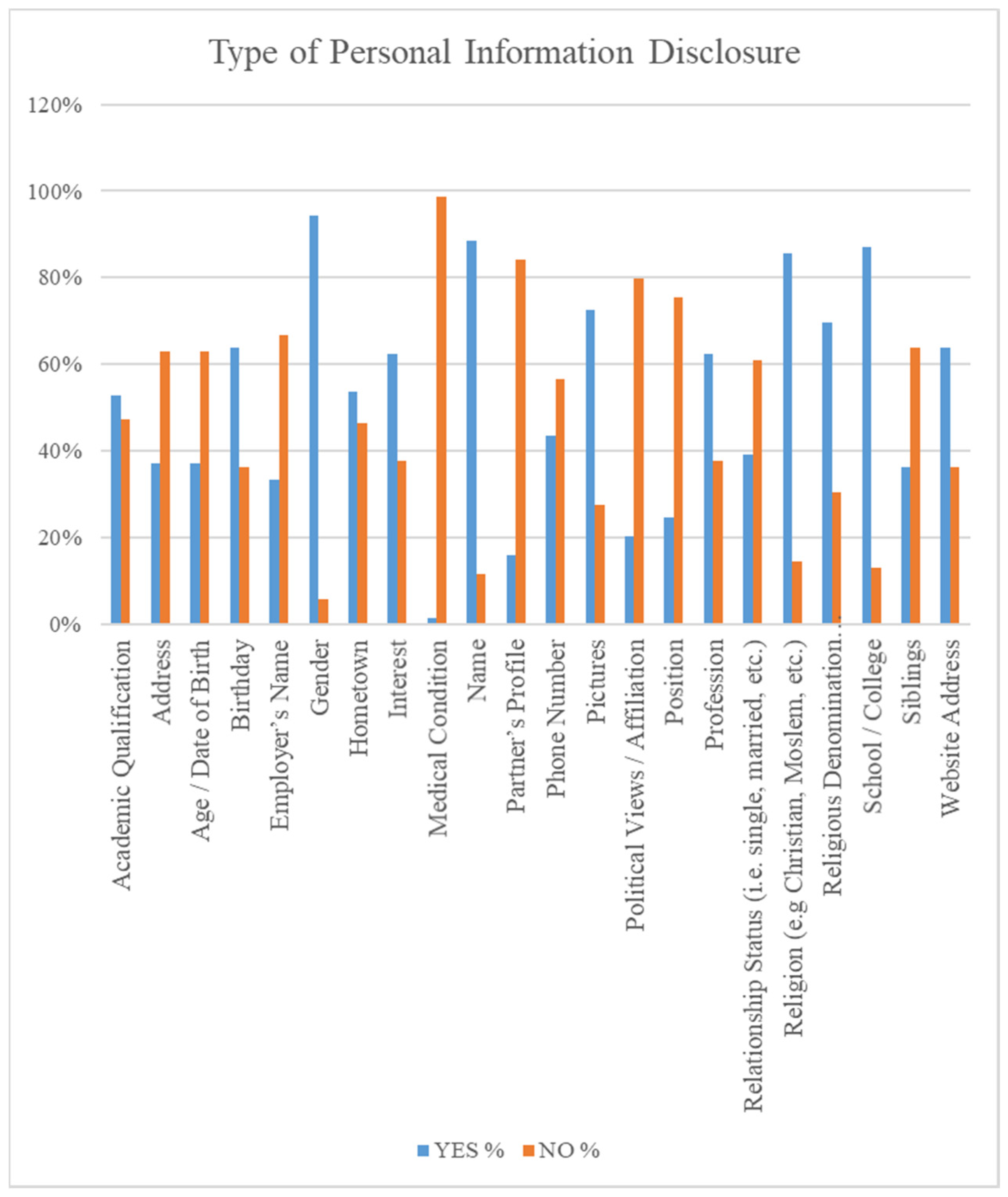
“My father used my posts on Instagram to detect a guy I was dating, it was not easy for me. Since I posted a video of a school party on Facebook, some of my relatives have accused me of being a spoilt child so I have deleted such videos from my account a certain guy started sending me suggestive pictures and even tried to blackmail me into sleeping with him. Apparently, he found my contact details on Facebook. I have since deleted my contact details and changed my cell phone number. These days I only share information with only those I know. I do not make them public.”
“I usually to use nicknames on social media instead of my actual name. Even some of my close relatives do not know my Facebook account” some of my friends do not know that I am very active on social media because I do not post picture”. “I only share birthday and party photos with friends on social media using nicknames.”
“I suspect that what I say on social media and the type of friends that I engage with on social media can affect my chances of getting a visa to certain countries”. I have noticed that whenever I change my photo on LinkedIn, the system suggest friends with similar features to me. I am forced to change my picture of LinkedIn because I suspect potential employers might not take me seriously.”
6. Conclusions and Further Work
Author Contributions
Funding
Conflicts of Interest
References
- Mohale, G.T. The Implications of Social Media Use on Development in Africa: A Development Theory Perspective. Glob. J. Manag. Bus. Res. 2020, 20, 63–72. [Google Scholar] [CrossRef] [Scilit]
- Frøyen, I.W. Sometimes It’s Not a Switch, It’sa Dial: An Analysis of the Genderqueer Narrative in Symptoms of Being Human, and the Effects of Genderqueer Representation in Young Adult Literature. Master’s Thesis, University of Oslo, Oslo, Norway, 2019. [Google Scholar]
- Li, H.; Luo, X.R.; Zhang, J.; Xu, H. Resolving the privacy paradox: Toward a cognitive appraisal and emotion approach to online privacy behaviors. Inf. Manag. 2017, 54, 1012–1022. [Google Scholar] [CrossRef] [Scilit]
- Yu, L.; Li, H.; He, W.; Wang, F.-K.; Jiao, S. A meta-analysis to explore privacy cognition and information disclosure of internet users. Int. J. Inf. Manag. 2020, 51, 102015. [Google Scholar] [CrossRef] [Scilit]
- Pavlou, P.A. State of the Information Privacy Literature: Where are We Now and Where Should We Go? MIS Q. 2011, 35, 977. [Google Scholar] [CrossRef] [Scilit]
- Kemp, S. The Global State of Digital in October 2019. We Are Social. 2019. Available online: https://wearesocial.com/blog/2019/10/the-global-state-of-digital-in-october-2019 (accessed on 15 July 2020).
- Gagné, M.; Deci, E.L. Self-determination theory and work motivation. J. Organ. Behav. 2005, 26, 331–362. [Google Scholar] [CrossRef] [Scilit]
- Dzisah, W.S. Social Media and Participation in Ghana’s 2016 Elections. In Social Media and Elections in Africa; Ndlela, M., Mano, W., Eds.; Palgrave Macmillan: Cham, Switzerland, 2020; Volume 1, pp. 97–118. [Google Scholar]
- Yoon, C.; Hwang, J.W.; Kim, R. Exploring factors that influence students’ behaviors in information security. J. Inf. Syst. Educ. 2019, 23, 7. [Google Scholar]
- Mahalle, P.; Babar, S.; Prasad, N.R.; Prasad, R. Identity Management Framework towards Internet of Things (IoT): Roadmap and Key Challenges. In Recent Trends in Network Security and Applications. CNSA 2010. Communications in Computer and Information Science; Meghanathan, N., Boumerdassi, S., Chaki, N., Nagamalai, D., Eds.; Springer: Berlin/Heidelberg, Germany, 2010; Volume 89. [Google Scholar] [CrossRef] [Scilit]
- Bellini, F.; D’Ascenzo, F.; Dulskaia, I.; Savastano, M. Digital Identity: A Case Study of the ProCIDA Project. In Exploring Digital Ecosystems; Lazazzara, A., Ricciardi, F., Za, S., Eds.; Springer: Cham, Switzerland, 2020; pp. 315–327. [Google Scholar]
- Shibuya, K. Identity Protection. In Digital Transformation of Identity in the Age of Artificial Intelligence; Shibuya, K., Ed.; Springer: Singapore, 2020; pp. 73–88. [Google Scholar]
- Syed, R.; Dhillon, G.; Merrick, J. The Identity Management Value Model: A Design Science Approach to Assess Value Gaps on Social Media. Decis. Sci. 2018, 50, 498–536. [Google Scholar] [CrossRef] [Scilit]
- Chang, C.-W.; Heo, J. Visiting theories that predict college students’ self-disclosure on Facebook. Comput. Hum. Behav. 2014, 30, 79–86. [Google Scholar] [CrossRef] [Scilit]
- Joinson, A.N.; Reips, U.-D.; Buchanan, T.; Schofield, C.B.P. Privacy, Trust, and Self-Disclosure Online. Hum. Comput. Interact. 2010, 25, 1–24. [Google Scholar] [CrossRef] [Scilit]
- Metzger, M.J. Privacy, Trust, and Disclosure: Exploring Barriers to Electronic Commerce. J. Comput. Commun. 2006, 9, JCMC942. [Google Scholar] [CrossRef] [Scilit]
- Haddouti, S.E.; Kettani, M.D.E.C.E. Towards an interoperable identity management framework: A comparative study. arXiv 2019, arXiv:1902.11184. [Google Scholar]
- Windley, P.J. Digital Identity: Unmasking identity management architecture (IMA); Springer: Berlin, Germany, 2005; p. 52. [Google Scholar]
- Statista. Global Social Media Ranking 2018. Statistic. Statista. 2018. Available online: https://www.statista.com/statistics/272014/global-social-networks-ranked-by-number-of-users/ (accessed on 20 August 2020).
- Tsay-Vogel, M.; Shanahan, J.; Signorielli, N. Social media cultivating perceptions of privacy: A 5-year analysis of privacy attitudes and self-disclosure behaviors among Facebook users. New Media Soc. 2016, 20, 141–161. [Google Scholar] [CrossRef] [Scilit]
- Cao, J.; Basoglu, K.A.; Sheng, H.; Lowry, P.B. A systematic review of social networking research in information systems. Commun. Assoc. Inf. Syst. 2015, 36, 727–758. [Google Scholar]
- Andzulis, J.M.; Panagopoulos, N.G.; Rapp, A. A Review of Social Media and Implications for the Sales Process. J. Pers. Sell. Sales Manag. 2012, 32, 305–316. [Google Scholar] [CrossRef] [Scilit]
- Boyd, D.M.; Ellison, N.B. Social Network Sites: Definition, History, and Scholarship. J. Comput. Commun. 2007, 13, 210–230. [Google Scholar] [CrossRef] [Scilit]
- Ploof, R. Johnson & Johnson Does New Media. 2009. Available online: http://ronamok.com/ebooks/jnj_case_study■pdf (accessed on 20 August 2020).
- Harlow, S. Social media and social movements: Facebook and an online Guatemalan justice movement that moved offline. New Media Soc. 2011, 14, 225–243. [Google Scholar] [CrossRef] [Scilit]
- Bélanger, F.; Crossler, R.E. Privacy in the Digital Age: A Review of Information Privacy Research in Information Systems. MIS Q. 2011, 35, 1017–1042. [Google Scholar] [CrossRef] [Scilit]
- Malhotra, N.K.; Kim, S.S.; Agarwal, J. Internet Users’ Information Privacy Concerns (IUIPC): The Construct, the Scale, and a Causal Model. Inf. Syst. Res. 2004, 15, 336–355. [Google Scholar] [CrossRef] [Scilit]
- Sajithra, K.; Patil, R. Social Media—History and Components. J. Bus. Manag. 2013, 7, 69–74. [Google Scholar] [CrossRef] [Scilit]
- Boyd, D.; Ellison, N.B. Social network sites: Definition, history, and scholarship. IEEE Eng. Manag. Rev. 2010, 38, 16–31. [Google Scholar] [CrossRef] [Scilit]
- Leader-Chivee, L.; Hamilton, B.A.; Cowan, E. Networking the way to success: Online social networks for workplace and competitive advantage. People Strategy 2008, 31, 40. [Google Scholar]
- Neumann, M.; O’Murchu, I.; Breslin, J.; Decker, S.; Hogan, D.; Macdonaill, C. Semantic social network portal for collaborative online communities. J. Eur. Ind. Train. 2005, 29, 472–487. [Google Scholar] [CrossRef] [Scilit]
- Asongu, S.A.; Le Roux, S.; Nwachukwu, J.C.; Pyke, C. The mobile phone as an argument for good governance in sub-Saharan Africa. Inf. Technol. People 2019, 32, 897–920. [Google Scholar] [CrossRef] [Scilit]
- Boateng, A.B.; McCracken, D.P.; Lubombo, M. Intra-Party Election Campaigns in Ghana: An Analysis of Facebook Use. In Social Media and Elections in Africa; Ndlela, M., Mano, W., Eds.; Palgrave Macmillan: Cham, Switzerland, 2020; Volume 1, pp. 215–232. [Google Scholar]
- Shahbaz, A.; Funk, A. Freedom on the Net; The Crisis of Social Media; Freedom House: Washington, DC, USA, 2019. [Google Scholar]
- Dwyer, M.; Molony, T. Analysis across Africa Shows How Social Media is Changing Politics. 2019. Available online: https://theconversation.com/analysis-across-africa-shows-how-social-media-is-changing-politics-121577 (accessed on 16 August 2020).
- Ndlela, M.N.; Mano, W. (Eds.) The Changing Face of Election Campaigning in Africa. In Social Media and Elections in Africa; Palgrave Macmillan: Cham, Switzerland, 2020; Volume 1, pp. 1–12. [Google Scholar]
- Kamp, M. (Ed.) Assessing the Impact of Social Media on Political Communication and Civic Engagement in Uganda; Uganda Programme, Konrad Adenauer-Stiftung: Kampala, Uganda, 2016; Available online: http://www.kas.de/wf/doc/kas_43976-1522-2-30.pdf?160125084552/ (accessed on 20 August 2020).
- Ratten, V. Social media innovations and creativity. In Revolution of Innovation Management; Brem, A., Viardot, E., Eds.; Palgrave Macmillan: London, UK, 2017; pp. 199–220. [Google Scholar]
- Hamel, G.; Sampler, J. The e-Corporation. Fortune 1998, 138, 80–87. [Google Scholar]
- Derlega, V.J.; Berg, J.H. Perspectives in Social Psychology. Self-Disclosure: Theory, Research, and Therapy; Plenum Press: New York, NY, USA, 1987; Available online: https://www.springer.com/gp/book/9780306426353 (accessed on 20 August 2020).
- Zhang, S.; Kwok, R.C.-W.; Lowry, P.B.; Liu, Z. Does more accessibility lead to more disclosure? Exploring the influence of information accessibility on self-disclosure in online social networks. Inf. Technol. People 2019, 32, 754–780. [Google Scholar] [CrossRef] [Scilit]
- Nosko, A.; Wood, E.; Molema, S. All about me: Disclosure in online social networking profiles: The case of Facebook. Comput. Hum. Behav. 2010, 26, 406–418. [Google Scholar] [CrossRef] [Scilit]
- Fishbein, M.; Ajzen, I. Belief, Attitude, Intention, and Behavior: An Introduction to Theory and Research; Addison-Wesley: Reading, MA, USA, 1975. [Google Scholar]
- Kankanhalli, A.; Tan, B.C.Y.; Wei, K.-K. Contributing knowledge to electronic knowledge repositories: An empirical investigation. MIS Q. 2005, 29, 113–144. [Google Scholar] [CrossRef] [Scilit]
- Shtatfeld, R.; Barak, A. Factors related to initiating interpersonal contacts on Internet dating sites: A view from the social exchange theory. Interpersona Int. J. Pers. Relatsh. 2009, 3, 19–37. [Google Scholar] [CrossRef] [Scilit]
- Krasnova, H.; Spiekermann, S.; Koroleva, K.; Hildebrand, T. Online social networks: Why we disclose. J. Inf. Technol. 2010, 25, 109–125. [Google Scholar] [CrossRef] [Scilit]
- Altman, I. The Environment and Social Behavior: Privacy, Personal Space, Territory, and Crowding; Brooks/Cole Publishing Company: Monterey, CA, USA, 1975. [Google Scholar]
- Petronio, S. Boundaries of Privacy: Dialectics of Disclosure (SUNY Series in Communication Studies.); State University of New York Press: New York, NY, USA, 2002; p. 6. [Google Scholar]
- Ajzen, I.; Fishbein, M. Attitudinal and normative variables as predictors of specific behavior. J. Personal. Soc. Psychol. 1973, 27, 41. [Google Scholar] [CrossRef] [Scilit]
- Ajzen, I. (Ed.) From intentions to actions: A theory of planned behavior. In Action Control; Springer: Berlin/Heidelberg, Germany, 1985; pp. 11–39. [Google Scholar]
- Katz, E.; Blumler, J.G.; Gurevitch, M. Uses and gratifications research. Public Opin. Q. 1973, 37, 509–523. [Google Scholar] [CrossRef] [Scilit]
- Hoffman, D.L.; Novak, T.P.; Peralta, M.A. Information privacy in the marketspace: Implications for the commercial uses of anonymity on the Web. Inf. Soc. 1999, 15, 129–139. [Google Scholar]
- Jarvenpaa, S.L.; Tractinsky, N.; Saarinen, L. Consumer trust in an Internet store: A cross-cultural validation. J. Comput. Mediat. Commun. 1999, 526, 5. [Google Scholar] [CrossRef] [Scilit]
- Jarvenpaa, S.L.; Staples, D.S. The use of collaborative electronic media for information sharing: An exploratory study of determinants. J. Strateg. Inf. Syst. 2000, 9, 129–154. [Google Scholar] [CrossRef] [Scilit]
- Swaminathan, V.; Lepkowska-White, E.; Rao, B.P. Browsers or buyers in cyberspace? An investigation of factors influencing electronic exchange. J. Comput. Mediat. Commun. 1999. [Google Scholar] [CrossRef] [Scilit]
- Jourard, S.M. The Transparent Self; Van Nostrand Reinhold Company: New York, NY, USA, 1971; ISBN 0-442-24192-5. [Google Scholar]
- Rubin, Z. Disclosing oneself to a stranger: Reciprocity and its limits. J. Exp. Soc. Psychol. 1975, 11, 233–260. [Google Scholar] [CrossRef] [Scilit]
- Steel, J.L. Interpersonal correlates of trust and self-disclosure. Psychol. Rep. 1991, 68, 1319–1320. [Google Scholar] [CrossRef] [Scilit]
- Wheeless, L.R.; Grotz, J. The measurement of trust and its relationship to self-disclosure. Hum. Commun. Res. 1977, 3, 250–257. [Google Scholar] [CrossRef] [Scilit]
- Ayed, G.B. Architecting User-Centric Privacy-as-a-Set-of-Services: Digital Identity-Related Privacy Framework; Springer: Geneva, Switzerland, 2014. [Google Scholar]
- Wilton, R. Identity and privacy in the digital age. Int. J. Intellect. Prop. Manag. 2008, 2, 411. [Google Scholar] [CrossRef] [Scilit]
- Bertino, E. Trusted Identities in Cyberspace. IEEE Internet Comput. 2012, 16, 3–6. [Google Scholar] [CrossRef] [Scilit]
- Linn, A.; Boyle, J.; McVey, M.; McKerlie, R.; Noble-Jones, R.; Dowell, F.; McLeod, G.; Copsey, D.; Murray, J.-A. Digital Identity: Understanding How Students View their Digital Identity Working in Partnership with Students to Develop a Positive Digital Identity; Enlighten Publications: Glasgow, UK, 2017. [Google Scholar]
- Clarke, R. The digital persona and its application to data surveillance. Inf. Soc. 1994, 10, 77–92. [Google Scholar] [CrossRef] [Scilit]
- Roussos, G.; Peterson, D.; Patel, U. Mobile identity management: An enacted view. Int. J. Electron. Commer. 2003, 8, 81–100. [Google Scholar] [CrossRef] [Scilit]
- Crompton, M. Proof of ID Required? Getting Identity Management Right; Australian IT Security Forum, 2004; Available online: https://www.vs.inf.ethz.ch/edu/SS2005/DS/papers/identity/crompton_proof_of_id.pdf (accessed on 20 August 2020).
- Heyman, R.; De Wolf, R.; Pierson, J. Evaluating social media privacy settings for personal and advertising purposes. Info 2014, 16, 18–32. [Google Scholar] [CrossRef] [Scilit]
- Cameron, K. The laws of identity. Microsoft Corp 2005, 12, 8–11. [Google Scholar]
- Rahaman, A.; Sasse, M.A. A framework for the lived experience of identity. Identit. Inf. Soc. 2010, 3, 605–638. [Google Scholar] [CrossRef] [Scilit]
- Chatzakou, D.; Soler-Company, J.; Tsikrika, T.; Wanner, L.; Vrochidis, S.; Kompatsiaris, I. User Identity Linkage in Social Media Using Linguistic and Social Interaction Features. In Proceedings of the 12th ACM Conference on Web Science; Association for Computing Machinery (ACM): Southampton, UK, 2020; pp. 295–304. [Google Scholar]
- Weeks, B.E.; Lane, D.S.; Kim, D.H.; Lee, S.S.; Kwak, N. Incidental Exposure, Selective Exposure, and Political Information Sharing: Integrating Online Exposure Patterns and Expression on Social Media. J. Comput. Commun. 2017, 22, 363–379. [Google Scholar] [CrossRef] [Scilit]
- Goffman, E. The Presentation of Self in Everyday Life; Penguin: London, UK, 1959. [Google Scholar]
- Culnan, M.J.; Armstrong, P.K. Information Privacy Concerns, Procedural Fairness, and Impersonal Trust: An Empirical Investigation. Organ. Sci. 1999, 10, 104–115. [Google Scholar] [CrossRef] [Scilit]
- Stewart, K.A.; Segars, A.H. An Empirical Examination of the Concern for Information Privacy Instrument. Inf. Syst. Res. 2002, 13, 36–49. [Google Scholar] [CrossRef] [Scilit]
- Hurwitz, J.B. User choice, privacy sensitivity, and acceptance of personal information collection. In European Data Protection: Coming of Age; Springer: Geneva, Switzerland, 2013; pp. 295–312. [Google Scholar]
- Xu, H.; Dinev, T.; Smith, H.J.; Hart, P. Examining the formation of individual’s privacy concerns: Toward an integrative view. ICIS Proc. 2008, 6. Available online: https://aisel.aisnet.org/icis2008/6 (accessed on 20 August 2020).
- Wentzel, K.R.; Wigfield, A. Academic and Social Motivational Influences on Students’ Academic Performance. Educ. Psychol. Rev. 1998, 10, 155–175. [Google Scholar] [CrossRef] [Scilit]
- Deci, E.L.; Ryan, R.M. Overview of self-determination theory: An organismic dialectical perspective. In Handbook of Self-Determination Research; Ryan, R.M., Ed.; University Rochester Press: Rochester, NY, USA, 2002; pp. 3–33. [Google Scholar]
- Liu, Y.; Liu, R.-D.; Ding, Y.; Wang, J.; Zhen, R.; Xu, L. How Online Basic Psychological Need Satisfaction Influences Self-Disclosure Online among Chinese Adolescents: Moderated Mediation Effect of Exhibitionism and Narcissism. Front. Psychol. 2016, 7, 1279. [Google Scholar] [CrossRef] [Scilit] [PubMed]
- Shen, C.-X.; Liu, R.-D.; Wang, D. Why are children attracted to the Internet? The role of need satisfaction perceived online and perceived in daily real life. Comput. Hum. Behav. 2013, 29, 185–192. [Google Scholar] [CrossRef] [Scilit]
- Legault, L. Self-determination theory. In Encyclopedia of Personality and Individual Differences; Zeigler-Hill, V., Shackelford, T., Eds.; Springer: Cham, Switzerland, 2017; pp. 1–9. [Google Scholar] [CrossRef] [Scilit]
- Ryan, R.M.; Deci, E.L. Self-determination theory and the facilitation of intrinsic motivation, social development, and well-being. Am. Psychol. 2000, 55, 68. [Google Scholar] [CrossRef]
- Çelik, N.D.; Keklik, I. Personality Factors and Meaning in Life: The Mediating Role of Competence, Relatedness and Autonomy. J. Happiness Stud. 2018, 20, 995–1013. [Google Scholar] [CrossRef] [Scilit]
- McKnight, D.H.; Choudhury, V.; Kacmar, C. Developing and Validating Trust Measures for e-Commerce: An Integrative Typology. Inf. Syst. Res. 2002, 13, 334–359. [Google Scholar] [CrossRef] [Scilit]
- Bartsch, M.; Dienlin, T. Control your Facebook: An analysis of online privacy literacy. Comput. Hum. Behav. 2016, 56, 147–154. [Google Scholar] [CrossRef] [Scilit]
- Vansteenkiste, M.; Timmermans, T.; Lens, W.; Soenens, B.; Van den Broeck, A. Does extrinsic goal framing enhance extrinsic goal-oriented individuals’ learning and performance? An experimental test of the match perspective versus self-determination theory. J. Educ. Psychol. 2008, 100, 387–397. [Google Scholar] [CrossRef] [Scilit]
- Martela, F.; Ryan, R.M.; Steger, M.F. Meaningfulness as Satisfaction of Autonomy, Competence, Relatedness, and Beneficence: Comparing the Four Satisfactions and Positive Affect as Predictors of Meaning in Life. J. Happiness Stud. 2017, 19, 1261–1282. [Google Scholar] [CrossRef] [Scilit]
- Weinstein, N.; Ryan, R.M.; Deci, E.L. Motivation, meaning and wellness: A self-determination perspective on the creation and internalization of personal meanings and life goals. In The Human Quest for Meaning: Theories, Research, and Applications; Wong, P.T.P., Ed.; Taylor & Francis Group: New York, NY, USA, 2012; pp. 81–106. [Google Scholar]
- Hoffmann, C.P.; Lutz, C.; Ranzini, G. Privacy cynicism: A new approach to the privacy paradox. Cyberpsychol. J. Psychosoc. Res. Cyberspace 2016, 10. [Google Scholar] [CrossRef] [Scilit]
- Adjei, J.K. Explaining the role of trust in cloud computing services. Info 2015, 17, 54–67. [Google Scholar] [CrossRef] [Scilit]
- Creswell, J.W.; Clark, V.L.P. Designing and Conducting Mixed Methods Research; Sage Publications: New York, NY, USA, 2007, 2017.
- Demir, S.B.; Pismek, N. A Convergent Parallel Mixed-Methods Study of Controversial Issues in Social Studies Classes: A Clash of Ideologies. Educ. Sci. Theory Pract. 2018, 18, 119–149. [Google Scholar]
- Behrendt, S.; Richter, A.; Trier, M. Mixed methods analysis of enterprise social networks. Comput. Netw. 2014, 75, 560–577. [Google Scholar] [CrossRef] [Scilit]
- Venkatesh, V.; Brown, S.A.; Bala, H. Bridging the Qualitative-Quantitative Divide: Guidelines for Conducting Mixed Methods Research in Information Systems. Mis, Q. 2013, 37, 21–54. [Google Scholar] [CrossRef] [Scilit]
- Latham, G.P.; Pinder, C.C. Work motivation theory and research at the dawn of the twenty-first century. Annu. Rev. Psychol. 2005, 56, 485–516. [Google Scholar] [CrossRef] [Scilit]
- Vansteenkiste, M.; Ryan, R.M. On psychological growth and vulnerability: Basic psychological need satisfaction and need frustration as a unifying principle. J. Psychother. Integr. 2013, 23, 263. [Google Scholar] [CrossRef] [Scilit]
- Mouakket, S.; Sun, Y. Examining factors that influence information disclosure on social network sites from the perspective of network externalities. Ind. Manag. Data Syst. 2019, 119, 774–791. [Google Scholar] [CrossRef] [Scilit]



| Principe | Brief Description |
|---|---|
| User Control and Consent | Technical identity systems must only reveal information identifying a user with the user’s consent. |
| Minimal Disclosure for a Constrained Use | Digital Identity solutions that disclose the least amount of identifying information and best limit its use is the most stable long-term solution. |
| Justifiable Parties | Digital identity systems must be designed so the disclosure of identifying information is limited to parties having a necessary and justifiable place in a given identity relationship. |
| Directed Identity | A universal identity system must support both “omni-directional” identifiers for use by public entities and “unidirectional” identifiers for use by private entities, thus facilitating discovery while preventing unnecessary release of correlation handles |
| Pluralism of Operators and Technologies | A universal identity system must channel and enable the inter-working of multiple identity technologies operated by multiple identity providers. |
| Human Integration | Digital identity systems must define the human user as a component of the distributed system and offer protection against identity attacks. |
| Consistent Experience Across Contexts | Users must be guaranteed simple, consistent experience while enabling separation of contexts through multiple operators and technologies. |
| Focus Group | Venue | Number of Participants | Composition | Age Group | Summary of Findings | |
|---|---|---|---|---|---|---|
| Males | Females | |||||
| 1 | GIMPA | 10 | 6 | 4 | 20–25 | Users with prior exposure are very cautious of what they post on social media. Attention seeking users are usually not information privacy sensitive. |
| 2 | GIMPA | 12 | 5 | 7 | 22–35 | Information sharing with close relatives and friends are usually with less precaution. |
| 3 | KNUST | 8 | 5 | 3 | 19–26 | Users who are competent on social media usually exercise less precaution. Such users are very selective in the use of the privacy settings. |
| 4 | U.G | 11 | 7 | 5 | 18–27 | There is a disparity between information privacy concerns and actual practices on social media. |
| 5 | U.G | 10 | 4 | 6 | 19–25 | The actual user disclosure behavior on social media is usually different from their disclosure intentions. |
| 6 | U.G | 12 | 4 | 6 | 18–28 | Perceptions and attitudes of relatives and friends affect users behavior on social media |
| 7 | GIMPA | 11 | 7 | 5 | 20–33 | Pseudonyms are used to create a mask between users’ online and physical behavior. |
| 8 | KNUST | 12 | 8 | 4 | 18–30 | Many users believe that pseudonyms allow them to hide their true identity on social media. |
| Total Participants | 86 | 46 | 40 | |||
Publisher’s Note: MDPI stays neutral with regard to jurisdictional claims in published maps and institutional affiliations. |
© 2020 by the authors. Licensee MDPI, Basel, Switzerland. This article is an open access article distributed under the terms and conditions of the Creative Commons Attribution (CC BY) license (http://creativecommons.org/licenses/by/4.0/).
Share and Cite
Adjei, J.K.; Adams, S.; Mensah, I.K.; Tobbin, P.E.; Odei-Appiah, S. Digital Identity Management on Social Media: Exploring the Factors That Influence Personal Information Disclosure on Social Media. Sustainability 2020, 12, 9994. https://doi.org/10.3390/su12239994
Adjei JK, Adams S, Mensah IK, Tobbin PE, Odei-Appiah S. Digital Identity Management on Social Media: Exploring the Factors That Influence Personal Information Disclosure on Social Media. Sustainability. 2020; 12(23):9994. https://doi.org/10.3390/su12239994
Chicago/Turabian StyleAdjei, Joseph Kwame, Samuel Adams, Isaac Kofi Mensah, Peter Ebo Tobbin, and Solomon Odei-Appiah. 2020. "Digital Identity Management on Social Media: Exploring the Factors That Influence Personal Information Disclosure on Social Media" Sustainability 12, no. 23: 9994. https://doi.org/10.3390/su12239994
APA StyleAdjei, J. K., Adams, S., Mensah, I. K., Tobbin, P. E., & Odei-Appiah, S. (2020). Digital Identity Management on Social Media: Exploring the Factors That Influence Personal Information Disclosure on Social Media. Sustainability, 12(23), 9994. https://doi.org/10.3390/su12239994