Machine Learning in Predictive Maintenance towards Sustainable Smart Manufacturing in Industry 4.0

 ,
,  ,
,  , ,
, , 

Abstract
1. Introduction
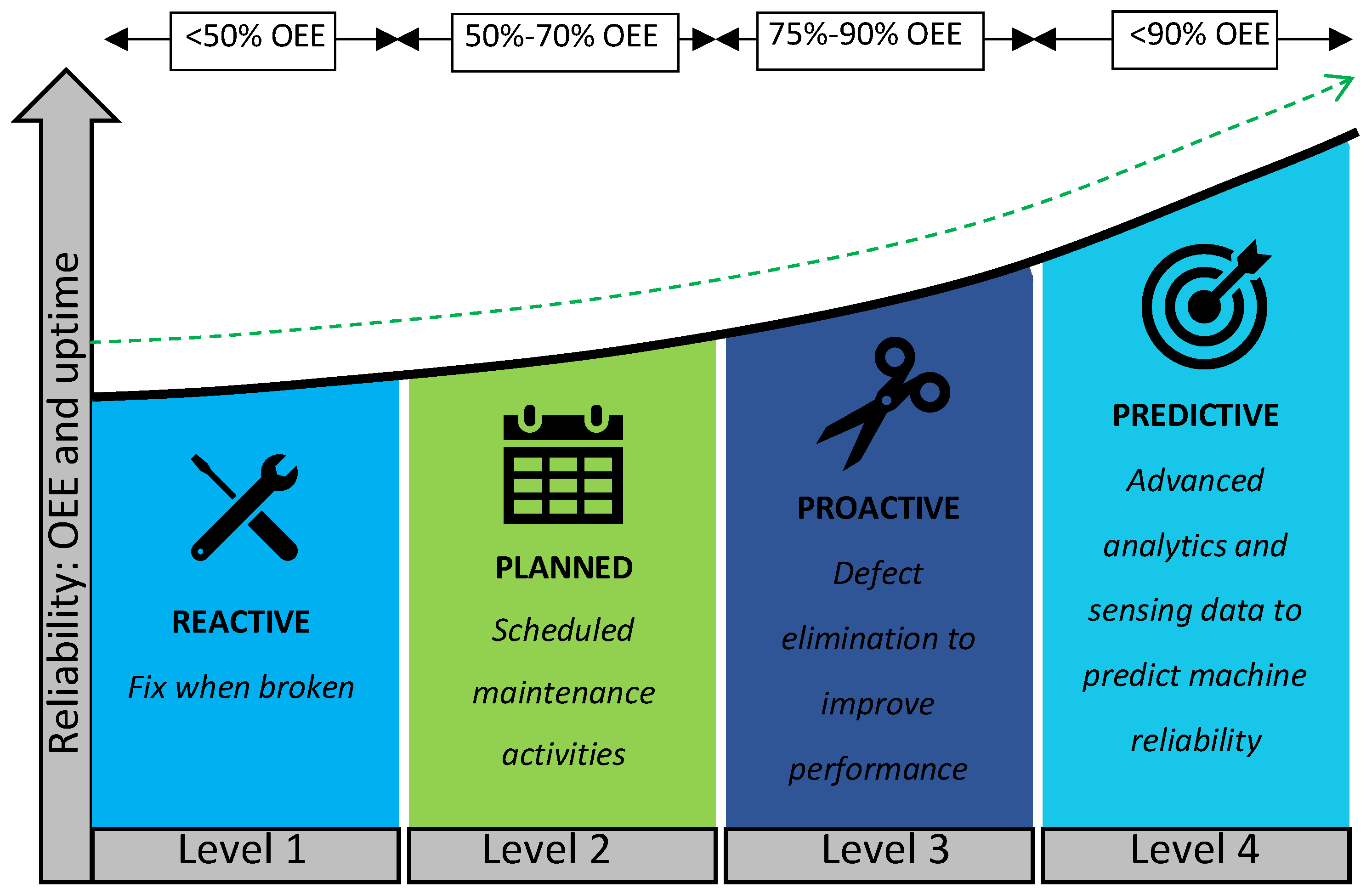
- (R2F) Run 2 Failure: also known as corrective maintenance or unplanned maintenance. It is the simplest amongst maintenance techniques which is performed only when the equipment has failed. It may lead to high equipment downtime and a high risk of secondary faults and thus, create a very large number of defective products in production.
- Preventive Maintenance (PvM): also known as scheduled maintenance or time-based maintenance (TBM). PvM refers to periodically performed maintenance based on a planned schedule in order to anticipate the failures. It sometimes leads to unnecessary maintenance which increase the operating costs. The main aim here is to improve the efficiency of the equipment by minimizing the failures in production [18].
- Condition-based Maintenance (CBM): this method of maintenance is based on a constant machine or equipment monitoring or their process health that can be carried out only when they are actually necessary. The maintenance actions can only be carried out when the actions on the process are taken after one or more conditions of degradation of the process. CBM usually cannot be planned in advance.
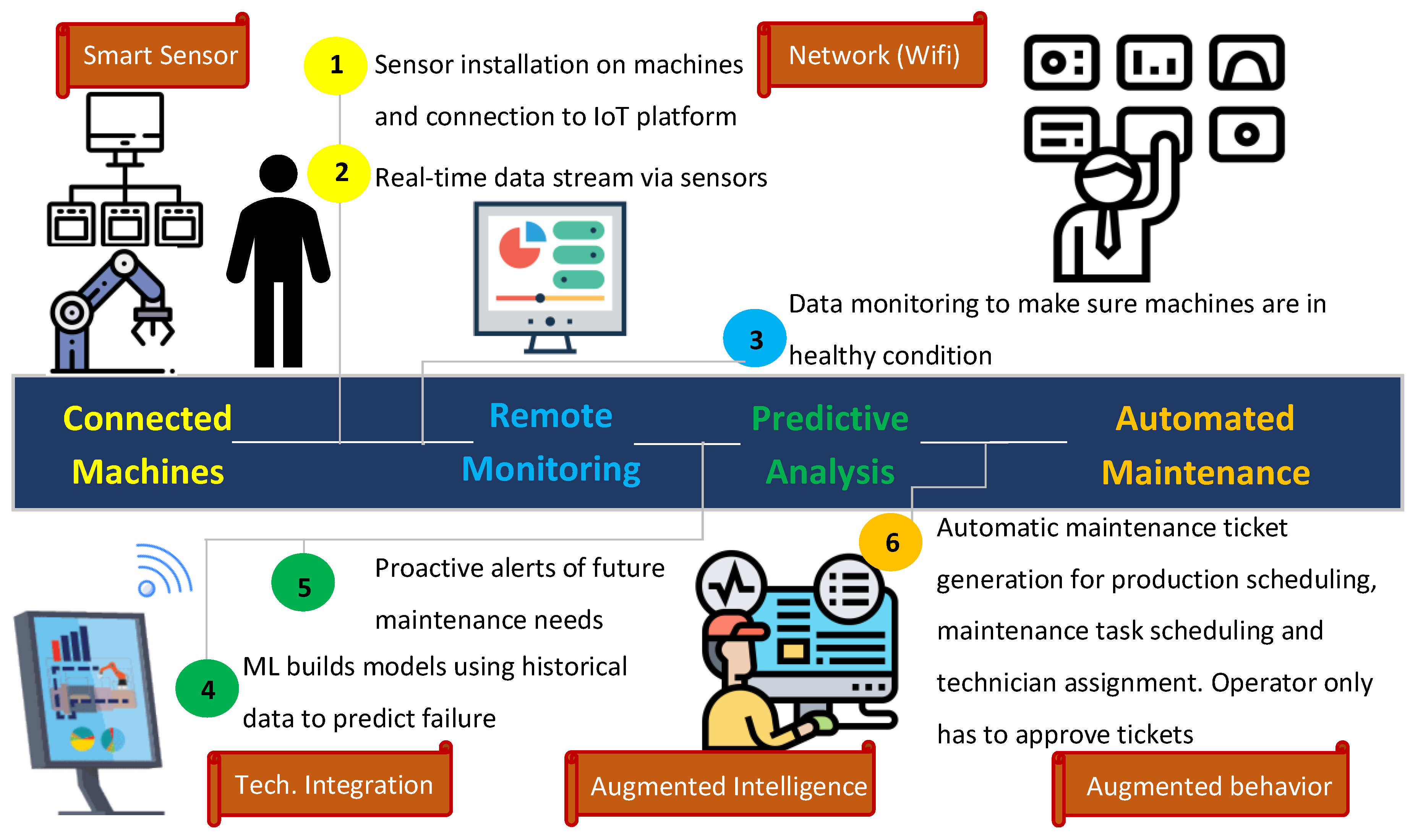
- PdM: known as Statistical-based maintenance: maintenance schedules are only taken when needed. It is based on the continuous monitoring of the equipment or the machine, as like CBM. It utilizes prediction tools to measure when such maintenance actions are necessary, hence the maintenance can be scheduled. Furthermore, it allows failure detection at an early stage based on the historical data by utilizing those prediction tools such as machine learning methods, integrity factors (such as visual aspects, coloration different from original, wear), statistical inference approaches, and engineering techniques.
2. PdM and ML Techniques
3. Survey Methodology and Analysis
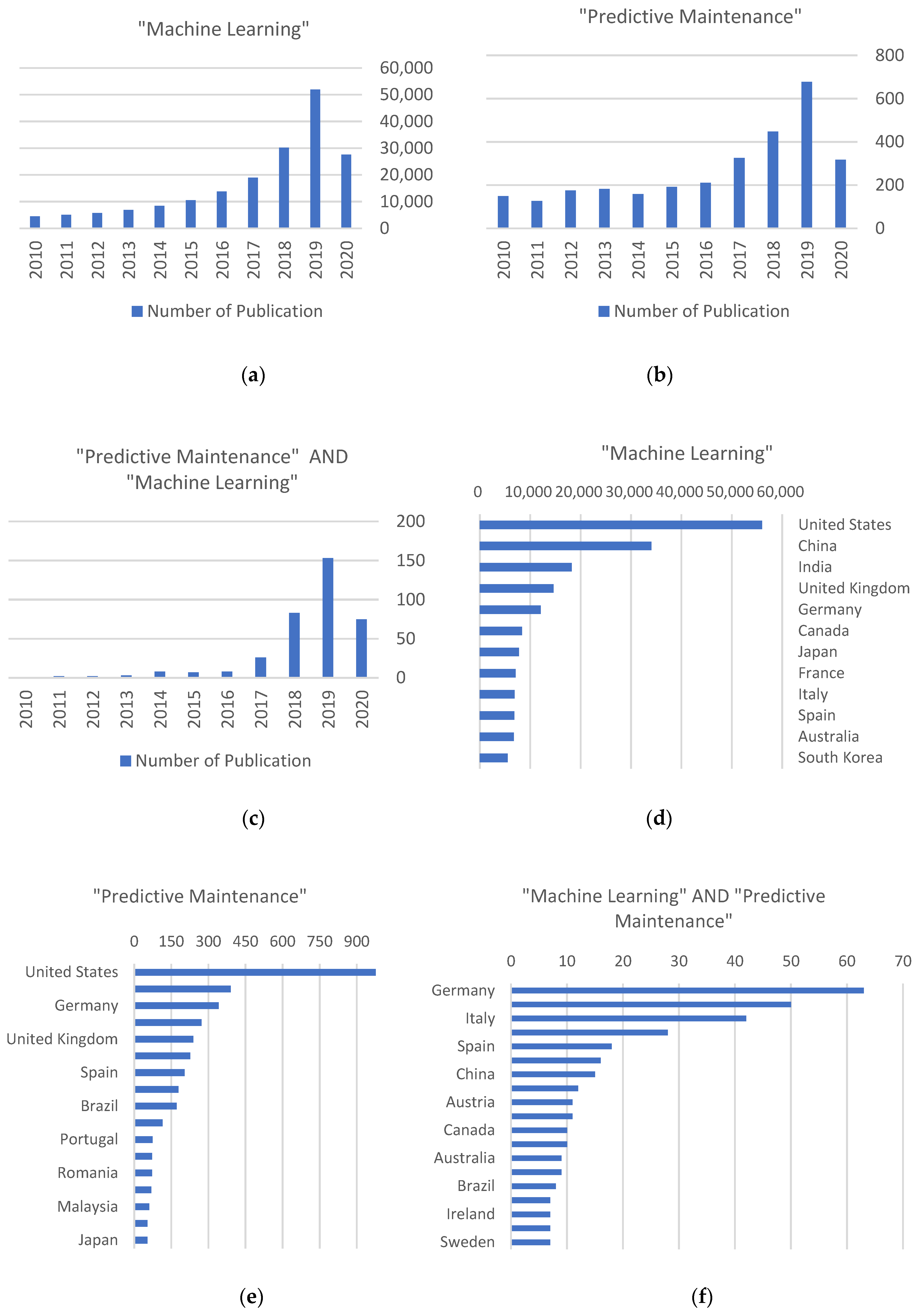
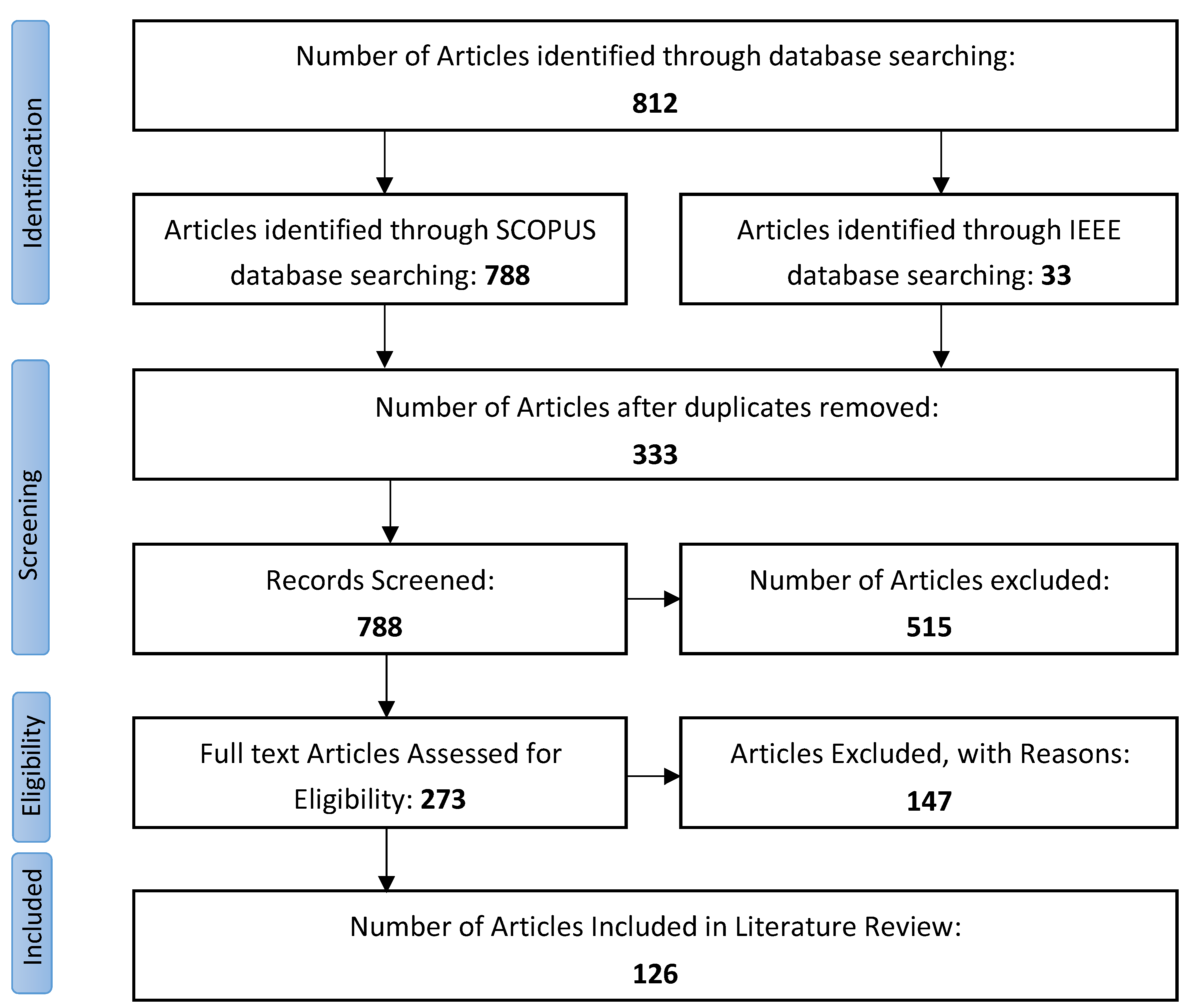
- Firstly, the search was carried out based on “machine learning.”
- Followed by search within search, with “predictive maintenance,” note that the use of quotation here means that the whole phrase was searched entirely, not as separate word by word.
- The documents were then limited to the recent time parameters of 2010 to 2020. All inclusively, the number of the documents reduced to 367.
- Subject area was limited to engineering, energy, and materials science, then the documents reduced to 273.
- Then, from the document type, review and conference review were excluded from the analysis. That left a total of 217 documents. From the language section, the documents were limited to English.
4. Applications of ML Algorithms in PdM
4.1. Artificial Neural Network (ANN)
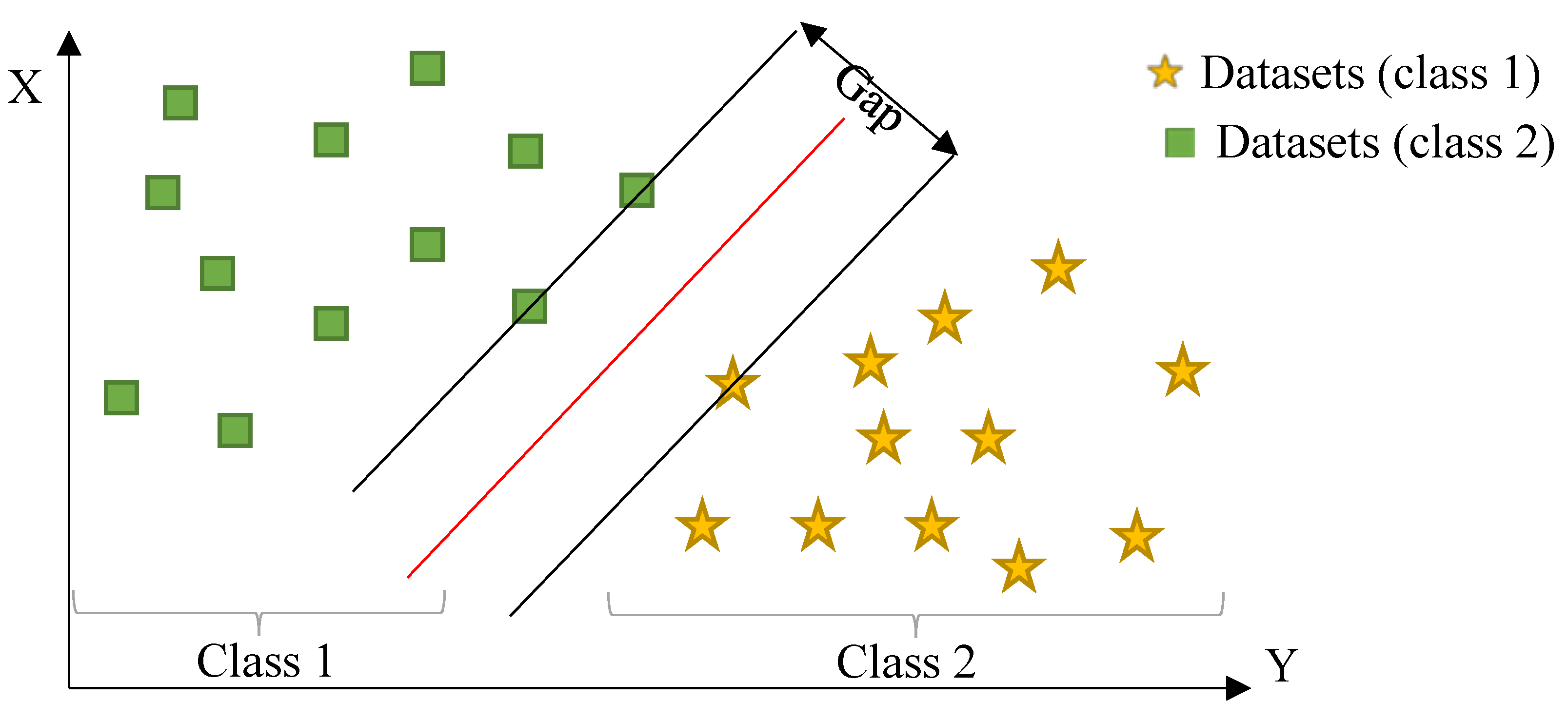
4.2. Support Vector Machine (SVM)
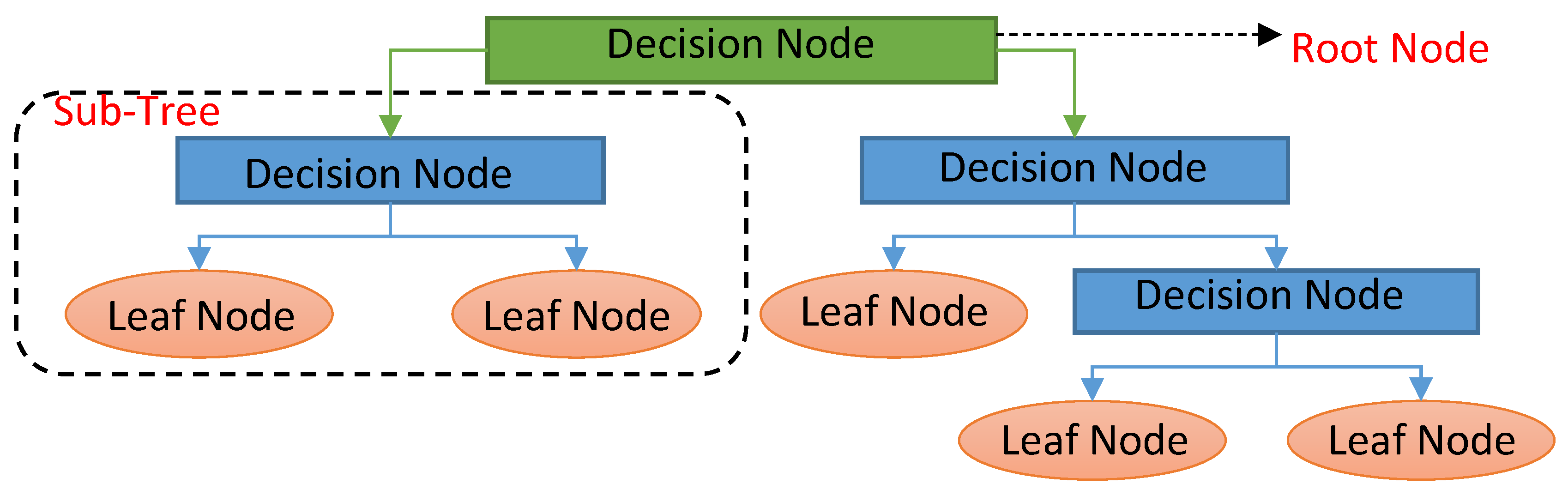
4.3. Decision Tree (DT)
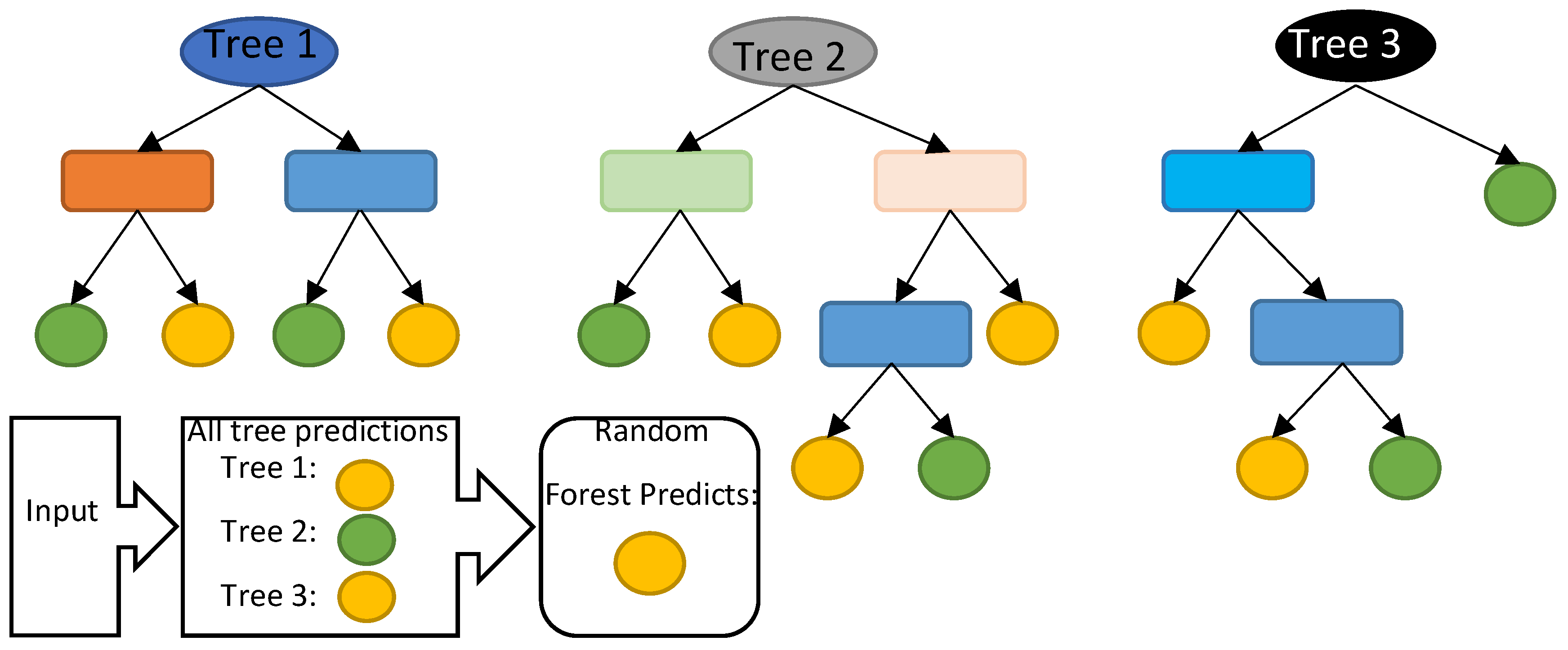
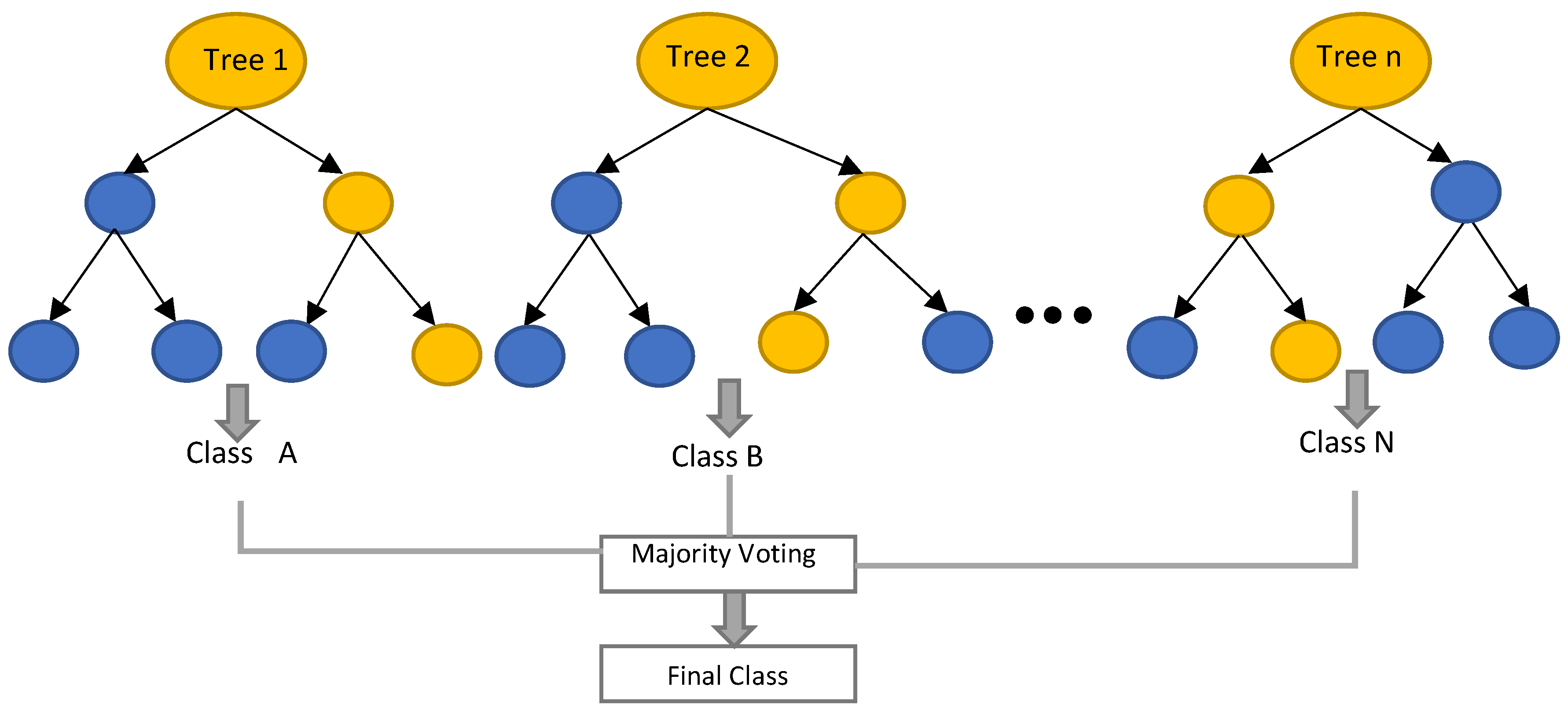
4.4. Random Forest (RF)
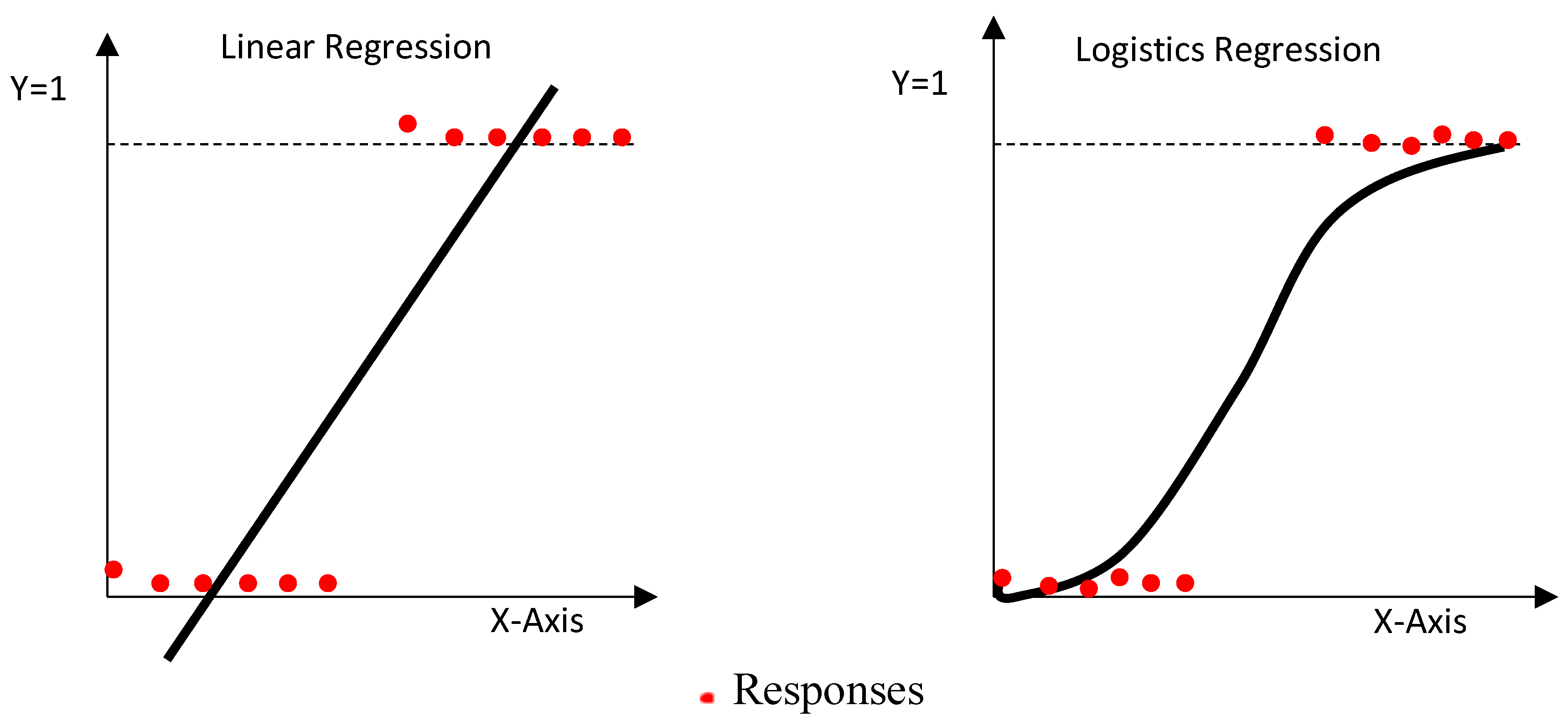
4.5. Logistic Regression (LR)
4.6. Extreme Gradient Boosted Trees (XGBoost)
4.7. Gradient Boosting Machines (GBM)
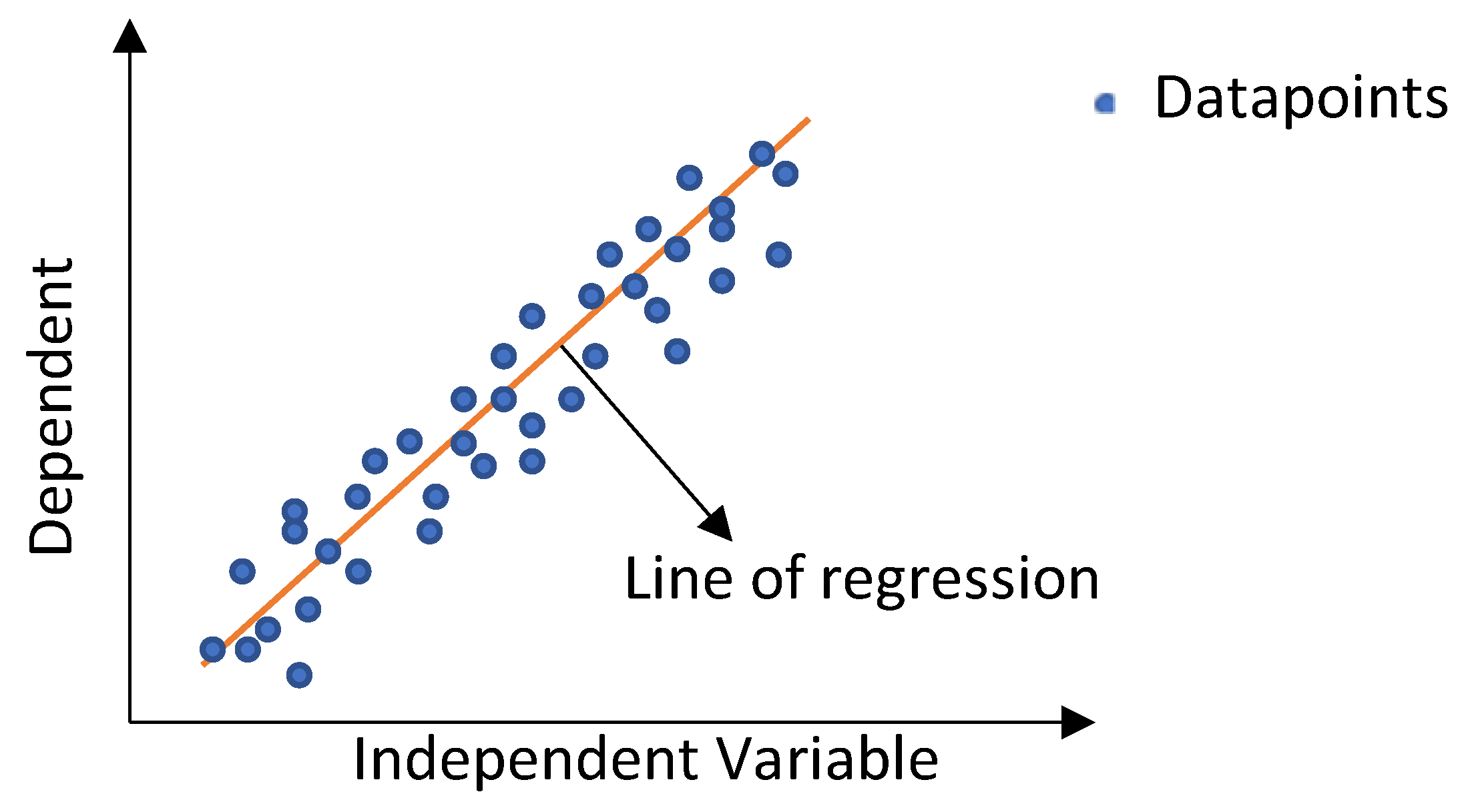
4.8. Linear Regression
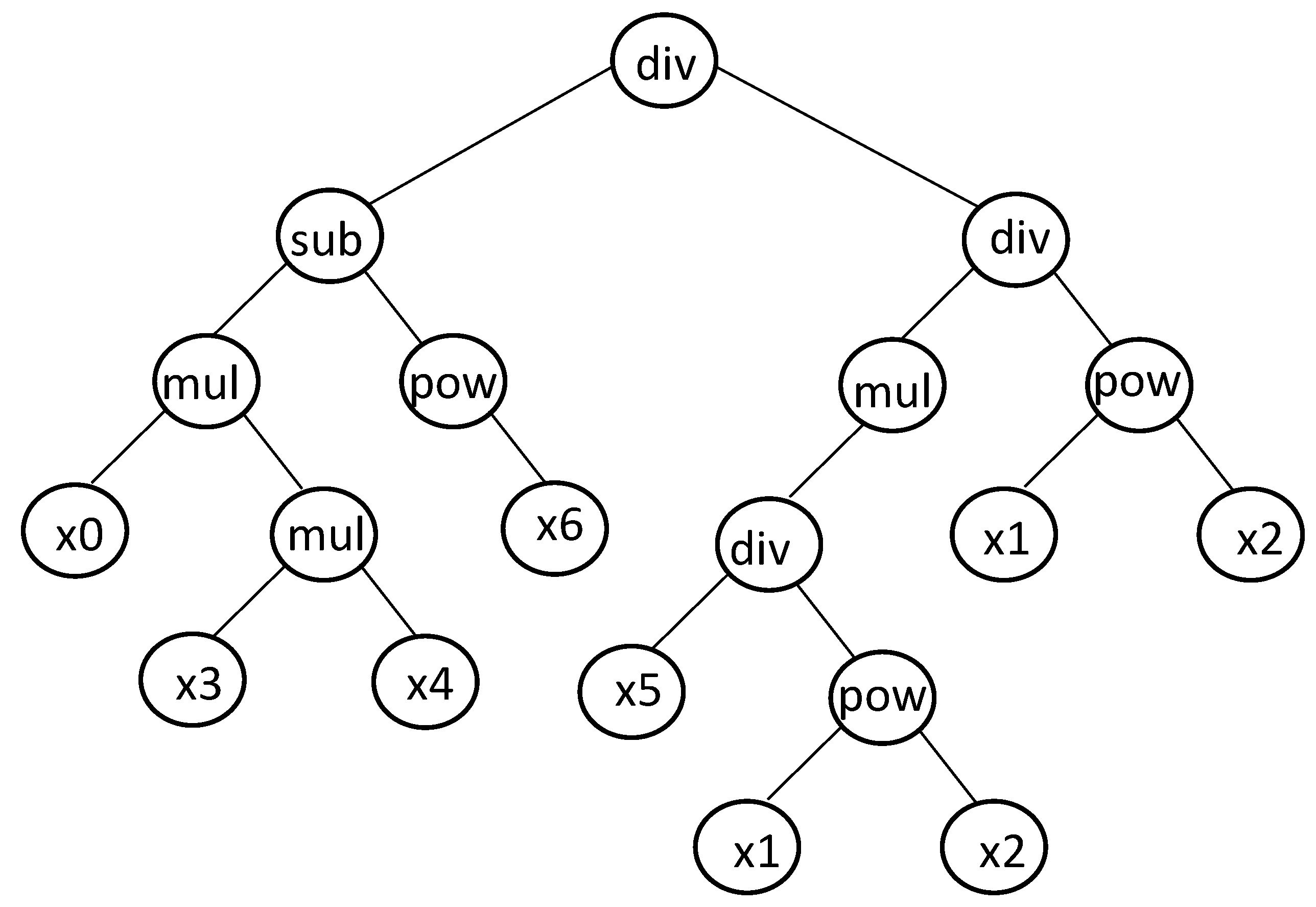
4.9. Symbolic Regression (SR)
4.10. Other Machine Learning Algorithms
4.11. Commercial Platforms available for Machine Learning in Smart Manufacturing Industry 4.0
5. Discussion and Conclusions
- Vibration signals acquired using accelerometer are the most used data.
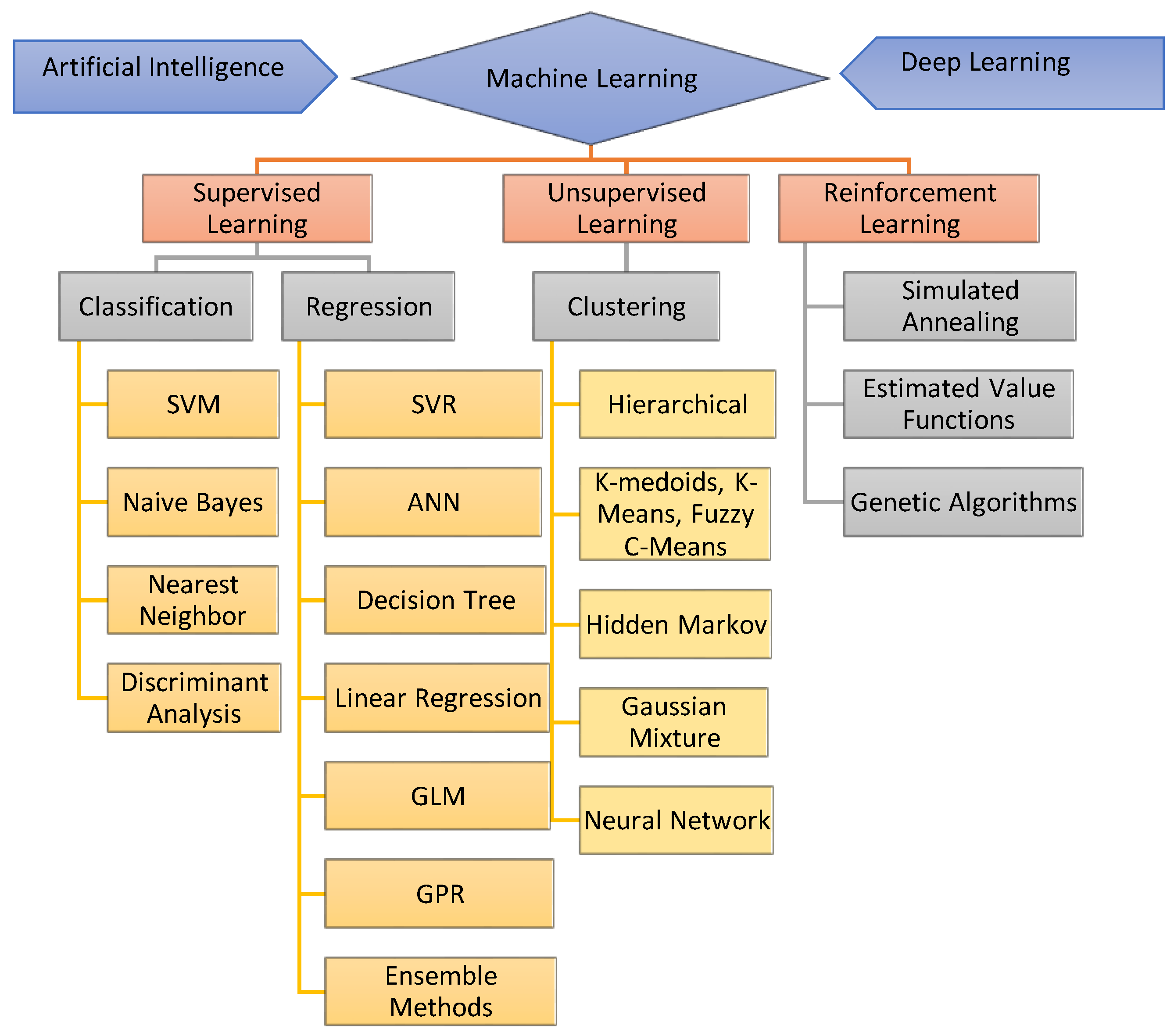
- The most applied ML category is classification.
- Extraction of real time data using intelligent data acquisition system can help to automate predictive maintenance.
- Combination of more than one ML models can provide better prediction compared to use of individual model.
- ML model implementations based on cloud can be further studied.
- Classification and Anomaly Detection algorithms can be combined to maintain precision of classification models without losing Anomaly detection advantages. By this way, PdM can be applied to equipment or system which does not have large dataset.
Author Contributions
Funding
Conflicts of Interest
References
- Carvalho, T.P.; Soares, F.A.; Vita, R.; Francisco, R.D.; Basto, J.P.; Alcalá, S.G. A systematic literature review of machine learning methods applied to predictive maintenance. Comput. Ind. Eng. 2019, 137, 106024. [Google Scholar] [CrossRef]
- Cinar, Z.M.; Nuhu, A.A.; Zeeshan, Q.; Korhan, O. Digital Twins for Industry 4.0: A Review. In Industrial Engineering in the Digital Disruption Era. GJCIE 2019. Lecture Notes in Management and Industrial Engineering; Calisir, F., Korhan, O., Eds.; Springer: Cham, Switzerland, 2020. [Google Scholar] [CrossRef]
- Cinar, Z.M.; Zeeshan, Q.; Solyali, D.; Korhan, O. Simulation of Factory 4.0: A Review. In Industrial Engineering in the Digital Disruption Era. GJCIE 2019. Lecture Notes in Management and Industrial Engineering; Calisir, F., Korhan, O., Eds.; Springer: Cham, Switzerland, 2020. [Google Scholar] [CrossRef]
- Zhang, W.; Yang, D.; Wang, H. Data-Driven Methods for Predictive Maintenance of Industrial Equipment: A Survey. IEEE Syst. J. 2019, 13, 2213–2227. [Google Scholar] [CrossRef]
- Borgi, T.; Hidri, A.; Neef, B.; Naceur, M.S. Data analytics for predictive maintenance of industrial robots. In Proceedings of the 2017 International Conference on Advanced Systems and Electric Technologies (IC_ASET), Hammamet, Tunisia, 14–17 January 2017; pp. 412–417. [Google Scholar] [CrossRef]
- Dai, X.; Gao, Z. From model, signal to knowledge: A data-driven perspective of fault detection and diagnosis. IEEE Trans. Ind. Inform. 2013, 9, 2226–2238. [Google Scholar] [CrossRef]
- Lee, J.; Lapira, E.; Bagheri, B.; Kao, H.A. Recent advances and trends in predictive manufacturing systems in big data environment. Manuf. Lett. 2013, 1, 38–41. [Google Scholar] [CrossRef]
- Peres, R.S.; Rocha, A.D.; Leitao, P.; Barata, J. IDARTS–Towards intelligent data analysis and real-time supervision for industry 4.0. Comput. Ind. 2018, 101, 138–146. [Google Scholar] [CrossRef]
- Sezer, E.; Romero, D.; Guedea, F.; MacChi, M.; Emmanouilidis, C. An Industry 4.0-Enabled Low Cost Predictive Maintenance Approach for SMEs. In Proceedings of the 2018 IEEE International Conference on Engineering, Technology and Innovation (ICE/ITMC), Stuttgart, Germany, 17–20 June 2018; pp. 1–8. [Google Scholar] [CrossRef]
- Biswal, S.; Sabareesh, G.R. Design and development of a wind turbine test rig for condition monitoring studies. In Proceedings of the 2015 International Conference on Industrial Instrumentation and Control (ICIC), Pune, India, 28–30 May 2015; pp. 891–896. [Google Scholar] [CrossRef]
- Wan, J.; Tang, S.; Li, D.; Wang, S.; Liu, C.; Abbas, H.; Vasilakos, A.V. A Manufacturing Big Data Solution for Active Preventive Maintenance. IEEE Trans. Ind. Inform. 2017, 13, 2039–2047. [Google Scholar] [CrossRef]
- Amruthnath, N.; Gupta, T. A research study on unsupervised machine learning algorithms for early fault detection in predictive maintenance. In Proceedings of the 2018 5th International Conference on Industrial Engineering and Applications, ICIEA, Singapore, 26–28 April 2018; pp. 355–361. [Google Scholar]
- Yoo, Y.; Park, S.H.; Baek, J.G. A Clustering-Based Equipment Condition Model of Chemical Vapor Deposition Process. Int. J. Precis. Eng. Manuf. 2019, 20, 1677–1689. [Google Scholar] [CrossRef]
- Susto, G.A.; Schirru, A.; Pampuri, S.; McLoone, S.; Beghi, A. Machine learning for predictive maintenance: A multiple classifier approach. IEEE Trans. Ind. Inform. 2015, 11, 812–820. [Google Scholar] [CrossRef]
- Susto, G.A.; Beghi, A.; De Luca, C. A predictive maintenance system for epitaxy processes based on filtering and prediction techniques. IEEE Trans. Semicond. Manuf. 2012, 25, 638–649. [Google Scholar] [CrossRef]
- Ahmad, R.; Kamaruddin, S. An overview of time-based and condition-based maintenance in industrial application. Comput. Ind. Eng. 2012, 63, 135–149. [Google Scholar] [CrossRef]
- Munirathinam, S.; Ramadoss, B. Big data predictive analtyics for proactive semiconductor equipment maintenance. In Proceedings of the 2014 IEEE International Conference on Big Data (Big Data), Washington, DC, USA, 27–30 October 2014; pp. 893–902. [Google Scholar] [CrossRef]
- Rivera Torres, P.J.; Serrano Mercado, E.I.; Llanes Santiago, O.; Anido Rifón, L. Modeling preventive maintenance of manufacturing processes with probabilistic Boolean networks with interventions. J. Intell. Manuf. 2018, 29, 1941–1952. [Google Scholar] [CrossRef]
- Jezzini, A.; Ayache, M.; Elkhansa, L.; Makki, B.; Zein, M. Effects of predictive maintenance(PdM), Proactive maintenace(PoM) & Preventive maintenance(PM) on minimizing the faults in medical instruments. In Proceedings of the 2013 2nd International Conference on Advances in Biomedical Engineering, Tripoli, Lebanon, 11–13 September 2013; pp. 53–56. [Google Scholar] [CrossRef]
- Kumar, A.; Chinnam, R.B.; Tseng, F. An HMM and polynomial regression based approach for remaining useful life and health state estimation of cutting tools. Comput. Ind. Eng. 2019, 128, 1008–1014. [Google Scholar] [CrossRef]
- Mathew, V.; Toby, T.; Singh, V.; Rao, B.M.; Kumar, M.G. Prediction of Remaining Useful Lifetime (RUL) of turbofan engine using machine learning. In Proceedings of the 2017 IEEE International Conference on Circuits and Systems (ICCS), Thiruvananthapuram, India, 20–21 December 2017; pp. 306–311. [Google Scholar] [CrossRef]
- Samuel, A.L. Some studies in machine learning using the game of checkers. IBM J. Res. Dev. 2000, 44, 206–226. [Google Scholar] [CrossRef]
- Wuest, T.; Weimer, D.; Irgens, C.; Thoben, K.D. Machine learning in manufacturing: Advantages, challenges, and applications. Prod. Manuf. Res. 2016, 4, 23–45. [Google Scholar] [CrossRef]
- Testik, M.C. Expert Systems with Applications A review of data mining applications for quality improvement in manufacturing industry. Expert Syst. Appl. 2011, 38, 13448–13467. [Google Scholar] [CrossRef]
- Qiao, W.; Member, S.; Lu, D.; Member, S. A Survey on Wind Turbine Condition Monitoring and Fault Diagnosis—Part I: Components and Subsystems. IEEE Trans. Ind. Electron. 2015, 62, 6536–6545. [Google Scholar] [CrossRef]
- Lee, J.; Wu, F.; Zhao, W.; Ghaffari, M.; Liao, L.; Siegel, D. Prognostics and health management design for rotary machinery systems—Reviews, methodology and applications. Mech. Syst. Signal Process. 2014, 42, 314–334. [Google Scholar] [CrossRef]
- Jardine, A.K.S.; Lin, D.; Banjevic, D. A review on machinery diagnostics and prognostics implementing condition-based maintenance. Mech. Syst. Signal Process. 2006, 20, 1483–1510. [Google Scholar] [CrossRef]
- Kwak, D.S.; Kim, K.J. A data mining approach considering missing values for the optimization of semiconductor-manufacturing processes. Expert Syst. Appl. 2012, 39, 2590–2596. [Google Scholar] [CrossRef]
- Deloitte. Making Maintenance Smarter; Deloitte University Press: New York, NY, USA, 2017. [Google Scholar]
- Cheng, J.C.P.; Chen, W.; Chen, K.; Wang, Q. Data-driven predictive maintenance planning framework for MEP components based on BIM and IoT using machine learning algorithms. Autom. Constr. 2020, 112, 103087. [Google Scholar] [CrossRef]
- Deloitte Touche Tohmatsu Limited (DTTL). Industry 4.0: Challenges and Solutions for the Digital Transformation and Use of Exponential Technologies; Finance, Audit Tax Consulting Corporate: Zurich, Switzerland, 2015. [Google Scholar]
- Nasir, T.; Asmael, M.; Zeeshan, Q.; Solyali, D. Applications of Machine Learning to Friction Stir Welding Process Optimization Applications of Machine Learning to Friction Stir Welding Process Optimization. J. Kejuruter. 2020, 32, 171–186. [Google Scholar] [CrossRef]
- Hakeem, A.A.A.; Solyali, D.; Asmael, M.; Zeeshan, Q. Smart Manufacturing for Industry 4.0 using Radio Frequency Identification (RFID) Technology. J. Kejuruter. 2020, 32, 31–38. [Google Scholar]
- Centre, M.E. Machine-learning techniques and their applications in manufacturing. Proc. Inst. Mech. Eng. Part B J. Eng. Manuf. 2005, 219, 395–412. [Google Scholar] [CrossRef]
- Monostori, L. AI and machine learning techniques for managing complexity, changes and uncertainties in manufacturing. Eng. Appl. Artif. Intel. 2003, 16, 277–291. [Google Scholar]
- Flynn, P.J. Data Clustering: A Review. ACM Comput. Surv. 2000, 31, 264–323. [Google Scholar]
- Merizalde, Y.; Hernández-Callejo, L.; Duque-Perez, O.; Alonso-Gómez, V. Maintenance models applied to wind turbines. A comprehensive overview. Energies 2019, 12, 225. [Google Scholar] [CrossRef]
- MatlabWorks What Is Machine Learning? Available online: https://www.mathworks.com/discovery/machine-learning.html (accessed on 2 August 2020).
- Jiang, Y.; Yin, S. Recursive Total Principle Component Regression Based Fault Detection and Its Application to Vehicular Cyber-Physical Systems. IEEE Trans. Ind. Inform. 2018, 14, 1415–1423. [Google Scholar] [CrossRef]
- You, D.; Gao, X.; Katayama, S. WPD-PCA-based laser welding process monitoring and defects diagnosis by using FNN and SVM. IEEE Trans. Ind. Electron. 2015, 62, 628–636. [Google Scholar] [CrossRef]
- Orille-fernández, Á.L.; Khalil, N.; Rodríguez, S.B. Failure Risk Prediction Using Artificial Neural Networks for Lightning Surge Protection of Underground MV Cables. IEEE Trans. Power Deliv. 2006, 21, 1278–1282. [Google Scholar] [CrossRef]
- Mao, J. Why Artificial Neural Networks? Computer 1996, 29, 31–44. [Google Scholar] [CrossRef]
- Saritas, M.M.; Yasar, A. Performance Analysis of ANN and Naive Bayes Classification Algorithm for Data Classification. Int. J. Intell. Syst. Appl. Eng. 2019, 7, 88–91. [Google Scholar] [CrossRef]
- Gomes Soares, S.; Araújo, R. An on-line weighted ensemble of regressor models to handle concept drifts. Eng. Appl. Artif. Intell. 2015, 37, 392–406. [Google Scholar] [CrossRef]
- Shin, J.H.; Jun, H.B.; Kim, J.G. Dynamic control of intelligent parking guidance using neural network predictive control. Comput. Ind. Eng. 2018, 120, 15–30. [Google Scholar] [CrossRef]
- Hesser, D.F.; Markert, B. Tool wear monitoring of a retrofitted CNC milling machine using artificial neural networks. Manuf. Lett. 2019, 19, 1–4. [Google Scholar] [CrossRef]
- Scalabrini Sampaio, G.; de Vallim Filho, A.R.A.; da Santos Silva, L.; da Augusto Silva, L. Prediction of Motor Failure Time Using An Artificial Neural Network. Sensors 2019, 19, 4342. [Google Scholar] [CrossRef]
- Falamarzi, A.; Moridpour, S.; Nazem, M.; Cheraghi, S. Prediction of tram track gauge deviation using artificial neural network and support vector regression. Aust. J. Civ. Eng. 2019, 17, 63–71. [Google Scholar] [CrossRef]
- Zhang, Y.; Liu, J.; Hanachi, H.; Yu, X.; Yang, Y. Physics-based Model and Neural Network Model for Monitoring Starter Degradation of APU. In Proceedings of the 2018 IEEE International Conference on Prognostics and Health Management (ICPHM), Seattle, WA, USA, 11–13 June 2018; pp. 1–7. [Google Scholar] [CrossRef]
- Sexton, T.; Brundage, M.P.; Hoffman, M.; Morris, K.C. Hybrid datafication of maintenance logs from AI-assisted human tags. In Proceedings of the 2017 IEEE International Conference on Big Data (Big Data), Boston, MA, USA, 11–14 December 2017; pp. 1769–1777. [Google Scholar] [CrossRef]
- Chang, C.C.; Lin, C.J. LIBSVM: A Library for support vector machines. ACM Trans. Intell. Syst. Technol. 2011, 2, 604–611. [Google Scholar] [CrossRef]
- Ahmad, W.M.T.W.; Ghani, N.L.A.; Drus, S.M. Data mining techniques for disease risk prediction model: A systematic literature review. Adv. Intell. Syst. Comput. 2019, 843, 40–46. [Google Scholar] [CrossRef]
- Parikh, U.B.; Das, B.; Maheshwari, R. Fault classification technique for series compensated transmission line using support vector machine. Int. J. Electr. Power Energy Syst. 2010, 32, 629–636. [Google Scholar] [CrossRef]
- DataFlair Team Support Vector Machines Tutorial—Learn to implement SVM in Python. Data Flair 2019. Available online: https://data-flair.training/blogs/svm-support-vector-machine-tutorial/ (accessed on 19 September 2020).
- Widodo, A.; Yang, B.S. Support vector machine in machine condition monitoring and fault diagnosis. Mech. Syst. Signal Process. 2007, 21, 2560–2574. [Google Scholar] [CrossRef]
- Xiang, S.; Huang, D.; Li, X. A Generalized Predictive Framework for Data Driven Prognostics and Diagnostics using Machine Logs. In Proceedings of the TENCON 2018—2018 IEEE Region 10 Conference, Jeju, Korea, 28–31 October 2018; pp. 695–700. [Google Scholar] [CrossRef]
- Sugumaran, V.; Muralidharan, V.; Ramachandran, K.I. Feature selection using Decision Tree and classification through Proximal Support Vector Machine for fault diagnostics of roller bearing. Mech. Syst. Signal Process. 2007, 21, 930–942. [Google Scholar] [CrossRef]
- Rasoul, S.; David, L. A Survey of Decision Tree Classifier Methodology. IEEE Trans. Syst. Man. Cybern. 1991, 21, 660–674. [Google Scholar]
- Silipo, R. From a Single Decision Tree to a Random Forest. Dataversity 2019. Available online: https://www.dataversity.net/from-a-single-decision-tree-to-a-random-forest/ (accessed on 19 September 2020).
- Breiman, L. Random Forests; Working Paper CISL: Cambridge, UK, 2001; Volume 15, pp. 1–19. ISBN 9783110941975. [Google Scholar] [CrossRef]
- Polamuri, S. How Does the Random Forest Algorithm Work in Machine Learning. Available online: https://opendatascience.com/how-does-the-random-forest-algorithm-work-in-machine-learning/ (accessed on 30 July 2020).
- Binding, A.; Dykeman, N.; Pang, S. Machine Learning Predictive Maintenance on Data in the Wild. In Proceedings of the 2019 IEEE 5th World Forum on Internet of Things (WF-IoT), Limerick, Ireland, 15–18 April 2019; pp. 507–512. [Google Scholar] [CrossRef]
- Zenisek, J.; Holzinger, F.; Affenzeller, M. Machine learning based concept drift detection for predictive maintenance. Comput. Ind. Eng. 2019, 137, 106031. [Google Scholar] [CrossRef]
- Janssens, O.; Loccufier, M.; Van Hoecke, S. Thermal Imaging and Vibration-Based Multisensor Fault Detection for Rotating Machinery. IEEE Trans. Ind. Inform. 2019, 15, 434–444. [Google Scholar] [CrossRef]
- Lacaille, J.; Rabenoro, T. A Trend Monitoring Diagnostic Algorithm for Automatic Pre-identification of Turbofan Engines Anomaly. In Proceedings of the 2018 Prognostics and System Health Management Conference (PHM-Chongqing), Chongqing, China, 26–28 October 2018; pp. 819–823. [Google Scholar] [CrossRef]
- Quiroz, J.C.; Mariun, N.; Mehrjou, M.R.; Izadi, M.; Misron, N.; Mohd Radzi, M.A. Fault detection of broken rotor bar in LS-PMSM using random forests. Meas. J. Int. Meas. Confed. 2018, 116, 273–280. [Google Scholar] [CrossRef]
- Yan, W.; Zhou, J.H. Predictive modeling of aircraft systems failure using term frequency-inverse document frequency and random forest. In Proceedings of the 2017 IEEE International Conference on Industrial Engineering and Engineering Management (IEEM), Singapore, 10–13 December 2017; pp. 828–831. [Google Scholar] [CrossRef]
- ODSC Logistic Regression with Python. Available online: https://medium.com/@ODSC/logistic-regression-with-python-ede39f8573c7 (accessed on 12 August 2020).
- Chen, T.; Guestrin, C. XGBoost: A scalable tree boosting system. In Proceedings of the 22nd ACM SIGKDD International Conference on Knowledge Discovery and Data Mining, San Francisco, CA, USA, 13–17 August 2016; pp. 785–794. [Google Scholar] [CrossRef]
- TIBCO Community Template for Using XGBoost in TIBCO Spotfire. Available online: https://www.google.com/imgres?imgurl=https%3A%2F%2Feng.uber.com%2Fwp-content%2Fuploads%2F2019%2F12%2FTwitter.png&imgrefurl=https%3A%2F%2Feng.uber.com%2Fproductionizing-distributed-xgboost%2F&tbnid=JkiedoDnC48yVM&vet=12ahUKEwiVjOOvv_XqAhWWwoUKHedmD6IQMygLe (accessed on 19 September 2020).
- Cao, H.; Nguyen, M.N.; Phua, C.; Krishnaswamy, S.; Li, X.L. An integrated framework for human activity recognition. In Proceedings of the 2012 ACM Conference on Ubiquitous Computing, Pittsburgh, PA, USA, 5–8 September 2012; pp. 621–622. [Google Scholar] [CrossRef]
- Akira Al Gradient Boosting. Available online: https://www.akira.ai/glossary/gradient-boosting/ (accessed on 30 July 2020).
- Mattes, A.; Schopka, U.; Schellenberger, M.; Scheibelhofer, P.; Leditzky, G. Virtual Equipment for benchmarking Predictive Maintenance algorithms. In Proceedings of the 2012 Winter Simulation Conference (WSC), Berlin, Germany, 9–12 December 2012. [Google Scholar] [CrossRef]
- Koza, J.R. Genetic programming as a means for programming computers by natural selection. Stat. Comput. 1994, 4, 87–112. [Google Scholar] [CrossRef]
- Janssens, O.; Van De Walle, R.; Loccufier, M.; Van Hoecke, S. Deep Learning for Infrared Thermal Image Based Machine Health Monitoring. IEEE/ASME Trans. Mechatron. 2018, 23, 151–159. [Google Scholar] [CrossRef]
- Huuhtanen, T.; Jung, A. Predictive Maintenance of Photovoltaic Panels via Deep Learning. In Proceedings of the 2018 IEEE Data Science Workshop (DSW), Lausanne, Switzerland, 4–6 June 2018; pp. 66–70. [Google Scholar] [CrossRef]
- Pan, Z.; Ge, Y.; Zhou, Y.C.; Huang, J.C.; Zheng, Y.L.; Zhang, N.; Liang, X.X.; Gao, P.; Zhang, G.Q.; Wang, Q.; et al. Cognitive Acoustic Analytics Service for Internet of Things. In Proceedings of the 2017 IEEE International Conference on Cognitive Computing (ICCC), Honolulu, HI, USA, 25–30 June 2017; pp. 96–103. [Google Scholar] [CrossRef]
- Jimenez-Cortadi, A.; Irigoien, I.; Boto, F.; Sierra, B.; Rodriguez, G. Predictive maintenance on the machining process and machine tool. Appl. Sci. 2020, 10, 224. [Google Scholar] [CrossRef]
- Luo, W.; Hu, T.; Ye, Y.; Zhang, C.; Wei, Y. A hybrid predictive maintenance approach for CNC machine tool driven by Digital Twin. Robot. Comput. Integr. Manuf. 2020, 65, 101974. [Google Scholar] [CrossRef]
- Abu-Samah, A.; Shahzad, M.K.; Zamai, E.; Ben Said, A. Failure prediction methodology for improved proactive maintenance using Bayesian approach. IFAC-PapersOnLine 2015, 28, 844–851. [Google Scholar] [CrossRef]
- Carbery, C.M.; Woods, R.; Marshall, A.H. A new data analytics framework emphasising preprocessing of data to generate insights into complex manufacturing systems. Proc. Inst. Mech. Eng. Part. C J. Mech. Eng. Sci. 2019, 233, 6713–6726. [Google Scholar] [CrossRef]
- Butte, S.; Prashanth, A.R.; Patil, S. Machine Learning Based Predictive Maintenance Strategy: A Super Learning Approach with Deep Neural Networks. In Proceedings of the 2018 IEEE Workshop on Microelectronics and Electron Devices (WMED), Boise, ID, USA, 20 April 2018; pp. 1–5. [Google Scholar] [CrossRef]
- Susto, G.A.; Beghi, A. Dealing with time-series data in Predictive Maintenance problems. In Proceedings of the 2016 IEEE 21st International Conference on Emerging Technologies and Factory Automation (ETFA), Berlin, Germany, 6–9 September 2016; pp. 1–4. [Google Scholar] [CrossRef]
- Amihai, I.; Gitzel, R.; Kotriwala, A.M.; Pareschi, D.; Subbiah, S.; Sosale, G. An industrial case study using vibration data and machine learning to predict asset health. In Proceedings of the 2018 IEEE 20th Conference on Business Informatics (CBI), Vienna, Austria, 11–14 July 2018; Volume 1, pp. 178–185. [Google Scholar] [CrossRef]
- Paolanti, M.; Romeo, L.; Felicetti, A.; Mancini, A.; Frontoni, E.; Loncarski, J. Machine Learning approach for Predictive Maintenance in Industry 4.0. In Proceedings of the 2018 14th IEEE/ASME International Conference on Mechatronic and Embedded Systems and Applications (MESA), Oulu, Finland, 2–4 July 2018; pp. 1–6. [Google Scholar] [CrossRef]
- Kulkarni, K.; Devi, U.; Sirighee, A.; Hazra, J.; Rao, P. Predictive Maintenance for Supermarket Refrigeration Systems Using only Case Temperature Data. In Proceedings of the 2018 Annual American Control Conference (ACC), Milwaukee, WI, USA, 27–29 June 2018; pp. 4640–4645. [Google Scholar] [CrossRef]
- Su, C.J.; Huang, S.F. Real-time big data analytics for hard disk drive predictive maintenance. Comput. Electr. Eng. 2018, 71, 93–101. [Google Scholar] [CrossRef]
- Dos Santos, T.; Ferreira, F.J.T.E.; Pires, J.M.; Damasio, C. Stator winding short-circuit fault diagnosis in induction motors using random forest. In Proceedings of the 2017 IEEE International Electric Machines and Drives Conference (IEMDC), Miami, FL, USA, 21–24 May 2017. [Google Scholar] [CrossRef]
- Canizo, M.; Onieva, E.; Conde, A.; Charramendieta, S.; Trujillo, S. Real-time predictive maintenance for wind turbines using Big Data frameworks. In Proceedings of the 2017 IEEE International Conference on Prognostics and Health Management (ICPHM), Dallas, TX, USA, 19–21 June 2017; pp. 70–77. [Google Scholar] [CrossRef]
- Prytz, R.; Nowaczyk, S.; Rögnvaldsson, T.; Byttner, S. Predicting the need for vehicle compressor repairs using maintenance records and logged vehicle data. Eng. Appl. Artif. Intell. 2015, 41, 139–150. [Google Scholar] [CrossRef]
- Nguyen, K.T.P.; Medjaher, K. A new dynamic predictive maintenance framework using deep learning for failure prognostics. Reliab. Eng. Syst. Saf. 2019, 188, 251–262. [Google Scholar] [CrossRef]
- Aydin, O.; Guldamlasioglu, S. Using LSTM networks to predict engine condition on large scale data processing framework. In Proceedings of the 2017 4th International Conference on Electrical and Electronic Engineering (ICEEE), Ankara, Turkey, 8–10 April 2017; pp. 281–285. [Google Scholar] [CrossRef]
- Du, Y.; Chen, Y.; Meng, G.; Ding, J.; Xiao, Y. Fault severity monitoring of rolling bearings based on texture feature extraction of sparse time-frequency images. Appl. Sci. 2018, 8, 1538. [Google Scholar] [CrossRef]
- Guo, R.; Sui, J. Prognostics for an actuator based on an ensemble of support vector regression and particle filter. Proc. Inst. Mech. Eng. Part. I J. Syst. Control. Eng. 2019, 233, 642–655. [Google Scholar] [CrossRef]
- Cárdenas-Gallo, I.; Sarmiento, C.A.; Morales, G.A.; Bolivar, M.A.; Akhavan-Tabatabaei, R. An ensemble classifier to predict track geometry degradation. Reliab. Eng. Syst. Saf. 2017, 161, 53–60. [Google Scholar] [CrossRef]
- Lasisi, A.; Attoh-Okine, N. Principal components analysis and track quality index: A machine learning approach. Transp. Res. Part. C Emerg. Technol. 2018, 91, 230–248. [Google Scholar] [CrossRef]
- Mathew, J.; Luo, M.; Pang, C.K. Regression kernel for prognostics with support vector machines. In Proceedings of the 2017 22nd IEEE International Conference on Emerging Technologies and Factory Automation (ETFA), Limassol, Cyprus, 12–15 September 2017; pp. 1–5. [Google Scholar] [CrossRef]
- Arias, P.A. Planning Models for Distribution Grid: A Brief Review Piedy. U. Prto J. Eng. 2017, 4, 42–55. [Google Scholar] [CrossRef][Green Version]
- Durbhaka, G.K.; Selvaraj, B. Predictive maintenance for wind turbine diagnostics using vibration signal analysis based on collaborative recommendation approach. In Proceedings of the 2016 International Conference on Advances in Computing, Communications and Informatics (ICACCI), Jaipur, India, 21–24 September 2016; pp. 1839–1842. [Google Scholar] [CrossRef]
- Machado, R.G.V.; De Oliveira Mota, H. Simple self-scalable grid classifier for signal denoising in digital processing systems. In Proceedings of the 2015 IEEE 25th International Workshop on Machine Learning for Signal Processing (MLSP), Boston, MA, USA, 17–20 September 2015; pp. 1057–1061. [Google Scholar] [CrossRef]
- Ahmad, W.; Khan, S.A.; Islam, M.M.M.; Kim, J.M. A reliable technique for remaining useful life estimation of rolling element bearings using dynamic regression models. Reliab. Eng. Syst. Saf. 2019, 184, 67–76. [Google Scholar] [CrossRef]
- Ha, J.M.; Kim, H.J.; Shin, Y.S.; Choi, B.K. Degradation Trend Estimation and Prognostics for Low Speed Gear Lifetime. Int. J. Precis. Eng. Manuf. 2018, 19, 1099–1105. [Google Scholar] [CrossRef]
- Duan, C.; Deng, C.; Wang, B. Optimal maintenance policy incorporating system level and unit level for mechanical systems. Int. J. Syst. Sci. 2018, 49, 1074–1087. [Google Scholar] [CrossRef]
- Uhlmann, E.; Pontes, R.P.; Geisert, C.; Hohwieler, E. Cluster identification of sensor data for predictive maintenance in a Selective Laser Melting machine tool. Procedia Manuf. 2018, 24, 60–65. [Google Scholar] [CrossRef]
- Amihai, I.; Chioua, M.; Gitzel, R.; Kotriwala, A.M.; Pareschi, D.; Sosale, G.; Subbiah, S. Modeling Machine Health Using Gated Recurrent Units with Entity Embeddings and K-Means Clustering. In Proceedings of the 2018 IEEE 16th International Conference on Industrial Informatics (INDIN), Porto, Portugal, 18–20 July 2018; pp. 212–217. [Google Scholar] [CrossRef]
- Eke, S.; Aka-Ngnui, T.; Clerc, G.; Fofana, I. Characterization of the operating periods of a power transformer by clustering the dissolved gas data. In Proceedings of the 2017 IEEE 11th International Symposium on Diagnostics for Electrical Machines, Power Electronics and Drives (SDEMPED), Tinos, Greece, 29 August–1 September 2017; pp. 298–303. [Google Scholar] [CrossRef]
- Kumar, A.; Shankar, R.; Thakur, L.S. A big data driven sustainable manufacturing framework for condition-based maintenance prediction. J. Comput. Sci. 2018, 27, 428–439. [Google Scholar] [CrossRef]
- Luo, B.; Wang, H.; Liu, H.; Li, B.; Peng, F. Early Fault Detection of Machine Tools Based on Deep Learning and Dynamic Identification. IEEE Trans. Ind. Electron. 2018, 66, 509–518. [Google Scholar] [CrossRef]
- Kolokas, N.; Vafeiadis, T.; Ioannidis, D.; Tzovaras, D. Forecasting faults of industrial equipment using machine learning classifiers. In Proceedings of the 2018 Innovations in Intelligent Systems and Applications (INISTA), Thessaloniki, Greece, 3–5 July 2018; pp. 1–6. [Google Scholar] [CrossRef]
- Garg, A.; Vijayaraghavan, V.; Tai, K.; Singru, P.M.; Jain, V.; Krishnakumar, N. Model development based on evolutionary framework for condition monitoring of a lathe machine. Meas. J. Int. Meas. Confed. 2015, 73, 95–110. [Google Scholar] [CrossRef]
- Coraddu, A.; Oneto, L.; Ghio, A.; Savio, S.; Anguita, D.; Figari, M. Machine learning approaches for improving condition-based maintenance of naval propulsion plants. Proc. Inst. Mech. Eng. Part. M J. Eng. Marit. Environ. 2016, 230, 136–153. [Google Scholar] [CrossRef]
- Manfre, M. Creation of a Machine Learning Model for the Predictive Maintenance of an Engine Equipped with a Rotating Shaft. Master’s Thesis, Politechnico Di Torino, Torino, Italy, 2020. [Google Scholar]
- Bekar, E.T.; Nyqvist, P.; Skoogh, A. An intelligent approach for data pre-processing and analysis in predictive maintenance with an industrial case study. Adv. Mech. Eng. 2020, 12, 1–14. [Google Scholar] [CrossRef]
- Koca, O.; Kaymakci, O.T.; Mercimek, M. Advanced Predictive Maintenance with Machine Learning Failure Estimation in Industrial Packaging Robots. In Proceedings of the 2020 International Conference on Development and Application Systems (DAS), Suceava, Romania, 21–23 May 2020; pp. 1–6. [Google Scholar] [CrossRef]
- Gohel, H.A.; Upadhyay, H.; Lagos, L.; Cooper, K.; Sanzetenea, A. Predictive Maintenance Architecture Development for Nuclear Infrastructure using Machine Learning. Nucl. Eng. Technol. 2020, 52, 1436–1442. [Google Scholar] [CrossRef]
- Keartland, S.; Van Zyl, T.L. Automating predictive maintenance using oil analysis and machine learning. In Proceedings of the 2020 International SAUPEC/RobMech/PRASA Conference, Cape Town, South Africa, 29–31 January 2020. [Google Scholar] [CrossRef]
- Kaparthi, S.; Bumblauskas, D. Designing predictive maintenance systems using decision tree-based machine learning techniques. Int. J. Qual. Reliab. Manag. 2020, 37, 659–686. [Google Scholar] [CrossRef]
- Aremu, O.O. Achieving a Representation of Asset Data Conducive to Machine Learning driven Predictive Maintenance. Ph.D. Thesis, The University of Queensland, Brisbane, Australia, 2019. [Google Scholar]
- Fernandes, S.; Antunes, M.; Santiago, A.R.; Barraca, J.P.; Gomes, D.; Aguiar, R.L. Forecasting appliances failures: A machine-learning approach to predictive maintenance. Information 2020, 11, 208. [Google Scholar] [CrossRef]
- Calabrese, M.; Cimmino, M.; Fiume, F.; Manfrin, M.; Romeo, L.; Ceccacci, S.; Paolanti, M.; Toscano, G.; Ciandrini, G.; Carrotta, A.; et al. SOPHIA: An event-based IoT and machine learning architecture for predictive maintenance in industry 4.0. Information 2020, 11, 202. [Google Scholar] [CrossRef]
- Hoffmann, M.W.; Wildermuth, S.; Gitzel, R.; Boyaci, A.; Gebhardt, J.; Kaul, H.; Amihai, I.; Forg, B.; Suriyah, M.; Leibfried, T.; et al. Integration of novel sensors and machine learning for predictive maintenance in medium voltage switchgear to enable the energy and mobility revolutions. Sensors 2020, 20, 2099. [Google Scholar] [CrossRef] [PubMed]
- Dangut, M.D.; Skaf, Z.; Jennions, I.K. An integrated machine learning model for aircraft components rare failure prognostics with log-based dataset. ISA Trans. 2020. [Google Scholar] [CrossRef] [PubMed]
- Karlsson, L. Predictive Maintenance for RM12 with Machine Learning. Master’s Thesis, Halmstad University, Halmstad, Sweden, 2020. [Google Scholar]
- Eriksson, J. Machine Learning for Predictive Maintenance on Wind Turbines. Master’s Thesis, Linköping University, Linköping, Sweden, 2020. [Google Scholar]
- G2 Best Data Science and Machine Learning Platforms. Available online: https://www.g2.com/categories/data-science-and-machine-learning-platforms (accessed on 13 August 2020).
- Seebo, Why Predictive Maintenance is Driving Industry 4.0: The Definitive Guide. 2019, pp. 1–13. Available online: https://files.solidworks.com/partners/pdfs/why-predictive-maintenance-is-driving-industry-4.0405.pdf (accessed on 15 August 2020).


| ML Techniques | ML Cat. | Equipment/System | Device Used for Data Acquisition | PdM Data Description | Data Size | Data Type | Key-Findings | Ref |
|---|---|---|---|---|---|---|---|---|
| ANN | C | Tool wear for CNC-MM, Deckel Maho DMU 35M | Bosch XDK sensor | Acceleration data | 3-dimensional input vector | Real data |
| [46] |
| ANN | C | AK-FN059 with 12 cm cooilng fan | MMA8452Q-Accelerometer | Motor vibration measurements | 9180 observations with 4 attributes | Synthetic data |
| [47] |
| LR XGBoost RF | C | Printing machine | - | Machine’s operational status data | 100 operational variables/minute | Real data |
| [62] |
| ANN SVM | C, R | Rail-Tram track, 250 km of double tracks and 25 routes | Non-contact optical laser | Track geometry data-gauge measurements data | - | Real data |
| [48] |
| ANN | C | Wind turbine at 1200 rpm | Accelerometer sensor | Vibration signals data | 243 datasets with 10,000 sample length | Real data |
| [10] |
| DNN-CNN, DL | C | Rotating machinery | IRT image, temperature sensors | Accelerometer, thermocouple, and thermal camera measurements | 5 REBs × 8 conditions for IRT and 5 REBs × 12 temperature measurements | Real data |
| [75] |
| CNN | C | Photovoltaic panels | Wireless sensor | Electrical power signals | 400 samples at 1-min sample interval for 1000 days | Synthetic data and real data |
| [76] |
| CNN | C | IoT- IBM system x3650 M4 machine that has 16 hardware threads with 192 GB memory | Acoustic sensor | Acoustic sensor data | Dataset of >20 h-audio within 7-sounds of classes | Real data |
| [77] |
| NN | - | APU-gas turbine, GTCP 331–430 kW | Fleet of Airbus | Gas path measurements | 310 routine records, with 14- starter nominal and 12-starter degraded conditions | Real data |
| [49] |
| BN | C | TASMI-01 | - | Semiconductor manufacturer | 1890-time intervals with 24 failure occurrences | Real data |
| [80] |
| RF | C | Rotating machinery with SEW Euro drive 1.1 kW motor | IRT imaging and Vibration-based sensors | Thermal imaging and vibration data | 5 bearings × 8 conditions for IRT and 5 bearings × 12 measurements | Real data |
| [64] |
| RF, DT, NB, BC | C | Turbofan-engine | Phonic wheel-pressure, fuel metering valve, temperature sensors | Turbofan-engine multidimensional data | 1616 observations of abnormal and healthy engines | Real data |
| [65] |
| RF, -DT, NBC, SVM, LR, linear ridge | C | Rotor bar- LS-PMSM | Torque and speed sensors | Transient current signal data | 320 tests for healthy and faulty motor | Real data |
| [66] |
| RF, TF-IDF -SVM, LR | C | Aircrafts | - | Historical data of aircraft maintenance systems | 1542 events with 131 fault types for 2 years | Real data |
| [67] |
| RF, and XGBoost | C | Production lines and semiconductor | - | Bosch and SECOM manufacturing datasets | Bosch: 1.2 mill observations and over 4000 features. | Real data |
| [81] |
| GLM, RF, GBM, DL | - | Semiconductor | Tool sensors, process recipe and wafer count. | Past maintenance, tool sensors, and process datasets | 21 tool-sensors, 3 process recipe and wafer count | Real data |
| [82] |
| SAFE | R | Semiconductor Ion Implantation process | 31 sensors, - ion-implantation tool | Maintenance cycles dataset | 33 R2F maintenance cycles with 31 variables | Real data |
| [83] |
| RF | C | Industrial pumps | Accelerometer and temperature sensors - ABB WiMon 100 | Industrial pumps vibration data | 30 chemical plant industrial pumps for 2.5 years with 1066 features. | Real data |
| [84] |
| RF | C | Industry 4.0 - cutting machine | Machine PLCs and communication protocols sensors | PLCs and communication protocols sensors data | 530,731 data readings for 15 different machine features | Real data |
| [85] |
| RF | C | Refrigeration systems of supermarket | Temperature sensors | Temperature, work-order data and defrost state | 2265 refrigeration cases across 17 stores for 2 months | Real data |
| [86] |
| RF | C | HDD | - | Historical data | Dataset of 16,862 failures and 47,677 non-failures for 2 years | Real data |
| [87] |
| RF | C | Induction motor, 2.2 kW | Datalogger with WIFI communication capability | Voltage and Current waveforms data | 3-phases dataset of 1159-(357-healthy and 802-faulty) | Real data |
| [88] |
| RF | C | Wind turbine | Alarms activations and deactivations | Alarm types and operational dataset for 17-turbines | 448-alarm types and 104-operational data (2 years-1,787,040 dataset) | Real data |
| [89] |
| RF | C | Trucks and buses air compressors | Logged on-board | LVD and VSR dataset with 65,000 European Volvo trucks | 1250 unique features | Real data |
| [90] |
| LSTM | Classifier | Turbofan engine | C-MAPSS tool – multiple sensors | NASA Ames Prognostics Data Repository | A dataset of 4subsets with 708-trajectories by 21 columns for 21 sensors | Synthetic data |
| [91] |
| LSTM | Clustering | Engine | Operational and Sensors | CMAPSS NASA simulation dataset of engine degradation | 14-inputs and 4-outputs of (21 sensor measurements and 3-operational settings) | Synthetic data |
| [92] |
| 1NNC, LS-SVM-linear kernal | C | Rolling bearing | TFI recognition | Vibration signals data | 80 samples for a test with 1024 data points. | Real data |
| [93] |
| SVM, - PF, GAPF | R | Aircraft | LVDT and RVDT | Actuator internal oil leakage fault data | 2400- training samples and 480- testing samples datasets | Real data |
| [94] |
| SVM, RF, GBM | R | Vending machines | - | System logs, operation logs, context, process and performance logs data. | 3450 malfunction machines data | Real data |
| [56] |
| SVM, Binary LR, Gamma process | C, R, D | Track | - | Track geometry data of railroads | 6500 red and 17,500 yellow tag defects records of dataset | Real data |
| [95] |
| SVM, RF, LDA | C | Railways -Mile track | - | Track geometry data | 1 mile of track with 28 inspection dates and 31 features by 31 parameters | Real data |
| [96] |
| SVM-Regression kernel | R | Gas turbine engine of an aircraft | Time series sensor | Sensor measurements data of the time series from CMAPSS dataset of aircrafts | CMAPSS dataset-14 inputs with 21 outputs | Synthetic data |
| [97] |
| 1st and 2nd class SVM, DT, RF, LSTM-NN | - | Power Transformer | - | Insulating oil tests dataset: Mechanical and chemical measurements | 15,031 tests with 30 variables | Real data |
| [98] |
| SVM, K-means, K-NN, Euclidean Distance, and CRA | C | Wind turbine bearings | Accelerometer, displacement, velocity, and torque sensors | Vibration signals data | - | Real data |
| [99] |
| SVM, MLP-ANN | C | Electrical power systems | - | Partial Discharge samples and noise samples dataset | 100 thousand datasets | Synthetic data & Real data |
| [100] |
| SVM, k-NN, MC | C | Tungsten filament - Ion implantation | Ion-implantation tool | Maintenance cycles dataset | N = 33 R2F maintenance cycles with 31 variables and 3671 batches | Real data |
| [14] |
| Dynamic regression | R | Bearing | PRONOSTIA platform | Vibration measurements data | 2560 samples amplitude of the vibration signals | Real data |
| [101] |
| GA-ANN, SVM | C | Rotating machine-Gear box | Acoustic emission and vibration sensors | Acoustic emission and vibration signals | (16 time-domain and 6 frequency-domain | Real data |
| [102] |
| SMDP | - | Ram feed-Boring machine | - | Feed straightness, positioning and hydrostatic pressure units | 18 degradation histories and 16 failure histories | Real data |
| [103] |
| HC, k-means, PCA, model-based and Fuzzy C-Means clustering | Clustering | Exhaust fan | Vibration monitor sensor | Vibration data | The vibration was collected at every 240 min for 12 days with 41 observations | Real data |
| [12] |
| k-means | Clustering | Laser melting | Temperature & pressure sensors | Laser melting machine sensor data | 206 manufacturing processes data with 3D- matrix (7 × 3 × 206) | Real data |
| [104] |
| k-means, - DL, RNN, | C | - | Vibration sensors | Vibration data and categorical metadata. | 51 vibration sensors for 2.5 years | Real data |
| [105] |
| PCA, k-means | C, Clustering | Oil-immersed power transformer | - | Dissolved gas concentrations data | 46-observations with 6-variables | Real data |
| [106] |
| FURIA, -ANN, SVM, RF, BayesNet, LogitBoost | C | Gas turbine | - | Big dataset of gas turbine | 11,934 instances with 16 independent variables for 49 measurements | Synthetic data |
| [107] |
| DL | C | CNC machine | Accelerometer sensor | Vibrational data | 10,000 samples with 1024 data points for 288 days | Real data |
| [108] |
| DT, ANN, RF, GNB, BNB | C | Anode production of industrial equipment | Process sensor | Process sensor data within the period of operation | 29 features and 96 faults with 4,852,153 data points | Real data |
| [109] |
| LR, DT, SVM, RF, kNN, K-Means, GBM, AdaBoost | - | Turbofan engine | Sensor run-to-failure measurements | Repository dataset of NASA for turbofan-engine | Dataset collected from 100 to 250 engines, each engine with 21 sensor values. | Real data |
| [21] |
| MGGP | C | Metal lathe machine | Accelerometer and noise level meter | Vibration and acoustic signals data | 42 data samples | Real data |
| [110] |
| RLS, SVM | R | LM 2500 - Gas turbine | Sophisticated simulator of a gas turbine | CODLAG propulsion plant data | 9 × 51 experiments | Synthetic data |
| [111] |
| HC, K-medoids, K-means | Clustering | Semiconductor manufacturing- CVD process | CVD process | Sensors dataset | 80-sensors for 6-months: 6,912,000 data points | Real data |
| [13] |
| ARIMA, GB, RF and RNN | R, Clustering | Machine tool of CNC Machine | Machine tool signal recorder | Spindle load, piece number, and tool position | 2 years data. 1100 series and 550,000 pieces were stored. | Real data |
| [78] |
| GBM, K-nearest Neighbors, BNB, NN, DT | C | Engine equipped with a rotating shaft | MEMS triaxial accelerometer | Vibration, noise, pressure, temperature, humidity | 4000 acceleration values | Real data |
| [112] |
| LR, DTR, RFR, SVR | R | CNC machine tool | Accelerometer, Dynamometer, AE sensor | Vibration, force, temperature, federate, cutting depth | 3 sensors utilized for data collection | Real data |
| [79] |
| K-means, PCA | Clustering | Machine motor | Sensor, PLC, Production monitoring system | Power, torque, vibration, temperature | 13 datasets for machine1, 9 datasets for machine 2 | Real data |
| [113] |
| ANN, SVM | C, R | Building facilities | IoT sensor network | Temperature, pressure, flow rate | 300 datasets for condition prediction. | Real data |
| [30] |
| ANN | C | Packaging robot | Sensor | Vibration, temperature, humidity | 157 failure for 2 years. 8 input, 20 hidden and 4 output nodes | Real data |
| [114] |
| SVM, LR | C, R | Nuclear power plant | Temperature sensor, pressure sensor | Temperature, power, current, speed | - | Synthetic data |
| [115] |
| FFNN, RF, LR | C, R | Oil analysis of gearbox | Data obtained from oil analysis company | Oil condition (loss of additives or contamination detection) | 26 features with 887,255 samples collected from 126,644 gearboxes | Synthetic data |
| [116] |
| DT, RF, LR | C, R | Backblaze data center | SMART sensor | vibration | 232,662 recordings in 2018. | Real data |
| [117] |
| DNN, KNN | C, R | Turbofan engine | Multi-sensor | temperature, rotation speed, pressure | 21 featured data sets. | Real data |
| [118] |
| NN, weighted NN, DT | C | Boiler and heat pump of (HVAC) system | Sensor in each boiler and IoT platform | Temperature, number of boilers, heating requests, and cycle | The data was collected for 16 months, 1000 appliances of ten different models. | Real data |
| [119] |
| GBM, RF, XGBoost, NN classifier | C | Woodworking industrial machines | Big Data provided by machine tool data log systems | Vibration, current, temperature | Dataset divided into two groups: a training set (70%) and testing set (30%) | Real data |
| [120] |
| RNN, SVMi k-nearest neighbor | C | Switchgear, | Infrared Sensor, thermopile array sensor | Temperature, voltage, current | - | Real data |
| [121] |
| RF | C | Aircraft | Aircraft advanced sensors | Pre-defined parameters, failure messages | More than 7 years’ worth of data collected. | Real data |
| [122] |
| LR | R | Jet engine blades | Flight sensor | Temperature, stress, strain | - | Real data |
| [123] |
| MLP, LR, GBT, SVM | R, C, Clustering | Wind turbine | Public dataset library, SCADA | Rotation, temperature, itch angle, wind speed | Real data |
| [124] |
| Software | Remarks |
|---|---|
| TensorFlow |
|
| IBM Watson Studio |
|
| RapidMiner |
|
| Google Cloud AI Platform |
|
| Box Skills |
|
| Google Cloud AutoML |
|
| SAS Enterprise Miner |
|
| MATLAB |
|
| IBM Watson Machine Learning |
|
| Anaconda Enterprise |
|
| Amazon SageMaker |
|
| IBM Decision Optimization |
|
| IBM Cloud Pak for Data |
|
| BigML |
|
| H2O |
|
| Oracle Data Science Cloud Service |
|
| Domino |
|
| Deep Cognition |
|
| KNIME Analytics |
|
| Qubole |
|
| Challenges | Remarks | References |
|---|---|---|
| Identification of required data to collect |
| [33] |
| Getting required dataset |
| [29] |
| Enhanced data science |
| [126] |
| Security |
| [29,33,126] |
© 2020 by the authors. Licensee MDPI, Basel, Switzerland. This article is an open access article distributed under the terms and conditions of the Creative Commons Attribution (CC BY) license (http://creativecommons.org/licenses/by/4.0/).
Share and Cite
Çınar, Z.M.; Abdussalam Nuhu, A.; Zeeshan, Q.; Korhan, O.; Asmael, M.; Safaei, B. Machine Learning in Predictive Maintenance towards Sustainable Smart Manufacturing in Industry 4.0. Sustainability 2020, 12, 8211. https://doi.org/10.3390/su12198211
Çınar ZM, Abdussalam Nuhu A, Zeeshan Q, Korhan O, Asmael M, Safaei B. Machine Learning in Predictive Maintenance towards Sustainable Smart Manufacturing in Industry 4.0. Sustainability. 2020; 12(19):8211. https://doi.org/10.3390/su12198211
Chicago/Turabian StyleÇınar, Zeki Murat, Abubakar Abdussalam Nuhu, Qasim Zeeshan, Orhan Korhan, Mohammed Asmael, and Babak Safaei. 2020. "Machine Learning in Predictive Maintenance towards Sustainable Smart Manufacturing in Industry 4.0" Sustainability 12, no. 19: 8211. https://doi.org/10.3390/su12198211
APA StyleÇınar, Z. M., Abdussalam Nuhu, A., Zeeshan, Q., Korhan, O., Asmael, M., & Safaei, B. (2020). Machine Learning in Predictive Maintenance towards Sustainable Smart Manufacturing in Industry 4.0. Sustainability, 12(19), 8211. https://doi.org/10.3390/su12198211