


Abstract
The declining number of yak farming families is perceived as a socio-political and economic concern in Bhutan. However, there is limited understanding of what influences herders’ plans and decisions on yak farming. We studied factors determining future perspectives of yak farming by interviewing yak herders and livestock professionals. We analysed relationships between herders’ characteristics and level of concerns, and future plans related to yak farming. Furthermore, relationships between level of concern and future plans were analysed. Most of the herder characteristics did not influence their future plans with yak farming. Age and level of perceived concern of the herders was associated with their wish for their children to continue yak farming in the future. Nevertheless, they expect that the number of yak farming families will decline in the next ten years. Additionally, most of the livestock professionals believe that the number of yak farming families will decline in the future. No differences were observed between the aggregated score of concern of herders and livestock professionals. The most important factors threatening the future of yak farming in Bhutan according to herders and livestock professionals are forage shortage, predation and no successor to take up yak farming.
1. Introduction
Yak is the main source of livelihood for transhumant pastoralists residing 2500 m above sea level in 10 northern districts of Bhutan. In transhumance systems, herders migrate with their yak herds between summer and winter rangelands to maximize forage availability, while their families remain in permanent villages [1]. Yaks are kept mainly for milk and meat purposes, and in some areas yak bulls are used as a draft animal to plough agricultural fields. Besides, the transhumance pastoralism system maintains socio-cultural landscapes, which often have spiritual importance to the wellbeing of the community and is assumed to preserve biodiversity in the mountains [2]. Furthermore, the unique cultural identity of yak-based communities supports tourism, which generates high revenues to Bhutan [3]. However, there are numerous challenges that yak herders face, such as declining labour availability, low forage availability in the rangeland, yak mortality, and limited access to the market to sell yak products [4,5,6]. The numerous challenges to yak farming have continued to increase over the years due to socio-economic developments, changing policies [4,5,7] and climate change [8].
Socio-economic developments have impacted yak-based transhumant pastoralists at family level. While acknowledging that modern education for younger pastoralists is important to develop skills and knowledge to improve living standards, a lack of awareness and incentives for them to stay in their village to take over yak farming means they will migrate from villages to urban areas where they can find better services and facilities [5,9]. In addition, both young and adult family members prefer to be engaged in other activities than yak farming, such as collecting the mushroom cordyceps (Cordyceps sinensis) and medicinal plants, which gives them a relatively high economic return [5,7,9]. In addition, the policy to increase food safety in Bhutan has led to the import of cheap dairy products and to non-yak dairy development. Both are mentioned as threats to the sale of yak products [10].
Policy developments and climate change affect forage availability. For example, regulations that prohibit herders from burning and removing shrubs on rangelands (Forest and Nature Conservation Act of 1995), a method that was effective to control shrubs and maintain forage production on the rangelands in the past [10], were instated. This has become more urgent due to climate change which causes shrub proliferation due to warming and lengthening of the growing season [8]. Other regulations related to nature conservation affect yak farming by an increase of human-wildlife conflicts [7].
Hence there are many reasons to expect yak farming to decline in the near future. Policy makers perceive the decline in yak farming as a socio-political and economic concern to Bhutan. In order to find a solution within the context of these socio-economic developments and regulations to maintain yak farming in Bhutan, interventions to support these communities may be needed. In order to understand where to target the new policies, the perceived level of concern regarding these factors affecting the yak farming practices from yak herders’ and livestock professionals’ perspective need to be known. Since there are regional differences in yak farming, constraints and level of concern on factors might be different. Moreover, demographic factors including age, gender, education, herd size, source of income are used to assess management practices of farmers and decisions in farming [11,12,13]. We hypothesized that the perceived level of concerns of factors that affect yak farming practices is likely to be associated with herders’ demographics and regional differences. We also hypothesized that herders who are more concerned about factors that affect yak farming are more likely to quit yak farming in the future. Therefore, this study builds on the previous efforts of Dorji et al. [7], and assesses the factors that determine the future of yak farming from the perspective of yak herders and livestock professionals.
2. Materials and Methods
2.1. Study Area
Bhutan has 10 districts with in total 25 geogs (blocks) where yak farming is operated [14]. Yak-based communities in Bhutan can be classified into three regions based on specific types of yak cheese produced, cattle–yak hybridisation practice, and source of income [6]. Three yak farming blocks matching the different yak farming regions were visited: Merag (eastern region), Saephu (central region), and Laya (western region) as shown in Table 1. In Bhutan, blocks are the local administrative unit. One block consists of several villages. These three blocks were maximal one day walk from the nearest road and they were located over 3000 m above sea level (masl). Hereafter, we will use the name of the regions (east, central, west) instead of the name of the blocks for the sake of convenience. Detailed information required about villages and yak herders to be visited in each block was gathered either from local livestock extensionists or obtained from Livestock Statistic [14].

Table 1.
Descriptions of yak farming regions.
2.2. Data Collection
During the field visit, a verbal consent was obtained from the yak herders taking part in the study. Sixty-seven herders (east, n = 25; central, n = 20; west, n = 22) were interviewed face to face using a semi-structured questionnaire. In the western and central region, the Bhutanese national language was used to interview the herders, which was translated from English by a qualified local translator. In the eastern region the local dialect called sharchopkha was used, which was translated by the interviewer, who is a native speaker of this dialect. The semi-structured questionnaire consisted of two sections (Table 2):
Table 2.
Variables and descriptions used to determine the factors affecting the herders’ future plans and decisions on yak farming.
- -
- Respondent’s perceived level of concern about factors related to yak farming challenges.
- -
- Respondent’s future plans with developing yak herd size in the next 10 years, their wish for their children to continue yak farming, and their opinion on the number of yak farming families in the next 10 years.
Besides yak herders, 2 yak researchers and 26 local livestock extensionists working with yak-based communities were interviewed face to face (n = 2) or using email (n = 26). The questions included the respondents’ perceived level of concern of factors and opinions on the number of yak farming families in the next 10 years (Table 2). Details about the data collection procedure can be found in non-published material (Dorji et al. unpublished).
The questionnaire for the yak herders was tested with three yak herders of the Tsento yak farming block (which were not included in the analysis), while the questionnaire for livestock professionals was tested with two BSc students of College of Natural Resources who worked with yak-based communities to check for problems in the questionnaire design, such as unclear wording, sensitive questions, and misinterpretation of questions. The revised version of the questionnaire was used to interview yak herders and livestock professionals.
2.3. Characteristics of the Herders
The proportion of male/female respondents was 76%/24% (east), 40%/60% (central), and 34%/56% (west). The age of respondents (mean ± SEM) was 49.1 ± 3.1 (east), 41.9 ± 2.8 (central) and 39.7 ± 3.1 (west) years. The majority of the herders were illiterate (east, 73%; central, 80%; west, 88%) Dorji et al. (unpublished). The average yak herd size was 54.6 ± 5.8 (east), 47.4 ± 4.7 (central) and 49.8 ± 8.6 (west). More than half of the respondents preferred choice of livelihood was yak farming (east, 54%; central, 71%; west, 65%) Dorji et al. (unpublished).
2.4. Data Processing and Analysis
All statistical analyses were performed in R-Studio (version 3.5.0). The characteristics, perceived concerns on factors affecting yak farming practices (called concern factors hereafter), and future plans and decisions on yak farming of the yak herders used in the analyses are shown in Table 2. The internal consistency of the 16 concern factors affecting yak farming was checked using Cronbach’s alpha. The Cronbach’s alpha coefficient (α = 0.81) showed that the question items had an acceptable internal consistency [15].
Descriptive statistics were computed for all variables. Medians were determined for the 16 factors of concern related to yak farming. Next, deviations from the medians were calculated by subtracting the median from the individual rates of each respondent. The aggregated score was computed by summing the deviations from the median of 16 concern factors. A ‘zero’ value was used when the original response was ‘don’t know’, to prevent an effect of this answer on the aggregated score. The aggregated score of concern was calculated because we expect that some respondents have more concerns than others, which may be explained by personality traits and attitudes and perceived risk of the respondents [16]. For example, herders with a neurotic profile tend to be nervous, easily depressed, fearful, highly sensitive, and insecure [17] and therefore they might potentially be more concerned. The aggregated score of concern was tested for normality and homogeneity of variance. The quantile-quantile plot and Shapiro–Wilk’s test showed that the aggregated score of concern was normally distributed (p > 0.05). Additionally, the Levene’s test indicated that the aggregated score of concern met the assumption of homogeneity of variance (p > 0.05). Multiple linear regression was used to examine whether the characteristics of the respondents or region influenced the aggregated score of concern. The residual plots did not indicate evidence of poor fit of the model. In regression modelling, correlation among explanatory variables is undesirable because the standard errors of coefficients can be overestimated, which may affect the regression results [18]. Thus, variance inflation factors (VIFs) were used to detect multicollinearity between explanatory factors [19] using the package “vif” in R. VIFs more than 5 were considered unfavourable [18], and were removed from the final model.
The Likert-type items used to get insight into the herders’ future plans and decisions on yak farming were converted to a binary variable (Table 2) because there were only a few respondents who selected a specific answer option. For example, only 4 of 67 herders planned to decrease their herd size in the next 10 years (detail in Appendix A Figure A1). The response ‘don’t know’ was excluded from the analysis. Binary logistic regression was used to test the relationships between the respondent’s characteristics and their future plans and decisions on yak farming (plans with developing yak herd size in the next 10 years, their wish for their children to continue yak farming, and their opinion on the number of yak farming families in the next 10 years). The Hosmer–Lemeshow goodness of test was used to assess the model using the package generalhoslem [20] and a confusion matrix was used to check the model accuracy using the package caTools in R [21]. Furthermore, model fitness was assessed by calculating McFadden’s pseudo R2 [22]. Further, the point-biserial correlation [23] was used to test whether the aggregated score of concern was associated with the herders’ future plans and decisions on yak farming. The Fisher exact test was used to evaluate the association between herder’s plans with developing yak herd size in the next 10 years and their wish for children to continue yak farming, and the opinion on the number of yak farming families in the next 10 years.
The Wilcoxon–Mann–Whitney test was used to examine the differences between yak herders’ and livestock professionals’ aggregated score of concern, while the Fisher exact test was used to check if the opinion of herders on the number of yak farming families differed from the opinion of livestock professionals.
3. Results
3.1. Concern Factors Related to Yak Farming
The majority of the herders expressed that the forage availability in rangelands (86.6%), predation on yaks (88.0%), and presence of a successor (72.6%) are concern factors to yak farming. Regional differences were found for availability of high-quality breeding bulls (central, 75%), smaller body size of adult yaks over generations (east, 80.0%; central, 75.0%), prevalence of diseases and parasites (east, 76.0%; west, 68.0%), and access to veterinary services (east, 84.0%). Similarly, livestock professionals perceived forage shortage (83.0%), availability of high-quality breeding bulls (89.3%), predation on yaks (92.9%), labour availability to herd yaks (92.8%), and lack of training to improve yak farming (89.3%) as concern factors to yak farming. The yak herder’s and livestock professionals’ perceived level of concerns of factors related to yak farming is included in Appendix A. Although no difference was observed between the aggregated score of concerns of herders and livestock professionals (z = 1.86, p = 0.06) (Figure 1), the concern level for individual factors to yak farming practices is different.
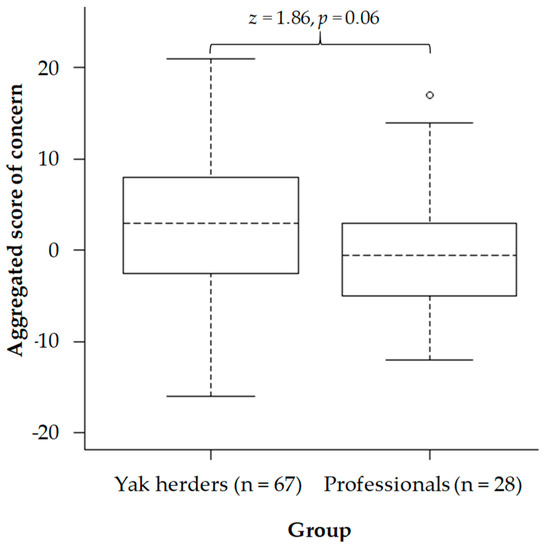
Figure 1.
Respondents’ aggregated score of concern factors to yak farming.
The herders’ sex, education, age, and the region did not influence their aggregated score of concern (p > 0.05), but size of the herd owned was positively related with the aggregated score of concern (p = 0.04). The herders’ aggregated score of concern to yak farming is likely to increase (odds ratio = 1.07) with a unit increase in current yak herd size (Table 3).
Table 3.
Multiple linear regression results for variables influencing the aggregated score of concerns related to yak farming.
3.2. Herders’ Future Plan with Herd Size
Half of the herders planned to increase the current yak herd size in the next 10 years. The reasons they mentioned were earning more income through sales of yak products (e.g., cheese, meat, sell live animals, hair products) and that it is a reliable source of income while other activities such as cordyceps collection are not (Table 4). Some herders plan to maintain the current herd size because it is able to meet the family daily household requirements, family labour is sufficiently present, and there is no successor to take over yak farming. A few herders responded to decrease the current yak herd size because of experiencing forage and labour shortage (Table 4).
Table 4.
Yak herders’ (n = 67) plans on the development of their herd size in the next 10 years.
The characteristics of the herders had no effect on their future plans with regard to herd size (Table 5), but the association between region and herders’ plans on the development of their herd size was stronger in the western region than the eastern and central regions (average marginal effect, AME = 0.43). Moreover, the herders’ plans on the development of their herd size in the next 10 years was not associated with the aggregated score of concern (t = −0.28, rpb = −0.04, p = 0.78).
Table 5.
Binary logit model results for variables influencing the herders’ plans on the development of their herd size in the next 10 years.
3.3. Herders’ Wish for their Children to Continue Yak Farming
The majority of the herders (82%) wish their children to continue yak farming in the future because they consider yak farming a reliable source of income and give importance to the traditional way of life (Table 6). Some herders also mentioned that the children have to make their own choice or should not continue yak farming in the future, with the argument that yak farming is a tough way of living and the herders usually have to endure a lonely life when at the summer rangelands. A few herders were unsure whether they wish their children to continue yak farming in the future.
Table 6.
Yak herders’ (n = 67) wish for the children to continue yak farming in future (yes/no) and their opinion on number of yak farming families in the next 10 years.
The age of the herder had a significant positive effect on the wish for their children to continue yak farming in the future (p = 0.03), but sex, education, size of the herd owned, and region did not (Table 7). This relation indicates that when the herder’s age increases their wish for children to continue yak farming is likely to increase (AME = 0.01). Moreover, the association between region and herders’ wish for their children to continue yak farming was stronger in the western region than in the eastern and central region (AME = 0.25). Additionally, the herders’ wish for their children to continue yak farming was positively associated with their aggregated score of concern (t = 2.89, rpb = 0.34, p = 0.01).
Table 7.
Binary logit model results for variables influencing the herder’s wish for their children to continue yak farming.
3.4. Number of Yak Farming Families in 10 Years
Of the herders 58% of the herders believed that the number of yak farming families will decline in the next 10 years, because young and adult family members will continue to migrate to towns looking for better economic opportunities and easy lifestyles (Table 6). Another reason mentioned by herders was a decreasing forage availability and an increasing predation on yaks, which might discourage yak farming families to continue in the future. In contrast, youth outmigration from their villages (p = 0.00) is believed by most livestock professionals (96%) to negatively affect the number of yak farming families in the next 10 years. A few herders also think that the number of yak farming families will remain the same in the future because current yak farming families are those who own adequate rangeland. Some herders (east, n = 7) think that the number of yak farming families will increase in the future because of traditional practices of dividing the yak herd among the family members in these communities (Table 6). In addition, a few herders of the central (n = 1) and western (n = 2) regions think that governmental support might encourage yak farming and increase the number of yak farming families in the future.
Table 8 shows that the herders’ characteristics and the region did not influence their opinion on the number of yak farming families in the next 10 years (p > 0.05). Moreover, the herders’ aggregated score of concern was not associated with their view on the number of yak farming families in the next 10 years (t = −0.38, rpb = −0.05, p = 0.70). In contrast, a negative association was observed for the livestock professionals’ aggregated score of concern and their opinion on the number of yak farming families in the next 10 years (t = −2.15, rpb = −0.39, p = 0.04). The result indicates that when the livestock professionals’ aggregated score of concern increases, the odds of thinking that the number of yak farming families will decline in the next 10 years increases. The herders’ opinion on the number of yak farming families in the next 10 years differed from livestock professionals (p = 0.00).
Table 8.
Binary logit model results for variables influencing the herders’ opinion on the number of yak farming families in the next 10 years.
3.5. Association between the Herders’ Plans and Decisions on Yak Farming
Herders’ plans on the development of their herd size was not associated with their wish for their children to continue yak farming and their opinion on the number of yak farming families in the next 10 years (p > 0.05). Additionally, no association between the herders’ wish for their children to continue yak farming and their view on the number of yak farming families in the next 10 years was observed (p > 0.05).
4. Discussion
This study aimed to deepen our understanding of the relationship between (perceived) level of concern, future plans and herders’ characteristics for yak farming in Bhutan.
Herders’ characteristics, the region, and the herders’ aggregated score had no relation with herders’ opinion on the number of yak farming families in the next 10 years, which contradicts with our expectation. Our hypothesis on the decreasing number of yak farming families comes from Wangchuk and Wangdi [5]. Wangdi [9] further reports that the age of herders affects the opinion on future of yak farming. The fact that no relation between the age of herders and their opinions was found in this study may be explained partly by the differences in analysis approach. The age of the herders was treated as a continuous variable in the logistic regression, while Wangdi [9] probably used age as categorial variable (young and elderly) to investigate whether age and their opinion on future of yak farming was related. In addition, we took into account more than one factor that may be associated with the opinion of the herders on the number of yak farming families in the future, so logistic regression is an appropriate approach [24,25]. If the aggregated score of concerns and characteristics of the herders do not appear to affect the opinion on the number of yak farming families in the future, then possibly the motivation of a person [26,27,28,29,30], risks perceived by a person [16,28], and/or current situation and constraints [29] do. Therefore, further analysis is required to examine relationships between aforementioned variables to deepen our understanding on future trends of yak farming. Furthermore, the R2 and pseudo R2 of the models are low but significant (Table 3 and Table 5). They indicate that even if the dependent variable was associated with the predictor when other predictors in the model are held constant [31], there are other potential important factors affecting the herders’ plan and decision on yak farming that were excluded in the model such as personality traits. The pseudo R2 of 0.22 (in Table 7) indicates a good model fit [32].
A substantial number of yak herders (east, 48%; central, 70%; west, 55%) said that the number of yak farming families will decrease in the next 10 years. Except for one, livestock professionals agreed that outmigration of the villages to towns and cities is the main reason. We single out the youth outmigration from the villages as the main potential threat to yak farming in the future due to access to education for children of yak-based communities and economic opportunities. In other studies by Dorji et al. [7] and Phuntsho and Dorji [10], it was shown that the younger generation of the yak-based families indeed had less interest to take up yak farming and prefer to migrate to towns and cities, which offer better amenities. Another study reported that the number of yak farming families has declined by approximately 31% from 1400 in 1996 to 968 in 2013 in Bhutan [9]. They indicate that this is probably due to outmigration leading to no successor and labour shortage. A similar decline in the number of the transhumance families by 35 to 50% was reported in Nepal [33]. The increasing youth outmigration from the villages was also reported in other parts of Bhutan [34,35] and other transhumant communities in other countries [4,33,36,37,38], affecting rural development and also leading to the loss of unique cultural traditions of the yak-based communities. Thus, a decreasing number of successors to take over yak farming is a policy issue, which requires governmental interventions when one wants to stop this process. One strategy is to provide good facilities (e.g., communication services, health services, upgrade schools) that should encourage younger literate pastoralists to stay in the yak farming business. However, some interventions by the government would also have to identify priorities of different stakeholders in addition to yak herders. For instance, yak farming communities request to revise the Forest Act by allowing them to conduct prescribed burning of rangelands to control shrub proliferation [9], while the Department of Forest and Park Services aims to strengthen conservation of biodiversity in protected areas and does not want to allow burning of rangelands.
Although more than half of the herders think yak farming will decline, most herders wish their children to continue yak farming in the future. The reason given by herders was that they view yak farming more like a traditional way of life than a profession, which was also the feeling expressed by transhumant herders in other countries [39,40]. Herders said that yak farming is their culture and tradition and so it is their and their children’s responsibility to keep yak farming alive. Younger generations, however, were not interviewed to ascertain that they are not interested in yak farming. Bernués et al. [41] indicated that having children in the farming family and successors willing to take over farming should be the core focus when assuring the sustainability of transhumant pastoralism systems. Moreover, the positive association between herders’ aggregated score of concern and their wish for children to continue yak farming in the future perhaps explains the confidence herders have in yak farming as a reliable source of income and the perceived responsibilities to maintain their unique culture and tradition.
We also found that herders of the western region had a stronger wish for their children to continue yak farming and planned changes in herd size in the next 10 years than in the other two regions. This observation is interesting because cordyceps collection (western and central region) and horses used in tourism and transportation (western region) are a very lucrative occupation compared to yak farming [9], which has less economic return and is a challenging occupation. Two reasons probably explain why most herders in the western region wish their children to continue yak farming. First, the Bhutanese government has legalised cordyceps collection in 2004 to encourage yak-based communities to stay active in the mountains and maintain keeping yaks, which might be a successful strategy in this region. Second, herders of the central and western region expressed that cordyceps yield and quality has declined compared to the past and they view yak farming as a reliable source of income, which was consistent with previous studies in Bhutan [5,9]. The decreased cordyceps quality and quantity was also reported in other Himalayan countries because of over exploitation of the resources [42,43], so the perception of the herders could be accurate. This implies that the government should explore novel alternative livelihoods for yak-based communities and assure better prices for their yak products to encourage pastoralists to stay in yak farming business, but it does not necessarily guarantee sustainable yak farming. For future research, we suggest studying the willingness of the younger generation of yak-based communities to take up yak farming in the future, and the related requirements.
The present study observed a very weak association between the herders’ wish for their children to continue yak farming in the future and their plan on the development of herd size in the next 10 years. This could be because the herders’ plans on the development of herd size greatly depend on other important factors, such as forage availability [44] (p. 191), the social purpose of keeping yaks (e.g., social symbol of the family), or for the future generation [45] than the herder’s characteristics in our study. From our survey, some herders mentioned that they would expand their yak herd size to cope with losses due to predation which they mentioned has increased over the years. A similar increase of wild predation on yaks was reported in the Ghunsa valley in Nepal [46]. A few herders (n = 3) also stated that whether they keep a small or large herd size, they should look after them anyway, so they plan to expand their herd size in the next 10 years. Elsewhere, the expansion of herd size is a strategy to reduce risk under the challenging living environment and climate change, such as in the Saami reindeer herders in Norway [47] and pastoral herders in northern Kenya [48]. Nevertheless, probabilities of yak herders to remain with yak farming are higher when they plan to expand their herd size, based on the assumption that they do not experience resource and management constraints, such as labour and forage shortage. Ondersteijn et al. [49] reported that the age is negatively related to growth of dairy herd size. The young farmers who have just taken over the farms are in effort to meet their financial needs, while the experienced farmers have a stable herd size that maintains a stable income.
Our cross-sectional analysis indicated that the herders’ aggregated score of concern was positively associated to the size of herd owned. A possible explanation is that herders become more concerned to meet forage and labour requirements and other management with increasing herd size [50,51]. In this context, it is important to get insight into which factors require immediate attention or even an intervention. For example, our survey results showed that the forage availability in rangelands (east, 86%; central, 87%; west, 91%), predation on yaks (east, 84%; central, 85%; west, 95%), and presence of a successor (east, 72%; central, 80%; west, 68%) were a concern in all visited regions.
Although herders’ aggregated score of concern did not differ from livestock professionals’, their opinions on the number of yak farming families in the next 10 years differed. It could be that many herders will continue yak farming for another 10 years as their average age was 41 years. Whereas livestock professionals might have learnt and/or heard during meetings that the younger pastoralists have no interest in yak farming and they think that number of yak farming families will decline in the future because of no successors. Nonetheless, more than half of the respondents (herders and livestock professionals) view that the number of yak farming families will decline in the future.
5. Conclusions
To our knowledge, this is the first kind of study unravelling the factors that affect the future for yak farming in Bhutan from the perspective of herders and livestock extensionists. We conclude that not many herders’ characteristics were associated with perceived concerns and the future plans and decisions on yak farming as was hypothesized, but probably there are other factors such as the motivation of a person in farming and risks perceived by a person. Nevertheless, our work underscores that policy makers should consider and incorporate factors that associate with perceived concerns such as forage shortage, predation, and decreasing successor to take up yak farming. This would contribute to the chances for sustaining yak farming in Bhutan. In addition, development policies should aim for financial security by helping yak farmers selling their products for a good price and by looking for novel alternate livelihoods. Besides, they should also provide better local infrastructures, communication services, health services, and upgrading the existing schools to give opportunities for young people to stay in the local communities having a good future perspective.
Author Contributions
Conceptualization, N.D., M.D., P.W.G.G.K. and E.A.M.B.; methodology, N.D., M.D., P.W.G.G.K. and E.A.M.B.; software, N.D.; validation, N.D., M.D. and E.A.M.B.; formal analysis, N.D., M.D. and E.A.M.B.; investigation, N.D.; writing—original draft preparation, N.D.; writing—review and editing, N.D., M.D., E.A.M.B. and P.W.G.G.K.; visualisation, N.D., M.D. and E.A.M.B.; supervision, M.D., P.W.G.G.K. and E.A.M.B.; project administration, P.W.G.G.K., N.D., M.D. and E.A.M.B.; funding acquisition, P.W.G.G.K., E.A.M.B. and N.D. All authors have contributed to discussion, read and agreed to the published version of the manuscript.
Funding
This project was funded by The Netherlands University Foundation for International Cooperation (NUFFIC). The study is a part of the PhD thesis of the first author (N.D.).
Acknowledgments
The authors are grateful to the local livestock extensionists for their logistic support to the first author (N.D.). The authors wish to thank all the respondents for their valuable time. We further thank the College of Natural Resources, The Royal University of Bhutan for the support during data collection in Bhutan.
Conflicts of Interest
The authors declare no conflicts of interest.
Appendix A
Table A1.
Yak herder’s (n = 67) and livestock professionals’ (n = 28) perceive level of concerns of factors related to yak farming.
Table A1.
Yak herder’s (n = 67) and livestock professionals’ (n = 28) perceive level of concerns of factors related to yak farming.
| Aspects | Level of Perceived Concern (%) | ||||
|---|---|---|---|---|---|
| Not at All | To Small Extent | To Moderate Extent | To Large Extent | Don’t Know | |
| Forage availability in winter rangeland | |||||
| Yak herders | 11.9 | 13.4 | 25.4 | 47.8 | 1.5 |
| Livestock professionals | 10.7 | 25 | 28.6 | 28.6 | 7.1 |
| Forage availability in summer rangeland | |||||
| Yak herders | 10.5 | 17.9 | 23.9 | 47.8 | 0 |
| Livestock professionals | 0 | 25 | 28.6 | 64.4 | 0 |
| Water availability | |||||
| Yak herders | 53.7 | 10.4 | 19.4 | 14.9 | 1.5 |
| Livestock professionals | 14.3 | 3.6 | 46.4 | 21.4 | 14.3 |
| Quality breeding bull availability | |||||
| Yak herders | 59.7 | 13.4 | 17.9 | 9 | 0 |
| Livestock professionals | 7.1 | 25 | 25 | 11 | 3.6 |
| Conception rate of yak cow | |||||
| Yak herders | 61.2 | 11.9 | 17.9 | 1.5 | 7.5 |
| Livestock professionals | 17.9 | 28.6 | 28.6 | 14.3 | 10.7 |
| Milk yield of yak cow | |||||
| Yak herders | 34.3 | 11.9 | 26.9 | 25.4 | 1.5 |
| Livestock professionals | 21.4 | 28.6 | 32.1 | 14.3 | 3.6 |
| Body size of adult yak | |||||
| Yak herders | 38.8 | 23.9 | 25.4 | 10.4 | 1.5 |
| Livestock professionals | 21.4 | 35.7 | 21.4 | 3.6 | 17.9 |
| Prevalence of diseases and parasites | |||||
| Yak herders | 32.8 | 23.9 | 14.9 | 23.9 | 4.5 |
| Livestock professionals | 7.1 | 39.3 | 32.1 | 21.4 | 0 |
| Access to veterinary and extension services | |||||
| Yak herders | 46.3 | 29.9 | 13.4 | 9 | 1.5 |
| Livestock professionals | 17.9 | 14.3 | 25 | 42.9 | 0 |
| Predation on yaks | |||||
| Yak herders | 9 | 10.5 | 19.4 | 58.2 | 3.0 |
| Livestock professionals | 0 | 14.3 | 7.1 | 71.4 | 7.1 |
| Market for selling yak products | |||||
| Yak herders | 79.1 | 13.4 | 6 | 0 | 1.5 |
| Livestock professionals | 17.9 | 14.3 | 32.1 | 28.6 | 7.1 |
| Labour availability to herd yaks | |||||
| Yak herders | 49.3 | 22.4 | 17.9 | 9 | 1.5 |
| Livestock professionals | 3.6 | 28.6 | 25 | 39.3 | 3.6 |
| Successor (youth) to yak farming | |||||
| Yak herders | 22.9 | 17.9 | 26.9 | 28.4 | 4.5 |
| Livestock professionals | 10.7 | 14.3 | 21.4 | 39.3 | 14.3 |
| Yak population in the community | |||||
| Yak herders | 44.8 | 19.4 | 20.9 | 14.9 | 0 |
| Livestock professionals | 17.9 | 42.9 | 17.9 | 21.4 | 0 |
| Number of yak farming families | |||||
| Yak herders | 49.3 | 17.9 | 13.4 | 19.4 | 0 |
| Livestock professionals | 21.4 | 17.9 | 35.7 | 21.4 | 3.6 |
| Training to improve yak management practices | |||||
| Yak herders | 52.2 | 29.9 | 6 | 7.5 | 4.5 |
| Livestock professionals | 7.1 | 14.3 | 46.4 | 28.6 | 3.6 |
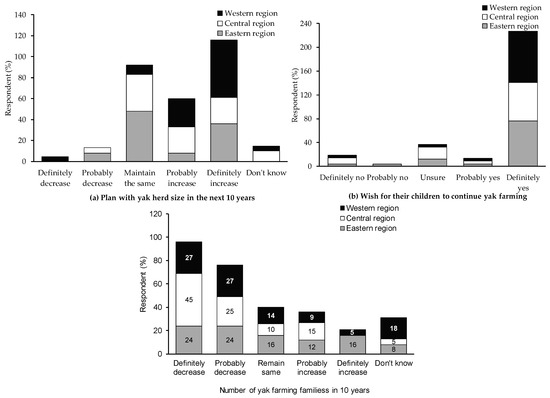
Figure A1.
Herders’ future plans and decisions on yak farming.
References
- Allen, V.G.; Batello, C.; Berretta, E.J.; Hodgson, J.; Kothmann, M.; Li, X.; McIvor, J.; Milne, J.; Morris, C.; Peeters, A.; et al. An international terminology for grazing lands and grazing animals. Grass Forage Sci. 2011, 66, 2–28. [Google Scholar] [CrossRef]
- Gyamtsho, P. Economy of yak herders. J. Bhutan Stud. 2000, 2, 1–45. [Google Scholar]
- Suntikul, W.; Dorji, U. Tourism development: The challenges of achieving sustainable livelihoods in Bhutan’s remote reaches. Int. J. Tour. Res. 2016, 18, 447–457. [Google Scholar] [CrossRef]
- Joshi, S.; Shrestha, L.; Bisht, N.; Wu, N.; Ismail, M.; Dorji, T.; Dangol, G.; Long, R. Ethnic and cultural diversity amongst yak herding communities in the Asian highlands. Sustainability 2020, 12, 957. [Google Scholar] [CrossRef]
- Wangchuk, K.; Wangdi, J. Mountain pastoralism in transition: Consequences of legalizing Cordyceps collection on yak farming practices in Bhutan. Pastoralism 2015, 5. [Google Scholar] [CrossRef]
- Derville, M.; Bonnemaire, J. Marginalisation of Yak Herders in Bhutan: Can Public Policy Generate New Stabilities that can Support the Transformation of Their Skills and Organisations? And Bonds to Territories: A Case Study in France and Brazil; ISDA: Montpellier, France, 2010; p. 10. [Google Scholar]
- Dorji, N.; Derks, M.; Dorji, P.; Groot Koerkamp, P.W.G.; Bokkers, E.A.M. Resilience of yak farming in Bhutan. In 70th Annual Meeting of the European Federation of Animal Science; Book of abstracts, 25; Wageningen Academic Publishers: Wageningen, The Netherlands; Ghent, Belgium, 2019; p. 426. [Google Scholar]
- Wangchuk, K.; Wangdi, J. Signs of climate warming through the eyes of yak herders in northern Bhutan. Mt. Res. Dev. 2018, 38, 45–52. [Google Scholar] [CrossRef]
- Wangdi, J. The future of yak farming in Bhutan: Policy measures government should adopt. Rangel. J. 2016, 38, 367–371. [Google Scholar] [CrossRef]
- Phuntsho, K.; Dorji, T. Yak herding in Bhutan: Policy and practice. In Transboundary Challenges and Opportunities for Yak Raising in a Changing Hindu Kush Himalayan Region; Wu, N., Yi, S., Joshi, S., Bisht, N., Eds.; International Centre for Integrated Mountain Development: Kathmandu, Nepal, 2016; pp. 147–163. [Google Scholar]
- Corner-Thomas, R.A.; Kenyon, P.R.; Morris, S.T.; Ridler, A.L.; Hickson, R.E.; Greer, A.W.; Logan, C.M.; Blair, H.T. Influence of demographic factors on the use of farm management tools by New Zealand farmers. N. Z. J. Agric. Res. 2015, 58, 412–422. [Google Scholar] [CrossRef]
- Myeni, L.; Moeletsi, M.; Thavhana, M.; Randela, M.; Mokoena, L. Barriers affecting sustainable agricultural productivity of smallholder farmers in the eastern free state of South Africa. Sustainability 2019, 11, 3003. [Google Scholar] [CrossRef]
- Cornish, A.; Raubenheimer, D.; McGreevy, P. What we know about the public’s level of concern for farm animal welfare in food production in developed countries. Animals 2016, 6, 74. [Google Scholar] [CrossRef]
- DoL. Livestock Statistics 2007; Livestock, D.O., Ed.; Ministry of Agriculture and Forests: Thimphu, Bhutan, 2007; p. 131.
- Gliem, J.A.; Gliem, R.R. Calculating, interpreting, and reporting Cronbach’s alpha reliability coefficient for Likert-type scales. In Midwest Research to Practice Conference in Adult, Continuing, and Community Education; The Ohio State University: Columbus, OH, USA, 2003. [Google Scholar]
- Adler, F.; Christley, R.; Campe, A. Invited review: Examining farmers’ personalities and attitudes as possible risk factors for dairy cattle health, welfare, productivity, and farm management: A systematic scoping review. J. Dairy Sci. 2019, 102, 3805–3824. [Google Scholar] [CrossRef]
- Willock, J.; Deary, I.J.; McGregor, M.M.; Sutherland, A.; Edwards-Jones, G.; Morgan, O.; Dent, B.; Grieve, R.; Gibson, G.; Austin, E.; et al. Farmers’ attitudes, objectives, behaviors, and personality traits: The Edinburgh study of decision making on farms. J. Vocat. Behav. 1999, 54, 5–36. [Google Scholar] [CrossRef]
- Daoud, J.I. Multicollinearity and regression analysis. J. Phys. Conf. Ser. 2017, 949, 012009. [Google Scholar] [CrossRef]
- O’brien, R.M. A caution regarding rules of thumb for variance inflation factors. Qual. Quant. 2007, 41, 673–690. [Google Scholar] [CrossRef]
- Jay, M. Goodness of Fit Tests for Logistic Regression Models. 2019, p. 10. Available online: https://cran.r-project.org/web/packages/generalhoslem/generalhoslem.pdf (accessed on 6 January 2020).
- Tuszynski, J. Package ‘caTools’; 2020. Available online: https://cran.r-project.org/web/packages/caTools/caTools.pdf (accessed on 31 January 2020).
- Hu, B.; Shao, J.; Palta, M. Pseudo-R2 in logistic regression model. Stat. Sin. 2006, 16, 847–860. [Google Scholar]
- Cureton, E.E. Rank-biserial correlation. Psychometrika 1956, 21, 287–290. [Google Scholar] [CrossRef]
- Peng, C.-Y.J.; Lee, K.L.; Ingersoll, G.M. An introduction to logistic regression analysis and reporting. J. Educ. Res. 2002, 96, 3–14. [Google Scholar] [CrossRef]
- Cassidy, L.D. Basic concepts of statistical analysis for surgical research. J. Surg. Res. 2005, 128, 199–206. [Google Scholar] [CrossRef]
- Ryan, R.M.; Deci, E.L. Intrinsic and extrinsic motivations: Classic definitions and new directions. Contemp. Educ. Psychol. 2000, 25, 54–67. [Google Scholar] [CrossRef]
- Bukchin, S.; Kerret, D. Food for hope: The role of personal resources in farmers’ adoption of green technology. Sustainability 2018, 10, 1615. [Google Scholar] [CrossRef]
- Warren, C.R.; Burton, R.; Buchanan, O.; Birnie, R. Limited adoption of biomass energy crops: The role of farmers’ socio-cultural identity in influencing practice. J. Rural Stud. 2016, 45, 175–183. [Google Scholar] [CrossRef]
- Kollmuss, A.; Agyeman, J. Mind the Gap: Why do people act environmentally and what are the barriers to pro-environmental behavior? Environ. Educ. Res. 2002, 8, 239–260. [Google Scholar] [CrossRef]
- Edwards-Jones, G. Modelling farmer decision-making: Concepts, progress and challenges. Anim. Sci. 2006, 82, 783–790. [Google Scholar] [CrossRef]
- Frost, J. How to Interpret Regression Models that Have Significant Variables but a Low R-Squared. Available online: https://statisticsbyjim.com/regression/interpret-coefficients-p-values-regression/ (accessed on 23 April 2020).
- McFadden, D. Quantitative methods for analysing travel behaviour of individuals: Some Recent developments. In Behavioural Travel Modelling; Hensher, D.A., Stopher, P.R., Eds.; Croom Helm.: London, UK, 1979; pp. 279–318. [Google Scholar]
- Tiwari, K.R.; Sitaula, B.K.; Bajracharya, R.M.; Raut, N.; Bhusal, P.; Sengel, M. Vulnerability of pastoralism: A case study from the high mountains of Nepal. Sustainability 2020, 12, 2737. [Google Scholar] [CrossRef]
- Lorway, R.; Dorji, G.; Bradley, J.; Ramesh, B.M.; Isaac, S.; Blanchard, J. The drayang girls of Thimphu: Sexual network formation, transactional sex and emerging modernities in Bhutan. Cult. Health Sex. 2011, 13 (Suppl. 2), S293–S308. [Google Scholar] [CrossRef] [PubMed]
- Walcott, S. Urbanization in Bhutan. Geogr. Rev. 2009, 99, 81–93. [Google Scholar] [CrossRef]
- Aryal, S.; Maraseni, T.N.; Cockfield, G.J. Sustainability of transhumance grazing systems under socio-economic threats in Langtang, Nepal. J. Mt. Sci. 2014, 11, 1023–1034. [Google Scholar] [CrossRef]
- Oteros-Rozas, E.; Ontillera-Sánchez, R.; Sanosa, P.; Gómez-Baggethun, E.; Reyes-García, V.; González, J.A. Traditional ecological knowledge among transhumant pastoralists in Mediterranean Spain. Ecol. Soc. 2013, 18. [Google Scholar] [CrossRef]
- Jurt, C.; Häberli, I.; Rossier, R. Transhumance farming in Swiss mountains: Adaptation to a changing environment. Mt. Res. Dev. 2015, 35, 57–65. [Google Scholar] [CrossRef]
- Oteros-Rozas, E.; Martín-López, B.; López, C.A.; Palomo, I.; González, J.A. Envisioning the future of transhumant pastoralism through participatory scenario planning: A case study in Spain. Rangel. J. 2013, 35, 251–272. [Google Scholar] [CrossRef]
- Bhasin, V. Pastoralists of Himalayas. J. Hum. Ecol. 2011, 33, 147–177. [Google Scholar] [CrossRef]
- Bernués, A.; Ruiz, R.; Olaizola, A.; Villalba, D.; Casasús, I. Sustainability of pasture-based livestock farming systems in the European Mediterranean context: Synergies and trade-offs. Livest. Sci. 2011, 139, 44–57. [Google Scholar] [CrossRef]
- Winkler, D. Steps towards Sustainable Harvest of Yartsa Gunbu (Caterpillar Fungus, Ophiocordyceps sinensis). In Proceedings of the 7th International Medicinal Mushroom Conference, Beijing, China, 25–29 August 2013; pp. 635–644. [Google Scholar]
- Hopping, K.A.; Chignell, S.M.; Lambin, E.F. The demise of caterpillar fungus in the Himalayan region due to climate change and overharvesting. Proc. Natl. Acad. Sci. USA 2018, 115, 11489–11494. [Google Scholar] [CrossRef] [PubMed]
- Nawaz, M.A.; Din, J.U.; Buzdar, H. Chapter 14–Livestock husbandry and snow leopard conservation. Subchapter–The ecosystem health program: A tool to promote the coexistence of livestock owners and snow leopards. In Snow Leopards; McCarthy, T., Mallon, D., Eds.; Academic Press: New York, NY, USA, 2016; pp. 179–195. [Google Scholar]
- Mulder, M.B.; Fazzio, I.; Irons, W.G.; Bowles, S.; Bell, A.V.; Hertz, T.; Hazzah, L. Revisiting an old question: Pastoralism and wealth inequality. Curr. Anthropol. 2010, 51, 35–48. [Google Scholar] [CrossRef]
- Sherchan, R.; Bhandari, A. Status and trends of human-wildlife conflict: A case study of Lelep and Yamphudin region, Kanchenjunga Conservation Area, Taplejung, Nepal. Conserv. Sci. 2017, 5, 19–25. [Google Scholar] [CrossRef]
- Næss, M.W.; Bårdsen, B.-J. Environmental stochasticity and long-term livestock viability—herd-accumulation as a risk reducing strategy. Hum. Ecol. 2010, 38, 3–17. [Google Scholar] [CrossRef]
- McPeak, J. Individual and collective rationality in pastoral production: Evidence from Northern Kenya. Hum. Ecol. 2005, 33, 171–197. [Google Scholar] [CrossRef]
- Ondersteijn, C.J.M.; Giesen, G.W.J.; Huirne, R.B.M. Identification of farmer characteristics and farm strategies explaining changes in environmental management and environmental and economic performance of dairy farms. Agric. Syst. 2003, 78, 31–55. [Google Scholar] [CrossRef]
- Gargiulo, J.I.; Eastwood, C.R.; Garcia, S.C.; Lyons, N.A. Dairy farmers with larger herd sizes adopt more precision dairy technologies. J. Dairy Sci. 2018, 101, 5466–5473. [Google Scholar] [CrossRef]
- Gray, C.L. Rural out-migration and smallholder agriculture in the southern Ecuadorian Andes. Popul. Environ. 2009, 30, 193–217. [Google Scholar] [CrossRef]
© 2020 by the authors. Licensee MDPI, Basel, Switzerland. This article is an open access article distributed under the terms and conditions of the Creative Commons Attribution (CC BY) license (http://creativecommons.org/licenses/by/4.0/).