


Abstract
Social entrepreneurship has been recognized as a tool to attain sustainable development. This paper highlights the role of social entrepreneurship in triggering social change and attaining sustainable development. The paper contributes significantly to the existing literature by conducting a systematic review of extant works. To this end, we analyzed and reviewed 173 research papers from the Web of Science database. The results are presented in the form of descriptive findings and thematic discussion. The paper concludes by setting up the agenda for future researchers in the field.
1. Introduction
Academic interest in sustainable development is growing significantly. Researchers are approaching the subject of sustainable development from various contexts. In that course, the concepts of social entrepreneurship and sustainable development are also crossing paths [1]. Social entrepreneurs have been understood as change agents who employ entrepreneurial means for providing systemic solutions to social and environmental problems [2] while also ensuring their own survival and sustainability [3]. Recent literature on social entrepreneurship focuses on the relevance of small and medium-sized enterprises (SMEs) and entrepreneurship for economic development [4]. In developing countries where resources are scarce and banks and financial institutions are reluctant to lend financial support to SMEs, the governments have an even larger role to play by providing sources of financing for SME development [5]. While lack of resources is considered to be the major barrier or hindrance to responsible business practices in SMEs, resource-poor entrepreneurs are looking for innovative business models in order to sustain themselves [6].
Considerable attention has been devoted to sustainable development supporting social, economic and environmental aspects [7]. To recognize opportunities for sustainable development, entrepreneurial knowledge and innovative abilities play a key role [8]. The innovative power of entrepreneurs has an important part in ensuring a more sustainable future. Entrepreneurs are, therefore, recognized as the engines of sustainable development [9]. While entrepreneurs are considered as vehicles for meeting (currently) unmet social needs, the academic discourse on how this process will actually unfold has been sparse [8].
The present paper consolidates the developments in extant literature on the contribution of social entrepreneurship towards sustainable development through systematic review methodology and suggests the agenda for future researchers in the field. The paper contributes to the literature of social entrepreneurship as well as sustainable development in a novel way by providing ready reference of the extant literature to the potential researchers in both fields. In a specific way, we combine the research outcomes and parameters of the extant literature in six categories. These include the studies focusing on (a) innovation and technology adopted by the social entrepreneurs; (b) contribution of social entrepreneurs towards rural and community development and urbanization; (c) social, economic and environmental considerations of the social entrepreneurs; (d) financing and crowdfunding patterns in social entrepreneurs; (e) women entrepreneurs; and (f) corporate social responsibility performed by the social entrepreneurs. We also identify parameters within each category being addressed by the extant literature; and the objectives studied, methodologies employed, and findings of the important studies within the six categories. Finally, we highlight research directions in the field by indicating the following research questions for future researchers.
- RQ1: What are the major themes and sub-themes identified and discussed by extant literature studying social entrepreneurship in the context of sustainable development?
- RQ2: Which methodological approaches have been employed by the extant literature to study social entrepreneurs in the context of sustainable development?
- RQ3: What are the gaps in existing literature studying social entrepreneurship in the context of sustainable development; and what are the potential focus areas for future research in the field?
The paper is organized as follows. The present section introduces the ideation of the paper and the research questions; the second section outlines the methodology applied for this review; the third section presents the descriptive findings and thematic analysis of the papers under reference; the fourth section concludes and suggests the research agenda for future research in the field.
2. Methodology
The methodology of this paper is inspired by Tranfield, Denyer, and Smart [10], Jabbour [11]; Junior and Filho [12]; Sharma, Aryan, Singh, and Kaur [13]; Talan and Sharma [14].
We use the Web of Science database to conduct our search using the BOOLEAN criteria. Web of Science provides access to multidisciplinary research which allows for in-depth examination of particular sub-fields within an academic or scientific discipline [15]. To answer the research questions specified in the Introduction, we have conducted a comprehensive systematic review of the literature. Following their initial application in medical research, systematic reviews have been widely used in the fields of economics and management, due to their ability to improve the quality of review process and establish a systematic, clear and duplicable literature review [10]. Systematic reviews involve detailed examination of each paper considering their abstract, introduction, methods, findings and conclusions [16], thereby highlighting the major trends and results from the existing literature and providing directions for future research [17]. In systematic reviews, where a typical number of papers are inspected, the researcher specifies the Boolean query to find relevant papers [18,19]. The usage of BOOLEAN criteria has become much prevalent across disciplines in recent times [14,17,20]. Boolean is used to structure a query, that is easily replicable and editable, and for more control in retrieving plurals and different spellings that result in stronger and more precise searches [21]. The papers that match the query are retrieved and inspected but those which do not match the query are never viewed regardless of their relevance [19].
A systematic search was conducted (on 1 March 2018) in the Web of Science (WoS) database to identify all peer-review papers using the following BOOLEAN:
TS= ((social*) AND ((entrepreneur*) OR (entrepreneurial*) OR (entrepreneurship*)) AND (“sustainable development”)).
The query led to 176 papers, which were further evaluated as per the procedure exhibited in Figure 1. To begin with, non-English papers were rejected. We came down to a list of 175 papers, out of which two papers were doubtful, so the papers were reassessed and finally rejected as they were not directly related to the study. Afterwards, a final list of 173 papers was obtained (Supplementary Materials). After collecting and screening the research papers, we categorized and coded them to have an overall view of the studies on social entrepreneurship and sustainable development.
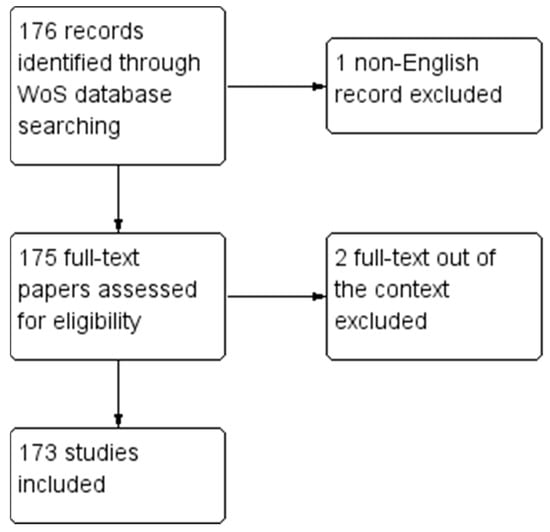
Figure 1.
Search and selection process.
The classification includes seven major subjects, numbered from one to seven, and coded using alphabetical letters that go from A to I. Table 1 depicts the categorization framework and codes.

Table 1.
The framework for categorizing and coding the studies analyzed.
The classification and categorization scheme is in line with Jabbour [11]; Ferreira et al. [16] Sharma et al. [13]; Jain and Sharma [17]; Talan and Sharma [14]. The first category identifies the distribution of publications per year and year-wise citations for the period 1992–2018 to arrive at the period witnessing an increase in academic interest to the subject. The second category involves identifying the coverage of the selected papers, which have been coded as: “A- Developed countries”, “B- Developing countries” and “C- No specific coverage”. Code “C” is applied to the papers, not specific to a specific country. To further specify the geographical area covered by the papers, the third category has been created, which are coded on a scale from A–F. The fourth category classifies the papers based on the dimensions studied by them, and is coded by the letters A, B, C and D. Social entrepreneurship has been used as one of the most powerful tools for promoting sustainable development [22], which entails social, economic and environmental dimensions [23]. The fifth category identifies the research method applied in the extant literature and is coded on a scale from A–C. This category identifies the prominent methods used by the extant literature. The sixth category associates with the main themes of the reviewed research papers, coded from A–I. The seventh category classifies the studies according to their contribution to the body of knowledge, and codes the papers on a scale of A–D. The aim of this category is to assess the findings of the papers and to verify whether the authors have introduced a new stream of research or are conforming to the previous literature.
3. Results and Discussion
3.1. Descriptive Findings
The descriptive findings provide an overview and help clarify the main characteristics and methodology used by selected studies [24].
3.1.1. Year-Wise Publications and Citations
Figure 2 presents the number of papers published per year and the citations of all the reviewed papers per year for the period 1992–2018. Figure 2 reveals an increasing trend signaling an increased interest of researchers in this area [1]. The highest number of publications and the sum of times cited are in the year 2017.
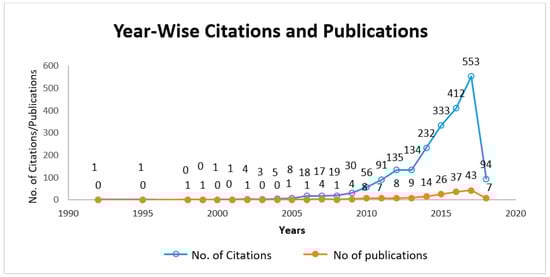
Figure 2.
Year-wise citations and publications.
Table 2 shows the results obtained after the analysis of 173 research papers. The number of papers belonging to different categories are shown in the table, while the percentage of the papers belonging to specific categories is shown in the parenthesis. N/A represents the categories in which these codes are not applicable.
Table 2.
Descriptive findings of papers reviewed.
3.1.2. Coverage
Category two involves identifying the coverage analyzed by the research papers. The analysis shows that most of the previous research is dedicated to the developed countries followed by developing countries or emerging economies. There are some studies that compares data between countries. The results reveal that there exists fewer papers that cope with the relationship between social entrepreneurship and sustainable development in developing countries. Murthy, Sagayam, Rengalakshmi, and Nair [25] highlight the necessity of exploring the concept in developing nations since the details concerning social issues in these countries and the strategies adopted by them to strive are limited.
3.1.3. Geographical Coverage
The third category relates to specific geographical coverage of the researched countries. A large proportion of studies come from Europe, while the contributions from Asia and North America are still modest. Although the research in these regions are comparatively low, the concept has been emerging since 1990s. Public authorities along with social enterprises are paying attention towards mobilizing economic and social resources towards the growing welfare needs [26].
3.1.4. Dimensions
The fourth category analyses the dimensions addressed by extant literature covered in the study. According to the concern of the present research, most of the studies focuses on economy-related issues, followed by environment-related issues and social issues respectively.
3.1.5. Methodology
The fifth category identifies the research methodology applied in the selected literature. The analysis clearly reveals that most of the research papers use empirical methodology (67 percent), while 27 percent of the papers employ case studies methodology. Although there exists empirical research in the field, more empirical studies are required in order to understand the important antecedents and outcome of social entrepreneurship [27,28]. More in-depth interviews with informants shall better manage the cultural and social issues concerning access to informants, social desirability bias [29].
3.1.6. Themes
The results reveal that extant literature has mostly focused on environmental and ecological considerations, rural and community development and urbanization. The concept of social entrepreneurship takes multiple forms, depending on socioeconomic and cultural circumstances, placing obstacles on research in the area. This calls for further research to establish concrete definitions for overcoming ambiguity of the concept [3,27].
3.1.7. Contribution of the Research Papers
The seventh classification explores the contribution made by the existing literature. Findings of the maximum papers (81 percent) are ‘consistent with previous literature’. To further inform social entrepreneurs for contributing towards sustainable development, more comparative and longitudinal research can be conducted [28,30].
3.2. Thematic Discussion
The term “entrepreneur” was originated by Schumpeter in the 20th century who calls the entrepreneur a “man of action” who drives the creative-destruction process considered as the core of capitalism. He describes entrepreneurs as the innovators and catalysts behind social and economic progress facing the risks and reforms or revolutionize the process of production for producing new goods or producing existing ones in a new way [22].
Entrepreneurship is progressively accepted as a duct to create sustainable products/services and processes integrating social and environmental concerns. The extant literature does not extensively discuss the contribution of entrepreneurs towards a sustainable future [8]. Belz and Binder [31] conclude that it is crucial for entrepreneurs to blend social, ecological concerns and customer benefits as a solution to the triple bottom line further leading to the sustainability of their ventures as also that of the universe.
Social entrepreneurship has emerged as a sub-discipline within the field of entrepreneurship [27]. Social entrepreneurs create social value by providing social benefit for all, and economic value by creating jobs and income for their venture while accomplishing their vision and missions [32]. Partzsch and Ziegler [2] propose that the innovative capacity of social entrepreneurs is their primary source of authority to deal with the commonly perceived problems.
Although the objective of a profit-maximizing firm is different from a social business, the managerial mindset should be the same as in a business while creating social benefit. Social businesses can certainly generate income while achieving their social missions and can be self-sustainable. The surplus generated by such businesses may be reinvested in the business to provide cost-effective quality goods and services to the target group of beneficiaries [33].
Traditional financial institutions are cautious in lending to social entrepreneurs whereas commercial entrepreneurs can attract traditional capital providers and equity investors [34]. Belz and Binder [31] argue that resources for social enterprises are confined not only to personal savings and banks loans but their social value creation and environmental concerns open up the door to novel, unconventional and increasingly important source of public funding such as crowdfunding.
Buil-Fabregà et al. [35] establish that the relationship between the individual dynamic capabilities (IDC) of managers with their social and environmental commitment to promote sustainability is greater in cases of businesses being led by women. Vinokurova and Natalia [36] argue that despite having many accomplishments, women hold lower position in comparison with men as they are lacking in terms of academic capital and scientific power.
Social responsibility of businesses is considered to be beneficial both the society and the firm [37]. Doukas, Tsiousi, Marinakis, and Psarras [38] conclude that the corporations with goals limited to the mandatory legislations achieve lower performance as compared to the ones integrating fundamental environmental practices and corporate social responsibility (CSR) concepts. To incorporate these practices into the corporate policies and structures, United Nations general assembly proposes to integrate entrepreneurship in the education curriculum and universities around the world shall be encouraged to inform students about the demands of diverse communities and the world [39]. Abou-Warda [40] opines that fostering entrepreneurial education requires support from government authorities in the form of reviewing regulations on the assistance of educators and entrepreneurs in entrepreneurship teaching activities; favoring practical activities related to technology/entrepreneurship education, and sustainable market; establishing awards for teachers and students of entrepreneurial universities; and promoting positive examples of academic spin-offs.
The main purpose of thematic discussion is to identify new research directions and synthesize the main outcomes extracted from the extant literature [24]. The thematic discussion of this paper is based on the research outcomes and parameters of the extant literature as exhibited in Table 3, followed by the parameters for each outcome as identified by us for the purpose of this thematic discussion.
Table 3.
Research outcomes and parameters.
In the following sub-sections, we discuss the important studies related to each outcome in detail. Table 4, Table 5, Table 6, Table 7, Table 8 and Table 9 are spread over five columns, namely: authors, objectives, methodology and basis for inclusion for these studies of the outcomes.
Table 4.
Innovation and technology.
Table 5.
Rural and community development and urbanization.
Table 6.
Social, economic and environmental considerations.
Table 7.
Women entrepreneurs.
Table 8.
Financing and Crowdfunding.
Table 9.
Corporate social responsibility (CSR).
3.2.1. Innovation and Technology
Table 4 discusses social entrepreneurship from the perspective of social innovation and technology. The research on “social entrepreneurship” and “social innovation” has increased during the last decade [47]. Innovation brings creative ideas into existence [42]. Innovation in the context of social entrepreneurship is not only the replication of existing practices but also involves creating something new [88,89]. Innovation forms part of different stages in the social entrepreneurial process [90].
Social entrepreneurs create institutions to actualize their mission of social transformation and to carry the innovative solutions forward. The major challenge faced by social entrepreneurs includes the challenge of creating a new product or a service, creating demand for the product or even assessing the inputs or assessing the markets [91]. Social entrepreneurs need to be innovative while framing their objectives in order to maintain a balance between their social and economic objectives with limited resources [92]. To improve the social and environmental impact by social entrepreneurs, a Government must support and stimulate innovation in the form of funding and subsidies. Government can encourage entrepreneurial solutions by directing public policies towards innovative causes [6].
Individual entrepreneurs find new/innovative ways to create a product/ service in order to cater to some social needs to achieve sustainable development without compromising profits while conducting their activities. However, their ability to create social value must be the primary objective [93].
Local entrepreneurs lack the ability to develop necessary capabilities for innovation, product differentiation and technology improvement, and are confined to competing on low price and large volume [94].
3.2.2. Rural and Community Development and Urbanization
Table 5 summarizes the important literature focusing on social entrepreneurship from the perspective of rural and community development. Social entrepreneurs in rural areas face many challenges including powerful resistance from time to time while adopting new approaches to work for common and inclusive prosperity [94]. Social entrepreneurs lead villagers’ cooperatives and rural communities towards a clear social mission so as to improve the living conditions of underprivileged people [95]. The outcome of this process of rural community development is largely dependent on the personal experiences of the social entrepreneur dealing with the challenges and obstacles [96]. Success of a social entrepreneur depends on his ability to attract resources (labor and capital) and innovative ways to create social value in a competitive environment [97]. Social entrepreneurial policies of the government play an important role in rural economic growth, which is dependent on allocation of research and development (R&D) resources and labor mobility by the government [98].
The amount of social value created is considered to be the main sign or characteristic of sustainable development of a region [50] therefore, the promotion of social entrepreneurship and SMEs is crucial for creating social value and, therefore, contributes towards sustainable regional development [4,54].
3.2.3. Social, Economic and Environmental Considerations
Table 6 discusses social entrepreneurship from the perspective of triple bottom-line. The concept of triple bottom line refers to the social, economic, and environmental aspects and dimensions of sustainable development [23,99]. The concept is pertinent to economic development and related fields such as finance, business, planning and real estate [100].
Extant literature studies entrepreneurs focusing on environmental aspects as ecopreneurs. An ecopreneur is an individual or institution that seeks to popularize eco-friendly ideas/products/technology/innovations either through the market or non-market routes. The approach of ecopreneurship is helpful for policy makers and society at large, since there is little doubt that the transformation to sustainable development requires ecopreneurship on a grand scale [58,101]. Environmental policy that aims to correct market failures or externalities, thereby impacting market forces is growing strongly [102]. These ecopreneurs focus only on the environmental aspect of sustainable development but the social entrepreneurship process involves integrating economic/financial interest and social value as well. Social entrepreneurship is emerging as a sustainable solution that requires a blend of social, economic and environmental value or triple bottom line performance [103].
3.2.4. Women Entrepreneurs
Table 7 discusses social entrepreneurship from the perspective of women entrepreneurs. Female social entrepreneurs are characterized by a high degree of agreeableness, openness, emotional stability and conscientiousness. The attribute related to agreeableness is more significantly observed in female social entrepreneurs as compared to men [104]. Women entrepreneurs reflect vision, which is the key characteristic, and improves the wealth of a nation and therefore contributes to the growth of an economy [105]. Women in top management help companies to provide socially desirable products and services. Such entrepreneurs are able to create social value because of their greater social and environmental commitment [35]. The qualities of women entrepreneurs include creativity, a hardworking nature, determination, ability and desire to take risk and profit earning capacity [76]. Professionally qualified and technically sound women must be encouraged to manage their own business instead of being dependent on wage employment outlets [106].
Microenterprises provide new sources of income for women and can be helpful in bridging the gap between the social and environmental dimensions of sustainable development. They help in spreading sustainable agriculture, protecting and ensuring accessibility of clean water sources, reducing deforestation and preserving biodiversity [79]. To ensure the growth of women entrepreneurs, various programs of assistance and incentives have been introduced by the government.
3.2.5. Financing and Crowdfunding
Table 8 discusses social entrepreneurship from the perspective of financing and crowdfunding. Crowdfunding is a new form of entrepreneurship raising money to address some social or cultural problems [72]. Crowdfunding is becoming an important source of financing for social ventures. The process of crowdfunding takes place online and includes choosing an online platform to raise funds for a campaign that focuses on an initiative. Afterwards, the social entrepreneur remain active on the online platform to encourage funders or backers to fund their operations and programs. In return, the social ventures can choose the types of rewards for crowdfunders. Once the fundraising goal at the end is met the creator of the project can use the capital raised and must distribute the rewards [32]. A project with many reward possibilities offers more choice as well as a greater chance of success to the funders [34].
An informal form of Internet-based investor relation plays a crucial role in keeping the crowdfunders happy and informed [107]. Crowdfunding websites are also used as a marketing tool by established firms with different objectives such as fundraising, creation of product ideas and direct sales. In order to succeed, a project must be appealing to potential backers while fundraising and development updates must also be provided to these backers [67]. On many crowdfunding platforms, entrepreneurs provide limited and self-reported information based on which potential funders make their decisions [34].
3.2.6. Corporate Social Responsibility
Table 9 discusses social entrepreneurship from the perspective of corporate social responsibility. Social entrepreneurship shares common goals with sustainable development and CSR [108]. Aiming to achieve the highest profitability, business often use practices which go beyond the legal requirements and have negative impacts on sustainable development as they usually end up taking unsustainable solutions [103,109]. To reduce the negative impacts of decisions and activities of businesses of all sizes, CSR drives them to contribute towards social welfare [83].
Although it is difficult for SMEs to compete with large-sized international corporations, they have some relative advantage in the local market because of their simple organizational structures and small size which enables them to maintain close connections with communities by responding quickly to their local needs and undertaking socially meaningful actions, thereby sustaining their competitive advantage [85].
In developing countries, companies that view CSR as an opportunity rather than a threat can contribute significantly towards sustainable development in their operating environment while also increasing their profitability, competitiveness and expansion opportunities [80]. To stimulate sustainable development, CSR must be embedded in the company’s strategy by using various programs such as international service learning programs [82].
While the majority of the studies have focused on environmental and ecological considerations of social entrepreneurship, very limited literature has focused on understanding the concept of social entrepreneurship. It is interesting to observe that out of the studies focused on agriculture and rural development, a considerable number comes from the developed regions.
4. Conclusions
This paper aimed at reviewing and consolidating the extant literature studying social entrepreneurship from the context of sustainable development. For this purpose, 173 papers were studied, classified and coded to present the discussion in a systematic way. Extant literature suggests that sustainable development is aimed at resolving the challenges such as poverty; inequality; safety etc., which are deep rooted and widespread in developing countries [29,110,111,112]. Since social entrepreneurship has largely been practiced in the developed countries so far, there is a need to increase its focus on the developing world [3]. Although there exists some empirical research on the topic of social entrepreneurship and sustainable development, more empirical studies can add to our understanding of the important outcomes of social entrepreneurship [27]. Further research is needed to establish a complete picture of social entrepreneurship [3]. There is a need for more longitudinal and comparative researches on this emerging topic through empirical research [30].
Table 10 highlights the research gaps as explored through this study and suggests research problems for the potential researchers in the field.
Table 10.
Research gaps and suggested research problems.
As outlined in Section 1 of this paper, we considered three research questions—(a) to identify the major themes and sub-themes discussed by extant literature studying social entrepreneurship in the context of sustainable development; (b) to understand the methodological approaches employed by the extant literature; (c) to identify research gaps in the existing literature studying social entrepreneurship in the context of sustainable development and the potential focus areas for future researches in the field.
We contribute to the body of knowledge in the twin fields of social entrepreneurship and sustainable development by suggesting how social entrepreneurship can concretely help attain the goal of sustainable development. Future studies may contribute towards investigating issues that have been uncovered during this review process. First, despite the existence of a definition of social entrepreneurship, there is a need to standardize the term for bringing more clarity to the concept and explore its important components and antecedents. Second, social entrepreneurship has been focusing on the environmental dimension of sustainable development while overlooking other social dimensions. Third, while on one hand social entrepreneurs—by operating in a desirable manner—may help the cause of sustainable development, the governments also have their task cut out to help remove hindrances from the path of social entrepreneurship through policy making. It is also suggested that governments to play a lead role in creating social incubators, which hold the potential for social change. Also, by supporting and facilitating focused educational institutions to further the cause of education and research in entrepreneurship, the governments can provide a major nudge to social entrepreneurship, thereby contributing towards the cause of sustainable development. Fourth, although research in the field is emerging in developing countries but there is a lack of research on the topic in developing regions, which merit the case for attention on the topic in developing countries.
The novel contribution of the paper is to identify the major outcomes of the extant literature, namely—(a) innovation and technology adopted by the social entrepreneurs; (b) contribution of social entrepreneurs towards rural and community development and urbanization; (c) social, economic and environmental considerations of the social entrepreneurs; (d) financing and crowdfunding patterns in social entrepreneurs; (e) women entrepreneurs; and (f) corporate social responsibility performed by the social entrepreneurs for the existing and potential researchers in the field. The study suggests a research agenda for the future researchers in the field, while also highlighting the significant works that can be used by future researchers. Future researchers would do well to carry forward the research agenda suggested by this paper in order to further enrich the body of knowledge in the fields of social entrepreneurship and sustainable development.
Supplementary Materials
The following are available online at http://www.mdpi.com/2071-1050/11/4/1091/s1, Appendix 1: List of papers reviewed, Appendix 2: Classification and coding of the analyzed studies.
Author Contributions
Conceptualization, S.B., I.G., G.D.S.; Methodology, S.B., G.D.S.; Validation, S.B.; Formal Analysis, S.B., I.G.; Investigation, I.G., G.D.S.; Resources, S.B. and I.G.; Writing—Original Draft Preparation, S.B., I.G.; Writing—Review and Editing, S.B., G.D.S.; Visualization, G.D.S.; Supervision, S.B.; Project Administration, S.B., I.G., G.D.S.; Funding Acquisition, S.B.
Funding
No specific funding was received for this study. However, upon acceptance of the paper, an application for funding the article processing charges shall be submitted to Guru Gobind Singh Indraprastha University, New Delhi. The authors thank the university in anticipation of this funding.
Conflicts of Interest
The authors declare no conflict of interest.
References
- Picciotti, A. Towards Sustainability: The Innovation Paths of Social Enterprise. Ann. Public Coop. Econ. 2017, 88, 233–256. [Google Scholar] [CrossRef]
- Partzsch, L.; Ziegler, R. Social entrepreneurs as change agents: A case study on power and authority in the water sector. Int. Environ. Agreem. Polit. Law Econ. 2011, 11, 63–83. [Google Scholar] [CrossRef]
- Mair, J.; Martí, I. Social entrepreneurship research: A source of explanation, prediction, and delight. J. World Bus. 2006, 41, 36–44. [Google Scholar] [CrossRef]
- Simón, F.J.G.; González-Cruz, T.; Contreras-Pacheco, O. Policies to enhance social development through the promotion of SME and social entrepreneurship: A study in the Colombian construction industry. Entrep. Reg. Dev. 2017, 29, 51–70. [Google Scholar] [CrossRef][Green Version]
- Wonglimpiyarat, J. Challenges of SMEs innovation and entrepreneurial financing. World J. Entrep. Manag. Sustain. Dev. 2015, 11, 295–311. [Google Scholar] [CrossRef]
- Halme, M.; Korpela, M. Responsible innovation toward sustainable development in small and medium-sized enterprises: A resource perspective. Bus. Strateg. Environ. 2014, 23, 547–566. [Google Scholar] [CrossRef]
- Lourenço, F. To challenge the world view or to flow with it? Teaching sustainable development in business schools. Bus. Ethics A Eur. Rev. 2013, 22, 292–307. [Google Scholar] [CrossRef]
- Hall, J.K.; Daneke, G.A.; Lenox, M.J. Sustainable development and entrepreneurship: Past contributions and future directions. J. Bus. Ventur. 2010, 25, 439–448. [Google Scholar] [CrossRef]
- Patzelt, H.; Shepherd, D.A. Recognizing opportunities for sustainable development. Entrep. Theory Pract. 2011, 35, 631–652. [Google Scholar] [CrossRef]
- Tranfield, D.; Denyer, D.; Smart, P. Towards a methodology for developing evidence-informed Management knowledge by means of systematic review. Br. J. Manag. 2003, 14, 207–222. [Google Scholar] [CrossRef]
- Jabbour, C.J.C. Environmental training in organisations: From a literature review to a framework for future research. Resour. Conserv. Recycl. 2013, 74, 144–155. [Google Scholar] [CrossRef]
- Lage Junior, M.; Godinho Filho, M. Variations of the kanban system: Literature review and classification. Int. J. Prod. Econ. 2010, 125, 13–21. [Google Scholar] [CrossRef]
- Sharma, G.D.; Aryan, R.; Singh, S.; Kaur, T. A systematic review of literature about leadership and organization. Res. J. Bus. Manag. 2018. [Google Scholar] [CrossRef]
- Talan, G.; Sharma, G. Doing Well by Doing Good: A Systematic Review and Research Agenda for Sustainable Investment. Sustainability 2019, 11, 353. [Google Scholar] [CrossRef]
- Drake, M.A. Encyclopedia of Library and Information Science, First Update Supplement; CRC Press: Boca Raton, FL, USA, 2005. [Google Scholar]
- De Carvalho Ferreira, M.C.R.; Sobreiro, V.A.; Kimura, H.; de Moraes Barboza, F.L. A systematic review of literature about finance and sustainability. J. Sustain. Financ. Invest. 2016, 6, 112–147. [Google Scholar] [CrossRef]
- Jain, M.; Sharma, G. Economics of Happiness: A Systematic Review and Research Agenda. In Proceedings of the BAM 2018 Proceedings, Bristol, UK, 4–6 September 2018; British Academy of Management: Bristol, UK, 2018. [Google Scholar]
- Huang, Y.; Schuehle, J.; Porter, A.L.; Youtie, J. A systematic method to create search strategies for emerging technologies based on the Web of Science: Illustrated for ‘Big Data’. Scientometrics 2015, 105, 2005–2022. [Google Scholar] [CrossRef]
- Pohl, S.; Zobel, J.; Moffat, A. Extended Boolean retrieval for systematic biomedical reviews. In Proceedings of the Thirty-Third Australasian Conference on Computer Science, Brisbane, Australia, 18–22 January 2010; Volume 102, pp. 117–125. [Google Scholar]
- Casimir, G.J.; Tobi, H. Defining and using the concept of household: A systematic review. Int. J. Consum. Stud. 2011, 35, 498–506. [Google Scholar] [CrossRef]
- Hirsh Health Sciences Library Advanced Searching Techniques. Available online: https://researchguides.library.tufts.edu/hsl-advanced-searching (accessed on 19 February 2019).
- Rahdari, A.; Sepasi, S.; Moradi, M. Achieving sustainability through Schumpeterian social entrepreneurship: The role of social enterprises. J. Clean. Prod. 2016, 137, 347–360. [Google Scholar] [CrossRef]
- Elkington, J. Partnerships from Cannibals with forks: The triple bottom line of 21st century business. Environ. Qual. Manag. 1998, 8, 37–51. [Google Scholar] [CrossRef]
- Lettieri, E.; Masella, C.; Radaelli, G. Disaster management: Findings from a systematic review. Disaster Prev. Manag. An Int. J. 2009, 18, 117–136. [Google Scholar] [CrossRef]
- Murthy, R.K.; Sagayam, J.; Rengalakshmi; Nair, S. Gender, efficiency, poverty reduction, and empowerment: Reflections from an agriculture and credit programme in Tamil Nadu, India. Gend. Dev. 2008, 16, 101–116. [Google Scholar] [CrossRef]
- Defourny, J.; Kim, S. Emerging models of social enterprise in Eastern Asia: A cross-country analysis. Soc. Enterp. J. 2011, 7, 86–111. [Google Scholar] [CrossRef]
- Certo, S.T.; Miller, T. Social entrepreneurship: Key issues and concepts. Bus. Horiz. 2008, 51, 267–271. [Google Scholar] [CrossRef]
- Manzini, E. Design, When Everybody Designs: An Introduction to Design for Social Innovation; MIT Press: Cambridge, MA, USA, 2015. [Google Scholar]
- Haugh, H.M.; Talwar, A. Linking Social Entrepreneurship and Social Change: The Mediating Role of Empowerment. J. Bus. Ethics 2016, 133, 643–658. [Google Scholar] [CrossRef]
- Angelidou, M.; Psaltoglou, A. An empirical investigation of social innovation initiatives for sustainable urban development. Sustain. Cities Soc. 2017, 33, 113–125. [Google Scholar] [CrossRef]
- Belz, F.M.; Binder, J.K. Sustainable Entrepreneurship: A Convergent Process Model. Bus. Strateg. Environ. 2017, 26, 1–17. [Google Scholar] [CrossRef]
- Meyskens, M.; Bird, L. Crowdfunding and value creation. Entrep. Res. J. 2015, 5, 155–166. [Google Scholar] [CrossRef]
- Yunus, M.; Moingeon, B.; Lehmann-Ortega, L. Building social business models: Lessons from the Grameen experience. Long Range Plan. 2010, 43, 308–325. [Google Scholar] [CrossRef]
- Calic, G.; Mosakowski, E. Kicking off Social Entrepreneurship: How a Sustainability Orientation influences Crowdfunding success. J. Manag. Stud. 2016, 53, 738–767. [Google Scholar] [CrossRef]
- Buil-Fabregà, M.; del Mar Alonso-Almeida, M.; Bagur-Femenías, L. Individual dynamic managerial capabilitiesInfluence over environmental and social commitment under a gender perspective. J. Clean. Prod. 2017, 151, 371–379. [Google Scholar]
- Vinokurova, N. Sustainable Entrepreneurship and Women in Science and Education: Gender Equality, Gender Inequality. Entrep. Sustain. Issues 2015, 2, 220–232. [Google Scholar] [CrossRef]
- Kriščiūnas, K.; Greblikaitė, J. Entrepreneurship in Sustainable Development: SMEs Innovativeness in Lithuania. J. Dev. Entrep. 2007, 4, 20–26. [Google Scholar]
- Doukas, H.; Tsiousi, A.; Marinakis, V.; Psarras, J. Linguistic multi-criteria decision making for energy and environmental corporate policy. Inf. Sci. 2014, 258, 328–338. [Google Scholar] [CrossRef]
- Rountree, M.M.; Koernig, S.K. Values-Based Education for Sustainability Marketers: Two Approaches for Enhancing Student Social Consciousness. J. Mark. Educ. 2015, 37, 5–24. [Google Scholar] [CrossRef]
- Abou-Warda, S.H. New educational services development. Int. J. Educ. Manag. 2016, 30, 698–717. [Google Scholar] [CrossRef]
- Boons, F.; Montalvo, C.; Quist, J.; Wagner, M. Sustainable innovation, business models and economic performance: An overview. J. Clean. Prod. 2013, 45, 1–8. [Google Scholar] [CrossRef]
- Bridgstock, R.; Lettice, F.; Özbilgin, M.F.; Tatli, A. Diversity management for innovation in social enterprises in the UK. Entrep. Reg. Dev. 2010, 22, 557–574. [Google Scholar] [CrossRef]
- Khefacha, I.; Belkacem, L. Technology-based ventures and sustainable development: Cointegrating and causal relationships with a panel data approach. J. Int. Trade Econ. Dev. 2016, 25, 192–212. [Google Scholar] [CrossRef]
- Kraus, S.; Burtscher, J.; Niemand, T.; Roig-Tierno, N.; Syrjä, P. Configurational paths to social performance in SMEs: The interplay of innovation, sustainability, resources and achievement motivation. Sustainability 2017, 9, 1828. [Google Scholar] [CrossRef]
- Provasnek, A.K.; Schmid, E.; Geissler, B.; Steiner, G. Sustainable Corporate Entrepreneurship: Performance and Strategies Toward Innovation. Bus. Strategy Environ. 2017, 535, 521–535. [Google Scholar] [CrossRef]
- Rinkinen, S.; Oikarinen, T.; Melkas, H. Social enterprises in regional innovation systems: A review of Finnish regional strategies. Eur. Plan. Stud. 2016, 24, 723–741. [Google Scholar] [CrossRef]
- Sanzo-Perez, M.J.; Álvarez-González, L.I.; Rey-García, M. How to encourage social innovations: A resource-based approach. Serv. Ind. J. 2015, 35, 430–447. [Google Scholar] [CrossRef]
- Szabo, Z.K.; Soltes, M.; Herman, E. Innovative Capacity & Performance of Transition Economies: Comparative Study At the Level of Enterprises. E M Ekon. Manag. 2013, 16, 52–68. [Google Scholar]
- Angrisano, M.; Biancamano, P.F.; Bosone, M.; Carone, P.; Daldanise, G.; De Rosa, F.; Franciosa, A.; Gravagnuolo, A.; Iodice, S.; Nocca, F.; et al. Towards operationalizing UNESCO Recommendations on “Historic Urban Landscape”: A position paper. Aestimum 2016, 165–210. [Google Scholar] [CrossRef]
- Delgado, C. Mapping urban agriculture in Portugal: Lessons from practice and their relevance for European post-crisis contexts. Morav. Geogr. Rep. 2017, 25, 139–153. [Google Scholar] [CrossRef]
- Erzurumlu, S.S.; Erzurumlu, Y.O. Sustainable mining development with community using design thinking and multi-criteria decision analysis. Resour. Policy 2015, 46, 6–14. [Google Scholar] [CrossRef]
- López-i-Gelats, F.; Tàbara, J.D.; Bartolomé, J. The rural in dispute: Discourses of rurality in the Pyrenees. Geoforum 2009, 40, 602–612. [Google Scholar] [CrossRef]
- Monshidi, F.; Choolandimi, A.A. Studying the effects of agriculture on sustainable development in some villages of hamidieh. IIOAB J. 2016, 7, 527–534. [Google Scholar]
- Polak, J.; Snowball, J. Towards a framework for assessing the sustainability of local economic development based on natural resources: Honeybush tea in the Eastern Cape Province of South Africa. Local Environ. 2017, 22, 335–349. [Google Scholar] [CrossRef]
- Mykolaivna, R.A. Social entrepreneurship as the main resource for the regional development. Mark. Manag. Innov. 2017, 311–318. [Google Scholar]
- Ruiu, M.L.; Maurizi, S.; Sassu, S.; Seddaiu, G.; Zuin, O.; Blackmore, C.; Roggero, P.P. Re-staging La Rasgioni: Lessons learned from transforming a traditional form of conflict resolution to engage stakeholders in agricultural water governance. Water 2017, 9, 297. [Google Scholar] [CrossRef]
- Yildirim, M.; Turan, G. Sustainable development in historic areas: Adaptive re-use challenges in traditional houses in Sanliurfa, Turkey. Habitat Int. 2012, 36, 493–503. [Google Scholar] [CrossRef]
- Dixon, S.E.A.; Clifford, A. Ecopreneurship – a new approach to managing the triple bottom line. J. Organ. Chang. Manag. 2007, 20, 326–345. [Google Scholar] [CrossRef]
- Hollnagel, H.C.; de Araújo, L.J.S.; Bueno, R.L.P. Analysis of the Contribution of Small Residential Care Centers for the Elderly To Reduce the Socio Environmental Impact and Foster Entrepreneurship in Brazilian Megacities (Sao Paulo). Risus-J. Innov. Sustain. 2016, 7, 103–119. [Google Scholar] [CrossRef][Green Version]
- Mieszajkina, E. Ecological Entrepreneurship and Sustainable Development Przedsiębiorczość ekologiczna a rozwój zrównoważony Elena Mieszajkina. Probl. Sustain. Dev. 2016, 12, 163–171. [Google Scholar]
- Raszkowski, A. Dzierżoniów Town in the eyes of its residents—A study report. GeoScape 2015, 9, 47–55. [Google Scholar] [CrossRef]
- Rizzi, F.; Pellegrini, C.; Battaglia, M. The structuring of social finance: Emerging approaches for supporting environmentally and socially impactful projects. J. Clean. Prod. 2018, 170, 805–817. [Google Scholar] [CrossRef]
- Serenari, C.; Peterson, M.N.; Wallace, T.; Stowhas, P. Private protected areas, ecotourism development and impacts on local people’s well-being: A review from case studies in Southern Chile. J. Sustain. Tour. 2017, 25, 1792–1810. [Google Scholar] [CrossRef]
- Stubbs, W. Sustainable Entrepreneurship and B Corps. Bus. Strateg. Environ. 2017, 26, 331–344. [Google Scholar] [CrossRef]
- Woźniak, J.; Pactwa, K. Environmental activity of mining industry leaders in poland in line with the principles of sustainable development. Sustainability 2017, 9, 1903. [Google Scholar]
- Abdullah, R.; Ismail, A.G. Taking stock of the waqf-based Islamic microfinance model. Int. J. Soc. Econ. 2017, 44, 1018–1031. [Google Scholar] [CrossRef]
- Brown, T.E.; Boon, E.; Pitt, L.F. Seeking funding in order to sell: Crowdfunding as a marketing tool. Bus. Horiz. 2017, 60, 189–195. [Google Scholar] [CrossRef]
- Estapé-Dubreuil, G.; Ashta, A.; Hédou, J.P. Micro-equity for sustainable development: Selection, monitoring and exit strategies of micro-angels. Ecol. Econ. 2016, 130, 117–129. [Google Scholar] [CrossRef]
- Hahn, T.; Figge, F. Beyond the Bounded Instrumentality in Current Corporate Sustainability Research: Toward an Inclusive Notion of Profitability. J. Bus. Ethics 2011, 104, 325–345. [Google Scholar] [CrossRef]
- Hurt, C. Pricing Disintermediation: Crowdfunding and Online Auction Ipos. Univ. Ill. Law Rev. 2015, 217–261. [Google Scholar] [CrossRef]
- Parhankangas, A.; Renko, M. Linguistic style and crowdfunding success among social and commercial entrepreneurs. J. Bus. Ventur. 2017, 32, 215–236. [Google Scholar] [CrossRef]
- Vealey, K.P.; Gerding, J.M. Rhetorical work in crowd-based entrepreneurship: Lessons learned from teaching crowdfunding as an emerging site of professional and technical communication. IEEE Trans. Prof. Commun. 2016, 59, 407–427. [Google Scholar] [CrossRef]
- Favre, C.C. The Small2Mighty tourism academy: Growing business to grow women as a transformative strategy for emerging destinations. Worldw. Hosp. Tour. Themes 2017, 9, 555–563. [Google Scholar] [CrossRef]
- Hallak, R.; Assaker, G.; Lee, C. Tourism Entrepreneurship Performance: The Effects of Place Identity, Self-Efficacy, and Gender. J. Travel Res. 2015, 54, 36–51. [Google Scholar] [CrossRef]
- Morshed, A. Building empowerment: Female Grameen Entrepreneurs in Rural Bangladesh. South Asia J. South Asia Stud. 2014, 37, 605–624. [Google Scholar] [CrossRef]
- Pirakatheeswari, P. Problems and Prospects of Women Entrepreneurs in India in the era of Globalization. Pacific Bus. Rev. Int. 2015, 8, 128–134. [Google Scholar]
- Shah, H.; Saurabh, P. Women Entrepreneurs in Developing Nations: Growth and Replication Strategies and Their Impact on Poverty Alleviation. Technol. Innov. Manag. Rev. 2015, 5, 34–43. [Google Scholar] [CrossRef]
- Sigalla, R.J.; Carney, S. Poverty reduction through entrepreneurship: Microcredit, learning and ambivalence amongst women in urban Tanzania. Int. J. Educ. Dev. 2012, 32, 546–554. [Google Scholar] [CrossRef]
- Warnecke, T. “Greening” gender equity: Microfinance and the sustainable development agenda. J. Econ. Issues 2015, 49, 553–562. [Google Scholar] [CrossRef]
- García-Rodríguez, F.J.; García-Rodríguez, J.L.; Castilla-Gutiérrez, C.; Major, S.A. Corporate Social Responsibility of Oil Companies in Developing Countries: From Altruism to Business Strategy. Corp. Soc. Responsib. Environ. Manag. 2013, 20, 371–384. [Google Scholar] [CrossRef]
- Ketschau, T. A Conceptual Framework for the Integration of Corporate Social Responsibility and Human Resource Development Based on Lifelong Learning. Sustainability 2017, 9, 1545. [Google Scholar] [CrossRef]
- Pless, N.; Maak, T.; Stahl, G. Promoting Corporate Social Responsibility and Sustainable Development Through Management Development: What Can be Learned from International Service Learning Programs. Hum. Resour. Manag. 2012, 1, 269–288. [Google Scholar] [CrossRef]
- Raimi, L.; Akhuemonkhan, I.; Ogunjirin, O.D. Corporate Social Responsibility and Entrepreneurship (CSRE): Antidotes to poverty, insecurity and underdevelopment in Nigeria. Soc. Responsib. J. 2015, 11, 56–81. [Google Scholar] [CrossRef]
- Ras, P.J.; Vermeulen, W.J. V Sustainable production and the performance of South African entrepreneurs in a global supply chain. The case of South African table grape producers. Sustain. Dev. 2009, 17, 325–340. [Google Scholar] [CrossRef]
- Szczanowicz, J.; Saniuk, S. Evaluation and reporting of CSR in SME sector. Management 2016, 20, 96–110. [Google Scholar] [CrossRef]
- Wu, G.-C. Effects of Socially Responsible Supplier Development and Sustainability-Oriented Innovation on Sustainable Development: Empirical Evidence from SMEs. Corp. Soc. Responsib. Environ. Manag. 2017, 675, 661–675. [Google Scholar] [CrossRef]
- Zinenko, A.; Rovira, M.R.; Montiel, I. The fit of the social responsibility standard ISO 26000 within other CSR instruments. Sustain. Account. Manag. Policy J. 2015, 6, 498–526. [Google Scholar] [CrossRef]
- Austin, J.; Stevenson, H.; Wei-Skillern, J. Social and commercial entrepreneurship: Same, different, or both? Entrep. Theory Pract. 2006, 47, 370–384. [Google Scholar] [CrossRef]
- Shaw, E.; Carter, S. Social entrepreneurship: Theoretical antecedents and empirical analysis of entrepreneurial processes and outcomes. J. Small Bus. Enterp. Dev. 2007, 14, 418–434. [Google Scholar] [CrossRef]
- Spear, R. Social entrepreneurship: A different model? Int. J. Soc. Econ. 2006, 33, 399–410. [Google Scholar] [CrossRef]
- Satar, M.S.; John, S. A conceptual model of critical success factors for Indian social enterprises. World J. Entrep. Manag. Sustain. Dev. 2016, 12, 113–138. [Google Scholar] [CrossRef]
- Bornstein, D. How to Change the World: Social Entrepreneurs and the Power of New Ideas; Oxford University Press: Oxford, UK, 2007; ISBN 0195334760. [Google Scholar]
- Seelos, C.; Mair, J. Social Entrepreneurship—The Contribution of Individual Entrepreneurs to Sustainable Development. Bus. Strateg. Rev. 2004, 10, 69–78. [Google Scholar] [CrossRef]
- Yang, J.Y.; Li, J. The development of entrepreneurship in China. Asia Pac. J. Manag. 2008, 25, 335–359. [Google Scholar] [CrossRef]
- Cornwall, J.R. The entrepreneur as a building block for community. J. Dev. Entrep. 1998, 3, 141–148. [Google Scholar]
- Lan, H.; Zhu, Y.; Ness, D.; Xing, K.; Schneider, K. The role and characteristics of social entrepreneurs in contemporary rural cooperative development in China: Case studies of rural social entrepreneurship. Asia Pac. Bus. Rev. 2014, 20, 379–400. [Google Scholar] [CrossRef]
- Dees, J.G. The meaning of social entrepreneurship. Innovation 1998, 2006, 1–6. [Google Scholar]
- Wu, J.; Zhuo, S.; Wu, Z. National innovation system, social entrepreneurship, and rural economic growth in China. Technol. Forecast. Soc. Chang. 2017, 121, 238–250. [Google Scholar] [CrossRef]
- Elkington, J. Enter the Triple Bottom Line. The Triple Bottom Line. 2013, pp. 23–38. Available online: http://www.johnelkington.com/archive/TBL-elkington-chapter.pdf (accessed on 19 February 2018).
- Hammer, J.; Pivo, G. The Triple Bottom Line and Sustainable Economic Development Theory and Practice. Econ. Dev. Q. 2017, 31, 25–36. [Google Scholar] [CrossRef]
- Pastakia, A. Grassroots ecopreneurs : Change agents for a sustainable society. J. Organ. Chang. Manag. 1998, 11, 157. [Google Scholar] [CrossRef]
- Albrecht, J. Environmental issue entrepreneurship: A Schumpeterian perspective. Futures 2002, 34, 649–661. [Google Scholar] [CrossRef]
- Nga, J.K.H.; Shamuganathan, G. The influence of personality traits and demographic factors on social entrepreneurship start up intentions. J. Bus. Ethics 2010, 95, 259–282. [Google Scholar]
- Bernardino, S.; Santos, J.F.; Ribeiro, J.C. Social entrepreneur and gender: what’s personality got to do with it? Int. J. Gend. Entrep. 2018, 10, 61–82. [Google Scholar] [CrossRef]
- Arun, K.V.; Unnipulan, H. Women Entrepreneurs In India: Challenges And Opportunities. EPRA Int. J. Econ. Bus. Rev. 2015, 3, 156–160. [Google Scholar]
- Goyal, M.; Parkash, J.A.I. Women Entrepreneurship in India- Problems and Prospects. Int. J. Multidiscip. Res. 2011, 1, 195–207. [Google Scholar]
- Lehner, O.M. The formation and interplay of social capital in crowdfunded social ventures. Entrep. Reg. Dev. 2014, 26, 478–499. [Google Scholar] [CrossRef]
- Nicolopoulou, K. Social entrepreneurship between cross-currents: Toward a framework for theoretical restructuring of the field. J. Small Bus. Manag. 2014, 52, 678–702. [Google Scholar] [CrossRef]
- Hart, S.L.; Milstein, M.B. Global Sustainability and the Creative Destruction of Industries. Sloan Manag. Rev. 1999, 41, 22–33. [Google Scholar]
- Pless, N.M.; Appel, J. In Pursuit of Dignity and Social Justice: Changing Lives Through 100% Inclusion-How Gram Vikas Fosters Sustainable Rural Development. J. Bus. Ethics 2012, 111, 389–411. [Google Scholar] [CrossRef]
- Sodhi, M.M.S.; Tang, C.S. Social enterprises as supply-chain enablers for the poor. Socioecon. Plan. Sci. 2011, 45, 146–153. [Google Scholar] [CrossRef]
- Tobias, J.M.; Mair, J.; Barbosa-Leiker, C. Toward a theory of transformative entrepreneuring: Poverty reduction and conflict resolution in Rwanda’s entrepreneurial coffee sector. J. Bus. Ventur. 2013, 28, 728–742. [Google Scholar] [CrossRef]
- Littlewood, D.; Holt, D. Social Entrepreneurship in South Africa: Exploring the Influence of Environment. Bus. Soc. 2018, 57, 525–561. [Google Scholar] [CrossRef]
- Drăgoi, M.C.; Iamandi, I.E.; Munteanu, S.M.; Ciobanu, R.; Tartavulea, R.I.; Lădaru, R.G. Incentives for developing resilient agritourism entrepreneurship in rural communities in Romania in a European context. Sustainability 2017, 9, 2205. [Google Scholar] [CrossRef]
- De Lange, D.; Dodds, R. Increasing sustainable tourism through social entrepreneurship. Int. J. Contemp. Hosp. Manag. 2017, 29, 1977–2002. [Google Scholar] [CrossRef]
- Thorgren, S.; Omorede, A. Passionate leaders in social entrepreneurship: Exploring an African context. Bus. Soc. 2018, 57, 481–524. [Google Scholar] [CrossRef]
- Moskwa, E.; Higgins-Desbiolles, F.; Gifford, S. Sustainability through food and conversation: The role of an entrepreneurial restaurateur in fostering engagement with sustainable development issues. J. Sustain. Tour. 2015, 23, 126–145. [Google Scholar] [CrossRef]
- Dedeurwaerdere, T.; de Schutter, O.; Hudon, M.; Mathijs, E.; Annaert, B.; Avermaete, T.; Bleeckx, T.; de Callataÿ, C.; de Snijder, P.; Fernández-Wulff, P.; et al. The Governance Features of Social Enterprise and Social Network Activities of Collective Food Buying Groups. Ecol. Econ. 2017, 140, 123–135. [Google Scholar] [CrossRef]
- Larsson, M. Environmental Entrepreneurship in Organic Agriculture in Järna, Sweden. J. Sustain. Agric. 2012, 36, 153–179. [Google Scholar] [CrossRef]
- Lettice, F.; Parekh, M. The social innovation process: Themes, challenges and implications for practice. Int. J. Technol. Manag. 2010, 51, 139–158. [Google Scholar] [CrossRef]
- Steinz, H.J.; Van Rijnsoever, F.J.; Nauta, F. How to Green the red Dragon: A Start-ups’ Little Helper for Sustainable Development in China. Bus. Strateg. Environ. 2016, 25, 593–608. [Google Scholar] [CrossRef]
- Clausen, H.B.; Gyimóthy, S. Seizing community participation in sustainable development: Pueblos Mágicos of Mexico. J. Clean. Prod. 2016, 111, 318–326. [Google Scholar] [CrossRef]
- Barrutia, J.M.; Echebarria, C. Greening regions: The effect of social entrepreneurship, co-decision and co-creation on the embrace of good sustainable development practices. J. Environ. Plan. Manag. 2012, 55, 1348–1368. [Google Scholar] [CrossRef]
- Colvin, J.; Blackmore, C.; Chimbuya, S.; Collins, K.; Dent, M.; Goss, J.; Ison, R.; Roggero, P.P.; Seddaiu, G. In search of systemic innovation for sustainable development: A design praxis emerging from a decade of social learning inquiry. Res. Policy 2014, 43, 760–771. [Google Scholar] [CrossRef]
- Burch, S. Sustainable development paths: Investigating the roots of local policy responses to climate change. Sustain. Dev. 2011, 19, 176–188. [Google Scholar] [CrossRef]
- Warnecke, T.; Houndonougbo, A.N. Let There Be Light: Social Enterprise, Solar Power, and Sustainable Development. J. Econ. Issues 2016, 50, 362–372. [Google Scholar] [CrossRef]
© 2019 by the authors. Licensee MDPI, Basel, Switzerland. This article is an open access article distributed under the terms and conditions of the Creative Commons Attribution (CC BY) license (http://creativecommons.org/licenses/by/4.0/).