Abstract
The response to the penalty for an environmental violation on the firm level is a matter of reactive corporate environmental practices, about which the existence of a penalty is critical for environmental public policy. We propose that a penalty acts as a deterrence signal to enhance the perceived threat of legal punishment and the peer effect serves as the path through which peer firms learn from target firms. Based on the peer effect among firms and the deterrence effect in criminal economics, we investigated whether and how the peer firm responds to the penalty for environmental violation of target firms in the same industrial sector. Using samples of Chinese listed firms from 2008 to 2015, this paper finds that the penalty for the target firms can increase the peer firms’ environmental investment, and compared to the sample with low-level environmental regulation, the increase in the sample with high-level environmental regulation is more significant. These findings suggest that a penalty for target firms has a deterrence effect on peer firms and the environmental regulation strengthens the above deterrence effect. This is expected to help both theorists and practitioners achieve a better understanding of the implementation of a penalty for an environmental violation.
1. Introduction
While firms in developed countries are taking a proactive sustainability strategy by integrating sustainability into business strategy in pursuit of sustainable growth [1], the firms in emerging countries are taking reactive corporate environmental practices to deal with environmental regulation [2,3,4]. In most developing and transition countries, the government is an important driver of corporate environmental practices, and the existence of the penalty is also critical for environmental public policy [5]. It is thought to be an optimal penalty when the expected total penalty for any illegal behavior equals the total social cost of such kind behavior [6], which seldom happens in most emerging markets due to market imperfections and poor enforcement of environmental and social governance [7]. Therefore, many scholars still examine the relationship between the penalty for environmental violation and reactive corporate environmental practices [8], in order to get a more comprehensive understanding of whether and how the penalty works.
The penalty is believed to be effective in spurring specific and general deterrence. The basic theory of deterrence relies on the notion that any profit-seeking firm is an “amoral calculator” [9]. According to the extant literature, if the penalty for environmental violation is high enough to outweigh the cost of compliance, the profit maximizing firms will intend to comply [2]. Earnhart (2004) [10] believes that US federal fines on wastewater treatment plants affected their pollution reduction during the 1990s. Shimshack and Ward (2008) [11] also proved that penalties were responsible for compliance with a sample of pulp and paper plants. Shimshack (2014) [12] points out that the penalty can deter future violations. However, with the limitations of capacity and information asymmetry, government officials formally prosecute and obtain legal sanction against violators in only a small proportion [13], with the detected violation at the bottom of the “pyramid of sanctions”, which makes a great challenge for the regulatory officials. To deal with this, maximizing the deterrence not only on the violator or its future violation but also on the potential violator could provide a better solution, which is worth investigating.
In this paper, peer effect is exploited to explain whether and how the penalty for environmental violation deters potential violators and motivates them to reduce environmental harm. While the peer effect is widely documented in settings like tax [14], audit [15], earning management [16], and other financial policy [16,17], the study of peer effect in corporate environmental violation is novel. The penalty for environmental violation sends a “threat message” through the community of related firms, and thereby is likely to enable peer firms to learn about the consequences and the costs of engaging in similar questionable environmental practices, leading the peer firms to increase their investment in compliance. This phenomenon of perceived risk and cost of violation spreading from the target firm to the peer firm is referred to as deterrence.
After receiving the deterrence message, corporate environmental investment is studied as the reactive corporate environmental practices of peer firms. In today’s business climate, corporate environmental investment is an important aspect of corporate social responsibility (CSR), which is monitored and judged by many stakeholders [18]. The investment in environmental protection activities is disclosed in the Sustainable Development Report and Environmental Report, which is part of the CSR Report. Because the disclosure is not compulsory, the sample selection is biased due to unobservable data. So the Heckman two-stage model was employed to correct the selection bias in this paper.
Based on the peer effect, we attempt to investigate the influence of penalties of target firms on peer firms’ environmental investment. The data of penalties for environmental violation comes from the websites of the Institute of Public and Environmental Affairs (IPE), the local government and local environmental protection bureau, and is manually collected. The empirical results show that the penalties of target firms will give incentive to peer firms to perform compliance by increasing corporate environmental investment, proving that the penalty for environmental violation has a deterrent effect on potential violators. Furthermore, as firms in different provinces of China face varied pressure from environmental regulation, with a high level of environmental regulation the deterrence effect is stronger.
The main contributions of this paper focus on two aspects. First, our study contributes to the sustainability literature by integrating the deterrence theory in criminal economics into environmental governance. Extant work shows that penalized firms have the incentives to invest more in environmental protection to meet the regulatory requirement [19,20]. Deterrence from the penalty focuses on discouraging the violator itself and its future violation, for the potential violation whether the deterrence works is largely unexplored and related empirical evidence is scarce [21]. We are the first to empirically prove the deterrence effect of the penalty for environmental violation on the potential violator with firm-level data and explain how deterrence of the penalty, an important mechanism of environmental governance, works on potential violators. Second, this paper highlights the importance of peer effect to explain the mechanism or channel through which deterrence of the penalty plays a role. Hirshleifer and Teoh (2009) [22] document that market participants can learn from each other, and Kedia, et al. (2015) [23] argue that peer members learn from each other via communication, observation of others’ actions, or what happens after these actions. We provide evidence that the decision to invest in environmental activities for a manager is not made in isolation and is affected by other firms’ actions and the consequence of the violation. Further evidence shows that firms facing a high level of environmental regulation react more strongly to the penalties of target firms, consistent with the documented effect being greater in those firms.
The remainder of the paper is organized as follows. First, we analyze the theory and develop the hypotheses. Second, the empirical methodology is designed to provide evidence associated with the above hypotheses. Next, we discuss the empirical results. Afterward, robust tests are described. In conclusion, we elaborate on the theoretical and practical implications of our findings.
2. Theoretical Analysis and Hypothesis
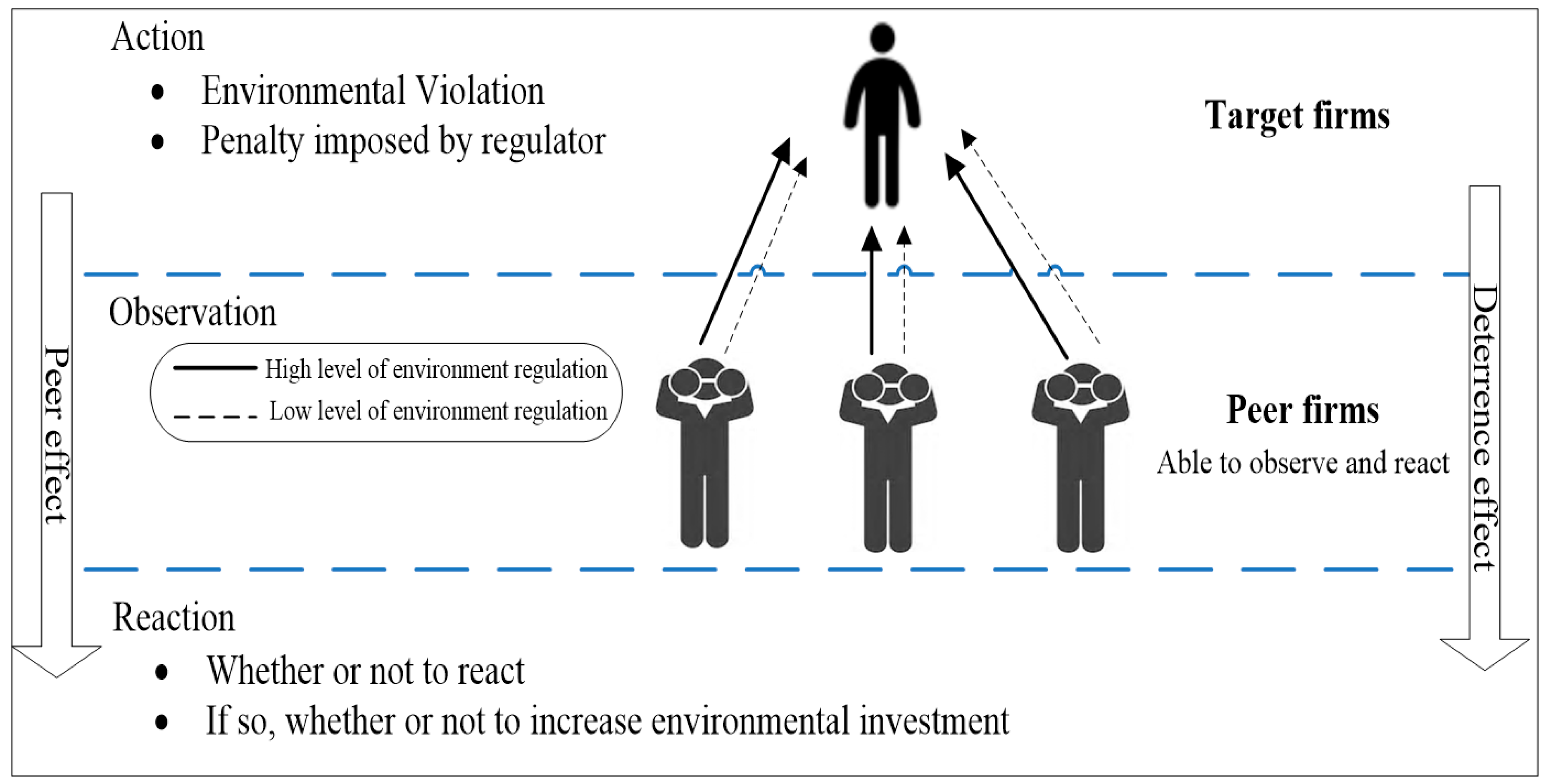
By drawing on the relational view of peer effect on corporate behavior and the deterrence effect in criminal economics when observing the penalty of a target firm for an environmental violation, whether and how the peer firms should react is investigated in this paper. We propose that the penalty for environmental violation of target firms may have a deterrence effect to encourage peer firms to invest more in environmental protection while environmental regulation may strengthen the deterrence effect. The theoretical framework is shown in Figure 1.
Figure 1.
Theoretical framework.
2.1. The Deterrence Effect of Target Firms’ Penalties for Environmental Violation on Peer Firms’ Environmental Investment
The classical criminal theorists Beccaria and Marchese Di Beccaria (2009) [24] believe that the probability of a penalty would achieve a preventive effect and a penalty serves to deter others from committing crimes and to prevent the criminal from repeating his crime. Bentham (1887) [25] argues that punishment had a deterrent function to prevent all sins in all possible and worthwhile ways. Becker (1968) [6] rationally opts for the crime by weighing the cost and benefit of illegality and documents that people commit crimes when they rationally see that the benefit of their crime outweighs the cost. Therefore, deterrence works when people are discouraged from future criminal acts by instilling in them the consequences of the penalty.
The deterrence to intimidate potential violators so as to refrain from crime is regarded as the general deterrence theory [26], which can also be applied in environmental violation. Additionally, the peer effect can be exploited to explain how deterrence works, in which case the violators are target firms and the potential violators are peer firms. The peer effect explains how and why the imitation of behaviors and social learning occurs from the perspectives of social norm and psychology [27,28,29]. When the environmental violation of target firms becomes the invisible norm in a social group [17], similar behavior might spread from target firms to peer firms. However, when environmental violation is considered as undesirable behavior, or the penalty is imposed on the target firm, which sends a meaningful “threat message”, then the peer firms learn about the risk of engaging in environmental violation and the cost rising from the penalty, inducing them to increase their compliance-related efforts, such as investing more in corporate compliance with environmental standards.
According to the above theories, it is believed that target firms’ penalties for environmental violation would have a deterrence effect on peer firms and motivate them to invest more in environmental protection. Some research points out that even if the manager promises to be compliant with environmental standards, the employees or the subordinates will choose not to comply because of performance pressure [30]. When that is this case, the deterrence message from the target penalized firm may not motivate the peer firms to comply, but serves as a reminder of the managers’ commitments, leading them to check whether anti-pollution measurements are taken, or if emission-control equipment should be upgraded. The head of the U.S. OPA (Office of Price Administration) Chester Bowles during World War II said that 25% of the public would comply with any legislation, and 70% would choose to comply or not depending on whether the remaining 5% is caught or penalized. So the regulatory department penalizing the “bad apples” can keep the “contingently good apples” good [31]. When penalties for environmental violations occur, and the target firms suffer the consequence of losing their competitive position or reputation, the peer firms learn that compliance is both prudent and right, and in this way, an eternal deterrence message has a “reassurance function”.
Firms within the same industry face the same economic situation, competitive pressure and common risk [32], and are benchmarked to each other by analysts and investors, therefore they are the natural peers [23]. In this paper, peer firms are in the same industry as the target firms. Based on the above theoretical analysis, thus we posit:
Hypothesis 1.
The target firms’ penalties for environmental violation can increase the environmental investment of peer firms in the same industry sector.
2.2. The Influence of Environmental Regulation on the Deterrence Effect
Academics and regulators argue that environmental regulation is the dominant determinant in the dramatic improvement of environmental quality in developing countries [33]. With gradually strengthening of environmental regulation, under high-profile environmental regulation the violation cost increases largely. Facing potential threat, and combined with the normative obligation and reputation concern, most firms should be committed to comply with environmental monitoring and enforcement, which obviously is not consistent with the reality of a great many environmental violations. A proportion of 80% of China’s environmental pollution stems from business activities, and their low extent of environmental compliance seems to point out that both the monitoring and enforcement of environmental regulation are becoming controversial [2].
The enforcement of environmental regulation varying in different regions of China may have several reasons. First, the efficiency of administrative management of the government of each province is not the same, and some may be highly renowned for regulatory incompetence and administrative inaction. Second, without enough environmental awareness and the incentive from political promotion (in some provinces the performance of a government officer is evaluated based on the growth rate of GDP), some local governments outweigh economic development and ignore environmental protection. Besides, corruption attributes to the variation in environmental regulation and could weaken the strength of environmental regulation in the official economy, resulting in the ineffective enforcement of environmental regulation [34,35].
Firms in different provinces of China face varied pressure from environmental regulation, which makes them have different expectations about the risk and cost of the potential penalties. For peer firms, even observing the penalty for the target firm, they may think that it was an accident or other factors but violation, such as no political connection with the government, that led to the penalty. In that case, peer firms would not increase environmental investment.
Hypothesis 2.
In regions with high-level environmental regulations, the target firms’ penalties for environmental violation can increase more the environmental investment of peer firms in the same industry sector.
3. Materials and Methods
3.1. Sample and Variables
Sample: Our sample contains data of non-financial Chinese listed firms for the period between 2008 and 2015. We selected all observations with penalties for environmental violation from the websites of IPE, the local government and local environmental protection bureau, the environmental investment from CSR reports and financial data from the China Stock Market and Accounting Research (CSMAR) database.
Dependent variables: The environmental investment data (ENI) is disclosed in the Sustainable Development Report and Environmental Report of the CSR Report, and includes the investment on technical innovation in environmental protection, expenditure on pollution abatement, installation of emission-control equipment, pollution discharge fees, etc. The number of 852 firm-year observations with environmental investment were selected manually by the author and processed with a logarithm to limit the extent of changes in the range of the data. The penalized firm may respond to the penalties by increasing its environmental investment, and in order to study the deterrence effect of the penalized target firms on the peer firms, the peer firms were distinguished from the target firms, the observations, which have environmental investment and at the same time get penalized, were excluded and then 550 firm-year observations were obtained. Finally, 506 firm- year observations were used in the empirical tests due to the missing data of other variables and the lagging process. ENI01 is a dummy variable, which equals 1 when a firm has environmental investment and discloses it.
Independent variables: Penalties for environmental violation come from penalty notices announced in the websites of the IPE, the local government and local environmental protection bureau, and 2679 pieces of penalty notice were collected. According to the study of Ma (2017) [36] and Kedia, et al. (2015) [23], two variables are constructed as the proxies of penalty for target firms. One is Number of target firms, which is the log-transformed number of firms penalized in a particular industry and year plus one, the other is Ratio of target firms, which is the ratio of the firms penalized in a particular industry and year to the total number of firms in the same industry and year.
The proxy of environmental regulation is measured by the ratio of pollutant discharge fees to a total industrial output value in each region (EER), which comes from China’s Environmental Yearbook and China Statistic Yearbook. The categorical variable (EERid) equals 1 when EER is higher than the mean of EER and 0 otherwise. In the robust test, another proxy, measured by the number of local laws and regulations promulgated (GOV) in various regions from the China Environmental Yearbook, is adopted. The categorical variable (GOVid) equals 1 when GOV is higher than the mean of GOV and 0 otherwise.
Control variables: In addition, financial situations are key factors to determine whether the firm invests in environmental protection activities. As it is already documented in the literature [36], the financial indicators, such as the asset (SIZE), asset-liability ratio (LEV), return on total assets (ROA), total sales scaled by total assets (SALES), Tobin’s Q (the usual proxy for investment opportunities) (TQ), can impact the environmental investment decision. In addition, corporate governance indicators also play roles, such as agency cost measured by the management fees scaled by the sales (MRF), and independent directors (INDDIR), whose reputation would be damaged by negative reports [37,38]. Also, the number of years since the first year that a firm initiated its public offering (AGE), firm nature of whether it is state-owned (STATE), and whether it is in a heavy pollution industry (HP) are included.
3.2. Empirical Model
Environmental investment is disclosed in the Sustainable Development Report and Environmental Report in the CSR Report. However, this disclosure is not compulsory and firms have great discretion in whether their environmental information is disclosed. There are firms that invest in environmental protection but have no disclosure of this. Therefore, the sample we collected is biased due to the unobservable data. To solve this problem, the Heckman two-stage model was employed to correct the selectivity bias [39]. There are two stages in the environmental investment decision. The first is a probit-type selection equation that describes the propensity to invest and to disclose an observed environmental investment. The second is a regular regression equation with the additional inverse Mills ratio (IMR) estimated in the first stage. With other fundamental factors, this model was employed to examine the influence of the penalty for target firm environmental violation on peer firm environmental investment in Hypothesis 1, and this model is shown in Equations (1) and (2):
Equation (1) is the first stage in the Heckman two-stage model, is the probability of a peer firm i’s investment in year t. Equation (2) is the second stage in the Heckman two-stage model ENIit stands for the environmental investment of a peer firm i in year t. The difference in Equation (2) lies in the additional IMR, which is estimated in the first stage. The selectivity bias is examined by a t-test on the coefficient on , and if the coefficient is significant, it shows that the bias is corrected with the necessary Heckman model.
The proxies for are Number of target firms: log-transformed the number of target firms penalized for environmental violation in a particular industry and year plus one and Ratio of target firms: the ratio of target firms penalized for environmental violation in a particular industry and year. Hypothesis 1 predicts positive , suggesting that the peer firms will increase environmental investment when observing that the target firms in the same industry are penalized. is a set of control variables defined in the above part of the sample and variables which are supposed to have influence on corporate environmental investment.
When considering the influence of environmental regulation, the whole sample is divided into two subsamples according to the categorical variable (EERid). The extent of environmental regulation is high when EERid = 1; the extent of environmental regulation is low when EERid = 0. The tests are done with the same regression in Equations (1) and (2) with the two subsamples and then the results are compared to prove Hypothesis 2.
4. Results
4.1. Descriptive Statistics
Table 1 presents the summary statistics of peer firms’ environmental investment, target firms’ penalties in the same industrial sector and other control variables. At first, there are 852 firm-year observations with environmental investment selected manually. Considering that the penalized firm may respond to the penalties by improving its environmental investment, and in order to only study the deterrence effect of the penalized target firms on the peer firms, peer firms are distinguished from target firms. The observations, which have environmental investment but also get penalized, were excluded and then 550 firm-year observations were obtained. The mean of Number of target firms is 2.102, smaller than the median (2.197). The mean of Ratio of target firms is 0.168, which means that on average 16.8% firms in an industrial sector are penalized, and the maximum of Ratio of target firms indicates that in some industrial sectors 63.3% firms are penalized. From the summary statistics of state and HP, we find that there are more state-owned firms and heavy-polluted firms involved in environmental investment.
Table 1.
Descriptive statistics.
Table 2 shows the correlations between the measures of the penalty for target firms, environmental investment, and control variables. From this table, we can see that the Ratio of target firms is positively correlated with ENI, significant at the 0.01 level, which indicates that penalties for the target firms in the same industry are related to peer firms’ environmental investment, which is consistent with our expectation. The positive correlation between Number of target firms and ENI is not significant. The Pearson correlation between Number of target firms and Ratio of target firms is relatively high, because they are the proxies of the penalty for target firms and they capture a similar construct; we report their effects on ENI separately. The positive correlation between SIZE and ENI indicates that firms with more assets may have a better capacity to invest in environmental management, which is similar to the positive correlation between SALES and ENI. However, it does not happen with ROA and TQ. The positive correlation between STATE and ENI shows that state- owned firms intend to invest more in environmental management. Overall, it seems that all the correlations between variables are within acceptable limits, and there should be no concerns about multi-collinearity.
Table 2.
The Pearson correlation matrix.
4.2. Tests Results
Table 3 presents the results of estimating Equations (1) and (2) when the independent variables are Number of target firms and Ratio of target firms. The columns (1) and (3) report the estimation results of the first stage of the Heckman model, and the columns (2) and (4) report the estimation results of the second stage. From the columns (2) and (4) we can see that the coefficients on the variables Number of target firms and Ratio of target firms are 0.366 and 3.425 respectively, both are significant at the level of 0.01, implying that after learning about the penalties of the target firms, the peer firms check their environmental performance, such as whether the emission-control equipment is installed or not, leading to the deterrence effect on environmental investment. The number and proportion of the penalized firms in an industry when increasing, indicates that the certainty of the environmental regulation is strengthened, and is more likely to cause peer firms to invest more in environmental protection, leading to the deterrence effect increasing, which proves Hypothesis 1.
Table 3.
The influence of target firms’ penalties on peer firms’ environmental investment.
Turning to the control variables, in the first stage the variables l.ENI01 and ENI01 in the year t − 1, are included in columns (1) and (3) and in the second stage the variable l.ENI, ENI in the year t − 1, is included. The coefficients of the above-included variables are significantly positive, suggesting that the decision of environmental investment is inertia, affected by the decision at year t − 1. According to Equation (1) of the first stage of the Heckman model, the IMR (inverse Mills ratio) is calculated and the coefficients on IMR in columns (2) and (4) are significant, proving that the sample selection bias is effectively corrected. Besides, a firm’s environmental investment increases with its SIZE, return on assets (ROA), SALES, the percentage of independent directors on boards (INDDIR), and the nature of the firm (STATE). It decreases with its Tobin’s Q (TQ), asset-liability ratio (LEV), and the management fees scaled by the sales (MRF). These associations seem intuitive, as a powerful firm with good corporate governance has the capability for environmental investment. Usually, a state-owned firm is stronger than other firms, and under its diverse political aims, it will intend to invest more in environmental investment. Additionally, a firm facing good investment opportunity, with high liability or high agency cost, will reduce the investment in environmental management in order to increase the investment in production. Whether the firm is exposed to heavy pollution has no significant influence. Finally, the year effect and the industry effect are controlled in all regressions.
Table 4 summaries the results of Table A1 in the Appendix A and presents the estimated results of two samples: one with a low extent of environmental regulation and one with a high extent of environmental regulation. When the independent variable is Number of target firms, comparing the columns (2) between Panel A and Panel B, the coefficient in the sample of low extent of environmental regulation is 0.367, significant at a level of 0.1 and the coefficient in the sample of low extent of environmental regulation is 0.451, significant at a level of 0.01. When the independent variable is Ratio of target firms, comparing the columns (4) between Panel A and Panel B, the coefficient in the sample of low extent of environmental regulation is 2.955, significant at a level of 0.05 and the coefficient in the sample of low extent of environmental regulation is 3.465, significant at a level of 0.01. We can see that the significance is also obviously improved. All these results show that the influence of target firms’ penalties on peer firms’ environmental investment in the sample of the high extent of environmental regulation is much stronger than that in the sample of the low extent of environmental regulation. In regions with high-level environmental regulation, the penalties for the target firms have a stronger deterrence effect.
Table 4.
The influence of environmental regulation.
5. Robust Tests
Several tests were conducted to challenge the robustness of our results. First, the Heckman two- stage model was employed to correct the selectivity bias based on the consideration that the observations we collected were biased due to the unobservable data. However, if there is no selectivity bias in the sample, the ordinary least squares regression could be the best method to use to do the empirical test. Panel A of Table 5 shows the summary of the test results with the regression method of ordinary least squares (OLS) in Table A2 and Table A3. From the columns (2) and (4) in Panel A in Table 5, we can see that the coefficients on the variables Number of target firms and Ratio of target firms are 0.325 and 3.336 respectively, which are significant at the level of 0.05 and 0.01 respectively. The results show that the penalties for target firms can be significantly associated with the peer firms’ environmental investment, which are the same as the results with the method of Heckman two-stage. Similarly, with the environmental regulation’s influence being considered, when comparing columns (3) and (5), the coefficient on the variable Number of target firms becomes significant with high extent of environmental regulation from being insignificant with low extent of environmental regulation. Also, when comparing columns (4) and (6), the coefficient of the variable Ratio of target firms becomes significant at a level of 0.01 with high extent of environmental regulation from being significant at a level of 0.05 with low extent of environmental regulation. The results show that environmental regulation increased the deterrence effect of the penalty. Results obtained using OLS regression are consistent with our main findings.
Table 5.
The robust tests with different regression methods.
Second, when considering the two-way causal relationship between the penalties for target firms and peer firms’ environmental investment, on the one hand, it could be the process of the penalties for target firms leading to peer firms’ environmental investment, during which after the penalties for target firms are observed, the peer firms perceive that the risk and cost for environmental violation are increasing and so they increase environmental investment to avoid potential violation. On the other hand, it also may be the other process of peer firms’ environmental investment leading to the penalties for target firms, during which the environmental investment of peers’ firms reduces their risk of being penalized, and then the possibility of penalties for target companies increases, because penalties always target at firms with relatively poor environmental performance. In order to avoid the relationship between the penalties for target firms and peer firms’ environmental investment in the second case, this paper introduces instrumental variables to solve possible endogenous problems.
The instrumental variables introduced in this paper are penalties for target firms in the year t + 1. The penalized target firms will be on the blacklist of the regulators and receive continuous attention from them. The penalties for target firms in the year t are highly related to penalties for target firms in the year t + 1, however, for peer firms’ environmental investment in the year t, penalties for target firms in the year t + 1 have not happened yet and cannot be the information of peer firms’ environmental investment decisions. Therefore, the instrumental variable is highly correlated with the explanatory variable but is not related to the random error term.
As an additional robustness test, we repeated our analysis with an instrumental variable by the method of 2SLS and observed results consistent with the main findings. Using the two-stage least squares method (2SLS), the instrumental variable replaces the endogenous variable itself with the predicted value of the endogenous variable. The results are shown in Panel B in Table 5, which are the summary of Table A4 and Table A5. With penalties for target firms in the year t + 1 as the instrumental variable, the estimated estimators are still significant in the second-stage regression, and the coefficient directions are consistent with before. The Hausman test was used for the endogeneity test, and the exogenous hypothesis was rejected, indicating that the two-stage least squares method is more effective.
Finally, another proxy for environmental regulation, measured by the number of local laws and regulations (GOV) promulgated in the environmental law work in various regions from the China Environmental Yearbook, was adopted. The whole sample was divided into two subsamples according to the categorical variable (GOVid). The extent of environmental regulation is high when GOVid = 1; the extent of environmental regulation is low when GOVid = 0. The tests were done with the same regression method based on the two subsamples and are shown in Table 6 and the whole table with all the control variables is presented as Table A6. The significance of coefficient on Number of target firms increases from column (1) of Panel A to column (1) of Panel B, and the significance of coefficient on Ratio of target firms increases from column (2) of Panel A to column (2) of Panel B. Therefore, with another proxy of environmental regulation, our main findings are still robust.
Table 6.
The robust tests with environmental regulation measured as GOV.
6. Discussion and Conclusion
6.1. Discussion
To clarify the penalty mechanism for corporate environmental violation in prior literature, this study investigated the deterrence effect of the penalty by examining the relationship between the target firm’s penalty and peer firm’s environmental investment. The research makes valuable advances contributing to academic research and regulatory officials.
6.1.1. Theoretical Implications
Our research highlights a new possible way of understanding the influence of penalties for an environmental violation as a driving force that originated from the deterrence effect of such penalties. Growing literature examines the influence of penalties on the penalized firms themselves. It has been found that firms suffer drops in market value [37,38,39], damage in corporate reputation [40,41], even boycotts from consumers [42], as evidence that product markets and capital markets discourage corporate environmental misconduct. However, the debate over the environmental penalty constantly occurs amidst a vacuum of evidence from empirical evidence. There is surprisingly little research that investigates the importance of the threat of a legal penalty in motivating other firms to comply with the law and little is known about the actual effect of the penalties imposed on firms that violate environmental regulations and how such penalties can influence other firms.
We combined deterrence theory to predict that the information of the target firm’s penalty is one of the determinants of the receivers’ reactions. Our study shows that only to study the direct effects of penalties for the environmental violation on the penalized firms themselves cannot fully evaluate the effectiveness of legal sanctions against violators. Together with the association between the observation of a target firm’s penalty and risk perception of the peer firm, we extended the focus to whether peer firms in the same industrial sector are affected when the target firms are penalized for environmental violations. Furthermore, we used environmental investment as a measure of behavior change taken by the peer firms in response to deterrence signals. This study shows that the information conveyed by environmental violation and the related penalty is not confined to the focal firms but is also related with environmental investment decisions within the same industrial sector, including peer firms that do not conduct such environmental misbehavior.
By extending current research from the content perspective, our work contributes to a better understanding of the nature of peer effects in the study of environmental issues. A growing body of literature on peer effects shows that corporate decisions are often made after learning and considering other firms’ actions [14,17,36], and this exists in many corporate events, such as corporate liquidations [43], earning management [23], and tax [14]. Applying the peer effect in the field of corporate environmental violation is relatively novel. While other studies on peer effect focus on contagion and imitation of behavior, this paper investigated the deterrence also arising from other firm’s observed behavior, which in this case is the penalty for an environmental violation. We proved that the penalty of the target firm poses a potential legitimacy threat to peer firms, eventually motivating them to do subsequent environmental investment. In this way, the environmental violation setting provides us with suggestive evidence of the deterrence mechanism that is used as incentive to peer firms to respond to the actions of focal firms.
6.1.2. Practical Implications
Our study has practical implications and important guidance for regulatory officials and regulatory scholars, especially in an emerging country. China, as a typical representation of a transition and developing economy, faces serious environmental problems. The corporate approach to environmental protection is mainly a regulation-driven reactive mode, which is pushed by legal penalties imposed by the government. With the limits of governmental capacity and information asymmetry, officials formally prosecute and obtain legal sanction against violators in only a small proportion. Also, at the current stage, most firms just respond to changing environmental policies by committing minimal resources towards environmental issues, which is a kind of reactive environmental practice emphasizing ex-post actions. Only based on actual corporate reactions, can the policies of environmental protection be well-designed and have an effect. Thus, it is crucial to know the extent and the way in which the implementation of regulatory norms will actually lead to improvements toward environmental protection, and whether the penalty has deterrence effect is important in the implementation of a penalty for environment violation. Our study proves that the existence of any penalty is crucial for environmental public policy and it is important to keep the penalty to be effective in spurring specific and general deterrence, which by increasing the violation cost and perceived risks of the penalized firms and reducing the potential expected earnings from violation, eventually achieves the goal of protecting the environment and maximizing social welfare.
6.2. Limitations and Future Study
This study is subject to some limitations which should be rectified by future research. First, the deterrence effect on peer firms could not only come from the fear of a formal legal penalty but also from the potential drops in market value, damage in corporate reputation or manager’s job, and a boycott from consumers. Environmental investment could be a form of compliance stemming more from fear of these informal sanctions. The theatrical framework should be completed by adding these factors and related mediators should be used in empirical tests in the future. Plus, the observation of penalty might lead to other reactive environmental practices, such as information disclosure of environmental responsibility, or other changes in corporate governance, eventually leading to improved environmental performance.
Second, the sample in this paper contains only public listed firms in China. The fact is that the penalty for environmental violation is not only imposed on public listed firms. Thus, the target firms could be non-listed firms, and behaviors are observed by peer firms, which could also be listed and non-listed firms. Moreover, the listed firms mostly are larger firms, which are more visible and easier to be the target of inspection. The results for the non-listed or small firms could not be the same. However, the data of non-listed and small firms is hard to access. In future research, a case study may be used to investigate the reaction of non-listed firms to the penalty of target firms. Also, the research context could be extended on a wider scale in different countries.
Third, the announcements of penalties for environmental violation are gathered using web crawler technology from the websites of IPE and others, and they are not uniform. Detailed information, such as the specific time in a year when the violation happens and how serious it could be, is hard to extract. Therefore, the differentiated influence of a penalty for various environmental violations should be further investigated when detailed information can be obtained and processed.
Additionally, the importance of peer effect on the environmental penalty may encourage future research to explore other specific mechanisms. As peer effect is closely related to the social network, people observe and learn through economic links among them. In future research, the social network and the economic link should be considered in the framework of this study. We explored the environmental regulation level as a contextual factor, further study may take other potentially important contextual factors into consideration.
6.3. Conclusions
Based on the sample of Chinese listed companies, the firm-level environmental investment and penalty for environmental violation were collected by hand in the period between 2007 and 2015 from multiple resources, the deterrence effect of the penalty for target firms on peer firms was investigated. With the Heckman two-stage model, the empirical tests showed that the penalty for the target firms was positively related to the peer firms’ environmental investment, no matter whether the penalty for the target firms is measured by Number of target firms or Ratio of target firms, which proves that environmental regulation has a deterrent effect. Further, the formal institution of environmental governance was considered, and we found that with a high level of environmental regulation, the deterrence effect of the penalty for target firms on peer firms is stronger than that with a low level of environmental regulation. The results of this study are consistent with the anecdotal evidence that using legal means to reduce environmental pollution is necessary and that deterrence theory applies to the penalty of environmental violation.

Author Contributions
Data curation, Z.M.; Investigation, Z.M.; Supervision, J.S.; Writing—original draft, Y.W.; Writing—review & editing, Y.L.
Funding
This research was funded by the Major Program of the National Fund of the Philosophy and Social Science of China (Grant No. 18ZDA095).
Conflicts of Interest
The authors declare no conflict of interest.
Appendix A
Table A1.
The influence of environmental regulation.
Table A1.
The influence of environmental regulation.
| Peer Firms’ Environmental Investment | ||||||||
|---|---|---|---|---|---|---|---|---|
| Low Extent of Environmental Regulation | High Extent of Environmental Regulation | |||||||
| (1) | (2) | (3) | (4) | (5) | (6) | (7) | (8) | |
| ENI01 | ENI | ENI01 | ENI | ENI01 | ENI | ENI01 | ENI | |
| Number of target firms | 0.017 | 0.367 * | 0.044 | 0.451 *** | ||||
| (0.33) | (1.73) | (0.92) | (2.77) | |||||
| Ratio of target firms | −0.061 | 2.955 ** | 0.511 | 3.465 *** | ||||
| (−0.16) | (2.01) | (1.52) | (3.17) | |||||
| l.ENI01 | 1.566 *** | 1.566 *** | 1.571 *** | 1.564 *** | ||||
| (15.41) | (15.40) | (15.63) | (15.53) | |||||
| l.ENI | 0.196 ** | 0.190 ** | 0.050 | 0.015 | ||||
| (2.46) | (2.39) | (0.61) | (0.18) | |||||
| IMR | 2.127 * | 2.052 * | 0.092 | −0.389 | ||||
| (1.96) | (1.90) | (0.08) | (−0.34) | |||||
| SIZE | 0.262 *** | 0.948 *** | 0.261 *** | 0.980 *** | 0.296 *** | 0.290 | 0.293 *** | 0.147 |
| (6.60) | (3.97) | (6.56) | (4.11) | (6.90) | (1.10) | (6.84) | (0.57) | |
| ROA | 1.013 | 2.073 | 0.998 | 1.999 | 1.676 * | −1.520 | 1.789 ** | −0.040 |
| (1.08) | (0.48) | (1.06) | (0.46) | (1.95) | (−0.43) | (2.09) | (−0.01) | |
| TQ | −0.013 | −0.242 | −0.012 | −0.226 | −0.022 | −0.158 | −0.020 | −0.173 |
| (−0.47) | (−1.52) | (−0.45) | (−1.42) | (−0.74) | (−1.36) | (−0.70) | (−1.51) | |
| SALES | −0.038 | 0.426 | −0.039 | 0.453 | −0.038 | 0.249 | −0.036 | 0.265 |
| (−0.54) | (1.32) | (−0.55) | (1.41) | (−0.58) | (1.10) | (−0.55) | (1.18) | |
| LEV | −0.437 | 0.854 | −0.436 | 0.648 | −0.238 | 0.966 | −0.231 | 1.287 |
| (−1.63) | (0.67) | (−1.63) | (0.51) | (−0.97) | (1.10) | (−0.94) | (1.49) | |
| MFR | −1.768 ** | 5.274 | −1.783 * | 6.153 | −1.815 ** | −5.578 | −1.618 ** | −1.917 |
| (−1.96) | (1.03) | (−1.96) | (1.20) | (−2.22) | (−1.41) | (−2.00) | (−0.48) | |
| INDDIR | 0.757 | 2.278 | 0.759 | 2.167 | −0.244 | 1.169 | −0.209 | 1.354 |
| (1.22) | (0.87) | (1.22) | (0.83) | (−0.36) | (0.56) | (−0.31) | (0.65) | |
| AGE | 0.033 | −0.999 *** | 0.036 | −0.926 *** | 0.085 | 0.182 | 0.082 | 0.199 |
| (0.42) | (−3.05) | (0.46) | (−2.88) | (1.08) | (0.65) | (1.05) | (0.72) | |
| STATE | 0.342 *** | 0.714 | 0.344 *** | 0.571 | 0.191 ** | −0.813 ** | 0.191 ** | −0.814 *** |
| (3.67) | (1.52) | (3.68) | (1.21) | (2.34) | (−2.59) | (2.35) | (−2.63) | |
| HP | −0.127 | −0.414 | −0.064 | −0.384 | 0.059 | 0.272 | 0.027 | 0.203 |
| (−0.27) | (−0.22) | (−0.14) | (−0.21) | (0.16) | (0.19) | (0.08) | (0.14) | |
| constant | −8.018 *** | −10.329 | −8.001 *** | −10.853 | −8.675 *** | 7.392 | −8.653 *** | 11.301 |
| (−8.04) | (−1.34) | (−8.01) | (−1.42) | (−8.54) | (0.85) | (−8.53) | (1.33) | |
| Year effect | Yes | Yes | Yes | Yes | Yes | Yes | Yes | Yes |
| Industry effect | Yes | Yes | Yes | Yes | Yes | Yes | Yes | Yes |
| N | 5120 | 244 | 5120 | 244 | 5910 | 262 | 5910 | 262 |
| r2_p | 0.315 | 0.315 | 0.304 | 0.305 | ||||
| r2_a | 0.244 | 0.251 | 0.284 | 0.294 | ||||
| F | 3.711 | 3.801 | 4.562 | 4.749 | ||||
Note: * p < 0.1, ** p < 0.05, *** p < 0.01; t statistics in parentheses.
Table A2.
The influence of target firms’ penalties on peer firms’ environmental investment with OLS.
Table A2.
The influence of target firms’ penalties on peer firms’ environmental investment with OLS.
| Peer Firms’ Environmental Investment | ||||
|---|---|---|---|---|
| (1) | (2) | |||
| ENI | ENI | |||
| Number of target firms | 0.325 ** | (2.57) | ||
| Ratio of target firms | 3.336 *** | (3.97) | ||
| l.ENI | 0.042 *** | (3.68) | 0.040 *** | (3.52) |
| SIZE | 0.567 *** | (5.50) | 0.566 *** | (5.56) |
| ROA | −1.819 | (−0.76) | −0.681 | (−0.29) |
| TQ | −0.167 * | (−1.80) | −0.170 * | (−1.85) |
| SALES | 0.392 ** | (2.10) | 0.406 ** | (2.20) |
| LEV | 0.555 | (0.79) | 0.578 | (0.83) |
| MFR | −0.311 | (−0.11) | 1.544 | (0.55) |
| INDDIR | 0.447 | (0.30) | 0.615 | (0.41) |
| AGE | −0.523 *** | (−2.66) | −0.493 ** | (−2.53) |
| STATE | −0.307 | (−1.45) | −0.316 | (−1.51) |
| HP | −0.215 | (−0.19) | −0.424 | (−0.38) |
| constant | 3.367 | (1.34) | 3.201 | (1.28) |
| Year effect | Yes | Yes | ||
| Industry effect | Yes | Yes | ||
| N | 506 | 506 | ||
| r2_a | 0.245 | 0.259 | ||
| F | 6.636 | 7.075 | ||
Note: * p < 0.1, ** p < 0.05, *** p < 0.01; t statistics in parentheses.
Table A3.
The influence of environmental regulation with OLS.
Table A3.
The influence of environmental regulation with OLS.
| Peer Firms’ Environmental Investment | ||||||||
|---|---|---|---|---|---|---|---|---|
| Low Extent of Environmental Regulation | High Extent of Environmental Regulation | |||||||
| (1) | (2) | (3) | (4) | |||||
| ENI | ENI | ENI | ENI | |||||
| Number of target firms | 0.340 | (1.60) | 0.448 *** | (2.85) | ||||
| Ratio of target firms | 3.157 ** | (2.14) | 3.567 *** | (3.41) | ||||
| l.ENI | 0.044 ** | (2.31) | 0.043 ** | (2.28) | 0.043 *** | (3.09) | 0.042 *** | (2.99) |
| SIZE | 0.616 *** | (3.62) | 0.664 *** | (3.86) | 0.272 * | (1.96) | 0.221 | (1.59) |
| ROA | −0.116 | (−0.03) | −0.102 | (−0.02) | −1.680 | (−0.57) | 0.665 | (0.23) |
| TQ | −0.215 | (−1.35) | −0.200 | (−1.26) | −0.156 | (−1.37) | −0.181 | (−1.62) |
| SALES | 0.503 | (1.55) | 0.527 | (1.64) | 0.251 | (1.12) | 0.256 | (1.15) |
| LEV | 1.370 | (1.10) | 1.131 | (0.91) | 0.976 | (1.13) | 1.245 | (1.46) |
| MFR | 8.625 * | (1.78) | 9.420 * | (1.94) | −5.454 | (−1.51) | −2.418 | (−0.66) |
| INDDIR | 0.514 | (0.21) | 0.440 | (0.18) | 1.179 | (0.56) | 1.314 | (0.63) |
| AGE | −1.115 *** | (−3.44) | −1.043 *** | (−3.29) | 0.175 | (0.66) | 0.226 | (0.85) |
| STATE | 0.167 | (0.44) | 0.036 | (0.09) | −0.826 *** | (−3.17) | −0.757 *** | (−2.92) |
| HP | 0.021 | (0.01) | −0.089 | (−0.05) | 0.260 | (0.18) | 0.261 | (0.19) |
| constant | 2.314 | (0.55) | 1.259 | (0.30) | 8.022 ** | (2.38) | 8.654 ** | (2.60) |
| Year effect | Yes | Yes | Yes | Yes | ||||
| Industry effect | Yes | Yes | Yes | Yes | ||||
| N | 244 | 244 | 262 | 262 | ||||
| r2_a | 0.234 | 0.241 | 0.287 | 0.297 | ||||
| F | 3.658 | 3.762 | 4.745 | 4.934 | ||||
Note: * p < 0.1, ** p < 0.05, *** p < 0.01; t statistics in parentheses.
Table A4.
The influence of target firms’ penalties on peer firms’ environmental investment with 2SLS.
Table A4.
The influence of target firms’ penalties on peer firms’ environmental investment with 2SLS.
| Peer Firms’ Environmental Investment | ||||
|---|---|---|---|---|
| (1) | (2) | |||
| ENI | ENI | |||
| Number of target firms | 0.408 *** | (2.70) | ||
| Ratio of target firms | 4.932 *** | (4.57) | ||
| l.ENI | 0.051 *** | (4.56) | 0.045 *** | (4.09) |
| SIZE | 0.546 *** | (5.44) | 0.563 *** | (5.68) |
| ROA | −2.264 | (−0.97) | −0.918 | (−0.40) |
| TQ | −0.049 | (−0.49) | −0.037 | (−0.38) |
| SALES | 0.195 | (1.12) | 0.225 | (1.31) |
| LEV | 0.857 | (1.28) | 0.802 | (1.21) |
| MFR | −1.094 | (−0.40) | 1.798 | (0.65) |
| INDDIR | 0.601 | (0.41) | 0.749 | (0.52) |
| AGE | −0.329 * | (−1.76) | −0.282 | (−1.52) |
| STATE | −0.256 | (−1.25) | −0.271 | (−1.34) |
| HP | −0.610 | (−0.57) | −1.042 | (−1.01) |
| constant | 3.254 | (1.34) | 2.658 | (1.11) |
| Year effect | Yes | Yes | ||
| Industry effect | Yes | Yes | ||
| N | 425 | 425 | ||
| r2_a | 0.257 | 0.275 | ||
Note: * p < 0.1, ** p < 0.05, *** p < 0.01; t statistics in parentheses.
Table A5.
The influence of environmental regulation with 2SLS.
Table A5.
The influence of environmental regulation with 2SLS.
| Peer Firms’ Environmental Investment | ||||||||
|---|---|---|---|---|---|---|---|---|
| Low Extent of Environmental Regulation | High Extent of Environmental Regulation | |||||||
| (1) | (2) | (3) | (4) | |||||
| ENI | ENI | ENI | ENI | |||||
| Number of target firms | 0.481 * | (1.85) | 0.479 *** | (2.71) | ||||
| Ratio of target firms | 4.428 ** | (2.09) | 5.263 *** | (4.35) | ||||
| l.ENI | 0.058 *** | (3.21) | 0.055 *** | (3.08) | 0.050 *** | (3.77) | 0.045 *** | (3.39) |
| SIZE | 0.576 *** | (3.52) | 0.662 *** | (3.80) | 0.287 ** | (2.22) | 0.231 * | (1.79) |
| ROA | 1.296 | (0.33) | 0.867 | (0.22) | −3.869 | (−1.32) | −1.123 | (−0.39) |
| TQ | −0.130 | (−0.81) | −0.096 | (−0.60) | −0.004 | (−0.03) | −0.007 | (−0.06) |
| SALES | 0.106 | (0.36) | 0.186 | (0.64) | 0.220 | (1.08) | 0.241 | (1.19) |
| LEV | 1.734 | (1.52) | 1.246 | (1.08) | 1.141 | (1.40) | 1.445 * | (1.80) |
| MFR | 6.042 | (1.36) | 7.179 | (1.62) | −3.436 | (−0.95) | 1.629 | (0.43) |
| INDDIR | 0.506 | (0.22) | 0.075 | (0.03) | 0.739 | (0.38) | 1.277 | (0.67) |
| AGE | −0.866 *** | (−2.89) | −0.759 *** | (−2.60) | 0.264 | (1.05) | 0.380 | (1.51) |
| STATE | 0.335 | (0.95) | 0.142 | (0.40) | −0.856 *** | (−3.41) | −0.781 *** | (−3.14) |
| HP | −0.802 | (−0.48) | −0.824 | (−0.50) | 0.331 | (0.25) | 0.003 | (0.00) |
| constant | 3.173 | (0.80) | 1.402 | (0.34) | 6.915 ** | (2.21) | 7.132 ** | (2.31) |
| Year effect | Yes | Yes | Yes | Yes | ||||
| Industry effect | Yes | Yes | Yes | Yes | ||||
| N | 201 | 201 | 224 | 224 | ||||
| r2_a | 0.250 | 0.262 | 0.297 | 0.313 | ||||
Note: * p < 0.1, ** p < 0.05, *** p < 0.01; t statistics in parentheses.
Table A6.
The influence of environmental regulation measured as GOV.
Table A6.
The influence of environmental regulation measured as GOV.
| Peer Firms’ Environmental Investment | ||||||||
|---|---|---|---|---|---|---|---|---|
| Low Extent of Environmental Regulation | High Extent of Environmental Regulation | |||||||
| (1) | (2) | (3) | (4) | |||||
| ENI | ENI | ENI | ENI | |||||
| Number of target firms | 0.274 | (1.34) | 0.338 ** | (2.07) | ||||
| Ratio of target firms | 2.809 ** | (2.25) | 4.021 *** | (3.36) | ||||
| l.ENI | 0.048 *** | (2.78) | 0.045 *** | (2.64) | 0.038 ** | (2.39) | 0.036 ** | (2.29) |
| SIZE | 0.883 *** | (5.45) | 0.893 *** | (5.57) | 0.503 *** | (3.38) | 0.488 *** | (3.33) |
| ROA | −8.103 ** | (−2.36) | −7.049 ** | (−2.07) | 1.327 | (0.35) | 2.039 | (0.55) |
| TQ | −0.109 | (−0.75) | −0.114 | (−0.80) | −0.191 | (−1.52) | −0.173 | (−1.40) |
| SALES | 0.351 | (1.22) | 0.294 | (1.02) | 0.518* | (1.97) | 0.660 ** | (2.51) |
| LEV | −1.394 | (−1.25) | −1.384 | (−1.25) | 1.335 | (1.39) | 1.255 | (1.33) |
| MFR | −4.350 | (−1.00) | −2.908 | (−0.67) | 4.316 | (1.05) | 6.745 | (1.64) |
| INDDIR | 1.734 | (0.80) | 1.763 | (0.82) | −0.572 | (−0.25) | −0.032 | (−0.01) |
| AGE | −0.582 * | (−1.82) | −0.553 * | (−1.74) | −0.570 ** | (−2.08) | −0.579 ** | (−2.14) |
| STATE | −0.309 | (−0.94) | −0.412 | (−1.25) | −0.269 | (−0.90) | −0.143 | (−0.48) |
| HP | 3.924 * | (1.68) | 3.854 * | (1.67) | −0.469 | (−0.38) | −0.755 | (−0.63) |
| constant | −6.894 | (−1.58) | −7.239 * | (−1.68) | 4.887 | (1.36) | 4.742 | (1.34) |
| Year effect | Yes | Yes | Yes | Yes | ||||
| Industry effect | Yes | Yes | Yes | Yes | ||||
| N | 239 | 239 | 267 | 267 | ||||
| r2_a | 0.308 | 0.319 | 0.179 | 0.203 | ||||
| F | 4.927 | 5.122 | 3.078 | 3.412 | ||||
Note: * p < 0.1, ** p < 0.05, *** p < 0.01; t statistics in parentheses.
References
- Post, J.E.; Preston, L.E.; Sauter-Sachs, S. Redefining the Corporation: Stakeholder Management and Organizational Wealth; Stanford University Press: Palo Alto, CA, USA, 2002. [Google Scholar]
- Chen, H.; Hao, Y.; Li, J.; Song, X. The impact of environmental regulation, shadow economy, and corruption on environmental quality: Theory and empirical evidence from China. J. Clean. Prod. 2018, 195, 200–214. [Google Scholar] [CrossRef]
- Kim, K. Proactive versus reactive corporate environmental practices and environmental performance. Sustainability 2018, 10, 97. [Google Scholar] [CrossRef]
- Earnhart, D.H.; Khanna, M.; Lyon, T.P. Corporate environmental strategies in emerging economies. Rev. Environ. Econ. Policy 2014, 8, 164–185. [Google Scholar] [CrossRef]
- Wang, R.; Wijen, F.; Heugens, P.P. Government’s green grip: Multifaceted state influence on corporate environmental actions in China. Strateg. Manag. J. 2018, 39, 403–428. [Google Scholar] [CrossRef]
- Becker, G.S. Crime and punishment: An economic approach. In The Economic Dimensions of Crime; Springer: Berlin/Heidelberg, Germany, 1968; pp. 13–68. [Google Scholar]
- Blackman, A. Alternative Pollution Control Policies in Developing Countries. Rev. Environ. Econ. Policy 2010, 4, 234–253. [Google Scholar] [CrossRef]
- Marquis, C.; Raynard, M. Institutional strategies in emerging markets. Acad. Manag. Ann. 2015, 9, 291–335. [Google Scholar] [CrossRef]
- Kagan, R.A.; Scholz, J.T. The “criminology of the corporation” and regulatory enforcement strategies. In Organisation und Recht; Springer: Berlin/Heidelberg, Germany, 1980; pp. 352–377. [Google Scholar]
- Earnhart, D. Regulatory factors shaping environmental performance at publicly-owned treatment plants. J. Environ. Econ. Manag. 2004, 48, 655–681. [Google Scholar] [CrossRef]
- Shimshack, J.P.; Ward, M.B. Enforcement and over-compliance. J. Environ. Econ. Manag. 2008, 55, 90–105. [Google Scholar] [CrossRef]
- Shimshack, J.P. The economics of environmental monitoring and enforcement. Annu. Rev. Resour. Econ. 2014, 6, 339–360. [Google Scholar] [CrossRef]
- Ayres, I.; Braithwaite, J. Responsive Regulation: Transcending the Deregulation Debate; Oxford University Press: Oxford, NY, USA, 1995. [Google Scholar]
- Bird, A.; Edwards, A.; Ruchti, T.G. Taxes and peer effects. Account. Rev. 2018. [Google Scholar] [CrossRef]
- Li, L.; Qi, B.; Tian, G.; Zhang, G. The contagion effect of low-quality audits at the level of individual auditors. Account. Rev. 2016, 92, 137–163. [Google Scholar] [CrossRef]
- Foucault, T.; Fresard, L. Learning from peers’ stock prices and corporate investment. J. Financ. Econ. 2014, 111, 554–577. [Google Scholar] [CrossRef]
- Leary, M.T.; Roberts, M.R. Do peer firms affect corporate financial policy? J. Financ. 2014, 69, 139–178. [Google Scholar] [CrossRef]
- Khavul, S.; Bruton, G.D. Harnessing innovation for change: Sustainability and poverty in developing countries. J. Manag. Stud. 2013, 50, 285–306. [Google Scholar] [CrossRef]
- Kesidou, E.; Demirel, P. On the drivers of eco-innovations: Empirical evidence from the UK. Res. Policy 2012, 41, 862–870. [Google Scholar] [CrossRef]
- Leiter, A.M.; Parolini, A.; Winner, H. Environmental regulation and investment: Evidence from European industry data. Ecol. Econ. 2011, 70, 759–770. [Google Scholar] [CrossRef]
- Thornton, D.; Gunningham, N.A.; Kagan, R.A. General deterrence and corporate environmental behavior. Law Policy 2005, 27, 262–288. [Google Scholar] [CrossRef]
- Hirshleifer, D.; Teoh, S.H. Thought and behavior contagion in capital markets. In Handbook of Financial Markets: Dynamics and Evolution; Elsevier: Amsterdam, The Netherlands, 2009; pp. 1–56. [Google Scholar]
- Kedia, S.; Koh, K.; Rajgopal, S. Evidence on contagion in earnings management. Account. Rev. 2015, 90, 2337–2373. [Google Scholar] [CrossRef]
- Beccaria, C.; Marchese Di Beccaria, C. On Crimes and Punishments and Other Writings; University of Toronto Press: North York, ON, Canada, 2009. [Google Scholar]
- Bentham, J. Theory of Legislation; Trübner & Company: London, UK, 1887. [Google Scholar]
- Williams, K.R.; Hawkins, R. Perceptual research on general deterrence: A critical review. Law Soc. Rev. 1986, 20, 545. [Google Scholar] [CrossRef]
- Gino, F.; Ayal, S.; Ariely, D. Contagion and differentiation in unethical behavior: The effect of one bad apple on the barrel. Psychol. Sci. 2009, 20, 393–398. [Google Scholar] [CrossRef]
- Bandura, A. Influence of models’ reinforcement contingencies on the acquisition of imitative responses. J. Personal. Soc. Psychol. 1965, 1, 589. [Google Scholar] [CrossRef]
- Ariely, D.; Loewenstein, G.; Prelec, D. Tom Sawyer and the construction of value. J. Econ. Behav. Organ. 2006, 60, 1–10. [Google Scholar] [CrossRef]
- Malloy, T.F. Regulation, compliance and the firm. Temple Law Rev. 2003, 76, 451. [Google Scholar]
- Kaufmann, W. Going by the Book: The Problem of Regulatory Unreasonableness; Routledge: Abingdon-on-Thames, UK, 2017. [Google Scholar]
- Bhojraj, S.; Sengupta, P. Effect of corporate governance on bond ratings and yields: The role of institutional investors and outside directors. J. Bus. 2003, 76, 455–475. [Google Scholar] [CrossRef]
- Kagan, R.A.; Gunningham, N.; Thornton, D. Explaining corporate environmental performance: How does regulation matter? Law Soc. Rev. 2003, 37, 51–90. [Google Scholar] [CrossRef]
- Fredriksson, P.G.; Svensson, J. Political instability, corruption and policy formation: The case of environmental policy. J. Public Econ. 2003, 87, 1383–1405. [Google Scholar] [CrossRef]
- Pellegrini, L.; Gerlagh, R. Corruption, democracy, and environmental policy: An empirical contribution to the debate. J. Environ. Dev. 2006, 15, 332–354. [Google Scholar] [CrossRef]
- Ma, M. Economic links and the spillover effect of earnings quality on market risk. Account. Rev. 2017, 92, 213–245. [Google Scholar] [CrossRef]
- Capelle-Blancard, G.; Laguna, M. How does the stock market respond to chemical disasters? J. Environ. Econ. Manag. 2010, 59, 192–205. [Google Scholar] [CrossRef]
- Xu, X.D.; Zeng, S.X.; Tam, C.M. Stock market’s reaction to disclosure of environmental violations: Evidence from China. J. Bus. Ethics 2012, 107, 227–237. [Google Scholar] [CrossRef]
- Hawn, O.; Chatterji, A.K.; Mitchell, W. Do investors actually value sustainability? New evidence from investor reactions to the Dow Jones Sustainability Index (DJSI). Strateg. Manag. J. 2018, 39, 949–976. [Google Scholar] [CrossRef]
- Karpoff, J.M.; Lott, J.J.R.; Wehrly, E.W. The reputational penalties for environmental violations: Empirical evidence. J. Law Econ. 2005, 48, 653–675. [Google Scholar] [CrossRef]
- Zou, H.L.; Zeng, R.C.; Zeng, S.X.; Shi, J.J. How do environmental violation events harm corporate reputation? Bus. Strategy Environ. 2015, 24, 836–854. [Google Scholar] [CrossRef]
- Shabecoff, P. Six groups urge boycott of Exxon. The New York Times, 3 May 1989; A17. [Google Scholar]
- Akhigbe, A.; Madura, J.; Newman, M. Industry effects of analyst stock revisions. J. Financ. Res. 2006, 29, 181–198. [Google Scholar] [CrossRef]
© 2019 by the authors. Licensee MDPI, Basel, Switzerland. This article is an open access article distributed under the terms and conditions of the Creative Commons Attribution (CC BY) license (http://creativecommons.org/licenses/by/4.0/).