


Abstract
Evidence has been accumulating of the psychological and physiological benefits and well-being gained by individuals from recreational activities in urban green spaces due to their ability to sustain biodiversity, but maximizing both biodiversity and recreational values of green spaces has become increasingly difficult in practice. In order to better maximize the biodiversity and recreational value of urban green space, this study was conducted through the utilization of an onsite questionnaire to understand people’s perceptions of and preferences for biodiversity and recreational values of urban green spaces in Baoji City, China. The results showed that respondents were able to correctly perceive biodiversity and preferred to engage in recreational activities in the high biodiversity environment. However, the respondents’ perceptions of the eight perceived sensory dimensions (PSDs) in the different habitats were divergent, and an environment which is high in biodiversity does not necessarily have higher PSDs. Moreover, ‘living environment’ and ‘frequency to the park’ had significant impacts on perception of and preference for urban biodiversity. In addition, ‘education level’, ‘living environment’, ‘age’, and other indicators were more likely to influence the perception of the eight PSDs. Therefore, the presented findings can be applied by urban landscape planners to assess the qualities of urban green spaces in order to maintain urban biodiversity and meet the satisfaction of human recreation in the future.
1. Introduction
With the rapid development of urbanization and the pursuit of high-quality living conditions for inhabitants, urban green spaces have played a significant role in ecology, economy, socio-culture, health, and environmental benefits [1,2,3,4,5]. The ways in which urban green spaces can benefit cities and their inhabitants have become key issues in urban planning [6]. Evidence has been accumulating of the psychological and physiological benefits and well-being gained by individuals from recreational activities in urban green spaces due to their ability to sustain biodiversity [7,8], but maximizing both biodiversity and recreational values of green spaces has become increasingly difficult in practice [9]. Many conservation biologists have found that it is challenging to mesh conservation priorities with recreational motivations for maintaining and enhancing green spaces [10], mainly due to the lack of knowledge about the relationship between biodiversity and recreational values in urban green spaces.
Uzzell [11] claimed that environmental issues are often derived from human emotions and perceptions of the environment. Stokes [12] noted that much of the world’s biodiversity can survive if people choose to protect it, which implies that human preference could be an important determinant of many species’ prospects for survival. In a certain sense, human biodiversity preferences not only play a significant role in the implementation of biodiversity conservation, but also can predict which aspects of biodiversity appeal to people and which aspects repel them [13]. In order to better maximize the biodiversity and recreational value of urban green space, it is important to understand people’s perceptions of and preferences for biodiversity. Although landscape perception and preference has gradually formed a set of systems, research on the perception of and preference for biodiversity in urban green spaces is not abundant. Moreover, the relationship between biodiversity and recreational preference is unclear [14]. In a study of urban green space in Sheffield, England, Fuller et al. [15] found that species richness had a positive relationship with human well-being, while the results of Dallimer et al. [16] were the opposite. Qiu et al. [13] found that although respondents could correctly perceive biodiversity, they preferred low biodiversity scenes of open areas with groups of bushes and trees rather than high biodiversity scenes of dense vegetation in the forest. These inconsistencies require further attention to reveal the reasonings and driven factors of human perceptions of green spaces.
People seeking different recreational experiences may require different environmental conditions for their satisfaction [9], while people’s perceptions and experiences can shape and define different environments [10]. The characteristics of the environment thus depend on the interaction between people’s cognition and the environment, which can shape and be shaped by the interactive process [9]. Previous studies of landscape perception and preference suggested that people’s perceived value of green space can be classified into specific characteristics [17,18,19], which largely correspond to different human recreational needs. In recent decades, these perceptive attributes have often been regarded as a tool for green space assessment, green space planning and design, recreational experience mapping of green space, and related planning policy guidance [20,21,22]. One of these classifications that has been developed over the last 40 years has become widely applied in green space assessment. The latest version is referred to as the eight perceived sensory dimensions (PSDs), which is based on the results of a questionnaire used to survey over a thousand randomly selected participants in four Swedish cities who reported their preferences from a long list of qualities of green space [20]. These eight PSDs include: Serene, Nature, Rich in species, Space, Prospect, Refuge, Social and Culture. In this study, the eight PSDs were used as tools for a recreational-values assessment of urban green space based on the legitimacy that several studies have tested the eight PSDs in urban environmental settings within different cultural contexts [20,23,24]. For urban biodiversity (a complex concept involving different levels and scales), this study reflected the level of urban biodiversity through well-defined, quantifiable, and easily monitored biodiversity, mainly focusing on the number of vascular plants [25,26].
In order to explore the specific relationship between biodiversity and recreational preference in Chinese urban environmental settings, this study was conducted using an interdisciplinary research of trade-offs and synergies between biodiversity conservation and human recreation. The specific objectives were to investigate:
- Measurement of biodiversity in the study area.
- Residents’ perceptions of and preferences for biodiversity in different types of urban green spaces.
- Residents’ perceptions of the eight PSDs (Serene, Nature, Rich in species, Space, Prospect, Refuge, Social, and Culture) in different urban green spaces.
- Relationship between biodiversity and the eight PSDs in urban green spaces.
- Factors influencing the perceptions of and preferences for biodiversity and the eight PSDs in urban green spaces.
2. Materials and Methods
2.1. Study Area
The study was conducted at the People’s Park of Baoji City, Shaanxi Province. The park was opened in 1979 and covers a total area of 34.60 hm2, with 9.33 hm2 of water accounting for approximately 27% of the entire park. The park has a high level of management and is mainly composed of lawns, shrubs, and woods, with an artificial lake and islet. The People’s Park attracts a large number of visitors annually, making it one of the most popular recreational areas in Baoji (Figure 1). After a comprehensive field survey of the green spaces was conducted with varying vegetation structure and main landscape features of the People’s Park, six typical types of habitats were selected with similar sizes (Table 1).
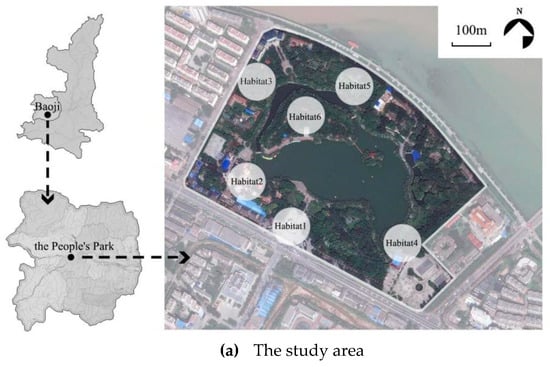
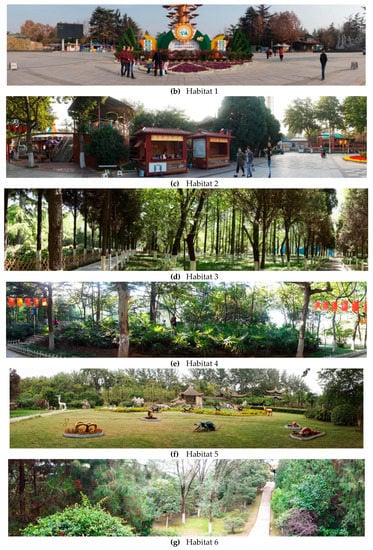
Figure 1.
The study area with panoramic photos of the six different habitats in People’s Park.

Table 1.
Characteristics of the study area.
Habitat 1 is a public square in the entrance of the park which is paved with rigid materials; a few rows of trees line the two sides of the square along with some cultural sculptures and flower beds.
Habitat 2 is a playground, which includes a large number of recreational facilities and benches, but the greening in the area is not too lush, containing only shrubs.
Habitat 3 is a closed one-layered mixed grove with paths and some benches where people can move around freely.
Habitat 4 is a semiclosed multilayered mixed woodland, surrounded by a road along the lake and some benches placed under the Cedrus deodara.
Habitat 5 is the largest perennial manicured open lawn containing some animal sculptures made from discarded tyres. This habitat contains some pavilions on the north side where visitors often perform with musical instruments, chorus training, and singing performances.
Habitat 6 is an islet with closed multilayered mixed woodland and is densely covered with plants; there exists artificial rockery and some pavilions for tourists to watch and relax (Figure 1).
2.2. Measurement of Biodiversity
In this study, the species survey of vascular plants was carried out on the selected six habitats using a linear measurement method. Three parallel or “*” lines with a spacing of 20 m and a length of 60 m were utilized in each habitat to set the center of each plot, excluding peripheries of five meters. Every species of vascular plant which was exposed within 2 m of each strip at 4 m intervals was recorded, including those that were touched by the strip and vertically projected above and below the strip. The species of vascular plants that came into contact with lines and the frequency of their occurrence in the plot were recorded. The total frequency of the species was the sum of the frequencies of the species on the three lines. Therefore, the number of vascular plant species in each green space was obtained.
2.3. Data Collection
In this study, we used eight PSDs. The eight PSDs were used by Grahn and Stigsdotter [19] and they include:
- Serene: An undisturbed, silent and safe environment where one can completely relax, without too many disturbances.
- Nature: An experience of the inherent force and power of nature, designing and displaying intrinsic vitality, inaccessible and wild.
- Rich in species: Sensation of finding a wide range of expressions of life, such as abundant flowers, birds, and butterflies.
- Space: An environment experienced as spacious and free, one which has a certain quality of connectedness and lots of trees, and is not disturbed by too many roads and paths.
- Prospect: An area containing open and plane views, e.g., flat and well-cut lawns with scattered trees.
- Refuge: An enclosed and safe environment with many bushes. People can sit down and watch other people being active.
- Social: An environment in which social activities can be performed, such as gatherings, exhibitions, etc.
- Culture: A cultural and historical environment with fountains, statues, and exotic plants, etc.
Before the design of the questionnaire, in order to understand whether local Chinese residents understand the meaning of the eight PSDs, an interview survey was conducted. The results showed that the vast majority of interviewees could correctly understand the meanings of the eight PSDs. Then, respondents were randomly selected from the six habitats in which they were for recreational purposes. The questionnaire was distributed after their consent was obtained. Before filling in the questionnaire, the scope of the venue was explained to the respondents to ensure that their answers could accurately reflect their feelings at the time. The study was conducted on both weekdays and weekends during September and October of 2017 when the weather was sunny and windless.
The questionnaire contains three parts: (1) Personal basic information, including gender, age, education level, living environment, and ecological background knowledge. (2) Usage of green space in the park, including the distance of residence from the park, the frequency of park use, and how respondents reach the park. (3) Perception of and preference for species richness and the eight PSDs. The perceptive degree of species richness is represented by "1, 2, 3" representing "low, medium, high". The eight PSDs are described in text, accompanied by the corresponding photos. Perception of the eight PSDs is measured using a five-point Likert scale. The score of "1, 2, 3, 4, and 5" represents "none, weak, medium, strong, and very strong" of the perception level. According to the method of Tosun [27], a mean value of the five-point Likert scale of the eight PSDs between 1 and 2.4, indicates that the degree of perception is low, a mean value between 2.5 and 3.4 indicates a moderate degree of perception, and a mean value between 3.5 and 5 indicates a high degree of perception.
2.4. Data Analysis
This study used the number of vascular plant species (NVPS) to represent the level of species richness in each habitat. A reliability analysis of the five-point Likert scale used by respondents to rate the eight PSDs in different habitats was utilized by the researchers using SPSS 17.0 (Statistical Package for the Social Sciences version 17.0) software. The total Cronbach’s α coefficient of the scale is 0.774 (>0.7), which means that the evaluation project has a high correlation and the internal reliability is quite reliable.
Correlation analysis among actual biodiversity, perceived biodiversity, and the eight PSDs in different habitat types was conducted using the Pearson correlation analysis (CORR) in SAS 9.4 (Statistical Analysis System 9.4) software. A one-way analysis of variance (ANOVA) was used to analyze the variance of preferences in different habitats to test the significance of any differences. The generalized linear model (GLM) was used to determine the factors influencing the perception and preference of biodiversity and the eight PSDs, respectively, and the significant factors were identified.
3. Results
A total of 1119 respondents filled out the questionnaire, with incomplete responses obtained from 30 respondents. Thus, the final total of valid questionnaires received was 1089 (Table 2), of which 119 were conducted in Habitat 1 (119), 133 in Habitat 2 (133), 269 in Habitat 3 (269), 109 in Habitat 4 (109), 270 in Habitat 5 (270), and 189 in Habitat 6 (189). Through field investigation and statistical analysis, the species richness (NVPS) of the six habitat types was obtained; the habitats were ranked from lowest to highest including Habitat 1 (5 species), Habitat 2 (18 species), Habitat 3 (20 species), Habitat 4 (24 species), Habitat 5 (27 species), and Habitat 6 (31 species) (Table 3 and Table A1 in Appendix A).
Table 2.
Major personal basic information of respondents within the six habitats.
Table 3.
One-way analysis of variance between each preference in different habitats.
3.1. Perception and Preference of Biodiversity
Correlation analysis showed that there was a significant correlation between perceived biodiversity and actual biodiversity (R = 0.08, P < 0.05), and indicated that respondents were able to correctly perceive biodiversity among the different habitat types.
The results of a one-way analysis of variance (ANOVA) suggested that respondents’ preferences of each habitat significantly differed (F = 4.34, P < 0.01). Habitats 4 and 5 were the most popular of the six habitats, while Habitat 2 was the most disliked. Habitats 1, 3, and 6 were in the middle of the preference list (Table 3).
Correlation analysis also showed a significant positive correlation between perceived biodiversity and preference (R = 0.448, P < 0.0001), which indicated that the respondents preferred the habitats with the highest levels of biodiversity (Figure 2).
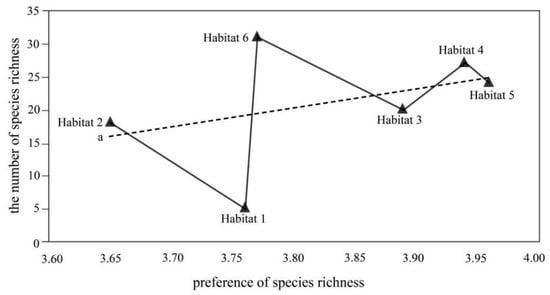
Figure 2.
The relationship between perceived biodiversity and preference; “a” represents the trendline of perceived biodiversity and preference.
3.2. Perception of the Eight Perceived Sensory Dimensions and the Relationship with Recreational Preference
3.2.1. Perception of the Eight Perceived Sensory Dimensions
It was found that respondents were able to perceive different recreational attributes in each of the six habitats. Environments with more natural and abundant vegetation structures (Habitats 3, 4, 6) provided the highest number of experiences of Serene, Nature, and Space, while the environments with high artificial management and hard pavement (Habitat 1, 2) accounted for the majority of experiences of Social and Culture. Social was also highly perceived in the open lawn with some pavilions (Habitat 5). In addition, the respondents did not frequently perceive Rich in species, Prospect, and Refuge in these six habitats (Table 4).
Table 4.
Perception of the eight perceived sensory dimensions in different habitats.
3.2.2. Relationship between Preference and the Number of Highly Rated PSDs in the Different Habitats
In order to identify the relationship between recreational preference and recreational values of environment in different habitats, correlation analyses between preference and the number of highly rated PSDs in each habitat were conducted (Figure 3). However, the correlation analyses found that there were not significant correlations between them (R = 0.435, p = 0.389).
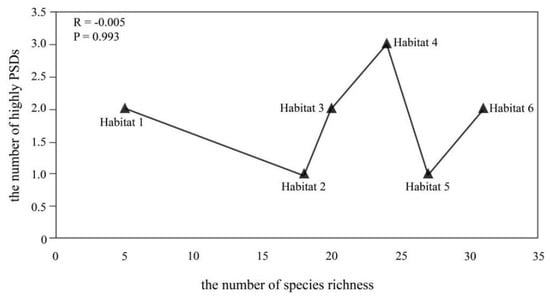
Figure 3.
The relationship between the preference and the number of recreational attributes.
3.3. Relationship between Biodiversity and the Number of Eight PSDs
The species richness number and perception of the eight PSDs in different habitats can be found in Figure 4. The correlation analyses found that a correlation did not exist between them (R = −0.005, p = 0.993), indicating that an environment with high biodiversity is not necessarily to be perceived as having many recreational attributes, and vice versa.
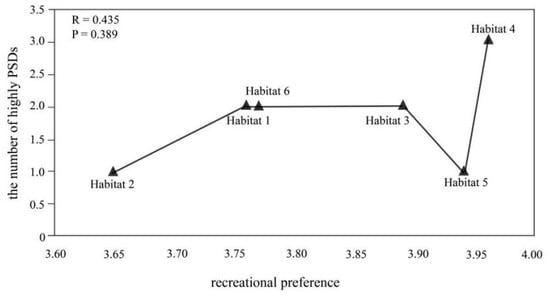
Figure 4.
The relationship between the species richness and the number of recreational attributes.
3.4. Factors Influencing Perception of and Preference for Biodiversity and Eight PSDs
3.4.1. Factors Affecting Perception and Preference of Biodiversity
There exists a significant correlation between respondents’ attributes and the perception and preference of biodiversity (p < 0.05). Specifically, ‘living environment’ and ‘frequency to the park’ had significant influences on the perception of and preference for urban biodiversity, which indicates that people who live in an environment containing more green spaces and who often visit the park are able to more easily perceive biodiversity and appreciate it (Table 5).
Table 5.
Factors affecting the preference and perception of biodiversity.
3.4.2. Factors Affecting Perception of the Eight PSDs
The generalized linear regression showed that the perception of each PSD was influenced by the different factors. ‘Education level’, ‘living environment’, ‘age’, ‘ecological knowledge’, ‘attitude towards public green spaces’, ‘frequency to the park’, ‘how to get to the park’, ‘distance between home and park’, and ‘number of companions’ more easily influenced the perception of the certain PSDs. Respondents who have received basic education, who drive, or those who come to the park two or three times a week were more likely to perceive the sensory dimension of Nature; Rich in species was more frequently perceived by respondents with basic education levels and private gardens; Prospect was more frequently perceived by respondents who were 13–17 years old, who had a basic education, and those whose living environment contained a private garden; respondents living 0–100m from the park and individual activity could better perceive the sensory dimension of Refuge; Culture was more frequently perceived by respondents who were 13–17 years old, those who had a basic level of education and those who had some ecological knowledge. The difference in perceptions of Serene and Social was not obvious (Table 6).
Table 6.
Influencing factors that have significant differences in the perception of the eight perceived sensory dimensions.
4. Discussion
4.1. Perception and Preference of Biodiversity in the Different Habitats
In more controlled settings, such as experimental plant arrays or grassland patches, there has been shown to be a significant positive association between perceived and actual plant species richness [28]. This study found that the respondents could also correctly perceive species richness in urban green spaces, indicating that the Chinese inhabitants are not disconnected from an experience of green biodiversity in the urban environment. Fuller and his colleagues [15] considered that this was because plants are the most visible and static component of biodiversity. Some studies have found that people have perceived colorful plants as having higher species richness than those with single colors [29,30], and other researchers have found that lush plants, private gardens, and old trees were often used to describe high species richness, while lawns and bare ground were thought to be characteristics of low species richness [13]. Perceived species richness was positively associated with vegetation height, evenness, and color, suggesting that these may be the cues used to estimate species richness in a related study [30]. In general, our findings are consistent with other studies, confirming that the actual biodiversity of urban green space can indeed be estimated to some degree of precision by urban inhabitants [13,15,23,28].
Studies by Qiu et al. [13] and Dallimer et al. [16] showed that people’s recreational preferences are not related to biodiversity, but some studies have found that people preferred an environment with rich and diverse plants [15,31,32]. This study found that people’s preferences have a positive correlation with species richness, and the degree of preference significantly differed in the different habitats. In general, respondents preferred green spaces to grey spaces. Comparing to Habitat 6 with the highest species richness but a jumble of plants, Habitat 4, which was located around the lake with an open view, and Habitat 5, which contained an open lawn, were more popular places for recreation. This is perhaps because people preferred green spaces with open lawns and shrubbery than the jungle [33,34,35]. People often have different understandings of nature and their picturesque notion of nature (i.e., ’natural’) as a landscape that looks tended, demand a certain level of visible care and order rather than wild, but truly ecologically rich environments are often considered ‘messy’ [13]. Therefore, although Habitats 4–6 were the environments with high species richness, people still preferred Habitat 4 and 5 with high management and orderliness. Moreover, the lake in the park could be another reason why visitors were attracted [29], which reflected individuals’ inherent sentiment of water. That is why Habitat 4 is one of the most favored places of respondents. Habitat 1 and 2 were grey spaces and were the most disliked places due to the low presence of plants and less recreational facilities for the respondents’ relaxation. Although there were a few plants in Habitat 2, ceaseless noise from the children’s amusement equipment could possibly influence the respondents’ social communication and recreation. In this study, we found that respondents were able to accurately perceive biodiversity and preferred the habitats high in biodiversity among the different habitat types for recreation. Therefore, in Chinese urban environmental settings, it may be a greater challenge of trade-offs and synergies between biodiversity conservation and human recreation, thereby requiring greater reason and caution when planning and designing urban green spaces.
4.2. Perception of the Eight PSDs in the Different Habitats
The personal perception of local respondents has an important impact on shaping environmental characteristics [19,36]. This study found that people could frequently experience the sensory dimension of Social in Habitats 1, 2, and 5. Habitat 1 provides an open space for social activities, such as public square dancing which has become a common open-air fitness practice across China in the recent decade with many middle-aged and elderly participants. Habitat 2 contains many recreational facilities for people’s recreation, such as a roller coaster and a pirate ship. Habitat 5 has some pavilions, wherein some people gathered together to perform musical instruments, exercise chorus, and watch others. The sensory dimension of Culture can be embodied by the cultural elements of human artifacts such as stone, artificial fountains, and ornamental plants, history, myths, and the living conditions of human beings [20]. In Habitat 1, respondents strongly perceived the Culture sensory dimension, because it includes large artificial landscape sculptures, fountains, and walls which are set up in the center and on both sides, reflecting the characteristics of culture. In Habitats 3, 4, and 6 both Serene and Nature sensory dimensions can be perceived. Those inhabiting environments inclusive of many plants are more likely to experience calm and peaceful feelings than those in the environment containing hard pavement in the grey spaces and the environment with many tourists [37]. These three habitat types are all woodlands with more trees and shrubs, mainly covered by herbaceous species, and the whole atmosphere is serene and peaceful. Among them, Habitat 4 is located on the lakeside of the park with some benches located under the trees. The respondents would have a leisurely feeling of entering another world and could perhaps feel and perceive more Space there. Urban parks not only provide residents with a peaceful, spacious, and natural environment, but also provide places for a full variety of social and cultural activities. Therefore, it is easy for respondents to feel the dimensions of Serene, Space, Nature, Social, and Culture in the park. Respondents were not easily able to perceive Prospect, Rich in species, and Refuge in the People’s Park probably due to the limited amount of green spaces with seldom complex structures and higher levels of management.
People in different habitats can perceive different PSDs and have diverse experiences [20]. Serene, Nature, and Space were perceived in Habitat 4, but Social was perceived in Habitat 5. In Habitats 1, 3, and 6, although respondents perceived the greatest number of highly rated PSDs (Table 4), the degree of preference varied, which indicated that people’s preferences were not related to the number of highly rated PSDs. This could be attributed to the distinctive characteristics of each habitat, such as the certain specific elements or the setting configurations [13]. Interestingly, Habitats 2 and 5 were both highly perceived as Social, but they received vastly different preferences. Habitat 2 was the most disliked habitat, while Habitat 5 was the most liked, perhaps because people have different understandings of the Social dimension due to these two habitats’ features. The parents would like to accompany their kids playing on the playground in Habitat 2, but where the noise of amusement equipment existed, they were annoyed. Respondents in Habitat 5 were willing to participate in all kinds of social activities including instrumental performance, chorus, and watching people.
4.3. Analysis of Relationship between Biodiversity and the Eight PSDs
Biodiversity plays a positive role in urban ecological protection and improves residents’ well-being [29]. The eight PSDs are reliable tools for urban green space assessment and planning, which can help planners plan and design for public recreational needs and expectations [21]. However, this study showed that the relationship between biodiversity and the number of highly rated PSDs is irrelative. A green space’s attributes, surrounding environment, as well as people’s internal cognition of green space can all influence the perceptions of the PSDs [21]. The biodiversity in the different habitats may affect people’s perceptions of the certain PSDs, and an environment high in biodiversity does not necessarily provide a lot of PSDs for human recreation. On the contrary, not all recreational values of urban green space should be represented in an environment with high levels of biodiversity. The perceptions of biodiversity also depend on the respondents’ own attributes [35]. In our study, the results showed that education level and living environment could affect the perception of Rich in species (Table 6). Ecological education and green living environments might be some ways by which the merging of ecological and recreational benefits could be achieved through green space planning and management.
4.4. Factors Influencing Perception and Preference of Biodiversity and the Eight PSDs
When discussing biodiversity and how people perceive, experience, and evaluate it, one has to consider people’s understanding of natural landscapes and nature, because each person’s perception and evaluation of the environment is based upon their personal and cultural backgrounds [29,38,39,40]. High frequency to the green spaces affects people’s environmental awareness and preference [41]. Respondents who came to the park two or three times a week and had private gardens were generally satisfied with the park and easily perceived the high level of biodiversity [42]. This indicates that the more green spaces exist in people’s living environment and more frequent their visits to the park, the stronger people’s perceptions of and preferences for biodiversity are. These results can be used as a theoretical support for public awareness and conservation of biodiversity.
Due to different social and cultural backgrounds, people’s perception and assessment of the natural environment vary [40]. The perception of various landscapes also depends on the respondents’ own attributes, such as gender, age, social status, childhood environment, and frequency of green space use [24,35,43]. This study showed that for the different PSDs, respondents with varying personal backgrounds had different perceptions of the park, which is of great importance to planning and designing a specific recreational environment. Respondents from different backgrounds have different perceptions of Rich in species, Nature, Prospect, Refuge, Culture, and Space, depending on their different natural experiences [40]. Interestingly, in this study, we found that Serene and Social were the two perceived dimensions that could be generally perceived by respondents in the context of the urban parks in China, that is, respondents had frequent experiences of Serene and Social in urban parks and there was no significant difference in the perception of them among the respondents. Thus, we suggest that in order to provide urban residents with more recreational activities, urban parks with certain PSDs (e.g., Nature, Rich in species, and Prospect) could be added in process of the urban green space planning and design. Meanwhile, the corresponding provisions of potential recreational activities should have less impact on urban biodiversity in order to fulfil the maximum biodiversity and recreational values in the Chinese urban environmental settings. For example, chatting, playing chess, gathering, meditation, etc. could be tentative options.
5. Conclusions
This study was the first to explore the perception and preference of residents for biodiversity and PSDs in the Chinese urban environmental settings, and aimed to provide a scientific theoretical basis and practical methods for balancing urban biodiversity conservation and human recreation. We found that respondents were able to accurately perceive biodiversity and preferred to engage in recreational activities in the higher biodiversity environments. However, the respondents’ perceptions of the eight PSDs in the different habitats were divergent, and there were no specific correlations between biodiversity and the number of highly rated PSDs, that is, an environment with higher biodiversity does not necessarily have more highly valued PSDs. In addition, environments with more natural and abundant vegetation structures (Habitats 3, 4, 6) provided the most experiences of Serene, Nature, and Space, while the environments with high artificial management and hard pavement (Habitats 1, 2) provided the greatest experiences of Social and Culture and the environment containing an open lawn with some pavilions (Habitat 5) can be perceived as having a high degree of the Social dimension as well. The PSDs were quite closed related to biophysical landscape features and spatial properties [21], since the recreational values provided by the different levels of biodiversity environment were divergent. Therefore, we should determine the specific aims of the actual green space planning (biodiversity conservation or human recreation) to construct urban green spaces in future. Moreover, personal information can also affect respondents’ perception and preference of green space. For instance, ‘living environment’ and ‘frequency to the park’ were the most important two factors influencing people’s perception of and preference for biodiversity. The accessibility of green space has thus a great impact on people’s perceptions and preferences. Compared with the quality of a green space, close proximity to the green space should be taken more into account in urban green space planning [44]. More attractive green spaces within walking distance should be added in the urban environmental settings. We also found that ‘education level’, ‘living environment’, ‘age level’, and other indicators were easier to influence the perception of the eight PSDs, which could be used for guiding the human-oriented planning and design of urban green spaces. Understanding people’s perceptions and preferences of the green space environment is conducive to improving the quality of residents’ urban green space experiences and recreation, thereby increasing their well-being, but more importantly stimulated the awareness of the urban residents to recognize and support urban biodiversity and ecosystem services in green spaces.
In order to identify the specific relationships between biodiversity, PSDs, and preference for the trade-offs and synergies of urban biodiversity conservation and human recreation, further comparison investigations within different types of urban green spaces combined with the collection of more demographic information should be examined. In addition, although most people have higher ecological knowledge by self-test, the results showed that there was no significant correlation between ecological knowledge and preference. This result is not in line with previous studies [13,29] and needs further examination.
Author Contributions
Conceptualization, T.G. and L.Q.; Methodology, T.G., L.Z. and L.Q.; Validation, T.G., L.Z. and L.Q.; Formal analysis, L.Z. and L.Q.; Investigation, L.Z., T.Z. and R.S.; Resources, T.G. and L.Q.; Data curation, L.Z. and R.S.; Software, L.Z. and T.Z.; Writing—original draft preparation, L.Z.; Writing—review and editing, L.Q. and Y.Z.; Visualization, L.Z.; Supervision, T.G. and L.Q.; Project administration, T.G. and L.Q.; Funding acquisition, T.G. and L.Q.
Funding
This research was funded by the National Natural Science Foundation of China [grant numbers: 31500582 and 31600580], the Research Fund for Advanced Talents of Northwest A&F University [grant numbers: Z111021501], Talent Support of Shaanxi Province [grant numbers: A279021715 and A279021830], and Chinese Universities Scientific Fund [grant numbers: Z109021701 and 2452019175].
Acknowledgments
We would especially like to thank Lori Staggs in Mississippi State University for helping revise this manuscript and the 1119 park visitors who participated in our survey.
Conflicts of Interest
The authors declare no conflict of interest.
Appendix A
Table A1.
Total species of plants found in the People’s Park.
Table A1.
Total species of plants found in the People’s Park.
| Number | Species | Frequency | Life Form | Origin | Growth Pattern |
|---|---|---|---|---|---|
| 1 | Veronica persica | 7 | Annual herb | From abroad | Spontaneous |
| 2 | Artemisia argyi | 2 | Perennial herb | Local | Spontaneous |
| 3 | Amaranthus lividus | 3 | Annual herb | From abroad | Spontaneous |
| 4 | Fatsia japonica | 17 | Shrubs | From abroad | Cultivated |
| 5 | Trifolium repens | 12 | Perennial herb | From abroad | Cultivated |
| 6 | Fraxinus chinensis | 1 | Tree | From abroad | Cultivated |
| 7 | Echinochloa crusgalli | 1 | Annual herb | Local | Spontaneous |
| 8 | Platycladus orientalis | 6 | Tree | Local | Cultivated |
| 9 | Potentilla supina | 1 | Annual or biennial herb | Local | Spontaneous |
| 10 | Plantago asiatica | 5 | Biennial or perennial herb | Local | Spontaneous |
| 11 | Rumex dentatus | 1 | Annual | Local | Spontaneous |
| 12 | Ailanthus altissima | 7 | Tree | Local | Cultivated |
| 13 | Broussonetia kazinoki | 1 | Shrub | From home | Spontaneous |
| 14 | Salix babylonica | 2 | Tree | Local | Cultivated |
| 15 | Juniperus formosana | 8 | Tree | Local | Cultivated |
| 16 | Robinia pseudoacacia | 7 | Tree | From abroad | Cultivated |
| 17 | Calystegia hederacea | 1 | Annual herb | Local | Spontaneous |
| 18 | Hemerocallis middendorfii | 1 | Perennial herb | From abroad | Cultivated |
| 19 | Rehmannia glutinosa | 1 | Perennial herb | Local | Spontaneous |
| 20 | Euphorbia humifusa | 2 | Annual herb | Local | Spontaneous |
| 21 | Euonymus japonicus | 4 | Shrub | From abroad | Cultivated |
| 22 | Eucommia ulmoides | 1 | Tree | Local | Cultivated |
| 23 | Stellaria media | 2 | Annual or biennial herb | Local | Spontaneous |
| 24 | Yucca gloriosa | 1 | Shrub | From abroad | Cultivated |
| 25 | Trigonotis peduncularis | 2 | Annual or biennial herb | Local | Spontaneous |
| 26 | Phyllostachys | 2 | Bamboo | Local | Cultivated |
| sulphurea | |||||
| 27 | Setaria viridis | 11 | Annual herb | Local | Spontaneous |
| 28 | Cynodon dactylon | 14 | Perennial herb | Local | Spontaneous |
| 29 | Broussonetia papyrifera | 8 | Tree | Local | Cultivated |
| 30 | Magnolia grandiflora | 1 | Tree | From abroad | Cultivated |
| 31 | Sophora japonica | 2 | Tree | Local | Cultivated |
| 32 | Pittosporum tobira | 1 | Shrub or small tree | From home | Cultivated |
| 33 | Rorippa indica | 1 | Annual or biennial herb | Local | Spontaneous |
| 34 | Salix matsudana | 1 | Tree | Local | Cultivated |
| 35 | Lolium perenne | 6 | Perennial herb | From abroad | Cultivated |
| 36 | Oxalis corymbosa | 1 | Perennial herb | Local | Cultivated |
| 37 | Photinia serrulata | 1 | Shrub or small tree | From abroad | Cultivated |
| 38 | Ancuba japonica | 3 | Shrub | From abroad | Cultivated |
| 39 | Eragrostis pilosa | 2 | Annual or biennial herb | Local | Spontaneous |
| 40 | Youngia japonica | 4 | Annual herb | Local | Spontaneous |
| 41 | Artemisia annua | 1 | Annual herb | Local | Spontaneous |
| 42 | Pyracantha fortuneana | 2 | Shrub | Local | Cultivated |
| 43 | Celosia cristata | 1 | Annual herb | From abroad | Cultivated |
| 44 | Paederia scandens | 18 | Perennial vine | Local | Spontaneous |
| 45 | Acer palmatum | 2 | Tree | From home | Cultivated |
| 46 | Populus × canadensis | 4 | Tree | From abroad | Cultivated |
| 47 | Nerium indicum | 1 | Shrub | From abroad | Cultivated |
| 48 | Equisetum ramosissimum | 1 | Annual herb | Local | Spontaneous |
| 49 | Arthraxon hispidus | 18 | Annual herb | Local | Spontaneous |
| 50 | Sonchus arvensis | 1 | Perennial herb | Local | Spontaneous |
| 51 | Melia azedarach | 1 | Tree | From home | Cultivated |
| 52 | Indocalamus latifolius | 1 | Bamboo | From home | Cultivated |
| 53 | Chimonanthus praecox | 3 | Shrub | Local | Cultivated |
| 54 | Chenopodium album | 4 | Annual herb | Local | Spontaneous |
| 55 | Eclipta prostrata | 2 | Annual herb | Local | Spontaneous |
| 56 | Forsythia suspensa | 4 | Shrub | Local | Cultivated |
| 57 | Paspalum conjugatum | 6 | Perennial herb | Local | Spontaneous |
| 58 | Sabina chinensis | 16 | Tree | Local | Cultivated |
| 59 | Solanum nigrum | 2 | Annual | Local | Spontaneous |
| 60 | Sophora japonica | 1 | Tree | Local | Cultivated |
| 61 | Humulus scandens | 1 | Perennial herb | Local | Spontaneous |
| 62 | Verbena officinalis | 3 | Perennial herb | Local | Spontaneous |
| 63 | Portulaca oleracea | 1 | Annual herb | Local | Spontaneous |
| 64 | Kalimeris indica | 2 | Perennial herb | Local | Spontaneous |
| 65 | Digitaria sanguinalis spp.sanguinalis | 9 | Annual herb | Local | Spontaneous |
| 66 | Dichondra repens | 1 | Perennial herb | From home | Spontaneous |
| 67 | Ophiopogon japonicus | 39 | Perennial herb | Local | Cultivated |
| 68 | Swida walteri | 21 | Tree | From home | Cultivated |
| 69 | Hibiscus mutabilis | 1 | Shrub or small tree | Local | Cultivated |
| 70 | Chaenomeles sinensis | 2 | Shrub or small tree | Local | Cultivated |
| 71 | Osmanthus fragrans | 1 | Shrub or small tree | From home | Cultivated |
| 72 | Nandina domestica | 7 | Shrub | Local | Cultivated |
| 73 | Araucaria cunninghamii | 3 | Tree | From abroad | Cultivated |
| 74 | Eleusine indica | 15 | Annual | Local | Spontaneous |
| 75 | Cynanchum auriculatum | 1 | Perennial herb | Local | Spontaneous |
| 76 | Achyranthes bidentata | 4 | Perennial herb | Local | Spontaneous |
| 77 | Galinsoga parviflora | 1 | Annual herb | From abroad | Spontaneous |
| 78 | Ligustrum lucidum | 46 | Shrub or small tree | Local | Cultivated |
| 79 | Plantago depressa | 18 | Annual or biennial herb | Local | Spontaneous |
| 80 | Veronica didyma | 1 | Annual | Local | Spontaneous |
| 81 | Taraxacum mongolicum | 8 | Perennial herb | Local | Spontaneous |
| 82 | Senecio scandens | 3 | Perennial herb | Local | Spontaneous |
| 83 | Pharbitis nil | 1 | Annual herb | Local | Spontaneous |
| 84 | Rubia cordifolia | 3 | Perennial herb | From abroad | Spontaneous |
| 85 | Bromus japonica | 3 | Annual | Local | Spontaneous |
| 86 | Cerasus serrulata var. lannesiana | 3 | Tree | From home | Cultivated |
| 87 | Acer buergerianum | 5 | Tree | From home | Cultivated |
| 88 | Platanus orientalis | 7 | Tree | From home | Cultivated |
| 89 | Sabina vulgaris | 1 | Shrub | Local | Cultivated |
| 90 | Pilea japonica | 1 | Annual herb | Local | Spontaneous |
| 91 | Amygdalus davidiana | 4 | Tree | Local | Cultivated |
| 92 | Duchesnea indica | 17 | Perennial herb | Local | Spontaneous |
| 93 | Punica granatum | 9 | Shrub or small tree | From abroad | Cultivated |
| 94 | Photinia serrulata | 3 | Shrub or small tree | Local | Cultivated |
| 95 | Metasequoia glyptostroboides | 13 | Tree | From home | Cultivated |
| 96 | Hydrocotyle sibthorpioides | 10 | Perennial herb | From home | Spontaneous |
| 97 | Chaenomeles speciosa | 2 | Shrub | Local | Cultivated |
| 98 | Acalypha australis | 17 | Annual | Local | Spontaneous |
| 99 | Tagetes erecta | 3 | Annual | From abroad | Cultivated |
| 101 | Cayratia japonica | 5 | Perennial vine | Local | Spontaneous |
| 102 | Kyllinga brevifolia var. leiolepis | 2 | Perennial | Local | Spontaneous |
| 100 | Coleus scutellarioides | 1 | Annual | From abroad | Cultivated |
| 103 | Acer mono | 3 | Tree | Local | Cultivated |
| 104 | Parthenocissus quinquefolia | 2 | Perennial vine | From abroad | Cultivated |
| 105 | Cyperus rotundus | 1 | Perennial | Local | Spontaneous |
| 106 | Ligustrum sinense | 31 | Shrub or small tree | From home | Cultivated |
| 107 | Armeniaca vulgaris | 1 | Tree | From home | Cultivated |
| 108 | Inula japonica | 2 | Perennial | Local | Spontaneous |
| 109 | Cedrus deodara | 57 | Tree | From abroad | Cultivated |
| 110 | Artemisia lavandulaefolia | 4 | Perennial | Local | Spontaneous |
| 111 | Dendranthema indicum | 1 | Perennial | Local | Spontaneous |
| 112 | Erigeron annuus | 6 | Annual or biennial | From abroad | Spontaneous |
| 113 | Platanus occidentalis | 24 | Tree | From abroad | Cultivated |
| 114 | Ginkgo biloba | 2 | Tree | From home | Cultivated |
| 115 | Prunus Cerasifera | 5 | Shrub or small tree | Local | Cultivated |
| 116 | Jasminum nudiflorum | 4 | Shrub | Local | Cultivated |
| 117 | Pinus tabuliformis | 7 | Tree | Local | Cultivated |
| 118 | Ulmus pumila | 7 | Tree | Local | Cultivated |
| 119 | Amygdalus triloba | 1 | Tree | Local | Cultivated |
| 137 | Brassica oleracea var. acephala | 8 | Biennial herb | From abroad | Cultivated |
| 120 | Magnolia denudata | 1 | Tree | From home | Cultivated |
| 121 | Iris tectorum spp. tectorum | 4 | Perennial herb | Local | Cultivated |
| 122 | Sabina chinensis | 3 | Tree | Local | Cultivated |
| 123 | Malva rotundifolia | 2 | Perennial herb | Local | Spontaneous |
| 124 | Pharbitis purpurea | 1 | Annual herb | From abroad | Spontaneous |
| 125 | Rosa chinensis | 3 | Shrub | From home | Cultivated |
| 126 | Poa annua | 25 | Perennial herb | From home | Cultivated |
| 127 | Viola inconspicua | 1 | Perennial herb | Local | Spontaneous |
| 128 | ixeris chinensis | 3 | Perennial herb | Local | Spontaneous |
| 129 | Rumex crispus | 1 | Perennial herb | Local | Spontaneous |
| 130 | Catalpa ovata | 1 | Tree | Local | Cultivated |
| 131 | Syringa oblata | 2 | Shrub or small tree | Local | Cultivated |
| 132 | Viola yedoensis | 11 | Perennial | Local | Spontaneous |
| 133 | Cercis chinensis | 2 | Shrub | Local | Cultivated |
| 134 | Lagerstroemia indica | 2 | Shrub or small tree | Local | Cultivated |
| 135 | Trachycarpus fortunei | 10 | Tree | From home | Cultivated |
| 136 | Oxalis corniculata | 22 | Perennial herb | Local | Spontaneous |
References
- Roy, S.; Byrne, J.; Pickering, C. A systematic quantitative review of urban tree benefits, costs, and assessment methods across cities in different climatic zones. Urban For. Urban Green. 2014, 11, 351–363. [Google Scholar] [CrossRef]
- Mitchell, R. Is physical activity in natural environments better for mental health than physical activity in other environments? Soc. Sci. Med. 2013, 91, 130–134. [Google Scholar] [CrossRef] [PubMed]
- Lee, A.C.; Jordan, H.C.; Horsley, J. Value of urban green spaces in promoting healthy living and wellbeing: Prospects for planning. Risk Manag. Healthc. Policy 2015, 8, 131–137. [Google Scholar] [CrossRef] [PubMed]
- Lepczyk, C.A.; Aronson, M.F.J.; Evans, K.L.; Goddard, M.A.; Lerman, S.B.; MacIvor, J.S. Biodiversity in the City: Fundamental Questions for Understanding the Ecology of Urban Green Spaces for Biodiversity Conservation. Bioscience 2017, 67, 799–807. [Google Scholar] [CrossRef]
- Fan, C.; Johnston, M.; Darling, L.; Scott, L.; Liao, F.H. Land use and socio-economic determinants of urban forest structure and diversity. Landsc. Urban Plan. 2019, 181, 10–21. [Google Scholar] [CrossRef]
- Vasiljevic, N.; Radic, B.; Gavrilovic, S.; Sljukic, B.; Medarevic, M.; Ristic, R. The concept of green infrastructure and urban landscape planning: A challenge for urban forestry planning in Belgrade, Serbia. iForest Biogeosci. For. 2018, 11, 491–498. [Google Scholar] [CrossRef]
- Bourne, K.S.; Conway, T.M. The influence of land use type and municipal context on urban tree species diversity. Urban Ecosyst. 2013, 17, 329–348. [Google Scholar] [CrossRef]
- Pires, A.P.F.; Amaral, A.G.; Padgurschi, M.C.G.; Joly, C.A.; Scarano, F.R. Biodiversity research still falls short of creating links with ecosystem services and human well-being in a global hotspot. Ecosyst. Serv. 2018, 34, 68–73. [Google Scholar] [CrossRef]
- Qiu, L. Linking Biodiversity and Recreational Merits of Urban Green Spaces; Swedish University of Agricultural Sciences: Alnarp, Sweden, 2014; pp. 9–25. [Google Scholar]
- Dearborn, D.C.; Kark, S. Motivations for conserving urban biodiversity. Conserv Biol. 2010, 2, 432–440. [Google Scholar] [CrossRef]
- Uzzell, D.L. The Psycho-Spatial Dimension of Global Environmental Problems. J. Environ. Psychol. 2000, 20, 307–318. [Google Scholar] [CrossRef]
- Stokes, D.L. Things We Like: Human Preferences among Similar Organisms and Implications for Conservation. Hum. Ecol. 2006, 35, 361–369. [Google Scholar] [CrossRef]
- Qiu, L.; Lindberg, S.; Nielsen, A.B. Is biodiversity attractive?—On-site perception of recreational and biodiversity values in urban green space. Landsc. Urban Plan. 2013, 119, 136–146. [Google Scholar] [CrossRef]
- Hoyle, H.; Hitchmough, J.; Jorgensen, A. All about the ‘wow factor’? The relationships between aesthetics, restorative effect and perceived biodiversity in designed urban planting. Landsc. Urban Plan. 2017, 164, 109–123. [Google Scholar] [CrossRef]
- Fuller, R.A.; Irvine, K.N.; Devine-Wright, P.; Warren, P.H.; Gaston, K.J. Psychological benefits of green space increase with biodiversity. Biol. Lett. 2007, 3, 390–394. [Google Scholar] [CrossRef] [PubMed]
- Dallimer, M.; Irvine, K.N.; Skinner, A.M.J.; Davies, Z.G.; Rouquette, J.R.; Maltby, L.L.; Warren, P.H.; Armsworth, P.R.; Gaston, K.J. Biodiversity and the Feel-Good Factor: Understanding Associations between Self-Reported Human Well-being and Species Richness. Bioscience 2012, 62, 47–55. [Google Scholar] [CrossRef]
- Van Herzele, A.; Wiedemann, T. A monitoring tool for the provision of accessible and attractive urban green spaces. Landsc. Urban Plan. 2003, 63, 109–126. [Google Scholar] [CrossRef]
- Gyllin, M.; Grahn, P. A semantic model for assessing the experience of urban biodiversity. Urban For. Urban Green. 2005, 3, 149–161. [Google Scholar] [CrossRef]
- Tyrväinen, L.; Mäkinen, K.; Schipperijn, J. Tools for mapping social values of urban woodlands and other green areas. Landsca. Urban Plan. 2007, 79, 5–19. [Google Scholar] [CrossRef]
- Grahn, P.; Stigsdotter, U.K. The relation between perceived sensory dimensions of urban green space and stress restoration. Landsc. Urban Plan. 2010, 94, 264–275. [Google Scholar] [CrossRef]
- Qiu, L.; Nielsen, A.B. Are Perceived Sensory Dimensions a Reliable Tool for Urban Green Space Assessment and Planning? Landsc. Res. 2015, 40, 834–854. [Google Scholar] [CrossRef]
- Ulrika, K.S.; Sus, S.C.; Ulrik, S.; Anne, D.R.; Patrik, G. Forest design for mental health promotion—Using perceived sensory dimensions to elicit restorative responses. Landsca. Urban Plan. 2017, 160, 1–15. [Google Scholar]
- Lindemann-Matthies, P.; Junge, X.; Matthies, D. The influence of plant diversity on people’s perception and aesthetic appreciation of grassland vegetation. Biol. Conserv. 2010, 1, 195–202. [Google Scholar] [CrossRef]
- Chen, H.; Qiu, L.; Gao, T. Application of the eight perceived sensory dimensions as a tool for urban green space assessment and planning in China. Urban For. Urban Green. 2018, 40, 224–235. [Google Scholar] [CrossRef]
- Hermy, M.; Cornelis, J. Towards a monitoring method and a number of multifaceted and hierarchical biodiversity indicators for urban and suburban parks. Landsc. Urban Plan. 2000, 49, 149–162. [Google Scholar] [CrossRef]
- Müller, N.; Abendroth, S. Biodiversity in urban areas-Recommendations for integration into the German biodiversity strategy. Naturschutz Landschaftsplanung 2007, 39, 114–118. [Google Scholar]
- Tosun, C. Host perceptions of impacts: A comparative tourism study. Ann. Tour. Res. 2002, 29, 231–253. [Google Scholar] [CrossRef]
- Young, C.; Frey, D.; Moretti, M.; Bauer, N. Research Note: Garden-owner reported habitat heterogeneity predicts plant species richness in urban gardens. Landsc. Urban Plan. 2019, 185, 222–227. [Google Scholar] [CrossRef]
- Muratet, A.; Pellegrini, P.; Dufour, A.B.; Arrif, T.; Chiron, F. Perception and knowledge of plant diversity among urban park users. Landsc. Urban Plan. 2015, 137, 95–106. [Google Scholar] [CrossRef]
- Southon, G.E.; Jorgensen, A.; Dunnett, N.; Hoyle, H.; Evans, K.L. Perceived species-richness in urban green spaces: Cues, accuracy and well-being impacts. Landsc. Urban Plan. 2018, 172, 1–10. [Google Scholar] [CrossRef]
- Faccioli, M.; Font, A.R.; Figuerola, C.M.T. Valuing the recreational benefits of wetland adaptation to climate change: A trade-off between species’ abundance and diversity. Environ. Manag. 2015, 55, 550–563. [Google Scholar] [CrossRef]
- Giergiczny, M.; Czajkowski, M.; Żylicz, T.; Angelstam, P. Choice experiment assessment of public preferences for forest structural attributes. Ecol. Econ. 2015, 119, 8–23. [Google Scholar] [CrossRef]
- Gobster, P.H. An ecological aesthetic for forest landscape management. Landsc. J. 1999, 18, 54–64. [Google Scholar] [CrossRef]
- Koniak, G.; Sheffer, E.; Noy-Meir, I. Recreation as an ecosystem service in open landscapes in the Mediterranean region in Israel: Public preferences. Isr. J. Ecol. Evolut. 2011, 57, 151–171. [Google Scholar] [CrossRef]
- Heyman, E.; Gunnarsson, B.; Stenseke, M.; Henningsson, S.; Tim, G. Openness as a key-variable for analysis of management trade-offs in urban woodlands. Urban For. Urban Green. 2011, 10, 281–293. [Google Scholar] [CrossRef]
- Gobster, P.H.; Nassauer, J.I.; Daniel, T.C.; Fry, G. The shared landscape: What does aesthetics have to do with ecology? Landsc. Ecol. 2007, 22, 959–972. [Google Scholar] [CrossRef]
- Özgüner, H. Cultural Differences in Attitudes towards Urban Parks and Green Spaces. Landscape Research. 2011, 5, 599–620. [Google Scholar] [CrossRef]
- Hunter, I.R. What do people want from urban forestry?—The European experience. Urban Ecosyst. 2011, 5, 277–284. [Google Scholar] [CrossRef]
- Coles, R.W.; Bussey, S.C. Urban forest landscapes in the UK-Progressing the social agenda. Landsc. Urban Plan 2000, 52, 181–188. [Google Scholar] [CrossRef]
- Elands, B.H.M.; van Koppen, C.S.A. Biocultural Diversity in the Netherlands: From Ecologically Noble Savages towards Biocultural Creatives; Arts, B., van Bommel, S., Ros-Tonen, M., Verschoor, G., Eds.; Forest People Interfaces; Wageningen Academic Publisheres: Wageningen, The Netherlands, 2013; pp. 181–193. [Google Scholar]
- Coldwell, D.F.; Evans, K.L. Contrasting effects of visiting urban green-space and the countryside on biodiversity knowledge and conservation support. PLoS ONE 2017, 12, e0174376. [Google Scholar] [CrossRef]
- Carrus, G.; Scopelliti, M.; Lafortezza, R.; Colangelo, G.; Ferrini, F.; Salbitano, F.; Agrimi, M.; Portoghesi, L.; Semenzato, P.; Sanesi, G. Go greener, feel better? The positive effects of biodiversity on the well-being of individuals visiting urban and peri-urban green areas. Landsc. Urban Plan. 2015, 134, 221–228. [Google Scholar] [CrossRef]
- Nielsen, A.B.; Heyman, E.; Richnau, G. Liked, disliked and unseen forest attributes: Relation to modes of viewing and cognitive constructs. J. Environ. Manag. 2012, 113, 456–466. [Google Scholar] [CrossRef]
- SKoohsari, M.J.; Kaczynski, A.T.; Giles-Corti, B.; Karakiewicz, J.A. Effects of access to public open spaces on walking: Is proximity enough? Landsc. Urban Plan. 2013, 117, 92–99. [Google Scholar] [CrossRef]
© 2019 by the authors. Licensee MDPI, Basel, Switzerland. This article is an open access article distributed under the terms and conditions of the Creative Commons Attribution (CC BY) license (http://creativecommons.org/licenses/by/4.0/).