


Abstract
The tourism industry has received increasing attention as it has become one of the fastest developing business sectors around the world. Service quality in tourism has come to be regarded as an important impetus for economic growth; however, the focus on tourism service quality has not yet been satisfactorily or comprehensively reviewed. Therefore, we conducted a systematic literature review combining bibliometric, citation network and keyword network analysis. We selected the top five tourism journals from the SCOPUS database and then collected papers according to their keywords. Our results revealed the critical issues, topics, and changes over time regarding research on tourism service quality. The critical issues included the important impact of service quality on tourist behavior and service quality evaluation, and topics comprised (1) tourist satisfaction, (2) sustainable issues in tourism, (3) value of service quality for customers, (4) restaurant service quality, (5) customers’ perceptions of tourism, (6) service quality evaluation in tourism, and (7) service quality’s influence on customer behavior. Furthermore, the keyword network analysis results revealed the most influential keywords.
1. Introduction
During the last few decades, the tourism industry has become extremely economically relevant, as it has become one of the fastest developing areas in the contemporary business environment. For example, global international tourist arrivals in 2013 reached a record of 1.087 billion, whereas international tourism revenue constituted a record US $1.159 billion in the same year [1]. This shows that tourism can significantly contribute to the economic growth of tourist destinations by increasing employment opportunities, developing infrastructure, and attracting foreign exchange earnings [2]. Tourism’s economic impetus can be investigated using various perspectives, which include, for example, (1) its direct effects such as “sales, employment, tax revenues, and income levels”, which come from the immediate impacts of tourist spending [2,3,4], (2) its indirect effects such as “prices, quantity and quality of products and services, taxes and property, and social and environmental impacts” [2,3,4], and (3) its efficiency and productivity due to economic resources being allocated to promote cost reductions in tourism sectors [2,5,6,7]. As a result, previous literature has regarded tourism as an important cause of variation in economic growth in many countries.
Among the factors related to tourism, service quality in tourism has received increasing academic attention. For example, research papers have been published in academic journals that utilize SERVQUAL, the most representative model for measuring service quality [8,9]. Nevertheless, service quality in tourism has not yet been satisfactorily reviewed despite its impact on tourists’ destination choice. Furthermore, because of tourism’s wide-ranging scope, which extends to various business settings, few studies have used a comprehensive perspective to examine service quality in tourism. Therefore, our study’s main objective was to identify the most influential studies as well as both broad and specific issues regarding tourism service quality and explore this research field’s current and future directions and trends through a systematic literature review.
2. Literature Review
Identifying the themes of a given field for the purpose of improving our understanding of it, and therefore stimulating further research is a proactive effort. Through the process of mapping and evaluating the body of literature, scholars can identify potential research gaps and opportunities for future research [10].
With regards to conducting such literature reviews, researchers have adopted various approaches. One influential perspective is the “popularity-based approach,” which includes the technique of bibliometric analysis. This method was created to investigate authors’ keywords and titles of published articles in various research fields. Specifically, bibliometric analysis can provide insights not captured or evaluated by other reviews because it offers additional data regarding authors, affiliation, popular words, and keywords and their frequency of use. However, while the popularity-based approach can indicate the importance of titles or keywords in a given research area by investigating their frequency of use in papers, significant information can only be obtained post-publication [11]. Moreover, this approach is considered unsuitable for identifying shared topical content due to its inability to assess relationships among published papers within a certain field.
Another literature review method involves the “network-based approach,” which uses citation and co-citation analysis to investigate the network structure that exists among articles in a given field by mapping and visualizing the citations generated among papers. Citation analysis has been used to determine the popularity of a publication [12]; that is, a network analysis of commonly used citations aims to identify the popularity of a published paper by counting how frequently a paper is cited by other papers. Unlike citation analysis, co-citation analysis has been implemented to identify topics in a given area by constructing a co-citation network comprising a set of nodes (journal papers) and a set of links (co-occurrences of the papers in other papers). That is, if two publications appear together in other publications’ reference lists, they represent a co-citation relationship [13]. Co-citation can be used to explore data structure by applying mapping as a form of exploratory data analysis. In other words, a co-citation network constructed based on papers that are more frequently co-cited indicates that the included papers have similar subject areas [14]. However, those network-based analyses have mainly been conducted on published papers, rather than specified keywords. Therefore, a network of commonly used citations or co-citations does not directly represent a specified knowledge network for a given area from a comprehensive perspective. To comprehensively identify issues and topics pertaining to tourism service quality, it is therefore essential to include papers not involved in the network.
Lai et al. [15] performed a systematic literature review on service quality in Hospitality and Tourism using the pathfinder network approach. This study differs from the present study in two significant ways. First, Lai et al. used citation counts to identify the most influential papers for content analysis. While citation counts are an important indicator of a paper’s impact, a highly cited paper can not necessarily indicate a prestigious paper, as measured by the number of times a paper is cited by other highly cited papers. In contrast, we used PageRank in the present study as an indicator of both “popularity, measured by citation count, and “prestige” to identify the most impactful papers and to analyze the contents of selected papers. Second, Lai et al. conducted a network-based study involving citation and co-citation analysis to identify research gaps and suggest directions for future research. Here, we adopted a systematic literature review approach that combined a network-based approach with bibliometric and keyword network analysis. The results are significantly different.
Considering these perceived drawbacks in the existing literature, we resolved to conduct a systematic literature review that combined the traditional systematic literature review approach (bibliometric and citation analysis) with keyword network analysis for a more comprehensive evaluation of research on service quality in tourism. As part of our method, we identified and investigated the keyword network linking an author’s keywords to comprehensively map knowledge of tourism service quality and identify important issues and topics and their change over time.
In our study, we first conducted rigorous bibliometric (i.e., frequency analysis) and network analysis on service quality in tourism research (e.g., citation, co-citation, and keyword network analysis) to map the knowledge structure of the issue and topic, and then carried out a content analysis of the key papers. In order to examine the structural characteristics of the network and identify critical issues and topics regarding service quality in tourism from a comprehensive perspective, we selected influential papers and extracted keywords. We performed a citation analysis to identify critical content in the existing literature and conducted a co-citation analysis to explore topical content based on classification of the existing studies. Finally, in order to carry out a systematic content analysis of the theme, we constructed a network based on keywords extracted from the selected publications and investigated changes in important keywords over time.
3. Research Methodology
As a first step, we selected tourism-related journals from the SCOPUS database. To extract the most influential papers, we reduced the journals to only the top five using the categories and impact factor (SJR, SCImago journal rank) provided by SCOPUS. We used “service quality” as the main search keyword.
We located papers with the identified keywords from the selected major journals by using the “article title, abstract, keywords” search in SCOPUS. To select the most influential papers, only journal articles written in English were used; conference papers, book series, commercial publications, and magazine articles were excluded. Search results included essential information such as title, author(s), abstract, paper keywords, and references.
Given that various tourism scholars might have differing perspectives in terms of which journals publish tourism-related articles, this study attempted to collect data from a diverse range of top tourism journals. The initial search attempts resulted in 178 papers. Due to a higher number of published papers in 2007 compared to 2008, we collected papers published during a 12-year period from 2008 to 2019. The results from the selected journals are summarized in Table 1. Figure 1 shows the quantity of publications per year.

Table 1.
Selected journals (2008–2019).
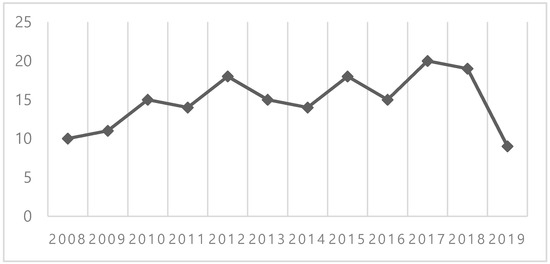
Figure 1.
Quantity of publications per year (2008–2019).
Table 2 lists the journal, year, title, and author keywords associated with 178 research paper used in this research analysis. Using Excel, the data set was first arranged by journal name in ascending order. Then, the data set was arranged in ascending order by year and then title.
Table 2.
Title and Author Keywords (2008–2019).
4. Bibliometric and Network Analysis
We briefly conducted a two-part data analysis comprising bibliometric analysis and network analysis (which included citation analysis and keyword network analysis) using NetMiner 4.0, a network analysis software that enables the analysis of not only network data but also unstructured text data. Using the bibliometric approach, we analyzed the frequency of titles and keywords in paper texts and abstracts to reveal a given paper’s importance and then identify critical issues and trends. Unlike bibliometric analysis, the network analysis was performed to investigate core research issues and topics by constructing networks based on the co-citation of papers and co-occurrence of keywords.
4.1. Bibliometric Analysis
To perform the bibliometric analysis, we used additional data, such as the frequency of titles, authors, journals, and keywords. NetMiner was used to extract frequent words in the titles and keywords in selected papers and analyze the constructed networks.
The results of the bibliometric analysis are summarized in Table 3. Initially, 539 words were extracted from titles and 1595 words from abstracts. We determined the importance of these words based on their frequency of appearance. Words identified as important, shown in Table 3, include “service quality,” “service,” “hotel,” “model,” and “satisfaction.” These results indicate that the included tourism service quality studies are mainly focused on the hotel industry and service satisfaction.
Table 3.
The most frequently used words.
4.2. Network-Based Analysis: Citation Network Analysis
Citation analysis has become more widespread because of its ability to objectively identify influential papers in a given area [16,17,18]. According to Ding and Cronin [12], citation analysis is primarily focused on identifying the popularity and significance of a published paper by counting how frequently that paper is cited by other papers [19].
To continue with our systematic literature review, we constructed a local citation network for analysis that determined how many times a published paper had been cited by other published papers within a local network comprised of the 178 initially selected papers. Then, we examined three structural characteristics of the citation network: density, distance, and clustering. Density measures the proportion of actual connections in a network relative to the number of connections possible, thereby revealing the size of the network. A large network is generally sparser. Distance refers to the average number of steps along the shortest paths for all pairs of published papers, indicating the degree of information efficiency on a network. Finally, the clustering coefficient reflects the degree of connection between a published paper and neighboring papers. This coefficient is based on the ratio of the number of existing links to the number of possible links among neighboring published papers. As shown in Table 4, the local citation network of published papers on service quality in tourism is relatively sparse and highly clustered.
Table 4.
The characteristics of network structure.
We used the PageRank measure to further identify core papers within the subset of 178 papers. PageRank, introduced by Brin and Page [20], was created to prioritize web pages in the Google search engine [19]. PageRank can be used to measure “prestige,” an important indicator of webpage quality, by revealing the number of times a paper is cited by other highly cited papers. The PageRank of paper A (denoted by PR(A)) in a network constructed with N papers can be computed as follows:
where paper has citations C () and is a damping factor representing the fraction of random walks that continue to propagate along the citations. In our study, the parameter was chosen to be 0.85 based on Brin and Page [20].
Table 5 indicates the top 10 papers as analyzed by PageRank. These papers can be regarded as core papers in the field of tourism service quality and mainly address the importance of service quality for customer satisfaction and its relationship with customer behavior. For example, Kim et al. [21] investigated the impact of tourism service quality on customer behavior according to customer satisfaction. Chen et al. [22] examined the determinants of customer participation in service encounters and their impact on customer loyalty. Ladhari et al. [23] analyzed the importance of service quality as a factor in dining satisfaction with regard to restaurant services. Ha and Jang [24] also studied the relationship between service quality and customer satisfaction regarding its effect on loyalty in Korean restaurants. Hutchinson et al. [25] attempted to clarify the impacts of service quality and customer satisfaction on customer behavioral intention. Additionally, some of the 10 papers dealt with service quality evaluation. For instance, Hsieh et al. [26] devised a service quality evaluation framework for hot spring hotels, and Martínez Caro and Martínez García [27] researched a comprehensive model to measure service quality in tourism-related sectors.
Table 5.
Top 10 papers according to the PageRank algorithm.
Likewise, we further conducted a co-citation analysis to identify prevalent topics through the co-occurrence of two given papers in other papers [31]. The papers comprising the co-citation network were classified into several clusters, in which the links between the articles in the given cluster were greater than those of other clusters [31,32,33]. In our study, clusters’ index Q was calculated by using the algorism [32] as follows:
where represents the weight of the edge between nodes and expresses the sum of the weights of the edges attached to node , is the community to which node is assigned, is equal to 1 if and 0 otherwise, and .
Table 6 shows the local citation network’s division into seven topical issue clusters. To identify the core topical issues for each cluster, we determined the lead papers in each cluster by using the PageRank algorithm. Then, a general description for each cluster’s topic was ascertained using these lead papers.
Table 6.
The lead papers using the PageRank algorithm for each cluster.
Cluster 1 corresponded to tourist satisfaction from various perspectives. For example, Wong and Wan [34] explored tourists’ shopping satisfaction and examined its dimensionality. Ahrholdt et al. [35] also investigated tourists’ satisfaction and loyalty according to prior experience. Tanford and Jung [36] evaluated the factors contributing to tourists’ festival satisfaction.
Cluster 2 related to sustainable issues in tourism. Han and Kim [37] examined tourists’ intention to revisit a green hotel. Lee and Cheng [13] investigated tourists’ decision-making process in terms of staying at a green hotel. Most recently, Merli et al. [38] addressed tourists’ perception of green practices and the impact of these practices on their satisfaction and loyalty.
Cluster 3 corresponded to the value customers place on tourism service quality. For example, Nasution and Mavondo [29] viewed customer value from two perspectives: that of the service provider, and that of the customer. Hutchinson et al. [25] addressed the effect of service evaluations, including value, on customer intentions. Chiang and Birtch [39] researched the effect of service value congruence between the employee and organization on pay-for-performance and work attitudes.
Cluster 4 mainly focused on service quality in restaurants and its impact on customer satisfaction. For example, Ryu and Han [40] examined the effect of restaurant food and service quality on customer intention. Barber et al. [41] aimed to determine the relationship between restaurant cleanliness and customers’ repeated patronage. Nam and Lee [42] investigated the factors related to foreign tourists’ satisfaction with traditional Korean restaurants.
Cluster 5 generally included customer perceptions regarding service quality. For example, Yuan and Wu [43] focused on the emotional and functional values made by service quality. Gazzoli et al. [44] discussed the relationship of empowerment and job satisfaction to customers’ perception of service quality. Mathe and Slevitch [45] explored the factors impacting customers’ perception of service quality.
Cluster 6 contained various assessments of service quality to identify service quality’s effect on customer satisfaction. For example, Hsieh et al. [26] analyzed customers’ expectations for hotel service quality according to its five dimensions. Likewise, Martínez Caro and Martínez García [27] developed a comprehensive model to measure service quality in tourism. Kim and Mattila [46] also studied customer evaluations regarding hotel service through six distinct dimensions.
Lastly, Cluster 7 corresponded to how service quality affects customer behavior. For instance, Kim et al. [21] analyzed the effect of service quality on customers’ intention to return and word-of-mouth endorsement. Ladhari et al. [23] determined dining satisfaction factors in terms of restaurant service and its relationship to customer behaviors such as loyalty and willingness to pay more. Similarly, Ha and Jang [24] examined the relationship between perceived quality by customers and restaurant loyalty.
To understand the evolution of tourism service quality research over time, we also conducted a dynamic co-citation analysis of analyzed articles to indicate the evolution/development of each cluster over time. (Table 7)
Table 7.
Research focus of each cluster.
As seen in Table 8, earlier publications corresponded to Clusters 1, 3, 5, 6, and 7. Significantly, development of the topics corresponding to Clusters 1, 5, and 7 has diminished while that of Clusters 2 and 4 has continued to grow. Furthermore, the number of research papers focusing on the topics in Clusters 2 and 3 has steadily increased.
Table 8.
The number of published papers in each cluster (2008–2019).
4.3. Network-Based Analysis: Keyword Network Analysis
After performing the citation network analysis, we executed a keyword network analysis based on 608 keywords extracted from 178 papers.
To conduct the keyword network analysis, we followed the process summarized in Table 9. First, we (1) constructed a keyword network using keywords extracted from premiere international tourism-focused academic journals (namely, The Annals of Tourism Research, International Journal of Hospitality Management, Journal of Hospitality and Tourism Research, Journal of Travel Research, and Tourism Management). We then (2) investigated the issues and topics related to service in the tourism sector utilizing network analysis. Finally, we (3) observed the changes in the issues and topics that occurred from 2008 to 2019.
Table 9.
Keyword network analysis process.
More specifically, in the afore-mentioned step 1, we used 608 keywords to form a network for tourism service quality. Before constructing a keyword network, we refined the keywords extracted from 178 papers by standardizing keywords that had the same fundamental meaning. The rules used to refine the keywords [11] are as follows:
- Standardization into a singular form
- Removing redundant keywords
- Removing hyphens
- Avoidance of abbreviations
- Unification of synonyms
- Separation of multiple terms in a single keyword
Thus, standardization resulted in 604 relevant keywords from the original list of 629 keywords. To construct the network consisting of the most important, commonly referenced keywords, we then performed component analysis using NetMiner. A component in a network indicates a group of nodes (papers) that are all connected to each other, representing commonly addressed issues and topics in the network.
4.3.1. Keyword Network Analysis: Network Centrality Analysis
After performing the component analysis, we were able to observe differences in the classification of the top 10 keywords across three different measures: degree, betweenness, and closeness centrality. As shown in Table 10, the differences in the top-ranked keywords according to the three measures implies that research on tourism service focuses on both broad and specific issues. The top 10 keywords according to the centrality measures are important in terms of their structural positions in the keyword network.
Table 10.
Top 10 keywords across measures.
The top 10 keywords according to the degree of centrality are “satisfaction,” “customer satisfaction,” “value,” “behavioral intention,” “online review,” “equity,” “loyalty,” “emotion,” “perceived value,” and “customer satisfaction,” and these words represent important keywords in terms of their structural position in the keywords network. These keywords have many connections with other keywords, which indicates that they represent major research issues in the field of tourism service quality.
The top 10 keywords according to betweenness centrality—“satisfaction,” “customer satisfaction,” “China,” “behavioral intention,” “emotion,” “online review,” “service failure,” “equity,” “electronic word-of-mouth,” and “perceived quality”—play an important role in bridging separated groups of research themes. In other words, these keywords lie between two distinctive research themes.
Finally, the top 10 keywords in terms of closeness centrality are “satisfaction,” “customer satisfaction”, “value,” “behavioral intention,” “online review,” “equity,” “loyalty,” “emotion,” “perceived value,” and “customer loyalty.” These words were used with nearly all other keywords and themes in the network because a keyword with high closeness centrality is located in the center of the keyword network.
4.3.2. Keyword Network Analysis: Changes in Important Keywords Over Time
To address the changes in the important keywords over time, we compared the important keywords from the first nine years (2008–2016) with those from the three most recent years (2017–2019). We then compared high-ranked keywords across the three network measurements (see Table 11). It is important to note that the connections between keywords have accumulated over years, making it inherently difficult to investigate the evolution of keyword networks. In other words, although the keyword network constructed for a certain period of time offers information about the associations among the keywords for the published papers in that specific period, it is possible to exclude significant information regarding keyword associations in other periods [11]. The associations among keywords across different time periods do affect one another; thus, they are correlated [11]. This is a common issue when investigating the evolution of citation, author, and keyword networks. Comparing the keyword network corresponding to data obtained from much earlier studies with that from more recent studies can mitigate the potential loss of information concerning recent changes in impactful keywords [11].
Table 11.
Comparison of the top five keywords across three network measurements.
Our comparison reveals some notable findings. “Service quality,” “satisfaction,” “customer satisfaction,” and “loyalty” were the most important keywords for all three measures for both clustered time periods. Significantly, customer satisfaction-related keywords (such as “customer satisfaction,” “satisfaction,” and “loyalty”) have received growing attention over the nine-year time period. Additionally, tourism management-related keywords (such as “trip advisor” and “hospitality industry”) have become substantially more prevalent over the years.
5. Conclusions
Service quality has been established as an important economic impetus of tourism. To explore how this factor has been represented in past tourism literature, we conducted a systematic literature review combining bibliometric, citation network, and keyword network analysis. Furthermore, our study attempted to identify how important keywords have changed over time to capture the emerging critical issues and topical trends in tourism service research.
This study has significant implications for both theory and practice in several ways. First, due to the existence of diverse tourism sub-sectors across business settings, previous reviews on service quality have mainly focused on service quality with regard to specific themes pre-identified by the author. In contrast, the present study represents a more comprehensive literature review on service quality in tourism research by applying a systematic approach.
Second, we identified that the keyword network of service quality in tourism is relatively small, characterized by low density, short distance, and fewer clusters. It is possible that new issues and concepts related to service quality in tourism have not emerged as rapidly [11] because relatively large networks with less connectivity to neighboring research areas do not easily facilitate the creation of new issues and concepts.
Third, based on the citation analysis of research on tourism service quality, we identified critical issues most commonly discussed by influential papers. To conduct content analysis, we rigorously identified papers as “more important” by using not only the frequency of citations but also the degree of prestige, established through the PageRank measure. This is a significant methodological development, as previous studies have only used the frequency of citation to assess importance. The critical issues identified in this study concern how service quality affects tourists’ behavior and service quality evaluation. Current research on service quality in tourism is still focused on the impact of service quality on customer satisfaction and behavior.
Fourth, this study extends and supports the previous systematic literature review on service quality provided by Lai et al. [15]. Their review suggested 17 research topics that comprise two main research streams: (1) service quality scares, and (2) the consequences of service quality. According to the co-citation analysis presented in this article, research on tourism service quality can actually be classified into seven topic clusters: (1) tourist satisfaction, (2) sustainable issues in tourism, (3) value of service quality for customers, (4) restaurant service quality, (5) customer perception of tourism service quality, (6) tourism service quality evaluation, and (7) service quality’s influence on customer behavior.
Fifth, because important issues and topics were selected from a local citation network comprising 136 cited papers within the total 178 papers used in our study, it was difficult to identify comprehensive issues and topics due to the exclusion of the remaining 42 papers from the network configuration. Therefore, we implemented a keyword network analysis to complement the drawbacks of citation and co-citation analysis. The keyword network analysis revealed differences in the classification of important keywords across centrality measures. Our results reveal some notable findings. “Satisfaction” and “customer satisfaction” are represented as major research issues in the area of service quality in tourism. Also, “satisfaction” and “customer satisfaction” have not only a high degree of centrality but also high betweenness and closeness centrality. These results indicate that these are important service quality issues, and the existing literature has focused on them. Thus, service quality issues related to “satisfaction” and/or “customer satisfaction” might be a good starting point for researching the overall topic of service quality in tourism.
Finally, to identify changes in and the development of topics over time, we performed a dynamic co-citation analysis. These results showed that “sustainable issues in tourism” and “restaurant service quality” have gained researchers’ attention in recent years, whereas the focus on topics such as “tourist satisfaction,” “customer perception of tourism service quality,” and “service quality’s influence on customer behavior” has decreased. This current trend suggests an increasing interest in investigating service quality regarding sustainability (green hotel and green practice) and restaurants. Thus, this paper suggests two research areas that deserve further investigation and research: (1) service quality and sustainability, and (2) service quality and restaurants.
Customer satisfaction-related keywords (such as “customer satisfaction,” “satisfaction,” and “loyalty”) have received growing attention over the nine-year period used in the study, while the importance of tourism management-related keywords (such as “trip advisor” and “hospitality industry”) has also substantially increased during the same period. The results of this study reveal the most frequently used words in research titles and abstracts in the field of tourism service quality. After using “service quality” as the main keyword to extract significant papers, “service quality” emerged as the most frequently used word in titles and abstracts. Moreover, “hotel” and “restaurant” are also included in the list of popular keywords. This indicates that tourism service quality is largely associated with hotels and restaurants compared to other tourist destinations.
Although our study has interesting implications for service quality tourism research, this study is not free of limitations. Despite providing a comprehensive systematic review of this area, the manual search method used to retrieve the articles may have excluded or overlooked other relevant articles. As the papers were retrieved only from SCOPUS, any related articles that could not be listed in one of these databases were excluded. In addition, we choose our keywords according to our research topic. The keywords used may not be exhaustive. Expanding the keywords to reflect “service quality” could result in a more exhaustive review of the field.
Author Contributions
J.P. and E.J. conceived of and designed the methodology; J.P. conducted the literature review and collected data; E.J. performed the analysis; J.P. and E.J. contributed to the interpretation of results and discussion; J.P. and E.J. wrote the paper.
Funding
This research received no external funding.
Acknowledgments
This research is (partially) supported by the BK21PLUS Research Fund for Korea University Business School.
Conflicts of Interest
The authors declare no conflict of interest.
References
- UNWTO World Tourism Organization. Available online: http://mkt.unwto.org (accessed on 21 May 2019).
- Li, K.X.; Jin, M.; Shi, W. Tourism as an important impetus to promoting economic growth: A critical review. Tour. Manag. Perspect. 2018, 26, 135–142. [Google Scholar] [CrossRef]
- Brida, J.G.; Pereyra, J.S.; Devesa, M.J.S. Evaluating the contribution of tourism to economic growth. Anatolia 2008, 19, 351–357. [Google Scholar] [CrossRef]
- Khan, H.; Seng, C.F.; Cheong, W.K. Tourism multiplier effects on Singapore. Ann. Tour. Res. 1990, 17, 408–418. [Google Scholar] [CrossRef]
- Chen, C.-F. Applying the stochastic frontier approach to measure hotel managerial efficiency in Taiwan. Tour. Manag. 2007, 28, 696–702. [Google Scholar] [CrossRef]
- Dwyer, L.; Forsyth, P.; Spurr, R. Contrasting the uses of TSAs and CGE models: Measuring tourism yield and productivity. Tour. Econ. 2007, 13, 537–551. [Google Scholar] [CrossRef]
- Goncalves, O. Efficiency and productivity of French ski resorts. Tour. Manag. 2013, 36, 650–657. [Google Scholar] [CrossRef]
- Meesala, A.; Paul, J. Service quality, consumer satisfaction and loyalty in hospitals: Thinking for the future. J. Retail. Consum. Serv. 2018, 40, 261–269. [Google Scholar] [CrossRef]
- Rauch, D.A.; Collins, M.D.; Nale, R.D.; Barr, P.B. Measuring service quality in mid-scale hotels. Int. J. Contemp. Hosp. Manag. 2015, 27, 87–106. [Google Scholar] [CrossRef]
- Transfield, D.; Denyer, D.; Smart, P. Towards a methodology for developing evidence-informed management knowledge by means of systematic review. Br. J. Manag. 2003, 14, 207–222. [Google Scholar] [CrossRef]
- Choi, J.H.; Yi, S.; Lee, K.C. Analysis of keyword networks in MIS research and implication for predicting knowledge evolution. Inf. Manag. 2011, 48, 371–381. [Google Scholar] [CrossRef]
- Ding, Y.; Cronin, B. Popular and/or prestigious? Measures of scholarly esteem. Inf. Process. Manag. 2011, 47, 80–96. [Google Scholar] [CrossRef]
- Lee, W.-H.; Cheng, C.-C. Less is more: A new insight for measuring service quality of green hotels. Int. J. Hosp. Manag. 2018, 68, 32–40. [Google Scholar] [CrossRef]
- Hjørland, B. Citation analysis: A social and dynamic approach to knowledge organization. Inf. Process. Manag. 2013, 49, 1313–1325. [Google Scholar] [CrossRef]
- Lai, I.K.W.; Hitchcock, M.; Yang, T.; Lu, T.-W. Literature review on service quality in hospitality and tourism (1984–2014): Future directions and trends. Int. J. Contemp. Hosp. Manag. 2017, 30, 114–159. [Google Scholar] [CrossRef]
- Culnan, M.J.; O’Reilly, C.A., III; Chatman, J.A. Intellectual structure of research in organizational behavior, 1972–1984: A cocitation analysis. J. Assoc. Inf. Sci. Technol. 1990, 41, 453–458. [Google Scholar] [CrossRef]
- Culnan, M.J. Mapping the intellectual structure of MIS, 1980–1985: A co-citation analysis. Manag. Inf. Syst. Q. 1987, 11, 341–353. [Google Scholar] [CrossRef]
- Gundolf, K.; Filser, M. Management research and religion: A citation analysis. J. Bus. Ethics 2013, 112, 177–185. [Google Scholar] [CrossRef]
- Fahimnia, B.; Sarks, J.; Davarzani, H. Green supply chain management: A review and bibliometric analysis. Int. J. Prod. Econ. 2015, 162, 101–114. [Google Scholar] [CrossRef]
- Brin, S.; Page, L. The anatomy of a large-scale hypertextual Web search engine. Comput. Netw. ISDN Syst. 1998, 30, 107–117. [Google Scholar] [CrossRef]
- Kim, W.G.; Ng, C.Y.N.; Kim, Y.-S. Influence of institutional DINESERV on customer satisfaction, return intention, and word-of-mouth. Int. J. Hosp. Manag. 2009, 28, 10–17. [Google Scholar] [CrossRef]
- Chen, S.C.; Raab, C.; Tanford, S. Antecedents of mandatory customer participation in service encounters: An empirical study. Int. J. Hosp. Manag. 2015, 46, 65–75. [Google Scholar] [CrossRef]
- Ladhari, R.; Brun, I.; Morales, M. Determinants of dining satisfaction and post-dining behavioral intentions. Int. J. Hosp. Manag. 2008, 27, 563–573. [Google Scholar] [CrossRef]
- Ha, J.; Jang, S. Effects of service quality and food quality: The moderating role of atmospherics in an ethnic restaurant segment. Int. J. Hosp. Manag. 2010, 29, 520–529. [Google Scholar] [CrossRef]
- Hutchinson, J.; Lai, F.; Wang, Y. Understanding the relationships of quality, value, equity, satisfaction, and behavioral intentions among golf travelers. Tour. Manag. 2009, 30, 298–308. [Google Scholar] [CrossRef]
- Hsieh, L.-F.; Lin, L.-H.; Lin, Y.-Y. A service quality measurement architecture for hot spring hotels in Taiwan. Tour. Manag. 2008, 29, 429–438. [Google Scholar] [CrossRef]
- Caro, L.M.; García, J.A.M. Developing a multidimensional and hierarchical service quality model for the travel agency industry. Tour. Manag. 2008, 29, 706–720. [Google Scholar] [CrossRef]
- Chen, S.C.; Raab, C. Construction and validation of the customer participation scale. J. Hosp. Tour. Res. 2017, 41, 131–153. [Google Scholar] [CrossRef]
- Nasution, H.N.; Mavondo, F.T. Customer value in the hotel industry: What managers believe they deliver and what customer experience. Int. J. Hosp. Manag. 2008, 27, 204–213. [Google Scholar] [CrossRef]
- Liou, J.J.H.; Hsu, C.-C.; Yeh, W.-C.; Lin, R.-H. Using a modified grey relation method for improving airline service quality. Tour. Manag. 2011, 32, 1381–1388. [Google Scholar] [CrossRef]
- Leydesdorff, L. Bibliometrics/Citation Networks. In Encyclopedia of Social Networks; Barnett, G.A., Ed.; SAGE Publications, Inc.: Thousand Oaks, CA, USA, 2011; pp. 73–94. [Google Scholar]
- Clauset, A.; Newman, M.E.J.; Moore, C. Finding community structure in very large networks. Phys. Rev. E 2004, 70, 066111. [Google Scholar] [CrossRef]
- Radicchi, F.; Castellano, C.; Cecconi, F.; Loreto, V.; Parisi, D. Defining and identifying communities in networks. Proc. Natl. Acad. Sci. USA 2004, 101, 2658–2663. [Google Scholar] [CrossRef] [PubMed]
- Wong, I.A.; Wan, Y.K.P. A systematic approach to scale development in tourist shopping satisfaction: Linking destination attributes and shopping experience. J. Travel Res. 2013, 52, 29–41. [Google Scholar] [CrossRef]
- Ahrholdt, D.C.; Gudergan, S.P.; Ringle, C.M. Enhancing service loyalty: The roles of delight, satisfaction, and service quality. J. Travel Res. 2017, 56, 436–450. [Google Scholar] [CrossRef]
- Tanford, S.; Jung, S. Festival attributes and perceptions: A meta-analysis of relationships with satisfaction and loyalty. Tour. Manag. 2017, 61, 209–220. [Google Scholar] [CrossRef]
- Han, H.; Kim, Y. An investigation of green hotel customers’ decision formation: Developing an extended model of the theory of planned behavior. Int. J. Hosp. Manag. 2010, 29, 659–668. [Google Scholar] [CrossRef]
- Merli, R.; Preziosi, M.; Acampora, A.; Lucchetti, M.C.; Ali, F. The impact of green practices in coastal tourism: An empirical investigation on an eco-labelled beach club. Int. J. Hosp. Manag. 2019, 77, 471–482. [Google Scholar] [CrossRef]
- Chiang, F.F.T.; Birtch, T.A. Pay for performance and work attitudes: The mediating role of employee-organization service value congruence. Int. J. Hosp. Manag. 2010, 29, 632–640. [Google Scholar] [CrossRef]
- Ryu, K.; Han, H. Influence of the quality of food, service, and physical environment on customer satisfaction and behavioral intention in quick-casual restaurants: Moderating role of perceived price. J. Hosp. Tour. Res. 2010, 34, 310–329. [Google Scholar] [CrossRef]
- Barber, N.; Goodman, R.J.; Goh, B.K. Restaurant consumers repeat patronage: A service quality concern. Int. J. Hosp. Manag. 2011, 30, 329–336. [Google Scholar] [CrossRef]
- Nam, J.-H.; Lee, T.J. Foreign travelers’ satisfaction with traditional Korean restaurants. Int. J. Hosp. Manag. 2011, 30, 982–989. [Google Scholar] [CrossRef]
- Yuan, Y.-H.; Wu, C. Relationships among experiential marketing, experiential value, and customer satisfaction. J. Hosp. Tour. Res. 2008, 32, 387–410. [Google Scholar] [CrossRef]
- Gazzoli, G.; Hancer, M.; Park, Y. The role and effect of job satisfaction and empowerment on customers’ perception of service quality: A study in the restaurant industry. J. Hosp. Tour. Res. 2010, 34, 56–77. [Google Scholar] [CrossRef]
- Mathe, K.; Slevitch, L. An exploratory examination of supervisor undermining, employee involvement climate, and the effects on customer perceptions of service quality in quick-service restaurants. J. Hosp. Tour. Res. 2013, 37, 29–50. [Google Scholar] [CrossRef]
- Kim, S.; Mattila, A.S. An examination of electronic video clips in the context of hotel Websites. Int. J. Hosp. Manag. 2011, 30, 612–618. [Google Scholar] [CrossRef]
© 2019 by the authors. Licensee MDPI, Basel, Switzerland. This article is an open access article distributed under the terms and conditions of the Creative Commons Attribution (CC BY) license (http://creativecommons.org/licenses/by/4.0/).