

Measuring the Direct and Indirect Effects of Neighborhood-Built Environments on Travel-related CO2 Emissions: A Structural Equation Modeling Approach

Abstract
1. Introduction
2. Methodology and Data
2.1. Study Area and Neighborhoods Surveyed
2.2. Survey Data
2.3. Calculation of Travel-Related CO2 Emissions
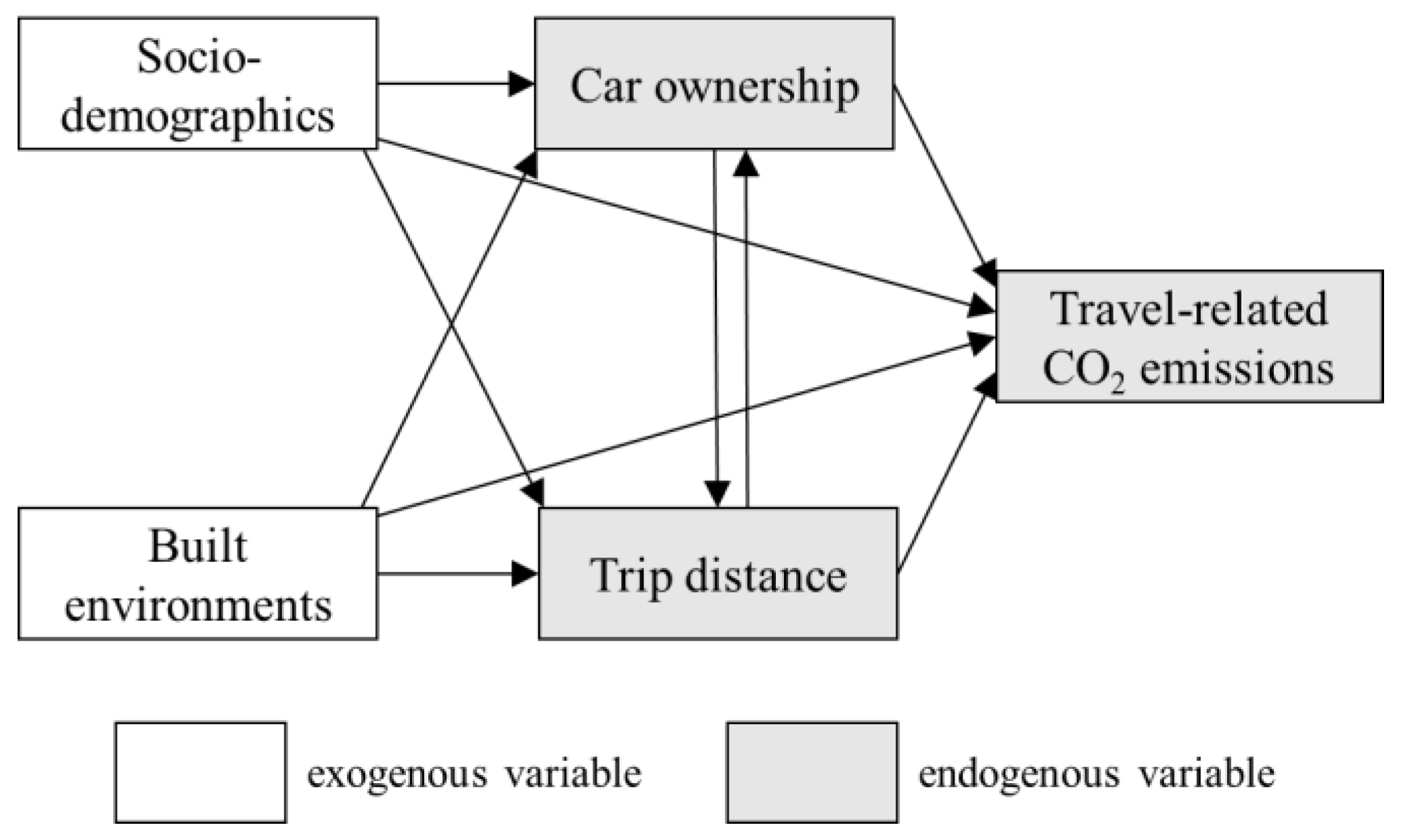
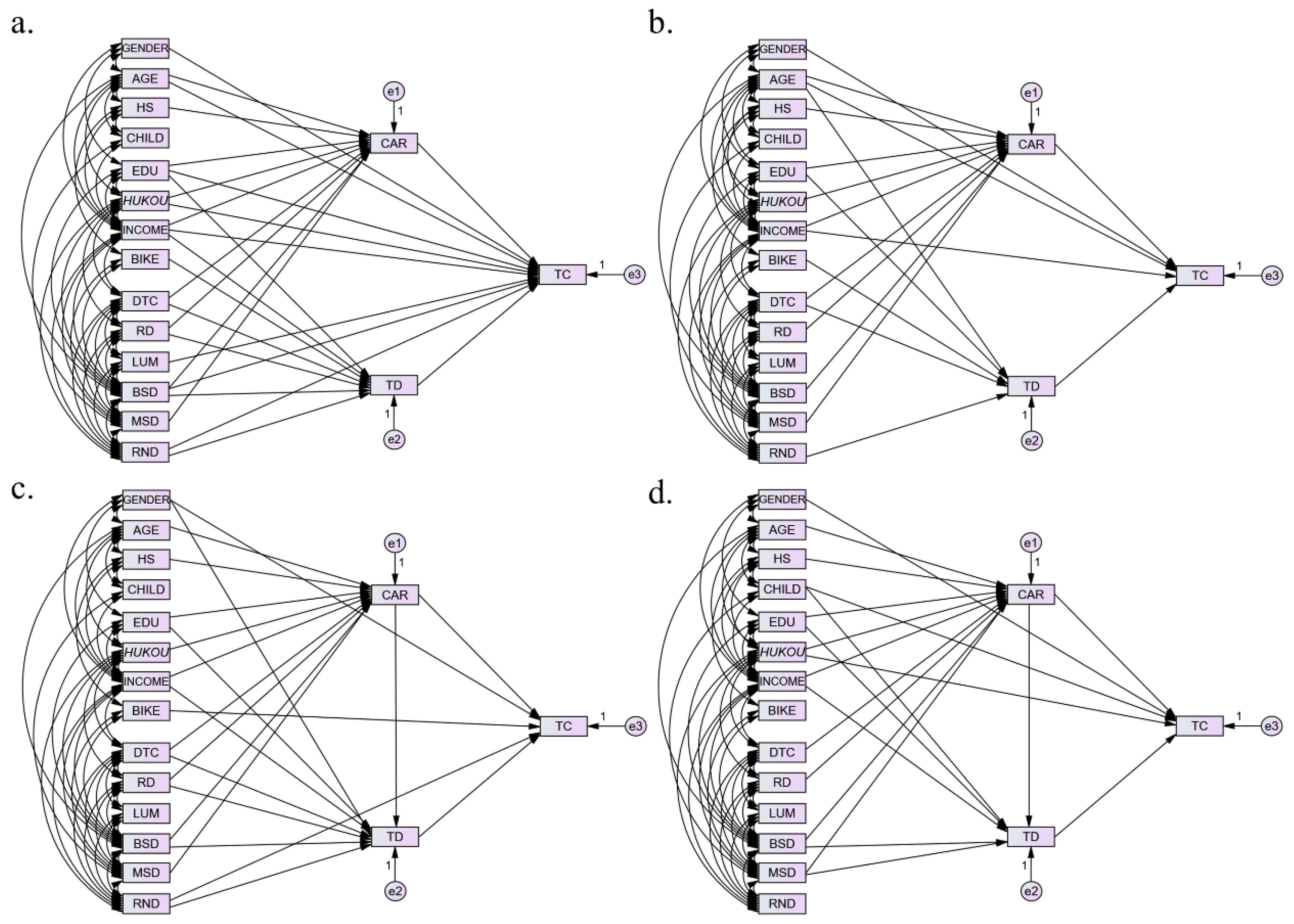
2.4. Structural Equation Model (SEM)
3. Results and Discussion
3.1. Goodness-of-Fit for SEMs
3.2. The Interaction between Car Ownership, Trip Distance, and Travel-Related CO2 Emissions
3.3. The Direct Effects of Neighborhood Built Environments on Travel-Related CO2 Emissions
3.4. The Indirect Effects of Neighborhood Built Environments on Travel-Related CO2 Emissions
4. Conclusions and Policy Implications
Author Contributions
Acknowledgments
Conflicts of Interest
References
- IEA (International Energy Agency). CO2 Emissions from Fuel Combustion; IEA: Paris, France, 2016. [Google Scholar]
- Fuglestvedt, J.; Berntsen, T.; Myhre, G.; Rypdal, K.; Skeie, R.B. Climate forcing from the transport sectors. Proc. Natl. Acad. Sci. USA 2008, 105, 454–458. [Google Scholar] [CrossRef] [Scilit] [PubMed]
- Marsden, G.; Rye, T. The governance of transport and climate change. J. Transp. Geogr. 2010, 18, 669–678. [Google Scholar] [CrossRef] [Scilit]
- Brand, C.; Tran, M.; Anable, J. The UK transport carbon model: An integrated life cycle approach to explore low carbon futures. Energy Policy 2012, 41, 107–124. [Google Scholar] [CrossRef] [Scilit]
- IEA (International Energy Agency). CO2 Emissions from Fuel Combustion Highlights 2010; IEA: Paris, France, 2010. [Google Scholar]
- Zhao, P.; Lü, B.; Roo, G.D. Impact of the jobs-housing balance on urban commuting in Beijing in the transformation era. J. Transp. Geogr. 2011, 19, 59–69. [Google Scholar] [CrossRef] [Scilit]
- Zhao, P. Sustainable urban expansion and transportation in a growing megacity: Consequences of urban sprawl for mobility on the urban fringe of Beijing. Habit. Int. 2010, 34, 236–243. [Google Scholar] [CrossRef] [Scilit]
- Yang, W.; Li, T.; Cao, X. Examining the impacts of socio-economic factors, urban form and transportation development on CO2 emissions from transportation in china: A panel data analysis of China’s provinces. Habit. Int. 2015, 49, 212–220. [Google Scholar] [CrossRef] [Scilit]
- Handy, S.L.; Krizek, K.J. The role of travel behavior research in reducing the carbon footprint: From the US perspective. In Proceedings of the Triennial Meeting of the International Association of Travel Behavior Research, Jaipur, India, 13–18 December 2009. [Google Scholar]
- Crane, R. The influence of urban form on travel: An interpretive review. J. Plan. Lit. 2000, 15, 3–23. [Google Scholar] [CrossRef] [Scilit]
- Handy, S.L.; Boarnet, M.G.; Ewing, R.; Killingsworth, R.E. How the built environment affects physical activity: Views from urban planning. Am. J. Prev. Med. 2002, 23, 64–73. [Google Scholar] [CrossRef] [Scilit]
- Handy, S.; Cao, X.; Mokhtarian, P. Correlation or causality between the built environment and travel behavior? Evidence from Northern California. Transp. Res. Part D Transp. Environ. 2005, 10, 427–444. [Google Scholar] [CrossRef] [Scilit]
- Boarnet, M.G. A broader context for land use and travel behavior, and a research agenda. J. Am. Plan. Assoc. 2011, 77, 197–213. [Google Scholar] [CrossRef] [Scilit]
- Ewing, R.; Cervero, R. Travel and the built environment. J. Am. Plan. Assoc. 2010, 76, 265–294. [Google Scholar] [CrossRef] [Scilit]
- Ewing, R.; Cervero, R. Travel and the built environment: A synthesis. Transp. Res. Record J. Transp. Res. Board 2001, 1780, 87–114. [Google Scholar] [CrossRef] [Scilit]
- Cao, X.J. Land use and transportation in China. Transp. Res. Part D Transp. Environ. 2017, 52 Pt B, 423–427. [Google Scholar] [CrossRef] [Scilit]
- Cao, X.; Yang, W. Examining the effects of the built environment and residential self-selection on commuting trips and the related CO2 emissions: An empirical study in Guangzhou, China. Transp. Res. Part D Transp. Environ. 2017, 52 Pt B, 480–494. [Google Scholar] [CrossRef] [Scilit]
- Lakshmanan, T.R.; Han, X. Factors underlying transportation CO2 emissions in the USA: A decomposition analysis. Transp. Res. Part D Transp. Environ. 1997, 2, 1–15. [Google Scholar] [CrossRef] [Scilit]
- Timilsina, G.R.; Shrestha, A. Transport sector CO2 emissions growth in Asia: Underlying factors and policy options. Energy Policy 2009, 37, 4523–4539. [Google Scholar] [CrossRef] [Scilit]
- Wang, W.W.; Zhang, M.; Zhou, M. Using LMDI method to analyze transport sector CO2 emissions in China. Energy 2011, 36, 5909–5915. [Google Scholar] [CrossRef] [Scilit]
- Lu, I.J.; Lin, S.J.; Lewis, C. Decomposition and decoupling effects of carbon dioxide emission from highway transportation in Taiwan, Germany, Japan and South Korea. Energy Policy 2007, 35, 3226–3235. [Google Scholar] [CrossRef] [Scilit]
- Bueno, G. Analysis of scenarios for the reduction of energy consumption and GHG emissions in transport in the Basque country. Renew. Sustain. Energy Rev. 2012, 16, 1988–1998. [Google Scholar] [CrossRef] [Scilit]
- He, D.; Liu, H.; He, K.; Meng, F.; Jiang, Y.; Wang, M.; Zhou, J.; Calthorpe, P.; Guo, J.; Yao, Z. Energy use of, and CO2 emissions from China’s urban passenger transportation sector: Carbon mitigation scenarios upon the transportation mode choices. Transp. Res. Part A Policy Pract. 2013, 53, 53–67. [Google Scholar] [CrossRef] [Scilit]
- Matsuhashi, K.; Ariga, T. Estimation of passenger car CO2 emissions with urban population density scenarios for low carbon transportation in Japan. IATSS Res. 2016, 39, 117–120. [Google Scholar] [CrossRef] [Scilit]
- Zhou, G.; Chung, W.; Zhang, X. A study of carbon dioxide emissions performance of China’s transport sector. Energy 2013, 50, 302–314. [Google Scholar] [CrossRef] [Scilit]
- Cui, Q.; Li, Y. An empirical study on the influencing factors of transportation carbon efficiency: Evidences from fifteen countries. Appl. Energy 2015, 141, 209–217. [Google Scholar] [CrossRef] [Scilit]
- Lin, W.; Chen, B.; Xie, L.; Pan, H. Estimating energy consumption of transport modes in China using DEA. Sustainability 2015, 7, 4225–4239. [Google Scholar] [CrossRef] [Scilit]
- Barla, P.; Miranda-Moreno, L.F.; Lee-Gosselin, M. Urban travel CO2 emissions and land use: A case study for Quebec City. Transp. Res. Part D-Transp. Environ. 2011, 16, 423–428. [Google Scholar] [CrossRef] [Scilit]
- Ko, J.; Park, D.; Lim, H.; Hwang, I.C. Who produces the most CO2 emissions for trips in the Seoul metropolis area? Transp. Res. Part D Transp. Environ. 2011, 16, 358–364. [Google Scholar] [CrossRef] [Scilit]
- Brand, C.; Goodman, A.; Rutter, H.; Song, Y.; Ogilvie, D. Associations of individual, household and environmental characteristics with carbon dioxide emissions from motorised passenger travel. Appl. Energy 2013, 104, 158–169. [Google Scholar] [CrossRef] [Scilit] [PubMed]
- Brand, C. “Hockey sticks” made of carbon unequal distribution of greenhouse gas emissions from personal travel in the United Kingdom. Transp. Res. Rec. 2009, 2139, 88–96. [Google Scholar] [CrossRef] [Scilit]
- Zahabi, S.A.H.; Miranda-Moreno, L.; Patterson, Z.; Barla, P.; Harding, C. Transportation greenhouse gas emissions and its relationship with urban form, transit accessibility and emerging green technologies: A Montreal case study. Procedia Soc. Behav. Sci. 2012, 54, 966–978. [Google Scholar] [CrossRef] [Scilit]
- Hong, J.; Goodchild, A. Land use policies and transport emissions: Modeling the impact of trip speed, vehicle characteristics and residential location. Transp. Res. Part D Transp. Environ. 2014, 26, 47–51. [Google Scholar] [CrossRef] [Scilit]
- Hong, J. Non-linear influences of the built environment on transportation emissions: Focusing on densities. J. Transp. Land Use 2015, 10, 229–240. [Google Scholar] [CrossRef] [Scilit]
- Ma, J.; Liu, Z.; Chai, Y. The impact of urban form on CO2 emission from work and non-work trips: The case of Beijing, China. Habit. Int. 2015, 47, 1–10. [Google Scholar] [CrossRef] [Scilit]
- Liu, Z.; Ma, J.; Chai, Y. Neighborhood-scale urban form, travel behavior, and CO2 emissions in Beijing: Implications for low-carbon urban planning. Urban Geogr. 2017, 38, 381–400. [Google Scholar] [CrossRef] [Scilit]
- Frank, L.D.; Andresen, M.A.; Schmid, T.L. Obesity relationships with community design, physical activity, and time spent in cars. Am. J. Prev. Med. 2004, 27, 87–96. [Google Scholar] [CrossRef] [Scilit] [PubMed]
- Moniruzzaman, M.; Páez, A.; Habib, K.M.N.; Morency, C. Mode use and trip length of seniors in montreal. J. Transp. Geogr. 2013, 30, 89–99. [Google Scholar] [CrossRef] [Scilit]
- Aguiléra, A.; Voisin, M. Urban form, commuting patterns and CO2 emissions: What differences between the municipality’s residents and its jobs? Transp. Res. Part A Policy Pract. 2014, 69, 243–251. [Google Scholar] [CrossRef] [Scilit]
- Wang, Y.; Yang, L.; Han, S.; Li, C.; Ramachandra, T.V. Urban CO2 emissions in Xi’an and Bangalore by commuters: Implications for controlling urban transportation carbon dioxide emissions in developing countries. Mitig. Adapt. Strateg. Glob. Chang. 2017, 22, 993–1019. [Google Scholar] [CrossRef] [Scilit]
- Entwicklungsbank, K. Transport in China: Energy Consumption and Emissions of Different Transport Modes; Institute for Energy and Environmental Research Heidelberg: Heidelberg, Germany, 2008. [Google Scholar]
- Bagley, M.N.; Mokhtarian, P.L. The impact of residential neighborhood type on travel behavior: A structural equations modeling approach. Ann. Reg. Sci. 2002, 36, 279–297. [Google Scholar] [CrossRef] [Scilit]
- Van Acker, V.; Witlox, F. Car ownership as a mediating variable in car travel behaviour research using a structural equation modelling approach to identify its dual relationship. J. Transp. Geogr. 2010, 18, 65–74. [Google Scholar] [CrossRef] [Scilit]
- Cao, X.; Mokhtarian, P.L.; Handy, S.L. Do changes in neighborhood characteristics lead to changes in travel behavior? A structural equations modeling approach. Transportation 2007, 34, 535–556. [Google Scholar] [CrossRef] [Scilit]
- Cervero, R.; Murakami, J. Effects of built environments on vehicle miles traveled: Evidence from 370 US urbanized areas. Environ. Plan. A 2010, 42, 400–418. [Google Scholar] [CrossRef] [Scilit]
- Aditjandra, P.T.; Cao, X.J.; Mulley, C. Understanding neighbourhood design impact on travel behaviour: An application of structural equations model to a British metropolitan data. Transp. Res. Part A Policy Pract. 2012, 46, 22–32. [Google Scholar] [CrossRef] [Scilit]
- Shen, Q.; Chen, P.; Pan, H. Factors affecting car ownership and mode choice in rail transit-supported suburbs of a large Chinese city. Transp. Res. Part A Policy Pract. 2016, 94, 31–44. [Google Scholar] [CrossRef] [Scilit]
- Lu, X.; Pas, E.I. Socio-demographics, activity participation and travel behavior. Transp. Res. Part A Policy Pract. 1999, 33, 1–18. [Google Scholar] [CrossRef] [Scilit]
- Chowdhury, S.; Ceder, A. A psychological investigation on public-transport users’ intention to use routes with transfers. Int. J. Transp. 2013, 1, 1–20. [Google Scholar] [CrossRef] [Scilit]
- Ma, L.; Dill, J.; Mohr, C. The objective versus the perceived environment: What matters for bicycling? Transportation 2014, 41, 1135–1152. [Google Scholar] [CrossRef] [Scilit]
- Wu, M. Structural Equation Modeling: The Operation and Application of AMOS; Chongqing University Press: Chongqing, China, 2010. (in Chinese) [Google Scholar]
- Stevens, J.P. Applied Multivariate Statistics for the Social Sciences; Routledge: Abingdon, UK, 2012. [Google Scholar]
- Yang, W.; Chen, B.Y.; Cao, X.; Li, T.; Li, P. The spatial characteristics and influencing factors of modal accessibility gaps: A case study for Guangzhou, china. J. Transp. Geogr. 2017, 60, 21–32. [Google Scholar] [CrossRef] [Scilit]
- Wang, S.; Liu, P. China’s city-level energy-related CO2 emissions: Spatio-temporal patterns and driving forces. Appl. Energy 2017, 200, 204–214. [Google Scholar] [CrossRef] [Scilit]
- Wang, S.; Liu, X.; Zhou, C.; Hu, J.; Ou, J. Examining the impacts of socioeconomic factors, urban form, and transportation networks on CO2 emissions in China’s megacities. Appl. Energy 2017, 185, 189–200. [Google Scholar] [CrossRef] [Scilit]
- Wang, S.; Fang, C.; Wang, Y.; Huang, Y.; Ma, H. Quantifying the relationship between urban development intensity and carbon dioxide emissions using a panel data analysis. Ecol Indicators 2015, 49, 121–131. [Google Scholar] [CrossRef] [Scilit]
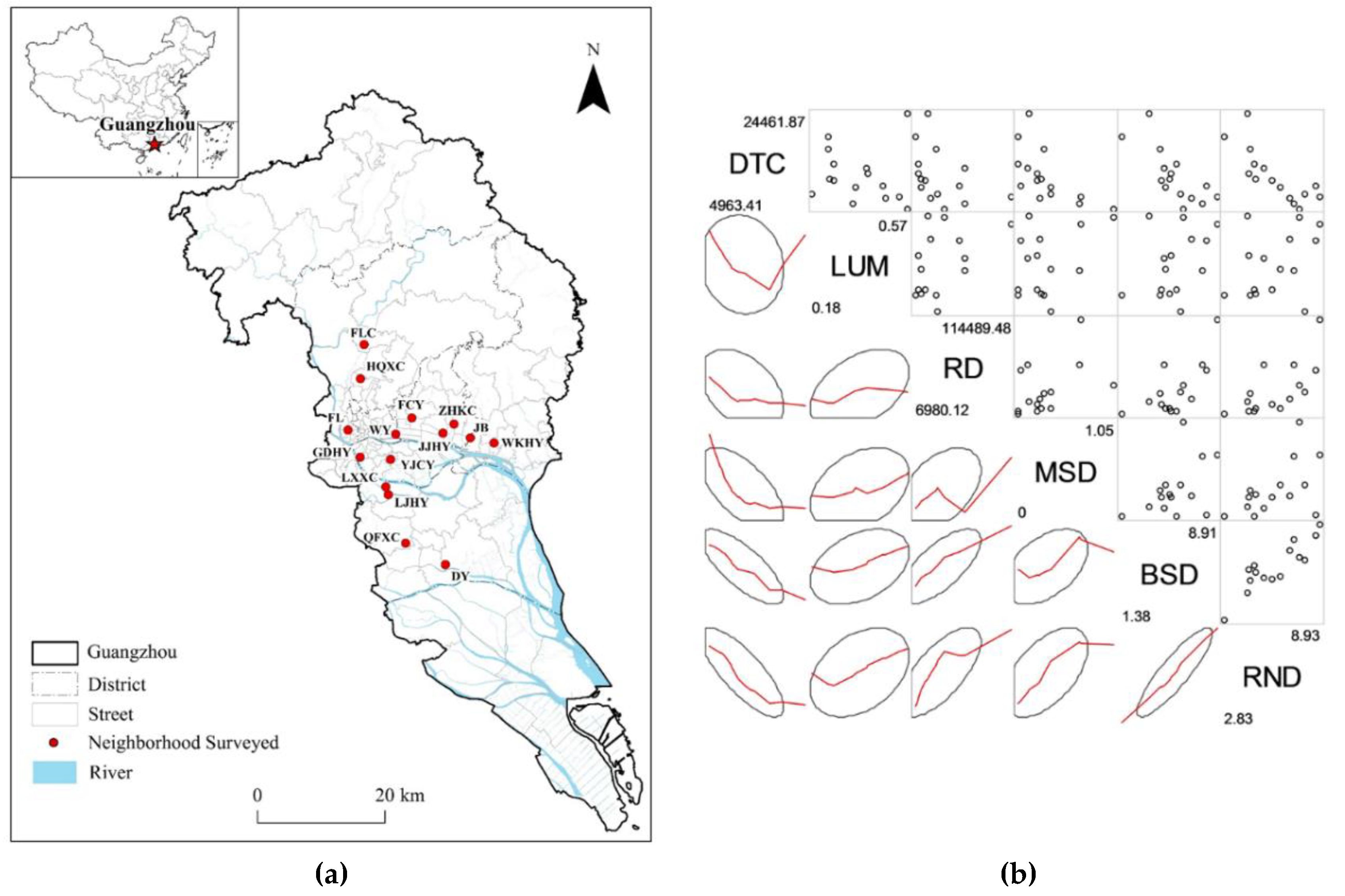

| Neighborhood | District | Sample | Distance to City Public Centers | Land-Use Mix | Residential Density | Bus Stop Density | Metro Station Density | Road Network Density |
|---|---|---|---|---|---|---|---|---|
| km | - | Person/km2 | Unit/km2 | Unit/km2 | km/km2 | |||
| Fuli | Liwan | 63 | 7.37 | 0.54 | 11,4489 | 8.91 | 0.68 | 8.93 |
| Wuyang | Yuexiu | 88 | 4.96 | 0.57 | 39,885 | 6.28 | 1.05 | 7.63 |
| Yijingcuiyuan | Haizhu | 75 | 7.23 | 0.48 | 24,695 | 6.89 | 0.23 | 6.99 |
| Guangdahuayuan | Haizhu | 102 | 8.04 | 0.18 | 32,147 | 6.09 | 0.36 | 7.97 |
| Fangcaoyuan | Tianhe | 39 | 5.93 | 0.35 | 63,200 | 7.72 | 0.67 | 7.28 |
| Junjinghuayuan | Tianhe | 109 | 9.34 | 0.36 | 13,827 | 4.85 | 0.36 | 6.43 |
| Zhonghaikangcheng | Tianhe | 69 | 10.71 | 0.27 | 17,580 | 4.56 | 0.21 | 5.86 |
| Huiqiaoxincheng | Baiyun | 121 | 9.49 | 0.47 | 56,825 | 8.07 | 0.02 | 8.68 |
| Fulicheng | Baiyun | 41 | 14.05 | 0.27 | 10,343 | 5.70 | 0.00 | 4.78 |
| Jinbi | Huangpu | 89 | 13.36 | 0.40 | 63,149 | 4.75 | 0.10 | 5.38 |
| Wankehuayuan | Huangpu | 34 | 17.12 | 0.25 | 29,717 | 4.45 | 0.29 | 4.48 |
| Luoxixincheng | Panyu | 109 | 11.00 | 0.25 | 13,938 | 5.15 | 0.25 | 4.81 |
| Lijianghuayuan | Panyu | 95 | 12.13 | 0.41 | 9989 | 5.32 | 0.21 | 4.42 |
| Qifuxincun | Panyu | 159 | 19.64 | 0.25 | 6980 | 1.38 | 0.00 | 2.83 |
| Dongyi | Panyu | 46 | 24.46 | 0.57 | 20,503 | 3.52 | 0.12 | 4.31 |
| Total | 1239 | 11.66 | 0.37 | 34,484 | 5.58 | 0.30 | 6.05 | |
| Variable | Level | Number of Samples | Percent |
|---|---|---|---|
| Gender | 0 for male | 694 | 56.01% |
| 1 for female | 545 | 43.99% | |
| Age | 1 represents age 16–24 | 137 | 11.06% |
| 2 represents age 25–34 | 605 | 48.83% | |
| 3 represents age 35–44 | 426 | 34.38% | |
| 4 represents age 45–60 | 71 | 5.73% | |
| Household size | 1 represents 1 people | 39 | 3.15% |
| 2 represents 2 people | 140 | 11.30% | |
| 3 represents 3 people | 429 | 34.62% | |
| 4 represents 4 people | 355 | 28.65% | |
| 5 represents ≥ 5 people | 276 | 22.28% | |
| Any child under 16 | 0 for no | 414 | 33.41% |
| 1 for yes | 825 | 66.59% | |
| Education | 1 represents senior high school and below | 151 | 12.19% |
| 2 represents junior college | 357 | 28.81% | |
| 3 represents bachelor degree | 551 | 44.47% | |
| 4 represents master degree or above | 180 | 14.53% | |
| Hukou | 0 for other cities | 584 | 47.13% |
| 1 for Guangzhou | 655 | 52.87% | |
| Household monthly incomes per capita | 1 represents income ≤ 3999 RMB | 129 | 10.41% |
| 2 represents income 4000–5999 RMB | 221 | 17.84% | |
| 3 represents income 6000–7999 RMB | 208 | 16.79% | |
| 4 represents income 8000–9999 RMB | 202 | 16.30% | |
| 5 represents income 10,000–14,999 RMB | 208 | 16.79% | |
| 6 represents income ≥15,000 RMB | 271 | 21.87% | |
| Car ownership | 0 for no | 488 | 39.39% |
| 1 for yes | 751 | 60.61% | |
| Bicycle ownership | 0 for no | 429 | 34.62% |
| 1 for yes | 810 | 65.38% |
| Motorized Travel Modes | Final Energy Consumption (l/100 km, KWh/km) | Capacity (Persons) | Primary Energy Consumption (MJ/Pkm) | CO2 (g/Pkm) |
|---|---|---|---|---|
| Passenger car | 11.0 | 1.3 | 0.84 | 233.1 |
| Urban bus | 35.0 | 40 | 0.35 | 26.0 |
| Coach | 30.0 | 44.0 | 0.27 | 20.3 |
| Metro | 5.0 | 216 | 0.26 | 20.9 |
| Model Fit Indices | Reference Value | Model-Based Value | |||
|---|---|---|---|---|---|
| Commuting | Social | Recreational | Daily Shopping | ||
| Chi-square (χ2) | 55.940 | 63.407 | 70.981 | 54.887 | |
| Degrees of freedom (df) | 68 | 73 | 72 | 73 | |
| Bollen-Stine bootstrap p-value | >0.05 | 0.861 | 0.755 | 0.493 | 0.929 |
| Goodness of Fit Index (GFI) | >0.9 | 0.992 | 0.990 | 0.988 | 0.991 |
| Adjusted Goodness of Fit Index (AGFI) | >0.9 | 0.981 | 0.979 | 0.975 | 0.981 |
| Comparative Fit Index (CFI) | >0.9 | 1.000 | 1.000 | 1.000 | 1.000 |
| Normed Fit Index (NFI) | >0.9 | 0.990 | 0.988 | 0.986 | 0.989 |
| Non-Normed Fit Index (NNFI) | >0.9 | 1.004 | 1.003 | 1.000 | 1.007 |
| Root Mean Square Error of Approximation (RMSEA) | <0.05 | 0.000 | 0.000 | 0.000 | 0.000 |
| Endogenous Variables | Effect | Commuting | Social | Recreational | Daily Shopping | ||||||||
|---|---|---|---|---|---|---|---|---|---|---|---|---|---|
| CAR | TD | TC | CAR | TD | TC | CAR | TD | TC | CAR | TD | TC | ||
| Distance to city public centers | Total | −0.240 *** | 0.374 *** | 0.094 ** | −0.339 *** | 0.231 *** | 0.029 | −0.335 *** | 0.274 *** | 0.056 | −0.307 *** | 0.028 ** | −0.051 *** |
| Direct | −0.240 *** | 0.374 *** | - | −0.339 *** | 0.231 *** | - | −0.335 *** | 0.237 *** | - | −0.307 *** | - | - | |
| Indirect | - | - | 0.094 ** | - | - | 0.029 | - | 0.037 *** | 0.056 | - | 0.028 ** | −0.051 *** | |
| Residential density | Total | 0.175 *** | −0.134 ** | −0.008 | 0.221 *** | - | 0.054 *** | 0.217 *** | −0.119 ** | −0.005 | 0.193 *** | −0.018 ** | 0.032 *** |
| Direct | 0.175 *** | −0.134** | - | 0.221 *** | - | - | 0.217 *** | −0.095 * | - | 0.193 *** | - | - | |
| Indirect | - | - | −0.008 | - | - | 0.054 *** | - | −0.024 *** | −0.005 | - | −0.018 ** | 0.032 *** | |
| Land-use mix | Total | - | - | −0.077 ** | - | - | - | - | - | - | - | - | - |
| Direct | - | - | −0.077 ** | - | - | - | - | - | - | - | - | - | |
| Indirect | - | - | - | - | - | - | - | - | - | - | - | - | |
| Bus stop density | Total | −0.318 *** | 0.416 *** | 0.311 *** | −0.432 *** | - | −0.105 *** | −0.419 *** | 0.399 *** | 0.100 * | −0.388 *** | −0.184 *** | −0.176 *** |
| Direct | −0.318 *** | 0.416 *** | 0.222 *** | −0.432 *** | - | - | −0.419 *** | 0.352 *** | - | −0.388 *** | −0.219 *** | - | |
| Indirect | - | - | 0.090 * | - | - | −0.105 *** | - | 0.047 *** | 0.100 * | - | 0.036 ** | −0.176 *** | |
| Metro station density | Total | −0.152 *** | - | −0.045 *** | −0.192 *** | - | −0.047 *** | −0.201 *** | 0.022 *** | −0.042 *** | −0.190 *** | −0.125 *** | −0.104 *** |
| Direct | −0.152 *** | - | - | −0.192 *** | - | - | −0.201 *** | - | - | −0.190 *** | −0.143 *** | - | |
| Indirect | - | - | −0.045 *** | - | - | −0.047 *** | - | 0.022 *** | −0.042 *** | - | 0.017 ** | −0.104 *** | |
| Road network density | Total | - | −0.313 *** | −0.274 *** | - | −0.175 *** | −0.085 *** | - | −0.399 *** | −0.137 * | - | - | - |
| Direct | - | −0.313 *** | −0.136 * | - | −0.175 *** | - | - | −0.399 *** | 0.077 ** | - | - | - | |
| Indirect | - | - | −0.138 *** | - | - | −0.085 *** | - | - | −0.214 *** | - | - | - | |
| Car ownership | Total | - | - | 0.296 *** | - | - | 0.244 *** | - | −0.111 *** | 0.211 *** | - | −0.092 ** | 0.165 *** |
| Direct | - | - | 0.296 *** | - | - | 0.244 *** | - | −0.111 *** | 0.271 *** | - | −0.092 ** | 0.212 *** | |
| Indirect | - | - | - | - | - | - | - | - | −0.059 *** | - | - | −0.047 ** | |
| Trip distance | Total | - | - | 0.441 *** | - | - | 0.485 *** | - | - | 0.536 *** | - | - | 0.508 *** |
| Direct | - | - | 0.441 *** | - | - | 0.485 *** | - | - | 0.536 *** | - | - | 0.508 *** | |
| Indirect | - | - | - | - | - | - | - | - | - | - | - | - | |
© 2018 by the authors. Licensee MDPI, Basel, Switzerland. This article is an open access article distributed under the terms and conditions of the Creative Commons Attribution (CC BY) license (http://creativecommons.org/licenses/by/4.0/).
Share and Cite
Yang, W.; Wang, S.; Zhao, X. Measuring the Direct and Indirect Effects of Neighborhood-Built Environments on Travel-related CO2 Emissions: A Structural Equation Modeling Approach. Sustainability 2018, 10, 1372. https://doi.org/10.3390/su10051372
Yang W, Wang S, Zhao X. Measuring the Direct and Indirect Effects of Neighborhood-Built Environments on Travel-related CO2 Emissions: A Structural Equation Modeling Approach. Sustainability. 2018; 10(5):1372. https://doi.org/10.3390/su10051372
Chicago/Turabian StyleYang, Wenyue, Shaojian Wang, and Xiaoming Zhao. 2018. "Measuring the Direct and Indirect Effects of Neighborhood-Built Environments on Travel-related CO2 Emissions: A Structural Equation Modeling Approach" Sustainability 10, no. 5: 1372. https://doi.org/10.3390/su10051372
APA StyleYang, W., Wang, S., & Zhao, X. (2018). Measuring the Direct and Indirect Effects of Neighborhood-Built Environments on Travel-related CO2 Emissions: A Structural Equation Modeling Approach. Sustainability, 10(5), 1372. https://doi.org/10.3390/su10051372


