



Clin. Pract., Volume 15, Issue 12 (December 2025) – 21 articles
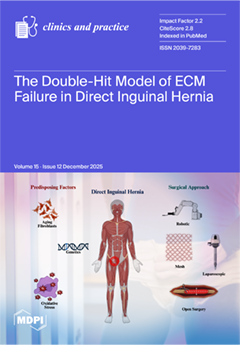
Cover Story (view full-size image):
Direct inguinal hernia is increasingly recognized as a disorder of extracellular matrix remodeling rather than a purely mechanical defect. This review highlights how aging and oxidative stress converge to weaken the abdominal wall fascia through reduced collagen I:III ratios, impaired cross-linking, fibroblast senescence, and dysregulated MMP/TIMP activity. Surgical technique, mesh properties, and perioperative redox balance further modulate this vulnerable matrix, thereby influencing tissue repair and recurrence risk. Collectively, these findings support a “double-hit” model in which intrinsic connective-tissue aging primes the fascia for failure, while oxidative and inflammatory stress accelerate ECM degradation. Understanding these biological drivers provides a framework for more durable, biologically informed hernia prevention and repair strategies. View this paper
- Issues are regarded as officially published after their release is announced to the table of contents alert mailing list.
- You may sign up for e-mail alerts to receive table of contents of newly released issues.
- PDF is the official format for papers published in both, html and pdf forms. To view the papers in pdf format, click on the "PDF Full-text" link, and use the free Adobe Reader to open them.
Previous Issue
Next Issue
