


Abstract
(1) Background: The COVID-19 pandemic has cost social, economic, cultural, and educational life, distressing nursing training and practice. This study aimed to map the literature on changes in clinical training for nursing students during the COVID-19 pandemic. (2) Methods: A scoping review was conducted according to JBI methodology’s latest guidance. A set of relevant electronic databases and grey literature was searched to report results published in English, Spanish, and Portuguese. (3) Results: A total of 12 studies were included in the study, addressing changes in clinical training in undergraduate nursing students due to COVID-19 pandemic activity, published between 2020 and 2022. (4) Conclusions: Nursing schools made an effort to replace traditional clinical training with several activities, primarily based on simulation or virtual activities. However, contact with others is essential, and simulation programs or scenarios cannot provide it.
1. Introduction
The emergence and effect of the SARS-CoV-2 coronavirus transformed educational approaches, as clinical settings were no longer available for internship, and nursing schools had to replace and reshape clinical scenarios [1] by reinventing strategies and adjusting teaching, learning, and assessment methods in nursing education [2,3].
It created unprecedented opportunities for nursing education as it required creative teaching techniques to promote students’ clinical learning, ensuring that the necessary learning outcomes and professional competencies were achieved [4,5].
The traditional clinical practice and face-to-face experiences were replaced by technological environments, for both students and faculty, with screen-based simulation [4], remote or virtual simulated learning experiences using commercial products or telehealth [6], and technology-enhanced storyboard techniques [7]. Moreover, nursing schools were unprepared for remote instruction transition during the COVID-19 pandemic, which challenged their curricula [5].
The discipline of nursing focuses on human reactions to health disease occurrences and life processes, where face-to-face nursing care is vital [8]. Thus, training students who will be qualified nurses caring for people involves developing specific skills, reflecting on role-playing discussions, exchanging clinical experiences, professional and multidiscipline relationships, and critical thinking [8].
The pandemic raised numerous challenges in teaching nursing students, specifically in the clinical context. This new reality allowed [9] students to achieve the required clinical hours and therefore complete their degrees if they were senior students. On the other hand, young nursing students had their clinical placements delayed due to rapid changes in the clinical environment. Conversely, lock-in policies forced junior students to discontinue or delay clinical education [9]. What alternatives were offered to these students?
According to JBI methodology and the previously published review protocol [10], we conducted a scoping review to map the changes in clinical training for undergraduate nursing students during the COVID-19 pandemic.
Moreover, it would be relevant to do this mapping at any level of education. The focus on undergraduate students is because the fundamentals of nursing are acquired in this period. During training, when undergraduate students receive the information and abilities that set nurses apart from laypeople as professional healthcare providers, it is a crucial time in the professional development of nursing students [11]. If it is compromised, the repercussions will manifest from the base of the nursing profession.
This review aims to understand how faculties adapted curricula to face the problem of inaccessibility to clinical settings and how academics developed programs to target clinical teaching, learning, and assessment strategies for nursing students in similar contexts. This map identified relevant topics on nursing education strategies to improve nursing students’ knowledge development and helped identify potential research gaps. This mapping will support, in the near future, comparison studies between changes in teaching before and after the pandemic, and comparison studies between changes implemented temporarily and those which “came to stay”.
An initial search of MEDLINE (PubMed), the J.B.I. Evidence Synthesis, the Cochrane Database of Systematic Reviews, PROSPERO, and Open Science Framework (O.S.F.) revealed that, currently, there are no scoping reviews or systematic reviews (published or in progress) about this subject [12,13,14].
This scoping review was developed to answer the following questions:
- -
- What are the changes in clinical practice training for nursing students during the COVID-19 pandemic? (By change it means an alternative to clinical practice in context).
- -
- What is the context of clinical practice training for nursing students where the changes are described? (By context it means the level/year of training).
- -
- What are the academic and personal implications in the nursing student learning process? (By implications, it is intended to map the consequences of the training changes on a personal or academic level).
2. Materials and Methods
The JBI latest guidance methodology guided this scoping review [12,13,14], and was reported following the Preferred Reporting Items for Systematic Reviews and Meta-Analyses Extension for Scoping Reviews (PRISMA-ScR) guidelines [15]. This review protocol has been previously published [10].
2.1. Inclusion Criteria
According to the JBI recommendations mnemonic “P.C.C.” for scoping reviews, the inclusion criteria were: Participants—Undergraduate nursing students. Concept—Studies exploring nursing students’ clinical training changes during the COVID-19 pandemic. Context—Any clinical practice setting, independent of the country of the study. Types of sources—Studies with quantitative, qualitative, and mixed methods study design. In addition to these, all types of systematic review were considered.
2.2. Search Strategy
The search strategy was used to identify published and unpublished primary studies and reviews.
Two reviewers developed the search strategy and peer-review by an expert third reviewer who considered the Peer Review of Electronic Search Strategies (PRESS) checklist [16]. The JBI recommended that three-step search strategy was applied [12,14]. Records in English, Spanish, and Portuguese were included to ensure a suitable selection procedure and data extraction.
The search strategy was adapted to the specificities of each information source. The databases searched included MEDLINE (via PubMed); CINAHL Complete (EBSCOhost); Cochrane Central Register of Controlled Trials; Cochrane Database of Systematic Reviews; LILACS; Scopus; and SciELO. The search for unpublished studies included DART-Europe and OpenGrey. As an example, the search strategy used for MEDLINE (via PubMed) is presented in Table 1. The search was structured in both Medical Subject Headings (MeSH) and text words shown in the literature. The terms were combined using truncation symbols and Boolean operators (“OR” and “AND”). Lastly, the reference lists of the articles included in the review were screened for supplementary papers.

Table 1.
Search strategy for MEDLINE (via Pubmed) conducted on 28 March 2022.
Study languages were restricted to those mastered by the authors—English, Spanish, and Portuguese—to ensure a good-quality selection procedure and data extraction. No time limit was considered in this review. However, the research has considered the COVID-19 pandemic; as such, all the studies included were dated equal to or greater than 2019.
Furthermore, since this scoping review aims to map the changes in clinical training for undergraduate nursing students during the COVID-19 pandemic, no rating of the methodological quality was provided, according to the JBI methodology, and as a result, practice recommendations were provided with caution. As mentioned by JBI “no assessment of methodological quality and formal synthesis takes place as part of a scoping review” [12].
2.3. Study Selection and Screening Process
All the records identified over database searching were retrieved and kept in Mendeley® V1.19.4 (Mendeley Ltd., Elsevier, Amsterdam, The Netherlands) and duplicates were removed. Two reviewers independently screened the titles and abstracts. A pilot test was made to verify whether inclusion criteria were met. The two independent reviewers assessed the full text of selected citations in detail against the inclusion criteria. The references of the included studies in the review were hand-searched. Disagreements among the two reviewers were solved through discussion or with a third reviewer. In the case of the inaccessible full article, the author was contacted [15].
3. Results
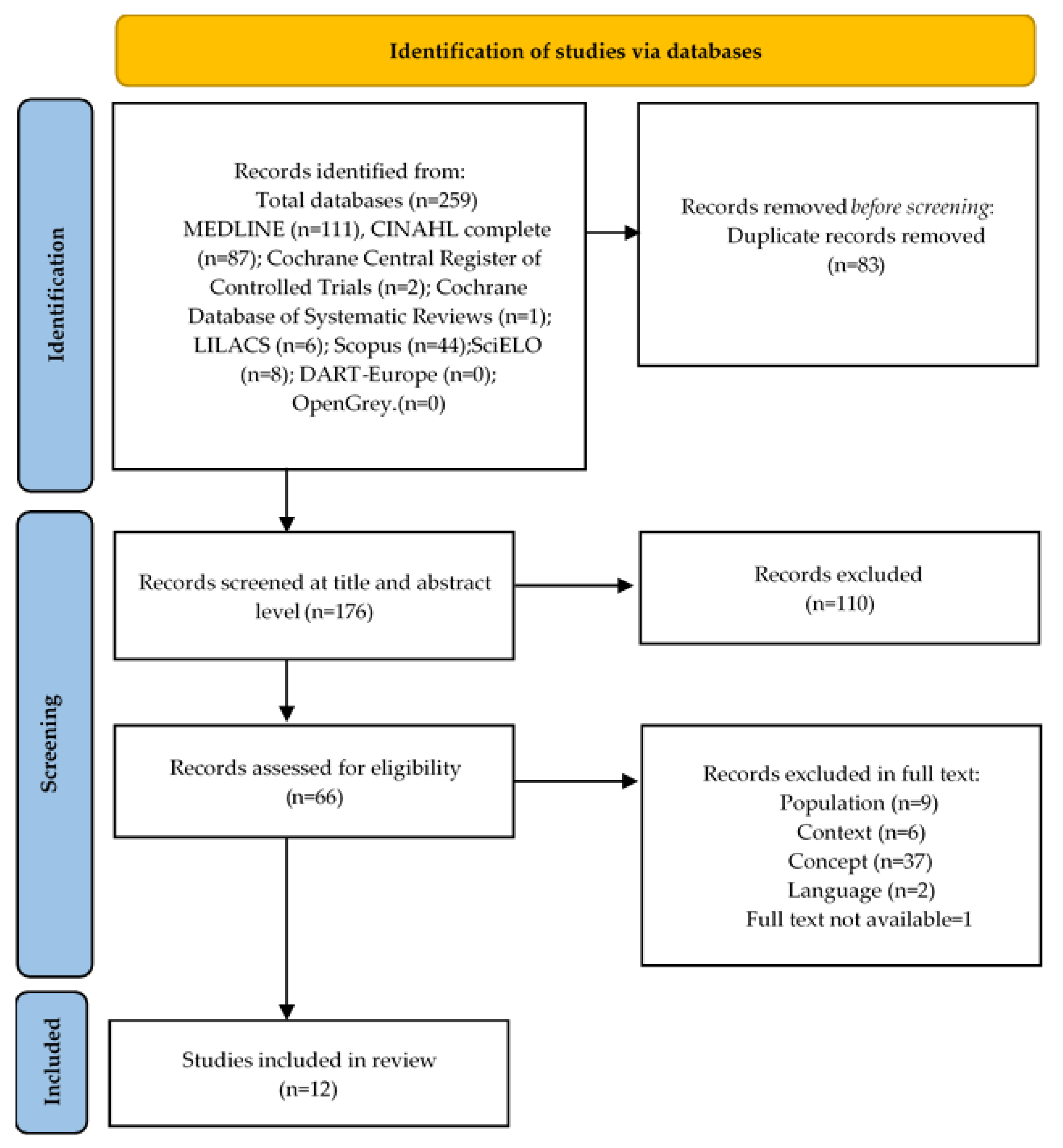
The data total of two hundred and fifty-nine studies were identified from the databases. After removing eighty-three duplicates, one hundred and seventy-six references remained. The titles and abstracts of these articles were reviewed, resulting in a total of sixty-six eligible records. After the complete reading of these records and application of the previously defined inclusion criteria, two were excluded because they were in a language different from those the research team spoke. Additionally, nine did not comply with the requirements referring to the population, six did not comply with the selected context, and thirty-seven were excluded due to the concept not being stipulated by the inclusion criteria.
As such, after the identification and screening phases of the review procedure (Figure 1), 12 studies were included in this review.
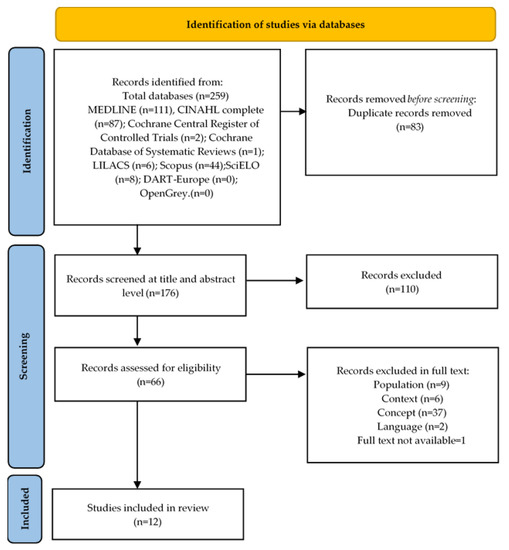
Figure 1.
PRISMA Flowchart.
Data Analysis and Presentation
The characteristics of the included studies and the answers to the review question are summarised in Table 2. Of the twelve studies included in this review, one was conducted in Indonesia, six in the USA, one in Germany, one in Colombia, one in Hong Kong, and two in the Republic of Korea. The studies were published in the years 2020 (n = 2), 2021 (n = 8), and 2022 (n = 2).
Table 2.
Articles included in the scoping review.
The first study analysed was conducted by Anggraini, Chrisnawati, and Warjiman (2022) [17] in Indonesia, targeting 30 nursing students during clinical nursing training. To continue the training of those students, they used a simulation program that proved beneficial in reviewing the theories obtained previously (Table 2).
The study by Banjo-Ogunnowo and Chisholm (2022) [18] was conducted on nursing students who were developing their learning in the maternal–pediatric course. They used virtual learning as an alternative to clinical practice in hospital settings (Table 2).
The third study [19] analyzed was developed by a team of researchers from Germany. In this study, nursing students received the interprofessional COVID-19 substitution program (I-reCovEr) during clinical teaching in a pediatric setting (Table 2).
Another study included [20] was conducted in Columbia (U.S.A.) by Bradford et al. (2021) with midwifery and women’s health nurse practitioner students. Synchronous and asynchronous simulation sessions were offered for their formative learning. These simulation opportunities served as valuable adjuncts to traditional learning and provided a level of experiences to students with unequal access and capability to engage in the clinical setting (Table 2).
In the study developed by Cowperthwait et al. (2021) [21], during clinical training in psychiatric mental health nursing, eighty senior undergraduate students were allocated to a simulation that replaced the physical clinical context. The main benefits emphasized by the students were the reflection developed during the simulation sessions, the opportunity to receive feedback, and the learning acquired through the observation of other colleagues in the interaction with the same patients (Table 2).
Fung et al. (2021) [22] conducted a study in Hong Kong with 188 final-year undergraduate nursing students. In this study, a virtual simulation educational program replaced traditional clinical practice in medical and surgical cases with debriefing. In the students’ perception, this educational program was beneficial in developing clinical competence and the nursing process. However, communication and critical thinking were better applied in the traditional clinical setting (Table 2).
In a study by Hassler et al. (2021) [23], flipped clinical practice was analysed through a synchronized remote clinical experience in one clinical specialty chosen by 98 s-year nursing students. Students emphasized that they saw the methodology as successful to reinforce clinical concepts to simulate the experiences of the traditional hospital setting’s clinical training (Table 2).
Another study included in this scoping review and developed by Hwang and Chun (2021) [24] put into evidence the use of clinical practice education with virtual reality in the Republic of Korea (Table 2). Fifty-nine nursing students were divided into two groups. In this study, the experimental group was exposed to the vSim nursing program as an alternative practice to the traditional clinical practice using virtual reality. Their results showed positive benefits in clinical thinking and clinical practice performance but without wide statistical significance.
From the Republic of Korea arrived the study of Kim, Kang, and Gagne (2021) [25], which highlighted the use of a six step virtual simulation alternative program to the traditional nursing clinical practice (Table 2). The proposed six step virtual simulation alternative program evidenced the difficulties perceived by the students in using a non-native language and the impact of the specific cultural differences shown in the scenarios. On the other hand, the developed confidence and competence in providing patient-centered care were shown as benefits of virtual simulation.
The study by Revell et al. (2022) [26] disclosed the results of supplementing the traditional clinical period with an 18-h simulated experiences pack (Table 2). The authors revealed the evidence of transformative learning expressed by students. The sample of undergraduate nursing students demonstrated an evident response to the change and challenges, discovering and developing other professional competencies and skills.
In 2020, Shea and Rovera [27] developed a study with two hundred and forty-four nursing students exposed to virtual and remote simulations as telehealth with standardized patients as an alternative of half of the clinical practice hours (Table 2). During the health emergency period and the university campus closure, every effort was needed to replace clinical practice hours and stop the interruption of the nursing graduation process with simulation activities in different clinical areas.
The last analyzed study, developed by Wands, Geller, and Hallman (2020) [28], presents to the scientific community a four-week simulation program with forty-two nursing students to substitute their in-person clinical experiences (Table 2). By using four free online simulation programs, logged over 1200 h, the students referred to experiencing positive growth in different professional competencies and skills despite difficulties when trying to manage multiple devices to access the virtual sessions and materials.
Our findings show that nursing schools made an effort to replace traditional clinical training with several activities, primarily based on simulation or virtual activities, allowing students to improve their abilities in caretaking [17,18,21,24,25,27,28]. Simulation sessions were structured in steps, with suggested reading, pre- and post-simulation quizzes, interactive clinical scenarios, and reflection [25,26]. They improved communication skills by role-playing, gaining experience in practical activities, and flipping clinical practice to replicate traditional care [17,20,23]. Scholarly journals were also proposed to enhance reflection and knowledge acquisition by virtual clinical practice [26].
After simulation sessions, debriefing moments were taken where simulation and case management were analyzed [18,22] or replaced by online seminars [26].
One of the included articles, Banjo-Ogunnowo and Chisholm (2022) [18], mention as a strategy the use of a virtual platform—the i-Human platform was widely used to assess case scenarios, including patient history, physical assessment, defining nursing diagnoses, and prioritizing interventions [18,29], although other virtual platforms were used by universities [30,31].
The primary contexts varied from maternal–pediatric [18,19,23,27], women’s health [20], psychiatric mental health [21,23,27], medical–surgical health [22,26,27], adult health [23], nursing fundamentals/profession stage [17,27], and community health promotion and wellness reproductive health [27].
4. Discussion
In this scoping review, we identified twelve primary studies, mainly from the U.S.A., addressing changes in clinical training in undergraduate nursing students due to COVID-19 pandemic activity, published between 2020 and 2022.
Concerning the simulation time, the included articles varied in context and ranged from 18 h to 8 weeks of rotation [18,19,26,28].
The adoption of virtual lessons allowed each nursing school to define clinical training replacement time, letting students progress at their graduation level. At the end of the program, students reported that this learning methodology enabled them to continue clinical training, with advantages in reviewing concepts, nursing theories, and applying them in simulation scenarios or later engaging in clinical settings [17,20]. Reflective and debriefing periods were viewed as positive. Professor–student and student–student interaction encouraged discussion, feedback, and interchange of opinions [21,22], analysis of clinical competencies and information to include in the nursing process [22,24], and clinical concepts reinforcement [23]. A positive modification in students’ attitudes was also noticed, such as confidence, resilience, gratitude, or embracing advocacy [20,25,26,28]. On the other hand, managing multiple technological devices for videos or website material was more challenging. Additionally, simulation widgets in the English language were hard to understand for those whose native language was not English and simulations were not adapted to cultural users’ differences [25]. The lack of understanding of simulation widgets in English among non-native speakers could be attributed to language barriers, where individuals may not have a good command of the English language, making it challenging for them to understand technical terms and concepts. Additionally, cultural differences could play a role, as certain phrases or expressions may not be familiar to individuals from different cultures. To address these challenges, it may be necessary to provide language and cultural adaptations to simulation widgets. As technology advances, the need for technical skills and understanding will likely increase, making it even more critical to bridging language and cultural barriers.
The Pandemic made it challenging for nursing schools to adapt their curricula to allow students to continue their practice and advance at their graduation level. Each school sets a different program, adjusting to its needs, making its comparison difficult. Overall, synchronous or hybrid virtual classes narrowed relations between professors and students. Narrowed relations refer to the potentially reduced level of interaction and engagement between professors and students in virtual or hybrid learning environments compared to face-to-face classes. In a virtual or hybrid setting, students may feel more disconnected from their professors and peers, which can decrease the quality of interaction, collaboration, and feedback. Depending on each context, setting specific scenarios allowed a deeper reflection on practice, connecting concepts and theories. However, users also had to invest time in acquiring technological competencies, which could be time-consuming and challenge the learning process. The interaction between users and simulation programs was centered on pressing buttons rather than the natural interaction between carer and cared [25].
The results were similar when comparing clinical practice education with virtual reality and traditional learning. There were no observed differences between these two learning approaches [18,19,24], although both improved learning abilities, mainly on previous practice before clinical training, in conjunction with reflection on person-centered needs, developing communication skills, and performing decision-making in a controlled environment [17,20].
The simulation was not new in nursing, where specific practices were already used, such as resuscitation or technical training before clinical practice [32]. The pandemic set a new view for the patient through the usage of technological widgets. Clinical practice was replaced by virtual scenarios, in which the interaction between participants (students and professors) promoted a richness of sharing.
A potential limitation of this scoping review was that only studies published in English, Portuguese, and Spanish were included. Articles published in other languages may potentially add information to this review’s results. Furthermore, since the objective of this scoping review was to map, no rating of the methodological quality was used. In contrast to systematic reviews where implications or recommendations for practice are a key feature, scoping reviews are not designed to underpin clinical practice decisions; therefore, the assessment of methodological quality or risk of bias of included studies (which is critical when reporting effect size estimates) does not occur [33].
Finally, the concept “changes” was not included in the search strategy in order not to exclude potential studies relevant to the present review.
5. Conclusions
The impact of the coronavirus pandemic created the need to reinvent strategies and readjust teaching, learning, and assessment processes in nursing education, namely in a clinical context. This scoping review identified twelve primary studies about changes in clinical training for nursing students during the COVID-19 pandemic published between 2020 and 2022. This mapping shows that the pandemic made it challenging for nursing schools to adapt their curricula to allow students to continue their practice and advance at their graduation level.
In this sense, nursing schools tried to replace traditional clinical training with several activities based on simulation or virtual activities. However, contact with others is essential, and simulation programs or scenarios cannot provide it. Simulation is essential for skill development, however, developing technical and non-technical skills simultaneously requires direct contact with patients.
More studies should be carried out within the scope of the long-term consequences of adopting these methodologies in nursing practice.
Author Contributions
Conceptualization: C.L., A.C., R.G., V.P., H.N., and J.P.S.; Validation: V.P. and H.N.; Writing—initial draft preparation: C.L., A.C., R.G., V.P., H.N., and J.P.S.; Writing—review and editing: C.L., A.C., R.G., V.P., H.N., and J.P.S. All authors have read and agreed to the published version of the manuscript.
Funding
This research received no external funding.
Institutional Review Board Statement
Not applicable.
Informed Consent Statement
Not applicable.
Data Availability Statement
Not applicable.
Acknowledgments
The authors wish to acknowledge the Health Sciences Research Unit: Nursing, Nursing School of Coimbra, Portugal and the Portugal Centre for Evidence-Based Practice: a Joanna Briggs Institute Centre of Excellence, Portugal.
Conflicts of Interest
The authors declare no conflict of interest.
References
- Silva, F.T.M.; Kubrusly, M.; Peixoto Junior, A.A.; Vieira, L.X.S.D.S.; Augusto, K.L. Adaptations and Repercussions in the Experiences in a Hybrid Education University during the Sars-CoV-2 Pandemic TT-Adaptações e Repercussões Nas Vivências Em Escola de Ensino Híbrido Durante a Pandemia Por Sars-CoV-2. Rev. Bras. Educ. Med. 2021, 45, e068. [Google Scholar] [CrossRef]
- Agu, C.F.; Stewart, J.; McFarlane-Stewart, N.; Rae, T. COVID-19 Pandemic Effects on Nursing Education: Looking through the Lens of a Developing Country. Int. Nurs. Rev. 2021, 1–6. [Google Scholar] [CrossRef]
- dos Santos Ferreira, A.M.; Príncipe, F.; Pereira, H.; Oliveira, I.; Mota, L. COVimpact: Pandemia COVID-19 Nos Estudantes Do Ensino Superior Da Saúde. Rev. Investig. Inovação em Saúde 2020, 3, 7–16. [Google Scholar] [CrossRef]
- Leighton, K.; Kardong-Edgren, S.; Schneidereith, T.; Foisy-Doll, C.; Wuestney, K.A. Meeting Undergraduate Nursing Students’ Clinical Needs: A Comparison of Traditional Clinical, Face-to-Face Simulation, and Screen-Based Simulation Learning Environments. Nurse Educ. 2021, 46, 349–354. [Google Scholar] [CrossRef]
- Bourgault, A.; Mayerson, E.; Nai, M.; Orsini-Garry, A.; Alexander, I.M. Implications of the COVID-19 Pandemic: Virtual Nursing Education for Delirium Care. J. Prof. Nurs. 2022, 38, 54–64. [Google Scholar] [CrossRef] [PubMed]
- Kazawa, K.; Teramoto, C.; Azechi, A.; Satake, H.; Moriyama, M. Undergraduate Nursing Students’ Learning Experiences of a Telehealth Clinical Practice Program during the COVID-19 Pandemic: A Qualitative Study. Nurse Educ. Today 2022, 111. [Google Scholar] [CrossRef]
- Roberts, M.L.; Mazurak, J.O.E. Virtual Clinical Experiences in Nursing Education: Applying a Technology-Enhanced Storyboard Technique to Facilitate Contextual Learning in Remote Environments. Nurs. Educ. Perspect. 2021. [Google Scholar] [CrossRef] [PubMed]
- Lira, A.L.B.D.C.; Adamy, E.K.; Teixeira, E.; Silva, F.V.D. Educação Em Enfermagem: Desafios e Perspectivas Em Tempos Da Pandemia COVID-19. Rev. Bras. Enferm. 2020, 73, e20200683. [Google Scholar] [CrossRef] [PubMed]
- Swift, A.; Banks, L.; Baleswaran, A.; Cooke, N.; Little, C.; McGrath, L.; Meechan-Rogers, R.; Neve, A.; Rees, H.; Tomlinson, A.; et al. COVID-19 and Student Nurses: A View from England. J. Clin. Nurs. 2020, 29, 3111–3114. [Google Scholar] [CrossRef]
- Lobão, C.; Coelho, A.; Gonçalves, R.; Parola, V.; Neves, H.; Sousa, J.P. Changes in Clinical Training for Nursing Students during the COVID-19 Pandemic: A Scoping Review Protocol. Nurs. Rep. 2022, 12, 210–216. [Google Scholar] [CrossRef] [PubMed]
- Lundell Rudberg, S.; Westerbotn, M.; Sormunen, T.; Scheja, M.; Lachmann, H. Undergraduate Nursing Students’ Experiences of Becoming a Professional Nurse: A Longitudinal Study. BMC Nurs. 2022, 21, 1–10. [Google Scholar] [CrossRef] [PubMed]
- Peters, M.D.J.; Godfrey, C.; Mcinerney, P.; Munn, Z.; Tricco, A.C.; Khalil, H. Chapter 11: Scoping Reviews. In JBI Manual for Evidence Synthesis; Aromataris, E., Munn, Z., Eds.; JBI: Adelaide, Australia, 2020. [Google Scholar]
- Khalil, H.; Peters, M.; Godfrey, C.M.; McInerney, P.; Soares, C.B.; Parker, D. An Evidence-Based Approach to Scoping Reviews. Worldviews Evid.-Based Nurs. 2016, 13, 118–123. [Google Scholar] [CrossRef]
- Peters, M.D.J.; Marnie, C.; Tricco, A.C.; Pollock, D.; Munn, Z.; Alexander, L.; McInerney, P.; Godfrey, C.M.; Khalil, H. Updated Methodological Guidance for the Conduct of Scoping Reviews. JBI Evid. Synth. 2020, 18, 2119–2126. [Google Scholar] [CrossRef] [PubMed]
- Tricco, A.C.; Lillie, E.; Zarin, W.; Brien, K.K.O.; Colquhoun, H.; Levac, D.; Moher, D.; Peters, M.D.J.; Ma, Q.; Horsley, T.; et al. PRISMA Extension for Scoping Reviews ( PRISMA-ScR ): Checklist and Explanation. Ann. Intern. Med. 2018. [Google Scholar] [CrossRef]
- McGowan, J.; Sampson, M.; Salzwedel, D.M.; Cogo, E.; Foerster, V.; Lefebvre, C. PRESS Peer Review of Electronic Search Strategies: 2015 Guideline Statement. J. Clin. Epidemiol. 2016, 75, 40–46. [Google Scholar] [CrossRef]
- Anggraini, S.; Chrisnawati, C.; Warjiman, W. The Effectiveness of the Implementation of the Hospital Clinical Practice Based Simulation Model on the Practice Learning Outcomes of Nurse Profession Students During the Covid-19. Indones. Nurs. J. Educ. Clin. 2021, 6, 185–191. [Google Scholar] [CrossRef]
- Banjo-Ogunnowo, S.; Chisholm, L. Virtual versus Traditional Learning during COVID-19: Quantitative Comparison of Outcomes for Two Articulating ADN Cohorts. Teach. Learn. Nurs. 2022. [Google Scholar] [CrossRef]
- Bode, S.; Dürkop, A.; Wilcken, H.; Peters, S.; Straub, C. Interprofessional Learning during Sars-Cov-2 (Covid-19) Pandemic Conditions: The Learning Project i-Recover as a Substitute for a Rotation on an Interprofessional Training Ward. GMS J. Med. Educ. 2021, 38, 1–8. [Google Scholar] [CrossRef]
- Bradford, H.M.; Farley, C.L.; Escobar, M.; Heitzler, E.T.; Tringali, T.; Walker, K.C. Rapid Curricular Innovations During COVID-19 Clinical Suspension: Maintaining Student Engagement with Simulation Experiences. J. Midwifery Womens. Health 2021, 66, 366–371. [Google Scholar] [CrossRef]
- Cowperthwait, A.; Graber, J.; Carlsen, A.; Cowperthwait, M.; Mekulski, H. Innovations in Virtual Education for Clinical and Simulation Learning. J. Prof. Nurs. 2021, 37, 1011–1017. [Google Scholar] [CrossRef] [PubMed]
- Fung, J.T.C.; Zhang, W.; Yeung, M.N.; Pang, M.T.H.; Lam, V.S.F.; Chan, B.K.Y.; Wong, J.Y.-H. Evaluation of Students’ Perceived Clinical Competence and Learning Needs Following an Online Virtual Simulation Education Programme with Debriefing during the COVID-19 Pandemic. Nurs. Open 2021, 8, 3045–3054. [Google Scholar] [CrossRef] [PubMed]
- Hassler, L.J.; Moscarella, D.; Easley, L.; Olaode, S. Flipped Clinical Teaching: Battling COVID-19 With Creative and Active Pedagogy. J. Nurs. Educ. 2021, 60, 534–537. [Google Scholar] [CrossRef] [PubMed]
- Hwang, H.-Y.; Chun, Y.-E. Simulation Clinical Practice Education That Combines Virtual Reality Effects on Clinical Thinking Disposition and Clinical Practice Performance. Rev. Int. Geogr. Educ. Online 2021, 11, 246–253. [Google Scholar]
- Kim, M.J.; Kang, H.S.; De Gagne, J.C. Nursing Students’ Perceptions and Experiences of Using Virtual Simulation During the COVID-19 Pandemic. Clin. Simul. Nurs. 2021, 60, 11–17. [Google Scholar] [CrossRef] [PubMed]
- Revell, S.M.H.; Sethares, K.A.; Chin, E.D.; Kellogg, M.B.; Armstrong, D.; Reynolds, T. A Transformative Learning Experience for Senior Nursing Students. Nurse Educ. 2022, 47, 161–167. [Google Scholar] [CrossRef]
- Shea, K.L.; Rovera, E.J. Preparing for the COVID-19 Pandemic and Its Impact on a Nursing Simulation Curriculum. J. Nurs. Educ. 2021, 60, 52–55. [Google Scholar] [CrossRef]
- Wands, L.; Geller, D.E.; Hallman, M. Positive Outcomes of Rapid Freeware Implementation to Replace Baccalaureate Student Clinical Experiences. J. Nurs. Educ. 2020, 59, 701–704. [Google Scholar] [CrossRef]
- Weston, J.; Zauche, L.H. Comparison of Virtual Simulation to Clinical Practice for Prelicensure Nursing Students in Pediatrics. Nurse Educ. 2021, 46, E95–E98. [Google Scholar] [CrossRef] [PubMed]
- Verkuyl, M.; Lapum, J.L.; St-Amant, O.; Hughes, M.; Romaniuk, D. Curricular Uptake of Virtual Gaming Simulation in Nursing Education. Nurse Educ. Pract. 2021, 50, 102967. [Google Scholar] [CrossRef]
- Callender, L.F.; LuValle Johnson, A.; Clark, J.N.; Terrero de la Osa, A. Coordinating Clinical Rotations During the Novel Corona Virus 2 Pandemic. J. Nurs. Educ. 2021, 60, 394–396. [Google Scholar] [CrossRef]
- Glasper, A. Simulation and Student Learning: Will NMC Policy Lead to Lasting Change? Br. J. Nurs. 2021, 30, 498–499. [Google Scholar] [CrossRef] [PubMed]
- Peters, M.D.J.; Marnie, C.; Colquhoun, H.; Garritty, C.M.; Hempel, S.; Horsley, T.; Langlois, E.V.; Lillie, E.; O’Brien, K.K.; Tunçalp, Ö.; et al. Scoping Reviews: Reinforcing and Advancing the Methodology and Application. Syst. Rev. 2021, 10, 263. [Google Scholar] [CrossRef] [PubMed]
Disclaimer/Publisher’s Note: The statements, opinions and data contained in all publications are solely those of the individual author(s) and contributor(s) and not of MDPI and/or the editor(s). MDPI and/or the editor(s) disclaim responsibility for any injury to people or property resulting from any ideas, methods, instructions or products referred to in the content. |
© 2023 by the authors. Licensee MDPI, Basel, Switzerland. This article is an open access article distributed under the terms and conditions of the Creative Commons Attribution (CC BY) license (https://creativecommons.org/licenses/by/4.0/).