

Reaching the End of the ICEV Domination: 35 Years of Battery Electric Vehicles in Norway


Abstract
1. Introduction
2. Background
3. Method and Data Sources
3.1. Research Questions
- RQ1: What are the most important factors behind the 35-year-long Norwegian BEV development?RQ2: What makes the Norwegian BEV development different from that of other countries?
3.2. Method
3.3. Data Sources
4. The Norwegian BEV Development
4.1. Main Phase 1: Norwegian BEV Producer Led Innovation 1990–2010
4.2. Main Phase 2: Global OEM Led BEV Innovation 2011–2020
4.3. Main Phase 3: Reaching the End of the ICEV Domination 2021–2025
5. Results
5.1. Demand-Side and Supply-Side Challenges
- BEV Characteristics and Markets
- Charging-Infrastructure Challenges
- User Groups, Perceptions and Experiences
- Policies
- The end of the road for ICEVs
- The long lines
5.2. Rational Choices—Total Cost of Ownership
5.3. Societal Process
5.4. Differences from Other Countries
6. Discussion
- RQ1, “What are the most important factors behind the 35-year-long Norwegian BEV development?”
- RQ2, “What makes the Norwegian BEV development different from that of other countries?”
- Will BEVs still be a rational choice in Norway when the VAT exemption is fully removed by 2028 and other incentives are reduced, or will the price increase effect of the VAT and reduced advantages be partially or fully compensated by reduced BEV manufacturer prices so that the market share stays high?
- Have the vehicle buyer preferences changed so much that the “norm” of choosing BEVs in the new-vehicle market will remain even if the economic advantages are reduced?
- The Norwegian BEV incentives overcompensate BEVs so much that the economic benefits completely overshadow all other reasons for buying or not buying BEVs, but how will this play out in other countries with fewer incentives?
- Will other countries be able to diffuse BEVs faster now that BEVs are much more developed, desirable, and available, or must costs still be reduced with large incentives, and BEV interest take its time to rise?
7. Conclusions
Funding
Data Availability Statement
Conflicts of Interest
Appendix A

| Incentives | Year | Comments |
| Fiscal incentives: Reduction in purchase price/yearly cost gives competitive prices | ||
| Exemption from the registration tax | 1990/1996 | Temporary 1990. Permanent 1996 as tax on value and weight. Weight, engine power and volume 1999–2005. CO2 replaced engine volume 2007. Engine power removed in 2018. |
| Value Added Tax (VAT) exemption, implemented as a zero-rate VAT. | 2001 | Introduced in mid-2001 when the VAT was 24% (now 25%). From 2023 was full VAT introduced on the part of the value of BEVs exceeding 500,000 NOK. |
| Zero-rate VAT on BEV leasing and on replacement batteries | 2015 | Reduce worries about second-hand value and make leasing more attractive. Battery replacement VAT exemption only effective outside battery warranty. Changed as above. |
| Zero-rate VAT on wall box and standard installation cost | 2013–2019 | Zero VAT on BEV purchase extended to equipment and the wall box with standard installation was considered equipment when purchased with the BEV |
| Reduced annual tax (from 2018 called insurance tax) | 1996/2004 | 1996–2003: full exemption. 2004–2017: low rate. 2018–2020: full exemption. Gradual re-introduction to full annual tax 2022–2023. |
| Reduced company car benefit tax | 2000 | Introduced when BEVs had short range and minimal private advantage. The reduction varied over the years, with limited impact on top of other incentives. |
| Exemption from ownership change tax | 2018–2021 | This tax is imposed on sales of used ICEVs. BEVs were exempted 2018–2021. |
| Direct subsidies to users: Reduction in variable costs and help solving range challenges | ||
| Reduced toll roads | 1997 | 1997–2017 full exemption. Oslo users saved up to 1000 €/year. Other places users could save more. Revised 2017: Rates decided locally, max 50% of ICEVs. From 2023:70%. |
| Reduced fare main road ferries | 2009 | Reduced fares 2009–2017. From 2018 up to 50% of the ICEV rate. From 2023 up to 70%. |
| Financial support normal chargers | 2009 | 2009 financial crisis fund. Additional local support from counties and municipalities |
| Financial support for fast chargers | 2011 | Supported by Transnova 2011–2014. Enova from 2015 and some counties. |
| User privileges: Reduction in time costs and providing users with relative advantages | ||
| Access to bus lanes | 2003/2005 | Full access Oslo area: 2003. Nationally 2005. Local authorities to decide from 2017. Some restriction around Oslo since 2015 due to congestion in bus lanes. |
| Free/reduced parking fees, including. Preferential BEV parking to charge | 1999 | Fully exempted 1999–2016. Local authorities can since 2017 charge BEVs. Parliament decided max BEV rate 50% of ICEV rate from 2018, 70% from 2023, not implemented. |
| Organizational measures enabling an efficient transition | ||
| Right to access chargers in jointly owned properties (flats) | 2017 | Law change. Owners of flats in jointly owned properties can demand access to chargers in the jointly owned parking area/garage. |
| Right to access chargers in parking areas of housing communities | 2020 | Law change. Owners of flats in housing communities can demand possibility to charge BEVs in the jointly owned parking area/garage. |
| Obligation to offer charging access in parking facilities | 2017/2020 | Law change. Up to 6%, depending on BEV fleet shares, of parking spaces in park houses, other parking areas should also be equipped. |
| Disincentives | Year | Comments |
| Vehicle weight tax | 2023 | Weight tax on weight above 500 kg on all vehicles. Hit heavy BEVs harder than ICEVs. |
| Annual tax | 2024 | A slightly higher tax on BEVs than on ICEVs from 2024. |
| Topic | Research Articles and Reports | Other Reports and Documents |
|---|---|---|
| Demand-side and supply-side issues | [1,6,12,13,14,27,36,48,49,50,56] | |
| BEV and market development | [1,6,12,13,14,15,16,20,21,36,37,38,48,49,50,63,69] | [35,43,56] |
| BEV user needs, perceptions and characteristics | [1,6,12,14,20,22,23,24,25,26,27,28,63,64,65] | [39] |
| Effects of policies and incentives | [1,6,12,13,14,17,18,19,20,21,24,25,26,29,30,31,70] | |
| Charging-infrastructure needs/perceptions | [1,6,12,24,25,26,27,28] | |
| Charging-infrastructure experiences | [1,6,12,24,25,26,27,28] | |
| Charging-infrastructure deployment and organization | [1,6,13,27,28,63] | |
| Policy development | [1,5,6,12,13,18,36,48] | [2,4,47,51] |
| Societal development | [1,14,15,16,18,22,40,41,42,48,49] | [10,52] |
| Governance | [3,4,5,31,51] | |
| Datasets | [2,9,11,32,33,54,58,67,69,73] | |
| Press articles, press releases, and newsletter | [7,8,34,45,46,53,55,57,59,60,61,62,66,68,71] | |
| Supply-Side Challenges | Demand-Side Challenges | |||||||||||
|---|---|---|---|---|---|---|---|---|---|---|---|---|
| Period | BEV Production and Availability | BEV Value Chains | Charging Infra-Structure Deployment | Charging Infra-Structure Value Chain | Policies Vehicles | Policies Charging Infrastructure | User Characteristics | User Knowledge Awareness and Perception | Market Activity | Charging Infrastructure Availability | Total Cost of Owner-Ship (TCO) | Policies |
| 1990 Status | ||||||||||||
| 1990 status | None | None | None | None | None | None | No users | BEVs totally unknown | None | Outdoor power sockets are widely available, used for ICEV engine heaters | None | |
| Norwegian BEV producer-led innovation phases | ||||||||||||
| 1990–1996 | Import of Kewets, PIVCO prototypes, tests of French BEVs | Energy sectors actors invest in PIVCO who use standard BEV system and Ni-CD battery | None, could use existing outdoor Schuko sockets | None | Research grants | None | Fleets, technology enthusiasts | Energy sector and other fleets test BEVs. Test programs evaluate potential | Testing BEV as a concept. BEV rental tests. Demonstrations and awareness raising activities | Home charging with domestic outdoor Schuko sockets | Unfavorable | Exemption reg. Tax Exemption annual tax |
| 1997–2002 | THINK city BEVs French BEVs limited | THINK uses available BEV components and French Ni-CD battery | Less than 30 charge boxes with Schuko plugs available | Some dealers and energy sector actors deploy chargers on own land | None | None | Fleets, technology enthusiasts | Slow uptake, fleets and enthusiasts, uncertainty prevail | Regular sales to fleets, some consumers | Home charging with domestic outdoor Schuko sockets | Unfavorable | As above plus: Free road tolls Free public parkingExemption VATReduced company car tax |
| 2003–2006 | Import of used BEVs from France/USA, Buddy production from 2005 | Buddy: Uses standard drive system and lead-acid battery | Less than 30 domestic type Schuko sockets available | None | None | None | Commuters driving in bus lanes | Commuter bus-lane access and toll road savings build positive image | Second-hand import to support bus lane market | Home charging with domestic outdoor Schuko sockets | Unfavorable unless very large local incentives advantage | As above plus: Bus lanes access |
| 2007–2010 | THINK BEVs and Buddy produced in Norway (THINK move production to Finland 2010). Reva imported. | THINK: uses Na-NiCl2 and Li-Ion batteries and THINK specific drive-system. Buddy: Std. drive syst., lead-acid and Ni-MH battery | <30 domestic Schuko sockets available. Oslo plan to deploy 400 public chargers, | Municipalities are the main actors in deployment. Some producers of outdoor power socket installations | A public funding agency invests in THINK. Transnova support for chargers outside Oslo | Transnova support for chargers across Norway. Oslo City decide to deploy 400 public chargers with own funding | Commuters driving in bus lanes | As above, longer range at the cost of higher prices and challenges in vehicle supply limit the potential buying interest. Climate is not an important driver for buying | Mainly domestic producers that sell directly to fleets and consumers | Home charging using existing domestic outdoor Schuko sockets solve the charging challenges. Available BEVs cannot be fast charged | Unfavorable unless very large local incentives advantage | As above plus: Reduced ferry rates |
| 2010 Status | ||||||||||||
| 2010 | National brand BEVs limited available Mitsubishi pre-sale of I-Miev. | Norwegian producers ended production and went bankrupt | Chargers in Oslo and across Norway under deployment. | Energy actor funds CPOs too support build out fast and normal chargers | National target for average new vehicles to emit <120 g CO2/km by 2012 | Oslo and Transnova offer support for Normal chargers | 3360 BEV owners, mainly commuters | Pre-sale of Mitsubishi I-miev broadens interest to more traditional vehicle buyers | Pre-sales OEM BEVs | As above | Unfavorable unless very large local incentives advantage | As above. |
| Global OEM BEV production-led innovation phases | ||||||||||||
| 2011–2016 | No Norwegian BEVs available anymore Import of Mitsubishi, Peugeot/Citroën BEVs, then Nissan Leaf before many other OEMs follow | BEV value chains are now global led by the OEMs | Fast chargers deployed from 2011, along major south roads from 2015. The first wall boxes are installed, often bundled with BEV sale | New value chain for charging developed in Norway, including Tesla and national CPOs/EMSPs and producers of chargers | National target for average new vehicles to emit less than 85 g CO2 /km by 2020. | Fast chargers supported by Transnova, Enova, some Counties. Support along major roads from 2016 | At first mainly commuters, then multi-vehicle households in general | BEVs a natural economic choice as second household vehicles, with access to home charging. Tesla long distance capability demonstrated | OEM BEVs sold through regular auto-dealers and importers | Fast chargers in and around major cities, increasingly along major roads southern Norway | Favorable | As above, bus-lane access restrictions in some areas (must have passenger) |
| 2017–2021 | All traditional OEMs apart from Toyota, and some luxury brands offer BEVs. Chinese BEVs from 2019. BEV market share pass > 50% | Chines BEV brands join market from 2019. | Network of fast chargers along all major roads built, as well as in Municipalities lacking fast chargers, low-capacity lead to queues | As above, national producers of normal chargers dominate markets, international investment funds buy into CPOs. | National target to only sell ZEVs from 2025 | Support for main road fast chargers and in Municipalities lacking fast chargers. Cities support curb-side chargers. | Multi- and increasingly single- vehicle households | BEVs is a real economic alternative for all new vehicle buyers, users struggle with all the charging APPs and payment systems | Fast chargers in cities and along all major roads in the South by 2020, and by 2021 North, enable long distance driving across the nation. Law change: Flat owners can demand access to charging in common parking | Very favorable | As above, plus exemption from re-registration tax, local authorities decide on bus-lane access, up to 50% of ICEV rates allowed for road tolls, parking, ferry, decided locally | |
| 2022–2025 | BEVs dominate market, ICEV availability declines rapidly | Chargers built out on commercial terms | As above, all fuel station chains invest in chargers and becomes CPOs | As above | No deployment policies decided but requirement to install bank-card payment | All new vehicle buyers, and increasingly second-hand vehicle buyers | BEVs favored option among vehicle buyers. Charging infrastructure usability challenge, less queuing issues | Fast charge stations upgraded to ultra-fast chargers, payment terminals from 2025 | Favorable | Reduction in VAT exemption, annual tax exemption, 70% of ICEV rate road toll; parking, ferries | ||
References
- Figenbaum, E. Norway, the world leader in BEV adoption. In Who’s Driving Electric Cars. Understanding Consumer Adoption and Use of Plug-in Electric Cars; Springer Nature: Berlin/Heidelberg, Germany, 2020; Available online: https://link.springer.com/book/10.1007/978-3-030-38382-4#about (accessed on 5 January 2026).
- Statistics Norway 2026. Datasets of New Vehicle Sales and Fleet, Energy Carrier Compositions. Available online: www.ssb.no (accessed on 1 February 2026).
- Parliament 2017a. Innst. 460 S (2016–2017). Nasjonal Transport Plan (2018–2029). Stortinget 12 Juni 2017. Available online: https://www.stortinget.no/no/Saker-og-publikasjoner/Publikasjoner/Innstillinger/Stortinget/2016-2017/inns-201617-460s/?all=true (accessed on 1 February 2026).
- Paris Agreement 2016. Norway’s First NDC (National Determined Contribution) Towards the Paris Agreement. Available online: https://unfccc.int/NDCREG?gclid=Cj0KCQjwjryjBhD0ARIsAMLvnF8DtyTQnYevIyA43VrqOx1qG1vjOau084RhWpWFoHuyug8Yw_FzpHkaAjjyEALw_wcB (accessed on 20 June 2016).
- Figenbaum, E. An empirical study of the policy process behind Norway’s BEV-olution. World Electr. Veh. J. 2024, 15, 37. [Google Scholar] [CrossRef]
- Figenbaum, E. Electromobility Status in Norway: Mastering Long Distances—The Last Hurdle to Mass Adoption; TØI-Rapport 1627/2018; Transportøkonomisk Institutt: Oslo, Norway, 2018; Available online: https://www.toi.no/publikasjoner/status-for-elektromobilitet-i-norge-lange-reiser-den-siste-barrieren-for-videre-ekspansjon-article34902-8.html (accessed on 5 January 2026).
- Electrifying: First Norwegian Customers Receive Their Opel Ampera-e. Press Release 17 May 2017. Stellantis. Available online: https://www.media.stellantis.com/em-en/opel/press/electrifying-first-norwegian-customers-receive-their-opel-ampera-e (accessed on 30 January 2026).
- Elbil.no 2024b. Økte Avgifter På nye Forurensende Biler i 2025 (News Article on Elbil.no. 2 December 2024). Available online: https://elbil.no/okte-avgifter-pa-nye-forurensende-biler-i-2025/ (accessed on 10 December 2024). (In Norwegian)
- ACEA 2026a. New Car Sales Registration Statistics 2018–2025. Available online: https://www.acea.auto/nav/?content=press-releases&tag=registrations-of-vehicles (accessed on 20 January 2026).
- Garcia-Swartz, D.D.; Campbell-Kelly, M. Cellular: An Economic and Business History of the International Mobile-Phone Industry; MIT Press: Cambridge, MA, USA, 2022; ISBN 978-0-262-54392-7. [Google Scholar]
- ACEA 2026b. Vehicles on European Roads. ACEA Report January 2026. Available online: https://www.acea.auto/files/ACEA_Report_-_Vehicles_on_European_roads_2025.pdf (accessed on 20 January 2025).
- Hardman, S.; Axsen, J.; Chakraborty, A.; Figenbaum, E.; Jensen, A.F.; Helveston, J.P.; Hoogland, K.; Jenn, A.; Jochem, P.; Plötz, P.; et al. Demand-side challenges and research needs on the road to 100% zero-emission vehicles sales. Prog. Energy 2024, 7, 022001. [Google Scholar] [CrossRef]
- Jenn, A.; Chakraborty, A.; Hardman, S.; Hoogland, K.; Sugihara, C.; Tal, G.; Helveston, G.; Rich, J.; Jochem, P.; Plötz, P.; et al. Supply-side challenges and research needs on the road to 100% zero-emissions vehicle sales. Prog. Energy 2024, 7, 022002. [Google Scholar] [CrossRef]
- Figenbaum, E. Perspectives on Norway’s supercharged electric vehicle policy. Environ. Innov. Soc. Transit. 2017, 25, 14–34. [Google Scholar] [CrossRef]
- Langeland, O.; George, C.; Figenbaum, E. Technological innovation system and transport innovations: Understanding vehicle electrification in Norway. In Innovations in Transport: Success, Failure and Societal Impacts; van Wee, B., Annema, J., Köhler, J., Eds.; Edward Elgar: Glos, UK, 2022; Available online: https://www.elgaronline.com/edcollchap-oa/book/9781800373372/book-part-9781800373372-14.xml (accessed on 5 January 2026).
- Vergis, S.; Turrentine, T.S.; Fulton, L.; Fulton, E. Plug-in Electric Vehicles: A Case Study of Seven Markets; Research Report—UCD-ITS-RR-14-17; UC Davis: Davis, CA, USA, 2014. [Google Scholar]
- Bjerkan, K.Y.; Nørbech, T.E.; Nordtømme, M.E. Incentives for promoting Battery Electric Vehicle (BEV) adoption in Norway. Transp. Res. Part D Transp. Environ. 2016, 43, 169–180. [Google Scholar] [CrossRef]
- Bjerkan, K.Y.; Bjørge, N.M.; Babri, S. Transforming socio-technical configurations through creative destruction: Local policy, electric vehicle diffusion, and city governance in Norway. Energy Res. Soc. Sci. 2021, 82, 102294. [Google Scholar] [CrossRef]
- Halse, A.H.; Hauge, K.E.; Isaksen, E.T.; Johansen, B.G.; Raaum, O. Local Incentives and Electric Vehicle Adoption. J. Assoc. Environ. Resour. Econ. 2025, 12, 2025. [Google Scholar] [CrossRef]
- Mersky, A.C.; Sprei, F.; Samaras, C.; Qian, Z. Effectiveness of incentives on electric vehicle adoption in Norway. Transp. Res. Part D 2016, 46, 56–68. [Google Scholar] [CrossRef]
- Figenbaum, E. Retrospective Total Cost of Ownership analysis of Battery Electric Vehicles in Norway. Transp. Res. Part D 2022, 105, 103246. [Google Scholar] [CrossRef]
- Fevang, E.; Figenbaum, E.; Fridstrøm, L.; Halse, A.H.; Hauge, K.E.; Johansen, B.J.; Raaum, O. Who goes electric? The anatomy of electric car ownership in Norway. Transp. Res. Part D 2021, 92, 102727. [Google Scholar] [CrossRef]
- Nayum, A.; Klöckner, C.A.; Mehmetoglu, M. Comparison of socio-psychological characteristics of conventional and battery electric vehicle buyers. Travel Behav. Soc. 2016, 3, 8–20. [Google Scholar] [CrossRef]
- Figenbaum, E.; Kolbenstvedt, M.; Elvebakk, B. Electric Vehicles—Environmental, Economic and Practical Aspects. As Seen by Current and Potential Users; Report 1329/2014; Institute of Transport Economics: Oslo, Norway, 2014; Available online: https://www.toi.no/publications/electric-vehicles-environmental-economic-and-practical-aspects-as-seen-by-current-and-potential-users-article32644-29.html (accessed on 5 January 2025).
- Figenbaum, E.; Kolbenstvedt, M. Learning from Norwegian Battery Electric and Plug-in Hybrid Vehicle Users—Results from a Survey of Vehicle Owners; TØI Report 1492/2016; Institute of Transport Economics: Oslo, Norway, 2016; Available online: https://www.toi.no/publications/learning-from-norwegian-battery-electric-and-plug-in-hybrid-vehicle-users-results-from-a-survey-of-vehicle-owners-article33869-29.html (accessed on 5 January 2025).
- Figenbaum, E.; Nordbakke, S. Battery Electric Vehicle User Experiences in Norway’s Maturing Market; TØI Report 1719/2019; Institute of Transport Economics: Oslo, Norway, 2019; Available online: https://www.toi.no/publications/battery-electric-vehicle-user-experiences-in-norway-s-maturing-market-article35709-29.html?deviceAdjustmentDone=1 (accessed on 5 January 2025).
- Hardman, S.; Jenn, A.; Tal, G.; Axsen, J.; Beard, G.; Daina, N.; Figenbaum, E.; Jakobsson, N.; Jochem, P.; Kinnear, N.; et al. A review of consumer preferences of and interactions with electric vehicle recharging infrastructure. Transp. Res. Part D 2018, 62, 508–523. [Google Scholar] [CrossRef]
- Figenbaum, E. Fast Charging—Evidence from the Norwegian Market. World Electr. Veh. J. 2020, 11, 38. [Google Scholar] [CrossRef]
- Münzel, C.; Plötz, P.; Sprei, F.; Gnann, T. How large is the effect of financial incentives on electric vehicle sales?—A global review and European analysis. Energy Econ. 2019, 84, 104493. [Google Scholar] [CrossRef]
- Fridstrøm, L.; Østli, V. The vehicle purchase tax as a climate policy instrument. Transp. Res. Part A 2017, 96, 168–189. [Google Scholar] [CrossRef]
- Ryghaug, M.; Skjølsvold, T.M. Nurturing a Regime Shift Toward Electro-mobility in Norway. In The Governance of Smart Transportation Systems; The Urban Book Series; Finger, M., Audouin, M., Eds.; Springer: Cham, Switzerland, 2019. [Google Scholar] [CrossRef]
- EAFO 2025. Data on Incentives Phase-in and Phase-out in European Countries. Available online: https://alternative-fuels-observatory.ec.europa.eu/transport-mode/road (accessed on 5 January 2026).
- Tsakalidis, A.; Thiel, C. Electric Vehicles in Europe from 2010 to 2017: Is Full-Scale Commercialisation Beginning? An Overview of the Evolution of Electric Vehicles in Europe; EUR 29401 EN; Publications Office of the European Union: Luxembourg, 2018. [Google Scholar]
- Elbil.no 2023a. Nå Bruker Nesten Alle Ladeboks. News Article on Elbil.no 8 September 2023. 19 July 2023. Available online: https://elbil.no/na-bruker-nesten-alle-ladeboks/ (accessed on 11 November 2024). (In Norwegian)
- Think City. Think City Business Plan (Version 2.0); Think City: Pulau Pinang, Malaysia, 2000. [Google Scholar]
- Wesseling, J.H.; Farla, J.C.M.; Sperling, D.; Hekkert, M.P. Car manfacturers’ changing political strategies on the ZEV mandate. Transp. Res. Part D 2014, 33, 196–209. [Google Scholar] [CrossRef]
- Laurikko, J.; Granström, R.; Haakana, A. Realistic estimates of EV range based on extensive laboratory and field tests in Nordic climate conditions. In Proceedings of the 2013 World Electric Vehicle Symposium and Exhibition (EVS27), Barcelona, Spain, 17–20 November 2013; Volume 6, ISSN 2032-6653. [Google Scholar]
- Laurikko, J.; Granström, R.; Haakana, A. Assessing range and performance of electric vehicles in Nordic driving conditions—Project “RekkEVidde”. In Proceedings of the EVS26, Los Angeles, CA, USA, 6–9 May 2012; Volume 5, ISSN 2032-6653. [Google Scholar]
- Figenbaum, E. Reaching the end of the ICEV domination 35 years of BEVs in Norway. In Proceedings of the 38th International Electric Vehicle Symposium and Exhibition (EVS38), Gothenburg, Sweden, 15–18 June 2025; Available online: https://evs38-program.org/images/Proceedings/B%20Policy%20&%20Society/333_Reaching%20the%20end%20of%20the%20ICEV%20domination%2035%20years%20of%20BEVs%20in%20Norway.pdf (accessed on 1 February 2026).
- Geels, F.W. A socio-technical analysis of low-carbon transitions: Introducing the multi-level perspective into transport studies. J. Trans. Geogr. 2012, 24, 471–482. [Google Scholar] [CrossRef]
- Bergek, A. Technological innovation systems: A review of recent findings and suggestions for further research. In Handbook of Sustainable Innovation; Boons, F., McMeekin, A., Eds.; Edward Elgar: Glos, UK, 2019; pp. 200–218. Available online: https://www.elgaronline.com/edcollchap/edcoll/9781788112567/9781788112567.00019.xml (accessed on 5 January 2026).
- Rogers, E.M. Diffusion of Innovations, 5th ed.; Simon & Schuster: New York City, NY, USA, 2003; ISBN 9780743222099. [Google Scholar]
- Asphjell, A.; Asphjell, Ø.; Kvisle, H.H. Elbil På Norsk; Transnova: Lincoln, UK, 2013; ISBN 978-82-7704-142-1. [Google Scholar]
- Norstart. The Original First Statutes of «Norstart—Norsk Elbilforening», i.e., The Norwegian EV Association. Obtained from the Norwegian EV Association; Norwegian EV Association: Oslo, Norway, 1995. (In Norwegian) [Google Scholar]
- Elbilnytt Oktober 1996. News Notes from the Norwegian EV Association 1996. Available online: https://elbil.no/elbilnytt-arkiv/#oktober (accessed on 28 November 2025). (In Norwegian)
- Elbilnytt Juli 1996. News Notes from the Norwegian EV Association 1996. Available online: https://elbil.no/elbilnytt-arkiv/#juli (accessed on 28 November 2025). (In Norwegian)
- CARB 2004. 2003 Zero Emission Vehicle Program Change. Fact Sheet. 3/18/04. Available online: https://grist.org/wp-content/uploads/2008/03/2003zevchanges.pdf (accessed on 5 January 2025).
- Calef, D.; Goble, R. The allure of technology: How France and California promoted electric and hybrid vehicles to reduce urban air pollution. Policy Sci. 2007, 40, 1–34. [Google Scholar] [CrossRef]
- Hoogma, R.; Kemp, R.; Schot, J.; Truffer, B. Experimenting for Sustainable Transport. In The Approach of Strategic Niche Management. Chapter 4: Experiments in Electrifying Mobility, The PIVCO Experience: Ecological Product Differentiation; Routledge: Oxfordshire, UK, 2002; ISBN 978-0-415-27116-5. [Google Scholar]
- KFB. “Rena Fordon Med Eldrift”, Slutrapport Från KFBs Forsknings- Utvecklings- och Demonstrationsprogram Kring el- och Hybridfordon 1993–2000; KFB-Rapport 2000:26; KFB: Stockholm, Sweden, 2000; ISBN 91-88371-81-6. [Google Scholar]
- Sem 2001. Government Declaration. Information Found in: Samarbeidsregjeringens Statusrapport. Oppfølging av Sem-Erklæringen etter 1 år 19 Oktober 2002. Available online: https://www.nb.no/maken/item/URN:NBN:no-nb_digibok_2009070101002 (accessed on 5 January 2026). (In Norwegian)
- UNEP FI. Investor leadership on climate change. An analysis of the investment community’s role on climate change, and snapshot of recent investor activity. In UNPRI/UNEP Financial Initiative; UN Global Compact Office: New York, NY, USA, 2009; Available online: https://unglobalcompact.org/library/127 (accessed on 1 February 2026).
- TU 2009a. Til Finland Med Statsstøtte (News Article). TU 27 August 2009. Available online: https://www.tu.no/artikler/til-finland-med-statsstotte/242491 (accessed on 30 November 2025). (In Norwegian)
- IEA Electric Vehicles Technology Collaboration Programme (EV TCP) Annual Reports. Available online: https://evtcp.org/publications/ (accessed on 30 November 2025).
- Finansavisen 2010. Fire-Seters el-bil til Under 240000. News Article. 20 August 2010. Available online: https://www.finansavisen.no/nyheter/motor/2010/08/fire-seters-el-bil-til-under-240-000?zephr_sso_ott=xTbrWX (accessed on 31 July 2025). (In Norwegian)
- T&E. Electric Surge: Carmakers’ BEV Plans Across Europe 2019–2025; Rapport; Transport & Environment: Brûssel, Belgium, 2019; Available online: https://www.transportenvironment.org/publications/electric-surge-carmakers-electric-car-plans-across-europe-2019-2025 (accessed on 10 June 2025).
- Elbil 2024. Nær Halvparten av Modellene er Borte (News Article). Available online: https://elbil.no/naer-halvparten-av-ladbare-hybrider-er-borte/ (accessed on 3 October 2021). (In Norwegian)
- Nybilvelger 2025. Data Extracted 26. May from Norwegian Public Roads Administrations—Nybilvelger, a Dynamic Database of Currently Available Vehicle Models. Available online: https://www.vegvesen.no/kjoretoy/kjop-og-salg/nye-biler-med-minst-klimaavtrykk/ (accessed on 26 May 2025).
- Bilnytt.no 2023. Tar Alle på Senga: Tesla Setter Ned Prisen Med 120,000 Kroner på Model Y. News Note Bilnytt.no 13 January 2024. Available online: https://www.bilnytt.no/subscriber/showArticle.aspx?articleID=11297 (accessed on 12 December 2024).
- DEFA 2020. Så Mye bør Ditt Borettslag Eller Sameie ta for Elbillading. DEFA Pressemelding 30 September 2020. Press Release. Available online: https://www.mynewsdesk.com/no/defasverige/pressreleases/saa-mye-boer-ditt-borettslag-eller-sameie-ta-for-elbillading-3039197 (accessed on 1 August 2025). (In Norwegian)
- Elbil.no 2020. Endelig Bygges Ladenettverket i Troms og Finnmark! News Article 28 May 2020. Available online: https://elbil.no/endelig-bygges-ladenettverket-i-troms-og-finnmark/ (accessed on 1 August 2025). (In Norwegian)
- Elbil.no 2025. Nå er det over 10,000 Hurtigladere i Norge (News Article). Elbil.no 9 July 2025. Available online: https://elbil.no/na-er-det-over-10-000-hurtigladere-i-norge/ (accessed on 16 July 2025). (In Norwegian)
- Figenbaum, E.; Wangsness, P.B.; Amundsen, A.H.; Milch, V. Empirical Analysis of the User Needs and the Business Models in the Norwegian Charging Infrastructure Ecosystem. World Electr. Veh. J. 2022, 13, 185. [Google Scholar] [CrossRef]
- ECON 2006. Elbileiernes Reisevaner. ECON Analyse. Rapport 2006-040. Available online: https://kudos.dfo.no/dokument/9646/elbileiernes-reisevaner (accessed on 5 January 2026). (In Norwegian)
- Asplan 2009. Spørreundersøkelse om Bruk av og Holdninger Til Elbiler i Norske Storbyer. Asplan Viak NOTAT, 2009-12-14. Unavailable Online but Some of the Data Is Available in: Trafikk i kollektivfelt. Kapasitet og avvikling. Elbilens rolle. Prosam rapport 176, December 2009. Available online: https://prosam.maps.arcgis.com/home/item.html?id=2ec1846e9588418290c77cdcaec4c962 (accessed on 1 February 2026). (In Norwegian)
- NRK 2025. Flertall av Elbiler i Bomringen for Første Gang. NRK.no News Article. Available online: https://www.nrk.no/stor-oslo/flertall-av-elbiler-i-bomringen-for-forste-gang-1.17615121 (accessed on 24 November 2025). (In Norwegian)
- Data from EAFO, IEA Global EV Outlook 2020, and Complementary National Sources. Available online: https://alternative-fuels-observatory.ec.europa.eu/; https://www.iea.org/reports/global-ev-outlook-2020 (accessed on 30 November 2025).
- SN 2010. Danskerne Købte 153,512 Benzinbiler og 50 Elbiler i 2010. Sjællandske Nyheder 20 January 2011. Available online: https://www.sn.dk/art5179087/danmark/danskerne-koebte-153512-benzinbiler-og-50-elbiler-i-2010/ (accessed on 30 November 2025).
- Gis, W.; Menes, M. The development of the world electric vehicles fleet in years 201–2017. IOP Conf. Ser. Mater. Sci. Eng. 2018, 421, 022008. Available online: https://iopscience.iop.org/article/10.1088/1757-899X/421/2/022008 (accessed on 1 February 2026). [CrossRef]
- Pfaffenbichler, P.; Fearnley, N.; Figenbaum, E.; Emberger, G. Simulating the effects of tax exemptions for plug-in electric vehicles in Norway. Eur. Transp. Res. Rev. 2024, 16, 26. [Google Scholar] [CrossRef]
- Cube 2022. Cube Infrastructure Fund III invests in Kople. News Note on Cubeinfrastructure.com 18 January 2022. Available online: https://www.cubeinfrastructure.com/news/cube-infrastructure-fund-iii-invests-in-kople/ (accessed on 5 January 2025).
- Fortum to Sell Remaining Ownership in Charging Point Operator Recharge AS to Infracapital. Fortum Press Release 10 June 2022. Available online: https://www.fortum.com/media/2022/06/fortum-sell-remaining-ownership-charging-point-operator-recharge-infracapital (accessed on 5 January 2026).
- Statistics from DrivkraftNorge. Available online: https://www.drivkraftnorge.no/Tall-og-fakta/ (accessed on 22 January 2026).




| Incentives | Year |
| Fiscal incentives: Reduction in purchase price/yearly cost | |
| Exemption from the registration tax | 1990/1996 |
| Zero rate Value Added Tax (VAT) | 2001 |
| VAT exemption BEV leasing/batteries | 2015 |
| Zero rate VAT on wall box and standard installation cost | 2013–2019 |
| Reduced annual tax (from 2018 called insurance tax) | 1996/2004 |
| Reduced company car benefit tax | 2000 |
| Exemption from ownership change tax | 2018–2021 |
| Direct use subsidies: Reduction in variable costs, reduce range concerns | |
| Reduced toll roads | 1997 |
| Reduced fare main road ferries | 2009 |
| Financial support normal chargers | 2009 |
| Financial support for fast chargers | 2011 |
| User privileges: Reduction in time and usage costs | |
| Access to bus lanes | 2003/2005 |
| Free/reduced parking fee, preferential BEV parking when charging | 1999 |
| Organizational measures enabling an efficient transition | |
| Right to access charging in parking area of jointly owned properties and housing communities | 2017/2020 |
| Obligation to offer charging access in parking facilities (parking, houses, etc.) | 2017/2020 |
| Disincentives | Year |
| Vehicle weight tax | 2023 |
| Annual tax | 2024 |
| Supply-Side Factors | Demand-Side Factors | ||
|---|---|---|---|
| BEV availability | National production Import | Users | Characteristics Awareness and knowledge Perception |
| BEV value chains | Access to parts, technology Access to knowledge | Market | Market shares Fleet shares Total cost of ownership |
| Charging infrastructure | Deployment Value chains | Charging-infrastructure availability | Home Public Fast-charger networks |
| Policies | Vehicles Charging infrastructure | Policies | Purchase incentives Ownership incentives Local incentives and driver advantages |
| 1990–1996 | 1997–2002 | 2003–2006 | 2007–2010 | 2011–2016 | 2017–2021 | 2022–2025 | |
|---|---|---|---|---|---|---|---|
| Vehicle segments | Mini | Mini-Small | Mini-Small | Mini-Small | Small-Compact | Small-Large | All |
| Number of seats | 2 | 2–4 | 2–4 | 2 | 4–5 | 4–7 | All variants |
| Battery type | Lead/Ni-Cd | Lead/Ni-Cd | Lead/Ni-Cd | Li-Ion/Ni-MH | Li-Ion | Li-Ion | Li-Ion |
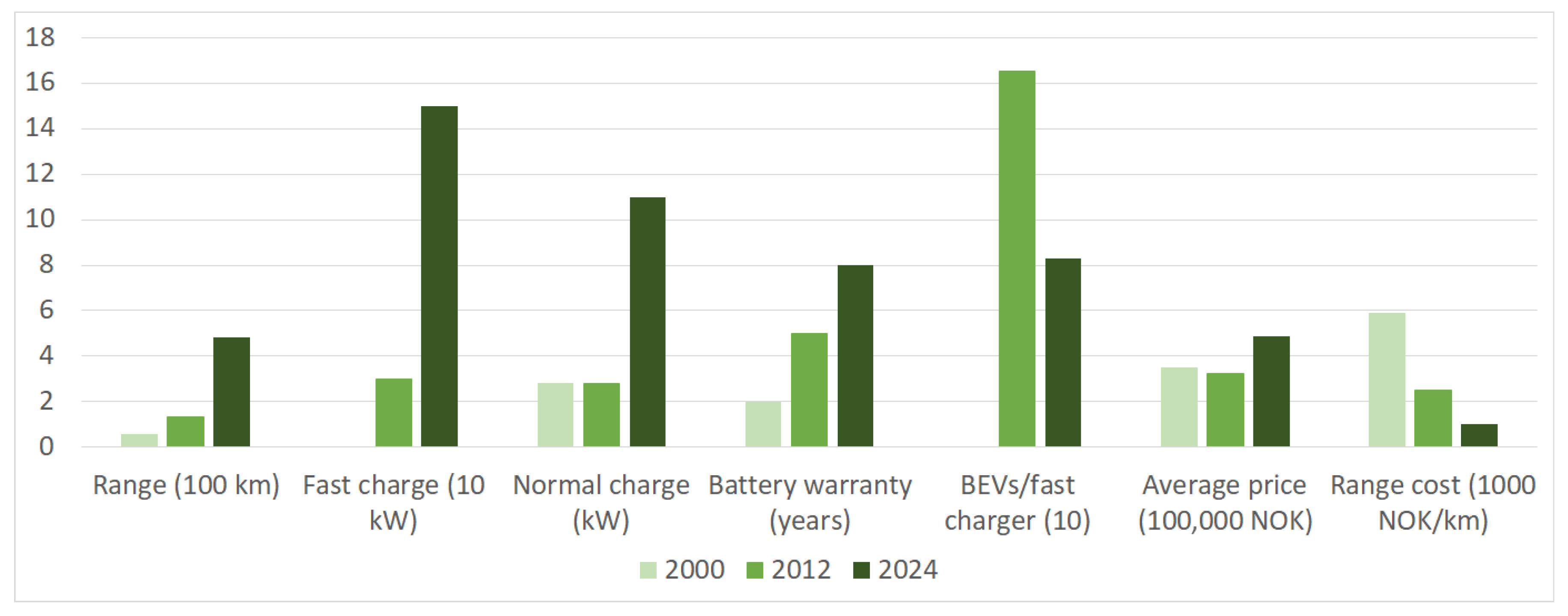
| Battery warranty (years/km) | 2/- | 2/- | 2/- | 2/- | 5/100,000 | 8/160,000 | 8/160,000 |
| Average WLTP range km | 30–40 | 40–70 | 40–70 | 50–86 | 120 to 209 | 301 to 433 | 433 to 484 |
| Average range winter (est.) km | 20 | 30–50 | 30–50 | 35–60 | 80 → 150 | 210 → 300 | 300 → 340 |
| Charge power (normal) kW | 2.3 | 2.8 | 2.8 | 2.8 | 2.8–7 | 4.6–7 (Some up to 11) | 4.6–11 (some up to 22) |
| Charge power (fast, average) kW | 30–80 | 40–150 | 60–150 | ||||
| Use area | Local | Local | Local | Local | Regional | Everywhere | Everywhere |
| Average price in 1000 (2024) NOK | 186–202 | 201–368 | 190 | 209–263 | 315–411 | 466–542 | 487–609 |
| Price/km range in 1000 (2024) NOK | 6.7 → 6.2 | 6.1 → 4.4 | 3.8 → 3.7 | 3.8 → 3.0 | 3 → 2 | 1.6 → 1.1 | 1.2 → 1.0 |
| Public normal chargers (nr. of) | 0–30 | 30–50 | Not available | From ca. 0 to 1163 | From 2297 to 7830 | From 6858 to 12,962 | From 17,558 to 18,932 |
| Public fast chargers (nr. of) | None | None | None | None | From 5 to 529 | From 847 to 2950 | From 5183 to 9478 |
| Tesla reserved chargers (nr. of) | None | None | None | None | From 0 to 228 | From 364 to 1085 | From 484 to 4 |
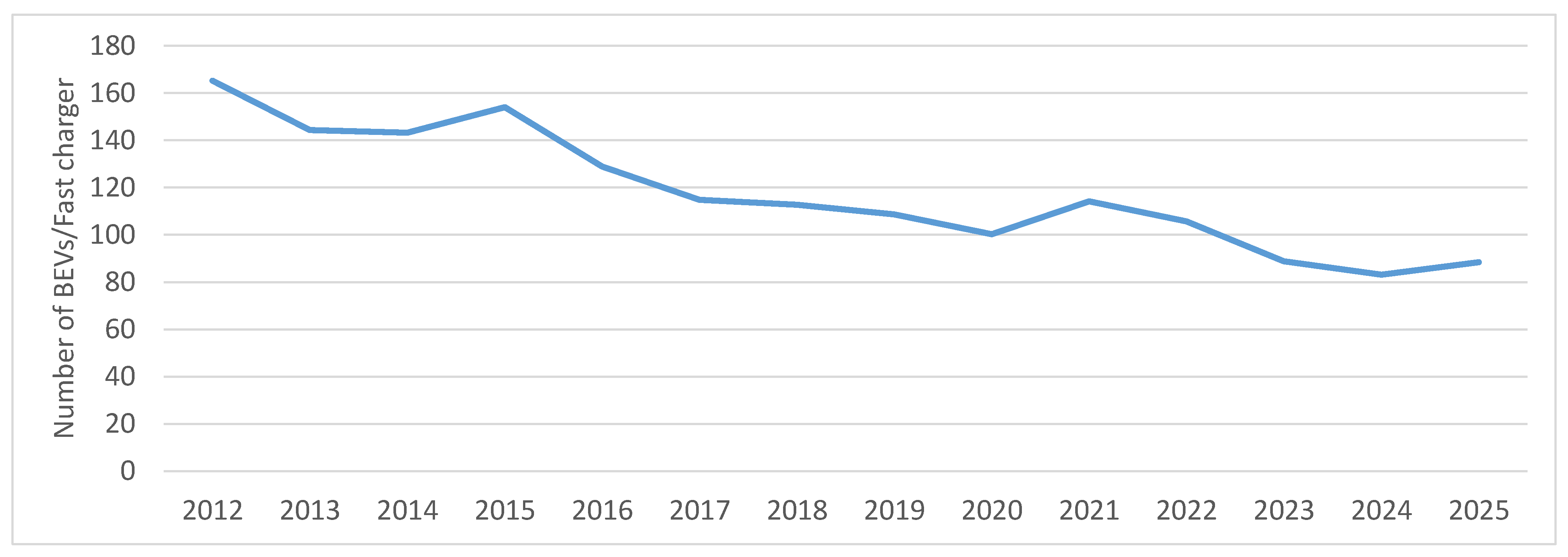
| BEVs/fast charger (incl. Tesla) | n.a. | n.a. | n.a. | n.a. | From 165 to 129 | From 115 to 100 | From 114 to 83 |
| Geography fast charger available. | n.a. | n.a. | n.a. | n.a. | Local/regional | South-Norway | Across Norway |
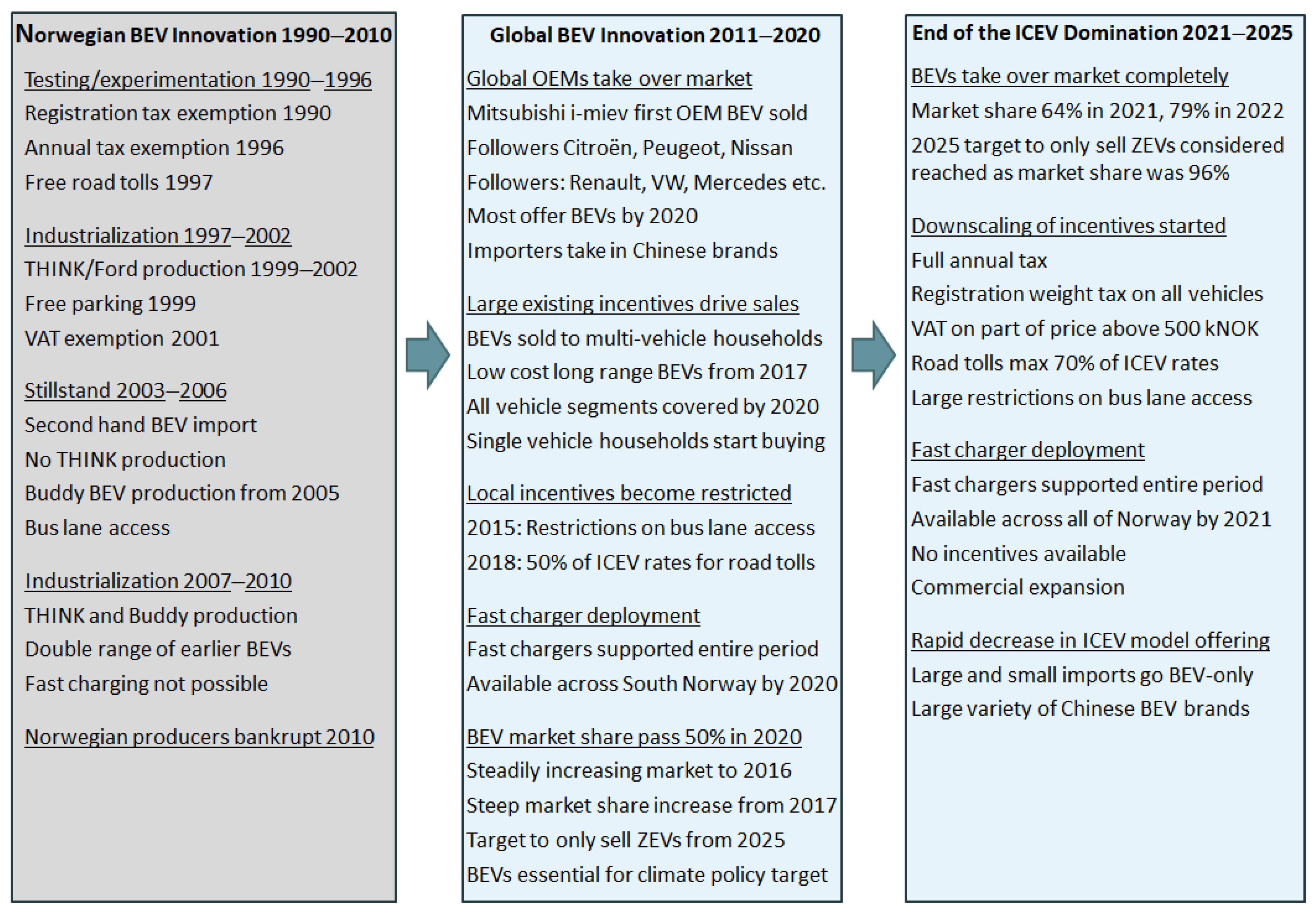
| 1990–2010 | 2011–2020 | 2021–2025 | ||
|---|---|---|---|---|
| Supply-side issues | BEV supply | Norwegian small-volume production of mini BEVs, a few BEVs imported from France | OEM BEVs, starting with four brands, growing to most brands and new Chinese brands at the end of the period | All OEMs offered BEVs, BEV model availability became higher than ICEV model availability |
| BEV characteristics | 30–60 km range, increasing to 80–120 km at the end of the period. Slow, small (two seats). No fast charge capability | First small/compact OEM BEVs had 80–140 km range, expanding to 300–500 km for most segments by 2020. 30–50 kW fast charge up to 2016, then 40–150 kW | Range expanded to 400–700 km and fast charge power to 100–200 kW, some even higher | |
| Charging-infrastructure deployment | None, until 2009–2010 when the first public normal chargers were put in place, first in Oslo, then nationwide | Support for normal chargers across Norway, fast chargers around and between cities. Flat owners received a right to charge | All charging infrastructure deployed on commercial terms. Very limited support available in areas without fast chargers | |
| Norwegian Policies | Generally applicable policies such as research grants, none for vehicle production specifically | Increasingly ambitious targets until target to only sell ZEVs from 2025 introduced 2017. | National target to only sell ZEVs from 2025 | |
| European policies | EU new vehicle CO2 regulation increases BEV availability | EU new vehicle CO2 regulation forces all OEMs to offer BEVs | ||
| Demand-side issues | User characteristics | Mainly fleets testing BEV usability and a few enthusiasts | Commuter, multi-vehicle house-holds, and expansion to single-vehicle households from 2017 | Everyone buys BEVs, including laggards as selection of ICEVs is greatly reduced |
| Consumer awareness | BEVs were unknown in 1990. By 2010, BEVs were well-known in/around cities, highly visible with recognizable designs and use of bus lanes | Awareness increases to all parts of Norway as diffusion increased outside city areas and BEVs were widely covered in the press | BEVs established as a standard vehicle purchase option along with gasoline and diesel vehicles | |
| Charging-infrastructure availability | Home charging from regular household outdoor sockets. No public chargers, no fast chargers | First fast chargers deployed and spread gradually out across Southern Norway | Fast chargers available all over Norway and expanded further on commercial terms. | |
| Policies | Exemptions from registration tax, annual tax, value added tax, access bus lanes, free road tolls, free parking, reduced ferry rates | Incentives continue, local incentive value is reduced by 50% from 2018 | Incentives still available but downscaling of tax exemptions started and reduction in local incentive value continued. | |
| Total cost of ownership factoring in incentives | Unfavorable apart from when cheap second-hand BEVs were imported from France | Favorable, but barriers related to limited range, uncertain life persisted the first years | Favorable, very few barriers, life expectancy of batteries now matches vehicle life | |
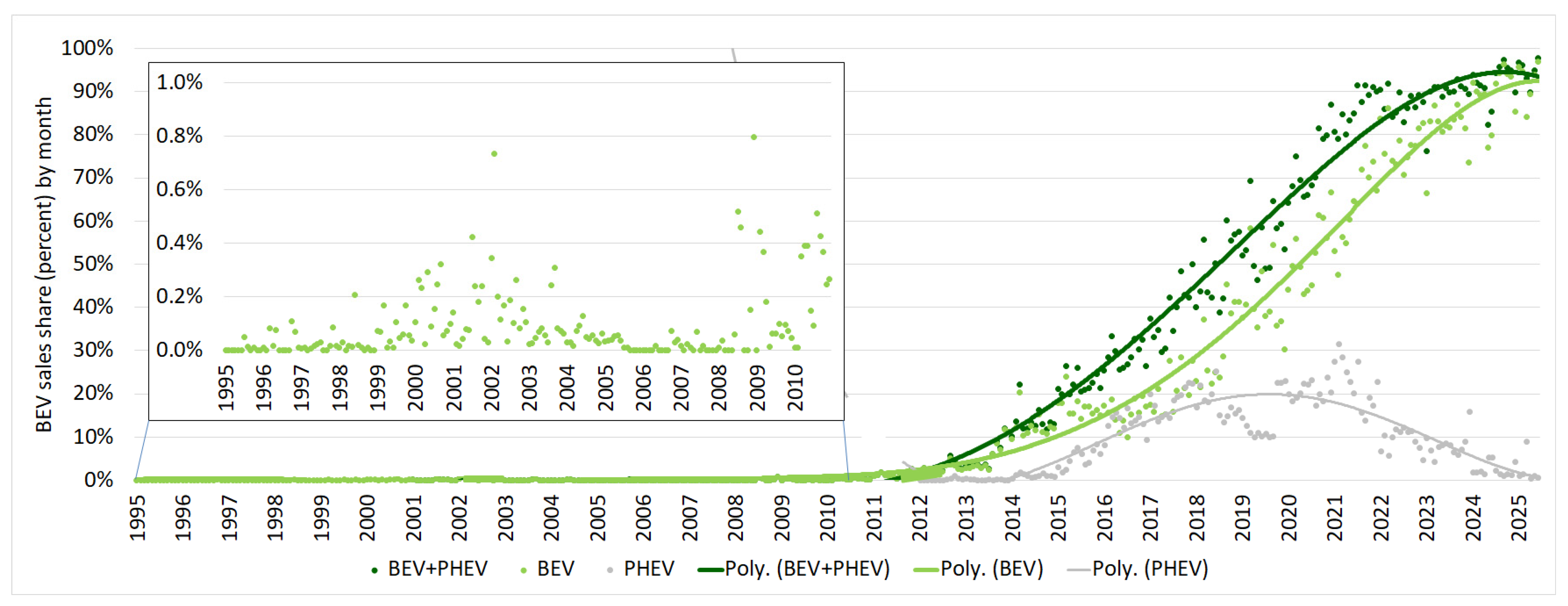
| Market and fleet | BEV market share | Close to zero, below 0.5% | Increasing from 1% to 16% (2016) and 54% 2020. | Increasing from 65% to 96% |
| BEV fleet share | ~0% | Increasing from ~0% to 12% | Increasing from 16% to 33% | |
| Intended market niche | Local transport in cities and public and private fleets | Commuters, multi-vehicle households and fleets. In the end all household types | General purpose one-to-one ICEV replacements in all vehicle segments and uses |
Disclaimer/Publisher’s Note: The statements, opinions and data contained in all publications are solely those of the individual author(s) and contributor(s) and not of MDPI and/or the editor(s). MDPI and/or the editor(s) disclaim responsibility for any injury to people or property resulting from any ideas, methods, instructions or products referred to in the content. |
© 2026 by the author. Published by MDPI on behalf of the World Electric Vehicle Association. Licensee MDPI, Basel, Switzerland. This article is an open access article distributed under the terms and conditions of the Creative Commons Attribution (CC BY) license.
Share and Cite
Figenbaum, E. Reaching the End of the ICEV Domination: 35 Years of Battery Electric Vehicles in Norway. World Electr. Veh. J. 2026, 17, 89. https://doi.org/10.3390/wevj17020089
Figenbaum E. Reaching the End of the ICEV Domination: 35 Years of Battery Electric Vehicles in Norway. World Electric Vehicle Journal. 2026; 17(2):89. https://doi.org/10.3390/wevj17020089
Chicago/Turabian StyleFigenbaum, Erik. 2026. "Reaching the End of the ICEV Domination: 35 Years of Battery Electric Vehicles in Norway" World Electric Vehicle Journal 17, no. 2: 89. https://doi.org/10.3390/wevj17020089
APA StyleFigenbaum, E. (2026). Reaching the End of the ICEV Domination: 35 Years of Battery Electric Vehicles in Norway. World Electric Vehicle Journal, 17(2), 89. https://doi.org/10.3390/wevj17020089