1. Introduction
Climate change is an urgent issue, with current carbon dioxide (CO
2) levels reaching around 421 ppm, approximately 50% higher than pre-industrial levels [
1]. The transportation sector is a major contributor, responsible for around 25% of global CO
2 emissions [
2]. Within this sector, road transport accounts for nearly 75% of emissions, with light-duty vehicles (cars, vans, and small trucks) making up to 45% [
2]. In response, Europe is pursuing a pathway to carbon neutrality, aiming for a 55% reduction in emissions by 2030 and climate neutrality by 2050. Central to this strategy is the promotion of new light-duty vehicle (LDV) technologies, including battery electric vehicles (BEVs), hybrid electric vehicles (HEVs), plug-in hybrid electric vehicles (PHEVs), and hydrogen fuel cell vehicles (FCEVs). While transitioning to new light-duty vehicle technologies and implementing stringent regulations are crucial steps toward carbon neutrality, they seem to be insufficient. Reducing street-level impacts and optimizing urban infrastructure, through traffic flow improvements, enhanced public transportation, active mobility initiatives such as cycling and walking, and the integration of smart city solutions, can effectively lower transportation emissions while enhancing urban sustainability and livability [
3].
This work builds upon and significantly extends a previous conference publication by the authors [
4]. In this expanded version, a much deeper literature review is presented alongside a more comprehensive methodology detailing all analytical phases, from data acquisition to indicator calculation. The manuscript also features new figures and a more focused discussion on the specific impacts of vehicle technologies and urban street characteristics. These substantial enhancements represent a considerable improvement over the original study, offering a more robust and actionable framework for urban sustainability planning.
To estimate energy consumption and emissions from vehicles at the city level, road transport energy use and emissions indicators are assessed based on the distribution of vehicle technologies across different road categories.
Generally, a vehicle perspective methodology is used to define the emissions from vehicles at the city level, which can be mainly divided into two approaches: the first involves integrating traffic volumes on road segments with their corresponding emission factors based on dynamic or static databases; the second approach defines the specific energy use and emissions for a given vehicle, then extrapolates the scenario based on traffic count.
Integrating traffic volumes on road segments can be done using a dynamic database built from manual or automated local traffic counting [
5], offering high spatial and temporal resolution but requiring significant time and cost. Access to these databases normally is restricted, and the size of the region it covers is very limited [
6].
Traffic volume can also be simulated using social media data [
7] or telecom data [
8] as an alternative to traditional traffic data, but these sources introduce uncertainties due to privacy restrictions, sampling biases and the need for advanced data processing techniques [
6]. Afterward, traffic emissions are estimated using emission factors based on traffic volume, influenced by factors such as fuel consumption, the age and composition of the vehicle fleet, traveling speed and traffic congestion.
These emission factors are often derived from established sources such as:
The Handbook Emission Factors for Road Transport (HBEFA), which provides detailed emissions data under various driving conditions [
9].
Static database simulators, traffic volume emissions can be estimated for a specific region over a defined period, based on existing emission calculation models like, the Calculation of Air Pollutant Emissions from Road Transport (COPERT) model [
10] or the German Transport Model, DEMO [
11].
However, these models tend to be very complex and require extensive data inputs.
The second approach regarding the vehicle perspective methodology offers enhanced accuracy by defining energy use and emissions based on vehicle type through predictive models derived from real-world on-road measurements. This allows for more precise results by considering both vehicle characteristics and external conditions. These models may include machine learning techniques [
12,
13,
14], physics-based and semi-empirical models such as Vehicle Specific Power (VSP) [
15,
16,
17] or energy-based models [
18].
By leveraging real-world data, these models predict energy consumption and emissions across various vehicle types with higher precision. This approach facilitates the build-up of a vehicle specific database, which can then be extrapolated using dynamic datasets derived from traffic counts, similar to the first approach. While this method yields more accurate predictions, it is more time-consuming and computationally intensive.
Despite the common use of a vehicle perspective methodology, a street perspective methodology can also be employed to estimate vehicle emissions at the city level. Several factors related to street characteristics, such as road grade, surface quality, road length, width and curvature, traffic control measures and maximum speed, have an impact on emissions.
Road gradient significantly influences vehicle energy consumption and emissions. Kaishan Zhang and H. Christopher Frey, based on analysis combining LIDAR-estimated road grades with portable emissions measurement system (PEMS) data, demonstrated that on road grades of approximately 5%, vehicle emissions increased substantially compared to flat terrain, with nitrogen oxides (NO
x) rising by up to 450%, carbon monoxide (CO) by up to 140%, hydrocarbons (HC) by up to 110%, and CO
2 by up to 90% [
19].
Jens Gallus et al. furthermore, based on PEMS data collected on real driving test routes with precise road grade estimation using a segment method applied to Google elevation data, confirmed this trend for passenger diesel vehicles observing increases in CO
2 emissions between 65% and 81%, and NO
x emissions between 85% and 115% as road grades rose from 0% to 5% [
20].
Flamur Salihu et al. found that VSP increases linearly by approximately 5.07 kW/t for every 1% increase in road grade, with positive road grades up to 10% corresponding to VSP values as high as 60 kW/t. This increase in VSP correlates with marked rises in emissions, particularly CO, HC, and NO
x [
21].
Complementing these works, Bigang Jiang et al. conducted comprehensive road tests in mountainous regions using Geographic Information System (GIS) technology to accurately calculate road gradients and collected vehicle data to analyze VSP and fuel consumption. Their findings revealed a strong positive correlation between road gradients from −5% to +5%, VSP, and fuel consumption. Fuel consumption increased linearly with slope and peaked near a +4% gradient, where uphill driving increased fuel use by up to 96% compared to flat roads. The results of the study revealed that, for road gradients between 1% and 3%, the fuel saved during downhill driving effectively offsets the additional consumption required for uphill travel. However, on steeper slopes ranging from 4% to 6%, the increase in fuel consumption during the climb significantly surpasses the savings achieved during the descent, leading to a net increase in energy demand [
22].
Road roughness significantly influences vehicle emissions. In a study conducted in the United States, Li et al. investigated the impact of pavement roughness—measured by the International Roughness Index (IRI)—on vehicle emissions. Utilizing detailed vehicle data combined with PEMS, the study revealed a complex, nonlinear relationship between pavement roughness and emissions. Interestingly, both very smooth and very rough pavements were found to increase emissions such as CO
2 and NO
x, largely due to altered driving behaviors and variations in engine load [
23].
In contrast, Mora et al. analyzed urban roads in Barranquilla, Colombia, applying the IRI alongside a calibrated mechanistic Highway Development and Management model to estimate fuel consumption and emissions. Their results indicated a clear, linear increase in fuel consumption and greenhouse gas emissions, predominantly CO
2 and NO
x, correlating directly with increasing pavement roughness. The study also found that variations in pavement macrotexture had a negligible effect, less than 1%, on emissions. Moreover, larger vehicles exhibited greater sensitivity to pavement roughness compared to smaller vehicles such as motorcycles [
24].
Road expansion, whether through longer highways or wider lanes, consistently increases travel demand, energy use, and emissions. Early work by Hansen and Huang, using California data from 1973–1990, showed that a 1% increase in highway lane miles raised vehicle miles traveled (VMT) by about 0.2% in the short term and 0.7% in the long run, pointing to persistent demand growth as roads expand [
25].
Noland and Cowart reached similar conclusions with U.S. metropolitan data (1982–1996), estimating VMT elasticities of 0.28 (short run) and 0.90 (long run) [
26]. Further analysis by Noland suggested an even stronger response, with short-run elasticities between 0.3–0.6 and up to 1.0 in the long run, nearly a one-to-one expansion in traffic and emissions with additional capacity [
27].
Duranton and Turner, using U.S. metropolitan panel data (1983–2003), found a proportional response: each 1% increase in lane miles induced about a 1% increase in VMT [
28].
Mohajeri et al. extended the discussion beyond highways, analyzing 41 British cities and demonstrating that transport fuel use and CO
2 emissions rise superlinearly with total street-network length (scaling exponents ≈ 1.14 for fuel, 1.13 for CO
2), suggesting that larger networks disproportionately amplify energy demand and emissions [
29].
More recently, a global study by Boeing et al. found that a 1% increase in per capita street length is associated with a 0.8% rise in transport emissions. Conversely, straighter and more connected street networks are linked to lower emissions [
30].
Road curvature also plays a crucial role in influencing vehicle fuel consumption and emissions.
According to Dong et al., the smaller the curvature radius, the higher the energy consumption and emissions due to rapidly increasing turning losses. Increasing the radius reduces lateral forces significantly and brings emissions closer to those on flat roads. Superelevation further helps by offsetting centrifugal forces through banking the road surface inward, which reduces the lateral force the tires must resist. This reduction in lateral force lowers the curve driving resistance, thereby decreasing energy consumption and carbon emissions while maintaining driving stability and comfort [
31].
The impact of traffic control measures on fuel consumption and emissions is multifaceted and context dependent, while certain strategies can reduce emissions by optimizing traffic flow, others may inadvertently increase. Boulter et al. conducted field monitoring and emission testing of traffic calming devices such as speed humps and speed restrictions, finding that poorly designed measures can increase emissions by 20–60% due to repeated acceleration and deceleration cycles [
32].
Alshayeb et al. analyzed fuel consumption and emissions at signalized intersections using traffic simulation coupled with a microscopic fuel consumption and emission model. They found that frequent stops and acceleration events caused by fixed-time or poorly coordinated traffic lights significantly increase fuel consumption, with the stop penalty factor, varying widely depending on operational conditions such as vehicle type, driving behavior, road gradient and cruising speed [
33].
Zong et al. evaluated various congestion pricing schemes (charging by distance, time, or both) using a bi-level optimization framework that combined traffic simulation with real-world travel behavior data. They found that combined pricing strategies can reduce carbon emissions, while also decreasing car-mode share [
34].
Most recently, Wu et al. developed a big-data empowered adaptive traffic signal control system that dynamically adjusts traffic lights timings using real-time microscopic traffic data. Their large-scale study across China’s 100 most congested cities demonstrated emission reductions of 13–18% and fuel savings exceeding 15% by smoothing traffic flow, minimizing stops, and reducing idling time [
35].
Finally, the maximum speed of a road, despite being determined by various design characteristics and functional considerations, also influences emissions.
According to Otten et al. CO
2 emissions follow a U-shaped pattern in relation to the vehicle speed. At low speeds (0–50 km/h), stop-and-go driving increases fuel consumption and emissions. Moderate speeds (50–90 km/h) are the most efficient, minimizing emissions through steady driving. At high speeds (above 100–120 km/h), aerodynamic drag increases, leading to higher engine rpm and load, hence raising emissions [
36].
By addressing urban street-level characteristics, it is possible to promote sustainable practices that enhance climate neutrality while improving quality of life. [
37].
The aim of this work is to assess a small neighborhood by calculating an indicator that identifies which streets have the most significant impact in terms of energy consumption and CO2 emissions due to traffic and their specific characteristics. Additionally, this study evaluates the individual impact of each LDV technology within the neighborhood context and analyze how different combinations of technologies, based on traffic distribution, influence overall energy and emissions outcomes.
Compared to existing methods, this approach introduces a shift in perspective. While VSP is traditionally used to characterize vehicle performance or driver behavior, this methodology associates VSP directly with the street’s physical characteristics. Previous studies using VSP and GIS established foundational links between road grades and power demand [
21,
22]. However, those findings are often limited to specific vehicle types or the analysis of a restricted number of road segments during individual trips.
This work builds upon those foundations but moves toward a network-level analysis. By combining power demand with road network properties, the proposed framework identifies critical energy-demand corridors inherent to the urban layout. Unlike traditional indicators that depend on traffic volumes, this tool highlights permanent structural inefficiencies that impact energy consumption regardless of fleet modernization or vehicle technology.
2. Methodology
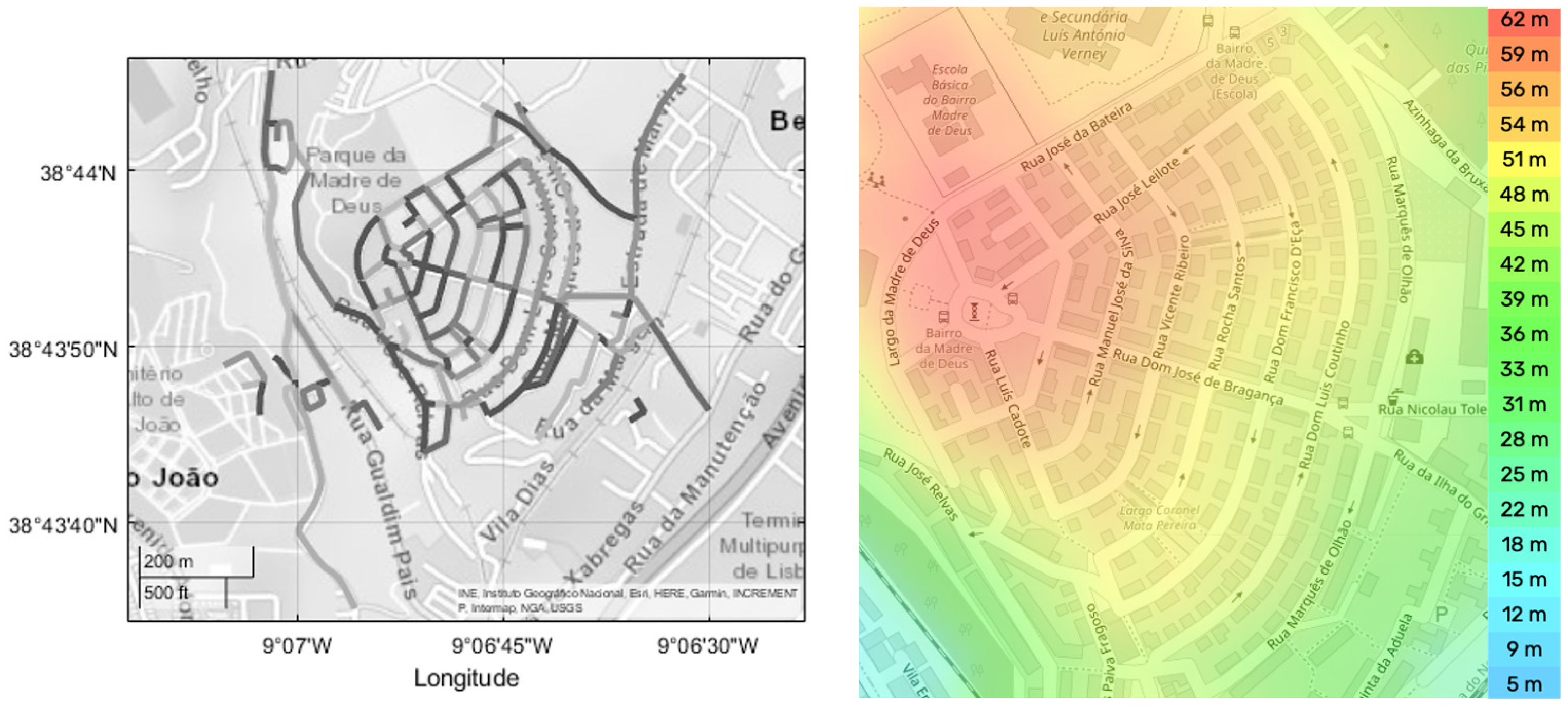
This case study examines a specific area within the Beato neighborhood in Lisbon, consisting of 26 streets, as illustrated in
Figure 1. Serving as a representative model, it offers insights that can be applied to other districts in Lisbon and comparable European cities. While primarily residential, the neighborhood also includes a school district, which influences traffic patterns throughout the day. A well-organized bus network ensures efficient connectivity between the neighborhood’s central hub and the school zone. Additionally, its limited access points enable effective monitoring of traffic flow in and out of the area.
After identifying the 26 street names, the next step in the methodology involves gathering data from Bing Maps APIs. To initiate the route collection process, a request is sent to the Bing Maps API [
38], which requires an origin and a destination as inputs. In this case, one of the 26 streets is used as the origin, with the remaining 25 streets serving as destinations for each request. This process is repeated for every street, ensuring all possible routes are covered.
A MATLAB script (version R2024b) was developed to extract relevant route data for the study. When a request is sent, the Bing Maps API returns route information in JSON format, including latitude and longitude coordinates, maneuvers, street attributes and other relevant details. Following the initial request, a subsequent request is sent to the Bing Maps Elevation API [
38] to obtain altitude data for the selected route. Additionally, supplementary requests are sent to the OpenStreetMap API [
39] along the route to gather detailed information on crosswalks, traffic light locations, stop sign placements and other key roadway features.
This multi-source integration provides a high spatial data resolution (approximately 1 m) of the neighborhood. By combining these high-resolution geographic features with the travel times provided by the API, the speed cycle simulation tool ensures that the generated driving profiles are both structurally accurate and temporally realistic, effectively capturing the micro-scale impacts of road geometry.
Through data collection, a 26-by-26 matrix is built with an empty diagonal, resulting in a total of 650 possible routes.
With all data gathered, it is possible to develop driving cycles associated with each route, considering different driving styles and traffic conditions. The driving styles can be categorized as normal, eco-driving, and aggressive driving, with the main parameters summarized in
Table 1, following the methodology established by Nunes [
40].
Traffic conditions can be classified as rush hour (RH) or off-rush hour (ORH) and are shaped by key factors such as the unpredictability of stops, the duration of stops and the characteristics of the road infrastructure, as detailed in previous studies [
40].
A MATLAB code, adapted from previous work [
40], was used to create five driving cycles for each driver’s behavior (Eco, Normal and Aggressive) and traffic condition (RH and ORH), resulting in 30 driving cycles per route and a total of 19,500 driving cycles generated.
To analyze the generated driving cycles the VSP methodology is applied to each second of driving [
41]. The VSP is calculated according to Equation (1), being this a simplified equation, where
v corresponds to vehicle speed (m/s),
a corresponds to vehicle acceleration (m/s
2) and
grade corresponds to the relationship between altitude and distance traveled (dimensionless).
The calculation of the VSP value is performed every second of the trip and is typically grouped into fourteen mode bins. Using VSP modes allows to analyze vehicle behavior in different bins, by assessing power considering only parameters from vehicle dynamics [
42,
43], as shown in
Table 2.
From another perspective, street characteristics directly impact the VSP calculation, so, instead of calculating the VSP distribution for each specific route individually, the goal is to establish an approach to define a VSP distribution at the street level.
Based on the 19,500 driving cycles, a mean VSP distribution was established for each street, considering the street directions when applicable.
The frequency of street usage was calculated based on the kilometers traveled on each street across the 19,500 driving cycles. A higher frequency of usage may correlate with the street type and the infrastructure present. The frequency level of each street is entirely dependent on the route design—meaning that if a street is used more often, it likely provides better accessibility.
For the purpose of comparing results and improving the indicator, an actual count was carried out in order to obtain the effective frequency of use.
This count took place over the course of a single, representative weekday during a period of normal urban activity (outside of school or public holidays) to ensure the characterization of typical mobility patterns. The operation was conducted by a team of four researchers throughout the entire day. During peak hours, monitoring was prioritized in areas identified as having the highest traffic conflict and density. Conversely, during off-peak periods, the team was redistributed across various points in the neighborhood to ensure a balanced spatial coverage.
The calculation of street observed frequency was defined as the ratio between the number of vehicles on a given street and the total number of vehicles in the neighborhood, considering the time period (off-rush hour or rush hours).
Leveraging VSP at the street level, along with street usage frequency, enables the calculation of an impact indicator, named Street VSP Impact Factor (SVIF), as shown in Equation (2).
This indicator combines the percentage of time spent in each VSP mode (%ti) with the average VSP for that mode (W/kg) and the frequency of street usage (%F), considering the direction of the street, if applicable. The fact that the VSP framework (W/kg) inherently normalizes power demand by vehicle mass allows the SVIF to reflect the structural energy demand of the street layout independent of absolute vehicle weight, providing a standardized metric for energy intensity across the network.
A higher SVIF indicates a street’s greater impact on energy consumption and emissions due to frequent use or high-power demand. A lower SVIF suggests less influence, either from low traffic or lower power-demanding conditions. Identifying high SVIF streets helps target areas for traffic management, infrastructure upgrades, and vehicle technology deployment, such as prioritizing electrification in high-impact zones.
The positioning of the SVIF against existing vehicle- and city-scale methodologies is compared in
Table 3, based on their inputs, outputs, and scale.
While the indicator reflects the impact at the street level, it is also possible to quantify impacts at technology level.
For all LDVs, the impact at the technology level can be assessed by knowing each vehicle’s characteristic VSP profile, which represents energy consumption and, where applicable, emissions based on real driving test data,
(g/s). Energy consumption per distance (Wh/km) or emissions per distance (g/km), denoted as
x, are determined based on the sum of the percentage of time,
%ti, spent in each VSP mode per street, multiplied by the total time,
t (s), spent on the street and the energy consumption or emissions in that VSP mode,
. This sum is then normalized by the total distance,
d (km), traveled on that street differentiated by traffic type, as shown in Equation (3).
The overall impact in terms of energy consumption and emissions (where applicable) is determined by applying the distribution of traffic types and existing technologies to the individual impact of each technology, weighted by the number of vehicles (
N), as outlined in Equation (4).
Finally, with the SVIF indicator and the overall impact, in terms of energy consumption and emissions, calculated for each street, it is possible to validate the indicator through the Pearson correlation coefficient to assess the relationship between SVIF and the impact per street, simplified by Equation (5).
The variable xi and yi represent the paired observations of SVIF and the overall impact for each street, and and their respective means. The significance of this correlation is tested using a p-value calculated from the t-statistic.
3. Results
Based on the methodological procedure, the frequency of street use and the SVIF were determined based on traffic type, off and rush hour. Each street is represented on the
x-axis by a unique number. If the street has two directions, a letter is appended to the number to differentiate them.
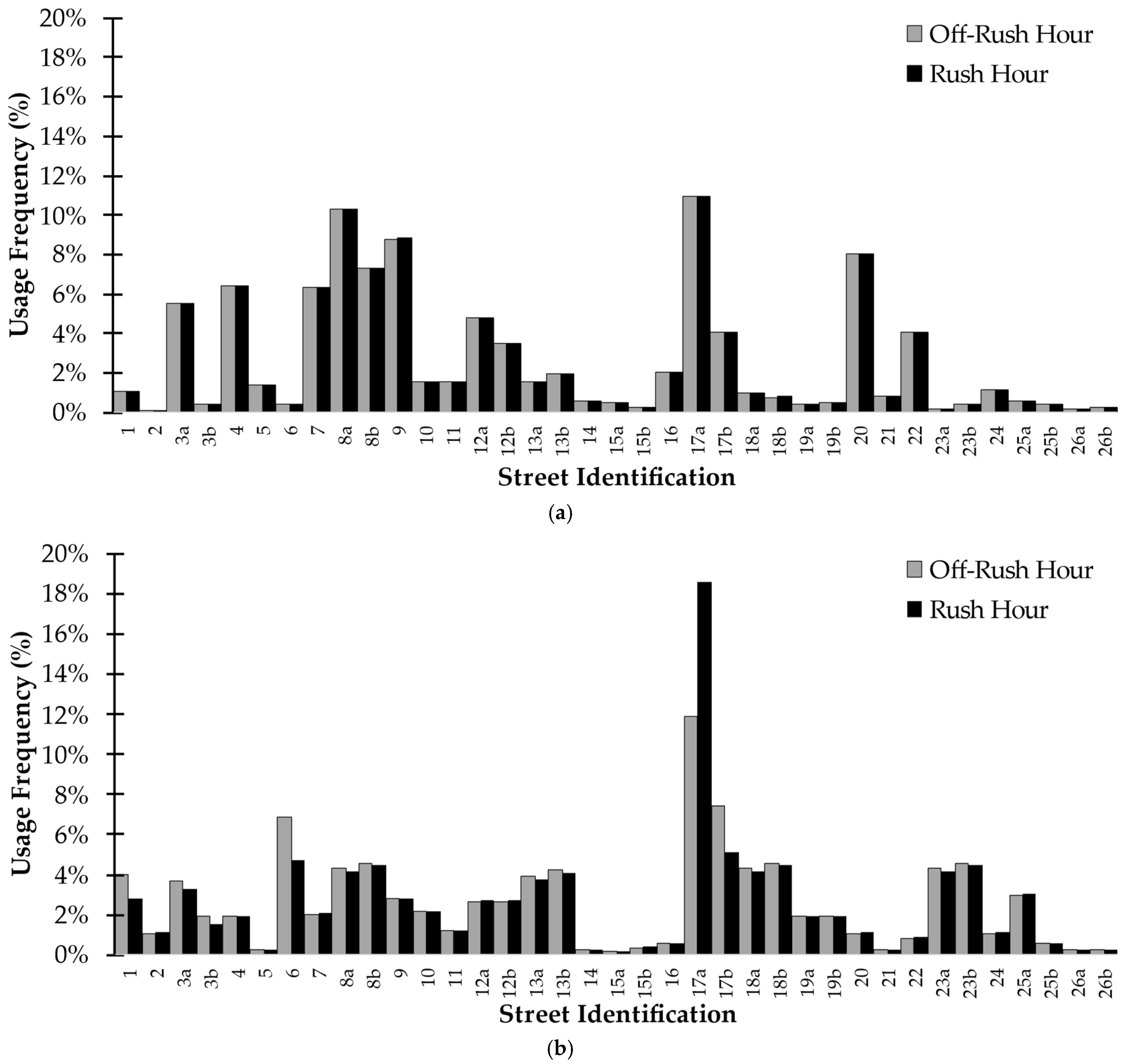
Figure 2 illustrates the theoretical frequency, estimated from the distance traveled on each street within the driving cycles, and the observed frequency, derived from a manual count conducted during both off-rush and rush hours.
The comparison between the observed and the theoretical frequency data shows that observed frequencies are often higher than the calculated ones during on and off-rush hours, suggesting more consistent traffic flow.
However, during rush hours, an increase in the observed frequency is detected compared to off-rush hours on specific streets, such as Street 17a, which functions both as an entry and exit point of the neighborhood and hosts a school cluster. This effect is not reflected in the theoretical frequency, likely because the calculation method, which is based solely on distance traveled, does not consider factors such as congestion, that increase stop times, but do not affect the total distance traveled.
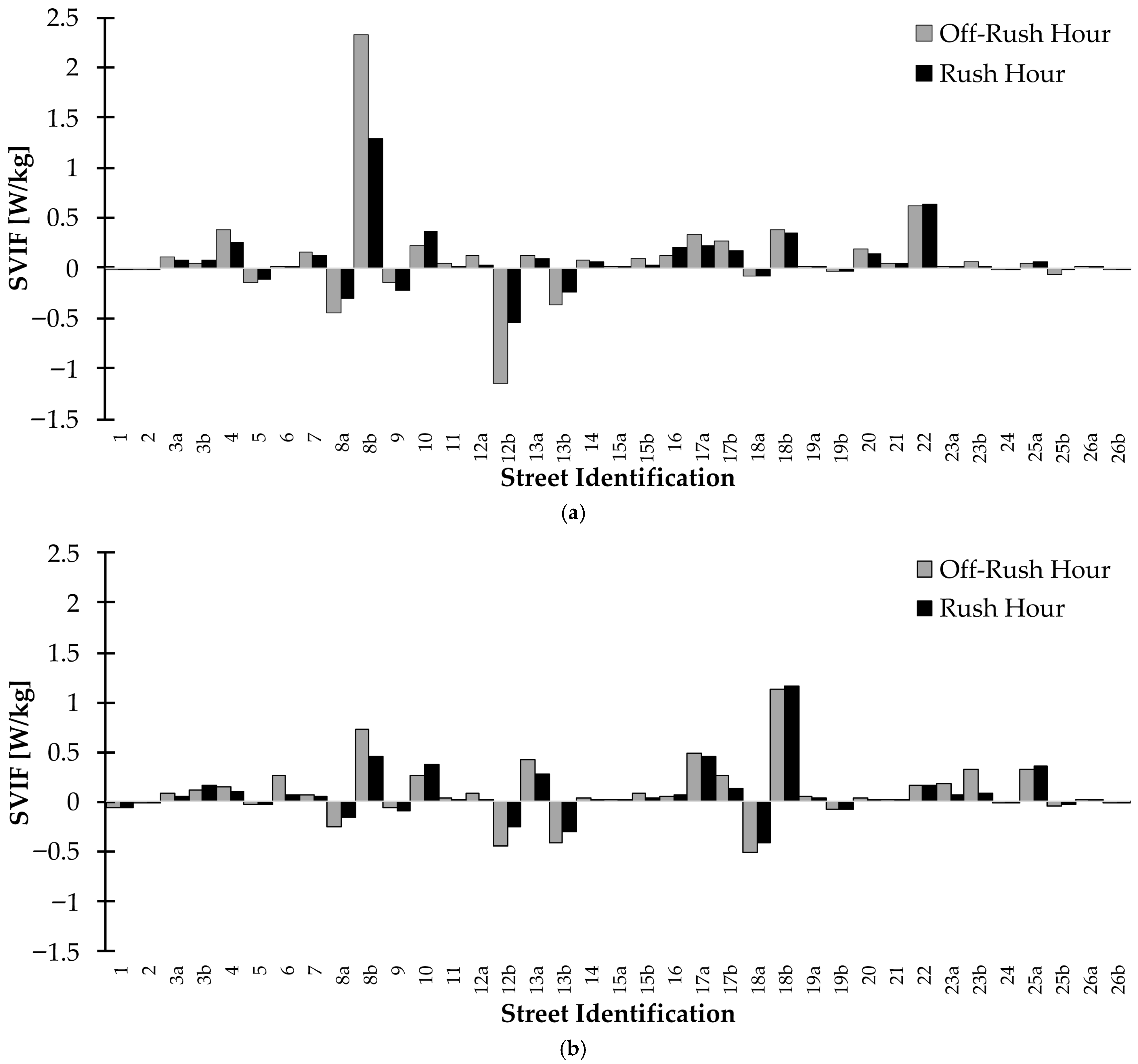
Figure 3 illustrates the SVIF indicator calculated using both theoretical and observed frequencies based on Equation (2). In this case, although the frequency influences the SVIF value, it is the characteristic VSP profile of each street that defines whether that street will have a significant or minor impact in terms of energy consumption and emissions.
Based on
Figure 3, the SVIF calculation maintains a consistent trend, regardless of whether theoretical or observed vehicle frequencies are used as input, as the topography and speed profile remains unchanged. While specific values may vary, the overall pattern shows higher impacts during off-rush hours and lower impacts during rush hours. This occurs because vehicles travel at higher speeds during off-rush hours, leading to greater power demands and emissions per second. This suggests that the theoretical SVIF effectively captures the overall trend, even if it may underestimate the magnitude of impact under certain traffic conditions. Nevertheless, the SVIF indicator provides a useful measure of each street’s impact within the neighborhood.
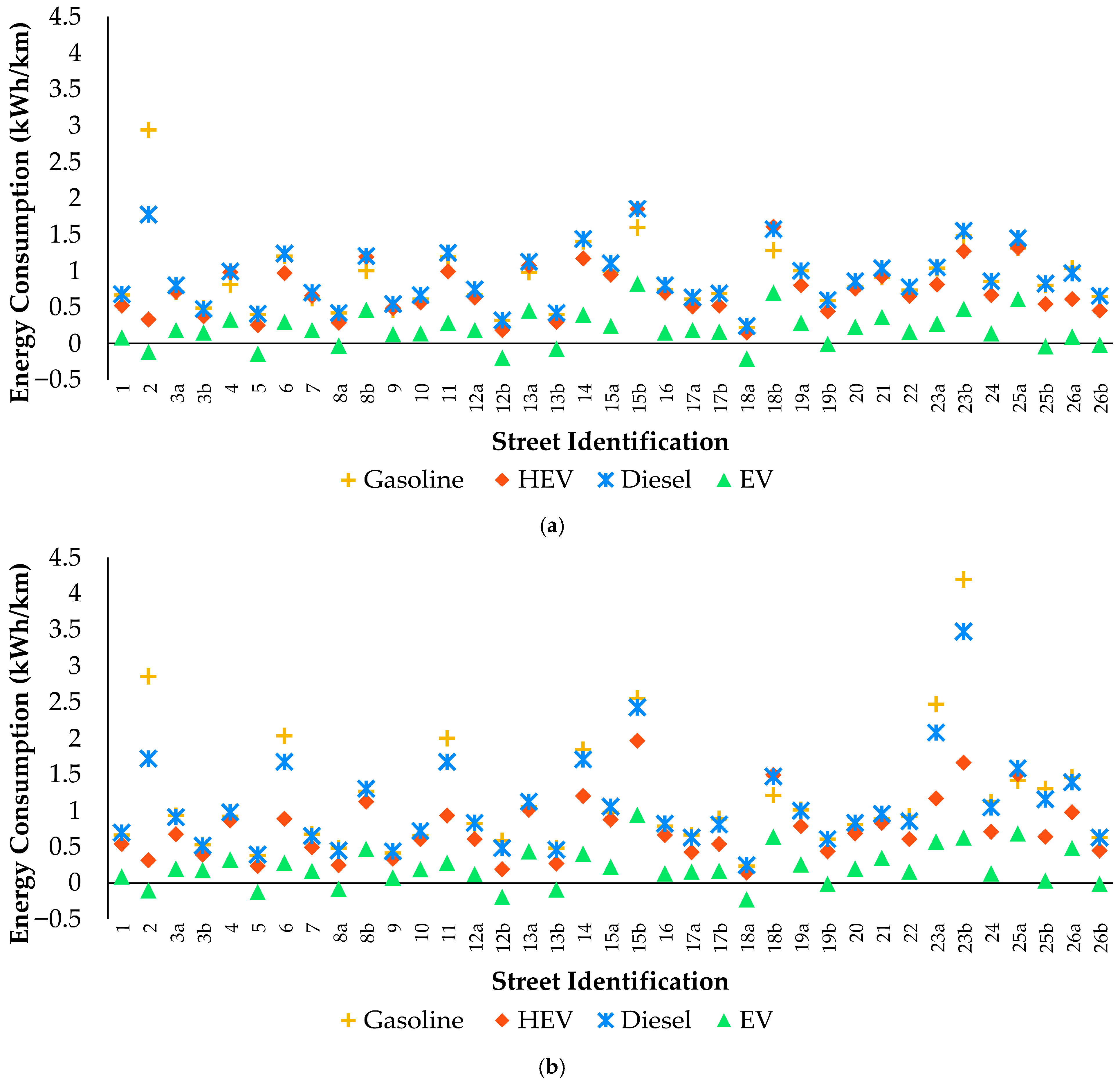
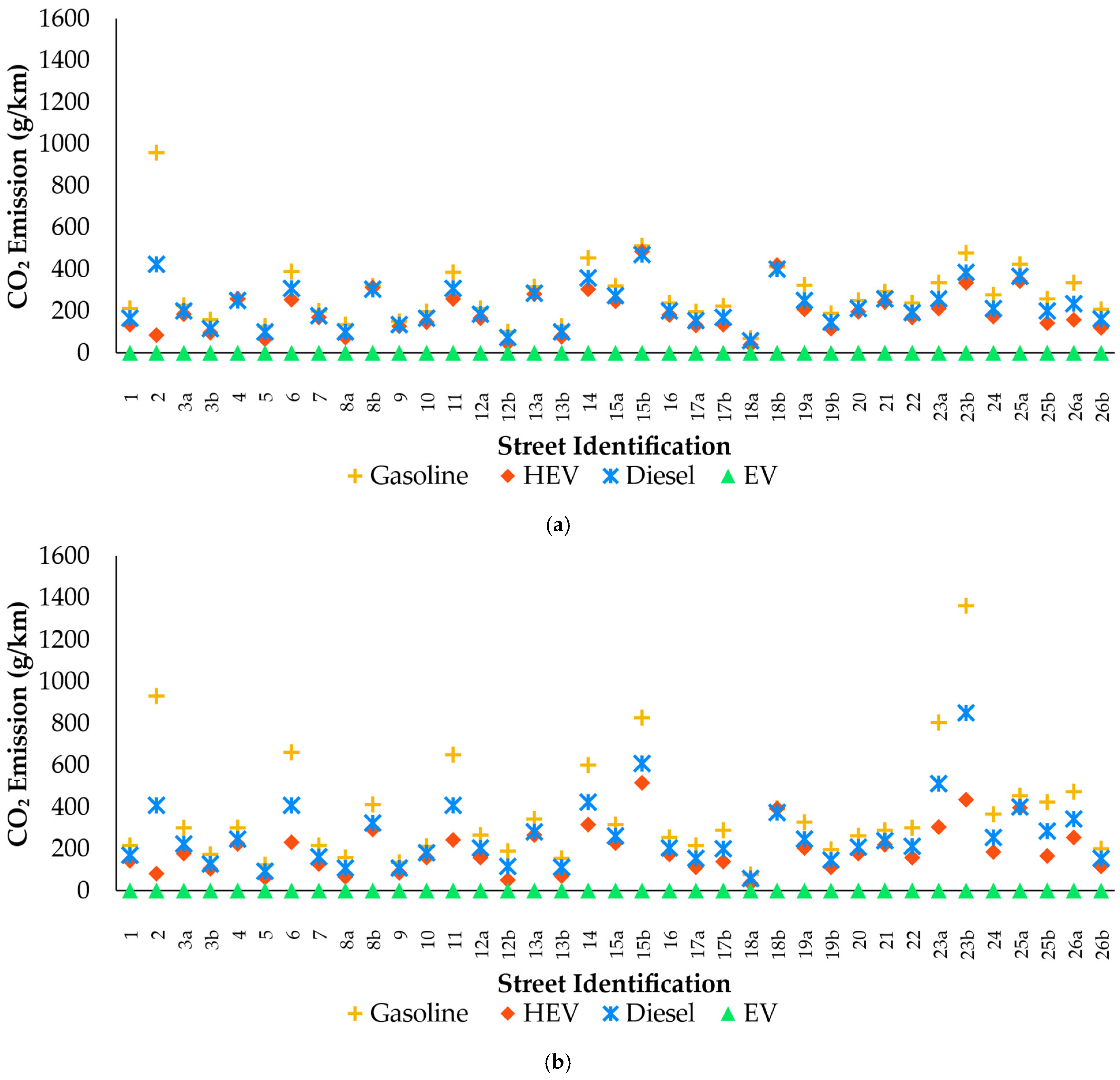
To quantify impacts at the technology level, four representative vehicles from the Portuguese fleet were considered: one Euro 6 gasoline, one Euro 6 diesel, one Euro 6 hybrid electric vehicle, and one electric vehicle. The specific operating modes of these technologies are reflected in their respective VSP distribution profiles. For BEVs and HEVs, modes 1 and 2 are treated as regenerative phases (negative energy demand), mode 3 represents idle conditions, and modes 4 through 14 correspond to consumption phase. For conventional gasoline and diesel vehicles, all VSP modes are associated with fuel consumption, as no energy recovery occurs during deceleration. Applying Equation (3) to all vehicles across all streets, the energy consumption and CO
2 emissions, when applicable, were calculated for off-rush and rush hours, as illustrated in
Figure 4 and
Figure 5.
Based on
Figure 4, it is possible to observe that during rush hours gasoline and diesel vehicles exhibit higher energy consumption due to frequent idling, stop-and-go driving, and reduced engine efficiency (gasoline: 0.88 ± 0.48 kWh/km off-rush and 1.15 ± 0.81 kWh/km rush; diesel: 0.91 ± 0.40 kWh/km off-rush and 1.07 ± 0.65 kWh/km rush). HEVs show relatively stable energy consumption between traffic conditions (0.73 ± 0.39 kWh/km off-rush and 0.74 ± 0.43 kWh/km rush), as only fuel consumption is accounted for and electric operation mitigates idling losses. BEVs maintain the lowest and most stable energy demand across all conditions (0.19 ± 0.24 kWh/km off-rush and 0.22 ± 0.26 kWh/km rush). Despite these differences, congestion negatively affects all powertrains, although BEVs consistently remain the most energy-efficient option. Streets with high energy demand are often associated with steep uphill sections, while downhill segments reduce overall consumption, particularly for BEVs, where energy recovery through regeneration plays a dominant role.
During off-rush hours, the influence of road properties such as gradient on energy consumption becomes more evident, since shorter congestion periods make it easier to correlate energy use with road slope. By contrast, during rush hours this influence is less discernible, as extended congestion time, mainly driven by traffic-related events (e.g., crosswalks, stop signs, and traffic signals), increase travel time and overall energy consumption, without being directly linked to the road gradient, as exemplified by Street 23a.
Based on
Figure 5, gasoline and diesel vehicles emit significant CO
2, with gasoline showing slightly higher emissions than diesel, particularly during rush conditions (gasoline: 283.4 ± 156.8 g/km off-rush and 374.0 ± 264.5 g/km rush; diesel: 225.5 ± 101.7 g/km off-rush and 264.9 ± 160.1 g/km rush). HEVs present lower emissions overall but show a slight increase during rush hours (191.3 ± 102.3 g/km off-rush and 193.6 ± 112.3 g/km rush), likely due to a greater reliance on the internal combustion engine under more demanding driving conditions. BEVs remain the cleanest option, generating zero emissions in all conditions, as expected.
For both off-rush and rush hours, the overall emission values remain within the expected range, as the analysis is limited to an urban environment where low speeds are predominant. Some emission peaks are observed, occurring more frequently during rush hours, and are associated with longer permanence period time on the street combined with shorter distances traveled. Nevertheless, all recorded values for gasoline and diesel vehicles exceed the EU threshold of 95 g/km, acknowledging that this benchmark represents a weighted average over a complete mixed driving cycle.
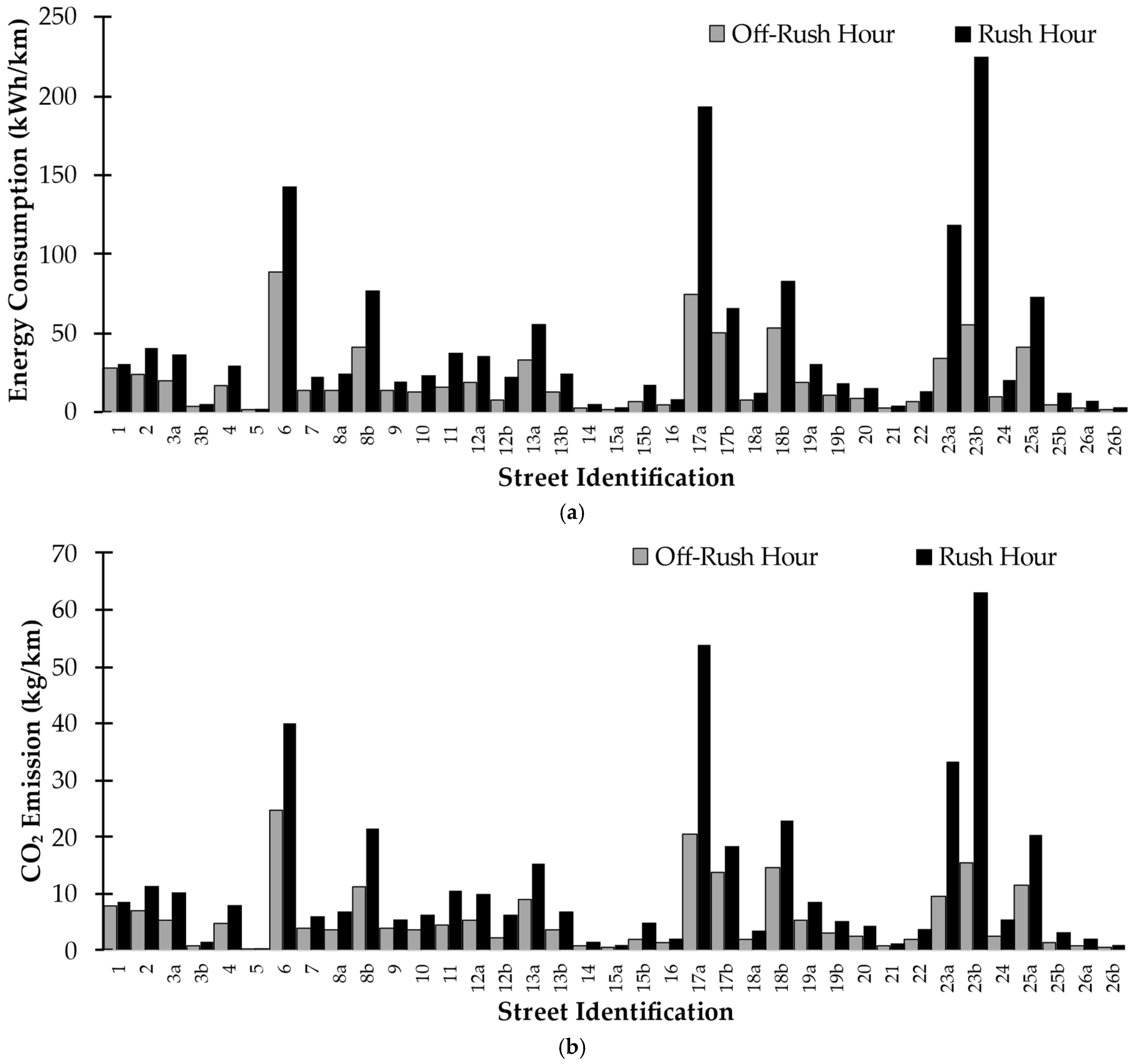
Based on Equation (4), the distribution of the Portuguese fleet—39.85% gasoline vehicles, 1.45% HEVs, 57.06% diesel vehicles, and 1.63% BEVs and PHEVs [
44], along with the observed frequency of vehicle usage, are used to assess the overall impact on energy consumption and emissions during both on and off-rush hours, as illustrated on
Figure 6.
In addition to the graphical representations (
Figure 3 and
Figure 6),
Table 4 provides a comprehensive numerical summary of the SVIF values, energy consumption, and emissions for each street.
The analysis of the energy consumption data shows that energy usage during off-rush hours is generally lower than during rush hours, which is expected due to lighter traffic. However, certain streets, such as Street 6, Street 17a, and Street 23b, have exceptionally high energy consumption during rush hours, mainly due to heavy traffic, and in the case of Street 17a, also due to a steeper incline. On the other hand, streets like Street 5 and Street 15a exhibit low energy consumption, attributed to low traffic flow and negative road grade, which reduce vehicle energy demand. In terms of CO
2 emissions, the data follows the same trend as energy consumption, with higher values during rush hours. Comparing the energy consumption and SVIF using the observed frequency (
Table 4), it was found that during the off-rush hours there is moderate to strong correlation between the energy consumption and SVIF (r = 0.607) with a
p-value < 0.001, indicating a statistically significant relationship. On the other hand, during rush hours, the correlation between energy consumption and SVIF was moderate (r = 0.385) with a
p-value ≈ 0.019, also statistically significant but weaker than in the off-rush hour scenario. Given the weaker and less consistent correlation, it can be inferred that the SVIF is less capable of adapting to rush hour scenarios compared to off-rush hours. This may be due to the fact that the indicator is not influenced by the total time spent. During rush hours, even though power demand might be lower, vehicles tend to spend significantly more time in traffic. As a result, overall energy consumption and CO
2 emissions increase, which is not fully captured by the SVIF during rush hours. Nonetheless, the SVIF indicator is able to detect roads more prone to generate higher energy use and emissions in an automated way, only by known the street coordinates.
4. Discussion
The findings presented in this study reveal that both street characteristics and traffic conditions significantly influence the energy consumption and emissions of light-duty vehicles.
The Street VSP Impact Factor (SVIF) developed in this work, and presented in
Figure 3, proves to be an effective indicator for identifying streets with disproportionately high impacts on neighborhood-level energy demand and emissions. By combining street specific power with traffic frequency, the SVIF captures how both intrinsic characteristics (e.g., slope, curvature, infrastructure) and behavioral patterns (e.g., rush-hour vs. off-rush hours) define the environmental footprint of mobility in urban areas.
A key result is the relationship between uphill and downhill gradients and their influence on vehicle performance. Uphill streets consistently register higher SVIF values due to increased power demands, while downhill segments enable partial energy recovery in electric vehicles, emphasizing the role of regenerative braking.
This confirms the findings of Zhang et al. [
19], Gallus et al. [
20], and Salihu et al. [
21], who have shown that fuel use and emissions rise steeply with positive road grade. Importantly, these results also highlight that BEVs not only reduce overall energy demand but also capitalize on braking energy recovery, reinforcing their advantage in urban environments with variable slopes.
When comparing vehicle technologies (
Figure 4 and
Figure 5), BEVs are consistently the most energy-efficient, with their performance proving almost immune to congestion effects. This aligns with the broader literature establishing BEVs as the optimal urban solution to decarbonization. HEVs also performed relatively well, particularly during rush hours, as the electric drive mitigates idling and low-speed inefficiencies.
In contrast, gasoline and diesel vehicles displayed the highest consumption and emissions, with both surpassing EU fleet average CO2 thresholds under all tested scenarios. These findings suggest that accelerating the replacement of conventional ICE vehicles with BEVs (and secondarily HEVs) will be fundamental to achieving climate neutrality in European cities.
Another relevant finding concerns the difference between off-rush and rush periods. During off-rush hours, correlations between SVIF and energy consumption are stronger, since power demand is more directly linked to topography and driving dynamics.
However, during rush hours, the explanatory power of SVIF decreases. This indicates that congestion-related factors (prolonged idling, stop-and-go dynamics, infrastructure bottlenecks) play a dominant role not fully captured by the SVIF.
Specifically, while the SVIF measures the power required to overcome a street’s physical layout, it does not account for the ‘time’ penalty imposed by traffic density. In congested scenarios, the energy consumption becomes decoupled from the road’s gradient and length, as vehicles spend significant time in low-efficiency operating modes (idling) despite covering little distance.
To methodologically address this, we propose an extended formulation (SVIFRH) that explicitly incorporates a congestion factor: SVIFRH = SVIF × (1 + ), where represents the time spent in congestion (VSP mode 3).
By weighting the structural energy penalty of the street with a temporal delay ratio, this formulation allows for a differentiated analysis of rush-period traffic. This transition from a purely structural to a hybrid structural–operational indicator will ensure that the framework remains robust and adaptable for real-time traffic management without losing its original diagnostic focus on road geometry.
From an urban planning perspective, the identification of high-SVIF streets provides immediate practical value. Unlike existing methodologies that often rely on aggregate traffic volumes, the SVIF couples VSP with network frequency to reveal structural inefficiencies that persist even as vehicle fleets modernize. Streets characterized by steep gradients and high demand, were shown to have the greatest influence on neighborhood energy and emissions profiles. These streets represent priority areas for targeted interventions, including:
deployment of BEV charging infrastructure in strategic corridors;
design of traffic management measures (e.g., dynamic signal control, congestion pricing);
implementation of differentiated route selection for ICE and EVs;
definition of restricted zones for ICE vehicles in high-impact corridors.
This distinction is critical for evaluating the transition to electric mobility. For instance, the model directly accounts for how regenerative braking efficiency alters the energy profile of hilly corridors.
Consequently, the SVIF serves as a baseline to quantify the localized benefits of targeted policies, such as Low Emission Zones (LEZs) or technology-specific routing, which macro-level models typically overlook.
Moreover, the analysis underscores the policy synergies between technological change and infrastructure management. Simply replacing ICE vehicles with BEVs will reduce emissions, but addressing structural urban characteristics—road gradients, pavement quality, traffic flow—will further multiply the benefits.
This reinforces the call for integrated approaches, where street-level analysis tools inform broader city-level decarbonization strategies.
Regarding methodological uncertainties, the use of high-resolution spatial data (~1 m) and the calibration of speed cycles to match or exceed Bing API travel times minimized potential modeling errors. Unlike traditional volume-centric assessments, the SVIF provides a more granular comparison by coupling VSP with network frequency, identifying high-impact corridors that are often overlooked by macro-level methodologies.
It is important to note that since street usage frequency is defined as a relative ratio within the neighborhood, the SVIF remains constant under proportional traffic variations. While absolute energy and emission levels vary directly with total traffic volume, the SVIF effectively isolates the permanent structural inefficiencies of the urban layout, ensuring a stable ranking for infrastructure prioritization.
However, it should be noticed that this indicator is scale-dependent: whether applied to a small neighborhood, a district, or an entire city, the SVIF will consistently identify the most extreme cases of energy inefficiency relative to the analyzed study area.
Furthermore, the robustness of the framework is supported by the extensive scale of the simulation, which integrated 19,500 distinct driving cycles. By incorporating three driving styles (eco, normal, and aggressive) and accounting for stochastic variability (5 cycles per scenario), the resulting indicator reflects a balanced average of the fleet’s behavior.
While individual driving styles shift the VSP distribution toward higher or lower power demands, the SVIF aggregates these variations to provide a stable structural diagnostic. Since route selection is comprehensively covered by the network-wide origin-destination pairs and traffic conditions are explicitly separated, the indicator successfully isolates the permanent energy impact of street geometry from transient behavioral or temporal fluctuations.
Finally, the study demonstrates that leveraging real-world traffic data to validate theoretical models significantly improves the reliability of predictions. Even with modest manual traffic counts, the observed vs. theoretical comparison helped refine SVIF outputs. This suggests that hybrid data systems—combining automated sensor networks, open GIS sources, and limited manual counts—can provide a cost-effective path for cities to monitor and optimize transportation-related emissions in real time.