Article

Analytical Modelling of Arc Flash Consequences in High-Power Systems with Energy Storage for Electric Vehicle Charging


by
Juan R. Cabello
1,2,*,
David Bullejos
1 and
Alvaro Rodríguez-Prieto
3
1
Department of Electrical Engineering, Universidad de Córdoba, 14014 Córdoba, Spain
2
Industrial Inspection and Technical Assistance, SGS Tecnos, 28042 Madrid, Spain
3
College of Industrial Engineering, Universidad Nacional de Educación a Distancia (UNED), 28040 Madrid, Spain
*
Author to whom correspondence should be addressed.
World Electr. Veh. J. 2025, 16(8), 425; https://doi.org/10.3390/wevj16080425
Submission received: 2 July 2025 / Revised: 22 July 2025 / Accepted: 25 July 2025 / Published: 29 July 2025
(This article belongs to the Special Issue Fast-Charging Station for Electric Vehicles: Challenges and Issues)

Abstract

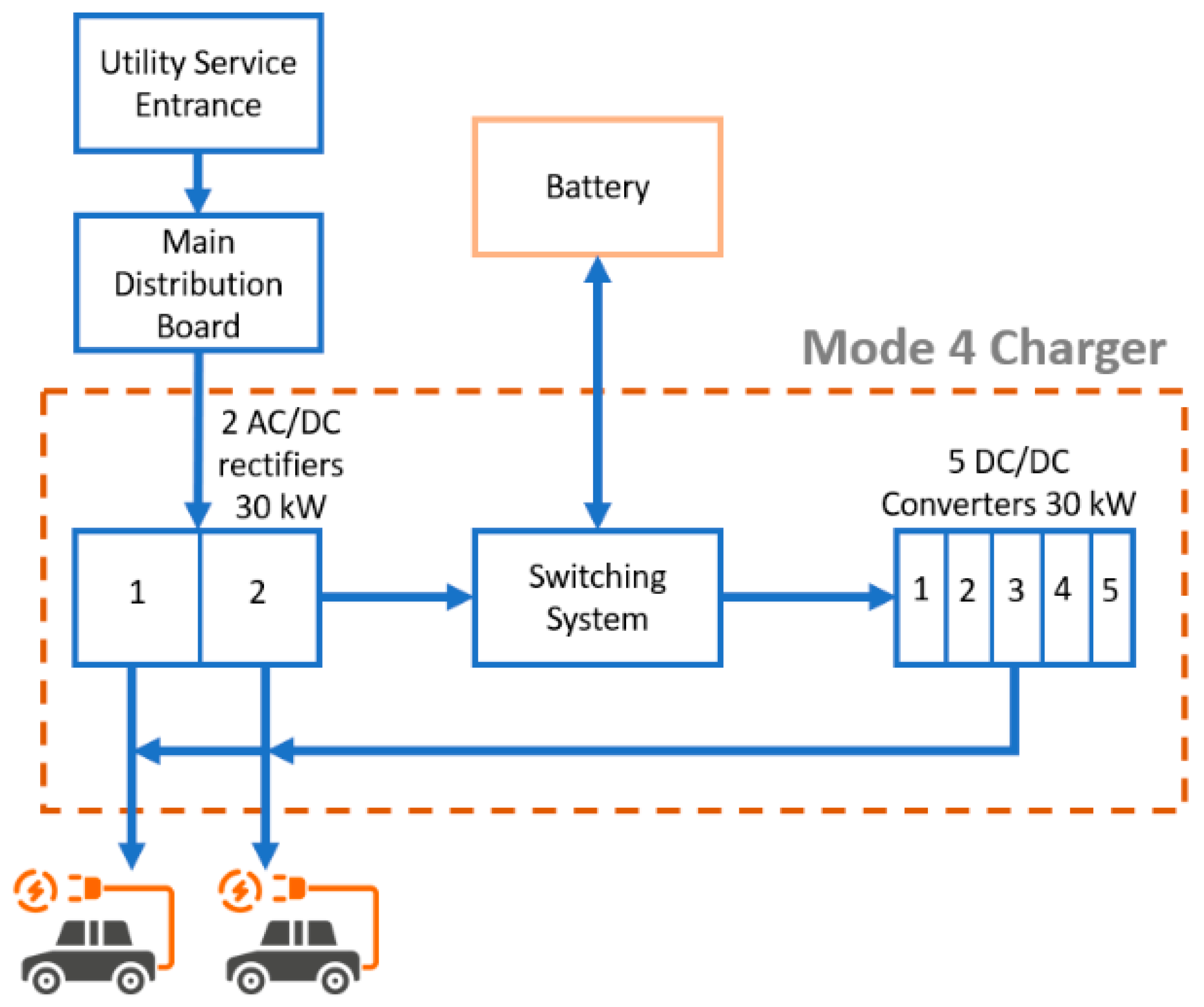
The improvement of environmental conditions has become a priority for governments and legislators. New electrified mobility systems are increasingly present in our environment, as they enable the reduction of polluting emissions. Electric vehicles (EVs) are one of the fastest-growing alternatives to date, with exponential growth expected over the next few years. In this article, the various charging modes for EVs are explored, and the risks associated with charging technologies are analysed, particularly for charging systems in high-power DC with Lithium battery energy storage, given their long market deployment and characteristic behaviour. In particular, the Arc Flash (AF) risk present in high-power DC chargers will be studied, involving numerous simulations of the charging process. Subsequently, the Incident Energy (IE) analysis is carried out at different specific points of a commercial high-power ‘Mode 4’ charger. For this purpose, different analysis methods of recognised prestige, such as Doan, Paukert, or Stokes and Oppenlander, are applied, using the latest version of the ETAP® simulation tool version 22.5.0. This study focuses on quantifying the potential severity (consequences) of an AF event, assuming its occurrence, rather than performing a probabilistic risk assessment according to standard methodologies. The primary objective of this research is to comprehensively quantify the potential consequences for workers involved in the operation, maintenance, repair, and execution of tasks related to EV charging systems. This analysis makes it possible to provide safe working conditions and to choose the appropriate and necessary personal protective equipment (PPE) for each type of operation. It is essential to develop this novel process to quantify the consequences of AF and to protect the end users of EV charging systems.
Keywords: safety; electric recharging; charger; arc flash; electric car; battery; installation safety; electric recharging; charger; arc flash; electric car; battery; installation