Abstract
The steering system plays a critical role in the vehicle’s handling and directly influences its lateral dynamics. Faults or abnormal behavior in this system can affect performance, cause vehicle instability, and even lead to accidents. Therefore, considering these potential events is essential for designing robust controllers for autonomous vehicles. For this reason, in this work, a fault-tolerant path-tracking Static Output-Feedback controller is designed to handle steering actuator faults in autonomous vehicle steering systems. The controller adopts a Linear Parameter Varying approach to effectively handle nonlinearities associated with varying vehicle speeds and tire behavior. Furthermore, it only uses information from sensors, avoiding estimation stages. This controller can operate in two modes: a no-fault mode where only the steering is controlled to follow the reference path and a fault mode where the controller manages both the steering and torque vectoring. In fault mode, torque vectoring compensates for faults in the steering actuator. The design of the controller is completed considering gain faults in the steering system. The simulation results show that the proposed controller successfully maintains vehicle stability and significantly reduces tracking errors during high-risk maneuvers, achieving reductions of up to 50.65% in lateral error and 47.26% in heading error under worst-case fault scenarios.
1. Introduction
Automated vehicles (AVs) have emerged as a transformative technology with the potential to revolutionize transport systems worldwide. These vehicles promise numerous benefits, including improved safety, increased mobility, and greater efficiency in transport networks. The convergence of AV technology with electric vehicles (EVs) and the rise of distributed energy systems have further accelerated this transition. Electric powertrains offer benefits such as lower emissions, reduced noise, and simpler mechanical designs that support more sustainable transport solutions [1,2]. EVs include several types, such as Battery Electric Vehicles (BEVs), Plug-in Hybrid Electric Vehicles (PHEVs), and Fuel Cell Electric Vehicles (FCEVs), each with unique characteristics and control requirements [3].
One of the critical tasks in automated driving is path-tracking, which involves guiding the vehicle along a predetermined path while maintaining stability and passenger comfort. Some of the most widely used methods include simple geometry-based techniques such as the pure pursuit controller and the Stanley controller [4], as well as classical control methods such as Proportional–Integral–Derivative (PID) control [4,5]. These controllers are popular for their ease of implementation. Although effective at lower speeds, these methods are unsuitable for high-speed applications where the nonlinear dynamic behavior of the vehicle can lead to tracking errors or instability. Consequently, model-based approaches that better capture vehicle dynamics are preferred in these cases [6]. More modern approaches such as Linear Quadratic Regulator (LQR) control have been introduced to improve path-following control and stability by minimizing a cost function that balances tracking accuracy and control efforts [7,8]. More recently, Model Predictive Control (MPC) has emerged as a powerful control technique for path-tracking. MPC uses predictive models to optimize future control actions over a receding horizon, providing enhanced path-tracking performance, particularly in challenging driving scenarios [9,10,11]. However, this method is computationally demanding and requires knowledge of all vehicle states, which are often difficult to measure directly or require additional state observers [12]. Ensuring the stability of the system is crucial, and Lyapunov-based stability methods are commonly used to ensure the stability of the system [13,14].
To further increase robustness to disturbances and model uncertainties, robust control techniques have been applied regarding the path-tracking problem. In [15,16,17], Sliding Mode Control (SMC) is used to ensure stability in the context of parameter variations and external disturbances in the design of path-tracking controllers. Another commonly used approach, control, provides robustness by minimizing the worst-case gain between input disturbances and system outputs, effectively enhancing the system’s ability to handle uncertainties [18,19,20]. Robust Model Predictive Control (RMPC) combines the predictive capabilities of MPC with a robust design, ensuring that the controller remains effective even in the presence of significant model mismatches or disturbances [21,22,23].
Vehicle components are susceptible to faults that degrade performance and compromise stability, potentially leading to unsafe driving situations. Such effects can be mitigated by the early detection of these anomalies using model-based [24] and data-driven techniques [25,26]. Beyond detection, fault-tolerant control (FTC) incorporates fault handling into the controller design, enabling the system to adjust inputs and provide a robust dynamic response even when faults occur [27,28].
In the literature, path-tracking fault-tolerant control has been extensively studied to improve the robustness of automated vehicles against actuator faults. FTC control has been used to deal with faults in both steering actuators and wheel motors [29,30]. In [31], a second-order Kalman filter is used to estimate the steering actuator fault so that this estimation can then be used in a fault-tolerant path-tracking Sliding Mode Controller (SMC). In [32], an LQR controller is designed to deal with faults in the steering system, working in conjunction with an SMC to achieve the desired yaw rate, while [33] uses a fault-tolerant controller based on SMC, incorporating fault diagnosis based on the use of neural networks. The work presented in [34] compensates for stuck steering faults by using a differential steering approach for compensation. In [35], an interval observer is presented to recalculate the control input and mitigate the effects of steering actuator faults, similar to the work in [36], where a robust SMC is used in combination with an MPC.
Many of the aforementioned approaches rely on information that is typically not available in commercial vehicles or require additional stages to estimate faults or vehicle states, making real-world implementation difficult. The purpose of this work is to overcome these challenges and enhance the practicality of controller designs for commercial vehicles by introducing a flexible Static Output-Feedback (SOF) controller that adapts to both fault-free and fault conditions using only information available from on-board sensors. The proposed controller operates in two modes: a fault-free mode that controls the vehicle using only the front steering angle and a fault-tolerant mode that uses torque vectoring (TV) to compensate for actuator faults. This dual-mode operation ensures that vehicle stability and path-tracking performance are maintained even under fault conditions, thereby minimizing tracking degradation, along with steering control. The main contributions of this work are as follows:
- A Multi-Input–Multi-Output (MIMO) SOF controller is developed for a path-tracking system, enabling operation in both fault-tolerant and fault-free modes. This novel approach enables the system to operate in a dual mode: under normal conditions, it relies only on the steering input actuator, and, in the event of a steering system fault, torque vectoring is activated to assist the vehicle and effectively compensate for the steering actuator faults.
- Vehicle uncertainties and nonlinearities caused by varying vehicle speeds are considered in the controller design using an LPV approach. This ensures that the system remains robust and stable under a wide range of operating conditions.
- The driving automation system presented in this work only requires on-board sensors that can be found in series-production vehicles to compute the control inputs. By eliminating the need for expensive sensors for the estimation of vehicle states such as sideslip angle, the practical implementation of the method is guaranteed.
The rest of the article is organized as follows: in Section 2, the problem formulation is introduced, along with the formulation of the vehicle model considered for the controller design. Section 3 presents the controller design methodology. Section 4 discusses the results obtained via simulation. Section 5 concludes the paper.
2. Problem Formulation
2.1. Vehicle Model
The lateral dynamic behavior of the vehicle can be expressed as [37]
where , , and r are the vehicle’s longitudinal velocity, lateral velocity, and yaw rate. The vehicle parameters are described in Table 1. stands for the front steering angle and for the yaw moment generated by the action of braking/driving on the individual controller wheels:
where denotes the longitudinal driving/braking forces and the lateral tire forces, for , front and rear axes and for , left and right sides of the vehicle. The values of these forces depend on several factors, including vertical load, tire pressure, and road conditions. Despite nonlinear tire–road models existing that represent tire behavior, such as the Pacejka magic formula, the Burckhardt model, or the Dugoff model [38,39,40], in this work, a simplified linear model [41,42] is considered to simplify the tire behavior as follows:
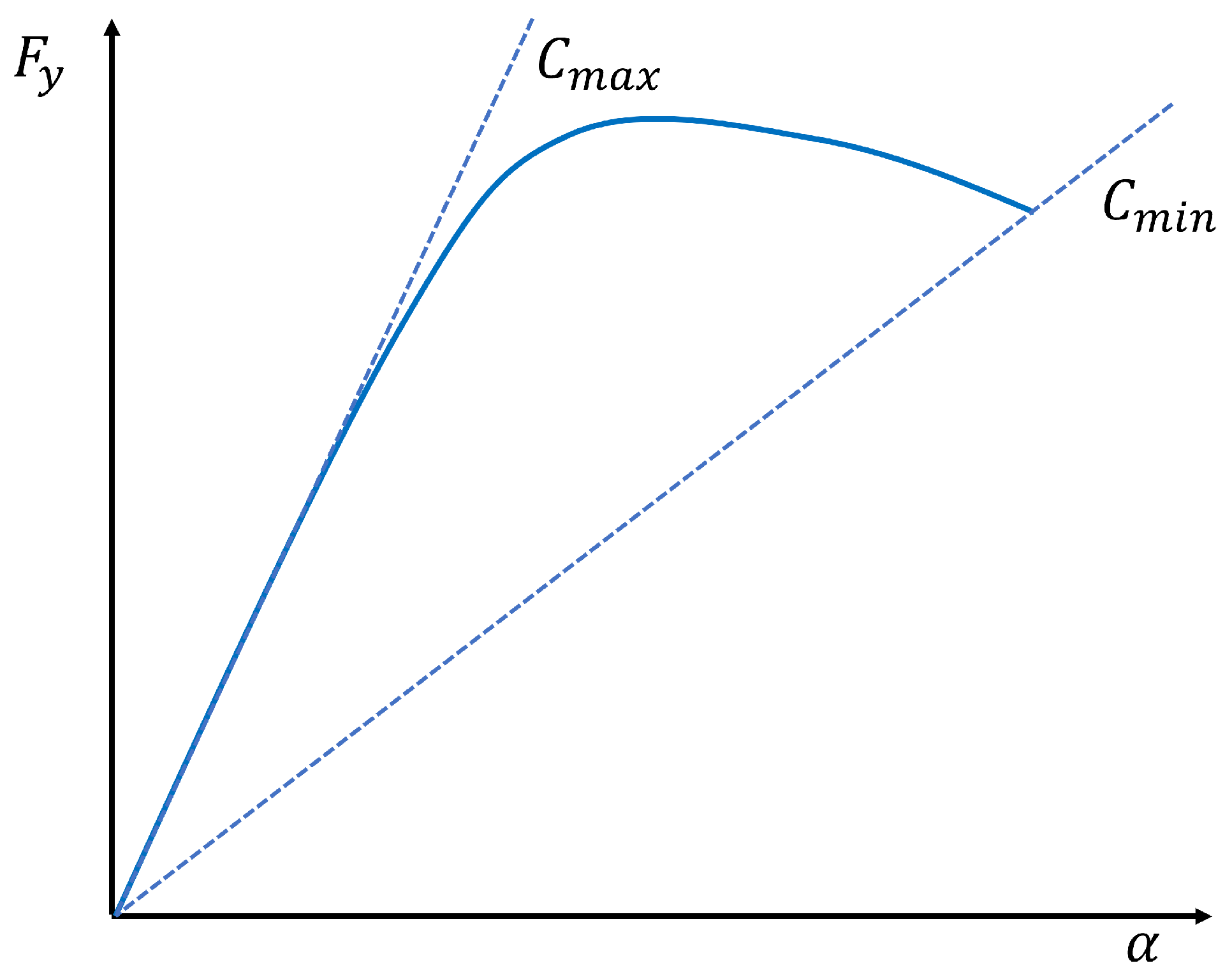
where and are the front and rear tire slip angles, respectively. and are the front and rear tire cornering stiffness, respectively. These parameters are functions of the vertical load and tire–road interaction. As direct measurement in real-time is not possible, they can be assumed to be bounded as
Table 1.
Vehicle model parameters.
This enables the nonlinearities of the tire model to be taken into account, especially at high slip angles (Figure 1).
Figure 1.
Cornering stiffnesses limits for tire lateral force.
2.2. Path-Tracking Model
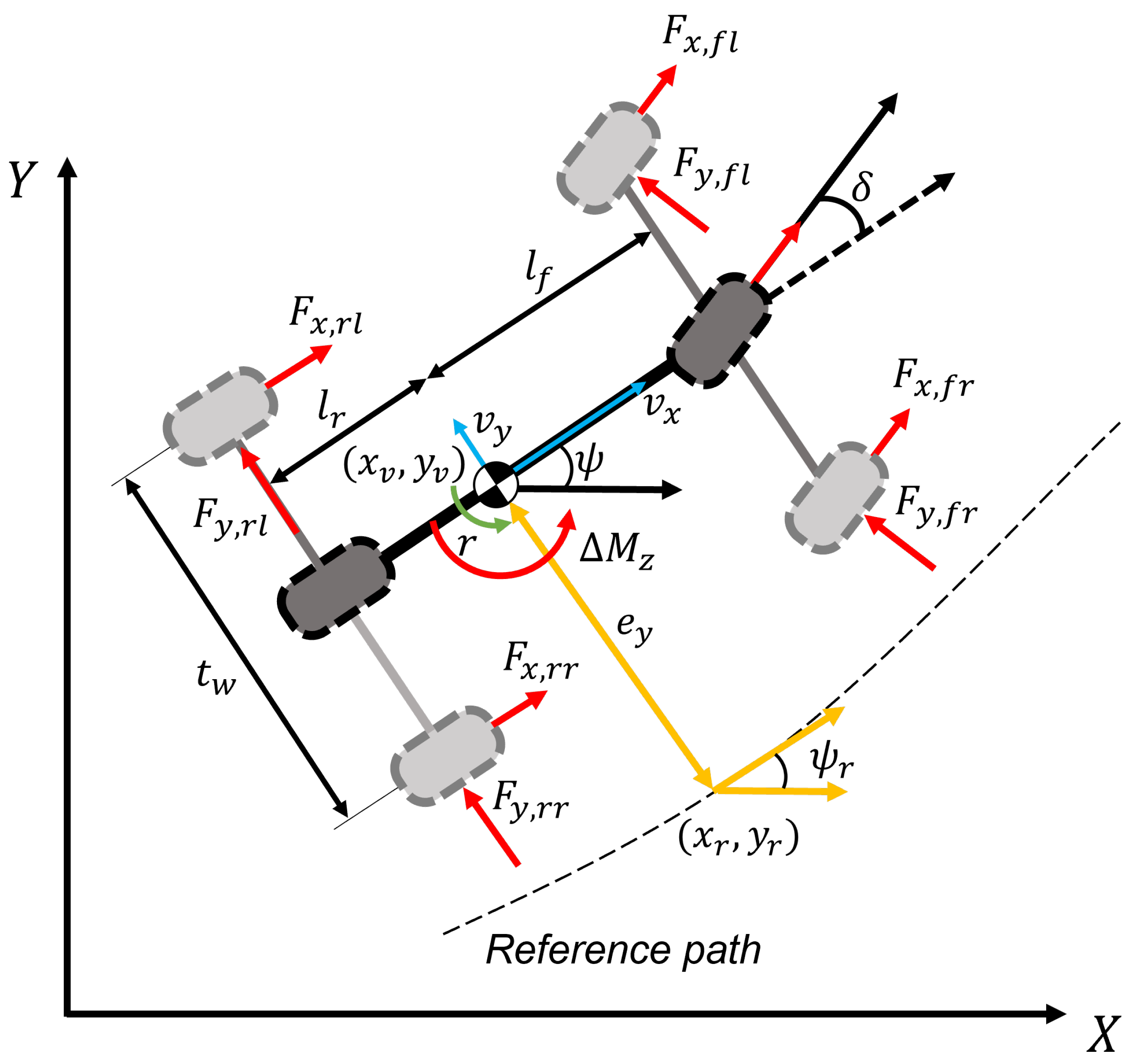
Consider the path defined by its reference positions and reference heading angle , as represented in Figure 2. To track the reference path, the lateral error and the heading error must be minimized:
being the heading angle of the vehicle. The path-tracking error dynamics are [43]
where denotes the path curvature and is assumed as unknown in this work; is the look-ahead distance, which has been defined as a function of the vehicle’s speed as in [44]
Figure 2.
Vehicle path-tracking model.
2.3. Combined Lateral Dynamics and Path-Tracking Model
A model that captures both the vehicle lateral dynamics and the path-tracking behavior is obtained by combining (5) and (7) such that
where is the vehicle state vector, is the control input, and is the system disturbance. The state-space matrices are
with
Matrices and from (9) depend on the stiffness of the front and rear tires and the longitudinal velocity of the vehicle through the terms , , , and , with . To overcome this problem, a polytope model method is used to handle the range of varying parameters. As a result, the time-varying parameters can be expressed as a linear combination of vertices. The terms and are not completely independent; a change in the variable can occur to reduce the conservatism of the problem:
where is a bounded parameter that satisfies . If we use Taylor’s approximation [43] and and , we can obtain
In this way, the number of polytope vertices is reduced to vertices:
with
and
Then, the nonlinear system in (9) can be rewritten as
where represents the weights of the polytope vertices and
To facilitate design and implementation, the system in (17) is converted into its discrete analogue via Euler’s discretization:
being the sampling time. The discrete-time state-space model of the system in question is
with
Using on-board vehicle sensors, the vehicle’s yaw rate can be measured using the vehicle’s Inertial Measurement Unit (IMU), while lateral and heading errors are acquired using a LiDAR sensor or a video camera. Therefore, the vector of measured variables is obtained as follows:
In order to achieve good tracking performance, the lateral tracking error and heading tracking error must be minimized. Additionally, lateral velocity should remain as low as possible in order not to compromise driving safety. These key performance indicators are contained in the output vector , which is expressed as
2.4. Active Steering System Actuator Fault
In this work, the fault in the ASS is modeled as a loss of effectiveness fault, which is very common in the literature [45,46]:
where stands for the loss of effectiveness factor and is the final steering angle in the front wheels. To compensate for this fault, a yaw torque is generated when a steering actuator fault is detected. Under this consideration, system (20) is rewritten as
where , , , , and is a switching variable that indicates whether the steering actuator is faulty or not and is used to activate the torque-vectoring control:
2.5. Torque Allocation
In order to distribute the torque to the four wheels of the vehicle, the yaw moment provided by the upper-level controller is distributed as [47]
with
where represents the torque increment added to the current torque of the wheel motor to avoid compromising the longitudinal dynamics, and and represent the trade-off between the torque in the left and right sides of the vehicle, respectively. In this work, these parameters are set to 0.5 to provide an even distribution between both sides of the vehicle.
3. Fault-Tolerant Controller Design
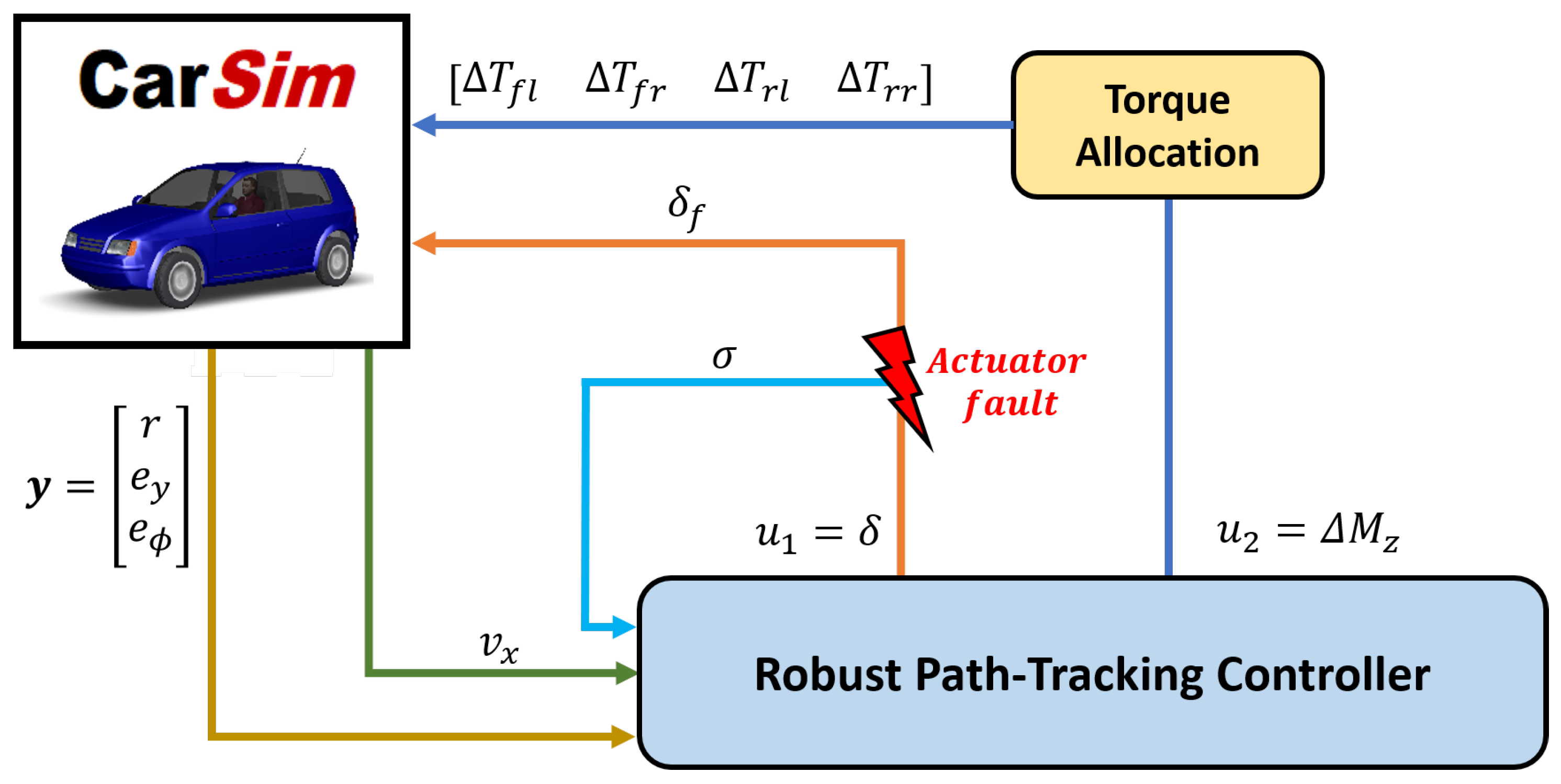
This section derives the fault-tolerant path-tracking controller that compensates for the steering actuator faults using TV. The control architecture is shown in Figure 3.
Figure 3.
Control scheme of the proposed fault-tolerant controller.
The controller has to maintain the stability of the vehicle and track the reference path in both fault-free and faulty conditions of the steering actuator. Furthermore, the controller may only use the information provided by commercial vehicles [48]. For this purpose, the following control laws are proposed:
where and are the gain control matrices to be found. Matrices and are computed online using , as is the only polytopic parameter available, which is considered to be known as it depends on the longitudinal velocity of the vehicle (12):
Combining the control laws from (30) and state-space equation from (25), we can write the closed-loop dynamics as
Theorem 1.
Given a definite positive symmetric matrix , the system of (32) is asymptotically stable with an performance index less than γ and for an actuator fault gain if the following LMIs hold:
Proof.
Let us define a Lyapunov function
with . It is assumed that the parameter does not change significantly between successive instants since it depends on the longitudinal velocity, which is assumed to vary slowly. For the system in (32) to be stable, the following condition must be satisfied:
In order to minimize the influence of the external disturbance over the chosen controlled outputs, approach is used:
being the upper bound of the worst-case gain from disturbance d to controlled outputs z. For control design, combining performance in (36) and Lyapunov stability criterion in (35) yields
According to the steering, the actuator fault indicator (37) can be expressed in LMI form for both non-faulty and faulty cases as
with and . Using Schur complement, LMIs in (38) are rewritten as
Now, if we apply a congruent transformation by multiplying by on the left and by its transpose on the right, the LMIs in (39) become
The controller gains are determined by solving the following optimization problem:
The LMI in (33) to be solved is a bi-linear problem as variable is coupled to and ; an iterative procedure is used to find a feasible solution [44]. A full description of this method is presented in Algorithm 1.
| Algorithm 1 Iterative procedure for solving bi-linear LMI problem. |
| Input: |
| Vehicle parameters from Table 1. |
| Output: |
| Controller gain matrices from (30) |
4. Results and Discussion
In this section, the proposed fault-tolerant SOF path-tracking controller is tested using the vehicle dynamics simulation software CarSim ® 2022.1 version. The vehicle model is configured with the parameters described in Table 1. The vehicle speed is assumed to be in the range m/s. The path-tracking controller is designed by solving the optimization problem (41), considering a maximum gain fault of , using the Robust Control Toolbox included in Matlab 2022b. By computing Algorithm 1, a feasible control solution has been found with an robustness index of . Only two iterations were required.
Two different fault scenarios are simulated to test the proposed controller:
- (A)
- DLC maneuver under steering actuator degradation with and .
- (B)
- DLC maneuver under steering actuator saturation at and .
The test maneuver is a Double Lane Change (DLC), designed to simulate an obstacle avoidance situation and challenge the controller under a high-risk scenario.
4.1. Case A: Loss of Effectiveness in the Steering Actuator
To evaluate the effectiveness of the proposed methodology, three cases are compared: (1) a baseline case with no steering faults, (2) a fault case without fault-tolerant control, and (3) the proposed fault-tolerant controller. All the cases are evaluated at a constant vehicle speed of m/s under identical fault conditions.
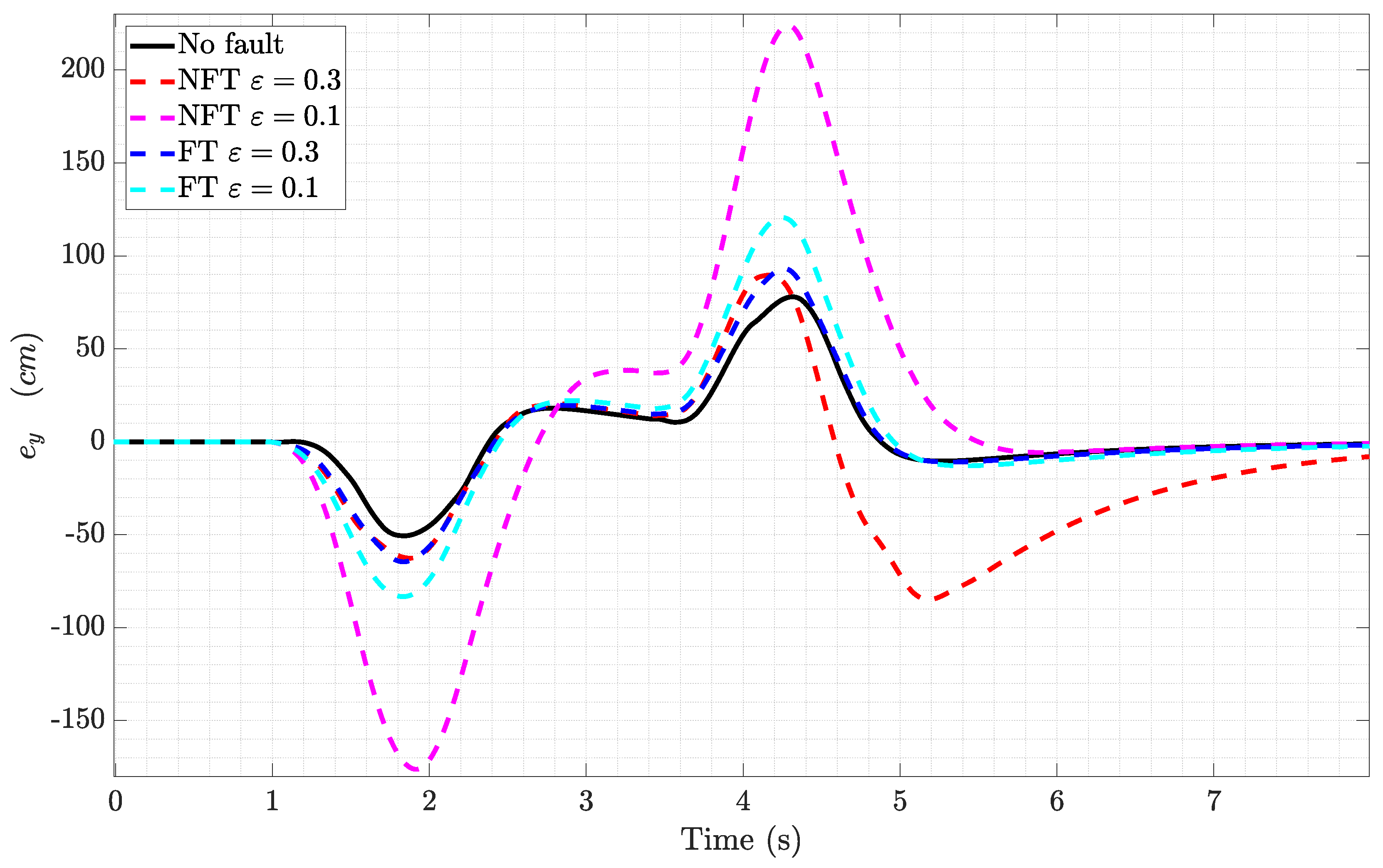
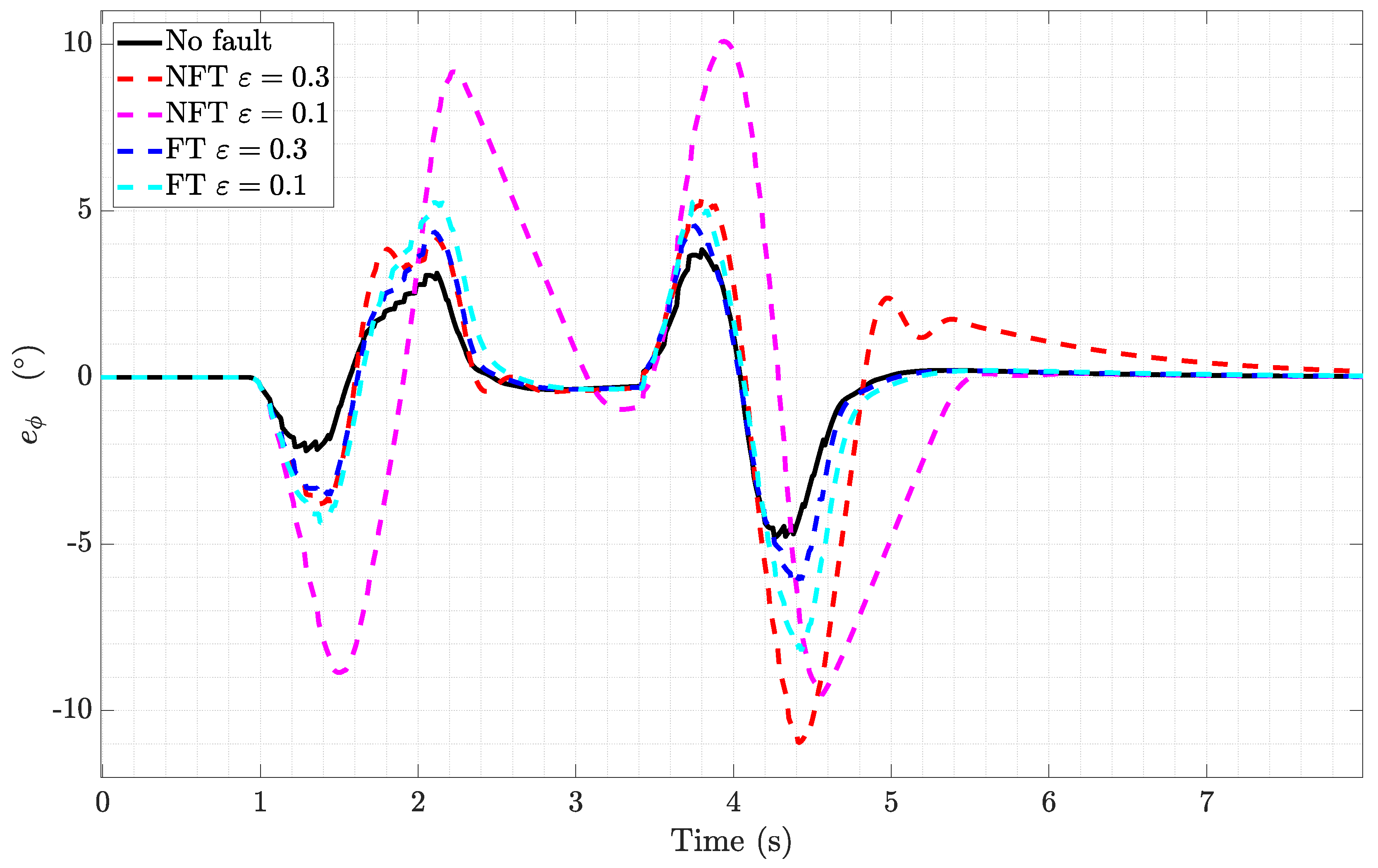
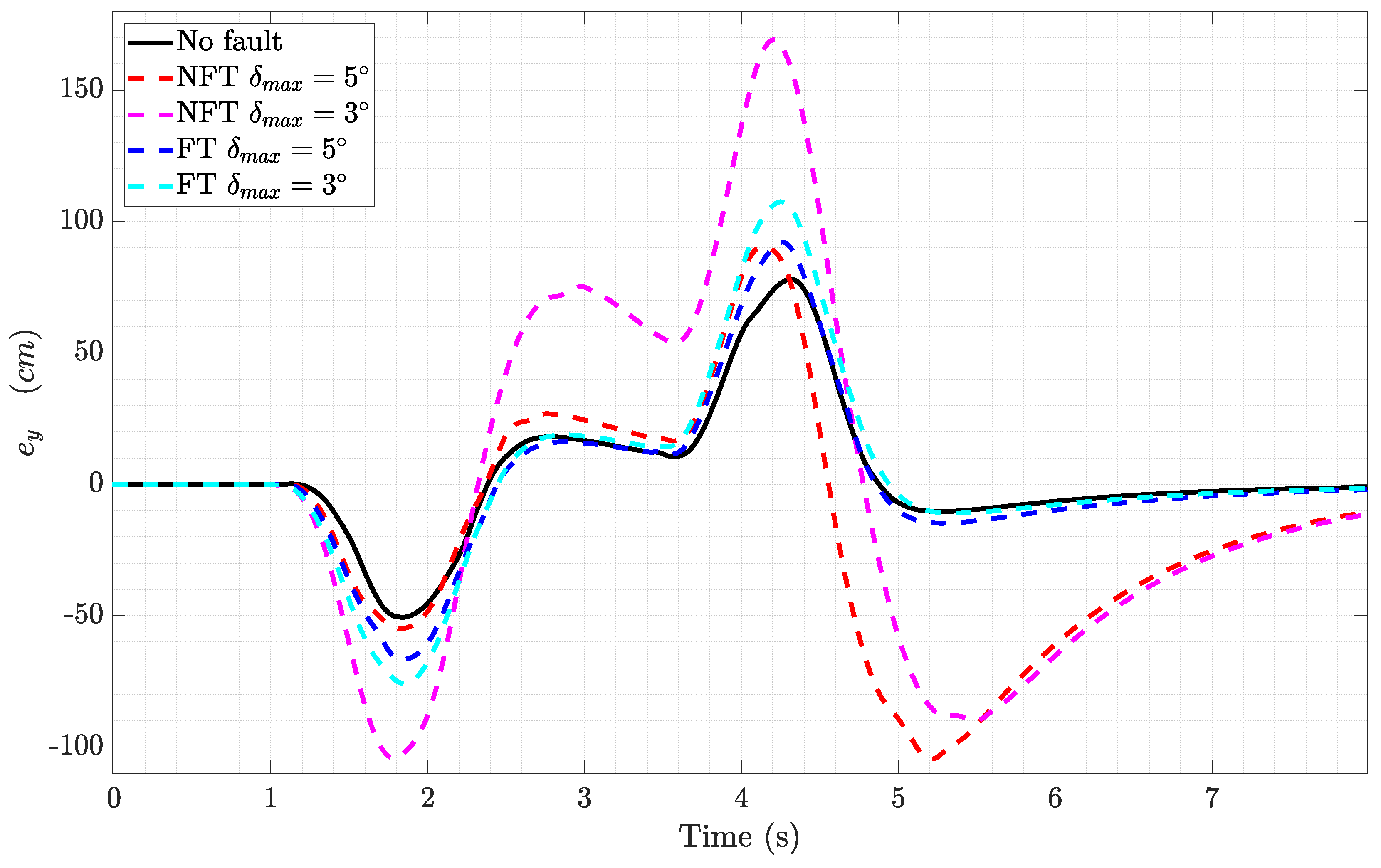
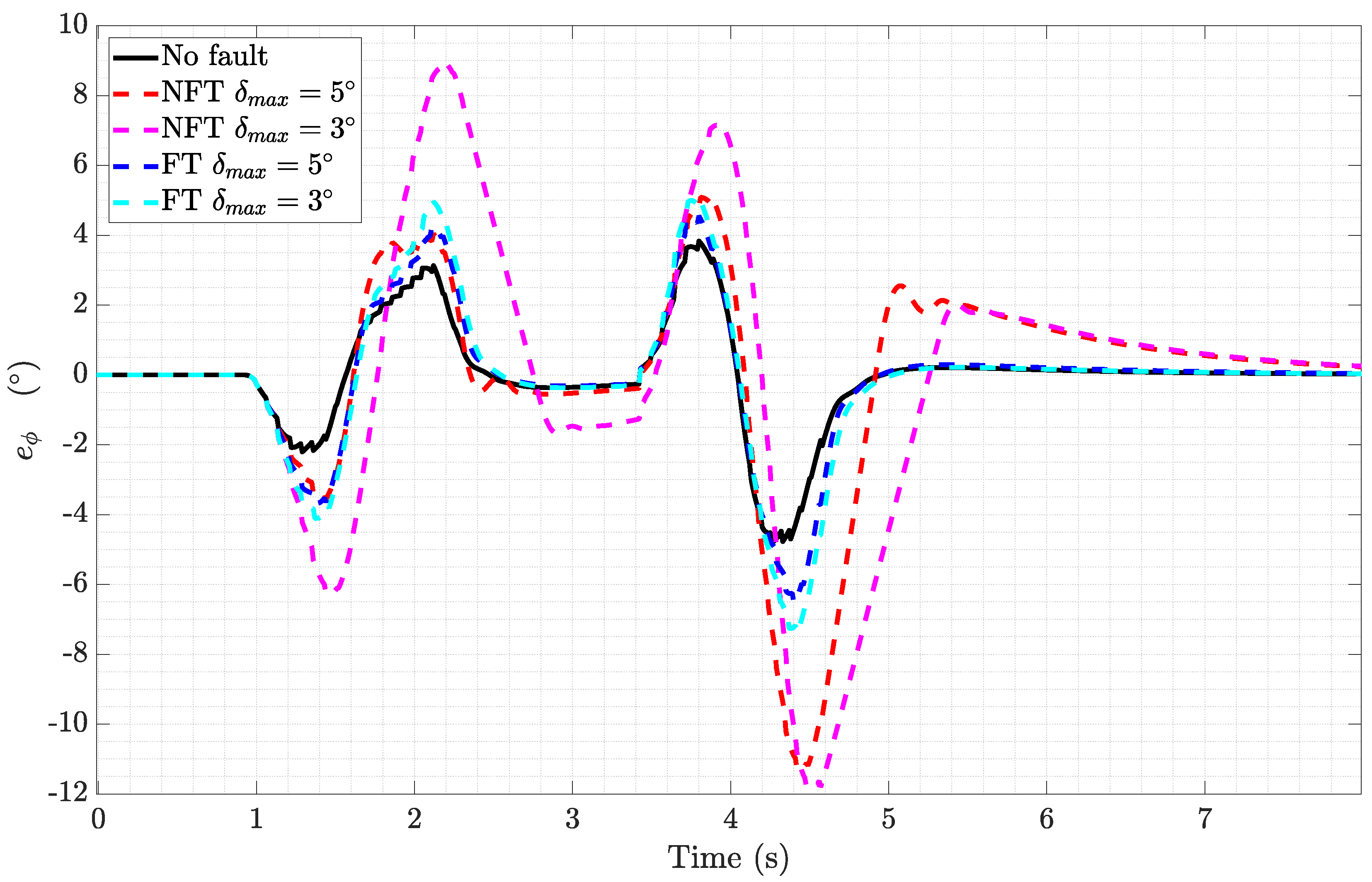
As shown in Figure 4, the fault-tolerant controller reduces the Root Mean Square (RMS) of the lateral error from cm to cm with the proposed controller for and from cm to cm for . This demonstrates that the proposed controller improves the tracking accuracy, particularly during the second turn when the vehicle returns to its original lane at 4.5s of the simulation. Evidently, the controller can reduce the tracking error of the vehicle even for the most extreme case, . The proposed controller also reduces the heading error, with the maximum error dropping from to and RMS heading error from to for the most severe scenario (Figure 5).
Figure 4.
Lateral error for Case A.
Figure 5.
Heading error for Case A.
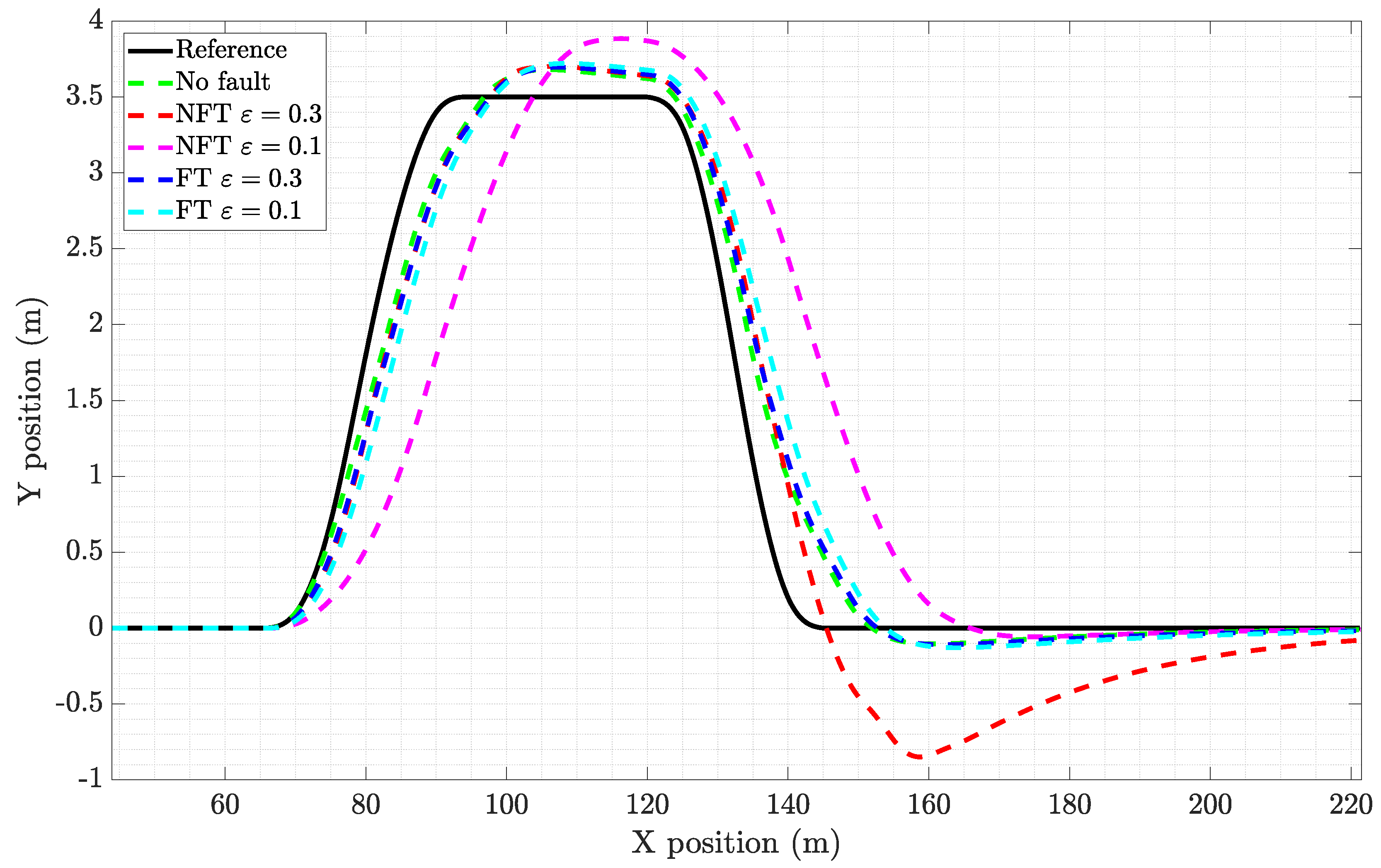
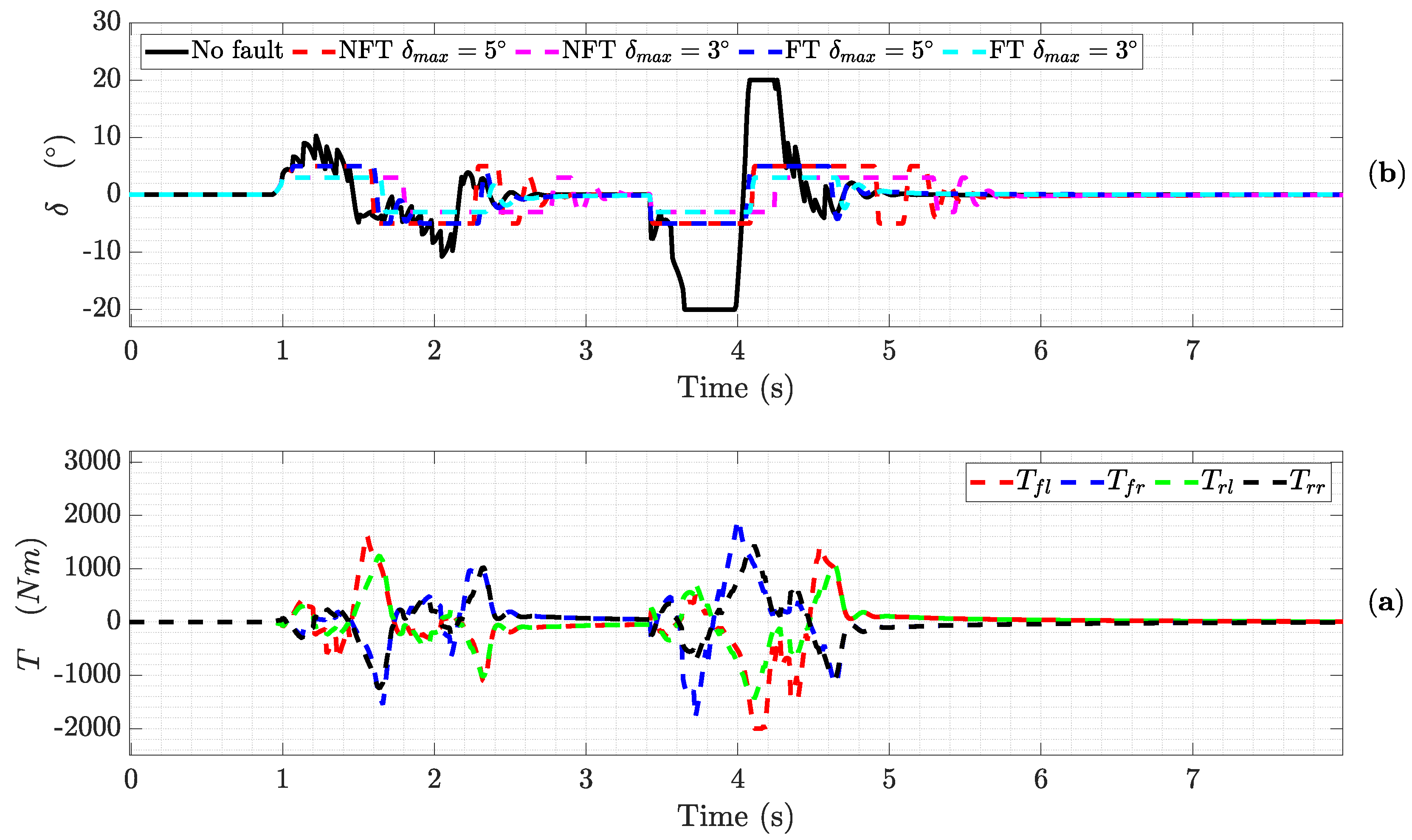
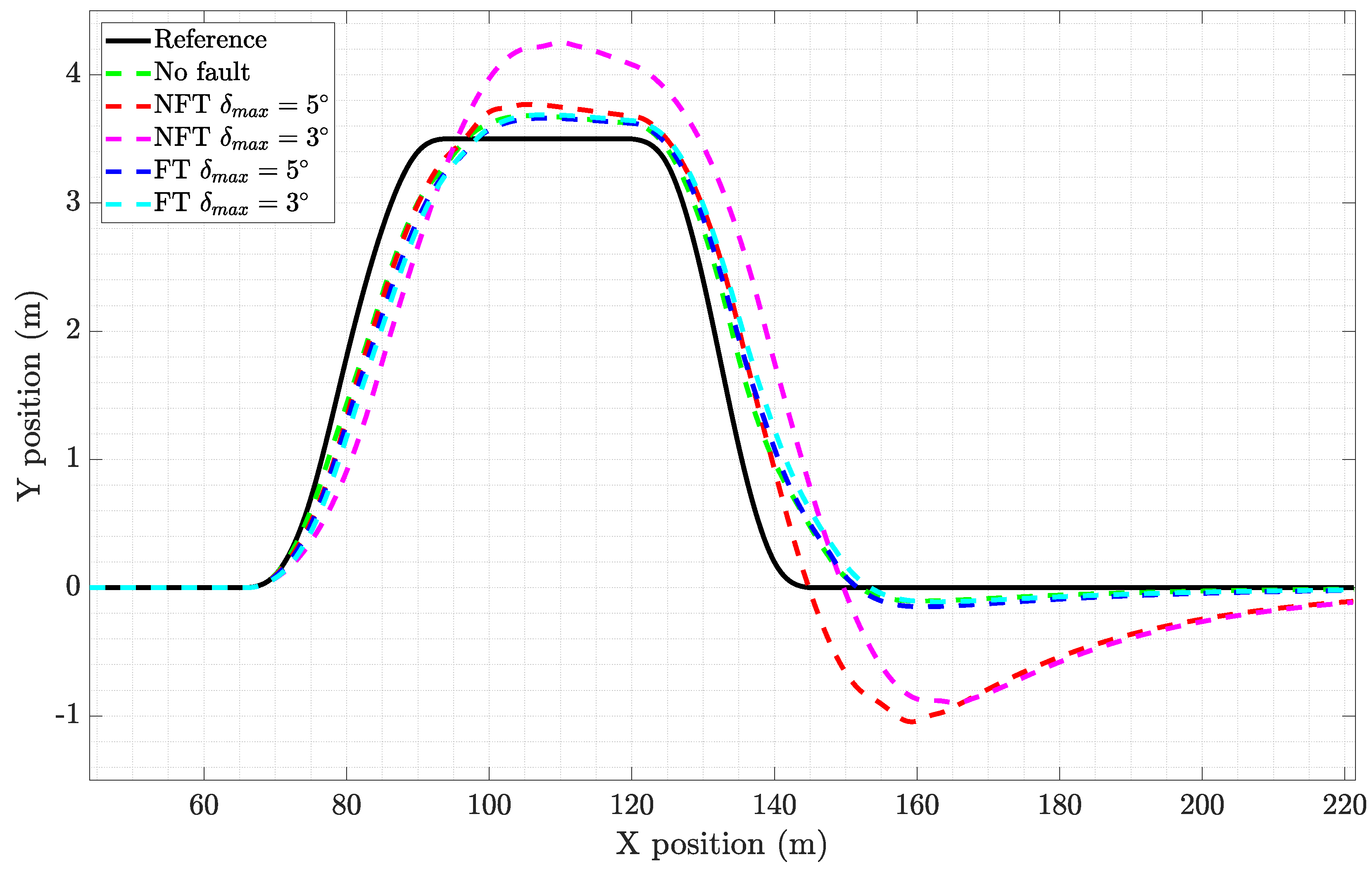
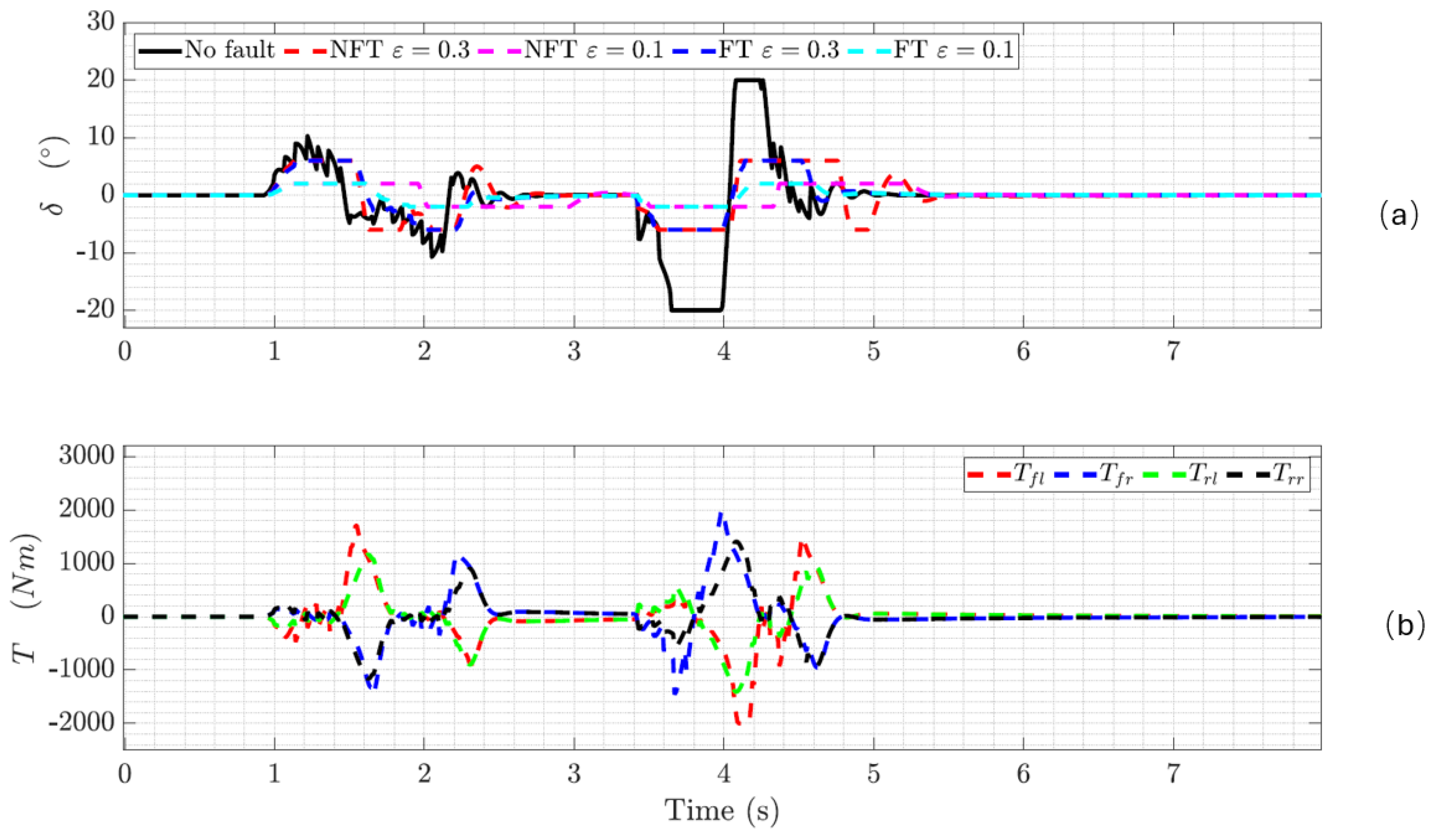
The control inputs are shown in Figure 6, which displays the steering angle input in Figure 6a and the input torque of the wheel for the fault-tolerant case in Figure 6b. Evidently, the controller demands a higher steering angle due to the actuator’s reduced effectiveness, but this demand is limited by physical saturation, as shown in Figure 6a, and the motor torque compensates for this effect by adding extra torque in the wheels as in [36]. Finally, the path followed by the vehicle in each scenario is illustrated in Figure 7, highlighting the differences in tracking performance between the cases with and without fault-tolerant control.
Figure 6.
Control inputs for Case A. (a) Front steering angle. (b) In-wheel motor torque when .
Figure 7.
Path for Case A.
4.2. Case B: Steering Actuator Saturation
In this scenario, the fault limits the steering angle to a range of and . As shown in Figure 8, the non-fault-tolerant controller results in a maximum lateral error of cm for in the case of the most severe fault. However, the proposed controller reduces this maximum error to , a more acceptable level. The RMS lateral error is also decreased from cm to cm and cm to cm for and , respectively. Similarly, as in the previous case, the heading error is minimized, as shown in Figure 9, dropping from to for the most extreme case. The RMS of the heading error is further reduced from to and from to to for and , respectively (Figure 9).
Figure 8.
Lateral error for Case B.
Figure 9.
Heading error for Case B.
The control inputs for this case are shown in Figure 10, where the steering angle limitation caused by the fault is visible as in [30], resulting in behavior similar to the previous scenario. The path tracked by the vehicle is illustrated in Figure 11. Table 2 summarizes the results obtained.
Figure 10.
Control inputs for Case B. (a) Front steering angle. (b) In-wheel motor torque for .
Figure 11.
Path for Case B.
Table 2.
Tracking errors.
5. Conclusions
In this work, a novel fault-tolerant path-tracking SOF controller is developed for electric DDV vehicles, specifically designed to handle actuator faults with a flexible approach. Using an LPV approach, the controller design accounts for nonlinearities associated with varying vehicle speeds and tire behavior, using theory to minimize its effects on tracking performance. A key innovation of this work is the dual-mode operation: a fault-free mode and an actuator fault mode in which the TV compensates for faults. The simulation results demonstrate the effectiveness of the controller in improving vehicle stability and reducing tracking error under fault conditions in a high-risk maneuver. The controller achieves up to a 50.65% reduction in RMS lateral error and 45.69% reduction in RMS heading error in the worst-case scenario for gain steering fault and a reduction of 36.42% for RMS lateral error and 47.26% reduction for RMS heading error for the saturation fault type.
This controller provides practical benefits for vehicle designers and engineers, offering a robust solution for path-tracking in fault conditions with ease of implementation. Future work may explore extending this approach to address more complex fault types and to enhance the controller for trajectory-tracking applications.
Author Contributions
Conceptualization, M.M.-U. and F.V.-M.; methodology, M.M.-U., F.V.-M., M.J.-S. and M.J.L.-B.; software, M.M.-U.; validation, M.M.-U., F.V.-M. and M.J.-S.; formal analysis, M.M.-U., F.V.-M., M.J.-S. and M.J.L.-B.; investigation, M.M.-U., F.V.-M., M.J.-S. and M.J.L.-B.; resources, M.J.L.-B.; data curation, M.M.-U.; writing—original draft preparation, M.M.-U. and F.V.-M.; writing—review and editing, M.M.-U., F.V.-M., M.J.-S. and M.J.L.-B.; visualization, M.M.-U. and F.V.-M.; supervision, M.J.L.-B.; project administration, F.V.-M. and M.J.L.-B.; funding acquisition, F.V.-M. and M.J.L.-B. All authors have read and agreed to the published version of the manuscript.
Funding
The work was supported in part by the grant [PID2022-136468OB-I00] funded by MCIN/AEI/ 10.13039/501100011033 by “ERDF A way of making Europe”.
Institutional Review Board Statement
Not applicable.
Data Availability Statement
The current study’s data is available from the corresponding author on reasonable request.
Conflicts of Interest
The authors declare no conflicts of interest.
Abbreviations
The following abbreviations are used in this manuscript:
| AV | Automated Vehicle |
| DDV | Distributed Driven Vehicle |
| DLC | Double Lane Change |
| EV | Electric Vehicle |
| IMU | Inertial Measurement Unit |
| LMI | Linear Matrix Inequality |
| LPV | Linear Parameter Varying |
| LQR | Linear Quadratic Regulator |
| MPC | Model Predictive Control |
| TV | Torque Vectoring |
References
- Wang, Z.; Qu, X.; Cai, Q.; Chu, F.; Wang, J.; Shi, D. Efficiency Analysis of Electric Vehicles with AMT and Dual-Motor Systems. World Electr. Veh. J. 2024, 15, 182. [Google Scholar] [CrossRef]
- Puma-Benavides, D.S.; Calderon-Najera, J.d.D.; Izquierdo-Reyes, J.; Galluzzi, R.; Llanes-Cedeño, E.A. Methodology to Improve an Extended-Range Electric Vehicle Module and Control Integration Based on Equivalent Consumption Minimization Strategy. World Electr. Veh. J. 2024, 15, 439. [Google Scholar] [CrossRef]
- Hussan, U.; Majeed, M.A.; Asghar, F.; Waleed, A.; Khan, A.; Javed, M.R. Fuzzy logic-based voltage regulation of hybrid energy storage system in hybrid electric vehicles. Electr. Eng. 2022, 104, 485–495. [Google Scholar] [CrossRef]
- Amer, N.H.; Hudha, K.; Zamzuri, H.; Aparow, V.R.; Abidin, A.F.Z.; Abd Kadir, Z.; Murrad, M. Adaptive modified Stanley controller with fuzzy supervisory system for trajectory tracking of an autonomous armoured vehicle. Robot. Auton. Syst. 2018, 105, 94–111. [Google Scholar] [CrossRef]
- Jianhui, Z.; Hongbo, G.; Xinyu, Z.; Yinglin, Z. Automatic driving control based on time delay dynamic predictions. J. Tsinghua Univ. (Sci. Technol.) 2018, 58, 432–437. [Google Scholar]
- Moreno-Gonzalez, M.; Artuñedo, A.; Villagra, J.; Join, C.; Fliess, M. Speed-adaptive model-free path-tracking control for autonomous vehicles: Analysis and design. Vehicles 2023, 5, 698–717. [Google Scholar] [CrossRef]
- Zhang, X.; Zhu, X. Autonomous path tracking control of intelligent electric vehicles based on lane detection and optimal preview method. Expert Syst. Appl. 2019, 121, 38–48. [Google Scholar] [CrossRef]
- Xu, S.; Peng, H. Design, analysis, and experiments of preview path tracking control for autonomous vehicles. IEEE Trans. Intell. Transp. Syst. 2019, 21, 48–58. [Google Scholar] [CrossRef]
- Yang, S.; Qian, Y.; Hu, W.; Xu, J.; Sun, H. Adaptive MPC-Based Lateral Path-Tracking Control for Automatic Vehicles. World Electr. Veh. J. 2024, 15, 95. [Google Scholar] [CrossRef]
- Tang, L.; Yan, F.; Zou, B.; Wang, K.; Lv, C. An improved kinematic model predictive control for high-speed path tracking of autonomous vehicles. IEEE Access 2020, 8, 51400–51413. [Google Scholar] [CrossRef]
- Stano, P.; Montanaro, U.; Tavernini, D.; Tufo, M.; Fiengo, G.; Novella, L.; Sorniotti, A. Model predictive path tracking control for automated road vehicles: A review. Annu. Rev. Control 2023, 55, 194–236. [Google Scholar] [CrossRef]
- Viadero-Monasterio, F.; García, J.; Meléndez-Useros, M.; Jiménez-Salas, M.; Boada, B.L.; López Boada, M.J. Simultaneous Estimation of Vehicle Sideslip and Roll Angles Using an Event-Triggered-Based IoT Architecture. Machines 2024, 12, 53. [Google Scholar] [CrossRef]
- Hussan, U.; Hassan, M.; Ayub, M.A.; Peng, J.C.; Rasheed, H.; Jiang, H.; Asghar, F. Smooth and Uninterrupted Operation of Standalone DC Microgrid Under High and Low Penetration of RESs. IEEE Access 2024, 12, 48620–48629. [Google Scholar] [CrossRef]
- Viadero-Monasterio, F.; Gutiérrez-Moizant, R.; Meléndez-Useros, M.; López Boada, M.J. Static Output Feedback Control for Vehicle Platoons with Robustness to Mass Uncertainty. Electronics 2025, 14, 139. [Google Scholar] [CrossRef]
- Guo, J.; Luo, Y.; Hu, C.; Tao, C.; Li, K. Robust combined lane keeping and direct yaw moment control for intelligent electric vehicles with time delay. Int. J. Automot. Technol. 2019, 20, 289–296. [Google Scholar] [CrossRef]
- Torres-Romero, L.A.; Ruiz-Cruz, R.; González-Jiménez, L.E. Path-Following Sliding Mode Controller for an Electric Vehicle Considering Actuator Dynamics. Machines 2024, 12, 219. [Google Scholar] [CrossRef]
- Taghavifar, H.; Rakheja, S. Path-tracking of autonomous vehicles using a novel adaptive robust exponential-like-sliding-mode fuzzy type-2 neural network controller. Mech. Syst. Signal Process. 2019, 130, 41–55. [Google Scholar] [CrossRef]
- Xu, J.; Tang, J.; Liu, C. Robust H∞ output-feedback control for lane keeping of autonomous ground vehicles considering the system uncertainties. Proc. Inst. Mech. Eng. Part D J. Automob. Eng. 2024. [Google Scholar] [CrossRef]
- Wang, J.; Wang, B.; Liu, C.; Zhang, L.; Li, L. A Novel Robust H∞ Control Approach Based on Vehicle Lateral Dynamics for Practical Path Tracking Applications. World Electr. Veh. J. 2024, 15, 293. [Google Scholar] [CrossRef]
- Liu, T.; Wang, X.; Zhao, J.; Wong, P.K.; Wang, Y. Robust H-infinity fuzzy output feedback control for path following of FWID-EVs with actuator saturation. Int. J. Fuzzy Syst. 2023, 25, 1674–1688. [Google Scholar] [CrossRef]
- Nodozi, I.; Rahmani, M. LMI-based robust mixed-integer model predictive control for hybrid systems. Int. J. Control 2020, 93, 2336–2345. [Google Scholar] [CrossRef]
- Yu, Z.; Zhao, R.; Yuan, T. Lateral-Stability-Oriented Path-Tracking Control Design for Four-Wheel Independent Drive Autonomous Vehicles with Tire Dynamic Characteristics under Extreme Conditions. World Electr. Veh. J. 2024, 15, 465. [Google Scholar] [CrossRef]
- Liang, J.; Tian, Q.; Feng, J.; Pi, D.; Yin, G. A Polytopic Model-Based Robust Predictive Control Scheme for Path Tracking of Autonomous Vehicles. IEEE Trans. Intell. Veh. 2024, 9, 3928–3939. [Google Scholar] [CrossRef]
- Meléndez-Useros, M.; Jiménez-Salas, M.; Viadero-Monasterio, F.; López-Boada, M.J. Novel Methodology for Integrated Actuator and Sensors Fault Detection and Estimation in an Active Suspension System. IEEE Trans. Reliab. 2024. [Google Scholar] [CrossRef]
- Park, S.; Oh, K.; Jeong, Y.; Yi, K. Model predictive control-based fault detection and reconstruction algorithm for longitudinal control of autonomous driving vehicle using multi-sliding mode observer. Microsyst. Technol. 2020, 26, 239–264. [Google Scholar] [CrossRef]
- He, S.; Xu, X.; Xie, J.; Wang, F.; Liu, Z.; Zhao, F. Fault detection and fault-tolerant control of autonomous steering system for intelligent vehicles combining Bi-LSTM and SPRT. Measurement 2023, 212, 112708. [Google Scholar] [CrossRef]
- Viadero-Monasterio, F.; Boada, B.L.; Zhang, H.; Boada, M.J.L. Integral-Based Event Triggering Actuator Fault-Tolerant Control for an Active Suspension System Under a Networked Communication Scheme. IEEE Trans. Veh. Technol. 2023, 72, 13848–13860. [Google Scholar] [CrossRef]
- Zhang, D.; Liu, G.; Zhou, H.; Zhao, W. Adaptive sliding mode fault-tolerant coordination control for four-wheel independently driven electric vehicles. IEEE Trans. Ind. Electron. 2018, 65, 9090–9100. [Google Scholar] [CrossRef]
- Chen, L.; Li, X.; Xiao, W.; Li, P.; Zhou, Q. Fault-tolerant control for uncertain vehicle active steering systems with time-delay and actuator fault. Int. J. Control Autom. Syst. 2019, 17, 2234–2241. [Google Scholar] [CrossRef]
- Tian, C.; Huang, C.; Huang, H.; Zhao, J. Fault-Tolerant Path Tracking Control for Electric Vehicles with Steering Actuator Faults via Learning-Based Fault Detection. In Proceedings of the 2024 IEEE 22nd International Conference on Industrial Informatics (INDIN), Beijing, China, 17–20 August 2024; pp. 1–6. [Google Scholar]
- Chen, T.; Chen, L.; Xu, X.; Cai, Y.; Jiang, H.; Sun, X. Passive fault-tolerant path following control of autonomous distributed drive electric vehicle considering steering system fault. Mech. Syst. Signal Process. 2019, 123, 298–315. [Google Scholar] [CrossRef]
- Li, Y.; Chen, Q.; Zhang, T.; Wang, J. Path following fault-tolerant control of distributed drive autonomous unmanned vehicle via adaptive terminal sliding mode. J. Frankl. Inst. 2024, 361, 429–452. [Google Scholar] [CrossRef]
- Sun, T.; Wong, P.K.; Wang, X. Back Propagation Neural Network-Based Fault Diagnosis and Fault Tolerant Control of Distributed Drive Electric Vehicles Based on Sliding Mode Control-Based Direct Yaw Moment Control. Vehicles 2023, 6, 93–119. [Google Scholar] [CrossRef]
- Wang, Y.; Zong, C.; Guo, H.; Chen, H. Fault-tolerant path-following control for in-wheel-motor-driven autonomous ground vehicles with differential steering. Asian J. Control 2020, 22, 1230–1240. [Google Scholar] [CrossRef]
- Han, J.; Zhang, J.; Lv, C.; He, C.; Wei, H.; Zhao, S. Robust Fault Tolerant Path Tracking Control for Intelligent Vehicle under Steering System Faults. IEEE Trans. Intell. Veh. 2024. [Google Scholar] [CrossRef]
- Huang, X.; Zha, Y.; Lv, X.; Quan, X. Torque Fault-Tolerant Hierarchical Control of 4WID Electric Vehicles Based on Improved MPC and SMC. IEEE Access 2023, 11, 132718–132734. [Google Scholar] [CrossRef]
- Zhang, H.; Liang, J.; Jiang, H.; Cai, Y.; Xu, X. Stability research of distributed drive electric vehicle by adaptive direct yaw moment control. IEEE Access 2019, 7, 106225–106237. [Google Scholar] [CrossRef]
- Villano, E.; Lenzo, B.; Sakhnevych, A. Cross-combined UKF for vehicle sideslip angle estimation with a modified Dugoff tire model: Design and experimental results. Meccanica 2021, 56, 2653–2668. [Google Scholar] [CrossRef]
- Meléndez-Useros, M.; Jiménez-Salas, M.; Viadero-Monasterio, F.; Boada, B.L. Tire slip H∞ control for optimal braking depending on road condition. Sensors 2023, 23, 1417. [Google Scholar] [CrossRef]
- May, M.P.; Henning, K.U.; Sawodny, O. Experimental validation of sensor fault estimation for vehicle dynamics with a nonlinear tire model. Control Eng. Pract. 2023, 141, 105725. [Google Scholar] [CrossRef]
- Li, W.; Xie, Z.; Wong, P.K.; Mei, X.; Zhao, J. Adaptive-Event-Trigger-Based Fuzzy Nonlinear Lateral Dynamic Control for Autonomous Electric Vehicles Under Insecure Communication Networks. IEEE Trans. Ind. Electron. 2021, 68, 2447–2459. [Google Scholar] [CrossRef]
- Chen, Y.; Zhang, Y.; Zhang, F. Personalized path generation and robust H∞ output-feedback path following control for automated vehicles considering driving styles. IET Intell. Transp. Syst. 2021, 15, 1582–1595. [Google Scholar] [CrossRef]
- Nguyen, A.T.; Rath, J.; Guerra, T.M.; Palhares, R.; Zhang, H. Robust set-invariance based fuzzy output tracking control for vehicle autonomous driving under uncertain lateral forces and steering constraints. IEEE Trans. Intell. Transp. Syst. 2020, 22, 5849–5860. [Google Scholar] [CrossRef]
- Viadero-Monasterio, F.; Nguyen, A.T.; Lauber, J.; Boada, M.J.L.; Boada, B.L. Event-Triggered Robust Path Tracking Control Considering Roll Stability Under Network-Induced Delays for Autonomous Vehicles. IEEE Trans. Intell. Transp. Syst. 2023, 24, 14743–14756. [Google Scholar] [CrossRef]
- Wang, Y.; Zong, C.; Li, K.; Chen, H. Fault-tolerant control for in-wheel-motor-driven electric ground vehicles in discrete time. Mech. Syst. Signal Process. 2019, 121, 441–454. [Google Scholar] [CrossRef]
- Zhang, G.; Zhang, H.; Huang, X.; Wang, J.; Yu, H.; Graaf, R. Active fault-tolerant control for electric vehicles with independently driven rear in-wheel motors against certain actuator faults. IEEE Trans. Control Syst. Technol. 2015, 24, 1557–1572. [Google Scholar] [CrossRef]
- Mangia, A.; Lenzo, B.; Sabbioni, E. An integrated torque-vectoring control framework for electric vehicles featuring multiple handling and energy-efficiency modes selectable by the driver. Meccanica 2021, 56, 991–1010. [Google Scholar] [CrossRef]
- Viadero-Monasterio, F.; Meléndez-Useros, M.; Jiménez-Salas, M.; Boada, B.L. Robust Static Output Feedback Control of a Semi-Active Vehicle Suspension Based on Magnetorheological Dampers. Appl. Sci. 2024, 14, 10336. [Google Scholar] [CrossRef]
Disclaimer/Publisher’s Note: The statements, opinions and data contained in all publications are solely those of the individual author(s) and contributor(s) and not of MDPI and/or the editor(s). MDPI and/or the editor(s) disclaim responsibility for any injury to people or property resulting from any ideas, methods, instructions or products referred to in the content. |
© 2025 by the authors. Published by MDPI on behalf of the World Electric Vehicle Association. Licensee MDPI, Basel, Switzerland. This article is an open access article distributed under the terms and conditions of the Creative Commons Attribution (CC BY) license (https://creativecommons.org/licenses/by/4.0/).