


Abstract
This paper presents a bibliometric analysis of battery state estimation in electric vehicles. In this paper, a quick study is performed on the top global research contributors, funding agencies, and affiliate universities or institutes performing research on this topic while also finding the top keyword searches and top authors based on the most citations in the field of electric vehicles. Trend analysis is done by using the SCOPUS and Web of Science (WOS) databases (DB) from the period of 2000 to 2021. Battery state estimation plays a major role in the battery present state based on past experience. Battery available charge and health knowledge is a must for range estimation and helps us acknowledge if a battery is in useful condition or needs maintenance or replacement. A total of 136 documents in SCOPUS and 1311 documents in Web of Science were analyzed. Through this bibliometric analysis, we learn the top authors, country, publication journal, citation, funding agency, leading documents, research gap, and future trends in this research direction. The author Xiong Rui has the most publications, and he is working at the Beijing Institute of Technology, China. The most common institution is the Beijing Institute of Technology, and China is the most highly contributing country in this research. Most of the publications are conference types in SCOPUS DB and article types in WOS DB. The National Natural Science Foundation of China provides the most funding. The journal Energies has the most publications related to this field. The most cited works are by the authors M.A. Hannan and L.G. Lu in SCOPUS and WOS DB, respectively. A statistical analysis of the top ten countries’ productivity results is also discussed.
1. Introduction
Nations of the world are trying to reduce their carbon footprints by way of sustainable development. The automotive industry has advanced in its technologies and stepped toward electric vehicles. The journey of the electric vehicle (EV) started in 1835 with a non-rechargeable battery. As the population increases, the demand for automobiles for transportation also increases day by day. Electric buses [1] have advantages like reduced pollution and noise, but they also pose some challenges like charging demand modeling and their impact on the power grid. Lithium-ion batteries have high energy density and are used for uninterrupted power supply (UPS), smart phones, EVs, and electronic devices in airplanes and military services. The characteristics of lithium-ion batteries are non-linearity and unpredictability. The battery will explode if not handled with care; therefore, a state of charge (SOC) estimation and state of health (SOH) estimation is necessary. The SOC estimation is essential for a series-parallel combination of batteries to check for the imbalance of charge capacity in individual cells. This imbalance will shorten the battery life [2]. Accurate SOC estimation is important for enhancing driver’s safety, re-routing, comfort, control, and protection from the full discharge of the battery. Proper predictive maintenance is required. Forecasting of SOC by using ML algorithms like ARIMA, LSTM, and XGBoost are carried out in [3], where XGBoost and ARIMA show fewer errors as compared to LSTM. The major components in EVs are the battery, motor, and controller. A battery pack is comprised of electrochemical cells, and protection of each cell from overvoltage, overcurrent, and overcharge/discharge are difficult to manage. In order to enhance the battery performance, it is necessary to estimate battery health and predict aging conditions. EV users’ driving and charging behaviors are diverse, and battery health assessment is costly and difficult for EV manufacturers to periodically analyze. By using statistical analysis of the stored data, it is easier to analyze aging indicators. Calendar aging and cycling have a high impact on lithium batteries when in use. Driving EVs at high SOC has the most significant impact on battery aging, and driving at a high cycling rate or fast charging leads to a high discharge current and even damage to the material composition of a lithium battery [4]. The lithium-ion battery changes its behavior in different operating conditions; therefore, nonlinear characteristic analysis is necessary in order to predict its state. It is necessary to account for different battery characteristics in different scenarios when conducting an analysis. By analyzing different cells at different temperatures and charging current rates, state health can be estimated. A partial charge voltage curve-based health indicator is used to predict the remaining useful life (RUL) of the battery [5]. In order to drive an EV, a high-capacity and high-power battery are deployed in the chassis of the vehicle. The arrangement of cells is in a series-parallel fashion, and each cell’s temperature, overcurrent, overvoltage, protection, and durability monitoring are difficult to manage. EV battery cost is very high, and battery non-linear characteristics are unpredictable. Major challenges are battery lifetime prediction, the lack of a direct measurement of battery SOC, SOH, and end of life (EOL), protection issues, and safety. A battery management system (BMS) plays a major role in lithium-ion batteries for protection, diagnosis, sensing, interface communication, and performance management. BMS is an electronic controller which communicates between hardware like sensors and software algorithms. BMS is required for cell balancing, charge control, state estimations, and prediction of RUL. Lithium-ion batteries are mostly preferred over NiMH and Ni-cadmium batteries due to their low weight, high energy density, and low self-discharging rate [6]. Early detection of a fault or inadequate performance of the battery will save lives from severe danger. For applications in which available energy plays a major role in EVs, capacity is taken for SOH characterization. For applications wherein power plays a major role in EV, internal resistance is used for SOH parametric characterization.
Bibliometric analysis is important for identifying leading authors, co-authors, funding agencies, countries of origin, the articles with the most citations, and the top keyword searches in the area of BMS state estimation. The objective of this bibliometric study is based on research questions such as:
Q1. What is the global trend of scientific publications on BMS state estimation of EVs?
Q2. Who are the prominent authors and what are the countries contributing to this area of research?
Q3. How many papers are published in this research field?
Q4. How many citations were gathered by the top author and which journal has the most citations?
Q5. Which information is covered or uncovered in this area of research?
Q6. What are the future directions of this research work?
In order to address the above problem and begin research on an EV battery state estimation, the bibliometric analysis is carried out as a necessary step. Researchers in the particular specialization will be able to gain basic knowledge about that particular topic, key authors, contributing country, funding agency, affiliation, work direction, research gap, and future research trends. Research related to EV batteries is a trending topic. But most of the research problems related to EVs and batteries are unexplored, such as why EVs catch fire suddenly, the issue of the design and cooling of the battery, manufacturing, and issues related to the disposal and recycling of the battery need to be addressed. A bibliometric study gives a brief idea of how to search keywords, and how to find topic-specific authors, countries, funding agencies, documents, and affiliations. The paper is organized as follows. Section 2 enlists the bibliometric articles in this field. Section 3 describes how this bibliometric analysis has been conducted with the road map. Section 4 elaborates the analysis of the bibliometric study. Section 5 discusses research trends and research gaps in this area of research. Section 6 concludes the paper with future directions for implementation.
2. Related Work
Bibliometric analysis is a quantitative analysis conducted on the basis of a database provided by books, articles, and publishing bodies like SCOPUS, Web of Science (WOS), ABCD, PubMed, EBSCO, and CrossRef. The bibliometric study is conducted on the basis of the scientific method that uses mathematical equations and statistical tools to evaluate the output. The bibliometric study helps researchers, scholars, and beginners in their respective research domains to initiate and start their work and also helps to narrow down the broad area of the research statement. For this bibliometric study, the SCOPUS and WOS databases were used. Similar, bibliometric analysis with a different domain and database done in reference [7]. The data collection of all the scientific publications from all of history was done on 23 September 2021. The bibliometric analysis was applied to various fields such as visualizing features, status, development, latest trends, and research gaps. This helps scholars, manufacturers, professors, and researchers who are not experts in the field to get a summary of knowledge in a given area. This analysis also helps manufacturers and experts to create a better model of BMS for better state prognosis in real-time. Software tools like VOSviewer, CiteSpace, and HitsCite are used for finding the correlation between author and keywords in the form of a bibliometric network.
A scientific and comprehensive study of bibliographic data has increased the number of bibliometric reviews in different fields. Different techniques were applied to extract appropriate data and visualization. Table 1 lists the related bibliometric method and EV bibliometric database for the study. The bibliometric study allows the reader to identify the main research domain variable within a short span of time. Reference [8] presents a business model in terms of services, charging technology, energy management, production plant, and the leasing of batteries/electric cars. The government is trying to boost the EV sector by giving subsidies, but the development progress is still slow in this sector as there are a lot of unexplored research areas in this sector. Reference [9] presents a bibliometric analysis in thermal management of batteries in which the author discussed different methods of cooling and heat transfer in different batteries and cars. Reference [10] discusses the energy management of a hybrid electric vehicle (HEV) and its environmental impact. Reference [11] discusses the development, changes, and challenges in EVs over a decade. Reference [12] discusses the development and implementation of EVs so far and the areas that need to be explored. Reference [13] presents a life-cycle cost analysis based on different models. Policies, subsidies, and business plans are described in this paper. Reference [14] discusses the latest trends and work on blockchain technology through bibliometric analysis. Bitcoin, cryptocurrency, security, and smart contract are the hot research topics in blockchain technology. By understanding this topic thoroughly, many of the blockchain issues will be solved. In [15], energy management by a rule-based approach and by an optimization-based approach is discussed. Reference [16] presents a simulation model for lithium-ion battery lifetime prediction under real-time operating conditions. A semi-empirical accelerated aging model is used to parameterize the model. Fusion-based open-circuit voltage (OCV) and incremental capacity analysis (ICA) is used as a robust method for accurately estimating SOH and is discussed in [17]. Reference [18] discusses about the estimation of hybrid and battery electric vehicle management, its control and battery unit management. Reference [19] discusses calendar and cyclic aging tests for the lithium-ion 18,650 battery. Factors that influence calendar aging are temperature and voltage, whereas factors that influence cyclic aging are cycle depth and average SOC.

Table 1.
List of study related to the Bibliometric method and EV.
Given above is the table of bibliometric studies of EV development, policies, subsidy plans, and research areas. Some papers on different topics of bibliometric study are referred to so as to gain knowledge of which visualization tools are used in that paper, how they have done the analysis and the purpose of the study.
The review paper is basically a deep analysis of the literature related to the topic and requires a short summary of all the past work done, an analysis of information and methodology, the advantages/disadvantages, limitations, and future scope. Some review papers are discussed in Table 2. In contrast, a bibliometric paper is a short analysis of research trends, top documents, top authors and co-authors, top citations, publishing bodies, the top titles of the papers, top keywords, top affiliations, countries working on that area, and year-by-year analysis.
Table 2.
List of the study related to review documents.
There are various highly cited bibliometric papers in the year 2021–2022 in different domains such as eye health/vision impairment [26], the effect of knowledge management in industrial 4.0 [27], global geoparks analysis [28], transfer pricing [29], and security aspects related to the smart grid [30] policy analysis using data science [31].
Bibliometric analysis is an overview or shallow discussion of a paper, whereas a review paper is an in-depth discussion. How to conduct a bibliometric analysis is described in detail in [32]. In [26], the author has provided a detailed analysis report of vision impairment, its causes, and its effect on health. Women are mostly suffering from eye health issues as compared to men. This gender imbalance is due to demographic and socially related factors. Women are less cared about with regard to their health, save money for their families, and do not spend money on their own health-related problems. Transfer pricing (TP) [29] refers to financial transactions within or in between the enterprise members. TP plays a significant role in an organization as it directly reflects organization pricing, revenue, and profitability. TP analysis helps in tax saving and avoiding unnecessary penalties. There are various types of cyber threats in a smart grid, and the way to mitigate cyber threats, as well as future directions in this area, are discussed in [30].
3. Methodology
The bibliometric analysis is done in five steps: the purpose of study design, data collection, and analysis of data, data visualization through tools, and inference from data which is shown in Figure 1. Bibliometric analysis is a scientific method conducted through mathematical calculations and statistical analysis. The main objective of this research is to find which author, country, journal, keyword, subject area, year, language, and institution is dominant in the state estimation of the EV battery.
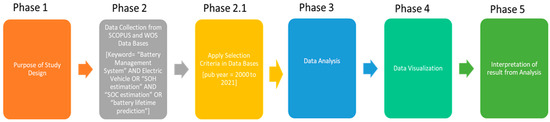
Figure 1.
Methodology step by step phase process.
The first phase started with research-based questions. Appropriate keyword selection for analysis is also a topic of concern. The gathering of keywords is done from highly cited publications along with essential keywords according to the author [8]. Relevant databases from SCOPUS and WOS were explored for the review articles related to state estimation of electric vehicle batteries.
In the second phase, data collection is done with the appropriate keyword and with filtering elements like publication, year, subject, keyword, author, citation, and institution. Applying Boolean logic operations in keyword searches also gives different results for documents. Using an inverted comma in each keyword will not allow two or more words in a block to separate. Using a single colon in a keyword means a suitable suffix along with a keyword will search and give results. We fixed year constraints as selection criteria for database extraction, and we limited the years of investigation to be from 2000 to 2021.
In the third phase, data analysis is done. After downloading the CSV file, normalization of the data is done if there is missing/redundant/oversampled data. We mapped the data network and moved to the next step.
In the fourth step, data visualization is done. There are many visualizations open-source software tools available like VOSviewer, CiteSpace, Hitscite, Gephi, Wordcloud, Excel, Orange, R software, MiniTab, and TABLU. In this paper, the authors used Wordcloud, Excel, and VOSviewer as visualization tools.
In the final phase, inferences were drawn from the available data visualization. This result helps in concluding the research-based questions answers. Inference from the bibliometric study also helps find literature gaps, future trends, and the amount of work that has been done in a particular research area. The bibliometric study is a history of scientific publications on a particular topic within a short span of time.
3.1. Significant Keywords
The searched keywords are “battery management system” AND ”electric vehicle” OR “SOH estimation” AND “SOC estimation” OR “battery lifetime prediction”. Primary and secondary queried keywords are shown in Table 3. By using only primary keywords, there are 5129 documents in SCOPUS and 1339 documents in WOS. Then adding specialized keywords specific to a particular topic that is using primary as well as secondary keywords by “ORing” the result will bring 828 documents in SCOPUS and 1434 documents in WOS. By using the above query string keywords with Boolean logic along with the year constraint (2000 to 2021), there are 136 documents in SCOPUS and 1311 documents in WOS. On the left-hand side of SCOPUS and WOS library, there are options to exclude or limit country, publication type, language, affiliation, and many more parameters. The correct incorporation of keywords helps to reach the target research areas in terms of the number of publications (NoP). WOS has more documents searched as compared to SCOPUS.
Table 3.
Keywords used for querying SCOPUS DB and WOS DB (Source: SCOPUS DB and WOS DB accessed on 7 March 2022).
The search of appropriate keywords and the time duration over which this keyword is searched also plays an important role in finding relevant data. Tips to search results in different ways are discussed in Table 4, which helps researchers to fine tune and narrow down their research topic.
Table 4.
Tips to search relevant document result in different ways of keyword search.
3.2. Preliminary Analysis
WOS has more publications than the SCOPUS DB, which is clearly seen in Figure 2. There is a drastic increase in NOP from 2014 to 2021 in both databases. Awareness programs, promotion through social media, subsidy missions, and research trends in the EV sector increased starting in 2018.
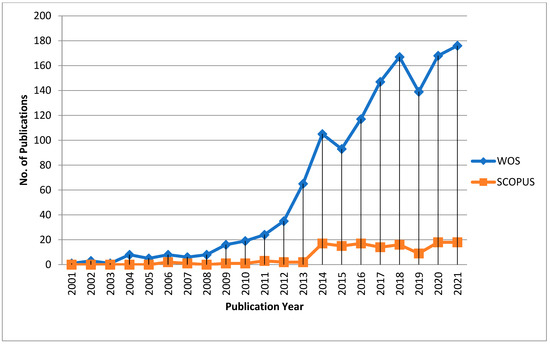
Figure 2.
Total number of publications between 2000 to 2021 in SCOPUS and WOS databases.
In Figure 3, the top ten most influential authors of EV BMS in both SCOPUS DB and WOS DB are listed. Rui Xiong is the author with the most contributions with total 52 publications, followed by Minggao Ouyang with total 50 publications in WOS DB. Rui Xiong is the most contributing author in SCOPUS DB with 8 publications followed by Hongwen He with 5 publications.
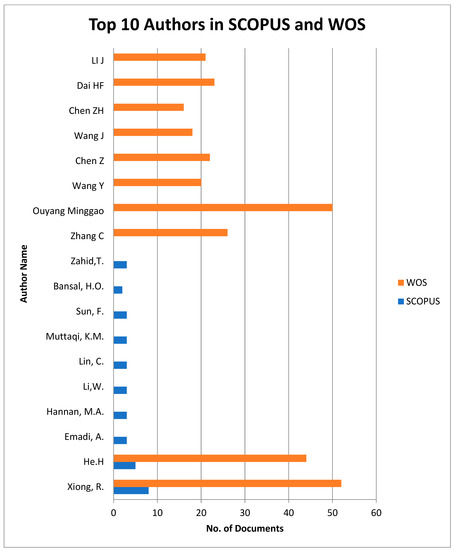
Figure 3.
Top ten authors of SCOPUS and WOS DB along with NOPs.
Figure 4 shows the top ten affiliations in SCOPUS and WOS DB. The Beijing Institute of Technology leads with 14 publications followed by the Chinese Academy of Sciences with 11 publications in the top ten affiliated publishing institutes in the SCOPUS DB lists. The Beijing Institute of Technology leads with 105 publications followed by Tsinghua University with 89 publications in the top ten affiliated publishing institutes in the WOS DB lists.
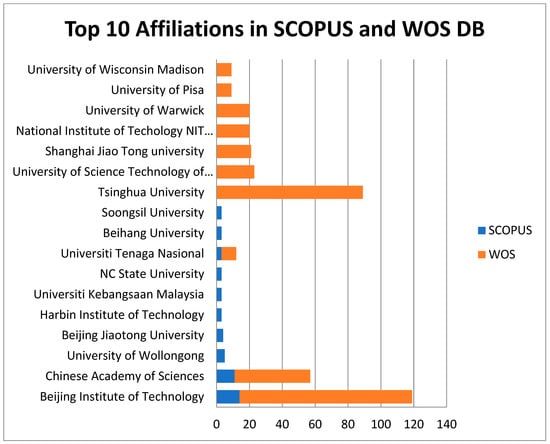
Figure 4.
Top ten affiliations in BMS EV in SCOPUS and WOS DB.
The categories of documents for publication are shown in Figure 5 and Figure 6 for SCOPUS DB and WOS DB respectively. Conference paper publications are most prevalent with 74 documents, followed by article-type documents with 58 documents, and then review-type papers with 4 documents in SCOPUS DB. Article-type publications are most prevalent in WOS DB with 763 documents, followed by meeting-type papers with 616 documents. The other categories of WOS DB publications are review, early access, and books.
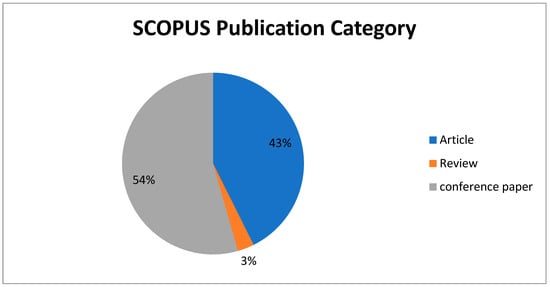
Figure 5.
SCOPUS DB publication category in the field of BMS EV.
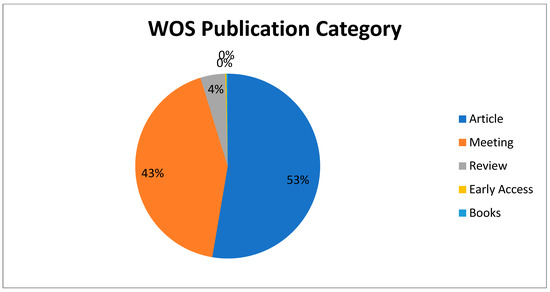
Figure 6.
WOS DB publication category in the field of BMS EV.
Numbers related to publications’ countries of origin are shown in Figure 7. China has the most publications with 72 documents, followed by India with 16 documents in SCOPUS DB. China has the most publications with 827 documents followed by the USA with 215 documents in WOS DB. China is the top contributor to the EV battery research field because of the following reasons.
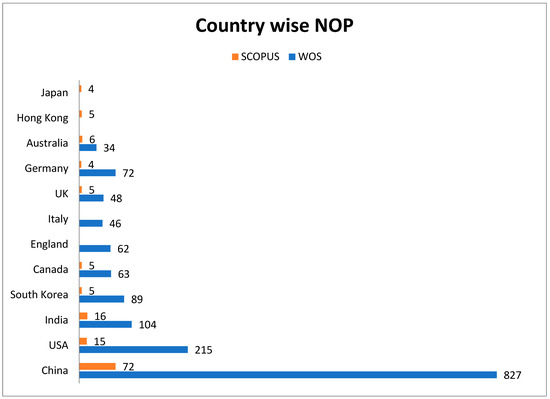
Figure 7.
Based on country-wise NOP in SCOPUS and WOS DB.
As per the SCOPUS database, Table 5 shows the top ten countries with maximum publication and the top ten highly cited papers’ countries. The statistical t-test is conducted for finding the difference between top ten countries’ productivity. The null hypothesis is there is no difference between the number of publications of the top ten most highly cited papers’ countries and the maximum number of publications from top ten countries. In the alternative hypothesis, there is a difference between the number of publications of top ten highly cited papers’ countries and the maximum number of publications from top ten countries.
Table 5.
Comparison of top ten countries in all and highly cited paper countries.
One sample t-test is conducted, and Equation (1) shows the formula for the t ratio:
where is the calculated mean, µ is the hypothetical mean,
- S is the standard deviation, and
- n is the sample size.
JASP is an open-source software and can be downloaded freely. By using JASP software, statistical analysis was performed for this paper. Results are discussed in Table 6 and Table 7. The p-value is more than 0.05 for both the sample publications, which means the null hypothesis is accepted and the alternative hypothesis is rejected. There is no difference between the number of publications of top ten highly cited papers countries and the maximum number of publications from top ten countries.
Table 6.
One-sample t-test of top ten countries in all and highly cited paper countries.
Table 7.
Descriptive statistics of top ten countries in all and highly cited paper countries.
The top ten funding agencies of BMS state estimation in EV from SCOPUS DB and WOS DB is shown in Figure 8 and Figure 9 respectively. The most documents are funded by the National Natural Science Foundation of China with 19 and 195 publications in SCOPUS DB and WOS DB, respectively. As per Figure 8 and Figure 9, most of the funding comes from NSFC China. Figure 4 shows that most of the research articles are from the Beijing Institute of Technology. China has also a high lithium reserve.
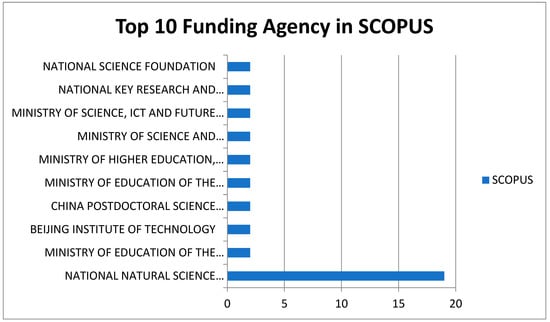
Figure 8.
Top ten funding agencies in BMS EV for SCOPUS DB.
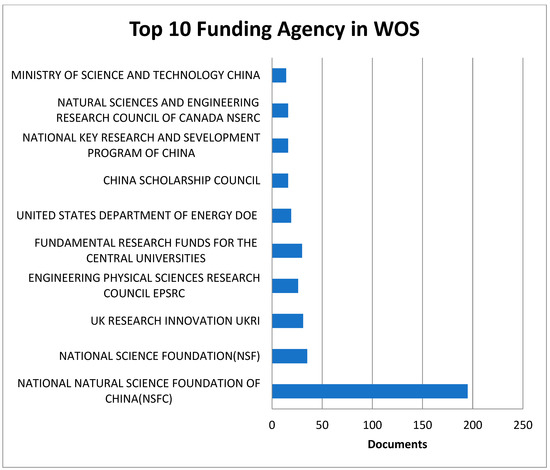
Figure 9.
Top ten funding agencies in BMS EV for WOS DB.
Figure 10 shows the number of publications in SCOPUS DB and WOS DB as per subject area. “Engineering” has the highest number of publications in both databases. A total of 1133 documents related to engineering were published in WOS DB followed by 986 ”energy fuel” documents. A total of 108 documents were related to “engineering” in SCOPUS DB followed by “energy” with 52 documents.
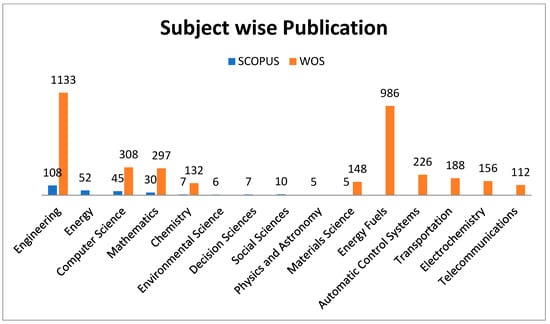
Figure 10.
Subject-wise number of publications in SCOPUS DB and WOS DB.
4. Bibliometric Analysis
The citation shows which paper is referred to most of the time. The h-index is an indicator through which the evaluation of productive and influential authors is known. The h-index is calculated when the number of paper publications of an author is cited as greater than or equal to the number of papers published by the author. Table 8 and Table 9 list the top 15 most cited papers in SCOPUS DB and WOS DB, respectively, along with publication year, title, author name, journal publication, and total citations gathered. M.A. Hannan had two SCOPUS documents published, one of which was a review paper on lithium-ion battery SOC estimation and management; this gathered 776 citations. L.G. Lu has one review paper on key issues of lithium-ion batteries in BMS, which gathered 2576 citations in WOS DB.
Table 8.
Top 15 most cited papers in SCOPUS databases for BMS EV state estimation.
Table 9.
Top 15 cited papers in WOS databases for BMS EV state estimation.
There are many papers with repeated works with limited contributions. When reading a paper, first read the abstract and conclusion; if the topic and content are useful, then read the rest of the paper. While reading the whole paper, first go through the overview of the topics discussed in sections, figures/tables through that paper pattern, and the relevance of work is identified. In this way, we can identify the contribution of the paper. Every paper is unique in its own way. While doing the literature review, this process needs to be followed. The literature review gives a brief qualitative discussion of papers, their findings, their research gaps, the methodologies used in the paper, the comparison of different methods, and the applied methods. In contrast, the bibliometric review is a quantitative discussion of papers, authors, countries, year of publication, subject area, keywords, funding agency, journals, and affiliation. Figure 11 shows a critical analysis of the top-cited paper on SCOPUS and WOS. Highly cited authors provide more discussion on issues, challenges, and methods to overcome problems in lithium-ion battery BMS and SOC. Mostly since 2020, these papers are cited by other authors, which shows that researchers are most enthusiastic about this BMS and SOC topic. Battery SOH papers number 496 documents in SCOPUS and 1323 documents in WOS. At the same time, battery SOC papers number 2808 documents in SCOPUS and 7741 documents in WOS. The level of complexity to estimate SOH is more as compared to SOC. For instance, the estimation of SOH seems more difficult than SOC, but in reality, more publications deal with the latter issue. Much less research work has been done with regard to the challenges, issues, and state estimation methods for Li-ion battery, and BMS and SOC estimation.
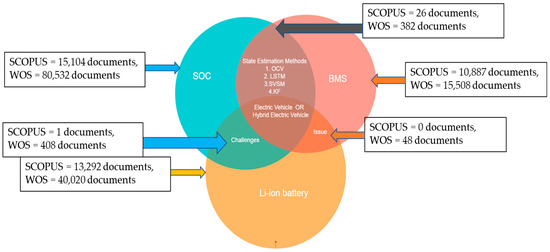
Figure 11.
Critical analysis of top cited paper of SCOPUS and WOS.
Figure 12 and Figure 13 show the graph trend of the top five documents in SCOPUS and WOS DB, respectively, in BMS EV state estimation.
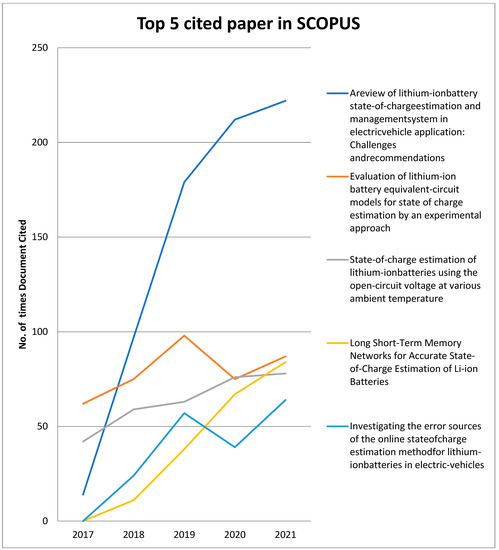
Figure 12.
Top five cited papers of BMS EV across 5 years in SCOPUS DB.
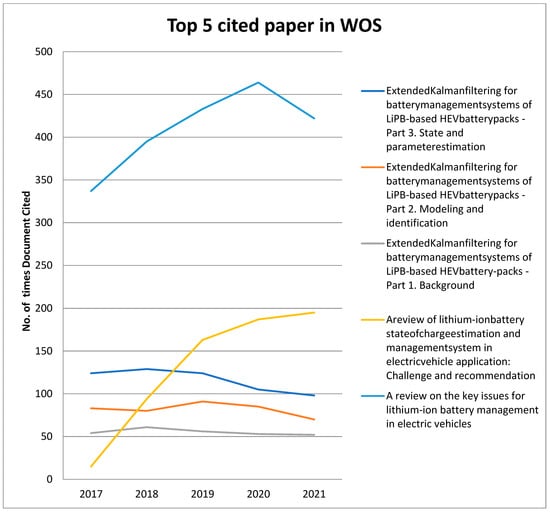
Figure 13.
Top five cited papers of BMS EV across the last 5 years in WOS DB.
The paper entitled “A review of lithium-ion battery state of charge estimation and management system in electric vehicle applications: Challenges and recommendations” had a steep increase in the number of citations in 2020 in SCOPUS DB. The paper entitled “A review on the key issues for lithium-ion battery management in electric vehicles” had a steep increase in the number of citations in 2020 in WOS DB. In Figure 12, we see that the paper entitled “State of-charge estimation of lithium-ion batteries using the open circuit voltage at various ambient temperature” initially had an overall higher citation rate than “Long short-term memory networks for accurate state-of-charge estimation of Li-ion batteries,” but the latter paper has gathered more citations than the earlier paper over time. Similarly, in Figure 13, the second overall most cited document was highly cited in 2021. This shows that trend of highly cited papers changes every year. In that particular year whichever paper was more highly cited proved that it had some new informative content.
Source titles in SCOPUS and WOS DB are shown in Figure 14 and Figure 15 respectively. Energies has a maximum 22% of publications and contributions in the state estimation of EV in SCOPUS DB followed by the Journal of Power Sources with 15% of publications. However, in the case of WOS DB, the Journal of Power Sources and Energies lead with 21% of publications, followed by Applied Energy with 12% of publications.
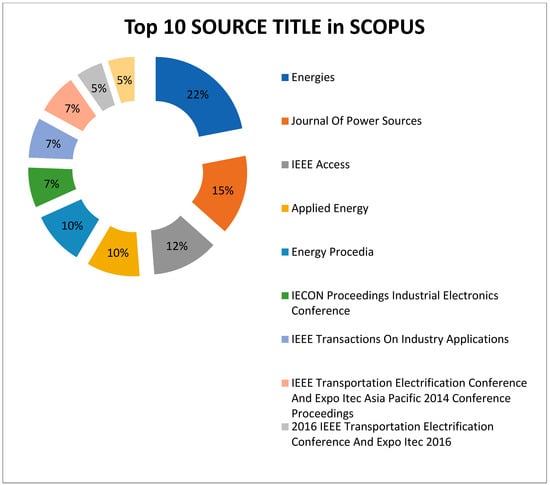
Figure 14.
Top ten source titles in SCOPUS DB.
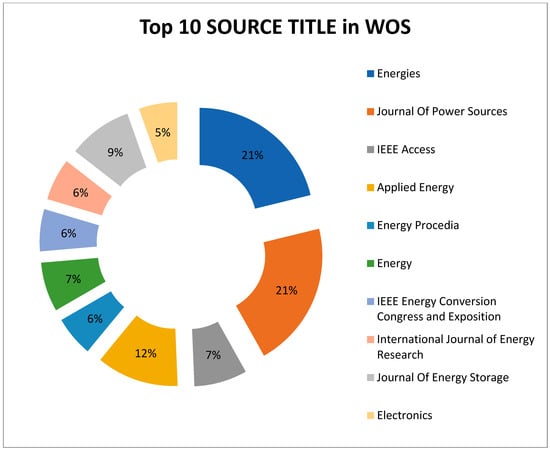
Figure 15.
Top ten source titles in WOS DB.
Figure 16 shows maximum number of words used in the most cited paper. This visualization is created by using online the free software found at www.wordclouds.com (Accessed on 15 March 2022). In this software, a PDF document of a paper is uploaded, and this effect with a vehicle theme is created. The word “SOC” is repeated the most in this paper followed by “SOH”, “model”, “cell”, “system”, “sources”, and “BMS”.
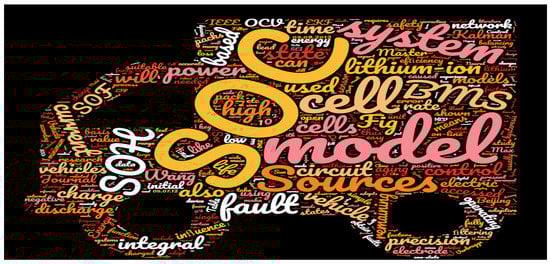
Figure 16.
Visualization of top cited paper words in “Wordcloud”.
In Figure 17, GPS visualization using the www.gpsvisualizer.com (Accessed on 15 March 2022) tool helps to understand which countries are contributing the most toward research work in EV BMS state estimation. China leads in research work contributions and publications. Mostly Asian and Europeans countries are influencing the research work in EV BMS, followed by the USA and Australia. The research is mostly carried out in Asian and Western European countries.
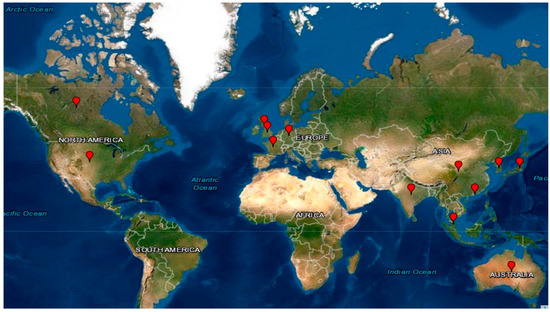
Figure 17.
GPS visualization of countries contributing to EV BMS state estimation.
Figure 18 shows the clustering of author and co-authorship in the SCOPUS DB. There are four clusters of authors and co-author relationships from the SCOPUS DB. R. Xiong has the most networks (13 links) between co-authors, followed by H. He with eight links. This cluster is generated by using VOSviewer open-source software. The minimum number of documents per author is two and a minimum of two citations per author is the criteria set for this analysis.
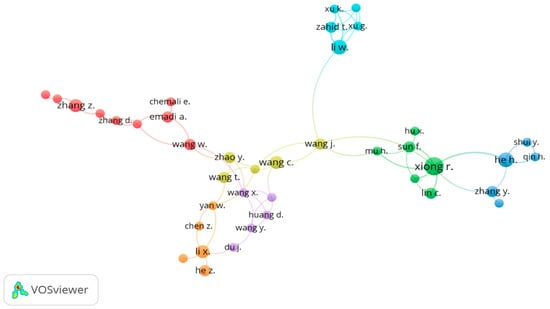
Figure 18.
Cluster of co-authorship and author in the SCOPUS DB.
Figure 19 shows the clustering of author keywords and their occurrence in the SCOPUS DB. The “SOC estimation” keyword is big in size, which reflects that this keyword has a maximum occurrence of 47, and 96 links in different papers, followed by “electric vehicle”, which has 31 occurrences and 94 links. Then “state of charge” has 29 occurrences and 72 links, and then “lithium-ion battery” has 23 occurrences and 56 links. The minimum number of occurrences of the keyword is chosen as two in VosViewer as the threshold.
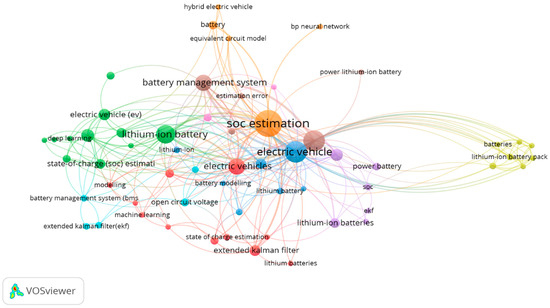
Figure 19.
Mapping of authors’ keyword and occurrence in the SCOPUS DB.
5. Challenges and Future Perspective
There are various issues related to lithium-ion batteries. Issues related to recycling lithium-ion batteries and pertinent environmental issues as well as manufacturing, utilizing, and end-of-life issues are discussed in [33]. In [34], the author discusses issues related to lithium-ion safety, accidents, existing technology, solid-state batteries, and causes in the lithium-ion battery at the cell level or pack level. Lithium-ion battery impedance varies with time, and temperature; therefore, proper modeling of lithium-ion battery in on-board vehicles is discussed in [35]. Different safety issues related to chemical reaction, thermal runaway [36], electrical–mechanical abuse, strategies and testing standard of lithium-ion batteries are discussed in [37]. Based on machine learning tools safety risk is predicted in [38]. The achievement of high accuracy in the prediction of cylindrical and pouch battery is another issue. After completion of the first life cycle of the lithium-ion battery, one can plan how to use it for a second life. These challenges are discussed in [39]. There are various new battery chemistries researched, and some of the latest popular batteries are the sodium-ion batteries [40], bio-inspired material for the secondary application of batteries [41], anionic battery [42], rechargeable Zn-air battery [43], potassium ion batteries [44], batteries related to particular applications such as EVs [45,46], non-aqueous, rechargeable aluminum batteries [47,48], and flexible zinc battery [49]. BMS plays a major role in state monitoring, energy management, communication between hardware and software and the protection of batteries from fault. The state estimation of batteries is a critical task for detection and handling. Early detection of sudden disturbances will save lives from severe danger. Batteries have to respond in milliseconds in order to prevent any hazardous activity. Data acquisition should respond quickly at high frequencies in order to provide accurate data online. Standardizing the charging mechanism and network protocol will help to simplify use cases. Giving more weight to the charging/discharging cycle, temperature change, resistance increase, and capacity fade will contribute to early detection of the fault. In the future, a deep analysis of capacity fading due to low temperature and high cycling rates has to be investigated [50]. Capacity fade behavior due to deep discharge with different load conditions has to be analyzed. Much less research has been done on calendar aging batteries, and keeping batteries idle also reduces the capacity of a battery. Most of the research work has been done on the cell level, not on the battery-pack level, which can be explored as a part of a future work. There are various evolving terminologies related to EV battery SOC and SOH which need to be explored in depth in the future. These include “beginning of life” (BOL), “state of power” (SOP), “state of safety” (SOS), “remaining useful life” (RUL), and “end of life” (EOL). By knowing SOH, SOC can be determined and vice versa. By knowing SOC, SOP can be estimated and the remaining distance to travel to empty can be calculated. Challenges include the research gaps that can be fulfilled in the future, and by the help of this analysis, researchers will be able to refer to the latest papers of top authors and also ask for funding from a highly funding agency.
6. Concluding Remark
The bibliometric analysis is based on the recent trend in EV BMS with respect to author, citation, country, journal publication, and funding agency. Most of the bibliometric EV study has been done on policy frameworks, battery thermal management, and the overall development in the EV sector and the amount of research carried out on EVs. This paper’s main aim is to discover the top ten authors, documents, journals, funding sponsors, affiliates, and countries in the field of state estimation of battery management system in EVs. This analysis will help researchers, industrialists and beginners to know who the top authors are and their research work. The published literature was sourced by SCOPUS and WOS database record, and the analysis was done through visualization tools. China leads in EV BMS research work, Xiong Rui and He Hongwen are the top authors. The Journal of Power Sources and Energies are the top journals. The National Natural Science Foundation of China is the top funding agency and “engineering” is the core subject area where this type of research is going on. The Chinese Academy of Sciences and Beijing Institute of Technology are the top affiliations. Very little research has been carried out on the state estimation of EV batteries. The statistical analysis of the top ten countries’ productivity results is also discussed.
Online accurate data collection and prediction is necessary for the unforeseen nonlinear behavior of batteries. Sensors must give exact data and must be unaffected by noise emulsion. The capacity of batteries degrades over time, and manufacturers give a 5-year warranty in battery purchase but due to cycling and use case, the battery degrades before warranty time. In the future, developing an algorithm that detects health indications in a few cycles with less error will further improve overall battery life. BMS is tested in a laboratory-controlled environment so real-time dynamic environmental analysis of BMS plays significant role in developing good BMS. Integrating BMS data with the cloud will allow a large amount of data to be stored and analyzed better.
Author Contributions
Conceptualization, methodology, R.S., R.H., M.S.; software, validation, formal analysis, investigation, resources, data curation, writing—original draft preparation, R.S.; writing—review and editing, visualization, R.S., R.H., M.S.; supervision, R.H.; project administration, M.S. All authors have read and agreed to the published version of the manuscript.
Funding
The bibliometric survey was not funded by any organization.
Institutional Review Board Statement
Not applicable.
Informed Consent Statement
Not applicable.
Data Availability Statement
The datasets that support the findings of this study are collected by the first author and available from the corresponding author upon reasonable request.
Conflicts of Interest
The authors declare that there are no conflict of interest relevant to the topic and publication of this paper. This manuscript has not been submitted to any other journal for review and publication.
References
- Deng, R.; Liu, Y.; Chen, W.; Liang, H. A Survey on Electric Buses—Energy Storage, Power Management, and Charging Scheduling. IEEE Trans. Intell. Transp. Syst. 2021, 22, 9–22. [Google Scholar] [CrossRef]
- Chen, Z.; Zhou, J.; Zhou, F.; Xu, S. State-of-charge estimation of lithium-ion batteries based on improved H infinity filter algorithm and its novel equalization method. J. Clean. Prod. 2021, 290, 125180. [Google Scholar] [CrossRef]
- NaitMalek, Y.; Najib, M.; Bakhouya, M.; Essaaidi, M. On the Use of Machine Learning for State-of-Charge Forecasting in Electric Vehicles. In Proceedings of the 2019 IEEE International Smart Cities Conference (ISC2), Casablanca, Morocco, 14–17 October 2019; pp. 408–413. [Google Scholar] [CrossRef]
- Mawonou, K.S.; Eddahech, A.; Dumur, D.; Beauvois, D.; Godoy, E. State-of-health estimators coupled to a random forest approach for lithium-ion battery aging factor ranking. J. Power Sources 2021, 484, 229154. [Google Scholar] [CrossRef]
- Xiong, R.; Zhang, Y.; Wang, J.; He, H.; Peng, S.; Pecht, M. Lithium-Ion Battery Health Prognosis Based on a Real Battery Management System Used in Electric Vehicles. IEEE Trans. Veh. Technol. 2019, 68, 4110–4121. [Google Scholar] [CrossRef]
- Omariba, Z.; Zhang, L.; Sun, D. Review on Health Management System for Lithium-Ion Batteries of Electric Vehicles. Electronics 2018, 7, 72. [Google Scholar] [CrossRef]
- Wagle, S.A.; Harikrishnan, R. A Bibliometric Analysis of Plant Disease Classification with Artificial Intelligence Based on Scopus and WOS. 2021. Available online: https://www.researchgate.net/profile/Shivali-Wagle/publication/350092508_A_Bibliometric_Analysis_of_Plant_Disease_Classification_with_Artificial_Intelligence_based_on_Scopus_and_WOS/links/6062165f458515e8347d7837/A-Bibliometric-Analysis-of-Plant-Disease-Classification-with-Artificial-Intelligence-based-on-Scopus-and-WOS.pdf (accessed on 26 June 2022).
- Secinaro, S.; Brescia, V.; Calandra, D.; Biancone, P. Employing bibliometric analysis to identify suitable business models for electric cars. J. Clean. Prod. 2020, 264, 121503. [Google Scholar] [CrossRef]
- Cabeza, L.F.; Frazzica, A.; Chàfer, M.; Vérez, D.; Palomba, V. Research trends and perspectives of thermal management of electric batteries: Bibliometric analysis. J. Energy Storage 2020, 32, 101976. [Google Scholar] [CrossRef]
- Raboaca, M.S.; Bizon, N.; Grosu, O.V. Energy management strategies for hybrid electric vehicles-vosviwer bibliometric analysis. In Proceedings of the 2020 12th International Conference on Electronics, Computers and Artificial Intelligence (ECAI), Bucharest, Romania, 25–27 June 2020; pp. 1–8. [Google Scholar] [CrossRef]
- Ramirez Barreto, D.A.; Ochoa Guillermo, E.V.; Peña Rodriguez, A.; Cardenas Escorcia, Y.D. Bibliometric analysis of nearly a decade of research in electric vehicles: A dynamic approach. ARPN J. Eng. Appl. Sci. 2018, 13, 4730–4736. [Google Scholar]
- Gochhait, D.S.; Sudheesh, V.I. Trend Analysis of Electric Vehicles through Web Of Science: A Bibliometric Analysis. Eur. J. Mol. Clin. Med. 2020, 7, 2595–2603. [Google Scholar]
- Pan, Y.; Ren, D.; Kuang, K.; Feng, X.; Han, X.; Lu, L.; Ouyang, M. Novel non-destructive detection methods of lithium plating in commercial lithium-ion batteries under dynamic discharging conditions. J. Power Sources 2022, 524, 231075. [Google Scholar] [CrossRef]
- Donthu, N.; Kumar, S.; Mukherjee, D.; Pandey, N.; Lim, W.M. How to conduct a bibliometric analysis: An overview and guidelines. J. Bus. Res. 2021, 133, 285–296. [Google Scholar] [CrossRef]
- Zhang, P.; Yan, F.; Du, C. A comprehensive analysis of energy management strategies for hybrid electric vehicles based on bibliometrics. Renew. Sustain. Energy Rev. 2015, 48, 88–104. [Google Scholar] [CrossRef]
- Bian, X.; Wei, Z.G.; Li, W.; Pou, J.; Sauer, D.U.; Liu, L. State-of-Health Estimation of Lithium-ion Batteries by Fusing an Open-Circuit-Voltage Model and Incremental Capacity Analysis. IEEE Trans. Power Electron. 2021, 37, 2226–2236. [Google Scholar] [CrossRef]
- Ecker, M.; Nieto, N.; Käbitz, S.; Schmalstieg, J.; Blanke, H.; Warnecke, A.; Sauer, D.U. Calendar and cycle life study of Li(NiMnCo)O2-based 18650 lithium-ion batteries. J. Power Sources 2014, 248, 839–851. [Google Scholar] [CrossRef]
- Cuma, M.U.; Koroglu, T. A comprehensive review on estimation strategies used in hybrid and battery electric vehicles. Renew. Sustain. Energy Rev. 2015, 42, 517–531. [Google Scholar] [CrossRef]
- Ecker, M.; Gerschler, J.B.; Vogel, J.; Käbitz, S.; Hust, F.; Dechent, P.; Sauer, D.U. Development of a lifetime prediction model for lithium-ion batteries based on extended accelerated aging test data. J. Power Sources 2012, 215, 248–257. [Google Scholar] [CrossRef]
- Lu, L.; Han, X.; Li, J.; Hua, J.; Ouyang, M. A review on the key issues for lithium-ion battery management in electric vehicles. J. Power Sources 2013, 226, 272–288. [Google Scholar] [CrossRef]
- Noura, N.; Boulon, L.; Jemeï, S. A Review of Battery State of Health Estimation Methods: Hybrid Electric Vehicle Challenges. World Electr. Veh. J. 2020, 11, 66. [Google Scholar] [CrossRef]
- Park, S.; Ahn, J.; Kang, T.; Park, S.; Kim, Y.; Cho, I.; Kim, J. Review of state-of-the-art battery state estimation technologies for battery management systems of stationary energy storage systems. J. Power Electron. 2020, 20, 1526–1540. [Google Scholar] [CrossRef]
- Waag, W.; Fleischer, C.; Sauer, D.U. Critical review of the methods for monitoring of lithium-ion batteries in electric and hybrid vehicles. J. Power Sources 2014, 258, 321–339. [Google Scholar] [CrossRef]
- Xiong, R.; Cao, J.; Yu, Q.; He, H.; Sun, F. Critical Review on the Battery State of Charge Estimation Methods for Electric Vehicles. IEEE Access 2018, 6, 1832–1843. [Google Scholar] [CrossRef]
- Zhang, J.; Lee, J. A review on prognostics and health monitoring of Li-ion battery. J. Power Sources 2011, 196, 6007–6014. [Google Scholar] [CrossRef]
- Burton, M.J.; Ramke, J.; Marques, A.P.; Bourne, R.R.A.; Congdon, N.; Jones, I.; Tong, B.A.M.A.; Arunga, S.; Bachani, D.; Bascaran, C.; et al. The Lancet Global Health Commission on Global Eye Health: Vision beyond 2020. Lancet Glob. Health 2021, 9, e489–e551. [Google Scholar] [CrossRef]
- Chen, Y.; Kang, Y.; Zhao, Y.; Wang, L.; Liu, J.; Li, Y.; Liang, Z.; He, X.; Li, X.; Tavajohi, N.; et al. A review of lithium-ion battery safety concerns: The issues, strategies, and testing standards. J. Energy Chem. 2021, 59, 83–99. [Google Scholar] [CrossRef]
- Gao, X.; Liu, H.; Deng, W.; Tian, Y.; Zou, G.; Hou, H.; Ji, X. Iron-Based Layered Cathodes for Sodium-Ion Batteries. Batter. Supercaps 2021, 4, 1657–1679. [Google Scholar] [CrossRef]
- Kumar, S.; Pandey, N.; Lim, W.M.; Chatterjee, A.N.; Pandey, N. What do we know about transfer pricing? Insights from bibliometric analysis. J. Bus. Res. 2021, 134, 275–287. [Google Scholar] [CrossRef]
- Sakhnini, J.; Karimipour, H.; Dehghantanha, A.; Parizi, R.M.; Srivastava, G. Security aspects of Internet of Things aided smart grids: A bibliometric survey. Internet Things 2021, 14, 100111. [Google Scholar] [CrossRef]
- Zhang, Y.; Porter, A.L.; Cunningham, S.; Chiavetta, D.; Newman, N. Parallel or Intersecting Lines? Intelligent Bibliometrics for Investigating the Involvement of Data Science in Policy Analysis. IEEE Trans. Eng. Manag. 2021, 68, 1259–1271. [Google Scholar] [CrossRef]
- Guo, Y.-M.; Huang, Z.-L.; Guo, J.; Guo, X.-R.; Li, H.; Liu, M.-Y.; Ezzeddine, S.; Nkeli, M.J. A bibliometric analysis and visualization of blockchain. Future Gener. Comput. Syst. 2021, 116, 316–332. [Google Scholar] [CrossRef]
- Herrera-Franco, G.; Montalván-Burbano, N.; Carrión-Mero, P.; Jaya-Montalvo, M.; Gurumendi-Noriega, M. Worldwide Research on Geoparks through Bibliometric Analysis. Sustainability 2021, 13, 1175. [Google Scholar] [CrossRef]
- Das, S.; Manna, S.S.; Pathak, B. Recent Trends in Electrode and Electrolyte Design for Aluminum Batteries. ACS Omega 2021, 6, 1043–1053. [Google Scholar] [CrossRef] [PubMed]
- Wang, X.; Wei, X.; Zhu, J.; Dai, H.; Zheng, Y.; Xu, X.; Chen, Q. A review of modeling, acquisition, and application of lithium-ion battery impedance for onboard battery management. ETransportation 2021, 7, 100093. [Google Scholar] [CrossRef]
- Ibrahim, A.; Jiang, F. The electric vehicle energy management: An overview of the energy system and related modeling and simulation. Renew. Sustain. Energy Rev. 2021, 144, 111049. [Google Scholar] [CrossRef]
- Fakhar Manesh, M.; Pellegrini, M.M.; Marzi, G.; Dabic, M. Knowledge Management in the Fourth Industrial Revolution: Mapping the Literature and Scoping Future Avenues. IEEE Trans. Eng. Manag. 2021, 68, 289–300. [Google Scholar] [CrossRef]
- Jia, Y.; Li, J.; Yuan, C.; Gao, X.; Yao, W.; Lee, M.; Xu, J. Data-Driven Safety Risk Prediction of Lithium-Ion Battery. Adv. Energy Mater. 2021, 11, 2003868. [Google Scholar] [CrossRef]
- Shahjalal, M.; Roy, P.K.; Shams, T.; Fly, A.; Chowdhury, J.I.; Ahmed, M.R.; Liu, K. A review on second-life of Li-ion batteries: Prospects, challenges, and issues. Energy 2022, 241, 122881. [Google Scholar] [CrossRef]
- Costa, C.; Barbosa, J.; Gonçalves, R.; Castro, H.; Del Campo, F.; Lanceros-Méndez, S. Recycling and environmental issues of lithium-ion batteries: Advances, challenges and opportunities. Energy Storage Mater. 2021, 37, 433–465. [Google Scholar] [CrossRef]
- Jo, C.; Voronina, N.; Sun, Y.; Myung, S. Gifts from Nature: Bio-Inspired Materials for Rechargeable Secondary Batteries. Adv. Mater. 2021, 33, 2006019. [Google Scholar] [CrossRef]
- Karkera, G.; Reddy, M.A.; Fichtner, M. Recent developments and future perspectives of anionic batteries. J. Power Sources 2021, 481, 228877. [Google Scholar] [CrossRef]
- Leong, K.W.; Wang, Y.; Ni, M.; Pan, W.; Luo, S.; Leung, D.Y.C. Rechargeable Zn-air batteries: Recent trends and future perspectives. Renew. Sustain. Energy Rev. 2022, 154, 111771. [Google Scholar] [CrossRef]
- Liu, S.; Kang, L.; Henzie, J.; Zhang, J.; Ha, J.; Amin, M.A.; Hossain, S.A.; Jun, S.C.; Yamauchi, Y. Recent Advances and Perspectives of Battery-Type Anode Materials for Potassium Ion Storage. ACS Nano 2021, 15, 18931–18973. [Google Scholar] [CrossRef] [PubMed]
- Shah, R.; Gashi, B.; González-Poggini, S.; Colet-Lagrille, M.; Rosenkranz, A. Recent trends in batteries and lubricants for electric vehicles. Adv. Mech. Eng. 2021, 13, 168781402110217. [Google Scholar] [CrossRef]
- Salgado, R.M.; Danzi, F.; Oliveira, J.E.; El-Azab, A.; Camanho, P.P.; Braga, M.H. The Latest Trends in Electric Vehicles Batteries. Molecules 2021, 26, 3188. [Google Scholar] [CrossRef] [PubMed]
- Shen, L.; Du, X.; Ma, M.; Wang, S.; Huang, S.; Xiong, L. Progress and Trends in Nonaqueous Rechargeable Aluminum Batteries. Adv. Sustain. Syst. 2022, 6, 2100418. [Google Scholar] [CrossRef]
- Huang, W.; Feng, X.; Han, X.; Zhang, W.; Jiang, F. Questions and Answers Relating to Lithium-Ion Battery Safety Issues. Cell Rep. Phys. Sci. 2021, 2, 100285. [Google Scholar] [CrossRef]
- Xu, Y.; Xu, X.; Guo, M.; Zhang, G.; Wang, Y. Research Progresses and Challenges of Flexible Zinc Battery. Front. Chem. 2022, 10, 827563. [Google Scholar] [CrossRef] [PubMed]
- Ayodele, B.V.; Mustapa, S.I. Life cycle cost assessment of electric vehicles: A review and bibliometric analysis. Sustainability 2020, 12, 2387. [Google Scholar] [CrossRef]
Publisher’s Note: MDPI stays neutral with regard to jurisdictional claims in published maps and institutional affiliations. |
© 2022 by the authors. Licensee MDPI, Basel, Switzerland. This article is an open access article distributed under the terms and conditions of the Creative Commons Attribution (CC BY) license (https://creativecommons.org/licenses/by/4.0/).