
Enhancing Transplantation Care with eHealth: Benefits, Challenges, and Key Considerations for the Future


Abstract
1. Introduction
- What evidence exists regarding the effectiveness of specific eHealth tools (e.g., virtual health, health apps, wearables) in improving health outcomes for transplant patients?
- Who are the primary user groups of eHealth devices in the transplantation context, and how do their needs and experiences differ?
- What are the predominant barriers hindering the widespread adoption of digital health tools among different user groups (e.g., patients, healthcare providers)?
- What are the key benefits of eHealth tools for pre- and post-transplant care?
- What are the critical factors to consider in designing and implementing eHealth interventions for transplant patients?
2. Methods
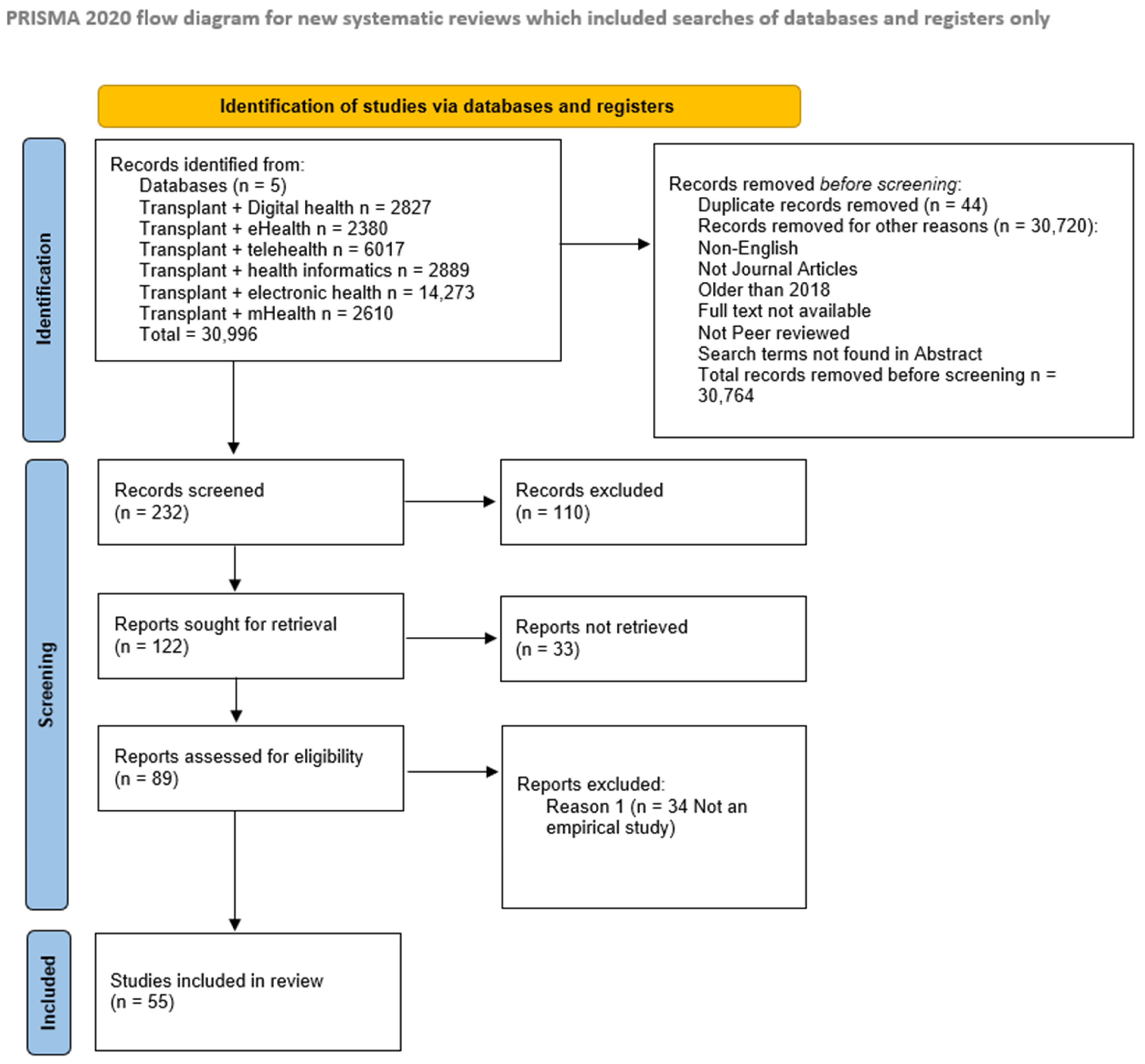
2.1. Data Sources and Search Strategies
2.2. Eligibility Criteria and Selection of Studies
- Peer-reviewed articles;
- Empirical studies using primary or secondary data;
- Published in English (due to the team’s inability to translate articles);
- Studies published between 2018 and September 2023.
- Non-English studies;
- Secondary research and conceptual papers (e.g., review studies that incorporated theoretical studies or opinions as primary sources of evidence);
- Non-peer reviewed papers;
- Papers older than 2018;
- Full text not available;
- Search terms not found in the abstract;
- Books, PhD and Masters theses, and conference abstracts.
2.3. Data Extraction
3. Results
3.1. End-User Communication and Interaction with Technology
3.2. Characteristics of Included Study
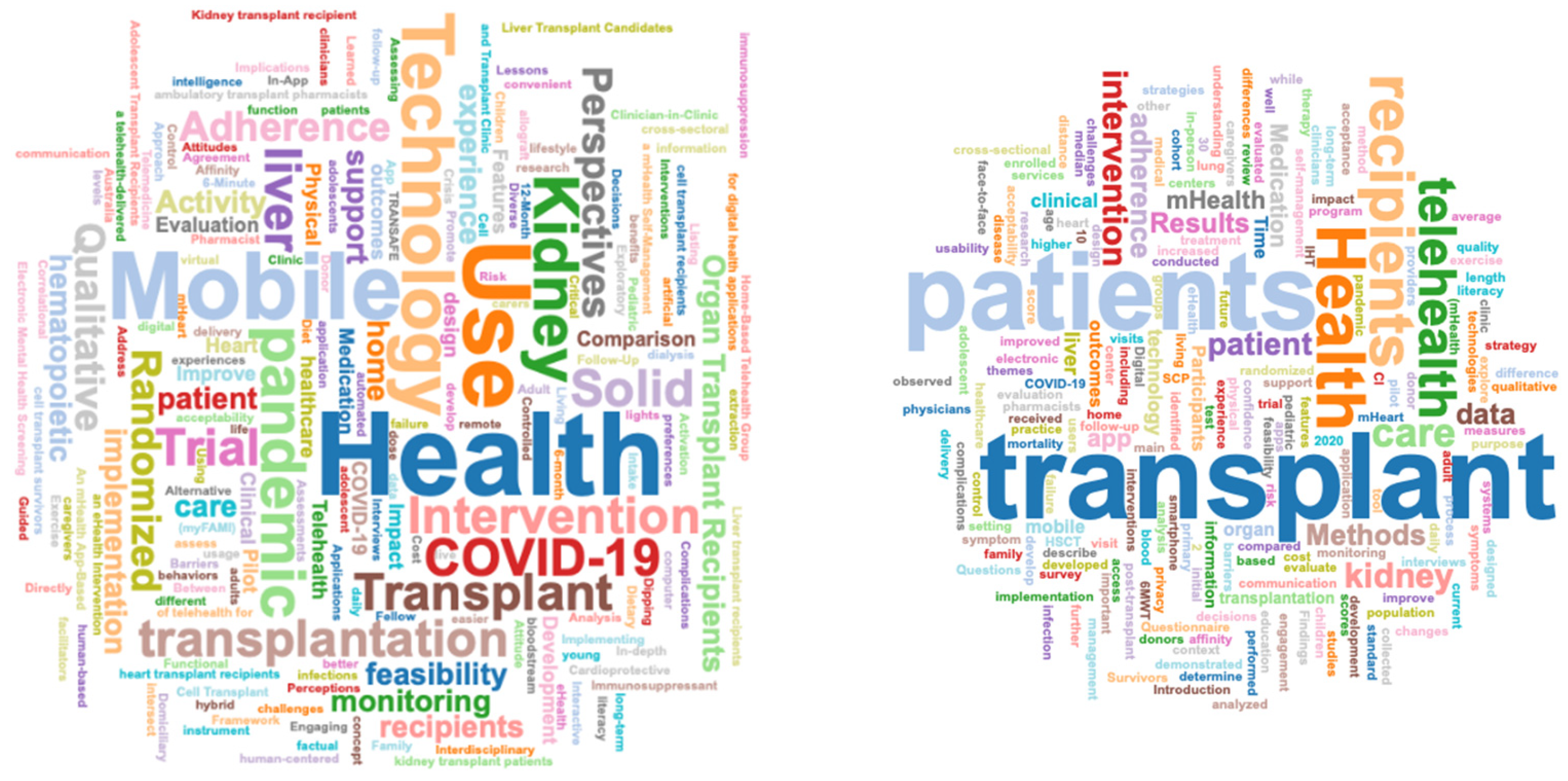
3.3. Descriptive Overview
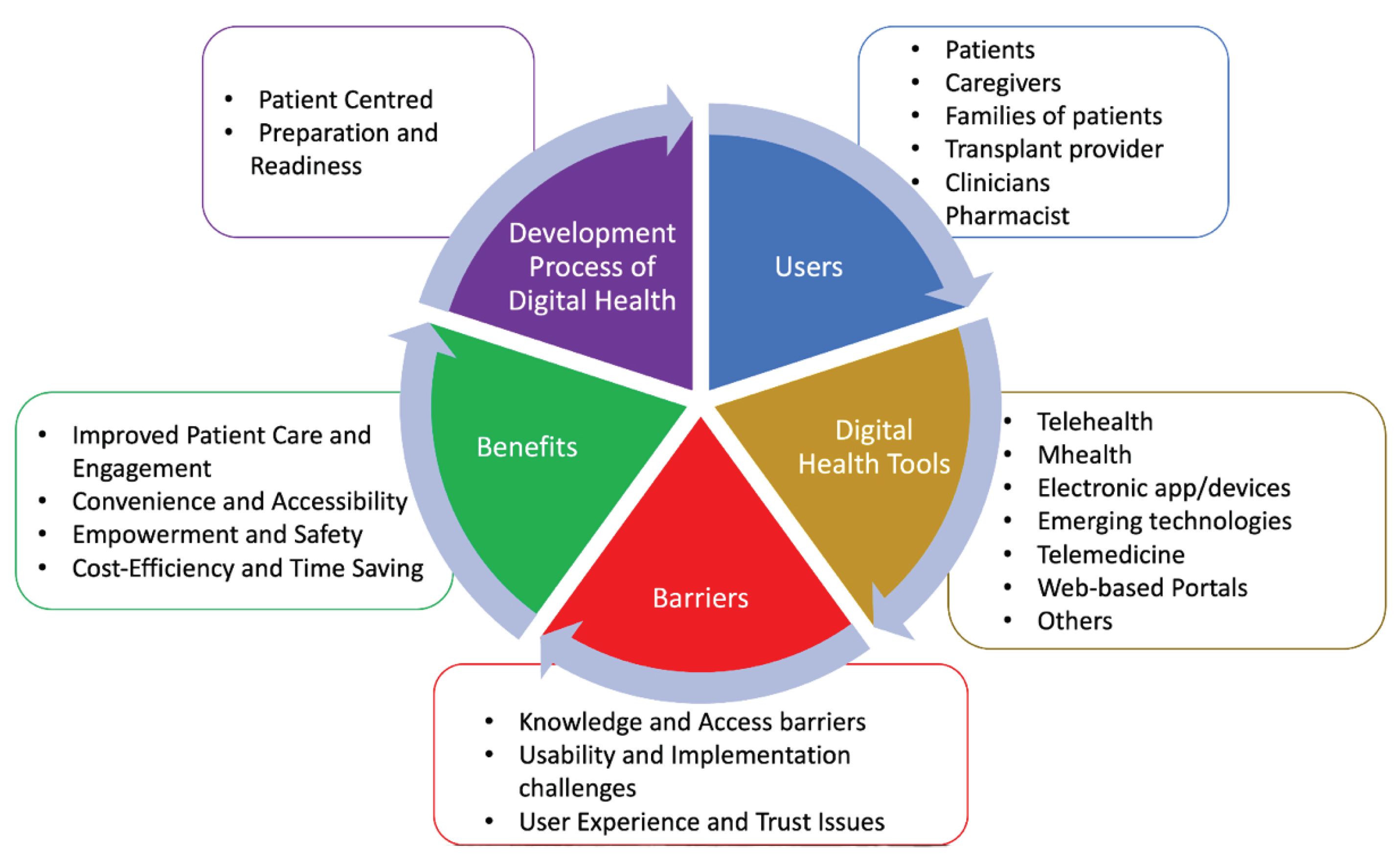
3.4. Extracted Themes
3.4.1. Users
3.4.2. Process of Development of Digital Health Tools
3.4.3. Benefits of Using Digital Health Tools
3.4.4. Barriers of Using Digital Health Tools
3.4.5. Different Types of eHealth Tools
3.4.6. The Role of Networking and Communication in eHealth for Transplantation
4. Discussion
Limitations and Future Research
5. Conclusions
Author Contributions
Funding
Data Availability Statement
Conflicts of Interest
Appendix A

| Author(s)/Year | Objective of Study | Study Design/Methodology | Type of Transplant | Health Technology | Participants | Number of Participants | Country | Main Findings | |
|---|---|---|---|---|---|---|---|---|---|
| [9] | Kimiafar et al., 2019 | Create a tool for evaluating privacy issues in a web-based liver transplantation registry (WLTR) and gauge patient perspectives on the WLTR’s privacy aspects. | Mixed methods—quantitative and qualitative | Organ—liver | Web-based portal (registry) | Patients | 81 | Iran | System designers and developers need to create privacy policies aligning with the registry program’s goals and user needs to safeguard patient information. |
| [10] | Handler et al., 2023 | Examine healthcare providers’ views on the characteristics of digital health interventions. | Qualitative, thematic analysis | Organ | Electronic app/devices (Digital Health Program) | Providers | 13 | Canada | Providers saw digital health interventions as a potential complement to current physical activity counselling, forming an innovative strategy to tackle identified barriers in solid organ transplant recipients’ participation in physical activity. |
| [11] | La hoz et al., 2021 | Assess the effectiveness of an electronic health record-based registry and its data extraction tools for clinical research in solid organ transplantation. | Quantitative | Organ—heart, kidney, liver, lung, multiorgan | Electronic app/devices (electronic health record) | Patients | 917 | US | Our study demonstrates the value of an electronic health record-based registry and automated extraction tools for clinical research in solid organ transplantation. A bloodstream infection (BSI) diminishes the 1-year survival of solid organ transplant recipients. |
| [12] | Deboni et al., 2020 | Detail the creation and execution of telehealth for monitoring renal transplant and peritoneal dialysis patients amid the COVID-19 pandemic. | Quantitative—descriptive study | Organ | Telehealth | Patients | 960 | Brazil | Outlines the creation and use of telehealth in monitoring renal transplant and peritoneal dialysis patients amid the COVID-19 pandemic. |
| [14] | Chang et al., 2021 | Assessing the viability and efficiency of remotely monitoring kidney transplant patients. | Quantitative | Organ—kidney | Telehealth | Patients | 2 | US | Our early findings show RPM’s feasibility and effectiveness post-transplant, broadening care through remote models. This is particularly crucial now, enabling close monitoring of COVID-19-positive transplant patients in home isolation. |
| [15] | Forbes et al., 2018 | Compare the expenses between patients initially evaluated via telehealth and those assessed in-person throughout the evaluation process. | Quantitative | Organ | Telehealth | Patients | 302 | US | Amid the rising prevalence of telemedicine applications, we share our encounter using telehealth for initial kidney transplant waitlist evaluations, showcasing reduced costs and time, potentially enhancing transplantation accessibility. |
| [17] | Hatzikiriakidis et al., 2022 | Investigate how the COVID-19 pandemic affected the daily lives of young LTx recipients, examining the relationship between immunosuppression and the virus. | Qualitative | Organ—lung | Telehealth | Patients | 11 | Australia | Adolescent LTx recipients face poorer post-transplant outcomes than adults, leading to lower survival rates. Strategies informed by youth could enhance healthcare during public health crises, including (1) empowering youth in shaping their healthcare; (2) tailoring care programs; (3) implementing video-based telehealth when in-person care is not available; (4) offering in-person care for socially vulnerable youth lacking private, secure spaces for telehealth; (5) utilizing technology to improve health literacy, care, and psychosocial support; and (6) ensuring consistent clinicians to build trusting relationships. |
| [18] | Holderried et al., 2021 | Assessed the utilization and promise of contemporary ICT in solid organ transplant recipients. | Quantitative—questionnaire | Solid organ transplants—kidney, liver, pancreas, or combined | Telemedicine | Patient | 234 | Germany | Most SOT recipients widely embrace modern ICT for health purposes. Integrating eHealth more extensively has the potential to enhance comprehensive care, regardless of the transplanted organ. Successful implementation of eHealth technologies in cross-sectoral care will require research on online physician–patient communication, data security, safety, and the quality of care. |
| [20] | Reber et al., 2018 | Identify RTRs favoring and benefiting from mobile technologies like smartphones, potentially suited for mHealth interventions. | Quantitative | Organ—renal | mHealth | Patients | 109 | Germany | Young adult patients may benefit considerably from mobile health strategies. Additionally, a higher education level and typical cognitive function support an inclination toward mobile technology. These factors should be considered in crafting mHealth interventions for RTRs. Further research on potential barriers and desired technological features is crucial to tailor apps to patients’ requirements for effective mHealth interventions. |
| [21] | Duarte-Rojo et al., 2022 | Create a technique to gauge the step length of LT candidates, enabling the remote acquisition of the 6 min walk test (6MWT) distance using a personal activity tracker (PAT). | Quantitative | Organ—liver | Emerging technologies (Wearables) | Patient | 137 | US | We devised a technique to measure the 6MWT distance remotely using a PAT. This innovative method introduces the potential for conducting telemedicine-based PAT-6MWT to track the frailty status of LT candidates. |
| [22] | Eno et al., 2018 | Evaluate living kidney donors’ views and beliefs regarding mHealth for follow-up purposes. | Quantitative—survey | Organ—kidney | mHealth | Patient | 100 | US | In general, smartphone ownership was prevalent (94 out of 100, 94.0%), and among smartphone users surveyed, 79% (74 out of 94) believed that using an mHealth tool for their required follow-up would be helpful. There were no notable differences by age, gender, or race. These findings imply that patients could gain from an mHealth tool for living donor follow-up. |
| [23] | Hensler et al., 2018 | A pharmacist-led dose optimization program using electronic health records (EHRs) was created. A retrospective study was performed to assess if there was a reduced occurrence of CMV infection and ganciclovir-resistant infections after the intervention. | Quantitative | Organ—kidney, liver, and pancreas kidney | Electronic app/devices (electronic health record) | Patients | 566 | US | A pharmacist-led valganciclovir dose optimization program using EHR was linked to decreased CMV infections. |
| [24] | Tang et al., 2020 | Detail the viewpoints and encounters with eHealth within kidney transplant recipients. | Qualitative | Organ—kidney | Electronic app/devices (eHealth) | Patients | 30 | Australia | Recipients recognized eHealth’s potential for aiding healthcare and self-care but faced tech navigation issues and worried about privacy and misinformation. User-friendly, tailored, and secure eHealth systems could enhance satisfaction and outcomes. |
| [25] | Barnett et al., 2021 | Investigate liver transplant recipients’ experiences with a 12-week telehealth lifestyle program and evaluate the feasibility of this innovative service. | Qualitative | Organ—liver | Telehealth | Patients | 19 | Australia | A telehealth lifestyle program, administered by dietitians and exercise physiologists, is a viable alternative to in-person care for liver transplant recipients. There is a necessity to expand and innovate routine service delivery beyond face-to-face consultations. |
| [26] | Park et al., 2021 | Detail the establishment of a CT transplant pharmacist role in an LTR virtual clinic and outline the clinical interventions and medication errors discovered by the pharmacists amid COVID-19. | Quantitative | Organ—lung | Telemedicine | Transplant pharmacists and patients | Two Pharmacists and 157 Lung Transplant Patients | US | Introducing CT transplant pharmacist telehealth sessions could boost patient access to pharmacy care and enhance medication list accuracy. Most errors showed significant severity and service value. Further study is required to assess this service’s impact on patient outcomes and cost-effectiveness. |
| [29] | Erez et al., 2023 | Assess the viability and acceptance of a home urinalysis kit paired with a smartphone app. | Quantitative | Organ—kidney | mHealth | Patients | 103 | US | The Healthy.io home urine testing app garnered significantly higher satisfaction from patients and caregivers compared to current methods, indicating substantial potential to improve patient-centred care. |
| [30] | Lerret et al., 2022 | Outline the viability, acceptance, and initial effectiveness of an mHealth family self-management intervention (myFAMI) aimed at enhancing coping post-discharge, family quality of life, self-efficacy, family self-management, and healthcare resource utilization. | Quantitative | Organ—pediatric heart, kidney and liver | mHealth | Patient families | 46 | US | The intervention was positively accepted and showed promise for future post-discharge programs for families of pediatric transplant recipients. |
| [31] | Gonzales et al., 2022 | Outline the occurrence and nature of interventions in a pharmacist-led, mobile health-based approach for KTX recipients, and its effect on patient risk levels. | Quantitative | Organ—kidney | mHealth | Patient | 68 | US | A pharmacist-led mHealth intervention could increase chances for diverse interventions and lower risk levels in KTX recipients. |
| [32] | Khalil et al., 2022 | Evaluate transplant pharmacists’ encounters with telehealth amid the COVID-19 pandemic. | Quantitative | Organ—heart, lung, liver, intestine, kidney, pancreas | Telehealth | Pharmacists of Transplant patients | 45 | US | COVID-19 prompted widespread telehealth adoption, aiding in maintaining care continuity. While pharmacists expected reduced future use, most preferred ongoing telehealth utilization in their practice. |
| [33] | Mussetti et al., 2021 | Assess the application of a telehealth platform in monitoring HCT patients within the initial two weeks post-discharge. | Quantitative | Hematopoietic cell transplantation | Telehealth | Patients | 12 | Spain | This study demonstrated the feasibility of using telehealth in the early post-transplant phase, offering benefits to physicians and patients in the medical and psychological realms. However, technological challenges persist, particularly for older adult patients. Simplified technologies could enhance the future utilization of telehealth systems in this context. |
| [34] | Divard et al., 2022 | Assess transplant physicians’ capability to forecast long-term allograft failure and compare their predictions to a validated artificial intelligence (AI) algorithm. | Quantitative | Organ—kidney | Emerging technologies (Artificial Intelligence (iBox)) | Patients and Physicians | 400 | France | The study highlights physicians’ generally limited accuracy in predicting long-term graft failure, contrasting with the superior performance of iBox. It advocates for a companion tool to aid physicians in prognosis and clinical decision-making. |
| [35] | Sidhu et al., 2019 | Assess the effects of telehealth versus face-to-face follow-up on lung transplant recipients. | Quantitative | Organ—lung | Telehealth | Patients | 204 | Canada | Telehealth proves safe and effective for specific transplant recipients, improving care access and lessening time and financial strain, particularly for patients distant from primary transplant centres. |
| [36] | Gunn et al., 2021 | Uncover the social, emotional, psychological, spiritual, informational, and practical challenges faced by organ transplant recipients and their caregivers in regional areas, and explore ways to enhance support services for this demographic. | Qualitative | Organ—liver, lung, kidney, heart | Telehealth | Patients | 22 | Australia | Inventive approaches are needed to provide specialized transplant information and psychosocial support to rural transplant recipients, their caregivers, employers, and local health professionals. These strategies, delivered through telehealth, phone, social media, or websites, should be tailored based on preferences and the extent of required support. |
| [37] | Bangerter et al., 2022 | Utilize a human-centred design to create a high-fidelity prototype of a HIT-enabled psychoeducational tool for HSCT caregivers. | Mixed methods—literature review, visualization, design evaluation | Hematopoietic stem cell transplant | Others (Health Information Technology) | Caregivers | 63 | US | This study combines healthcare delivery research and human-centred design to create tech-supported aid for HSCT caregivers. It presents a design approach for a HIT-enabled psychoeducational prototype, aiding the development of future eHealth innovations for HSCT optimization. |
| [38] | Eno et al., 2019 | Create an mHealth platform tailored to gather and report follow-up data from Living Kidney Donors after donation. | Qualitative | Organ—kidney | mHealth | Transplant providers | 21 | US | Transplant providers believe mHealth could enhance LKD follow-up and aid centres in meeting reporting requirements. Yet, creating a secure, user-friendly, and affordable system remains a challenge. |
| [39] | O’Brien et al., 2018 | Outline demographics, usage, obstacles, and views on mobile app utilization for self-care management among adult kidney transplant recipients. | Quantitative—questionnaire/survey | Organ—kidney | mHealth | Patients | 123 | US | Results hint at a possible link between using mHealth apps and reduced hospitalizations post-kidney transplantation. |
| [40] | Adib et al., 2022 | Create a smartphone-driven app framework aimed at offering connected health management solutions and assisting family members of pediatric transplant recipients. | Qualitative—action research methodology | Pediatric—organ | mHealth | Family members of patients | US | Outlines a successful mHealth app development process by combining theory-based nursing interventions with AR methodology in computer science. Emphasizing efficiency-enhancing factors facilitated seamless app navigation and data collection. Enables the evaluation of acceptability, usefulness, and usability for similar future studies. | |
| [41] | Gomis-Pastor et al., 2020 | Detail the execution of the mHeart model and highlight key facilitators in designing an mHealth approach. | Mixed methods | Organ—heart | mHealth | Patients | 135 | Spain | The versatile mHeart model can be adapted to various clinical and research settings, encouraging cardiology health providers to devise innovative approaches for managing complex treatments and multiple health issues within healthcare systems. Both professionals and patients show readiness to embrace such innovative mHealth programs. The highlighted facilitators and strategies were crucial for successfully implementing this new holistic, theory-based mHealth strategy. |
| [42] | Vanhoof et al., 2018 | To (a) choose an IHT platform for a self-management aid, (b) gauge transplant patients’ readiness to utilize IHT for self-management support, and (c) examine transplant patients’ opinions regarding potential IHT functions. | Quantitative—descriptive study | Organ—heart, lung, liver, kidney | Others (Interactive Health Technology) | Patients | 122 | Belgium | Studying transplant patients’ ICT ownership and usage revealed that computers and the internet, not smartphones, are the optimal platforms for self-management interventions. Though patients are generally receptive to IHT, considering patient acceptance factors and their preferred IHT features is crucial in further IHT development. This initial step in human-centered design is pivotal for designers creating or utilizing IHTs. |
| [43] | Wang et al., 2019 | Investigates the potential for customization considering patients’ medical status and health literacy. | Mixed methods | Organ—kidney | Web-based portal (self-management support system) | Patients | 49 | Netherlands | Data indicate that when creating an SMSS, the communication approach should align with patients’ experiences and medical conditions. |
| [44] | Oliveira et al., 2023 | Assessing the adoption of a kidney health app among kidney transplant recipients | Quantitative | Organ—kidney | mHealth | Patients | 225 | Brazil | The kidney transplant recipient segment in the Renal Health app intrigued the younger demographic but demonstrated low engagement over the monitored months. These outcomes provide valuable insights into implementing mHealth tech in kidney transplantation. |
| [45] | Keating et al., 2020 | Assessing the agreement and reliability of clinician-measured versus patient self-measured clinical and functional assessments in remote home-based monitoring via telehealth. | Quantitative | Organ—liver | Telehealth | Patients | 18 | Australia | In general, liver transplant recipients (LTRs) can reliably self-assess clinical and functional measures at home. Yet, there was considerable individual variability in accuracy and agreement, with no functional assessment meeting acceptable limits relative to MCIDs over 80% of the time. |
| [46] | Xu-Stettner et al., 2023 | Highlight the significance of treatment choices made by transplant pharmacists concerning telehealth versus in-person clinic visits. | Quantitative—descriptive comparative evaluation | Organ—liver | Telehealth | Providers/pharmacists of transplant patients | 28 | US | Transplant pharmacists can offer similarly crucial recommendations via telehealth as they do during in-clinic visits, considering both the total and critical treatment decisions. |
| [47] | Morken et al., 2023 | We investigated the obstacles and aids to Survivorship Care Plan (SCP) utilization among HSCT survivors and their clinicians. | Quantitative—survey | Hematopoietic stem cell | Electronic app/devices (electronic health record) | Patients and clinicians | 27 Patients and 18 Clinicians | US—Wisconsin | While previous efforts focused on barriers to SCP creation, our study delved into factors impacting SCP utilization. Identifying barriers and aids for SCP use among HSCT survivors and clinicians enables the creation of optimized SCP templates and clinical processes, potentially improving outcomes for these survivors. |
| [48] | Kelly et al., 2019 | Detail the execution of a five-session group intervention aimed at enhancing medication adherence in adolescent transplant recipients using home-based telemedicine. | Quantitative | Organ—kidney, livery, heart | Telehealth | Patients | 33 | US | We investigate the hurdles in establishing a home-based group, offer practical solutions tailored for adolescents, and suggest ways to equip clinicians for potential obstacles when implementing a telehealth group with youth. |
| [49] | Killian et al., 2022 | Explored the feasibility and acceptance of an asynchronous mHealth application for directly observed therapy (DOT) among adolescent heart transplant recipients. | Quantitative—pilot study and survey | Organ—heart | mHealth | Patients | 10 | US | This pilot study yields promising indications about the feasibility, acceptability, and potential impact of DOT for adolescent heart transplant recipients. Further randomized studies are needed to validate these findings. |
| [50] | Odisho et al., 2023 | Created a digital health intervention employing Bluetooth-enabled home spirometers for real-world monitoring of lung transplantation complications. | Quantitative | Organ—lung | Electronic app/devices (digital health home spirometry intervention) | Patients | 371 | US | Our innovative EHR-integrated home spirometry intervention, utilizing automated chat, garnered high acceptance, provided dependable graft function assessments, and offered automated feedback and education, resulting in reasonably high adherence rates. Notably, in-person onboarding improved engagement and adherence. Subsequent research will explore the impact of remote care monitoring on the early detection of lung transplant complications. |
| [51] | O’Brien et al., 2022 | Detail insights gained from training a research team and educating kidney transplant recipients on mHealth technology through a virtual format. | Quantitative | Organ—kidney | mHealth | Patients | 20 | US | Results indicate that time, educational resources, and employing verbal, written, and visual information are crucial when executing a virtual research study. |
| [52] | Gomis-Pastor et al., 2021 | Assess if an mHealth approach outperforms standard care in enhancing adherence and patients’ experiences among heart transplant recipients. | Quantitative and qualitative | Organ—heart | mHealth | Patients | 134 | Spain | Our study found that the mHealth approach notably enhanced medication adherence and patient confidence in their medication routines among HTx recipients. The mHeart mobile app proved to be a viable tool for delivering personalized, long-term interventions to improve assessed objectives in this population. |
| [53] | Killian et al., 2023 | Examine the type and extent of in-app communication between adolescent heart transplant recipients and nursing staff during an asynchronous mobile video directly observed therapy intervention. | Mixed methods—content analysis. creating codes and using thematic analysis | Organ—heart | mHealth | Patients | 10 | US | The research highlighted the feasibility and advantages of the two-way communication features in the directly observed therapy intervention, boosting engagement and enhancing medication adherence among adolescent heart transplant patients. Ongoing research and clinical emphasis on patient engagement and meaningful interpersonal communication could facilitate integrating this intervention into standard care at pediatric transplant centres. |
| [54] | Sayegh et al., 2022 | Assess the suitability and viability of a short mobile health (mHealth) intervention and its influence on medication adherence in Adolescent and Young Adult (AYA) liver transplant recipients. | Mixed methods | Organ—liver | mHealth | Patients | 35 | US | The findings indicate that sending text messages to patients regarding positive health markers was well-received and could potentially enhance self-management of illness in AYA individuals with refinement. |
| [55] | Vaughn et al., 2020 | To examine the viability of incorporating mHealth tech for monitoring symptom data in PBMT patients and assess the study’s structure, assessments, and protocols. | Qualitative | Pediatric blood and marrow transplant | mHealth | Patients | 7 | US | Gathering frequent, long-term symptom data from kids and showing mobile tech acceptance indicates its feasibility. Our results also show how these technologies help gather symptom data for better understanding and devising symptom management strategies. |
| [56] | Hickman et al., 2021 | Explored the viability of a 12-week telehealth lifestyle intervention for liver transplant recipients. | Quantitative | Organ—liver | Telehealth | Patients | 7 | Australia | A telehealth-based cardio-protective lifestyle intervention is viable for liver transplant recipients and could enhance access to specialized care for supporting metabolic health post-transplant. |
| [57] | Pollockm et al., 2023 | Assess if the MyKidneyCoach app enhanced patient activation, engagement, and dietary habits in a diverse kidney transplant (KT) population. | Quantitative | Organ—kidney | mHealth | Patients | 9 | US | MyKidneyCoach had high user acceptance and minimal dropout, with enhancements seen in patient-reported outcomes. Both Black and non-Black users showed better self-management skills, indicating a potential in reducing healthcare disparities in KT. |
| [58] | Delman et al., 2021 | Reporting the University of Cincinnati Medical Centre response to the COVID-19 pandemic | Quantitative | Organ—liver | Telehealth | Patients | 344 | US | During the COVID-19 period, performing orthotopic liver transplants safely and successfully is achievable without jeopardizing results. This is achieved by enhancing telehealth usage, conducting rapid COVID-19 tests, and implementing comprehensive protocols for handling immunosuppressed patients. |
| [59] | John et al., 2020 | Studied the impact of telehealth on the liver transplant assessment. | Quantitative | Organ—liver | Telehealth | Patients | 465 | US | Telehealth significantly shortens the time from referral to the initial hepatologist evaluation and placement on the liver transplant waitlist, especially for patients with lower MELD scores. However, it does not affect the time to transplantation or pretransplant mortality. Further research, especially outside the Veterans Administration Health System, is required to validate telehealth as a safe and efficient means to broaden access for patients undergoing liver transplant evaluations. |
| [60] | Anton et al., 2021 | Assess the viability of employing electronic mental health screenings in pediatric heart failure and transplant clinics. | Quantitative—surveys | Organ—Heart | Electronic app/devices (Electronic Mental Health Screening) | Patients | 119 | US | Findings indicate the viability of electronic mental health screening during cardiology clinic visits, offering valuable mental health insights. |
| [61] | Andrew et al., 2020 | Assessing the use of telehealth within the routine follow-up of renal transplant patients. | Quantitative | Organ—Liver | Telehealth | Patients | Australia | A telehealth model of care for routine follow-up of renal transplant recipients was successful in reducing travel costs and time for regional patients. | |
| [62] | Fleming et al., 2021 | Assess a pharmacist-led telehealth intervention using mHealth (TRANSAFE Rx study) aimed at enhancing medication safety. | Quantitative | Organ—kidney | mHealth | Patients | 68 | US | A link was found between the active trial intervention and improved tacrolimus IPV. Given the consistent link between high tacrolimus IPV and negative allograft outcomes, our findings suggest that employing multi-dimensional technologies could enhance clinical results. However, further prospective studies are needed to confirm the changeability of tacrolimus IPV and the effects of reducing it on long-term clinical outcomes. |
| [63] | Gomis-Pastor et al., 2023 | Evaluating if mHeart lowers complication rates and healthcare resource utilization, considering its correlation with patient adherence. | Quantitative | Organ—heart | mHealth | Patients | 134 | Spain | The mHeart approach notably decreased post-transplant complications and medical attention requirements in HTx recipients. Adherence status influences the need for medical care. |
| [64] | Forbes et al., 2018 | Assess the impact of telehealth within the transplant waitlist evaluation process | Quantitative | Organ—kidney | Telehealth | Care Providers | US | Implementation of telehealth, including web-based referrals and videoconference, improved timeliness to kidney transplant waitlist evaluation. | |
| [65] | Huuskes et al., 2021 | Detailed kidney transplant recipients’ views on telehealth advantages, obstacles, and potential risks. | Quantitative and qualitative | Organ—kidney | Telehealth | Patients | 34 | Australia | Telehealth offers convenience, reduces time and financial burdens, and lessens the overall treatment load. Post-pandemic, it should be accessible through trusted nephrologists and include resources to assist patients in preparing for appointments. |
| [66] | Maroney et al., 2021 | Examine eHealth literacy in kidney transplant (KT) and liver transplant (LT) recipients, and explore its correlation with the use of web-based patient portals. | Quantitative—surveys | Organ—kidney and Lung | Web-based portal (patient portal) | Patients | 288 | US—Atlanta | Kidney and liver transplant recipients who regularly use patient portals exhibit high eHealth literacy, suggesting the benefit of promoting regular usage to enhance post-transplant health and medication adherence. |
| [67] | Mathur et al., 2021 | Explored views of solid organ transplant (SOT) recipients on physical activity and their preferences for features in digital health tools. | Quantitative and qualitative | Organ—liver, heart, lung, kidney, pancreas | mHealth | Patients | 21 | Canada | Solid organ transplant (SOT) recipients outlined preferred features for a digital health tool, potentially informing the design of future applications supporting physical activity in this group. |
| [68] | O’Brien et al., 2020 | Investigated kidney transplant recipients’ opinions on the utility of mHealth apps and identified crucial features they find valuable in these applications. | Qualitative | Organ—kidney | mHealth | Patients | 20 | US | Further research is necessary to determine the most effective consumer-oriented mHealth app for kidney transplant recipients’ self-care. Interestingly, participants had limited discussions with their healthcare providers regarding the use of mHealth apps for self-care tracking. |
| [69] | Schmidt et al., 2021 | Evaluating the use of EHR for kidney transplant recipients | Mixed methods | Kidney | Electronic health record | Providers | Germany | Integrated electronic health record and research database for kidney transplant recipients that combines automated and manual data entry to enable efficient clinical care and research. | |
| [70] | Tang et al., 2023 | Assess the perspectives, factors and patterns of eHealth use in Kidney Transplant recipients | Mixed methods | Kidney | Electronic devices/app (eHealth) | Patients | Australia | Study found that the burden of technology hindered eHealth adoption among transplant patients. Participants felt overwhelmed by the large volume of online information, making it difficult to filter and trust eHealth resources. Many struggled to decipher complex medical content, leading to confusion and reluctance to use eHealth for self-management. Additionally, technical challenges, such as navigation difficulties and hardware issues, further discouraged engagement, especially among those who lacked confidence in their digital skills. | |
| [71] | Thiessen et al., 2020 | An observational review of the abdominal transplant program at the University of California. | Quantitative—descriptive study | Organ—kidney, liver, pancreas | Telehealth | Transplant Clinic | US | Each transplant program is distinct, necessitating a tailored approach to sustain crucial transplantation services. The authors’ experience highlights specific areas needing attention in these programs, offering potential solutions applicable to ensure ongoing transplantation during the COVID-19 era. | |
| [72] | Zmaili et al., 2022 | Assessing Takotsubo cardiomyopathy in orthotopic liver transplant recipients | Quantitative | Organ—liver | Electronic health record | Patients | US | Takotsubo cardiomyopathy is significantly more likely to occur in orthotopic liver transplant recipients, especially in older, Caucasian, female patients with cardiac arrhythmias. | |
| [73] | Skeens et al., 2022 | Evaluate the practicality and usability of a mHealth app (BMT4me) aimed at enhancing adherence to immunosuppressant medication and monitoring symptoms in children after HSCT. | Mixed methods—qualitative and quantitative | Hematopoietic stem cell transplant | mHealth | Caregivers of Pediatric Patients | 15 | US | This protocol outlines a mixed-methods study focusing on developing and deploying a smartphone app for caregivers of children undergoing HSCT. The app aims to enhance immunosuppressant adherence and symptom monitoring post-discharge. Study results will guide further app refinement and assess the feasibility of a pilot randomized controlled trial assessing its impact on clinical outcomes. |
References
- Senbach, G. What is e-health? J. Med. Internet Res. 2001, 3, e20. [Google Scholar] [CrossRef] [PubMed]
- World Health Organisation. Global Diffusion of eHealth: Making Universal Health Coverage Achievable: Report of the Third Global Survey on eHealth; WHO: Geneva, Switzerland, 2016; Available online: https://iris.who.int/bitstream/handle/10665/252529/9789241511780-eng.pdf?sequence=1 (accessed on 15 September 2023).
- European Parliament. The Rise of Digital Health Technologies During the Pandemic. 2021. Available online: https://www.europarl.europa.eu/RegData/etudes/BRIE/2021/690548/EPRS_BRI(2021)690548_EN.pdf (accessed on 15 September 2023).
- Castor, C.; Lindkvist, R.M.; Hallström, I.K.; Holmberg, R. Health Care Professionals’ Experiences and Views of eHealth in Pediatric Care: Qualitative Interview Study Applying a Theoretical Framework for Implementation. JMIR Pediatr. Parent. 2023, 6, e47663. [Google Scholar] [CrossRef] [PubMed]
- Lee, J.; Schrader, D.; Boelman, C.; Huh, L.; Connolly, M.B. Rapid Implementation of Virtual Health in a Pediatric Neurology Practice During COVID-19. Can. J. Neurol. Sci. J. Can. Sci. Neurol. 2021, 48, 575–577. [Google Scholar] [CrossRef] [PubMed]
- Li, C.; Borycki, E.M.; Kushniruk, A.W. Connecting the World of Healthcare Virtually: A Scoping Review on Virtual Care Delivery. Healthcare 2021, 9, 1325. [Google Scholar] [CrossRef]
- Lee, K.C.S.; Breznen, B.; Ukhova, A.; Martin, S.S.; Koehler, F. Virtual healthcare solutions in heart failure: A literature review. Front. Cardiovasc. Med. 2023, 10, 1231000. [Google Scholar] [CrossRef]
- Shaheen, M.Y. Applications of Artificial Intelligence (AI) in healthcare: A review. Sci. Prepr. 2021. [CrossRef]
- Kimiafar, K.; Yazdipour, A.B.; Hoseini, B.; Sarbaz, M. Development and implementation of an instrument to assess privacy challenges of a web-based liver transplantation registry. Electron. Physician 2019, 11, 7441–7449. [Google Scholar] [CrossRef]
- Handler, L.; Jaloul, P.; Clancy, J.; Cuypers, B.; Muir, J.; Hemphill, J.; Janaudis-Ferreira, T.; Gottesman, C.; Wickerson, L.; Lovas, M.; et al. A qualitative study of the Perspectives of Healthcare Professionals on Features of Digital Health Interventions to Support Physical Activity in Solid Organ Transplant Recipients. Prog. Transplant. 2023, 33, 43–49. [Google Scholar] [CrossRef]
- La Hoz, R.M.; Liu, T.; Xie, D.; Adams-Huet, B.; Willett, D.L.; Haley, R.W.; Greenberg, D.E. The use of automated data extraction tools to develop a solid organ transplant registry: Proof of concept study of bloodstream infections. J. Infect. 2021, 82, 41–47. [Google Scholar] [CrossRef]
- Deboni, L.M.; Neermann, E.M.V.; Calice-Silva, V.; Hanauer, M.A.; Moreira, A.; Ambrósio, A.; Guterres, D.B.; Vieira, M.A.; Nerbass, F.B. Development and implementation of telehealth for peritoneal dialysis and kidney transplant patients monitoring during the COVID-19 pandemic. Braz. J. Nephrol. 2020, 43, 422–428. [Google Scholar] [CrossRef]
- Doyle-Lindrud, S. State of eHealth in cancer care: Review of the benefits and limitations of ehealth tools. Clin. J. Oncol. Nurs. 2020, 24, 10–15. [Google Scholar] [CrossRef] [PubMed]
- Chang, J.H.; Sritharan, S.; Schmitt, K.; Patel, S.; Crew, R.J.; Tsapepas, D.S. Home care delivery and remote patient monitoring of kidney transplant recipients during COVID-19 pandemic. Prog. Transplant. 2021, 31, 381–384. [Google Scholar] [CrossRef] [PubMed]
- Forbes, R.C.; Rybacki, D.B.; Johnson, T.B.; Hannah-Gillis, A.; Shaffer, D.; Hale, D.A. A cost comparison for telehealth utilization in the kidney transplant waitlist evaluation process. Transplantation 2018, 102, 279–283. [Google Scholar] [CrossRef] [PubMed]
- Bakker, A.; Riper, H.; Olff, M. E-health applications in the field of traumatic stress. Eur. J. Psychotraumatol. 2020, 11, 1762317. [Google Scholar] [CrossRef]
- Hatzikiriakidis, K.; West, S.; Ayton, D.; Morris, H.; Martin, R.S.; Paraskeva, M. When immunosuppression and COVID-19 intersect: An exploratory qualitative study of young lung transplant recipient perceptions of daily life during a pandemic. Pediatr. Transplant. 2022, 26, e14281. [Google Scholar] [CrossRef]
- Holderried, M.; Hoeper, A.; Holderried, F.; Heyne, N.; Nadalin, S.; Unger, O.; Ernst, C.; Guthoff, M. Attitude and potential benefits of modern information and communication technology use and telemedicine in cross-sectoral solid organ transplant care. Sci. Rep. 2021, 11, 9037. [Google Scholar] [CrossRef]
- Duettmann, W.; Naik, M.G.; Zukunft, B.; Osmonodja, B.; Bachmann, F.; Choi, M.; Roller, R.; Mayrdorfer, M.; Halleck, F.; Schmidt, D.; et al. eHealth in transplantation. Transpl. Int. 2021, 34, 16–26. [Google Scholar] [CrossRef]
- Reber, S.; Scheel, S.; Stoessel, L.; Schieber, K.; Jank, S.; Lüker, C.; Vitinius, F.; Grundmann, F.; Eckardt, K.-U.; Prokosch, H.-U.; et al. Mobile technology affinity in renal transplant recipients. Transplant. Proc. 2018, 50, 92–98. [Google Scholar] [CrossRef]
- Duarte-Rojo, A.; Brown, R.A.; Bloomer, P.M.; Duarte, M.N.; Grubbs, R.K.; Hernaez, R. A Telemedicine Alternative to the 6-Minute Walk Test Using Personal Activity Trackers in Liver Transplant Candidates. Transplant. Direct 2022, 8, e1347. [Google Scholar] [CrossRef]
- Eno, A.K.; Thomas, A.G.; Ruck, J.M.; Rasmussen, S.E.V.P.; Halpern, S.E.; Waldram, M.M.; Muzaale, A.D.; Purnell, T.S.; Massie, A.B.; Wang, J.M.G.; et al. Assessing the attitudes and perceptions regarding the use of mobile health technologies for living kidney donor follow-up: Survey study. JMIR mHealth uHealth 2018, 6, e11192. [Google Scholar] [CrossRef]
- Hensler, D.; Richardson, C.L.; Brown, J.; Tseng, C.; DeCamp, P.J.; Yang, A.; Pawlowski, A.; Ho, B.; Ison, M.G. Impact of electronic health record-based, pharmacist-driven valganciclovir dose optimization in solid organ transplant recipients. Transpl. Infect. Dis. 2018, 20, e12849. [Google Scholar] [CrossRef] [PubMed]
- Tang, J.; James, L.; Howell, M.; Tong, A.; Wong, G. eHealth interventions for solid organ transplant recipients: A systematic review and meta-analysis of randomized controlled trials. Transplantation 2020, 104, e224–e235. [Google Scholar] [CrossRef]
- Barnett, A.; Campbell, K.L.; Mayr, H.L.; Keating, S.E.; Macdonald, G.A.; Hickman, I.J. Liver transplant recipients’ experiences and perspectives of a telehealth-delivered lifestyle programme: A qualitative study. J. Telemed. Telecare 2021, 27, 590–598. [Google Scholar] [CrossRef]
- Park, L.; Kim, J.H.; Waldman, G.; Marks, C.R.; Clark, J.E. Impact analysis of virtual ambulatory transplant pharmacists during COVID-19. J. Am. Coll. Clin. Pharm. 2021, 4, 978–987. [Google Scholar] [CrossRef] [PubMed]
- Lame, G. Systematic Literature Reviews: An Introduction. Proc. Des. Soc. Int. Conf. Eng. Des. 2019, 1, 1633–1642. [Google Scholar] [CrossRef]
- Moher, D.; Liberati, A.; Tetzlaff, J.; Altman, D.G.; PRISMA Group. Preferred reporting items for systematic reviews and meta-analyses: The PRISMA statement. Ann. Intern. Med. 2020, 151, 264–269. [Google Scholar] [CrossRef]
- Erez, D.L.; Derwick, H.; Furth, S.; Ballester, L.; Omuemu, S.; Adiri, Y.; Mink, J.; Denburg, M. Dipping at home: Is it better, easier, and more convenient? A feasibility and acceptability study of a novel home urinalysis using a smartphone application. Pediatr. Nephrol. 2023, 38, 139–143. [Google Scholar] [CrossRef]
- Lerret, S.M.; Schiffman, R.; White-Traut, R.; Medoff-Cooper, B.; Ahamed, S.I.; Adib, R.; Liegl, M.; Alonso, E.; Mavis, A.; Jensen, K.; et al. Feasibility and acceptability of a mHealth self-management intervention for pediatric transplant families. West. J. Nurs. Res. 2022, 44, 955–965. [Google Scholar] [CrossRef]
- Gonzales, H.M.; Fleming, J.N.; Gebregziabher, M.; Posadas Salas, M.A.; McGillicuddy, J.W.; Taber, D.J. A critical analysis of the specific pharmacist interventions and risk assessments during the 12-month TRANSAFE Rx randomized controlled trial. Ann. Pharmacother. 2022, 56, 685–690. [Google Scholar] [CrossRef]
- Khalil, K.; Tsapepas, D.; West-Thielke, P. Transplant pharmacists’ experience with telehealth during the COVID-19 pandemic. J. Pharm. Pract. 2022, 37, 307–310. [Google Scholar] [CrossRef]
- Mussetti, A.; Salas, M.Q.; Condom, M.; Antonio, M.; Ochoa, C.; Ivan, I.; Torre, D.J.R.L.; Linares, G.S.; Ansoleaga, B.; Patiño-Gutierrez, B.; et al. Use of telehealth for domiciliary follow-up after hematopoietic cell transplantation during the COVID-19 pandemic: Prospective pilot study. J. Med. Internet Res. Form. Res. 2021, 5, e26121. [Google Scholar] [CrossRef] [PubMed]
- Divard, G.; Raynaud, M.; Tatapudi, V.S.; Abdalla, B.; Bailly, E.; Assayag, M.; Binois, Y.; Cohen, R.; Zhang, H.; Ulloa, C.; et al. Comparison of artificial intelligence and human-based prediction and stratification of the risk of long-term kidney allograft failure. Commun. Med. 2022, 2, 150. [Google Scholar] [CrossRef] [PubMed]
- Sidhu, A.; Chaparro, C.; Chow, C.W.; Davies, M.; Singer, L.G. Outcomes of telehealth care for lung transplant recipients. Clin. Transplant. 2019, 33, e13580. [Google Scholar] [CrossRef] [PubMed]
- Gunn, K.M.; Skrabal Ross, X.; McLoughlin, M.; McDonald, S.; Olver, I. The psychosocial experiences and supportive care preferences of organ transplant recipients and their carers who live in regional Australia. Aust. J. Rural. Health 2021, 29, 92–105. [Google Scholar] [CrossRef]
- Bangerter, L.R.; Looze, M.; Barry, B.; Harder, K.; Griffin, J.; Dezutter, M.; Khera, N.; Ailawadhi, S.; Schaepe, K.; Fischer, K. A hybrid method of healthcare delivery research and human-centered design to develop technology-enabled support for caregivers of hematopoietic stem cell transplant recipients. Support. Care Cancer 2022, 30, 227–235. [Google Scholar] [CrossRef]
- Eno, A.L.; Rucj, J.M.; Rasmussen, S.E.V.P.; Waldram, M.M.; Thomas, A.G.; Purnell, T.S.; Wang, J.M.G.; Massie, A.B.; Almmary, F.A.; Cooper, L.M.; et al. Perspectives on implementing mobile health technology for living kidney donor follow-up: In-depth interviews with transplant providers. Clin. Transplant. 2019, 33, e13637. [Google Scholar] [CrossRef]
- O’Brien, T.; Russell, C.L.; Tan, A.; Washington, M.; Hathaway, D. An exploratory correlational study in the use of mobile technology among adult kidney transplant recipients. Prog. Transplant. 2018, 28, 368–375. [Google Scholar] [CrossRef]
- Adib, R.; Das, D.; Ahamed, S.I.; Lerret, S.M. An mHealth app-based self-management intervention for family members of pediatric transplant recipients (myFAMI): Framework design and development study. JMIR Nurs. 2022, 5, e32785. [Google Scholar] [CrossRef]
- Gomis-Pastor, M.; Mirabet, S.; Roig, E.; Brossa, V.; Lopez, L.; Ros, S.; Mas Malagarriga, N.; Mangues, M. Improving patients’ experience and medication adherence after heart transplant using a multilevel eHealth intervention: The mHealth clinical trial. Transplantion 2020, 104, S578–S579. [Google Scholar] [CrossRef]
- Vanhoof, J.; Vandenberghe, B.; Geerts, D.; Philippaerts, P.; De Maziere, P.; Dabs, D.A.; De Geest, S.; Dobbels, F. Technology experience of solid organ transplant patients and their overall willingness to use interactive health technology. J. Nurs. Scholarsh. 2018, 50, 151–162. [Google Scholar] [CrossRef]
- Wang, W.; van Lint, C.L.; Brinkman, W.P.; Rövekamp, T.J.; van Dijk, S.; van der Boog, P.; Neerincx, M.A. Guided or factual computer support for kidney patients with different experience levels and medical health situations: Preferences and usage. Health Technol. 2019, 9, 329–342. [Google Scholar] [CrossRef]
- Oliveira, J.G.R.D.; Sanders-Pinheiro, H.; Freitas Filho, R.A.D.; Vasconcelos Filho, J.E.; Askari, M.; Silva Júnior, G.B.D. Evaluation of the use of a Renal Health application by kidney transplant recipients. Rev. Lat. Am. Enferm. 2023, 31, e3822. [Google Scholar] [CrossRef] [PubMed]
- Keating, S.E.; Barnett, A.; Croci, I.; Hannigan, A.; Elvin-Walsh, L.; Coombes, J.S.; Campbell, K.L.; Macdonald, G.A.; Hickman, I.J. Agreement and reliability of clinician-in-clinic versus patient-at-home clinical and functional assessments: Implications for telehealth services. Arch. Rehabil. Res. Clin. Transl. 2020, 2, 100066. [Google Scholar] [CrossRef] [PubMed]
- Xu-Stettner, J.; Thompson, A.N.; Fitzgerald, L.J.; Licari, T.; McMurry, K.A.; Tischer, S. Comparison of Transplant Pharmacist Treatment Decisions Between Telehealth and Clinic Visits. Prog. Transplant. 2023, 33, 156–161. [Google Scholar] [CrossRef]
- Morken, C.; Tevaarwek, A.J.; Jukett, M.B.; Swiecichowski, A.K.; Haine, J.E.; Zhang, X.; Williams, Z.T.; Norslien, K.; Campbell, B.; Wassenaar, T.; et al. Barriers and facilitators to the use of survivorship care plans by hematopoietic stem cell transplant survivors and clinicians. Support. Care Cancer 2022, 30, 1323–1330. [Google Scholar] [CrossRef]
- Kelly, S.L.; Steinberg, E.A.; Suplee, A.; Upshaw, N.C.; Campbell, K.R.; Thomas, J.F.; Buchanan, C.L. Implementing a home-based telehealth group adherence intervention with adolescent transplant recipients. Telemed. e-Health 2019, 25, 1040–1048. [Google Scholar] [CrossRef]
- Killian, M.O.; Clifford, S.; Lustria, M.L.A.; Skivington, G.L.; Gupta, D. Directly observed therapy to promote medication adherence in adolescent heart transplant recipients. Pediatr. Transplant. 2022, 26, e14288. [Google Scholar] [CrossRef]
- Odisho, A.Y.; Liu, A.W.; Maiorano, A.R.; Bigazzi, M.O.A.; Medina, E.; Leard, L.E.; Shah, R.; Venado, A.; Perez, A.; Golden, J.; et al. Design and implementation of a digital health home spirometry intervention for remote monitoring of lung transplant function. J. Heart Lung Transplant. 2023, 42, 828–837. [Google Scholar] [CrossRef]
- O’Brien, T. Lessons Learned for Training a Research Team and Teaching Kidney Transplant Recipients How to Use a Mobile Health Technology for Dietary Intake and Physical Activity via a Virtual Platform. Nephrol. Nurs. J. 2022, 49, 527–530. [Google Scholar] [CrossRef]
- Gomis-Pastor, M.; Perez, S.M.; Minguell, E.R.; Loidi, V.B.; Lopez, L.L.; Abarca, S.R.; Tugas, E.G.; Mas-Malagarriga, N.; Bafalluy, M.A.M. Mobile health to improve adherence and patient experience in heart transplantation recipients: The mHeart trial. Healthcare 2021, 9, 463. [Google Scholar] [CrossRef]
- Killian, M.O.; Schelbe, L.; Lustria, M.L.A.; Watkivs, M.; Gupta, D. Engaging Adolescent Heart Transplant Recipients Through In-App Messaging During Mobile Health Intervention. Prog. Transplant. 2023, 33, 229–235. [Google Scholar] [CrossRef] [PubMed]
- Sayegh, C.; Im, D.; Moss, I.K.; Urquiza, R.; Patel, S.; Thomas, D.W. Randomized pilot trial of praise text messages to improve medication adherence among adolescents and young adults with liver transplants. Pediatr. Transplant. 2022, 26, e14361. [Google Scholar] [CrossRef] [PubMed]
- Vaughn, J.; Gollarahalli, S.; Shaw, R.J.; Docherty, S.; Yang, Q.; Malhotra, C.; Summers-Gockerman, E.; Shah, N. Mobile health technology for pediatric symptom monitoring: A feasibility study. Nurs. Res. 2020, 69, 142–148. [Google Scholar] [CrossRef]
- Hickman, I.J.; Hannigan, A.K.; Johnson, H.E.; Elvin-Walsh, L.; Mayr, H.L.; Staudacher, H.M.; Barnett, A.; Stoney, R.; Salisbury, C.; Jarrett, M.; et al. Telehealth-delivered, cardioprotective diet and exercise program for liver transplant recipients: A randomized feasibility study. Transplant. Direct 2021, 7, e667. [Google Scholar] [CrossRef]
- Pollockm, M.D.; Stauffer, N.; Lee, H.; Chow, S.; Satoru, I.; Moats, L.; Swan-Nesbit, S.; Li, Y.; Roberts, J.K.; Ellis, M.J.; et al. MyKidneyCoach, patient activation, and clinical outcomes in diverse kidney transplant recipients: A randomized control pilot trial. Transplant. Direct 2023, 9, e1462. [Google Scholar] [CrossRef]
- Delman, A.M.; Turner, K.M.; Jones, C.R.; Vaysburg, D.M.; Silski, L.S.; King, C.; Luckett, K.; Safdar, K.; Quillin, R.C.; Shah, S.A. Keeping the lights on: Telehealth, testing, and 6-month outcomes for orthotopic liver transplantation during the COVID-19 pandemic. Surgery 2021, 169, 1519–1524. [Google Scholar] [CrossRef]
- John, B.V.; Love, E.; Dahman, B.; Kurbanova, N.; Konjeti, V.R.; Sundaram, L.T.; Deng, Y.; Aubuchon, S.; Heuman, D.; Bajaj, J.S.; et al. Use of telehealth expedites evaluation and listing of patients referred for liver transplantation. Clin. Gastroenterol. Hepatol. 2020, 18, 1822–1830. [Google Scholar] [CrossRef]
- Anton, C.M.; Drake, M.B.; Butts, R.J.; Cao, T.; Rezaeizadeh, A.; Trivedi, M.H.; Triplett, K.N. Electronic mental health screening in a pediatric heart failure and transplant clinic. J. Clin. Psychol. Med. Settings 2021, 28, 815–825. [Google Scholar] [CrossRef]
- Andrew, N.; Barraclough, K.A.; Long, K.; Barraclough, K.A.; Fazio, T.N.; Holt, S.; Kanhutu, K.; Hughes, P.D. Telehealth model of care for routine follow up of renal transplant recipients in a tertiary centre: A case study. J. Telemed. Telecare 2020, 26, 232–238. [Google Scholar] [CrossRef]
- Fleming, J.N.; Gebregziabher, M.; Posadas, A.; Su, Z.; McGillicuddy, J.W.; Taber, D.J. Impact of a pharmacist-led, mHealth-based intervention on tacrolimus trough variability in kidney transplant recipients: A report from the TRANSAFE Rx randomized controlled trial. Am. J. Health-Syst. Pharm. 2021, 78, 1287–1293. [Google Scholar] [CrossRef]
- Gomis-Pastor, M.; Mirabet Perez, S.; De Dios Lopez, A.; Brossa Loidi, V.; Lopez Lopez, L.; Pelegrin Cruz, R.; Mangues Bafalluy, M.A. Does an eHealth Intervention Reduce Complications and Healthcare Resources? A mHeart Single-Center Randomized-Controlled Trial. J. Cardiovasc. Dev. Dis. 2023, 10, 77. [Google Scholar] [CrossRef] [PubMed]
- Forbes, R.C.; Broman, K.K.; Johnson, T.B.; Forbes, R.C.; Johnson, T.B.; Rybacki, D.B.; Hannah Gillis, A.E.; Hagemann Williams, M.; Shaffer, D.; Feurer, I.D.; et al. Implementation of telehealth is associated with improved timeliness to kidney transplant waitlist evaluation. J. Telemed. Telecare 2018, 24, 485–491. [Google Scholar] [CrossRef] [PubMed]
- Huuskes, B.M.; Scholes-Robertson, N.; Guha, C.; Baumgart, A.; Wong, G.; Kanellis, J.; Chadban, S.; Barraclough, K.A.; Viecelli, A.K.; Hawley, C.M.; et al. Kidney transplant recipient perspectives on telehealth during the COVID-19 pandemic. Transpl. Int. 2021, 34, 1517–1529. [Google Scholar] [CrossRef] [PubMed]
- Maroney, K.; Curtis, L.M.; Opsasnick, L.; Smith, K.D.; Eifler, M.R.; Moore, A.; Wedd, A.; Wolf, M.S.; Patzer, R.E. eHealth literacy and web-based patient portal usage among kidney and liver transplant recipients. Clin. Transplant. 2021, 35, e14184. [Google Scholar] [CrossRef] [PubMed]
- Mathur, S.; Janaudis-Ferreira, T.; Hemphill, J.; Cafazzo, J.A.; Hart, D.; Holdsworth, S.; Lovas, M.; Wickerson, L. User-centered design features for digital health applications to support physical activity behaviors in solid organ transplant recipients: A qualitative study. Clin. Transplant. 2021, 35, e14472. [Google Scholar] [CrossRef]
- O’Brien, T.; Rosenthal, A. Preferred Features in Mobile Health Applications for Kidney Transplant Recipients: A Qualitative Approach. Nephrol. Nurs. J. 2020, 47, 529–536. [Google Scholar] [CrossRef]
- Schmidt, D.; Osmanodja, B.; Pfefferkorn, M.; Graf, V.; Raschke, D.; Duettmann, W.; Naik, M.G.; Gethmann, C.J.; Mayrdorfer, M.; Halleck, F.; et al. TBase—An Integrated Electronic Health Record and Research Database for Kidney Transplant Recipients. J. Vis. Exp. 2021, 170, e61971. [Google Scholar] [CrossRef]
- Tang, J.; Howell, M.; Lee, V.W.; Guha, C.; Dominello, A.; Roger, S.; Keung, K.; Teixeira-Pinto, A.; Tong, A.; Wong, G. Patients’ Perspectives, Factors, and Patterns of eHealth Use in Kidney Transplant Recipients. Kidney Int. Rep. 2023, 8, 727–736. [Google Scholar] [CrossRef]
- Thiessen, C.; Wisel, S.A.; Yamaguchi, S.; Dietch, Z.C.; Feng, S.; Freise, C.E. Rapid modification of workflows and fellow staffing at a single transplant center to address the COVID-19 crisis. Transplant. Proc. 2020, 52, 2596–2600. [Google Scholar] [CrossRef]
- Zmaili, M.; Alzubi, J.; Alkhayyat, M.; Cohen, J.; Alkharabsheh, S.; Rana, M.; Alvarez, P.A.; Mansoor, E.; Xu, B. Takotsubo cardiomyopathy in orthotopic liver transplant recipients: A cohort study using multi-center pooled electronic health record data. World J. Hepatol. 2022, 14, 400–410. [Google Scholar] [CrossRef]
- Skeens, M.; Sezgin, E.; Stevens, J.; Landier, W.; Pai, A.; Gerhardt, C. An mHealth App to Promote Adherence to Immunosuppressant Medication and Track Symptoms in Children After Hematopoietic Stem Cell Transplant: Protocol for a Mixed Methods Usability Study. J. Med. Internet Res. Res. Protoc. 2022, 11, e39098. [Google Scholar] [CrossRef] [PubMed]
- DePaolo, C.A.; Wilkinson, K. Get Your Head into the Clouds: Using Word Clouds for Analyzing Qualitative Assessment Data. TechTrends 2014, 58, 38–44. [Google Scholar] [CrossRef]
- Niehm, L.S.; Tyner, K.; Shelley, M.C.; Fitzgerald, M.A. Technology adoption in small family-owned businesses: Accessibility, perceived advantage, and information technology literacy. J. Fam. Econ. Issues 2010, 31, 498–515. [Google Scholar] [CrossRef]
- Shelley, M.; Thrane, L.; Shulman, S.; Lang, E.; Beisser, S.; Larson, T.; Mutiti, J. Digital citizenship: Parameters of the digital divide. Soc. Sci. Comput. Rev. 2004, 22, 256–269. [Google Scholar] [CrossRef]
- Matthews, A.K.; Min, Y.J.; Akufo, J.; Burke, L.; Dodd, D.; Donenberg, G. Barriers to Using a Patient Portal Among Low-income Patient Populations: A Qualitative Descriptive Study. J. Health Care Poor Underserved 2023, 34, 863–883. [Google Scholar] [CrossRef]


| Author, Year | Clinical Focus | Health Technology | End-User Communication and Interaction with Technology |
|---|---|---|---|
| Kimiafar et al., 2019 [9] | Organ—heart | Web-based portal (registry) | Adolescent transplant patients using a mobile health application to communicate via in-app texts with practitioners. Practitioners using video calls and communicating via the app to improve medication adherence amongst adolescent transplant patients. |
| Handler et al., 2023 [10] | Organ | Electronic app/devices (Digital Health Program) | Health practitioners using digital health program to manage and improve physical health of transplant patients. |
| La hoz et al., 2021 [11] | Organ—liver | Electronic app/devices (electronic health record) | Women were concerned with using the web-app application. Older generation were less likely to use the web-app compared to youth. |
| Deboni et al., 2020 [12] | Organ | Telehealth | Health practitioners using technology to remotely manage patient health. |
| Chang et al., 2021 [14] | Organ—kidney | Telehealth | Health practitioners using technology to remotely manage patient health. |
| Forbes et al., 2018 [15] | Organ | Telehealth | Transplant patients using telehealth for evaluations. |
| Hatzikiriakidis et al., 2022 [17] | Organ—lung | Telehealth | Technology could be used to improve the health outcomes of adolescent transplant patients. |
| Holderried et al., 2021 [18] | Solid organ transplants—kidney, liver, pancrease or combined | Telemedicine | Transplant patients using technology for health information and engaging with practitioners |
| Reber et al., 2018 [20] | Organ—renal | mHealth | Technology use among transplant patients was high. |
| Duarte-Rojo et al., 2022 [21] | Organ—liver | Emerging technologies (Wearables) | Practitioners using wearable technology to monitor transplant patients’ physical health. |
| Eno et al., 2018 [22] | Organ—kidney | mHealth | Transplant donors using mobile health application for follow-ups. |
| Hensler et al., 2018 [23] | Organ—kidney, liver and pancreas kidney | Electronic app/devices (electronic health record) | Pharmacist using technology to identify patients that needed adjustments to medication. |
| Tang et al., 2020 [24] | Organ—kidney | Electronic app/devices (eHealth) | Using eHealth to support self-care management. |
| Barnett et al., 2021 [25] | Organ—liver | Telehealth | Telehealth delivered lifestyle programme. |
| Park et al., 2021 [26] | Organ—lung | Telemedicine | Transplant providers using telemedicine to support patients. |
| Erez et al., 2023 [29] | Organ—kidney | mHealth | Transplant patients using a mobile health app to check health. |
| Lerret et al., 2022 [30] | Organ—pediatric heart, kidney and liver | mHealth | Families of transplant patients using mobile health applications to communicate with practitioners, triggering alerts for timely responses. |
| Gonzales et al., 2022 [31] | Organ—heart | mHealth | Patients using mobile health application to engage with practitioners. Practitioners using mobile health application to improve medication management. |
| Khalil et al., 2022 [32] | Organ—kidney, liver, heart | Telehealth | Health practitioners using telemedicine (video conferencing) to improve medicine adherence for adolescent patients. |
| Mussetti et al., 2021 [33] | Hematopoietic Cell Transplantation | Telehealth | Health practitioners using telehealth to monitor health of transplant patients. The intervention was the use of a telehealth platform to collect daily vital signs (heart rate, oxygen saturation, blood pressure, temperature) as well as physical and psychological symptoms from hematopoietic cell transplant (HCT) patients for 2 weeks after hospital discharge. Patients were provided with the necessary medical devices (oximeter and blood pressure monitor) and a dedicated smartphone app to report the data, which was then reviewed daily by a hematologist. |
| Divard et al., 2022 [34] | Organ—kidney | Emerging technologies (Artificial Intelligence (iBox)) | Health practitioners using AI to help with predicting risk of long-term graft failure amongst transplant patients. |
| Sidhu et al., 2019 [35] | Organ—lung | Telehealth | Healthcare providers using telehealth to provide care and service to transplant patients (video-conferencing), especially for long-distance patients. |
| Gunn et al., 2021 [36] | Organ—liver, lung, kidney, heart | Telehealth | Transplant patients living in rural areas would benefit from telehealth. |
| Bangerter et al., 2022 [37] | Hematopoietic Cell Transplantation | Others (Health Information Technology) | Caregivers of HSCT patients help co-design a HIT for education and support. |
| Eno et al., 2019 [38] | Organ—kidney | mHealth | Healthcare facilities recommend mobile health application to help with facilitating communication with patients. |
| O’Brien et al., 2018 [39] | Organ—kidney | mHealth | Transplant patients using mobile health application for self-care management. |
| Adib et al., 2022 [40] | Pediatric—organ | mHealth | Families of transplant patients use a mobile health application to access health information and support. |
| Gomis-Pastor et al., 2020 [41] | Organ—kidney | mHealth | Pharmacists using mobile application to monitor transplant patient’s medication, blood pressure, and glucose. Patients using mobile health application for education purposes. |
| Vanhoof et al., 2018 [42] | Organ—heart, lung, liver, kidney | Others (Interactive Health Technology) | Patients using technology for self-management. |
| Wang et al., 2019 [43] | Organ—kidney | Web-based portal (self-management support system) | Patients using tech for support. |
| Oliveira et al., 2023 [44] | Organ—kidney | mHealth | Transplant patients using app to record weight, scheduling appointments, medication intake, and creatinine level. |
| Keating et al., 2020 [45] | Organ—liver | Telehealth | Transplant patients using telehealth for evaluation. |
| Xu-Stettner et al., 2023 [46] | Organ—liver | Telehealth | Transplant pharmacist delivering services to patients via telehealth. |
| Morken et al., 2023 [47] | Hematopoietic Cell Transplantation | Electronic app/devices (electronic health record) | Care plans for patients need to be electronically available to increase usage. |
| Kelly et al., 2019 [48] | Organ—liver | Telehealth | Patients using telehealth for self-health assessments at home. |
| Killian et al., 2022 [49] | Organ—heart, lung, liver, intestine, kidney, pancreas | mHealth | Pharmacists using telehealth to deliver services for transplant patients. |
| Odisho et al., 2023 [50] | Organ—lung | Electronic app/devices (Digital Health Home spirometry intervention) | The application prompts patients to perform home spirometry and enter their FEV1 values, provides patient education, and alerts patients and providers to substantial FEV1 decreases and concerning symptoms. |
| O’Brien et al., 2022 [51] | Organ—kidney | mHealth | Transplant patients using mobile health application to track dietary intake and physical activity. |
| Gomis-Pastor et al., 2021 [52] | Organ—heart | mHealth | Patients using mobile health application for improving medication adherence. |
| Killian et al., 2023 [53] | Organ—heart | mHealth | Practitioners use mobile apps with text and video communication to support adolescent patients’ medication adherence. |
| Sayegh et al., 2022 [54] | Organ—liver | mHealth | Practitioners using mHealth to improve patient medication adherence through text messaging. |
| Vaughn et al., 2020 [55] | Pediatric blood and marrow transplant | mHealth | Patients using app to track symptom and health metrics. |
| Hickman et al., 2021 [56] | Organ—liver | Telehealth | Telehealth-delivered lifestyle programme. |
| Pollockm et al., 2023 [57] | Organ—kidney | mHealth | Patients using mobile health application for self management. |
| Delman et al., 2021 [58] | Organ—liver | Telehealth | Transplant patients and donors using technology for screening, consultations, etc. |
| John et al., 2020 [59] | Organ—kidney | Telehealth | Transplant patients using telehealth for consultations with practitioners. |
| Anton et al., 2021 [60] | Organ—heart | Electronic app/devices (Electronic Mental Health Screening) | Pediatric transplant patients using tablets to complete assessments. |
| Andrew et al., 2020 [61] | Organ—renal | Telehealth | Patients and practitioners using Skype for consultations. Patients communicating through their own computers, laptops, iPad, tablet, or smart phone. |
| Fleming et al., 2021 [62] | Organ—kidney | mHealth | Patients used mobile health app for medication safety. |
| Gomis-Pastor et al., 2023 [63] | Organ—heart | mHealth | Transplant patients using technology for consultations with health practitioners. |
| Forbes et al., 2018 [64] | Organ—kidney | Telehealth | Healthcare Facilities using telehealth to conduct evaluations. |
| Huuskes et al., 2021 [65] | Organ—heart, kidney, liver, lung, multiorgan | Telehealth | Practitioners using technology to identify infections in transplant patients. |
| Maroney et al., 2021 [66] | Organ—kidney and lung | Web-based portal (patient portal) | Kidney and liver transplant recipients who routinely used the patient portal had higher eHealth literacy scores compared to those who used it less frequently or not at all. |
| Mathur et al., 2021 [67] | Organ—liver, heart, lung, kidney, pancreas | mHealth | Health-care providers using mobile health application to improve health and physical activity of transplant patients. |
| O’Brien et al., 2020 [68] | Organ—kidney | mHealth | Transplant patients found mobile health applications that had health-tracking features (food, physical activity, medication reminders) helpful. Patients also found that supportive messages in mobile health applications were helpful. |
| Schmidt et al., 2021 [69] | Kidney | electronic health record | Healthcare facilities using EHR for patient management. |
| Tang et al., 2023 [70] | Kidney | eHealth | Patients were using smartphones, desktops, and laptops for education, self-monitoring, and feedback. |
| Thiessen et al., 2020 [71] | Organ—kidney, liver, pancreas | Telehealth | Healthcare providers using telehealth provide care to patients. |
| Zmaili et al., 2022 [72] | Organ—liver | electronic health record | Healthcare facilities using EHR to identify at risk patients for developing diseases/infections. |
| Skeens et al., 2022 [73] | Hematopoietic Cell Transplantation | mHealth | Providers using a mobile health application to send reminders to patients for medication. |
| Descriptive Attributes | Frequency | Percentage | |
|---|---|---|---|
| Method | Quantitative | 38 | 63% |
| Qualitative | 9 | 15% | |
| Mixed method | 13 | 22% | |
| Type of Transplant | General (multi-organ) | 15 | 25% |
| Kidney | 20 | 33% | |
| Heart | 6 | 10% | |
| Hematopoietic stem cell | 4 | 7% | |
| Liver | 10 | 17% | |
| Lungs | 4 | 7% | |
| Blood and marrow | 1 | 1% | |
| Type of Digital Health | Telehealth | 19 | 32% |
| mHealth | 22 | 37% | |
| Electronic app/devices (e.g., digital health home spirometry, electronic mental health screening, electronic health record) | 10 | 17% | |
| Emerging technologies (e.g., AI, wearables) | 2 | 3% | |
| Telemedicine | 2 | 3% | |
| Web-based portals | 3 | 5% | |
| Others | 2 | 3% | |
| Location | America (USA, Canada, and Brazil) | 40 | 67% |
| Europe | 10 | 17% | |
| Asia-Pacific | 9 | 15% | |
| Middle East (Iran) | 1 | 1% | |
| Participants | Patients | 46 | 77% |
| Family members | 4 | 6% | |
| Care providers | 10 | 17% | |
| Themes | Key Indicators and Factors of Theme | References |
|---|---|---|
| Users of digital health | Caregivers and families | [30,37,40,73] |
| Transplant providers, clinicians, and pharmacists | [10,11,23,26,34,46,47] | |
| Barriers of digital health tools | Access and knowledge barriers (e.g., poor IT literacy, poor IT acceptance, demographic, and socio-economic factors) | [22,24,39,44,70,75,76] |
| Usability and implementation challenges (manual and continuous data entry, lack of professional support, poor dissemination of digital intervention, costs) | [22,39,44,45] | |
| User experience and trust issues (privacy and security concerns, lack of human connection, outdated/inconsistent information) | [9,24,38] | |
| Benefits of digital health tools | Improving patient care and engagement | [17,18,26,29,30,32,41,49,52,54,55,69,72] |
| Convenience and accessibility | [17,22,35,56,59,61] | |
| Empowerment and safety | [22,33,52,55] | |
| Cost-efficiency and time-saving | [35,56,59,64,65] | |
| Process of development of digital health | Patient-centered | [12,37,70] |
| Preparation and readiness | [37,73] |
Disclaimer/Publisher’s Note: The statements, opinions and data contained in all publications are solely those of the individual author(s) and contributor(s) and not of MDPI and/or the editor(s). MDPI and/or the editor(s) disclaim responsibility for any injury to people or property resulting from any ideas, methods, instructions or products referred to in the content. |
© 2025 by the authors. Licensee MDPI, Basel, Switzerland. This article is an open access article distributed under the terms and conditions of the Creative Commons Attribution (CC BY) license (https://creativecommons.org/licenses/by/4.0/).
Share and Cite
Falevai, I.; Hassandoust, F. Enhancing Transplantation Care with eHealth: Benefits, Challenges, and Key Considerations for the Future. Future Internet 2025, 17, 177. https://doi.org/10.3390/fi17040177
Falevai I, Hassandoust F. Enhancing Transplantation Care with eHealth: Benefits, Challenges, and Key Considerations for the Future. Future Internet. 2025; 17(4):177. https://doi.org/10.3390/fi17040177
Chicago/Turabian StyleFalevai, Ilaisaane, and Farkhondeh Hassandoust. 2025. "Enhancing Transplantation Care with eHealth: Benefits, Challenges, and Key Considerations for the Future" Future Internet 17, no. 4: 177. https://doi.org/10.3390/fi17040177
APA StyleFalevai, I., & Hassandoust, F. (2025). Enhancing Transplantation Care with eHealth: Benefits, Challenges, and Key Considerations for the Future. Future Internet, 17(4), 177. https://doi.org/10.3390/fi17040177