


Abstract
Although several years have passed since its first introduction, the significance of Delay-Tolerant Networking (DTN) remains evident, particularly in challenging environments where traditional networks face operational limitations such as disrupted communication or high latency. This survey paper aims to explore the diverse array of applications where DTN technologies have proven successful, with a focus on emerging and novel application paradigms. In particular, we focus on the contributions of DTN in the Future Internet, including its contribution to space applications, smart cities and the Internet of Things, but also to underwater communications. We also discuss its potential to be used jointly with information-centric networks to change the internet communication paradigm in the future.
1. Introduction
The Delayed/Disruptive Tolerance Network (DTN) has experienced significant growth in usage and applicability throughout the years since its inception. Hence, although the original focus of DTN was space communications [1,2], its utility has rapidly extended to encompass a growing number of diverse applications [3,4]. These applications span various domains including, but not limited to, space communications, the Internet of Things (IoT), smart cities, and underground or underwater environments. To this end, we discuss how the DTN suite of protocols and mechanisms work, its underlying philosophy, and the technological gaps it addresses in order to identify DTN’s utility across a broad spectrum of applications.
Therefore, this work explores the contribution of DTN towards a Future Internet, including a Space Internet: what new concepts it brings, what possibilities it creates, and consequently, how internet users gradually change the way they think. Practically, DTN is a technology that allows for connectivity with disruptions and/or delays, even when disruptions or delays dominate. This changes the notion of “connected” devices in its own right, since it turns all devices into potentially connected or temporarily disconnected. In turn, this changes the volume of data that can be gathered in a search if the search results can be returned at a later time; the number of devices that share their relevant information can be much larger if the response time can be extended in order to accommodate information from currently disconnected devices. Therefore, requests need not necessarily be satisfied immediately if they prioritize content optimization over response time. Another interesting aspect is the varying impact of disconnections on applications. In space, for instance, where the line of site is typically a communication requirement, a minute of disruption may result in days of data–delivery delay. In space, occasionally time “stops”. Hence, the ability to interconnect devices and reroute the data, using contact graph routing for example, allows for time to restart or otherwise allows for transmission scheduling based on well-known a priori, deterministic events. Clearly, the traditional conception of communication changes, and disconnection impact is restrained.
While several comprehensive surveys on DTN exist in the literature, with each emphasizing specific aspects such as routing protocols [5,6] or IoT integration [7], our approach in this work is to highlight the major novelties of DTN applications across certain research areas. Therefore, we focus on describing the innovative aspects of DTN rather than attempting an exhaustive survey covering every possible dimension. Based on this approach, we filtered out these publications based primarily on their relevance to the selected topics, along with their impact, in our opinion, on the applications of the Future Internet. Along these lines, we gather related works in specific domains where DTN introduces some conceptual or technological novelty; in particular, we examined the following domains as illustrated in Figure 1:
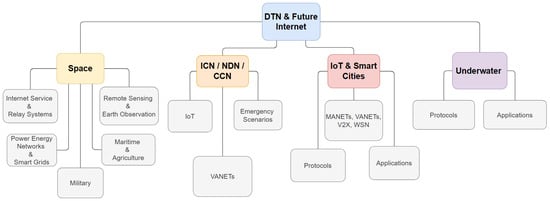
Figure 1.
Graphical paper overview.
- Space.
- Information-Centric and Named Data Networking.
- Internet of Things and Smart Cities.
- Underwater.
The remainder of the paper is organized as follows: in Section 2, we provide an overview of the general concept of the DTN approach and discuss the major challenges it encounters. In Section 3, we present the taxonomy of major research areas where the DTN suite is applied, while we also detail the relevant works and proposed solutions within each category. Finally, in Section 4, we highlight our concluding remarks and future work emphasizing the utilization of DTN in shaping the future internet landscape.
2. Concept and Challenges
DTN was originally developed, as defined in RFC 4838 [2], to ensure reliable message delivery in highly dynamic and challenging Interplanetary Network (IPN) topologies, which are environments in which the conventional networking paradigms pose significant challenges. As a result, the fundamental concept of DTN, which distinguishes itself from those paradigms, is the acknowledgment of communication disruptions as an inherent feature rather than an abnormality. Therefore, DTN revolves around enabling communication in scenarios characterized by intermittent or disruptive connectivity, prolonged latency, and other challenging conditions.
In order to understand the operational principles of DTN, mechanisms such as the Store-Carry-and-Forward (SCF) and protocols like the Bundle Protocol (BP) serve as foundational paradigms in the DTN suite. The SCF mechanism enables communication in environments with intermittent connectivity, thus transforming intermediate (mobile) nodes into relays or “data mules” to store, carry, and forward messages toward the destination nodes until connectivity becomes available again in an asynchronous “hop-by-hop” manner. Complementing the SCF approach, the BP, presented in RFC 4838 and 5050 [2,8] as BP6, serves as a cornerstone protocol in DTN deployments. A bundle is defined as a series of contiguous encapsulated data blocks, which are independently routed and forwarded through the network. Its robustness lies in its ability to abstract underlying network complexities, thus providing a common interface for communication regardless of the underlying transport mechanisms or network topologies. Some notable features are the inherent support for store-and-forward operations through the custody transfer mechanism and Endpoint Identifiers (EIDs) for flexible addressing. The BP has been extended in RFC 9171 [9] (referred to as BP7), while several protocols and implementations have been built upon it. In summary, DTN operates by storing and forwarding messages (bundles) between nodes via the BP, i.e., Bundle Protocol Agents (BPAs), thus allowing communication in environments with intermittent connectivity. Bundles are relayed through the network opportunistically using custody transfer to ensure reliability.
However, the applicability of DTN principles has found relevance in terrestrial concepts as well. This transition from extraterrestrial to terrestrial environments resulted in various DTN-related protocols and solutions tailored to address the unique challenges encountered in real-world deployments. Some of the major challenges DTN tackles are listed below:
- Intermittent/Disruptive Connectivity and Link Disruptions: Deals with occasional breaks or interruptions in network connectivity, e.g., space missions, remote areas, or disaster zones with limited connectivity. Mechanisms are utilized to store and forward messages until connectivity is restored or alternative routes become available.
- High Latencies/Round Trip Time (RTT) and Low Throughput: Encounters long delays in message transmission and acknowledgment due to long-distance communication or congestion in the network. Also, issues achieving high data transfer rates due to limited bandwidth, intermittent connectivity, or congestion.
- Data Losses, Message Fragmentation, and Reassembly: Occur due to network congestion, link disruptions, or node failures. Also, in cases of limited bandwidth or size restrictions on transmitted data, large messages need to be fragmented into smaller pieces for transmission and afterward reassembled to accurately reconstruct the original message.
- Storage and Energy Constraints: Limitations regarding the availability of storage space for storing and forwarding messages or the energy consumption, especially in resource-constrained devices or networks. Storage management techniques, as well as prioritization, scheduling, or energy-efficient protocols and algorithms are employed.
- Routing and Forwarding: Determining optimal paths for message delivery in scenarios with dynamic network topologies, intermittent connectivity, or limited routing information requires the utilization of adaptive routing protocols and forwarding strategies.
- Security and Privacy: Ensuring data confidentiality, integrity, and authenticity across heterogeneous, decentralized, and potentially adversarial environments is crucial, particularly when transmitting sensitive information.
- Heterogeneity: Need to support seamless communication among diverse devices and networks with varying capabilities and characteristics, e.g., different protocols or data rates.
- Quality of Service (QoS): Due to the inherent constraints of DTN environments such as network disruptions and intermittent connectivity, there is a need for mechanisms to ensure reliable message delivery while meeting specified performance criteria, e.g., throughput, latency, and reliability.
3. Related Work
Categorizing the application domains that utilize DTN protocols poses a significant challenge due to the constantly expanding spectrum of DTN usage. The current review aims to address some of the most significant and broadest scientific areas in which DTN protocols find application, in particular (i) space; (ii) Information-Centric Networking (ICN) and specific architecture designs, e.g., Named Data Networking (NDN); (iii) the Internet of Things (IoT) and its applications in smart cities; and (iv) underwater applications. Before delving into a detailed analysis of DTN implementations within these specific areas, we provide an overview of each domain.
3.1. Space
This category focuses on the initial concept of DTN, particularly its application in space-related contexts. Within this domain, significant advancements in protocol implementations and the utilization of satellites for terrestrial communications are identified and explored. A summary of the space-related works is illustrated in Table 1.
While several studies have experimented with DTN-related protocols and solutions, the majority of them are conducted on a small scale. The mature and extensive DTN Engineering Network (DEN) testbed [10] is a worth-mentioning exception consisting of labs at NASA Centers, which are connected through VPNs for experimentation. In addition, SPICE, a state-of-the-art DTN testbed for developing and evaluating DTN implementations, architectures, and protocols (underlying or overlying) for satellite and space communications, is described in [11]. SPICE incorporates components such as a Portable Satellite Simulator (PSS) and CORTEX CRT and Satellite Tool Kit (STK), while it provides a link with a GEO satellite (HellasSat 2) to provide real satellite link characteristics.
Furthermore, some works attempt to incorporate novel computing technologies to the DTN experimentation process. For instance, the authors in [12,13,14] followed microservice-based and distributed approaches utilizing cloud-based computing and containerization in an attempt to enhance interconnectivity and scalability while lowering operating costs. The latter work also proposed the interconnection of the DEN with AWS cloud-based Ground Stations (GSs).
3.1.1. Space Protocols
To ensure reliable communication in space exploration, space protocols encompass a range of specialized protocols for interplanetary, satellite, and space-based systems. These protocols are designed to address the unique challenges of space environments, including long communication delays, intermittent connectivity, and high error rates. Some important protocols for space-related applications are listed below:
- Bundle Protocol (BP) and derivatives: One of the most popular and widely implemented protocols, also highlighted in Section 2, which influenced subsequent protocols, e.g., (B-)DTN7 [15,16]—a BP7 implementation in Golang and IBR-DTN [17,18] based on BP6.
- Licklider Transmission Protocol (LTP) [19]: Operates asynchronously by focusing on reliable transmission through segmentation, storage, reassembly, and congestion control of data packets in DTN environments [20,21,22].
- Advanced Orbiting Systems (AOSs) Space Data Link Protocol [23]: Includes mechanisms for error detection and correction and link synchronization between spacecrafts and GS.
- ION-DTN [24]: A DTN protocol suite/infrastructure suitable for interplanetary flight mission systems. For instance, ION CCSDS File Delivery Protocol (CFDP) [25], which focuses on file transmission among DTN nodes.
- QUIC Protocol and derivatives (e.g., QUICL [26]): Although primarily designed for use over traditional internet connections to provide low-latency communication over unreliable networks [27], it gained attention in the satellite domain.
- Delay-Tolerant Payload Conditioning (DTPC) Protocol [28]: Adding an application-independent protocol layer to provide end-to-end transport services to the ION-DTN implementation.
- Deep Space Transport Protocol (DS-TP) [29]: Includes novel proactive transmission and retransmission scheduling rules.
- Space Packet Protocol (SPP) [30]: Provide unidirectional space data transfer service containing an application process identifier to identify packet streams.
- Encapsulation Packet Protocol (EPP) [31]: Encapsulate higher-layer protocol data units using Space Data Link protocols without authorized packet version Numbers over space links.
- Routing Protocols: Spray and Wait [32,33], Contact Graph [34,35], Epidemic, Probabilistic, Social-Based.
3.1.2. Satellites
Satellites are the primary components of space communications serving as the tangible embodiment of the original DTN concept. They can be typically categorized based on their distance from the Earth’s surface into Geostationary Earth Orbit (GEO), Medium Earth Orbit (MEO), and Low Earth Orbit (LEO). In terms of size, there is a trend toward smaller and more agile satellites known as “SmallSats” and “CubeSats”, which adhere to SI metrics in their naming, e.g., minisatellites, microsatellites, nanosatellites, etc. (https://www.nasa.gov/what-are-smallsats-and-cubesats/ accessed on 4 March 2024). GEO satellites follow the rotation of the Earth and thus appear stationary over a fixed position for an observer located on Earth. Their wide coverage and lifespan are their major advantages, as three equally-spaced satellites can provide near-global coverage; however, latency becomes a significant drawback, especially for latency-sensitive applications such as voice or video communication. On the contrary, MEO and especially LEO satellites take advantage of the closer to the Earth distance and provide lower RTTs due to the lower propagation delay. However, more satellites are required for full coverage, while some significant challenges arise regarding the lifespan, complexity (e.g., intersatellite links and high mobility), congestion of radio spectrum, interference avoidance, and coordination of multiple interests.
In particular, the feasibility and implementations of space internetworking across various domains have been explored in different works [4,36,37]. An interesting domain is multimedia content delivery or streaming. Although in (deep) space communications the delay becomes a bottleneck, solutions have been proposed such as the Bundle Streaming Service (BSS) [38]. Applicationwise, there is a plethora of terrestrial services provided by satellites. including the following application domains:
- 1.
- Internet Service and Relay Systems: (i) Provide global internet coverage primarily facilitated by the rapid deployment of LEO satellites and constellations (e.g., Globalstar, Starlink, OneWeb) [39,40]. They can serve as complementary solutions to traditional internet services (e.g., in cases of emergency) or as effective substitutes in areas lacking terrestrial connectivity. Various proposals for communication enhancements have also been proposed. For instance, ref. [41] describes a transmission scheduling algorithm for LEO satellites involving a broadcasting mechanism with randomized retransmissions and a Peer-to-Peer (P2P) multicast ground distribution scheme. The paper by [42] proposes enhancements between LEO/MEO intersatellite communication systems through modulation techniques and electrical pulse generators or tools to predict delivery time, e.g., Bundle Delivery Time Estimation (BDTE) [43]. (ii) Data Relay Satellites (DRSs) transmit information to and from satellites, spacecraft, vehicles/vessels, and fixed Earth GSs, e.g., the European Data Relay System (EDRS) [44], U.S. Tracking and Data Relay Satellite System (TDRSS) [45], or Earth-to-Moon communication [46].
- 2.
- Remote Sensing and Earth Observation: (i) Environmental/climate monitoring (e.g., the GR01-DUTHSat for upper atmosphere measurements [47]); (ii) meteorology phenomena and atmospheric tracking (e.g., the Leonardo Bidirectional Reflectance Distribution Function (BRDF) constellation and Cyclone Global Navigation Satellite System (CYGNSS)); (iii) pollution monitoring (e.g., oil spill detection); and (iv) surveillance and high-resolution photography.
- 3.
- Power Energy Networks and Smart Grids: Provide robust and flexible network management and interconnection of distributed and heterogeneous energy infrastructures (e.g., supervisory control and data acquisition) while efficiently utilizing the bandwidth and minimizing installation and maintenance costs [48,49].
- 4.
- Maritime and Agriculture: Enable communication among devices/sensors in the field and drones/satellites. They allow for remote monitoring and the management of operations for (i) satellite–terrestrial communication networks at sea [50,51,52]; (ii) gathering data, e.g., meteorological, moisture levels, temperature, humidity, crop health [53]; and (iii) precision agriculture [54,55] and Machine Learning (ML) techniques [56].
- 5.
- Military: Enhance surveillance and aerial reconnaissance operations [57,58]. They provide reliable, global, and secure communication and navigation services while also gathering real-time intelligence by utilizing mainly LEO nano- and microsatellites.

Table 1.
Summary of space-related literature works.
Table 1.
Summary of space-related literature works.
| Challenges | Papers | Focus | Solution/Protocol |
|---|---|---|---|
| Extreme delay, intermittent connectivity, security and authentication, mobility, resource constraints, infrastructure damage | [2,8] | BP | |
| [15,16] | (B-)DTN7 | ||
| [17,18] | IBR-DTN | ||
| [19] | LTP | ||
| [24] | ION-DTN | ||
| [23] | AOS | ||
| [26,27] | Protocol definition | QUIC and QUICL | |
| [28] | DTPC | ||
| [29] | DS-TP | ||
| [30] | SPP | ||
| [31] | EPP | ||
| [32,33,34,35] | Routing protocols | ||
| [10] | Testbeds for space | DEN | |
| [11] | SPICE | ||
| [38] | Multimedia content delivery | BSS | |
| [12] | Microservice-based | A2C and DQN-based | |
| [13,14] | approaches | HDTN project | |
| [41] | P2P decentralized simulation tool | ||
| [42] | Enchantments for scheduling | Modulation techniques for | |
| and prediction | electrical pulse generators | ||
| [43] | BDTE tool and CGR | ||
| [48] | Energy and smart grids | AURA-NMS performance | |
| [49] | SATCOM systems in smart grids | ||
| [50,51,52] | Maritime | Networking, UAV-enhanced Hybrid Networks | |
| [54,55,56] | Agriculture | Precision agriculture with ML and DL | |
| [57,58] | Military support | Lasers and military satellites |
3.2. Information-Centric Networking (ICN) and Named Data Networking (NDN)
The ICN paradigm represents an alternative approach to traditional IP-based internetworking that focuses on the content itself rather than its (IP) location [59]. Notably, NDN emerges as a leading architecture within ICN, thus gaining increased attention [60,61]. In these lines, schemes such as NDN-over-DTN (NoD) have been proposed [62]. In particular, NDN accesses the content via its name (i.e., Named Data Objects (NDOs)) as facilitated by Content Identifiers (CIDs) rather than through host-to-host communication. Some key components of NDN include the Forwarding Information Base (FIB) (i.e., similar to routing tables in IP networks), which maps names to interfaces and determines where to forward the interest based on the name it carries, and the Pending Interest Table (PIT), which temporarily stores the corresponding interests. Hence, ICN approaches aim to improve content delivery, caching efficiency [63], and network scalability [64] by directly addressing content and enabling in-network caching and content-based routing. The related works can be found in Table 2.
3.2.1. DTN-ICN in IoT
The DTN-ICN convergence can offer a resilient architecture paradigm for IoT environments. It can enable efficient data dissemination, enhance reliability, and provide seamless communication within the dynamic, intermittently connected, and resource-constrained IoT ecosystems.
Efforts to evaluate the performance of NDN, DTN, and NoD architectures have been made within dynamic IoT networks [65,66]. Regarding the latter case, the authors identify tradeoffs (content retrieval delay, cache hit ratio, delivery ratio) within each approach with various packet sizes and numbers of nodes in stationary and mobile IoT networks. The work by [67], which is extended in [68,69], e.g., to include anomaly detection techniques for prediction and propose an adaptive NoD multiprotocol SDN solution for smart cities within the REWIRE project (https://www.fed4fire.eu/demo-stories/oc9/rewire/ accessed on 4 March 2024). The system was evaluated in the large-scale CityLab (https://www.fed4fire.eu/testbeds/citylab/ accessed on 4 March 2024) and w.iLab (https://www.fed4fire.eu/testbeds/w-ilab-t/ accessed on 4 March 2024) testbeds with extended metrics similar to [67]. Another paper [70] presents an architecture based on NDN-DTN to enhance data retrieval from intermittently connected devices, such as those found in the IoT and sensor networks operating in remote areas. Through real-world WiFi-based experiments, the authors demonstrated significant improvements in the interest satisfaction ratio and average delay, particularly in environments characterized by a low delivery ratio and contact duration. In a different study [71], the authors employed the BP as an underlying transport mechanism for the Constrained Application Protocol (CoAP), thus deviating from the default UDP, which is used in IoT scenarios. Furthermore, in [72], fog computing and IoT were integrated, thus introducing the concept of “content islands”. The authors developed a publish/subscribe system and a prototype over DTN to facilitate data and computation sharing utilizing MQTT and IBR-DTN. Similar works that utilize and leverage MQTT with DTN are also highlighted for IoT case studies in Section 3.3.
Modifications to ICN architectures have also been explored to achieve delay and disruption tolerance. In [73], the authors propose an ICN-over-LoRa framework within DTN-constrained IoT environments. They considered varying RTTs to facilitate end-to-end ICN communication from internet consumers to LoRa nodes. Additionally, in [74], the concept of reflexive forwarding/pushing is introduced as an extension to the Content-Centric Networking (CCN) and NDN protocol architectures, thus aiming to mitigate issues associated with independent interest–data message exchanges in scenarios involving the transfer of large data volumes. The paper by [75] also focuses on CCN but regarding data transmission and modifying caching during short network contacts through CCN content discovery. Furthermore, in [76], the RICE network layer framework is proposed for remote function invocation within ICN, thereby aiming to reduce polling overhead and introduce function-oriented capabilities. This includes employing the programming-oriented concept of “thunks” and introducing a 4-way handshake for security enhancement. Moreover, several works leverage the functionality of DTN architectures, such as the UMOBILE architecture [77] and the RIFE integrative architectural platform [78]. These frameworks bring together IP, ICN, and DTN into unified frameworks while also offering QoS-enhanced services.
3.2.2. DTN-ICN in Emergency Scenarios
The possibility of utilizing the ICN approach in emergency scenarios where the DTN concept is a key aspect has been highlighted by several research groups [79,80] and studies. This approach can help re-establish communication in scenarios where communication infrastructures are unavailable.
Along these lines, the authors in [75] introduce a CCN-Oriented Notification Service (CNS) that leverages ICN to facilitate efficient disaster management by minimizing administrative overhead, thus reducing network congestion, latency, and enhancing security during communication establishment. They perform large-scale simulations with real-world disaster traces and compare the CNS with IP-based solutions. The authors in [81] introduce Delay-Tolerant ICN for Disaster Management (DID), which is a framework designed to address the challenges of communication resilience in disaster scenarios. DID focuses on enabling interest-based content retrieval among fragmented networks. The work of [82] presents an orchestration framework that integrates ICN/DTN with long-term evolution standards for public security applications, thereby offering a radio access network to end users.
Furthermore, the notion of ICN “data mules” [81,83,84,85], which deliver information in a publish/subscribe manner to different fragments of the network with predetermined, fixed, or random paths, has also been examined. In this context, additional features have been introduced to ICN, such as scoping and prioritizing messages/interests according to specific attributes. These attributes may include (i) user-defined priorities; (ii) content lifetime and validity [86]; (iii) criticality (e.g., broadcasting emergency messages [81] or the preprocessing and delivery of medical images for healthcare workers [87,88]); (iv) popularity [85]; or (v) reputation score [89].
3.2.3. DTN-ICN-VANETs
Due to the inherited NDN features, such as multicast or in-path caching, NDN (and CCN/ICN in general) has been recognized as an attractive solution for Vehicular Ad Hoc Networks (VANETs) [90,91,92]. In particular, [93] introduces the Multihop Multipath and Multichannel Vehicular NDN routing protocol (iMMM-VNDN) designed for the Vehicle-to-Vehicle (V2V) message exchange. In another work [94], a Vehicle-to-Infrastructure (V2I) communication architecture based on NDN was investigated, including a content discovery phase with the assistance of both vehicles and Roadside Units (RSUs). Along these lines, they broadcast beacon messages containing information about content sources and MAC addresses. The authors in [95] propose a Density-Aware Delay-Tolerant (DADT) interest forwarding strategy to retrieve traffic data in vehicular NDN environments and retransmit interests based on directional network density considerations. Moreover, the NDN Vehicular Internetworking (V-NDN) framework, as discussed in [91], enables a car/node to utilize various wireless interfaces in a V2V and V2I manner according to the requirements of specific applications.
The paper by [96] focuses on NDN-based content caching within dynamic and delay-constrained network topologies. They introduce DeepNDN, an architecture that combines probabilistic techniques with convolutional neural networks to optimize content caching. Similar contexts have been explored in V2V [97] and V2I [98] scenarios and in [99] where cache refreshing schemes have been proposed in rational order or updated upon requests with a defined probability.
Efforts to increase link stability and improve content delivery timeliness have also been discussed. The importance of prioritizing neighboring vehicles with more stable links is highlighted in [100], while ref. [101] suggests sharing time-critical content among RSUs and vehicles using a publish/subscribe-based message propagation approach to prevent accidents.
To conclude, while ICN/NDN and DTN initially addressed distinct networking challenges, i.e., content retrieval in fixed networks and data delivery in deep space communications, respectively, they can complement each other in scenarios involving mobility and intermittent or disrupted connectivity. In these cases where the usual end-to-end paths may not be available, the content-centric approach of ICN can improve content delivery, as expressions of interest (subscriptions) can be satisfied long after they have been issued and may be served from any node that has a copy of an object that matches the interest.
3.3. Internet of Things and Smart Cities
The IoT refers to a network of physical objects embedded with software, sensors, and other technologies, thereby enabling connectivity and data exchange among devices and systems. Some primary reasons for leveraging the IoT include (i) improved efficiency [102]; (ii) data-driven decision making [103]; (iii) enchanted user experience [104]; and (iv) remote monitoring and controlling [105].
The concept of the “Internet of Things” was first introduced as a term in a speech in 1985 and has since evolved to be driven by the combination of multiple technologies such as ubiquitous computing, shared sensors, increasingly powerful embedded systems, and ML. It finds applications in various sectors of human life, including healthcare systems, transportation, smart homes, and energy. Along these lines, the smart city concept utilizes IoT technologies and data-driven solutions to enhance the efficiency, sustainability, and quality of life of its residents [106]. Incorporating IoT devices [107], sensors, data analytics, and various other technologies allows for the real-time utilization of data, thus enabling better decision-making and resource management across different domains such as transportation [108], energy [109], healthcare [110], public safety [111], and governance [112]. A summary of the discussed works is illustrated in Table 3.
Table 2.
Summary of ICN/NDN-based literature works.
Table 2.
Summary of ICN/NDN-based literature works.
| Challenges | Papers | Focus | Solution/Protocol |
|---|---|---|---|
| Heterogeneity, integration with IP-based networks, data prioritization, security, intermittent connectivity | [62,65,66,70,73] | NDN/DTN architectures | NoD, ICN-over-LoRa |
| [77] | NDN/DTN platforms for IoT | UMOBILE | |
| [76] | RICE | ||
| [62,67,68,69] | Adaptive multiprotocols | NoD and ML | |
| for smart cities | |||
| [63] | Caching in IoT | EFPCaching | |
| [71] | CoAP | ||
| [72] | IoT protocols and concepts | Content islands | |
| [74,75] | CCN and reflexive forwarding | ||
| [81] | DID | ||
| [83] | ICN Data muling | ||
| [84] | Name-based push and pull service | ||
| [85] | Disaster scenarios and | Popularity estimation scheme | |
| [87] | prioritization of interests | Image prioritization method | |
| [86] | NREP scheme | ||
| [88] | Opportunistic named functions | ||
| [89] | Reputation-based trust | ||
| [94] | Protocols/Solutions | iMMM-VNDN | |
| [95] | for VANETs | DADT | |
| [91] | V-NDN | ||
| [90] | ICN VANETs architecture | SEVeN | |
| [97] | CSPC and PPCCR mechanism | ||
| [98] | Caching in VANETs | Content prefetching optimization | |
| [99] | RSUC and ReA schemes | ||
| [100] | Prioritization in VANETs | LISIC protocol | |
| [101] | Push-based VNDN |
3.3.1. IoT and Smart Cities Protocols
To ensure effective communication among network nodes, efficient message delivery, and overall IoT operation, the following DTN-related protocols are commonly utilized:
- Bundle Protocol (BP) [7]: Enables the transmission of data in challenged environments by encapsulating data into bundles and routing them opportunistically.
- Spray and Wait (SNW) [113]: Distributes messages by spraying multiple copies and then waiting for successful delivery, thus storing and forwarding messages opportunistically.
- Epidemic Routing [5]: Disseminates data by reproducing and pushing messages to all the nodes it encounters, thus ensuring final delivery through opportunistic encounters in latency-tolerant networks.
- MaxProp [114]: Prioritizes message forwarding on the basis of maximum probability for a successful delivery, thus optimizing the efficiency of communication in delay-tolerant networks.
- Prophet [115]: Utilizes probabilistic forwarding based on historical encounter information for improving message delivery in intermittent networks.
- MQTT: A widely used TCP-based publish/subscribe protocol within IoT deployments. It is proposed to be combined with the DTN and IBR-DTN for real IoT Sensor Networks (MQTT-SN) [116] and IoT environment cases [117]; to be utilized complementarily to DTN under various disruption patterns [118,119] utilizing the 5.0 MQTT version (https://docs.oasis-open.org/mqtt/mqtt/v5.0/mqtt-v5.0.html accessed on 4 March 2024); run over the QUIC protocol (i.e., MQTT over QUIC) [120]; or leveraged as the next generation IoT standard protocol, thereby offering substantial performance advantages and resource footprint reduction.
- Licklider Transmission Protocol (LTP) [121].
3.3.2. IoT and Smart Cities Applications
Regarding the DTN suit and its applications in the IoT and smart city domains, some highlighted research areas focus on the following:
- Remote Environmental Monitoring: The process of collecting data on various environmental parameters in areas that are difficult to access or far from settlements. Delay-Tolerant Wireless Sensor Networks (DTWSNs) have been established to assist with the collection of data, as well as the tracking and monitoring of animals. For instance, [122] describes the design of a GPS tracking device that utilizes the DTN suite in order to monitor, collect data, and track the Galápagos pink land iguana.
- Data Aggregation and Data Collection: The collection and integration of dispersed data points from various sources into a central system for analysis and decision making frequently address challenges related to limited connectivity. A typical example is the usage of DTN on Wireless Body Area Networks (WBANs), which are used in a plethora of scenarios, such as hospital data, military situations, and in the recognition of dangerous diseases for animals, as mentioned in [123]. Furthermore, DTN assists in data collection from Vehicular Delay-Tolerant Networks (VDTNs), particularly in applications for smart cities. An example is the Data Collection for Low Energy Devices (DC4LED), which is a hierarchical VDTN routing tested in the city of Helsinki [124].
- Disaster Management and Emergency Reports: Aim to address issues related to natural or man-made disasters. Typical examples are the utilization of the DTN protocols to ensure effective communication for the prioritization of messages in disaster scenarios [125], the organization of recovery operations in areas with limited network availability, and in proactive disaster management applications to predict patterns of human and vehicle mobility [126,127].
- Healthcare Monitoring in Rural Areas: Leveraging solutions to remotely monitor and manage patients’ health, particularly in regions with limited access to medical facilities and health professionals. Such a delay-tolerant data communication system for the transmission of health and environmental data to areas of developing countries is presented in [87].
- Public Transportation and Mobility: The provision of common transport services facilitate efficient movement in both urban and rural areas, thereby improving accessibility and reducing congestion. An example of DTN application in this domain is the DTN routing algorithm as presented in [128].
- Energy Management: The efficient use, monitoring, and optimization of energy resources to minimize consumption, reduce costs, and mitigate environmental impact. A combination of energy-efficient architectures is provided by [129] and evaluated in the ONE simulation.
- Location Monitoring: The Real-Time Location System (RTLS) is a technology that tracks and identifies the current geographic location of objects or people in real time. RTLS is integrated in IoT cases, thereby allowing for the monitoring of the environmental and health conditions of workers. In underground scenarios such as miners’ reconnaissance, RTLS plays a crucial role in location monitoring, as discussed in [130]. Additionally, the proposed architecture includes Bluetooth Low-Energy (BLE) beacon-based devices, while it also analyzes key factors for a future 6G IoT system.
3.3.3. MANETs, VANETs, V2X, WSN
A significant category where DTN protocols find extended applications is VANETs [131]. VANETs enable communication between vehicles and roadside infrastructure to enhance road safety, traffic efficiency, and provide infotainment services. To this end, DTN protocols provide resilience to VANET infrastructures, which is an important aspect due to the obstacles, signal interference, or network congestion that they may encounter.
Similarly, Mobile Ad Hoc Networks (MANETs) [132], i.e., decentralized mobile networks of autonomous agents that collaborate and communicate, are commonly employed in scenarios where traditional infrastructure is lacking or impractical. One key benefit gained from DTN utilization is resilient communication. In this context, DTN protocols enable communication even in challenging and dynamic environments encountered by MANETs, such as intermittent connectivity, node mobility, and disruptions. In addition, the store-and-forward mechanism of DTN allows for efficient message delivery, as messages are relayed opportunistically through intermediate nodes. This is particularly beneficial in MANETs, where varying communication ranges and node densities are common issues.
Moreover, as mentioned in [133], DTN’s decentralized nature aligns well with the autonomous operation of agents in MANETs, thus enabling self-organizing and self-healing communication without relying on fixed infrastructure. Dynamic routing is another advantage, as DTN protocols adapt routes based on real-time network conditions, thereby making them suitable for MANETs where network topology and connectivity can change rapidly.
Furthermore, several works on DTN-related solutions for emergency situations have been proposed. In [134], the authors propose LoRAgent, a DTN-based location-aware system and geospatial routing mechanism using LoRa technology to provide decentralized communication and message forwarding. Moreover, in [135], a mobile cloud computing system for information exchange among isolated shelters via mobile vehicle server is introduced using IBR-DTN and DTN2. In addition, [136] provides an overview regarding the utilization of UAVs in V2X applications, e.g., as access point carriers [137].
3.4. Underwater
The applications of Underwater Wireless Communication (UWN) range from ocean pollution monitoring to environment, climate, natural disturbances, and marine ecosystem monitoring for survey and overview operations, surveillance, offshore exploration, navigation, and disaster prevention. The primary objective of UWN is the detection and monitoring of the underwater environment, as well as the navigation of Autonomous Underwater Vehicles (AUVs) and information provision to offshore centers via intermediate data collection points or floating sinks above sea level. Some additional limitations specific to the underwater application scheme include propagation delay or time-varying multiparty propagation [138], multivariate attenuation [139], the effect of noise [140], limited bandwidth [141], high transmission power [142], big error rates [143], limited energy harvesting options [144], and no position information [145]. A summary of the related underwater works is illustrated in Table 4.
Table 3.
Summary of IoT/smart cities-related literature works.
Table 3.
Summary of IoT/smart cities-related literature works.
| Challenges | Papers | Focus | Solution/Protocol |
|---|---|---|---|
| Heterogeneity, mobility, scalability, variable delay, resource/(energy) constraints, security and privacy | [7] | BP | |
| [113] | SNW | ||
| [5] | Epidemic routing | ||
| [114] | Protocols definition | MaxPro | |
| [115] | Prophet | ||
| [116,117,118,119,120] | MQTT-DTN | ||
| [121] | LTP | ||
| [87,122,123,124] | Data collection and monitoring | BP, VDTN, epidemic routing | |
| [125,126,127,129] | Disaster and energy management | Routing protocols | |
| [108,128] | Public transportation and mobility | Review, routing protocols | |
| [130] | Location monitoring | RTLS, LoRaWAN, Zigbee | |
| [131] | VANETs | IQDN | |
| [132,133] | MANETs | Routing protocols | |
| [134] | LoRAgent: LoRa and BP | ||
| [135] | Mobile computing in disaster | IBR-DTN and DTN2 | |
| [137] | UAVs in V2X | UGV and UAV |
3.4.1. Underwater Protocols
Some of the protocols commonly used in underwater applications include the following:
- Spray and Wait (SNW) [146].
- Resource Allocation Protocol for Intentional DTN (RAPID) [147]: Optimizes resource allocation and scheduling for data transmission in DTNs, thereby enhancing efficiency and reliability.
- Underwater DTN with Probabilistic Spraying (UDTN-Prob) [146]: Broadcasts underwater messages using probabilistic copy transmission, thereby optimizing data delivery in difficult underwater communication environments.
- Q Learning-Based DTN Routing Protocol (QDTR) [138]: Uses reinforcement learning techniques to adjust routing decisions dynamically and optimize message delivery.
- Redundancy-Based Adaptive Routing (RBAR) [148]: Optimizes message delivery in delay-tolerant networks by dynamically adjusting routing decisions based on redundancy levels to enhance reliability.
- Prediction-Based Delay-Tolerant Protocol (PBDTR) [149] and Prediction-Assisted Single-copy Routing (PASR): Employ prediction information to improve message routing and enhance delivery efficiency.
- Delay-Tolerant Data Dolphin (DDD) [144]: Utilizes dolphin-inspired communication strategies to optimize data transmission and improve efficiency.
3.4.2. Underwater Applications
Some applications in which DTN finds implementation in underwater networks are those where traditional communication methods such as Radio Frequency (RF) or optical signals may be ineffective due to signal attenuation, propagation limitations, or environmental factors. These applications include the following:
- Underwater Environmental Monitoring: The systematic collection of data to evaluate and understand ecological conditions and changes in underwater ecosystems, as presented in [150] with a deepwater monitoring system in the Cambos Basin offshore area.
- Underwater Exploration and Surveillance: Utilized to explore and monitor underwater environments for scientific research, safety, or commercial purposes. This application employs technologies such as the Coastal Patrol and Surveillance Application (CPSA) and introduces novel protocols like Reed–Solomon (RS) [151].
- Underwater Acoustic Communication: Involves the transmission of data through sound waves in underwater environments, thus allowing communication among underwater devices, vehicles, and surface stations [152].
- Underwater Remote Sensing and Mapping: The integration of technologies to harvest data from underwater environments to generate detailed maps and comprehend underwater topography, habitats, and resources [152].
- Underwater Disaster Prevention: Deals with the implementation of measures and strategies to mitigate risks and minimize the impact of natural or man-made disasters in underwater environments, such as oil spills, tsunamis, or industrial accidents. An example is the utilization of DTN for the Underwater Internet of Things (UIoT) and its various applications, as demonstrated in [153].
Table 4.
Summary of underwater-related literature works.
Table 4.
Summary of underwater-related literature works.
| Challenges | Papers | Focus | Solution/Protocol |
|---|---|---|---|
| Propagation delay, multivariate attenuation, limited bandwidth, high transmission power, bit error rate, intermittent connectivity, no position information, limited energy demands | [146] | SNW | |
| [147] | RAPID | ||
| [146] | UDTN-Prob | ||
| [138] | QDTR | ||
| [148] | RBAR | ||
| [149] | Protocols definition | PBDTR | |
| [149] | PASR | ||
| [144] | DDD | ||
| [143] | ORIT | ||
| [150] | Monitoring surveillance and sensing | Prophet and epidemic routing | |
| [151] | UDTN-RS | ||
| [152] | Acoustic communication | Network and routing protocols | |
| [154] | Reinforcement learning-based selection | ||
| [153] | Disaster prevention and UIoT | Survey | |
| [155] | Underwater DTN network simulator | DTN Aqua-Sim | |
| [156] | Overlay networking WSN | DTN-Janus |
4. Discussion and Conclusions
We have highlighted the potential of DTN to contribute to a variety of internet applications and also to contribute toward extending the internet in order to accommodate isolated environments such as underwater or space. The key characteristics of this technology that enable a unification of diverse environments are the custody transfer and the storage capabilities. In fact, the way DTN operates is not in contrast with the traditional end-to-end architecture of transport protocols; it transforms it into an end-to-end architecture with one sliding end. Indeed, the custody is gradually transferred to the next node each time, thereby making graduated progress toward reaching the other end. This new philosophy of communication, even when connection gaps exist, allows for a new perspective for interconnecting devices: Not all devices need to be interconnected at all times. Hence, information can be shared from devices that may be interconnected in the near future. Such devices and their users can now become active members of the internet community even when they are temporarily disconnected.
Focusing on the specified domains presented in Section 3, i.e., space, ICN and NDN, IoT and smart cities, and underwater, we have described a number of works that utilize DTN within each domain. In space, DTN allows for interconnecting space devices and permits an alternative solution to line-of-sight limitations, thus allowing for a 24/7 paradigm and opening a new era for satellite technologies as well. In particular, we have identified the necessity—and, in turn, the challenges—to implement and evaluate the proposed DTN-based solutions (e.g., protocols, algorithms, or frameworks) not only in simulated environments but also on a large scale, as well as in real-world scenarios. Along these lines, scalable testbeds such as DEN or SPICE have emerged, thus providing space-related environments for the evaluation of solutions, with some proposing integration with cloud-based computing and containerization technologies. Furthermore, satellites have gained increased attention as significant enablers in the new era of the internet and communications, thereby aiming to harvest the close-to-terrestrial delays that LEO satellite communications provide. This has implications for a range of terrestrial domains such as internet services, Earth observation, energy, maritime, agriculture, and military applications. However, some of the related challenges, protocols, and solutions they aim to solve include the routing and scheduling of data transmission in intermittently connected networks; efficient resource allocation to optimize bandwidth utilization; seamless integration and interoperability with existing terrestrial networks, technologies, and protocols; and robust security mechanisms.
Also, it is worth noting that the incorporation of DTN protocols in ICN architectures allows for a publish/subscribe model even when users are temporarily disconnected but still gather useful information from their local spot. This information can be shared or delivered to the interested users if they do not demand immediate answers to their queries. This feature also allows for optimizing search results when time is not a critical issue, as delivered information can then be more complete and enhanced. In this context, we have identified works that implement solutions leveraging DTN combined with ICN paradigms like NDN and CCN in critical and challenging domains. Environments like IoT, emergency scenarios, and VANETs demand adaptive and multiprotocol solutions, as well as mechanisms and frameworks to deal with the heterogeneity and special requirements of the involved ecosystems (e.g., the prioritization of messages, large data delivery, forwarding strategies, and dynamic content caching).
Likewise, in IoT and smart city applications, DTN-based solutions can enhance system efficiency and enable real-time data utilization, as well as better decision making according to the collected and processed data. In this context, the development of dynamic and next-generation routing solutions/protocols, as well as the integration with data analytics and ML/AI-oriented solutions, can improve IoT efficiency. Furthermore, user experiences can be enhanced in smart city scenarios while providing the necessary means for remote monitoring and surveillance in domains such as healthcare, e.g., monitoring patients in remote and rural areas, or public transportation, e.g., optimizing public transportation by avoiding traffic during peak hours.
The contribution of DTN in underwater applications is equally important, as it assists in dealing with limitations such as the propagation delay and the limited bandwidth and environmental factors present in underwater environments. Some representative examples include the monitoring of environmental data in underwater ecosystems or the establishment of acoustic communication among underwater vehicles and offshore stations. Finally, DTN plays a crucial role in the Underwater IoT, thereby enabling a wide range of applications in this domain.
As emphasized in the Section 1, it is important to acknowledge that this work does not attempt to provide a comprehensive and exhaustive review covering the entirety of applications and domains in which DTN excels. Instead, it focuses on specific research areas that can benefit from enhancements provided by DTN, i.e., space, ICN/DTN, IoT and smart cities, and underwater applications. In future work, we intend to expand upon the findings presented in this DTN-focused paper, thereby covering a broader spectrum of domains and applications. This includes investigating innovative technologies, which can act as enablers of the Future Internet such as 5G/6G and Low-Power Wide Area Network (LPWAN) technologies, e.g., NarrowBand IoT and Zigbee, Software-Defined Networking (SDN), ML/AI-driven networking, or edge computing. Along these lines, we aim to explore how these technologies intersect with DTN’s perspective within the evolving internet landscape. In addition, an examination of DTN’s performance through an overarching analysis of its real-world applications presents an interesting area for further investigation. By closely examining the practical implementations of DTN in these contexts, we can gain valuable insights into its effectiveness, scalability, and adaptability in dynamic and challenging environments.
Author Contributions
Conceptualization, V.T.; methodology, G.K., K.S. and V.T.; validation, V.T.; formal analysis, V.T.; investigation, G.K. and K.S.; resources, G.K., K.S. and V.T.; data curation, G.K. and K.S.; writing—original draft preparation, G.K., K.S. and V.T.; writing—review and editing, V.T.; visualization, G.K.; supervision, V.T.; project administration, V.T. All authors have read and agreed to the published version of the manuscript.
Funding
This research received no external funding.
Data Availability Statement
Not applicable.
Conflicts of Interest
The authors declare no conflicts of interest.
References
- Burleigh, S.; Hooke, A.; Torgerson, L.; Fall, K.; Cerf, V.; Durst, B.; Scott, K.; Weiss, H. Delay-tolerant networking: An approach to interplanetary Internet. IEEE Commun. Mag. 2003, 41, 128–136. [Google Scholar] [CrossRef]
- Torgerson, L.; Burleigh, S.C.; Weiss, H.; Hooke, A.J.; Fall, K.; Cerf, D.V.G.; Scott, K.; Durst, R.C. Delay-Tolerant Networking Architecture. RFC 4838. 2007. Available online: https://datatracker.ietf.org/doc/html/rfc4838 (accessed on 25 February 2024).
- Fall, K. A delay-tolerant network architecture for challenged internets. In Proceedings of the 2003 Conference on Applications, Technologies, Architectures, and Protocols for Computer Communications, New York, NY, USA, 25–29 August 2003; pp. 27–34. [Google Scholar] [CrossRef]
- Burleigh, S.; Cerf, V.G.; Crowcroft, J.; Tsaoussidis, V. Space for Internet and Internet for space. Ad Hoc Netw. 2014, 23, 80–86. [Google Scholar] [CrossRef]
- Sobin, C.C.; Raychoudhury, V.; Marfia, G.; Singla, A. A survey of routing and data dissemination in Delay Tolerant Networks. J. Netw. Comput. Appl. 2016, 67, 128–146. [Google Scholar] [CrossRef]
- Madni, M.A.A.; Iranmanesh, S.; Raad, R. DTN and Non-DTN Routing Protocols for Inter-CubeSat Communications: A comprehensive survey. Electronics 2020, 9, 482. [Google Scholar] [CrossRef]
- Benhamida, F.Z.; Bouabdellah, A.; Challal, Y. Using delay tolerant network for the Internet of Things: Opportunities and challenges. In Proceedings of the 2017 8th International Conference on Information and Communication Systems (ICICS), Irbid, Jordan, 4–6 April 2017; pp. 252–257. [Google Scholar] [CrossRef]
- Scott, K.; Burleigh, S.C. Bundle Protocol Specification. RFC 5050. 2007. Available online: https://datatracker.ietf.org/doc/html/rfc5050 (accessed on 25 February 2024).
- Burleigh, S.; Fall, K.; Birrane, E.J. Bundle Protocol Version 7. RFC 9171. 2022. Available online: https://datatracker.ietf.org/doc/rfc9171/ (accessed on 25 February 2024).
- Birrane, E. The Delay-Tolerant Networking Experimental Network Constructing a Cross-agency Supported Internetworking Testbed. In Proceedings of the 2012 SpaceOps Conference, Stockholm, Sweden, 11–15 June 2012. [Google Scholar] [CrossRef][Green Version]
- Komnios, I.; Alexiadis, I.; Bezirgiannidis, N.; Diamantopoulos, S.; Lenas, S.A.; Papastergiou, G.; Tsaoussidis, V. SPICE Testbed: A DTN Testbed for Satellite and Space Communications. In Proceedings of the 2014 Testbeds and Research Infrastructure: Development of Networks and Communities, Guangzhou, China, 5–7 May 2014; Springer: Cham, Switzerland, 2014; pp. 205–215. [Google Scholar]
- Dudukovich, R.; Clark, G.; Briones, J.; Hylton, A. Microservice Architecture for Cognitive Networks. In Proceedings of the 2020 IEEE International Conference on Wireless for Space and Extreme Environments (WiSEE), Aveiro, Portugal, 6–8 September 2020; pp. 39–44. [Google Scholar] [CrossRef]
- Dudukovich, R.; LaFuente, B.; Hylton, A.; Tomko, B.; Follo, J. A Distributed Approach to High-Rate Delay Tolerant Networking within a Virtualized Environment. In Proceedings of the 2021 IEEE Cognitive Communications for Aerospace Applications Workshop (CCAAW), Cleveland, OH, USA, 21–23 June 2021; pp. 1–5. [Google Scholar] [CrossRef]
- LaFuente, B.; Dudukovich, R.; Kortas, N.; Schweinsberg, E.; Tomko, B.; Kotliarchuk, A. Exploring New Frontiers in Space Communications: Enhancing Delay Tolerant Networking through Cloud and Containerization. In Proceedings of the 2024 AIAA SCITECH Forum, Orlando, FL, USA, 8–12 January 2024; pp. 1–6. [Google Scholar] [CrossRef]
- Penning, A.; Baumgärtner, L.; Höchst, J.; Sterz, A.; Mezini, M.; Freisleben, B. DTN7: An Open-Source Disruption-Tolerant Networking Implementation of Bundle Protocol 7. In Lecture Notes in Computer Science; Springer International Publishing: Berlin/Heidelberg, Germany, 2019; pp. 196–209. [Google Scholar] [CrossRef]
- Baumgärtner, L.; Höchst, J.; Meuser, T. B-DTN7: Browser-based Disruption-tolerant Networking via Bundle Protocol 7. In Proceedings of the 2019 International Conference on Information and Communication Technologies for Disaster Management (ICT-DM), Paris, France, 18–20 December 2019; pp. 1–8. [Google Scholar] [CrossRef]
- Doering, M.; Lahde, S.; Morgenroth, J.; Wolf, L. IBR-DTN: An efficient implementation for embedded systems. In Proceedings of the 2008 3rd ACM Workshop on Challenged Networks, New York, NY, USA, 3–7 October 2008; pp. 117–120. [Google Scholar] [CrossRef]
- Fauzan, M.; Purboyo, T.W.; Setianingsih, C. IBR-DTN to Solve Communication Problem on Post-Disaster Rescue Mission. In Proceedings of the 2019 International Seminar on Intelligent Technology and Its Applications (ISITIA), Surabaya, Indonesia, 28–29 August 2019; pp. 24–28. [Google Scholar] [CrossRef]
- Burleigh, S.C.; Farrell, S.; Ramadas, M. Licklider Transmission Protocol-Specification. RFC 5326. 2008. Available online: https://datatracker.ietf.org/doc/rfc5326/ (accessed on 25 February 2024).
- Yang, L.; Liang, J.; Wang, R.; Liu, X.; De Sanctis, M.; Burleigh, S.C.; Zhao, K. A Study of Licklider Transmission Protocol in Deep-Space Communications in Presence of Link Disruptions. IEEE Trans. Aerosp. Electron. Syst. 2023, 59, 6179–6191. [Google Scholar] [CrossRef]
- Zhang, W.; Yang, G.; Jiang, F.; Zhao, K.; Wang, J.; Li, W.; Cheng, Z. Licklider Transmission Protocol for GEO-Relayed Space Internetworking. Wirel. Netw. 2019, 25, 3747–3757. [Google Scholar] [CrossRef]
- Bisacchi, A.; Caini, C.; de Cola, T. Multicolor Licklider Transmission Protocol: An LTP Version for Future Interplanetary Links. IEEE Trans. Aerosp. Electron. Syst. 2022, 58, 3859–3869. [Google Scholar] [CrossRef]
- Consultative Committee for Space Data Systems (CCSDS). AOS Space Packet Protocol; Recommendation for Space Data System Standards (Blue Book); National Aeronautics and Space Administration: Washington, DC, USA, 2021.
- Wang, R.; Dave, V.; Ren, B.; Bhavanthula, R.; Zhang, Q.; Hou, J.; Zhou, L. Interplanetary Overlay Network (ION) for Long-Delay Communications with Asymmetric Channel Rates. In Proceedings of the 2011 IEEE International Conference on Communications (ICC), Kyoto, Japan, 5–9 June 2011; pp. 1–5. [Google Scholar] [CrossRef]
- Consultative Committee for Space Data Systems (CCSDS). File Delivery Protocol (CFDP)—Part 1: Introduction and Overview; Report Concerning Space Data System Standards (Green Book); National Aeronautics and Space Administration: Washington, DC, USA, 2021.
- Sommer, M.; Sterz, A.; Vogelbacher, M.; Bellafkir, H.; Freisleben, B. QUICL: A QUIC Convergence Layer for Disruption-tolerant Networks. In Proceedings of the International ACM Conference on Modeling Analysis and Simulation of Wireless and Mobile Systems, New York, NY, USA, 30 October–3 November 2023; pp. 37–46. [Google Scholar] [CrossRef]
- Yang, S.; Li, H.; Wu, Q. Performance Analysis of QUIC Protocol in Integrated Satellites and Terrestrial Networks. In Proceedings of the 2018 14th International Wireless Communications & Mobile Computing Conference (IWCMC), Limassol, Cyprus, 25–29 June 2018; pp. 1425–1430. [Google Scholar] [CrossRef]
- Papastergiou, G.; Alexiadis, I.; Burleigh, S.; Tsaoussidis, V. Delay Tolerant Payload Conditioning protocol. Comput. Netw. 2014, 59, 244–263. [Google Scholar] [CrossRef]
- Papastergiou, G.; Psaras, I.; Tsaoussidis, V. Deep-space transport protocol: A novel transport scheme for space DTNs. Comput. Commun. 2009, 32, 1757–1767. [Google Scholar] [CrossRef]
- Consultative Committee for Space Data Systems (CCSDS). Space Packet Protocol; Recommendation for Space Data System Standards (Blue Book); National Aeronautics and Space Administration: Washington, DC, USA, 2020.
- Consultative Committee for Space Data Systems (CCSDS). Encapsulation Packet Protocol; Recommendation for Space Data System Standards (Blue Book); National Aeronautics and Space Administration: Washington, DC, USA, 2020.
- Spyropoulos, T.; Psounis, K.; Raghavendra, C.S. Spray and wait: An efficient routing scheme for intermittently connected mobile networks. In Proceedings of the 2005 ACM SIGCOMM Workshop on Delay-Tolerant Networking, New York, NY, USA, 26 August 2005; pp. 252–259. [Google Scholar] [CrossRef]
- Wu, L.; Cao, S.; Chen, Y.; Cui, J.; Chang, Y. An adaptive multiple spray-and-wait routing algorithm based on social circles in delay tolerant networks. Comput. Netw. 2021, 189, 107901. [Google Scholar] [CrossRef]
- Bezirgiannidis, N.; Caini, C.; Tsaoussidis, V. Analysis of contact graph routing enhancements for DTN space communications. Int. J. Satell. Commun. Netw. 2016, 34, 695–709. [Google Scholar] [CrossRef]
- Araniti, G.; Bezirgiannidis, N.; Birrane, E.; Bisio, I.; Burleigh, S.; Caini, C.; Feldmann, M.; Marchese, M.; Segui, J.; Suzuki, K. Contact graph routing in DTN space networks: Overview, enhancements and performance. IEEE Commun. Mag. 2015, 53, 38–46. [Google Scholar] [CrossRef]
- Kodheli, O.; Lagunas, E.; Maturo, N.; Sharma, S.K.; Shankar, B.; Montoya, J.F.M.; Duncan, J.C.M.; Spano, D.; Chatzinotas, S.; Kisseleff, S.; et al. Satellite Communications in the New Space Era: A Survey and Future Challenges. IEEE Commun. Surv. Tutor. 2021, 23, 70–109. [Google Scholar] [CrossRef]
- Curzi, G.; Modenini, D.; Tortora, P. Large Constellations of Small Satellites: A Survey of Near Future Challenges and Missions. Aerospace 2020, 7, 133. [Google Scholar] [CrossRef]
- Lenas, S.A.; Burleigh, S.C.; Tsaoussidis, V. Bundle streaming service: Design, implementation and performance evaluation. Trans. Emerg. Telecommun. Technol. 2015, 26, 905–917. [Google Scholar] [CrossRef]
- Su, Y.; Liu, Y.; Zhou, Y.; Yuan, J.; Cao, H.; Shi, J. Broadband LEO Satellite Communications: Architectures and Key Technologies. IEEE Wirel. Commun. 2019, 26, 55–61. [Google Scholar] [CrossRef]
- Maral, G.; Bousquet, M.; Sun, Z. Satellite Communications Systems: Systems, Techniques and Technology; John Wiley & Sons Ltd.: Hoboken, NJ, USA, 2020. [Google Scholar] [CrossRef]
- Vardalis, D.; Lenas, S.A.; Diamantopoulos, S.; Tsaoussidis, V.; Belli, F.; Beavis, P.; Patterson, D.; Nergaard, K. Decentralized space-data dissemination for low-cost, dense satellite networks. IEEE Trans. Aerosp. Electron. Syst. 2015, 51, 3071–3084. [Google Scholar] [CrossRef]
- Rashed, A.N.Z.; Tabbour, M.S.F.; Natarajan, K. Performance enhancement of overall LEO/MEO intersatellite optical wireless communication systems. Int. J. Satell. Commun. Netw. 2020, 38, 31–40. [Google Scholar] [CrossRef]
- Bezirgiannidis, N.; Burleigh, S.; Tsaoussidis, V. Delivery Time Estimation for Space Bundles. IEEE Trans. Aerosp. Electron. Syst. 2013, 49, 1897–1910. [Google Scholar] [CrossRef]
- European Space Agency (ESA). European Data Relay Satellite System (EDRS) Overview. Available online: https://connectivity.esa.int/european-data-relay-satellite-system-edrs-overview (accessed on 25 February 2024).
- National Aeronautics and Space Administration (NASA). Tracking and Data Relay Satellites. Available online: https://www.nasa.gov/mission/tracking-and-data-relay-satellites/. (accessed on 25 February 2024).
- Kim, I.; Baek, J.; Han, S.; Han, Y. The Performance Analysis of Multi-Hop Relay DTN Communication System in Interplanetary Network. In Proceedings of the 2020 International Conference on Information and Communication Technology Convergence (ICTC), Jeju Island, Republic of Korea, 21–23 October 2020; pp. 1136–1141. [Google Scholar] [CrossRef]
- Sarris, T.E.; Mpalafoutis, T.; Kottaras, G.; Psomoulis, A.; Vasileiou, I.; Papathanasiou, A.; Mpaloukidis, D.; Nissopoulos, I.; Pirnaris, P.; Aggelis, A.; et al. DUTHSat: A Greek QB50 nano-satellite for Upper Atmosphere Studies. HIPPARCHOS Hell. Astron. Soc. Newsl. 2014, 2, 11–17. [Google Scholar]
- Yang, Q.; Laurenson, D.I.; Barria, J.A. On the Use of LEO Satellite Constellation for Active Network Management in Power Distribution Networks. IEEE Trans. Smart Grid 2012, 3, 1371–1381. [Google Scholar] [CrossRef]
- Meloni, A.; Atzori, L. The Role of Satellite Communications in the Smart Grid. IEEE Wirel. Commun. 2017, 24, 50–56. [Google Scholar] [CrossRef]
- Yau, K.L.A.; Syed, A.R.; Hashim, W.; Qadir, J.; Wu, C.; Hassan, N. Maritime Networking: Bringing Internet to the Sea. IEEE Access 2019, 7, 48236–48255. [Google Scholar] [CrossRef]
- Li, X.; Feng, W.; Chen, Y.; Wang, C.X.; Ge, N. Maritime Coverage Enhancement Using UAVs Coordinated with Hybrid Satellite-Terrestrial Networks. IEEE Trans. Commun. 2020, 68, 2355–2369. [Google Scholar] [CrossRef]
- Wei, T.; Feng, W.; Chen, Y.; Wang, C.X.; Ge, N.; Lu, J. Hybrid Satellite-Terrestrial Communication Networks for the Maritime Internet of Things: Key Technologies, Opportunities, and Challenges. IEEE Internet Things J. 2021, 8, 8910–8934. [Google Scholar] [CrossRef]
- Radočaj, D.; Obhođaš, J.; Jurišić, M.; Gašparović, M. Global Open Data Remote Sensing Satellite Missions for Land Monitoring and Conservation: A Review. Land 2020, 9, 402. [Google Scholar] [CrossRef]
- Victor, N.; Maddikunta, P.K.R.; Mary, D.R.K.; Murugan, R.; Chengoden, R.; Gadekallu, T.R.; Rakesh, N.; Zhu, Y.; Paek, J. Remote Sensing for Agriculture in the Era of Industry 5.0—A Survey. IEEE J. Sel. Top. Appl. Earth Obs. Remote Sens. 2024, 17, 5920–5945. [Google Scholar] [CrossRef]
- Sishodia, R.P.; Ray, R.L.; Singh, S.K. Applications of Remote Sensing in Precision Agriculture: A Review. Remote Sens. 2020, 12, 3136. [Google Scholar] [CrossRef]
- Nguyen, T.T.; Hoang, T.D.; Pham, M.T.; Vu, T.T.; Nguyen, T.H.; Huynh, Q.T.; Jo, J. Monitoring agriculture areas with satellite images and deep learning. Appl. Soft Comput. 2020, 95, 106565. [Google Scholar] [CrossRef]
- Kaushal, H.; Kaddoum, G. Applications of Lasers for Tactical Military Operations. IEEE Access 2017, 5, 20736–20753. [Google Scholar] [CrossRef]
- Anil, K.M. Military Satellites. In Handbook of Defence Electronics and Optronics; John Wiley & Sons, Ltd.: Hoboken, NJ, USA, 2018; Chapter 5; pp. 419–473. [Google Scholar] [CrossRef]
- Wissingh, B.; Wood, C.A.; Afanasyev, A.; Zhang, L.; Oran, D.R.; Tschudin, C. Information-Centric Networking (ICN): Content-Centric Networking (CCNx) and Named Data Networking (NDN) Terminology. RFC 8793. 2020. Available online: https://doi.org/10.17487/RFC8793 (accessed on 25 February 2024).
- Zhang, L.; Afanasyev, A.; Burke, J.; Jacobson, V.; claffy, k.; Crowley, P.; Papadopoulos, C.; Wang, L.; Zhang, B. Named data networking. SIGCOMM Comput. Commun. Rev. 2014, 44, 66–73. [Google Scholar] [CrossRef]
- Azamuddin, W.M.H.; Aman, A.H.M.; Hassan, R.; Abdali, T.A.N. Named Data Networking Mobility: A Survey. In Proceedings of the Emerging Technology Trends in Internet of Things and Computing (TIoTC 2021), Erbil, Iraq, 6–8 June 2021; Springer: Cham, Switzerland, 2022; pp. 266–281. [Google Scholar]
- Demiroglou, V.; Sarros, C.A.; Tsaoussidis, V. NoD: A content retrieval scheme for intermittently-connected IoT networks. Ad Hoc Netw. 2022, 130, 102825. [Google Scholar] [CrossRef]
- Baltagiannis, N.; Kapetanidou, I.A.; Tsaoussidis, V. EFPCaching: Energy-aware and Fault-tolerant Probabilistic Caching of popular IoT content in ICN. In Proceedings of the NOMS 2023—2023 IEEE/IFIP Network Operations and Management Symposium, Miami FL, USA, 8–12 May 2023; pp. 1–4. [Google Scholar] [CrossRef]
- Kutscher, D.; Eum, S.; Pentikousis, K.; Psaras, I.; Corujo, D.; Saucez, D.; Schmidt, T.C.; Wählisch, M. Information-Centric Networking (ICN) Research Challenges. RFC 7927. 2016. Available online: https://datatracker.ietf.org/doc/rfc7927/ (accessed on 25 February 2024).
- Gao, W.; Liang, H.; Nguyen, J.; Liang, F.; Yu, W.; Lu, C.; Orpilla, M. Emulation-Based Performance Evaluation of the Delay Tolerant Networking (DTN) in Dynamic Network Topologies. In Software Engineering Research, Management and Applications; Lee, R., Ed.; Springer International Publishing: Cham, Switzerland, 2020; pp. 23–41. [Google Scholar] [CrossRef]
- Demiroglou, V.; Martinis, M.; Florou, D.; Tsaoussidis, V. IoT Data Collection over Dynamic Networks: A Performance Comparison of NDN, DTN and NoD. 2023. Available online: https://www.researchgate.net/publication/376238818_IoT_Data_Collection_Over_Dynamic_Networks_A_Performance_Comparison_of_NDN_DTN_and_NoD (accessed on 25 February 2024).
- Demiroglou, V.; Mamatas, L.; Tsaoussidis, V. Adaptive NDN, DTN and NoD Deployment in Smart-City Networks Using SDN. In Proceedings of the 2023 IEEE 20th Consumer Communications & Networking Conference (CCNC), Las Vegas, NV, USA, 8–11 January 2023; pp. 1092–1097. [Google Scholar] [CrossRef]
- Mamatas, L.; Demiroglou, V.; Kalafatidis, S.; Skaperas, S.; Tsaoussidis, V. Protocol-Adaptive Strategies for Wireless Mesh Smart City Networks. IEEE Netw. 2023, 37, 136–143. [Google Scholar] [CrossRef]
- Demiroglou, V.; Skaperas, S.; Mamatas, L.; Tsaoussidis, V. Adaptive Multi-Protocol Communication in Smart City Networks. IEEE Internet Things J. 2024, 1. [Google Scholar] [CrossRef]
- Sarros, C.A.; Demiroglou, V.; Tsaoussidis, V. Intermittently-connected IoT devices: Experiments with an NDN-DTN architecture. In Proceedings of the 2021 IEEE 18th Annual Consumer Communications & Networking Conference (CCNC), Las Vegas, NV, USA, 9–12 January 2021; pp. 1–9. [Google Scholar] [CrossRef]
- Auzias, M.; Mahéo, Y.; Raimbault, F. CoAP over BP for a Delay-Tolerant Internet of Things. In Proceedings of the 2015 3rd International Conference on Future Internet of Things and Cloud, Rome, Italy, 24–26 August 2015; pp. 118–123. [Google Scholar] [CrossRef]
- Manzoni, P.; Hernández-Orallo, E.; Calafate, C.T.; Cano, J.C. A Proposal for a Publish/Subscribe, Disruption Tolerant Content Island for Fog Computing. In Proceedings of the 3rd Workshop on Experiences with the Design and Implementation of Smart Objects, New York, NY, USA, 16 October 2017; pp. 47–52. [Google Scholar] [CrossRef]
- Kietzmann, P.; Alamos, J.; Kutscher, D.; Schmidt, T.C.; Wählisch, M. Delay-tolerant ICN and its application to LoRa. In Proceedings of the 9th ACM Conference on Information-Centric Networking, New York, NY, USA, 19–21 September 2022; pp. 125–136. [Google Scholar] [CrossRef]
- Oran, D.R.; Kutscher, D. Reflexive Forwarding for CCNx and NDN Protocols; Technical Report; Internet Engineering Task Force: Fremont, CA, USA, 2023. [Google Scholar]
- Anastasiades, C.; Schmid, T.; Weber, J.; Braun, T. Opportunistic content-centric data transmission during short network contacts. In Proceedings of the 2014 IEEE Wireless Communications and Networking Conference (WCNC), Istanbul, Turkey, 6–9 April 2014; pp. 2516–2521. [Google Scholar] [CrossRef][Green Version]
- Król, M.; Habak, K.; Oran, D.; Kutscher, D.; Psaras, I. RICE: Remote method invocation in ICN. In Proceedings of the 5th ACM Conference on Information-Centric Networking, New York, NY, USA, 21–23 September 2018; pp. 1–11. [Google Scholar] [CrossRef]
- Sarros, C.A.; Diamantopoulos, S.; Rene, S.; Psaras, I.; Lertsinsrubtavee, A.; Molina-Jimenez, C.; Mendes, P.; Sofia, R.; Sathiaseelan, A.; Pavlou, G.; et al. Connecting the Edges: A Universal, Mobile-Centric, and Opportunistic Communications Architecture. IEEE Commun. Mag. 2018, 56, 136–143. [Google Scholar] [CrossRef]
- Trossen, D.; Sathiaseelan, A.; Ott, J. Towards an Information Centric Network Architecture for Universal Internet Access. SIGCOMM Comput. Commun. Rev. 2016, 46, 44–49. [Google Scholar] [CrossRef]
- Pentikousis, K.; Ohlman, B.; Corujo, D.; Boggia, G.; Tyson, G.; Davies, E.B.; Molinaro, A.; Eum, S. Information-Centric Networking: Baseline Scenarios. RFC 7476. 2015. Available online: https://datatracker.ietf.org/doc/rfc7476/ (accessed on 25 February 2024).
- Seedorf, J.; Arumaithurai, M.; Tagami, A.; Ramakrishnan, K.; Blefari-Melazzi, N. Research Directions for Using Information-Centric Networking (ICN) in Disaster Scenarios. RFC 8884. 2020. Available online: https://datatracker.ietf.org/doc/rfc8884/ (accessed on 25 February 2024).
- Monticelli, E.; Schubert, B.M.; Arumaithurai, M.; Fu, X.; Ramakrishnan, K.K. An information centric approach for communications in disaster situations. In Proceedings of the 2014 IEEE 20th International Workshop on Local & Metropolitan Area Networks (LANMAN), Reno, Nevada, 21–23 May 2014; pp. 1–6. [Google Scholar] [CrossRef]
- Schiller, E.; Kalogeiton, E.; Braun, T.; Gomes, A.; Nikaein, N. 11-ICN/DTN for Public Safety in Mobile Networks. In Proceedings of the Wireless Public Safety Networks 3; Câmara, D., Nikaein, N., Eds.; Elsevier: Amsterdam, The Netherlands, 2017; pp. 231–247. [Google Scholar] [CrossRef]
- van Adrichem, N.; Wissingh, B.; Ravesteijn, D.; D’Acunto, L. Data muling in ICN. In Proceedings of the 4th ACM Conference on Information-Centric Networking, New York, NY, USA, 26–28 September 2017; pp. 206–207. [Google Scholar] [CrossRef]
- Tagami, A.; Yagyu, T.; Sugiyama, K.; Arumaithurai, M.; Nakamura, K.; Hasegawa, T.; Asami, T.; Ramakrishnan, K.K. Name-based push/pull message dissemination for disaster message board. In Proceedings of the 2016 IEEE International Symposium on Local and Metropolitan Area Networks (LANMAN), Rome, Italy, 13–15 June 2016; pp. 1–6. [Google Scholar] [CrossRef]
- Seedorf, J.; Kutscher, D.; Gill, B.S. Decentralised Interest Counter Aggregation for ICN in Disaster Scenarios. In Proceedings of the 2016 IEEE Globecom Workshops (GC Wkshps), Washington, DC, USA, 4–8 December 2016; pp. 1–6. [Google Scholar] [CrossRef]
- Psaras, I.; Saino, L.; Arumaithurai, M.; Ramakrishnan, K.; Pavlou, G. Name-based replication priorities in disaster cases. In Proceedings of the 2014 IEEE Conference on Computer Communications Workshops (INFOCOM WKSHPS), Toronto, ON, Canada, 27 April–2 May 2014; pp. 434–439. [Google Scholar] [CrossRef]
- Ashar, M.; Suwa, H.; Arakawa, Y.; Yasumoto, K. Priority medical image delivery using DTN for healthcare workers in volcanic emergency. Sci. Phone Apps Mob. Devices 2016, 2, 9. [Google Scholar] [CrossRef]
- Graubner, P.; Lampe, P.; Höchst, J.; Baumgärtner, L.; Mezini, M.; Freisleben, B. Opportunistic named functions in disruption-tolerant emergency networks. In Proceedings of the 2018 15th ACM International Conference on Computing Frontiers, Ischia, Italy, 8–10 May 2018; pp. 129–137. [Google Scholar] [CrossRef]
- Rezaeifar, Z.; Wang, J.; Oh, H. A trust-based method for mitigating cache poisoning in Name Data Networking. J. Netw. Comput. Appl. 2018, 104, 117–132. [Google Scholar] [CrossRef]
- Modesto, F.M.; Boukerche, A. SEVeN: A novel service-based architecture for information-centric vehicular network. Comput. Commun. 2018, 117, 133–146. [Google Scholar] [CrossRef]
- Grassi, G.; Pesavento, D.; Pau, G.; Vuyyuru, R.; Wakikawa, R.; Zhang, L. VANET via Named Data Networking. In Proceedings of the 2014 IEEE Conference on Computer Communications Workshops (INFOCOM WKSHPS), Toronto, ON, Canada, 27 April–2 May 2014; pp. 410–415. [Google Scholar] [CrossRef]
- Khelifi, H.; Luo, S.; Nour, B.; Moungla, H.; Faheem, Y.; Hussain, R.; Ksentini, A. Named Data Networking in Vehicular Ad Hoc Networks: State-of-the-Art and Challenges. IEEE Commun. Surv. Tutor. 2020, 22, 320–351. [Google Scholar] [CrossRef]
- Kalogeiton, E.; Kolonko, T.; Braun, T. A topology-oblivious routing protocol for NDN-VANETs. Ann. Telecommun. 2018, 73, 577–587. [Google Scholar] [CrossRef]
- Kalogeiton, E.; Braun, T. Infrastructure-Assisted Communication for NDN-VANETs. In Proceedings of the 2018 IEEE 19th International Symposium on “A World of Wireless, Mobile and Multimedia Networks” (WoWMoM), Chania, Greece, 12–15 June 2018; pp. 1–10. [Google Scholar] [CrossRef]
- Kuai, M.; Hong, X.; Yu, Q. Delay-tolerant forwarding strategy for named data networking in vehicular environment. Int. J. Ad Hoc Ubiquitous Comput. 2019, 31, 1–12. [Google Scholar] [CrossRef]
- Manzo, G.; Kalogeiton, E.; Di Maio, A.; Braun†, T.; Palattella, M.R.; Turcanu, I.; Souas, R.; Rizzo, G. DeepNDN: Opportunistic Data Replication and Caching in Support of Vehicular Named Data. In Proceedings of the 2020 IEEE 21st International Symposium on “A World of Wireless, Mobile and Multimedia Networks” (WoWMoM), Cork, Ireland, 31 August–3 September 2020; pp. 234–243. [Google Scholar] [CrossRef]
- Zhao, W.; Qin, Y.; Gao, D.; Foh, C.H.; Chao, H.C. An Efficient Cache Strategy in Information Centric Networking Vehicle-to-Vehicle Scenario. IEEE Access 2017, 5, 12657–12667. [Google Scholar] [CrossRef]
- Mauri, G.; Gerla, M.; Bruno, F.; Cesana, M.; Verticale, G. Optimal Content Prefetching in NDN Vehicle-to-Infrastructure Scenario. IEEE Trans. Veh. Technol. 2017, 66, 2513–2525. [Google Scholar] [CrossRef]
- Zhang, S.; Li, J.; Luo, H.; Gao, J.; Zhao, L.; Sherman Shen, X. Low-Latency and Fresh Content Provision in Information-Centric Vehicular Networks. IEEE Trans. Mob. Comput. 2022, 21, 1723–1738. [Google Scholar] [CrossRef]
- Boukerche, A.; Coutinho, R.W.L.; Yu, X. LISIC: A Link Stability-Based Protocol for Vehicular Information-Centric Networks. In Proceedings of the 2017 IEEE 14th International Conference on Mobile Ad Hoc and Sensor Systems (MASS), Orlando, FL, USA, 22–25 October 2017; pp. 233–240. [Google Scholar] [CrossRef]
- Majeed, M.F.; Ahmed, S.H.; Dailey, M.N. Enabling Push-Based Critical Data Forwarding in Vehicular Named Data Networks. IEEE Commun. Lett. 2017, 21, 873–876. [Google Scholar] [CrossRef]
- Su, G.; Moh, M. Improving energy efficiency and scalability for IoT communications in 5G networks. In Proceedings of the 12th International Conference on Ubiquitous Information Management and Communication, Kuala Lumpur, Malaysia, 5–8 January 2018; pp. 1–8. [Google Scholar]
- Ray, P.P. A survey on Internet of Things architectures. J. King Saud Univ.-Comput. Inf. Sci. 2018, 30, 291–319. [Google Scholar]
- Curry, E.; Hasan, S.; Kouroupetroglou, C.; Fabritius, W.; ul Hassan, U.; Derguech, W. Internet of things enhanced user experience for smart water and energy management. IEEE Internet Comput. 2018, 22, 18–28. [Google Scholar] [CrossRef]
- Park, K.; Park, J.; Lee, J. An IoT system for remote monitoring of patients at home. Appl. Sci. 2017, 7, 260. [Google Scholar] [CrossRef]
- Sánchez-Corcuera, R.; Nuñez-Marcos, A.; Sesma-Solance, J.; Bilbao-Jayo, A.; Mulero, R.; Zulaika, U.; Azkune, G.; Almeida, A. Smart cities survey: Technologies, application domains and challenges for the cities of the future. Int. J. Distrib. Sens. Netw. 2019, 15, 1550147719853984. [Google Scholar] [CrossRef]
- Syed, A.S.; Sierra-Sosa, D.; Kumar, A.; Elmaghraby, A. IoT in smart cities: A survey of technologies, practices and challenges. Smart Cities 2021, 4, 429–475. [Google Scholar] [CrossRef]
- Zantalis, F.; Koulouras, G.; Karabetsos, S.; Kandris, D. A review of machine learning and IoT in smart transportation. Future Internet 2019, 11, 94. [Google Scholar] [CrossRef]
- O’Dwyer, E.; Pan, I.; Acha, S.; Shah, N. Smart energy systems for sustainable smart cities: Current developments, trends and future directions. Appl. Energy 2019, 237, 581–597. [Google Scholar] [CrossRef]
- Pacheco Rocha, N.; Dias, A.; Santinha, G.; Rodrigues, M.; Queirós, A.; Rodrigues, C. Smart cities and healthcare: A systematic review. Technologies 2019, 7, 58. [Google Scholar] [CrossRef]
- Wan, S.; Lu, J.; Fan, P.; Letaief, K.B. To smart city: Public safety network design for emergency. IEEE Access 2017, 6, 1451–1460. [Google Scholar] [CrossRef]
- Pereira, G.V.; Parycek, P.; Falco, E.; Kleinhans, R. Smart governance in the context of smart cities: A literature review. Inf. Polity 2018, 23, 143–162. [Google Scholar] [CrossRef]
- Spaho, E. Usage of DTNs for low-cost IoT application in smart cities: Performance evaluation of spray and wait routing protocol and its enhanced versions. Int. J. Grid Util. Comput. 2021, 12, 173–177. [Google Scholar] [CrossRef]
- Lohachab, A.; Jangra, A. Opportunistic internet of things (IoT): Demystifying the effective possibilities of opportunisitc networks towards IoT. In Proceedings of the 2019 6th International Conference on Signal Processing and Integrated Networks (SPIN), Noida, India, 7–8 March 2019; pp. 1100–1105. [Google Scholar]
- Park, S.H.; Cho, S.; Lee, J.R. Energy-efficient probabilistic routing algorithm for internet of things. J. Appl. Math. 2014, 2014, 213106. [Google Scholar] [CrossRef]
- Luzuriaga, J.E.; Zennaro, M.; Cano, J.C.; Calafate, C.; Manzoni, P. A disruption tolerant architecture based on MQTT for IoT applications. In Proceedings of the 2017 14th IEEE Annual Consumer Communications & Networking Conference (CCNC), Las Vegas, NV, USA, 8–11 January 2017; pp. 71–76. [Google Scholar] [CrossRef]
- Castellano, G.; Risso, F.; Loti, R. Fog Computing Over Challenged Networks: A Real Case Evaluation. In Proceedings of the 2018 IEEE 7th International Conference on Cloud Networking (CloudNet), Tokyo, Japan, 22–24 October 2018; pp. 1–7. [Google Scholar] [CrossRef]
- Demiroglou, V.; Manzoni, P.; Tsaoussidis, V. A Combined MQTT 5.0 and DTN Architecture for Mobile Edge IoT Nodes. In Proceedings of the 2023 IEEE 9th World Forum on Internet of Things (WF-IoT), Aveiro, Portugal, 12–27 October 2023; pp. 1–6. [Google Scholar]
- Baumgärtner, L. Dtnmqtt: A Resilient Drop-In Solution for MQTT in Challenging Network Conditions. In Proceedings of the Advances in Information and Communication; Arai, K., Ed.; Springer: Cham, Switzerland, 2024; pp. 524–543. [Google Scholar]
- Fernández, F.; Zverev, M.; Garrido, P.; Juárez, J.R.; Bilbao, J.; Agüero, R. And QUIC meets IoT: Performance assessment of MQTT over QUIC. In Proceedings of the 2020 16th International Conference on Wireless and Mobile Computing, Networking and Communications (WiMob), Thessaloniki, Greece, 12–14 October 2020; pp. 1–6. [Google Scholar] [CrossRef]
- Ateya, A.A.; Soliman, N.F.; Alkanhel, R.; Alhussan, A.A.; Muthanna, A.; Koucheryavy, A. Lightweight deep learning-based model for traffic prediction in fog-enabled dense deployed iot networks. J. Electr. Eng. Technol. 2023, 18, 2275–2285. [Google Scholar] [CrossRef]
- Bracciale, L.; Catini, A.; Gentile, G.; Loreti, P. Delay tolerant wireless sensor network for animal monitoring: The pink iguana case. In Proceedings of the Applications in Electronics Pervading Industry, Environment and Society: APPLEPIES 2016 5; Springer: Berlin/Heidelberg, Germany, 2018; pp. 18–26. [Google Scholar]
- Anuja; Chawla, P. A review of delay tolerant protocol for data aggregation in WBAN application. In Proceedings of the 2019 International Conference on Machine Learning, Big Data, Cloud and Parallel Computing (COMITCon), Faridabad, India, 14–16 February 2019; pp. 237–242. [Google Scholar]
- Er, N.I.; Singh, K.D.; Bonnin, J.M. DC4LED: A hierarchical VDTN routing for data collection in smart cities. In Proceedings of the 2019 16th IEEE Annual Consumer Communications & Networking Conference (CCNC), Las Vegas, NV, USA, 11–14 January 2019; pp. 1–4. [Google Scholar]
- Rosas, E.; Andrade, O.; Hidalgo, N. Effective communication for message prioritization in DTN for disaster scenarios. Peer-to-Peer Netw. Appl. 2023, 16, 368–382. [Google Scholar] [CrossRef]
- Jamal, M.N.; Asif, R.; Khan, F.N.; ur Rehman, M.Z. Disaster Management through Delay Tolerant Networks. Int. J. Future Gener. Commun. Netw. 2017, 10, 57–69. [Google Scholar] [CrossRef]
- Raffelsberger, C.; Hellwagner, H. Overview of hybrid MANET-DTN networking and its potential for emergency response operations. Electron. Commun. EASST 2013, 56, 1–13. [Google Scholar] [CrossRef]
- Segundo, F.R.; e Silva, E.S.; Farines, J.M. A DTN routing strategy based on neural networks for urban bus transportation system. J. Netw. Comput. Appl. 2016, 64, 216–228. [Google Scholar] [CrossRef]
- Bhattacharjee, S.; Roy, S.; Bandyopadhyay, S. Exploring an energy-efficient DTN framework supporting disaster management services in post disaster relief operation. Wirel. Netw. 2015, 21, 1033–1046. [Google Scholar] [CrossRef]
- Pattnaik, S.K.; Samal, S.R.; Bandopadhaya, S.; Swain, K.; Choudhury, S.; Das, J.K.; Mihovska, A.; Poulkov, V. Future wireless communication technology towards 6G IoT: An application-based analysis of IoT in real-time location monitoring of employees inside underground mines by using BLE. Sensors 2022, 22, 3438. [Google Scholar] [CrossRef] [PubMed]
- Sarlak, A.; Darmani, Y. An Approach to Improve the Quality of Service in DTN and Non-DTN based VANET. Inf. Syst. Telecommun. 2020, 263. [Google Scholar] [CrossRef]
- Loo, J.; Lloret Mauri, J.; Hamilton Ortiz, J. Mobile ad hoc Networks: Current Status and Future Trends. 2011. Available online: https://library.oapen.org/handle/20.500.12657/41721 (accessed on 4 March 2024).
- Ott, J.; Kutscher, D.; Dwertmann, C. Integrating DTN and MANET routing. In Proceedings of the 2006 SIGCOMM Workshop on Challenged Networks, Pisa, Italy, 15 September 2006; pp. 221–228. [Google Scholar]
- Baumgärtner, L.; Lieser, P.; Zobel, J.; Bloessl, B.; Steinmetz, R.; Mezini, M. LoRAgent: A DTN-based Location-aware Communication System using LoRa. In Proceedings of the 2020 IEEE Global Humanitarian Technology Conference (GHTC), Virtual, 29 October–1 November 2020; pp. 1–8. [Google Scholar] [CrossRef]
- Otomo, M.; Hashimoto, K.; Uchida, N.; Shibata, Y. Mobile cloud computing usage for onboard vehicle servers in collecting disaster data information. In Proceedings of the 2017 IEEE 8th International Conference on Awareness Science and Technology (iCAST), Taichung, Taiwan, 8–10 November 2017; pp. 475–480. [Google Scholar] [CrossRef]
- Bekkouche, O.; Samdanis, K.; Bagaa, M.; Taleb, T. A Service-Based Architecture for Enabling UAV Enhanced Network Services. IEEE Netw. 2020, 34, 328–335. [Google Scholar] [CrossRef]
- Baumgärtner, L.; Kohlbrecher, S.; Euler, J.; Ritter, T.; Stute, M.; Meurisch, C.; Mühlhauser, M.; Hollick, M.; von Stryk, O.; Freisleben, B. Emergency communication in challenged environments via unmanned ground and aerial vehicles. In Proceedings of the 2017 IEEE Global Humanitarian Technology Conference (GHTC), San Jose, CA, USA, 19–22 October 2017; pp. 1–9. [Google Scholar] [CrossRef]
- Bouk, S.H.; Ahmed, S.H.; Kim, D. Delay tolerance in underwater wireless communications: A routing perspective. Mob. Inf. Syst. 2016, 6574697. [Google Scholar] [CrossRef]
- V.-Balogh, K.; Németh, B.; Vörös, L. Specific attenuation coefficients of optically active substances and their contribution to the underwater ultraviolet and visible light climate in shallow lakes and ponds. Hydrobiologia 2009, 632, 91–105. [Google Scholar] [CrossRef]
- Dhamija, A. Disruption Tolerant Networks for Underwater Communications. arXiv 2019, arXiv:1905.03932. [Google Scholar]
- Martins, R. Disruption/delay tolerant networking with low-bandwidth underwater acoustic modems. In Proceedings of the 2010 IEEE/OES Autonomous Underwater Vehicles, Monterey, CA, USA, 1–3 September 2010; pp. 1–5. [Google Scholar]
- Lucani, D.E.; Médard, M.; Stojanovic, M. Underwater acoustic networks: Channel models and network coding based lower bound to transmission power for multicast. IEEE J. Sel. Areas Commun. 2008, 26, 1708–1719. [Google Scholar] [CrossRef]
- Su, Y.; Fan, R.; Jin, Z. ORIT: A transport layer protocol design for underwater DTN sensor networks. IEEE Access 2019, 7, 69592–69603. [Google Scholar] [CrossRef]
- Magistretti, E.; Kong, J.; Lee, U.; Gerla, M.; Bellavista, P.; Corradi, A. A mobile delay-tolerant approach to long-term energy-efficient underwater sensor networking. In Proceedings of the 2007 IEEE Wireless Communications and Networking Conference (WCNC), Hong Kong, China, 11–15 March 2007; pp. 2866–2871. [Google Scholar]
- Cho, H.H.; Chen, C.Y.; Shih, T.K.; Chao, H.C. Survey on underwater delay/disruption tolerant wireless sensor network routing. IET Wirel. Sens. Syst. 2014, 4, 112–121. [Google Scholar] [CrossRef]
- Casari, P.; Azad, S.; Zanforlin, M.; Zorzi, M. Underwater delay-tolerant routing via probabilistic spraying. IEEE Access 2018, 6, 77767–77784. [Google Scholar] [CrossRef]
- Rahim, M.S.; Casari, P.; Guerra, F.; Zorzi, M. On the performance of delay—Tolerant routing protocols in underwater networks. In Proceedings of the OCEANS 2011 IEEE-Spain, Santander, Spain, 6–9 June 2011; pp. 1–7. [Google Scholar]
- Guo, Z.; Peng, Z.; Wang, B.; Cui, J.H.; Wu, J. Adaptive routing in underwater delay tolerant sensor networks. In Proceedings of the 2011 6th International ICST Conference on Communications and Networking in China (CHINACOM), Harbin, China, 17–19 August 2011; pp. 1044–1051. [Google Scholar]
- Zhang, Z.; Lin, S.L.; Sung, K.T. A prediction-based delay-tolerant protocol for underwater wireless sensor networks. In Proceedings of the 2010 International Conference on Wireless Communications & Signal Processing (WCSP), Suzhou, China, 21–23 October 2010; pp. 1–6. [Google Scholar]
- Ribeiro, F.J.L.; Pedroza, A.d.C.P.; Costa, L.H.M.K. Deepwater monitoring system in underwater delay/disruption tolerant network. IEEE Lat. Am. Trans. 2012, 10, 1324–1331. [Google Scholar] [CrossRef]
- Azad, S.; Neffati, A.A.; Mahmud, M.; Kaiser, M.S.; Ahmed, M.R.; Kamruzzaman, J. UDTN-RS: A New Underwater Delay Tolerant Network Routing Protocol for Coastal Patrol and Surveillance. IEEE Access 2023, 11, 142780–142793. [Google Scholar] [CrossRef]
- Islam, M.M.; Haque, K.F.; Imtiaz, S. Under Water Delay Tolerant Network by Accoustic Communication and Data Analysis. Ph.D. Thesis, IUT, Geneva, Switzerland, 2016. [Google Scholar]
- Mohsan, S.A.H.; Mazinani, A.; Othman, N.Q.H.; Amjad, H. Towards the internet of underwater things: A comprehensive survey. Earth Sci. Inform. 2022, 15, 735–764. [Google Scholar] [CrossRef]
- Zhang, Y.; Su, Y.; Shen, X.; Wang, A.; Wang, B.; Liu, Y.; Bai, W. Reinforcement Learning Based Relay Selection for Underwater Acoustic Cooperative Networks. Remote Sens. 2022, 14, 1417. [Google Scholar] [CrossRef]
- Su, Y.; Fan, R.; Fu, X.; Jin, Z. A DTN Supportive Network Simulator for Underwater Acoustic Sensor Networks. In Proceedings of the OCEANS 2019-Marseille, Marseille, France, 17–20 June 2019; pp. 1–4. [Google Scholar] [CrossRef]
- Rehash Rushmi Pavitra, A.; Srie Vidhya Janani, E. Overlay Networking to ensure seamless communication in Underwater Wireless Sensor Networks. Comput. Commun. 2019, 147, 122–126. [Google Scholar] [CrossRef]
Disclaimer/Publisher’s Note: The statements, opinions and data contained in all publications are solely those of the individual author(s) and contributor(s) and not of MDPI and/or the editor(s). MDPI and/or the editor(s) disclaim responsibility for any injury to people or property resulting from any ideas, methods, instructions or products referred to in the content. |
© 2024 by the authors. Licensee MDPI, Basel, Switzerland. This article is an open access article distributed under the terms and conditions of the Creative Commons Attribution (CC BY) license (https://creativecommons.org/licenses/by/4.0/).