


Abstract
Invasive fungal infections increase mortality and morbidity rates worldwide. The treatment of these infections is still limited due to the low bioavailability and toxicity, requiring therapeutic monitoring, especially in the most severe cases. Voriconazole is an azole widely used to treat invasive aspergillosis, other hyaline molds, many dematiaceous molds, Candida spp., including those resistant to fluconazole, and for infections caused by endemic mycoses, in addition to those that occur in the central nervous system. However, despite its broad activity, using voriconazole has limitations related to its non-linear pharmacokinetics, leading to supratherapeutic doses and increased toxicity according to individual polymorphisms during its metabolism. In this sense, nanotechnology-based drug delivery systems have successfully improved the physicochemical and biological aspects of different classes of drugs, including antifungals. In this review, we highlighted recent work that has applied nanotechnology to deliver voriconazole. These systems allowed increased permeation and deposition of voriconazole in target tissues from a controlled and sustained release in different routes of administration such as ocular, pulmonary, oral, topical, and parenteral. Thus, nanotechnology application aiming to delivery voriconazole becomes a more effective and safer therapeutic alternative in the treatment of fungal infections.
1. Introduction
Fungal infections are a growing threat to global public health. Most of these fungal infections are superficial, but some species can cause life-threatening illnesses. Immunocompromised patients are at higher risk for fungal infections, including organ transplant, oncology, HIV/AIDS, and, more recently, SARS-CoV-2 patients [1,2,3,4,5]. It has also occurred in immunocompetent patients as a secondary infection [6,7]. Systemic fungal infections usually originate either in the lungs, after conidia inhalation (Aspergillus, Cryptococcus), or from endogenous microbiota (Candida spp.) as a result of infected lines or leakage from the gastrointestinal tract, and may spread to many other organs. These pathogens, under certain circumstances, can spread, causing fatal infections responsible for more than one million deaths worldwide each year. Thus, the systemic spread of fungi is a critical step in developing these deadly infections. These infections are associated with high morbidity and mortality rates, especially in some hospital settings [8,9,10,11]. If appropriate therapy is delayed, systemic fungal infections are medical emergencies with high mortality rates.
The distribution of mycoses varies according to several factors, including the region and the epidemiological conditions, and may be classified as superficial [12], cutaneous [13,14,15], subcutaneous [16], and systemic [17]. Among the most common fungal infections prevails in order of importance infections by Cryptococcus sp. [18], Candida sp. [19], and Aspergillus sp. [20]. These infections are cited in a document published this year as belonging to the critical priority group, these based not only on prevalence or incidence, but also considering multicriteria decision analysis [21].
Treatment for these infections involves four main antifungal classes targeting different fungal cell structures [22]. However, studies have shown a reduction in the susceptibility of fungi compared to the available classes [23,24]. The main factors related to decreased antifungal susceptibility are drug target overexpression, efflux pumps, and amino acid substitution [25,26]. In addition, another limitation to the use of current antifungals is the presence of adverse effects, the main ones being nephrotoxicity and hepatotoxicity [27,28].
Voriconazole (VCZ) is an antifungal of the azole class, resulting from a structural modification of fluconazole with a broad spectrum of activity, and is commonly used for prophylaxis and treatment of invasive fungal infections [29,30,31,32,33]. VCZ requires therapeutic monitoring and maintenance dosages for a prolonged period due to the recurrence of infection [34,35,36]. The main limitation of VCZ therapy is the inter-individual variation of its plasma levels due to factors such as liver function, polymorphisms in cytochrome P450 isoenzymes [37,38], drug interactions, liver disease, and cancer [39,40,41]. Toxicity occurs when serum levels are in the supratherapeutic range, especially in prolonged treatments, including phototoxicity, hallucinations, hyponatremia, and others [42,43]. VCZ has been the second alternative because it has less favorable pharmacological properties. To overcome these features is necessary to develop a new approach as nanostructured systems that could be excellent carriers for antifungal drugs, reducing toxicity and targeting their action. The application of nanostructured systems for antifungal therapy began in the 1990s with the development of lipid formulations of amphotericin B [44].
Nanoparticles have been studied for antifungal therapy, and results show evident improvements in drug aspects such as solubility and stability in water, increased bioavailability, and tissue penetration, which result in increased efficacy and reduced toxicity [45,46,47]. Moreover, due to the prolonged drug release profile, nanoparticles can maintain drug plasma levels balanced in the therapeutic range, which is especially important for antifungals with a low therapeutic index or that present non-linear pharmacokinetics, such as VCZ [44]. Also, drug-loaded nanoparticles can improve the fungal inhibition profile even in lower concentrations compared to plain antifungals [48,49].
Therefore, this review presents the main nanotechnology-based systems developed for delivering VCZ and discusses their effectiveness as a new avenue for treating fungal infections.
2. Fungal Infections
2.1. Pulmonary Aspergillosis
Pulmonary aspergillosis is caused by the conidial saprophytic fungus Aspergillus, found in the soil and the air, dust from civil construction, and medical dispositive, which affects immunocompromised patients or those with pre-existing lung disease [20,50]. The main pathologies related to pulmonary aspergillosis are allergic bronchopulmonary aspergillosis (ABPA), chronic pulmonary aspergillosis (CPA), and invasive pulmonary aspergillosis (IPA), the determinant of these infections being the interactive relationship between the fungus and the host [51].
Currently, 446 species of Aspergillus are described in the literature; however, only 20 are related to fungal infections [52,53,54]. The main species that cause invasive and pulmonary infections are A. fumigatus, A. flavus, A. niger, A. terreus, A. nidulans, A. calidoustus, A. sydowii, and A. versicolor [51]. Studies compared Aspergillus species isolated from respiratory samples of CPA patients with those from colonization. The species that were most often isolated from patients were A. fumigatus (48.3%), A. niger (29.2%), A. flavus (8.3%), A. terreus (2.5%), and A. nidulans (0.8%) [55].
2.1.1. Allergic Bronchopulmonary Aspergillosis (ABPA)
ABPA is characterized by inflammation in the lung due to hypersensitivity to the fungus Aspergillus sp. It is related to patients with asthma and cystic fibrosis, some patients with tuberculosis [56], or who suffer from chronic obstructive pulmonary disease (COPD) [57].
The most common symptoms are chronic cough, wheezing, and recurrent pulmonary infiltrates, with a chest X-ray showing dilatation of the bronchi with phlegm (bronchiectasis). However, patients with ABPA may present nonspecific symptoms that are like other pre-existing pulmonary pathologies, reporting symptoms such as productive cough, wheezing, fever, chest pain, sweating, weight loss, blood expectoration (hemoptysis), and golden-brown mucus secretion is characteristic of this pathology [56].
The diagnosis is based on three criteria: predisposition due to the presence of asthma or cystic fibrosis; the mandatory criterion, a positive skin test for Aspergillus or elevated IgE against A. fumigatus (total IgE > 1000 UI/mL); and finally, at least two of the three support criteria—recent eosinophil count in patients without the use of corticosteroids (>500 cell/L), radiographic characteristics of ABPA how the bronchiectasis, and serum precipitins or IgG against A. fumigatus [58,59].
Treating asymptomatic patients with controlled asthma has no clear benefits; however, careful monitoring of patients is necessary to define treatment. The main point of treating ABPA is suppressing the hyperimmune response and reducing the mycological load, using glucocorticoids and antifungals, such as itraconazole, as the first-choice treatment. If the pathological picture does not improve, the second-choice treatment involves using VCZ orally or posaconazole [60]. Biologic therapies have recently shown promising results with omalizumab and mepolizumab [61,62].
2.1.2. Chronic Pulmonary Aspergillosis (CPA)
CPA is a chronic progressive pulmonary disease commonly caused by Aspergillus fumigatus and affects immunocompromised patients and those with pre-existing lung disease [63,64]. The most usual form among most patients is chronic cavitary pulmonary aspergillosis (CCPA) [65]; however, if treatment does not occur or is inadequate, it can progress to chronic fibrosing pulmonary aspergillosis (CFPA) [20]. Conditions that predispose to CPA are ABPA, COPD, lung cancer, asthma, pneumonia, and fibrocavitary sarcoidosis [55].
The most frequent symptoms are chronic productive cough, weight loss, fever [66], dyspnea [55], hemoptysis with nodules, cavities, and fungi balls [67]. The persistence of symptoms for more than three months helps its diagnosis [68].
Diagnostic criteria are related to the consistent appearance in clinical and radiological aspects, an immune response to Aspergillus sp., being culture positive for Aspergillus sp. for sputum or bronchoscopy samples and/or detectable galactomannan and/or positive Aspergillus sp. DNA by PCR polymerase chain reaction [63,69,70].
The VCZ treatment is the first choice, followed by posaconazole, which demonstrates fewer side effects [71]. Antifungal treatment intravenously can be used in the event of failure with previous therapies, but its response is slow, and its use is indicated for at least six months [72].
2.1.3. Invasive Aspergillosis (IA)
Invasive aspergillosis includes invasive pulmonary aspergillosis (IPA), Aspergillus sinusitis, disseminated aspergillosis, and several types of the single organ [70]. Invasive aspergillosis (IA) in hematology/oncology patients presents as a primary or rupture infection, which can become refractory to antifungal treatment and has a high associated mortality. Other risk groups of emerging patients include patients in intensive care with severe respiratory viral infections, including COVID-19 [73]. The size of the conidia, thermotolerance, hydrophobins, and melanin on the conidial surface, adaptability to the host environment, and angioinvasive nature all contribute to pathogenicity [74]. The global prevalence of aspergillosis reaches an estimated 3,000,000 cases per year of chronic pulmonary aspergillosis and 300,000 cases per year of IA [75].
IPA is the most severe evolutionary form of this pathology characterized by the growth of Aspergillus sp. hyphae in the lung, and it affects immunocompromised patients with a high mortality rate [76]. Tracheobronchitis is an infection limited to the tracheobronchial region and is an exclusive form of IPA [77,78]. Invasive rhinosinusitis is also recognized as another form of pathology [59]. The progression of the IPA is rapid, from days to weeks, with a mortality rate between 30% and 85%, with A. fumigatus being the most frequent cause of IPA [76]. There are several risk factors related to IPA, such as prolonged profound neutropenia, human immunodeficiency virus (HIV) infection, acute leukemia, hematopoietic stem cell transplantation, and diabetes mellitus, among others [20,79].
Acute symptoms can cause intravascular thrombosis and pulmonary hemorrhagic infarction [80]. Clinical manifestations that are more common are cough, fever, chest or pleuritic pain, dyspnea, and hemoptysis [77]. This form may be confused with bacterial pneumonia [8].
Invasive pulmonary aspergillosis is an opportunistic mycosis, challenging to diagnose due to environmental Aspergillus. Current recommendations suggest that epidemiological, radio-clinical, and biological data support the diagnosis of aspergillosis, as well as early computed tomography (CT) scans to identify the two main features, angioinvasive and invasive airway aspergillosis. Although CT findings are not entirely specific, they usually allow for early initiation of therapy before mycological confirmation of the diagnosis. Confirmation is based on microscopy and culture of respiratory specimens, histopathology in case of biopsy, and, most importantly, detection of Aspergillus galactomannan using an immunoassay in serum and bronchoalveolar lavage. Histology allows proving the diagnosis of aspergillosis, but biopsy is not always possible in immunosuppressed patients.
New antifungal agents have been developed in the last two decades: new azoles (VCZ, posaconazole, and isavuconazole), lipid formulations of amphotericin B (liposomal amphotericin B, and amphotericin B lipid complex), echinocandins (caspofungin, micafungin, and anidulafungin). Thus, medical imaging and serum galactomannan antigen currently form the basis of the screening approach, although both have some limitations in specificity.
The first-choice treatment for IPA is VCZ, which should be administered once the diagnosis is confirmed to reduce patient mortality [81]. The therapy is initially administered intravenously until the patient shows improvement and then substitutes for oral therapy. Alternative therapies in IPA treatment are liposomal amphotericin B, isavuconazole, itraconazole, and echinocandins, which can be used as a combination therapy with other antifungals. The duration of treatment with an antifungal is around six to twelve weeks, but it can take months for up to over a year [80]. For the treatment of invasive aspergillosis (IA), the most recently used therapy has been isavuconazole, showing a high efficacy in the treatment of aspergillosis in immunocompromised patients, a lower potential for Drug–Drug Interactions (DDIs), and no risk of QT prolongation (heart rhythm disturbance) that can cause a rapid and chaotic heartbeat [82,83,84].
2.2. Candida Infections
Several species can cause Candida infections, but the most common is Candida albicans. Among the most common clinical manifestations of Candida sp. are invasive candidiasis, oral candidiasis, denture stomatitis, and candidemia neonatal [85,86,87]. Invasive candidiasis is one of the most aggressive forms of this disease, and affects immunocompromised patients, those who have undergone some organ transplant or are undergoing chemotherapy treatment, with a mortality rate above 70% in the latter group [88,89,90]. Candida spp. are common commensal organisms in the skin and gut microbiota, and disruptions in the cutaneous and gastrointestinal barriers (for example, owing to gastrointestinal perforation) promote invasive disease [90].
There are more than 15 species of Candida sp. capable of causing infections in humans; however, the five most common species that cause infections are C. albicans, C. glabrata, C. tropicalis, C. parapsilosis, and C. krusei, where C. albicans is responsible for 40 to 60% of cases worldwide [91,92,93,94]. Another species that has drawn attention is C. auris. Infections and outbreaks caused by this species in hospital settings have recently increased. Difficulty in its identification, multidrug resistance properties, the evolution of virulence factors, high associated mortality rates in patients, and long-term survival on surfaces in the environment make this species particularly problematic in clinical settings [95,96,97]. Associated with the increase in COVID-19 infections, a trend toward bacterial, fungal, and viral superinfection has been observed. An important co-infection agent is C. auris due to its multidrug-resistant nature and easy transmissibility. Patients with comorbidities, immunosuppressive states, and intubated and mechanically ventilated patients are more likely to contract the fungal infection; therefore, being placed in the critical group of human pathogenic fungi by the WHO [21,98,99].
Risk factors for candidemia are using the venous catheter, admission to the intensive care unit, broad-spectrum antibiotics, abdomen surgery, parenteral nutrition, neutropenia, acute renal failure, malignancy, and burns [11].
Candidemia symptoms are related to the risk factors predisposing to this type of infection. However, clinical manifestations such as blood infections related to catheter use, septic shock, and eye involvement are observed [92].
The diagnosis is based on the detection of Candida sp. by the culture method, which in turn has low sensitivity, and other tests are frequently requested, such as the detection of antigen (1,3)-β-D-glucan, tube antibodies C. albicans, and techniques based on molecular biology such as PCR, RT-PCR and MALDI-TOF MS [100,101,102].
The treatment protocols use four different classes of drugs: polyenes, triazoles, echinocandins, and flucytosine [103,104]. The first-choice medicine for treating candidiasis and invasive Candida infections is echinocandins; however, other protocols are used and consider the species causing the infection and the associated clinical conditions [105]. Monotherapy protocols are amphotericin B, in the traditional or liposomal form, anidulafungin, caspofungin, micafungin, fluconazole, and VCZ. However, the combined therapies of amphotericin B and fluconazole or amphotericin B and flucytosine also apply [106,107].
2.3. Cryptococcosis
Cryptococcosis is a systemic fungal infection caused by Cryptococcus spp., the main species are Cryptococcus neoformans, and Cryptococcus gattii can affect both immunocompetent and immunosuppressed patients in the pulmonary, extrapulmonary, and disseminated form through the Central Nervous System (CNS), causing meningoencephalitis and rarer cases of cutaneous or transplant-associated mycosis [108]. Cryptococcal meningitis has become an infection of global importance reaching 1 million new infections per year; despite both species having many characteristics in common, there are some differences regarding geographic distribution, environmental niches, host predilection, and clinical manifestations that should be emphasized [109,110].
Cryptococcosis was recently highlighted by the world health organization as the first highest-priority microorganism, surpassing even C. auris, more recently described and of worldwide concern due to its resistance. Inserting new therapies for mycoses, especially those referred to here, is essential in this context, according to the number of deaths from HIV associated cryptococcol meningitis, an estimated 181,000 cases worldwide represent 15% of all AIDS-related deaths [1,21].
The pathogenic species of Cryptococcus sp. are divided into five different serotypes subdivided into different molecular types described in Table 1.

Table 1.
Classification of Cryptococcus species.
Cryptococcus spp. virulence is associated with the polysaccharide capsule, which increases pathogenicity, modulates the immune response, and protects against oxidative stress [114,115,116]. The presence of melanin in the cell wall protects against antifungal drug attacks at elevated temperatures and contributes to the modulation of the immune response [117,118]. Furthermore, the secretion of enzymes, such as urease, has played a significant role in fungal metabolic pathways [119,120].
The transmission occurs from inhaling desiccated airborne yeast cells, or possibly sexually produced basidiospores, into the lungs from the feces of pigeons in the environment or different tree species [121]. Risk factors for Cryptococcus spp. infection are HIV, rheumatic diseases, solid organ transplantation, corticosteroid or immunosuppressive therapies, chronic decompensated liver disease, diabetes mellitus, sarcoidosis, kidney problems, use of monoclonal antibodies, lymphoid diseases, and overexpression syndrome IgE and IgM [1,110,122].
Patients with pulmonary infection caused by Cryptococcus spp. are usually asymptomatic and account for a third of the number of cases, and the diagnosis is made by the presence of nodules on radiographic examination [113]. Some patients also have symptoms like pneumonia and can progress quickly to acute respiratory distress syndrome even without CSN involvement [110]. According to authors [113], the most common symptoms are fever and dry cough, but the patient may have dyspnea, chest pain or discomfort, malaise, or no symptoms.
There are some options to diagnose Cryptococcus sp, isolation of the fungus in biological fluids using culture and identification, histopathology, serological detection of the cryptococcal capsular polysaccharide antigen (CrAg), and molecular methods [122].
Treatment of patients with cryptococcosis considers risk factors or other pathologies that affect the patient concurrently being categorized by the host’s immune status, organ involvement, and respiratory cryptococcosis with or without CNS problems [1]. The treatment is based on using antifungal agents or drainage of cerebrospinal fluid and surgical resection [123].
The first-choice treatment of cryptococcosis is using Amphotericin B, despite the reported hepatotoxic and nephrotoxic effects [124]. Following the use of fluconazole, mainly because it has a lower cost, some studies indicate a reduction in susceptibility to this class of antifungals [125]. In addition, Cryptococcus sp. has intrinsic resistance to echinocandins [126]. In this sense, the treatment of cryptococcosis is a challenge, and the search for new alternatives has grown in recent years [127], such as the combination of antifungal drugs [128], the use of nanotechnology, and the search for new molecular targets [129,130,131].
3. Voriconazole
3.1. General Aspects
VCZ (Vfend®. by Pfizer®, via tablet and IV) is an antifungal agent belonging to the azole class, derived from a structural modification of fluconazole and approved by the Food and Drug Administration (FDA) in 2002 [132,133]. It has low solubility in water (0.098 mg/mL), log P 1.82, and pKa 2.01 and 12.7 [134]. VCZ acts by inhibiting cytochrome P450 (CYP 450)-dependent 14α-lanosterol demethylation, an important step in cell membrane ergosterol synthesis by fungi [135,136]. It is fungicidal against most molds, except Mucorales. It is active against all species of Aspergillus, including A. terreus, which is generally resistant to amphotericin B, hyaline fungi, including Fusarium spp. and members of the Scedosporium apiospermum complex, except S. prolificans [137,138,139]. VCZ is fungistatic, like all azoles, against Candida spp. Species that are inherently resistant to fluconazole, such as C. krusei, are susceptible to VCZ and some C. glabrata that are resistant to fluconazole are susceptible to VCZ, but many strains develop resistance to fluconazole also become resistant to VCZ [140,141]. Candida albicans was the predominant species, causing up to two-thirds of all cases of invasive candidiasis. However, a change to Candida spp. non-albicans, such as C. glabrata and C. krusei, with reduced susceptibility to commonly used antifungals, have been recently observed. On the other hand, Candida auris, an emerging pathogen, is highly tolerant to azoles and often resistant to several drugs [142,143]. VCZ shows good in vitro activity against other yeasts, including Cryptococcus neoformans, Trichosporon asahii, and Saccharomyces cerevisiae [144,145]. Finally, VCZ has activity against Blastomyces dermatitidis, Coccidioides spp., Histoplasma capsulatum and Paracoccidioides brasiliensis, but it is not active against Sporothrix schenckii [146,147,148].
Although it is still widely used in the treatment of invasive aspergillosis, the consequences of the non-linear pharmacokinetics of VCZ are one of its main limitations [53,149]. Since dosages have wide interpersonal variation, they can reach subtherapeutic or toxicity levels [150,151]. Antifungals of the same class, such as posaconazole and isavuconazole, have been used as an alternative in risk groups for treatment with VCZ [152,153].
3.2. Pharmacokinetics
VCZ is a class II drug with low solubility and high permeability [154,155,156]. Low water solubility makes it difficult to administer by different routes of administration [157]. VCZ is commercially available in tablets, oral suspension, and intravenous solutions [158,159,160]. An essential point of the VCZ pharmacokinetics is that they are non-linear, presenting wide inter-individual variability according to cytochrome P450 polymorphisms [161].
3.2.1. Absorption
VCZ is rapidly absorbed, and its plasma levels depend on body weight, age, route of administration, presence of polymorphisms, and inflammation, among other factors [162,163,164,165]. After oral administration, the maximum plasma concentration occurs within 1 to 2 h, reaching about 96% [166]. However, a wide variation of absorption (35% to 83%) appears in clinical studies associated with the high or low activity of the CYP2C19 enzyme [167,168,169].
3.2.2. Distribution
The estimated volume of distribution is between 2 to 4.6 L/kg, suggesting intravascular and extravascular distribution [41]. Binding to plasma proteins has not been defined yet, despite efforts to measure it through in vitro and in vivo studies. The binding proteins reported are albumin and glycogen-α-1-acid [170,171].
3.2.3. Metabolism
VCZ is extensively metabolized in the liver by enzymes of cytochrome P450 (CYP450), comprising CYP2C19, CYP3A, and CYP2C9 subfamilies [38], which may present genetic polymorphism and their expression is affected, resulting in a phenotype of poor, intermediate, or rapid metabolizers [172]. CYP2C19 enzymes convert VCZ into its inactive metabolite, VCZ-N-oxide [173].
Factors such as pre-existing diseases and the presence of CYP450 polymorphisms are responsible for the non-linear metabolism of the VCZ, resulting in dose-dependent auto-inhibition and saturation of metabolism [161,174,175,176]. In addition, polymorphisms can lead to unwanted interactions with other drugs [177].
3.2.4. Excretion
Only 2% VCZ is excreted unchanged in the urine, with an elimination half-life of approximately six hours [178,179].
3.3. Toxicity and Drug Monitoring Therapeutics
Therapeutic monitoring has been suggested in clinical practice to reduce adverse effects and increase the therapeutic efficacy and safety of VCZ [180,181]. Its unpredictable nonlinear pharmacokinetics, with wide variation in serum levels between individuals, makes therapeutic regimens difficult due to the polymorphisms associated with its primary metabolism, drug interactions, and oral bioavailability [135,182].
An investigation conducted by Zonios with 95 patients at a medical center, about 7 to 18% of patients treated with VCZ experienced adverse effects, including hallucinations, visual disturbances, photosensitivity, and hepatotoxicity [183]. Among the adverse effects in patients with prolonged therapy, hepatotoxicity and neurotoxicity were frequent [42,184,185]. In another study carried out by Epaulard, phototoxicity was present in 8% of patients treated in 61 case reports [186].
Therapeutic monitoring of VCZ levels has been investigated due to the effects of its non-linear pharmacokinetics, especially in children [187], the elderly [37], patients in Intensive Care Units (ICU), and for hematological and inflammatory diseases [188,189]. The central monitoring measures have been the evaluation of CYP2C19 polymorphisms [190] and plasma drug concentration [189,191], in addition to the evaluation of liver function and other measures [192,193]. Monitoring VCZ plasma concentrations is carried out with well-standardized Liquid Chromatography coupled with Mass Spectrometry and High-Performance Liquid Chromatography methods [194,195].
It has been observed an increase in clinical efficacy, reduction in adverse effects [196,197,198], and reduction in intra and inter-individual variability [199] with dose monitoring, being a safe alternative for using VCZ in the treatment of invasive fungal infections [200].
4. Nanotechnology-Based Voriconazole Delivery Systems
The interest in studying nanostructured systems has been maintained over the years due to their numerous advantages for developing of science and society. In pharmaceutical and biomedical fields, the application of nanoparticles has modified the way drug transporting in the body [201]. Hydrophilic or hydrophobic molecules, with highly variable molecular weight, labile (proteins, nucleic acids, vaccines) or not, can be carried by nanostructures and safely transported to exert their pharmacological activities [202,203]. The modification of several drug parameters has already been reported after their nanoencapsulation, such as the improvement in solubility [204], controlled release, improvement in pharmacokinetics [205], protection against degradation [206,207], and targeting to specific tissues [208]. Furthermore, these systems can be used as diagnostic [209] and therapeutic tools [210].
Nanoparticles are mainly classified according to their composition, and depending on the method used to obtain them, different supramolecular structures are obtained. A variety of materials has been used to obtain organic nanoparticles, such as polymers (natural or synthetic), lipids, surfactants, or proteins (animal or vegetable) [211]. These materials require biocompatibility, biodegradability, and specific mechanical and/or thermal properties. Based on these parameters, structures such as nanocapsules, nanospheres, liposomes, solid lipid nanoparticles, nanostructured lipid carriers, nano and microemulsions, cyclodextrins, and others can be developed [212,213]. The different supramolecular arrangements give these nanostructured systems differences in size, shape, drug loading capacity, drug release profile, biological half-life, interaction with cells and biodistribution [214]. The material’s chemical composition confers different electrical charge characteristics to the surface of the particles, which interferes with its physical and biological stability and interaction with cells and tissue internalization. The surface of nanoparticles can be chemically modified by interaction and cellular targeting [215].
Considering all limitations regarding the use of VCZ, nanotechnology-based delivery systems represent an excellent approach. Furthermore, the loading of VCZ in nanoparticles, in addition to improving the physicochemical and biological aspects of the drug in the conventional routes of administration (oral and parenteral), could propose alternative routes (topical, intranasal, pulmonary, ocular, vaginal, and others), as can be represented in Figure 1. Table 2 lists some studies of nanoparticle formulations containing VCZ. We briefly present the composition of formulations, preparation methods, route of administration, and the in vitro and in vivo results.
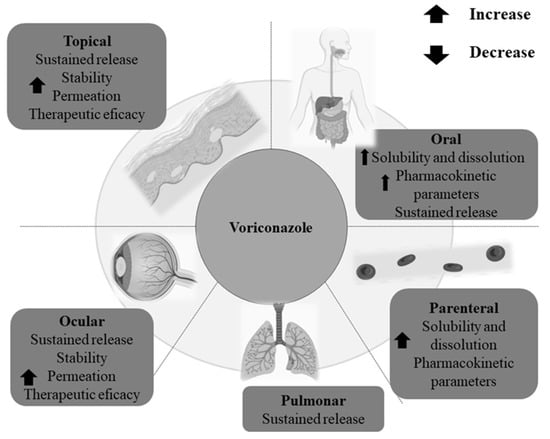
Figure 1.
Possible routes for voriconazole delivery from nanoparticles.
Table 2.
Some aspects of studies on nanoformulations containing voriconazole in recent years.
4.1. Lipid Nanoparticles
Lipid nanocarriers are potential drug delivery systems because they allow a controlled and specific target release [250,251]. The main lipid nanocarriers are the liposomes, solid lipid nanoparticles (SLNs), and nanostructured lipid carriers (NLCs) [252,253].
Liposomes are spherical vesicles formed by one or more phospholipid bilayers, surrounded by an aqueous compartment. Hydrophilic drugs can be loaded in the aqueous core while hydrophobic drugs are trapped into the lipid bilayer [254].
SLNs consist of carriers composed of a solid lipid core surrounded by a surfactant layer. The lipid is presented as a solid at room temperature and is smelt at higher temperatures. Hydrophobic drugs are better loaded in SLNs than hydrophilic ones. This first generation of SLNs presented limitations such as low physical stability, limited encapsulation efficiency, and expulsion of the drug during storage. It occurs due to the formation of a perfectly crystallized lipid matrix after solidification of the lipid. The second generation of SLNs are the NLCs, the core of which is constituted by a solid lipid and a liquid lipid (oil), forming a disordered lipid arrangement, avoiding the drawbacks of SLNs [255].
Among the solid lipids commonly used for SLNs are those with a low melting point and solidity at body temperature, in addition to surfactants and co-surfactants [256]. The development of SLN has improved the encapsulation efficiency and stability of drugs using a mixture of liquid, solid lipids, and surfactants [257,258].
SLNs plays a significant role in improving pharmacokinetic characteristics and reducing the adverse effects of antifungals [259]. Amphotericin B was the first antifungal to be commercialized in colloidal dispersion systems, lipid complexes, or liposomes to improve drug solubility and reduce its adverse effects, [45,260].
The ability to improve drug solubility through lipid formulations has also been explored in VCZ delivery systems, to topical [160,232] and ocular administration [157]. In the study carried out by Andrade, an NLS was developed with 75% encapsulation efficiency that allowed safe release into ocular tissue in ex vivo tests [232].
In a study by Liu et al. (2023), a liposome containing voriconazole showed a greater capacity for binding to the chitin of the fungal cell wall of C. albicans. Furthermore, the in vivo study improved the delivery efficacy of voriconazole [261].
In vivo study of vaginal infections by candida albicans showed a significant reduction in infection after 48 and 72 h compared to free voriconazole, indicating sustained release of the drug [220].
In general, lipid nanoparticles containing voriconazole have been developed mainly for ocular delivery and this is justified by the compatibility and permeation capacity of these systems in this tissue, favoring a safe delivery of drugs. Studies with SLNs have shown increased permeation, mainly ocular, and allowed controlled and sustained release, increasing the therapeutic efficacy of these systems for VCZ delivery [46,243,244].
4.2. Polymeric Nanoparticles
Among the administration systems and targeted delivery of drugs and molecules, polymeric nanoparticles play a prominent role in this scenario. The main feature is the ease of interacting with pharmacokinetic parameters in administering these systems, such as absorption, bioavailability, and excretion [262,263].
There are two types of biodegradable polymers used, with synthetic polymers such as Poly (lactide) (PLA) [264], Poly (lactide-co-glycolic) (PLGA) [265], Poly (ε-caprolactone) (PCL) [266], and natural polymers such as chitosan [267], zein [268], casein [269], alginate [270], gelatin [271], and albumin [272].
The methods for obtaining nanostructured systems with polymeric nanoparticles are based on two main techniques, dispersion and polymerization [273]. However, these systems still present some challenges as drug delivery systems: the non-scalable procurement methods, the safety and cost of development, and limitations as a system, such as overcoming some biological and stability barriers [274].
In this sense, several systems have been studied in different pathophysiological conditions to overcome these challenges. Among the main diseases that have already been approved and have effective results is cancer, in systems that release doxorubicin and paclitaxel, for example [275,276,277]. Studies also use neurodegenerative [278] and cardiovascular diseases [279,280].
Despite the challenges, polymeric nanoparticles are promising for their use and development advantages [281]. They provide the encapsulated molecule with protection against degradation in some routes of administration, such as oral administration [282]. They enable the controlled release of the target-specific drug and surface modification with the incorporation of ligands [283,284].
Some nanoparticles have also been explored for VCZ delivery. Chitosan-coated PLGA nanoparticles were developed by Paul (2018) using the solvent evaporation emulsification method to improve the bioavailability and release of VCZ through the pulmonary route. The study obtained nanoparticles with 68.57% encapsulation efficiency and a sustained and slow release in vitro and in vivo, which allowed the retention of VCZ in the lung and plasma [230].
In another study by Rençber and Karavana (2018), chitosan nanoparticles were developed to carry VCZ by the emulsification method for topical administration. The nanoparticles had almost 99% encapsulation efficiency. The release was characterized by diffusion, and the method was considered promising for topical administration. The authors justify the result by the association of chitosan, which has mucoadhesive properties [229].
Das (2015) was able to increase the bioavailability of VCZ via the pulmonary route in PLGA nanoparticles developed by solvent evaporation emulsification, with an average diameter of approximately 300 nm. The system allowed increased pulmonary deposition and prolonged release, thus improving the pharmacokinetic characteristics of VCZ [248]. Another study with PLGA was developed by Sinha, Mukherjee and Pattnaik (2013), and the system allowed more significant pulmonary deposition and prolonged release of VCZ [285].
The characteristic of allowing the incorporation of different molecules into the polymeric nanoparticle allows for an increase in the interaction of the nanostructured system with the target tissue [229,283,284]. This has been explored in the literature with chitosan, which is known to have a mucoadhesive property and allows the increase in the delivery of VCZ in the target tissue [218,221,230,247].
4.3. Protein Nanocarriers
Protein nanoparticles are also described as polymeric nanoparticles, as they are classified as natural biopolymers. The main proteins used in developing these systems are proteins of animal origin, such as albumin, gelatin, collagen, and fibroin, and proteins of vegetable origin, such as zein and gliadin [286]. The procurement of nanoparticles occurs through different techniques, such as emulsification, desolvation, complexation by coacervation, electrospray deposition, and nanoprecipitation [287,288]. The protein nanoparticles can be classified, according to composition, into several types: solid spherical nanoparticles, plate-shaped nanoparticles, and nanogels [289]. Its applications involve different areas such as drug delivery, nutrient and metabolite delivery, gene delivery, tissue engineering, photodynamic therapy, growth factor delivery, vaccines, and cosmetics [288,290].
Human serum albumin nanoparticles containing VCZ were successfully developed by nabTM technology. The aim of the investigation was to optimize critical process parameters such as the homogenization pressure, the number of homogenization cycles, and the organic solvent. After determining the critical parameters, the authors obtained nanoparticles in the range of 35 to 85 nm, whose size was adequate for the proposed parenteral administration, with an encapsulation efficiency of around 69%. After 6 h, the system had already released 85% of the encapsulated VCZ, which made this system promising for further studies [231].
In addition, nanoparticles for delivering voriconazole are promising, although their application varies according to the need for the route of administration. It is possible to see that lipid formulations seem to improve delivery by the ocular and topical route and protein and polymeric formulations were explored for oral and pulmonary delivery [217,222,234,237,240]. The physicochemical characteristics of nanoparticles are important for the treatment of fungal infections, as they allow a better interaction between the fungus and the nanostructure.
In general, using nanotechnology for voriconazole encapsulation and release is a strategy to increase therapeutic activity since studies have reported increased tissue permeation with reduced toxicity, mainly due to the observed sustained and controlled release [211,216]. In addition, it is possible to observe an improvement in the solubility and bioavailability of VCZ [230,237].
Despite this, there is still a need for more comprehensive studies regarding the cytotoxicity and antifungal potential of these nanoparticles, mainly in in vivo studies.
5. Other Systems for Voriconazole Delivery
5.1. Cubosomes
Cubosomes are reversed bicontinuous cubic phase liquid crystalline nanoparticles capable of transporting and releasing drugs at the specific target site and have a high rate of encapsulation efficiency. These characteristics are due to the high surface area between the hydrophilic and hydrophobic regions present in its structure. They are composed of a lipid and surfactant/stabilizer, which extends in three dimensions and two nanochannels interwoven, but not connected [291,292,293].
Recently, cubosomes have been studied to increase and control the bioavailability of VCZ after ocular application. VCZ suspensions showed a low ocular residence time, which leads to an increase in the frequency of applications, while VCZ-containing cubosomes demonstrated a prolonged release profile compared to the suspension. Cubosomes were also coated with chitosan, increasing transcorneal permeation and residence time at the site [224].
5.2. Cyclodextrins
Cyclodextrins (CD) are cyclic oligosaccharides composed of six or more glucose units formed from an enzymatic reaction on starch. The most important naturally occurring forms are the a-, b-, and g- CD, whose structural shape resembles a cone, where the inner cavity has hydrophobic characteristics and the outer part is hydrophilic. Among the advantages of using DC in nanotechnology is its ability to improve drug solubility and organoleptic properties, stability, and safety [294,295].
CDs were used to improve VCZ solubility, dissolution rate, and chemical stability through complexation in an aqueous solution, followed by spray-dryer drying [294]. Another study carried out the complexation of CD and VCZ to produce a thermosensitive gel based on Poloxamer 407 and Poloxamer 188 for vaginal application. VCZ formulation complexed as CD showed greater uptake of the drug by the vaginal tissue compared to the formulation that used dispersed VCZ [236].
One of the most recent studies involves CD to improve the solubility of VCZ and the production of hydrogels for ophthalmic application since there is no formulation for this purpose. The authors compared the residence time and ophthalmic safety of b- and g- CD complexes compared to the control (VFEND). The results demonstrated good corneal permeability of VCZ, longer residence time, and ophthalmic safety [296]. Therefore, the use of DC to improve the performance of VCZ has shown promise.
6. Clinical Trials
Currently, on the Clinical Trials website, there are 189 records of studies with VCZ, of which only two registered studies involve the evaluation of nanocarrier formulations. The PHASE 2 study under registration NCT04110860 conducted by the Minia University of Egypt evaluated the application of a nanoemulsion-based gel containing VCZ in patients with tinea versicolor once or twice a day, compared to a placebo (nanoemulsion-based gel without VCZ). The study included 30 volunteer patients aged between 10 and 60 years, both sexes, with tinea versicolor, excluding pregnant women, nursing mothers, and immunocompromised patients. Patients’ clinical improvement, satisfaction, and duration of treatment were evaluated. Adverse effects were recorded, photographs of the lesions were taken before the start of treatment, during and at the end, and the clinical improvement criteria used by the physicians used a quartile rating scale. No results from this study have been published on the Clinical Trials website [297].
The PHASE 1 study under registration NCT01657201 conducted by Samyang Biopharmaceuticals Corporation of South Korea evaluated intravenous administration of VCZ-loaded-PNP 200 mg versus Vfend 200 mg in 59 healthy male patients aged 20 to 45 years to assess pharmacokinetic parameters and safety. The study was randomized, crossover, and an open intervention model; the pharmacokinetic parameters evaluated during the 24 h of the study were AUClast, Cmax, AUCinf, Tmax, T1/2, and CL [298]. Through this brief research, we can conclude that studies involving the application of nanostructured systems containing VCZ are still limited and that the studies carried out are still in the initial stages of research.
7. Future Prospects
It was observed that advances in the production of nanostructures containing voriconazole with a focus on topical, ocular, and pulmonary administration are significant in relation to other drug application routes. Despite the diversity of developed systems, there are still limitations regarding efficacy and safety studies. Most of the studies compiled in this work employ in vitro tests to demonstrate its performance, while in vivo tests are rarely explored. The reduced applicability of in vivo tests and the lack of use of alternative models, both used for toxicity and pharmacokinetic assessments, indicate the need for efforts in this area. Another point is the development of new drugs using nanotechnology, where clinical studies are rare, which indicates that there is still much to be done for research to proceed and benefit the population. In this sense, the application of nanotechnology is encouraged for better performance of fungal drugs, which allow a higher efficacy and safety for the treatment of different fungal infections that explore the interaction of nanoparticles with yeast and filamentous fungi, improving the prospective application of these nanoparticles.
8. Conclusions
The therapeutic management of opportunistic fungal infections such as aspergillosis, candidiasis, and cryptococcosis is still a challenge, which is associated with pharmacokinetic and toxicity limitations of currently available antifungals. Among them, VCZ has a wide sub- and supratherapeutic variation due to its metabolism and CYP450 polymorphisms, which reduce its therapeutic efficacy and amplify its adverse effects.
Nanocarrier systems loaded-VCZ offer numerous advantages. Among the results demonstrated, we can highlight the improvement in solubility and dissolution rate of VCZ in an aqueous medium. The release control presented different release profiles, most of them allowing a prolonged or sustained release in the presence of an initial burst effect. In addition, pharmacokinetic parameters improve the increase in mucosal adhesion and safety for topical applications. The physicochemical characteristics change according to the nanostructured system, and these data are verified according to widely disseminated techniques for characterization. Nanotechnology applied to the use of VCZ has the potential to improve parameters related to drug targeting, release, and therapeutic effects for overcoming the biological and physicochemical hurdles.
Author Contributions
Conceptualization, L.d.A.C., M.T.F., K.S.S., M.W.d.L.G., N.M.K., A.M.F.-A., R.M.M. and M.J.S.M.-G. Methodology L.d.A.C., M.T.F., K.S.S., M.W.d.L.G., N.M.K., A.M.F.-A., R.M.M. and M.J.S.M.-G. Software, not applicable. Validation, N.M.K., A.M.F.-A., R.M.M. and M.J.S.M.-G. Formal analysis, N.M.K., A.M.F.-A., R.M.M. and M.J.S.M.-G. Investigation, L.d.A.C., M.T.F., K.S.S., M.W.d.L.G., N.M.K., A.M.F.-A., R.M.M. and M.J.S.M.-G. Resources, L.d.A.C., M.T.F., K.S.S., M.W.d.L.G., N.M.K., A.M.F.-A., R.M.M. and M.J.S.M.-G. Data curation, L.d.A.C., M.T.F., K.S.S., M.W.d.L.G., N.M.K., A.M.F.-A., R.M.M. and M.J.S.M.-G. Writing—original draft administration, L.d.A.C., M.T.F., K.S.S., M.W.d.L.G., N.M.K., A.M.F.-A., R.M.M. and M.J.S.M.-G. Writing—review and editing, L.d.A.C., M.T.F., K.S.S., M.W.d.L.G., A.K.L.F.C., N.M.K., A.M.F.-A., R.M.M. and M.J.S.M.-G. Visualization, L.d.A.C., M.T.F., K.S.S., M.W.d.L.G., N.M.K., A.M.F.-A., R.M.M. and M.J.S.M.-G. Supervision, N.M.K., A.M.F.-A., R.M.M. and M.J.S.M.-G. Project administration, N.M.K., A.M.F.-A., R.M.M. and M.J.S.M.-G. Funding acquisition, N.M.K., A.M.F.-A., R.M.M. and M.J.S.M.-G. All authors have read and agreed to the published version of the manuscript.
Funding
This research was funded by “Conselho Nacional de Desenvolvimento Científico e Tecnológico (CNPq)” for financial support (grant no 01/2020), and financed part by the “Coordenação de Aperfeiçoamento de Pessoal de Nível Superior—Brazil (CAPES)—Finance Code 001 and “Fundação de Amparo à Pesquisa do Estado de São Paulo” (grant no 21/14839-9).
Institutional Review Board Statement
Not applicable.
Informed Consent Statement
Not applicable.
Data Availability Statement
Not applicable.
Acknowledgments
The authors are grateful to Universidade Estadual do Centro-Oeste and Universidade Estadual Paulista Júlio de Mesquita Filho for the structure and support provided during this work, and Programa de Pós-graduação em Ciências Farmacêuticas of Universidade Estadual do Centro-Oeste and Programa de Pós-graduação em Biociências e Biotecnologia Aplicadas à Farmácia of Universidade Estadual Paulista Júlio de Mesquita Filho.
Conflicts of Interest
The authors declare no conflict of interest.
References
- Gushiken, A.C.; Saharia, K.K.; Baddley, J.W. Cryptococcosis. Infect. Dis. Clin. N. Am. 2021, 35, 493–514. [Google Scholar] [CrossRef] [PubMed]
- Lakoh, S.; Rickman, H.; Sesay, M.; Kenneh, S.; Burke, R.; Baldeh, M.; Jiba, D.F.; Tejan, Y.S.; Boyle, S.; Koroma, C.; et al. Prevalence and Mortality of Cryptococcal Disease in Adults with Advanced HIV in an Urban Tertiary Hospital in Sierra Leone: A Prospective Study. BMC Infect. Dis. 2020, 20, 1–7. [Google Scholar] [CrossRef] [PubMed]
- Lockhart, S.R.; Guarner, J. Emerging and Reemerging Fungal Infections. Semin. Diagn. Pathol. 2019, 36, 177–181. [Google Scholar] [CrossRef] [PubMed]
- Otto, W.R.; Green, A.M. Fungal Infections in Children with Haematologic Malignancies and Stem Cell Transplant Recipients. Br. J. Haematol. 2020, 189, 607–624. [Google Scholar] [CrossRef]
- Vila, T.; Sultan, A.S.; Montelongo-Jauregui, D.; Jabra-Rizk, M.A. Oral Candidiasis: A Disease of Opportunity. J. Fungi 2020, 6, 15. [Google Scholar] [CrossRef]
- David, F.; Rodrigues Morais, J.; Beires, F.; Greefield, H.; Fernandes, G.L. Invasive Pulmonary Aspergillosis after COVID-19 Pneumonia. Eur. J. Case Rep. Intern. Med. 2022, 9, 003209. [Google Scholar] [CrossRef]
- Swain, S.; Ray, A.; Sarda, R.; Vyas, S.; Singh, G.; Jorwal, P.; Kodan, P.; Khanna, P.; Xess, I.; Sinha, S.; et al. COVID-19-Associated Subacute Invasive Pulmonary Aspergillosis. Mycoses 2022, 65, 57–64. [Google Scholar] [CrossRef]
- Blot, S.; Rello, J.; Koulenti, D. Diagnosing Invasive Pulmonary Aspergillosis in ICU Patients: Putting the Puzzle Together. Curr. Opin. Crit. Care 2019, 25, 430–437. [Google Scholar] [CrossRef]
- Hadrich, I.; Ayadi, A. Epidemiology of Antifungal Susceptibility: Review of Literature. J. Mycol. Med. 2018, 28, 574–584. [Google Scholar] [CrossRef]
- Jamzivar, F.; Shams-Ghahfarokhi, M.; Khoramizadeh, M.; Yousefi, N.; Gholami-Shabani, M.; Razzaghi-Abyaneh, M. Unraveling the Importance of Molecules of Natural Origin in Antifungal Drug Development through Targeting Ergosterol Biosynthesis Pathway. Iran. J. Microbiol. 2019, 11, 448–459. [Google Scholar] [CrossRef]
- Poissy, J.; Damonti, L.; Bignon, A.; Khanna, N.; von Kietzell, M.; Boggian, K.; Neofytos, D.; Vuotto, F.; Coiteux, V.; Artru, F.; et al. Risk Factors for Candidemia: A Prospective Matched Case-Control Study. Crit. Care 2020, 24, 1–11. [Google Scholar] [CrossRef]
- Bonifaz, A.; Rojas, R.; Tirado-Sánchez, A.; Chávez-López, D.; Mena, C.; Calderón, L.; María, P.-O.R. Superficial Mycoses Associated with Diaper Dermatitis. Mycopathologia 2016, 181, 671–679. [Google Scholar] [CrossRef]
- Costa-Orlandi, C.B.; Sardi, J.C.O.; Santos, C.T.; Fusco-Almeida, A.M.; Mendes, M. In Vitro Characterization of Trichophyton rubrum and T. mentagrophytes Biofilms. Biofouling 2014, 30, 719–727. [Google Scholar] [CrossRef]
- Heidrich, D.; Garcia, M.R.; Stopiglia, C.D.O.; Magagnin, C.M.; Daboit, T.C.; Vetoratto, G.; Schwartz, J.; Amaro, T.G.; Scroferneker, M.L. Dermatophytosis: A 16-Year Retrospective Study in a Metropolitan Area in Southern Brazil. J. Infect. Dev. Ctries. 2015, 9, 865–871. [Google Scholar] [CrossRef]
- Maraki, S.; Mavromanolaki, V.E. Epidemiology of Dermatophytoses in Crete, Greece: A 5-Year Survey. Med. Mycol. J. 2016, 57, e69–e75. [Google Scholar] [CrossRef]
- Queiroz-Telles, F.; Fahal, A.H.; Falci, D.R.; Caceres, D.H.; Chiller, T.; Pasqualotto, A.C. Neglected Endemic Mycoses. Lancet Infect. Dis. 2017, 17, 367–377. [Google Scholar] [CrossRef]
- Carrasco-Zuber, J.E.; Navarrete-Dechent, C.; Bonifaz, A.; Fich, F.; Vial-Letelier, V.; Berroeta-Mauriziano, D. Afectación Cutánea En Las Micosis Profundas: Una Revisión de La Literatura. Parte II. Micosis Sistémicas. Actas Dermosifiliogr. 2016, 107, 816–822. [Google Scholar] [CrossRef]
- Bollam, R.; Yassin, M.; Phan, T. Disseminated Cryptococcosis in an Immunocompetent Patient. Respir. Med. Case Rep. 2020, 30, 101034. [Google Scholar] [CrossRef]
- Papachristou, S.G.; Iosifidis, E.; Sipsas, N.V.; Gamaletsou, M.N.; Walsh, T.J.; Roilides, E. Management of Osteoarticular Fungal Infections in the Setting of Immunodeficiency. Expert Rev. Anti Infect. Ther. 2020, 18, 461–474. [Google Scholar] [CrossRef]
- El-Baba, F.; Gao, Y.; Soubani, A.O. Pulmonary Aspergillosis: What the Generalist Needs to Know. Am. J. Med. 2020, 133, 668–674. [Google Scholar] [CrossRef]
- WHO. Fungal Priority Pathogens List to Guide Research, Development and Public Health Action; World Health Organization: Geneva, Switzerland, 2022. [Google Scholar]
- Revie, N.M.; Iyer, K.R.; Robbins, N.; Cowen, L.E. Antifungal Drug Resistance: Evolution, Mechanisms and Impact HHS Public Access. Curr. Opin. Microbiol. 2018, 45, 70–76. [Google Scholar] [CrossRef] [PubMed]
- Perlin, D.S.; Rautemaa-Richardson, R.; Alastruey-Izquierdo, A. The Global Problem of Antifungal Resistance: Prevalence, Mechanisms, and Management. Lancet Infect. Dis. 2017, 17, 383–392. [Google Scholar] [CrossRef] [PubMed]
- Vartak, R.; Menon, S.; Patki, M.; Billack, B.; Patel, K. Ebselen Nanoemulgel for the Treatment of Topical Fungal Infection. Eur. J. Pharm. Sci. 2020, 148, 105323. [Google Scholar] [CrossRef] [PubMed]
- Abbes, S.; Sellami, H.; Neji, S.; Trabelsi, H.; Makni, F.; Ayadi, A. Implication of Efflux Pumps and ERG11 Genes in Resistance of Clinical Trichosporon Asahii Isolates to Fluconazole. J. Med. Microbiol. 2021, 70, 001236. [Google Scholar] [CrossRef] [PubMed]
- Pristov, K.E.; Ghannoum, M.A. Resistance of Candida to Azoles and Echinocandins Worldwide. Clin. Microbiol. Infect. 2019, 25, 792–798. [Google Scholar] [CrossRef] [PubMed]
- Andrew, E.C.; Curtis, N.; Coghlan, B.; Cranswick, N.; Gwee, A. Adverse Effects of Amphotericin B in Children; a Retrospective Comparison of Conventional and Liposomal Formulations. Br. J. Clin. Pharmacol. 2018, 84, 1006–1012. [Google Scholar] [CrossRef]
- Takahashi, T.; Smith, A.R.; Jacobson, P.A.; Alharbi, A.F.; Fisher, J.; Rubin, N.T.; Kirstein, M.N. CYP51A1 Polymorphism and Voriconazoleassociated Hepatotoxicity in Children Undergoing Hematopoietic Cell Transplant. Int. J. Clin. Pharmacol. Ther. 2021, 59, 442–446. [Google Scholar] [CrossRef]
- Donnelly, J.P.; de Pauw, B.E. Voriconazole—A New Therapeutic Agent with an Extended Spectrum of Antifungal Activity. Clin. Microbiol. Infect. 2004, 10, 107–117. [Google Scholar] [CrossRef]
- Johnson, L.B.; Kauffman, C.A.; John, S. Voriconazole: A New Triazole Antifungal Agent. Clin. Infect. Dis. 2003, 36, 630–637. [Google Scholar] [CrossRef]
- Jeu, L.; Piacenti, F.J.; Lyakhovetskiy, A.G.; Fung, H.B. Voriconazole. Clin. Ther. 2003, 25, 1321–1381. [Google Scholar] [CrossRef]
- Limper, A.H.; Knox, K.S.; Sarosi, G.A.; Ampel, N.M.; Bennett, J.E.; Catanzaro, A.; Davies, S.F.; Dismukes, W.E.; Hage, C.A.; Marr, K.A.; et al. An Official American Thoracic Society Statement: Treatment of Fungal Infections in Adult Pulmonary and Critical Care Patients. Am. J. Respir. Crit. Care Med. 2011, 183, 96–128. [Google Scholar] [CrossRef]
- Job, K.M.; Olson, J.; Stockmann, C.; Constance, J.E.; Enioutina, E.Y.; Rower, J.E.; Linakis, M.W.; Balch, A.H.; Yu, T.; Liu, X.; et al. Pharmacodynamic Studies of Voriconazole: Informing the Clinical Management of Invasive Fungal Infections. Expert Rev. Anti Infect. Ther. 2016, 14, 731–746. [Google Scholar] [CrossRef]
- Collins, L.M.; Moore, R.; Sobel, J.D. Prognosis and Long-Term Outcome of Women with Idiopathic Recurrent Vulvovaginal Candidiasis Caused by Candida Albicans. J. Low Genit. Tract. Dis. 2020, 24, 48–52. [Google Scholar] [CrossRef]
- Hassanmoghadam, F.; Shokohi, T.; Hedayati, M.T.; Aslani, N.; Haghani, I.; Nabili, M.; Lotfali, E.; Moazeni, M. High Prevalence of Itraconazole Resistance among Candida Parapsilosis Isolated from Iran. Curr. Med. Mycol. 2019, 5, 43–46. [Google Scholar] [CrossRef]
- Perez-Pitarch, A.; Guglieri-Lopez, B.; Ferriols-Lisart, R.; Pérez, A.; Ezquer-Garín, C.; Hernández-Boluda, J.C.; Piñana, J.L.; Navarro, D.; Solano, C.; Alós-Almiñana, M. Pharmacokinetic/Pharmacodynamic Analysis of Voriconazole against Candida spp. and Aspergillus spp. in Allogeneic Stem Cell Transplant Recipients. Ther. Drug Monit. 2019, 41, 740–747. [Google Scholar] [CrossRef]
- Cheng, L.; Xiang, R.; Liu, F.; Li, Y.; Chen, H.; Yao, P.; Sun, F.; Xia, P. Therapeutic Drug Monitoring and Safety of Voriconazole in Elderly Patients. Int. Immunopharmacol. 2020, 78, 106078. [Google Scholar] [CrossRef]
- Zhong, X.; Tong, X.; Ju, Y.; Du, X.; Li, Y. Interpersonal Factors in the Pharmacokinetics and Pharmacodynamics of Voriconazole: Are CYP2C19 Genotypes Enough for Us to Make a Clinical Decision? Curr. Drug Metab. 2018, 19, 1152–1158. [Google Scholar] [CrossRef]
- Resztak, M.; Kosicka, K.; Zalewska, P.; Krawiec, J.; Główka, F.K. Determination of Total and Free Voriconazole in Human Plasma: Application to Pharmacokinetic Study and Therapeutic Monitoring. J. Pharm. Biomed. Anal. 2020, 178, 112952. [Google Scholar] [CrossRef]
- Shi, C.; Xiao, Y.; Mao, Y.; Wu, J.; Lin, N. Voriconazole: A Review of Population Pharmacokinetic Analyses. Clin. Pharmacokinet. 2019, 58, 687–703. [Google Scholar] [CrossRef]
- Theuretzbacher, U.; Ihle, F.; Derendorf, H. Pharmacokinetic/Pharmacodynamic Profile of Voriconazole. Clin. Pharmacokinet. 2006, 45, 649–663. [Google Scholar] [CrossRef]
- Levine, M.T.; Chandrasekar, P.H. Adverse Effects of Voriconazole: Over a Decade of Use. Clin. Transplant. 2016, 30, 1377–1386. [Google Scholar] [CrossRef]
- Musayeva, A.; Riedl, J.C.; Schuster, A.K.; Wasielica-Poslednik, J.; Pfeiffer, N.; Gericke, A. Topical Voriconazole as Supplemental Treatment for Acanthamoeba Keratitis. Cornea 2020, 39, 986–990. [Google Scholar] [CrossRef]
- Voltan, A.R.; Quindós, G.; Alarcón, K.P.M.; Fusco-Almeida, A.M.; Mendes-Giannini, M.J.S.; Chorilli, M. Fungal Diseases: Could Nanostructured Drug Delivery Systems Be a Novel Paradigm for Therapy? Int. J. Nanomed. 2016, 11, 3715–3730. [Google Scholar] [CrossRef] [PubMed]
- Renzi, D.F.; de Almeida Campos, L.; Miranda, E.H.; Mainardes, R.M.; Abraham, W.-R.; Grigoletto, D.F.; Khalil, N.M. Nanoparticles as a Tool for Broadening Antifungal Activities. Curr. Med. Chem. 2021, 28, 1841–1873. [Google Scholar] [CrossRef] [PubMed]
- Khare, A.; Singh, I.; Pawar, P.; Grover, K. Design and Evaluation of Voriconazole Loaded Solid Lipid Nanoparticles for Ophthalmic Application. J. Drug Deliv. 2016, 2016, 1–11. [Google Scholar] [CrossRef] [PubMed]
- Radwan, M.A.; AlQuadeib, B.T.; Šiller, L.; Wright, M.C.; Horrocks, B. Oral Administration of Amphotericin B Nanoparticles: Antifungal Activity, Bioavailability and Toxicity in Rats. Drug Deliv. 2017, 24, 40–50. [Google Scholar] [CrossRef] [PubMed]
- Roque, L.; Molpeceres, J.; Reis, C.; Rijo, P.; Pinto Reis, C. Past, Recent Progresses and Future Perspectives of Nanotechnology Applied to Antifungal Agents. Curr. Drug Metab. 2017, 18, 280–290. [Google Scholar] [CrossRef]
- Szalewski, D.A.; Hinrichs, V.S.; Zinniel, D.K.; Barletta, R.G. The Pathogenicity of Aspergillus Fumigatus, Drug Resistance, and Nanoparticle Delivery. Can. J. Microbiol. 2018, 64, 439–453. [Google Scholar] [CrossRef]
- Oliveira, L.T.; Lopes, L.G.; Ramos, S.B.; Martins, C.H.G.; Jamur, M.C.; Pires, R.H. Fungal Biofilms in the Hemodialysis Environment. Microb. Pathog. 2018, 123, 206–212. [Google Scholar] [CrossRef]
- Cadena, J.; Thompson, G.R.; Patterson, T.F. Invasive Aspergillosis: Current Strategies for Diagnosis and Management. Infect. Dis. Clin. N. Am. 2016, 30, 125–142. [Google Scholar] [CrossRef]
- Houbraken, J.; Kocsubé, S.; Visagie, C.M.; Yilmaz, N.; Wang, X.C.; Meijer, M.; Kraak, B.; Hubka, V.; Bensch, K.; Samson, R.A.; et al. Classification of Aspergillus, Penicillium, Talaromyces and Related Genera (Eurotiales): An Overview of Families, Genera, Subgenera, Sections, Series and Species. Stud. Mycol. 2020, 95, 5–169. [Google Scholar] [CrossRef]
- Park, S.Y.; Yoon, J.-A.; Kim, S.-H. Voriconazole-Refractory Invasive Aspergillosis. Korean J. Intern. Med. 2017, 32, 805–812. [Google Scholar] [CrossRef]
- Warris, A. The Biology of Pulmonary Aspergillus Infections. J. Infect. 2014, 44, 36–41. [Google Scholar] [CrossRef]
- Ohara, S.; Tazawa, Y.; Tanai, C.; Tanaka, Y.; Noda, H.; Horiuchi, H.; Usui, K. Clinical Characteristics of Patients with Aspergillus Species Isolation from Respiratory Samples: Comparison of Chronic Pulmonary Aspergillosis and Colonization. Respir. Investig. 2016, 54, 92–97. [Google Scholar] [CrossRef]
- Iqbal, N.; Sheikh, M.D.A.; Jabeen, K.; Awan, S.; Irfan, M. Allergic Bronchopulmonary Aspergillosis Misdiagnosed as Smear Negative Pulmonary Tuberculosis; a Retrospective Study from Pakistan. Ann. Med. Surg. 2021, 72, 103045. [Google Scholar] [CrossRef]
- Tiew, P.Y.; Lim, A.Y.H.; Keir, H.R.; Dicker, A.J.; Aogáin, M.M.; Pang, S.L.; Boon, L.T.; Hassan, T.M.; Poh, M.E.; Xu, H.; et al. High Frequency of Allergic Bronchopulmonary Aspergillosis in Bronchiectasis-COPD Overlap. Chest 2022, 161, 40–53. [Google Scholar] [CrossRef]
- Agarwal, R. Allergic Bronchopulmonary Aspergillosis. Chest 2009, 135, 805–826. [Google Scholar] [CrossRef]
- Asano, K.; Hebisawa, A.; Ishiguro, T.; Takayanagi, N.; Nakamura, Y.; Suzuki, J.; Okada, N.; Tanaka, J.; Fukutomi, Y.; Ueki, S.; et al. New Clinical Diagnostic Criteria for Allergic Bronchopulmonary Aspergillosis/Mycosis and Its Validation. J. Allergy Clin. Immunol. 2021, 147, 1261–1268. [Google Scholar] [CrossRef]
- Tompkins, M.G.; Pettit, R. Beyond the Guidelines: Treatment of Allergic Bronchopulmonary Aspergillosis in Cystic Fibrosis. Ann. Pharmacother. 2022, 56, 181–192. [Google Scholar] [CrossRef]
- Boyle, M.; Mulrennan, S.; Morey, S.; Vekaria, S.; Popowicz, N.; Tai, A. Mepolizumab Use in Cystic Fibrosis-Associated Allergic Bronchopulmonary Aspergillosis. Respirol. Case Rep. 2021, 9, e00696. [Google Scholar] [CrossRef]
- O’Reilly, A.; Dunican, E. The Use of Targeted Monoclonal Antibodies in the Treatment of ABPA—A Case Series. Medicina 2022, 58, 53. [Google Scholar] [CrossRef] [PubMed]
- Denning, D.W.; Cadranel, J.; Beigelman-Aubry, C.; Ader, F.; Chakrabarti, A.; Blot, S.; Ullmann, A.J.; Dimopoulos, G.; Lange, C. Chronic Pulmonary Aspergillosis: Rationale and Clinical Guidelines for Diagnosis and Management. Eur. Respir. J. 2016, 47, 45–68. [Google Scholar] [CrossRef] [PubMed]
- Takeda, K.; Suzuki, J.; Watanabe, A.; Arai, T.; Koiwa, T.; Shinfuku, K.; Narumoto, O.; Kawashima, M.; Fukami, T.; Tamura, A.; et al. High Detection Rate of Azole-Resistant Aspergillus Fumigatus after Treatment with Azole Antifungal Drugs among Patients with Chronic Pulmonary Aspergillosis in a Single Hospital Setting with Low Azole Resistance. Med. Mycol. 2021, 59, 327–334. [Google Scholar] [CrossRef] [PubMed]
- Sehgal, I.S.; Dhooria, S.; Muthu, V.; Prasad, K.T.; Agarwal, R. An Overview of the Available Treatments for Chronic Cavitary Pulmonary Aspergillosis. Expert Rev. Respir. Med. 2020, 14, 715–727. [Google Scholar] [CrossRef] [PubMed]
- Ohba, H.; Miwa, S.; Shirai, M.; Kanai, M.; Eifuku, T.; Suda, T.; Hayakawa, H.; Chida, K. Clinical Characteristics and Prognosis of Chronic Pulmonary Aspergillosis. Respir. Med. 2012, 106, 724–729. [Google Scholar] [CrossRef]
- Im, Y.; Jhun, B.W.; Kang, E.S.; Koh, W.J.; Jeon, K. Impact of Treatment Duration on Recurrence of Chronic Pulmonary Aspergillosis. J. Infect. 2021, 83, 490–495. [Google Scholar] [CrossRef]
- Rodriguez-Goncer, I.; Harris, C.; Kosmidis, C.; Muldoon, E.G.; Newton, P.J.; Denning, D.W. Assessment of Posaconazole Salvage Therapy in Chronic Pulmonary Aspergillosis Using Predefined Response Criteria. Int. J. Antimicrob. Agents 2018, 52, 258–264. [Google Scholar] [CrossRef]
- Jenks, J.D.; Nam, H.H.; Hoenigl, M. Invasive Aspergillosis in Critically Ill Patients: Review of Definitions and Diagnostic Approaches. Mycoses 2021, 64, 1002–1014. [Google Scholar] [CrossRef]
- Patterson, T.F.; Thompson, G.R., III; Denning, D.W.; Fishman, J.A.; Hadley, S.; Herbrecht, R.; Kontoyiannis, D.P.; Marr, K.A.; Morrison, V.A.; Nguyen, M.H.; et al. Practice Guidelines for the Diagnosis and Management of Aspergillosis: 2016 Update by the Infectious Diseases Society of America. Clin. Infect. Dis. 2016, 63, e1–e60. [Google Scholar] [CrossRef]
- Maertens, J.A.; Rahav, G.; Lee, D.G.; Ponce-de-León, A.; Ramírez Sánchez, I.C.; Klimko, N.; Sonet, A.; Haider, S.; Diego Vélez, J.; Raad, I.; et al. Posaconazole versus Voriconazole for Primary Treatment of Invasive Aspergillosis: A Phase 3, Randomised, Controlled, Non-Inferiority Trial. Lancet 2021, 397, 499–509. [Google Scholar] [CrossRef]
- Bongomin, F.; Otu, A.; Harris, C.; Foden, P.; Kosmidis, C.; Denning, D.W. Risk Factors for Relapse of Chronic Pulmonary Aspergillosis after Discontinuation of Antifungal Therapy. Clin. Infect. Pract. 2020, 5, 100015. [Google Scholar] [CrossRef]
- Cadena, J.; Thompson, G.R., III; Patterson, T.F. Aspergillosis Epidemiology, Diagnosis, and Treatment. Infect. Dis. Clin. N. Am. 2021, 35, 415–434. [Google Scholar] [CrossRef]
- Challa, S. Pathogenesis and Pathology of Invasive Aspergillosis. Curr. Fungal Infect. Rep. 2018, 12, 23–32. [Google Scholar] [CrossRef]
- Bongomin, F.; Gago, S.; Oladele, R.O.; Denning, D.W. Global and Multi-National Prevalence of Fungal Diseases—Estimate Precision. J. Fungi 2017, 3, 57. [Google Scholar] [CrossRef]
- Raveendran, S.; Lu, Z. CT Findings and Differential Diagnosis in Adults with Invasive Pulmonary Aspergillosis. Radiol. Infect. Dis. 2018, 5, 14–25. [Google Scholar] [CrossRef]
- Desoubeaux, G.; Bailly, E.; Chandenier, J. Diagnosis of Invasive Pulmonary Aspergillosis: Updates and Recommendations. Med. Mal. Infect. 2014, 44, 89–101. [Google Scholar] [CrossRef]
- Romero-Palacios, A.; Mera Gallardo, O.; Jiménez Aguilar, P.; Borrallo Torrejón, J.J.; Maza Ortega, C.; Rodriguez-Iglesias, M.A. Traqueobronquitis Obstructiva Por Aspergillus Fumigatus En Un Paciente Inmunocompetente. Rev. Iberoam. Micol. 2019, 36, 34–36. [Google Scholar] [CrossRef]
- Tudesq, J.J.; Peyrony, O.; Lemiale, V.; Azoulay, E. Invasive Pulmonary Aspergillosis in Nonimmunocompromised Hosts. Semin. Respir. Crit. Care Med. 2019, 40, 540–547. [Google Scholar] [CrossRef]
- Kanj, A.; Abdallah, N.; Soubani, A.O. The Spectrum of Pulmonary Aspergillosis. Respir. Med. 2018, 141, 121–131. [Google Scholar] [CrossRef]
- Tissot, F.; Agrawal, S.; Pagano, L.; Petrikkos, G.; Groll, A.H.; Skiada, A.; Lass-Flörl, C.; Calandra, T.; Viscoli, C.; Herbrecht, R. ECIL-6 Guidelines for the Treatment of Invasive Candidiasis, Aspergillosis and Mucormycosis in Leukemia and Hematopoietic Stem Cell Transplant Patients. Haematologica 2017, 102, 433–444. [Google Scholar] [CrossRef]
- Astvad, K.M.T.; Hare, R.K.; Arendrup, M.C. Evaluation of the In Vitro Activity of Isavuconazole and Comparator Voriconazole against 2635 Contemporary Clinical Candida and Aspergillus Isolates. Clin. Microbiol. Infect. 2017, 23, 882–887. [Google Scholar] [CrossRef] [PubMed]
- Buil, J.B.; Brüggemann, R.J.M.; Wasmann, R.E.; Zoll, J.; Meis, J.F.; Melchers, W.J.G.; Mouton, J.W.; Verweij, P.E. Isavuconazole Susceptibility of Clinical Aspergillus Fumigatus Isolates and Feasibility of Isavuconazole Dose Escalation to Treat Isolates with Elevated MICs. J. Antimicrob. Chemother. 2018, 73, 134–142. [Google Scholar] [CrossRef] [PubMed]
- Bolcato, L.; Thiebaut-Bertrand, A.; Stanke-Labesque, F.; Gautier-Veyret, E. Variability of Isavuconazole Trough Concentrations during Longitudinal Therapeutic Drug Monitoring. J. Clin. Med. 2022, 11, 5756. [Google Scholar] [CrossRef] [PubMed]
- Intra, J.; Sala, M.R.; Brambilla, P.; Carcione, D.; Leoni, V. Prevalence and Species Distribution of Microorganisms Isolated among Non-Pregnant Women Affected by Vulvovaginal Candidiasis: A Retrospective Study over a 20 Year-Period. J. Med. Mycol. 2022, 32, 101278. [Google Scholar] [CrossRef] [PubMed]
- Dadar, M.; Tiwari, R.; Karthik, K.; Chakraborty, S.; Shahali, Y.; Dhama, K. Candida Albicans—Biology, Molecular Characterization, Pathogenicity, and Advances in Diagnosis and Control—An Update. Microb. Pathog. 2018, 117, 128–138. [Google Scholar] [CrossRef]
- Zheng, Y.J.; Xie, T.; Wu, L.; Liu, X.Y.; Zhu, L.; Chen, Y.; Mao, E.Q.; Han, L.Z.; Chen, E.Z.; Yang, Z.T. Epidemiology, Species Distribution, and Outcome of Nosocomial Candida spp. Bloodstream Infection in Shanghai: An 11-Year Retrospective Analysis in a Tertiary Care Hospital. Ann. Clin. Microbiol. Antimicrob. 2021, 20, 1–10. [Google Scholar] [CrossRef]
- Colombo, A.L.; Agnelli, C.; Kontoyiannis, D.P. Knowledge Gaps in Candidaemia/Invasive Candidiasis in Haematological Cancer Patients. J. Antimicrob. Chemother. 2021, 76, 543–546. [Google Scholar] [CrossRef]
- Eggimann, P.; Garbino, J.; Pittet, D. Management of Candida Species Infections in Critically Ill Patients. Lancet Infect. Dis. 2003, 3, 772–785. [Google Scholar] [CrossRef]
- Pappas, P.G.; Lionakis, M.S.; Arendrup, M.C.; Ostrosky-Zeichner, L.; Kullberg, B.J. Invasive Candidiasis. Nat. Rev. Dis. Prim. 2018, 4, 18026. [Google Scholar] [CrossRef]
- Doi, A.M.; Pignatari, A.C.C.; Edmond, M.B.; Rodrigues Marra, A.; Camargo, L.F.A.; Siqueira, R.A.; Pereira Da Mota, V.; Lopes Colombo, A. Epidemiology and Microbiologic Characterization of Nosocomial Candidemia from a Brazilian National Surveillance Program. PLoS ONE 2016, 11, e0146909. [Google Scholar] [CrossRef]
- Epelbaum, O.; Chasan, R. Candidemia in the Intensive Care Unit. Clin. Chest Med. 2017, 38, 493–509. [Google Scholar] [CrossRef]
- Falces-Romero, I.; Romero-Gómez, M.P.; Moreno-Ramos, F.; Mingorance, J.; García-Rodríguez, J.; Cendejas-Bueno, E. Epidemiology of Bloodstream Candida Species in a Spanish Tertiary Care Hospital as a Guide for Implementation of T2MR (T2CANDIDA®) for Rapid Diagnosis of Candidemia. Med. Mycol. 2021, 59, 350–354. [Google Scholar] [CrossRef]
- Colombo, A.L.; Nucci, M.; Park, B.J.; Nouér, S.A.; Arthington-Skaggs, B.; da Matta, D.A.; Warnock, D.; Morgan, J. Epidemiology of Candidemia in Brazil: A Nationwide Sentinel Surveillance of Candidemia in Eleven Medical Centers. J. Clin. Microbiol. 2006, 44, 2816–2823. [Google Scholar] [CrossRef]
- Colombo, A.L.; Júnior, J.N.D.A.; Guinea, J. Emerging Multidrug-Resistant Candida Species. Curr. Opin. Infect. Dis. 2017, 30, 528–538. [Google Scholar] [CrossRef]
- Du, H.; Bing, J.; Hu, T.; Ennis, C.L.; Nobile, C.J.; Huang, G. Candida Auris: Epidemiology, Biology, Antifungal Resistance, and Virulence. PLoS Pathog. 2020, 16, e1008921. [Google Scholar] [CrossRef]
- Sardi, J.D.C.O.; Silva, D.R.; Mendes-Giannini, M.J.S.; Rosalen, P.L. Candida Auris: Epidemiology, Risk Factors, Virulence, Resistance, and Therapeutic Options. Microb. Pathog. 2018, 125, 116–121. [Google Scholar] [CrossRef]
- Najeeb, H.; Siddiqui, S.A.; Anas, Z.; Ali, S.H.; Usmani, S.U.R.; Jawed, F.; Jatoi, H.N. The Menace of Candida Auris Epidemic Amidst the COVID-19 Pandemic: A Systematic Review. Diseases 2022, 10, 58. [Google Scholar] [CrossRef]
- De Almeida, J.N., Jr.; Francisco, E.C.; Hagen, F.; Brandão, I.B.; Pereira, F.M.; Dias, P.H.P.; de Miranda Costa, M.M.; de Souza Jordão, R.T.; de Groot, T.; Colombo, A.L.; et al. Emergence of Candida Auris in Brazil in a COVID-19 Intensive Care Unit. J. Fungi 2021, 7, 220. [Google Scholar] [CrossRef]
- Alothman, A.F.; Al-Musawi, T.; Al-Abdely, H.M.; Salman, J.A.; Almaslamani, M.; Yared, N.; Butt, A.A.; Raghubir, N.; Morsi, W.; Thaqafi, A.O.; et al. Clinical Practice Guidelines for the Management of Invasive Candida Infections in Adults in the Middle East Region: Expert Panel Recommendations. J. Infect. Public Health 2014, 7, 6–19. [Google Scholar] [CrossRef]
- Arastehfar, A.; Daneshnia, F.; Kord, M.; Roudbary, M.; Zarrinfar, H.; Fang, W.; Hashemi, S.J.; Najafzadeh, M.J.; Khodavaisy, S.; Pan, W.; et al. Comparison of 21-Plex PCR and API 20C AUX, MALDI-TOF MS, and RDNA Sequencing for a Wide Range of Clinically Isolated Yeast Species: Improved Identification by Combining 21-Plex PCR and API 20C AUX as an Alternative Strategy for Developing Countries. Front. Cell. Infect. Microbiol. 2019, 9, 21. [Google Scholar] [CrossRef]
- Contreras, D.A.; Morgan, M.A.; Wang, Y.F.; Desnos-Ollivier, M. Surveillance Diagnostic Algorithm Using Real-Time PCR Assay and Strain Typing Method Development to Assist with the Control of C. auris amid COVID-19 Pandemic. Front. Cell. Infect. Microbiol. 2022, 12, 887754. [Google Scholar] [CrossRef] [PubMed]
- Morace, G.; Perdoni, F.; Borghi, E. Antifungal Drug Resistance in Candida Species. J. Glob. Antimicrob. Resist. 2014, 2, 254–259. [Google Scholar] [CrossRef] [PubMed]
- Tragiannidis, A.; Gkampeta, A.; Vousvouki, M.; Vasileiou, E.; Groll, A.H. Antifungal Agents and the Kidney: Pharmacokinetics, Clinical Nephrotoxicity, and Interactions. Expert Opin. Drug Saf. 2021, 20, 1061–1074. [Google Scholar] [CrossRef] [PubMed]
- Ceballos-Garzon, A.; Monteoliva, L.; Gil, C.; Alvarez-Moreno, C.; Vega-Vela, N.E.; Engelthaler, D.M.; Bowers, J.; le Pape, P.; Parra-Giraldo, C.M. Genotypic, Proteomic, and Phenotypic Approaches to Decipher the Response to Caspofungin and Calcineurin Inhibitors in Clinical Isolates of Echinocandin-Resistant Candida Glabrata. J. Antimicrob. Chemother. 2022, 77, 585–597. [Google Scholar] [CrossRef]
- Ruhnke, M. Antifungal Stewardship in Invasive Candida Infections. Clin. Microbiol. Infect. 2014, 20, 11–18. [Google Scholar] [CrossRef] [PubMed]
- Zhang, M.; Yang, X.; Wang, D.; Yu, C.; Sun, S. Antifungal Activity of Immunosuppressants Used Alone or in Combination with Fluconazole. J. Appl. Microbiol. 2019, 126, 1304–1317. [Google Scholar] [CrossRef] [PubMed]
- Noguchi, H.; Matsumoto, T.; Kimura, U.; Hiruma, M.; Kusuhara, M.; Ihn, H. Cutaneous Cryptococcosis. Med. Mycol. J. 2019, 60, 101–107. [Google Scholar] [CrossRef]
- Henao-Martínez, A.F.; Chastain, D.B.; Franco-Paredes, C. Treatment of Cryptococcosis in Non-HIV Immunocompromised Patients. Curr. Opin. Infect. Dis. 2018, 31, 278–285. [Google Scholar] [CrossRef]
- Maziarz, E.K.; Perfect, J.R. Cryptococcosis. Infect. Dis. Clin. N. Am. 2016, 30, 179–206. [Google Scholar] [CrossRef]
- Franco-Paredes, C.; Womack, T.; Bohlmeyer, T.; Sellers, B.; Hays, A.; Patel, K.; Lizarazo, J.; Lockhart, S.R.; Siddiqui, W.; Marr, K.A. Management of Cryptococcus Gattii Meningoencephalitis. Lancet Infect. Dis. 2015, 15, 348–355. [Google Scholar] [CrossRef]
- Jackson, A.; Powderly, W.G. Cryptococcal Infection. In Handbook of Clinical Neurology; Elsevier: Amsterdam, The Netherlands, 2007; Volume 85, pp. 159–167. ISBN 9780444520104. [Google Scholar]
- Skolnik, K.; Huston, S.; Mody, C.H. Cryptococcal Lung Infections. Clin. Chest Med. 2017, 38, 451–464. [Google Scholar] [CrossRef]
- Leipheimer, J.; Bloom, A.L.M.; Campomizzi, C.S.; Salei, Y.; Panepinto, J.C. Translational Regulation Promotes Oxidative Stress Resistance in the Human Fungal Pathogen Cryptococcus Neoformans. MBio 2019, 10, e02143-19. [Google Scholar] [CrossRef]
- Lin, L.; Chen, S.; Zhang, J.; Li, X.; Wu, J.; Lin, N. Cryptococcus Neoformans CAP10 Gene Regulates the Immune Response in Mice. J. Med. Mycol. 2021, 31, 101160. [Google Scholar] [CrossRef]
- Wear, M.P.; Jacobs, E.; Wang, S.; McConnell, S.A.; Bowen, A.; Strother, C.; Cordero, R.J.B.; Crawford, C.J.; Casadavall, A. Cryptococcus Neoformans Capsule Regrowth Experiments Reveal Dynamics of Enlargement and Architecture. J. Biol. Chem. 2022, 298, 101769. [Google Scholar] [CrossRef]
- Ball, B.; Woroszchuk, E.; Sukumaran, A.; West, H.; Afaq, A.; Carruthers-Lay, D.; Muselius, B.; Gee, L.; Langille, M.; Pladwig, S.; et al. Proteome and Secretome Profiling of Zinc Availability in Cryptococcus Neoformans Identifies Wos2 as a Subtle Influencer of Fungal Virulence Determinants. BMC Microbiol. 2021, 21, 1–16. [Google Scholar] [CrossRef]
- Brandão, F.; Esher, S.K.; Ost, K.S.; Pianalto, K.; Nichols, C.B.; Fernandes, L.; Bocca, A.L.; Poças-Fonseca, M.J.; Alspaugh, J.A. HDAC Genes Play Distinct and Redundant Roles in Cryptococcus Neoformans Virulence. Sci. Rep. 2018, 8, 5209. [Google Scholar] [CrossRef]
- Fu, M.S.; Coelho, C.; de Leon-Rodriguez, C.M.; Rossi, D.C.P.; Camacho, E.; Jung, E.H.; Kulkarni, M.; Casadevall, A. Cryptococcus neoformans Urease Affects the Outcome of Intracellular Pathogenesis by Modulating Phagolysosomal pH. PLoS Pathog. 2018, 14, e1007144. [Google Scholar] [CrossRef]
- Toplis, B.; Bosch, C.; Schwartz, I.S.; Kenyon, C.; Boekhout, T.; Perfect, J.R.; Botha, A. The Virulence Factor Urease and Its Unexplored Role in the Metabolism of Cryptococcus Neoformans. FEMS Yeast Res. 2020, 20, foaa031. [Google Scholar] [CrossRef]
- Springer, D.J.; Mohan, R.; Heitman, J. Plants Promote Mating and Dispersal of the Human Pathogenic Fungus Cryptococcus. PLoS ONE 2017, 12, e0171695. [Google Scholar] [CrossRef]
- Zhou, Q.H.; Hu, C.Q.; Shi, Y.; Wu, F.T.; Yang, Q.; Guan, J.; Li, A.C.; Chen, Z. Cryptococcosis in Patients with Liver Cirrhosis: Death Risk Factors and Predictive Value of Prognostic Models. Hepatobiliary Pancreat. Dis. Int. 2021, 20, 460–468. [Google Scholar] [CrossRef]
- Huston, S.M.; Mody, C.H. Cryptococcosis: An Emerging Respiratory Mycosis. Clin. Chest Med. 2009, 30, 253–264. [Google Scholar] [CrossRef] [PubMed]
- Ferreira Magalhães, T.F.; Costa, M.C.; Holanda, R.A.; Ferreira, G.F.; Dutra Carvalho, V.S.; Cota Freitas, G.J.; Ribeiro, N.Q.; Peres Emídio, E.C.; Fonseca Carmo, P.H.; de Brito, C.B.; et al. N-Acetylcysteine Reduces Amphotericin B Deoxycholate Nephrotoxicity and Improves the Outcome of Murine Cryptococcosis. Med. Mycol. 2020, 58, 835–844. [Google Scholar] [CrossRef] [PubMed]
- Bongomin, F.; Oladele, R.O.; Gago, S.; Moore, C.B.; Richardson, M.D. A Systematic Review of Fluconazole Resistance in Clinical Isolates of Cryptococcus Species. Mycoses 2018, 61, 290–297. [Google Scholar] [CrossRef] [PubMed]
- Papon, N.; Goldman, G.H. Unraveling Caspofungin Resistance in Cryptococcus Neoformans. MBio 2021, 12, e03225-20. [Google Scholar] [CrossRef] [PubMed]
- Spadari, C.D.C.; Wirth, F.; Lopes, L.B.; Ishida, K. New Approaches for Cryptococcosis Treatment. Microorganisms 2020, 8, 613. [Google Scholar] [CrossRef] [PubMed]
- Ribeiro, N.Q.; Santos, A.P.N.; Emídio, E.C.P.; Costa, M.C.; Freitas, G.J.C.; Carmo, P.H.F.; Silva, M.F.; de Brito, C.B.; de Souza, D.G.; Paixão, T.A.; et al. Pioglitazone as an Adjuvant of Amphotericin B for the Treatment of Cryptococcosis. Int. J. Antimicrob. Agents 2019, 54, 301–308. [Google Scholar] [CrossRef]
- Iyer, K.R.; Revie, N.M.; Fu, C.; Robbins, N.; Cowen, L.E. Treatment Strategies for Cryptococcal Infection: Challenges, Advances and Future Outlook. Nat. Rev. Microbiol. 2021, 19, 454–466. [Google Scholar] [CrossRef]
- Jarvis, J.N.; Lawrence, D.S.; Meya, D.B.; Kagimu, E.; Kasibante, J.; Mpoza, E.; Rutakingirwa, M.K.; Ssebambulidde, K.; Tugume, L.; Rhein, J.; et al. Single-Dose Liposomal Amphotericin B Treatment for Cryptococcal Meningitis. N. Engl. J. Med. 2022, 386, 1109–1120. [Google Scholar] [CrossRef]
- Zaragoza, O. Basic Principles of the Virulence of Cryptococcus. Virulence 2019, 10, 490–501. [Google Scholar] [CrossRef]
- Pearson, M.M.; Rogers, P.D.; Cleary, J.D.; Chapman, S.W. Voriconazole: A New Triazole Antifungal Agent. Ann. Pharmacother. 2003, 37, 420–432. [Google Scholar] [CrossRef]
- Shirasawa, H.; Nagino, K. Voriconazole-Medicalneeds, Evidence, Potential for the Future. Nippon. Ishinkin Gakkai Zasshi 2005, 46, 223–228. [Google Scholar] [CrossRef]
- DrugBank. Voriconazole. Available online: https://go.drugbank.com/drugs/DB00582 (accessed on 6 December 2022).
- Malani, A.; Kerr, L.; Kauffman, C. Voriconazole: How to Use This Antifungal Agent and What to Expect. Semin. Respir. Crit. Care Med. 2015, 36, 786–795. [Google Scholar] [CrossRef]
- Niwa, T.; Imagawa, Y.; Yamazaki, H. Drug Interactions between Nine Antifungal Agents and Drugs Metabolized by Human Cytochromes P450. Curr. Drug Metab. 2014, 15, 651–679. [Google Scholar] [CrossRef]
- Carrillo, A.J.; Guarro, J. In Vitro Activities of Four Novel Triazoles against Scedosporium spp. Antimicrob. Agents Chemother. 2001, 45, 2151–2153. [Google Scholar] [CrossRef]
- Espinel-Ingroff, A. In Vitro Fungicidal Activities of Voriconazole, Itraconazole, and Amphotericin B against Opportunistic Moniliaceous and Dematiaceous Fungi. J. Clin. Microbiol. 2001, 39, 954–958. [Google Scholar] [CrossRef]
- Hoffman, H.L.; Rathbun, R.C. Review of the Safety and Efficacy of Voriconazole. Expert Opin. Investig. Drugs 2002, 11, 410–429. [Google Scholar]
- Fothergill, A.W.; Sutton, D.A.; Mccarthy, D.I.; Wiederhold, N.P. Impact of New Antifungal Breakpoints on Antifungal Resistance in Candida Species. J. Clin. Microbiol. 2014, 52, 994–997. [Google Scholar] [CrossRef]
- Espinel-Ingroff, A.; Pfaller, M.A.; Bustamante, B.; Canton, E.; Fothergill, A.; Fuller, J.; Gonzalez, G.M.; Lass-Flörl, C.; Lockhart, S.R.; Martin-Mazuelos, E.; et al. Multilaboratory Study of Epidemiological Cutoff Values for Detection of Resistance in Eight Candida Species to Fluconazole, Posaconazole, and Voriconazole. Antimicrob. Agents Chemother. 2014, 58, 2006–2012. [Google Scholar] [CrossRef]
- Chaabane, F.; Graf, A.; Jequier, L.; Coste, A.T. Review on Antifungal Resistance Mechanisms in the Emerging Pathogen Candida Auris. Front. Microbiol. 2019, 10, 2788. [Google Scholar] [CrossRef]
- Kane, A.; Carter, D.A. Augmenting Azoles with Drug Synergy to Expand the Antifungal Toolbox. Pharmaceuticals 2022, 15, 482. [Google Scholar] [CrossRef]
- Espinel-Ingroff, A.; Aller, A.I.; Canton, E.; Castañón-Olivares, L.R.; Chowdhary, A.; Cordoba, S.; Cuenca-Estrella, M.; Fothergill, A.; Fuller, J.; Govender, N.; et al. Cryptococcus Neoformans-Cryptococcus Gattii Species Complex: An International Study of Wild-Type Susceptibility Endpoint Distributions and Epidemiological Cutoff Values for Fluconazole, Itraconazole, Posaconazole, and Voriconazole. Antimicrob. Agents Chemother. 2012, 56, 5898–5906. [Google Scholar] [CrossRef] [PubMed]
- Hazirolan, G.; Canton, E.; Sahin, S.; Arikan-Akdagli, S. Head-to-Head Comparison of Inhibitory and Fungicidal Activities of Fluconazole, Itraconazole, Voriconazole, Posaconazole, and Isavuconazole against Clinical Isolates of Trichosporon asahii. Antimicrob. Agents Chemother. 2013, 57, 4841–4847. [Google Scholar] [CrossRef] [PubMed]
- Li, R.-K.; Ciblak, M.A.; Nordoff, N.; Pasarell, L.; Warnock, D.W.; Mcginnis, M.R. In Vitro Activities of Voriconazole, Itraconazole, and Amphotericin B against Blastomyces Dermatitidis, Coccidioides Immitis, and Histoplasma Capsulatum. Antimicrob. Agents Chemother. 2000, 44, 1734–1736. [Google Scholar] [CrossRef] [PubMed]
- Queiroz-Telles, F.; Goldani, L.Z.; Schlamm, H.T.; Goodrich, J.M.; Espinel-Ingroff, A.; Shikanai-Yasuda, M.A. An Open-Label Comparative Pilot Study of Oral Voriconazole and Itraconazole for Long-Term Treatment of Paracoccidioidomycosis. Clin. Infect. Dis. 2007, 45, 1462–1469. [Google Scholar] [CrossRef] [PubMed]
- Freifeld, A.; Proia, L.; Andes, D.; Baddour, L.M.; Blair, J.; Spellberg, B.; Arnold, S.; Lentnek, A.; Wheat, L.J. Voriconazole Use for Endemic Fungal Infections. Antimicrob. Agents Chemother. 2009, 53, 1648–1651. [Google Scholar] [CrossRef]
- Johnson, T.N.; Salem, F.; Jamei, M.; Rostami-Hodjegan, A. Prediction of Voriconazole Non-Linear Pharmacokinetics Using a Paediatric Physiologically Based Pharmacokinetic Modelling Approach. Clin. Pharmacokinet. 2015, 54, 567–568. [Google Scholar] [CrossRef]
- Luong, M.-L.; Al-Dabbagh, M.; Groll, A.H.; Racil, Z.; Nannya, Y.; Mitsani, D.; Husain, S. Utility of Voriconazole Therapeutic Drug Monitoring: A Meta-Analysis. J. Antimicrob. Chemother. 2016, 71, 1786–1799. [Google Scholar] [CrossRef]
- Yi, W.M.; Schoeppler, K.E.; Jaeger, J.; Mueller, S.W.; MacLaren, R.; Fish, D.N.; Kiser, T.H. Voriconazole and Posaconazole Therapeutic Drug Monitoring: A Retrospective Study. Ann. Clin. Microbiol. Antimicrob. 2017, 16, 1–14. [Google Scholar] [CrossRef]
- Benitez, L.L.; Carver, P.L. Adverse Effects Associated with Long-Term Administration of Azole Antifungal Agents. Drugs 2019, 79, 833–853. [Google Scholar] [CrossRef]
- Samanta, P.; Clancy, C.J.; Marini, R.V.; Rivosecchi, R.M.; McCreary, E.K.; Shields, R.K.; Falcione, B.A.; Viehman, A.; Sacha, L.; Kwak, E.J.; et al. Isavuconazole Is as Effective as and Better Tolerated than Voriconazole for Antifungal Prophylaxis in Lung Transplant Recipients. Clin. Infect. Dis. 2021, 73, 416–426. [Google Scholar] [CrossRef]
- Farooq, M.; Usman, F.; Zaib, S.; Shah, H.S.; Jamil, Q.A.; Akbar Sheikh, F.; Khan, A.; Rabea, S.; Hagras, S.A.A.; El-Saber Batiha, G.; et al. Fabrication and Evaluation of Voriconazole Loaded Transethosomal Gel for Enhanced Antifungal and Antileishmanial Activity. Molecules 2022, 27, 3347. [Google Scholar] [CrossRef]
- Mathieu, A.; Thiboutot, Z.; Ferreira, V.; Benoit, P.; Grandjean Lapierre, S.; Hétu, P.-O.; Halwagi, A. Voriconazole Sequestration during Extracorporeal Membrane Oxygenation for Invasive Lung Aspergillosis: A Case Report. ASAIO J. 2022, 68, e56–e58. [Google Scholar] [CrossRef]
- Rosanova, M.T.; Bes, D.; Serrano Aguilar, P.; Sberna, N.; Lede, R. Efficacy and Safety of Voriconazole in Immunocompromised Patients: Systematic Review and Meta-Analysis. Infect. Dis. 2018, 50, 489–494. [Google Scholar] [CrossRef]
- Füredi, P.; Pápay, Z.E.; Kovács, K.; Kiss, B.D.; Ludányi, K.; Antal, I.; Klebovich, I. Development and Characterization of the Voriconazole Loaded Lipid-Based Nanoparticles. J. Pharm. Biomed. Anal. 2017, 132, 184–189. [Google Scholar] [CrossRef]
- Chung, H.; Lee, H.; Han, H.; An, H.; Lim, K.S.; Lee, Y.; Cho, J.-Y.; Yoon, S.H.; Jang, I.-J.; Yu, K.-S. A Pharmacokinetic Comparison of Two Voriconazole Formulations and the Effect of CYP2C19 Polymorphism on Their Pharmacokinetic Profiles. Drug Des. Devel. Ther. 2015, 13, 2609–2616. [Google Scholar] [CrossRef]
- Salem, H.F.; Kharshoum, R.M.; Abdel Hakim, L.F.; Abdelrahim, M.E. Edge Activators and a Polycationic Polymer Enhance the Formulation of Porous Voriconazole Nanoagglomerate for the Use as a Dry Powder Inhaler. J. Liposome Res. 2016, 26, 324–335. [Google Scholar] [CrossRef]
- Song, S.H.; Lee, K.M.; Kang, J.B.; Lee, S.G.; Kang, M.J.; Choi, Y.W. Improved Skin Delivery of Voriconazole with a Nanostructured Lipid Carrier-Based Hydrogel Formulation. Chem. Pharm. Bull. 2014, 62, 793–798. [Google Scholar] [CrossRef]
- Hohmann, N.; Kocheise, F.; Carls, A.; Burhenne, J.; Weiss, J.; Haefeli, W.E.; Mikus, G. Dose-Dependent Bioavailability and CYP3A Inhibition Contribute to Non-Linear Pharmacokinetics of Voriconazole. Clin. Pharmacokinet. 2016, 55, 1535–1545. [Google Scholar] [CrossRef]
- Allegra, S.; Fatiguso, G.; de Francia, S.; Favata, F.; Pirro, E.; Carcieri, C.; de Nicolò, A.; Cusato, J.; di Perri, G.; D’Avolio, A. Therapeutic Drug Monitoring of Voriconazole for Treatment and Prophylaxis of Invasive Fungal Infection in Children. Br. J. Clin. Pharmacol. 2018, 84, 197–203. [Google Scholar] [CrossRef]
- Kadam, R.S.; van den Anker, J.N. Pediatric Clinical Pharmacology of Voriconazole: Role of Pharmacokinetic/Pharmacodynamic Modeling in Pharmacotherapy. Clin. Pharmacokinet. 2016, 55, 1031–1043. [Google Scholar] [CrossRef]
- Tang, D.; Song, B.; Yan, M.; Zou, J.; Zhang, M.; Zhou, H.; Wang, F.; Xiao, Y.; Xu, P.; Zhang, B.; et al. Identifying Factors Affecting the Pharmacokinetics of Voriconazole in Patients with Liver Dysfunction: A Population Pharmacokinetic Approach. Basic Clin. Pharmacol. Toxicol. 2019, 125, 34–43. [Google Scholar] [CrossRef] [PubMed]
- Zubiaur, P.; Kneller, L.A.; Ochoa, D.; Mejía, G.; Saiz-Rodríguez, M.; Borobia, A.M.; Koller, D.; García, I.G.; Navares-Gómez, M.; Hempel, G.; et al. Evaluation of Voriconazole CYP2C19 Phenotype-Guided Dose Adjustments by Physiologically Based Pharmacokinetic Modeling. Clin. Pharmacokinet. 2021, 60, 261–270. [Google Scholar] [CrossRef] [PubMed]
- Wyeth Vfend®: Voriconazol. 2021, pp. 1–30. Available online: https://www.pfizer.com.br/files/Vfend_Comprimidos_Profissional_de_Saude_33.pdf (accessed on 29 March 2022).
- Dolton, M.J.; McLachlan, A.J. Voriconazole Pharmacokinetics and Exposure-Response Relationships: Assessing the Links between Exposure, Efficacy and Toxicity. Int. J. Antimicrob. Agents 2014, 44, 183–193. [Google Scholar] [CrossRef] [PubMed]
- Li, X.; Frechen, S.; Moj, D.; Lehr, T.; Taubert, M.; Hsin, C.; Mikus, G.; Neuvonen, P.J.; Olkkola, K.T.; Saari, T.I.; et al. A Physiologically Based Pharmacokinetic Model of Voriconazole Integrating Time-Dependent Inhibition of CYP3A4, Genetic Polymorphisms of CYP2C19 and Predictions of Drug–Drug Interactions. Clin. Pharmacokinet. 2020, 59, 781–808. [Google Scholar] [CrossRef] [PubMed]
- Tanaka, R.; Eto, D.; Goto, K.; Ohchi, Y.; Yasuda, N.; Suzuki, Y.; Tatsuta, R.; Kitano, T.; Itoh, H. Pharmacokinetic and Adsorptive Analyses of Administration of Oral Voriconazole Suspension via Enteral Feeding Tube in Intensive Care Unit Patients. Biol. Pharm. Bull. 2021, 44, 737–741. [Google Scholar] [CrossRef]
- Vanstraelen, K.; Wauters, J.; de Loor, H.; Vercammen, I.; Annaert, P.; Lagrou, K.; Spriet, I. Protein-Binding Characteristics of Voriconazole Determined by High-Throughput Equilibrium Dialysis. J. Pharm. Sci. 2014, 103, 2565–2570. [Google Scholar] [CrossRef]
- Yuan, Z.-Q.-Y.; Qiao, C.; Yang, Z.-C.; Yu, L.; Sun, L.-N.; Qian, Y.; Zhang, X.-H.; Meng, L.; Zhang, X.-Y.; Wang, Y.-Q. The Impact of Plasma Protein Binding Characteristics and Unbound Concentration of Voriconazole on Its Adverse Drug Reactions. Front. Pharmacol. 2020, 11, 505. [Google Scholar] [CrossRef]
- Li, S.; Wu, S.; Gong, W.; Cao, P.; Chen, X.; Liu, W.; Xiang, L.; Wang, Y.; Huang, J. Application of Population Pharmacokinetic Analysis to Characterize CYP2C19 Mediated Metabolic Mechanism of Voriconazole and Support Dose Optimization. Front. Pharmacol. 2022, 12, 3828. [Google Scholar] [CrossRef]
- Geist, M.J.P.; Egerer, G.; Burhenne, J.; Riedel, K.-D.; Weiss, J.; Mikus, G. Steady-State Pharmacokinetics and Metabolism of Voriconazole in Patients. J. Antimicrob. Chemother. 2013, 68, 2592–2599. [Google Scholar] [CrossRef]
- Espinoza, N.; Galdames, J.; Navea, D.; Farfán, M.J.; Salas, C. Frequency of the CYP2C19*17 Polymorphism in a Chilean Population and Its Effect on Voriconazole Plasma Concentration in Immunocompromised Children. Sci. Rep. 2019, 9, 8863. [Google Scholar] [CrossRef]
- Lee, S.W.; Oh, J.; Kim, A.H.; Ji, S.C.; Park, S.-I.; Yoon, S.H.; Chung, J.-Y.; Yu, K.-S.; Jang, I.-J.; Lee, S. Oral Absorption of Voriconazole Is Affected by SLCO2B1 c.*396T>C Genetic Polymorphism in CYP2C19 Poor Metabolizers. Pharm. J. 2020, 20, 792–800. [Google Scholar] [CrossRef]
- Wang, T.; Zhu, H.; Sun, J.; Cheng, X.; Xie, J.; Dong, H.; Chen, L.; Wang, X.; Xing, J.; Dong, Y. Efficacy and Safety of Voriconazole and CYP2C19 Polymorphism for Optimised Dosage Regimens in Patients with Invasive Fungal Infections. Int. J. Antimicrob. Agents 2014, 44, 436–442. [Google Scholar] [CrossRef]
- Mikus, G.; Scholz, I.M.; Weiss, J. Pharmacogenomics of the Triazole Antifungal Agent Voriconazole. Pharmacogenomics 2011, 12, 861–872. [Google Scholar] [CrossRef]
- Hafner, V.; Czock, D.; Burhenne, J.; Riedel, K.-D.; Bommer, J.; Mikus, G.; Machleidt, C.; Weinreich, T.; Haefeli, W.E. Pharmacokinetics of Sulfobutylether-Beta-Cyclodextrin and Voriconazole in Patients with End-Stage Renal Failure during Treatment with Two Hemodialysis Systems and Hemodiafiltration. Antimicrob. Agents Chemother. 2010, 54, 2596–2602. [Google Scholar] [CrossRef]
- Yu, Y.; Yang, Y.-Q.; Zeng, N.-J.; Zhang, H.-W.; Sun, L.-N.; Wang, Y.-Q. Simultaneous Determination of Voriconazole and Its Voriconazole N-Oxide Metabolite in Human Urine by Liquid Chromatography/Tandem Mass Spectrometry. J. Chromatogr. Sci. 2022, 60, 800–806. [Google Scholar] [CrossRef]
- Farrokh, S.; Avdic, E. Voriconazole Autoinduction and Saturable Metabolism after Cessation of Rifampin in a Patient with Invasive Central Nervous System Aspergillus: Importance of Therapeutic Drug Monitoring. J. Pharm. Pract. 2019, 32, 589–594. [Google Scholar] [CrossRef]
- Jović, Z.; Janković, S.M.; Ružić Zečević, D.; Milovanović, D.; Stefanović, S.; Folić, M.; Milovanović, J.; Kostić, M. Clinical Pharmacokinetics of Second-Generation Triazoles for the Treatment of Invasive Aspergillosis and Candidiasis. Eur. J. Drug Metab. Pharmacokinet. 2019, 44, 139–157. [Google Scholar] [CrossRef]
- Tucker, L.; Higgins, T.; Egelund, E.F.; Zou, B.; Vijayan, V.; Peloquin, C.A. Voriconazole Monitoring in Children with Invasive Fungal Infections. J. Pediatr. Pharmacol. Ther. 2015, 20, 17–23. [Google Scholar] [CrossRef]
- Zonios, D.; Yamazaki, H.; Murayama, N.; Natarajan, V.; Palmore, T.; Childs, R.; Skinner, J.; Bennett, J.E. Voriconazole Metabolism, Toxicity, and the Effect of Cytochrome P450 2C19 Genotype. J. Infect. Dis. 2014, 209, 1941–1948. [Google Scholar] [CrossRef]
- Elewa, H.; El-Mekaty, E.; El-Bardissy, A.; Ensom, M.H.H.; Wilby, K.J. Therapeutic Drug Monitoring of Voriconazole in the Management of Invasive Fungal Infections: A Critical Review. Clin. Pharmacokinet. 2015, 54, 1223–1235. [Google Scholar] [CrossRef]
- Xing, Y.; Chen, L.; Feng, Y.; Zhou, Y.; Zhai, Y.; Lu, J. Meta-Analysis of the Safety of Voriconazole in Definitive, Empirical, and Prophylactic Therapies for Invasive Fungal Infections. BMC Infect. Dis. 2017, 17, 798. [Google Scholar] [CrossRef] [PubMed]
- Epaulard, O.; Leccia, M.-T.; Blanche, S.; Chosidow, O.; Mamzer-Bruneel, M.-F.; Ravaud, P.; Thiebaut, A.; Villier, C.; Lortholary, O. Phototoxicity and Photocarcinogenesis Associated with Voriconazole. Med. Mal. Infect. 2011, 41, 639–645. [Google Scholar] [CrossRef] [PubMed]
- Lempers, V.J.; Meuwese, E.; Mavinkurve-Groothuis, A.M.; Henriet, S.; van der Sluis, I.M.; Hanff, L.M.; Warris, A.; Koch, B.C.P.; Brüggemann, R.J. Impact of Dose Adaptations Following Voriconazole Therapeutic Drug Monitoring in Pediatric Patients. Med. Mycol. 2019, 57, 937–943. [Google Scholar] [CrossRef] [PubMed]
- Valle-T-Figueras, J.M.; Renedo Miró, B.; Benítez Carabante, M.I.; Díaz-de-Heredia, C.; Vima Bofarull, J.; Mendoza-Palomar, N.; Martín-Gómez, M.T.; Soler-Palacín, P. Voriconazole Use in Children: Therapeutic Drug Monitoring and Control of Inflammation as Key Points for Optimal Treatment. J. Fungi 2021, 7, 456. [Google Scholar] [CrossRef] [PubMed]
- Van Wanrooy, M.J.P.; Rodgers, M.G.G.; Span, L.F.R.; Zijlstra, J.G.; Uges, D.R.A.; Kosterink, J.G.W.; van der Werf, T.S.; Alffenaar, J.-W.C. Voriconazole Therapeutic Drug Monitoring Practices in Intensive Care. Ther. Drug Monit. 2016, 38, 313–318. [Google Scholar] [CrossRef]
- Lee, J.; Ng, P.; Hamandi, B.; Husain, S.; Lefebvre, M.J.; Battistella, M. Effect of Therapeutic Drug Monitoring and Cytochrome P450 2C19 Genotyping on Clinical Outcomes of Voriconazole: A Systematic Review. Ann. Pharmacother. 2021, 55, 509–529. [Google Scholar] [CrossRef]
- Pasqualotto, A.C.; Xavier, M.O.; Andreolla, H.F.; Linden, R. Voriconazole Therapeutic Drug Monitoring: Focus on Safety. Expert Opin. Drug Saf. 2010, 9, 125–137. [Google Scholar] [CrossRef]
- Amigues, I.; Cohen, N.; Chung, D.; Seo, S.K.; Plescia, C.; Jakubowski, A.; Barker, J.; Papanicolaou, G.A. Hepatic Safety of Voriconazole after Allogeneic Hematopoietic Stem Cell Transplantation. Biol. Blood Marrow Transplant. 2010, 16, 46–52. [Google Scholar] [CrossRef]
- Lin, X.; Li, Z.; Yan, M.; Zhang, B.; Liang, W.; Wang, F.; Xu, P.; Xiang, D.; Xie, X.; Yu, S.; et al. Population Pharmacokinetics of Voriconazole and CYP2C19 Polymorphisms for Optimizing Dosing Regimens in Renal Transplant Recipients. Br. J. Clin. Pharmacol. 2018, 84, 1587–1597. [Google Scholar] [CrossRef]
- Chawla, P.K.; Dherai, A.J.; Ashavaid, T.F. Plasma Voriconazole Estimation by HPLC. Indian J. Clin. Biochem. 2016, 31, 209–214. [Google Scholar] [CrossRef]
- Yousefian, S.; Dastan, F.; Marjani, M.; Tabarsi, P.; Barati, S.; Shahsavari, N.; Kobarfard, F. Determination of Voriconazole Plasma Concentration by HPLC Technique and Evaluating Its Association with Clinical Outcome and Adverse Effects in Patients with Invasive Aspergillosis. Can. J. Infect. Dis. Med. Microbiol. 2021, 2021, 5497427. [Google Scholar] [CrossRef]
- Chu, H.Y.; Jain, R.; Xie, H.; Pottinger, P.; Fredricks, D.N. Voriconazole Therapeutic Drug Monitoring: Retrospective Cohort Study of the Relationship to Clinical Outcomes and Adverse Events. BMC Infect. Dis. 2013, 13, 105. [Google Scholar] [CrossRef]
- Hanai, Y.; Hamada, Y.; Kimura, T.; Matsumoto, K.; Takahashi, Y.; Fujii, S.; Nishizawa, K.; Takesue, Y. Optimal trough Concentration of Voriconazole with Therapeutic Drug Monitoring in Children: A Systematic Review and Meta-Analysis. J. Infect. Chemother. 2021, 27, 151–160. [Google Scholar] [CrossRef]
- Li, H.; Li, M.; Yan, J.; Gao, L.; Zhou, L.; Wang, Y.; Li, Q.; Wang, J.; Chen, T.; Wang, T.; et al. Voriconazole Therapeutic Drug Monitoring in Critically Ill Patients Improves Efficacy and Safety of Antifungal Therapy. Basic Clin. Pharmacol. Toxicol. 2020, 127, 495–504. [Google Scholar] [CrossRef]
- Risum, M.; Vestergaard, M.-B.; Weinreich, U.M.; Helleberg, M.; Vissing, N.H.; Jørgensen, R. Therapeutic Drug Monitoring of Isavuconazole: Serum Concentration Variability and Success Rates for Reaching Target in Comparison with Voriconazole. Antibiotics 2021, 10, 487. [Google Scholar] [CrossRef]
- Duehlmeyer, S.; Klockau, C.; Yu, D.; Rouch, J. Characterization of Therapeutic Drug Monitoring Practices of Voriconazole and Posaconazole at a Pediatric Hospital. J. Pediatr. Pharmacol. Ther. 2021, 26, 26–32. [Google Scholar] [CrossRef]
- Hoshyar, N.; Gray, S.; Han, H.; Bao, G. The Effect of Nanoparticle Size on In Vivo Pharmacokinetics and Cellular Interaction. Nanomedicine 2016, 11, 673–692. [Google Scholar] [CrossRef]
- Oh, S.J.; Jung, J.H. Sustainable Drug Release Using Nanoparticle Encapsulated Microneedles. Chem. Asian J. 2022, 17, e202200333. [Google Scholar] [CrossRef]
- Jeong Yoo, Y.; Hoon Lee, C.; Hyun Park, S.; Taik Lim, Y. Nanoparticle-Based Delivery Strategies of Multifaceted Immunomodulatory RNA for Cancer Immunotherapy. J. Control. Release 2022, 343, 564–583. [Google Scholar] [CrossRef]
- Zhang, H.; Wang, T.; He, F.; Chen, G. Fabrication of Pea Protein-Curcumin Nanocomplexes via Microfluidization for Improved Solubility, Nano-Dispersibility and Heat Stability of Curcumin: Insight on Interaction Mechanisms. Int. J. Biol. Macromol. 2021, 168, 686–694. [Google Scholar] [CrossRef]
- Antonio, E.; dos Reis Antunes, O., Jr.; Marcano, R.G.D.J.V.; Diedrich, C.; da Silva Santos, J.; Machado, C.S.; Khalil, N.M.; Mainardes, R.M. Chitosan Modified Poly (Lactic Acid) Nanoparticles Increased the Ursolic Acid Oral Bioavailability. Int. J. Biol. Macromol. 2021, 172, 133–142. [Google Scholar] [CrossRef] [PubMed]
- Kumar, A.; Kanwar, R.; Mehta, S.K. Development of Phosphatidylcholine/Tween 80 Based Biocompatible Clove Oil-in-Water Nanoemulsion as a Green Nanocarrier for Controlled Herbicide Delivery. Environ. Pollut. 2022, 293, 118558. [Google Scholar] [CrossRef] [PubMed]
- Zou, J.J.; Wei, G.; Xiong, C.; Yu, Y.; Li, S.; Hu, L.; Ma, S.; Tian, J. Efficient Oral Insulin Delivery Enabled by Transferrin-Coated Acid-Resistant Metal-Organic Framework Nanoparticles. Sci. Adv. 2022, 8, eabm4677. [Google Scholar] [CrossRef] [PubMed]
- Ma, C.; Zhang, Y.; Zhang, Y.; Faheem, S.; Rizvi, A. A PH-Targeted and NIR-Responsive NaCl-Nanocarrier for Photothermal Therapy and Ion-Interference Therapy. Nanomedicine 2022, 39, 102460. [Google Scholar] [CrossRef] [PubMed]
- Yan, R.; Lu, N.; Han, S.; Lu, Z.; Xiao, Y.; Zhao, Z.; Zhang, M. Simultaneous Detection of Dual Biomarkers Using Hierarchical MoS2 Nanostructuring and Nano-Signal Amplification-Based Electrochemical Aptasensor toward Accurate Diagnosis of Prostate Cancer. Biosens. Bioelectron. 2022, 197, 113797. [Google Scholar] [CrossRef]
- Ghader, A.; Behruzi, M.; Hossein, M.; Ara, M.; Ghaznavi, H.; Abbasian, A. Photodiagnosis and Photodynamic Therapy Nonlinear Optical Response of Cancer Cells Following Conventional and Nano-Technology Based Treatment Strategies: Results of Chemo-, Thermo- and Radiation Therapies. Photodiagnosis Photodyn. Ther. 2022, 37, 102686. [Google Scholar] [CrossRef]
- Mishra, D.; Hubenak, J.R.; Mathur, A.B. Nanoparticle Systems as Tools to Improve Drug Delivery and Therapeutic Efficacy. J. Biomed. Mater. Res. A 2013, 101, 3646–3660. [Google Scholar] [CrossRef]
- Qamar, Z.; Qizilbash, F.F.; Iqubal, M.K.; Ali, A.; Narang, J.K.; Ali, J.; Baboota, S. Nano-Based Drug Delivery System: Recent Strategies for the Treatment of Ocular Disease and Future Perspective. Recent Pat. Drug Deliv. Formul. 2019, 13, 246–254. [Google Scholar] [CrossRef]
- Joudeh, N.; Linke, D. Nanoparticle Classification, Physicochemical Properties, Characterization, and Applications: A Comprehensive Review for Biologists. J. Nanobiotechnology 2022, 20, 1–29. [Google Scholar] [CrossRef]
- Muluh, T.A.; Chen, Z.; Li, Y.; Xiong, K.; Jin, J.; Fu, S.; Wu, J. Enhancing Cancer Immunotherapy Treatment Goals by Using Nanoparticle Delivery System. Int. J. Nanomed. 2021, 16, 2389–2404. [Google Scholar] [CrossRef]
- Mitchell, M.J.; Billingsley, M.M.; Haley, R.M.; Wechsler, M.E.; Peppas, N.A.; Langer, R. Engineering Precision Nanoparticles for Drug Delivery. Nat. Rev. Drug Discov. 2021, 20, 101–124. [Google Scholar] [CrossRef]
- Pardeshi, S.R.; More, M.P.; Patil, P.B.; Mujumdar, A.; Naik, J.B. Statistical Optimization of Voriconazole Nanoparticles Loaded Carboxymethyl Chitosan-Poloxamer Based in Situ Gel for Ocular Delivery: In Vitro, Ex Vivo, and Toxicity Assessment. Drug Deliv. Transl. Res. 2022, 12, 3063–3082. [Google Scholar] [CrossRef]
- Shah, M.K.A.; Azad, A.K.; Nawaz, A.; Ullah, S.; Latif, M.S.; Rahman, H.; Alsharif, K.F.; Alzahrani, K.J.; El-Kott, A.F.; Albrakati, A.; et al. Formulation Development, Characterization and Antifungal Evaluation of Chitosan NPs for Topical Delivery of Voriconazole In Vitro and Ex Vivo. Polymers 2022, 14, 135. [Google Scholar] [CrossRef]
- Kaur, R.; Dennison, S.R.; Burrow, A.J.; Rudramurthy, S.M.; Swami, R.; Gorki, V.; Katare, O.P.; Kaushik, A.; Singh, B.; Singh, K.K. Nebulised Surface-Active Hybrid Nanoparticles of Voriconazole for Pulmonary Aspergillosis Demonstrate Clathrin-Mediated Cellular Uptake, Improved Antifungal Efficacy and Lung Retention. J. Nanobiotechnol. 2021, 19, 1–19. [Google Scholar] [CrossRef]
- Qin, T.; Dai, Z.; Xu, X.; Zhang, Z.; You, X.; Sun, H.; Liu, M.; Zhu, H. Nanosuspension as an Efficient Carrier for Improved Ocular Permeation of Voriconazole. Curr. Pharm. Biotechnol. 2020, 22, 245–253. [Google Scholar] [CrossRef]
- Abd-Elsalam, W.H.; Nagy, Y.I.; Abouelatta, S.M. Tailoring Thixotropic Mixed-Lipid Nanoconstructs of Voriconazole for the Management of Vulvovaginal Candidiasis: Formulation, Statistical Optimization, In Vitro Characterization and In Vivo Assessment. Drug Deliv. 2021, 28, 1877–1889. [Google Scholar] [CrossRef]
- Mumtaz, T.; Ahmed, N.; Hassan, N.U.; Badshah, M.; Khan, S.; Rehman, A. Voriconazole Nanoparticles-Based Film Forming Spray: An Efficient Approach for Potential Treatment of Topical Fungal Infections. J. Drug Deliv. Sci. Technol. 2021, 70, 102973. [Google Scholar] [CrossRef]
- Wu, H.; Li, Y.; Liu, B.; Pan, H.; Liu, H. Establishment and Optimization of Voriconazole/HS15/SBE-β-CD Complex System: Based on Micellization Thermodynamics. J. Mol. Liq. 2021, 321, 114453. [Google Scholar] [CrossRef]
- Krawczyk-Santos, A.P.; da Rocha, P.B.R.; Kloppel, L.L.; Souza, B.D.S.; Anjos, J.L.V.; Alonso, A.; de Faria, D.L.A.; Gil, O.M.; Gratieri, T.; Marreto, R.N.; et al. Enhanced Nail Delivery of Voriconazole-Loaded Nanomicelles by Thioglycolic Acid Pretreatment: A Study of Protein Dynamics and Disulfide Bond Rupture. Int. J. Pharm. 2021, 602, 120597. [Google Scholar] [CrossRef]
- Said, M.; Aboelwafa, A.A.; Elshafeey, A.H.; Elsayed, I. Central Composite Optimization of Ocular Mucoadhesive Cubosomes for Enhanced Bioavailability and Controlled Delivery of Voriconazole. J. Drug Deliv. Sci. Technol. 2021, 61, 102075. [Google Scholar] [CrossRef]
- Rasoanirina, B.N.V.; Lassoued, M.A.; Kamoun, A.; Bahloul, B.; Miladi, K.; Sfar, S. Voriconazole-Loaded Self-Nanoemulsifying Drug Delivery System (SNEDDS) to Improve Transcorneal Permeability. Pharm. Dev. Technol. 2020, 25, 694–703. [Google Scholar] [CrossRef] [PubMed]
- Rasoanirina, B.N.V.; Lassoued, M.A.; Miladi, K.; Razafindrakoto, Z.; Chaâbane-Banaoues, R.; Ramanitrahasimbola, D.; Cornet, M.; Sfar, S. Self-Nanoemulsifying Drug Delivery System to Improve Transcorneal Permeability of Voriconazole: In-Vivo Studies. J. Pharm. Pharmacol. 2020, 72, 889–896. [Google Scholar] [CrossRef] [PubMed]
- Chen, R.; Zhang, T.; Bao, S.; Liu, Y.; Xu, X. Formulation and Characterization of Voriconazole Nanospray Dried Powders. Pharm. Dev. Technol. 2020, 25, 815–822. [Google Scholar] [CrossRef] [PubMed]
- Zhang, J.; Zhu, C.; Hu, L.; Liu, H.; Pan, H.C. Effect of Freeze-Drying Process on the Physical Stability and Properties of Voriconazole Complex System. Dry. Technol. 2018, 36, 871–878. [Google Scholar] [CrossRef]
- Rençber, S.; Karavana, S.Y. Development and In Vitro Evaluation of Voriconazole Nanoparticle Formulation for Mucosal Application. Turk. J. Pharm. Sci. 2018, 15, 142–148. [Google Scholar] [CrossRef] [PubMed]
- Paul, P.; Sengupta, S.; Mukherjee, B.; Shaw, T.K.; Gaonkar, R.H.; Debnath, M.C. Chitosan-Coated Nanoparticles Enhanced Lung Pharmacokinetic Profile of Voriconazole upon Pulmonary Delivery in Mice. Nanomedicine 2018, 13, 501–520. [Google Scholar] [CrossRef]
- Füredi, P.; Kovács, K.; Ludányi, K.; Antal, I.; Klebovich, I. Development and Characterization of Voriconazole Loaded Nanoparticles for Parenteral Delivery. Int. J. Pharm. 2016, 510, 159–163. [Google Scholar] [CrossRef]
- Andrade, L.M.; Rocha, K.A.D.; de Sá, F.A.P.; Marreto, R.N.; Lima, E.M.; Gratieri, T.; Taveira, S.F. Voriconazole-Loaded Nanostructured Lipid Carriers for Ocular Drug Delivery. Cornea 2016, 35, 866–871. [Google Scholar] [CrossRef]
- Vass, P.; Démuth, B.; Farkas, A.; Hirsch, E.; Szabó, E.; Nagy, B.; Andersen, S.K.; Vigh, T.; Verreck, G.; Csontos, I.; et al. Continuous Alternative to Freeze Drying: Manufacturing of Cyclodextrin-Based Reconstitution Powder from Aqueous Solution Using Scaled-up Electrospinning. J. Control. Release 2019, 298, 120–127. [Google Scholar] [CrossRef]
- Moon, C.; Watts, A.B.; Lu, X.; Su, Y.; Williams, R.O. Enhanced Aerosolization of High Potency Nanoaggregates of Voriconazole by Dry Powder Inhalation. Mol. Pharm. 2019, 16, 1799–1812. [Google Scholar] [CrossRef]
- Tian, B.; Yan, Q.; Wang, J.; Ding, C.; Sai, S. Enhanced Antifungal Activity of Voriconazole-Loaded Nanostructured Lipid Carriers against Candida Albicans with a Dimorphic Switching Model. Int. J. Nanomed. 2017, 12, 7131–7141. [Google Scholar] [CrossRef]
- Deshkar, S.S.; Palve, V.K. Formulation and Development of Thermosensitive Cyclodextrin-Based In Situ Gel of Voriconazole for Vaginal Delivery. J. Drug Deliv. Sci. Technol. 2019, 49, 277–285. [Google Scholar] [CrossRef]
- Liao, Q.; Yip, L.; Chow, M.Y.T.; Chow, S.F.; Chan, H.K.; Kwok, P.C.L.; Lam, J.K.W. Porous and Highly Dispersible Voriconazole Dry Powders Produced by Spray Freeze Drying for Pulmonary Delivery with Efficient Lung Deposition. Int. J. Pharm. 2019, 560, 144–154. [Google Scholar] [CrossRef]
- Kelidari, H.R.; Babaei, R.; Nabili, M.; Shokohi, T.; Saeedi, M.; Gholami, S.; Moazeni, M.; Nokhodchi, A. Improved Delivery of Voriconazole to Aspergillus Fumigatus through Solid Lipid Nanoparticles as an Effective Carrier. Colloids Surf. A 2018, 558, 338–342. [Google Scholar] [CrossRef]
- Veloso, D.F.M.C.; Benedetti, N.I.G.M.; Avila, R.I.; Bastos, T.S.A.; Silva, T.C.; Silva, M.R.R.; Batista, A.C.; Valadares, M.C.; Lima, E.M. Intravenous Delivery of a Liposomal Formulation of Voriconazole Improves Drug Pharmacokinetics, Tissue Distribution, and Enhances Antifungal Activity. Drug Deliv. 2018, 25, 1585–1594. [Google Scholar] [CrossRef]
- Santos, G.A.; Angelo, T.; Andrade, L.M.; Silva, S.M.M.; Magalhães, P.O.; Cunha-Filho, M.; Gelfuso, G.M.; Taveira, S.F.; Gratieri, T. The Role of Formulation and Follicular Pathway in Voriconazole Cutaneous Delivery from Liposomes and Nanostructured Lipid Carriers. Colloids Surf. B Biointerfaces 2018, 170, 341–346. [Google Scholar] [CrossRef]
- Qurt, M.S.; Esentürk, İ.; Tan, S.B.; Erdal, M.S.; Araman, A.; Güngör, S. Voriconazole and Sertaconazole Loaded Colloidal Nano-Carriers for Enhanced Skin Deposition and Improved Topical Fungal Treatment. J. Drug Deliv. Sci. Technol. 2018, 48, 215–222. [Google Scholar] [CrossRef]
- Esentürk, İ.; Balkan, T.; Özhan, G.; Döşler, S.; Güngör, S.; Erdal, M.S.; Sarac, A.S. Voriconazole Incorporated Nanofiber Formulations for Topical Application: Preparation, Characterization and Antifungal Activity Studies against Candida Species. Pharm. Dev. Technol. 2020, 25, 440–453. [Google Scholar] [CrossRef]
- Kumar, R.; Sinha, V.R. Solid Lipid Nanoparticle: An Efficient Carrier for Improved Ocular Permeation of Voriconazole. Drug Dev. Ind. Pharm. 2016, 42, 1956–1967. [Google Scholar] [CrossRef]
- Pandurangan, D.; Bodagala, P.; Palanirajan, V.; Govindaraj, S. Formulation and Evaluation of Voriconazole Ophthalmic Solid Lipid Nanoparticles in Situ Gel. Int. J. Pharm. Investig. 2016, 6, 56–62. [Google Scholar] [CrossRef]
- De Sá, F.A.P.; Taveira, S.F.; Gelfuso, G.M.; Lima, E.M.; Gratieri, T. Liposomal Voriconazole (VOR) Formulation for Improved Ocular Delivery. Colloids Surf. B Biointerfaces 2015, 133, 331–338. [Google Scholar] [CrossRef] [PubMed]
- Pawar, P.; Kashyap, H.; Malhotra, S.; Sindhu, R. Hp-β-CD-Voriconazole In Situ Gelling System for Ocular Drug Delivery: In Vitro, Stability, and Antifungal Activities Assessment. Biomed. Res. Int. 2013, 2013, 1–9. [Google Scholar] [CrossRef] [PubMed]
- Huang, J.-F.; Zhong, J.; Chen, G.-P.; Lin, Z.-T.; Deng, Y.; Liu, Y.-L.; Cao, P.-Y.; Wang, B.; Wei, Y.; Wu, T.; et al. A Hydrogel-Based Hybrid Theranostic Contact Lens for Fungal Keratitis. ACS Nano 2016, 10, 6464–6473. [Google Scholar] [CrossRef] [PubMed]
- Das, P.J.; Paul, P.; Mukherjee, B.; Mazumder, B.; Mondal, L.; Baishya, R.; Debnath, M.C.; Dey, K.S. Pulmonary Delivery of Voriconazole Loaded Nanoparticles Providing a Prolonged Drug Level in Lungs: A Promise for Treating Fungal Infection. Mol. Pharm. 2015, 12, 2651–2664. [Google Scholar] [CrossRef] [PubMed]
- El-Hadidy, G.N.; Ibrahim, H.K.; Mohamed, M.I.; El-Milligi, M.F. Microemulsions as Vehicles for Topical Administration of Voriconazole: Formulation and In Vitro Evaluation. Drug Dev. Ind. Pharm. 2012, 38, 64–72. [Google Scholar] [CrossRef]
- Carbone, C.; Fuochi, V.; Zielińska, A.; Musumeci, T.; Souto, E.B.; Bonaccorso, A.; Puglia, C.; Petronio Petronio, G.; Furneri, P.M. Dual-Drugs Delivery in Solid Lipid Nanoparticles for the Treatment of Candida Albicans Mycosis. Colloids Surf. B Biointerfaces 2020, 186, 110705. [Google Scholar] [CrossRef]
- Mu, H.; Holm, R. Solid Lipid Nanocarriers in Drug Delivery: Characterization and Design. Expert Opin. Drug Deliv. 2018, 15, 771–785. [Google Scholar] [CrossRef]
- Lankalapalli, S.; Vemuri, V.D.; Tenneti, V.S.V.K.; Guntaka, P.R. Bioavailability Enhancement of Voriconazole Using Liposomal Pastilles: Formulation and Experimental Design Investigation. J. Liposome Res. 2021, 20, 1–15. [Google Scholar] [CrossRef]
- Lima, T.W.K.D.; Renzi, D.F.; Campos, L.D.A. Solid Lipidic Nanoparticles and Their Application in the Delivery of Natural Active Compounds. Braz. J. Dev. 2021, 7, 110306–110330. [Google Scholar] [CrossRef]
- Sheoran, R.; Khokra, S.L.; Chawla, V.; Dureja, H. Recent Patents, Formulation Techniques, Classification and Characterization of Liposomes. Recent Pat. Nanotechnol. 2019, 13, 17–27. [Google Scholar] [CrossRef]
- Khosa, A.; Reddi, S.; Saha, R.N. Nanostructured Lipid Carriers for Site-Specific Drug Delivery. Biomed. Pharmacother. 2018, 103, 598–613. [Google Scholar] [CrossRef]
- Tapeinos, C.; Battaglini, M.; Ciofani, G. Advances in the Design of Solid Lipid Nanoparticles and Nanostructured Lipid Carriers for Targeting Brain Diseases. J. Control. Release 2017, 264, 306–332. [Google Scholar] [CrossRef]
- González-Fernández, F.M.; Bianchera, A.; Gasco, P.; Nicoli, S.; Pescina, S. Lipid-Based Nanocarriers for Ophthalmic Administration: Towards Experimental Design Implementation. Pharmaceutics 2021, 13, 447. [Google Scholar] [CrossRef]
- Makoni, P.A.; Ranchhod, J.; WaKasongo, K.; Khamanga, S.M.; Walker, R.B. The Use of Quantitative Analysis and Hansen Solubility Parameter Predictions for the Selection of Excipients for Lipid Nanocarriers to Be Loaded with Water Soluble and Insoluble Compounds. Saudi Pharm. J. 2020, 28, 308–315. [Google Scholar] [CrossRef]
- Liang, Z.; Zhang, Z.; Yang, J.; Lu, P.; Zhou, T.; Li, J.; Zhang, J. Assessment to the Antifungal Effects In Vitro and the Ocular Pharmacokinetics of Solid-Lipid Nanoparticle in Rabbits. Int. J. Nanomed. 2021, 16, 7847–7857. [Google Scholar] [CrossRef]
- Faustino, C.; Pinheiro, L. Lipid Systems for the Delivery of Amphotericin B in Antifungal Therapy. Pharmaceutics 2020, 12, 29. [Google Scholar] [CrossRef]
- Liu, W.; Li, M.; Tian, B.; Yang, X.; Du, W.; Wang, X.; Zhou, H.; Ding, C.; Sai, S. Calcofluor White-Cholesteryl Hydrogen Succinate Conjugate Mediated Liposomes for Enhanced Targeted Delivery of Voriconazole into Candida Albicans. Biomater. Sci. 2023. [Google Scholar] [CrossRef]
- Ahmed, A.; Sarwar, S.; Hu, Y.; Munir, M.U.; Nisar, M.F.; Ikram, F.; Asif, A.; Rahman, S.U.; Chaudhry, A.A.; Rehman, I.U. Surface-Modified Polymeric Nanoparticles for Drug Delivery to Cancer Cells. Expert Opin. Drug Deliv. 2021, 18, 1–24. [Google Scholar] [CrossRef]
- Li, L.; He, H.; Jiang, S.; Qi, J.; Lu, Y.; Ding, N.; Lin, H.-S.; Wu, W.; Xiang, X. Simulation of the In Vivo Fate of Polymeric Nanoparticles Traced by Environment-Responsive Near-Infrared Dye: A Physiologically Based Pharmacokinetic Modelling Approach. Molecules 2021, 26, 1271. [Google Scholar] [CrossRef]
- Afsharzadeh, M.; Hashemi, M.; Babaei, M.; Abnous, K.; Ramezani, M. PEG-PLA Nanoparticles Decorated with Small-molecule PSMA Ligand for Targeted Delivery of Galbanic Acid and Docetaxel to Prostate Cancer Cells. J. Cell. Physiol. 2020, 235, 4618–4630. [Google Scholar] [CrossRef]
- Ding, D.; Zhu, Q. Recent Advances of PLGA Micro/Nanoparticles for the Delivery of Biomacromolecular Therapeutics. Mater. Sci. Eng. C 2018, 92, 1041–1060. [Google Scholar] [CrossRef]
- Qian, Y.; Zhou, X.; Zhang, F.; Diekwisch, T.G.H.; Luan, X.; Yang, J. Triple PLGA/PCL Scaffold Modification Including Silver Impregnation, Collagen Coating, and Electrospinning Significantly Improve Biocompatibility, Antimicrobial, and Osteogenic Properties for Orofacial Tissue Regeneration. ACS Appl. Mater. Interfaces 2019, 11, 37381–37396. [Google Scholar] [CrossRef] [PubMed]
- Zahiri, M.; Khanmohammadi, M.; Goodarzi, A.; Ababzadeh, S.; Sagharjoghi Farahani, M.; Mohandesnezhad, S.; Bahrami, N.; Nabipour, I.; Ai, J. Encapsulation of Curcumin Loaded Chitosan Nanoparticle within Poly (ε-Caprolactone) and Gelatin Fiber Mat for Wound Healing and Layered Dermal Reconstitution. Int. J. Biol. Macromol. 2020, 153, 1241–1250. [Google Scholar] [CrossRef] [PubMed]
- Tapia-Hernández, J.A.; Rodríguez-Felix, F.; Juárez-Onofre, J.E.; Ruiz-Cruz, S.; Robles-García, M.A.; Borboa-Flores, J.; Wong-Corral, F.J.; Cinco-Moroyoqui, F.J.; Castro-Enríquez, D.D.; Del-Toro-Sánchez, C.L. Zein-Polysaccharide Nanoparticles as Matrices for Antioxidant Compounds: A Strategy for Prevention of Chronic Degenerative Diseases. Food Res. Int. 2018, 111, 451–471. [Google Scholar] [CrossRef] [PubMed]
- Zheng, Y.; Xiao, L.; Yu, C.; Jin, P.; Qin, D.; Xu, Y.; Yin, J.; Liu, Z.; Du, Q. Enhanced Antiarthritic Efficacy by Nanoparticles of (−)-Epigallocatechin Gallate–Glucosamine–Casein. J. Agric. Food Chem. 2019, 67, 6476–6486. [Google Scholar] [CrossRef]
- Severino, P.; da Silva, C.F.; Andrade, L.N.; de Lima Oliveira, D.; Campos, J.; Souto, E.B. Alginate Nanoparticles for Drug Delivery and Targeting. Curr. Pharm. Des. 2019, 25, 1312–1334. [Google Scholar] [CrossRef]
- Wang, B.; Guo, Y.; Chen, X.; Zeng, C.; Hu, Q.; Yin, W.; Li, W.; Xie, H.; Zhang, B.; Huang, X.; et al. Nanoparticle-Modified Chitosan-Agarose-Gelatin Scaffold for Sustained Release of SDF-1 and BMP-2. Int. J. Nanomed. 2018, 13, 7395–7408. [Google Scholar] [CrossRef]
- Roviello, G.; Conter, F.U.; Mini, E.; Generali, D.; Traversini, M.; Lavacchi, D.; Nobili, S.; Sobhani, N. Nanoparticle Albumin-Bound Paclitaxel: A Big Nano for the Treatment of Gastric Cancer. Cancer Chemother. Pharmacol. 2019, 84, 669–677. [Google Scholar] [CrossRef]
- Fan, X.; Yang, J.; Loh, X.J.; Li, Z. Polymeric Janus Nanoparticles: Recent Advances in Synthetic Strategies, Materials Properties, and Applications. Macromol. Rapid Commun. 2019, 40, 1800203. [Google Scholar] [CrossRef]
- Pridgen, E.M.; Alexis, F.; Farokhzad, O.C. Polymeric Nanoparticle Technologies for Oral Drug Delivery. Clin. Gastroenterol. Hepatol. 2014, 12, 1605–1610. [Google Scholar] [CrossRef]
- Bernabeu, E.; Cagel, M.; Lagomarsino, E.; Moretton, M.; Chiappetta, D.A. Paclitaxel: What Has Been Done and the Challenges Remain Ahead. Int. J. Pharm. 2017, 526, 474–495. [Google Scholar] [CrossRef]
- Joshi, M.D.; Patravale, V.; Prabhu, R. Polymeric Nanoparticles for Targeted Treatment in Oncology: Current Insights. Int. J. Nanomed. 2015, 10, 1001–1018. [Google Scholar] [CrossRef]
- Muniswamy, V.J.; Raval, N.; Gondaliya, P.; Tambe, V.; Kalia, K.; Tekade, R.K. ‘Dendrimer-Cationized-Albumin’ Encrusted Polymeric Nanoparticle Improves BBB Penetration and Anticancer Activity of Doxorubicin. Int. J. Pharm. 2019, 555, 77–99. [Google Scholar] [CrossRef]
- Saraiva, C.; Praça, C.; Ferreira, R.; Santos, T.; Ferreira, L.; Bernardino, L. Nanoparticle-Mediated Brain Drug Delivery: Overcoming Blood–Brain Barrier to Treat Neurodegenerative Diseases. J. Control. Release 2016, 235, 34–47. [Google Scholar] [CrossRef]
- Matoba, T.; Koga, J.; Nakano, K.; Egashira, K.; Tsutsui, H. Nanoparticle-Mediated Drug Delivery System for Atherosclerotic Cardiovascular Disease. J. Cardiol. 2017, 70, 206–211. [Google Scholar] [CrossRef]
- Pechanova, O.; Barta, A.; Koneracka, M.; Zavisova, V.; Kubovcikova, M.; Klimentova, J.; Török, J.; Zemancikova, A.; Cebova, M. Protective Effects of Nanoparticle-Loaded Aliskiren on Cardiovascular System in Spontaneously Hypertensive Rats. Molecules 2019, 24, 2710. [Google Scholar] [CrossRef]
- Choudhury, H.; Gorain, B.; Pandey, M.; Khurana, R.K.; Kesharwani, P. Strategizing Biodegradable Polymeric Nanoparticles to Cross the Biological Barriers for Cancer Targeting. Int. J. Pharm. 2019, 565, 509–522. [Google Scholar] [CrossRef]
- Nemati Shizari, L.; Mohammadpour Dounighi, N.; Bayat, M.; Mosavari, N. A New Amphotericin B-Loaded Trimethyl Chitosan Nanoparticles as a Drug Delivery System and Antifungal Activity on Candida Albicans Biofilm. Arch. Razi Inst. 2021, 76, 571–586. [Google Scholar] [CrossRef]
- Abd Ellah, N.H.; Abouelmagd, S.A. Surface Functionalization of Polymeric Nanoparticles for Tumor Drug Delivery: Approaches and Challenges. Expert Opin. Drug Deliv. 2017, 14, 201–214. [Google Scholar] [CrossRef]
- Banik, B.L.; Fattahi, P.; Brown, J.L. Polymeric Nanoparticles: The Future of Nanomedicine. WIREs Nanomed. Nanobiotechnology 2016, 8, 271–299. [Google Scholar] [CrossRef]
- Sinha, B.; Mukherjee, B.; Pattnaik, G. Poly-Lactide-Co-Glycolide Nanoparticles Containing Voriconazole for Pulmonary Delivery: In Vitro and In Vivo Study. Nanomedicine 2013, 9, 94–104. [Google Scholar] [CrossRef] [PubMed]
- Elzoghby, A.O.; Samy, W.M.; Elgindy, N.A. Protein-Based Nanocarriers as Promising Drug and Gene Delivery Systems. J. Control. Release 2012, 161, 38–49. [Google Scholar] [CrossRef] [PubMed]
- Kariduraganavar, M.Y.; Heggannavar, G.B.; Amado, S.; Mitchell, G.R. Protein Nanocarriers for Targeted Drug Delivery for Cancer Therapy. In Nanocarriers for Drug Delivery; Elsevier: Amsterdam, The Netherlands, 2019; pp. 173–204. ISBN 9780128140338. [Google Scholar]
- Samrot, A.V.; Sean, T.C.; Kudaiyappan, T.; Bisyarah, U.; Mirarmandi, A.; Faradjeva, E.; Abubakar, A.; Ali, H.H.; Angalene, J.L.A.; Suresh Kumar, S. Production, Characterization and Application of Nanocarriers Made of Polysaccharides, Proteins, Bio-Polyesters and Other Biopolymers: A Review. Int. J. Biol. Macromol. 2020, 165, 3088–3105. [Google Scholar] [CrossRef]
- Zhang, T.; Xu, J.; Chen, J.; Wang, Z.; Wang, X.; Zhong, J. Protein Nanoparticles for Pickering Emulsions: A Comprehensive Review on Their Shapes, Preparation Methods, and Modification Methods. Trends Food Sci. Technol. 2021, 113, 26–41. [Google Scholar] [CrossRef]
- Ghosh, G.; Panicker, L. Protein–Nanoparticle Interactions and a New Insight. Soft Matter 2021, 17, 3855–3875. [Google Scholar] [CrossRef]
- Rapalli, V.K.; Banerjee, S.; Khan, S.; Jha, N.; Gupta, G.; Dua, K.; Hasnain, S.; Kumar Nayak, A.; Kumar Dubey, S.; Singhvi, G. QbD-Driven Formulation Development and Evaluation of Topical Hydrogel Containing Ketoconazole Loaded Cubosomes. Mater. Sci. Eng. C 2020, 119, 111548. [Google Scholar] [CrossRef]
- Victorelli, F.D.; Salvati Manni, L.; Biffi, S.; Bortot, B.; Buzzá, H.H.; Lutz-Bueno, V.; Handschin, S.; Calixto, G.; Murgia, S.; Chorilli, M.; et al. Potential of Curcumin-Loaded Cubosomes for Topical Treatment of Cervical Cancer. J. Colloid Interface Sci. 2022, 620, 419–430. [Google Scholar] [CrossRef]
- Villalva, D.G.; França, C.G.; Loh, W. Characterization of Cubosomes Immobilized in Hydrogels of Hyaluronic Acid and Their Use for Diclofenac Controlled Delivery. Colloids Surf. B Biointerfaces 2022, 212, 112352. [Google Scholar] [CrossRef]
- Miletic, T.; Kyriakos, K.; Graovac, A.; Ibric, S. Spray-Dried Voriconazole-Cyclodextrin Complexes: Solubility, Dissolution Rate and Chemical Stability. Carbohydr. Polym. 2013, 98, 122–131. [Google Scholar] [CrossRef]
- Venturini, C.D.G.; Nicolini, J.; Machado, C.; Machado, V.G. Propriedades e Aplicações Recentes Das Ciclodextrinas. Quim. Nova 2008, 31, 360–368. [Google Scholar] [CrossRef]
- Díaz-Tomé, V.; García-Otero, X.; Varela-Fernández, R.; Martín-Pastor, M.; Conde-Penedo, A.; Aguiar, P.; González-Barcia, M.; Fernández-Ferreiro, A.; Otero-Espinar, F.J. In Situ Forming and Mucoadhesive Ophthalmic Voriconazole/HPβCD Hydrogels for the Treatment of Fungal Keratitis. Int. J. Pharm. 2021, 597, 120318. [Google Scholar] [CrossRef]
- Botros, S. Clinical Assessment of Voriconazole Self Nano Emulsifying Drug Delivery System Intermediate Gel. Available online: https://clinicaltrials.gov/ct2/show/NCT04110860?term=voriconazole&draw=5&rank=115 (accessed on 28 March 2022).
- Samyang Biopharmaceuticals Corporation. Study to Evaluate the Pharmacokinetic Properties of SYP-1018 (Voriconazole-Loaded PNP) and Voriconazole (Vfend). Available online: https://clinicaltrials.gov/ct2/show/NCT01657201?term=voriconazole&draw=4&rank=70 (accessed on 28 March 2022).
Disclaimer/Publisher’s Note: The statements, opinions and data contained in all publications are solely those of the individual author(s) and contributor(s) and not of MDPI and/or the editor(s). MDPI and/or the editor(s) disclaim responsibility for any injury to people or property resulting from any ideas, methods, instructions or products referred to in the content. |
© 2023 by the authors. Licensee MDPI, Basel, Switzerland. This article is an open access article distributed under the terms and conditions of the Creative Commons Attribution (CC BY) license (https://creativecommons.org/licenses/by/4.0/).