

You are currently viewing a new version of our website. To view the old version click .

Pharmaceutics, Volume 14, Issue 3

March 2022 - 216 articles

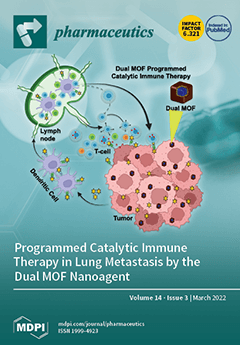
Cover Story: The self-defense mechanism of cancer cells, known as autophagy, and un-sustained ROS generation often restricts efficiency, lowering the immune attack, especially in invading metastatic clusters. Fenton-like reactions in cancer cells cause intratumoral generation of ROS, allowing the potential for immune therapy of tumor metastasis via the recognition of tumor-associated antigens. In this paper, a functional core–shell metal–organic framework nano-cube (dual MOF) as a programmed peroxide mimic in the cancer cells, doubling as a catalytic agent and T cell infiltration inducer that programs ROS and inhibits autophagy, is reported. Such synergy of T cell recruitment and ROS generation transported by dual MOF during metastases successfully suppresses more than 90% of tumor foci in the lung. View this paper
  • Issues are regarded as officially published after their release is announced to the table of contents alert mailing list .
  • You may sign up for email alerts to receive table of contents of newly released issues.
  • PDF is the official format for papers published in both, html and pdf forms. To view the papers in pdf format, click on the "PDF Full-text" link, and use the free Adobe Reader to open them.

Articles (216)

  • Article
  • Open Access
14 Citations
3,578 Views
19 Pages

Computational Design and Biological Evaluation of Analogs of Lupin Peptide P5 Endowed with Dual PCSK9/HMG-CoAR Inhibiting Activity

  • Carmen Lammi,
  • Enrico M. A. Fassi,
  • Jianqiang Li,
  • Martina Bartolomei,
  • Giulia Benigno,
  • Gabriella Roda,
  • Anna Arnoldi and
  • Giovanni Grazioso

(1) Background: Proprotein convertase subtilisin/kexin 9 (PCSK9) is responsible for the degradation of the hepatic low-density lipoprotein receptor (LDLR), which regulates the circulating cholesterol level. In this field, we discovered natural peptid...

  • Review
  • Open Access
47 Citations
5,353 Views
27 Pages

Gold Nanorods for Drug and Gene Delivery: An Overview of Recent Advancements

  • Atieh Jahangiri-Manesh,
  • Marziyeh Mousazadeh,
  • Shirinsadat Taji,
  • Abbas Bahmani,
  • Atefeh Zarepour,
  • Ali Zarrabi,
  • Esmaeel Sharifi and
  • Mostafa Azimzadeh

Over the past few decades, gold nanomaterials have shown great promise in the field of nanotechnology, especially in medical and biological applications. They have become the most used nanomaterials in those fields due to their several advantageous....

  • Article
  • Open Access
13 Citations
3,483 Views
13 Pages

Understanding the effects induced by carcinogens on primary colonic epithelial cells and how to counteract them might help to prevent colon cancer, which is one of the most frequent and aggressive cancers. In this study, we exposed primary human colo...

  • Article
  • Open Access
7 Citations
4,684 Views
8 Pages

Absorption of Direct Oral Anticoagulants in Cancer Patients after Gastrectomy

  • Hannah C. Puhr,
  • Aysegül Ilhan-Mutlu,
  • Matthias Preusser,
  • Peter Quehenberger,
  • Paul A. Kyrle,
  • Sabine Eichinger and
  • Lisbeth Eischer

Direct oral anticoagulants (DOACs) are safe and effective in cancer patients treated for venous thromboembolism (VTE) or atrial fibrillation (AF). Gastrectomy is the treatment of choice in patients with localized upper gastrointestinal cancer. DOACs...

  • Article
  • Open Access
47 Citations
4,692 Views
15 Pages

Smart Injectable Chitosan Hydrogels Loaded with 5-Fluorouracil for the Treatment of Breast Cancer

  • Ahmed A. H. Abdellatif,
  • Ahmed M. Mohammed,
  • Imran Saleem,
  • Mansour Alsharidah,
  • Osamah Al Rugaie,
  • Fatma Ahmed and
  • Shaaban K. Osman

The treatment of breast cancer requires long chemotherapy management, which is accompanied by severe side effects. Localized delivery of anticancer drugs helps to increase the drug concentration at the site of action and overcome such a problem. In t...

  • Article
  • Open Access
13 Citations
3,824 Views
17 Pages

Hyaluronic acid (HA) constitutes a versatile chemical framework for the development of osteoarthritis pain treatment by means of injection in the joints, so-called viscosupplementation. Without appropriate physico-chemical tuning, such preparations a...

  • Review
  • Open Access
17 Citations
4,965 Views
17 Pages

PLGA-Gold Nanocomposite: Preparation and Biomedical Applications

  • Alaaldin M. Alkilany,
  • Ousama Rachid,
  • Mahmoud Y. Alkawareek,
  • Nashiru Billa,
  • Anis Daou and
  • Catherine J. Murphy

A composite system consisting of both organic and inorganic nanoparticles is an approach to prepare a new material exhibiting “the best of both worlds”. In this review, we highlight the recent advances in the preparation and applications...

  • Article
  • Open Access
3 Citations
4,769 Views
12 Pages

Tailoring Rational Manufacturing of Extemporaneous Compounding Oral Dosage Formulations with a Low Dose of Minoxidil

  • Carlos Torrado-Salmeron,
  • Almudena Laguna,
  • Alicia Guillén,
  • Miguel G. Saro,
  • Antonio Matji,
  • Juan J. Torrado and
  • Dolores R. Serrano

Low amounts of minoxidil in oral dosage forms are commonly prescribed as anti-alopecic pharmacological treatments. Side effects are usually related to individual susceptibility. However, poor drug content and mass uniformity can lead to a potential r...

  • Article
  • Open Access
25 Citations
4,247 Views
18 Pages

Hepatoprotective Effect of Carob Pulp Flour (Ceratonia siliqua L.) Extract Obtained by Optimized Microwave-Assisted Extraction

  • Nikola Martić,
  • Jana Zahorec,
  • Nebojša Stilinović,
  • Bojana Andrejić-Višnjić,
  • Branimir Pavlić,
  • Nebojša Kladar,
  • Dragana Šoronja-Simović,
  • Zita Šereš,
  • Miodrag Vujčić and
  • Olga Horvat
  • + 1 author

To examine antioxidant capacity and the hepatoprotective effect of carob pulp flour, microwave-assisted extraction was performed. The influence of ethanol concentration (0–40% w/w), extraction time (5–25 min) and irradiation power (400&nd...

  • Article
  • Open Access
49 Citations
6,265 Views
22 Pages

Thymoquinone-Enriched Naringenin-Loaded Nanostructured Lipid Carrier for Brain Delivery via Nasal Route: In Vitro Prospect and In Vivo Therapeutic Efficacy for the Treatment of Depression

  • Farheen Fatima Qizilbash,
  • Muhammad Usama Ashhar,
  • Ameeduzzafar Zafar,
  • Zufika Qamar,
  • Annu,
  • Javed Ali,
  • Sanjula Baboota,
  • Mohammed M. Ghoneim,
  • Sultan Alshehri and
  • Asgar Ali

In the current research, a thymoquinone-enriched naringenin (NGN)-loaded nanostructured lipid carrier (NLC) was developed and delivered via the nasal route for depression. Thymoquinone (TQ) oil was used as the liquid lipid and provided synergistic ef...

of 22

Get Alerted

Add your email address to receive forthcoming issues of this journal.

XFacebookLinkedIn
Pharmaceutics - ISSN 1999-4923