



Mpox Person-to-Person Transmission—Where Have We Got So Far? A Systematic Review


 ,
,
Abstract
1. Introduction
2. Materials and Methods
2.1. Protocol
2.2. Eligibility Criteria
2.3. Information Sources and Search Strategy
2.4. Study Selection
2.5. Data Collection Process
2.6. Study Quality Assessment
3. Results
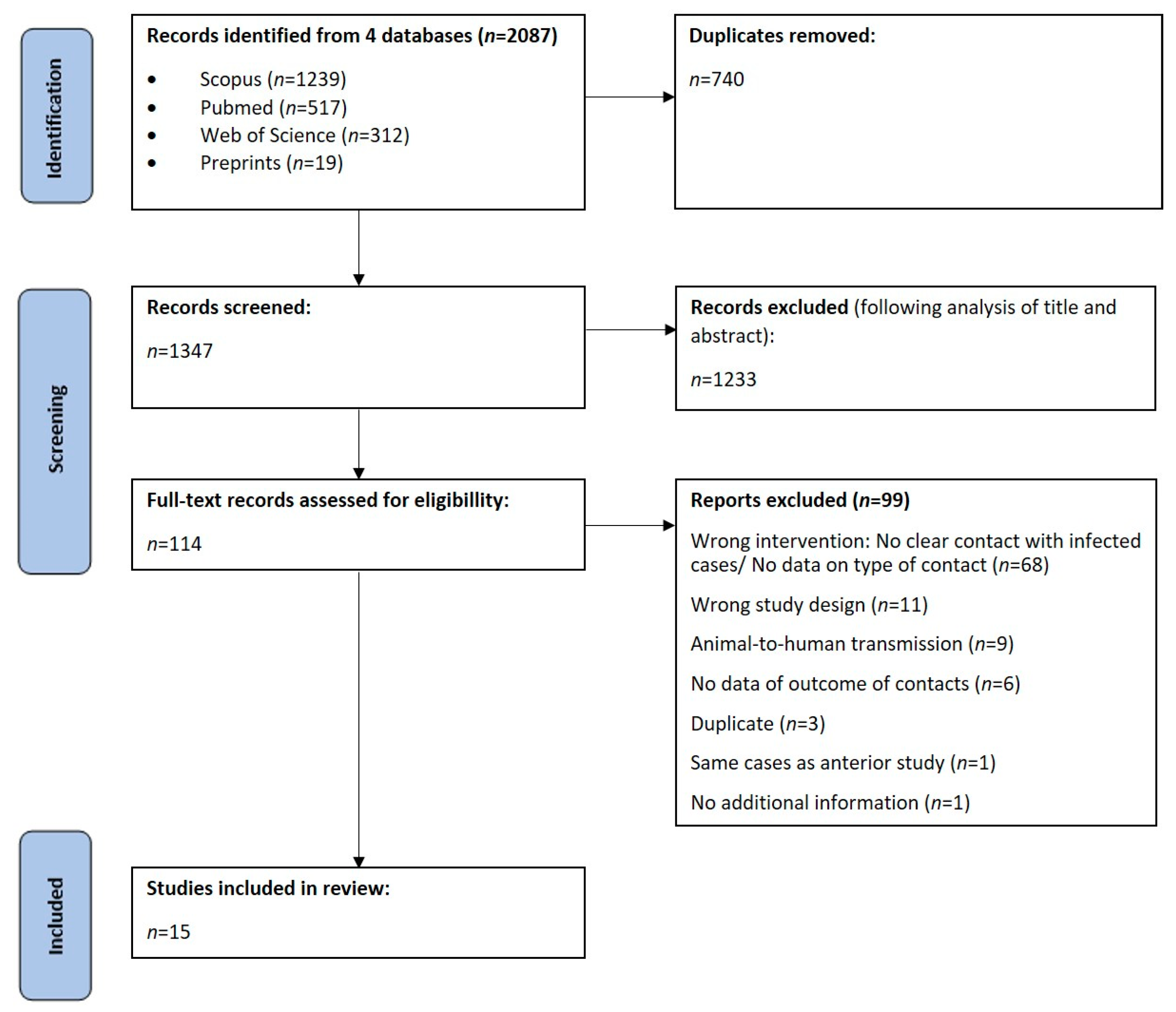
3.1. Number of Retrieved Papers
3.2. Study Characteristics
3.3. Outcome Assessment and Evidence of Contact with MPXV
3.4. Evidence of Transmission
3.5. Risk of Bias within and across Studies
4. Discussion
4.1. Summary of Evidence
4.2. Limitations
5. Conclusions
Supplementary Materials
Author Contributions
Funding
Institutional Review Board Statement
Informed Consent Statement
Data Availability Statement
Acknowledgments
Conflicts of Interest
References
- Jaiswal, V.; Nain, P.; Mukherjee, D.; Joshi, A.; Savaliya, M.; Ishak, A.; Batra, N.; Maroo, D.; Verma, D. Symptomatology, prognosis, and clinical findings of Monkeypox infected patients during COVID-19 era: A systematic-review. Immun. Inflamm. Dis. 2022, 10, e722. [Google Scholar] [CrossRef] [PubMed]
- Cho, S.Y. The 2022 monkeypox outbreak in nonendemic countries: A review for the emergency department clinician. Clin. Exp. Emerg. Med. 2022, 9, 281–285. [Google Scholar] [CrossRef]
- Chandran, D.; Dhama, K.; Chakraborty, S.; Mohapatra, R.K.; Yatoo, M.I. Monkeypox: An Update on Current Knowledge and Research Advances. J. Exp. Biol. Agric. Sci. 2022, 10, 679–688. [Google Scholar] [CrossRef]
- Breman, J.G.; Steniowski, M.V.; Zanotto, E.; Gromyko, A.I.; Arita, I. Human monkeypox, 1970–1979. Bull. World Health Organ. 1980, 58, 165–185. [Google Scholar]
- Ladnyj, I.D.; Ziegler, P.; Kima, E. A human infection caused by monkeypox virus in Basankusu Territory, Democratic Republic of the Congo. Bull. World Health Organ. 1972, 46, 593–597. [Google Scholar] [PubMed]
- Huo, S.; Chen, Y.; Lu, R.; Zhang, Z.; Zhang, G.; Zhao, L.; Deng, Y.; Wu, C.; Tan, W. Development of two multiplex real-time PCR assays for simultaneous detection and differentiation of monkeypox virus IIa, IIb, and I clades and the B.1 lineage. Biosaf. Health 2022, 4, 392–398. [Google Scholar] [CrossRef] [PubMed]
- Bragazzi, N.L.; Kong, J.D.; Mahroum, N.; Tsigalou, C.; Khamisy-Farah, R.; Converti, M.; Wu, J. Epidemiological trends and clinical features of the ongoing monkeypox epidemic: A preliminary pooled data analysis and literature review. J. Med. Virol. 2023, 95, e27931. [Google Scholar] [CrossRef] [PubMed]
- Sejvar, J.J.; Chowdary, Y.; Schomogyi, M.; Stevens, J.; Patel, J.; Karem, K.; Fischer, M.; Kuehnert, M.J.; Zaki, S.R.; Paddock, C.D.; et al. Human Monkeypox Infection: A Family Cluster in the Midwestern United States. J. Infect. Dis. 2004, 190, 1833–1840. [Google Scholar] [CrossRef]
- Ligon, B. Monkeypox: A review of the history and emergence in the Western hemisphere. Semin. Pediatr. Infect. Dis. 2004, 15, 280–287. [Google Scholar] [CrossRef]
- Centers for Disease Control and Prevention. 2022 Mpox Outbreak Global Map. Available online: https://www.cdc.gov/poxvirus/mpox/response/2022/world-map.html (accessed on 15 April 2023).
- Brown, K.; Leggat, P.A. Human Monkeypox: Current State of Knowledge and Implications for the Future. Trop. Med. Infect. Dis. 2016, 1, 8. [Google Scholar] [CrossRef]
- Karagoz, A.; Tombuloglu, H.; Alsaeed, M.; Tombuloglu, G.; AlRubaish, A.A.; Mahmoud, A.; Smajlović, S.; Ćordić, S.; Rabaan, A.A.; Alsuhaimi, E. Monkeypox (mpox) virus: Classification, origin, transmission, genome organization, antiviral drugs, and molecular diagnosis. J. Infect. Public Health 2023, 16, 531–541. [Google Scholar] [CrossRef] [PubMed]
- Zachary, K.C.; Shenoy, E.S. Monkeypox transmission following exposure in healthcare facilities in nonendemic settings: Low risk but limited literature. Infect. Control Hosp. Epidemiol. 2022, 43, 920–924. [Google Scholar] [CrossRef] [PubMed]
- Dashraath, P.; Nielsen-Saines, K.; Rimoin, A.; Mattar, C.N.; Panchaud, A.; Baud, D. Monkeypox in pregnancy: Virology, clinical presentation, and obstetric management. Am. J. Obstet. Gynecol. 2022, 227, 849–861.e7. [Google Scholar] [CrossRef] [PubMed]
- D’Antonio, F.; Pagani, G.; Buca, D.; Khalil, A. Monkeypox infection in pregnancy: A systematic review and metaanalysis. Am. J. Obstet. Gynecol. 2023, 5, 100747. [Google Scholar] [CrossRef] [PubMed]
- Liberati, M.; Tetzlaff, J.; Altman, D.G.; PRISMA Group. Preferred reporting items for systematic reviews and meta-analyses: The PRISMA statement. PLoS Med. 2009, 6, e1000097. [Google Scholar] [CrossRef] [PubMed]
- National Heart Lung and Blood Institute. Study Quality Assessment Tools; NHLBI: Bethesda, MD, USA, 2019.
- Arita, I.; Jezek, Z.; Khodakevich, L.; Ruti, K. Human Monkeypox: A Newly Emerged Orthopoxvirus Zoonosis in the Tropical Rain Forests of Africa. Am. J. Trop. Med. Hyg. 1985, 34, 781–789. [Google Scholar] [CrossRef]
- Jezek, Z.; Arita, I.; Mutombo, M.; Dunn, C.; Nakano, J.; Szczeniowski, M. Four generations of probable person-to-person transmission of human monkeypox. Am. J. Epidemiol. 1986, 123, 1004–1012. [Google Scholar] [CrossRef]
- Jezek, Z.; Marennikova, S.S.; Mutumbo, M.; Nakano, J.H.; Paluku, K.M.; Szczeniowski, M. Human Monkeypox: A Study of 2510 Contacts of 214 Patients. J. Infect. Dis. 1986, 154, 551–555. [Google Scholar] [CrossRef]
- Jezek, Z.; Grab, B.; Szczeniowski, M.V.; Paluku, K.M.; Mutombo, M. Human monkeypox: Secondary attack rates. Bull. World Health Organ. 1988, 66, 465–470. [Google Scholar]
- Fleischauer, A.T.; Kile, J.C.; Davidson, M.; Fischer, M.; Karem, K.L.; Teclaw, R.; Messersmith, H.; Pontones, P.; Beard, B.A.; Braden, Z.H.; et al. Evaluation of Human-to-Human Transmission of Monkeypox from Infected Patients to Health Care Workers. Clin. Infect. Dis. 2005, 40, 689–694. [Google Scholar] [CrossRef]
- Learned, L.A.; Bolanda, J.D.; Li, Y.; Reynolds, M.; Moudzeo, H.; Wassa, D.W.; Libama, F.; Harvey, J.M.; Likos, A.; Formenty, P.; et al. Extended interhuman transmission of monkeypox in a hospital community in the republic of the congo, 2003. Am. J. Trop. Med. Hyg. 2005, 73, 428–434. [Google Scholar] [CrossRef] [PubMed]
- Nolen, L.D.; Tamfum, J.-J.M.; Kabamba, J.; Likofata, J.; Katomba, J.; McCollum, A.M.; Monroe, B.; Kalemba, L.; Mukadi, D.; Bomponda, P.L.; et al. Introduction of Monkeypox into a Community and Household: Risk Factors and Zoonotic Reservoirs in the Democratic Republic of the Congo. Am. J. Trop. Med. Hyg. 2015, 93, 410–415. [Google Scholar] [CrossRef] [PubMed]
- Besombes, C.; Gonofio, E.; Konamna, X.; Selekon, B.; Grant, R.; Gessain, A.; Berthet, N.; Manuguerra, J.-C.; Fontanet, A.; Nakouné, E. Intrafamily Transmission of Monkeypox Virus, Central African Republic, 2018. Emerg. Infect. Dis. 2019, 25, 1602–1604. [Google Scholar] [CrossRef] [PubMed]
- Kyaw, W.M.; Vasoo, S.; Ho, H.J.A.; Chan, M.; Yeo, T.W.; Manauis, C.M.; Ang, H.; De, P.P.; Ang, B.S.P.; Chow, A.L.P. Monitoring healthcare professionals after monkeypox exposure: Experience from the first case imported to Asia. Infect. Control Hosp. Epidemiol. 2020, 41, 373–375. [Google Scholar] [CrossRef] [PubMed]
- Vaughan, A.; Aarons, E.; Astbury, J.; Brooks, T.; Chand, M.; Flegg, P.; Hardman, A.; Harper, N.; Jarvis, R.; Mawdsley, S.; et al. Human-to-Human Transmission of Monkeypox Virus, United Kingdom, October 2018. Emerg. Infect. Dis. 2020, 26, 782–785. [Google Scholar] [CrossRef]
- Aguilera-Alonso, D.; Alonso-Cadenas, J.A.; Roguera-Sopena, M.; Lorusso, N.; Miguel, L.G.S.; Calvo, C. Monkeypox virus infections in children in Spain during the first months of the 2022 outbreak. Lancet Child Adolesc. Health 2022, 6, e22–e23. [Google Scholar] [CrossRef]
- Hagan, L.M. Monkeypox Case Investigation—Cook County Jail, Chicago, Illinois, July–August 2022. Morb. Mortal. Wkly. Rep. 2022, 71, 1271–1277. [Google Scholar] [CrossRef]
- Marshall, K.E.; Barton, M.; Nichols, J.; de Perio, M.A.; Kuhar, D.T.; Spence-Davizon, E.; Barnes, M.; Herlihy, R.K.; Czaja, C.A.; Healthcare Personnel Monitoring Team. Health care personnel exposures to subsequently laboratory-confirmed monkeypox patients—Colorado, 2022. Morb. Mortal. Wkly. Rep. 2022, 71, 1216–1219. [Google Scholar] [CrossRef]
- Phelippeau, M.; Loison, G.; Rucay, P.; Le Guillou-Guillemette, H.; Ndiaye, D.; Dubée, V.; Legeay, C. Fortuitous diagnosis of monkeypox in a patient hospitalized for several days: Risk assessment and follow-up for exposed healthcare workers. J. Hosp. Infect. 2023, 131, 244–246. [Google Scholar] [CrossRef]
- Viedma-Martinez, M.; Dominguez-Tosso, F.R.; Jimenez-Gallo, D.; Garcia-Palacios, J.; Riera-Tur, L.; Montiel-Quezel, N.; Linares-Barrios, M. MPXV Transmission at a Tattoo Parlor. N. Engl. J. Med. 2023, 388, 92–94. [Google Scholar] [CrossRef]
- Vaughan, A.M.; Cenciarelli, O.; Colombe, S.; de Sousa, L.A.; Fischer, N.; Gossner, C.M.; Pires, J.; Scardina, G.; Aspelund, G.; Avercenko, M.; et al. A large multi-country outbreak of monkeypox across 41 countries in the WHO European Region, 7 March to 23 August 2022. Eurosurveillance 2022, 27, 2200620. [Google Scholar] [CrossRef] [PubMed]
- Morgan, C.N.; Whitehill, F.; Doty, J.B.; Schulte, J.; Matheny, A.; Stringer, J.; Delaney, L.J.; Esparza, R.; Rao, A.K.; McCollum, A.M. Environmental Persistence of Monkeypox Virus on Surfaces in Household of Person with Travel-Associated Infection, Dallas, Texas, USA, 2021. Emerg. Infect. Dis. 2022, 28, 1982–1989. [Google Scholar] [CrossRef]
- Pfeiffer, J.A. High-contact object and surface contamination in a household of persons with monkeypox virus infection—Utah, June 2022. Morb. Mortal. Wkly. Rep. 2022, 71, 1092–1094. [Google Scholar] [CrossRef] [PubMed]
- Atkinson, B.; Gould, S.; Spencer, A.; Onianwa, O.; Furneaux, J.; Grieves, J.; Summers, S.; Crocker-Buqué, T.; Fletcher, T.; Bennett, A.; et al. Monkeypox virus contamination in an office-based workplace environment. J. Hosp. Infect. 2022, 130, 141–143. [Google Scholar] [CrossRef] [PubMed]
- Nörz, D.; Pfefferle, S.; Brehm, T.T.; Franke, G.; Grewe, I.; Knobling, B.; Aepfelbacher, M.; Huber, S.; Klupp, E.M.; Jordan, S.; et al. Evidence of surface contamination in hospital rooms occupied by patients infected with monkeypox, Germany, June 2022. Eurosurveillance 2022, 27, 2200477. [Google Scholar] [CrossRef] [PubMed]
- Al-Raeei, M. The study of human monkeypox disease in 2022 using the epidemic models: Herd immunity and the basic reproduction number case. Ann. Med. Surg. 2023, 85, 316–321. [Google Scholar] [CrossRef]

| Authors, Year | Type of Study | Setting Data | Case Definition | Type of Contact/Mode of Transmission | Index Cases | Possible Contacts | Secondary Cases | Conclusions | Limitations | Quality Assessment 1 |
|---|---|---|---|---|---|---|---|---|---|---|
| Arita et al. [18] | Retrospective cohort (observational) | West and Central Africa1970–1983 Data included are from Zaire | Clinical, epidemiological and laboratorial diagnosis | Person to person | -- | Household: 708 Vaccination scar: 566 No vaccination scar: 142 Other: 945 Vaccination scar: 710 No vaccination scar: 235 | Household: 25 Vaccination scar: 3 No vaccination scar: 22 Other: 6 Vaccination scar: 0 No vaccination scar: 6 | The attack rate for household contacts was significantly higher than that for other contacts. | No data on how surveillance of contacts and cases was carried out. No case definition. | Poor |
| Jezek et al. [19] | Retrospective cohort (observational) | Outbreak of 5 children of human MPXV belonging to 2 families West Kasai, Zaire May-July 1983 | Clinical diagnosis + Serological test: 1 case Virus isolation from skin lesion: 3 cases | Person to person | 1 index case (animal to human) initiated a cascade of transmission that ended up with 4 secondary or tertiary infected cases. | Household: 17 Vaccination scar: 6 No vaccination scar: 11 Other: 22 Vaccination scar: 2 No vaccination scar: 20 | Household: 3 Vaccination scar: 2 No vaccination scar: 1 Other: 1 Vaccination scar: 1 No vaccination scar: 0 | Epidemiologic investigations of the 5 children suggest that the 1st case was infected from an animal source, and the other 4 cases were infected from a previous human case. | No case definition. Possibly, the same cases are reported by Arita et al. [18]. | Poor |
| Jezek et al. [20] | Prospective cohort study | Evaluation of transmission to 2510 contacts of 214 patients Zaire 1980–1984 | Confirmed case was one in which the clinical and epidemiological diagnosis of human MPXV was confirmed by laboratory findings | Person to person | 214 cases primary cases: 152 secondary cases: 62 | Household: 1187 Vaccination scar: 910 No vaccination scar: 277 Other: 1323 Vaccination scar: 959 No vaccination scar: 364 | Household: 48 Vaccination scar: 14 No vaccination scar: 34 Other: 14 Vaccination scar: 2 No vaccination scar: 12 | The attack rate for household contacts was significantly higher than that for other contacts, among both unvaccinated (4 times higher) and vaccinated (7 times higher) household contacts. | Only a few of the vaccinated contacts were tested serologically to determine a subclinical infection. Possibly, the same cases are reported by Arita et al. [18]. | Good |
| Jezek et al. [21] | Prospective cohort study | Evaluation of transmission from 338 patients Zaire 1981–1986 | A patient having onset of rash between 1 and 3 weeks after exposure to an index case is a secondary case, which may have arisen by person-to-person transmission. Confirmation by laboratory findings | Person to person | 338 cases primary cases: 245 secondary cases: 93 | Household: 1420 Vaccination scar: 989 No vaccination scar: 431 Other: 858 Vaccination scar: 566 No vaccination scar: 292 | Household: 53 Vaccination scar: 13 No vaccination scar: 40 Other: 16 Vaccination scar: 2 No vaccination scar: 14 | The affected households appear to be the most important focal point for dissemination of MPXV to susceptible individuals. | Possibly, the same cases are reported by Jezek et al. [20] | Good |
| Fleischauer et al. [22] | Prospective cohort study: analysis of exposure of HCWs to hospitalized infected patients | Evaluation of MPXV infection in HCWs who were within a radius of 2 m from 3 infected patients USA/Indiana 2003 | Serological studies were carried out. Presence of fever or rash with at least 2 other symptoms, including chills, headache, backache, lymphadenopathy, sore throat, cough, and shortness of breath | Person to person | Hospitalized patients: 3 | HCWs contacts: 57 Vaccination: 31 No vaccination: 26 Gloves: 35 Gown: 19 Surgical mask: 14 N95 mask: 11 Surfaces/ fomites: 46 Airway particles: 52 Skin-to-skin: 28 Out of 57 HCWs, 40 (70%) had ≥1 unprotected exposure | Symptoms: 0 Both IgG and IgM positive: 0 Just IgM: 1, was vaccinated in the last 6 months. 1 positive IgM, (asymptomatic) | Transmission not verified in healthcare facilities. | Potential selection bias (the participation rate in hospitals A and B was different). A control group was not used to test the accuracy of the ELISA test—there is the potential of some false positive tests. Potential reporter bias—difficulty to recall. | Fair |
| Learned et al. [23] | Retrospective Cohort | Cascade of six sequential transmissions in a hospital and between people belonging to the same family, almost all were less than 18 years old. Democratic Republic of the Congo 2003 | Suspect and probable case—meets both epidemiological and symptomatic (fever or rash if suspect, both conditions if probable) criteria Confirmed case—meets epidemiological, symptomatic and laboratory (virus in culture, PCR or immunohistochemical) criteria | Person to person | Index case: 1 Initiated a cascade of transmission that led to 11 more secondary cases: 1 suspect 7 probable 3 confirmed Type of contact: Household visitor: 1 (also owned a pet monkey, in good health) Hospital contact with a case: 3 Intrafamilial contact with a case: 2 Both intrafamilial and hospital contact: 4 Not specified: 1 | -- | Surveillance was not undertaken among exposed HCWs. However, none acquired symptoms. | Identified 11 clinical cases of secondary MPXV infection spread over 6 waves of person-to-person transmission. Transmission verified in healthcare facilities between patients, where control measures were not present. The primary infected people were children (less than 18 years old) After control measures were taken, no more cases were identified. No access to protective equipment (gloves, masks…). | No data on vaccination. Healthcare workers must have been spared because of previous vaccination. | Poor |
| Nolen et al. [24] | Retrospective cohort study | Identification of specific activities and behaviors potentially associated with an increased risk of MPXV transmission within 16 household Democratic Republic of the Congo 2013 | Clinical diagnosis or PCR (Cases that were not confirmed by PCR were based only on symptoms) | Person to person | Primary cases 17 | Household total: 97 | MPXV symptomatic contacts: 44 (22% vaccinated) Positive correlation: Drinking from the same cup Eating from the same dish Sleeping in the same room Sleeping in the same bed Negative correlation: Laundering clothes Kissing Assisting with toileting and hygiene | Risk factors of acquiring MPXV in a household included sleeping in the same room or bed or using the same plate or cup as the primary case. Activities associated with an increased risk of MPXV transmission all have potential for virus exposure to the mucosa. | Only 30% of the cases were confirmed by PCR. Possibility of immunity because of previous infection with MPXV. | Fair |
| Besombes et al. [25] | Prospective cohort study (observational) analysis of exposure of contacts to an index case | Intrafamily transmission on a family from an index case Central African Republic 2018 | Clinical diagnosis + laboratory confirmation (PCR) | Person to person | Index case (animal to human transmission): 1 Intrafamilial contact (confirmed by PCR): 5 Case-patient’s daughters: 2 Case-patient’s sisters: 2 Case-patient’s sister-in-law: 1 | HCWs contacts: 2 Other case patient’s family: 5 Case-patient’s village contacts: 31 | Total: 6 cases positive by serological test (all asymptomatic) HCWs: 2 (1 vaccinated) Other case patient’s family: 3 (1 animal contact and vaccinated) (1 vaccinated) (1 no animal contact, not vaccinated) Case-patient’s village contacts: 1 | Identified 5 clinical cases of secondary MPXV infection spread over 3 waves of intrafamilial infection, originating from an index case patient with primary infection possibly attributable to contact with wild fauna. Positive serological findings in healthcare workers highlight the limited infection prevention and control resources, to protect HCWs responding to outbreaks in Central African Republic. | No data about the kind of intrafamily transmission. No data about HCWs’ protection. | Poor |
| Kyaw et al. [26] | Prospective cohort study (observational) analysis of previous contacts of index cases | HCWs who were in contact with a case of MPXV, before admission to the isolation unit Singapore 2019 | Clinical diagnosis | Person to person | Hospitalized patient: 1 traveler who had recently returned from Nigeria (probable animal to human transmission) | Close contact: 27 Direct contact with the patient himself or the patient’s surrounding: 12 Surfaces/fomites (handled the patient’s linen and cleaned the NEP room): 3 Laboratory staff who had handled the patient’s specimens: 12 All had protected exposure to the patient, with the appropriate and adequate use of PPE. | All asymptomatic | Clear infection prevention guidelines on the appropriate PPE for different HCWs, based on patient care activities and the transmission risk are crucial. | HCWs used protection like gloves and face masks while having contact with the patient, so results must be biased. No lab confirmation that 27 HCWs had MPXV infection. No sampling of objects or surroundings of the index case patient. | Fair |
| Vaughan et al. [27] | Prospective cohort study (observational) analysis of contacts of 1 HCW | HCW who contact with a case of MPXV infected from Nigeria United Kingdom 2018 | Clinical diagnosis | Person to person Direct exposure of skin lesions, body fluids, including clothing or bedding without wearing appropriate PPE | Hospitalized patient: 1 traveler who had recently returned from Nigeria | 134 Adequate protective measures were taken (gown, gloves, face shield) | 4 became ill | The use of standard PPE may not have afforded sufficient protection against MPXV particularly if skin lesion debris containing the virus had been disturbed and inhaled when bedsheets were changed. The risk to the public was very low because effective human-to- human transmission requires close contact with an infected person or virus-contaminated materials. | No serology tests. No data on previous smallpox vaccination. Post-exposure vaccination to MPXV could have inhibited disease. | Fair |
| Aguilera-Alonso et al. [28] | Prospective cohort study | Pediatric population (n = 16) Aged 7 months to 17 years old Spain, 2022 | Clinical diagnosis + laboratory confirmation (PCR) | Sexual | Total: 16 positive cases 3 (aged 13–17 years old) | -- | -- | Either sexual, contact with contaminated material in a tattoo studio, or household contact with parents caused infection. Sexual contact does not explain all infections by MPXV. | Data were collected by epidemiological surveys based on interviews with patients and their family members. | Poor |
| Surfaces/ fomites (contaminated material in a tattoo and piercing studio) | 9 (aged 13–17 years old) | -- | ||||||||
| Household (contact with their parents: 3) | 3 (age inferior 4 years old) | -- | ||||||||
| Unknown | 1 (age inferior 4 years old) | -- | ||||||||
| Hagan et al. [29] | Prospective cohort study | Contacts with a confirmed case in a jail Clade: West African USA/Chicago 2022 | Clinical diagnosis, serological test, or both | Person to person but no sexual/skin-to-skin contact | 1 resident | 57 residents (22 lost follow-up) 35 residents completed follow-up (Mask usage is probably low) | Symptoms + serological testing for only 14 residents that consented to testing IgM positive: 0 IgG positive: 3 (asymptomatic) | No evidence of skin-to- skin or sexual contact among residents. No secondary cases were identified. | Difficult quantification of exposure risk. Out of 57 potentially exposed, only 35 completed follow-up. Out of 36 potentially exposed, only 13 accepted post-exposure prophylaxis; only 14 accepted testing. 3 IgG positive probably because of previous vaccination. Serological testing performed 7 days after potential exposure for some residents, when they might not yet have seroconverted. Self-report of symptoms/sexual contact. Not able to confirm childhood smallpox vaccination history. | Fair |
| Marshall et al. [30] | Prospective cohort study | HCWs exposed to 55 patients with MPXV USA/Colorado 1 May–31 July 2022 | Clinical diagnosis + laboratory confirmation (PCR) in two people | Surfaces/fomites | Total: 55 patients | Total: 313 HCWS 12% received postexposure vaccine. N = 26 HCWs Glove use: 23 No glove use: 3 Unknown glove use: 0 | Presence of symptoms: 7 2 people who had rash or lesions (n = 3) performed a PCR test: all negative | No HCWs developed an MPVX infection during the 21 days after exposure. Infection prevention training is important in all healthcare settings, and these findings can guide future updates for PPE recommendations and risk classification in healthcare settings. | Selection bias—these results must not be generalized to the community population. Data related to previous vaccination are lacking. Lack of information about exposure to contaminated materials. Lack of information about the use of facemasks by patients. | Fair |
| Airway particles (Aerosol-generating procedures) | N = 7 HCWs Mask use during the procedure: 3 | |||||||||
| Skin to skin | N = 161 HCWs Glove use: 125 No glove use: 30 Unknown glove use: 6 | |||||||||
| Phelippeau et al. [31] | Prospective cohort study | HCWs exposed to a patient with MPXV | Unknown | Person to person | 1 patient | 26 HCWs had direct contact Skin: 5 Clinical examination: 2 Undressing/making bed/temperature/blood pressure: 1 Linen: 4 Talking: 1 Eye care: 7 Measuring blood pressure/temperature: 3 Transport: 1 Other: 1 Glove use: 10 No glove use or other: 16 Vaccinated: 9 | None | No secondary cases were identified. At this hospital, HCWs were at low risk of contracting the infection. | It is not known if the assessment of outcomes was clinical or serological. Post-exposure vaccination to MPXV could have inhibited disease. | Fair |
| Martinez et al. [32] | Retrospective cohort study | Infection in customers at a tattoo parlor Spain 6 July–19 July 2022 | PCR | Person to person Surfaces (contaminated material in a tattoo and piercing studio) | Unknown | 58 customers | 21 cases 20 after piercing 1 after tattooing Parlor staff: no cases | 21 secondary cases were identified after contact with infected material at the tattoo parlor. The mode of transmission was probably the direct contact after piercing and tattooing. Material used at tattoo places must be carefully disinfected. | Unknown index case. No data on parlor staff protection (masks). No serological testing to evaluate asymptomatic MPXV infection. | Poor |
Disclaimer/Publisher’s Note: The statements, opinions and data contained in all publications are solely those of the individual author(s) and contributor(s) and not of MDPI and/or the editor(s). MDPI and/or the editor(s) disclaim responsibility for any injury to people or property resulting from any ideas, methods, instructions or products referred to in the content. |
© 2023 by the authors. Licensee MDPI, Basel, Switzerland. This article is an open access article distributed under the terms and conditions of the Creative Commons Attribution (CC BY) license (https://creativecommons.org/licenses/by/4.0/).
Share and Cite
Pinto, P.; Costa, M.A.; Gonçalves, M.F.M.; Rodrigues, A.G.; Lisboa, C. Mpox Person-to-Person Transmission—Where Have We Got So Far? A Systematic Review. Viruses 2023, 15, 1074. https://doi.org/10.3390/v15051074
Pinto P, Costa MA, Gonçalves MFM, Rodrigues AG, Lisboa C. Mpox Person-to-Person Transmission—Where Have We Got So Far? A Systematic Review. Viruses. 2023; 15(5):1074. https://doi.org/10.3390/v15051074
Chicago/Turabian StylePinto, Pedro, Miguel Alves Costa, Micael F. M. Gonçalves, Acácio Gonçalves Rodrigues, and Carmen Lisboa. 2023. "Mpox Person-to-Person Transmission—Where Have We Got So Far? A Systematic Review" Viruses 15, no. 5: 1074. https://doi.org/10.3390/v15051074
APA StylePinto, P., Costa, M. A., Gonçalves, M. F. M., Rodrigues, A. G., & Lisboa, C. (2023). Mpox Person-to-Person Transmission—Where Have We Got So Far? A Systematic Review. Viruses, 15(5), 1074. https://doi.org/10.3390/v15051074

