


Abstract
Foot-and-mouth disease virus (FMDV) causes FMD, a highly contagious disease of cloven-hoofed animals including cattle, goats, pigs and sheep. Rapid detection of FMDV is critical to limit the devastating economic losses due to FMD. Current laboratory methods for FMDV detection such as virus isolation, real-time reverse transcription PCR and antigen detection enzyme-linked immunosorbent assay (AgELISA) are labor-intensive, requiring trained personnel and specialized equipment. We present the development and validation of a pan-serotype lateral flow strip test (LFST) that uses recombinant bovine integrin αvβ6 as a universal capture ligand and a pan-serotype monoclonal antibody (mAb) to detect FMDV. The LFST detected all seven FMDV serotypes, where the diagnostic sensitivity was comparable to the AgELISA, and the diagnostic specificity was 100% without cross-reactivity to other viruses causing vesicular disease in livestock. This rapid test will be useful for on-site FMDV detection, as well as in laboratories in endemic countries where laboratory resources are limited.
1. Introduction
Foot-and-mouth disease (FMD) is caused by FMD virus (FMDV). FMD is acute and highly contagious and affects cloven-hoofed animals such as cattle, goats, pigs and sheep. FMD is a major economic concern for the livestock industry in many developing countries and is a continued threat to countries that are FMD-free because of its potential negative impact on trade in agricultural products. Rapid detection of FMDV is essential for swift control of outbreaks [1,2].
Multiple laboratory-based methods are available for FMDV detection, including virus isolation, real-time reverse transcription (rRT) PCR, antigen detection enzyme-linked immunosorbent assay (AgELISA) and genomic sequencing. While some molecular-based methods can be performed in the field such as rRT-PCR and RT loop-mediated isothermal amplification (LAMP) [3,4,5,6], trained personnel and specialized equipment may still be required [7].
Rapid lateral flow strip tests (LFSTs) are routinely used for the detection of bioactive molecules (hormones, drugs and toxins) and infectious agents [8,9,10]. They are easy to use, and results can be obtained in 10–30 min. FMDV LFSTs have previously been reported as sensitive and suitable for rapid on-site diagnosis, with sensitivity comparable or better than AgELISAs [11,12,13,14,15,16], and can detect FMDV in tissue homogenates, vesicular fluid, oral fluids and lesion swabs [14,17,18].
FMDV enters cells by attaching to an integrin heterodimeric receptor [19], and integrin αvβ6 has been shown to universally bind all FMDV serotypes [20,21,22,23]. Ferris et al. demonstrated recombinant bovine integrin that recognizes FMDV from sheep, goats and other species [21]. The use of recombinant bovine integrin (RBIαvβ6) as a capture ligand can make the diagnosis of FMD simpler since it circumvents the need for multiple polyclonal or monoclonal antibodies [23], but when RBIαvβ6 is used on its own, the reagent does not have the required FMDV specificity for diagnostic use. Therefore, ELISA formats that couple RBIαvβ6 with FMDV-specific monoclonal antibodies have been developed [24]. In this study, we aimed to develop a novel LFST for the detection of all seven serotypes of FMDV using RBIαvβ6 as a capture ligand, and a pan-serotype monoclonal antibody (mAb) [24] as the detection agent.
2. Materials and Methods
2.1. Production and Biotinylation of Recombinant Bovine Integrin αvβ6
The transfection and small-scale expression of RBIαvβ6 have previously been described by scientists at the FAO World Reference Laboratory for FMD (WRLFMD), Pirbright Institute, UK [23]. For larger-scale production, confluent HEK293T cells (ATCC, CRL-3216) were grown in expanded surface roller bottles, and the transfection agent PEI (polyethylenimine) was used for cost effectiveness. For each roller bottle, 0.5 mg of DNA (0.25 mg of each plasmid, αv-his-tagged and B6-his-tagged) and 0.875 mL of 1 mg/mL PEI were combined in 25 mL serum-free DMEM and left for 10 min at room temperature. This mix was then added to the roller bottle containing 100 mL DMEM supplemented with 2% FCS. The roller bottle was incubated for 5 to 6 days, then the supernatant was harvested and the his-tagged integrin was purified using a His-Trap FF column (GE Healthcare).
The purified RBIαvβ6 was biotinylated using BiotinTag Micro Biotinylation Kit (Cat# BTAG, Sigma-Aldrich, Burlington, MA, USA). BAC-SulfoNHS was dissolved using 30 µL DMSO and then added to 0.1 M PBS to a final concentration of 5 mg/mL. The dissolved BAC-SulfoNHS (10 µL) was added to the recombinant RBIαvβ6 (175 ug) in 0.1 M PBS and incubated for 30 min at room temperature. Following incubation, the unbound biotin was removed by dialysis against PBS at 4 °C. The biotinylated RBIαvβ6 was stored at 4 °C in PBS with 0.01% NaN3.
2.2. Purification and Gold Conjugation of the Monoclonal Antibody
The pan-serotype FMDV monoclonal antibody (mAb F21-42 [24]) was purified using a Hi-Trap Protein-G affinity column (GE, Fairfield, CT, USA) and an AKIA chromatography system.
The antibody was gold-conjugated using the High Sensitivity Conjugation kit (80 nm Gold Nanospheres and 150 nm Gold Nanoshells, nanoComposix, Inc., San Diego, CA, USA). Briefly, 70 µg 1-Ethyl-3-(3-dimethylaminopropyl)carbodiimide (EDC) and 140 µg Sulfo-NHS were added to 1 mL gold solution and incubated for 30 min at room temperature to activate carboxy gold. The gold solution was washed twice with 1 mL reaction buffer (potassium pH 7.4). The purified mAb F21-42 (20 µg) was added to the gold solution and incubated for 1 h at room temperature, followed by washing with reaction buffer twice. The gold-conjugated mAb F21-42 was re-suspended in the conjugation buffer (PBS with 0.5% BSA, 0.5% casein, 1% Tween-20 and 0.05% NaN3) and stored at 4 °C.
2.3. Experimental Samples
The majority of FMDV-positive samples representing different serotypes used in this study were obtained from the WRLFMD (The Pirbright Institute, Woking, UK) and processed as previously described [3,14,15,16,17,18]. FMDV-positive tissues were obtained from previously reported experimental studies in cattle, sheep and pigs [3,14,15,16,17,18] and 10% tissue suspensions prepared as previously described [3,14,15,16,17,18]. Negative epithelial tissues were collected from naïve controls in experimental studies and from abattoirs in Manitoba, Canada.
2.4. Development of Pan-Serotype FMD Lateral Flow Strip Test
FMDV samples (culture supernatants or tissue suspensions, 50 µL) were mixed with the biotin-conjugated RBIαvβ6 (0.5 µL/each) and the gold-conjugated detection mAb F21-42 (2 µL for each 80 nm and 150 nm gold conjugate) to form a complex in a running buffer (reaction mix).
Readymade gRAD strips (Bioporto Diagnostics A/S, Copenhagen, Denmark) had a biotin–binding protein sprayed on the test line and anti-mouse antibody sprayed on the control line [14,15,16]. The gRAD strips were dipped into the reaction mix which then flowed through the strip by capillary action. The results were determined through visualization after 30 min. A positive result was indicated by bands on both the test and control lines. A negative result was indicated by a single band on the control line only.
2.5. Antigen Detection Enzyme-Linked Immunosorbent Assay
Antigen detection ELISA for each FMDV serotype was performed as previously described [14,15,16,17,18,24].
2.6. Real-Time Reverse Transcription Polymerase Chain Reaction
Real-time reverse transcription polymerase chain reaction (rRT-PCR) was performed as previously described [3,18,25].
3. Results
3.1. Sensitivity and Specificity of the Pan-Serotype FMDV Lateral Flow Strip Test
Purified FMDV was used for the optimization and preliminary assessment of the sensitivity of the LFST. Representative subtypes of each FMDV serotype were detected by the LFST (Figure 1). Furthermore, swine vesicular disease (SVDV) and virus-free buffer were negative on the test line (Figure 1).
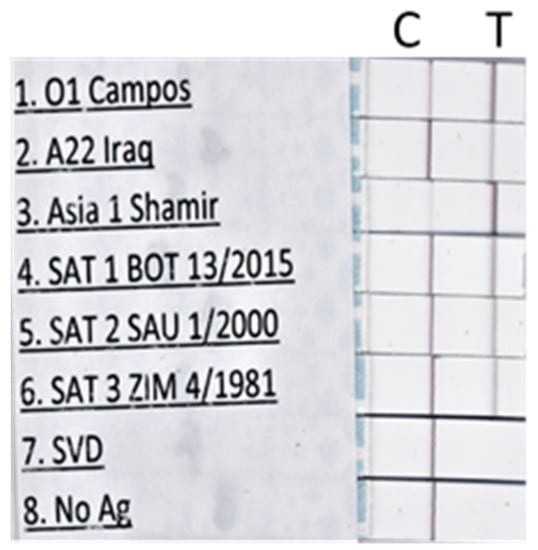
Figure 1.
Samples (representative of six foot-and-mouth disease virus serotypes and swine vesicular disease virus) were each mixed with biotinylated recombinant bovine integrin αvβ6 and a gold-conjugated monoclonal antibody (mAb F21-42) in running buffer. A gRAD strip per sample was dipped into the tube containing this mixture which ran through the strip by capillary action, and the results were determined after 10–30 min. A positive result is indicated by visible bands on both the test line (T) and the control line (C). A negative result is indicated by a visible band on the control line only.
Next, 24 epithelial tissue suspensions from naïve animals were tested to determine the diagnostic specificity (DSp) of the LFST, and all samples were negative, returning 100% DSp (data not shown). The ability of the LFST to detect different subtypes of the seven FMDV serotypes was examined. The LFST detected a total of 66 FMDV isolates (17 serotype O, 15 serotype A, 10 serotype Asia1, 7 serotype SAT1, 12 serotype SAT2, 5 serotype SAT3 and 1 serotype C) in the cell culture supernatants, confirming that the test could detect all 7 FMDV serotypes (Figure 2).
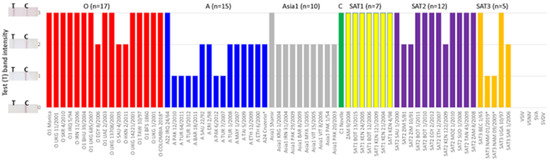
Figure 2.
Pan-serotype FMDV strip test results for FMDV and other vesicular disease viruses in cell culture supernatants. Samples were each mixed with biotinylated recombinant bovine integrin αvβ6 and a gold-conjugated monoclonal antibody (mAb F21-42) in running buffer. A gRAD strip per sample was dipped into the tube containing this mixture which ran through the strip by capillary action, and the results were determined after 10–30 min. A positive result is indicated by visible bands on both the test line (T) and the control line (C). A negative result is indicated by a visible band on the control line only. A score of 0, 1, 2 or 3 was recorded for a negative, weak, medium or strong positive test (T) result (band intensity), respectively. An image of a strip test band intensity is shown besides the corresponding numerical score on the Y axis.
The analytical sensitivity of the LFST was evaluated and compared to the AgELISA by testing two-fold serial dilutions of isolates of six FMDV serotypes (excluding C) in culture supernatants. The color intensity on the test line of the LFST was dose-dependent, progressively declining from strong to weak positive to negative for all serotypes (Table 1). The limit of detection (LOD) was identical for the LFST and AgELISA for serotypes SAT1, A and SAT3 at 5.4, 4.8 and 3.7 log10 50% tissue culture infectious dose (TCID50)/0.1 mL, respectively. The scoring of the LFST band intensity is shown in Figure 2, and for the AgELISA, an OD ≥ 0.1 is considered a positive result. For serotype O, the LOD for the LFST was 5.1 log10 TCID50/0.1 mL lower than that for the AgELISA, which was 6.0 log10 TCID50/0.1 mL. Similarly, for serotype SAT2, the LOD for the LFST was 4.3 log10 TCID50/0.1 mL, while that for the AgELISA was 4.6 log10 TCID50/0.1 mL. On the other hand, the LOD for the Asai1 LFST (4.0 log10 TCID50/0.1 mL) was higher than that of the AgELISA (3.4 log10 TCID50/0.1 mL). Overall, the analytical sensitivity of the LFST was comparable to that of the AgELISA (Table 1).

Table 1.
Comparison of analytical sensitivities of antigen detection ELISA (AgELISA) and pan-serotype FMDV lateral flow strip test (LFST) for isolates representing six FMDV serotypes.
3.2. Antigen Detection in Clinical Samples Using the Pan-Serotype FMDV Lateral Flow Strip Test
Tissues collected from animals experimentally inoculated and confirmed as positive for FMDV by RRT-PCR were tested on the pan-serotype FMDV LFST and AgELISA to evaluate whether the LFST can detect FMDV in tissue samples. All tissues were positive by both the LFST and AgELISA (Table 2).
Table 2.
Pan-serotype FMDV lateral flow strip test (LFST) results for FMDV-positive tissue suspensions.
4. Discussion
Previously reported LFSTs for FMDV antigen detection relied on a combination of monoclonal antibodies [11,12,13,14,15,16]. In this report, we successfully developed an LFST using RBIαvβ6, which is a recombinant version of the protein used by all naturally occurring serotypes of FMDV to enter cells [18,19,21,22], and a MAb that recognizes all seven serotypes of FMDV. Indeed, this pan-serotype LFST detected all serotypes of FMDV without cross-reactivity with other vesicular disease viruses, achieving a diagnostic specificity of 100%. Furthermore, with vesicular fluid, epithelial tags from ruptured vesicles or swabs of fresh lesions, the positive detection rate between the LFST and molecular assays is comparable [3,18]. These results render this LFST highly valuable for the rapid detection of FMDV in animals showing typical clinical signs. We anticipate that this test could be performed in the field for early detection and initiation of control measures while samples are being sent to the laboratory for further testing. Molecular assays such as rRT-PCR and RT-LAMP targeting the 3D gene continue to be the most analytically sensitive and specific pan-serotype assays for FMDV [4,6,25,26,27]. However, as opposed to the LFST, field deployable versions of these molecular assays still require expensive equipment and operator training [3,4,5,6]. Therefore, the LFST can be a useful support tool for enforcement of control measures in the face of an active outbreak. Indeed, during the 2007 FMD outbreak in the United Kingdom, the LFST was one of the tests used for FMD diagnosis [28].
On the other hand, there is merit to having a serotype-specific FMDV LFST, especially in endemic pools where circulating serotypes have been well characterized. Detecting FMD and simultaneously identifying the serotype of FMDV responsible for an outbreak allow for early consideration of vaccine choices. However, despite knowing the serotype, vaccine matching is essential to identify the best vaccine against the outbreak [29].
Some laboratories in developing countries rely solely on AgELISA for the detection of FMD. These ELISAs are serotype-specific and relatively difficult and require trained technicians and laboratory equipment. We have demonstrated that the sensitivity of this pan-serotype LFST is comparable to the AgELISA for the respective FMDV serotypes.
Acid treatment of FMDV-positive LFSTs is increasingly used as a safe means of transportation of inactivated FMDV from the field to the laboratory and/or from endemic countries to reference laboratories for further analysis. FMDV sequences have been derived from samples transported in this way, and in some cases, a live virus has been recovered through transfection of nucleic acid from the LFST into cells [30,31]. The pan-serotype LFST can provide a universal vehicle for all serotypes of FMDV, instead of having multiple serotype-specific LFSTs for pools with co-circulation of multiple FMDV serotypes.
5. Conclusions
This pan-serotype LFST is a potentially useful tool for the rapid detection of FMD in the field and laboratory, irrespective of the FMDV serotype. The binding characteristics of the recombinant bovine integrin also render the LFST a universal capture and safe transport tool for all serotypes of FMDV following acid inactivation of the membrane. However, additional field evaluation in multiple endemic pools is required. Furthermore, a field-ready version that does not require a cold chain will be ideal for remote settings.
Author Contributions
Conceptualization, M.Y., C.K.N., V.M. and D.P.K.; methodology, M.Y., D.Z. and A.B.; validation, M.Y. and D.Z.; formal analysis, M.Y. and D.Z.; investigation, M.Y. and D.Z.; resources, M.Y., C.K.N., V.M. and D.P.K.; data curation, M.Y., D.Z., C.K.N., V.M. and D.P.K.; writing—original draft preparation, M.Y. and C.K.N.; writing—review and editing, M.Y., D.Z., C.K.N., V.M. and D.P.K.; visualization, M.Y., D.Z. and C.K.N.; supervision, M.Y.; project administration, M.Y.; funding acquisition, M.Y., C.K.N., V.M. and D.P.K. All authors have read and agreed to the published version of the manuscript.
Funding
This research was funded by the Canadian Food Inspection Agency, project ID 2672. The work at Pirbright was funded by a research project from the UK Department for Environment, Food and Rural Affairs (Defra SE1130).
Institutional Review Board Statement
Clinical samples in this publication came from previous experimental animal studies approved by the Canadian Centre for Human and Animal Health (CCSHAH) Animal Care Committee under the following animal use document numbers C-02-007 (2002), C-03-001 (2003), C-07-005 (2007), C-08-009 (2008), C-11-003 (2011) and C-15-001 (2015).
Informed Consent Statement
Not applicable.
Data Availability Statement
Not applicable.
Acknowledgments
We acknowledge the technical support of Kate Hole, Orie Hochman and other NCFAD Vesicular Diseases Unit staff. We thank Kathleen Hooper-McGrevy and John Pasick for review of this publication.
Conflicts of Interest
The authors declare no conflict of interest. The funders had no role in the design of the study; in the collection, analyses or interpretation of data; in the writing of the manuscript; or in the decision to publish the results.
References
- Alexandersen, S.; Zhang, Z.; Donaldson, A.I.; Garland, A.J. The pathogenesis and diagnosis of foot-and-mouth disease. J. Comp. Pathol. 2003, 129, 1–36. [Google Scholar] [CrossRef]
- Grubman, M.J.; Baxt, B. Foot-and-mouth disease. Clin. Microbiol. Rev. 2004, 17, 465–493. [Google Scholar] [CrossRef] [PubMed] [Green Version]
- Hole, K.; Nfon, C. Foot-and-mouth disease virus detection on a handheld real-time polymerase chain reaction platform. Transbound. Emerg. Dis. 2019, 66, 1789–1795. [Google Scholar] [CrossRef] [PubMed]
- Howson, E.L.A.; Armson, B.; Lyons, N.A.; Chepkwony, E.; Kasanga, C.J.; Kandusi, S.; Ndusilo, N.; Yamazaki, W.; Gizaw, D.; Cleaveland, S.; et al. Direct detection and characterization of foot-and-mouth disease virus in east africa using a field-ready real-time pcr platform. Transbound. Emerg. Dis. 2018, 65, 221–231. [Google Scholar] [CrossRef] [PubMed]
- Ambagala, A.; Fisher, M.; Goolia, M.; Nfon, C.; Furukawa-Stoffer, T.; Ortega Polo, R.; Lung, O. Field-deployable reverse transcription-insulated isothermal pcr (rt-iipcr) assay for rapid and sensitive detection of foot-and-mouth disease virus. Transbound. Emerg. Dis. 2017, 64, 1610–1623. [Google Scholar] [CrossRef] [PubMed]
- Howson, E.L.A.; Armson, B.; Madi, M.; Kasanga, C.J.; Kandusi, S.; Sallu, R.; Chepkwony, E.; Siddle, A.; Martin, P.; Wood, J.; et al. Evaluation of two lyophilized molecular assays to rapidly detect foot-and-mouth disease virus directly from clinical samples in field settings. Transbound. Emerg. Dis. 2017, 64, 861–871. [Google Scholar] [CrossRef]
- Howson, E.L.A.; Soldan, A.; Webster, K.; Beer, M.; Zientara, S.; Belak, S.; Sanchez-Vizcaino, J.M.; Van Borm, S.; King, D.P.; Fowler, V.L. Technological advances in veterinary diagnostics: Opportunities to deploy rapid decentralised tests to detect pathogens affecting livestock. Rev. Sci. Technol. 2017, 36, 479–498. [Google Scholar] [CrossRef]
- Zhang, G.P.; Wang, X.N.; Yang, J.F.; Yang, Y.Y.; Xing, G.X.; Li, Q.M.; Zhao, D.; Chai, S.J.; Guo, J.Q. Development of an immunochromatographic lateral flow test strip for detection of beta-adrenergic agonist clenbuterol residues. J. Immunol. Methods 2006, 312, 27–33. [Google Scholar] [CrossRef]
- Zhang, C.; Zhang, Y.; Wang, S. Development of multianalyte flow-through and lateral-flow assays using gold particles and horseradish peroxidase as tracers for the rapid determination of carbaryl and endosulfan in agricultural products. J. Agric. Food Chem. 2006, 54, 2502–2507. [Google Scholar] [CrossRef]
- Zhao, Y.; Zhang, G.; Liu, Q.; Teng, M.; Yang, J.; Wang, J. Development of a lateral flow colloidal gold immunoassay strip for the rapid detection of enrofloxacin residues. J. Agric. Food Chem. 2008, 56, 12138–12142. [Google Scholar] [CrossRef]
- Ferris, N.P.; Nordengrahn, A.; Hutchings, G.H.; Paton, D.J.; Kristersson, T.; Brocchi, E.; Grazioli, S.; Merza, M. Development and laboratory validation of a lateral flow device for the detection of serotype sat 2 foot-and-mouth disease viruses in clinical samples. J. Virol. Methods 2010, 163, 474–476. [Google Scholar] [CrossRef] [PubMed]
- Ferris, N.P.; Nordengrahn, A.; Hutchings, G.H.; Reid, S.M.; King, D.P.; Ebert, K.; Paton, D.J.; Kristersson, T.; Brocchi, E.; Grazioli, S.; et al. Development and laboratory validation of a lateral flow device for the detection of foot-and-mouth disease virus in clinical samples. J. Virol. Methods 2009, 155, 10–17. [Google Scholar] [CrossRef] [PubMed]
- Oem, J.K.; Ferris, N.P.; Lee, K.N.; Joo, Y.S.; Hyun, B.H.; Park, J.H. Simple and rapid lateral-flow assay for the detection of foot-and-mouth disease virus. Clin. Vaccine Immunol. 2009, 16, 1660–1664. [Google Scholar] [CrossRef] [PubMed] [Green Version]
- Yang, M.; Goolia, M.; Xu, W.; Bittner, H.; Clavijo, A. Development of a quick and simple detection methodology for foot-and-mouth disease virus serotypes o, a and asia 1 using a generic rapidassay device. Virol. J. 2013, 10, 125. [Google Scholar] [CrossRef] [Green Version]
- Yang, M.; Mudabuka, B.; Quizon, K.; Nfon, C. Generation of monoclonal antibodies against foot-and-mouth disease virus sat 2 and the development of a lateral flow strip test for virus detection. Transbound. Emerg. Dis. 2019, 66, 1158–1166. [Google Scholar] [CrossRef]
- Yang, M.; Mudabuka, B.; Dueck, C.; Xu, W.; Masisi, K.; Fana, E.M.; Mpofu, C.; Nfon, C. Development of two rapid lateral flow test strips for detection of foot-and-mouth disease virus sat 1 and sat 3. J. Virol. Methods 2021, 291, 113967. [Google Scholar] [CrossRef]
- Kittelberger, R.; Nfon, C.; Swekla, K.; Zhang, Z.; Hole, K.; Bittner, H.; Salo, T.; Goolia, M.; Embury-Hyatt, C.; Bueno, R.; et al. Foot-and-mouth disease in red deer-experimental infection and test methods performance. Transbound. Emerg. Dis. 2017, 64, 213–225. [Google Scholar] [CrossRef]
- Senthilkumaran, C.; Yang, M.; Bittner, H.; Ambagala, A.; Lung, O.; Zimmerman, J.; Gimenez-Lirola, L.G.; Nfon, C. Detection of genome, antigen, and antibodies in oral fluids from pigs infected with foot-and-mouth disease virus. Can. J. Vet. Res. 2017, 81, 82–90. [Google Scholar]
- Kotecha, A.; Wang, Q.; Dong, X.; Ilca, S.L.; Ondiviela, M.; Zihe, R.; Seago, J.; Charleston, B.; Fry, E.E.; Abrescia, N.G.A.; et al. Rules of engagement between alphavbeta6 integrin and foot-and-mouth disease virus. Nat. Commun. 2017, 8, 15408. [Google Scholar] [CrossRef]
- Ferris, N.P.; Abrescia, N.G.; Stuart, D.I.; Jackson, T.; Burman, A.; King, D.P.; Paton, D.J. Utility of recombinant integrin alpha v beta6 as a capture reagent in immunoassays for the diagnosis of foot-and-mouth disease. J. Virol. Methods 2005, 127, 69–79. [Google Scholar] [CrossRef]
- Ferris, N.P.; Grazioli, S.; Hutchings, G.H.; Brocchi, E. Validation of a recombinant integrin alphavbeta6/monoclonal antibody based antigen elisa for the diagnosis of foot-and-mouth disease. J. Virol. Methods 2011, 175, 253–260. [Google Scholar] [CrossRef] [PubMed]
- King, D.P.; Burman, A.; Gold, S.; Shaw, A.E.; Jackson, T.; Ferris, N.P. Integrin sub-unit expression in cell cultures used for the diagnosis of foot-and-mouth disease. Vet. Immunol. Immunopathol. 2011, 140, 259–265. [Google Scholar] [CrossRef] [PubMed]
- Shimmon, G.; Wood, B.A.; Morris, A.; Mioulet, V.; Grazioli, S.; Brocchi, E.; Berryman, S.; Tuthill, T.; King, D.P.; Burman, A.; et al. Truncated bovine integrin alpha-v/beta-6 as a universal capture ligand for fmd diagnosis. PLoS ONE 2016, 11, e0160696. [Google Scholar] [CrossRef] [PubMed] [Green Version]
- Yang, M.; Clavijo, A.; Suarez-Banmann, R.; Avalo, R. Production and characterization of two serotype independent monoclonal antibodies against foot-and-mouth disease virus. Vet. Immunol. Immunopathol. 2007, 115, 126–134. [Google Scholar] [CrossRef] [PubMed]
- Moniwa, M.; Clavijo, A.; Li, M.; Collignon, B.; Kitching, P.R. Performance of a foot-and-mouth disease virus reverse transcription-polymerase chain reaction with amplification controls between three real-time instruments. J. Vet. Diagn. Investig. 2007, 19, 9–20. [Google Scholar] [CrossRef] [Green Version]
- Shaw, A.E.; Reid, S.M.; Ebert, K.; Hutchings, G.H.; Ferris, N.P.; King, D.P. Implementation of a one-step real-time rt-pcr protocol for diagnosis of foot-and-mouth disease. J. Virol. Methods 2007, 143, 81–85. [Google Scholar] [CrossRef]
- Reid, S.M.; Ebert, K.; Bachanek-Bankowska, K.; Batten, C.; Sanders, A.; Wright, C.; Shaw, A.E.; Ryan, E.D.; Hutchings, G.H.; Ferris, N.P.; et al. Performance of real-time reverse transcription polymerase chain reaction for the detection of foot-and-mouth disease virus during field outbreaks in the united kingdom in 2007. J. Vet. Diagn. Investig. 2009, 21, 321–330. [Google Scholar] [CrossRef] [Green Version]
- Ryan, E.; Gloster, J.; Reid, S.M.; Li, Y.; Ferris, N.P.; Waters, R.; Juleff, N.; Charleston, B.; Bankowski, B.; Gubbins, S.; et al. Clinical and laboratory investigations of the outbreaks of foot-and-mouth disease in southern England in 2007. Vet. Rec. 2008, 163, 139–147. [Google Scholar] [CrossRef]
- Paton, D.J.; Reeve, R.; Capozzo, A.V.; Ludi, A. Estimating the protection afforded by foot-and-mouth disease vaccines in the laboratory. Vaccine 2019, 37, 5515–5524. [Google Scholar] [CrossRef]
- Romey, A.; Relmy, A.; Gorna, K.; Laloy, E.; Zientara, S.; Blaise-Boisseau, S.; Bakkali Kassimi, L. Safe and cost-effective protocol for shipment of samples from foot-and-mouth disease suspected cases for laboratory diagnostic. Transbound. Emerg. Dis. 2018, 65, 197–204. [Google Scholar] [CrossRef]
- Fowler, V.L.; Bankowski, B.M.; Armson, B.; Di Nardo, A.; Valdazo-Gonzalez, B.; Reid, S.M.; Barnett, P.V.; Wadsworth, J.; Ferris, N.P.; Mioulet, V.; et al. Recovery of viral rna and infectious foot-and-mouth disease virus from positive lateral-flow devices. PLoS ONE 2014, 9, e109322. [Google Scholar] [CrossRef] [PubMed]
Publisher’s Note: MDPI stays neutral with regard to jurisdictional claims in published maps and institutional affiliations. |
© 2022 by the authors. Licensee MDPI, Basel, Switzerland. This article is an open access article distributed under the terms and conditions of the Creative Commons Attribution (CC BY) license (https://creativecommons.org/licenses/by/4.0/).