


Abstract
The Pacific oyster, Crassostrea gigas, is becoming a valuable model for investigating antiviral defense in the Lophotrochozoa superphylum. In the past five years, improvements to laboratory-based experimental infection protocols using Ostreid herpesvirus I (OsHV-1) from naturally infected C. gigas combined with next-generation sequencing techniques has revealed that oysters have a complex antiviral response involving the activation of all major innate immune pathways. Experimental evidence indicates C. gigas utilizes an interferon-like response to limit OsHV-1 replication and spread. Oysters injected with a viral mimic (polyI:C) develop resistance to OsHV-1. Improved survival following polyI:C injection was found later in life (within-generational immune priming) and in the next generation (multi-generational immune priming). These studies indicate that the oyster’s antiviral defense system exhibits a form of innate immune-memory. An important priority is to identify the molecular mechanisms responsible for this phenomenon. This knowledge will motivate the development of practical and cost-effective treatments for improving oyster health in aquaculture.
1. Introduction
Molluscs are protostomes belonging to the Lophotrochozoa superphylum, the third major bilateral animal lineage after Deuterostomia and Ecdysozoa [1]. Information has long been scarce on the antiviral responses of molluscs. The reasons for this poor knowledge are multiple and mostly linked to the lack of continuous molluscan cell lines for virus propagation and characterisation [2]. Ostreid herpesvirus 1 (OsHV-1) belongs to the genus Ostreavirus from the family Malacoherpesviridae [3] and this virus has caused serious economic losses of the Pacific oyster, Crassostrea gigas [4,5,6,7,8,9]. Thus, OsHV-1 has prompted researchers to study the antiviral defense system of C. gigas. This data provides an evolutionary link for the development of antiviral defenses between Ecdysozoa and Deuterostomia. Several literature reviews describing cellular and humoral responses of marine molluscs against herpesvirus infection have recently been published [10,11,12], and these will be highlighted where appropriate. The focus of this review was to ask: how can our current understanding of the antiviral defenses of C. gigas (i) inform predictions on the evolutionary origins of the antiviral defense systems of animals, and (ii) reduce the economic impact of viral disease on shellfish aquaculture.
3. Antiviral Defense in the Oyster
Crassostrea gigas and OsHV-1 make an ideal model for studying the antiviral defenses in the Lophotrochozoa superphylum. Firstly, the genome of C. gigas was sequenced in 2012 [30], providing an opportunity for the discovery of evolutionarily conserved antiviral immune genes [10]. Secondly, reproducible laboratory-based experimental infection protocols have been developed using OsHV-1 from naturally infected oysters [31,32,33]. These tools have revealed C. gigas has a diverse set of antiviral defense pathways that are equipped with expanded and often novel receptors and adaptors [34,35].
Transcriptome studies reveal an extensive set of C. gigas genes responding to OsHV-1 infection [34,35,36,37,38]. Highly activated genes include key components of the vertebrate type I interferon pathway (Figure 1). This includes homologs of cytoplasmic virus sensors, such as retinoic acid-inducible gene I (RIG-like receptors) and toll-like receptors (TLRs) that lack a trans-membrane domain [34]. Homologs of other interferon-signaling components include interferon-regulatory factors (IRFs), stimulator of interferon genes (STING), janus kinase (JAK), and signal transducer and activator of transcription (STAT) [34,37,39]. Several classic interferon stimulate genes (ISGs) are also upregulated in response to OsHV-1, including double-stranded RNA-specific adenosine deaminase (ADAR) and Viperin [36,37]. It was these data that led researchers to conclude that C. gigas might have an equivalent pathway to the vertebrate type I IFN pathway [34,37]. However, no obvious homologue of type I IFN cytokine (or arthropod Vago) has been identified in genomic datasets from C. gigas [10,34].
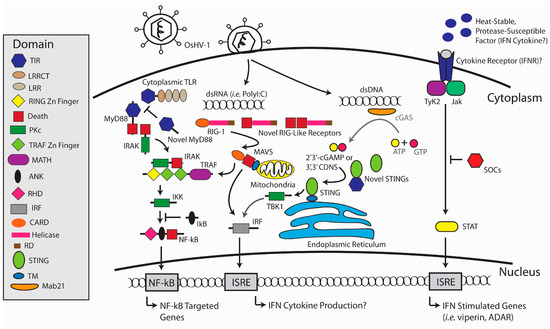
Figure 1.
Conceptual diagram of the interferon-like antiviral response of Crassostrea gigas involving the TLR/NF-κB, RIG-1/MAVS, and putative cGAS/STING signaling pathways that result in the transcription of antiviral genes. The oyster genome encodes several novel toll-like receptors (TLRs) that lack transmembrane domains, implying they have a cytoplasmic function. These novel TLRs and downstream signaling adaptors are upregulated in response to OsHV-1 inoculation [34,36,52]. The oyster has a functional RIG-1 pathway that senses the presence of cytoplasmic dsRNA (i.e., polyI:C) and signals via downstream MAVS and TRAF adaptors [46]. The transcription factor IRF appears to function downstream of oyster MAVS and activates the IFN promoter and IFN stimulated response elements (ISRE) in mammalian cells [46,53]. Activation of IRF and NF-κB results in their translocation to the cell nucleus, leading to the transcription of antiviral genes. It is not currently known if oysters have a functional cGAS/STING-dependent antiviral response (pathway highlighted with grey arrows) [54]. The oyster genome encodes a STING homologue with three N-terminal transmembrane domains followed by a STING domain [10]. Oyster STING binds cyclic dinucleotides (CDNs) [55] and interacts with downstream TBK1 kinase [39]. Functional assays are required to determine if oyster cGAS binds cytosolic DNA and synthesizes CDNs. Note the unusual protein domains for RIG-like receptors and STING. Novel RIG-like receptors contain N-terminal death domains and novel STING either lack transmembrane domains or contain TIR domains [56]. TIR domain-containing proteins such as TLRs and interleukin-1 receptors are known to play key roles in innate immune signaling [57]. TLR, toll-like receptor; MyD88, myeloid differentiation primary response 88; IRAK, interleukin receptor-associated kinase; TRAF, TNF-receptor associated factor; IKK, IκB kinase; IκB, Inhibitor of κB; NF-κB, nuclear factor kappa-light-chain-enhancer of activated B cells; RIG-1, retinoic acid-inducible gene-1-like receptor; MAVS, mitochondria antiviral signaling protein; IFN, interferon; IRF, interferon regulatory factor; cGAS, cyclic GMP-AMP synthase; STING, stimulator of IFN genes; TBK1, tank binding kinase 1; STAT, signal transducer and activator of transcription; SOCS, suppressor of cytokine signaling; ISRE, IFN stimulated response element.
Efforts have been made to elucidate the molecular and cellular mechanisms involved in the oyster’s type I IFN-like pathway, and some recent progress has been made. Poly(I:C) is a synthetic double-stranded RNA (dsRNA) molecule that has been widely used as a viral mimic in mammalian and fish models to activate the type I interferon pathway [15,40,41]. Intramuscular injection of poly(I:C) and other long dsRNA molecules induce an antiviral response in C. gigas that hampers OsHV-1 replication [42,43,44,45]. Oysters have a RIG-1 like receptor (RLR) pathway that senses cytoplasmic poly(I:C) and transmits signals via mitochondrial antiviral protein (MAVS) to activate NF-κB [46]. C. gigas interferon regulatory factors (IRFs) appear to function downstream of MAVS and were able to activate the IFN-β and ISG response elements in mammalian cells [46]. Furthermore, the hemolymph from poly(I:C)-injected C. gigas contains a heat-stable, protease-susceptible factor that induces the transcription of ISGs in oyster hemocytes, such as Viperin [47]. Viperin is one of the few mammalian ISGs that have direct antiviral activity against a range of RNA and DNA viruses [48]. C. gigas Viperin inhibits dengue virus replication when over-expressed in a mammalian cell line [47].
Other antiviral defense pathways must also function in C. gigas, but have received less attention. Experimental infection of C. gigas with OsHV-1 has shown that surviving oysters can clear OsHV-1 DNA after 24 h post-inoculation [49]. Autophagy is thought to participate in OsHV-1 clearance and confers a protective role against the virus when induced by carbamazepine or starvation [50]. The OsHV-1 genome encodes many anti-apoptotic proteins that suppress apoptosis in C. gigas hemocytes and mantle tissue [43,51], despite components of the extrinsic apoptosis pathway being upregulated in response to OsHV-1 inoculation [34,36]. Other evolutionarily conserved antiviral pathways are yet to be investigated.
6. Conclusions
Research on antiviral defense of the oyster is still in its infancy. In the past five years, the development of laboratory-based experimental infection protocols combined with next-generation sequencing has enabled researchers to identify C. gigas has a complex antiviral response [34]. Oysters have a transcriptional response to viral infection that has striking similarities to the vertebrate type I IFN response [34,37]. Activating the oysters IFN-like response by injecting C. gigas with polyI:C results in the upregulation of ISGs that inhibit OsHV-1 replication [42]. As more studies begin to characterize the antiviral defense responses of the oyster, we see several important questions to be addressed. These include determining whether the oyster utilizes the siRNA pathway to prevent virus replication and does the expansion of cytoplasmic and novel virus-recognition receptors enable the oyster to tailor its antiviral response against specific viruses. The ability of oysters to recognize foreign DNA (ISD and un-methylated CpG motifs [74]) to induce an antiviral response has yet to be determined. Purifying and characterizing the cytokine (heat-stable, protease-susceptible factor [47]) that induces C. gigas ISG expression would also provide valuable new information on the evolutionary origins of the IFN pathway.
Research into the antiviral defense response of C. gigas is quickly moving from the basic characterization of evolutionarily conserved antiviral genes to the possibility of using therapeutic treatments to ‘immunize’ oysters against viral diseases. The concept of innate immune memory in C. gigas is supported by heterologous immune-priming experiments using polyI:C to elicit long-lasting protection against OsHV-1 [44]. PolyI:C and its derivatives are non-hazardous synthetic compounds currently produced as vaccine adjuvants [92]. Thus, multi-generation immune-priming using polyI:C holds great promise as a cost-effective strategy to breed entire crops of oysters with enhanced protection against OsHV-1 [88]. The process is safe and would be acceptable to consumers because oysters sold for human consumption would not have directly been exposed to polyI:C (parents injected with polyI:C). The credibility of polyI:C as a therapeutic would benefit greatly from description of the molecular mechanisms underpinning the oyster’s innate immune memory.
Acknowledgments
The authors acknowledge funding provided to Timothy J. Green from the Canada Research Chair Program and to Peter Speck by the Australian Seafood Cooperative Research Centre (Project No. 2011/758).
Author Contributions
Timothy J. Green and Peter Speck contributed equally to drafting manuscript.
Conflicts of Interest
The authors declare no conflict of interest.
References
- Escoubas, J.-M.; Destoumieux-Garzon, D.; Montagnani, C.; Gourbal, B.; Duval, D.; Green, T.J.; Charriere, G.M. Immunity in Molluscs. In Encyclopedia of Immunobiology; Ratcliffe, M.J.H., Ed.; Academic Press: Oxford, UK, 2016; pp. 417–436. [Google Scholar]
- Bickham, U.; Bayne, C.J. Molluscan cells in culture: Primary cell cultures and cell lines. Can. J. Zool. 2013, 91, 391–404. [Google Scholar]
- Davison, A.J.; Eberia, R.; Ehlers, B.; Hayward, G.S.; McGeoch, D.J.; Minson, A.C.; Pellet, P.E.; Roizman, B.; Studdert, M.J.; Thiry, E. The Order Herpesvirales. Arch. Virol. 2009, 154, 171–177. [Google Scholar] [CrossRef] [PubMed]
- Segarra, A.; Pepin, J.F.; Arzul, I.; Morga, B.; Faury, N.; Renault, T. Detection and Description of a Particular Ostreid Herpesvirus 1 Genotype Associated with Massive Mortality Outbreaks of Pacific oysters, Crassostrea gigas, in France in 2008. Virus Res. 2010, 153, 92–99. [Google Scholar] [CrossRef] [PubMed]
- Jenkins, C.; Hick, P.; Gabor, M.; Spiers, Z.; Fell, S.A.; Gu, X.; Read, A.; Go, J.; Dove, M.; O’Connor, W.; et al. Identification and Characterisation of an Ostreid Herpesvirus-1 Microvariant (OsHV-1 μ-Var) in Crassostrea gigas (Pacific Oysters) in Australia. Dis. Aquat. Org. 2013, 105, 109–126. [Google Scholar] [CrossRef] [PubMed]
- Keeling, S.E.; Brosnahan, C.L.; R, W.; Gias, E.; Hannah, M.; Bueno, R.; McDonald, W.L.; Johnston, C. New Zealand juvenile oyster mortality associated with Ostreid herpesvirus 1—An opportunisitic longitudinal study. Dis. Aquat. Org. 2014, 109, 231–239. [Google Scholar] [CrossRef] [PubMed]
- Burge, C.A.; Griffin, F.J.; Friedman, C.S. Mortality and herpesvirus infections of the Pacific oyster Crassostrea gigas in Tomales Bay, California, USA. Dis. Aquat. Org. 2006, 72, 31–43. [Google Scholar] [CrossRef] [PubMed]
- Le Deuff, R.M.; Nicolas, J.L.; Renault, T.; Cochennec, N. Experimental transmission of a Herpes-like virus to axenic Larvae of Pacific oyster, Crassostrea gigas. Bull. Eur. Assoc. Fish Pathol. 1994, 14, 69–72. [Google Scholar]
- Renault, T.; Cochennec, N.; le Deuff, R.; Chollet, B. Herpes-like virus infecting Japanese oyster (Crassostrea gigas) Spat. Bull. Eur. Assoc. Fish Pathol. 1994, 14, 64–66. [Google Scholar]
- Green, T.J.; Raftos, D.A.; Speck, P.; Montagnani, C. Antiviral immunity in marine molluscs. J. Gen. Virol. 2015, 96, 2471–2482. [Google Scholar] [CrossRef] [PubMed]
- Guo, X.; Ford, S.E. Infectious diseases of marine molluscs and host responses as revealed by genomic tools. Philos. Trans. R. Soc. B 2016. [Google Scholar] [CrossRef] [PubMed]
- Arzul, I.; Corbeil, S.; Morga, B.; Renault, T. Viruses infecting marine molluscs. J. Invertebr. Pathol. 2017, 147, 118–135. [Google Scholar] [CrossRef] [PubMed]
- Mussabekova, A.; Daeffler, L.; Imler, J.-L. Innate and intrinsic antiviral immunity in Drosophila. Cell. Mol. Life Sci. 2017, 74, 2039–2054. [Google Scholar] [CrossRef] [PubMed]
- Sarkies, P.; Miska, E.A. RNAi pathways in the recognition of foreign RNA: Antiviral responses and host-parasite interactions in nematodes. Biochem. Soc. Trans. 2013, 41, 876–880. [Google Scholar] [CrossRef] [PubMed]
- Randall, R.E.; Goodbourn, S. Interferons and viruses: An interplay between induction, signalling, antiviral responses and viral countermeasures. J. Gen. Virol. 2008, 89, 1–47. [Google Scholar] [CrossRef] [PubMed]
- Blair, C.D. Mosquito RNAi is the major innate immune pathway controlling arbovirus infection and transmission. Future Microbiol. 2011, 6, 265–277. [Google Scholar] [CrossRef] [PubMed]
- Wilkins, C.; Dishongh, R.; Moore, S.C.; Whitt, M.A.; Chow, M.; Machaca, K. RNA interference is an antiviral defence mechanism in Caenorhabditis elegans. Nature 2005, 436, 1044–1047. [Google Scholar] [CrossRef] [PubMed]
- Weber, F.; Wagner, V.; Rasmussen, S.B.; Hartmann, R.; Pauldan, S.R. Double-stranded RNA is produced by positive-stranded RNA viruses and DNA viruses but not in detectable amounts by negative-stranded RNA viruses. J. Virol. 2006, 80, 5059–5064. [Google Scholar] [CrossRef] [PubMed]
- Tenoever, B.R. RNA viruses and the host microRNA machinery. Nat. Rev. Microbiol. 2013, 11, 169–180. [Google Scholar] [CrossRef] [PubMed]
- Sabin, L.R.; Cherry, S. Small creature use small RNAs to direct antiviral defenses. Eur. J. Immunol. 2013, 43, 27–33. [Google Scholar] [CrossRef] [PubMed]
- Benitez, A.A.; Spanko, L.A.; Bouhaddou, M.; Sachs, D.; tenOever, B.R. Engineered mammalian RNAi can elicit antiviral protection that Negates the requirement for the interferon response. Cell Rep. 2015, 13, 1456–1466. [Google Scholar] [CrossRef] [PubMed]
- Schoggins, J.W.; Rice, C.M. Interferon-stimulated genes and their antiviral effector functions. Curr. Opin. Virol. 2011, 1, 519–525. [Google Scholar] [CrossRef] [PubMed]
- Aguado, L.C.; tenOever, B.R. RNase III nucleases and the evolution of antiviral systems. BioEssays 2017. [Google Scholar] [CrossRef] [PubMed]
- Dostert, C.; Jouanguy, E.; Irving, P.; Troxler, L.; Galiana-Arnoux, D.; Hetru, C.; Hoffmann, J.A.; Imler, J.-L. The Jak-STAT signaling pathway is required but not sufficient for the antiviral response of Drosophila. Nat. Immunol. 2005, 6, 946–953. [Google Scholar] [CrossRef] [PubMed]
- Paradkar, P.N.; Trinidad, L.; Voysey, R.; Duchemin, J.-B.; Walker, P.J. Secreted Vago restricts West Nile virus infection in Culex mosquito cells by activating the Jak-STAT pathway. Proc. Natl. Acad. Sci. USA 2012, 109, 18915–18920. [Google Scholar] [CrossRef] [PubMed]
- Paradkar, P.N.; Duchemin, J.-B.; Voysey, R.; Walker, P.J. Dicer-2-dependent activation of Culex Vago occurs via the TRAF-Rel2 signaling pathway. PLoS Neg. Trop. Pathog. 2014, 8, e2823. [Google Scholar] [CrossRef] [PubMed]
- Deddouche, S.; Matt, N.; Budd, A.; Mueller, S.; Kemp, C.; Galiana-Arnoux, D.; Dostert, C.; Antoniewski, C.; Hoffmann, J.A.; Imler, J.-L. The Dexd/H-Box helicase Dicer-2 mediates induction of antiviral activity in Drosophila. Nat. Immunol. 2008, 9, 1425–1432. [Google Scholar] [CrossRef] [PubMed]
- Li, C.; Li, H.; Chen, Y.; Chen, Y.; Wang, S.; Weng, S.-P.; Xu, X.; He, J. Activation of Vago by interferon regulatory factor (IRF) suggests an interferon system-like antiviral mechanism in shrimp. Sci. Rep. 2015, 5, 15078. [Google Scholar] [CrossRef] [PubMed]
- Li, Y.; Basavappa, M.; Lu, J.; Dong, S.; Cronkite, D.A.; Prior, J.T.; Reinecker, H.-C.; Hertzog, P.; Han, Y.; Li, W.-X.; et al. Induction and suppression of antiviral RNA interference by influenza A virus in mammalian cells. Nat. Microbiol. 2016, 2, 16250. [Google Scholar] [CrossRef] [PubMed]
- Zhang, G.; Fang, X.; Guo, X.; Li, L.; Luo, R.; Xu, F.; Yang, P.; Zhang, L.; Wang, X.; Qi, H.; et al. The oyster genome reveals stress adaptation and complexity of shell formation. Nature 2012, 490, 49–54. [Google Scholar] [CrossRef] [PubMed]
- Paul-Pont, I.; Evans, O.; Dhand, N.K.; Whittington, R.J. Experimental infections of Pacific oyster Crassostrea gigas Using the Australian Ostreid herpesvirus-1 (OsHV-1) μvar strain. Dis. Aquat. Org. 2015, 113, 137–147. [Google Scholar] [CrossRef] [PubMed]
- Schikorski, D.; Faury, N.; Pepin, J.F.; Saulnier, D.; Tourbiez, D.; Renault, T. Experimental Ostreid herpesvirus 1 Infection of the Pacific oyster Crassostrea gigas: Kinetics of virus DNA detection by q-PCR in seawater and in oyster samples. Virus Res. 2011, 155, 28–34. [Google Scholar] [CrossRef] [PubMed]
- Schikorski, D.; Renault, T.; Saulnier, D.; Faury, N.; Moreau, P.; Pepin, J.F. Experimental infection of Pacific oyster Crassostrea gigas spat by Ostreid herpesvirus 1: Demonstration of oyster spat susceptibility. Vet. Res. 2011, 42, 27. [Google Scholar] [CrossRef] [PubMed]
- He, Y.; Jouaux, A.; Ford, S.E.; Lelong, C.; Sourdaine, P.; Mathieu, M.; Guo, X. Transcriptome analysis reveals strong and complex antiviral response in a mollusc. Fish Shellfish Immunol. 2015, 46, 131–144. [Google Scholar] [CrossRef] [PubMed]
- Zhang, L.; Li, L.; Guo, X.; Litman, G.W.; Dishaw, L.J.; Zhang, G. Massive expansion and functional divergence of innate immune genes in a Protostome. Sci. Rep. 2015, 5, 1–11. [Google Scholar] [CrossRef] [PubMed]
- Green, T.J.; Vergnes, A.; Montagnani, C.; de Lorgeril, J. Distinct immune responses of juvenile and adult oysters (Crassostrea gigas) to viral and bacterial infections. Vet. Res. 2016, 47, 72. [Google Scholar] [CrossRef] [PubMed]
- Rosani, U.; Varotto, L.; Domeneghetti, S.; Arcangeli, G.; Pallavicini, A.; Venier, P. Dual analysis of host and pathogen transcriptomes in Ostreid herpesvirus 1—Positive Crassostrea gigas. Environ. Microbiol. 2015, 17, 4200–4212. [Google Scholar] [CrossRef] [PubMed]
- Renault, T.; Faury, N.; Barbosa-Solomieu, V.; Moreau, K. Suppression substractive hybridisation (SSH) and real time PCR reveal differential gene expression in the Pacific cupped oyster, Crassostrea gigas, challenged with Ostreid herpesvirus 1. Dev. Comp. Immunol. 2011, 35, 725–735. [Google Scholar] [CrossRef] [PubMed]
- Tang, X.; Huang, B.; Zhang, L.; Li, L.; Zhang, G. Tank-binding kinase-1 broadly affects oyster immune response to bacteria and viruses. Fish Shellfish Immunol. 2016, 56, 330–335. [Google Scholar] [CrossRef] [PubMed]
- Fernandez-Trjuillo, A.; Ferro, P.; Garcia-Rosado, E.; Infante, C.; Alonso, M.C.; Bejar, J.; Borrego, J.J.; Manchado, M. Poly I:C induces Mx transcription and promotes an antiviral state against Sole Aquabirnavirus in the flatfish Senegalese sole (Solea Senegalensis Kaup). Fish Shellfish Immunol. 2008, 24, 279–285. [Google Scholar] [CrossRef] [PubMed]
- Plant, K.P.; Thune, R.L. Cloning and characterisation of a channel catfish (Ictalurus Punctatus) Mx gene. Fish Shellfish Immunol. 2004, 16, 391–405. [Google Scholar] [CrossRef] [PubMed]
- Green, T.J.; Montagnani, C. Poly I:C Induces a protective antiviral immune response in the Pacific oyster (Crassostrea gigas) against subsequent challenge with Ostreid herpesvirus (OsHV-1 μVar). Fish Shellfish Immunol. 2013, 35, 382–388. [Google Scholar] [CrossRef] [PubMed]
- Green, T.J.; Rolland, J.-L.; Vergnes, A.; Raftos, D.A.; Montagnani, C. OsHV-1 countermeasures to the Pacific oyster’s anti-viral response. Fish Shellfish Immunol. 2015, 47, 435–443. [Google Scholar] [CrossRef] [PubMed]
- Lafont, M.; Petton, B.; Vergnes, A.; Pauletto, M.; Segarra, A.; Gourbal, B.; Montagnani, C. Long-lasting antiviral innate immune priming in the Lophotrochozoan Pacific oyster, Crassostrea gigas. Sci. Rep. 2017, 7, 13143. [Google Scholar] [CrossRef] [PubMed]
- Pauletto, M.; Segarra, A.; Montagnani, C.; Quillien, V.; Faury, N.; le Grand, J.; Miner, P.; Petton, B.; Labreuche, Y.; Fleury, E.; et al. Long dsRNAs promote an anti-viral response in Pacific oyster hampering Ostreid herpesvirus 1 replication. J. Exp. Biol. 2017, 220, 3671–3685. [Google Scholar] [CrossRef] [PubMed]
- Huang, B.; Zhang, L.; Du, Y.; Xu, F.; Li, L.; Zhang, G. Characterization of the mollusc RIG-I/MAVS pathway reveals an archaic antiviral signalling framework in invertebrates. Sci. Rep. 2017, 7, 8217. [Google Scholar] [CrossRef] [PubMed]
- Green, T.J.; Speck, P.; Geng, D.; Raftos, D.A.; Beard, M.R.; Helbig, K.J. Oyster viperin retains direct antiviral activity and its transcription occurs via a signalling pathway involving a heat-stable hemolymph protein. J. Gen. Virol. 2015, 96, 3587–3597. [Google Scholar] [CrossRef] [PubMed]
- Helbig, K.J.; Beard, M.R. The Role of viperin in the innate antiviral response. J. Mol. Biol. 2014, 426, 1210–1219. [Google Scholar] [CrossRef] [PubMed]
- Segarra, A.; Baillon, L.; Tourbiez, D.; Benabdelmouna, A.; Faury, N.; Bourgougnon, N.; Renault, T. Ostreid herpesvirus type 1 replication and host response in adult Pacific oysters, Crassostrea gigas. Vet. Res. 2014, 45, 103. [Google Scholar] [CrossRef] [PubMed]
- Moreau, P.; Moreau, K.; Segarra, A.; Tourbiez, D.; Travers, M.-A.; Rubinsztein, D.C.; Renault, T. Autophagy plays an important role in protecting Pacific oysters from OsHV-1 and Vibrio aestuarianus infections. Autophagy 2015, 11, 516–526. [Google Scholar] [CrossRef] [PubMed]
- Martenot, C.; Gervais, O.; Chollet, B.; Houssin, M.; Renault, T. Haemocytes collected from experimentally infected Pacific oysters, Crassostrea gigas: Detection of Ostreid herpesvirus 1 DNA, RNA, proteins in relation with inhibition of apoptosis. PLoS ONE 2017, 12, e0177448. [Google Scholar] [CrossRef] [PubMed]
- Du, Y.; Zhang, L.; Huang, B.; Guan, X.; Li, L.; Zhang, G. Molecular cloning, characterization, expression of two myeloid differentiation factor 88 (MyD88) in Pacific oyster, Crassostrea gigas. J. World Aquac. Soc. 2013, 44, 759–774. [Google Scholar] [CrossRef]
- Lu, M.; Yang, C.; Li, M.; Yi, Q.; Lu, G.; Wu, Y.; Qu, C.; Wang, L.; Song, L. A Conserved interferon regulation factor 1 (IRF-1) from Pacific oyster Crassostrea gigas functioned as an activator of IFN pathway. Fish Shellfish Immunol. 2018, 76, 68–77. [Google Scholar] [CrossRef] [PubMed]
- Margolis, S.R.; Wilson, S.C.; Vance, R.E. Evolutionary Origins of cGAS-STING Signaling. Trends Immunol. 2017, 38, 733–743. [Google Scholar] [CrossRef] [PubMed]
- Kranzusch, P.J.; Wilson, S.C.; Lee, A.S.Y.; Berger, J.M.; Doudna, J.A.; Vance, R.E. Ancient Origin of cGAS-STING Reveals Mechanism of Universal 2′,3′ Cgamp Signaling. Mol. Cell 2015, 59, 891–903. [Google Scholar] [CrossRef] [PubMed]
- Gerdol, M. Immune-Related Genes in Gastropods and Bivalves: A Comparative Overview. ISJ Invertebr. Surviv. J. 2017, 14, 103–118. [Google Scholar]
- Jenkins, K.A.; Mansell, A. TIR-containing adaptors in Toll-like receptor signalling. Cytokine 2010, 49, 237–244. [Google Scholar] [CrossRef] [PubMed]
- Jeffrey, K.L.; Li, Y.; Ding, S. Reply to Questioning antiviral RNAi in mammals. Nat. Microbiol. 2017, 2, 17053. [Google Scholar] [CrossRef] [PubMed][Green Version]
- Gauthier, M.E.A.; Pasquier, L.D.; Degnan, B.M. The genome of the sponge Amphimedon queenslandica provides new perspectives into the origin of Toll-like and interleukin 1 receptor pathways. Evol. Dev. 2010, 12, 519–533. [Google Scholar] [CrossRef] [PubMed]
- Schr¨oder, H.C.; Natalio, F.; Wiens, M.; Tahir, M.N.; Shukoor, M.I.; Tremel, W.; Belikov, S.I.; Krasko, A.; M¨uller, W.E.G. The 2′-5′-Oligoadenylate synthetase in the lowest metazoa: Isolation, cloning, expression and functional activity in the Sponge Lubomirskia baicalensis. Mol. Immunol. 2008, 45, 945–953. [Google Scholar] [CrossRef] [PubMed]
- Kuusksalu, A.; Subbi, J.; Pehk, T.; Reintamm, T.; Muller, W.E.G.; Kelve, M. Identification of the reaction products of (2′-54)oligoadenylate synthetase in the marine sponge. Eur. J. Biochem. 1998, 257, 420–426. [Google Scholar] [CrossRef] [PubMed]
- Owens, L.; Malham, S. Review of the RNA interference pathway in molluscs including some possibilites for use in bivalve aquaculture. J. Mar. Sci. Eng. 2015, 3, 87–99. [Google Scholar] [CrossRef]
- Rosani, U.; Gerdol, M. A bioinformatics approach reveals seven nearly-complete RNA-virus genomes in bivalve RNA-seq data. Virus Res. 2017, 239, 33–42. [Google Scholar] [CrossRef] [PubMed]
- Seo, G.J.; Kincaid, R.P.; Phanaksri, T.; Burke, J.M.; Pare, J.M.; Cox, J.E.; Hsiang, T.; Krug, R.M.; Sullivan, C.S. Reciprocal Inhibition between Intracellular Antiviral Signaling and the RNAi Machinery in Mammalian Cells. Cell Host Microbe 2013, 14, 435–445. [Google Scholar] [CrossRef] [PubMed]
- Girardi, E.; Lefevre, M.; Chane-Woon-Ming, B.; Paro, S.; Claydon, B.; Imler, J.-L.; Meignin, C.; Pfeffer, S. Cross-Species Comparative Analysis of Dicer Proteins During Sindbis Virus Infection. Sci. Rep. 2015, 5, 10693. [Google Scholar] [CrossRef] [PubMed]
- Brubaker, S.W.; Bonham, K.S.; Zanoni, I.; Kagan, J.C. Innate Immune Pattern Recognition: A Cell Biological Perspective. Ann. Rev. Immunol. 2015, 33, 257–290. [Google Scholar] [CrossRef] [PubMed]
- Barber, G.N. STING: Infection, Inflamation and Cancer. Nat. Rev. Immunol. 2015, 15, 760–770. [Google Scholar] [CrossRef] [PubMed]
- Reinert, L.S.; Lopusna, K.; Winther, H.; Sun, C.; Thomsen, M.K.; Nandakumar, R.; Mogensen, T.H.; Meyer, M.; Vaegter, C.; Nyengaard, J.R.; et al. Sensing of HSV-1 by the cGAS-STING pathway in microglia orchestrates antiviral defence in the CNS. Nat. Commun. 2016, 7, 13348. [Google Scholar] [CrossRef] [PubMed]
- Wu, X.; Wu, F.-H.; Wang, X.; Wang, L.; Siedow, J.N.; Zhang, W.; Pei, Z.-M. Molecular evolutionary and structural analysis of the cytosolic DNA sensor cGAS and STING. Nucleic Acids Res. 2014, 42, 8243–8257. [Google Scholar] [CrossRef] [PubMed]
- Zhong, B.; Yang, Y.; Li, S.; Wang, Y.-Y.; Li, Y.; Diao, F.; Lei, C.; He, X.; Zhang, L.; Tien, P.; Shu, H.-B. The adaptor protein MITA Links virus-sening receptors to IRF3 transcription factor activation. Immunity 2008, 29, 538–550. [Google Scholar] [CrossRef] [PubMed]
- Woodward, J.J.; Iavarone, A.T.; Portnoy, D.A. C-Di-Amp secreted by intracellular Listeria monocytogenes activates a host type I interferon response. Science 2010, 328, 1703–1705. [Google Scholar] [CrossRef] [PubMed]
- Li, H.; Wang, S.; Lu, K.; Yin, B.; Xiao, B.; Li, S.; He, J.; Li, C. An invertebrate STING from Shrimp activates an innate immune defense against bacterial infection. FEBS Lett. 2017, 591, 1010–1017. [Google Scholar] [CrossRef] [PubMed]
- Green, T.J.; Montagnani, C.; Benkendorff, K.; Robinson, N.; Speck, P. Ontogeny and water temperature influences the antiviral response of the Pacific oyster, Crassostrea gigas. Fish Shellfish Immunol. 2014, 36, 151–157. [Google Scholar] [CrossRef] [PubMed]
- Stetson, D.B.; Medzhitov, R. Recognition of cytosolic DNA activates an IRF3-dependent innate immune response. Immunity 2006, 24, 93–103. [Google Scholar] [CrossRef] [PubMed]
- Hauton, C.; Smith, V.J. Adaptive immunity in invertebrates: A straw house without a mechanistic foundation. BioEssays 2007, 29, 1138–1146. [Google Scholar] [CrossRef] [PubMed]
- Degremont, L.; Lamy, J.-B.; Pepin, J.-F.; Travers, M.-A.; Renault, T. New insight for the genetic evaluation of resistance to Ostreid herpesvirus infection, a worldwide disease, in Crassostrea gigas. PLoS ONE 2015, 10, e0127917. [Google Scholar] [CrossRef] [PubMed]
- Carrasco, N.; Gairin, I.; Perez, J.; Andree, K.B.; Roque, A.; Fernandez-Tejedor, M.; Rodgers, C.J.; Aguilera, C.; Furones, M.D. A production calendar based on water temperature, spat size, husbandry practices reduce OsHV-1 μVar impact on cultured Pacific oyster Crassostrea gigas in the Ebro Delta (Calalonia), Mediterranean coast of Spain. Front. Physiol. 2017, 8, 125. [Google Scholar] [CrossRef] [PubMed]
- Paul-Pont, I.; Dhand, N.K.; Whittington, R.J. Influence of husbandry practices on OsHV-1 associated mortality of Pacific oysters Crassostrea gigas. Aquaculture 2013, 412, 202–214. [Google Scholar] [CrossRef]
- Whittington, R.J.; Dhand, N.K.; Evans, O.; Paul-Pont, I. Further observations on the influence of husbandry practives on OsHV-1 μVar mortality in Pacific oysters Crassostrea gigas: Age, cultivation structures and growing height. Aquaculture 2015, 438, 82–97. [Google Scholar] [CrossRef]
- Whittington, R.J.; Paul, H.M.; Evans, O.; Rubio, A.; Alford, B.; Dhand, N.; Paul-Pont, I. Protection of Pacific oyster (Crassostrea gigas) spat from mortality due to Ostreid herpes virus-1 (OsHV-1 μVar) using simple treatments of incoming seawater in land-based upwellers. Aquaculture 2015, 437, 10–20. [Google Scholar] [CrossRef]
- Pernet, F.; Lupo, C.; Bacher, C.; Whittington, R.J. Infectious disease in oyster aquaculture require a new integrated approach. Philos. Trans. R. Soc. B 2016, 371, 20150213. [Google Scholar] [CrossRef] [PubMed]
- Degremont, L.; Garcia, C.; Allen, S.K., Jr. Genetic improvement for disease resistance in oysters: A review. J. Invertebr. Pathol. 2015, 131, 221–241. [Google Scholar] [CrossRef] [PubMed]
- Pernet, F.; Barret, J.; le Gall, P.; Corporeau, C.; Degremont, L.L.; Lagarde, F.; Pepin, J.F.; Keck, N. Mass mortalities of Pacific oysters Crassostrea gigas reflect infectious diseases and vary with farming practices in the Mediterranean Thau Lagoon, France. Aquac. Environ. Interact. 2012, 2, 215–237. [Google Scholar] [CrossRef]
- Evans, O.; Hick, P.; Whittington, R.J. Detection of Ostreid herpesvirus-1 microvariants in healthy Crassostrea gigas following disease events and Their Possible role as reservoirs of infection. J. Invertebr. Pathol. 2017, 148, 20–33. [Google Scholar] [CrossRef] [PubMed]
- Barbosa-Solomieu, V.; Degremont, L.; Vazquez-Juarez, R.; Ascencio-Valle, F.; Boudry, P.; Renault, T. Ostreid herpesvirus 1 (OsHV-1) detection among three successive generations of Pacific oysters (Crassostrea gigas). Virus Res. 2005, 107, 47–56. [Google Scholar] [CrossRef] [PubMed]
- Little, T.J.; Kraaijeveld, A.R. Ecological and evolutionary implications of immunological priming in invertebrates. Trends Ecol. Evol. 2004, 19, 58–60. [Google Scholar] [CrossRef] [PubMed]
- Contreras-Garduno, J.; Lanz-Mendoza, H.; Franco, B.; Nava, A.; Pedraza-Reyes, M.; Canales-Lazcano, J. Insect immune priming: Ecology and experimental evidences. Ecol. Entomol. 2016, 41, 351–366. [Google Scholar] [CrossRef]
- Green, T.J.; Helbig, K.J.; Speck, P.; Raftos, D.A. Primed for success: Oyster parents treated with Poly(I:C) produce offspring with enhanced protection against Ostreid herpesvirus type I infection. Mol. Immunol. 2016, 78, 113–120. [Google Scholar] [CrossRef] [PubMed]
- Gavery, M.R.; Roberts, S.B. Epigenetic considerations in aquaculture. PeerJ 2017, 5, e4147. [Google Scholar] [CrossRef] [PubMed]
- Granada, L.; Lemos, M.F.L.; Cabral, H.N.; Bossier, P.; Novais, S.C. Epigenetics in aquaculture—The last frontier. Rev. Aquac. 2017. [Google Scholar] [CrossRef]
- Green, T.J.; Benkendorff, K.; Robinson, N.; Raftos, D.; Speck, P. Anti-viral gene induction is absent upon secondary challenge with double-Stranded RNA in the Pacific oyster, Crassostrea gigas. Fish Shellfish Immunol. 2014, 39, 492–497. [Google Scholar] [CrossRef] [PubMed]
- Martins, K.A.O.; Bavari, S.; Salazar, A.M. Vaccine adjuvant uses of poly-IC and derivatives. Expert Rev. Vaccines 2015, 14, 447–459. [Google Scholar] [CrossRef] [PubMed]
© 2018 by the authors. Licensee MDPI, Basel, Switzerland. This article is an open access article distributed under the terms and conditions of the Creative Commons Attribution (CC BY) license (http://creativecommons.org/licenses/by/4.0/).