


Abstract
Dendrochronology is a very useful science to reconstruct the long-term responses of trees and other woody plants forming annual rings in response to their environment. The present review considered Mexico, a megadiverse country with a high potential for tree-ring sciences given its high climatic and environmental variability. We reviewed papers considering Mexican tree species that were published from 2001 to 2016. Most of these studies examined tree species from temperate forests, mainly in the pine and fir species. The review included 31 tree species. The most intensively sampled family and species were the Pinaceae and Douglas fir (Pseudotsuga menziessi (Mirb.) Franco), respectively. Some threatened tree species were also studied. Dendrochronological investigations were mainly conducted in northern and central Mexico, with Durango being the most sampled state. The reviewed studies were mostly developed for hydroclimatic reconstructions, which were mainly based on the tree-ring width as a proxy for the climate. Tree-ring studies were carried out in both national and foreign institutions. Our review identified relevant research gaps for dendrochronologists such as: (i) biomes which are still scarcely studied (e.g., tropical dry forests) and (ii) approaches still rarely applied to Mexican forests as dendroecology.
1. Introduction
Dendrochronology is the science studying annual growth rings in trees and other woody plants by relating characteristics of these rings with the environmental conditions in which they were formed [1]. The features of tree rings constitute an indirect source for understanding the historical characteristics of the environment in which trees have grown [2]. Usually, sensitive tree species are chosen because they form annual growth rings with certain amount of variability, which allows for synchronizing tree-ring series of different trees growing at the same site. In this way, the targeted tree species should be able to record different types of temporal signals in their rings due to the variability of environment conditions, especially the climate [3,4,5].
One of the first dendrochronological investigations was carried out in America by Andrew E. Douglass, who found a clear dependence between the width of growth rings in pine species from the southwestern part of United States of America (USA) and precipitation [6]. Other early contributions to tree-ring sciences in the neotropical regions were based on quantifying the activity of the vascular cambium as related to climate [7] or in the study of specific tree species, often considering their cambium phenology [8,9]. In the southern part of America, one of the first tree-ring studies examined Cedrela fissilis [10]. As the species and site conditions of the earliest dendrochronological studies developed in the southwestern part of USA are similar to those encountered in many northern Mexico forests, this promoted the theory that Douglass’ school, including disciples such as E. Schulman, pioneered tree-ring studies in semi-arid northern American forests [11].
This research along with others stimulated the birth and development of dendrochronology, which promoted the realization of new studies mainly applied to reconstruct climate (dendroclimatology) [12]. Some of these studies are being developed in Mexico [13].
Mexico is considered one of the main Latin-American countries with a higher potential for dendrochronological investigations, due to its high environmental and climatic heterogeneity. These conditions result in a high diversity of gymnosperm (pines, firs and cypresses) or angiosperm tree species (oaks), which often show a high longevity [14,15,16]. The first dendrochronological studies of Mexico were carried out in places close to El Salto (Durango) city for some species of pines [11]. In the last decades, a large number of studies have been carried out, mainly focusing on dendroclimatology [17,18,19].
Although these studies are becoming more numerous in Mexico, we still do not know the state of the art in this scientific field. To our knowledge, there is no report that documents the current situation in the country of dendrochronology and the perspectives offered by dendrosciences. The systematization of this collection in a database would provide an overview to identify the background, knowledge gaps and trends that research has taken depending on the tree species, scientific scope, geographical region and type of ecosystem among other specific data. This constitutes a starting point for researchers interested in further developing dendrosciences in Mexico.
The objective of this study was to analyze the dendrochronological investigations that have been performed in Mexican terrestrial ecosystems, based on an exhaustive literature review to generate a diagnosis and synthesize the dendrochronological perspectives in this megadiverse country with a great tradition in forestry and ecology. In general, we expected to find more conifers and deciduous broadleaf tree species from seasonal climate zones in these studies. This is due to their growth rings being better defined, which facilitates their synchronization or cross-dating and subsequent measurement, compared with tropical forests in which tree-ring delimitation and cross-dating are not so simple [1,20,21].
2. Materials and Methods
A bibliographic research of scientific articles developed in the subject of dendrochronology was done, using scientific Internet searcher engines (Web of Science-Thomson, Scopus, Science Direct, Google Academic, Redalyc). The research was performed considering studies published between the years of 2001 and 2016. The following English and Spanish keywords were used in: “dendrocronología”, “dendrochronology”, “anillos de crecimiento”, “tree rings”, “paleoclimatología”, “paleoclimatology”, “dendroclimatología”, “dendroclimatology” “dendroecología” and “dendroecology”. We included those publications based on studies that were developed in Mexico and excluded those that were not published in indexed journals, avoiding grey literature (thesis, memories of congresses, technical brochures, etc.).
From the research, a bibliographic database was built and analyzed, containing the following fields of information: vegetation type based on the classification of Land Use and Vegetation of the National Institute of Statistics and Geography (INEGI), studied tree species, site data (state, geographic coordinates and altitude), study objective and scope, journal where the study was published and measured variables (tree-ring width, earlywood and latewood widths, length of the series or chronologies) as well as the institution where the investigation was conducted.
3. Results
A total of 55 articles were found in indexed journals (see the complete list in the Appendix A). These studies were carried out at altitudes ranging from 1300 to 4000 m above sea level (Figure 1). More than half of the studies (53%) were carried out in forests located at more than 3000 m of elevation.
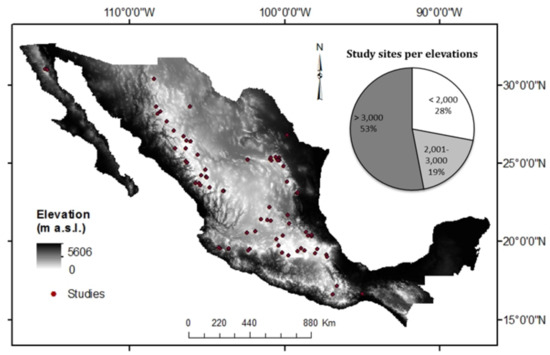
Figure 1.
Sample sites of the dendrochronological studies carried out in Mexico. The upper right graph indicates the classification of sites based on their elevation.
Dendrochronological studies have been developed in seven different types of vegetation (Figure 2). Among them, 48% of the studies were developed for the pine species found within pine forests, which were the most studied type of vegetation, followed by the oyamel forest (Abies religiosa (Kunth) Schltdl. & Cham.) in 24% of the studies. The pine-oak forest was found in 14% of the studies and the gallery forest accounted for 8%. The types of vegetation that were less frequently studied included mountain mesophilous forest, coniferous scrubland and subtropical scrubland, with 2% of studies carried out in each one.
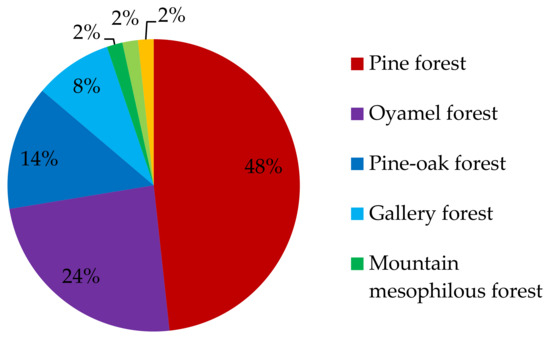
Figure 2.
Percentages of studies classified according to the type of ecosystem following the classification of the National Institute of Statistics and Geography (INEGI).
Dendrochronological studies in Mexico examined 26 tree species, which were distributed in five families. The species of the Pinaceae family accounted for 82% of the studies, those of the Cupressaceae family accounted for 13%. Finally, the families Oleaceae, Fabaceae and Fagaceae were only considered in 2% of the studies for each family (Figure 3). The most studied genera were Pinus, Taxodium, Pseudotsuga and Abies. Pinus was the most intensively studied (16 species), showing concordance with the great diversity of this genus present in Mexico that represents a world center in the diversity of pines [22].
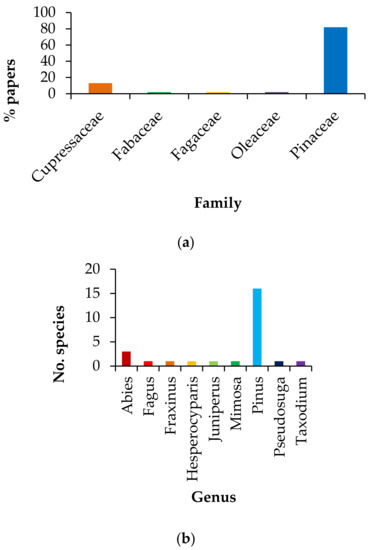
Figure 3.
Dendrochronological studies performed in Mexico and grouped, according to (a) the taxonomic family and (b) the genus of the studied tree species.
The studied species and their frequency are reported in Figure 4. The tree species with a greater number of studies is P. menziesii (16 studies), which is considered as one of the most important species in dendrochronology due to its climate sensitivity, good cross-dating and wide geographical distribution [23]. Another tree species frequently studied was Pinus cooperi C.E. Blanco (11 studies), which also has remarkable dendrochronological potential [24,25,26,27]. These two species were followed by Pinus hartwegii Lindl. and Taxodium mucronatum Ten. (5 studies).
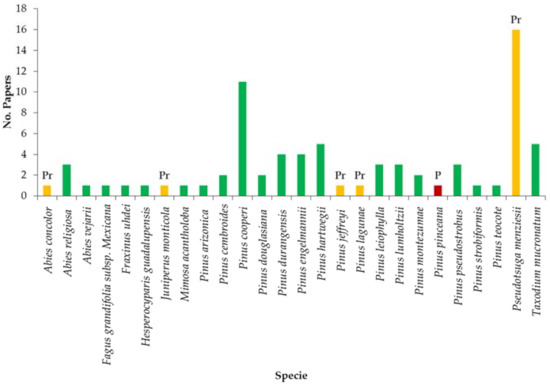
Figure 4.
Number of dendrochronological studies carried out in Mexico grouped according to the sampled species and its conservation status. Yellow and red bars correspond to those trees species listed within a category in Mexican Official Standard 059 [28]. According to the Official Mexican Standard 059, “Pr” indicates those tree species subject to special protection and “P” indicates endangered tree species.
There were six species studied that fall within a category of risk such as endangered (P) or subject to special protection (Pr) according to the Official Mexican Standard 059 [28]: Abies concolor Lindl. (Pr), Juniperus monticola Martínez (Pr), Pinus jeffreyi Balf. (Pr), Pinus lagunae (Rob.-Pass.) Passini (Pr), P. menziesii (Pr) [29] and Pinus pinceana Gordon & Glend. (P) (Figure 4). This section may be divided by subheadings. It should provide a concise and precise description of the experimental results, their interpretation as well as the experimental conclusions that can be drawn.
From the geographical point of view, dendrochronological studies in Mexico have been carried out in 20 states. Durango is the state most intensively sampled, followed by the states of Mexico, Chihuahua and Coahuila (Figure 5). These studies focused on the northern and central mountainous areas of the country, mostly in the Sierra Madre Occidental complex, which contains many temperate forests. A few studies in tropical ecosystems were found, whose research can be considered incipient in relation to other Latin-American countries [16,21,30,31].
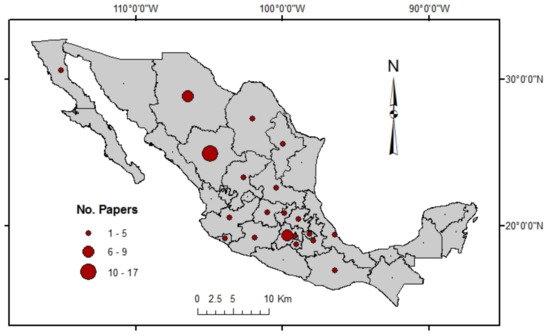
Figure 5.
Dendrochronological studies performed in Mexico and grouped by states.
Regarding the temporary evolution, we observed an ascending tendency of the number of annual studies (n = 12) in the year 2016, with years 2003 and 2013 having more studies performed compared to the previous ones (n = 4 and 9 studies, respectively) (Figure 6).
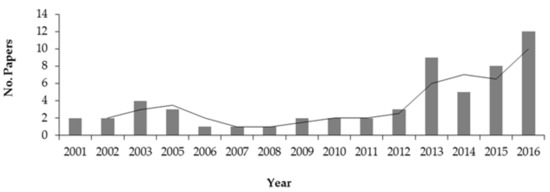
Figure 6.
Dendrochronological studies realized in Mexico, grouped by year of publication.
In relation to the field of application, most of the studies have been developed with a climatic objective (n = 30 studies), usually for reconstructing precipitation. This is followed by those developed in the ecological (n = 23 studies) and hydrological (n = 3 studies) fields (Figure 7). A few studies were carried out in rarely explored fields, such as dendrogeomorphology or dendrochemistry (see Appendix A).
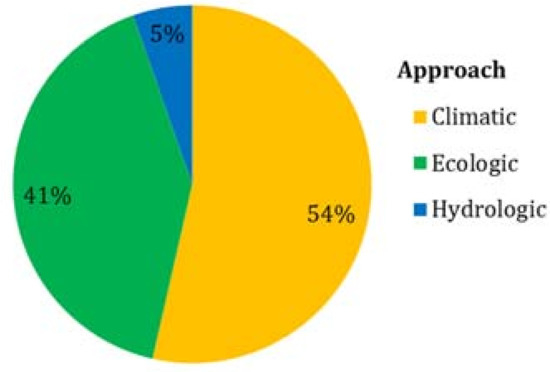
Figure 7.
Dendrochronological studies performed in Mexico and grouped by its scope of application.
The journals in which the greatest numbers of Mexican dendrochronological studies have been published are mostly national journals covering 40% of the studies, such as: Madera y Bosques (n = 9 studies), Revista Chapingo-Serie Ciencias Forestales y del Ambiente (n = 5 studies), Agrociencia (n = 4 studies). This is followed by international journals, such as Dendrochronologia or Tree-Ring Research, which represent the remaining 60% of the studies (Figure 8).
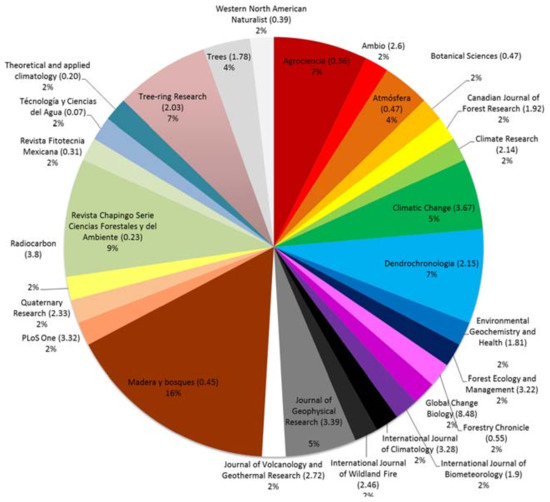
Figure 8.
Dendrochronological studies on Mexican forests grouped according to the journal where they were published. The impact factor of each journal was estimated for 2015 citation data.
Dendrochronological studies have been carried out including measures of width of earlywood (EW), latewood (LW) and tree-ring width (TRW). A total of 37 studies were found for the case of TRW, while 7 studies were detected for EW. For LW, only 1 study was found. Some studies analyzed several of these variables (Figure 9). A few studies considered other variables, such as carbon and oxygen isotopes, wood density or scars due to fires or volcanic activity (see Appendix A).
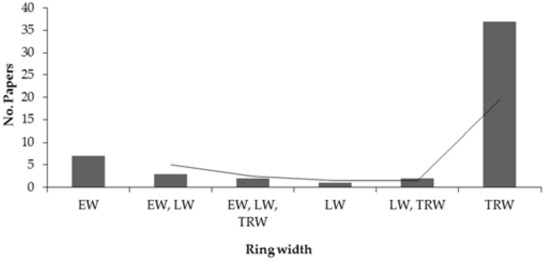
Figure 9.
Dendrochronological studies performed in Mexico considering measurements of the width of earlywood (EW), latewood (LW) and total ring width (TRW).
The studies considered chronologies or mean series of tree-ring variables of different lengths or amplitudes, ranging from 49 to 607 years. Most studies are concentrated in an amplitude of 100 to 300 years (Figure 10). This is because some trees have sufficient longevity to contribute to the reconstruction of climatic events over a wide period of time. This is the case for the earlywood chronologies of up to 554 years of the extension of P. menziesii developed by Villanueva-Díaz et al. for temperate forests located in northern Mexico [24].
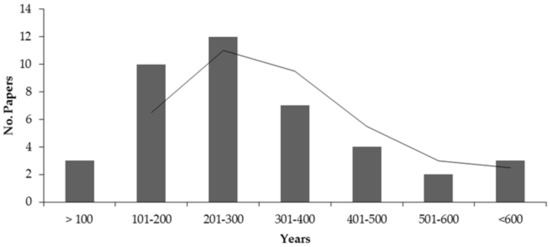
Figure 10.
Dendrochronological studies performed in Mexico and grouped according to the amplitude or length of the chronologies.
The species that present a greater climatic sensitivity, quantified as correlations between climatic variables and tree-ring width, were P. menziesii, T. mucronatum and P. cooperi.
A total of 69% of the dendrochronological research was generated in Mexican institutions (Figure 11), with almost 60% concentrated in two of the nine national centers where the research was carried out, namely the National Institute of Forest, Agriculture and Livestock Research (INIFAP) located in Gómez Palacio (Durango) and the Juarez University of Durango State [32,33]. Of the national institutions, 71% correspond to educational centers and 31% to research centers. In Mexico, INIFAP is one of the few laboratories with a long tradition in dendrochronology. In other studies, such as Díaz et al. [34], Sheppard et al. [35] or González-Cásares et al. [36], some parts were conducted in overseas laboratories located mainly in United States of America (USA) and Europe. In USA, the universities of Northern Arizona, Arizona and Arkansas were the institutions in which a greater number of studies were carried out. The University of Arizona is considered as a pioneering center in conducting studies of this type in Mexico [8], although it has a smaller number of published studies compared to the University of Arkansas [37,38].
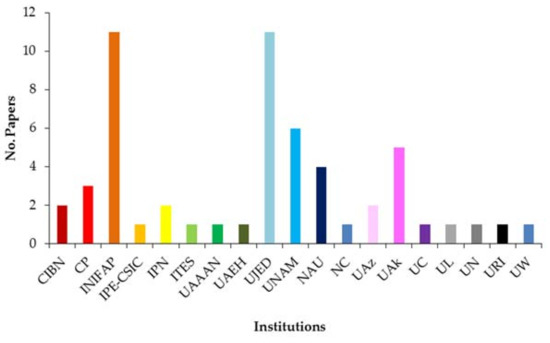
Figure 11.
Research centers in which work is carried out around dendrochronological issues in Mexico estimated according to the first author of the study). The abbreviations are: National Center of Biological Research of the Northwest (CIBN), College of Postgraduates (CP), National Institute of Forestry, Agriculture and Livestock Research (INIFAP), Pyrenean Institute of Ecology (IPE-CSIC), National Politecnich Institute (IPN), Technological Institute of El Salto (ITES), Antonio Narro Autonomous Agrarian University (UAAAN), Autonomous University of Hidalgo State (UAEH), Juarez University of Durango State (UJED), National Autonomous University of Mexico (UNAM), Northern Arizona University (NAU), The Nature Conservancy (NC), University of Arizona (UAz), University of Arkansas (UAk), University of California (UC), University of Leeds (UL), University of Nevada (UN), University of Rhode Island (URI) and University of Washington (UW).
4. Conclusions
This is the first systematic review conducted for dendrochronological investigations carried out in Mexico that were published from 2001 until 2016 in indexed journals. Conifers are the most intensively sampled tree species because of their longevity and sensitivity to climate variability. Regarding the measured variables, most studies were based on the measurement of tree-ring width, although measuring earlywood and latewood features may also contribute to improving the reach of some studies. A lack of studies on tropical dry forests has been detected, which is an area of opportunity for the development of projects given the high richness of tree species found in this biome and because these forests experience seasonal droughts. There is a marked tendency in carrying out tree-ring studies focusing on climatic reconstructions, which suggests that it may be beneficial to broaden tree-ring sciences to encompass other research fields, such as ecology (dendroecology) or geomorphology (dendrogeomorphology). Dendrochronological studies are mostly published in international journals. Collaboration with national and international researchers is a great opportunity to promote the future development of dendrochronology in Mexico.
Acknowledgments
Funding was provided by CONACYT (Consejo Nacional de Ciencia y Tecnología) through the CB-2013/222522 project. Authors are grateful to Editors and anonymous reviewers for their useful comments and suggestions.
Author Contributions
M.P.-G. and J.J.C. conceived and designed the review; A.C.A.-H. performed the review; all authors analyzed the data and wrote the paper.
Conflicts of Interest
The authors declare no conflict of interest.
Appendix A

Table A1.
List of articles consulted on dendrochronology by species or Mexican forests published in indexed scientific journals.
Table A1.
List of articles consulted on dendrochronology by species or Mexican forests published in indexed scientific journals.
| No | Year | Journal | Authors | Title | Family | Tree Species | Ecosystem (INEGI Classification) | Region/State | Area of Application | Variable |
|---|---|---|---|---|---|---|---|---|---|---|
| 1 | 2001 | Ambio | Biondi, F. | A 400-year tree-ring chronology from the tropical treeline of North America. | Pinaceae | Pinus hartwegii Lindl. | Pine forest | Colima | Dendroclimatology | TRW |
| 2 | 2001 | International Journal of Climatology | Díaz, S.C.; Touchan, R.; Swetnam, T. | A tree-ring reconstruction of past precipitation for Baja California Sur, Mexico. | Pinaceae | Pseudotsuga menziesii (Mirb.) Franco | Pine-oak forest | Baja California | Dendroclimatology | TRW |
| 3 | 2002 | Climate Research | Díaz, S.C.; Therrell, M.; Stahle, D.; Cleaveland, M. | Chihuahua (Mexico) winter-spring precipitation reconstructed from tree-rings, 1647–1992. | Pinaceae | Pinus lagunae (Rob.-Pass.) Passini | Oyamel forest | Chihuahua and Durango | Dendroclimatology | EW |
| 4 | 2002 | Journal of Geophysical Research | Therrell, M.; Stahle, D.; Cleaveland, M.; Villanueva-Díaz, J. | Warm season tree growth and precipitation over Mexico. | Pinaceae, Cupressaceae | Pseudotsuga menziesii (Mirb.) Franco, Pinus montezumae Lamb., Taxodium mucronatum Ten. | Pine forest and Gallery forest | - | Dendroclimatology | LW and TRW |
| 5 | 2003 | Tree-ring Research | Pohl, K.; Therrell, M.; Blay, J.; Ayotte, A.; Cabrera, J.; Díaz, S.; Cornejo, E.; Elvir, J.; González, M.; Opland, D.; Park, J.; Pederson, G.; Bernal, S.; Vázquez, L.; Villanueva-Díaz, J.; Stahle, D. | A cool season precipitation reconstruction for Saltillo, Mexico. | Pinaceae | Pseudotsuga menziesii (Mirb.) Franco | Oyamel forest | Coahuila | Dendroclimatology | EW |
| 6 | 2003 | Climatic Change | Cleaveland, M.; Stahle, D.; Therrell, M.; Villanueva-Diaz, J.; Burns, B. | Tree-Ring Reconstructed Winter Precipitation and Tropical Teleconnections in Durango, Mexico. | Pinaceae | Pseudotsuga menziesii (Mirb.) Franco | Oyamel forest | Durango | Dendroclimatology | EW |
| 7 | 2003 | Canadian Journal of Forest Research | Stephens, S.; Skinner, C.; Gill, S. | Dendrochronology-based fire history of Jeffrey pine—mixed conifer forests in the Sierra San Pedro Martir, Mexico. | Pinaceae | Pinus jeffreyi Balf. | Pine forest | Baja California | Dendroecology | Fire scars |
| 8 | 2003 | Quaternary Research | Biondi, F.; Galindo I.; Gavilanes, J.; Elizalde, A. | Tree growth response to the 1913 eruption of Volcán de Fuego de Colima, Mexico. | Pinaceae | Pinus hartwegii Lindl. | Pine forest | Colima | Dendroecology | TRW |
| 9 | 2005 | Forest Ecology and Management | González-Elizondo, M.; Jurado, E.; Návar, J.; González-Elizondo, M.S.; Villanueva, J.; Aguirre, O.; Jiménez, J. | Tree-rings and climate relationships for Douglas-fir chronologies from the Sierra Madre Occidental, Mexico: A 1681–2001 rain reconstruction. | Pinaceae | Pseudotsuga menziesii (Mirb.) Franco | Oyamel forest | Durango and Zacatecas | Dendroclimatology | TRW |
| 10 | 2005 | Dendrochronologia | Therrell, M. | Tree rings and “El año del hambre” in Mexico. | Pinaceae | Oyamel forest | Durango and Zacatecas | Dendroclimatology | ||
| 11 | 2005 | Dendrochronologia | Villanueva, J.; Luckman, B.; Stahle, D.; Therrell, M.; Cleaveland, M.; Cerano-Paredes, J.; Gutierrez-Garcia, G.; Estrada-Avalos, J.;Jasso-Ibarra, R. | Hydroclimatic variability of the upper Nazas basin: water management implications for the irrigated area of the Comarca Lagunera. | Pinaceae | Pseudotsuga menziesii (Mirb.) Franco, Pinus durangensis Martínez | Pine forest | Durango and Zacatecas | Dendrohydrology | EW |
| 12 | 2006 | Climatic Change | Therrell, M.; Stahle, D.; Villanueva-Díaz, J.; Cornejo-Oviedo, E.; Cleaveland, M. | Tree-ring reconstructed maize yield in central Mexico: 1474–2001. | Pinaceae | Pseudotsuga menziesii (Mirb.) Franco | Oyamel forest | Puebla | Dendroecology | LW |
| 13 | 2007 | Climatic Change | Villanueva-Diaz, J.; Stahle, D.; Luckman, B.; Cerano-Paredes, J.; Therrell, M.; Cleaveland, M.; Cornejo-Oviedo, E. | Winter-spring precipitation reconstructions from tree rings for northeast México. | Pinaceae | Pseudotsuga menziesii (Mirb.) Franco | Oyamel forest | Coahuila, Nuevo León and Tamaulipas | Dendroclimatology | EW |
| 14 | 2008 | Tree-ring Research | Sheppard, P.; Ort, M.; Anderson, K.; Elson, M.; Vazquez-Salem, L.; Clemens, A.; Little, N.; Speakman, R. | Multiple dendrochronological signals indicate the eruption of Paricutín volcano, Michoacán, México. | Pinaceae | Pinus leiophylla Schiede ex Schltdl. & Cham., Pinus pseudostrobus Lindl., Pinus montezumae Lamb., Pinus teocote Schltdl. & Cham. | Pine forest | Michoacan | Dendroecology | LW and TRW |
| 15 | 2009 | Madera y bosques | Villanueva Díaz, J.; Cerano Paredes, J.; Constante-García, V.; Fulé, P.; Cornejo, E. | Variabilidad hidroclimática histórica de la sierra de Zapalinamé y disponibilidad de recursos hídricos para Saltillo, Coahuila. | Pinaceae | Pseudotsuga menziesii (Mirb.) Franco, Pinus cembroides Gordon | Pine forest | Coahuila and Nuevo León | Dendroclimatology and dendrohydrology | EW, LW and TRW |
| 16 | 2009 | Madera y bosques | Cerano, J.; Villanueva, J.; Fulé, P.; Arreola, J.; Sánchez, I.; Valdez, R. | Reconstrucción de 350 años de precipitación para el suroeste de Chihuahua, México. | Pinaceae | Pseudotsuga menziesii (Mirb.) Franco | Oyamel forest | Chihuahua | Dendroclimatology | EW, LW and TRW |
| 17 | 2010 | Madera y bosques | Arreola-Ortiz, M.; González–Elizondo, M.; Návar–Cháidez, J. | Dendrocronología de Pseudotsuga menziesii (Mirb.) Franco de la Sierra Madre Oriental en Nuevo León, México. | Pinaceae | Pseudotsuga menziesii (Mirb.) Franco | Oyamel forest | Nuevo León | Dendroclimatology | TRW |
| 18 | 2010 | Madera y bosques | Santillán–Hernández, M.; Cornejo–Oviedo, E.; Villanueva–Díaz, J.; Cerano–Paredes, J.; Valencia–Manzo, S.; Capó–Arteaga, M. | Potencial dendroclimático de Pinus pinceana Gordon en la Sierra Madre Oriental | Pinaceae | Pinus pinceana Gordon & Glend. | Pine forest | Hidalgo, Queretaro, Zacatecas, San Luis Potosi and Coahuila | Dendroclimatology | TRW |
| 19 | 2011 | Western North American Naturalist | Bickford, I.; Fulé, P.; Kolb, T. | Growth Sensitivity to Drought of Co-Occurring Pinus spp. along an Elevation Gradient in Northern Mexico. | Pinaceae | Pinus engelmannii Carrière, Pinus lumholtzii B.L. Rob. & Fernald | Pine forest | Chihuahua | Dendroecology | TRW |
| 20 | 2011 | Revista Chapingo Serie Ciencias Forestales y del Ambiente | Cerano-Paredes, J.; Villanueva-Díaz, J.; Valdez-Cepeda, R.; Arreola-Ávila, J.; Constante-García, V. | El Niño Oscilación del Sur y sus efectos en la precipitación en la parte alta de la cuenca del río Nazas. | Pinaceae | Pseudotsuga menziesii (Mirb.) Franco | Oyamel forest | Durango | Dendrohydrology | TRW |
| 21 | 2012 | Técnología y Ciencias del Agua | Villanueva-Díaz, J.; Cerano-Paredes, J.; Estrada-Ávalos, J.; Constante-García, V.; Cortés-Barrera, E. | Variabilidad hidroclimática reconstruida con anillos de árboles para la cuenca Lerma Chapala en Guanajuato, México. | Pinaceae, Cupressaceae | Taxodium mucronatum Ten., Pinus cembroides Gordon | Pine forest and Gallery forest | Guanajuato, Jalisco and Queretaro | Dendroclimatology | TRW |
| 22 | 2012 | Revista Chapingo Serie Ciencias Forestales y del Ambiente | Villanueva Díaz, J.; Fulé, P.; Cerano Paredes, J.; Estrada Avalos, J.; Sánchez Cohen, I. | Reconstrucción de precipitación estacional para el barlovento de la Sierra Madre Occidental. | Pinaceae | Pseudotsuga menziesii (Mirb.) Franco | Oyamel forest | Durango | Dendroclimatology | EW |
| 23 | 2012 | Forestry Chronicle | Cassell, B.; Alvarado, E. | Reconstruction of fire history in Mexican tropical pines using tree rings. | Pinaceae | Pinus douglasiana Martínez | Pine forest | Jalisco | Dendroecology | TRW, fire scars |
| 24 | 2013 | Revista Chapingo Serie Ciencias Forestales y del Ambiente | Cerano-Paredes, J.; Méndez-González, J.; Amaro-Sánchez, A.; Villanueva-Díaz, J.; Cervantes-Martínez, R.; Rubio-Camacho, E. | Reconstrucción de precipitación invierno-primavera con anillos anuales de Pinus douglasiana en la Reserva de la Biosfera Sierra de Manantlán, Jalisco. | Pinaceae | Pinus douglasiana Martínez | Pine forest | Jalisco | Dendroclimatology | TRW |
| 25 | 2013 | Dendrochronologia | Pompa-García, M.; Cerano-Paredes, J.; Fulé, P. | Variation in radial growth of Pinus cooperi in response to climatic signals across an elevational gradient. | Pinaceae | Pinus cooperi C.E. Blanco | Pine forest | Durango | Dendroecology | TRW |
| 26 | 2013 | Agrociencia | Pompa-García, M.; Rodríguez-Flores, F.; Aguirre-Salado, C.; Miranda-Aragón, L. | Influencia de la evaporación en el crecimiento forestal. | Pinaceae | Pinus cooperi C.E. Blanco | Pine forest | Durango | Dendroecology | TRW |
| 27 | 2013 | Madera y bosques | Irby, C.; Fulé, P.; Yocom, L.; Villanueva, J. | Dendrochronological reconstruction of long-term precipitation patterns in Basaseachi National Park, Chihuahua, Mexico. | Pinaceae | Pinus durangensis Martínez, Pinus lumholtzii B.L. Rob. & Fernald, Pinus engelmannii Carrière | Pine forest | Chihuahua | Dendroclimatology | TRW |
| 28 | 2013 | Journal of Volcanology and Geothermal Research | Franco-Ramos, O.; Stoffel, M.; Vázquez-Selem, L.; Capra, L. | Spatio-temporal reconstruction of lahars on the southern slopes of Colima volcano, Mexico—A dendrogeomorphic approach. | Pinaceae | Pinus leiophylla Schiede ex Schltdl. & Cham. | Pine forest | Colima | Dendroecology | TRW, sacrs |
| 29 | 2013 | Radiocarbon | Beramendi-Orosco, L.; Hernandez-Morales, S.; Gonzalez-Hernandez, G.; Constante-Garcia, V.; Villanueva-Diaz, J. | Dendrochronological potential of Fraxinus uhdei and its use as bioindicator of fossil CO2 emissions deduced from radiocarbon concentrations in tree rings. | Oleaceae | Fraxinus uhdei (Wenz.) Lingelsh. | Subtropical scrubland | San Luis Potosi | Dendroecology | TRW |
| 30 | 2013 | Global Change Biology | Gómez-Guerrero, A.; Silva, L.; Barrera-Reyes, M.; Kishchuk, B.; Velázquez-Martínez, A.; Martínez-Trinidad, T.; Plascencia-Escalante, F.; Horwath, W. | Growth decline and divergent tree ring isotopic composition (δ13C and δ18O) contradict predictions of CO2 stimulation in high altitudinal forests. | Pinaceae | Abies religiosa (Kunth) Schltdl. & Cham., Pinus hartwegii Lindl. | Pine forest, Oyamel forest | Colima, Michoacan, Estado de México, Tlaxcala and Veracruz | Dendroecology | TRW, carbon and oxygen isotopes |
| 31 | 2013 | Journal of Geophysical Research | Brienen, R.; Hietz, P.; Wanek, W.; Gloor, M. | Oxygen isotopes in tree rings record variation in precipitation δ18O and amount effects in the south of Mexico. | Fabaceae | Mimosa acantholoba (Humb. & Bonpl. ex Willd.) Poir. | Oaxaca | Dendroclimatology | TRW, oxygen isotopoes | |
| 32 | 2013 | Journal of Geophysical Research | Meko, D.; Touchan, R.; Villanueva, J.; Griffin, D.; Woodhouse, C.; Castro, C.; Carillo, C.; Leavitt, S. | Sierra San Pedro Mártir, Baja California, cool-season precipitation reconstructed from earlywood width of Abies concolor tree rings. | Pinaceae | Abies concolor Lindl. | Oyamel forest | Baja California | Dendroclimatology | EW |
| 33 | 2014 | Theoretical and Applied Climatology | Pompa-García, M.; Jurado, E. | Seasonal precipitation reconstruction and teleconnections with ENSO based on tree ring analysis of Pinus cooperi. | Pinaceae | Pinus cooperi C.E. Blanco | Pine forest | Durango | Dendroclimatology | TRW |
| 34 | 2014 | Agrociencia | Villanueva-Díaz, J.; Cerano-Paredes, J.; Gómez-Guerrero, A.; Correa-Díaz, A.; Castruita-Esparza, L.; Cervantes-Martínez, R.; Stahle, D.; Martínez-Sifuentes, A. | Cinco siglos de historia dendrocronológica de los ahuehuetes (Taxodium mucronatum Ten.) del Parque el Contador, San Salvador Atenco, Estado de México. | Cupressaceae | Taxodium mucronatum Ten. | Gallery forest | Estado de Mexico | Dendroclimatology | TRW |
| 35 | 2014 | Agrociencia | Correa-Díaz, A.; Gómez-Guerrero, A.; Villanueva-Díaz, J.; Castruita-Esparza, L.; Martínez-Trinidad, T.; Cervantes-Martínez, R. | Análisis dendroclimático de Ahuehuete (Taxodium mucronatum Ten.) en el centro de México. | Cupressaceae | Taxodium mucronatum Ten. | Gallery forest | Estado de México, Querétaro, Hidalgo and Morelos | Dendroclimatology | TRW |
| 36 | 2014 | Madera y bosques | Pompa-García, M.; Dávalos-Sotelo, R.; Rodríguez-Téllez, E.; Aguirre-Calderón, O.; Treviño-Garza, E. | Sensibilidad climática de tres versiones dendrocronológicas para una conífera mexicana. | Pinaceae | Pinus cooperi C.E. Blanco | Pine-oak forest | Durango | Dendroclimatology | TRW |
| 37 | 2014 | International Journal of Wildland Fire | Yocom, L.; Fulé, P.; Falk, D.; García-Domínguez, C.; Cornejo-Oviedo, E.; Brown, P.; Villanueva-Díaz, J.; Cerano, J.; Montaño, C. | Fine-scale factors influence fire regimes in mixed-conifer forests on three high mountains in Mexico. | Pinaceae | Pinus hartwegii Lindl., Pinus strobiformis Engelm., Pseudotsuga menziesii (Mirb.) Franco, Abies vejarii (Martínez) | Pine-oak forest | Coahuila and Nuevo León | Dendroecology | TRW, fire scars |
| 38 | 2015 | Revista Chapingo Serie Ciencias Forestales y del Ambiente | Chacón-de la Cruz, J.; Pompa-García, M. | Response of tree radial growth to evaporation, as indicated by early and latewood. | Pinaceae | Pinus cooperi C.E. Blanco | Pine forest | Durango | Dendroecology | EW and LW |
| 39 | 2015 | Atmósfera | Pompa-García, M.; Némiga, X. | ENSO index teleconnection with seasonal precipitation in a temperate ecosystem of northern Mexico. | Pinaceae | Pinus cooperi C.E. Blanco | Pine-oak forest | Durango | Dendroclimatology | TRW |
| 40 | 2015 | Madera y bosques | Carlón-Allende, T.; Mendoza, M.; Villanueva-Díaz, J.; Pérez-Salicrup, D. | Análisis espacial del paisaje como base para muestreos dendrocronológicos: El caso de la Reserva de la Biosfera Mariposa Monarca, México. | Pinaceae | Abies religiosa (Kunth) Schltdl. & Cham., Pinus pseudostrobus Lindl. | Pine-oak forest Oyamel forest | Michoacan and estado de Mexico | Dendroecology | TRW |
| 41 | 2015 | Madera y bosques | Villanueva, J.; Cerano, J.; Olivares, N.; Valles, M.; Stahle, D.; Cervantes, R. | Respuesta climática del ciprés (Hesperocyparis guadalupensis) en Isla Guadalupe, Baja California, México. | Cupressaceae | Hesperocyparis guadalupensis (S. Watson) Bartel | Pine forest | Baja California | Dendroclimatology | TRW |
| 42 | 2015 | Agrociencia | Pompa-García, M.; Camarero, J. | Potencial dendroclimático de la madera temprana y tardía de Pinus cooperi Blanco. | Pinaceae | Pinus cooperi C.E. Blanco | Pine forest | Durango | Dendroclimatology | EW y LW |
| 43 | 2015 | International Journal of Biometeorology | Pompa-García, M.; Miranda-Aragón, L.; Aguirre-Salado, C. | Tree growth response to ENSO in Durango, Mexico. | Pinaceae | Pinus cooperi C.E. Blanco | Pine forest | Durango | Dendroecology | TRW |
| 44 | 2015 | Tree-ring Research | Pompa-García, M.; Camarero, J. | Reconstructing evaporation from pine tree rings in northern Mexico | Pinaceae | Pinus cooperi C.E. Blanco | Pine forest | Durango | Dendroclimatology | TRW |
| 45 | 2016 | Revista Fitotecnia Mexicana | Villanueva-Díaz, J.; Vázquez-Selem, L.; Gómez-Guerrero, A.; Cerano-Paredes, J.; Aguirre-González, N.; Franco-Ramos, O. | Potencial dendrocronológico de Juniperus monticola Martínez en el Monte Tláloc, México. | Cupressaceae | Juniperus monticola Martínez | Coniferous scrubland | Estado de Mexico | Dendroclimatology | TRW |
| 46 | 2016 | Madera y bosques | Díaz-Ramírez, B.; Villanueva-Díaz, J.; Cerano-Paredes, J. | Reconstrucción de la precipitación estacional con anillos de crecimiento para la región hidrológica Presidio-San Pedro. | Pinaceae | Pinus durangensis Martínez | Pine-oak forest | Sinaloa and Nayarit | Dendroclimatology | TRW |
| 47 | 2016 | PLoS One | Pompa-García, M.; Venegas-González, A. | Temporal Variation of wood Density and Carbon in Two Elevational Sites of Pinus cooperi in Relation to Climate Response in Northern Mexico. | Pinaceae | Pinus cooperi C.E. Blanco | Pine forest | Durango | Dendroecology | TRW, wood density |
| 48 | 2016 | Atmósfera | Pompa-García, M.; Hadad, M. | Sensitivity of pines in Mexico to temperature varies with age. | Pinaceae | Pinus cooperi C.E. Blanco | Pine forest | Durango | Dendroecology | TRW |
| 49 | 2016 | Trees | González-Cásares, M.; Pompa-García, M.; Camarero, J. | Differences in climate–growth relationship indicate diverse drought tolerances among five pine species coexisting in Northwestern Mexico. | Pinaceae | Pinus lumholtzii B.L. Rob. & Fernald, Pinus durangensis Martínez, Pinus arizonica Engelm., Pinus engelmannii Carrière, Pinus leiophylla Schiede ex Schltdl. & Cham. | Pine-oak forest | Chihuahua | Dendroecology | TRW |
| 50 | 2016 | Trees | Astudillo-Sánchez, C.; Villanueva-Díaz, J.; Endara-Agramont, A.; Nava-Bernal, G.; Gómez-Albores, M. | Climatic variability at the treeline of Monte Tlaloc, Mexico: a dendrochronological approach. | Pinaceae | Pinus hartwegii Lindl. | Pine forest | Mexico | Dendroclimatology | TRW |
| 51 | 2016 | Revista Chapingo Serie Ciencias Forestales y del Ambiente | Castruita-Esparza; L.; Correa-Díaz; A.; Gómez-Guerrero; A.; Villanueva-Díaz; J.; Ramírez-Guzmán, M.; Velázquez-Martínez, A.; Ángeles-Pérez, G. | Basal area increment series of dominant trees of Pseudotsuga menziesii (Mirb.) Franco show periodicity according to global climate patterns. | Pinaceae | Pseudotsuga menziesii (Mirb.) Franco | Pine-oak forest | Chihuahua | Dendroecology | TRW, basal area increment |
| 52 | 2016 | Botanical Sciences | Ortiz-Quijano, A.; Sánchez-González, A.; López-Mata, L.; Villanueva-Díaz, J. | Population structure of Fagus grandifolia subsp. Mexicana in the cloud forest of Hidalgo state, Mexico. | Fagaceae | Fagus grandifolia subsp. mexicana (Martínez) A.E. Murray | Mountain mesophilous forest | Hidalgo | Dendroecology | TRW |
| 53 | 2016 | Tree-ring Research | Torbenson, M.; Stahle, D.; Villanueva-Díaz, J.; Cook, E.; Griffin, D. | The relationship between earlywood and latewood ring-Growth across North America. | Pinaceae, Fagaceae, Cupressaceae | Pseudotsuga menziesii (Mirb.) Franco, Pinus engelmannii Carrière | - | Dendroecology | EW and LW | |
| 54 | 2016 | Dendrochronologia | Carlón, T.; Mendoza, M.; Pérez-Salicrup, D.; Villanueva-Díaz, J.; Lara, A. | Climatic responses of Pinus pseudostrobus and Abies religiosa in the Monarch Butterfly Biosphere Reserve, Central Mexico. | Pinaceae | Pinus pseudostrobus (Lindl), Abies religiosa (Kunth) Schltdl. & Cham. | Pine forest | Michoacan and estado de Mexico | Dendroecology | TRW |
| 55 | 2016 | Environmental Geochemistry and Health | Morton-Bermea, O.; Beramendi-Orosco, L.; Martínez-Reyes, Á.; Hernández-Álvarez, E.; González-Hernández, G. | Increase in platinum group elements in Mexico City as revealed from growth rings of Taxodium mucronatum ten. | Cupressaceae | Taxodium mucronatum Ten. | Gallery forest | Cd. de Mexico DF | Dendroecology | TRW, chemical elements |
Variables’ abbreviations: TRW, tree-ring width; EW, earlywood width; LW, latewood width.
References
- Fritts, H.C. Tree-Rings and Climate; Academia Press: London, UK, 1976; p. 567. [Google Scholar]
- Pompa-García, M.; Hadad, M.A. Sensitivity of pines in Mexico to temperature varies with age. Atmósfera 2016, 29, 209–219. [Google Scholar] [CrossRef]
- Arreola-Ortiz, M.R.; Návar-Cháidez, J.D.J. Análisis de sequías y productividad con cronologías de Pseudotsuga menziesii Rob. & Fern., y su asociación con El Niño en el nordeste de México. Investig. Geogr. 2010, 71, 7–20. [Google Scholar]
- Correa-Díaz, A.; Gómez-Guerrero, A.; Villanueva-Díaz, J.; Castruita-Esparza, L.U.; Martínez-Trinidad, T.; Cervantes-Martínez, R. Análisis dendroclimático de ahuehuete (Taxodium mucronatum Ten.) en el centro de México. Agrociencia 2014, 48, 537–551. [Google Scholar]
- Chhin, S. Influence of climate on the growth of hybrid poplar in Michigan. Forests 2010, 1, 209–229. [Google Scholar] [CrossRef]
- Douglass, A.E. A method of estimating rainfall by the growth of trees. Bull. Am. Geogr. Soc. 1914, 46, 321–335. [Google Scholar] [CrossRef]
- Worbes, M. One hundred years of tree-ring research in the tropics–A brief history and an outlook to future challenges. Dendrochronologia 2002, 20, 217–231. [Google Scholar] [CrossRef]
- Tschinkel, H.M. Anillos de crecimiento anual en Cordia alliodora. Turrialba 1966, 16, 73–80. [Google Scholar]
- Mariaux, A. Les cernes dans les bois tropicaux africains. Nature et Périodicité. Revue Bois et Forêts Des Tropiques 1967, 114, 23–37. [Google Scholar]
- Boninsegna, J.A.; Villalba, R.; Amarilla, L.; Ocampo, J. Studies on tree rings, growth rates and age–size relationships of tropical tree species in Misiones, Argentina. IAWA Bull. 1989, 10, 161–169. [Google Scholar] [CrossRef]
- Schulman, E. Dendrochronology in Mexico, I. Tree-Ring Bull. 1944, 10, 18–24. [Google Scholar]
- Hughes, M.K. Dendrochronology in climatology—The state of the art. Dendrochronologia 2002, 20, 95–116. [Google Scholar] [CrossRef]
- Scott, S.D. Dendrochronology in Mexico; Papers of the Laboratory of Tree-Ring Research; University of Arizona Press: Tucson, AZ, USA, 1966; p. 80. [Google Scholar]
- Villanueva-Díaz, J.; Cerano, J.; Stahle, D.W.; Therrell, M.D.; Vázquez, L.; Morán, R.; Luckman, B.H. Árboles Viejos del Centro–Norte de México: Importancia Ecológica y Paleoclimática; Folleto Científico 20; INIFAP–CENID–RASPA: Gómez Palacio, Durango, Mexico, 2006; p. 46. [Google Scholar]
- Villanueva-Díaz, J.; Vázquez-Selem, L.; Gómez-Guerrero, A.; Cerano-Paredes, J.; Aguirre-González, N.A.; Franco-Ramos, O. Potencial dendrocronológico de Juniperus monticola Martínez en el monte Tláloc, México. Rev. Fitotec. Mex. 2016, 39, 175–185. [Google Scholar]
- Tomazello, M.; Roig, F.A.; Zevallos, P.A. Dendrocronología y dendroecología tropical: Marco histórico y experiencias exitosas en los países de América Latina. Ecol. Boliv. 2009, 44, 73–82. [Google Scholar]
- Astudillo-Sánchez, C.C.; Villanueva-Díaz, J.; Endara-Agramont, A.R.; Nava-Bernal, G.E.; Gómez-Albores, M.A. Climatic variability at the treeline of Monte Tlaloc, Mexico: A dendrochronological approach. Trees 2017, 31, 441–453. [Google Scholar] [CrossRef]
- Díaz-Ramírez, B.; Villanueva-Díaz, J.; Cerano-Paredes, J. Reconstrucción de la precipitación estacional con anillos de crecimiento para la región hidrológica Presidio-San Pedro. Madera Bosques 2016, 22, 111–123. [Google Scholar] [CrossRef]
- Stahle, D.W.; Cook, E.R.; Burnette, D.J.; Villanueva, J.; Cerano, J.; Burns, J.N.; Griffin, D.; Cook, B.I.; Acuña, R.; Torbenson, M.C.A.; et al. The Mexican Drought Atlas: Tree-ring reconstructions of the soil moisture balance during the late pre-Hispanic, colonial, and modern eras. Quat. Sci. Rev. 2016, 149, 34–60. [Google Scholar] [CrossRef]
- Brienen, R.J.W.; Schöngart, J.; Zuidema, P.A. Tree rings in the tropics: Insights into the ecology and climate sensitivity of tropical trees. Trop. Tree Physiol. 2016, 6, 439–461. [Google Scholar]
- Mendivelso, H.A.; Camarero, J.J.; Gutiérrez, E. Dendrocronología en bosques neotropicales secos: Métodos, avances y aplicaciones. Ecosistemas 2016, 25, 66–75. [Google Scholar] [CrossRef]
- Perry, J.P. The pines of Mexico and Central America; Timber Press: Portland, OR, USA, 1991; p. 231. [Google Scholar]
- González-Elizondo, M.; Jurado, E.; Návar, J.; GonzálezElizondo, M.S.; Villanueva, J.; Aguirre, O.; Jiménez, J. Tree-rings and climate relationships for Douglas-fir chronologies from the Sierra Madre Occidental, Mexico: A 1681–2001 rain reconstruction. For. Ecol. Manag. 2005, 213, 39–53. [Google Scholar] [CrossRef]
- Villanueva–Díaz, J.; Stahle, D.W.; Luckman, B.H.; Cerano–Paredes, J.; Therrell, M.D.; Cleaveland, M.K. Winter–spring precipitation reconstructions from tree rings for northeast Mexico. Clim. Chang. 2007, 83, 117–131. [Google Scholar] [CrossRef]
- Griesbauer, H.; Scott, G.D. Assessing the climatic sensitivity of Douglas-fir at its northern range margins in British Columbia, Canada. Trees 2010, 24, 375–389. [Google Scholar] [CrossRef]
- Torbenson, M.C.A.; Stahle, D.W.; Villanueva, J.; Cook, E.R.; Griffin, D. The relationship between earlywood and latewood ring-growth across North America. Tree-Ring Res. 2016, 72, 53–66. [Google Scholar] [CrossRef]
- Pompa-García, M.; Cerano-Paredes, J.; Fulé, P.Z. Variation in radial growth of Pinus cooperi in response to climatic signals across an elevational gradient. Dendrochronologia 2013, 31, 198–204. [Google Scholar] [CrossRef]
- Secretaria de Medio Ambiente y Recursos Naturales (SEMARNAT). Norma Oficial Mexicana NOM.059-SEMARNAT; Diario Oficial de la Federación 30 de diciembre de 2010; SEMARNAT: Mexico City, Mexico, 2010.
- López-Upton, J.; Valdez-Lazalde, J.R.; Ventura-Ríos, A.; Vargas-Hernández, J.J.; Guerra-de-la-Cruz, V. Extinction risk of Pseudotsuga menziesii populations in the central region of Mexico: An AHP analysis. Forests 2015, 6, 1598–1612. [Google Scholar] [CrossRef]
- Jiménez, J.A.G. Dendrocronología en el trópico: Aplicaciones actuales y potenciales. Colomb. For. 2011, 14, 97–111. [Google Scholar] [CrossRef]
- Gutiérrez, L.A.B.; Ramos, G.M.V. Anatomía de anillos de crecimiento de 80 especies arbóreas potenciales para estudios dendrocronológicos en la Selva Central, Perú. Rev. Biol. Trop. 2013, 61, 1025–1037. [Google Scholar]
- Pompa-García, M.; Rodríguez-Flores, F.J.; Aguirre-Salado, C.A.; Miranda-Aragón, L. Influencia de la evaporación en el crecimiento forestal. Agrociencia 2013, 47, 829–836. [Google Scholar]
- Pompa-García, M.; Jurado, E. Seasonal precipitation reconstruction and teleconnections with ENSO based on tree ring analysis of Pinus cooperi. Theor. Appl. Climatol. 2014, 117, 495–500. [Google Scholar] [CrossRef]
- Díaz, S.C.; Therrell, M.D.; Stahle, D.W.; Cleaveland, M.K. Chihuahua (Mexico) winter-spring precipitation reconstructed from tree-rings, 1647–1992. Clim. Res. 2002, 22, 237–244. [Google Scholar] [CrossRef]
- Sheppard, P.R.; Ort, M.H.; Anderson, K.C.; Elson, M.D.; Vázquez-Selem, L.; Clemens, A.W.; Little, N.C.; Speakman, R.J. Multiple dendrochronological signals indicate the eruption of Paricutin volcano, Michoacan, Mexico. Tree-Ring Res. 2008, 64, 97–108. [Google Scholar] [CrossRef]
- González-Cásares, M.; Pompa-García, M.; Camarero, J.J. Differences in climate–growth relationship indicate diverse drought tolerances among five pine species coexisting in Northwestern Mexico. Trees 2016, 31, 531–544. [Google Scholar] [CrossRef]
- Cleaveland, M.K.; Cook, E.R.; Stahle, D.W. Secular variability of the ENSO signal detected in tree-ring data from Mexico and the southern United States. In El Nino: Historical and Paleoclimatic Aspects of the Southern Oscillation; Diaz, H., Markgraf, V., Eds.; Cambridge University Press: Cambridge, NY, USA, 1992; pp. 271–291. [Google Scholar]
- Stahle, D.W.; Cleaveland, M.K. Southern Oscillation extremes reconstructed from tree rings of the Sierra Madre Occidental and southern Great Plains. J. Clim. 1993, 6, 129–140. [Google Scholar] [CrossRef]
© 2017 by the authors. Licensee MDPI, Basel, Switzerland. This article is an open access article distributed under the terms and conditions of the Creative Commons Attribution (CC BY) license (http://creativecommons.org/licenses/by/4.0/).