


Abstract
The current global climate change, the 2030 Agenda, and the planetary boundaries have driven new development strategies, such as the circular economy, bioeconomy, and biorefineries. In this framework, this study analyzes the potential availability and sustainability of the wood supply chain for a small-scale biorefinery aiming at producing 280–300 L of bioethanol per ton of dry biomass, consuming 30,000 t of dry biomass per year harvested in a 50 km radius. This wood production goal was assessed from Eucalyptus grandis stands planted for solid wood in northeastern Uruguay. Moreover, to understand the environmental performance of this biomass supply chain, the energy return on investment (EROI), carbon footprint (CF), and potential soil erosion were also assessed. The results showed that the potential wood production would supply an average of 81,800 t of dry mass per year, maintaining the soil erosion below the upper threshold recommended, an EROI of 2.3, and annual CF of 1.22 kg CO m (2.6 g CO MJ). Combined with the environmental performance of the bioethanol biorefinery facility, these results would show acceptable values of sustainability according to EU Directive 2009/28/ec because the bioethanol CF becomes 1.7% of this petrol’s CF.
1. Introduction
Population growth and its resource consumption (food, fibers, fuels, and minerals) have directly and indirectly developed several environmental impacts on a world scale (e.g., climate change and biodiversity loss). From a public policy viewpoint, objectives and/or strategies have been proposed to solve these problems, through proposals such as sustainable development [1], the Elkington [2] triple bottom line (social, economic, and physical-natural), or multidimensional assessments with life cycle assessment (LCAs) [3] approaches that, in general, only allow a relative comparison of development styles or production strategies, without being able to identify sustainability in absolute terms. Conversely, Rockström et al. [4] highlighted the need to work according to natural systems limits because any economic or social arguments that try to overpass these natural limits will always have negative consequences.
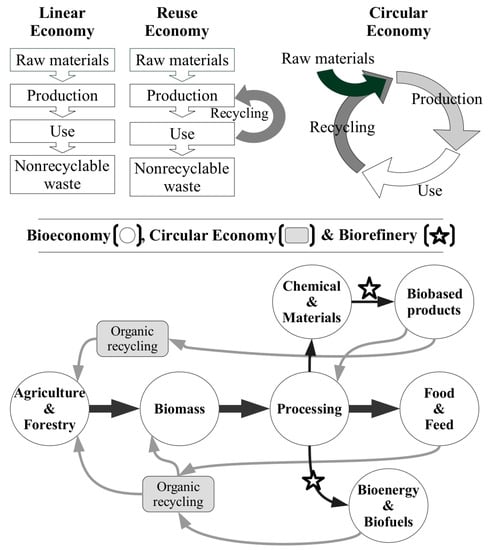
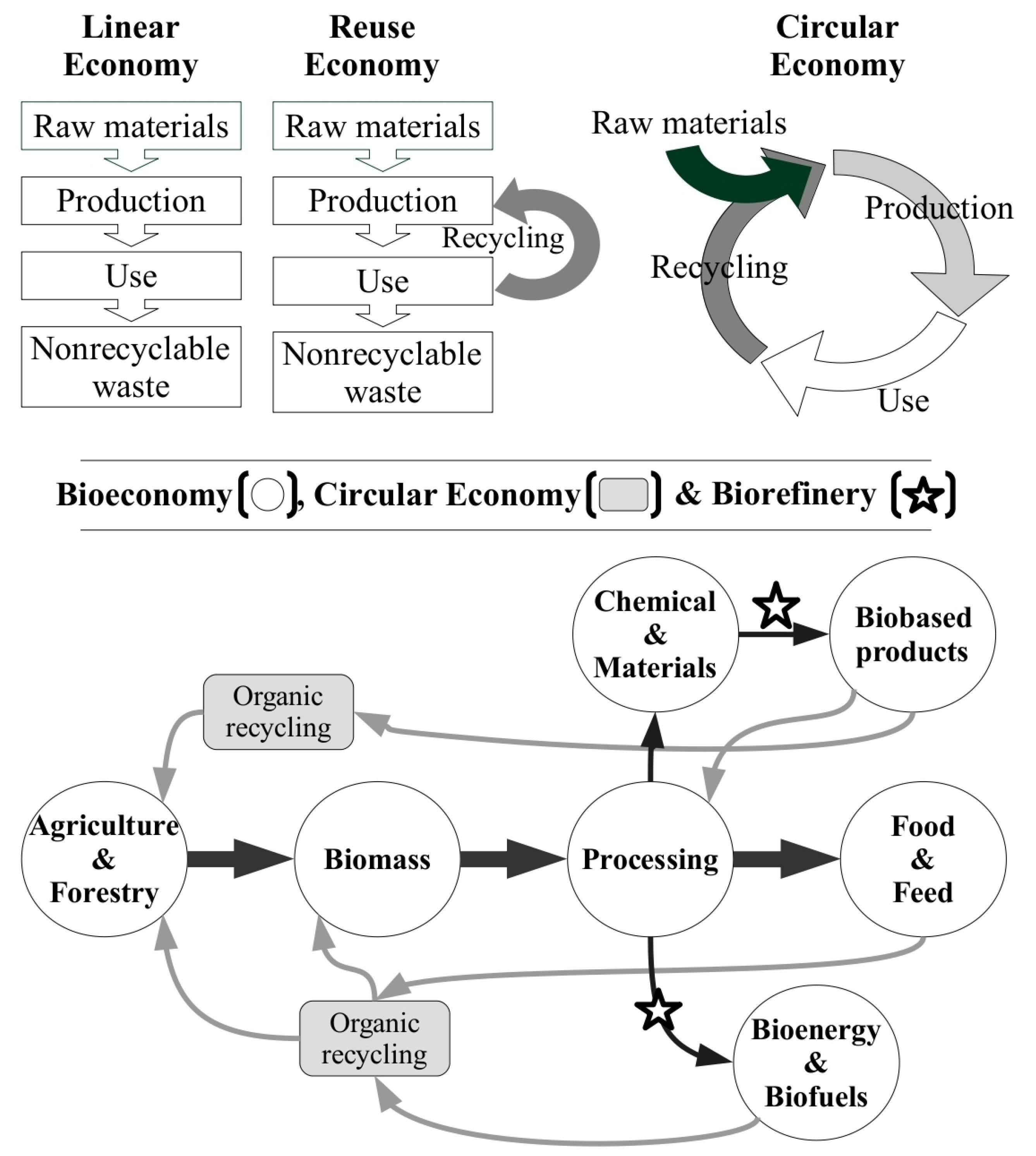
Moreover, the global goals of the 2030 Agenda for Sustainable Development aim to avoid overlapping or to contradict these goals and new proposals such as the circular economy, reuse economy, and bioeconomy (Figure 1), mainly for reduction of raw material consumption, fossil energy, and production of waste. Along the same lines, bioeconomy proposes a circular economy based on agricultural and forest products and biological wastes, for the production of biobased products, biofuels, and bioenergy, sometimes using biorefineries [5,6,7,8].
Figure 1.
Flux diagrams of a linear economy, reuse economy, circular economy, bioeconomy, and the potential niches for biorefineries.
A biorefinery is a facility for the generation of energy (e.g., biofuels) and biobased products (e.g., food, feed, fibers, and chemicals) as a result of the combination of several process steps (e.g., mechanical, thermochemical, chemical, and biochemical processes), using different raw materials, from both virgin and residual sources [5,9,10]. Thus, biorefineries have arisen as a potential solution because they avoid the increase in greenhouse gas (GHG) emissions by the production of biofuels and reduce waste production and consumption of new raw materials. In this way, biorefineries are an industrial strategy with greater economic strength than a traditional chemical industry because they are based on the coproduction of several biobased products.
Biorefineries as a potential solution imply several assumptions, such as (1) economic and environmental costs lower than a production based on fossil fuels or fresh raw materials, (2) availability of residues from sustainable agricultural productions [11,12], and (3) an energy return on investment (EROI) higher than 2 [13,14,15,16]. These assumptions can be false, which is the reason why the EU Directive 2009/28/ec requests a limit on GHG emissions for recognition of a biofuel as such [17]. Moreover, the agriculture/forest residues left on field can only be harvested in the amount that is required to maintain the soil organic matter and soil fertility. If these variables are not considered, the harvest of agriculture/forest residues would reduce soil erosion resistance [18,19], cation exchange capacity, and soil fertility [20]. Therefore, before the development of a biorefinery, it is necessary to survey hidden natural subsidies that can be allowed by circumstantial socioeconomic conditions. A good tool for analyzing the productive scenario is to know if the EROI of the whole process is higher than 2.
Countries with a GDP based on the exportation of agricultural products could meet the requirements for developing a circular economy based on biorefineries for the development of biobased products. An example could be Uruguay, whose GDP depends largely on the exportation of sulfate chemical wood pulp, frozen bovine meat, soybeans, concentrated milk, and rice [21]. Therefore, Uruguay could afford a circular economy scheme and a bioeconomy using biorefineries mainly, using harvest residues or wood from forests planted for solid wood purposes because: the biomass production is higher than the minimum amount required (7 ton ha yr) to maintain the soil organic matter balance [19]; currently, solid wood production is higher than the demand of the national industry or international market; and finally, the use for biofuels or biobased products is a research area under development in this country [22,23,24].
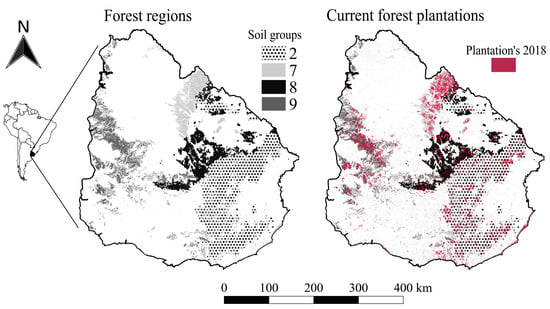
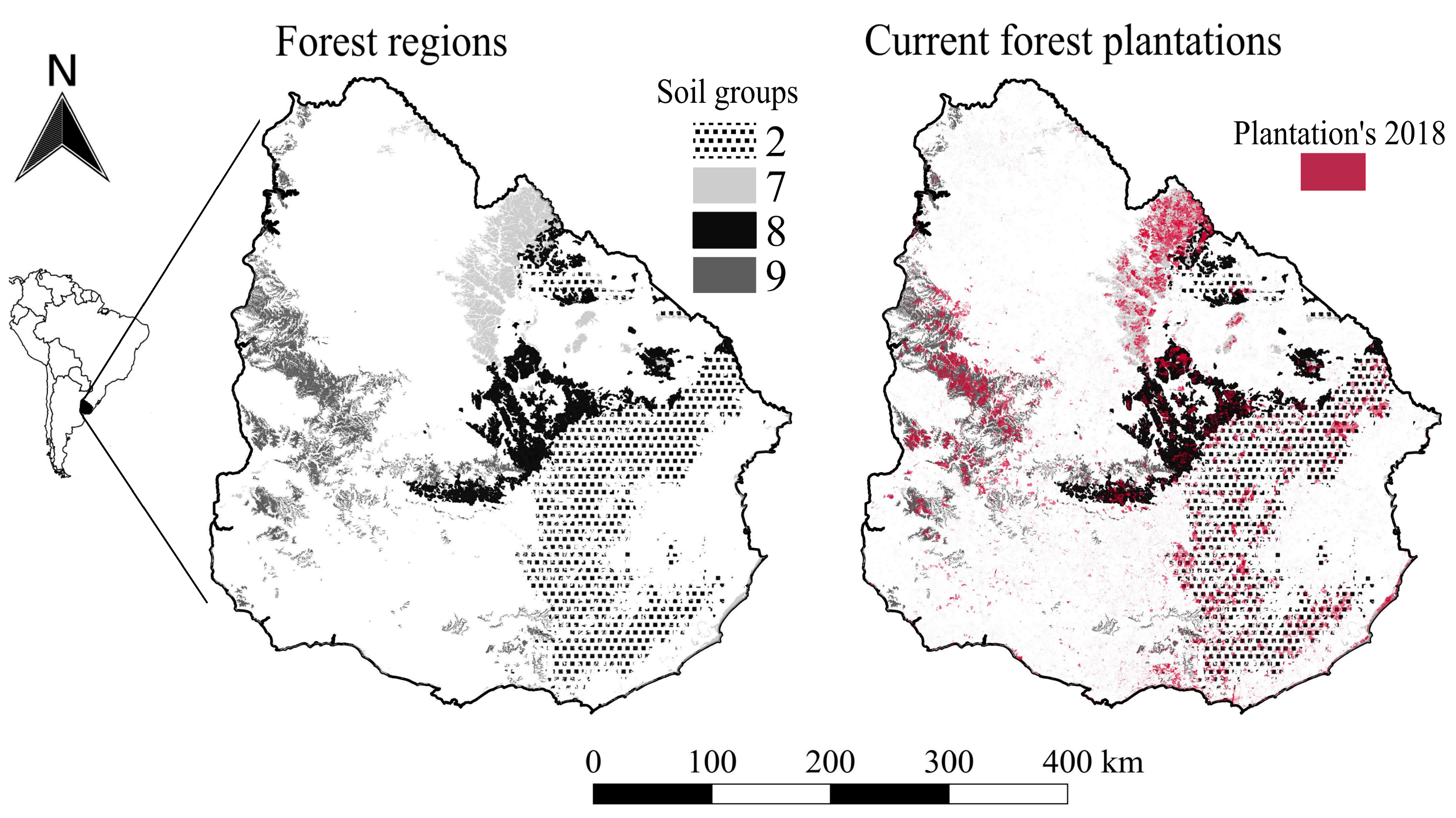
Forest plantations in Uruguay have achieved good yields with exotic trees(25 m ha yr, Eucalyptus spp.; 20 m ha yr Pinus spp.) that are prioritized for forestry by law (Figure 1) due to their low suitability for food production. Currently, forest plantations cover over 1,000,000 of the 4,420,000 hectares prioritized for forest plantations (Figure 2) [25]. The produced wood has two industrial uses: bleached cellulose pulp and solid wood. The latter industry grows a large proportion of wood that is discarded due to small diameter of logs. In the country’s northwest, currently, these solid wood plantations occupy almost 200,000 ha [26] (Table 1). The genera planted are Eucalyptus (E. grandis) and Pinus (P. taeda, P. elliottii) at a ratio of 70% and 35%, respectively, and the harvest age varies from 18 to 22 years. An EROI estimation of eight year Eucalyptus wood found a value of 4 (at the farm gate) [27]. It is possible to assume that wood from a 21 years plantation could reach similar values at the farm gate.
Figure 2.
Left map: Regions prioritized for forest plantations (black and gray patterns) according to the National Commission for Agroeconomic Studies of the Land Classification (CONEAT), soils corresponding to groups 2, 7, 8, and 9 have adequate soil fertility for forest plantation. Right map: The current forest plantations (red) reported by the Forestry Directorate (DGF) (Ministry of Cattle, Agriculture, and Fisheries, MGAP) [26].
Table 1.
Plantation area (ha) according to the species planted in the region [26].
This work evaluated two of the aforementioned hypotheses. First, the availability of solid wood forest production to supply 30,000 t of dry biomass for a semi-industrial pilot scale (280–300 L of bioethanol per ton of dry biomass; [28]). To test this, the wood production was estimated in a 50 km radius catchment in the northeast by applying biomass coefficients. Second, the acceptability of environmental performance of this wood supply chain was evaluated through EROI, carbon footprint (CF), and soil erosion. These analyses assumed that a conservative scenario (e.g., area planted, growth behavior, and tree species) would remain constant for the next 25 years.
2. Materials and Methods
2.1. Study Region
The Uruguayan northeast region (303914.49–325629.22 S, 544426.79–564121.23 W) covers the Departments (political divisions) of Tacuarembó and Rivera. The most extended climax vegetation is perennial pasture, characterized by tall grass in most of the territory [29]. The climate is temperate and humid without a dry season (Cfa) according to the Köppen–Geiger classification [30] and with the highest rainfall in the country (Table 2).
Table 2.
Climate characteristics of the northeast region for the period 1980–2009 [31].
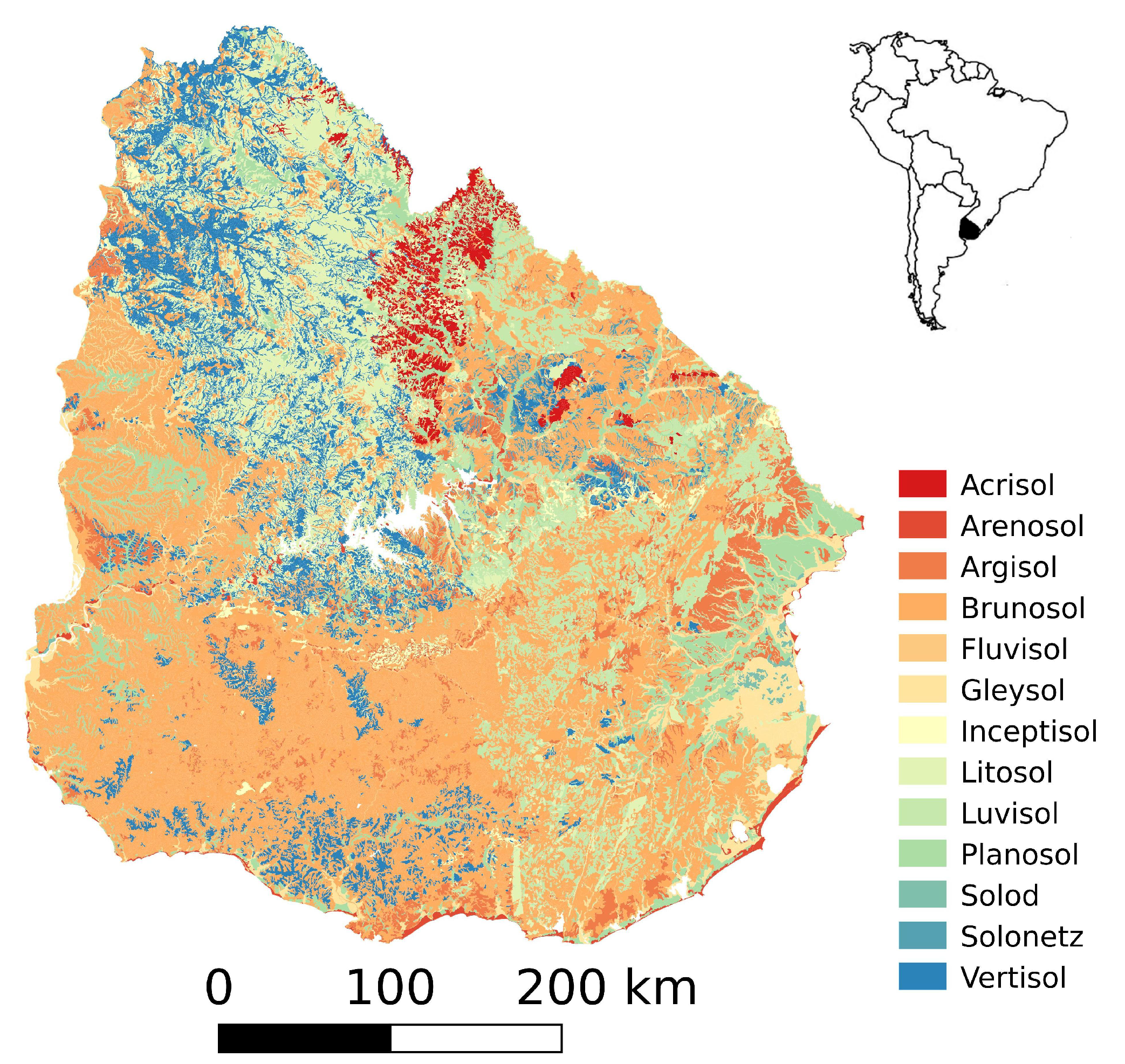
According to the Soil Atlas of Latin America and the Caribbean, the main soils of Uruguay are phaeozems, leptosols, vertisols, acrisols, and luvisols [32], which were redefined at the highest resolution available in Uruguay (Figure 3). The northeast region of the country (3011–351 S, 5323–5826 W) covers 176,215 km and comprises the Departments of Rivera and Tacuarembó, near the Brazilian border. In this region, most commercial plantations occur on acidic soils, low in base saturation with exchangeable aluminum and significant textural differentiation between superficial and subsuperficial horizons, and deep (up to 1.5–3 m). These soils were classified as acrisols and luvisols according to the Uruguayan soil taxonomy [33]. The parent material are sandstones from the Tacuarembó or Rivera [34,35,36].
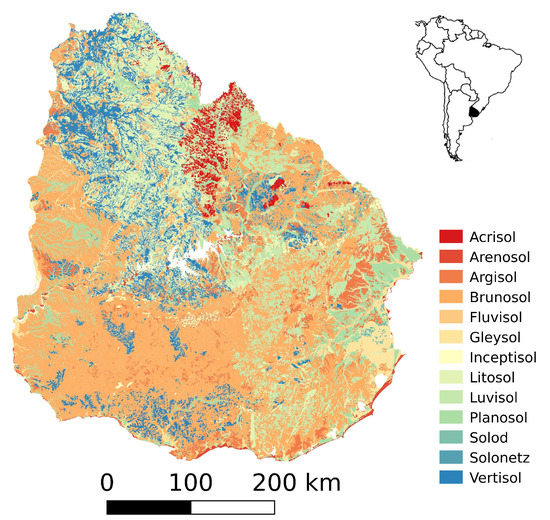
Figure 3.
Soil taxonomy map of Uruguay according to Durán and García-Préchac (2007) elaborated by Beretta-Blanco and Carrasco-Letelier [18].
2.2. Estimation of Potential Wood Supply
Plantation management changes considering the final product (i.e., pulp or solid wood). Solid wood production of Eucalyptus is the main target of the forest plantations analyzed (Figure 4, Table 3 and Table 4). The forest plantation considered: (1) a mean harvest rotation age of 11 and 21 years for thinning and clear cut, respectively (Table 5), (2) a minimum log diameter of 19 cm for local sawmill and plant board, and (3) the remaining portion of the stems was considered as a potential source of biomass Appendix A. The potential wood supply was estimated through the four following sequential steps.
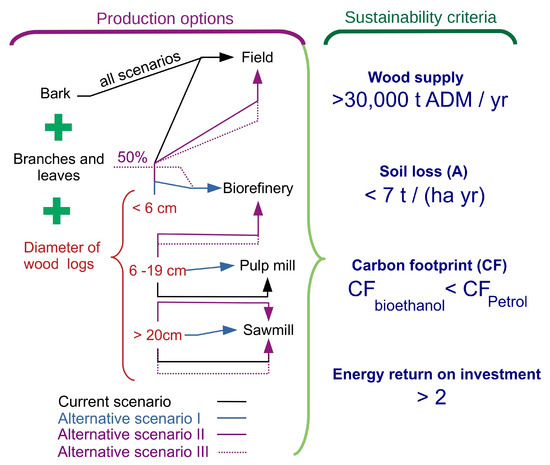
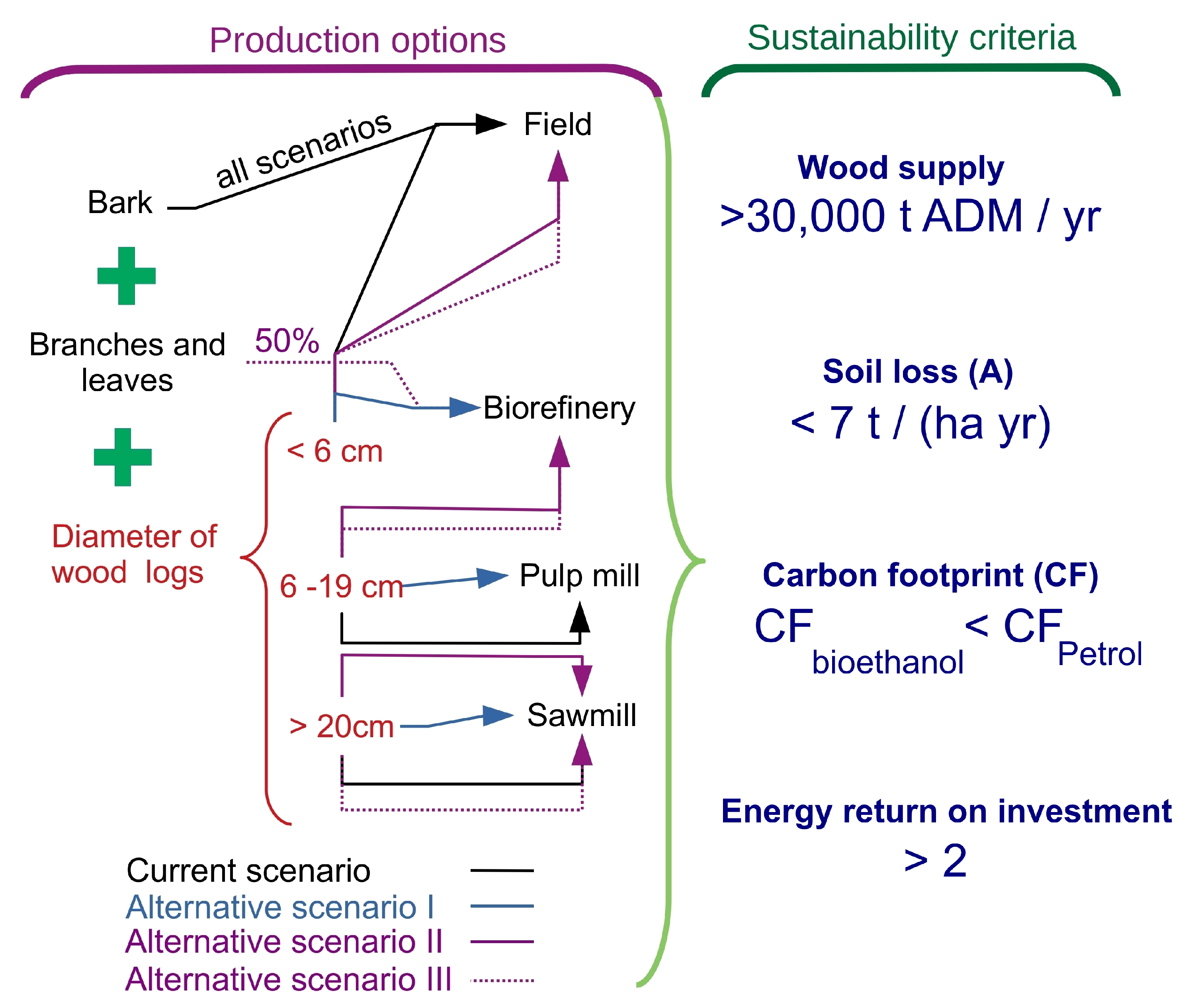
Figure 4.
Production scenarios and sustainability criteria assessed.
Table 3.
Eucalyptus grandis wood composition expressed in percentage, according to Lima et al. [37].
Table 4.
Solid wood production with Eucalyptus plantations.
Table 5.
Operations of Eucalyptus plantations for sawmills and plywood mills.
Solid wood production of Eucalyptus grandis was the analyzed supply chain. Based on the current management practices and biomass coefficients available, the forest plantation considered: (1) a mean harvest rotation age of 11 and 21 years for thinning and clear cut, respectively (Table 5), (2) a minimum log diameter of 19 cm for supplying local sawmills and board mills, and (3) the remaining portion of the stems was considered as a potential source of biomass Appendix A. The potential wood supply was estimated through the four following sequential steps.
- 1.
- Plantation plans recorded by the Government (Dirección General Forestal, DGF) for the region since 1975 were gathered and classified for the species and purpose of interest. This information included registration number of the plantation plan, the species (pines and eucalypts), plantation date, intended product (solid, pulp, etc.), number of trees per hectare, effective planted area, and cadastral number (land registration number).
- 2.
- Plantation plans were georeferenced through its corresponding cadastral number (land registration number) within the georeferenced national cadastral records [38] and checked with the geographical information system (GIS) of the National Forest Inventory for years 2010, 2011, and 2014 [39]. The GIS information was processed and analyzed with QGIS [40].
- 3.
- Based on biomass coefficients provided for Eucalyptus grandis in the northern region by previous work [41], we applied coefficients considering different tree fractions and stem portions usage: (a) a stem portion between 19 and 6 cm diameter only; (b) a stem portion smaller than 6 cm plus twigs, branches, leaves, and bark; (c) a stem portion smaller than 19 cm plus half of the biomass corresponding to twigs, branches, leaves, and bark. Coefficients applied are depicted in Table 6.Table 6. Biomass coefficients applied for Eucalyptus grandis in the North region [41].
- 4.
- Considering the plantation date of each record, we assumed one commercial thinning at age 11 years and the clear cut at age 21 years (Table 4). We also assumed that the biomass formed at the first thinning was not exported and therefore was not computed. For year 11 and 21, the planted area for each record was multiplied by the estimated amount of dry matter per hectare considering tree fractions and stem portions usage listed in step 3. The maximum amount of forest biomass was calculated for a catchment area of 50 km radius located in the center of the most planted area.
In the framework of potential harvestable biomass, this work analyzed the potential production of different feedstock scenarios (Table 7). Steps 1–4 provided 4 datasets comprising information for a 25-year period of potential biomass yearly harvested, summarized by land registration number for the species and region assessed. Those corresponded to the 3 feedstock scenarios analyzed and total residues.
Table 7.
Potential feedstocks scenarios using different fractions of trees.
2.3. Estimation of Soil Loss
Estimation of the mean annual soil erosion (A in Figure 4) was performed using the information required by the universal soil loss equation/revised universal soil loss equation (USLE/RUSLE) model (Equation (1)) validated for Uruguay [42,43,44] In this model, the mean soil loss (A) is expressed in units of t (ha yr) according to Foster et al. [45]:
where the rainfall erosivity factor (R-factor) is expressed in (MJ mm)(ha h yr), the soil erodibility factor (K-factor) is expressed in (t ha h)(ha MJ mm), L is the slope length factor, S is the slope gradient factor, C is the crop management factor, and P is the erosion control practice factor.
The mean annual soil loss was estimated based on a shapefile developed by the intersection of the mapping of CONEAT’s soil groups [46,47]. The soil loss was estimated by the product of all the factors in the model (Equation (1)), where each factor of the equation was incorporated into the GIS as a new information layer according to the description by Carrasco-Letelier and Beretta-Blanco [19].
2.4. Energy Return on Investment (EROI) and Carbon Footprint
The estimation of the EROI and CF was performed by building a life cycle inventory (LCI), which did not include human labor as an energy input. Infrastructure, machinery, chemicals, fertilizers, fuels, and transportation were included. The subsystems considered by the EROI, and the CF were seed production/nursery, field preparation, planting, pruning, harvest, and transportation to the biorefinery.
The study considered one cubic meter of harvested wood as a functional unit. The scope considered was cradle-to-gate of a biorefinery located 50 km far from the harvest site. All relevant activities and inputs (>1% of the CF) under management control, consumed electrical energy, and other supply chains were considered.
2.4.1. Energy Return on Investment (EROI)
The EROI was calculated according to Hall et al. [48,49] and Townsend et al. [16] on a spreadsheet for all the subsystems considered in the LCI. The energy of each component and processes (engines and machinery, pesticides and fertilizers [50]) were estimated according to their corresponding rate and conversion factors into energy units (MJ) (Table 8). When the primary national data of a particular input or emission were not available, information from the literature with similar regional conditions was used [51]. In the worst scenario, when the regional data were not available, international databases were used [52,53,54,55].
2.4.2. Carbon Footprint (CF)
LCI was evaluated in a spreadsheet using information from interviews and forest company records. This information was transferred to the OpenLCA software [55] using the AGRYBALYSE database. A temporal scope of 100 years was considered for the global warming potential (GWP) emissions according to the Intergovernmental Panel on Climate Change Fifth Assessment Report [56], with a GWP of 1, 25, and 265 for CO2, CH4, and N2O, respectively. Considered emissions were CO2 emitted by fossil fuel used [52] because there are no national records of these fuel consumptions. These conversion factors have low variability between countries [53]. The NOx emissions were not taken into account because no validated model is available.
Table 8.
Energy conversion factors used for EROI estimation.
3. Results
3.1. Potential Wood Supply
Geographic Distribution and Availability
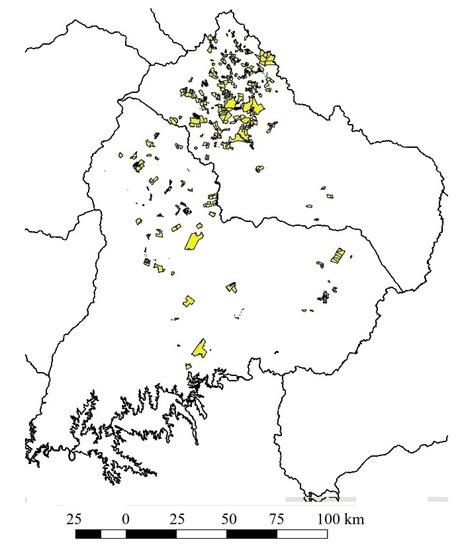
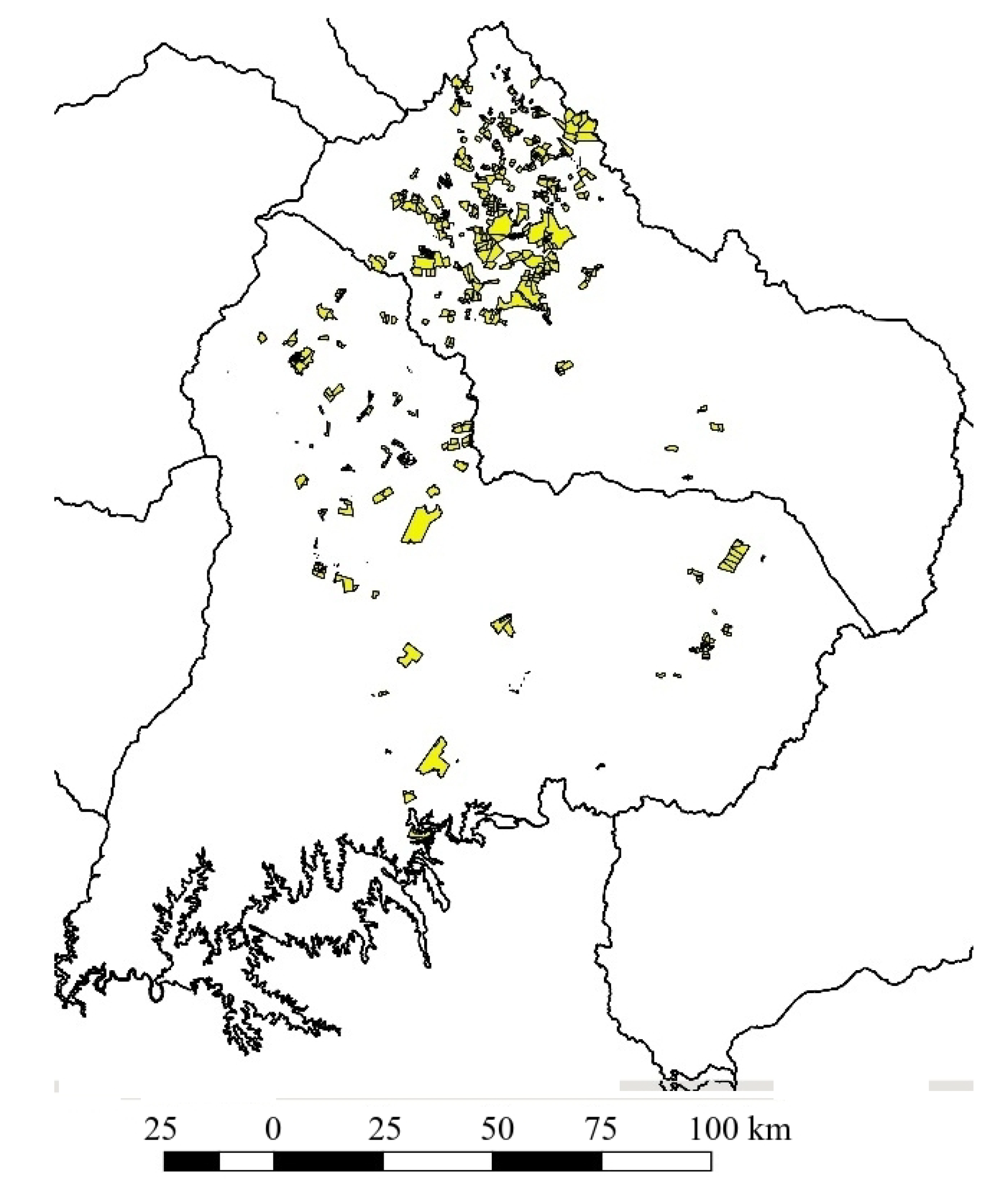
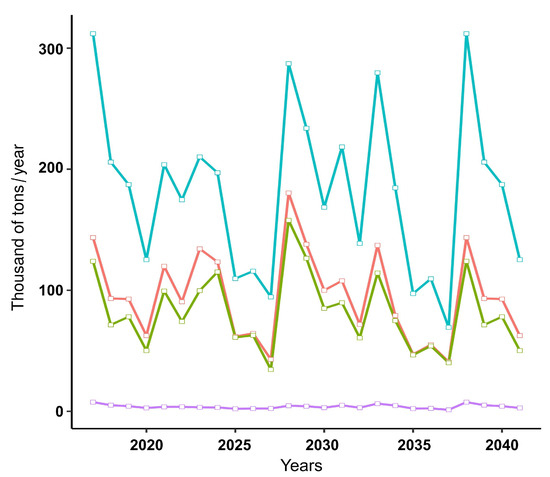
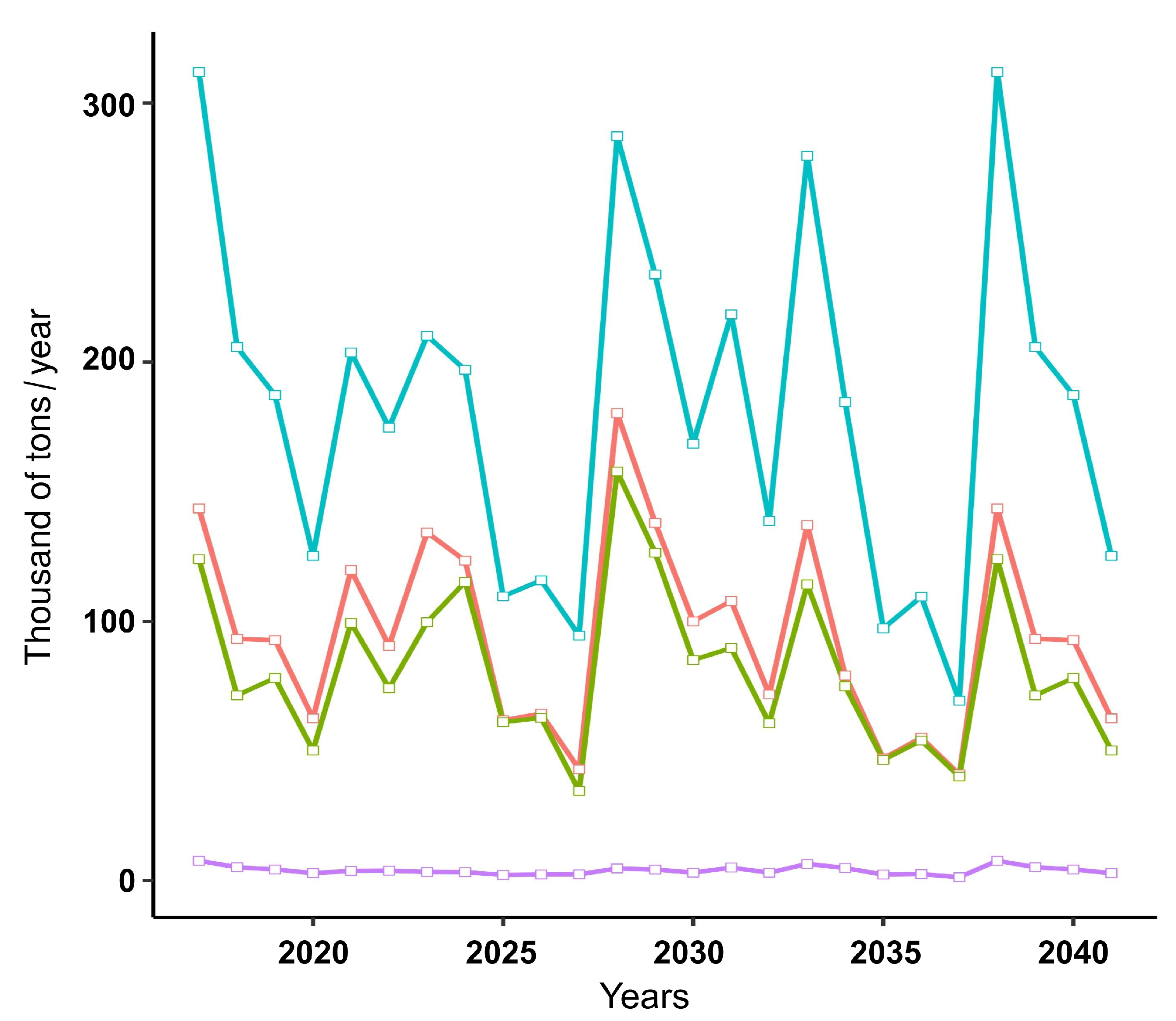
According to forest plans presented to DGF, the effective area occupied by Eucalyptus grandis plantations for sawmilling and plywood mills in the northern region is 39,772 ha. Based on this area and using biomass coefficients [41], projections of total biomass production for the region fluctuate between 70,000 and 300,000 t of dry matter per year, with an average of 180,000 t (Figure 5).
Figure 5.
Eucalyptus grandis plantations for sawmilling and plywood purposes in Rivera and Tacuarembó (in yellow).
Plantation forests managed for sawmills are long-rotation crops; therefore, regional yearly yield variations are likely related to the age of the stands and the number of hectares ready to be harvested or thinned each year. However, harvests can be delayed or advanced depending on market prices, feedstock needs, etc. The potential feedstock production for the scenarios of Table 7 considering the total area and a 50 km radius buffer zone (centered at 311326.25 S and 553934.87 W) is presented in Figure 6. Tips (scenario I) with a diameter smaller than 6 cm provide small amounts of biomass (3.9 t yr), whereas logs with a diameter between 6 and 19 cm (scenario II) showed an annual average yield of 81,800 t air-dry matter (ADM) and a range of 40,000–150,000 t ADM. Finally, scenario III shows an annual average yield of 91,900 t ADM, with a range between 50,000 and 160,000 t ADM.
Figure 6.
Projections of Eucalyptus grandis biomass production considering scenarios described in Table 7. Total residues (cyan); scenario I, wood and branches below 6 cm in diameter (purple); scenario II, wood from logs with a diameter between 6 and 19 cm (green); and scenario III, wood from logs with a diameter less than 19 cm and 50% of harvested branches (orange).
3.2. Soil Erosion by Water
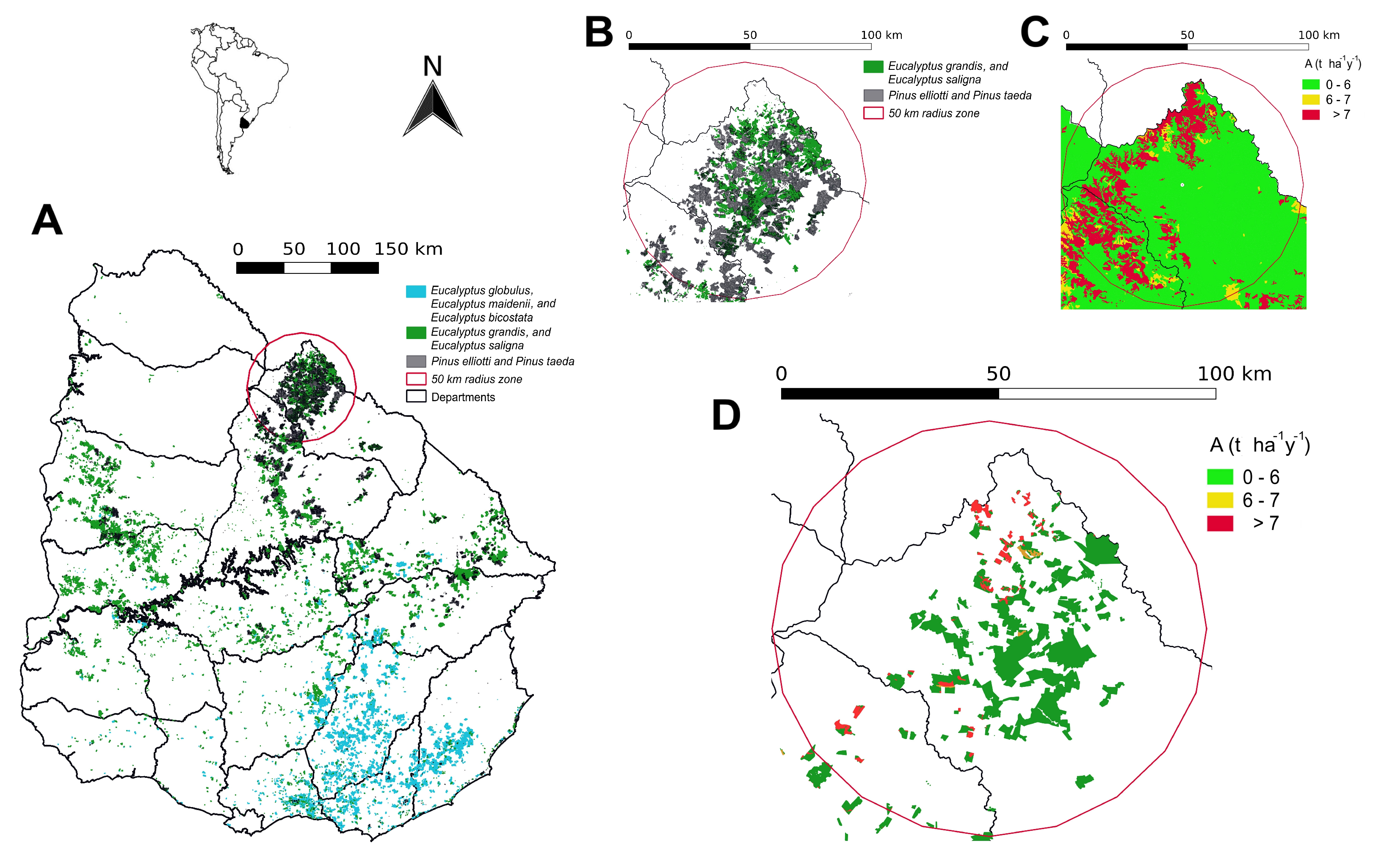
In the 50 km radius catchment area, there is 17.8% (104,460 ha) of 586,983 ha of soils (Figure 7C) with an annual erosion higher than the tolerable value (7 Mg ha yr). This occurs in steep, sandy loam soils [19,36,62]. In this catchment area of 73,152 ha (Figure 7D), 7.8% is found on soils with erosion greater than tolerable.
Figure 7.
(A) Current forest plantations reported by forest statistics 2019, (B) forest plantations in a 50 km radius zone, (C) soil erosion by water estimated by Carrasco-Letelier and Beretta-Blanco [18] and (D) soil erosion in plantations considered by this study.
3.3. EROI and CF
Most of the information about inputs, machinery characteristics, lifespans, fuel consumption, and other subjects were obtained from interviews with different forest companies. When the data were not available, the information was obtained from peer-reviewed publications. In exceptional cases, the information was obtained from the non-peer-reviewed literature. Most of the information gap was on tree nurseries; in this case, the data contained in Heller et al. [60] were used.
EROI estimation showed that the most important energy consumption was in the processes of harvest, second thinning, and plantation, which correspond to 53%, 25%, and 13% of the total input energy, respectively (Table 9). In terms of inputs, agriculture machinery, fuel, and pesticides explain 46%, 41%, and 11% of energy consumption, respectively. The ratios between energy output and input give a value between 44.5 and 49.1 for EROI; these values divided by the 21 years of plantations become values between 2.12 and 2.34.
Table 9.
Energy inputs and energy output of agroindustrial forestry chain. All values are expressed in MJ ha.
The CF results showed a mean value of 1.22 Kg CO per cubic meter of wood per year or 25.8 Kg CO m for a 21 year-old wood (Table 10). The major contributions to this CF outcome were linked to the harvest and second thinning processes at 74% and 9%, respectively. This was mainly caused by fuel consumption and machinery.
Table 10.
Global warming power for 100 years expressed in kg CO m of wood produced per year. Percentage of carbon footprint of current scenario in brackets.
4. Discussion
4.1. Potential Wood Supply
The wood availability in the different scenarios presented adequate volumes to satisfy the annual demand consumption (30,000 ADt) with scenarios II and III. However, scenarios I and III would not be recommended due to their high export of nutrients. Hernández et al. (2009) found that if the bark and leaves are left on the field it is possible to reduce the total exportations of N, P, K, Ca, and Mg to 41%, 55%, 46%, 68%, and 66%, respectively, in forest plantations for cellulose in northwestern soils. Nutrients can be restored faster in the soil where residues are buried and incorporated into the soil by tillage compared with soils where residues are left on the surface [63,64]. The PROBIO project results of plantations of E. grandis for solid wood have shown high rates of Ca with a harvest that does not remove bark from the field. These cation exportations in leaves and bark can reduce soil fertility and would reduce the yields, as occurred in the annual crops in Uruguay in the last decade [20]. In the same trend, Bentancor et al. [65] and Resquin et al. [66] showed the need to find a tradeoff between nutrient removal and wood production for forest plantation developments for bioenergy in northeastern soils, where the plantation density is a second variable that must be considered [66,67,68,69].
For the assessed region, the wood that is not used by the sawmill industry is sold to the pulp mill plant. At the current development of the forestry sector, two pulp mills are operating in the country, 430 [70] and 471 km [71] far from the center of the 50 km radius catchment area proposed in this study, and a third pulp mill will be located 221 km [72] far from the catchment center. Regionally, a new pulp industry could constitute the main threat for a sustained feedstock supply for a second-generation biorefinery. Therefore, because of a decrease in the freight distance, the competition for smaller pieces of Eucalyptus grandis increases, as does the price. The less favorable wood availability projections determine annual averages in the range of 27,000–45,000 ADt. By contrast, the distance from the nearest pulp mill would be four times or more than the harvest radius of the biorefinery. Therefore, there is a willingness to pay a near biorefinery better than the current price of wood for cellulose pulp, if it included the shipping costs for the farmer and the increase in the CF of cellulose pulp. Moreover, the E. grandis plantation area is already increasing, by the replacement of pine plantations, and the turn could decrease to 16 years as a consequence of a species replacement of pine plantations. Thus, these forest plantations changes would increase the Eucalyptus wood to 90,000 ADt per year.
The additional strengths of the region proposed are as follows: these plantations have long cycles; the company owners develop long-term plans for wood production; and E. grandis has shown good sanitary behavior so far, which reduces the risk against the appearance of pests or diseases [73]. This highlights the potential availability of feedstock to support the biorefinery for several decades.
4.2. Soil Erosion
The most important soil erosion processes in Uruguay were linked to the agricultural expansion and intensification of the last decade [19]. The situation partially explained the loss of nutrients due to bad fertilization management of rainfed crops, which reduced soil productivity [20]. Water erosion of the soil corresponds to a natural risk, that is, soils with high slope and structural fragility that are present in soils prioritized for forestry [18]. This situation was previously reported by Carrasco-Letelier and Beretta-Blanco [19]. This last type of erosion was the one detected in the studied area. Therefore, the erosion was not due to the afforestation but to their high sand content and steep slopes. Thus, the higher levels of erosion were not caused by the forest plantations studied. That situation agrees with other soil erosion studies [36,43,74].
4.3. EROI, Carbon Footprint, and Other Footprints
The EROI for template crops must remain between 2 and 4 [75]. The current value was higher than the 3.5, 1.28, and 0.76 reported for corn by Weißbach et al. [76], Kim and Dale [77], and Pimentel and Patzek [78], respectively. The EROI of 50 is close to the values reported by Romanelli and Milan [51] for Eucalyptus in Brazil. With this information only, it is possible to highlight that the current supply chain of wood for a biorefinery has an adequate EROI; however, this potential advantage depends on the industrial technology since this favorable EROI may be lost on the biorefinery [79] or improved with new technologies [80].
The CF result of Eucalyptus solid wood (1.22 kg CO m yr; 25.62 kg CO m in 21 years or 2.6 g CO MJ) is close to the 18.71 kg CO m reported by McCallum [81] and Berg [52] (20.4 kg CO m) but lower than that reported by Martínez-Alonso et al. [82] (423.21 kg CO m) for Spanish chestnut; lower than 0.61 kg CO kg (with no stored carbon) reported by Symons et al. [83], and if a wood density of 0.52 g cm[84] is considered, our CF should correspond to 0.05 kg CO kg. These differences in favor of Uruguayan solid wood could be higher than those indicated if the reported CF included the potential soil carbon sequestration that was not considered—mainly by the absence of the longest-running experiments on this kind of Uruguayan agriculture production, which allow one to estimate their impact. The situation that does not occur with annual rainfed crops that started the longest-running rainfed crop experiments in 1914, updated it 1964 [85], is complemented by the other longest-running experiments in the country [15,86].
This availability of biomass, EROI, and CF values suggests that these wood supply chains satisfy the sustainability criteria. However, this is only half of the process, because the main goal is bioethanol production. Then, these wood supply chains must be analyzed together with the EROI and CF of the destination biorefinery. In this framework, if this supply chain was considered with the first estimations of the BABET-REAL5 biorefinery (EROI = 1.16 MJ MJ; CF = 0.31 g if bioethanol was considered as the unique product), the average EROI and CF decrease to 1.73 MJ MJ and 1.39 g CO MJ. That is to say, the total CF would be 1.7% of the CF of petrol (83.8 g CO MJ,17]). Therefore, bioethanol would be sustainable according to the European Union norm [17].
Finally, the assessment performed by this study allows the description of the current condition of these forest plantations according to some of the main potential environmental impacts (availability of resources, soil erosion, EROI, and CFs). However, other dimensions such as water footprint, biodiversity loss [87], and eutrophication need to be studied to improve the LCA estimations as a strategy to identify, categorize, and hierarchize the environmental impacts that must be mitigated given its relevance according to the global impacts of the whole supply chain impact. Currently, according to Cravino and Brazeiro [88], grassland afforestation generates a negative impact at a local scale on the assemblage of medium- and large-sized native mammals, reducing cumulative species richness and capture rate compared with grasslands. Freshwater ecosystem modifications have shown that litter decomposition was inhibited at 36% in Uruguay [89] without significant differences in water chemistry between forested and nonforested basins. This information does not agree with the water stream acidification reported by Farley [90]. The results that are relevant to the two dimensions of LCA are water footprint and lost biodiversity. In addition, the hydrological studies of these forest plantations described a decrease in annual specific discharge (17%) for mean hydrological years relative to a pasture watershed [91].
The sustainability of all the supply chains will be highlighted in the near future, in particular by the direct and indirect consequences of global warming that will categorize the main supply chains by their total environmental impacts. This fact will change the willingness to pay, and feedstock availability will not be enough. Signs in this direction have been shown by the Food and Agriculture Organization of the United Nations (FAO) with Livestock Environmental Assessment and Performance guidelines of FAO [92]. The forestry sector will go in the same direction [87,93], and the comparisons between suppliers will increase in relevance [94,95]. Supply chain sustainability will require one to systematize research results, mainly in developing countries, at least the minimal descriptions about the common set of environmental categories used in an LCI assessment [96,97]. In this framework, the current information pointed out that Uruguay has the feedstock availability to hold a biorefinery and first results about environmental impacts. However, the current approach is not enough to avoid the impacts on its soils and waters [20,98]. In the future, the improvement in the information about water and biodiversity footprints would be required.
5. Conclusions
Based on the current results, it is possible to meet the feedstock requirements of a second-generation biorefinery considering the following criteria: (i) biomass availability larger than 30,000 tDM ha; (ii) soil loss originated by crop less than 7 t (ha yr); (iii) EROI larger than 2; and (iv) a CF lower than Petrol’s CF. First, we considered Eucalyptus grandis plantations specifically planted and managed for sawmill and plywood mill to use basal portions of stems up to a small-end diameter of 19 cm. For biorefinery purposes, using debarked logs with diameters between 19 and 6 cm would be recommended to attain at least twice the minimum amount of biomass required while maintaining the soil nutrient balance in a sustainable wood extraction scenario. Second, soils corresponding to plantations for solid wood did not show any significant soil erosion process due to agricultural activity. Although 17.8% of the catchment area show soil erosion larger than the tolerable thresholds, the soil erosion by water is rather linked to terrain and soil local characteristics. Third, the EROI considering cradle to gate analysis, and CF, showed acceptable values. Therefore, this supply chain can be considered sustainable according to the current published knowledge about environmental impacts. Future studies should focus on assessing water and biodiversity footprints for complementing this feedstock analysis.
Author Contributions
F.R., C.R.-C. and L.C.-L. planned and designed the research. F.R., C.R.-C. and L.C.-L. conducted fieldwork and performed experiments. F.R., C.R.-C. and L.C.-L. contributed to data elaboration and analysis. L.C.-L. wrote the manuscript, with contributions from all authors. All authors have read and agreed to the published version of the manuscript.
Funding
This study was funded by the European Commission in the frame of the BABET-REAL5 project (Horizon 2020 Program, Project No. 654365, accessed on 1st November 2021. http://www.babet-real5.eu).
Institutional Review Board Statement
Not applicable.
Informed Consent Statement
Not applicable.
Data Availability Statement
Data are available upon request to corresponding author.
Acknowledgments
The authors thank the INIA (accessed on 1st November 2021) http://inia.uy, MGAP https://www.gub.uy/ministerio-ganaderia-agricultura-pesca and forest companies for their collaboration with the information and databases.
Conflicts of Interest
The authors declare no conflict of interest.
Abbreviations
The following abbreviations are used in this manuscript:
| CF | Carbon footprint |
| EROI | Energy return on investment |
| LCA | Life cycle assessment |
Appendix A
Table A1.
Life cycle inventory of solid wood from 21 years Eucalyptus grandis plantations for sawmill and pulp mill.
References
- Brundtland, G.H. Our Common Future; United Nations: New York, NY, USA, 1987; p. 300. [Google Scholar]
- Elkington, J. Partnerships from Cannibals with Forks: The Triple Bottom Line of 21st-Century Business. Environ. Qual. Manag. 1998, 8, 37–51. [Google Scholar] [CrossRef] [Scilit]
- Brentrup, F.; Küsters, J.; Kuhlmann, H.; Lammel, J. Environmental Impact Assessment of Agricultural Production Systems Using the Life Cycle Assessment Methodology: I. Theoretical Concept of a LCA Method Tailored to Crop Production. Eur. J. Agron. 2004, 20, 247–264. [Google Scholar] [CrossRef] [Scilit]
- Rockström, J.; Steffen, W.; Noone, K.; Persson, Å.; Chapin, F.S.; Lambin, E.F.; Lenton, T.M.; Scheffer, M.; Folke, C.; Schellnhuber, H.J.; et al. A Safe Operating Space for Humanity. Nature 2009, 461, 472–475. [Google Scholar] [CrossRef] [Scilit] [PubMed]
- Cao, Y.; Chen, S.S.; Zhang, S.; Ok, Y.S.; Matsagar, B.M.; Wu, K.C.-W.; Tsang, D.C.W. Advances in Lignin Valorization towards Bio-Based Chemicals and Fuels: Lignin Biorefinery. Bioresour. Technol. 2019, 291, 121878. [Google Scholar] [CrossRef] [Scilit] [PubMed]
- De, D.; Naga Sai, M.S.; Aniya, V.; Satyavathi, B. Strategic Biorefinery Platform for Green Valorization of Agro-Industrial Residues: A Sustainable Approach towards Biodegradable Plastics. J. Clean. Prod. 2021, 290, 125184. [Google Scholar] [CrossRef] [Scilit]
- Poveda-Giraldo, J.A.; Solarte-Toro, J.C.; Cardona Alzate, C.A. The Potential Use of Lignin as a Platform Product in Biorefineries: A Review. Renew. Sustain. Energy Rev. 2021, 138, 110688. [Google Scholar] [CrossRef] [Scilit]
- Zhao, Y.; Shakeel, U.; Saif Ur Rehman, M.; Li, H.; Xu, X.; Xu, J. Lignin-Carbohydrate Complexes (LCCs) and Its Role in Biorefinery. J. Clean. Prod. 2020, 253, 120076. [Google Scholar] [CrossRef] [Scilit]
- Meena, M.; Shubham, S.; Paritosh, K.; Pareek, N.; Vivekanand, V. Production of Biofuels from Biomass: Predicting the Energy Employing Artificial Intelligence Modelling. Bioresour. Technol. 2021, 340, 125642. [Google Scholar] [CrossRef] [Scilit]
- Sivagurunathan, P.; Raj, T.; Mohanta, C.S.; Semwal, S.; Satlewal, A.; Gupta, R.P.; Puri, S.K.; Ramakumar, S.S.V.; Kumar, R. 2G Waste Lignin to Fuel and High Value-Added Chemicals: Approaches, Challenges and Future Outlook for Sustainable Development. Chemosphere 2021, 268, 129326. [Google Scholar] [CrossRef] [Scilit]
- Koberg, E.; Longoni, A. A Systematic Review of Sustainable Supply Chain Management in Global Supply Chains. J. Clean. Prod. 2019, 207, 1084–1098. [Google Scholar] [CrossRef] [Scilit]
- Lo, S.L.Y.; How, B.S.; Leong, W.D.; Teng, S.Y.; Rhamdhani, M.A.; Sunarso, J. Techno-Economic Analysis for Biomass Supply Chain: A State-of-the-Art Review. Renew. Sustain. Energy Rev. 2021, 135, 110164. [Google Scholar] [CrossRef] [Scilit]
- Hall, C.A.S.; Lambert, J.G.; Balogh, S.B. EROI of Different Fuels and the Implications for Society. Energy Policy 2014, 64, 141–152. [Google Scholar] [CrossRef] [Scilit]
- Hu, Y.; Hall, C.A.S.; Wang, J.; Feng, L.; Poisson, A. Energy Return on Investment (EROI) of China’s Conventional Fossil Fuels: Historical and Future Trends. Energy 2013, 54, 352–364. [Google Scholar] [CrossRef] [Scilit]
- Macedo, I.; Terra, J.A.; Siri-Prieto, G.; Velazco, J.I.; Carrasco-Letelier, L. Rice-Pasture Agroecosystem Intensification Affects Energy Use Efficiency. J. Clean. Prod. 2021, 278, 123771. [Google Scholar] [CrossRef] [Scilit]
- Townsend, J.M.; Hall, C.A.S.; Volk, T.A.; Murphy, D.; Ofezu, G.; Powers, B.; Quaye, A.; Serapiglia, M. Energy Return on Investment (EROI), Liquid Fuel Production, and Consequences for Wildlife. In Peak Oil, Economic Growth, and Wildlife Conservation; Gates, J.E., Trauger, D.L., Czech, B., Eds.; Springer: New York, NY, USA, 2014; pp. 29–61. ISBN 978-1-4939-1953-6. [Google Scholar]
- Howes, T. The EU’s new renewable energy directive (2009/28/EC). The new climate policies of the European. Union Intern. Legis. Clim. Dipl. 2010, 15, 3. [Google Scholar]
- Beretta-Blanco, A.; Carrasco-Letelier, L. USLE/RUSLE K-Factors Allocated through a Linear Mixed Model for Uruguayan Soils. Cienc. E Investig. Agrar. 2017, 44, 100–112. [Google Scholar] [CrossRef] [Scilit]
- Carrasco-Letelier, L.; Beretta-Blanco, A. Soil Erosion by Water Estimated for 99 Uruguayan Basins. Cienc. E Investig. Agrar. 2017, 44, 184–194. [Google Scholar]
- Beretta-Blanco, A.; Pérez, O.; Carrasco-Letelier, L. Soil Quality Decrease over 13 Years of Agricultural Production. Nutr. Cycl. Agroecosystems 2019, 114, 45–55. [Google Scholar] [CrossRef] [Scilit]
- Simoes, A. Uruguay (URY) Exports, Imports, and Trade Partners. The Observatory of Economic Complexity (OEC). Available online: https://oec.world/en/profile/country/ury (accessed on 1 November 2021).
- Bonifacino, S.; Resquín, F.; Lopretti, M.; Buxedas, L.; Vázquez, S.; González, M.; Sapolinski, A.; Hirigoyen, A.; Doldán, J.; Rachid, C.; et al. Bioethanol Production Using High Density Eucalyptus Crops in Uruguay. Heliyon 2021, 7, e06031. [Google Scholar] [CrossRef] [Scilit]
- Duque, A.; Doménech, P.; álvarez, C.; Ballesteros, M.; Manzanares, P. Study of the Bioprocess Conditions to Produce Bioethanol from Barley Straw Pretreated by Combined Soda and Enzyme-Catalyzed Extrusion. Renew. Energy 2020, 158, 263–270. [Google Scholar] [CrossRef] [Scilit]
- Ferrari, M.D.; Guigou, M.; Lareo, C. Energy Consumption Evaluation of Fuel Bioethanol Production from Sweet Potato. Bioresour. Technol. 2013, 136, 377–384. [Google Scholar] [CrossRef] [Scilit]
- DIEA Agricultural Statistic Yearbook 2018 (Anuario Estadístico Agropecuario 2018); Ministerio de Agricultura, Ganadería y Pesca, Editorial Hemisferio Sur (In Spanish): Montevideo, Uruguay, 2018.
- Boscana, M.; Boragno, L.; Arriaga, E. Estadísticas Forestales 2021: Extracción, Producción, Consumo, Mano de Obra, Comercio Exterior; División Evaluación e Información, Dirección General Forestal, Ministerio de Ganadería Agricultura y Pesca: Montevideo, Uruguay, 2021; p. 69. [Google Scholar]
- Carrasco-Letelier, L.; Vázquez, D.; D’Ottone, F.; Resquin, F.; Scoz, R.; Vilaró, F.; Rodríguez, G.; Terra, J. Revista INIA; Instituto de Investigación Agropecuaria: Montevideo, Uruguay, 2013; pp. 40–46. [Google Scholar]
- BABET-REAL5 Consortium BABET-REAL5. Available online: https://www.babet-real5.eu/https://www.babet-real5.eu/ (accessed on 18 August 2021).
- Royo Pallares, O.; Berretta, E.J.; Maraschin, G.E. Chapter 5: The South American Campos Ecosystem. In Grasslands of the World; Plant Production and Protection Series; FAO (Food and Agriculture Organization of the United Nations): Rome, Italy, 2005; pp. 171–220. ISBN 92-5-105337-5. [Google Scholar]
- Kottek, M.; Grieser, J.; Beck, C.; Rudolf, B.; Rubel, F. World Map of the Küppen-Geiger Climate Classification Updated. Meteorol. Z. 2006, 15, 259–263. [Google Scholar] [CrossRef] [Scilit]
- Castaño, J.P.G.; Ceroni, A.; Furest, M.; Aunchayna, J.; Bidegain, R. Caracterización Agroclimática Del Uruguay 1980–2009; Serie Técnica INIA; Serie Técnica N° 193; Instituto de Investigación Agropecuaria: Montevideo, Uruguay, 2011. [Google Scholar]
- Gardi, C.; Angelini, M.; Barceló, S.; Comerma, J.; Cruz Gaistardo, C.; Encina Rojas, A.; Jones, A.; Krasilnikov, P.; Mendonça Santos Brefin, M.L.; Montanarella, L.; et al. Atlas de Suelos de América Latina y El Caribe; Comisión Europea, Oficina de Publicaciones de la Unión Europea: Luxembourg, 2014. [Google Scholar]
- Altamirano, A.; Da Silva, H.; Durán, A.; Echevarría, A.; Panario, D.; Puentes, R. Carta de Reconocimiento de Suelos del Uruguay; Tomo I: Clasificación de Suelos; Dirección de Suelos y Fertilizantes, Ministerio de Agricultura y Pesca: Montevideo, Uruguay, 1976. [Google Scholar]
- Durán, A.; Califra, A.; Molfino, J.; Lynn, W. Keys to Soil Taxonomy for Uruguay; US Department of Agriculture, Natural Resources Conservation Service: Washington, DC, USA, 2006.
- MAP/DSF Carta de Reconocimiento de Suelos Del Uruguay. Descripciones, Datos Físicos y Químicos de Los Suelos Dominantes; Tomo III Apéndice- Parte I y Parte II; Dirección de Suelos y Fertilizantes, Ministerio de Agricultura y Pesca: Montevideo, Uruguay, 1976. [Google Scholar]
- Durán, A.; García-Préchac, F. Suelos Del Uruguay. Origen, Clasificación, Manejo y Conservación; Hemisferio Sur: Montevideo, Uruguay, 2007; Volume II. [Google Scholar]
- Lima, M.A.; Gomez, L.D.; Steele-King, C.G.; Simister, R.; Bernardinelli, O.D.; Carvalho, M.A.; Rezende, C.A.; Labate, C.A.; deAzevedo, E.R.; McQueen-Mason, S.J.; et al. Evaluating the Composition and Processing Potential of Novel Sources of Brazilian Biomass for Sustainable Biorenewables Production. Biotechnol. Biofuels 2014, 7, 10. [Google Scholar] [CrossRef] [Scilit] [PubMed]
- Dirección Nacional de Catastro Visualizador de geoCatastro. Available online: http://visor.catastro.gub.uy/visordnc/ (accessed on 23 August 2021).
- Dirección General Forestal Resultados de La Cartografía Forestal Nacíonal 2018; Ministerio de Agricultura, Ganadería y Pesca: Montevideo, Uruguay, 2018; p. 22.
- QGIS Geographic Information System. Open Source Geospatial Foundation Project. 2021. Available online: https://qgis.org/es/site/ (accessed on 1 November 2021).
- PROBIO Mejoramiento en la Calidad de la Información Vinculada con la Utilización de la Biomasa Forestal; MVOTMA, INIA: Tacuarembó, Uruguay, 2015; p. 34.
- García-Préchac, F. Guía Para la Toma de Decisiones en Conservación de Suelos: 3a. Aproximación; Serie Técnica INIA; INIA Uruguay: Montevideo, Uruguay, 1992. [Google Scholar]
- García-Préchac, F.; Hill, M.; Clericí, C. Erosión: Modelo de Estimación de Erosión de Suelos En Uruguay y Región Sur de La Cuenca Del Plata (software); Departamento de Suelos y Aguas, Facultad de Agronomía, Universidad de la República, Ministerio de Ganadería Agricultura y Pesca-Banco Mundial; Montevideo, Uruguay. 2013. Available online: https://www.gub.uy/ministerio-ganaderia-agricultura-pesca/politicas-y-gestion/actualizacion-tecnica-del-modelo-para-cuantificacion-perdida-suelo-erosion (accessed on 1 November 2021).
- García-Préchac, F.; Durán, A. Propuesta de Estimación Del Impacto de La Erosión Sobre La Productividad Del Suelo En Uruguay. Agrociencia Urug. 1998, 2, 26–36. [Google Scholar]
- Foster, G.R.; McCool, D.K.; Renard, K.G.; Moldenhauer, W.C. Conversion of the Universal Soil Loss Equation to SI Metric Units. J. Soil Water Conserv. 1981, 36, 355–359. [Google Scholar]
- DGRNR, (Dirección General de Recursos Naturales Renovables) Modelo Digital de Terreno de La República Oriental Del Uruguay: Resolución Del Modelo 30 × 30 Metros (Online) [Digital Terrain Model of the Eastern Republic of Uruguay: Model Resolution of 30 × 30 Meters]. 2014. Available online: https://www.gub.uy/ministerio-ganaderia-agricultura-pesca/tramites-y-servicios/servicios/modelo-digital-terreno/ (accessed on 23 August 2021).
- DGRNR, (Dirección General de Recursos Naturales Renovables) Cartografía Digital de Grupos de Suelos CONEAT (Comisión Nacional de Estudio Agroeconómico de La Tierra) de La República Oriental Del Uruguay (Online). Available online: http://web.renare.gub.uy/js/visores/coneat/ (accessed on 23 August 2021).
- Hall, C.A.S.; Balogh, S.; Murphy, D.J.R. What Is the Minimum EROI That a Sustainable Society Must Have? Energies 2009, 2, 25–47. [Google Scholar] [CrossRef] [Scilit]
- Hall, C.A.S.; Powers, R.; Schoenberg, W. Peak Oil, EROI, Investments and the Economy in an Uncertain Future. In Biofuels, Solar and Wind as Renewable Energy Systems; Pimentel, D., Ed.; Springer: Dordrecht, The Netherlands, 2008; pp. 109–132. ISBN 978-1-4020-8653-3. [Google Scholar]
- Roy, P.; Nei, D.; Orikasa, T.; Xu, Q.; Okadome, H.; Nakamura, N.; Shiina, T. A Review of Life Cycle Assessment (LCA) on Some Food Products. J. Food Eng. 2009, 90, 1–10. [Google Scholar] [CrossRef] [Scilit]
- Romanelli, T.L.; Milan, M. Energy Performance of a Production System of Eucalyptus. Rev. Bras. Eng. Agríc. E Ambient. 2010, 14, 896–903. [Google Scholar] [CrossRef] [Scilit]
- Berg, S. Some Aspects of LCA in the Analysis of Forestry Operations. J. Clean. Prod. 1997, 5, 211–217. [Google Scholar] [CrossRef] [Scilit]
- Berg, S.; Karjalainen, T. Comparison of Greenhouse Gas Emissions from Forest Operations in Finland and Sweden. For. Int. J. For. Res. 2003, 76, 271–284. [Google Scholar] [CrossRef] [Scilit]
- Berg, S.; Lindholm, E.-L. Energy Use and Environmental Impacts of Forest Operations in Sweden. J. Clean. Prod. 2005, 13, 33–42. [Google Scholar] [CrossRef] [Scilit]
- Green Delta OpenLCA; Green Delta: Berlin, Germany, 2020.
- Pachauri, R.K.; Allen, M.R.; Barros, V.R.; Broome, J.; Cramer, W.; Christ, R.; Church, J.A.; Clarke, L.; Dahe, Q.; Dasgupta, P.; et al. In Proceedings of the IPCC Fifth Assessment Synthesis Report-Climate Change 2014 Synthesis Report; IPCC: Geneva, Switzerland, 2014. [Google Scholar]
- Ulbanere, R.; Ferreira, W. Energetic Balance Analysis for Corn Production in Sao Paulo State-Southeast Brazil; Analise Do Balanco Energetico Para a Producao de Milho No Estado de Sao Paulo. Energ. Na Agric. 1989, 4, 35–42. [Google Scholar]
- Pimentel, D. Handbook of Energy Utilization in Agriculture; CRC press: Boca Raton, FL, USA, 1980. [Google Scholar]
- Nagy, C.N. Energy Coefficients for Agriculture Inputs in Western Canada; Centre for Studies in Agriculture, Law and the Environment, University of Saskatchewan: Saskatoon, SK, USA, 1999. [Google Scholar]
- Heller, M.C.; Keoleian, G.A.; Volk, T.A. Life Cycle Assessment of a Willow Bioenergy Cropping System. Biomass Bioenergy 2003, 25, 147–165. [Google Scholar] [CrossRef] [Scilit]
- Hill, J.; Nelson, E.; Tilman, D.; Polasky, S.; Tiffany, D. Environmental, Economic, and Energetic Costs and Benefits of Biodiesel and Ethanol Biofuels. Proc. Natl. Acad. Sci. USA 2006, 103, 11206–11210. [Google Scholar] [CrossRef] [Scilit]
- García-Prechac, F.; Durán, A. Estimating Soil Productivity Loss Due to Erosion in Uruguay in Terms of Beef and Wool Production on Natural Pastures. In Proceedings of the Sustaining the Global Farm; Stott, D.E., Mohtar, R.H., Steinhardt, G.C., Eds.; Purdue University and the USDA-ARS National Soil Erosion Research Laboratory: West Lafayette, IN, USA, 2001; pp. 040–045. [Google Scholar]
- Hernández, J.; del Pino, A.; Salvo, L.; Arrarte, G. Nutrient Export and Harvest Residue Decomposition Patterns of a Eucalyptus dunnii Maiden Plantation in Temperate Climate of Uruguay. For. Ecol. Manag. 2009, 258, 92–99. [Google Scholar] [CrossRef] [Scilit]
- Hernández, J.; del Pino, A.; Hitta, M.; Lorenzo, M. Management of Forest Harvest Residues Affects Soil Nutrient Availability during Reforestation of Eucalyptus grandis. Nutr. Cycl. Agroecosystems 2016, 105, 141–155. [Google Scholar] [CrossRef] [Scilit]
- Bentancor, L.; Hernández, J.; del Pino, A.; Califra, á.; Resquín, F.; González-Barrios, P. Evaluation of the Biomass Production, Energy Yield and Nutrient Removal of Eucalyptus dunnii Maiden Grown in Short Rotation Coppice under Two Initial Planting Densities and Harvest Systems. Biomass Bioenergy 2019, 122, 165–174. [Google Scholar] [CrossRef] [Scilit]
- Resquin, F.; Navarro-Cerrillo, R.M.; Carrasco-Letelier, L.; Casnati, C.R. Influence of Contrasting Stocking Densities on the Dynamics of Above-Ground Biomass and Wood Density of Eucalyptus benthamii, Eucalyptus dunnii, and Eucalyptusgrandis for Bioenergy in Uruguay. For. Ecol. Manag. 2019, 438, 63–74. [Google Scholar] [CrossRef] [Scilit]
- Resquin, F.; Navarro-Cerrillo, R.M.; Carrasco-Letelier, L.; Casnati, C.R.; Bentancor, L. Evaluation of the Nutrient Content in Biomass of Eucalyptus Species from Short Rotation Plantations in Uruguay. Biomass Bioenergy 2020, 134, 105502. [Google Scholar] [CrossRef] [Scilit]
- Resquin, F.; Navarro-Cerrillo, R.M.; Carrasco-Letelier, L.; Rachid-Casnati, C. Influence of Age and Planting Density on the Energy Content of Eucalyptus Benthamii, Eucalyptus Dunnii and Eucalyptus Grandis Planted in Uruguay. New For. 2020, 51, 631–655. [Google Scholar] [CrossRef] [Scilit]
- Resquin, F.; Navarro-Cerrillo, R.M.; Rachid-Casnati, C.; Hirigoyen, A.; Carrasco-Letelier, L.; Duque-Lazo, J. Allometry, Growth and Survival of Three Eucalyptus Species (Eucalyptus benthamii Maiden and Cambage, E. dunnii Maiden and E. grandis Hill Ex Maiden) in High-Density Plantations in Uruguay. Forests 2018, 9, 745. [Google Scholar] [CrossRef] [Scilit]
- UPM Pulp Direct 3/2017 - UPM Fray Bentos Has Been Serving Customers for 10 Years. Available online: https://www.upm.com/about-us/for-media/releases/2017/11/pulp-direct-32017---upm-fray-bentos-has-been-serving-customers-for-10-years/ (accessed on 23 August 2021).
- Stora Enso Montes Del Plata Mill. Available online: https://www.storaenso.com/en/about-stora-enso/stora-enso-locations/montes-del-plata-mil (accessed on 23 August 2021).
- UPM UPM Top Management Met with Uruguay’s President Dr. Tabaré Vázquez. Available online: https://www.upm.com/about-us/for-media/releases/2019/02/upm-top-management-met-with-uruguays-president-dr.-tabare-vazquez/ (accessed on 23 August 2021).
- da Silva, P.H.M.; Marco, M.; Alvares, C.A.; Lee, D.; de Moraes, M.L.T.; de Paula, R.C. Selection of Eucalyptus grandis Families across Contrasting Environmental Conditions. Crop Breed. Appl. Biotechnol. 2019, 19, 47–54. [Google Scholar] [CrossRef] [Scilit]
- Clericí, C.; García-Préchac, F. Aplicaciones Del Modelo USLE/RUSLE Para Estimar Pérdidas de Suelo Por Erosión En Uruguay y La Región Sur de La Cuenca Del Río de La Plata. Agrociencia 2001, V, 92–103. [Google Scholar]
- Murphy, D.J.; Hall, C.A.S.; Powers, B. New Perspectives on the Energy Return on (Energy) Investment (EROI) of Corn Ethanol. Environ. Dev. Sustain. 2011, 13, 179–202. [Google Scholar] [CrossRef] [Scilit]
- Weißbach, D.; Ruprecht, G.; Huke, A.; Czerski, K.; Gottlieb, S.; Hussein, A. Energy Intensities, EROIs (Energy Returned on Invested), and Energy Payback Times of Electricity Generating Power Plants. Energy 2013, 52, 210–221. [Google Scholar] [CrossRef] [Scilit]
- Kim, S.; Dale, B.E. Life Cycle Assessment of Various Cropping Systems Utilized for Producing Biofuels: Bioethanol and Biodiesel. Biomass Bioenergy 2005, 29, 426–439. [Google Scholar] [CrossRef] [Scilit]
- Pimentel, D.; Patzek, T. Ethanol Production Using Corn, Switchgrass and Wood; Biodiesel Production Using Soybean. In Biofuels, Solar and Wind as Renewable Energy Systems: Benefits and Risks; Pimentel, D., Ed.; Springer: Dordrecht, The Netherlands, 2008; pp. 373–394. ISBN 978-1-4020-8654-0. [Google Scholar]
- Chiriboga, G.; De La Rosa, A.; Molina, C.; Velarde, S.; Carvajal C, G. Energy Return on Investment (EROI) and Life Cycle Analysis (LCA) of Biofuels in Ecuador. Heliyon 2020, 6, e04213. [Google Scholar] [CrossRef] [Scilit]
- Hall, C.A.S.; Dale, B.E.; Pimentel, D. Seeking to Understand the Reasons for Different Energy Return on Investment (EROI) Estimates for Biofuels. Sustainability 2011, 3, 2413–2432. [Google Scholar] [CrossRef] [Scilit]
- McCallum, D. Carbon Footprint of New Zealand. Laminated Veneer Lumber SCION – Next Generation Biomaterials; 2010. Available online: http://www.nelsonpine.co.nz/wp-content/uploads/Carbon-Footprint-of-NZ-LVL-Dec10-FINAL.pdf (accessed on 1 November 2021).
- Martínez-Alonso, C.; Berdasco, L.; González, L.; Martínez, S. Huella de Carbono de Un Producto de Madera de Castaño (Proyecto Piloto En Asturias). Prog. For. 2012, 29, 35–39. [Google Scholar]
- Symons, K.; Dowdell, D.; Butler, J.; Vickers, J.; Wakelin, S.; Rawlinson, D. Timber, Carbon and the Environment; NZ Wood Design Guides; Wood Processors and Manufacturers Association. 2020. Available online: https://www.wpma.org.nz/uploads/1/3/2/8/132870817/ch-2.1-trees-carbon-and-the-environment.pdf (accessed on 1 November 2021).
- Doldán, J. Evaluación de Parámetros de Calidad de Eucalyptus globulus y Eucalyptus maidenii de Plantaciones Uruguayas Para Pulpa de Celulosa; LATU: Montevideo, Uruguay, 2006; p. 8. [Google Scholar]
- Grahmann, K.; Rubio Dellepiane, V.; Terra, J.A.; Quincke, J.A. Long-term observations in contrasting crop-pasture rotations over half a century: Statistical analysis of chemical soil properties and implications for soil sampling frequency. Agric. Ecosyst. Environ. 2020, 287, 106710. [Google Scholar] [CrossRef] [Scilit]
- Bustamante-Silveira, M.; Siri-Prieto, G.; Carrasco-Letelier, L. Water footprints of bioethanol cropping systems in Uruguay. Agric. Water Manag. 2021, 252, 106870. [Google Scholar] [CrossRef] [Scilit]
- Myllyviita, T.; Sironen, S.; Saikku, L.; Holma, A.; Leskinen, P.; Palme, U. Assessing Biodiversity Impacts in Life Cycle Assessment Framework - Comparing Approaches Based on Species Richness and Ecosystem Indicators in the Case of Finnish Boreal Forests. J. Clean. Prod. 2019, 236, 117641. [Google Scholar] [CrossRef] [Scilit]
- Cravino, A.; Brazeiro, A. Grassland Afforestation in South America: Local Scale Impacts of Eucalyptus Plantations on Uruguayan Mammals. For. Ecol. Manag. 2021, 484, 118937. [Google Scholar] [CrossRef] [Scilit]
- Ferreira, V.; Boyero, L.; Calvo, C.; Correa, F.; Figueroa, R.; Gonçalves, J.F.; Goyenola, G.; Graça, M.A.S.; Hepp, L.U.; Kariuki, S.; et al. A Global Assessment of the Effects of Eucalyptus Plantations on Stream Ecosystem Functioning. Ecosystems 2019, 22, 629–642. [Google Scholar] [CrossRef] [Scilit]
- Farley, K.A. Effects of Afforestation on Water Yield: A Global Synthesis with Implications for Policy. Glob. Change Biol. 2005, 11, 1565–1576. [Google Scholar] [CrossRef] [Scilit]
- Silveira, L.; Gamazo, P.; Alonso, J.; Martínez, L. Effects of Afforestation on Groundwater Recharge and Water Budgets in the Western Region of Uruguay. Hydrol. Process. 2016, 30, 3596–3608. [Google Scholar] [CrossRef] [Scilit]
- Gerber, P.J.; Mottet, A.; Opio, C.I.; Falcucci, A.; Teillard, F. Environmental Impacts of Beef Production: Review of Challenges and Perspectives for Durability. Meat Sci. 2015, 109, 2–12. [Google Scholar] [CrossRef] [Scilit]
- Côté, S.; Beauregard, R.; Margni, M.; Bélanger, L. Using Naturalness for Assessing the Impact of Forestry and Protection on the Quality of Ecosystems in Life Cycle Assessment. Sustainability 2021, 13, 8859. [Google Scholar] [CrossRef] [Scilit]
- Auer, V.; Rauch, P. Wood Supply Chain Risks and Risk Mitigation Strategies: A Systematic Review Focusing on the Northern Hemisphere. Biomass Bioenergy 2021, 148, 106001. [Google Scholar] [CrossRef] [Scilit]
- Korol, J.; Hejna, A.; Burchart-Korol, D.; Wachowicz, J. Comparative Analysis of Carbon, Ecological, and Water Footprints of Polypropylene-Based Composites Filled with Cotton, Jute and Kenaf Fibers. Materials 2020, 13, 3541. [Google Scholar] [CrossRef] [Scilit]
- Clift, R. Metrics for supply chain sustainability. In Technological Choices for Sustainability; Sikdar, S.K., Glavič, P., Jain, R., Eds.; Springer: Berlin/Heidelberg, Germany, 2004; pp. 239–253. ISBN 978-3-662-10270-1. [Google Scholar]
- Giannakis, M.; Papadopoulos, T. Supply Chain Sustainability: A Risk Management Approach. Int. J. Prod. Econ. 2016, 171, 455–470. [Google Scholar] [CrossRef] [Scilit]
- Beretta-Blanco, A.; Carrasco-Letelier, L. Relevant Factors in the Eutrophication of the Uruguay River and the Río Negro. Sci. Total Environ. 2021, 761, 143299. [Google Scholar] [CrossRef] [Scilit] [PubMed]

Publisher’s Note: MDPI stays neutral with regard to jurisdictional claims in published maps and institutional affiliations. |
© 2021 by the authors. Licensee MDPI, Basel, Switzerland. This article is an open access article distributed under the terms and conditions of the Creative Commons Attribution (CC BY) license (https://creativecommons.org/licenses/by/4.0/).