
Abstract
This paper introduces a novel method for the topology optimization of multi-material structures. The core innovation lies in minimizing an appropriate norm of the transfer matrix that links external loads to system outputs. Several formulations of structural compliance are considered within a framework that accommodates both single and multiple inputs and outputs. The multimaterial interpolation scheme follows the approach proposed by Yi and collaborators, which is adapted to the general topology optimization framework proposed by Venini and collaborators. While the proposed method is inherently capable of addressing the dynamic response of multimaterial structures, this study focuses exclusively on static topology optimization. The extension to dynamic topology optimization is deferred to a fortcoming study, which requires a multimaterial interpolation of inertial properties that is currently in an advanced development stage. Finally, a series of numerical case studies illustrate the key features of the proposed approach.
1. Introduction
Topology optimization (TO) is a powerful computational design methodology that seeks optimal material distribution within a given domain, subject to physics-based constraints and objectives [1,2]. Traditionally applied to single-material structures, TO has enabled the synthesis of highly efficient, lightweight, and innovative components across engineering disciplines. However, as manufacturing technologies such as additive manufacturing and multi-material printing have advanced [3], there is a growing need to extend TO methodologies to accommodate multiple material phases. This demand is driven by the potential of multimaterial structures to offer superior performance by strategically combining the desirable properties of different materials—e.g., stiffness, energy absorption, heat conduction, or cost-efficiency—in a single optimized layout.
Multimaterial Topology Optimization (MMTO) introduces several new challenges that distinguish it from its single-material counterpart. First, the interpolation of material properties becomes substantially more complex. Unlike the conventional SIMP (Solid Isotropic Material with Penalization) scheme [2] which interpolates between solid and void, MMTO must handle transitions across multiple discrete materials without producing physically meaningless mixtures or gray zones. Techniques such as the Discrete Material Optimization (DMO) [4], peak functions [5], and ordered SIMP interpolations [3] have been developed to address these challenges.
More recent efforts have focused on improving the manufacturability and computational efficiency of MMTO. Zheng et al. [6] proposed a mapping-based interpolation function implemented in a compact MATLAB code, extending the educational 88-line TO code [7] to handle 2D and 3D multimaterial structures. Their approach yields clear 0–1 solutions and ensures discrete material regions suitable for fabrication. Similarly, Dinh et al. [8] introduced a single-variable-based interpolation function with continuous derivatives to enhance optimization convergence and reduce design dimensionality.
A significant issue in MMTO is phase mixing at material boundaries, which complicates both physical interpretation and manufacturing. Asadpoure et al. [9] tackled this by developing a multi-phase topology optimization framework with independent design variables for each phase. Their approach employs Heaviside projections with phase-specific length-scale control, aggregated constraints to avoid overfilling, and consistent penalization for phase separation. This method enables large-scale optimization and mitigates the tendency for undesired material interpenetration.
Beyond mechanical compliance, MMTO has also been extended to address more complex physical behaviors such as plasticity and transient thermal conduction. Jia et al. [10] introduced a multiobjective MMTO framework for elastoplastic composite structures that simultaneously enhances stiffness, delays yielding, and maximizes energy dissipation. Their use of return mapping algorithms and history-dependent adjoint sensitivities marks an important advance in integrating realistic material behavior into TO. On the thermal side, Ogawa et al. [4] applied the DMO method to MMTO for unsteady heat conduction, emphasizing its robustness against material ordering and its capability to optimize thermal pathways in time-dependent problems.
Several common threads emerge across these studies. First, interpolation strategies remain a central concern: whether using multi-variable SIMP [11], DMO [12], or peak/ordered functions [3,5], each method seeks to balance fidelity, computational cost, and manufacturability. As far as other optimization methods are concerned, Huang and Xie (2023) [13], enhanced the BESO (Bi-directional Evolutionary Structural Optimization) method by incorporating buckling constraints, effectively addressing pseudo buckling modes in structural topology optimization; Huang (2020) developed an element-based topology optimization algorithm for a smooth design [14] that was further investigated in Huang and Li (2022), [15], that introduced a three-field FPTO (Floating Projection Topology Optimization) method employing linear material interpolation, facilitating the generation of clear 0/1 designs without the need for penalization schemes. Huang et al. (2020) [16], developed the SEMDOT (Smooth-Edged Material Distribution for Optimizing Topology) algorithm, which effectively produces optimized topologies with smooth and clear boundaries, outperforming traditional methods in certain applications. Second, controlling the interface between material phases—whether through filtering, projection, or constraint aggregation—proves essential in achieving physically meaningful designs. Third, scalability and code accessibility, as emphasized by Zheng et al. [6] and Sanders [17], are key to enabling broader adoption of MMTO by researchers and practitioners.
Despite these advances, MMTO remains a vibrant and rapidly evolving field. Open challenges include the integration of nonlinear material behaviors, uncertainty quantification, multi-physics coupling, and automated manufacturability constraints. Moreover, emerging fabrication technologies continue to push the boundaries of what is realizable, demanding increasingly sophisticated optimization formulations.
Given this background, the present paper proposes an innovative formulation for the topology optimization of Multi-Input (multi-loaded) Multi-Output (multi-objective) structures in a multi-material setting. While the framework naturally includes classical compliance optimization as a special case, it is sufficiently general to accommodate alternative compliance definitions and other objective functions tailored to specific applications. The central idea behind the proposed approach is the explicit formulation of the input-output transfer matrix, denoted as , which maps applied loads to the structural response.
In this framework, the structural response vector—often referred to as the output vector—can be any linear combination of the state vector components. Notably, structural compliance, which is the primary objective in most topology optimization studies, can inherently be expressed as a linear combination of displacements at the locations where loads are applied. The applied loads themselves serve as coefficients of this combination, as demonstrated later in this paper. Consequently, the optimization problem is formulated to minimize a suitable measure of the “amplitude” of the transfer matrix , which, from an engineering perspective, corresponds to reducing the impact of applied loads on the structure.
A key component of this methodology is the selection of an appropriate metric to quantify the amplitude of the transfer matrix. The Singular Value Decomposition (SVD) [18,19] emerges as a natural tool for this purpose. Not only does SVD facilitate the computation of matrix norms that serve as amplitude measures, but it also provides valuable insights into system behavior. Furthermore, since these norms are uniquely defined in terms of the singular values of , the computation of sensitivities is significantly simplified—reducing the problem to evaluating the gradients of singular values with respect to design parameters. The formulation presented in this paper extends to MMTO the one presented in [20] that is restricted to standard topology optimization in a SIMP framework. As for the 3D idealization, the formulation introduced in [21] shall be extended to the multimaterial case in a forthcoming contribution.
The remainder of this paper is structured as follows. Section 2 outlines the fundamental principles of the adopted multi-material interpolation scheme, which builds upon the methodology proposed in [22]. The section provides a detailed account of the interpolation strategy, along with a comprehensive description of the two-stage filtering process employed to mitigate checkerboarding and prevent the emergence of grey regions within the design domain.
Section 3 introduces the key properties of Singular Value Decomposition (SVD), emphasizing its relevance in engineering applications. A central insight is that the input and output singular vectors are linked through a gain defined by the corresponding singular value, making this framework particularly effective for both static and dynamic topology optimization problems, including the classical minimum compliance formulation. The section also provides an explicit derivation of the transfer matrix for the widely used case of displacement-based finite element discretization. Furthermore, it formulates the general topology optimization problem and presents a semi-analytic approach for computing the sensitivities of both the objective function and the constraints.
Section 4 focuses on selecting the components of the output vector, which define specific optimization objectives, with an emphasis on compliance and its generalized variants. By integrating compliance and its generalized forms into the output vector, the optimization process can systematically address multiple performance criteria, leading to structures that are both efficient and robust under various loading conditions.
Section 5 discusses the MATLAB implementation of the MMTO algorithm proposed in this work, and made available to the reader.
The effectiveness of the proposed methodology is demonstrated in Section 6, which presents numerical results and comparative analyses with standard topology optimization techniques (where applicable). The focus is placed on deriving general insights into the relative performance and robustness of various norm-based optimization criteria.
Finally, Section 7 offers concluding remarks and outlines potential directions for future research.
2. Multi-Material Interpolation
The objective of this section is twofold. First, the adopted multi-material interpolation scheme is introduced, accompanied by selected implementation details. Second, an explicit semi-analytical expression is derived for evaluating the gradient of the stiffness matrix. This formulation will be shown to play a critical role in the derivation of the sensitivity of the objective function, defined as a suitable norm of the input/output transfer matrix.
2.1. Design Variables, Intermediate Filtered Variables and Projected Variables
We adopt the multi-material interpolation scheme originally proposed in [22] and subsequently examined in [6], where the emphasis was placed on its MATLAB implementation. The design variables are grouped in an matrix:
where represents the number of finite elements, and denotes the number of materials. To avoid mesh-dependency and checkerboard issues, a standard density filter is applied that reads:
where is a proper set of elements surrounding element e, and is a weight factor. A projection function is further used to avoid grey patterns in the final structure at convergence. One then writes:
where controls the slope, and is the transition parameter.
2.2. Interpolation Function for Multi-Materials
The Young’s modulus of each element is interpolated between all the materials as:
where (all the components of are non-negative and therefore absolute values are omitted):
- -
- is the p-norm of vector ;
- -
- is the 1-norm of vector ;
- -
- n is a standard SIMP penalization factor, often set equal to 3;
- -
- is a small positive constant that avoids singularities to show up.
For the purpose of sensitivity analysis, it is appropriate to rewrite Equation (4) in the form:
where the i–th interpolation function reads:
An interpolation of the type shown in Equation (4) may introduce non-differentiability issues, as the p-norm is generally non-differentiable when p is an odd integer. However, this limitation does not apply in the present context, since all components of the vectors are constrained to be non-negative. Nonetheless, the adoption of general optimization algorithms that do not rely on gradient information remains a short-term objective and will be addressed in a forthcoming contribution.
2.3. Sensitivity Analysis
Let and denote, for the time being, the objective function and a generic constraint, respectively. Throughout the remainder of this paper, these will correspond to a suitable norm of the transfer matrix and a standard volume constraint. With regard to the components of the gradient vectors, the application of the chain rule yields the following expressions:
Upon differentiating Equation (3), one gets the derivative of the projected density with respect to the filtered density, that reads:
Upon recalling Equation (2), the derivative of the filtered density with respect to the original design variable may be written as:
The Derivative of the Stiffness Matrix
Let be the stiffness matrix of the standard quadrilateral element for unitary Young modulus. Thanks to Equation (5), the element stiffness matrix may be written as:
The gradient of the stiffness matrix therefore reads:
where:
The derivative of the interpolation function with respect to the generic projected variable admits two distinct expressions, depending on whether or :
and
where the derivatives of the p-norm and the 1-norm respectively writes as follows:
Ultimately, Equation (11) provides the key component required to compute the gradient of the cost function, as demonstrated in the following.
3. The Multi-Material Topology Optimization Problem
The reader is referred to [20] for further details within a standard single-material SIMP framework.
3.1. Matrix Norms via Singular Values
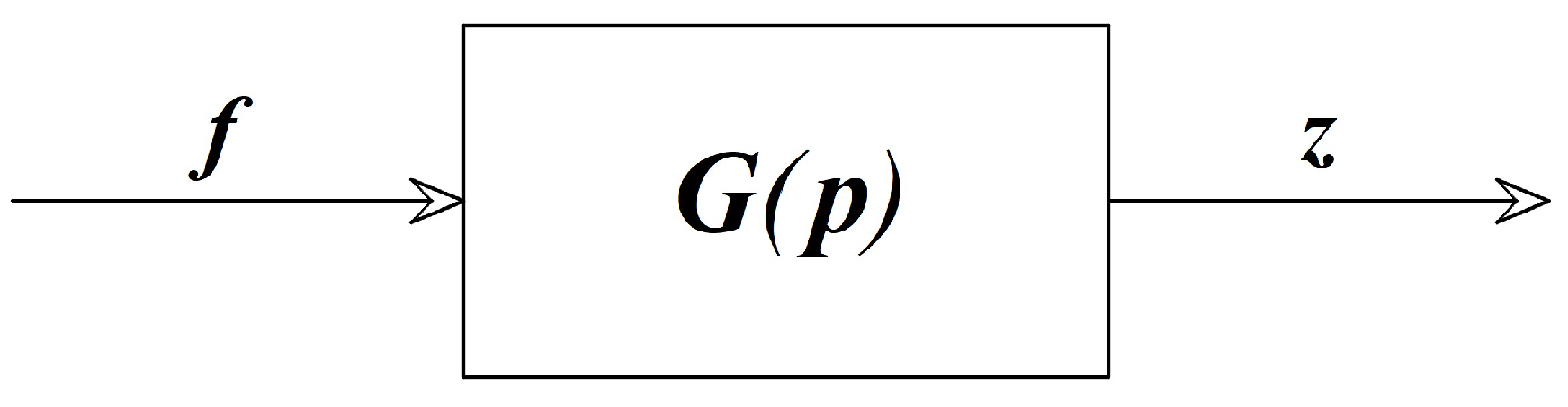
With reference to Figure 1, the (parameter-dependent) matrix mapping the input vector to the output vector z is given by
where B is an matrix that distributes the loads to the appropriate degrees of freedom, C is an output matrix that extracts the relevant components of the output vector z, and is the (parameter-dependent) system stiffness matrix, and is a vector of design parameters. For any fixed , the corresponding transfer matrix admits a Singular Value Decomposition (SVD) [19], which can be written as:
where:
- and are unitary matrices of dimensions and , respectively.
- is an diagonal matrix with the form:
- 2-Norm:
- Nuclear Norm:
- Frobenius Norm:
The matrix norms introduced above lay the groundwork for the multi-material topology optimization problem formulated in the following section.
Figure 1.
System Representation in Standard Input/Output Form.
3.2. The Topology Optimization Problem
For the sake of simplicity, the design variable matrix introduced in Equation (1) will henceforth be reformatted into a column vector, denoted by , defined as
where each block corresponds to the design variables associated with the i-th material phase. The typical -based optimal design problem may then be formulated as follows:
where:
- -
- (25)1 defines the objective function to be minimized;
- -
- (25)2 provides the explicit definition of the input/output transfer matrix, highlighting its dependence on the design variable vector ;
- -
- (25)3 imposes a standard volume constraint on each individual material. In the present formulation, all materials are subject to the same volume constraint, although non-uniform constraints may also be considered;
- -
- the inequalities on the design variables in (25)4 are to be interpreted componentwise. As is customary, each design variable is bounded between zero (void) and one (full material).
The optimization problem in (25) is solved numerically using the Method of Moving Asymptotes (MMA) [23]. To this end, the user must supply the current values of the objective function and the constraints, together with their sensitivities with respect to the design variables. When the objective function to be minimized is a matrix norm that depends on the singular values of the transfer matrix, a semi-analytical computation of the sensitivities is required. Specifically, using the chain rule, one must compute the derivatives of both the transfer matrix and its singular values with respect to each design variable, denoted generically by . Further details on this procedure are provided below.
3.3. Gradient of the Input/Output Transfer Matrix
Under the assumption that neither B nor C depend on the design variable vector , and recalling that the derivative of a matrix inverse is given by:
the gradient of the input/output transfer matrix with respect to the design variable becomes:
where the gradient of the stiffness matrix, , is computed using Equation (11).
3.4. Gradient of the Singular Values
As for the gradient of the generic h-th singular value , one can write (see also [19]):
where denotes the real part of a (possibly) complex number, and and are the left and right singular vectors corresponding to .
3.5. Gradient of the Norm of the Input/Output Transfer Matrix
Since the spectral (), nuclear (), and Frobenius () norms of are uniquely determined by its singular values, Equation (28), combined with a proper application of the chain rule, enables the computation of the sensitivity of any norm appearing in (25)1. In general, the sensitivity of each norm with respect to the design variable reads:
where the second factor on the right-hand side is provided by Equation (28), and the first factor depends on the chosen norm:
It is worth noting that these expressions assume all singular values are distinct and strictly positive. In cases where singular values are repeated (i.e., multiplicities greater than one) or approach zero, the singular value decomposition may become non-differentiable or numerically unstable. In such situations, regularization techniques or subdifferential approaches may be employed to ensure a well-defined and robust sensitivity analysis [24].
4. Definition of System Output and Optimization Goal
Referring again to Figure 1, the output vector z defines the optimization objective and depends linearly on the state vector x, which collects all the generalized displacements resulting from the finite element discretization. This relationship is expressed as:
A notable advantage of employing a norm minimization strategy is its ability to address multiple objectives—represented by the components of the output vector z—simultaneously through a standard scalar minimization procedure. This approach effectively transforms a multi-objective optimization problem into a single-objective one. Such scalarization techniques are widely recognized for their efficacy in simplifying complex optimization tasks while preserving the integrity of the original multi-objective problem [25].
Regarding the components of the output vector z, a few feasible options are outlined below.
4.1. Any Component of the State Vector x
In structural analysis, it is often necessary to ensure that specific displacements do not exceed predefined thresholds. When focusing on a particular displacement—denoted as the i-th component, , of the state vector x—this component can be incorporated into the output vector by augmenting the output matrix C with an appropriate row. Specifically, to include as the h-th component of z, the h-th row of C should be defined as:
4.2. Any Component of the Strain and Stress Tensors
As long as the structure is geometrically and constitutively linear, there exist discrete linear versions of the compatibility and constitutive equations such that any component of the strain and stress tensors may be respectively written as:
Therefore, and are line vectors that should be appended to the output matrix C to include and in the output vector.
4.3. The Structural Compliance
The proposed approach allows for the minimization of a wide variety of compliance, in a general multi-load setting. Reference is made to [20] for a detailed description of the approach.
Let be the column vector of the external forces and the displacement vector that is dual to in virtual work sense. The following should be noted:
- any coincides with a proper component of the state vector x;
- to any load , a compliance is associated that is defined as ;
- the overall compliance is defined as .
That said, the following cases are investigated:
4.3.1. SISO Case
The single input is represented by the force vector whose components act simultaneously, and the single output is the overall scalar compliance: .
4.3.2. MISO Case
Each component of the force vector represents an independent input, meaning that N independent structural analyses are performed. In each analysis, a single load component is applied in isolation. The scalar output is the total compliance, defined as , and is computed a posteriori by summing the N individual contributions associated with each load case.
4.3.3. SIMO Case
The single input is represented by the force vector , whose components act simultaneously in a single load case. The output vector z contains N components, each corresponding to an individual compliance term, defined as , for .
4.3.4. MIMO Case
This is the most general case. Each individual component of the input vector is assumed to act independently, resulting in N distinct load cases. On the output side, each corresponding compliance term forms a component of the output vector z, thereby enabling a fully decoupled multi-input, multi-output (MIMO) representation.
5. Implementation Details Using MATLAB
The MMTO algorithm discussed in this work is implemented using MATLAB 2023b, and the software code is freely accessible online (see Code Availability Statement). Specifically, the code is organized as follows:
- main_stat.m is the main file of the project, containing all user-defined parameters of MMTO algorithm and case study. Once their are properly setup, main_stat.m calls three further scripts, namely initialize_mma.m, which contains the parameters of the MMA algorithm, start_mma.m, which solves the MMTO problem using the MMA algorithm, and plot_densities.m, which takes care of producing the figures displayed in this paper.
- The casestudy folder contains the code required to define the setup of the case study, including the definition of loads (defineLoads.m), the definition of supports (defineSupports.m), and the computation of the dynamic system matrices B and C (prepareDynamicSystemSS_BandC.m).
- The costandconstraints folder contains the code required to define the objective function and the constraints of the MMTO problem. Specifically, the function compliance_stat_mma.m calls two dedicated subroutines to evaluate the objective function and its derivatives (computeCostWithSensitivities.m), and evaluate constraint violations and their derivatives (computeConstraintsWithSensitivities.m) at the current guess for the MMTO problem.
- The filteringprojectioninterpolation folder contains the code implementing the filtering, projection and interpolation functions for Multi-Materials, as discussed in Section 2.
- The matrixnorms folder contains the code required to carry out the computation of tensor norms (pnormmat.m and pnormmatmenouno.m) and their derivatives (pnormmatsens.m), as discussed in Section 3.
- The stiffnesscomputations folder contains the code required to compute the stiffness matrix of the system, based on the desired finite element discretization, relying on the subroutines prepareStiffnessMatIdxs.m, prepareFEM.m and computeStiffnessMatrix.m.
- The MMA folder contains the code of the MMA algorithm, as made available by [23].
- The utils folder contains the computeDependentParams.m function, which computes additional parameters of the MMTO algorithm, based on the user-defined parameters set in main_stat.m.
Thanks to its modularity, the proposed code structure allows the new user to successfully run the code by focusing on the main_stat.m file only. If required, a number of variations of the case studies discussed in this work can be straightforwardly obtained by implementing minor modifications to the subroutines contained in the casestudy folder. Furthermore, the code can be straightforwardly adjusted for use with any MATLAB optimization algorithm, by defining suitable objective and constraint functions based on computeCostWithSensitivities.m, and computeConstraintsWithSensitivities.m.
6. Numerical Results
Two representative numerical problems are investigated next:
- a simply supported cantilevered beam;
- an L-shaped appended structure.
Both structures are composed of three distinct materials and are subjected to two external loads, allowing the application of all the idealized input/output configurations discussed earlier—namely, SISO, MISO, SIMO, and MIMO.
6.1. Simply Supported Cantilevered Beam
6.1.1. General Data
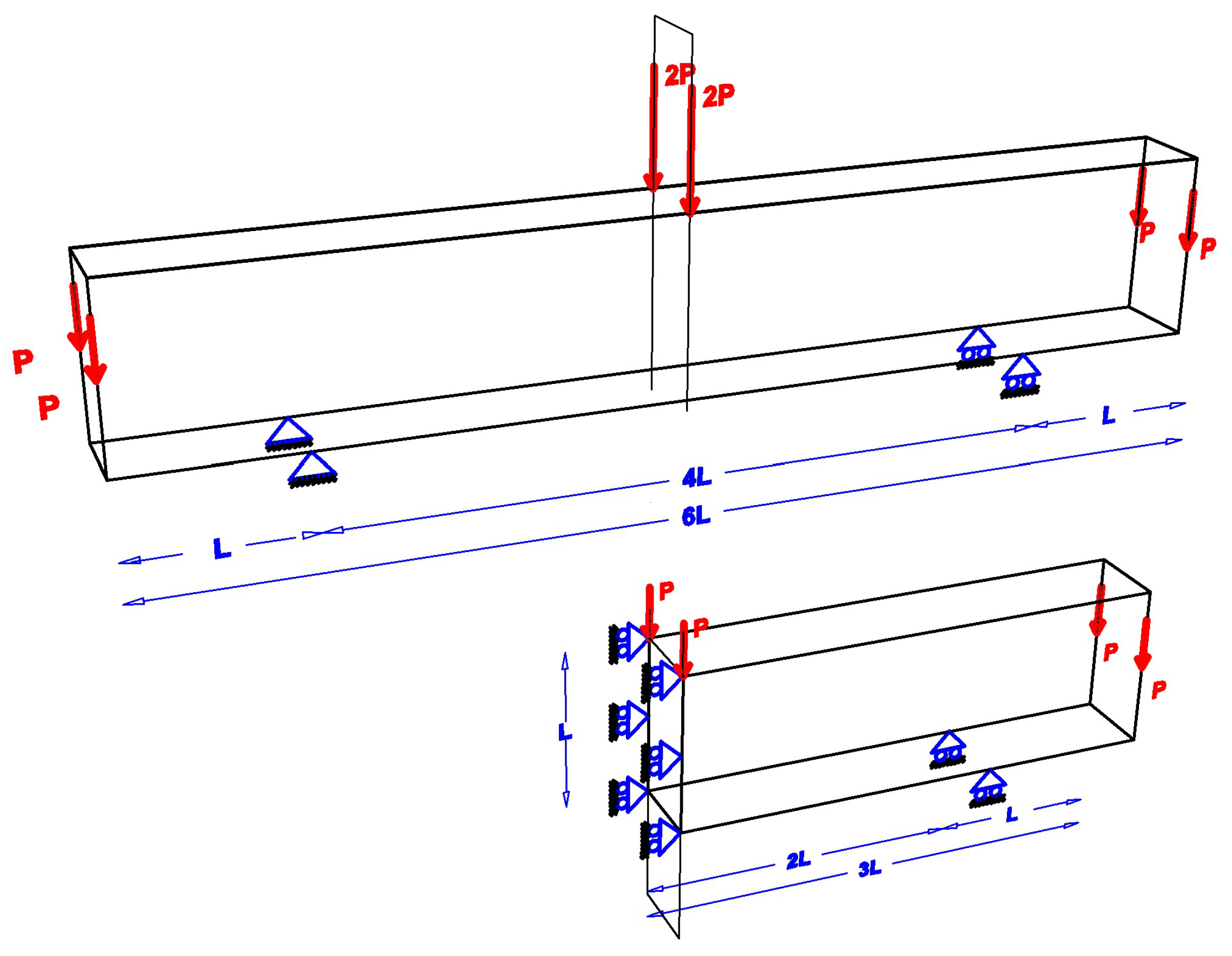
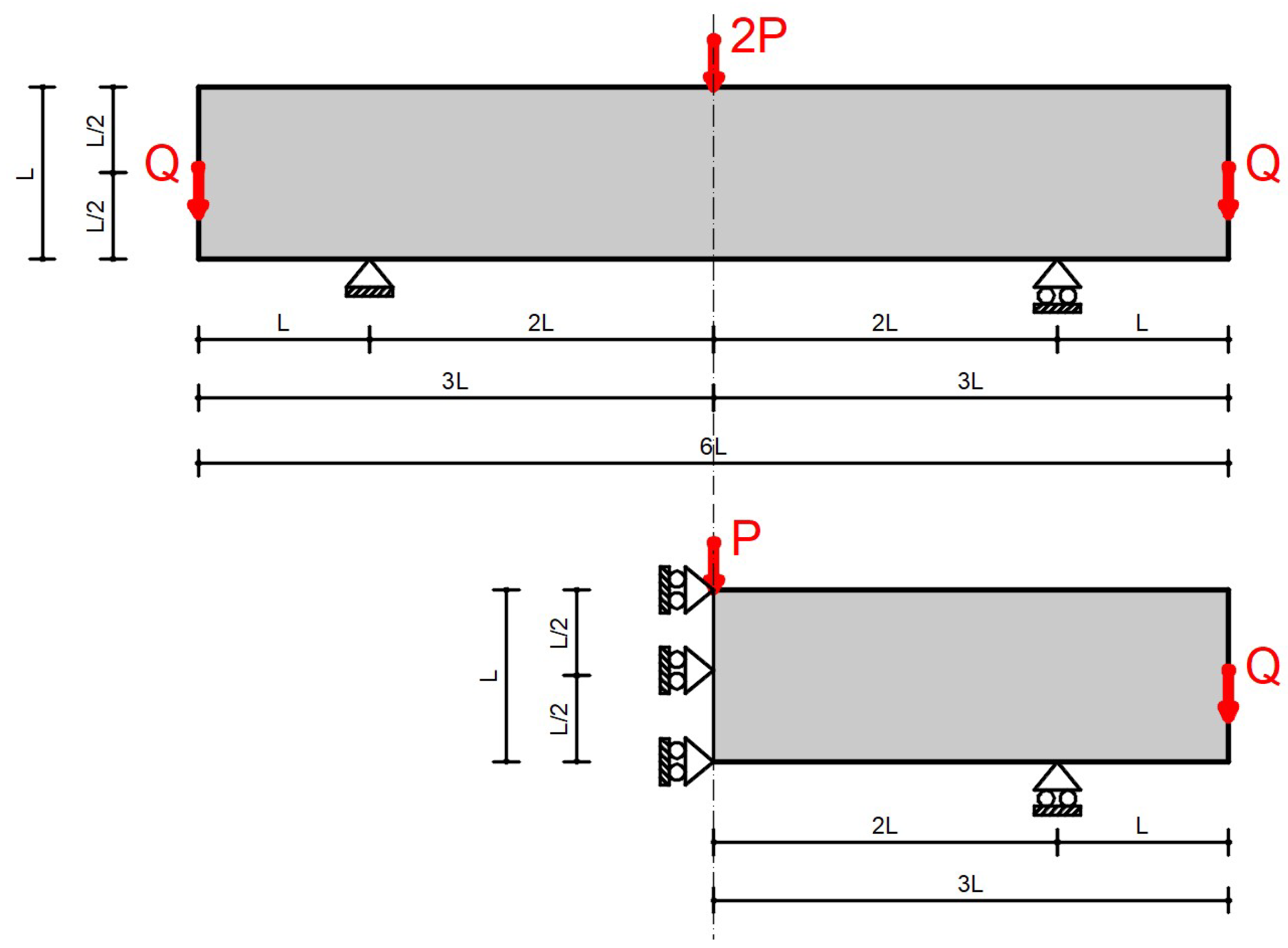
Figure 2 illustrates the geometry and loading conditions of the problem under investigation. Taking advantage of structural symmetry, a half-model—as shown in Figure 2—is adopted for the numerical simulations. The computations are carried out using the following parameters:
Figure 2.
Numerical example 1: full and half structure using symmetry.
- -
- Poisson ratio: ;
- -
- Number of elements in vertical (Y) direction: ;
- -
- Number of elements in horizontal (X) direction: ;
- -
- Side length: (by this choice a uniform mesh of square elements of unit size is generated);
- -
- ;
- -
- Volume fraction = 0.5;
- -
- SIMP penalization factor: n = 3;
- -
- p-norm parameter = 6;
- -
- .
As for the multi-material characterization, the number of materials is set to , with corresponding Young’s moduli , , and . It is worth noting that this configuration is based on the system previously studied in [20], with the sole difference being the extension to a three-material setting in the present work.
6.1.2. SISO System
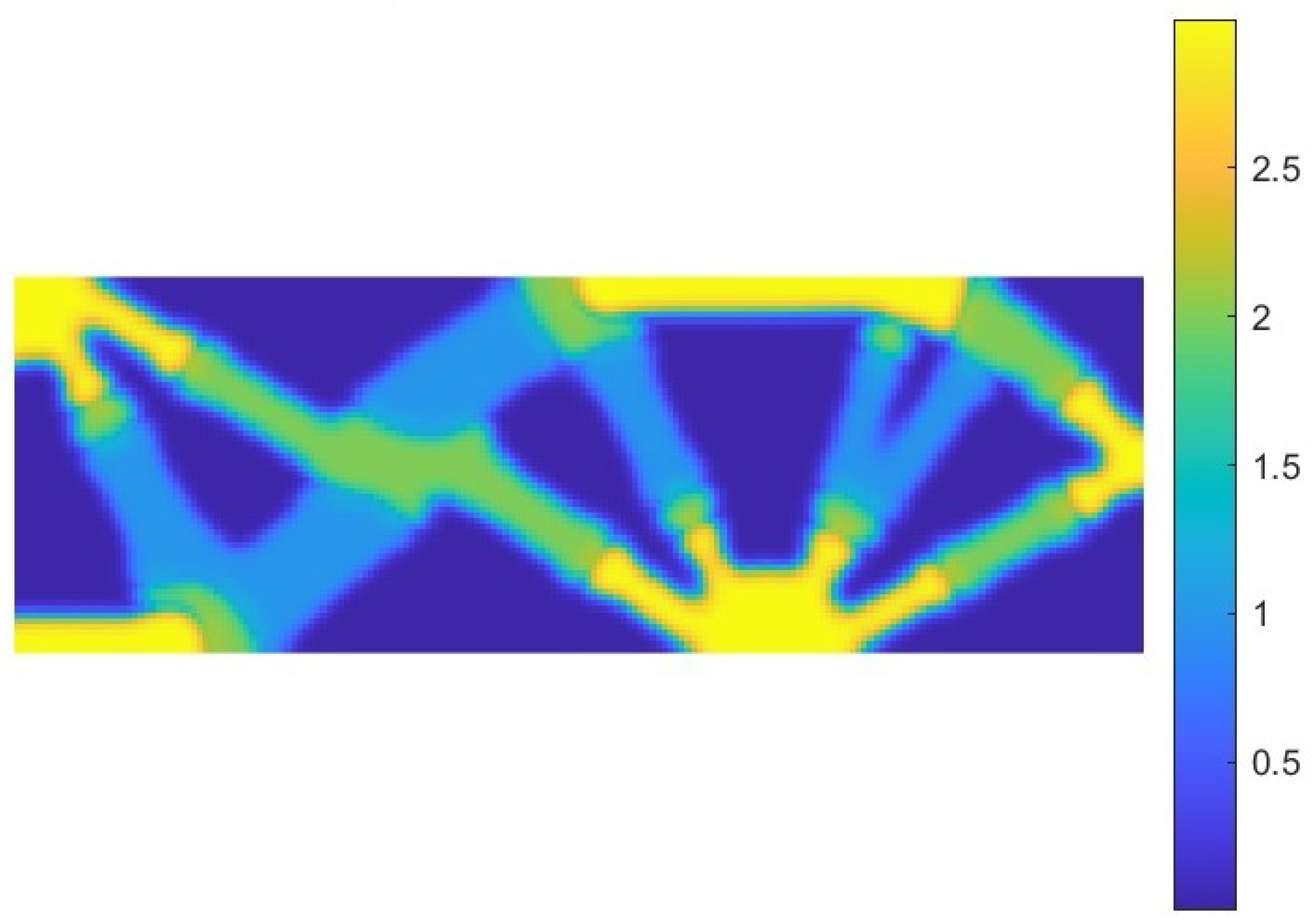
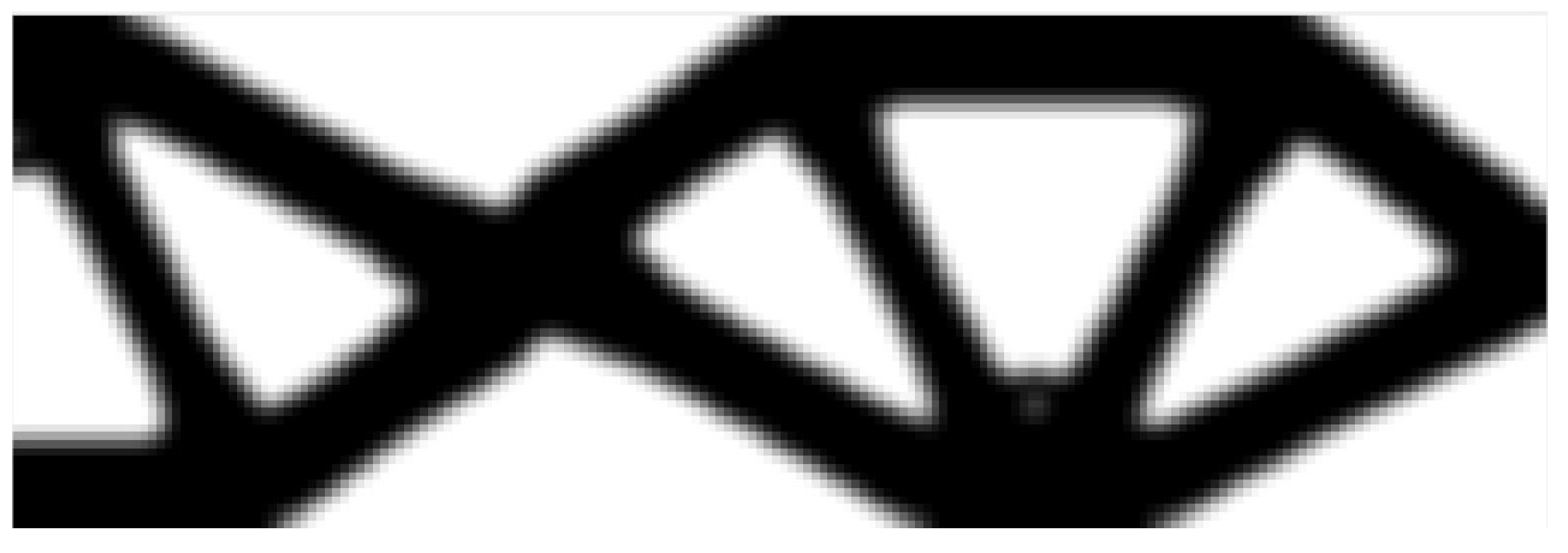
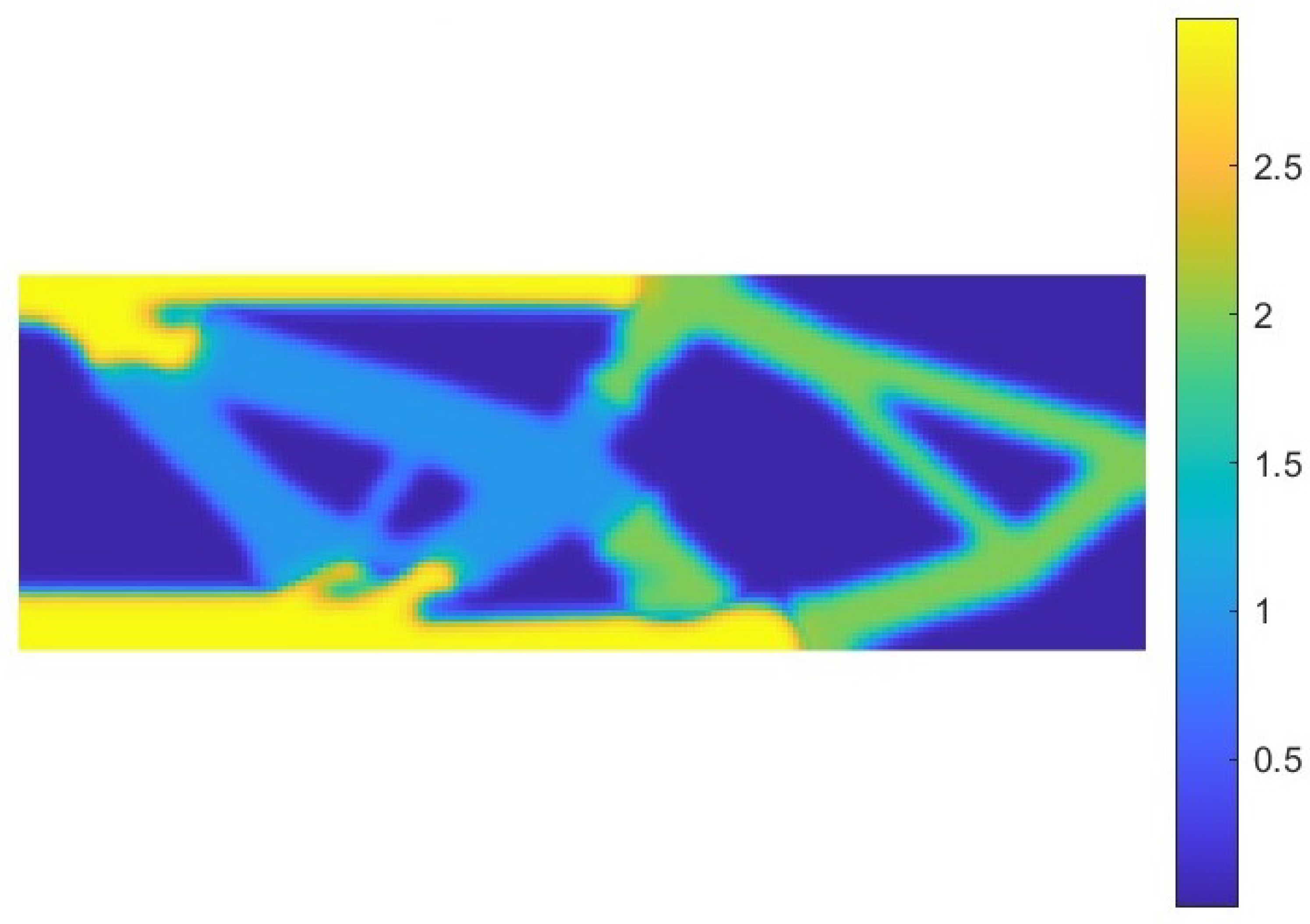
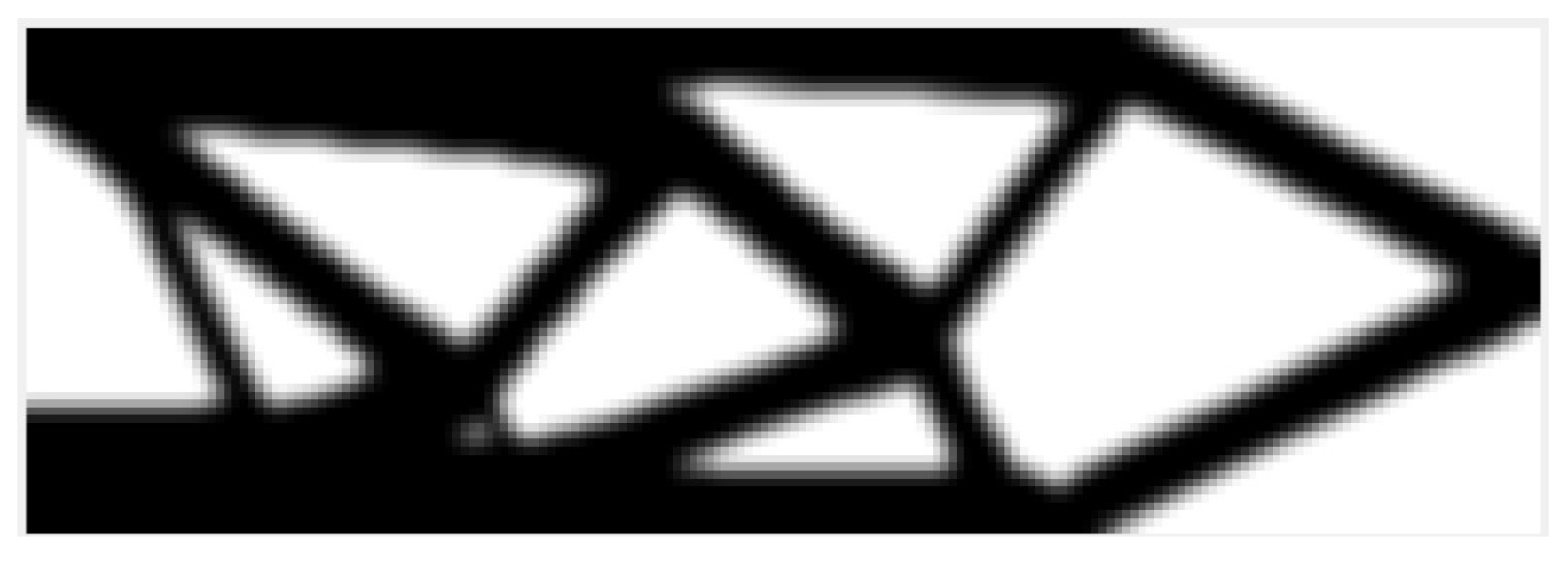
The optimal topology at convergence obtained using the SISO model is presented in Figure 3. In the following, blue, green, and yellow are used to represent the materials with , , , respectively. Interestingly, the single-material solution obtained using the approach presented in [20]—see Figure 4—appears to consist of (nearly) uniformly sized elements. In contrast, the components of the multi-material structure exhibits varying dimensions, with stronger materials tending to form thinner features. This behavior confirms the capability of the proposed approach to effectively exploit the available materials: since the objective is to minimize compliance, the algorithm allocates larger volumes to weaker materials in order to enhance the overall structural stiffness.
Figure 3.
Cantilevered structure: (SISO)-Optimal topology at convergence.
Figure 4.
Cantilevered structure: (SISO)-Optimal topology at convergence using standard SIMP.
6.1.3. Stability of the Results with Respect to Mesh Resolution: A Trade-Off with Computational Cost
In the context of topology optimization, the stability of results with respect to mesh resolution presents a twofold challenge:
- On one hand, the numerical method may be sensitive to the level of discretization, implying that accurate and reliable solutions can only be achieved with sufficiently fine meshes.
- On the other hand, finer meshes enable a richer representation of the design space, allowing for a broader range of topologies to be captured as the continuous, infinite-dimensional domain is projected onto its discrete, finite-dimensional counterpart.
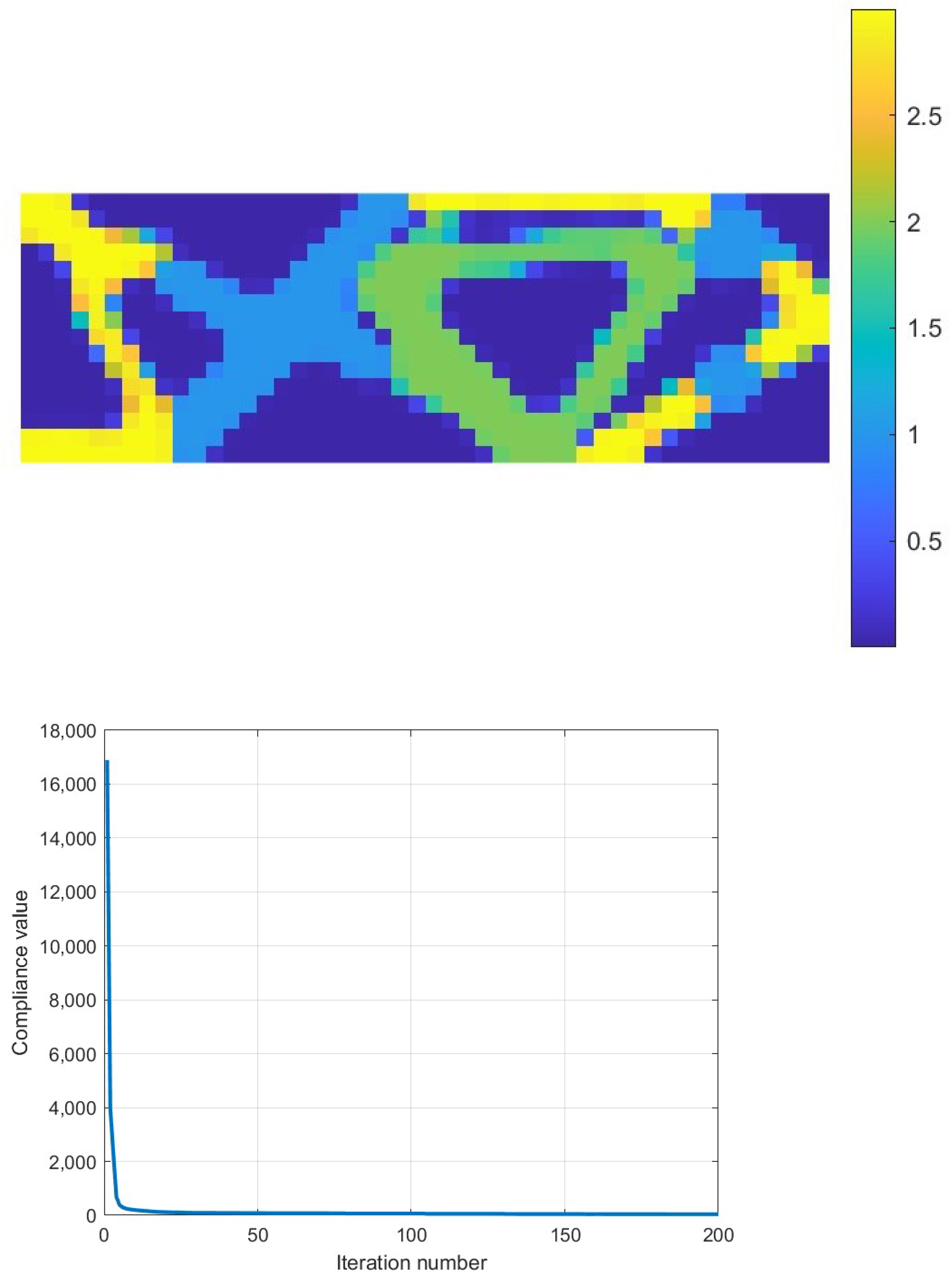
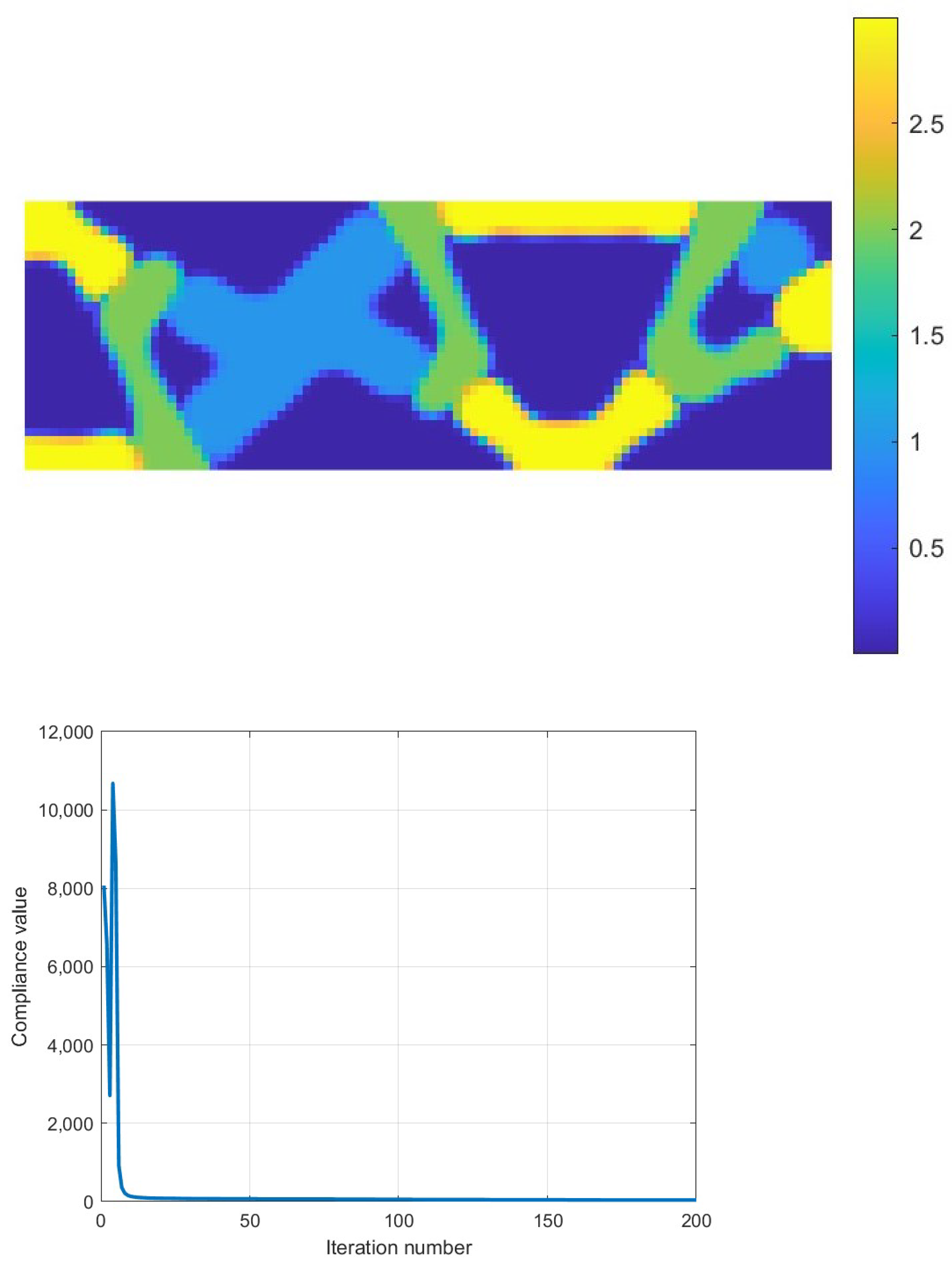
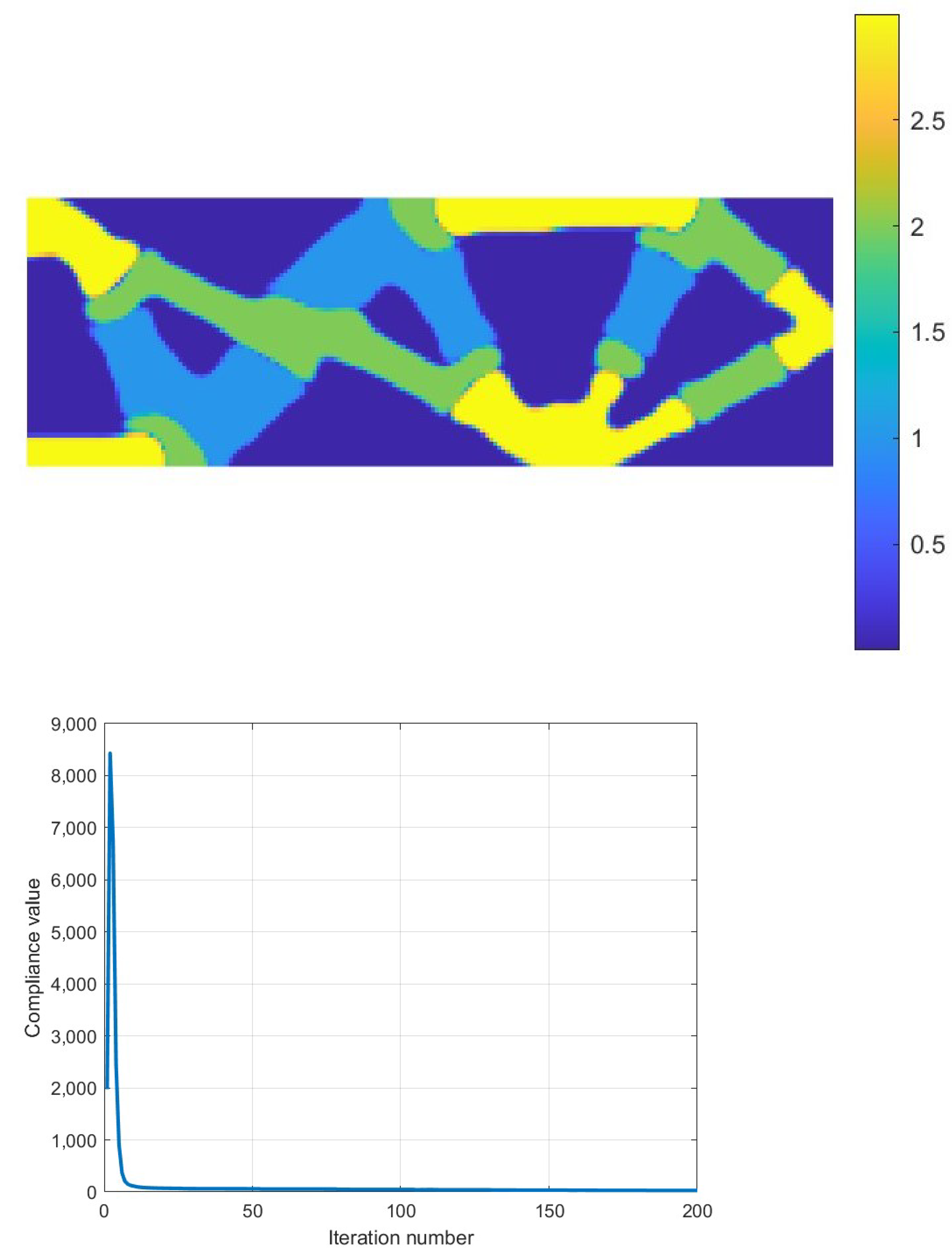
The two aspects above are investigated next solving three times the very same SISO problem of Section 6.1.2. The meshes of the three runs are as follows
- 1.
- Number of elements in Y direction = 16; number of elements in X direction = 48;
- 2.
- Number of elements in Y direction = 32; number of elements in X direction = 96;
- 3.
- Number of elements in Y direction = 64; number of elements in X direction = 192;
The optimal topologies along with the convergence curves for the three cases are respectively shown in Figure 5, Figure 6 and Figure 7. The CPU time needed to achieve convergence for the three runs were respectively as follows:
Figure 5.
Stability assessment wrt the mesh size-Number of elements in Y direction = 16. (up) Optimal Topology, (bottom) Convergence curve.
Figure 6.
Stability assessment wrt the mesh size-Number of elements in Y direction = 32. (up) Optimal Topology, (bottom) Convergence curve.
Figure 7.
Stability assessment wrt the mesh size-Number of elements in Y direction = 64. (up) Optimal Topology, (bottom) Convergence curve.
6.1.4. MIMO System-Norm 2
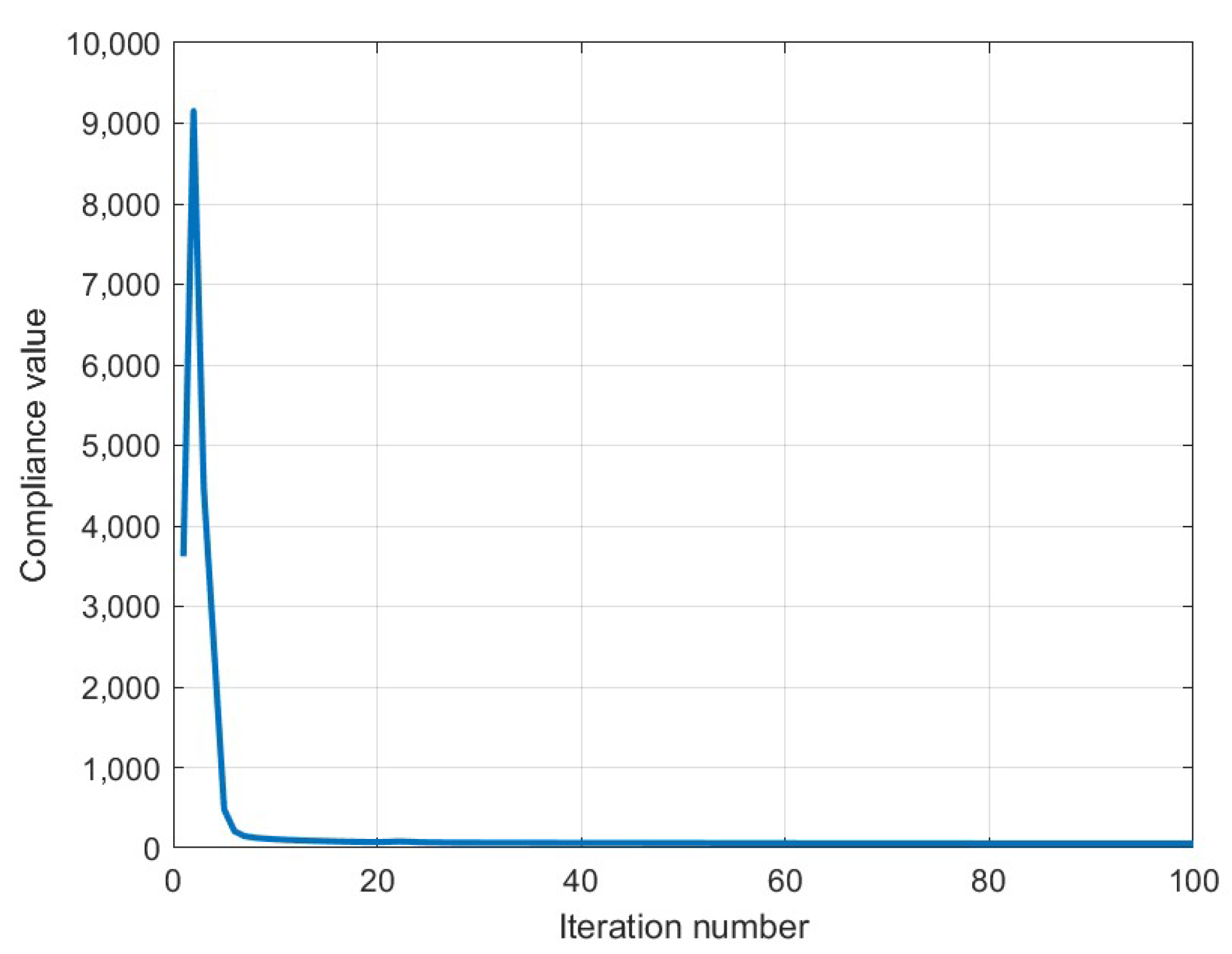
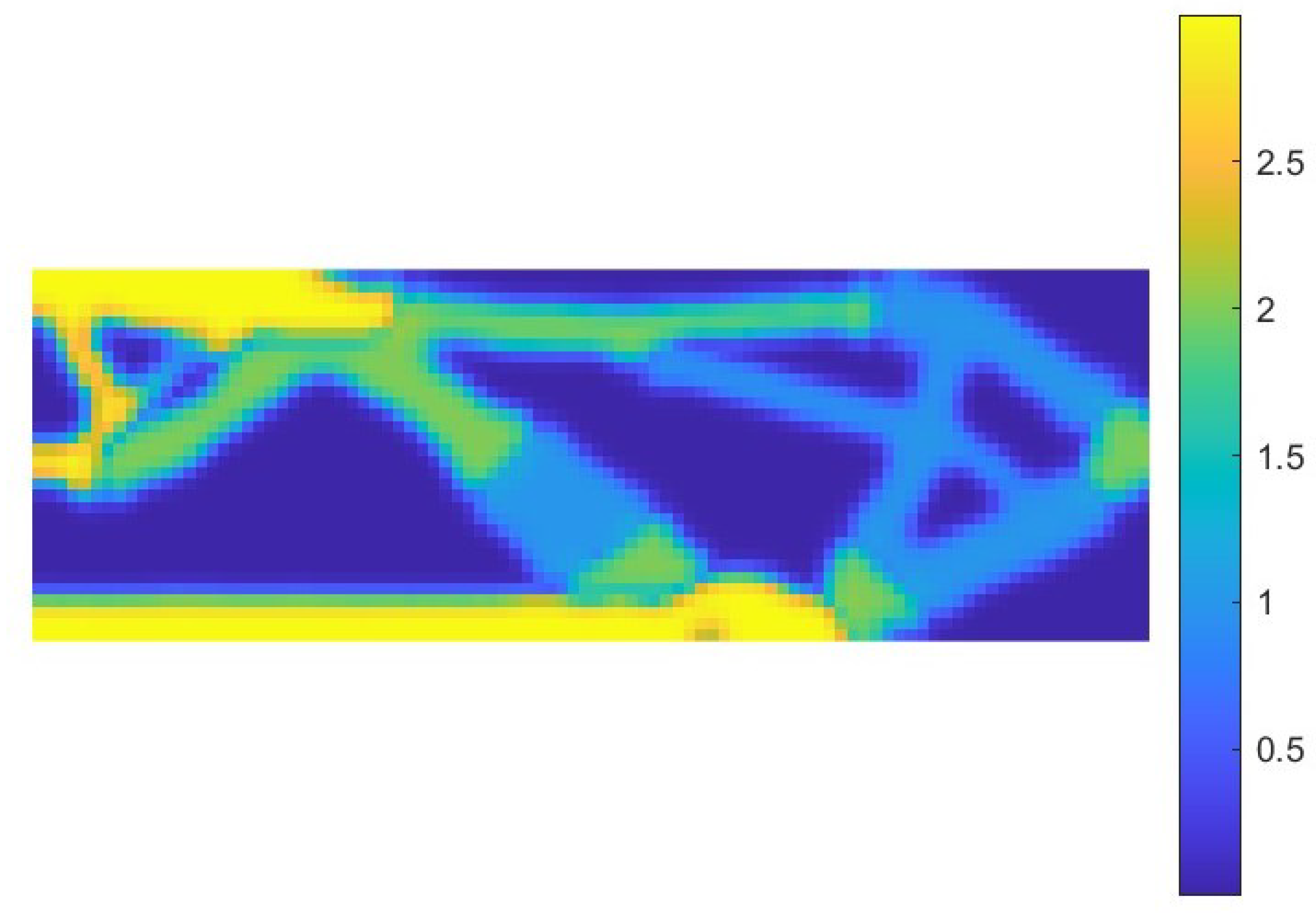
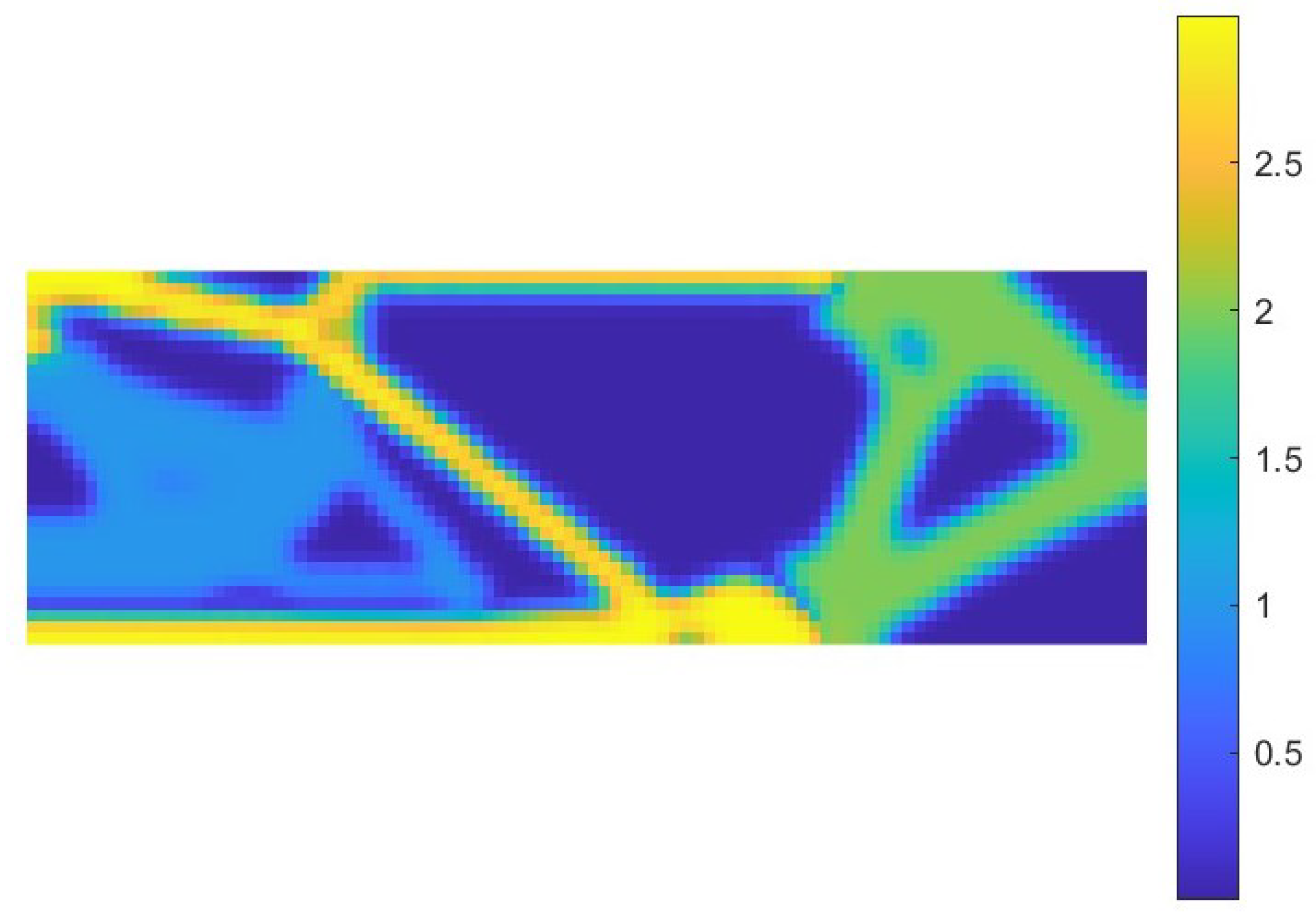
Figure 8 displays the optimal topology obtained in the MIMO setting using the spectral 2-norm. The design confirms the key feature observed in the SISO case: the weaker the material, the wider the corresponding structural component. A comparison with the standard single-material SIMP solution shown in Figure 9 reveals an additional characteristic. In the SIMP-based topology, the top and bottom chords constitute the most substantial elements of the truss, with their cross-sectional dimensions decreasing from midspan toward the supports. This behavior is not replicated in the multi-material design, where the top and bottom chords are composed of the stiffest material, resulting in nearly uniform and comparatively slender members throughout. Figure 10 depicts the convergence curve obtained solving the optimization.
Figure 8.
Cantilevered structure: (MIMO-2 Norm)-Optimal topology at convergence.
Figure 9.
Cantilevered structure: (MIMO-2 Norm)-Optimal topology at convergence using standard SIMP.
Figure 10.
Cantilevered structure: (MIMO-2 Norm)-Convergence curve.
6.1.5. Effect of the SIMP Penalization Factor n on the Optimal Topology
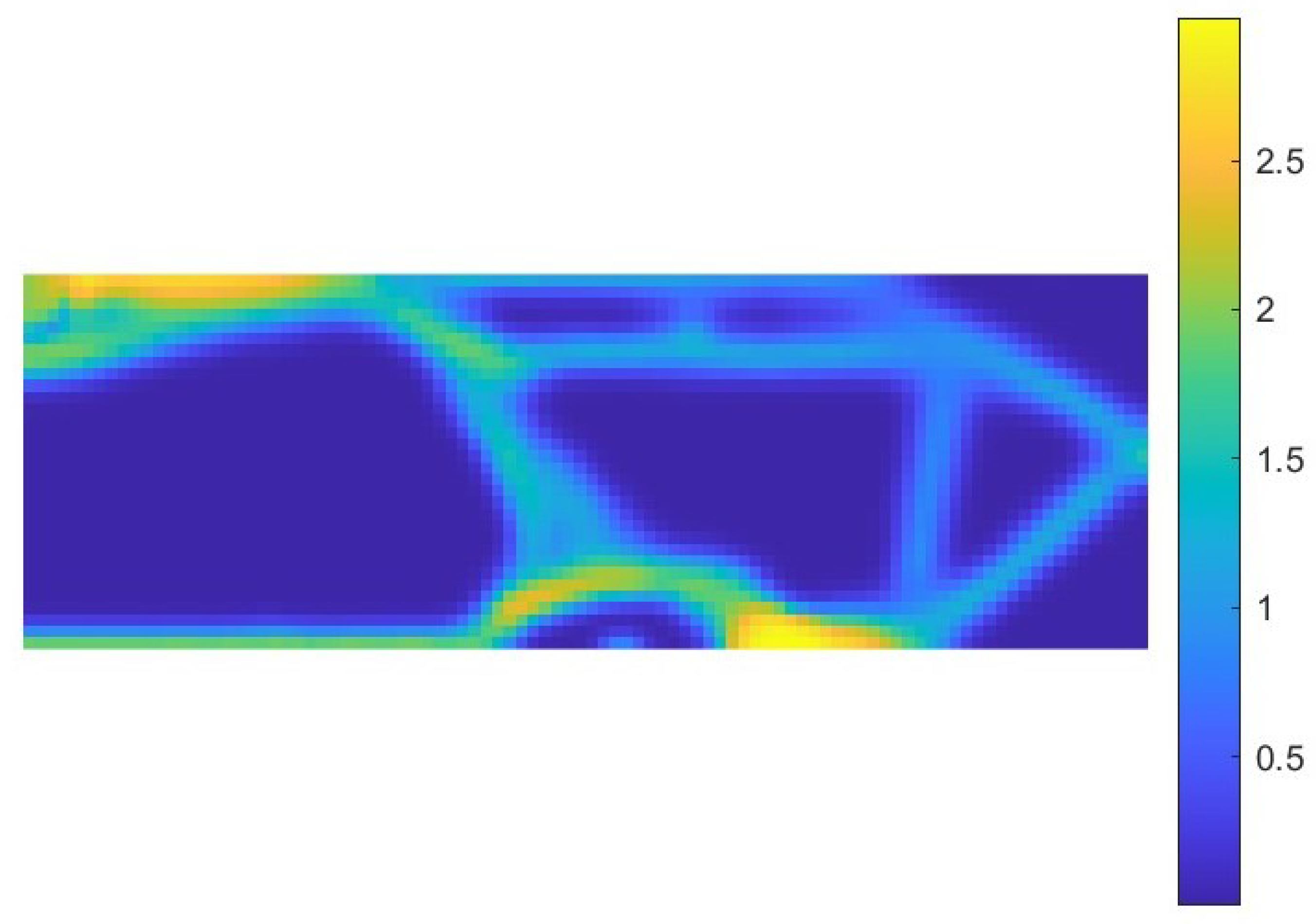
The same MIMO example introduced in Section 6.1.4 is now employed to investigate the sensitivity of the resulting optimal topology to variations in the SIMP penalization factor n. As established in [26], the choice n = 3 is particularly significant, as it renders the SIMP interpolation thermodynamically consistent and compliant with theoretical bounds. Nevertheless, from a numerical standpoint, it is insightful to examine how the optimal topology evolves as a function of n. To this end, a parametric study is conducted in which optimal designs corresponding to are computed and compared. Optimal topologies are shown in Figure 11, Figure 12 and Figure 13, for the choices , respectively. The superiority of the choice is demonstrated by the values of the compliance that are reported in Table 1.
Figure 11.
Cantilevered structure: (MIMO, 2-norm solution)-Optima topology at convergence using standard SIMP-n.
Figure 12.
Cantilevered structure: (MIMO, 2-norm solution)-Optima topology at convergence using standard SIMP-n .
Figure 13.
Cantilevered structure: (MIMO, 2-norm solution)-Optima topology at convergence using standard SIMP-n .
Table 1.
Compliance values vs. SIMP exponent n.
6.1.6. MIMO System-Nuclear Norm
Figure 14 shows the optimal topology obtained in the MIMO setting using the nuclear norm, while Figure 15 illustrates the corresponding convergence history. The convergence path is fast and monotonic; the initial increase in the objective function is attributed to a temporary violation of the volume constraints, which the solver successfully addresses starting from the third iteration.
Figure 14.
Cantilevered structure: (MIMO-Nuclear Norm)-Optimal topology at convergence.
Figure 15.
Cantilevered structure: (MIMO-Nuclear norm)-Convergence curve.
6.1.7. MIMO System-Frobenius Norm
Figure 16 presents the optimal topology obtained in the MIMO setting using the Frobenius norm, while Figure 17 depicts the associated convergence history. Similar observations to those made for the nuclear norm-based solution apply here. This similarity is expected, as both norms depend on all non-zero singular values (two in the present case), resulting in comparable optimal topologies and convergence behaviors. In contrast, the 2-norm depends solely on the largest singular value, which explains the significantly different topology obtained in that case.
Figure 16.
Cantilevered structure: (MIMO-Frobenius Norm)-Optimal topology at convergence.
Figure 17.
Cantilevered structure: (MIMO-Frobenius norm)-Convergence curve.
6.2. L-Shaped Structure
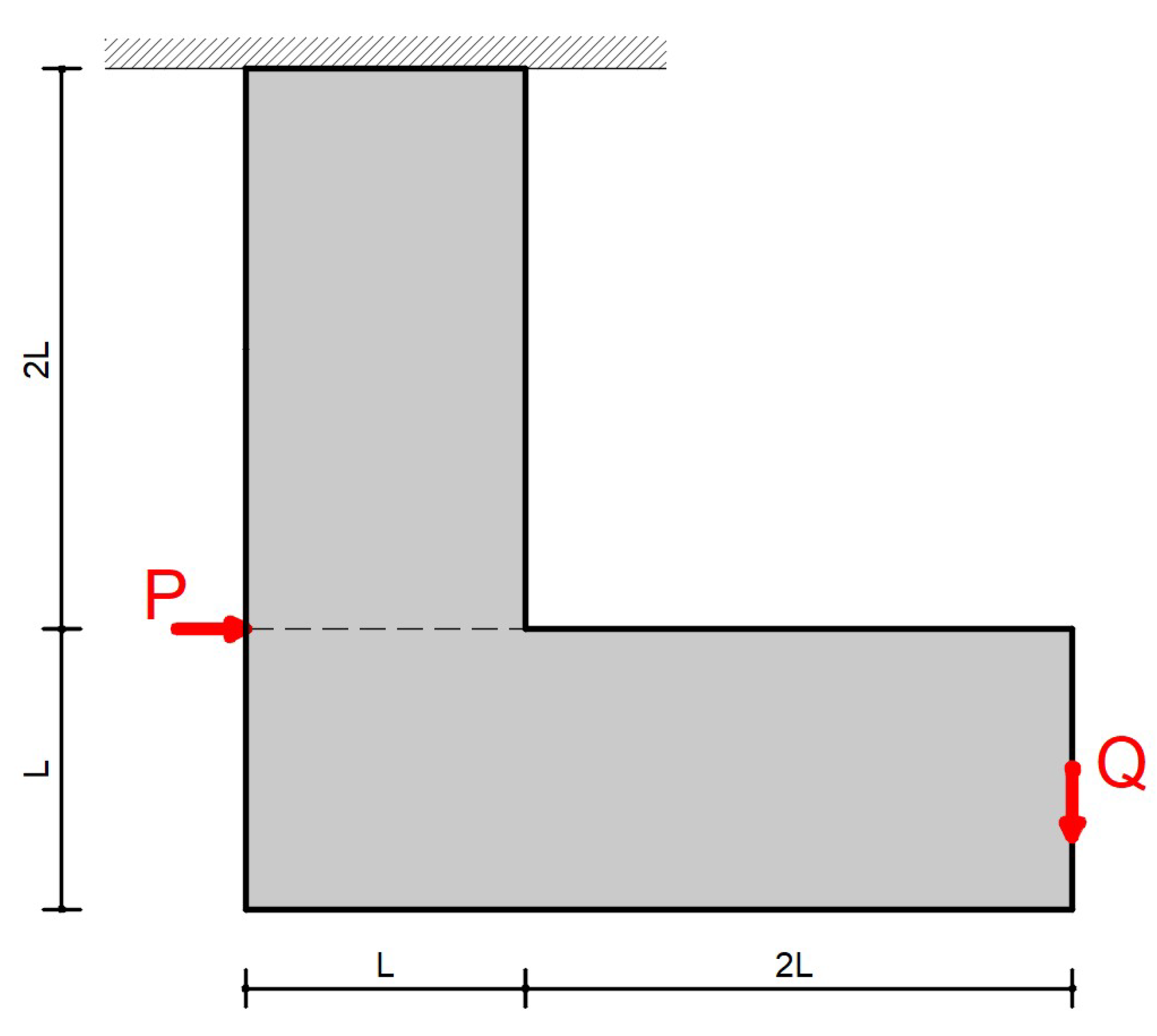
Figure 18 illustrates the geometry and loading conditions of the L-shaped problem under investigation. The following numerical parameters are used:
Figure 18.
Numerical example 2: L-shaped structure.
- -
- Poisson ratio: ;
- -
- Number of elements in vertical (Y) direction: ;
- -
- Number of elements in horizontal (X) direction: ;
- -
- Side length: ;
- -
- ;
- -
- Volume fraction = 0.5;
- -
- SIMP penalization factor: n = 3;
- -
- p-norm parameter = 6;
- -
- .
6.2.1. SISO System
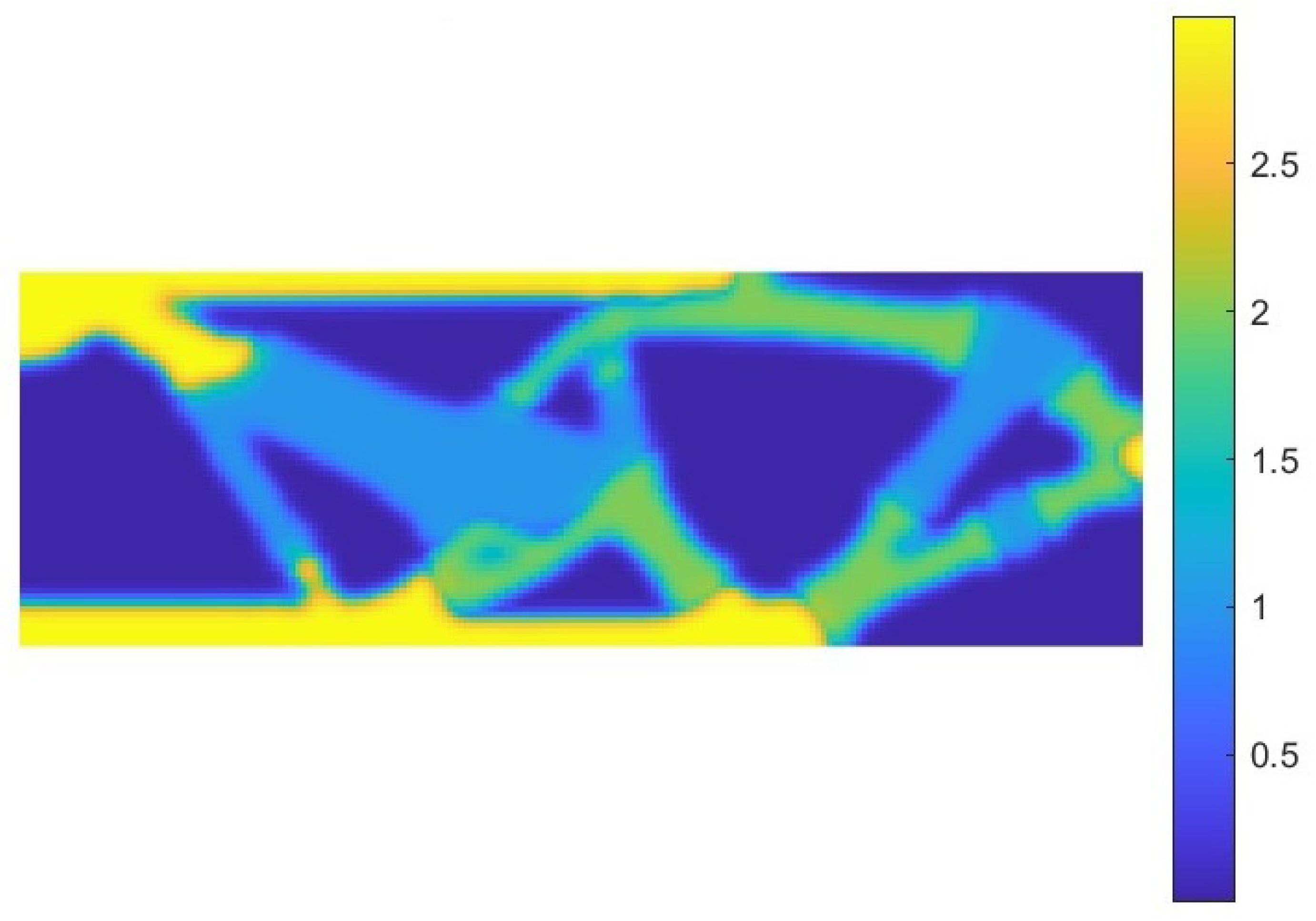
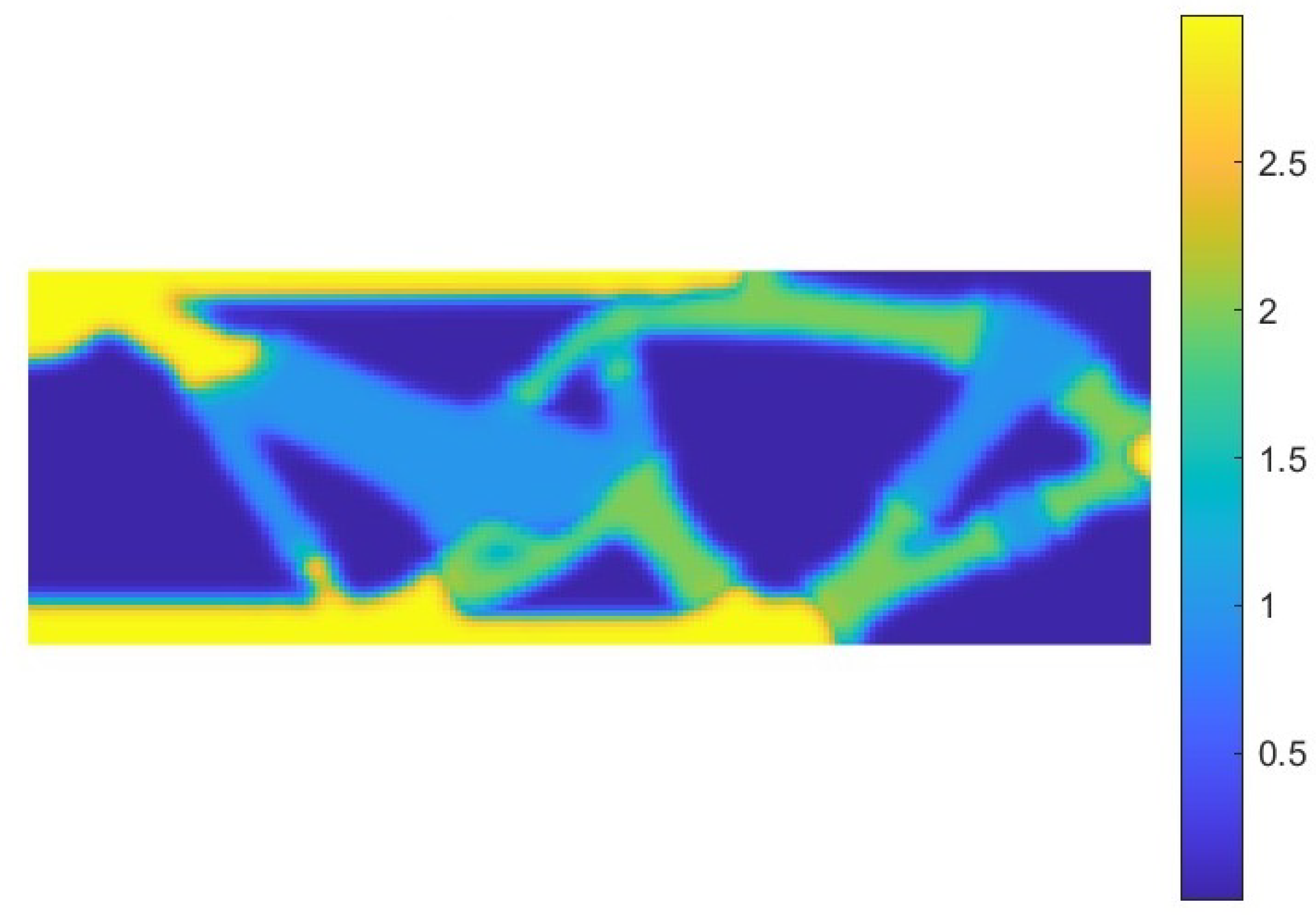
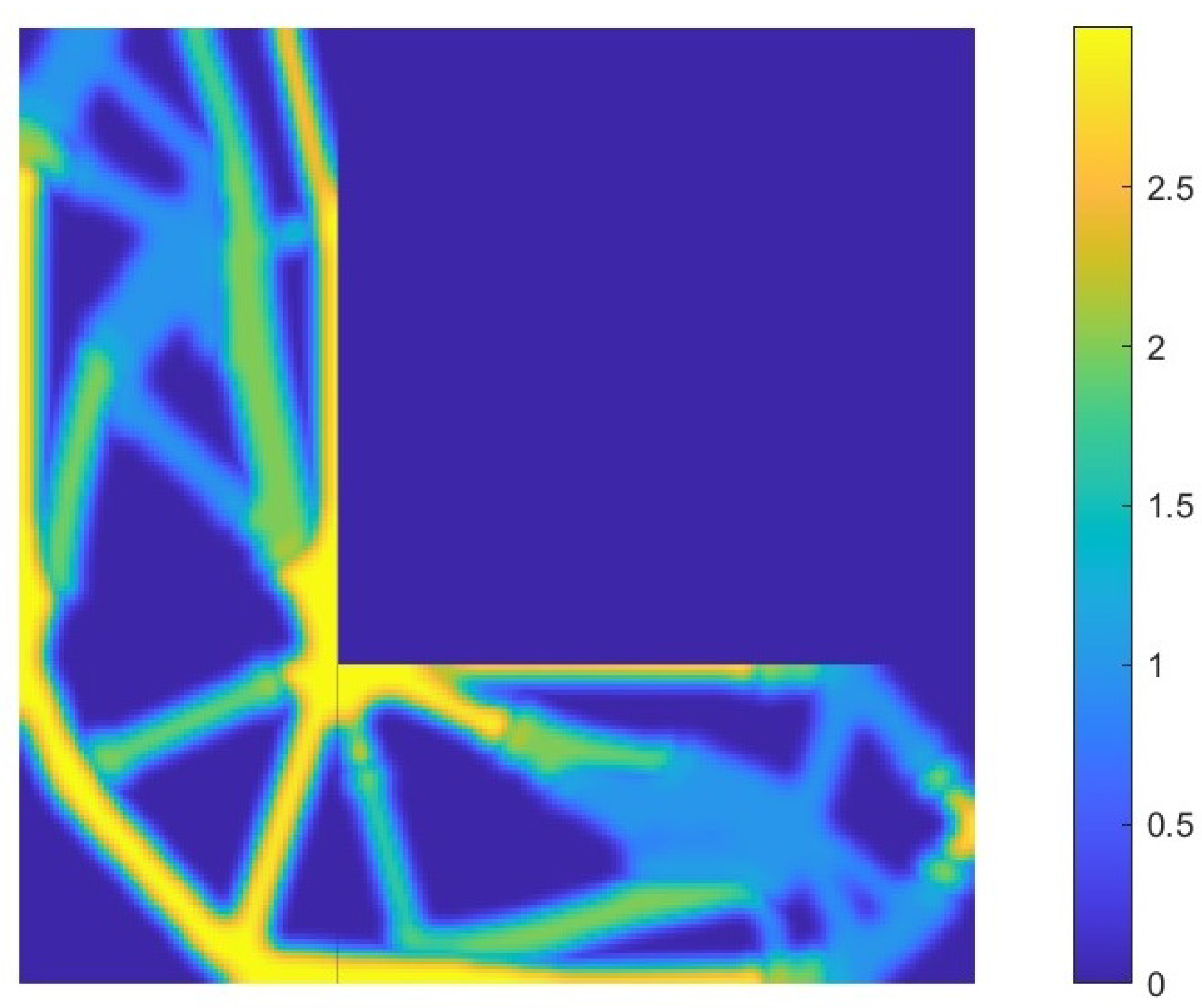
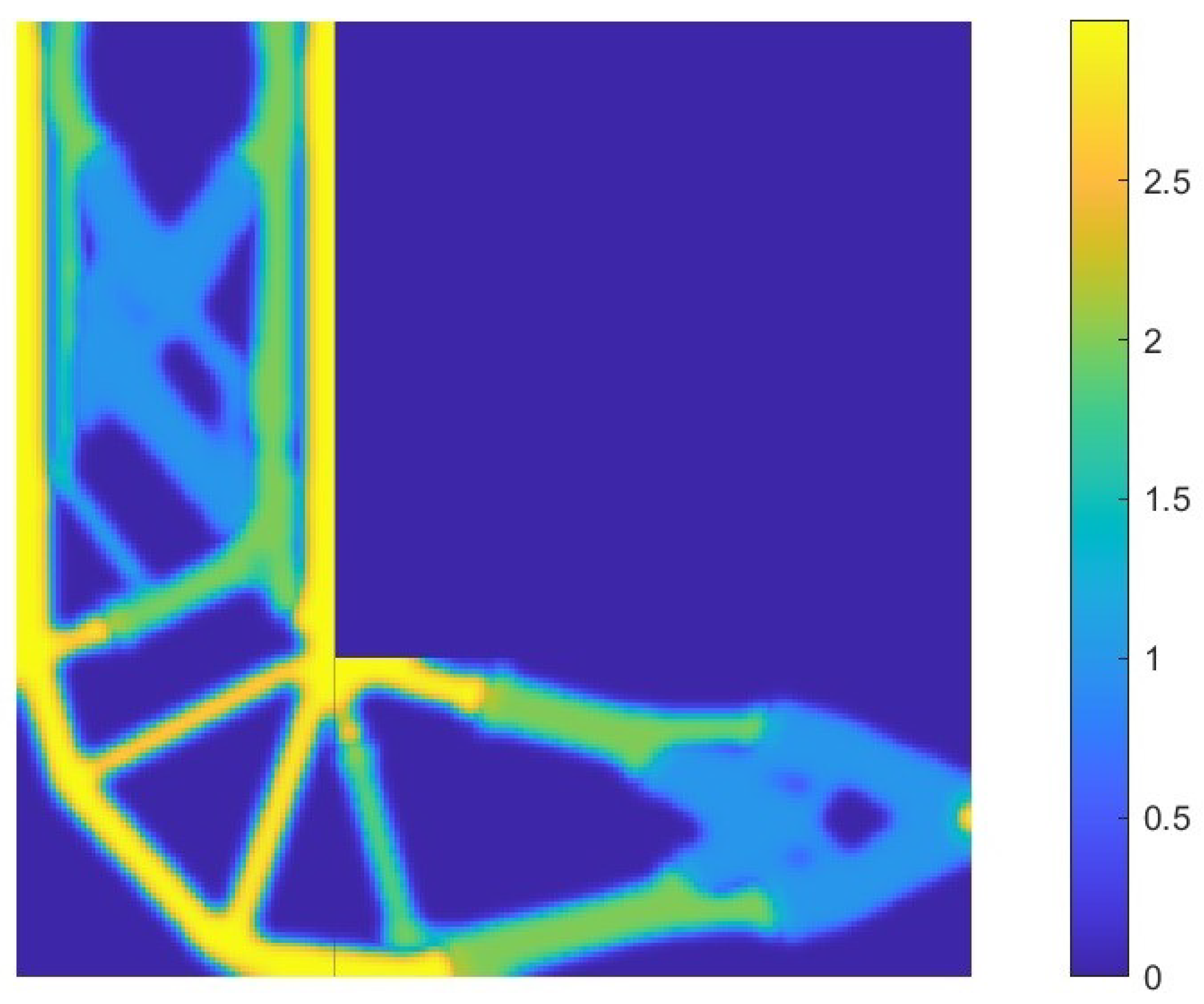
The optimal topology at convergence obtained using the SISO model is shown in Figure 19. In the visual representation, blue, green, and yellow correspond to the materials with , , and , respectively. As previously observed, the components of the multi-material structure exhibit varying thicknesses, with stiffer materials typically forming thinner, more localized features.
Figure 19.
L-shaped structure: (SISO) Optimal topology at convergence.
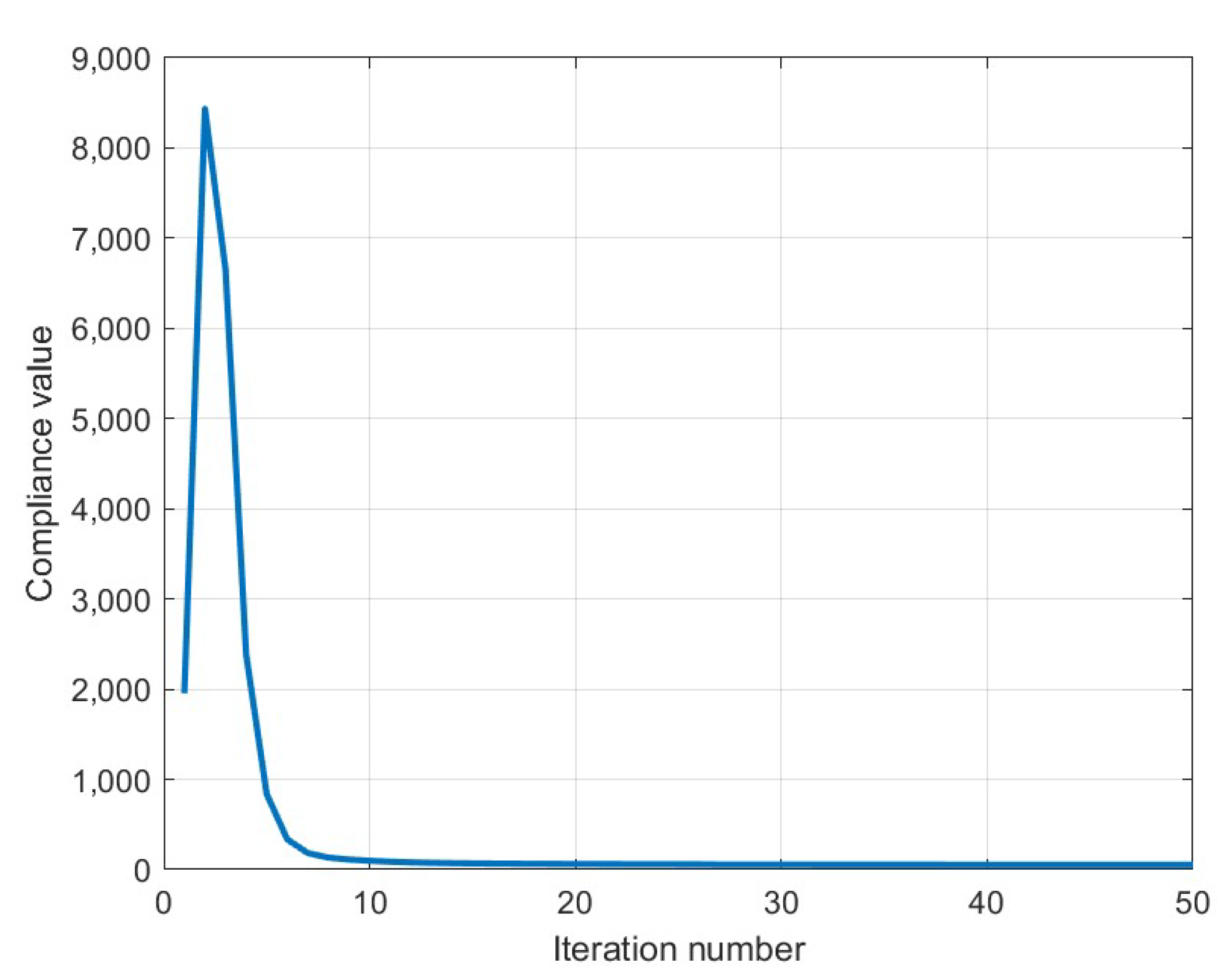
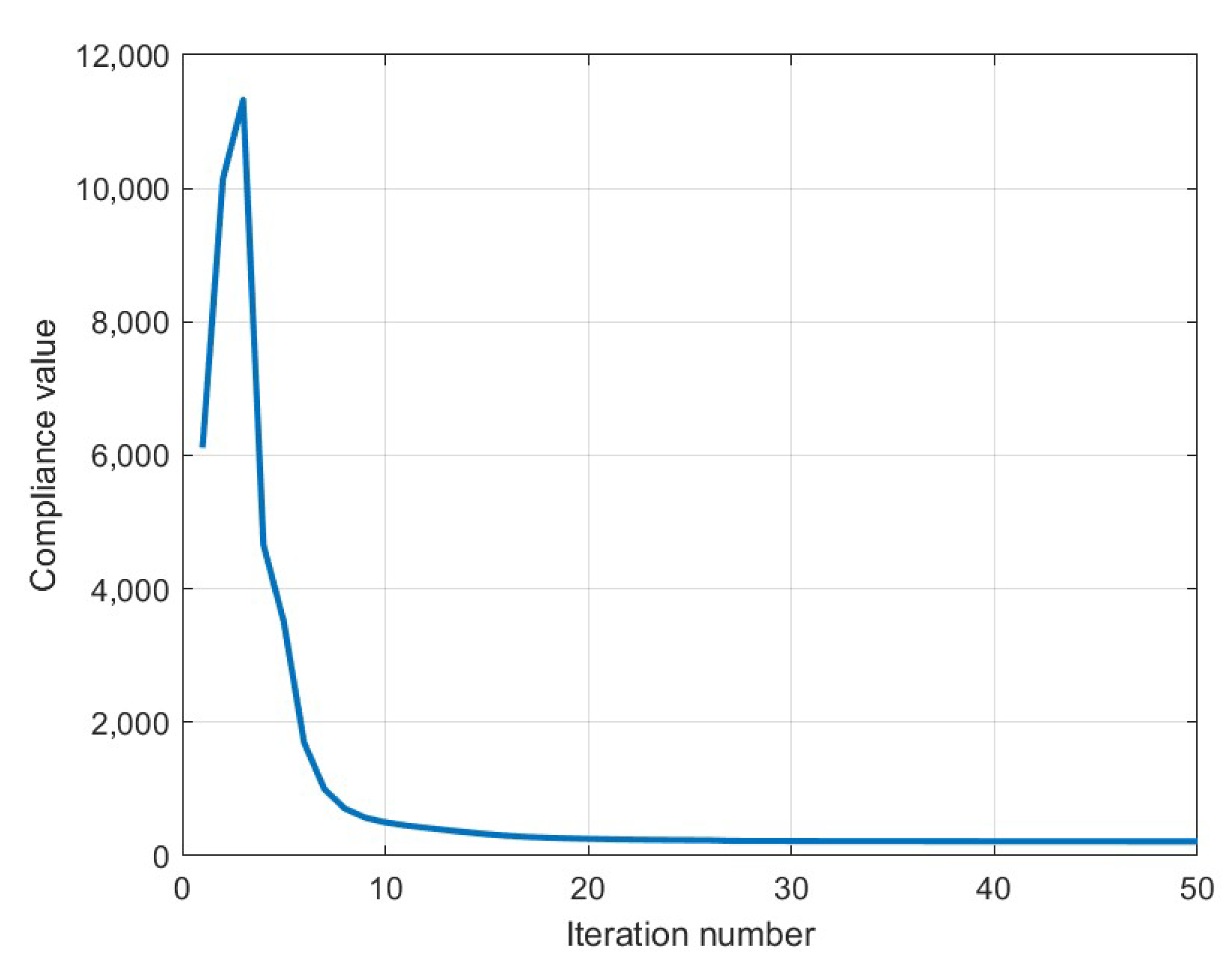
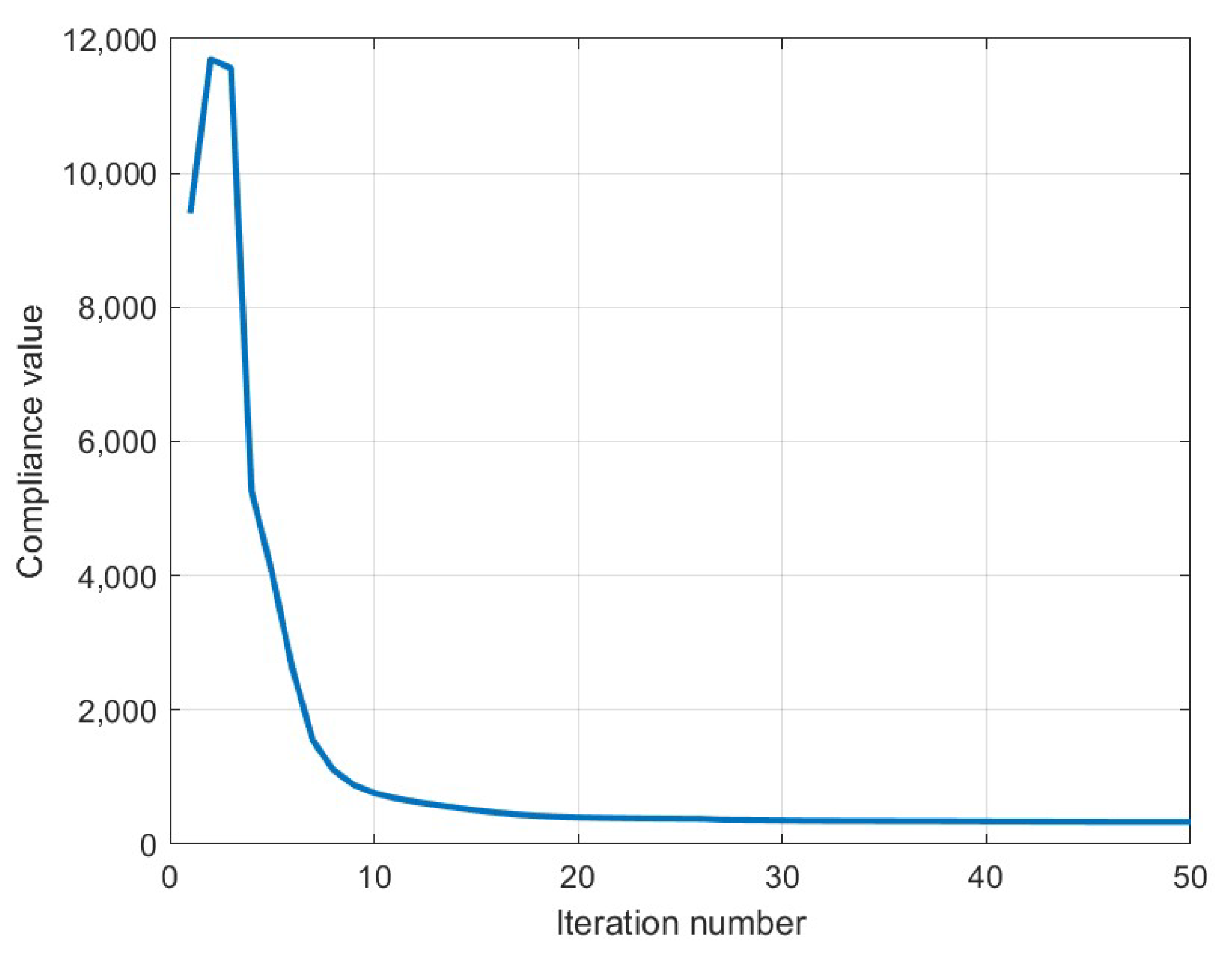
To assess the performance of the optimization algorithm, Figure 20 presents the evolution of the objective function over the course of the optimization. Although a total of 50 iterations were executed, convergence was effectively achieved after approximately 25 iterations, demonstrating the efficiency of the Method of Moving Asymptotes in this context.
Figure 20.
L-shaped structure: (SISO) Convergence curve.
A note is in order regarding the influence of the horizontal load P on the optimal topology. In the standard benchmark formulation of the L-shaped problem, the horizontal load is typically absent. As a result, the vertical leg of the structure is often reduced to a pair of vertical load-bearing chords positioned at the left and right edges.
The introduction of the horizontal load P, however, significantly alters the structural response. In addition to the need to sustain axial forces (tension and compression), the left vertical leg must now exhibit substantial bending rigidity to effectively counteract the moment induced by P. This additional requirement gives rise to a more complex and articulated topology in that region, aimed at minimizing the compliance associated with the horizontal loading component.
6.2.2. MIMO System-2 Norm
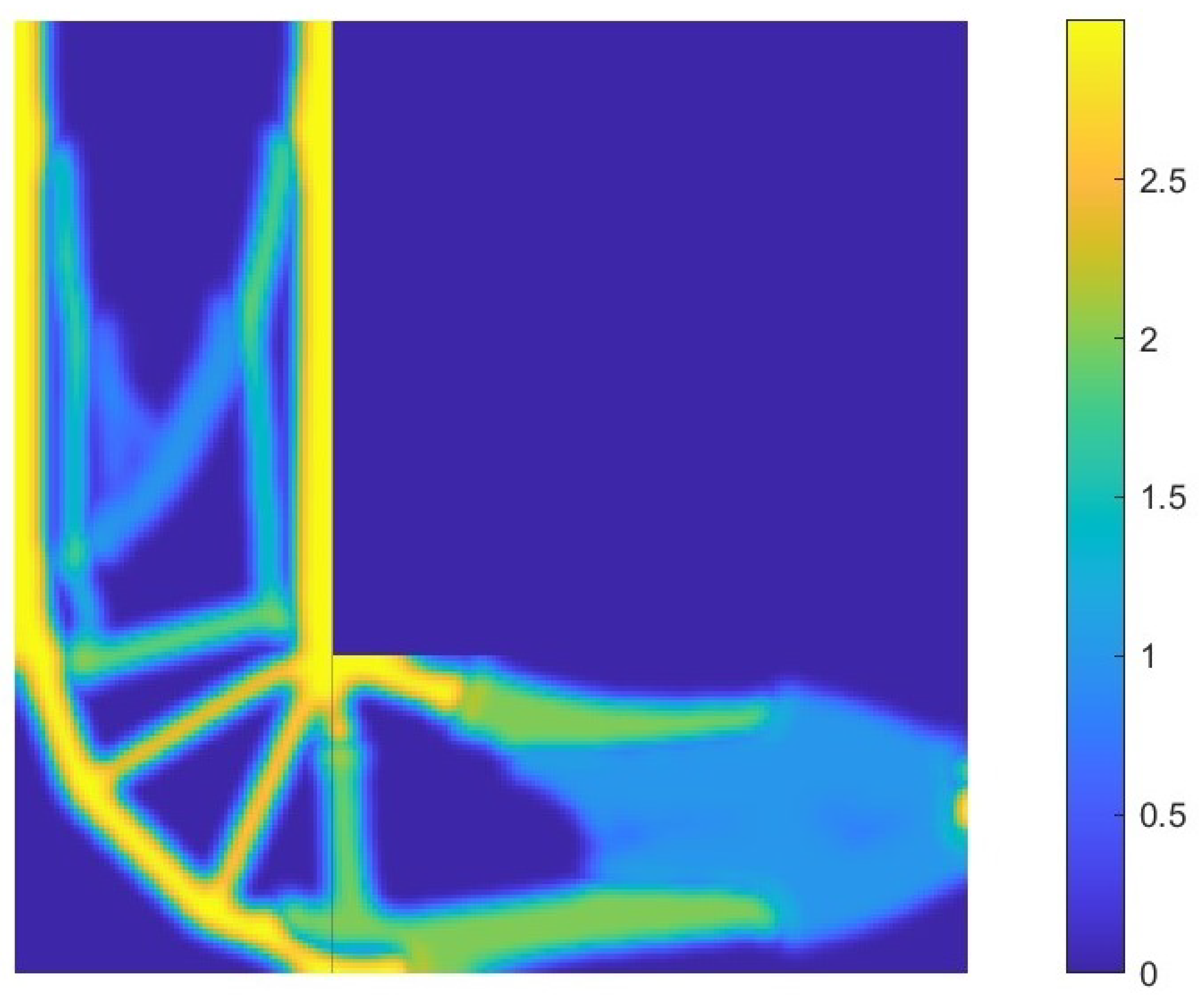
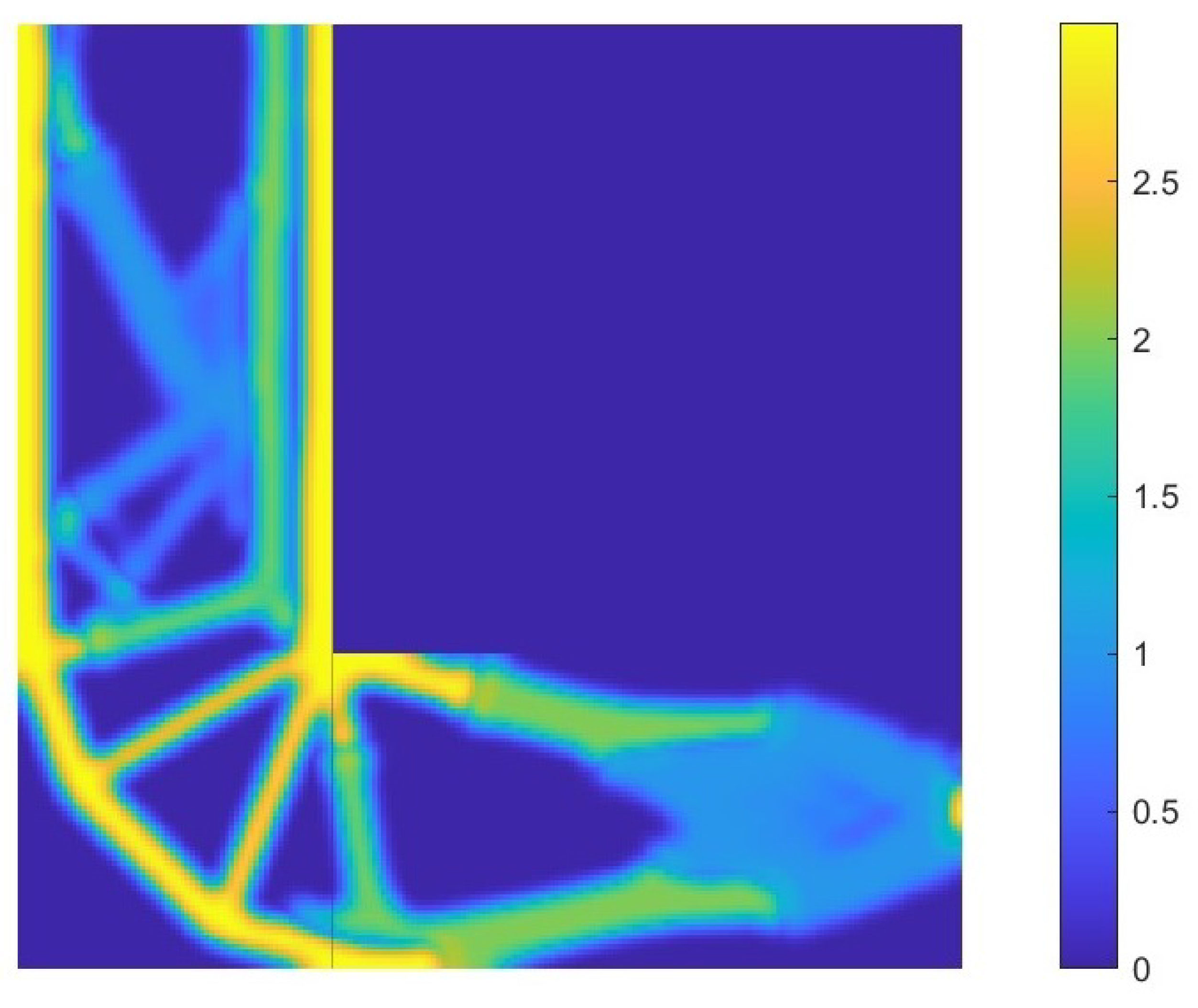
Figure 21 presents the optimal topology obtained by minimizing the 2-norm of the transfer matrix within a MIMO framework. The most notable feature of the resulting design is the emergence of a plate-like resisting member within the horizontal leg, where the majority of the weakest material phase (depicted in blue) is concentrated.
Figure 21.
L-shaped structure: (MIMO-2 Norm) Optimal topology at convergence.
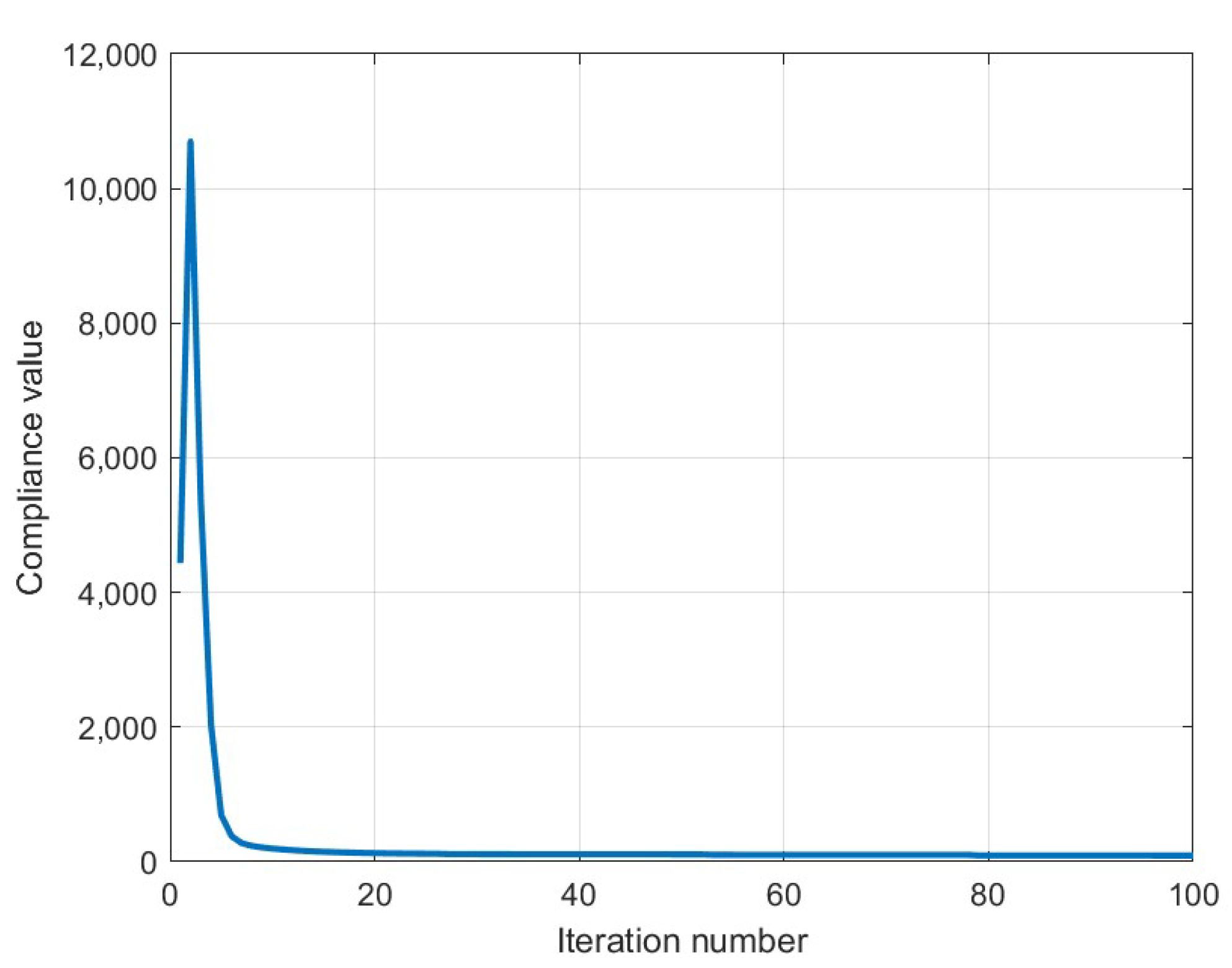
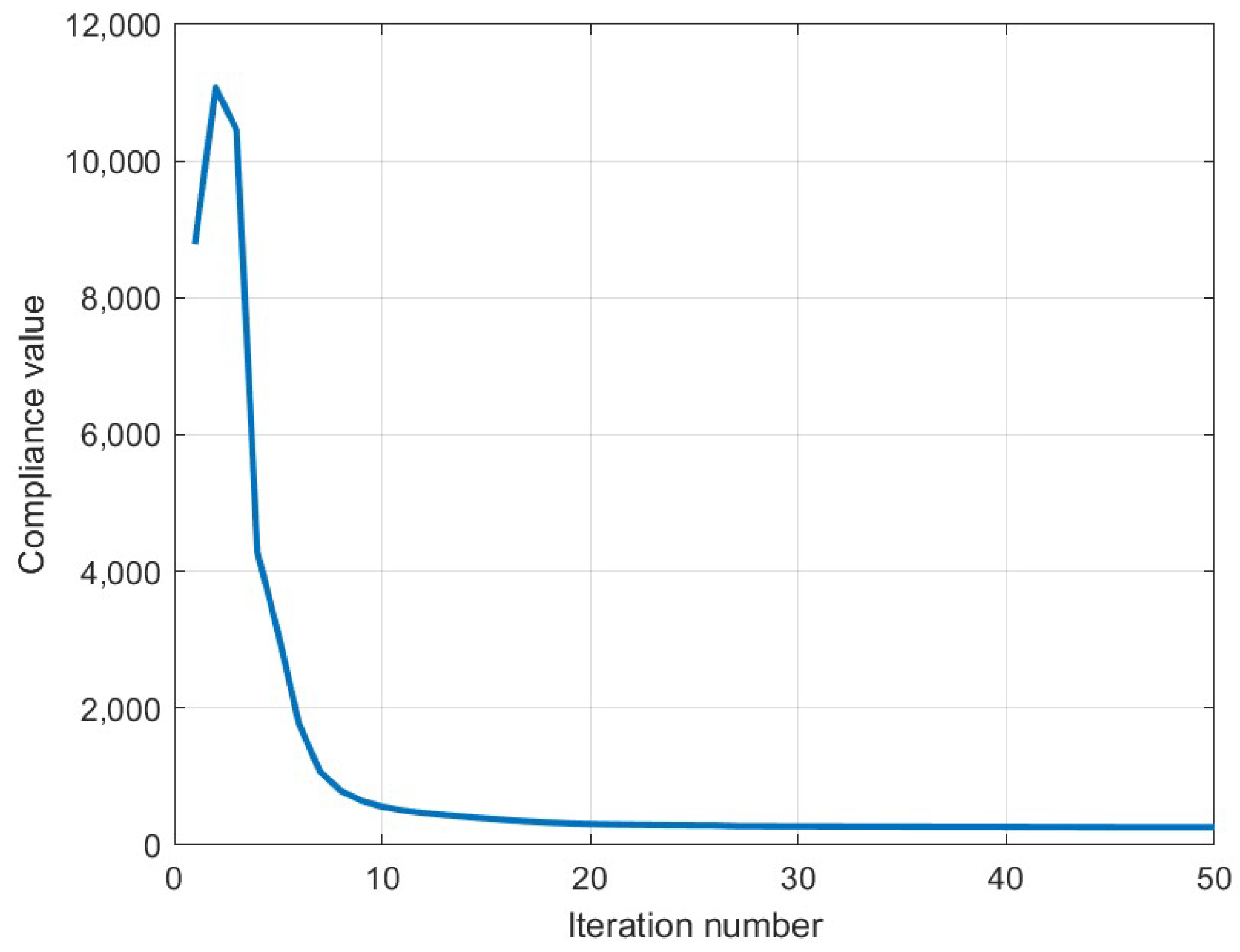
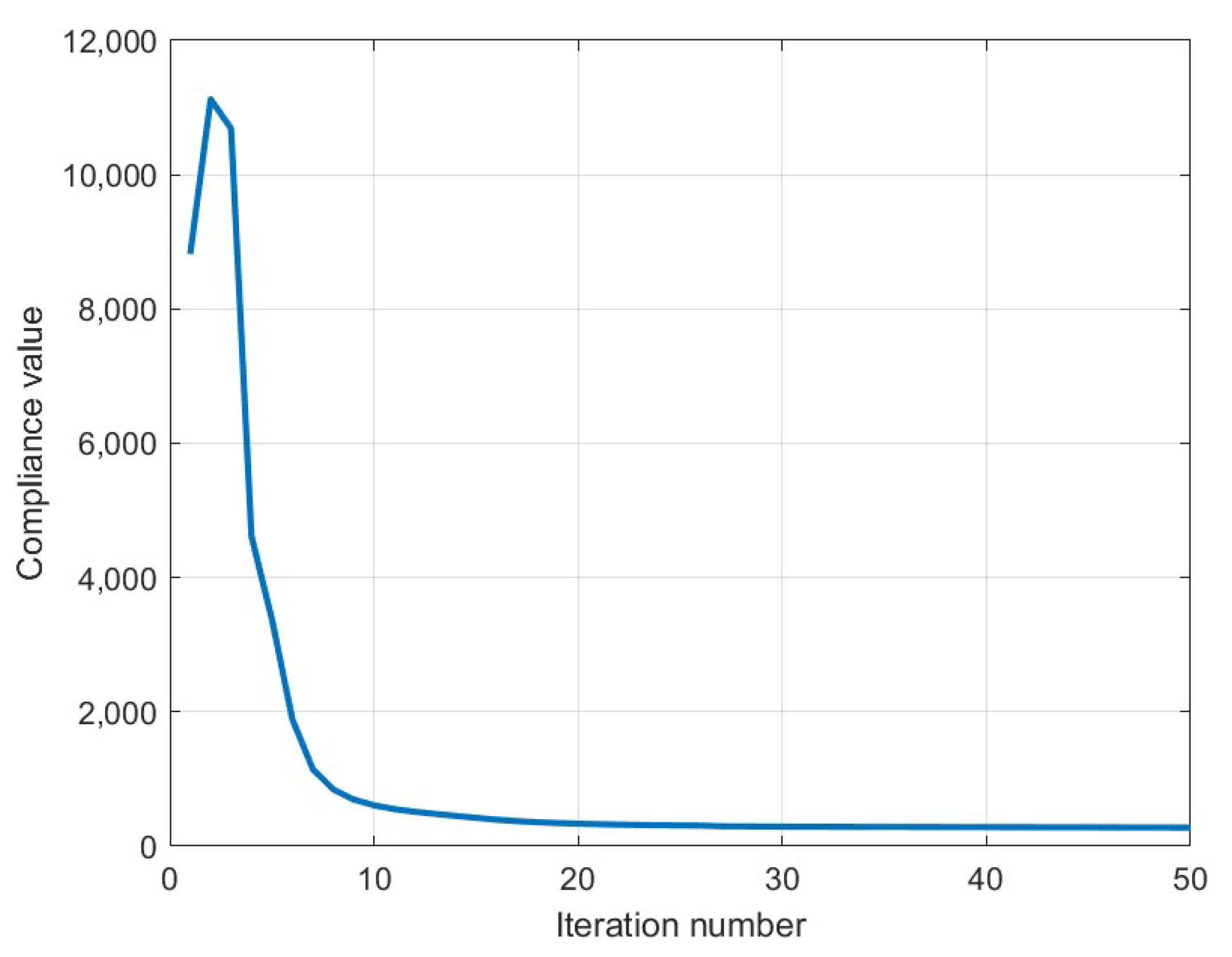
This behavior is closely tied to the nature of the 2-norm, which corresponds to the largest singular value of the transfer matrix and thus emphasizes the most critical input/output direction in terms of energy transfer or compliance [27]. Consequently, the optimization process concentrates design efforts on stiffening the dominant deformation mode, allocating stronger materials to regions of peak stress—namely, the vertical load-bearing chords and the reentrant corner, which is known to be subjected to significant stress concentrations (and therefore strains, and displacements). To conclude, Figure 22 depicts the convergence curve obtained during the optimization.
Figure 22.
L-shaped structure: (MIMO-2 Norm) Convergence curve.
6.2.3. MIMO System-Nuclear Norm
Figure 23 presents the optimal topology obtained by minimizing the Frobenius norm of the transfer matrix within a MIMO (Multiple-Input Multiple-Output) framework. A distinctive feature of this topology is the presence of two pairs of “twin” tendons located on the left and right sides of the vertical leg.
Figure 23.
L-shaped structure: (MIMO-Nuclear Norm) Optimal topology at convergence.
The outer tendons (highlighted in yellow) reduce the compliance associated with the vertical load Q, and their layout aligns with conventional design principles. In contrast, the inner tendons (depicted in green) facilitate the bending mechanism required to mitigate the compliance contribution from the horizontal load P. As previously observed, the green tendons appears thicker than the yellow ones due to their fabrication from a mechanically weaker material, which necessitates a larger cross-sectional area to ensure the desired structural performance.
The convergence behavior, depicted in Figure 24, confirms the same trend noted in the previously discussed cases.
Figure 24.
L-shaped structure: (MIMO-Nuclear Norm) Convergence curve.
6.2.4. MIMO System-Frobenius Norm
Figure 25 illustrates the optimal topology resulting from the minimization of the Frobenius norm of the transfer matrix within a MIMO (Multiple-Input Multiple-Output) framework. The most notable feature of this topology is the presence of two “twin” tendons located on the right side of the vertical leg.
Figure 25.
L-shaped structure: (MIMO-Frobenius Norm) Optimal topology at convergence.
The outer tendon (highlighted in yellow) primarily serves to reduce the compliance associated with the vertical load Q, and its configuration is consistent with classical designs. In contrast, the inner tendon (shown in green) contributes to the bending mechanism required to reduce the compliance component related to the horizontal load P. As previously noted, the green tendon appears thicker than the yellow one due to its composition from a mechanically weaker material, which necessitates a larger cross-section to achieve the desired structural response.
The convergence curve is shown in Figure 26 that confirms the same pattern already commented on for the other cases.
Figure 26.
L-shaped structure: (MIMO-Frobenius Norm) Convergence curve.
6.3. 3D Problem
The proposed topology optimization formulation is general enough to be applicable to any linear elastic problem. 3D structures do not represent an exception and can be addressed and solved using our approach, provided that a suitable finite-element discretization is adopted to model the structure to be designed. The standard eight-noded elements are therefore used to model the 3D problem of Figure 27 that shows the full problem and the half-domain that has been actually discretized using symmetries. Regarding the parameters of the numerical problem, the following values are used:
Figure 27.
3d Problem-Geometry, loads and constraints.
- -
- Number of elements in the transverse (Y) direction: 30;
- -
- Number of elements in the longitudinal (X) direction: 90;
- -
- Number of elements in the vertical, top-down (Z) direction: 3;
- -
- SIMP penalization factor: 3;
- -
- p-norm parameter: 6;
- -
- Filter distance: ;
- -
- Initial value of the filter parameter: ;
- -
- ;
- -
- Number of materials: 3;
- -
- Young moduli: , , ;
- -
- Poisson ratio: .
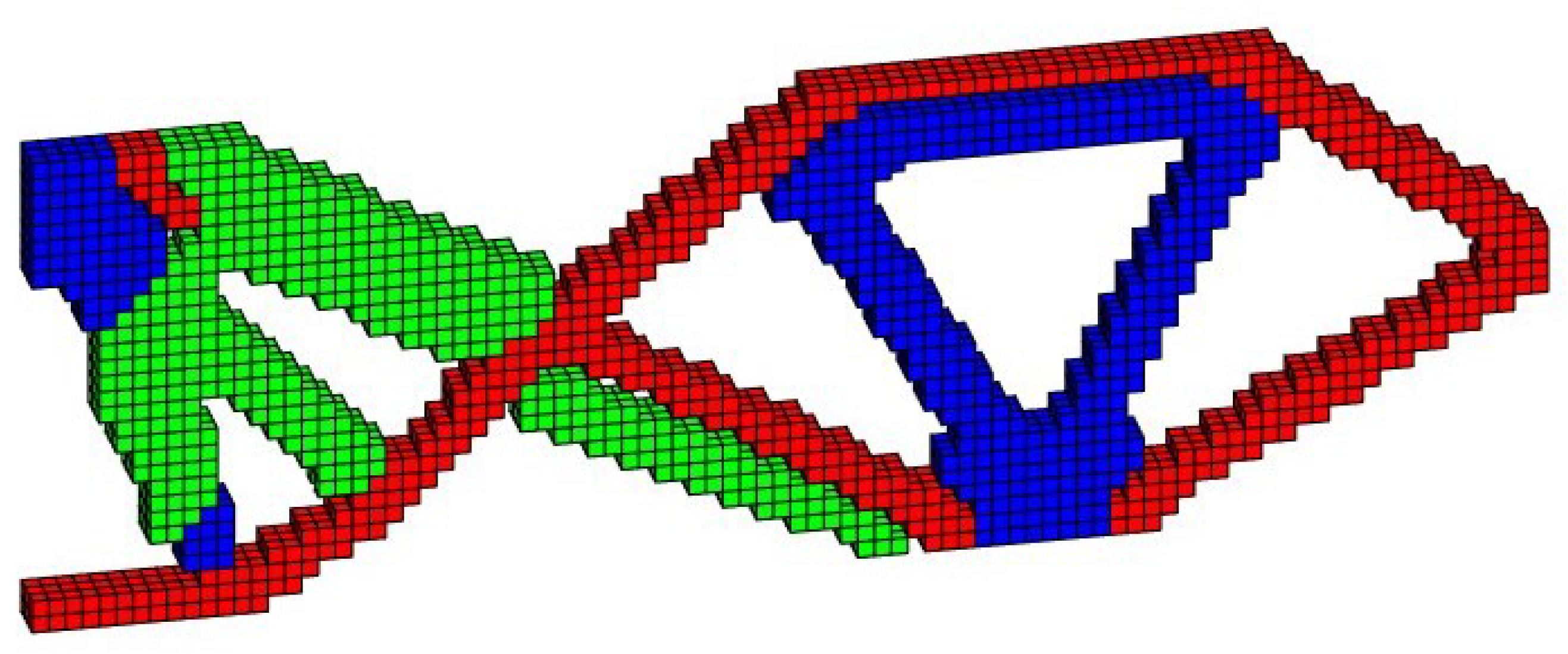
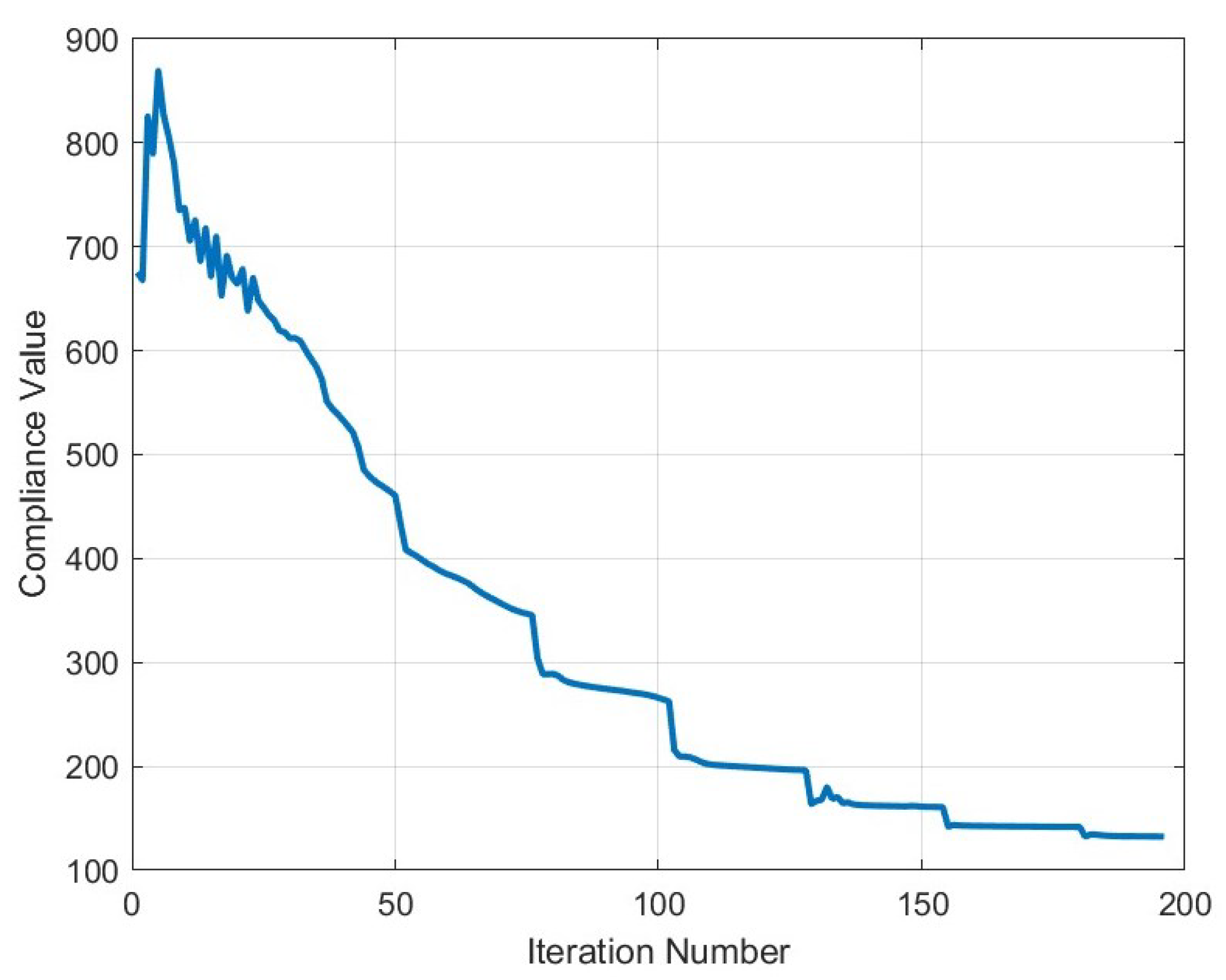
Only a SISO scheme is considered such that all loads are supposed to act simultaneously and concur to define a unique scalar compliance. The optimal topology at convergence is shown in Figure 28 where red, blue, and green are used for material 1 (stronger), 2 (intermediate) and 3 (weaker), respectively. Figure 29 shows the variation on the objective function, i.e., the overall compliance, with the iterations.
Figure 28.
3d Problem-Optimal topology at convergence (red = material 1, blue = material 2, green = material 3).
Figure 29.
3d Problem-Convergence history.
7. Conclusions
This paper introduced a novel framework for MMTO based on the explicit use of the input/output transfer matrix , which maps external loads to selected structural responses. By minimizing a suitable matrix norm of , the proposed approach enables the systematic design of high performance structures under general multiload, multiobjective settings, while seamlessly extending the classical compliance minimization problem as a special case.
The methodology incorporates an advanced multimaterial interpolation scheme that ensures well-defined discrete material distributions. Coupled with a robust two-stage filtering strategy, this formulation effectively mitigates numerical instabilities such as checkerboarding and gray regions. The use of Singular Value Decomposition (SVD) plays a central role, not only in defining the optimization objective but also in facilitating a semianalytical sensitivity analysis, which is crucial for the computational efficiency and robustness of the optimization process.
The numerical results obtained on 2D and 3D benchmark problems—including domains of simply supported and L-shaped—demonstrate the flexibility and effectiveness of the proposed framework. The method yields intuitive material layouts that reflect optimal load transfer paths and leverage the distinct stiffness properties of available materials. Moreover, the comparative analysis of different matrix norms (2-norm, nuclear norm, Frobenius norm) highlights the versatility of the approach in capturing various aspects of structural performance.
Ongoing extensions include dynamic response, thermal problems and compliant mechanism design.
Author Contributions
Conceptualization, P.V.; methodology, P.V.; software, P.V. and G.G.; validation, P.V.; formal analysis, P.V.; investigation, P.V.; resources, P.V.; writing—original draft preparation, P.V. and G.G.; writing—review and editing, P.V. and G.G.; visualization, P.V. and G.G.; supervision, P.V.; project administration, P.V. All authors have read and agreed to the published version of the manuscript.
Funding
This research received no external funding.
Data Availability Statement
This study did not involve any data. The software code related to this work is available online at https://github.com/GiacomoGaluppini?tab=repositories, accessed on 1 April 2025.
Conflicts of Interest
The authors declare no conflict of interest.
References
- Bendsøe, M.; Kikuchi, N. Generating optimal topologies in structural design using a homogenization method. Comput. Methods Appl. Mech. Eng. 1988, 71, 197–224. [Google Scholar] [CrossRef]
- Sigmund, O. A 99 line topology optimization code written in Matlab. Struct. Multidiscip. Optim. 2001, 21, 120–127. [Google Scholar] [CrossRef]
- Zuo, K.; Saitou, K. Ordered SIMP interpolation for multi-material topology optimization. Struct. Multidiscip. Optim. 2017, 55, 477–491. [Google Scholar]
- Ogawa, S.; Yonekura, K.; Suzuki, K. Multimaterial topology optimization of unsteady heat conduction problems based on discrete material optimization. Int. J. Heat Mass Transf. 2024, 225, 125353. [Google Scholar] [CrossRef]
- Yin, L.; Ananthasuresh, G. Topology optimization of compliant mechanisms with multiple materials using a peak function material interpolation scheme. Struct. Multidiscip. Optim. 2006, 33, 199–214. [Google Scholar] [CrossRef]
- Zheng, R.; Yi, B.; Peng, X.; Yoon, G.H. An Efficient Code for the Multi-Material Topology Optimization of 2D/3D Continuum Structures Written in Matlab. Appl. Sci. 2024, 14, 657. [Google Scholar] [CrossRef]
- Andreassen, E.; Clausen, A.; Schevenels, M.; Lazarov, B.S.; Sigmund, O. Efficient topology optimization in MATLAB using 88 lines of code. Struct. Multidiscip. Optim. 2011, 43, 1–16. [Google Scholar] [CrossRef]
- Dinh, T.; Hedayatrasa, S.; Bormann, F.; Bosman, M.; Paepegem, W.V. A smooth single-variable-based interpolation function for multi-material topology optimization. Eng. Comput. 2024, 40, 2841–2855. [Google Scholar] [CrossRef]
- Asadpoure, A.; Rahman, M.; Nejat, S.; Javidannia, L.; Valdevit, L.; Guest, J.; Tootkaboni, M. Topology optimization with multi-phase length-scale control. Int. J. Mech. Sci. 2025, 291–292, 110086. [Google Scholar] [CrossRef]
- Jia, Y.; Li, W.; Zhang, X. Multimaterial topology optimization of elastoplastic composite structures. J. Mech. Phys. Solids 2025, 196, 106018. [Google Scholar] [CrossRef]
- Hvejsel, C.; Lund, E. Material interpolation schemes in topology optimization. Int. J. Numer. Methods Eng. 2011, 85, 575–599. [Google Scholar]
- Bruyneel, M. A general and efficient multi-material topology optimization approach using the shape function with penalization. Struct. Multidiscip. Optim. 2010, 42, 529–553. [Google Scholar]
- Huang, X.D.; Xie, Y.M. Bi-directional evolutionary structural optimization with buckling constraints. Struct. Multidiscip. Optim. 2023, 67, 123–135. [Google Scholar]
- Huang, X. Smooth topological design of structures using the floating projection. Eng. Struct. 2020, 208, 110330. [Google Scholar] [CrossRef]
- Huang, X.D.; Li, W. Three-field floating projection topology optimization of continuum structures. Comput. Methods Appl. Mech. Eng. 2022, 398, 115259. [Google Scholar] [CrossRef]
- Fu, Y.F.; Rolfe, B.; Chiu, N.S.L.; Wang, Y.; Huang, X.; Ghabraie, K. Smooth-edged material distribution for optimizing topology algorithm. Adv. Eng. Softw. 2020, 149, 102921. [Google Scholar] [CrossRef]
- Sanders, E.D.; Pereira, A.; Aguiló, M.A.; Paulino, G.H. PolyMat: An efficient Matlab code for multi-material topology optimization. Struct. Multidiscip. Optim. 2018, 58, 2727–2759. [Google Scholar] [CrossRef]
- Brunton, S.; Kutz, J. Data-Driven Science and Engineering—Machine Learning, Dynamical Systems and Control; Cambrige University Press: Cambridge, MA, USA, 2019. [Google Scholar]
- Strang, G. Linear Algebra and Learning from Data; Cambridge Press: Wellesley, MA, USA, 2019. [Google Scholar]
- Venini, P.; Pingaro, M. Static and dynamic topology optimization: An innovative unifying approach. Struct. Multidiscip. Optim. 2023, 66, 85. [Google Scholar] [CrossRef]
- Venini, P. A new rational approach to multi-input multi-output 3D topology optimization. Comput. Struct. 2024, 298, 107362. [Google Scholar] [CrossRef]
- Yi, B.; Yoon, G.; Zheng, R.; Liu, L.; Li, D.; Peng, X. A unified material interpolation for topology optimization of multi-materials. Comput. Struct. 2023, 282, 107041. [Google Scholar] [CrossRef]
- Svanberg, K. The method of moving asymptotes—A new method for structural optimization. Int. J. Numer. Methods Eng. 1987, 24, 359–373. [Google Scholar] [CrossRef]
- Lewis, A.S.; Overton, M.L. Eigenvalue optimization. Acta Numer. 1996, 5, 149–190. [Google Scholar] [CrossRef]
- Ehrgott, M. Multicriteria Optimization; Springer Science & Business Media: Berlin/Heidelberg, Germany, 2005. [Google Scholar]
- Bendsøe, M.P.; Sigmund, O. Material interpolation schemes in topology optimization. Arch. Appl. Mech. 1999, 69, 635–654. [Google Scholar] [CrossRef]
- Trefethen, L.N.; Bau, B. Numerical Linear Algebra; SIAM: Philadelphia, PA, USA, 1997. [Google Scholar]
Disclaimer/Publisher’s Note: The statements, opinions and data contained in all publications are solely those of the individual author(s) and contributor(s) and not of MDPI and/or the editor(s). MDPI and/or the editor(s) disclaim responsibility for any injury to people or property resulting from any ideas, methods, instructions or products referred to in the content. |
© 2025 by the authors. Licensee MDPI, Basel, Switzerland. This article is an open access article distributed under the terms and conditions of the Creative Commons Attribution (CC BY) license (https://creativecommons.org/licenses/by/4.0/).