
Enhancing Intrusion Detection Systems with Dimensionality Reduction and Multi-Stacking Ensemble Techniques


Abstract
1. Introduction
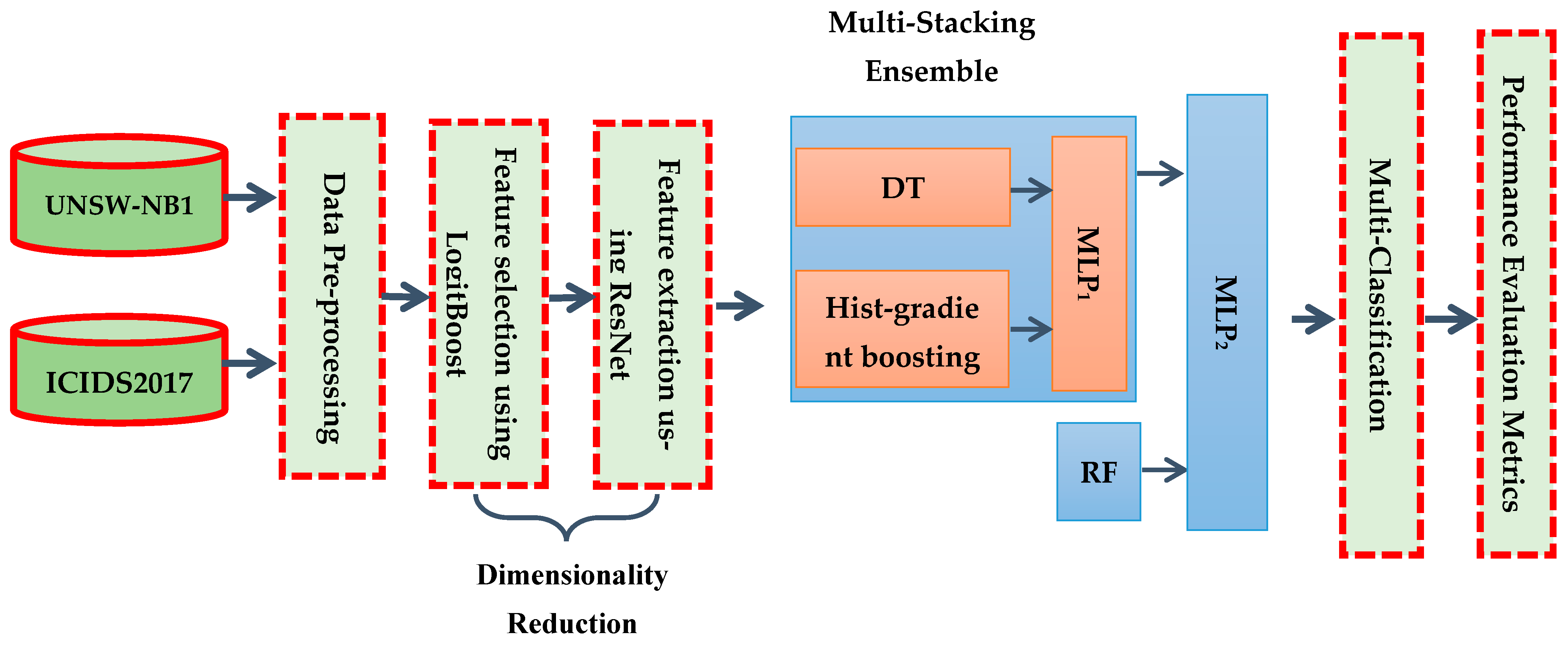
- It develops a dimensionality reduction approach by combining feature selection and extraction techniques to address the curse of dimensionality.
- The implementation of LogitBoost feature selection, based on XGBRegressor, identifies crucial features from datasets of varying sizes.
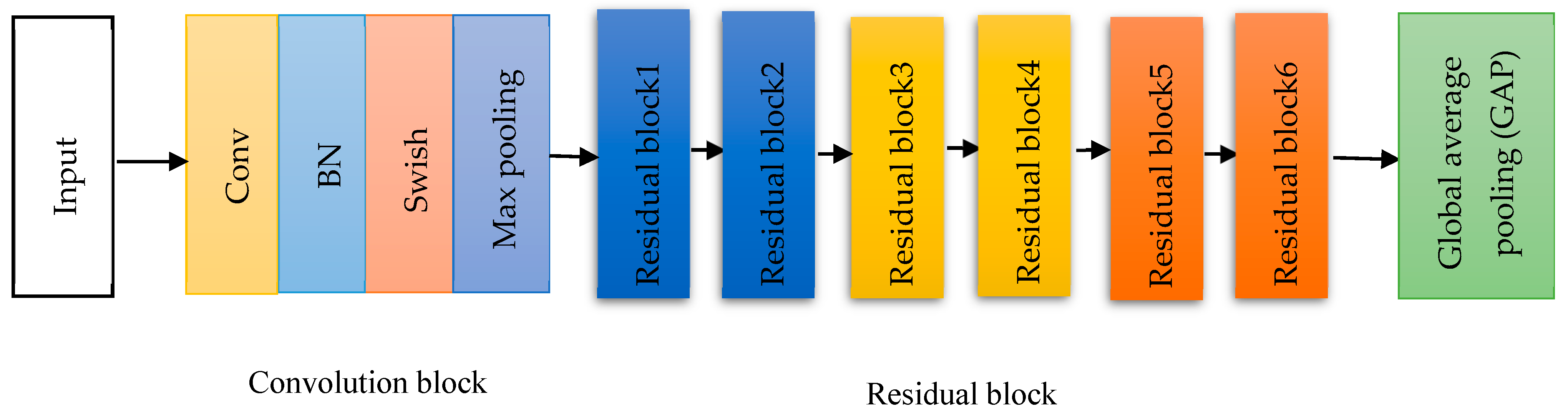
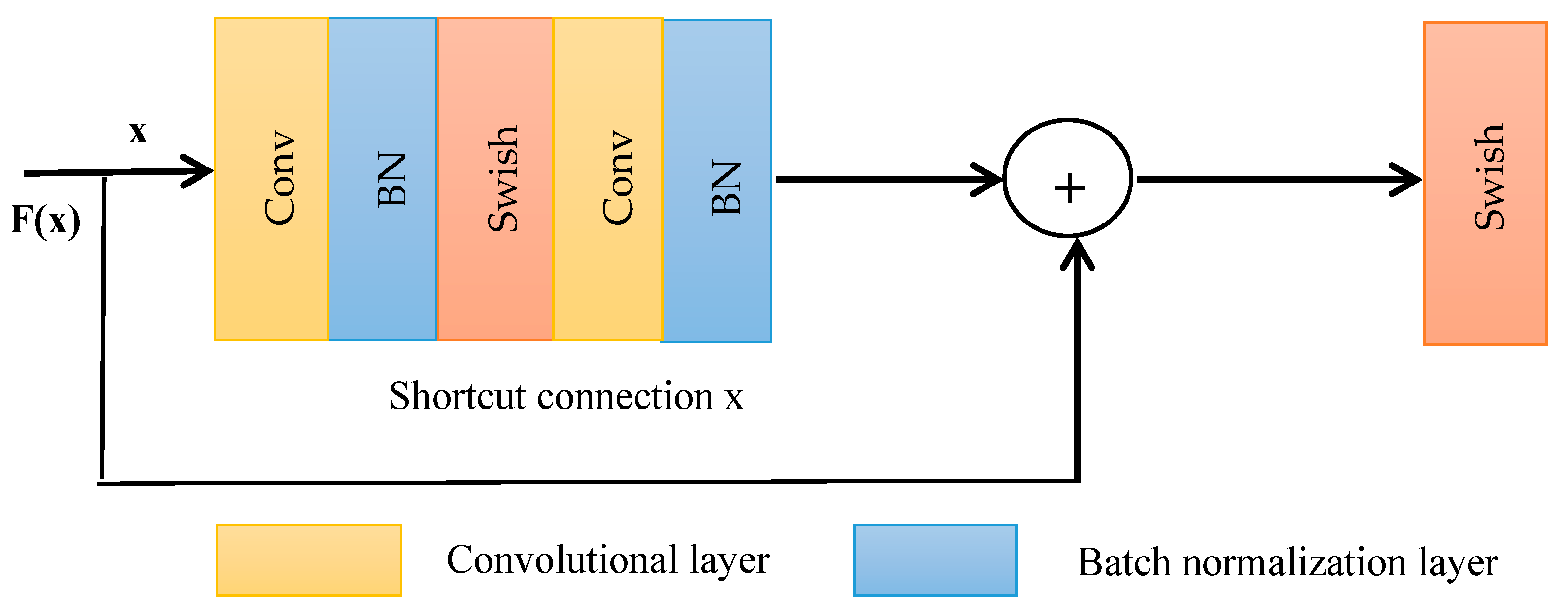
- A ResNet deep learning algorithm is designed for feature extraction, leveraging features selected by the LogitBoost algorithm.
- A novel multi-stacking ensemble (MSE) technique is devised to enhance the classification performance.
2. Related Work
2.1. Feature Selection Techniques with Classification Algorithms
2.2. Feature Extraction Techniques with Classification Algorithms
3. Methodology
3.1. Data Description
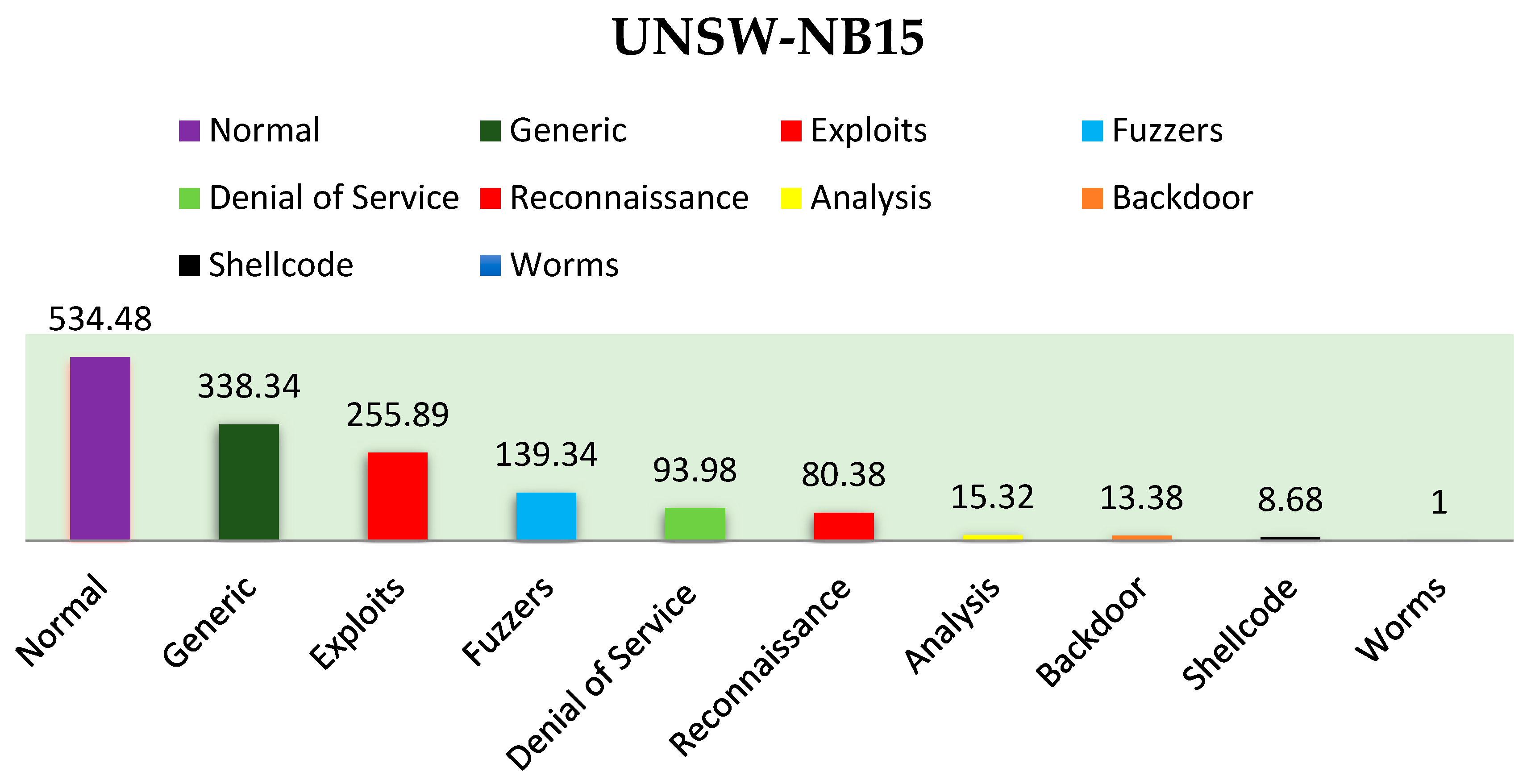
3.1.1. UNSW-NB15 Dataset (D1)
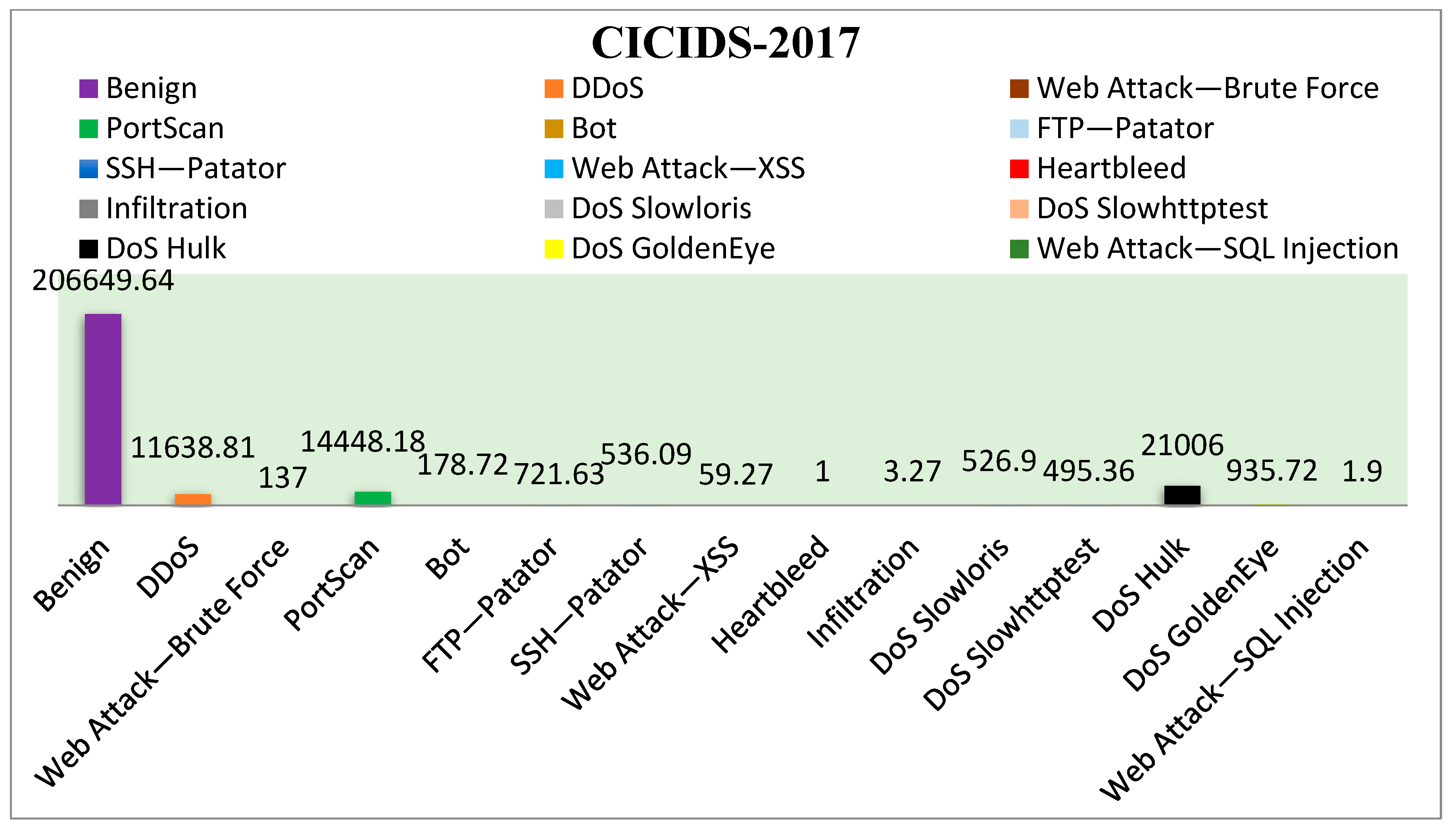
3.1.2. CICIDS2017 Dataset (D2)
3.2. Data Pre-Processing
3.2.1. Data Filtration
3.2.2. Data Numeralization
3.2.3. Data Normalization
3.3. Dimensionality Reduction
3.3.1. Feature Selection
| Algorithm 1. Pre-processing and Feature Selection Steps |
| Input: UNSW-NB15 dataset (), CICIDS2017 dataset () |
| Output: Optimal feature subsets chosen by for and |
| Data Pre-processing // Filtration: Step1: = Eliminate ‘Infinity’ and ‘NaN’ from . // Numeralization: Step2: If the dataset contains any non-numeric attributes then do: = used numeric coding to the dataset End if // Normalization: Step3: , = applied Min-MaxScaling for (, ) // LogitBoost Method Step4: = applied the approach based on XGBRegressor for and to determine the optimal set of features. |
3.3.2. Feature Extraction
3.4. Ensemble Learning Classifiers
- Improved accuracy: Stacked ensembles outperform individual predictive models and other ensemble methodologies such as boosting and bagging due to their integration of a diverse range of base models. This comprehensive technique allows for a rigorous analysis of the data, effectively reducing both bias and variance, thereby enhancing predictive accuracy [66].
- Enhanced robustness: Stacked ensembles mitigate overfitting risks and strengthen model robustness by employing a meta-learner to combine base model outputs. This meta-learner is capable of detecting and rectifying the errors of the base models, which leads to improved generalization [67].
- Flexibility: Contrary to boosting and bagging, which generally employ homogeneous model types, stacking ensembles distinguish themselves by integrating various models, comprising both nonlinear and linear ones. This attribute enhances the adaptability of model selection, thereby improving performance when dealing with complex datasets [68].
3.4.1. Decision Tree Classifier
3.4.2. Histogram-Based Gradient Boosting Classifier
3.4.3. Random Forest Classifier
3.4.4. Multilayer Perceptron Algorithm
3.4.5. Multi-Stacking Ensemble (MSE)
| Algorithm 2. Multi-Stacking Ensemble |
| Input: Train data = , where represents features and represents the label. |
| Output: the final predictions output (F) |
| // Prepare training set using cross-validation Step 1: Apply five-fold cross-validation in preparing the training set. // Splitting the dataset into five equally sized subsets. Step 2: Randomly Split into equally sized subsets. Step 3: for do where Step 3.1: for do where Employ base level classifiers (DT, hist-gradient boosting) for do Learn a classifier from end for Construct a training set for first meta-classifier () MLP1 for do Get record {}, where end for end for Step 3.2: Learn the first meta-classifier () MLP1 Learn a new classifier from the collection of { Step 3.3: Re-learn classifiers for do Learn a classifier based on end for Step 3.4: Step 3.5: Employ base level classifiers (, RF) for do Learn a classifier from end for Construct a training set for the second meta classifier () MLP2 for do Get record {}, where end for end for Step 4: Learn the second meta-classifier () MLP2 Learn a new classifier from the collection of { Step 5: Re-learn classifiers for do Learn a classifier based on end for Step 6: Return |
4. Performance Evaluation
- False positive (FP): the actual data are negative, but the prediction indicates them as positive.
- False negative (FN): the actual data are positive, but the prediction incorrectly indicates them as negative.
- True negative (TN): both the actual data and the prediction are negative.
- True positive (TP): both the actual data and the prediction are positive.
4.1. Experimental Results and Discussion
- Windows 11 (64-bit) as the operating system.
- VGA: RTX2070 8GB.
- HDD: 1 TB SSD.
- RAM: 32 GB.
- CPU: Ryzen7 5800h.
4.2. Comparing Individual Algorithms with MSE for Multiclass Classification
4.3. Comparison of Results with State-of-the-Art Models
5. Conclusions
Author Contributions
Funding
Data Availability Statement
Conflicts of Interest
Abbreviations
| IG | Information Gain |
| PIO | Pigeon-Inspired Optimization |
| MFO | Moth Flame Optimization |
| RFE | Recursive Feature Elimination |
| SFS | Sequential Forward Selection |
| LightGBM | Light Gradient Boosting |
| PSO | Particle Swarm Optimization |
| CFS | Correlation Feature Selection |
| RFECV | Recursive Feature Elimination Cross-Validation |
| HFBHA | Hybrid Firefly and Black Hole Algorithm |
| UMAP | Uniform Manifold Approximation and Projection |
| DBN | Deep Belief Network |
| TCNN | Triplet Convolutional Neural Network |
| RF | Random Forest |
| PCA | Principal Component Analysis |
| DR | Dimensionality Reduction |
| WOA | Whale Optimization Algorithm |
| XGBoost | eXtreme Gradient Boosting |
| DNN | Deep Neural Network |
| MLP | Multilayer Perceptron |
| CNN | Convolutional Neural Network |
| GRU | Gated Recurrent Unit |
| AE | Autoencoder |
| DAE | Denoising Autoencoder |
| VAE | Variational Autoencoder |
| LSTM | Long Short-Term Memory |
| DTTWSVM | Decision Tree Twin Support Vector |
| LSSVM | Least-Squares Vector Machine |
| SARSA | State–Action–Reward–Action |
| BPNN | Backpropagation Neural Network |
| Bi-LSTM | Bidirectional Long-Short Term Memory |
| ANN | Artificial Neural Network |
| NRS | Neighborhood Rough Set |
| KNN | K-Nearest Neighbor |
| SVM | Support Vector Machine |
| LR | Logistic Regression |
| DT | Decision Tree |
| SSA | Salp Swarm Algorithm |
References
- Leszczyna, R.; Wallis, T.; Wróbel, M.R. Developing novel solutions to realise the European energy–information sharing & analysis centre. Decis. Support Syst. 2019, 122, 113067. [Google Scholar]
- Koczkodaj, W.W.; Mazurek, M.; Strzałka, D.; Wolny-Dominiak, A.; Woodbury-Smith, M. Electronic health record breaches as social indicators. Soc. Indic. Res. 2019, 141, 861–871. [Google Scholar] [CrossRef] [Scilit]
- Zhang, H.; Chari, K.; Agrawal, M. Decision support for the optimal allocation of security controls. Decis. Support Syst. 2018, 115, 92–104. [Google Scholar] [CrossRef] [Scilit]
- Zadeh, A.; Jeyaraj, A. A multistate modeling approach for organizational cybersecurity exploration and exploitation. Decis. Support Syst. 2022, 162, 113849. [Google Scholar] [CrossRef] [Scilit]
- Khammassi, C.; Krichen, S. A GA-LR wrapper approach for feature selection in network intrusion detection. Comput. Secur. 2017, 70, 255–277. [Google Scholar] [CrossRef] [Scilit]
- Yang, B.; Arshad, M.H.; Zhao, Q. Packet-level and flow-level network intrusion detection based on reinforcement learning and adversarial training. Algorithms 2022, 15, 453. [Google Scholar] [CrossRef] [Scilit]
- Elhag, S.; Fernández, A.; Bawakid, A.; Alshomrani, S.; Herrera, F. On the combination of genetic fuzzy systems and pairwise learning for improving detection rates on intrusion detection systems. Expert Syst. Appl. 2015, 42, 193–202. [Google Scholar] [CrossRef] [Scilit]
- Khraisat, A.; Gondal, I.; Vamplew, P.; Kamruzzaman, J. Survey of intrusion detection systems: Techniques, datasets and challenges. Cybersecurity 2019, 2, 1–22. [Google Scholar] [CrossRef] [Scilit]
- Anwar, S.; Mohamad Zain, J.; Zolkipli, M.F.; Inayat, Z.; Khan, S.; Anthony, B.; Chang, V. From intrusion detection to an intrusion response system: Fundamentals, requirements, and future directions. Algorithms 2017, 10, 39. [Google Scholar] [CrossRef] [Scilit]
- Li, X.J.; Ma, M.; Sun, Y. An adaptive deep learning neural network model to enhance machine-learning-based classifiers for intrusion detection in smart grids. Algorithms 2023, 16, 288. [Google Scholar] [CrossRef] [Scilit]
- Wan, J.; Waqas, M.; Tu, S.; Hussain, S.M.; Shah, A.; Rehman, S.U.; Hanif, M. An efficient impersonation attack detection method in fog computing. CMC-Comput. Mater. Cont. 2021, 68, 267–281. [Google Scholar] [CrossRef] [Scilit]
- Pranto, M.B.; Ratul, M.H.A.; Rahman, M.M.; Diya, I.J.; Zahir, Z.-B. Performance of machine learning techniques in anomaly detection with basic feature selection strategy-a network intrusion detection system. J. Adv. Inf. Technol 2022, 13, 36–44. [Google Scholar] [CrossRef] [Scilit]
- Ozkan-Okay, M.; Samet, R.; Aslan, Ö.; Gupta, D. A comprehensive systematic literature review on intrusion detection systems. IEEE Access 2021, 9, 157727–157760. [Google Scholar] [CrossRef] [Scilit]
- Cui, J.; Zong, L.; Xie, J.; Tang, M. A novel multi-module integrated intrusion detection system for high-dimensional imbalanced data. Appl. Intell. 2023, 53, 272–288. [Google Scholar] [CrossRef] [Scilit]
- Kim, M.; Yun, J.; Cho, Y.; Shin, K.; Jang, R.; Bae, H.-j.; Kim, N. Deep learning in medical imaging. Neurospine 2019, 16, 657. [Google Scholar] [CrossRef] [Scilit]
- Yin, W.; Kann, K.; Yu, M.; Schütze, H. Comparative study of CNN and RNN for natural language processing. arXiv 2017, arXiv:1702.01923. [Google Scholar]
- Liu, L.; Wang, P.; Lin, J.; Liu, L. Intrusion detection of imbalanced network traffic based on machine learning and deep learning. IEEE Access 2020, 9, 7550–7563. [Google Scholar] [CrossRef] [Scilit]
- Esteva, A.; Robicquet, A.; Ramsundar, B.; Kuleshov, V.; DePristo, M.; Chou, K.; Cui, C.; Corrado, G.; Thrun, S.; Dean, J. A guide to deep learning in healthcare. Nat. Med. 2019, 25, 24–29. [Google Scholar] [CrossRef] [Scilit]
- Sun, X.; Lv, M. Facial expression recognition based on a hybrid model combining deep and shallow features. Cogn. Comput. 2019, 11, 587–597. [Google Scholar] [CrossRef] [Scilit]
- Chen, C.; Song, Y.; Yue, S.; Xu, X.; Zhou, L.; Lv, Q.; Yang, L. Fcnn-se: An intrusion detection model based on a fusion CNN and stacked ensemble. Appl. Sci. 2022, 12, 8601. [Google Scholar] [CrossRef] [Scilit]
- He, K.; Zhang, X.; Ren, S.; Sun, J. Deep residual learning for image recognition. In Proceedings of the IEEE Conference on Computer Vision and Pattern Recognition, Las Vegas, NV, USA, 27–30 June 2016; pp. 770–778. [Google Scholar]
- Mebawondu, J.O.; Alowolodu, O.D.; Mebawondu, J.O.; Adetunmbi, A.O. Network intrusion detection system using supervised learning paradigm. Sci. Afr. 2020, 9, e00497. [Google Scholar] [CrossRef] [Scilit]
- Zhang, L.; Xu, C. A Intrusion Detection Model Based on Convolutional Neural Network and Feature Selection. In Proceedings of the 2022 5th International Conference on Artificial Intelligence and Big Data (ICAIBD), Chengdu, China, 27–30 May 2022; pp. 162–167. [Google Scholar]
- Alazzam, H.; Sharieh, A.; Sabri, K.E. A feature selection algorithm for intrusion detection system based on pigeon inspired optimizer. Expert Syst. Appl. 2020, 148, 113249. [Google Scholar] [CrossRef] [Scilit]
- Tang, C.; Luktarhan, N.; Zhao, Y. An efficient intrusion detection method based on LightGBM and autoencoder. Symmetry 2020, 12, 1458. [Google Scholar] [CrossRef] [Scilit]
- Wang, Z.; Liu, J.; Sun, L. EFS-DNN: An Ensemble Feature Selection-Based Deep Learning Approach to Network Intrusion Detection System. Secur. Commun. Netw. 2022, 2022, 2693948. [Google Scholar] [CrossRef] [Scilit]
- Chowdhury, R.; Sen, S.; Roy, A.; Saha, B. An optimal feature based network intrusion detection system using bagging ensemble method for real-time traffic analysis. Multimed. Tools Appl. 2022, 81, 41225–41247. [Google Scholar] [CrossRef] [Scilit]
- Kannari, P.R.; Chowdary, N.S.; Biradar, R.L. An anomaly-based intrusion detection system using recursive feature elimination technique for improved attack detection. Theor. Comput. Sci. 2022, 931, 56–64. [Google Scholar] [CrossRef] [Scilit]
- Nazir, A.; Khan, R.A. A novel combinatorial optimization based feature selection method for network intrusion detection. Comput. Secur. 2021, 102, 102164. [Google Scholar] [CrossRef] [Scilit]
- Jiang, H.; He, Z.; Ye, G.; Zhang, H. Network intrusion detection based on PSO-XGBoost model. IEEE Access 2020, 8, 58392–58401. [Google Scholar] [CrossRef] [Scilit]
- Zong, X.; Li, R.; Ye, Z. An Intrusion Detection Model Based on Improved Whale Optimization Algorithm and XGBoost. In Proceedings of the 2021 11th IEEE International Conference on Intelligent Data Acquisition and Advanced Computing Systems: Technology and Applications (IDAACS), Virtual, 22–25 September 2021; pp. 542–547. [Google Scholar]
- Yong, X.; Gao, Y. Hybrid firefly and black hole algorithm designed for XGBoost tuning problem: An application for intrusion detection. IEEE Access 2023, 11, 28551–28564. [Google Scholar] [CrossRef] [Scilit]
- Iwendi, C.; Khan, S.; Anajemba, J.H.; Mittal, M.; Alenezi, M.; Alazab, M. The use of ensemble models for multiple class and binary class classification for improving intrusion detection systems. Sensors 2020, 20, 2559. [Google Scholar] [CrossRef] [Scilit]
- Zheng, X.; Wang, Y.; Jia, L.; Xiong, D.; Qiang, J. Network intrusion detection model based on Chi-square test and stacking approach. In Proceedings of the 2020 7th International Conference on Information Science and Control Engineering (ICISCE), Changsha, China, 18–20 December 2020; pp. 894–899. [Google Scholar]
- Rajadurai, H.; Gandhi, U.D. A stacked ensemble learning model for intrusion detection in wireless network. Neural Comput. Appl. 2022, 34, 15387–15395. [Google Scholar] [CrossRef] [Scilit]
- Jain, M.; Kaur, G. Distributed anomaly detection using concept drift detection based hybrid ensemble techniques in streamed network data. Clust. Comput. 2021, 24, 2099–2114. [Google Scholar] [CrossRef] [Scilit]
- Alsaffar, A.M.; Nouri-Baygi, M.; Zolbanin, H.M. Shielding networks: Enhancing intrusion detection with hybrid feature selection and stack ensemble learning. J. Big Data 2024, 11, 133. [Google Scholar] [CrossRef] [Scilit]
- Luo, J.; Zhang, Y.; Wu, Y.; Xu, Y.; Guo, X.; Shang, B. A multi-channel contrastive learning network based intrusion detection method. Electronics 2023, 12, 949. [Google Scholar] [CrossRef] [Scilit]
- Sherubha, P.; Sasirekha, S.; Anguraj, A.D.K.; Rani, J.V.; Anitha, R.; Praveen, S.P.; Krishnan, R.H. An Efficient Unsupervised Learning Approach for Detecting Anomaly in Cloud. Comput. Syst. Sci. Eng. 2023, 45, 149–166. [Google Scholar] [CrossRef] [Scilit]
- Yan, Y.; Qi, L.; Wang, J.; Lin, Y.; Chen, L. A network intrusion detection method based on stacked autoencoder and LSTM. In Proceedings of the ICC 2020-2020 IEEE International Conference on Communications (ICC), Dublin, Ireland, 7–11 June 2020; pp. 1–6. [Google Scholar]
- Du, X.; Lin, L.; Han, Z.; Zhang, C. An Intrusion Detection Algorithm Based on Hybrid Autoencoder and Decision Tree. In Proceedings of the 2022 12th International Conference on Information Science and Technology (ICIST), Kaifeng, China, 14–16 October 2022; pp. 32–37. [Google Scholar]
- Singh, S. Poly logarithmic naive Bayes intrusion detection system using linear stable PCA feature extraction. Wirel. Pers. Commun. 2022, 125, 3117–3132. [Google Scholar] [CrossRef] [Scilit]
- Waskle, S.; Parashar, L.; Singh, U. Intrusion detection system using PCA with random forest approach. In Proceedings of the 2020 International Conference on Electronics and Sustainable Communication Systems (ICESC), Coimbatore, India, 2–4 July 2020; pp. 803–808. [Google Scholar]
- Karanam, L.; Pattanaik, K.K.; Aldmour, R. Intrusion detection mechanism for large scale networks using CNN-LSTM. In Proceedings of the 2020 13th International Conference on Developments in eSystems Engineering (DeSE), Liverpool, UK, 14–17 December 2020; pp. 323–328. [Google Scholar]
- Zhao, Z.; Ge, L.; Zhang, G. A novel DBN-LSSVM ensemble method for intrusion detection system. In Proceedings of the 2021 9th International Conference on Communications and Broadband Networking, Shanghai, China, 25–27 February 2021; pp. 101–107. [Google Scholar]
- Moustafa, N.; Slay, J. UNSW-NB15: A comprehensive data set for network intrusion detection systems (UNSW-NB15 network data set). In Proceedings of the 2015 Military Communications and Information Systems Conference (MilCIS), Canberra, Australia, 10–12 November 2015; pp. 1–6. [Google Scholar]
- Awad, M.; Fraihat, S. Recursive feature elimination with cross-validation with decision tree: Feature selection method for machine learning-based intrusion detection systems. J. Sens. Actuator Netw. 2023, 12, 67. [Google Scholar] [CrossRef] [Scilit]
- Sharafaldin, I.; Lashkari, A.H.; Ghorbani, A.A. Toward generating a new intrusion detection dataset and intrusion traffic characterization. ICISSp 2018, 1, 108–116. [Google Scholar]
- Hastie, T.; Tibshirani, R.; Friedman, J.H.; Friedman, J.H. The Elements of Statistical Learning: Data Mining, Inference, and Prediction; Springer: Berlin/Heidelberg, Germany, 2009; Volume 2. [Google Scholar]
- Velliangiri, S.; Alagumuthukrishnan, S. A review of dimensionality reduction techniques for efficient computation. Procedia Comput. Sci. 2019, 165, 104–111. [Google Scholar] [CrossRef] [Scilit]
- Santos, I.; Young, A. Exploring the perception of social characteristics in faces using the isolation effect. Vis. Cogn. 2005, 12, 213–247. [Google Scholar] [CrossRef] [Scilit]
- Chao, G.; Luo, Y.; Ding, W. Recent advances in supervised dimension reduction: A survey. Mach. Learn. Knowl. Extr. 2019, 1, 341–358. [Google Scholar] [CrossRef] [Scilit]
- Ayesha, S.; Hanif, M.K.; Talib, R. Overview and comparative study of dimensionality reduction techniques for high dimensional data. Inf. Fusion 2020, 59, 44–58. [Google Scholar] [CrossRef] [Scilit]
- Zhou, Y.; Ren, H.; Li, Z.; Pedrycz, W. Anomaly detection based on a granular Markov model. Expert Syst. Appl. 2022, 187, 115744. [Google Scholar] [CrossRef] [Scilit]
- Alkanhel, R.; El-kenawy, E.-S.M.; Abdelhamid, A.A.; Ibrahim, A.; Alohali, M.A.; Abotaleb, M.; Khafaga, D.S. Network Intrusion Detection Based on Feature Selection and Hybrid Metaheuristic Optimization. Comput. Mater. Contin. 2023, 74. [Google Scholar] [CrossRef] [Scilit]
- Naseri, T.S.; Gharehchopogh, F.S. A feature selection based on the farmland fertility algorithm for improved intrusion detection systems. J. Netw. Syst. Manag. 2022, 30, 40. [Google Scholar] [CrossRef] [Scilit]
- Friedman, J.; Hastie, T.; Tibshirani, R. Additive logistic regression: A statistical view of boosting (with discussion and a rejoinder by the authors). Ann. Stat. 2000, 28, 337–407. [Google Scholar] [CrossRef]
- Hall, M.; Frank, E.; Holmes, G.; Pfahringer, B.; Reutemann, P.; Witten, I.H. The WEKA data mining software: An update. ACM SIGKDD Explor. Newsl. 2009, 11, 10–18. [Google Scholar] [CrossRef] [Scilit]
- Pourghasemi, H.R.; Gayen, A.; Park, S.; Lee, C.-W.; Lee, S. Assessment of landslide-prone areas and their zonation using logistic regression, logitboost, and naïvebayes machine-learning algorithms. Sustainability 2018, 10, 3697. [Google Scholar] [CrossRef] [Scilit]
- Kim, K.; Seo, M.; Kang, H.; Cho, S.; Kim, H.; Seo, K.-S. Application of logitboost classifier for traceability using snp chip data. PLoS ONE 2015, 10, e0139685. [Google Scholar] [CrossRef] [Scilit]
- Chen, T.; Guestrin, C. Xgboost: A scalable tree boosting system. In Proceedings of the 22nd ACM Sigkdd International Conference on Knowledge Discovery and Data Mining, San Francisco, CA, USA, 13–17 August 2016; pp. 785–794. [Google Scholar]
- Jia, W.; Sun, M.; Lian, J.; Hou, S. Feature dimensionality reduction: A review. Complex Intell. Syst. 2022, 8, 2663–2693. [Google Scholar] [CrossRef] [Scilit]
- Ramachandran, P.; Zoph, B.; Le, Q.V. Searching for activation functions. arXiv 2017, arXiv:1710.05941. [Google Scholar]
- Breiman, L. Bagging predictors. Mach. Learn. 1996, 24, 123–140. [Google Scholar] [CrossRef] [Scilit]
- Schapire, R.E. The strength of weak learnability. Mach. Learn. 1990, 5, 197–227. [Google Scholar] [CrossRef] [Scilit]
- Wolpert, D.H. Stacked generalization. Neural Netw. 1992, 5, 241–259. [Google Scholar] [CrossRef] [Scilit]
- Sagi, O.; Rokach, L. Ensemble learning: A survey. Wiley Interdiscip. Rev. Data Min. Knowl. Discov. 2018, 8, e1249. [Google Scholar] [CrossRef] [Scilit]
- Galar, M.; Fernandez, A.; Barrenechea, E.; Bustince, H.; Herrera, F. A review on ensembles for the class imbalance problem: Bagging-, boosting-, and hybrid-based approaches. IEEE Trans. Syst. Man Cybern. Part C (Appl. Rev.) 2011, 42, 463–484. [Google Scholar] [CrossRef] [Scilit]
- Lee, J.-H.; Lee, J.-H.; Sohn, S.-G.; Ryu, J.-H.; Chung, T.-M. Effective value of decision tree with KDD 99 intrusion detection datasets for intrusion detection system. In Proceedings of the 2008 10th International Conference on Advanced Communication Technology, Phoenix Park, Republic of Korea, 17–20 February 2008; pp. 1170–1175. [Google Scholar]
- Rahman, C.M.; Farid, D.M.; Harbi, N.; Bahri, E.; Rahman, M.Z. Attacks Classification in Adaptive Intrusion Detection Using Decision Tree; United International University: Dhaka, Bangladesh, 2010. [Google Scholar]
- Peddabachigari, S.; Abraham, A.; Thomas, J. Intrusion detection systems using decision trees and support vector machines. Int. J. Appl. Sci. Comput. USA 2004, 11, 118–134. [Google Scholar]
- Aljamaan, H.; Alazba, A. Software defect prediction using tree-based ensembles. In Proceedings of the 16th ACM International Conference on Predictive Models and Data Analytics in Software Engineering, Virtual, 8–9 November 2020; pp. 1–10. [Google Scholar]
- Guryanov, A. Histogram-based algorithm for building gradient boosting ensembles of piecewise linear decision trees. In Proceedings of the Analysis of Images, Social Networks and Texts: 8th International Conference, AIST 2019, Kazan, Russia, 17–19 July 2019; Revised Selected Papers 8. Springer: Cham, Switzerland, 2019; pp. 39–50. [Google Scholar]
- Lin, S.; Zheng, H.; Han, B.; Li, Y.; Han, C.; Li, W. Comparative performance of eight ensemble learning approaches for the development of models of slope stability prediction. Acta Geotech. 2022, 17, 1477–1502. [Google Scholar] [CrossRef] [Scilit]
- Breiman, L. Random forests. Mach. Learn. 2001, 45, 5–32. [Google Scholar] [CrossRef] [Scilit]
- Bloice, M.D.; Holzinger, A. A tutorial on machine learning and data science tools with python. In Machine Learning for Health Informatics: State-of-the-Art and Future Challenges; Springer: Cham, Switzerland, 2016; pp. 435–480. [Google Scholar]
- Yin, Y.; Jang-Jaccard, J.; Xu, W.; Singh, A.; Zhu, J.; Sabrina, F.; Kwak, J. IGRF-RFE: A hybrid feature selection method for MLP-based network intrusion detection on UNSW-NB15 dataset. J. Big Data 2023, 10, 15. [Google Scholar] [CrossRef] [Scilit]
- Ayantayo, A.; Kaur, A.; Kour, A.; Schmoor, X.; Shah, F.; Vickers, I.; Kearney, P.; Abdelsamea, M.M. Network intrusion detection using feature fusion with deep learning. J. Big Data 2023, 10, 167. [Google Scholar] [CrossRef] [Scilit]
- Mohamed, S.; Ejbali, R. Deep SARSA-based reinforcement learning approach for anomaly network intrusion detection system. Int. J. Inf. Secur. 2023, 22, 235–247. [Google Scholar] [CrossRef] [Scilit]
- Bowen, B.; Chennamaneni, A.; Goulart, A.; Lin, D. BLoCNet: A hybrid, dataset-independent intrusion detection system using deep learning. Int. J. Inf. Secur. 2023, 22, 893–917. [Google Scholar] [CrossRef] [Scilit]
- Yang, Z.; Liu, Z.; Zong, X.; Wang, G. An optimized adaptive ensemble model with feature selection for network intrusion detection. Concurr. Comput. Pract. Exp. 2023, 35, e7529. [Google Scholar] [CrossRef] [Scilit]
- Zou, L.; Luo, X.; Zhang, Y.; Yang, X.; Wang, X. HC-DTTSVM: A network intrusion detection method based on decision tree twin support vector machine and hierarchical clustering. IEEE Access 2023, 11, 21404–21416. [Google Scholar] [CrossRef] [Scilit]
- Azar, A.T.; Shehab, E.; Mattar, A.M.; Hameed, I.A.; Elsaid, S.A. Deep learning based hybrid intrusion detection systems to protect satellite networks. J. Netw. Syst. Manag. 2023, 31, 82. [Google Scholar] [CrossRef] [Scilit]
- Wang, A.; Wang, W.; Zhou, H.; Zhang, J. Network intrusion detection algorithm combined with group convolution network and snapshot ensemble. Symmetry 2021, 13, 1814. [Google Scholar] [CrossRef] [Scilit]
- Du, X.; Cheng, C.; Wang, Y.; Han, Z. Research on network attack traffic detection HybridAlgorithm based on UMAP-RF. Algorithms 2022, 15, 238. [Google Scholar] [CrossRef] [Scilit]
- Lazzarini, R.; Tianfield, H.; Charissis, V. A stacking ensemble of deep learning models for IoT intrusion detection. Knowl.-Based Syst. 2023, 279, 110941. [Google Scholar] [CrossRef] [Scilit]
- Lu, Y.; Chai, S.; Suo, Y.; Yao, F.; Zhang, C. Intrusion detection for Industrial Internet of Things based on deep learning. Neurocomputing 2024, 564, 126886. [Google Scholar] [CrossRef] [Scilit]
- Harini, R.; Maheswari, N.; Ganapathy, S.; Sivagami, M. An effective technique for detecting minority attacks in NIDS using deep learning and sampling approach. Alex. Eng. J. 2023, 78, 469–482. [Google Scholar] [CrossRef] [Scilit]



| Author(s) | DR Techniques | DR Technique Type | Classification Algorithm | Classification Algorithm Technique Type | Classification Type | Datasets Used |
| [22] | IG | Filter method | MLP | Single | Binary | UNSW-NB15 |
| [23] | PIO | Wrapper method | CNN | Single | Binary | NSL-KDD |
| [24] | PIO | Wrapper method | DT | Single | Binary | KDD99, NSL-KDD, and UNSW-NB15 |
| [25] | LightGBM | Embedded method | AE, DAE, and VAE | Single | Binary | NSL-KDD |
| [26] | LightGBM | Embedded method | DNN | Single | Binary and multiclass | KDD99, NSL-KDD, and UNSW-NB15 |
| [27] | MFO | Wrapper method | DT | Bagging | Binary and multiclass | NSL-KDD |
| [28] | RFE | Wrapper method | RF | Bagging | Binary and Multiclass | NSL-KDD |
| [29] | Tabu Search | Wrapper method | RF | Bagging | multiclass | UNSW-NB15 |
| [30] | PSO | Wrapper method | XGBoost | Boosting | Binary and multiclass | NSL-KDD |
| [31] | WOA | Wrapper method | XGBoost | Boosting | Binary and multiclass | NSL-KDD |
| [32] | HFBHA | Wrapper method | XGBoost | Boosting | Binary | NSL-KDD |
| [33] | CFS | Filter method | J48, RF, and Reptree | Bagging and Adaboost | Binary and multiclass | KDD99 and NSLKDD |
| [34] | Chi-squared | Filter method | XGBoost, K-means, BPNN, and SVM | Stacking | Binary | NSL-KDD |
| [35] | RF | Embedded method | RF and GBM | Stacking | Binary and multiclass | NSL-KDD |
| [36] | Attribute Ratio | Filter method | RF, LR, and SVM | Stacking | Binary | NSL-KDD and CICIDS2017 |
| [37] | Mutual information and Boruta algorithm | Filter and wrapper method | Catboost, RF, XGBoost, and MLP | Stacking | Binary and multiclass | UNSW-NB15 and CIDS2017 |
| [38] | AE | Feature extraction | TCNN | Single | Binary and multiclass | KDD99 |
| [39] | AE | Feature extraction | Naïve Bayes | Single | Binary | NSL-KDD |
| [40] | AE | Feature extraction | LSTM | Single | Binary | UNSW-NB15 |
| [41] | AE | Feature extraction | DT | Single | Binary | KDD99 |
| [42] | PCA | Feature extraction | Naïve Bayes | Single | Binary and multiclass | KDD99 |
| [43] | PCA | Feature extraction | RF | Bagging | Binary | KDD99 |
| [44] | CNN | Feature extraction | LSTM | Single | Binary and multiclass | NSL-KDD |
| [45] | DBN | Feature extraction | LSSVM | Single | Binary and multiclass | KDD99 |
| Category of Attack | Instance for Training | Instance for Testing |
|---|---|---|
| Fuzzers | 18,184 | 6062 |
| Generic | 40,000 | 18,871 |
| Reconnaissance | 10,491 | 3496 |
| Analysis | 2000 | 667 |
| Exploits | 33,393 | 11,132 |
| Backdoor | 1746 | 583 |
| Worms | 130 | 44 |
| Denial of Service (DoS) | 12,264 | 4089 |
| Shellcode | 1133 | 378 |
| Normal traffic | 56,000 | 37,000 |
| Overall total (instances) | 175,341 | 82,332 |
| Attack Type | Record Count |
|---|---|
| Normal | 2,273,097 |
| PortScan | 158,930 |
| Bot | 1966 |
| DoS GoldenEye | 10,293 |
| SSH—Patator | 5897 |
| Web Attack—SQL Injection | 21 |
| DoS Slowhttptest | 5499 |
| DDoS | 128,027 |
| Infiltration | 36 |
| FTP—Patator | 7938 |
| Web Attack—Brute Force | 1507 |
| Heartbleed | 11 |
| DoS Hulk | 231,073 |
| Web Attack—XSS | 652 |
| DoS slowloris | 5796 |
| Total attacks | 471,454 |
| Overall total (records) | 2,830,743 |
| Dataset | Feature Count | LogitBoost-Selected Features |
|---|---|---|
| D1 | 28 | Dur, service, ct_src_dport_ltm, dmean, ct_srv_src, dpkts, sbytes, ct_dst_src_ltm, sinpkt, dinpkt, ct_dst_ltm, smean, rate, sttl, sload, ct_dst_sport_ltm, dbytes, dtcpb, djit, stcpb, dload, dloss, tcprtt, synack, ackdat, sjit, ct_src_ltm, ct_srv_dst. |
| D2 | 35 | Destination Port, Flow IAT Min, Flow IAT Max, Total Fwd Packets, Flow Duration, Flow Bytes/s, Fwd Packet Length Std, Flow IAT Std, Fwd Packet Length Mean, Flow IAT Mean, Bwd Packet Length Min, Fwd Packet Length Max, Flow Packets/s, Bwd Packet Length Std, Fwd Packets/s, Fwd IAT Std, Bwd IAT Min, Fwd IAT Mean, Bwd IAT Mean, Fwd IAT Total, Bwd IAT Max, Fwd IAT Min, Bwd IAT Std, Bwd IAT Total, Fwd IAT Max, min_seg_size_forward, Max Packet Length, Init_Win_bytes_forward, Min Packet Length, Init_Win_bytes_backward, Bwd Packets/s, Average Packet Size, PSH Flag Count, Packet Length Std, URG Flag Count. |
| Layer | Parameters |
|---|---|
| Convolution layer | Size kernel = 7, number of kernel = 64, stride = 1 |
| Max pooling | Pooling size = 3, stride = 1 |
| Residual block1 | Size kernel = 3, number of kernel = 64, stride = 1 |
| Residual block2 | Size kernel = 3, number of kernel = 64, stride = 1 |
| Residual block3 | Size kernel = 3, number of kernel = 32, stride = 1 |
| Residual block4 | Size kernel = 3, number of kernel = 32, stride = 1 |
| Residual block5 | Size kernel = 3, number of kernel = 16, stride = 1 |
| Residual block6 | Size kernel = 3, number of kernel = 16, stride =1 |
| Algorithms | Parameters |
|---|---|
| DT | Criterion = ‘entropy’, min_samples_leaf = 5, min_samples_split = 2. |
| Hist-gradient boosting | Loss = ‘categorical_crossentropy’, min_samples_leaf = 10, learning_rate = 0.1. |
| RF | N_estimators = 100, criterion = ‘entropy’, max_depth = 60. |
| MLP | Hidden_layer_sizes with 100 neurons, activation = ‘relu’, solver = ‘adam’. |
| Classifier | Category of Attack | Precision | Recall | F1 Score |
|---|---|---|---|---|
| DT | Analysis | 66.66 | 10.09 | 17.53 |
| Backdoor | 50.81 | 6.65 | 11.76 | |
| DoS | 43.90 | 17.05 | 24.57 | |
| Exploits | 61.59 | 89.10 | 72.84 | |
| Fuzzers | 71.52 | 53.51 | 61.22 | |
| Generic | 99.17 | 97.76 | 98.46 | |
| Normal | 90.32 | 94.05 | 92.15 | |
| Reconnaissance | 89.25 | 74.51 | 81.22 | |
| Shellcode | 54.16 | 51.65 | 52.88 | |
| Worms | 33.33 | 11.42 | 17.02 | |
| Hist-gradient boosting | Analysis | 74.68 | 11.02 | 19.21 |
| Backdoor | 52.27 | 4.93 | 9.01 | |
| DoS | 45.62 | 11.46 | 18.32 | |
| Exploits | 61.12 | 91.04 | 73.14 | |
| Fuzzers | 75.71 | 55.31 | 63.92 | |
| Generic | 99.40 | 98.03 | 98.71 | |
| Normal | 90.64 | 95.08 | 92.81 | |
| Reconnaissance | 90.50 | 73.90 | 81.36 | |
| Shellcode | 53.82 | 58.27 | 55.96 | |
| Worms | 16.66 | 22.85 | 19.27 | |
| RF | Analysis | 69.56 | 11.96 | 20.41 |
| Backdoor | 64 | 6.86 | 12.40 | |
| DoS | 34.06 | 23.23 | 27.62 | |
| Exploits | 63.41 | 82.63 | 71.76 | |
| Fuzzers | 70.92 | 59.31 | 64.60 | |
| Generic | 99.63 | 97.92 | 98.77 | |
| Normal | 91.64 | 94.98 | 93.28 | |
| Reconnaissance | 89.96 | 75.91 | 82.34 | |
| Shellcode | 63.95 | 59.93 | 61.88 | |
| Worms | 33.33 | 8.50 | 13.63 | |
| MLP | Analysis | 65.16 | 10.84 | 18.58 |
| Backdoor | 57.62 | 7.29 | 12.95 | |
| DoS | 44.25 | 25.31 | 32.20 | |
| Exploits | 63.79 | 88.26 | 74.06 | |
| Fuzzers | 73.54 | 59.22 | 65.61 | |
| Generic | 99.44 | 98.06 | 98.74 | |
| Normal | 91.75 | 94.15 | 92.93 | |
| Reconnaissance | 91.35 | 75.12 | 82.44 | |
| Shellcode | 64.94 | 58.27 | 61.43 | |
| Worms | 27.27 | 17.14 | 21.05 | |
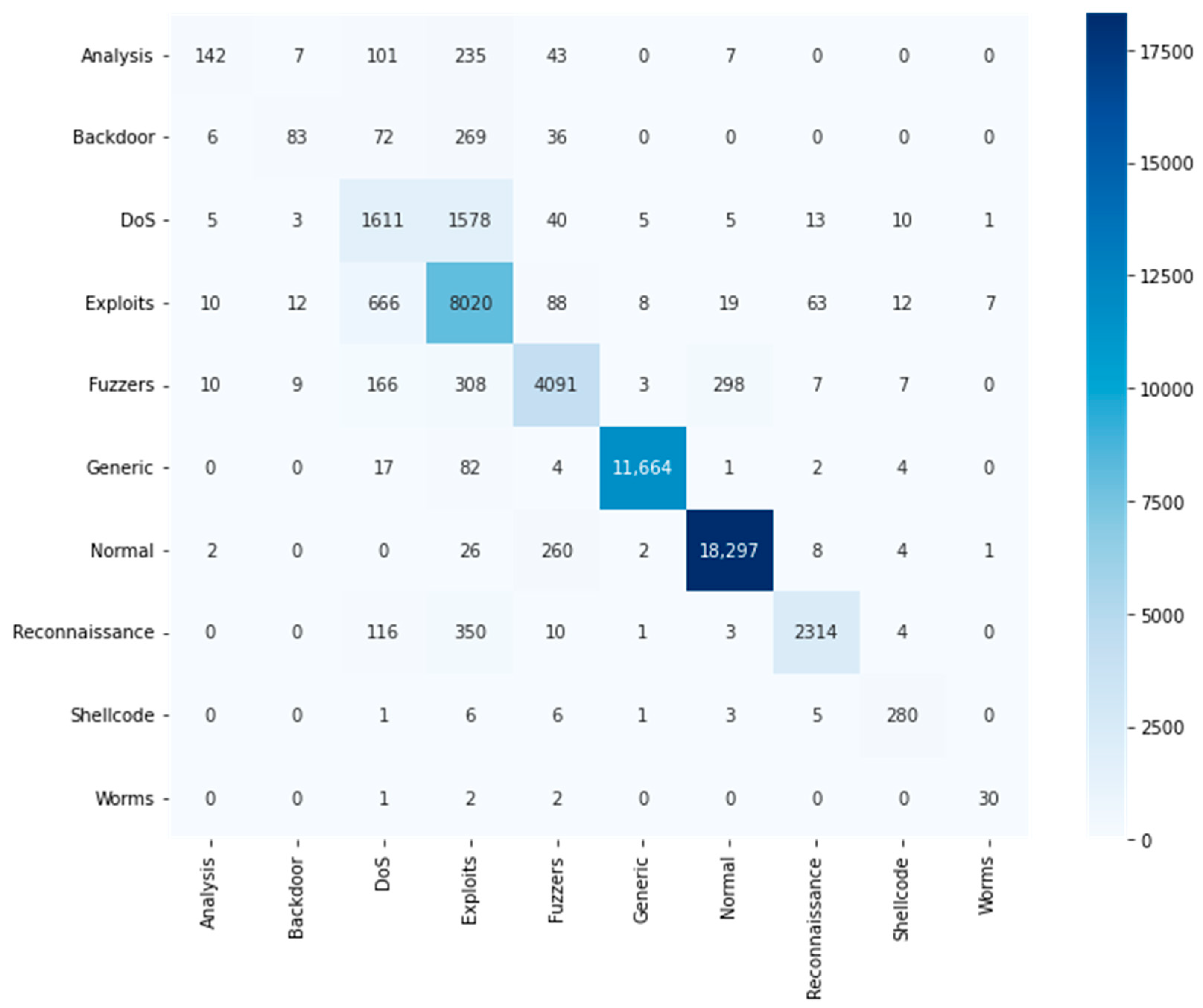
| Proposed model (MSE) | Analysis | 81.14 | 26.54 | 40 |
| Backdoor | 72.80 | 17.81 | 28.62 | |
| DoS | 59.64 | 49.25 | 53.95 | |
| Exploits | 73.74 | 90.06 | 81.08 | |
| Fuzzers | 89.32 | 84.36 | 86.77 | |
| Generic | 99.82 | 99.06 | 99.44 | |
| Normal | 98.19 | 98.37 | 98.28 | |
| Reconnaissance | 95.93 | 82.70 | 88.82 | |
| Shellcode | 87.22 | 92.71 | 89.88 | |
| Worms | 76.92 | 85.71 | 81.08 |
| Classifier | Category of Attack | Precision | Recall | F1 Score |
|---|---|---|---|---|
| DT | Benign | 99.54 | 98.69 | 99.11 |
| Bot | 91.94 | 35.03 | 50.74 | |
| DdoS | 99.59 | 99.68 | 99.64 | |
| DoS GoldenEye | 95.63 | 95.72 | 95.67 | |
| DoS Hulk | 97.98 | 99.31 | 98.64 | |
| DoS Slowhttptest | 95.17 | 98.63 | 96.87 | |
| DoS slowloris | 96.75 | 95.08 | 95.90 | |
| FTP—Patator | 97.49 | 97.98 | 97.73 | |
| Heartbleed | 0 | 0 | 0 | |
| Infiltration | 0 | 0 | 0 | |
| PortScan | 86.38 | 96.08 | 90.98 | |
| SSH—Patator | 98.03 | 92.79 | 95.34 | |
| Web Attack—Brute Force | 64.86 | 87.70 | 74.57 | |
| Web Attack—SQL Injection | 0 | 0 | 0 | |
| Web Attack—XSS | 0 | 0 | 0 | |
| Hist-gradient boosting | Benign | 99.54 | 98.53 | 99.03 |
| Bot | 44.10 | 43.98 | 44.04 | |
| DdoS | 99.90 | 98.76 | 99.33 | |
| DoS GoldenEye | 96.98 | 85.96 | 91.14 | |
| DoS Hulk | 98.29 | 99.28 | 98.78 | |
| DoS Slowhttptest | 75.98 | 98.09 | 85.63 | |
| DoS slowloris | 91.48 | 96.46 | 93.91 | |
| FTP—Patator | 96.27 | 97.79 | 97.03 | |
| Heartbleed | 0 | 0 | 0 | |
| Infiltration | 0 | 0 | 0 | |
| PortScan | 89.82 | 95.34 | 92.50 | |
| SSH—Patator | 95.19 | 95.76 | 95.47 | |
| Web Attack—Brute Force | 22.60 | 88.70 | 36.03 | |
| Web Attack—SQL Injection | 0 | 0 | 0 | |
| Web Attack—XSS | 1.04 | 2.30 | 1.44 | |
| RF | Benign | 99.67 | 98.61 | 99.14 |
| Bot | 100 | 37.85 | 54.91 | |
| DdoS | 99.98 | 99.77 | 99.88 | |
| DoS GoldenEye | 99.21 | 97.71 | 98.45 | |
| DoS Hulk | 98.56 | 99.23 | 98.89 | |
| DoS Slowhttptest | 98.28 | 98.90 | 98.59 | |
| DoS slowloris | 99.71 | 89.21 | 94.17 | |
| FTP—Patator | 99.60 | 95.84 | 97.68 | |
| Heartbleed | 100 | 100 | 100 | |
| Infiltration | 0 | 0 | 0 | |
| PortScan | 84.79 | 98.39 | 91.09 | |
| SSH—Patator | 98.82 | 92.45 | 95.53 | |
| Web Attack—Brute Force | 69.35 | 97 | 80.88 | |
| Web Attack—SQL Injection | 0 | 0 | 0 | |
| Web Attack—XSS | 33 | 0.76 | 1.50 | |
| MLP | Benign | 99.56 | 99.02 | 99.29 |
| Bot | 89.67 | 42.19 | 57.39 | |
| DdoS | 99.91 | 99.73 | 99.82 | |
| DoS GoldenEye | 98.50 | 99.02 | 98.76 | |
| DoS Hulk | 98.26 | 99.65 | 98.95 | |
| DoS Slowhttptest | 97.58 | 99 | 98.28 | |
| DoS slowloris | 99.12 | 97.75 | 98.43 | |
| FTP—Patator | 97.77 | 99.55 | 98.65 | |
| Heartbleed | 100 | 100 | 100 | |
| Infiltration | 0 | 0 | 0 | |
| PortScan | 89.67 | 95.81 | 92.64 | |
| SSH—Patator | 98.10 | 96.35 | 97.22 | |
| Web Attack—Brute Force | 65.11 | 55.81 | 60.10 | |
| Web Attack—SQL Injection | 0 | 0 | 0 | |
| Web Attack—XSS | 26 | 12 | 16.84 | |
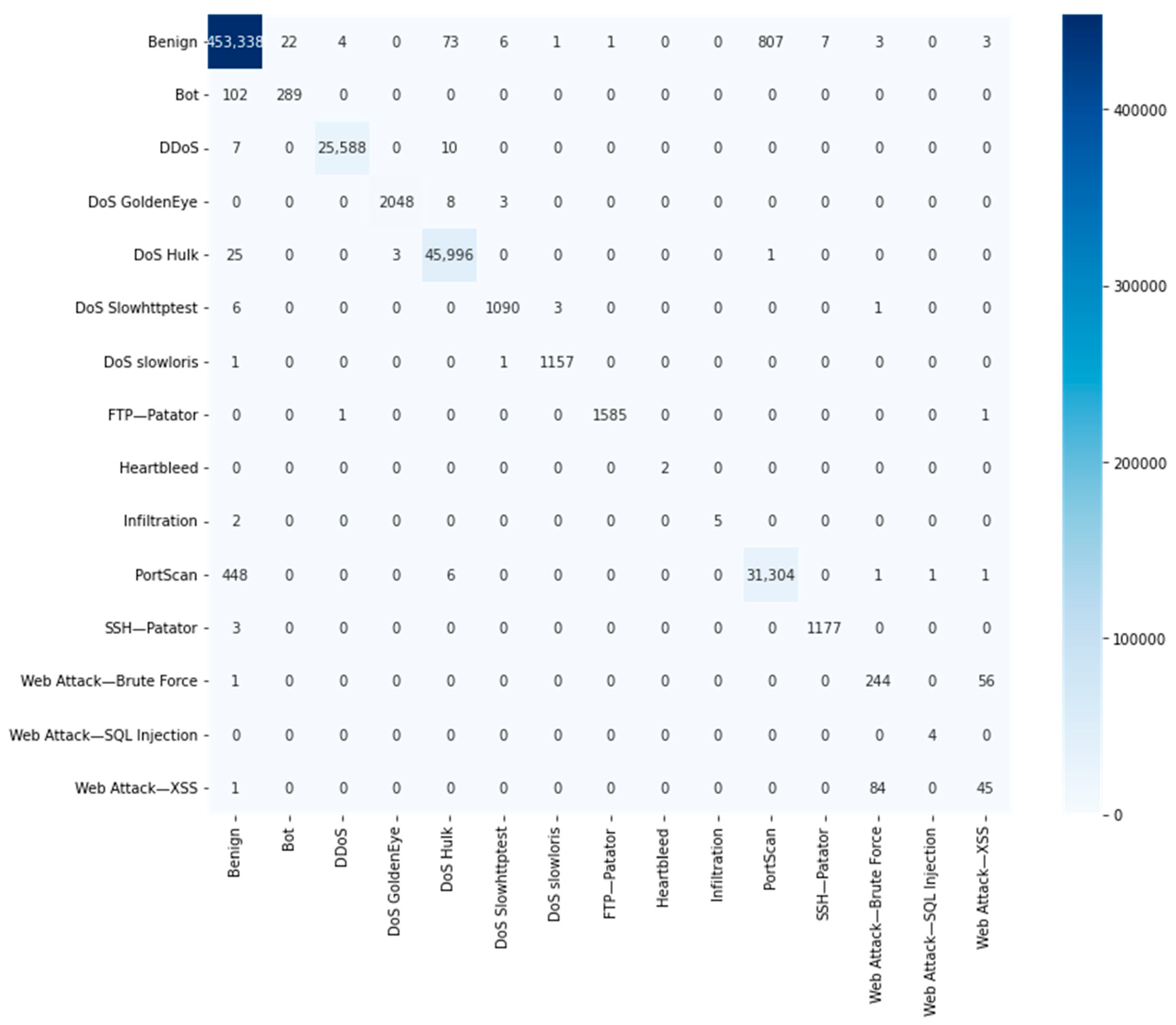
| Proposed model (MSE) | Benign | 99.86 | 99.79 | 99.83 |
| Bot | 92.92 | 73.91 | 82.33 | |
| DdoS | 99.98 | 99.93 | 99.95 | |
| DoS GoldenEye | 99.85 | 99.46 | 99.65 | |
| DoS Hulk | 99.78 | 99.93 | 99.86 | |
| DoS Slowhttptest | 99.09 | 99.09 | 99.09 | |
| DoS slowloris | 99.65 | 99.82 | 99.74 | |
| FTP—Patator | 99.93 | 99.87 | 99.90 | |
| Heartbleed | 100 | 100 | 100 | |
| Infiltration | 100 | 71.42 | 83.33 | |
| PortScan | 97.48 | 98.56 | 98.01 | |
| SSH—Patator | 99.40 | 99.74 | 99.57 | |
| Web Attack—Brute Force | 73.27 | 81.06 | 76.97 | |
| Web Attack—SQL Injection | 80 | 100 | 88.88 | |
| Web Attack—XSS | 42.45 | 34.61 | 38.13 |
| Ref. | Dataset | Dimensionality Reduction Techniques | Classification Techniques | Accuracy (%) | Recall (%) | Precision (%) | F1 Score (%) |
|---|---|---|---|---|---|---|---|
| [77] | D1 | IGRF-RFE | MLP | 84.24 | 84.24 | 83.6 | 82.85 |
| [78] | D1 | N/A | Early-fusion deep learning | 76.47 | 71.59 | 83.53 | N/A |
| [78] | D1 | N/A | Late-fusion deep learning | 77.09 | 69.5 | 86.04 | N/A |
| [78] | D1 | N/A | Late-ensemble deep learning | 76.84 | 68.18 | 85.92 | N/A |
| [79] | D1 | N/A | Deep SARSA | 82.62 | 82.6 | 82.4 | 82.49 |
| [80] | D1 | CNN | BLSTM | 76.32 | 76 | 81 | 77 |
| [81] | D1 | NRS-SSA | Adaptive ensemble (DT, KNN, RF, XGBoost) | 81.54 | 81.54 | 82.7 | 79.7 |
| [82] | D1 | Hierarchical Clustering | DTTWSVM | 81.21 | N/A | N/A | N/A |
| [83] | D1 | RF-SFS | ANN | 78.23 | 68.85 | 85.13 | 76.13 |
| [83] | D1 | RF-SFS | GRU | 79 | 63 | 70 | 62 |
| [83] | D1 | RF-SFS | LSTM | 78 | 63 | 70 | 64 |
| [84] | D1 | N/A | Ensemble (group convolution network snapshot ensemble) | 79.59 | 80.38 | 81.27 | 80.82 |
| [85] | D1 | UMAP | RF | 81.6 | 80 | N/A | 80 |
| This study | D1 | LogitBoost-ResNet | MSE | 90.29 | 90.29 | 90.45 | 89.87 |
| Ref. | Dataset | Dimensionality Reduction Techniques | Classification Techniques | Accuracy (%) | Recall (%) | Precision (%) | F1 Score (%) |
|---|---|---|---|---|---|---|---|
| [86] | D2 | N/A | Stacking (CNN, DNN, LSTM, MLP) | 98.7 | 98.7 | 98.7 | 98.6 |
| [80] | D2 | CNN | BLSTM | 98 | 98 | 99 | 98 |
| [87] | D2 | Greedy-RFECV | Global and local subnet parallel Deep Neural Network (CGL-DNN) | 85 | N/A | N/A | 86 |
| [88] | D2 | Chi-squared | Triple-layered hybrid (weighted DNN, CNN+LSTM, XGBoost) | 98.46 | 98.21 | 86.42 | 98.1 |
| This study | D2 | LogitBoost-ResNet | MSE | 99.69 | 99.69 | 99.69 | 99.69 |
Disclaimer/Publisher’s Note: The statements, opinions and data contained in all publications are solely those of the individual author(s) and contributor(s) and not of MDPI and/or the editor(s). MDPI and/or the editor(s) disclaim responsibility for any injury to people or property resulting from any ideas, methods, instructions or products referred to in the content. |
© 2024 by the authors. Licensee MDPI, Basel, Switzerland. This article is an open access article distributed under the terms and conditions of the Creative Commons Attribution (CC BY) license (https://creativecommons.org/licenses/by/4.0/).
Share and Cite
Alsaffar, A.M.; Nouri-Baygi, M.; Zolbanin, H. Enhancing Intrusion Detection Systems with Dimensionality Reduction and Multi-Stacking Ensemble Techniques. Algorithms 2024, 17, 550. https://doi.org/10.3390/a17120550
Alsaffar AM, Nouri-Baygi M, Zolbanin H. Enhancing Intrusion Detection Systems with Dimensionality Reduction and Multi-Stacking Ensemble Techniques. Algorithms. 2024; 17(12):550. https://doi.org/10.3390/a17120550
Chicago/Turabian StyleAlsaffar, Ali Mohammed, Mostafa Nouri-Baygi, and Hamed Zolbanin. 2024. "Enhancing Intrusion Detection Systems with Dimensionality Reduction and Multi-Stacking Ensemble Techniques" Algorithms 17, no. 12: 550. https://doi.org/10.3390/a17120550
APA StyleAlsaffar, A. M., Nouri-Baygi, M., & Zolbanin, H. (2024). Enhancing Intrusion Detection Systems with Dimensionality Reduction and Multi-Stacking Ensemble Techniques. Algorithms, 17(12), 550. https://doi.org/10.3390/a17120550