


Abstract
We define a new control function to approximate a stochastic fractional Volterra IDE using the concept of modular-stability.
Keywords:
stability; stochastic equation; fractional Volterra integral; stochastic fractional derivative; integro-differential equations; fixed point MSC:
54C40; 14E20; 46E25; 47H10; 20C20
1. Introduction
The stochastic fractional nonlinear Volterra-IDE is used in the science of engineering, management, economics and biophysics since many problems in these areas can be simulated by the stochastic fractional nonlinear Volterra-IDE. As a result, because of the important role these equations play in applied sciences, many researchers have investigated and presented numerical results for these equations. We refer the reader to methods such as the Galerkin method, shifted Legendre polynomials, and the collocation method based on radial basis functions (see [1,2]). In this paper, we study the existence of solutions for the stochastic fractional nonlinear Volterra-IDE:
with , where is a continuous random operator (in short CRO) with respect to all the variables , and ℏ on , is a CRO with respect to , , and ℏ on , is a fixed number, is defined later in (2) where , , and is the ℵ-Riemann–Liouville stochastic fractional integral, where , and is defined in the next section. We consider a new space called the modular space, which was first introduced in 1950 by Nakano [3]. Later, Musielak and Orlicz generalized it in [4], and we also refer the reader to [5] for more information. In this article, we use a fixed point technique, and it is of interest to note that this technique in modular spaces is a generalization of the technique in classical spaces and, to date, nonlinear and asymptotic contractions maps, as well as quasi-contraction mappings in modular spaces, have been studied in the literature. The description of our article is as follows:
We introduce a new space called a modular space and we examine the existence and uniqueness of solutions of stochastic fractional Volterra IDE in this new space. Furthermore, in this article, we consider the aggregation function and use special functions as inputs to the aggregation function to create a control function that for the solution of the equation has the best approximation. Finally, we present a practical example to illustrate our theory.
2. Preliminaries
Here, we let , with , , , and (note denotes the interior of ).
Definition 1.
Consider the linear space S and ν from to such that
- (MI)
- for any iff ;
- (MII)
- for each , and with ;
- (MIII)
- for all and ;
- (MIV)
- is continuous.
Then, is called a modular normed-space (in short, MNS).
Let be an MNS. A sequence is modular convergent to in MNS , if for any and , there exists a positive integer such that when . A sequence is modular Cauchy in MNS , if for any and , there exists a positive integer such that whenever . An MNS in which every Cauchy sequence is convergent is said to be an MBS.
An example of a modular norm is
in which is a nondecreasing function for all and is a member of a normed linear space .
Consider the probability measure space , and let and be Borel measureable spaces, for MNS U and S. If for every in U and , we say is a random operator.
To prove our main result, we use an alternative fixed point theorem (AFPT) (we refer the reader to [6,7]).
Definition 2
([8]). The gamma function is defined as
where , .
Consider and the integrable random operator f on and the nondecreasing random operator with , for each . The right-sided ℵ-Hilfer stochastic fractional derivative is defined by [9,10]
In the following, we present the definitions that are needed to obtain the control function (for more details, see [11]).
Definition 3.
The complex exponential function is defined as
Definition 4.
The generalized exponential function, which is called Mittag–Leffler function, is defined as
Definition 5.
The Gauss Hypergeometric series, which is called the Hypergeometric function, is defined as
We can rewrite the above series via the Mellin–Barnes integral as
Definition 6.
The Maitland function, which is called the Wright function, is defined as
The generalized Wright function, which is called the Fox–Wright function, is defined as
Definition 7.
For , , , , we define the following functions
In the above functions, if and only if , if and only if and if and only if . According to the above functions, we consider . The Mellin–Barnes integral (M-BI) representation of the H-Fox function (H-FF) is
where and is a path. Furthermore, the symbol is considered for this integral.
Now we introduce the aggregation function because, in this paper, we use this function as a control function.
Definition 8.
For a natural and fixed number k and , an aggregation function is a function , which is nondecreasing, that is, for all
hold for the desired k-tuples
The natural k represents the arity of the aggregation function when no confusion arises, and the aggregation function can be given as .
Now we consider some examples of aggregation functions. The arithmetic, the geometric, the projection, the order statistic, the minimum and maximum, the median are aggregation functions.
Example 1.
The arithmetic mean function is defined by
Example 2.
The geometric mean function is defined by
Example 3.
The projection function for and ℑth argument is defined by
where is the ℑth lowest coordinate of p, i.e., . Furthermore, the following functions show the in the first and last coordinates
Example 4.
The order statistic function with the ℑth argument and ℑth lowest coordinate is defined by
for any .
Example 5.
The minimum function and maximum function are defined as follows, respectively,
Example 6.
The median function is defined for odd and even values of and , respectively,
According to the above functions, we consider the following set:
and the necessary calculations were performed on the considered set, and the results are shown in the table below.
From the calculations in Table 1, we consider the minimum function as the control function and define it as follows
In the following, after the table, in Figure 1, we provide a graphical representation of some aggregation functions.

Table 1.
Calculation of aggregation function according to special functions for different values.
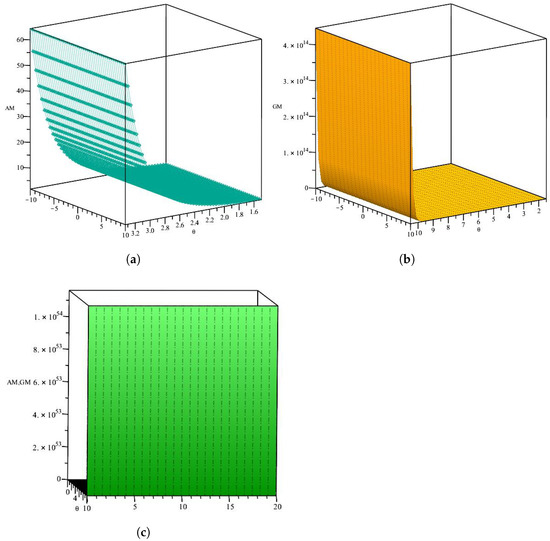
Figure 1.
Graph of aggregate functions AM and GM for, and different values . (a) The aggregation arithmetic mean function for . (b) The aggregation arithmetic mean function for . (c) The aggregation geometric mean function for .
Definition 9.
3. Main Results
We assume the following:
Hypothesis 1 (H1).
Let be fixed numbers with and let the CROs and satisfy
for all , , and , and
for all , , and .
Theorem 1.
Assume , the nondecreasing random operator with and the continuously differentiable random operator satisfying
for all , , and , where is a continuous modular set with
for each , and . Then, we can find a unique CRO , such that
with , , and
for each , and .
Proof.
For , we set
for each , and , where
Let be given by
for all , and .
First we show is strictly contractive on U. Let for any , be a fixed number, then from (19) we have
for each , and . From (13), (14), (16), (20) and (21), we have
and we conclude that
for all and . Hence, we deduce that for any , and recall .
Now (20), enables us to find , with
for arbitrary , for all , and . The boundedness property of
and (19) imply that . From the AFPT, we can find a CRO such that in and .
Since j and are bounded on for each and , then we have a fixed number with
for any , and . Thus for any .
Therefore, . Furthermore, the AFPT and (17), imply the uniqueness of .
Theorem 2.
Consider and the nondecreasing random operator with for all . Let be fixed numbers such that . Consider the CROs and satisfying (13) and (14), respectively. Let , and consider the continuously differentiable random operator such that
and
for all , , and . Then, we can find a unique CRO satisfying (17) and
for all , , and .
Proof.
Let . Consider the complete -valued metric on U given by
for each , and [10].
Consider in which
for all and .
Let and consider a fixed number such that and
for each , and . Using (13), (14), (26) and (27), we have
for each , and . Therefore
for each and . Let . We can find a fixed number with
for all and .
The boundedness of
and (25), imply that .
4. Example
Example 7.
We consider the stochastic fractional nonlinear Volterra-IDE:
where , , , , . Considering , and , for functions f and k, we have
for all , , and , and
for all , , and .
According to the function with , if we have
for all , , and , where is a continuous modular set with
for each , and , then, we can find a unique CRO , such that
with , and
where , for each , and .
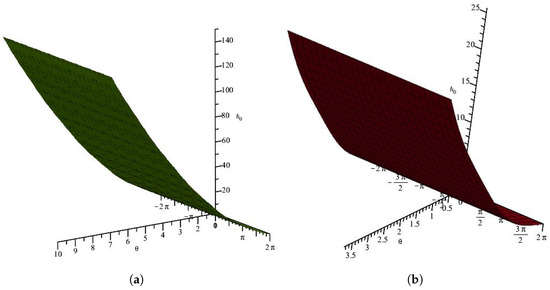
Figure 2.
Graphic representation of the exact solution of Equation (28) for different values. (a) The exact solution of stochastic fractional nonlinear Volterra-IDE for . (b) The exact solution of stochastic fractional nonlinear Volterra-IDE .
5. Conclusions
In this paper, we have considered a nonlinear stochastic fractional Volterra integro-differential equation, and we have presented a modular stability result for it. We have investigated the stability in the considered space by introducing special functions and considering the aggregation function, and we have obtained the best approximation for the desired equation. An application of our results is also presented, and we have provided graphical representations for some important functions and solved examples. In future work, we hope to extend our results with a nonstandard finite difference scheme and spatio-temporal numerical modeling [2,12,13,14,15,16,17,18,19,20,21,22,23,24].
Author Contributions
A.A., methodology, writing—original draft preparation. Z.E., methodology, writing—original draft preparation. R.S., supervision and project administration. D.O., writing—original draft preparation and editing—original draft preparation. All authors read and approved the final manuscript.
Funding
This research received no external funding.
Data Availability Statement
Not applicable.
Acknowledgments
The authors are thankful to the editor and referees for giving valuable comments and suggestions.
Conflicts of Interest
The authors declare no conflict of interest.
References
- Ahmadi, N.; Vahidi, A.R.; Allahviranloo, T. An efficient approach based on radial basis functions for solving stochastic fractional differential equations. Math. Sci. 2017, 11, 13–118. [Google Scholar] [CrossRef]
- Raza, A.; Arif, M.S.; Rafiq, M.; Bibi, M.; Fayyaz, R. Numerical analysis of stochastic vector borne plant disease model. Comput. Mater. Contin. 2020, 63, 65–83. [Google Scholar]
- Nakano, H. Modular Semi-Ordered Spaces; Maruzen Co., Ltd.: Tokyo, Japan, 1950. [Google Scholar]
- Musielak, J.; Orlicz, W. On modular space. Stud. Math. 1959, 18, 49–65. [Google Scholar] [CrossRef]
- Krasnoselskii, M.A.; Rutickii, Y.B. Convex Functions and Orlicz Spaces; Noordhoff, G., Translator; Fizmatgiz: Moscow, Russia, 1961. (In Russian) [Google Scholar]
- Cădariu, L.; Radu, V. Fixed points and the stability of Jensen’s functional equation. JIPAM J. Inequal. Pure Appl. Math 2003, 4, 4. [Google Scholar]
- Diaz, J.B.; Margolis, B. A fixed point theorem of the alternative, for contractions on a generalized complete metric space. Bull. Amer. Math. Soc. 1968, 74, 305–309. [Google Scholar] [CrossRef]
- Sousa, J.V.C.; de Oliveira, E.C. On a new operator in fractional calculus and applications. J. Fixed Point Theory Appl. 2018, 20, 96. [Google Scholar] [CrossRef]
- Sousa, J.V.d.C.; de Oliveira, E.C. On the Φ-Hilfer fractional derivative. Commun. Nonlinear Sci. Numer. Simul. 2018, 60, 72–91. [Google Scholar] [CrossRef]
- Sevgin, S.; Sevli, H. Stability of a nonlinear Volterra integro-differential equation via a fixed point approach. J. Nonlinear Sci. Appl. 2016, 9, 200–207. [Google Scholar] [CrossRef]
- Eidinejad, Z.; Saadati, R.; Mesiar, R. Optimum Approximation for ς-Lie Homomorphisms and Jordan ς-Lie Homomorphisms in ς-Lie Algebras by Aggregation Control Functions. Mathematics 2022, 10, 1704. [Google Scholar] [CrossRef]
- Ahmed, N.; Wei, Z.; Baleanu, D.; Rafiq, M.; Rehman, M.A. Spatio-temporal numerical modeling of reaction-diffusion measles epidemic system. Chaos 2019, 29, 103101. [Google Scholar] [CrossRef]
- Namjoo, M.; Zibaei, S. A NSFD scheme for the solving fractional-order competitive prey-predator system. Thai J. Math. 2020, 18, 1933–1945. [Google Scholar]
- Namjoo, M.; Zeinadini, M.; Zibaei, S. Nonstandard finite-difference scheme to approximate the generalized Burgers-Fisher equation. Math. Methods Appl. Sci. 2018, 41, 8212–8228. [Google Scholar] [CrossRef]
- Zibaei, S.; Namjoo, M. A nonstandard finite difference scheme for solving fractional-order model of HIV-1 infection of CD4+ T-cells. IJMC 2015, 6, 169–184. [Google Scholar]
- Baleanu, D.; Zibaei, S.; Namjoo, M.; Jajarmi, A. A nonstandard finite difference scheme for the modeling and nonidentical synchronization of a novel fractional chaotic system. Adv. Differ. Equ. 2021, 2021, 308. [Google Scholar] [CrossRef]
- Macías-Díaz, J.E.; Raza, A.; Ahmed, N.; Rafiq, M. Analysis of a nonstandard computer method to simulate a nonlinear stochastic epidemiological model of coronavirus-like diseases. Comput. Methods Programs Biomed. 2021, 204, 106054. [Google Scholar] [CrossRef]
- Nauman, A.; Macías-Díaz, J.E.; Raza, A.; Baleanu, D.; Rafiq, M.; Iqbal, Z.; Ahmad, M.O. Design, Analysis and Comparison of a Nonstandard Computational Method for the Solution of a General Stochastic Fractional Epidemic Model. Axioms 2021, 11, 10. [Google Scholar]
- Noor, M.A.; Raza, A.; Arif, M.S.; Rafiq, M.; Nisar, K.S.; Khan, I.; Abdelwahab, S.F. Non-standard computational analysis of the stochastic COVID-19 pandemic model: An application of computational biology. Alex. Eng. J. 2022, 61, 619–630. [Google Scholar] [CrossRef]
- Win, Z.T.; Eissa, M.A.; Tian, B. Stochastic epidemic model for COVID-19 transmission under intervention strategies in China. Mathematics 2022, 10, 3119. [Google Scholar] [CrossRef]
- Yasin, M.W.; Iqbal, M.S.; Ahmed, N.; Akgül, A.; Raza, A.; Rafiq, M.; Riaz, M.B. Numerical scheme and stability analysis of stochastic Fitzhugh–Nagumo model. Results Phys. 2022, 32, 105023. [Google Scholar] [CrossRef]
- Shatanawi, W.; Raza, A.; Arif, M.S.; Abodayeh, K.; Rafiq, M.; Bibi, M. Design of nonstandard computational method for stochastic susceptible–infected–treated–recovered dynamics of coronavirus model. Adv. Differ. Equ. 2020, 2020, 505. [Google Scholar] [CrossRef]
- Raza, A.; Rafiq, M.; Ahmed, N.; Khan, I.; Nisar, K.S.; Iqbal, Z. A structure preserving numerical method for solution of stochastic epidemic model of smoking dynamics. Comput. Mater. Contin. 2020, 65, 263–278. [Google Scholar] [CrossRef]
- Shatanawi, W.; Raza, A.; Muhammad, S.A.; Abodayeh, K.; Rafiq, M.; Bibi, M. An effective numerical method for the solution of a stochastic coronavirus (2019-nCovid) pandemic model. Comput. Mater. Contin. 2021, 66, 1121–1137. [Google Scholar] [CrossRef]
Publisher’s Note: MDPI stays neutral with regard to jurisdictional claims in published maps and institutional affiliations. |
© 2022 by the authors. Licensee MDPI, Basel, Switzerland. This article is an open access article distributed under the terms and conditions of the Creative Commons Attribution (CC BY) license (https://creativecommons.org/licenses/by/4.0/).