
You are currently viewing a new version of our website. To view the old version click .
Algorithms
  • Article
  • Open Access

11 August 2021

Detect Overlapping Community Based on the Combination of Local Expansion and Label Propagation
and
1
Applied Economics, Beijing University of Posts and Telecommunications, Beijing 100876, China
2
Management Science and Engineering, Beijing University of Posts and Telecommunications, Beijing 100876, China
*
Author to whom correspondence should be addressed.
This article belongs to the Special Issue Optimization Algorithms for Graphs and Complex Networks

Abstract

It is a common phenomenon in real life that individuals have diverse member relationships in different social clusters, which is called overlap in the science of network. Detecting overlapping components of the community structure in a network has extensive value in real-life applications. The mainstream algorithms for community detection generally focus on optimization of a global or local static metric. These algorithms are often not good when the community characteristics are diverse. In addition, there is a lot of randomness in the process of the algorithm. We proposed a algorithm combining local expansion and label propagation. In the stage of local expansion, the seed is determined by the node pair with the largest closeness, and the rule of expansion also depends on closeness. Local expansion is just to obtain the center of expected communities instead of final communities, and these immature communities leave only dense regions after pruning according to certain rules. Taking the dense regions as the source makes the label propagation reach stability rapidly in the early propagation so that the final communities are detected more accurately. The experiments in synthetic and real-world networks proved that our algorithm is more effective not only on the whole, but also at the level of the node. In addition, it is stable in the face of different network structures and can maintain high accuracy.

1. Introduction

In real-world social networks, the individual behavior is not simply obedient to the collective. Restricted by diverse social relations, they often naturally gather into some social structure, named a community in network research [1]. The community structure is considered to be the functional unit in a network system, as it often accounts for the functionality. Although there is no unified definition of community, many technologies have been developed to detect community, such as modularity maximization [2], random walks [3], particle swarm optimization [4], spectral clustering [5], etc. In the early studies of community detection, much of the focus was on disjoint communities, where individuals have only one membership [6]. However, it is obvious that people’s social memberships are not singular. For example, a person could be a member of family while also belonging to other social groups, such as those of friends and colleagues. Moreover, in large-scale social networks, the membership of an individual is more complex.
In general, the characteristic of nodes being able to belong to multiple communities is called overlap. There are extensive works on detecting overlapping communities [7] for which we provide a more detailed introduction in the next section. However, these studies are still insufficient in some ways. First, the static local optimization goal for detecting overlapping communities is adopted generally, such as fitness function in local expansion [8], optimization for modularity [9] and local Nash equation [10] in the game algorithm. The density, scale and edge distribution of different communities in real social networks are diverse. A static optimization goal can just be applied to detect some communities, and not to the whole. Second, there is a lot of randomness in the detection. For example, the integration order of a clique has no rules in most algorithms based on clique percolation. The selection of the start position in local expansion is always random. Some updated rules of labels in label propagation are not strict when nodes face the same degree of label influence, which may lead to unstable results. The existence of randomness often means that the algorithm performance can be optimized by some beneficial rules.
In this paper, an algorithm that combines local expansion and label propagation ( L E L P ) is proposed. We use an extended local expansion to obtain the immature communities instead of the final communities so that the disadvantages of static optimization are avoided. The seed of local expansion is selected based on the node pair with the highest c l o s e n e s s , an index expanded from the Jaccard coefficient [11], which governs the direction of expansion. The immature communities detected by local expansion are pruned to be dense regions in order to conduct label propagation, a speaker–listener-based information propagation process. As the source of propagation, these dense regions can reduce the process of reaching local stability in the early stage of label propagation, making this dynamic process more accurate. We conduct experiments on both synthetic and real-world networks to compare our algorithm with others. The experimental results show that our algorithm generally performs well and is stable in different conditions.

3. Algorithm

The essence of our algorithm is the combination of local expansion and label propagation ( L E L P ). It first intends to detect immature communities based on the improved local expansion. These immature communities are pruned to obtain dense regions that are likely to be the central area of the expected communities. Then, the label propagation that takes the dense regions as a source is conducted, where nodes are allowed to carry multiple labels. After propagation, nodes with the same label form a community and nodes with multiple labels are identified as overlapping.
In the stage of local expansion, a new fitness function, different from the previous ones that are related to only edges, is adopted to evaluate expansion. The basic assumption behind it is that a community essentially comprises local structures, involving those close nodes. It is difficult to determine the relationship between two nodes depending only on edges. Therefore, we introduce a new metric named c l o s e n e s s to measure the relationship of nodes. The c l o s e n e s s is defined as the number of neighbors shared by two nodes divided by the number of neighbors in their union, shown as follows:
c l o s e n e s s ( d ) ( i , j ) = c o v e r ( i , d ) c o v e r ( j , d ) c o v e r ( i , d ) c o v e r ( j , d ) ,
where c o v e r ( i , d ) is the neighborhood of node i and parameter d is a positive integer governing the range of neighbors. The c l o s e n e s s is the same as the Jaccard coefficient when d is equal to 1 [25]. The larger the d, the wider the range of neighbors considered. However, the relationship of the population will decline with distance in the real world, so d should be set to a small integer. In addition, two nodes that are not directly connected to each other may have common second-order neighbors, which means that their second-order closeness is not 0. For this case, the c l o s e n e s s between two nodes without direct edges is uniformly set to 0. In this way, we can weight edges by the c l o s e n e s s according to Equation (4) and generate a new weighted network.
Local expansion is no longer dependent on random seeds in L E L P . Random seeds mean that the starting position of the local expansion is random, which leads to unstable results in repeated experiments. There is no guarantee that the local expansion could start from an appropriate place, so the quality of the partition is often poor. In general, the node pairs with a high ratio of common neighbors tend to be located in the center of the expected community, while those with a low ratio of common neighbors tend to be located in the border. For this reason, node pairs are sorted according to c l o s e n e s s , and those with the largest c l o s e n e s s are determined as seeds first in order to ensure an optimal starting point of the local expansion. Therefore, the fitness function is modified as follows:
f ( c ) = c l o s e n e s s i n c c l o s e n e s s i n c + c l o s e n e s s o u t c ,
where c l o s e n e s s i n c and c l o s e n e s s o u t c are the total internal and external c l o s e n e s s of the cluster. When a round of local expansion ends, the next round starts from another seed that has not yet expanded.
In the previous works of detecting an overlapping community based on local expansion methods, such as C I S , L F M , M O N C , the detection is over after the above process. These algorithms always have low quality because the fitness function is static during the entirety of the detection. In fact, the effect of detecting is not always good when the same fitness function is used to detect communities with different sizes. A diverse scale of communities in networks affects the algorithm accuracy, especially at the border of communities. Unlike previous algorithms, the purpose of local expansion adopted in L E L P is not to generate the final communities, but to obtain the central area of expected communities, which are named the dense region. These dense regions are used as the source for label propagation in the following.
Then, we adopt an operation called prune to remove the unimportant component of immature community detected by local expansion. All nodes in one immature community are scanned, and the nodes for which more than half its neighbors are not inside are removed first. Then, those nodes that can increase the fitness function if they are removed are removed as well. In this way, the immature communities could be pruned to the dense regions, of which the number is close to that of the final communities. Nodes inside the dense regions are regarded as internal nodes that are closely related to each other, and nodes outside the dense regions are named boundary nodes.
Finally, label propagation is conducted based on the dense regions. Initially, the internal nodes in each dense region are labeled with the same label and set to a passive state, while each external node is labeled with a unique label and is set to an active state. In the process of label propagation, each active node updates its own label, according to the frequency of its neighbors’ labels. A node is allowed to have multiple labels when there are several labels whose frequency is larger than or equal to the average. If the label of a node does not change after a propagation, the node becomes passive, and it no longer accepts the labels of its neighbors. This process is repeated until all nodes in the network become passive. When label propagation stops, the labels of the nodes indicate the memberships. Nodes with the same label form a community, and nodes with multiple labels overlap.
Because the dense regions obtained from the local expansion are taken as the source, label propagation could spread from the center of the expected communities to the border in an orderly way. It could avoid the labels of nodes in the border of the communities with a simple structure reaching stability first, which would lead to the failure of the label propagation, locally. At the same time, the labels of nodes inside dense regions are already stable before label propagation, so it does not cost a lot of time to reach local stability. In short, the combination of local expansion and label propagation can complement each other.
In this way, the process of L E L P can be interpreted as the following procedure:
Step 1. Local expansion based on c l o s e n e s s . The c l o s e n e s s between each pair of directly connected nodes are measured by Equation (4). If there is no direct edge between two nodes, the c l o s e n e s s is set to 0. Then, node pairs are sorted according to c l o s e n e s s and local expansion is conducted from the pair with the largest c l o s e n e s s . An immature community is generated when a round of expansion is optimal, and the next pair in order of c l o s e n e s s that has not been expanded is selected as the seed. Local expansion is iterated until all nodes in the network are tried. The two immature community with more than half the same components are merged into one.
Step 2. The immature community is pruned to the dense region. Each node in the immature community generated by Step 1 is scanned. Those nodes for which more than half of its neighbors are not in the same immature community are removed. In addition, nodes are also removed if the fitness can be improved. This process is called pruning. The immature communities that are pruned are defined as dense regions. Nodes inside dense regions are called internal nodes and the rest are called boundary nodes.
Step 3. Label propagation. The internal nodes in a dense region are labeled with the same label and set to be passive, while the external nodes are labeled with unique labels and set to be active. In the process of label propagation, each active node updates the label by the frequency of its neighbors’ labels. A node is allowed to have multiple labels. Label propagation is repeated until all nodes reach a stable state. The nodes with the same label are grouped into a community, and those with multiple labels are identified as overlapping.

4. Experimental Result

4.1. Evaluation Criteria

The normalized mutual information ( N M I ) is used to evaluate algorithms by comparing the similarity between the ground truth and detected community [26]. The extended N M I to evaluate the algorithm for overlapping communities was proposed by Lancichinetti [14]. The membership of the node i that belongs to multiple communities can be regarded as a binary array with | C | entries, which is the community number of partition C . The k-th entry can be represented as a random variable X k = ( X ) k . If node i belongs to the k-th community C k , ( x i ) k = 1 ; otherwise, ( x i ) k = 0 . Then, the probability distribution can be obtained by the number of nodes in C k and all nodes. The same holds for the random variable Y l associated with the community C l of partition C . Due to the independence of X k and Y l , the joint distribution and conditional distribution can be obtained. We can define the amount of information to infer X k given a certain Y l as H ( X k | Y l ) = H ( X k , Y l ) H ( Y l ) , and its minimum can be defined as the conditional entropy of X k with respect to all the components of Y for which the average is H ( X | Y ) n o r m . Finally, the extended N M I is defined as follows:
N ( X | Y ) = 1 1 2 [ H ( X | Y ) n o r m + H ( X | Y ) n o r m ] ,
which is between 0 and 1. The function N ( X | Y ) is equal to 1 if and only if X k = f ( Y l ) for a certain l, and vice versa.
The extended N M I can only evaluate the algorithm of detecting overlapping communities at the overall level, but it cannot work at the node level. Therefore, we adopt the F-score to measure the accuracy of the algorithms at the node level [27]. The F-score is defined as the harmonic mean of p r e c i s i o n and r e c a l l , as follows:
F - score = 2 · p r e c i s i o n · r e c a l l p r e c i s i o n + r e c a l l ,
where p r e c i s i o n represents the proportion of the detected overlapping nodes that are true overlapping nodes, and r e c a l l is defined as the number of correctly detected overlapping nodes divided by the true number of overlapping nodes. The F-score accounts for the balance between the detection quantity and quality, and it reaches its best and worst values at 1 and 0, respectively.
The performance of algorithms can be measured by N M I and the F-score when the ground truth of the community is known. Given that the ground truth of most real-world networks are not available, we adopted an extended modularity: the overlapping modularity Q o v e proposed in [28], as our measure. Q o v e takes the membership of a node as a weight for modularity. The function is as follows:
Q o v e = 1 2 m c i , j c [ A i j k i k j 2 m ] 1 O i O j ,
where O i is the number of memberships that node i owns. One may argue that Q o v e is close to extended modularity Q o v n e , proposed by Nepusz et al. [29], where the degree of membership of node i in the community is the substitution of O i in Q o v e .

4.2. Synthetic Networks

It is necessary to have benchmarks to observe the performance of our algorithm and compare it with others. Due to the lack of ground truth, real-world networks do not show clear contrast results but the synthetic networks are adaptable. We adopt L F R benchmarks proposed in [30] and set the parameters of the L F R generator referring to [14]: the size of networks are between 1000 and 5000. The average degree is set to 10, which is the same as most real-world social networks. The node degree and community size are governed by power law distributions with exponents τ 1 = 2 and τ 2 = 1 , respectively. The maximum degree is k m a x = 50 , and community sizes vary within a small range s = ( 10 , 50 ) or large range l = ( 20 , 100 ) . The mixing parameter μ is set to 0.1 or 0.3. O n and O m together control the overlap, where the former is the number of overlapping nodes, while the latter is the number of communities to which each overlapping node belongs. O n is set to 10% or 50% of the total nodes so as to indicate the low or high density of overlapping nodes, respectively. O m varies from 2 to 8, indicating the diverse membership of overlapping nodes. By changing the combination of O n and O m , we create detection tasks with different difficulties so that we can compare the performance of the algorithms in greater detail. The specific parameter settings of L F R benchmarks are shown in Table 1. For each set of parameters, we generate 100 instantiations and adopted the average performance of each algorithm. For each set of parameters, we generated 100 instantiations and 100 times experiments were carried out on each instantiation. We adopted the average of all these experiments as the algorithm performance.
Table 1. The detailed parameters of L F R benchmarks are shown. L F R 1 to L F R 4 are grouped to test the performance of algorithms under different network sizes and mixing parameters, while L F R 4 to L F R 7 are governed by different community sizes and overlapping ratios.
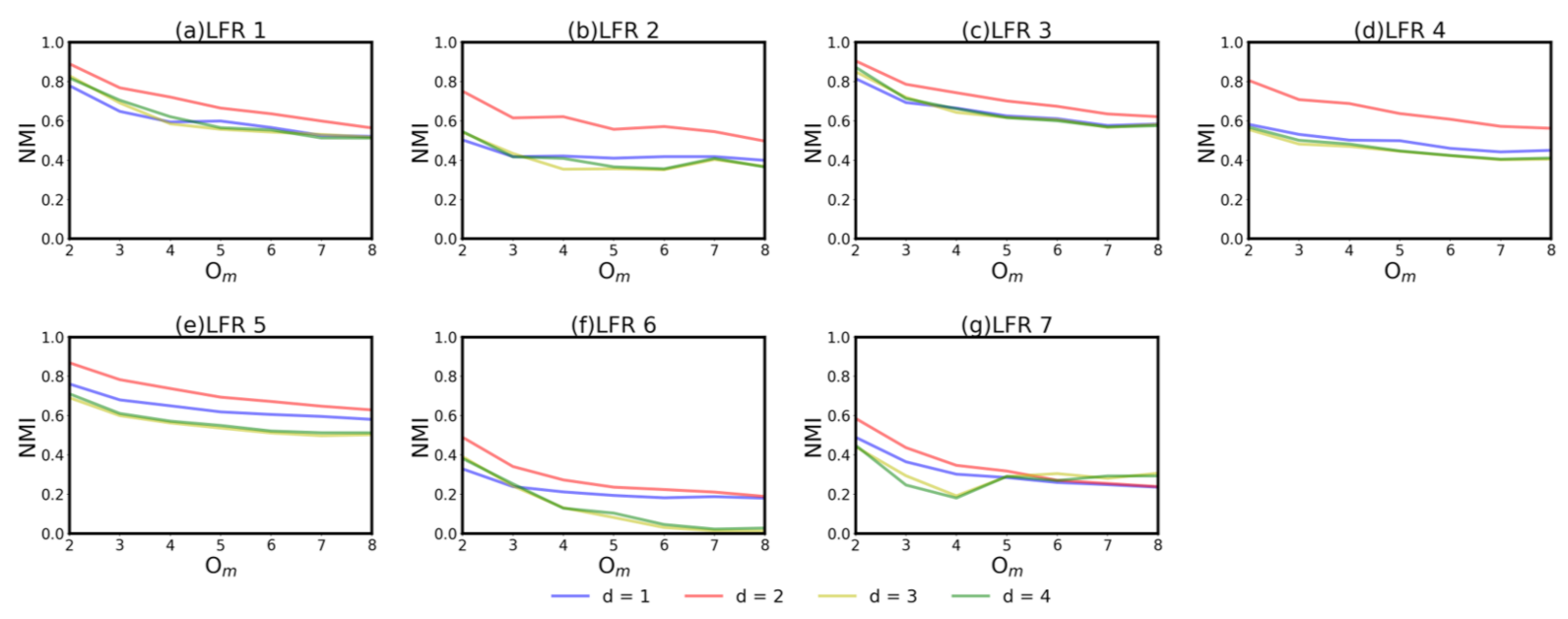
We compare L E L P with some representative algorithms. For algorithms with tunable parameters, the setting that can obtain the best result is selected. For C F i n d e r , k varies from 3 to 8. For L F M , α ranges from 0.8 to 1.6 with an interval of 0.1. For S L P A , parameter r varies from 0.05 to 0.5 with an interval of 0.05. For L E L P , we measure its performance with different d, which controls the range of node neighbors in c l o s e n e s s . In general, the local structure information around the nodes is not fully reflected if d is small, while the local details may be ignored if d is too large. Therefore, we set d from 1 to 4 to observe the performance of L E L P as shown in Figure 1. These parameters are still retained in real-world networks.
Figure 1. In the sub figure (ag), the curves with different colors represent the NMI of LELP when d is different.
It can be seen that the performance of L E L P with d = 4 is the worst in most cases and it is very close to that when d = 3 . This may be due to the fact that the smaller local structure is ignored when the neighborhood is large. In addition, the ratio of shared neighbors tends to be stable as the scale of neighbors expands. The performance of L E L P with d = 1 is slightly better than the former two cases in the face of small communities. In the cases where the proportion of the external edge is small ( μ = 0.1), there is little difference among L E L P with different d (the four curves are very close in Figure 1a,c). In the networks where there are more external edges of nodes ( μ = 0.3), the L E L P with d = 2 performs far better than others, especially when the community size is large and the membership is complex (the red curve is much higher than the others in Figure 1b,d, respectively). In general, the L E L P with d = 2 performs better in most cases. Therefore, in the following of this paper, we choose the result of our algorithm with d = 2 .
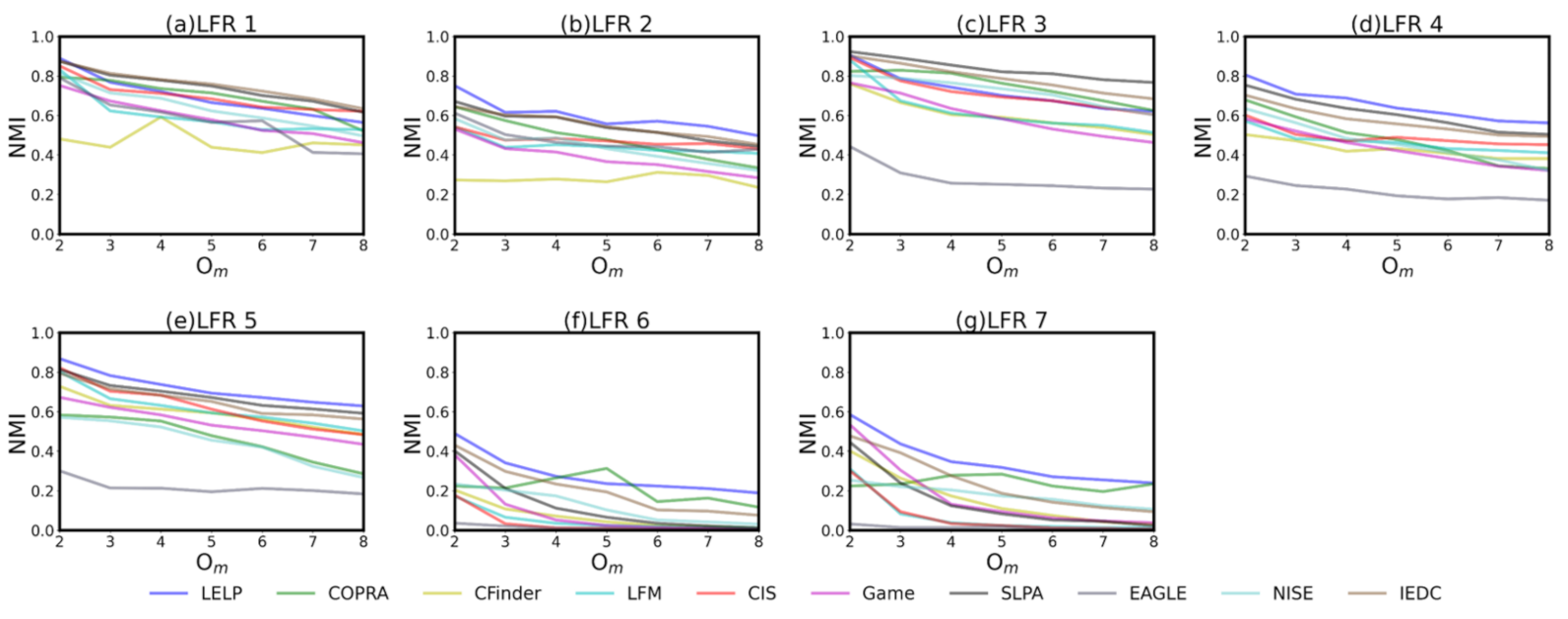
We first detect the performance of algorithms in the cases where there are different mixing parameter μ and network size N. The former controls the proportion of the internal edge to the external edge of nodes. Generally, the larger the μ , the fuzzier the community structure. When μ is close to 0.5, the community structure is not prominent at all. Obviously, the experimental results are in line with this fact. When μ = 0.1 but other conditions are the same, the N M I of all algorithms are almost better than those when μ = 0.3 (the yellow and blue curves are at the top of most L F R s). For L E L P , high μ does not weaken its performance greatly (the curves are very close in Figure 2a). Parameter N determines the network size, that is, the total number of nodes in the network. The performance of algorithms in larger networks is slightly better than that of small networks, except E A G L E , which deteriorates greatly with large N. O m represents the membership of nodes. When O m is large, the task of the algorithm is difficult. As shown in Figure 2, the majority of the N M I curves of each algorithm gradually decreases with the increase in O m .
Figure 2. Sub figure (aj) represent the NMI of different algorithms in the L F R 1 to L F R 4, where there are different mixing parameter μ and network size N.
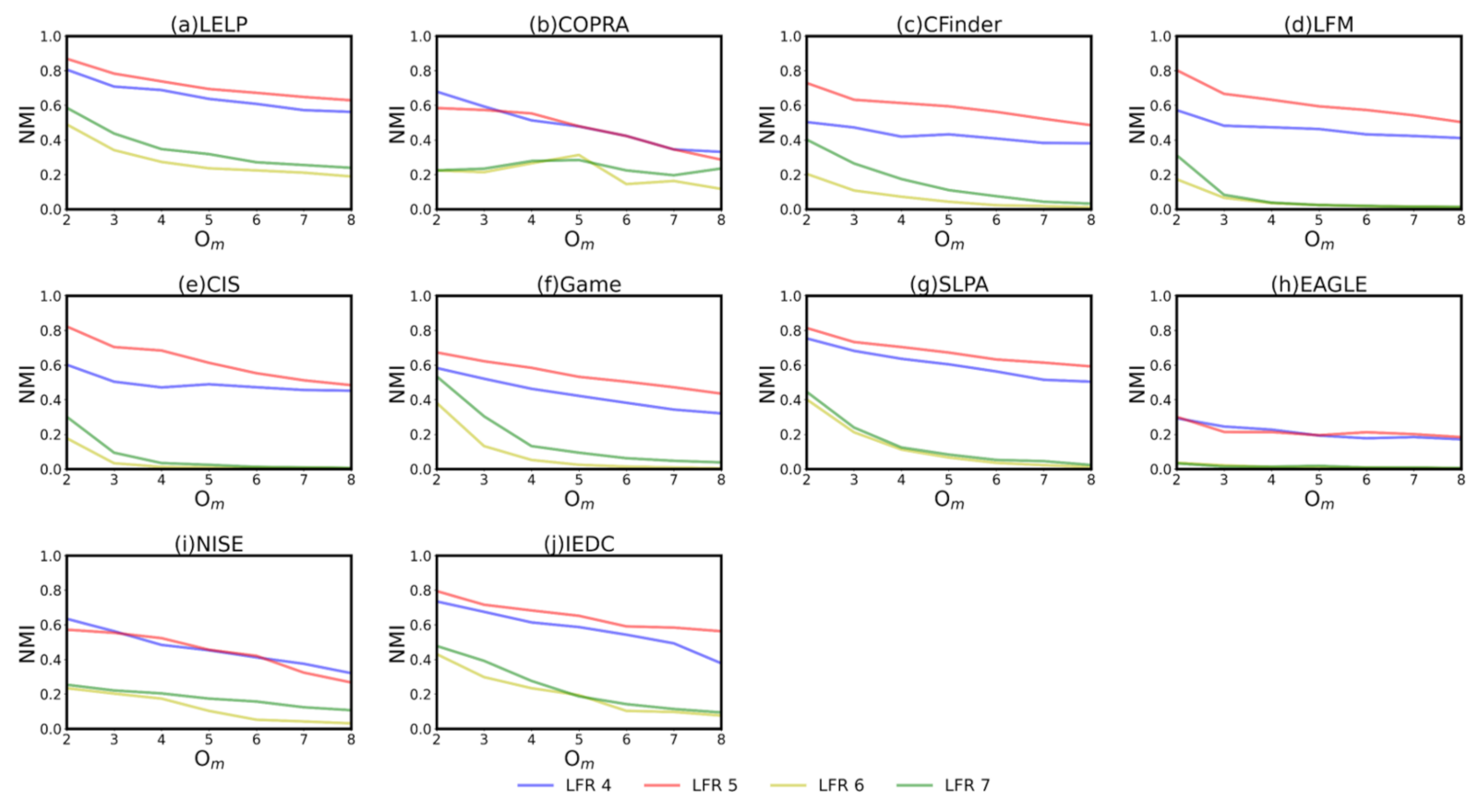
Then, the N M I of the algorithms is measured in the cases where the number of overlapping nodes O n and community size are different. As expected, there is a serious decline in the performance of algorithms when there are a large number of overlapping nodes in networks (yellow and green curves are much lower than blue and red curves for most L F R s in Figure 3). This is because O n can indirectly determine the overlapping size among communities. A high overlapping size will hinder the accuracy of algorithms in detecting a community. Then, most algorithms perform better in the L F R with smaller communities. The reason may be that the structural characteristics of a community become blurred as the community size increases, which is also mentioned in [31,32]. This feature has a great influence on simple local expansion or label propagation. For the former, the sensitivity of the fitness function lowers as the community size increases. For the latter, there are so many dense structures within a large community that the labels can reach stability at many places, which leads to the detection failure. Unlike others, L E L P is less affected by the community size than ther other algorithms as shown in Figure 3a. This is because local expansion is only used in the first stage of L E L P to locate dense regions, not the final community. These dense regions are small but have high density of edges, which prevents accuracy degradation. These dense regions determine the initial seed of label propagation in the following process, which can ensure that the label propagates from the dense to sparse regions. Usually, these two regions are likely to be the center and border of the expected community, respectively. Using the dense region instead of single node as the seed makes the labels reach stability more quickly in the early propagation.
Figure 3. Sub figure (aj) represent the NMI of different algorithms in the L F R 4 to L F R 7, where there are different overlapping nodes O n and community size.
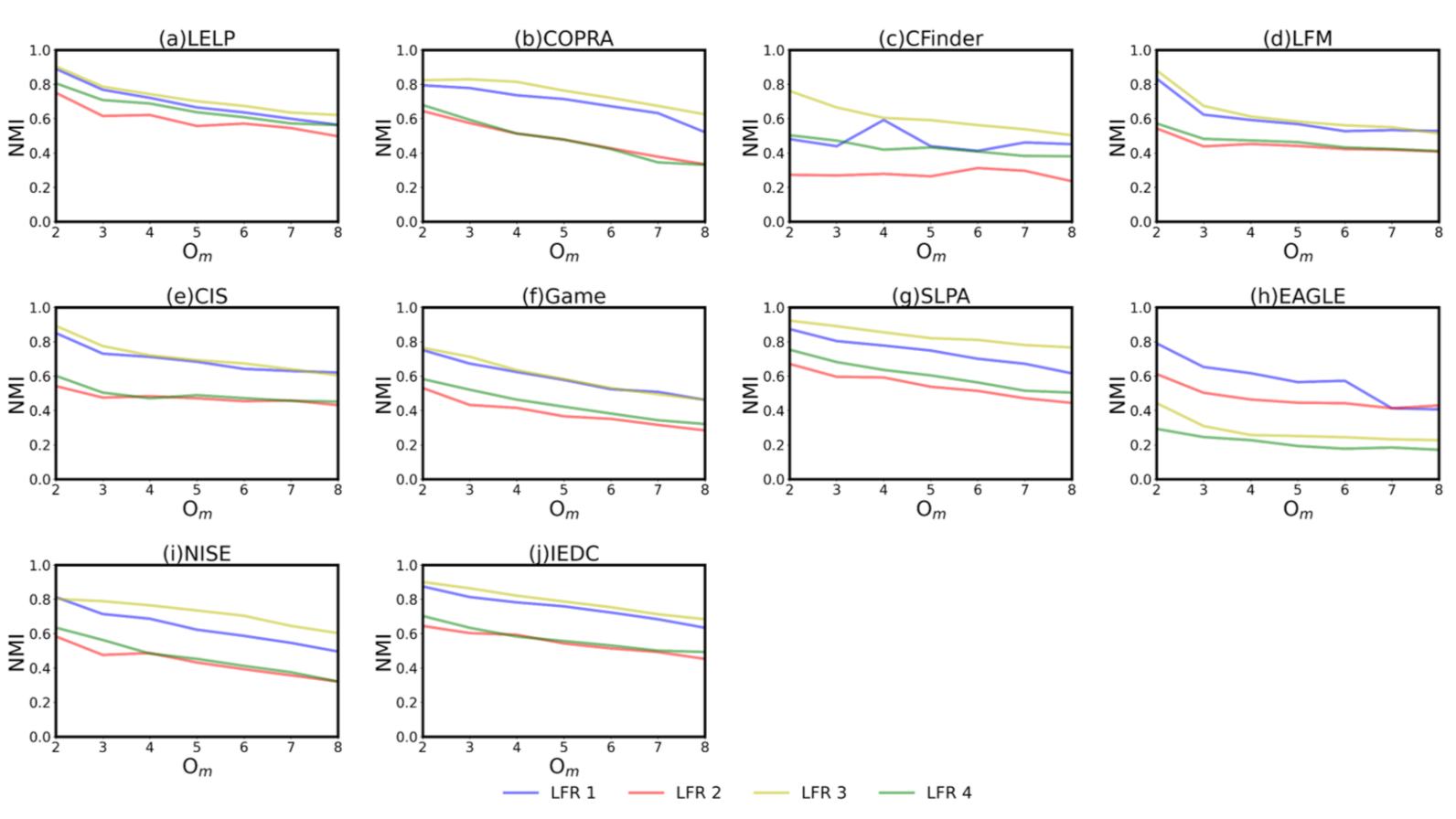
The N M I of algorithms on each L F R are compared in Figure 4. It can be seen that L E L P is better in most cases (the blue curve is usually at the top, except Figure 4a,c). However, in the networks with μ = 0.1 the two label propagation algorithms, C O P R A and S L P A , obtain higher N M I as a result of the rapid stability of the labels during early propagation. I D E C also obtains a better result, which may be because the division of overlapping and non overlapping regions is clear in this case. For the networks where there are many overlapping nodes, L E L P significantly outperforms other algorithms, excluding C O P R A . This is because the c l o s e n e s s can more accurately reflect the distance between the nodes than the edge, so the impact of complex memberships is not serious. The performance of G a m e , E A G L E and C F i n d e r are worse than other algorithms in most cases. This shows that algorithms based on cliques are not suitable for large networks where the clique is much smaller than the community.
Figure 4. Sub figure (ag) represent the NMI of different algorithms in the same L F R .
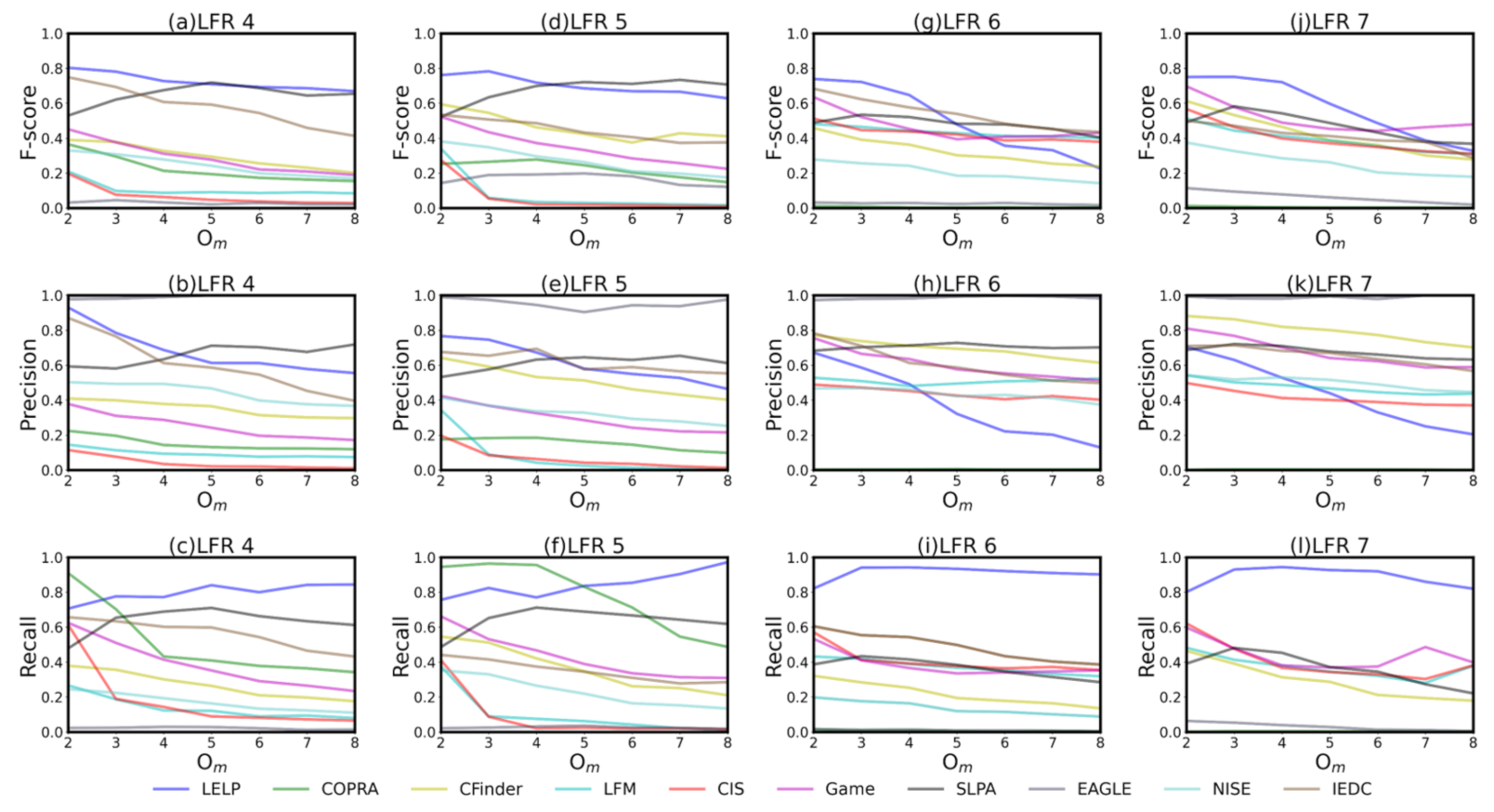
N M I focus only on providing the measure of overlapping size in each community. It might not be sensitive enough to depict what is going on regarding nodes. It is possible that the overlapping scale detected by algorithms is close to the ground truth, but the overlapping nodes detected are not true. For this reason, measuring the overlapping nodes detected is essential for evaluating the accuracy of detection algorithms. We measure the F-score of algorithms in Figure 5. It can be seen that the F-score of L E L P is much higher than that of other algorithms when O m is small. In particular, in L F R 4 and L F R 5, all algorithms are far behind L E L P , except for S L P A in the case of large O m . In L F R 6 and L F R 7, L E L P declines sharply with the increase in O m , but it is still higher than most algorithms. This trend of the F-score is due to the sharp decrease of the p r e c i s i o n as O m increases. The reason is that the p r e c i s i o n of L E L P is sensitive to O m , which has little influence on r e c a l l . The r e c a l l of L E L P is relatively stable in the face of different O m , and even ascend slightly with the rise in O m . This shows that L E L P can correctly detect most of the true overlapping nodes, but some non-overlapping nodes are wrongly detected as overlapping nodes. Meanwhile, almost all the non-overlapping nodes are detected correctly.
Figure 5. Sub figure (a,d,g,j) represent the F-score of algorithms in L F R 4 to L F R 7. Subfigure (b,e,h,k) represent the p r e c i s i o n of algorithms in L F R 4 to L F R 7. Subfigure (c,f,i,l) represent the r e c a l l of algorithms in L F R 4 to L F R 7. In L F R 4 to L F R 7, there are different overlapping nodes O n and community sizes but other conditions are the same.

4.3. Real-World Networks

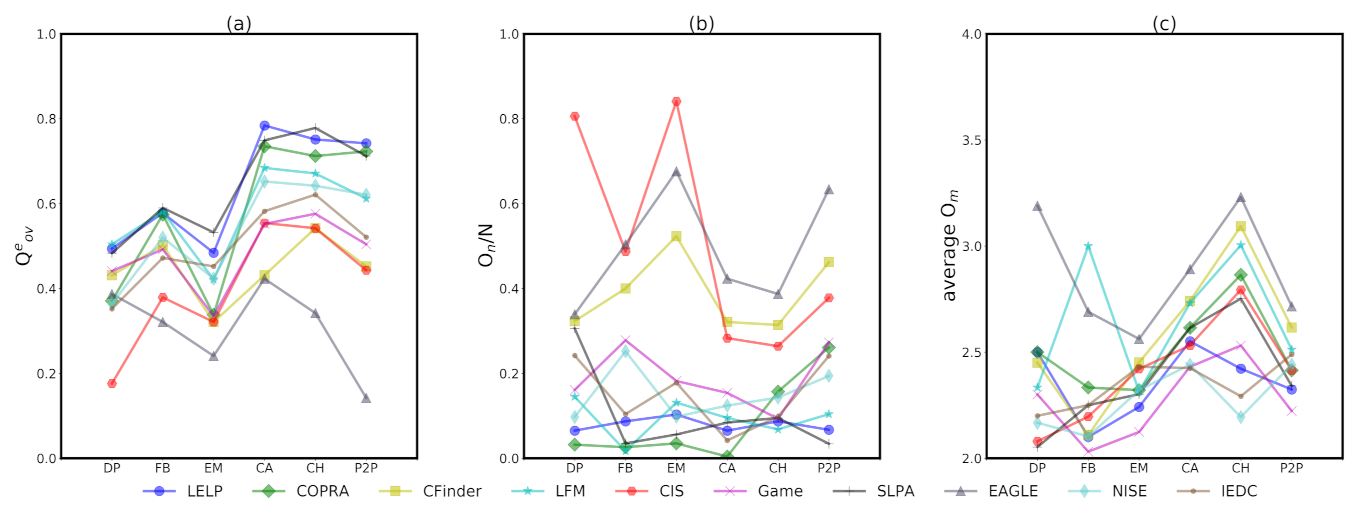
We tested on a series of real-world networks, whose main information is listed in Table 2. The dolphins and football network are commonly used social network. Email is the core of e-mail communication network from a large European research institution. CA-GrQc is a co-authorship network based on papers in General Relativity publishing in Arxiv. cit-HepTh is the citation graph of high energy physics theory in Arxiv. P2P is the Gnutella peer-to-peer file sharing network. Due to the unknown ground truth of these real-world networks, the algorithms’ performance is measured by Q o v e , as shown in Figure 6a. In each sub-figure of Figure 6, networks are arranged from left to right along the x-axis, according to the size and symbols of points representing different algorithms. The number of overlapping nodes and the average membership of the nodes are illustrated in Figure 6b,c, respectively.
Table 2. The basic features of real-world networks in the experiments are shown in the Table 2, including the number of nodes and edges, average degree, average clustering coefficient and reference.
Figure 6. Sub figure (ac) respectively represent overlapping modularity Q o v e , the proportion of overlapping node O n /N and average number of community memberships Q m of different algorithms in 6 real-world networks.
It can be seen that the performance of algorithms in different real-world networks is not constant, but the ranking of algorithms is relatively stable in each network. In most cases, Q o v e of L E L P and S L P A are generally the best two, especially in large networks, while E A G L E and C I S are always the worst two. In addition, the performance of C O P R A is also in the forefront. It illustrates that the algorithms utilizing label propagation are effective because the label propagation is similar to a simulation of information spreading in social networks. Given a good source of propagation, labels are more easily and accurately stable in a community through iterative propagation. In L E L P , local expansion can generate some dense regions closer to the center of expected communities as the source of label propagation. This is why our algorithm performs well.
As can be seen in Figure 6b, some algorithms may over-detect the overlap, such as C F i n d e r , C I S and E A G L E . The proportion of overlapping nodes that they detect in all nodes is far greater than that in other algorithms, and even more than 40% in some cases. This is why these algorithms do not perform well in Q o v e . Too many nodes are detected as overlapping nodes, which indicates that these algorithms fail. In contrast, this proportion of other algorithms is usually below 20%, and even C O P R A is often lower than 5%. For a detection algorithm, too high of an overlapping proportion detected means that the precision is too rough; too low of a proportion usually means that it does not work. The overlap detected by L E L P can be considered meaningful because the proportion of overlapping nodes detected in all nodes is appropriate at about 8%. Meanwhile, L E L P , L F M , N I S E and S L P A fluctuate a little as a result of insensitivity to specific structures, and all remain around 10%, except for the small networks. These algorithms also perform well in L F R . The stable performance makes it possible for L E L P to be applied to most networks. Otherwise, the diversity of membership in the tested networks is relatively small, and most nodes have only two or three community memberships, as shown in Figure 6c.

5. Conclusions

In this paper, we propose an overlapping community detection algorithm named L E L P that is a combination of local expansion and label propagation. It first conducts local expansion based on c l o s e n e s s to generate some immature communities, which are pruned to retain a dense structure called the dense region. These dense regions are very close to the center of the expected communities and so are taken as the source for label propagation. The experiments in diverse synthetic networks and real-world networks show that L E L P is excellent, compared with other algorithms. The results in the synthetic networks demonstrate that L E L P is better than the current mainstream algorithms in general. The performance of L E L P is less affected by the network size, mixing degree and community size. The proportion of overlapping nodes has a great influence on L E L P , which is similar to the contrast algorithms. The accuracy of L E L P is high at the node level. Most of the true overlapping nodes are correctly detected; a few nodes may be misjudged as being overlapping nodes. Almost all non-overlapping nodes are correctly detected. In the real-world networks, L E L P also performs better than other algorithms. It can be applied to most real-world networks as the result of its stability in the face of different network structures. The number of overlapping nodes detected by L E L P is in an appropriate range for the detection to be of practical significance.

Author Contributions

Conceptualization, X.L. and Q.S.; methodology, X.L. and Q.S.; software, X.L.; validation, X.L.; investigation, X.L. and Q.S.; resources, X.L. and Q.S.; writing—original draft preparation, X.L.; writing—review and editing, X.L. and Q.S.; visualization, X.L.; supervision, Q.S.; project administration, Q.S.; funding acquisition, Q.S. All authors have read and agreed to the published version of the manuscript.

Funding

This work was supported in part by the Beijing Social Science Fund No. 11JGB063 and Social Science Research Project of Ministry of Education No. 11YJA630109.

Data Availability Statement

Not applicable.

Conflicts of Interest

The authors declare no conflict of interest.

References

  1. Palla, G.; Deranyi, I.; Farkas, I. Uncovering the overlapping community structure of complex networks in nature and society. Nature 2005, 435, 814. [Google Scholar] [CrossRef] [PubMed] [Green Version]
  2. Newman, M. Modularity and community structure in networks. Proc. Natl. Acad. Sci. USA 2006, 103, 8577–8582. [Google Scholar] [CrossRef] [Green Version]
  3. Alzahrani, T.; Horadam, K.J.; Boztas, S. Community Detection in Bipartite Networks Using Random Walks; Springer: Cham, Switzerland, 2014; Volume 549, pp. 157–165. [Google Scholar]
  4. Cai, Q.; Gong, M.; Bo, S.T. Discrete particle swarm optimization for identifying community structures in signed social networks. Neural Netw. 2014, 58, 4–13. [Google Scholar] [CrossRef] [PubMed]
  5. White, S.; Smyth, P. A Spectral Clustering Approach To Finding Communities in Graph. In Proceedings of the 2005 SIAM International Conference on Data Mining, Newport Beach, CA, USA, 21–23 April 2005. [Google Scholar]
  6. Lancichinetti, A.; Fortunato, S. Community detection algorithms: A comparative analysis. Phys. Rev. E Stat. Nonlinear Soft Matter Phys. 2009, 80, 056117. [Google Scholar] [CrossRef] [PubMed] [Green Version]
  7. Xie, J.; Kelley, S.; Szymanski, B.; Zhang, J.; She, L. Overlapping Community Detection in Networks: The State of the Art and Comparative Study. ACM Comput. Surv. 2013, 45, 1–35. [Google Scholar] [CrossRef] [Green Version]
  8. Baumes, J.; Goldberg, M.; Krishnamoorthy, M. Finding communities by clustering a graph into overlapping subgraphs. In Proceedings of the AC 2005 IADIS International Conference on Applied Computing, Algarve, Portugal, 22–25 February 2005. [Google Scholar]
  9. Sobolevsky, S.; Campari, R.; Belyi, A. A General Optimization Technique for High Quality Community Detection in Complex Networks. Phys. Rev. E 2013, 90, 012811-1–012811-8. [Google Scholar] [CrossRef] [PubMed] [Green Version]
  10. Basu, S.; Maulik, U. Community detection based on strong Nash stable graph partition. Soc. Netw. Anal. Min. 2015, 5, 61. [Google Scholar] [CrossRef]
  11. Niwattanakul, S.; Singthongchai, J.; Naenudorn, E. Using of Jaccard Coefficient for Keywords Similarity. Ai Commun. 2013, 26, 161–177. [Google Scholar]
  12. Langville, A.N.; Meyer, C.D. Google’s PageRank and Beyond: The Science of Search Engine Rankings. Math. Intell. 2011, 30, 68–69. [Google Scholar]
  13. Kelley, S. The Existence and Discovery of Overlapping Communities in Large-Scale Networks; Rensselaer Polytechnic Institute: Troy, NY, USA, 2009. [Google Scholar]
  14. Lancichinetti, A.; Fortunato, S.; Kertész, J. Detecting the overlapping and hierarchical community structure of complex networks. New J. Phys. 2009, 11, 033015. [Google Scholar] [CrossRef]
  15. Havemann, F.; Heinz, M.; Struck, A. Identification of overlapping communities and their hierarchy by locally calculating community-changing resolution levels. Comput. Sci. 2011, 2011, 01023. [Google Scholar] [CrossRef] [Green Version]
  16. Whang, J.J.; Gleich, D.F.; Dhillon, I.S. Overlapping Community Detection Using Neighborhood-Inflated Seed Expansion. IEEE Trans. Knowl. Data Eng. 2016, 28, 1272–1284. [Google Scholar] [CrossRef]
  17. Barber, M.J.; Clark, J.W. Detecting network communities by propagating labels under constraints. Phys. Rev. E Stat. Nonlinear Soft Matter Phys. 2009, 80, 026129. [Google Scholar] [CrossRef] [Green Version]
  18. Gregory, S. Finding overlapping communities in networks by label propagation. New J. Phys. 2009, 12, 2011–2024. [Google Scholar] [CrossRef]
  19. Xie, J.; Szymanski, B.K. Towards Linear Time Overlapping Community Detection in Social Networks. In Proceedings of the The 16th Pacific-Asia conference on Advances in Knowledge Discovery and Data Mining, Auckland, New Zealand, 19–22 April 2016. [Google Scholar]
  20. Bollobás, B.; Riordan, O. Clique percolation. Random Struct. Algorithms 2009, 35, 294–322. [Google Scholar] [CrossRef] [Green Version]
  21. Shen, H.; Cheng, X.; Cai, K.; Hu, M.B. Detect overlapping and hierarchical community structure in networks. Phys. A Stat. Mech. Appl. 2009, 388, 1706–1712. [Google Scholar] [CrossRef] [Green Version]
  22. Chen, W.; Liu, Z.; Sun, X.; Zhang, J. A game-theoretic framework to identify overlapping communities in social networks. Data Min. Knowl. Discov. 2010, 21, 224–240. [Google Scholar] [CrossRef] [Green Version]
  23. Zhou, X.; Zhao, X.; Liu, Y.; Sun, G. A game theoretic algorithm to detect overlapping community structure in networks. Phys. Lett. A 2018, 382, 872–879. [Google Scholar] [CrossRef]
  24. Hajiabadi, M.; Zare, H.; Bobarshad, H. IEDC: An Integrated Approach for Overlapping and Non-overlapping Community Detection. Knowl. Based Syst. 2017, 123, 188–199. [Google Scholar] [CrossRef] [Green Version]
  25. Ball, B.; Karrer, B.; Newman, M. An efficient and principled method for detecting communities in networks. Phys. Rev. E Stat. Nonlinear Soft Matter Phys. 2011, 84, 036103. [Google Scholar] [CrossRef] [Green Version]
  26. Estévez, P.A.; Tesmer, M.; Perez, C.A.; Zurada, J.M. Normalized Mutual Information Feature Selection. IEEE Trans. Neural Netw. 2009, 20, 189–201. [Google Scholar] [CrossRef] [Green Version]
  27. Goutte, C.; Gaussier, E. A Probabilistic Interpretation of Precision, Recall and F-Score, with Implication for Evaluation. In The 2005 European Conference on Information Retrieval; Springer: Berlin, Germmary, 2005; pp. 345–359. [Google Scholar]
  28. Gregory, S. Fuzzy overlapping communities in networks. J. Stat. Mech. Theory Exp. 2010, 2, 02017. [Google Scholar] [CrossRef] [Green Version]
  29. Nepusz, T.; Petróczi, A.; Négyessy, L. Fuzzy communities and the concept of bridgeness in complex networks. Phys. Rev. E Stat. Nonlinear Soft Matter Phys. 2008, 77, 016107. [Google Scholar] [CrossRef] [Green Version]
  30. Lancichinetti, A.; Fortunato, S.; Radicchi, F. Benchmark graphs for testing community detection algorithms. Phys. Rev. E 2008, 78, 046110. [Google Scholar] [CrossRef] [Green Version]
  31. Pujol, J.M.; Delgado, J. Clustering algorithm for determining community structure in large networks. Phys. Rev. E Stat. Nonlinear Soft Matter Phys. 2006, 74, 016107. [Google Scholar] [CrossRef] [Green Version]
  32. De, M.P.; Ferrara, E.; Fiumara, G.; Provetti, A. Mixing local and global information for community detection in large networks. J. Comput. Syst. Sci. 2013, 80, 72–87. [Google Scholar]
  33. Lusseau, D.; Schneider, K.; Boisseau, O.J.; Haase, P.; Slooten, E.; Dawson, S.M. The bottlenose dolphin community of Doubtful Sound features a large proportion of long-lasting associations. Behav. Ecol. Sociobiol. 2003, 54, 396–405. [Google Scholar] [CrossRef]
  34. Girvan, M.; Newman, M. Community structure in social and biological networks. Proc. Natl. Acad. Sci. USA 2002, 99, 7821–7826. [Google Scholar] [CrossRef] [Green Version]
  35. Yin, H.; Benson, A.R.; Leskovec, J. Local Higher-Order Graph Clustering. In Proceedings of the 23rd ACM SIGKDD International Conference, Halifax, NS, Canada, 13–17 August 2017; ACM: New York, NY, USA, 2017. [Google Scholar]
  36. Chakrabarti, D.; Faloutsos, C. Graph Evolution: Densification and Shrinking Diameters. ACM Comput. Surv. 2006, 38, 2. [Google Scholar]
  37. Leskovec, J.; Kleinberg, J.M.; Faloutsos, C. Graphs over time: Densification laws, shrinking diameters and possible explanations. In Proceedings of the The Eleventh ACM SIGKDD International Conference, Chicago, IL, USA, 21–24 August 2005. [Google Scholar]
Publisher’s Note: MDPI stays neutral with regard to jurisdictional claims in published maps and institutional affiliations.

Article Metrics

Citations

Article Access Statistics

Multiple requests from the same IP address are counted as one view.