Precipitation of β-Mn in the Form of Widmanstätten Side-Plates in the Ferrite Matrix of an Fe–28.6 Mn–10.9 Al Alloy Steel

Highlights
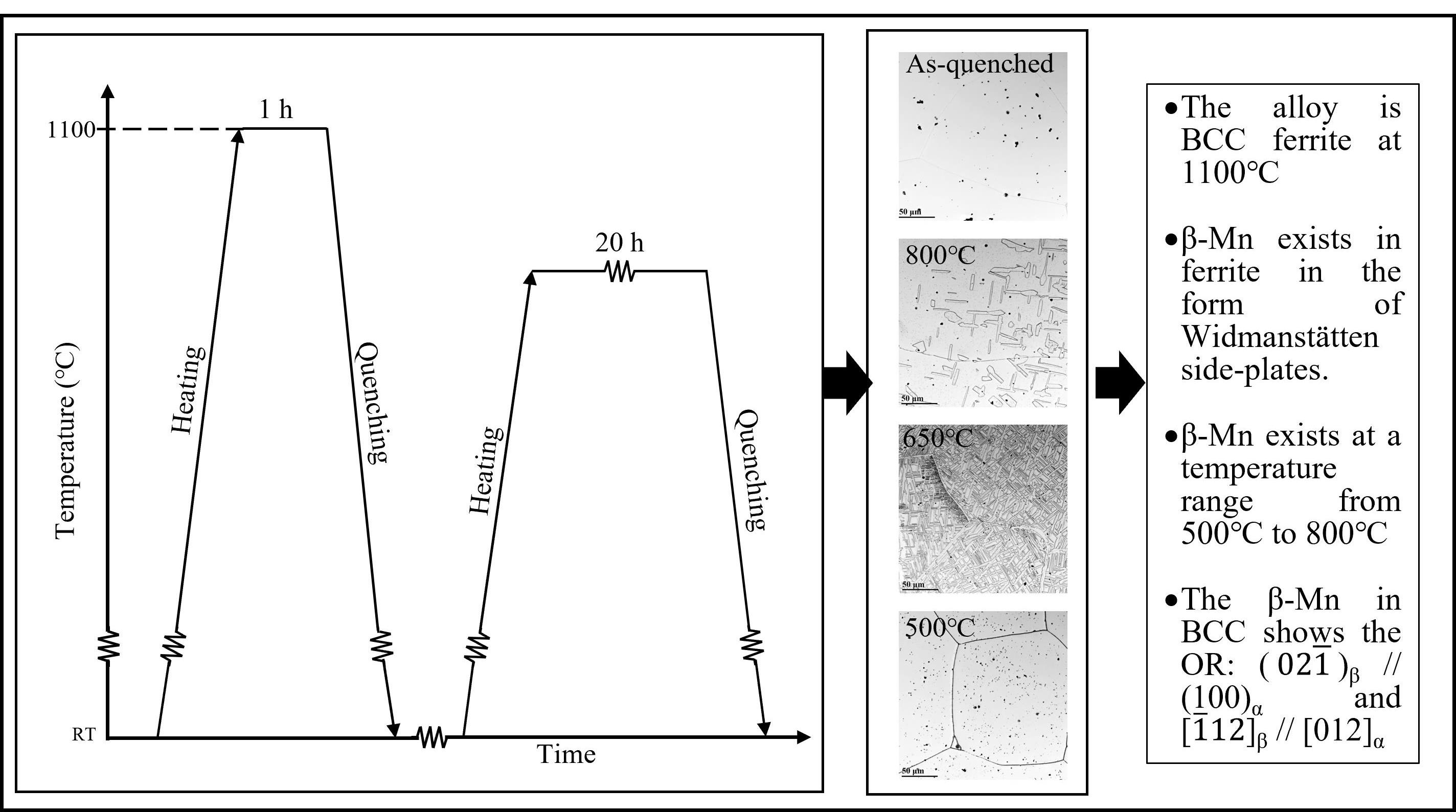
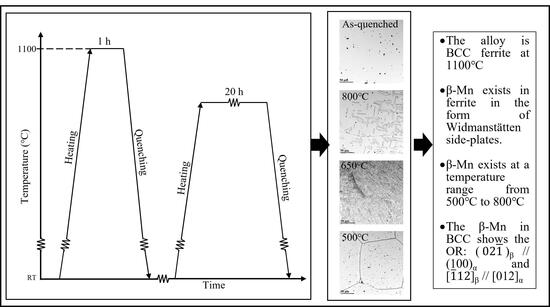
- The Fe–28.6 Mn–10.9 Al alloy is BCC ferrite at temperatures between 850 and 1100 °C.
- β-Mn exists in the ferrite at temperatures ranging from 500 °C to 850 °C.
- β-Mn phase is formed as Widmanstätten side-plates.
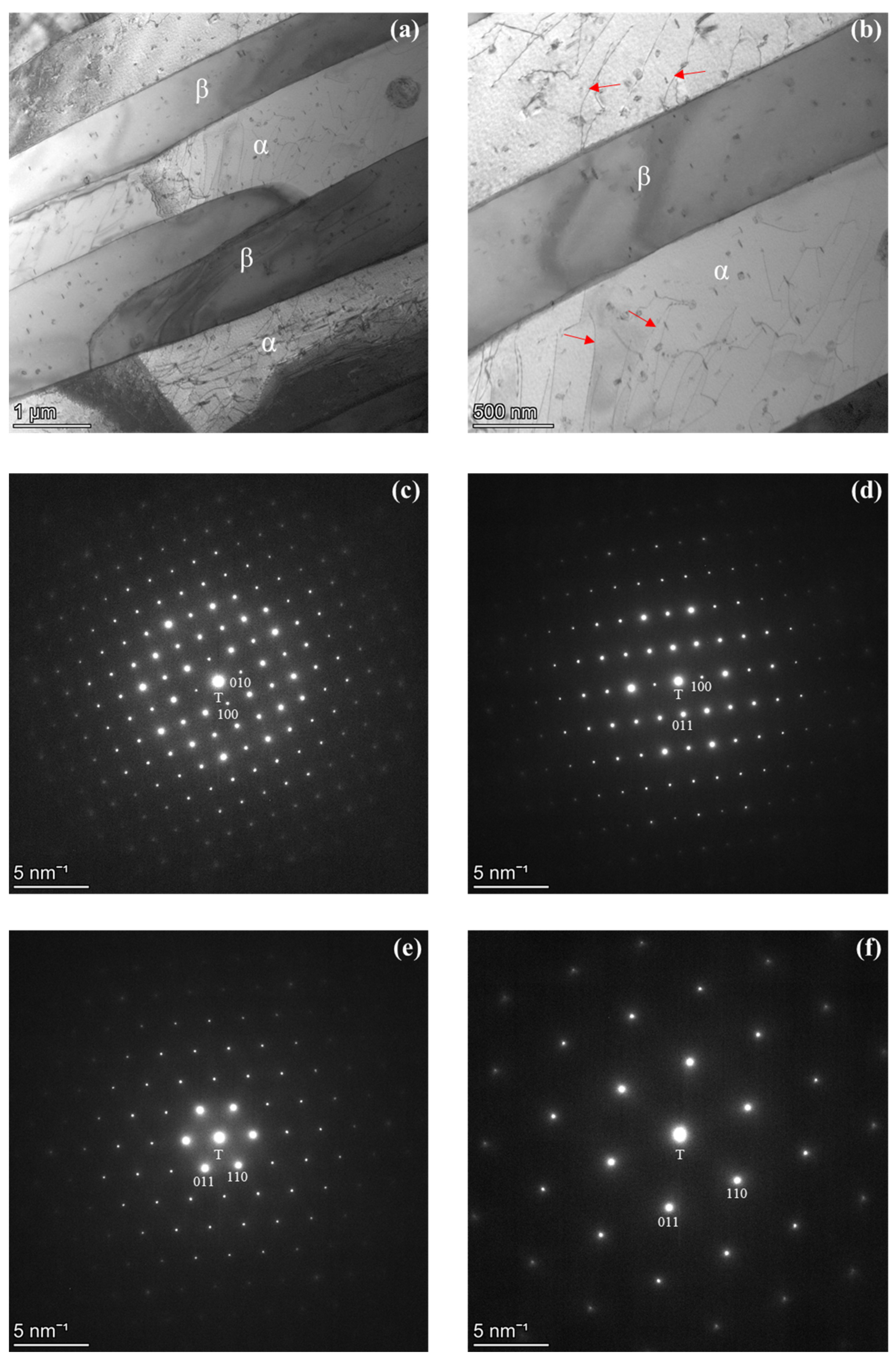
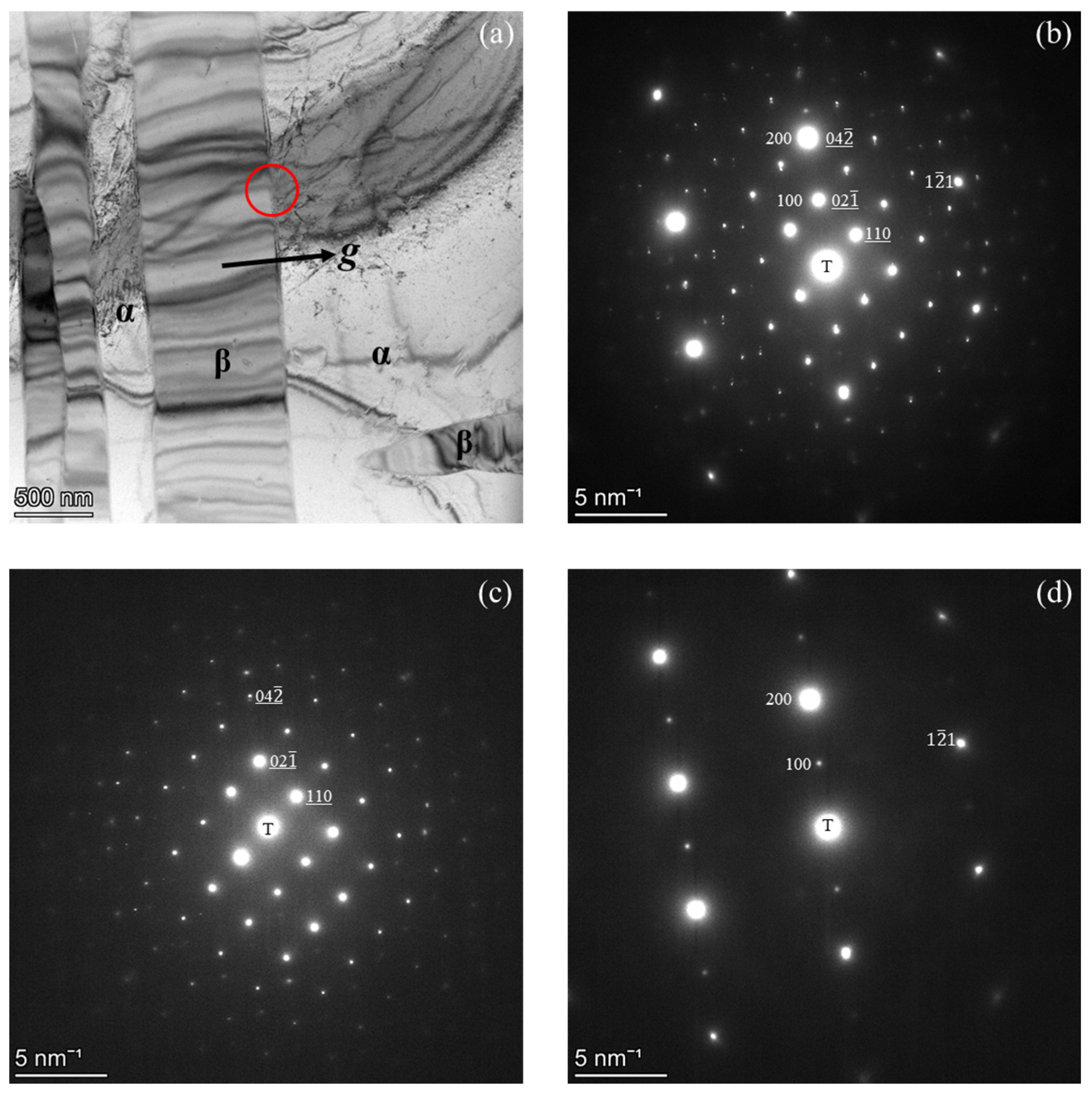
- The formation of the β-Mn in BCC shows the following OR: ()β // (100)α and []β // [012]α.
- The alloy exhibits a single BCC phase at temperatures above 850 °C.
- β-Mn is thermally stable between 500 °C and 850 °C.
- β-Mn appears as Widmanstätten side-plates that coarsen with temperature.
- The β-Mn in BCC shows an OR established as ()β // (100)α and []β // [012]α.
- We clarify the precipitation behavior of β-Mn.
- We provide new insights into β-Mn phase stability in Fe–Mn–Al alloy.
- We provide information contributing to the development of high-strength, lightweight steels.
Abstract
1. Introduction
2. Materials and Methods
3. Results and Discussion
4. Conclusions
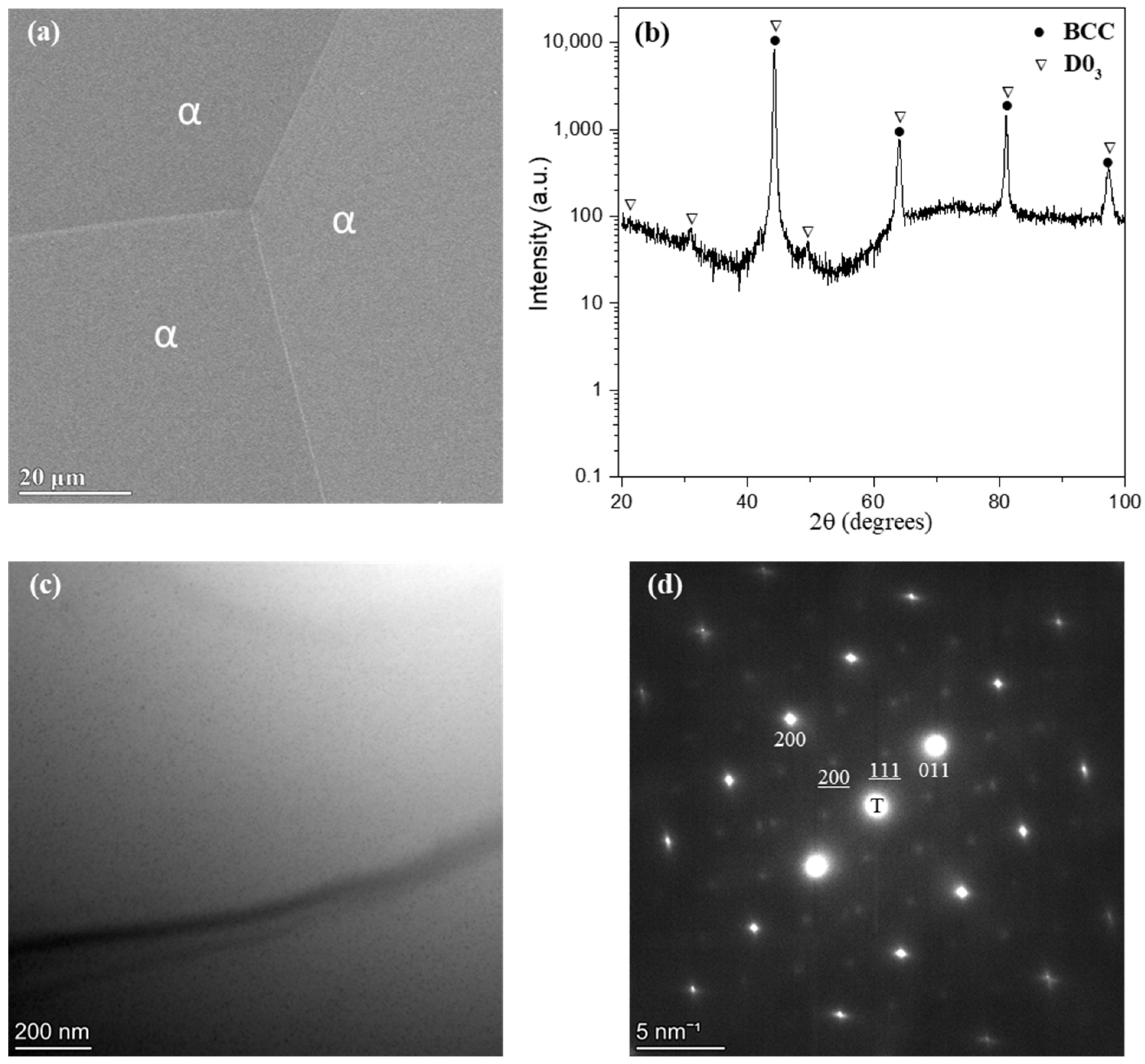
- The alloy exhibits a single BCC phase at temperatures ranging from 850 °C to 1100 °C.
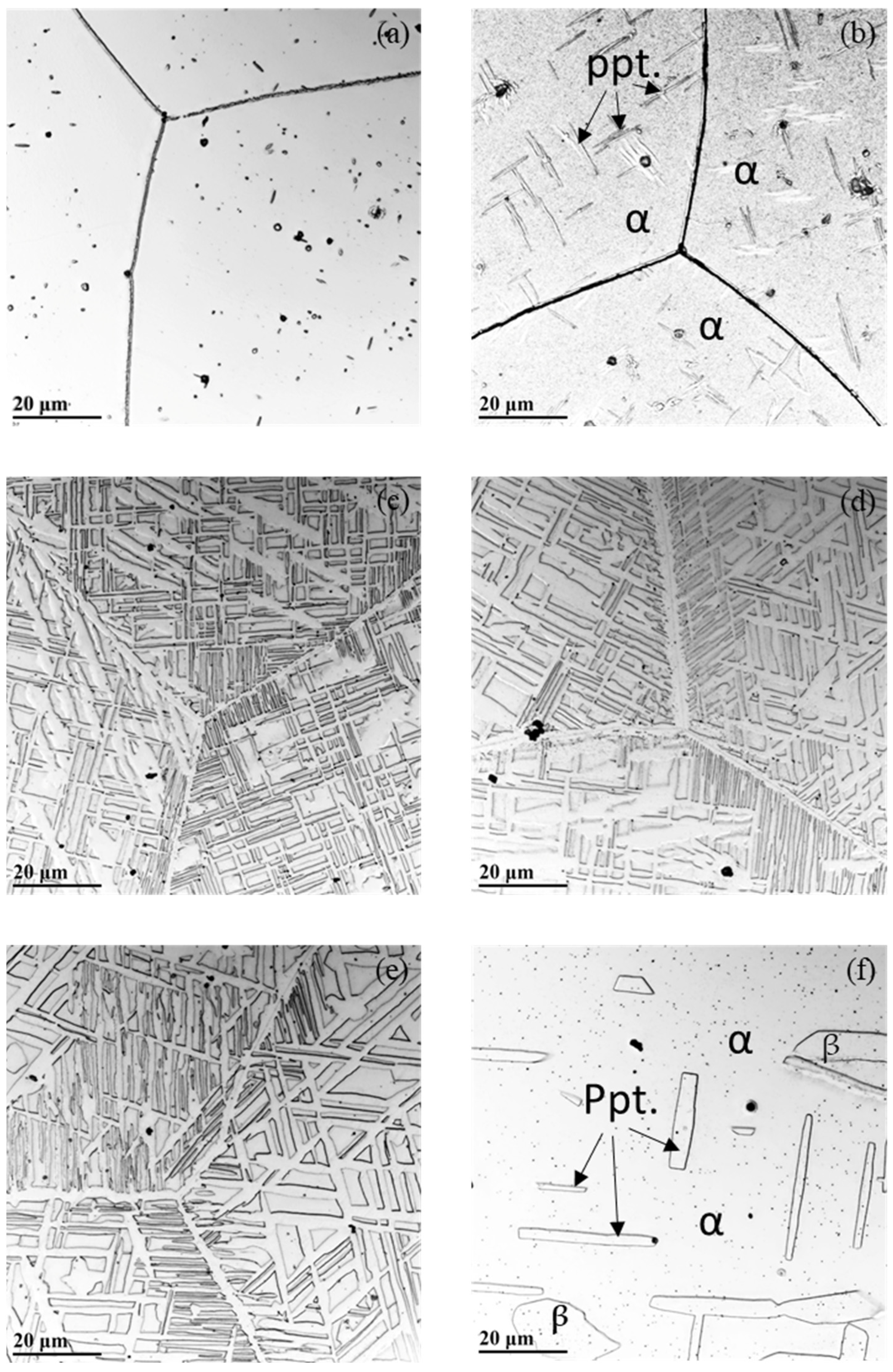
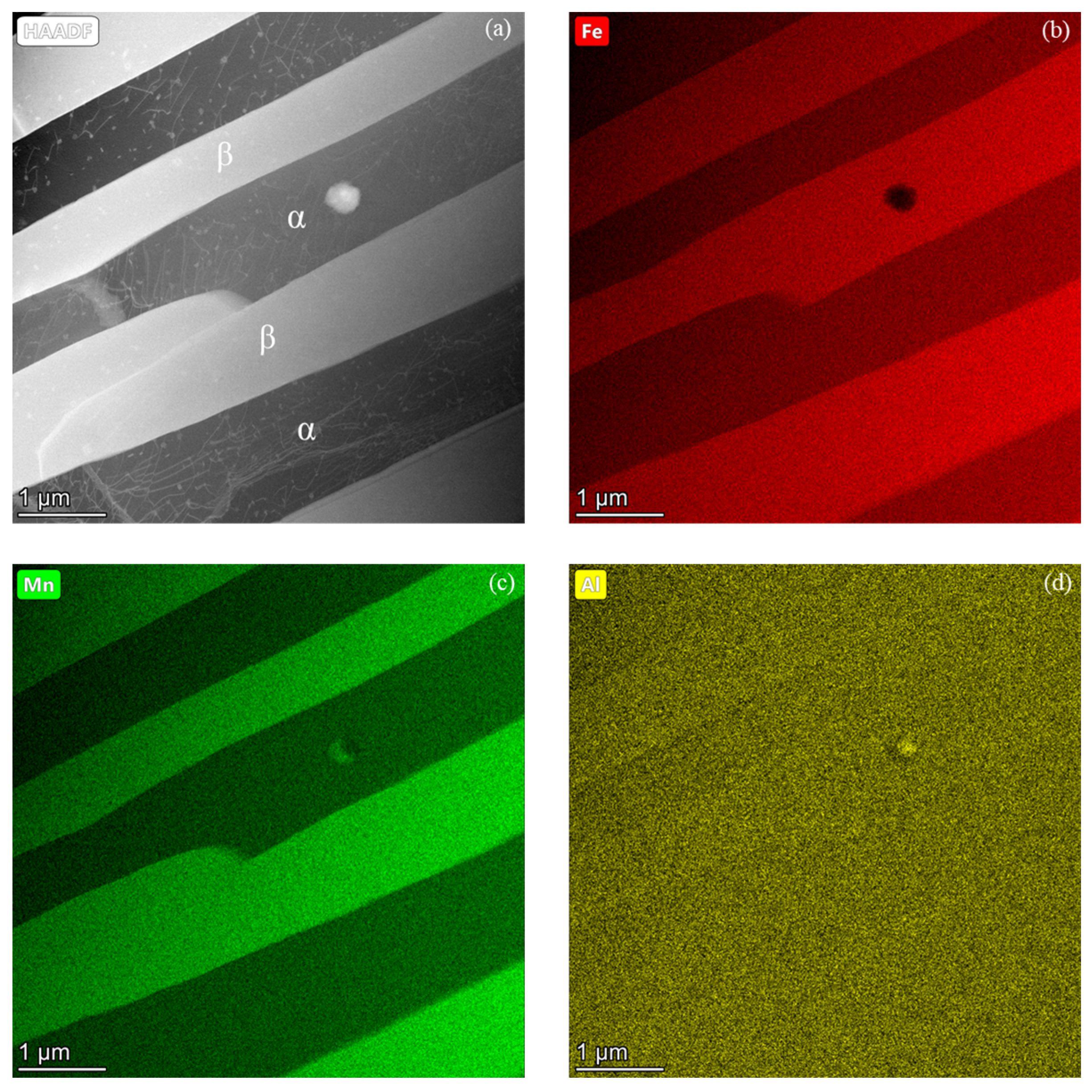
- During isothermal holding, β-Mn precipitates form heterogeneously within the BCC grains and grain boundaries through diffusion-aided elemental partitioning. The compositions of the constituent phases show that the β-Mn phase is enriched in Mn, while the BCC phase is enriched in Fe. Both phases show a weak Al partition.
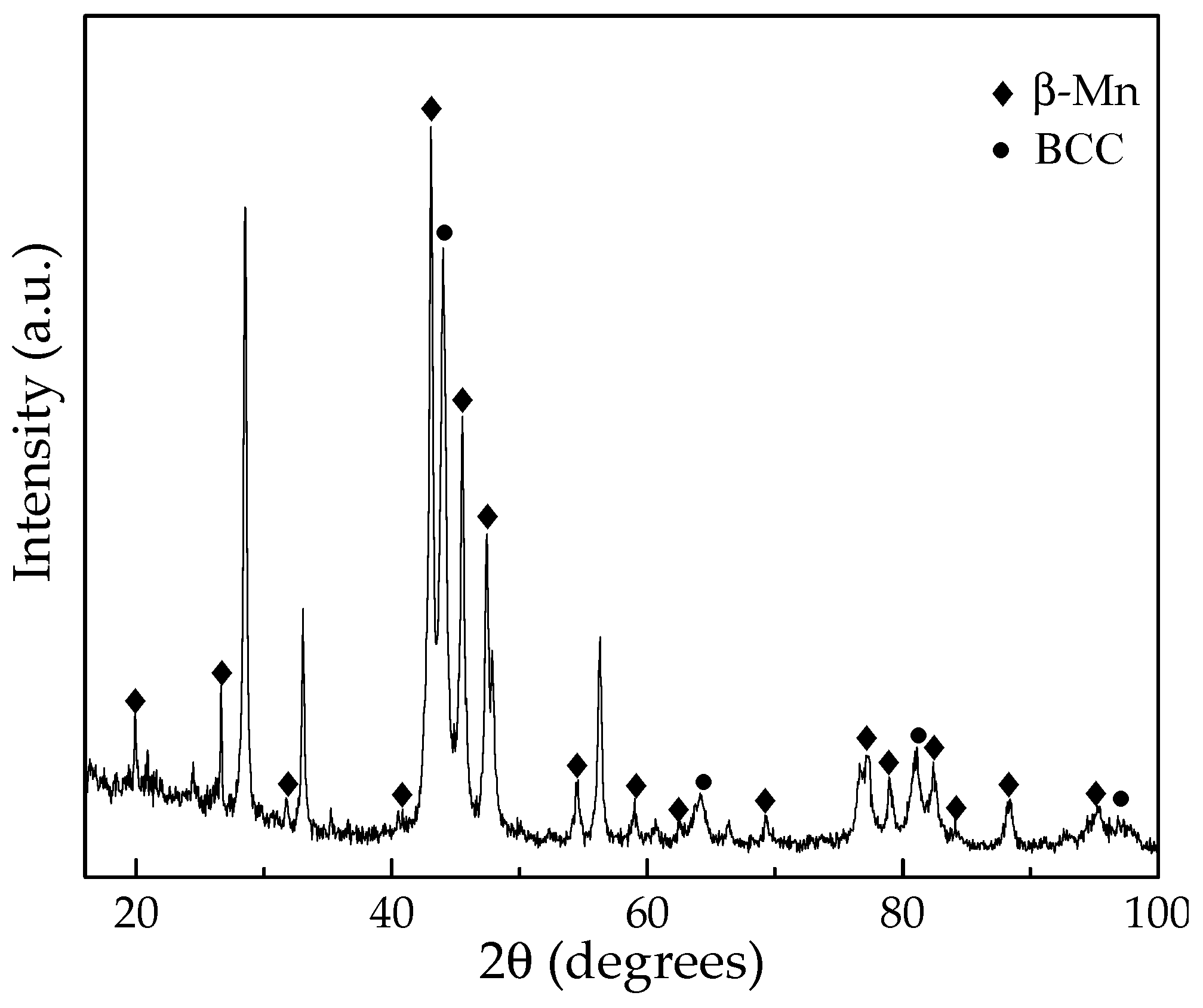
- The β-Mn phase remains stable in the ferritic phase between approximately 500 °C and 850 °C, with its volume fraction increasing with temperature and reaching a maximum at around 650 °C.
- β-Mn precipitates exhibit a Widmanstätten side-plate morphology, and their sizes increases progressively with the holding temperature.
- The β-Mn and BCC phases maintain an orientation relationship ()β // (100)α and []β // [012]α, indicating a partially coherent interface between the two structures.
- The disappearance of β-Mn above 850 °C demonstrates its limited thermal stability, indicating that microstructural control in this alloy system requires specific thermal processing.
Author Contributions
Funding
Institutional Review Board Statement
Informed Consent Statement
Data Availability Statement
Conflicts of Interest
References
- Kim, H.; Suh, D.W.; Kim, N.J. Fe–Al–Mn–C lightweight structural alloys: A review on the microstructures and mechanical properties. Sci. Technol. Adv. Mater. 2013, 14, 014205. [Google Scholar] [CrossRef] [Scilit] [PubMed]
- Gutierrez Urrutia, I. Low density Fe-Mn-Al-C steels: Phase structures, mechanisms and properties. ISIJ Int. 2021, 61, 16–25. [Google Scholar] [CrossRef] [Scilit]
- Frommeyer, G.; Brüx, U. Microstructures and mechanical properties of high-strength Fe-Mn-Al-C light-weight TRIPLEX steels. Steel Res. Int. 2006, 77, 627–633. [Google Scholar] [CrossRef] [Scilit]
- Moon, J.; Park, S.-J.; Jang, J.H.; Lee, T.-H.; Lee, C.-H.; Hong, H.-U.; Suh, D.-W.; Kim, S.H.; Han, H.N.; Lee, B.H. Atomistic investigations of κ-carbide precipitation in austenitic Fe-Mn-Al-C lightweight steels and the effect of Mo addition. Scr. Mater. 2017, 127, 97–101. [Google Scholar] [CrossRef] [Scilit]
- Wang, H.; Wang, C.; Liang, J.; Godfrey, A.; Wang, Y.; Weng, Y.; Cao, W. Effect of alloying content on microstructure and mechanical properties of Fe–Mn–Al–C low-density steels. Mater. Sci. Eng. A 2023, 886, 145675. [Google Scholar] [CrossRef] [Scilit]
- Chen, S.; Rana, R.; Haldar, A.; Ray, R.K. Current state of Fe-Mn-Al-C low density steels. Prog. Mater. Sci. 2017, 89, 345–391. [Google Scholar] [CrossRef] [Scilit]
- Khaple, S.; Golla, B.R.; Prasad, V.S. A review on the current status of Fe–Al based ferritic lightweight steel. Def. Technol. 2023, 26, 1–22. [Google Scholar] [CrossRef] [Scilit]
- Veis, V.; Semenko, A.; Voron, M.; Tymoshenko, A.; Likhatskyi, R.; Likhatskyi, I.; Parkhomchuk, Z. Lightweight Fe–Mn–Al–C Steels: Current State, Manufacturing, and Implementation Prospects. Steel Res. Int. 2025, 2400904. [Google Scholar] [CrossRef] [Scilit]
- Bai, R.; Du, Y.; Zhang, Y.; He, X. The influence of Al content and heat treatment on the microstructure and properties of austenite-ferrite duplex Fe-Mn-Al-C lightweight steels. J. Alloys Met. Syst. 2025, 9, 100162. [Google Scholar] [CrossRef] [Scilit]
- Chen, P.; Zhang, F.; Zhang, Q.; Du, J.; Shi, F.; Li, X. Precipitation behavior of κ-carbides and its relationship with mechanical properties of Fe–Mn–Al–C lightweight austenitic steel. J. Mater. Res. Technol. 2023, 25, 3780–3788. [Google Scholar] [CrossRef] [Scilit]
- Seede, R.; Whitt, A.; Ye, J.; Gibbons, S.; Flater, P.; Gaskey, B.; Elwany, A.; Arroyave, R.; Karaman, I. A lightweight Fe–Mn–Al–C austenitic steel with ultra-high strength and ductility fabricated via laser powder bed fusion. Mater. Sci. Eng. A 2023, 874, 145007. [Google Scholar] [CrossRef] [Scilit]
- Zhou, Y.; Man, T.; Wang, J.; Zhao, H.; Dong, H. Secondary Phase Precipitation in Fe-22Mn-9Al-0.6C Low-Density Steel during Continuous Cooling Process. Materials 2024, 17, 631. [Google Scholar] [CrossRef] [Scilit] [PubMed]
- An, Y.; Chen, X.; Ren, P.; Cao, W. Ultrastrong and ductile austenitic lightweight steel via ultra-fine grains and heterogeneous B2 precipitates. Mater. Sci. Eng. A 2022, 860, 144330. [Google Scholar] [CrossRef] [Scilit]
- Wang, J.; Man, T.; Zhou, Y.; Wei, X.; Dong, H. Effect of B2 Precipitation on Hot Ductility of Fe–22Mn–9Al–0.6 C Low-Density Steel. Metals 2024, 14, 724. [Google Scholar] [CrossRef] [Scilit]
- García-Domínguez, M.; Mejía, I.; Schell, N.; Stark, A.; Cabrera, J.; Barriobero-Vila, P. Evolution of precipitation in a duplex Fe-Mn-Al-C low-density steel revealed by in situ high-energy synchrotron X-ray diffraction. Mater. Today Commun. 2025, 47, 113101. [Google Scholar] [CrossRef] [Scilit]
- Lopez-Hirata, V.M.; Perez-Badillo, E.; Saucedo-Muñoz, M.L.; Hernandez-Santiago, F.; Villegas-Cardenas, J.D. Phase Transformations after Heat Treating an As-Cast Fe-30Mn-8.8Al-0.3Si-0.15C Steel. Metals 2024, 14, 748. [Google Scholar] [CrossRef] [Scilit]
- Chen, P.; Li, X.; Yi, H. The κ-Carbides in Low-Density Fe-Mn-Al-C Steels: A Review on Their Structure, Precipitation and Deformation Mechanism. Metals 2020, 10, 1021. [Google Scholar] [CrossRef] [Scilit]
- Seo, C.-H.; Kwon, K.H.; Choi, K.; Kim, K.-H.; Kwak, J.; Lee, S.; Kim, N.J. Deformation behavior of ferrite–austenite duplex lightweight Fe–Mn–Al–C steel. Scr. Mater. 2012, 66, 519–522. [Google Scholar] [CrossRef] [Scilit]
- Kenedy, G.R.; Lin, Y.-J.; Cheng, W.-C. Evidence of Martensitic Transformation in Fe-Mn-Al Steel Similar to Maraging Steel. Met. Mater. Trans. A 2020, 52, 26–33. [Google Scholar] [CrossRef] [Scilit]
- Omori, T. BCC/FCC martensitic transformation and thermoelasticity in Fe alloys. In Proceedings of the International Symposia on Steel Science (ISSS 2024); Iron and Steel Institute of Japan: Tokyo, Japan, 2024; pp. 155–164. [Google Scholar] [CrossRef] [Scilit]
- Saha, M. Ordered B2 phase in a disordered FCC matrix: Current state of research on the development of low-density B2-strengthened Fe-Mn-Al-Ni-C steels. ChemRxiv 2024. [Google Scholar] [CrossRef] [Scilit]
- Bai, S.B.; Chen, Y.A.; Liu, X.; Lu, H.H.; Bai, P.K.; Li, D.Z.; Huang, Z.Q.; Li, J.Y. Research status and development prospect of Fe–Mn–C–Al system low-density steels. J. Mater. Res. Technol. 2023, 25, 1537–1559. [Google Scholar] [CrossRef] [Scilit]
- Zuo, Y.; Fu, Y.; Sun, L.; Peng, H.; Wen, Y. Low-cost FeMnAlCu multi-principal element alloys with flexible hardness from soft to ultra-hard over 900 HV by short-time aging. J. Alloys Compd. 2025, 1022, 180061. [Google Scholar] [CrossRef] [Scilit]
- Wang, D.; Zuo, Y.; Sun, L.; Wang, F.; Xu, J.; Zhao, Y.; Fu, Y.; Peng, H. Effects of Al contents on aging hardening behaviors of Fe-Mn-Al-Cu low-density steels with ultra-high specific hardness. Mater. Charact. 2025, 221, 114761. [Google Scholar] [CrossRef] [Scilit]
- Lee, K.; Park, S.-J.; Moon, J.; Kang, J.-Y.; Lee, T.-H.; Han, H.N. β-Mn formation and aging effect on the fracture behavior of high-Mn low-density steels. Scr. Mater. 2016, 124, 193–197. [Google Scholar] [CrossRef] [Scilit]
- Chen, X.; Xu, Y.; Ren, P.; Li, W.; Cao, W.; Liu, Q. Aging hardening response and β-Mn transformation behavior of high carbon high manganese austenitic low-density Fe-30Mn-10Al-2C steel. Mater. Sci. Eng. A 2017, 703, 167–172. [Google Scholar] [CrossRef] [Scilit]
- Lee, K.; Park, S.-J.; Kang, J.-Y.; Park, S.; Han, S.S.; Park, J.Y.; Oh, K.H.; Lee, S.; Rollett, A.D.; Han, H.N. Investigation of the aging behavior and orientation relationships in Fe–31.4 Mn–11.4 Al–0.89 C low-density steel. J. Alloys Compd. 2017, 723, 146–156. [Google Scholar] [CrossRef] [Scilit]
- Liu, T.; Wu, C. β-Mn structure in an Fe-Al-Mn-Cr alloy. Scr. Metall. 1989, 23, 1087–1092. [Google Scholar] [CrossRef] [Scilit]
- Chen, S.K.; Lee, W.B.; Chour, K.W.; Wan, C.M.; Byrne, J. The BCC to FCC transformation in Fe-Mn-Al-C alloys. Scr. Metall. 1989, 23, 1919–1924. [Google Scholar] [CrossRef] [Scilit]
- Cheng, W.C.; Liu, C.F.; Lai, Y.F. Observing the D03 phase in Fe-Mn-Al alloys. Mater. Sci. Eng. A 2002, 337, 281–286. [Google Scholar] [CrossRef] [Scilit]
- Swann, P.R.; Duff, W.R.; Fisher, R.M. The electron metallography of ordering reactions in Fe-Al alloys. Met. Trans. 1972, 3, 413–423. [Google Scholar] [CrossRef] [Scilit]
- Morris, D.G.; Requejo, L.; Muñoz-Morris, M.A. A study of precipitation in D03 ordered Fe–Al–Nb alloy. Intermetallics 2005, 13, 862–871. [Google Scholar] [CrossRef] [Scilit]
- Porter, D.A.; Easterling, K.E.; Sherif, M.Y. Phase Transformations in Metals and Alloys (Revised Reprint); CRC Press, Taylor & Francis Group: Boca Raton, FL, USA, 2009; ISBN 978-1-4200-6210-2. [Google Scholar]
- Zuo, Y.; Fu, Y.; Xiong, R.; Sun, L.; Peng, H.; Wang, H.; Wen, Y.; Kim, H.S. From soft to ultrahard over 1000 HV: Engineering the hardness of FeMnAl(Cu) medium entropy alloys by unlocking the potential of β-Mn precipitation. Acta Mater. 2024, 278, 120235. [Google Scholar] [CrossRef] [Scilit]
- Witusiewicz, V.; Sommer, F.; Mittemeijer, E. Reevaluation of the Fe-Mn phase diagram. J. Phase Equilibria Diffus. 2004, 25, 346–354. [Google Scholar] [CrossRef] [Scilit]
- Shin, J.-H.; Song, J.-Y.; Kim, S.-D.; Park, S.-J.; Ma, Y.-W.; Lee, J.-W. Microstructure, Tensile, and Fatigue Properties of Large-Scale Austenitic Lightweight Steel. Materials 2022, 15, 8909. [Google Scholar] [CrossRef] [Scilit]
- Aaronson, H.I.; Enomoto, M.; Lee, J.K. Mechanisms of Diffusional Phase Transformations in Metals and Alloys; CRC Press, Taylor & Francis Group: Boca Raton, FL, USA, 2016; ISBN 978-1-4987-1324-4. [Google Scholar]


Disclaimer/Publisher’s Note: The statements, opinions and data contained in all publications are solely those of the individual author(s) and contributor(s) and not of MDPI and/or the editor(s). MDPI and/or the editor(s) disclaim responsibility for any injury to people or property resulting from any ideas, methods, instructions or products referred to in the content. |
© 2025 by the authors. Licensee MDPI, Basel, Switzerland. This article is an open access article distributed under the terms and conditions of the Creative Commons Attribution (CC BY) license.
Share and Cite
Korir, R.C.; Cheng, W.-C. Precipitation of β-Mn in the Form of Widmanstätten Side-Plates in the Ferrite Matrix of an Fe–28.6 Mn–10.9 Al Alloy Steel. Materials 2026, 19, 133. https://doi.org/10.3390/ma19010133
Korir RC, Cheng W-C. Precipitation of β-Mn in the Form of Widmanstätten Side-Plates in the Ferrite Matrix of an Fe–28.6 Mn–10.9 Al Alloy Steel. Materials. 2026; 19(1):133. https://doi.org/10.3390/ma19010133
Chicago/Turabian StyleKorir, Rosemary Chemeli, and Wei-Chun Cheng. 2026. "Precipitation of β-Mn in the Form of Widmanstätten Side-Plates in the Ferrite Matrix of an Fe–28.6 Mn–10.9 Al Alloy Steel" Materials 19, no. 1: 133. https://doi.org/10.3390/ma19010133
APA StyleKorir, R. C., & Cheng, W.-C. (2026). Precipitation of β-Mn in the Form of Widmanstätten Side-Plates in the Ferrite Matrix of an Fe–28.6 Mn–10.9 Al Alloy Steel. Materials, 19(1), 133. https://doi.org/10.3390/ma19010133