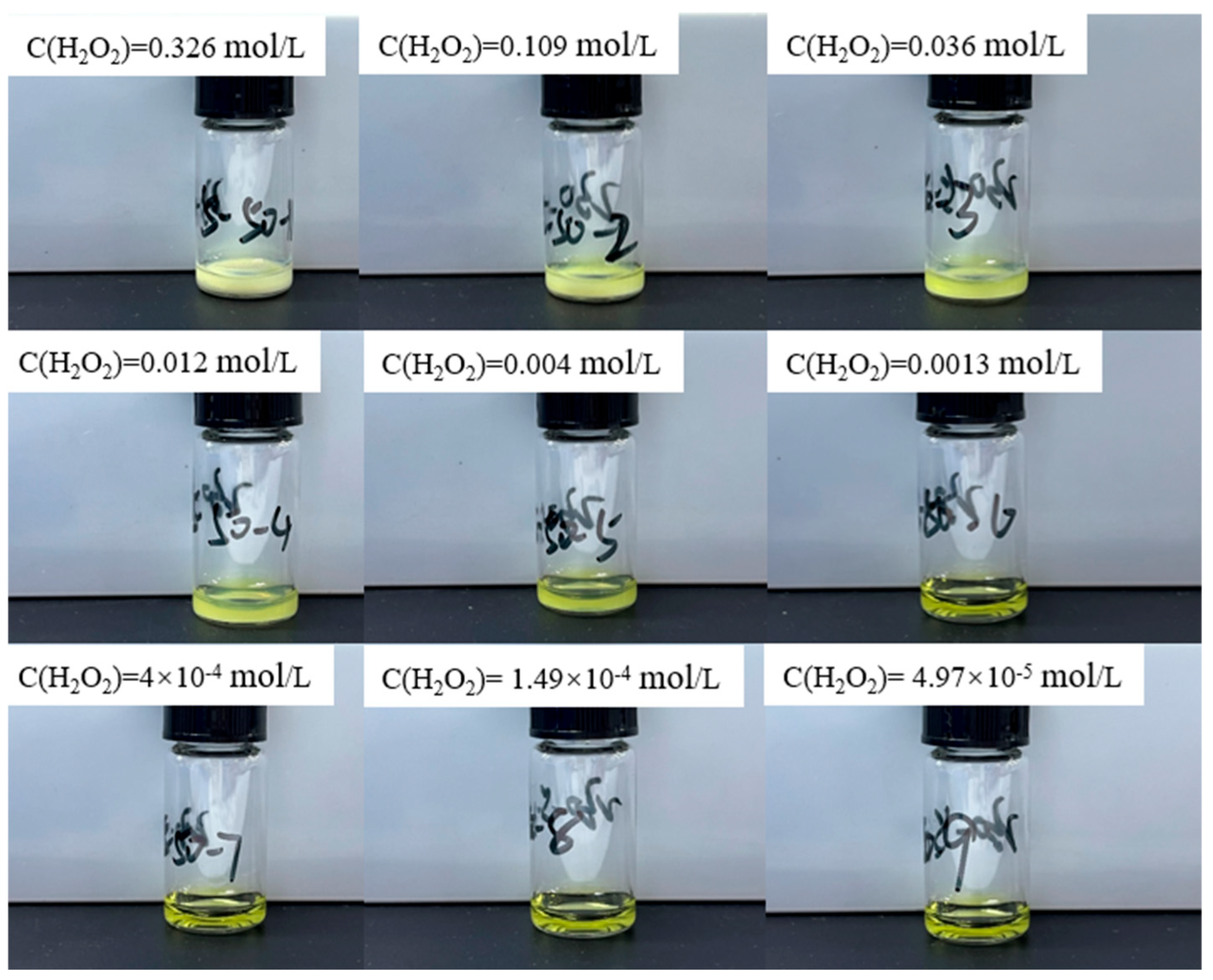
Correction: Zhao et al. Research on the Formation Conditions and Preventive Measures of Uranium Precipitates during the Service Process of Medical Isotope Production Reactors. Materials 2024, 17, 945

1. Text Correction
2. Error in Figure and Table
Reference
- Zhao, Y.; Gao, Y.; Li, X.; Le, Y.; Zhang, Y.; Qiu, J.; Xin, Y. Research on the Formation Conditions and Preventive Measures of Uranium Precipitates during the Service Process of Medical Isotope Production Reactors. Materials 2024, 17, 945. [Google Scholar] [CrossRef] [Scilit]


| Elements | Weight % | Atomic % | |
|---|---|---|---|
| 25 °C precipitate | O | 18.75 | 77.45 |
| U | 81.25 | 22.55 | |
| 50 °C precipitate | O | 13.93 | 70.66 |
| U | 86.07 | 29.34 | |
| 80 °C precipitate | O | 23.47 | 82.03 |
| U | 76.53 | 17.97 |
Disclaimer/Publisher’s Note: The statements, opinions and data contained in all publications are solely those of the individual author(s) and contributor(s) and not of MDPI and/or the editor(s). MDPI and/or the editor(s) disclaim responsibility for any injury to people or property resulting from any ideas, methods, instructions or products referred to in the content. |
© 2024 by the authors. Licensee MDPI, Basel, Switzerland. This article is an open access article distributed under the terms and conditions of the Creative Commons Attribution (CC BY) license (https://creativecommons.org/licenses/by/4.0/).
Share and Cite
Zhao, Y.; Gao, Y.; Li, X.; Le, Y.; Zhang, Y.; Qiu, J.; Xin, Y. Correction: Zhao et al. Research on the Formation Conditions and Preventive Measures of Uranium Precipitates during the Service Process of Medical Isotope Production Reactors. Materials 2024, 17, 945. Materials 2024, 17, 4932. https://doi.org/10.3390/ma17194932
Zhao Y, Gao Y, Li X, Le Y, Zhang Y, Qiu J, Xin Y. Correction: Zhao et al. Research on the Formation Conditions and Preventive Measures of Uranium Precipitates during the Service Process of Medical Isotope Production Reactors. Materials 2024, 17, 945. Materials. 2024; 17(19):4932. https://doi.org/10.3390/ma17194932
Chicago/Turabian StyleZhao, Yanli, Yuan Gao, Xinyue Li, Yi Le, Yang Zhang, Jie Qiu, and Yong Xin. 2024. "Correction: Zhao et al. Research on the Formation Conditions and Preventive Measures of Uranium Precipitates during the Service Process of Medical Isotope Production Reactors. Materials 2024, 17, 945" Materials 17, no. 19: 4932. https://doi.org/10.3390/ma17194932
APA StyleZhao, Y., Gao, Y., Li, X., Le, Y., Zhang, Y., Qiu, J., & Xin, Y. (2024). Correction: Zhao et al. Research on the Formation Conditions and Preventive Measures of Uranium Precipitates during the Service Process of Medical Isotope Production Reactors. Materials 2024, 17, 945. Materials, 17(19), 4932. https://doi.org/10.3390/ma17194932