Ultrasonic Cavitation Erosion Behavior of GX40CrNiSi25-20 Cast Stainless Steel through Yb-YAG Surface Remelting


 and
and
Abstract
1. Introduction
2. Materials and Experimental Procedures
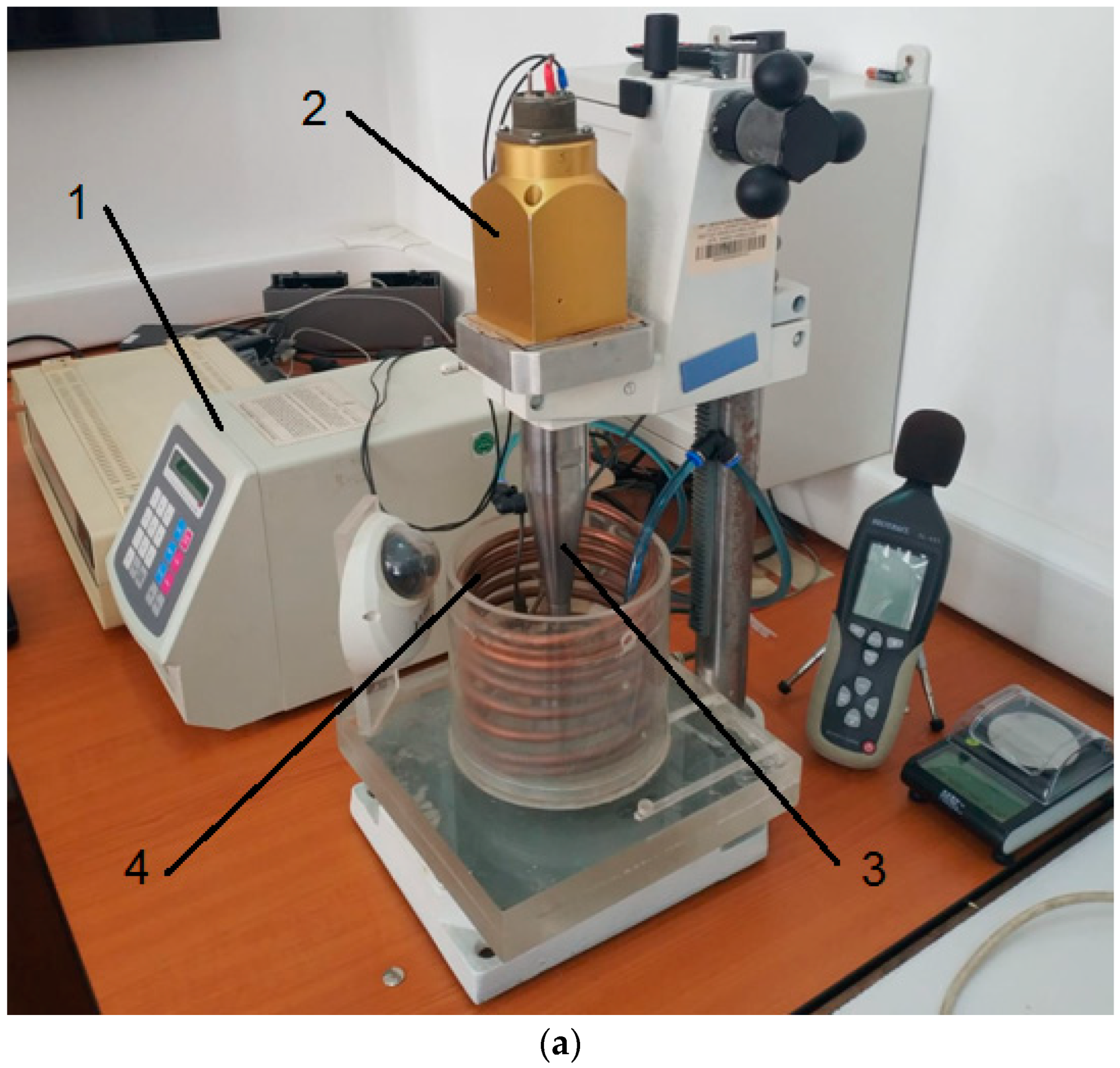
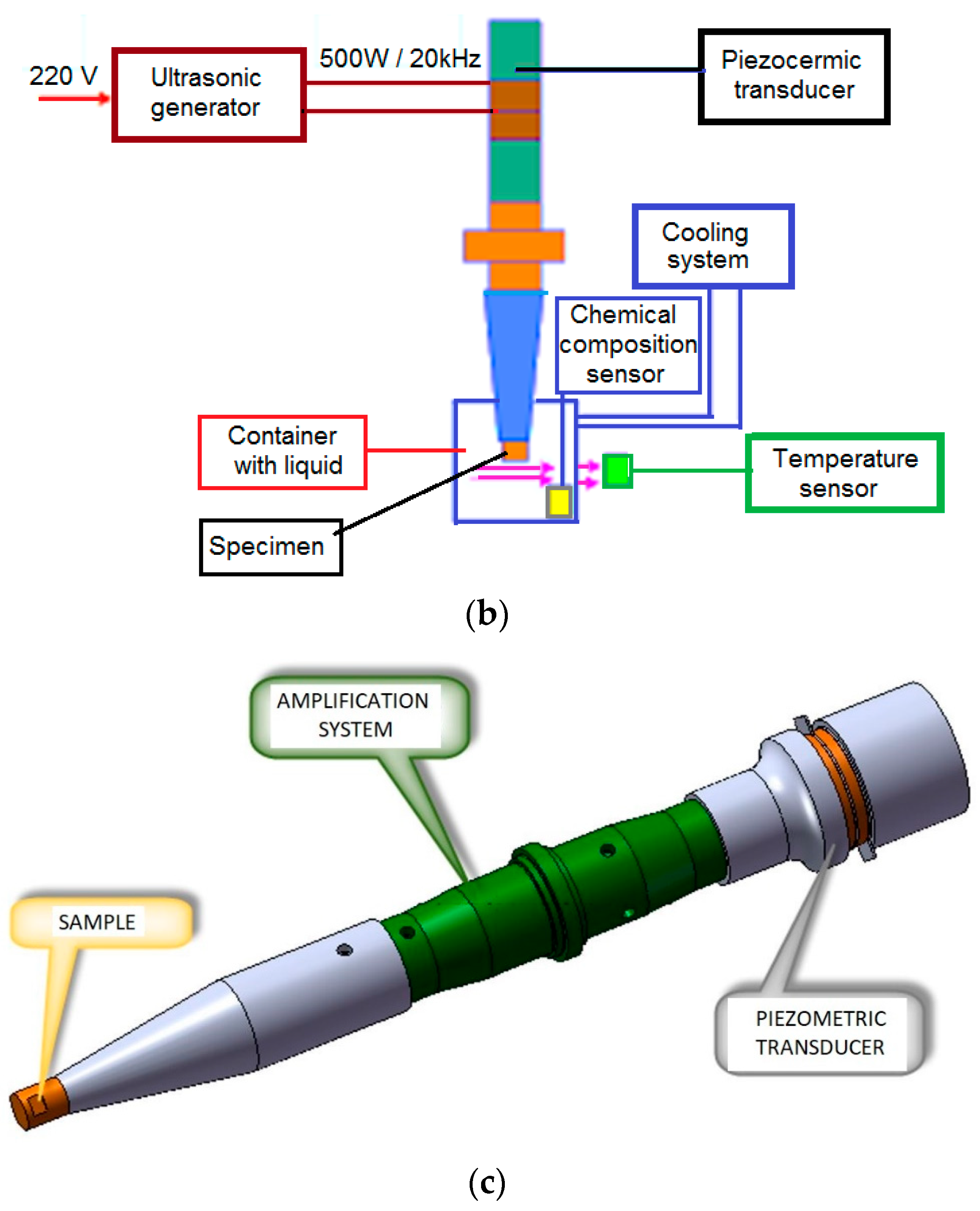
- Installed power: 500 W
- Frequency of vibrations: 20 kHz
- Amplitude of vibrations: 50 μm
- Supply voltage: 220 V/50 Hz
- Testing liquid: Tap water
- Temperature of the testing liquid: 22 ± 1 °C
- A—
- it is the statistically determined scale parameter for drawing the approximation/averaging curve, provided that the deviations of the experimental points from it are minimal;
- B—
- it is the shape parameter of the curve.
3. Results and Discussion
3.1. Hardness Measurements
3.2. Specific Curves and Characteristic Parameters of Cavitation Erosion
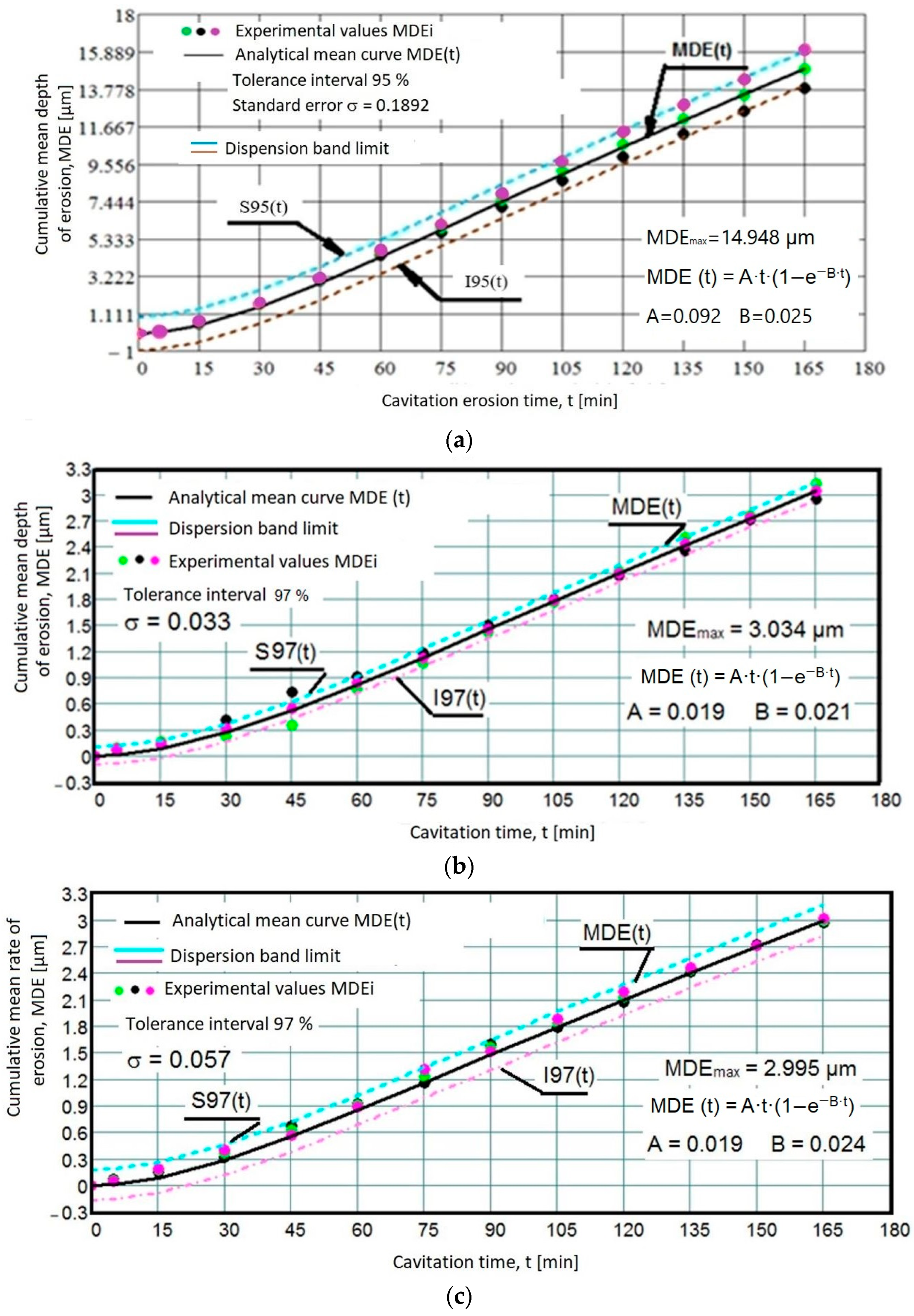
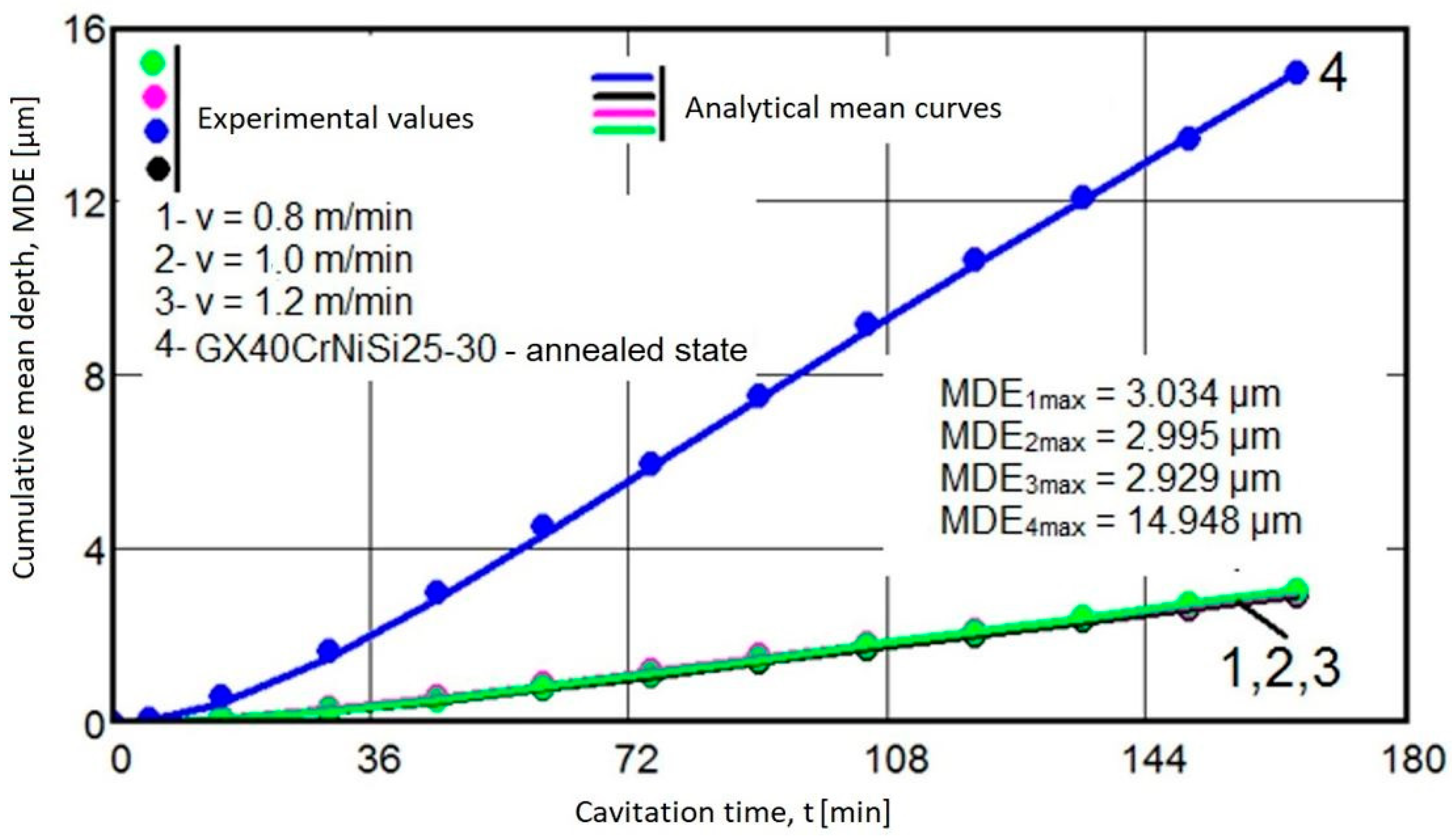
- the equation of the polynomial regression curve (Equation (1)),
- the standard error of estimation.
- -
- MDE(t)i—is the mean penetration depth of erosion defined by the regression curve (Equation (1)) at the time ti;
- -
- MDEi—is the mean experimental value of the values obtained through the experiment at time ti;
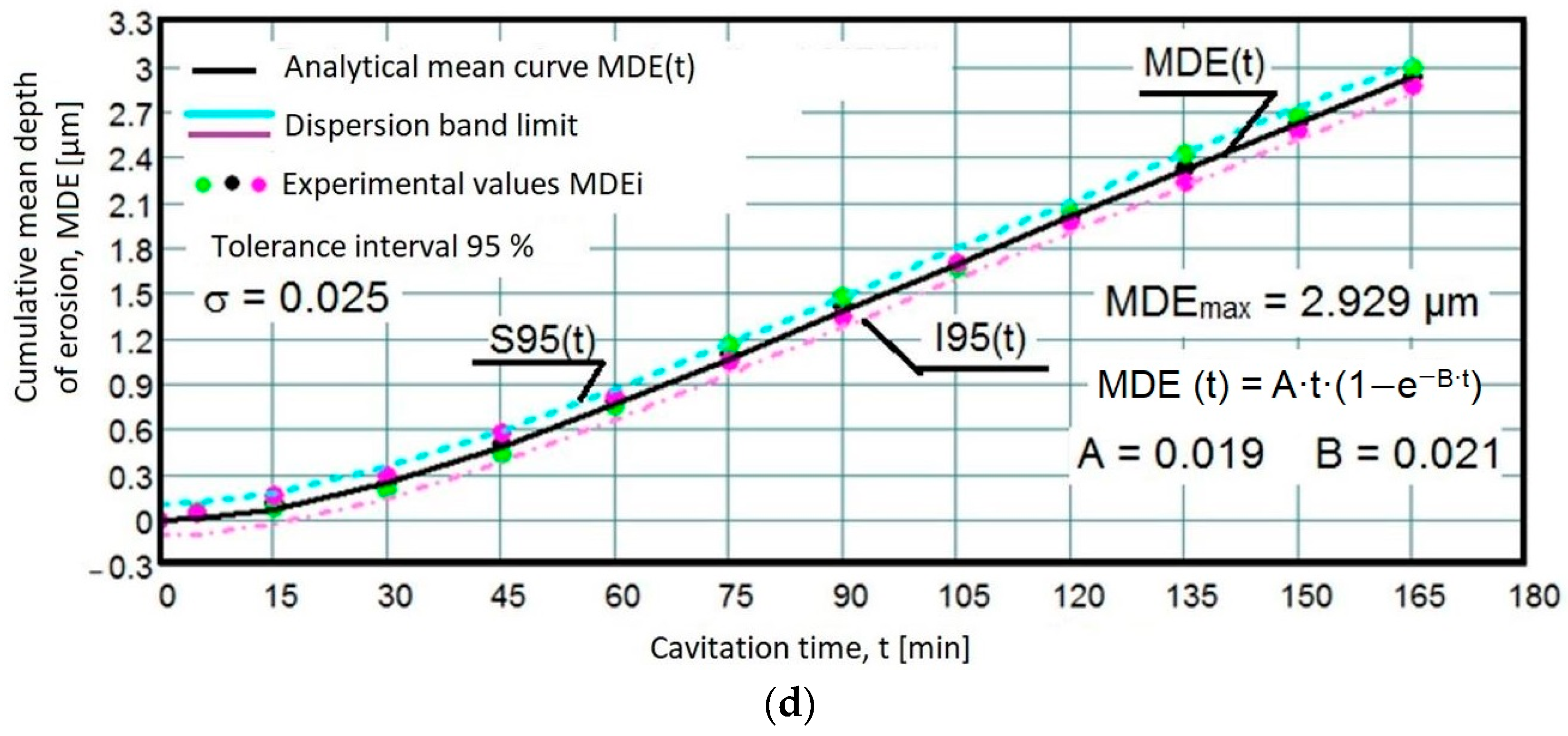
- The high accuracy of measurements on sets of three samples, regardless of their structural state, is reflected by the standard deviation values (0.025…0.1892) and the dispersion band of values corresponding to tolerance intervals of (95–97%).
- The test was conducted accurately, procedural steps were diligently followed, and the vibrator apparatus parameters, determining the destructive intensity of cavitation, were well controlled throughout the experiment.
- Natural differences between the values of standard deviation suggest that laser remelting with a speed of v = 1.2 m/min leads to obtaining a microstructure that provides the best resistance to cavitation erosion. Previous experiences [13,17,21,22] suggest that the dispersion of experimental values results from refining the microstructure and enhancing the mechanical properties of surfaces exposed to vibrating cavitation erosion.
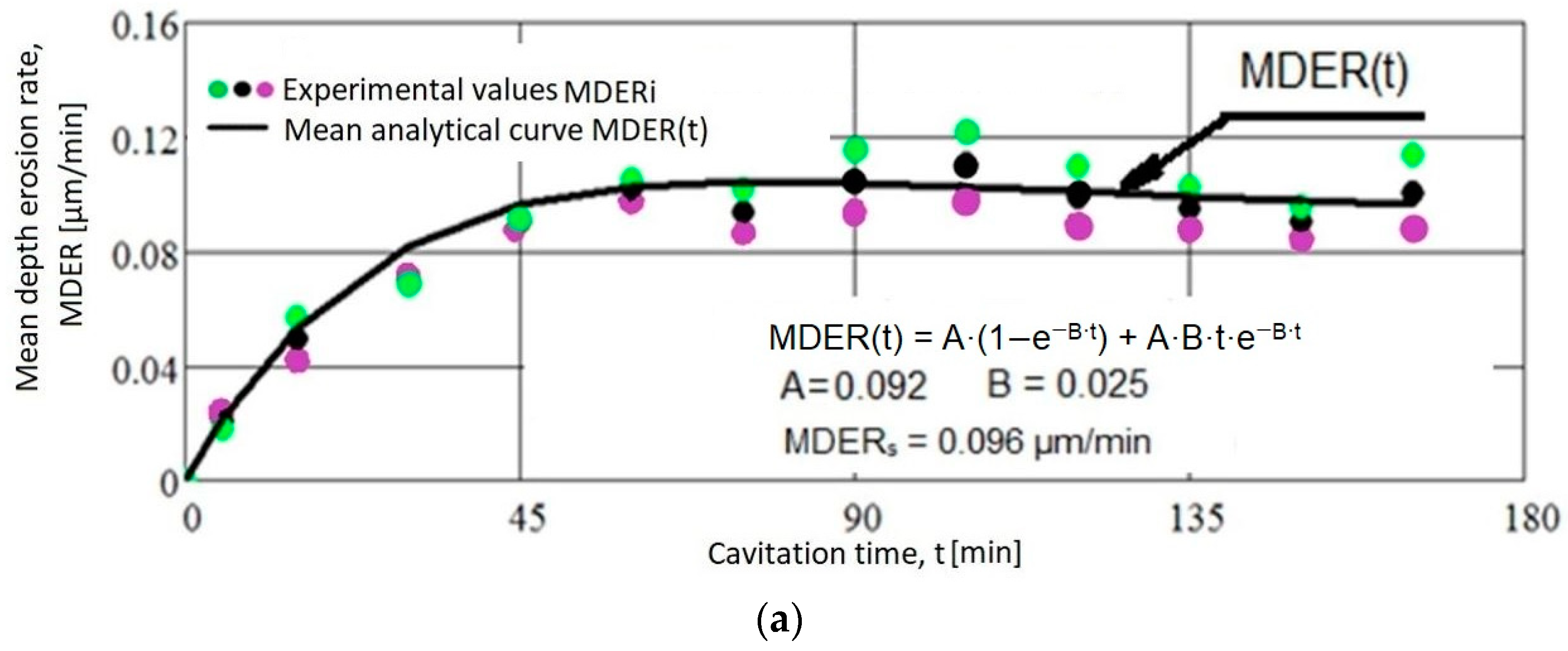
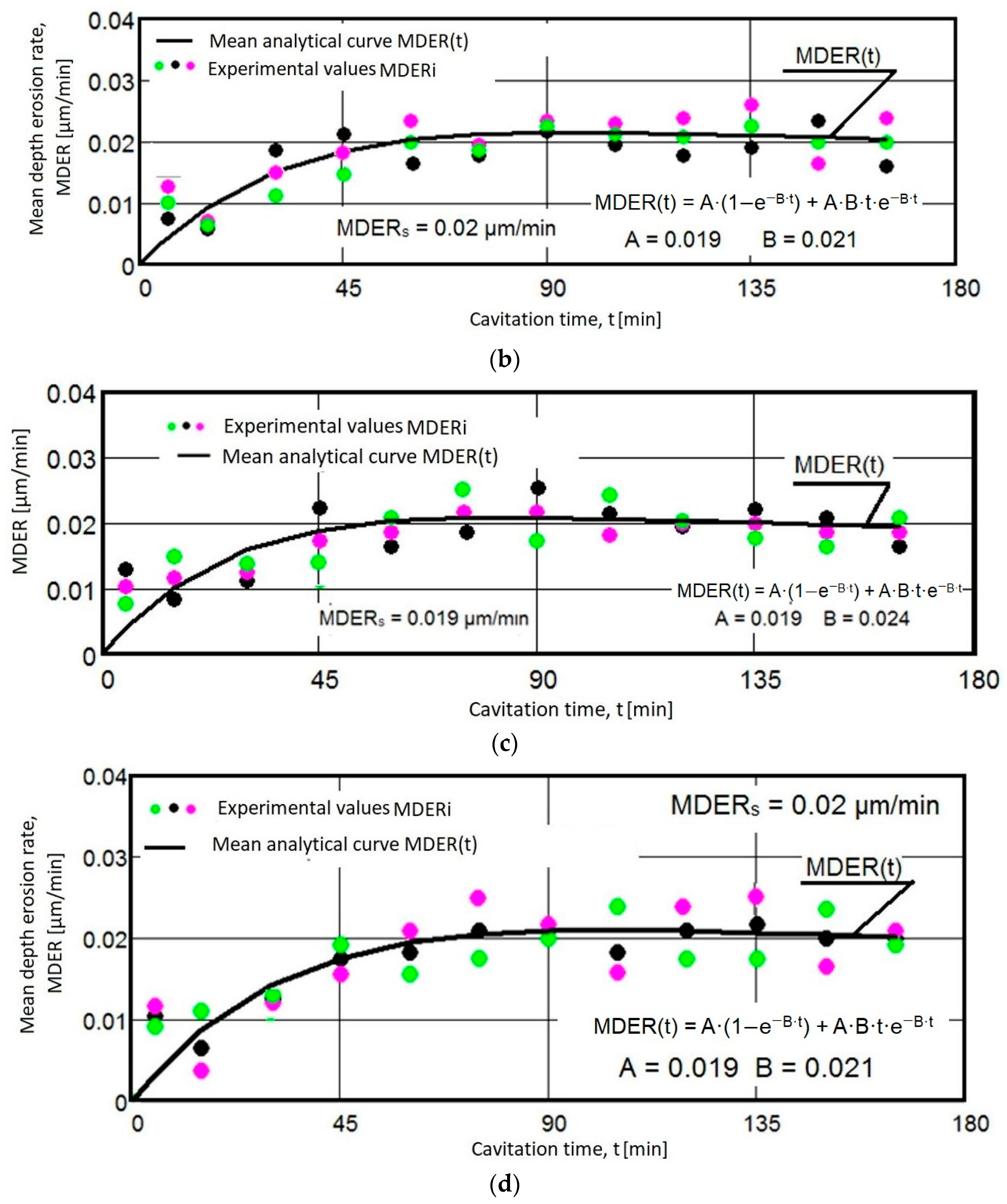
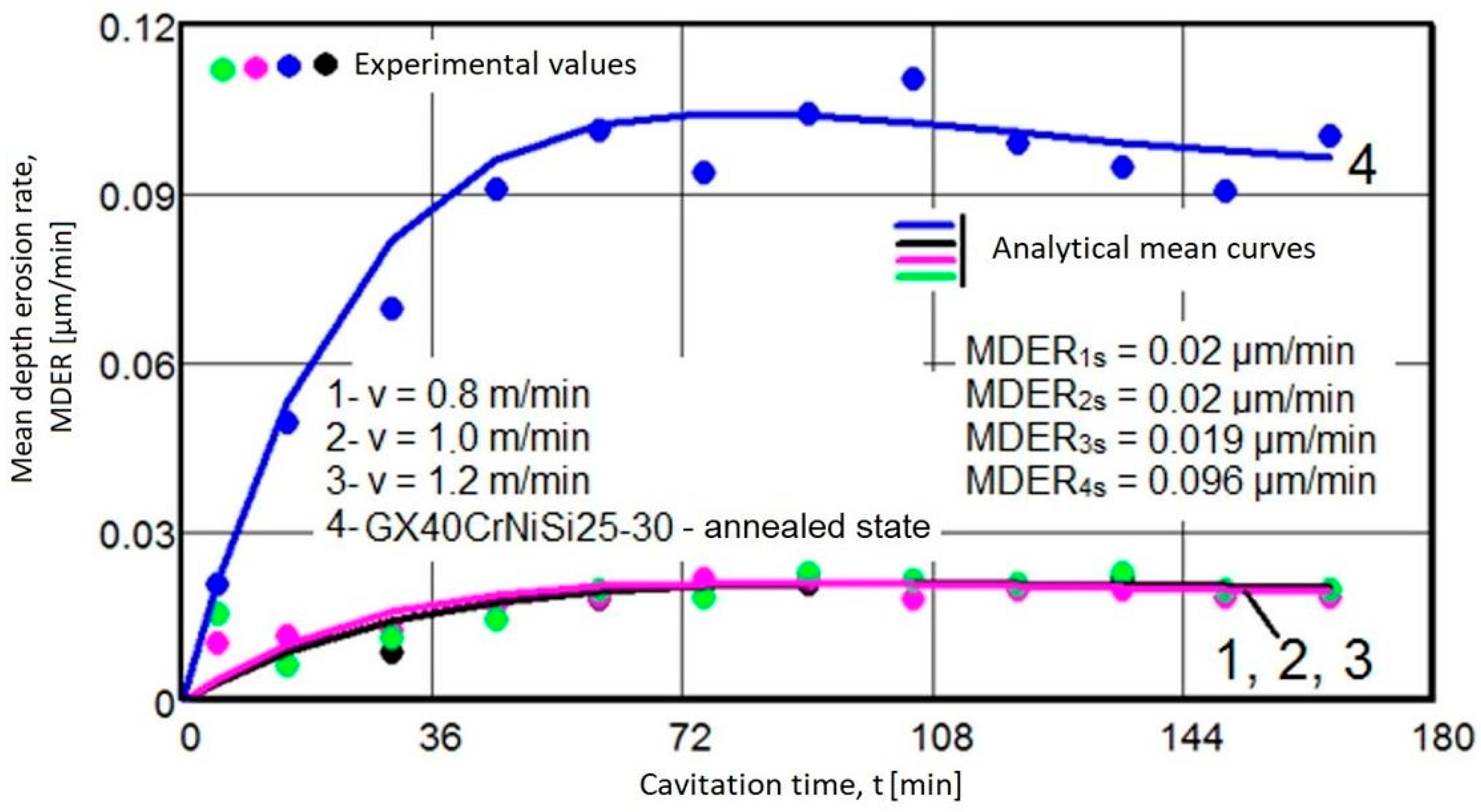
- A close relationship exists between the differences among the three experimental values obtained on each set of samples at the same duration of cavitation attack and the dimensions (or mass) of the grains ejected in the intermediate cavitation intervals. These differences are well highlighted in the variations of the experimental values, averaged algebraically, compared to the MDER(t) mean curves in Figure 7.
- The increase in strength achieved by remelting at a speed of 1.2 m/min, compared to samples where laser remelting speeds of 0.8 m/min and 1.0 m/min were used, is 1.035 times higher when analyzing the maximum value of the mean erosion depth (MDEmax) and 1.052 times higher when analyzing the MDERs value towards which the mean penetration depth of erosion rate tends to stabilize.
- The increase in resistance achieved at a working speed of 1.2 m/min, compared to samples where a laser remelting speed of 1 m/min was used, is higher, 1.022 times, when analyzing the maximum value of the mean depth of erosion (MDEmax) and of the same level after the MDERs value, towards which the mean penetration depth of erosion rate tends to stabilize.
- Between the resistances of the surfaces remelted with the laser beam at speeds of 0.8 m/min and 1.0 m/min, there is a negligible difference in resistance to cavitational stresses of 1.013 times, as per the maximum value of the mean erosion depth (MDEmax).
3.3. Structural Modifications
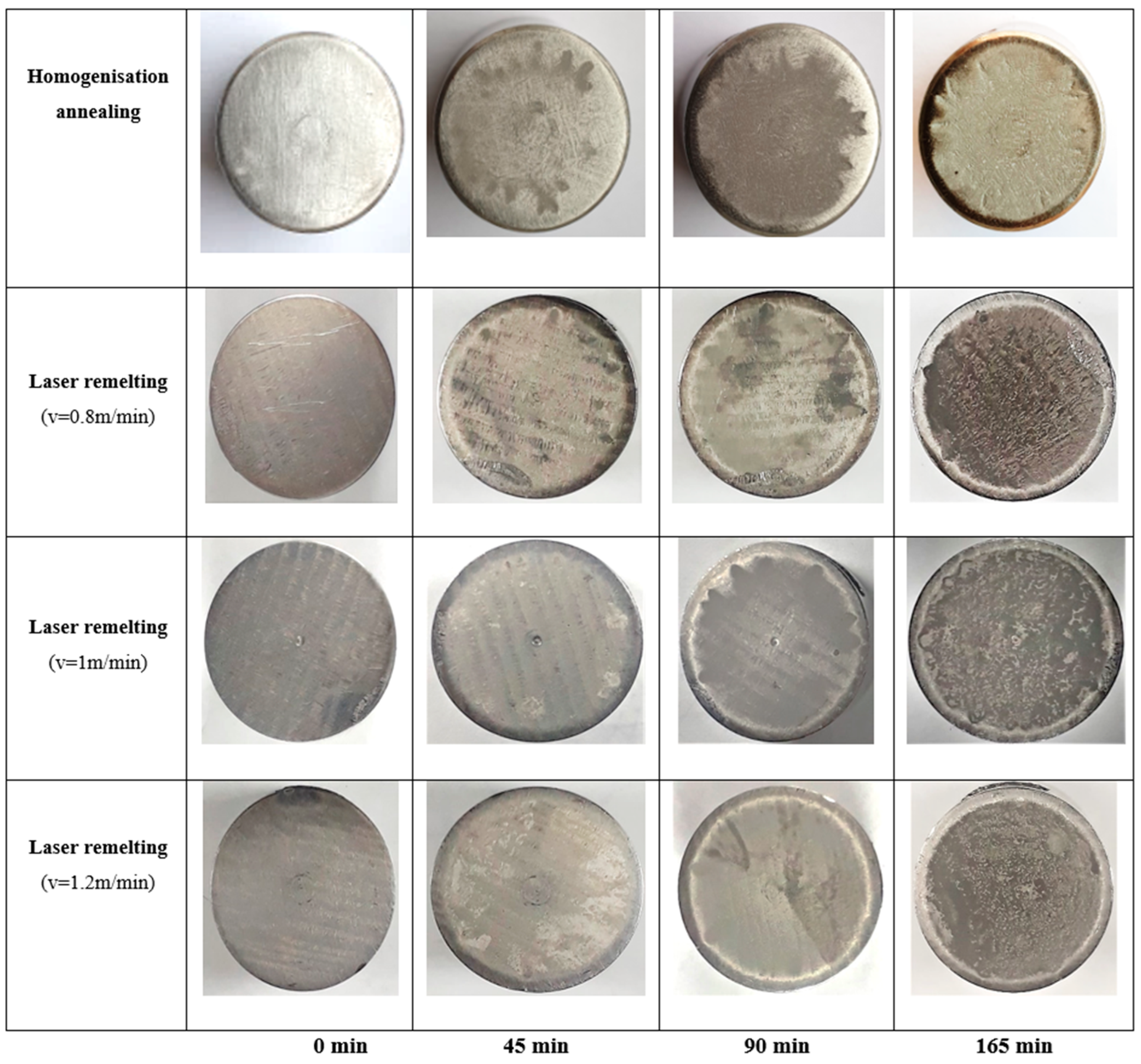
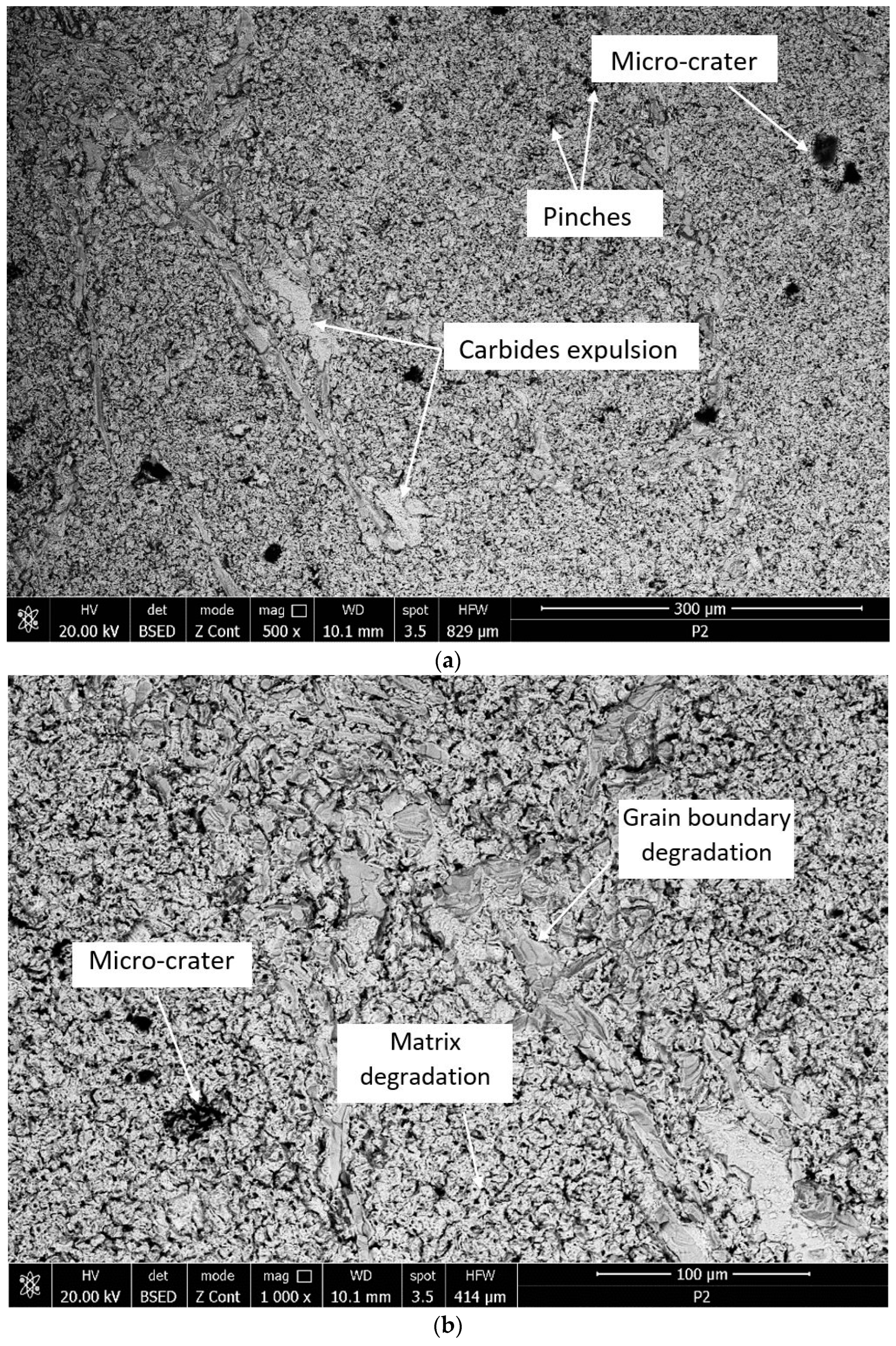
- In the reference state, during the first 30 min of cavitation attack, there is no noticeable deterioration of the surface. However, with a longer duration, a continuous increase in the density of pinches in the material and their depth is observed.
- With an increase in cavitation attack duration, the surface structure resulting from the laser remelting regime with a speed of v = 0.8 m/min is slightly more affected, indicating that this regime leads to lower resistance to surface degradation.
- The best resistance to vibratory cavitation attack is obtained by the structure resulting from the laser remelting regime with a speed of v = 1.2 m/min, with the evolution of destruction in terms of area and depth being significantly inferior to the other two regimes.
- These images of erosion evolution highlight that the resistance of a laser-remelted surface is dependent on the process parameters, namely the laser remelting speed.
4. Conclusions
- According to the value of the MDEmax parameter, the achieved increase is 2.2% compared to the regime with v = 1 m/min and 3.5% compared to the structure obtained by using the laser melting speed v = 0.8 m/min.
- According to the value of the MDERs parameter, the increase achieved is 5.2% compared to the structure obtained by using laser melting speeds v = 0.8 m/min and v = 1 m/min.
- Compared to the initial reference state of the material, the laser surface modification technique produces an increase in resistance to cavitation attack from 4.9 times to 5.1 times after the values of the cumulative mean depths, MDEmax, respectively from 4.8 times to 5 times, according to the values of the mean penetration depth of erosion rate, MDERs.
Author Contributions
Funding
Institutional Review Board Statement
Data Availability Statement
Conflicts of Interest
References
- Szala, M.; Walczak, M.; Świetlicki, A. Effect of Microstructure and Hardness on Cavitation Erosion and Dry Sliding Wear of HVOF Deposited CoNiCrAlY, NiCoCrAlY and NiCrMoNbTa Coatings. Materials 2022, 15, 93. [Google Scholar] [CrossRef]
- Franc, J.-P.; Michel, J.M. Fundamentals of Cavitation; Kluwer Academic Publishers: Dordrecht, Germany; Boston, MA, USA; London, UK, 2004. [Google Scholar]
- Sreedhar, B.K.; Albert, S.K.; Pandit, A.B. Cavitation Damage: Theory and Measurements—A Review. Wear 2017, 372–373, 177–196. [Google Scholar] [CrossRef]
- Niederhofer, P.; Huth, S. Cavitation Erosion Resistance of High Interstitial CrMnCN Austenitic Stainless Steels. Wear 2013, 301, 457–466. [Google Scholar] [CrossRef]
- Kwok, C.T.; Cheng, F.T.; Man, H.C. Synergistic Effect of Cavitation Erosion and Corrosion of Various Engineering Alloys in 3.5% NaCl Solution. Mater. Sci. Eng. A 2000, 290, 145–154. [Google Scholar] [CrossRef]
- Al-Hashem, A.; Riad, W. The Role of Microstructure of Nickel–Aluminium–Bronze Alloy on Its Cavitation Corrosion Behavior in Natural Seawater. Mater. Charact. 2002, 48, 37–41. [Google Scholar] [CrossRef]
- Bregliozzi, G.; Schino, A.D.; Ahmed, S.I.U.; Kenny, J.M.; Haefke, H. Cavitation Wear Behavior of Austenitic Stainless Steels with Different Grain Sizes. Wear 2005, 258, 503–510. [Google Scholar] [CrossRef]
- Pai, R.; Hargreaves, D.J. Performance of Environment-Friendly Hydraulic Fluids and Material Wear in Cavitating Conditions. Wear 2002, 252, 970–978. [Google Scholar] [CrossRef]
- Mesa, D.H.; Pinedo, C.E.; Tschiptschin, A.P. Improvement of the Cavitation Erosion Resistance of UNS S31803 Stainless Steel by Duplex Treatment. Surf. Coat. Technol. 2010, 205, 1552–1556. [Google Scholar] [CrossRef]
- Espitia, A.L.; Toro, A. Cavitation Resistance, Microstructure, and Surface Topography of Materials Used for Hydraulic Components. Tribol. Int. 2010, 43, 2037–2045. [Google Scholar] [CrossRef]
- Abouel-Kasem, A.; Ezz El-Deen, A.; Emara, K.M.; Ahmed, S.M. Investigation into Cavitation Erosion Pits. J. Tribol. 2009, 131, 031605–031612. [Google Scholar] [CrossRef]
- Choi, J.-K.; Jayaprakash, A.; Chahine, G.L. Scaling of Cavitation Erosion Progression with Cavitation Intensity and Cavitation. Wear 2012, 278–279, 53–61. [Google Scholar] [CrossRef]
- Chang, J.T.; Yeh, C.H.; He, J.J.; Chen, K.C. Cavitation Erosion and Corrosion Behavior of Ni–Al Intermetallic Coatings. Wear 2003, 255, 162–169. [Google Scholar] [CrossRef]
- Franc, J.-P. Incubation Time and Cavitation Erosion Rate of Work-Hardening Materials. J. Fluids Eng. 2009, 131, 021303–021317. [Google Scholar] [CrossRef]
- Ding, X.; Huang, Y.; Yuan, C.; Ding, Z. Deposition and Cavitation Erosion Behavior of Multimodal WC-10Co4Cr Coatings Sprayed by HVOF. Surf. Coat. Technol. 2020, 392, 125757. [Google Scholar] [CrossRef]
- Wang, J.; Yang, R.; Tian, Y.; Zhou, P.; Huang, J.; Li, H.; Chen, X. Effect of Annealing on the Cavitation Erosion Resistance of HVOF-Sprayed Fe-Based Amorphous Composite Coatings. J. Therm. Spray Technol. 2023, 32, 1758–1771. [Google Scholar] [CrossRef]
- Godoy, C.; Mancosu, R.D.; Lima, M.M.; Brandão, D.; Housden, J.; Avelar-Batista, J.C. Influence of Plasma Nitriding and PAPVD Cr1−xNx Coating on the Cavitation Erosion Resistance of an AISI 1045 Steel. Surf. Coat. Technol. 2006, 200, 5370–5378. [Google Scholar] [CrossRef]
- Espitia, L.A.; Varela, L.; Pinedo, C.E.; Tschiptschin, A.P. Cavitation Erosion Resistance of Low Temperature Plasma Nitrided Martensitic Stainless Steel. Wear 2013, 301, 449–456. [Google Scholar] [CrossRef]
- Mitelea, I.; Dimian, E.; Bordeasu, I.; Craciunescu, C. Ultrasonic Cavitation Erosion of Gas Nitrided Ti-6Al-4V Alloys. Ultrason. Sonochem. 2014, 21, 1544–1548. [Google Scholar] [CrossRef]
- Zenker, R.; Buchwalder, A.; Rüthrich, K.; Griesbach, W. First Results of a New Duplex Surface Treatment for Cast Iron: Electron Beam Remelting and Plasma Nitriding. Surf. Coat. Technol. 2013, 236, 58–62. [Google Scholar] [CrossRef]
- Santa, J.F.; Blanco, J.A.; Giraldo, J.E.; Toro, A. Cavitation Erosion of Martensitic and Austenitic Stainless Steel Welded Coatings. Wear 2011, 271, 1445–1453. [Google Scholar] [CrossRef]
- Jaafar, H.A. Microstructure and Erosion Characteristic of Nodular Cast Iron Surface Modified by Tungsten Inert Gas. Mater. Des. 2012, 35, 677–684. [Google Scholar]
- Benyounis, K.Y.; Fakron, O.M.A.; Abboud, J.H.; Olabi, A.G.; Hashmi, M.J.S. Surface Melting of Nodular Cast Iron by Nd-YAG Laser and TIG. J. Mater. Process. Technol. 2005, 170, 127–132. [Google Scholar] [CrossRef]
- Kwok, C.T.; Man, H.C.; Cheng, F.T.; Lo, K.H. Developments in Laser-Based Surface Engineering Processes: With Particular Reference to Protection against Cavitation Erosion. Surf. Coat. Technol. 2016, 291, 189–204. [Google Scholar] [CrossRef]
- Kathuria, K. Laser-Cladding Process: A Study Using Stationary and Scanning CO2 Laser Beams. Surf. Coat. Technol. 1997, 97, 442–447. [Google Scholar] [CrossRef]
- Yang, R.; Huang, N.; Tian, Y.; Qin, J.; Lu, P.; Chen, H.; Li, H.; Chen, X. Insights into the Exceptional Cavitation Erosion Resistance of Laser Surface Melted Ni-WC Composites: The Effects of WC Morphology and Distribution. Surf. Coat. Technol. 2022, 444, 128685. [Google Scholar] [CrossRef]
- Silva, M.R.; Gargarella, P.; Gustmann, T.; Botta Filho, W.J.; Kiminami, C.S.; Eckert, J.; Pauly, S.; Bolfarini, C. Laser Surface Remelting of a Cu-Al-Ni-Mn Shape Memory Alloy. Mater. Sci. Eng. A 2016, 661, 61–67. [Google Scholar] [CrossRef]
- Hardes, C.; Pohl, F.; Rottger, A.; Thiele, M.; Theisen, W.; Esen, C. Cavitation Erosion Resistance of 316 L Austenitic Steel Processed by Selective Laser Melting (SLM). Addit. Manuf. 2019, 29, 100786. [Google Scholar]
- Cheng, F.T.; Kwok, C.T.; Man, H.C. Laser Surfacing of S31603 Stainless Steel with Engineering Ceramics for Cavitation Erosion Resistance. Surf. Coat. Technol. 2001, 139, 14–24. [Google Scholar] [CrossRef]
- Cui, Z.D.; Man, H.C.; Cheng, F.T.; Yue, T.M. Cavitation Erosion–Corrosion Characteristics of Laser Surface Modified NiTi Shape Memory Alloy. Surf. Coat. Technol. 2003, 162, 147–153. [Google Scholar] [CrossRef]
- Alabeedi, K.F.; Abboud, J.H.; Benyounis, K.Y. Microstructure and Erosion Resistance Enhancement of Nodular Cast Iron by Laser Melting. Wear 2009, 266, 925–933. [Google Scholar] [CrossRef]
- Tomlinson, W.J.; Talks, M.G. Laser Surface Processing and the Cavitation Erosion of a 16 wt% Cr White Cast Iron. Wear 1990, 139, 269–284. [Google Scholar] [CrossRef]
- Kwok, C.T.; Man, H.C.; Cheng, F.T. Cavitation Erosion and Pitting Corrosion of Laser Surface Melted Stainless Steels. Surf. Coat. Technol. 1998, 99, 295–304. [Google Scholar] [CrossRef]
- Zeng, S.-Q.; Tian, J.-J.; Hu, S.-B.; Xiao, M.; Peng, B. Effect of Laser Surface Melting on Microstructure Evolution and Cavitation Behavior of Nickel Aluminum Bronze. Trans. Nonferrous Met. Soc. China 2023, 33, 2090–2109. [Google Scholar] [CrossRef]
- Szkodo, M.; Giren, B.G. Cavitation Erosion of Steels Processed by CO2 Laser Beams of Various Parameters. J. Mater. Process. Technol. 2004, 157–158, 446–450. [Google Scholar] [CrossRef]
- Kwok, T.C. Cavitation Erosion and Pitting Corrosion Behaviour of Laser Surface—Melted Martensitic Stainless Steel UNS S42000. Surf. Coat. Technol. 2000, 126, 238–255. [Google Scholar] [CrossRef]
- Lo, K.H.; Cheng, F.T.; Kwok, C.T.; Man, H.C. Effects of Laser Treatments on Cavitation Erosion and Corrosion of AISI 440C Martensitic Stainless Steel. Mater. Lett. 2004, 58, 88–93. [Google Scholar] [CrossRef]
- Gadag, S.P.; Srinivasan, M.N. Cavitation Erosion of Laser Melted Ductile Iron. J. Mater. Process. Technol. 1995, 51, 150–163. [Google Scholar] [CrossRef]
- Dube, D.; Fiset, M.; Laliberte, R.; Simoneau, R. Cavitation Resistance Improvement of IRECA Steel via Laser Processing. Mater. Lett. 1996, 28, 93–99. [Google Scholar] [CrossRef]
- Tang, C.H.; Cheng, F.T.; Man, H.C. Improvement in Cavitation Erosion Resistance of a Copper-Based Propeller Alloy by Laser Surface Melting. Surf. Coat. Technol. 2004, 182, 300–307. [Google Scholar] [CrossRef]
- Abbasi, M.; Vahdatnia, M.; Navaei, A. Solidification Microstructure of HK Heat Resistant Steel. Int. J. Met. Cast. 2015, 9, 14–26. [Google Scholar] [CrossRef]
- Haro, S.; Lopez, D.; Wong, A.; Martinez, L.; Velasco, A.; Viramontes, R. Aging of a Heat Resistant Alloy. In Proceedings of the 19th ASM Heat Treating Society Conference Including Steel Heat Treating in the New Millennium, Cincinnati, OH, USA, 1–4 November 1999; ASM International: Almere, The Netherlands, 2000; pp. 1–7. [Google Scholar]
- ASTM G32-2016; Standard Test Method for Cavitation Erosion Using Vibratory Apparatus. ASTM International: West Conshohocken, PA, USA, 2016.
- Bordeaşu, I.; Popoviciu, M.O.; Patrascoiu, C.; Bălăsoiu, V. An Analytical Model for the Cavitation Erosion Characteristic Curves. Sci. Bull. Politeh. Univ. Timiş. Trans. Mech. 2004, 49, 253–258. [Google Scholar]



| Carbon (C) | 0.38% |
| Silicon (Si) | 1.62% |
| Manganese (Mn) | 1.49% |
| Chromium (Cr) | 25.20% |
| Nickel (Ni) | 20.80% |
| Molybdenum (Mo) | 0.34% |
| Sulfur (S) | 0.027% |
| Phosphorous (P) | 0.031% |
| Iron (Fe) | Balance |
| Yield strength, Rp0,2 [N/mm2] | 234 |
| Ultimate tensile strength, Rm [N/mm2] | 452 |
| Elongation at break, A5 [%] | 7.1 |
| Necking, Z [%] | 36 |
| Hardness, HV [daN/mm2] | 198 |
Disclaimer/Publisher’s Note: The statements, opinions and data contained in all publications are solely those of the individual author(s) and contributor(s) and not of MDPI and/or the editor(s). MDPI and/or the editor(s) disclaim responsibility for any injury to people or property resulting from any ideas, methods, instructions or products referred to in the content. |
© 2024 by the authors. Licensee MDPI, Basel, Switzerland. This article is an open access article distributed under the terms and conditions of the Creative Commons Attribution (CC BY) license (https://creativecommons.org/licenses/by/4.0/).
Share and Cite
Cosma, D.; Mitelea, I.; Bordeașu, I.; Uțu, I.D.; Crăciunescu, C.M. Ultrasonic Cavitation Erosion Behavior of GX40CrNiSi25-20 Cast Stainless Steel through Yb-YAG Surface Remelting. Materials 2024, 17, 4180. https://doi.org/10.3390/ma17174180
Cosma D, Mitelea I, Bordeașu I, Uțu ID, Crăciunescu CM. Ultrasonic Cavitation Erosion Behavior of GX40CrNiSi25-20 Cast Stainless Steel through Yb-YAG Surface Remelting. Materials. 2024; 17(17):4180. https://doi.org/10.3390/ma17174180
Chicago/Turabian StyleCosma, Daniela, Ion Mitelea, Ilare Bordeașu, Ion Dragoș Uțu, and Corneliu Marius Crăciunescu. 2024. "Ultrasonic Cavitation Erosion Behavior of GX40CrNiSi25-20 Cast Stainless Steel through Yb-YAG Surface Remelting" Materials 17, no. 17: 4180. https://doi.org/10.3390/ma17174180
APA StyleCosma, D., Mitelea, I., Bordeașu, I., Uțu, I. D., & Crăciunescu, C. M. (2024). Ultrasonic Cavitation Erosion Behavior of GX40CrNiSi25-20 Cast Stainless Steel through Yb-YAG Surface Remelting. Materials, 17(17), 4180. https://doi.org/10.3390/ma17174180