


Abstract
The rare-earth hexaboride SmB6, known as the topological Kondo insulator, has attracted tremendous attention in recent years. It was revealed that the topological phase of SmB6 is insensitive to the value of on-site Coulomb interactions (Hubbard U), indicating that the topological phase in SmB6 is robust against strong correlations. On the contrary, the isostructural YbB6 displays a sensitivity to the Hubbard U value. As U increases, YbB6 transforms from topological Kondo insulator to trivial insulator, showing the weak robustness of the topological phase of YbB6 against U. Consequently, the dependence of the topological phase on Hubbard U is a crucial issue in the rare-earth hexaboride family. In this work, we investigate the structural and electronic properties of rare-earth hexaboride compounds through first-principles calculations based on density functional theory. By taking the strong correlations into consideration using a wide range of on-site U values, we study the evolution of the topological phases in rare-earth hexaboride (XB6, X = La, Ce, Pr, Nd, Pm, Sm, Eu). Unlike YbB6, the topological trends in all the examples of XB6 studied in this work are insensitive to the U values. We conclude that in addition to the well-known SmB6, PmB6, NdB6 and EuB6 are also topologically nontrivial compounds, whereas LaB6, CeB6 and PrB6 are topologically trivial metal.
1. Introduction
The discovery of the topological phase in condensed matter paved the way to classify electronic states [1,2]. Topological insulators have been attracting world-wide extensive attention in recent research [3,4,5,6]. Three dimensional materials with time reversal symmetry and inversion symmetry may harbor a topologically nontrivial phase if a band gap and band inversion emerge owing to spin–orbit interaction (SOI) [7].
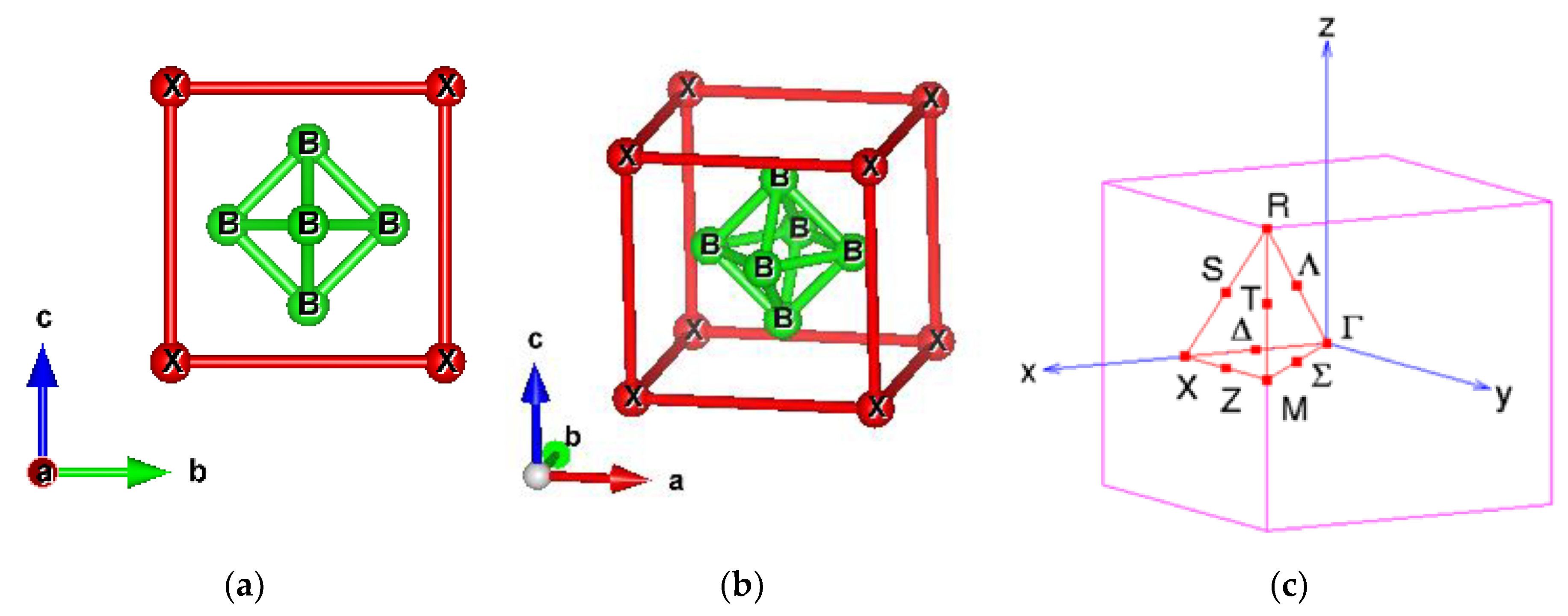
The rare earth hexaboride XB6 crystallizes in the CaB6-structure, as shown in Figure 1. Its lattice structure is similar to a body-centered cubic such as the CsCl-type lattice with Cs replaced by rare earth ions, and with Cl substituted by B6 octahedra. The variety of the physical properties observed in these compounds is intriguing. For example, the application of LaB6 has been paid attention due to its low work function, which is suitable for thermionic emission. LaB6 is metallic and becomes superconducting at TC = 0.45 K [8]. CeB6 is considered as a Kondo system. CeB6 presents an antiferro-quadrupolar ordering in the paramagnetic phase between Tq = 3.3 K (quadrupolar ordering temperature) and TN = 2.4 K (Neel’s Temperature) [9,10]. PrB6 has been confirmed that negative quadrupolar pair interactions exist in the paramagnetic phase (TN = 6.9 K) [11]. NdB6 is a localized 4f system that orders ferro-magnetically at low temperatures [12]. SmB6 is a well-known topological Kondo insulator [1,13,14]. EuB6 orders ferro-magnetically below 15.1 K with a huge decrease of resistivity and a significant blue shift of the reflectivity plasma edge [15,16,17]. At 12.7 K, another phase transition takes place, which is observed as a broad peak in the specific heat or an anomaly in the resistivity [18]. GdB6 is a localized 4f system with a ferromagnetic order at low temperatures [19]. YbB6 is a topology Kondo insulator at low temperatures, and is a classical mixed valence narrow band gap semiconductor [1,20,21]. Structural studies are also presented in Ref. [22,23]. As reported in Ref. [1], the topological phase of YbB6 is sensitive to the Hubbard U value. As U increases, YbB6 transforms from topological Kondo insulator to trivial insulator, showing the weak robustness of the topological phase of YbB6 against U.
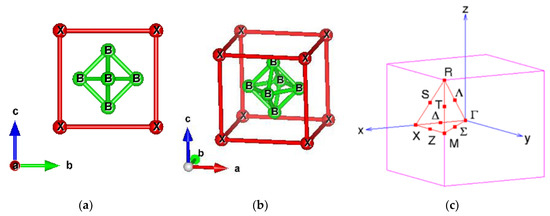
Figure 1.
CsCl-type cubic crystal structure and Brillouin Zone of rare-earth hexaboride XB6. (a) Side view. (b) Oblique view. (c) Brillouin Zone and high symmetry k-points.
In this study, the lattice structures of rare-earth hexaboride (XB6, X = La, Ce, Pr, Nd, Pm, Sm, Eu) are fully optimized through first-principles calculations. We then perform self-consistent field electronic structure calculations with and without SOI. To reveal the topological phases, we analyze if SOI would open up a continuous energy gap at the Fermi level with band inversion around the energy gap. To examine the robustness of the topological phase upon the strong correlation in XB6, we trace the evolution of its electronic structure by tuning the on-site U of the f electrons. We demonstrate that besides SmB6, PmB6, NdB6 and EuB6 are also topologically nontrivial compounds, while the others are topologically trivial normal metals.
2. Computational Details
First-principles calculations were performed using the Vienna Ab initio Simulation Package (VASP) with the Perdew-Burke-Ernzerhof (PBE) exchange-correlation functional used in the generalized gradient approximation (GGA) as well as the GGA plus Hubbard U (GGA + U) schemes [24,25,26,27] based on density functional theory (DFT). The cut-off energy of 500 eV was adopted for the plane-wave basis. A Γ-centered 15 × 15 × 15 k-mesh was used in geometry optimization and self-consistent field calculations. The geometry optimization converged until all residual forces remained below 0.01 eV/Å. Table 1 compares the experimental lattice parameters of rare-earth hexaboride with our geometrically optimized ones. Good agreement between experimental and theoretical results can be found with deviations, in general, of less than 1%.

Table 1.
Experimental (exp) and theoretical (the) lattice parameters. The rare-earth hexaboride crystalizes in a bcc-like structure with space group of (No. 221), in which metal ions are located at the Wyckoff position 1a(0,0,0) and octahedral B6 at the Wyckoff position 6f (1/2,1/2,z). The subscripts “exp” and “the” indicate experimental and theoretical results, respectively.
3. Results and Discussion
3.1. Topologically Trivial Normal Metal LaB6, CeB6, and PrB6
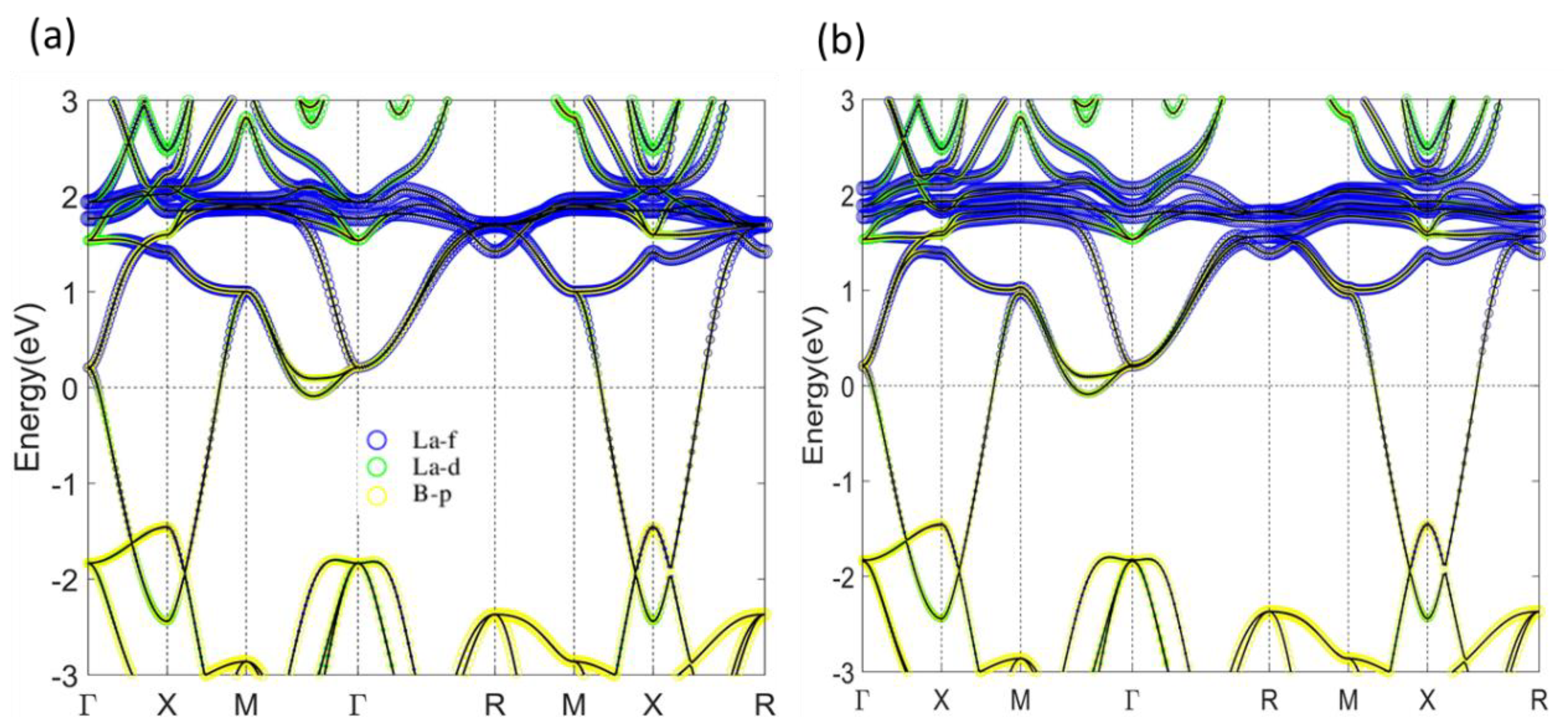
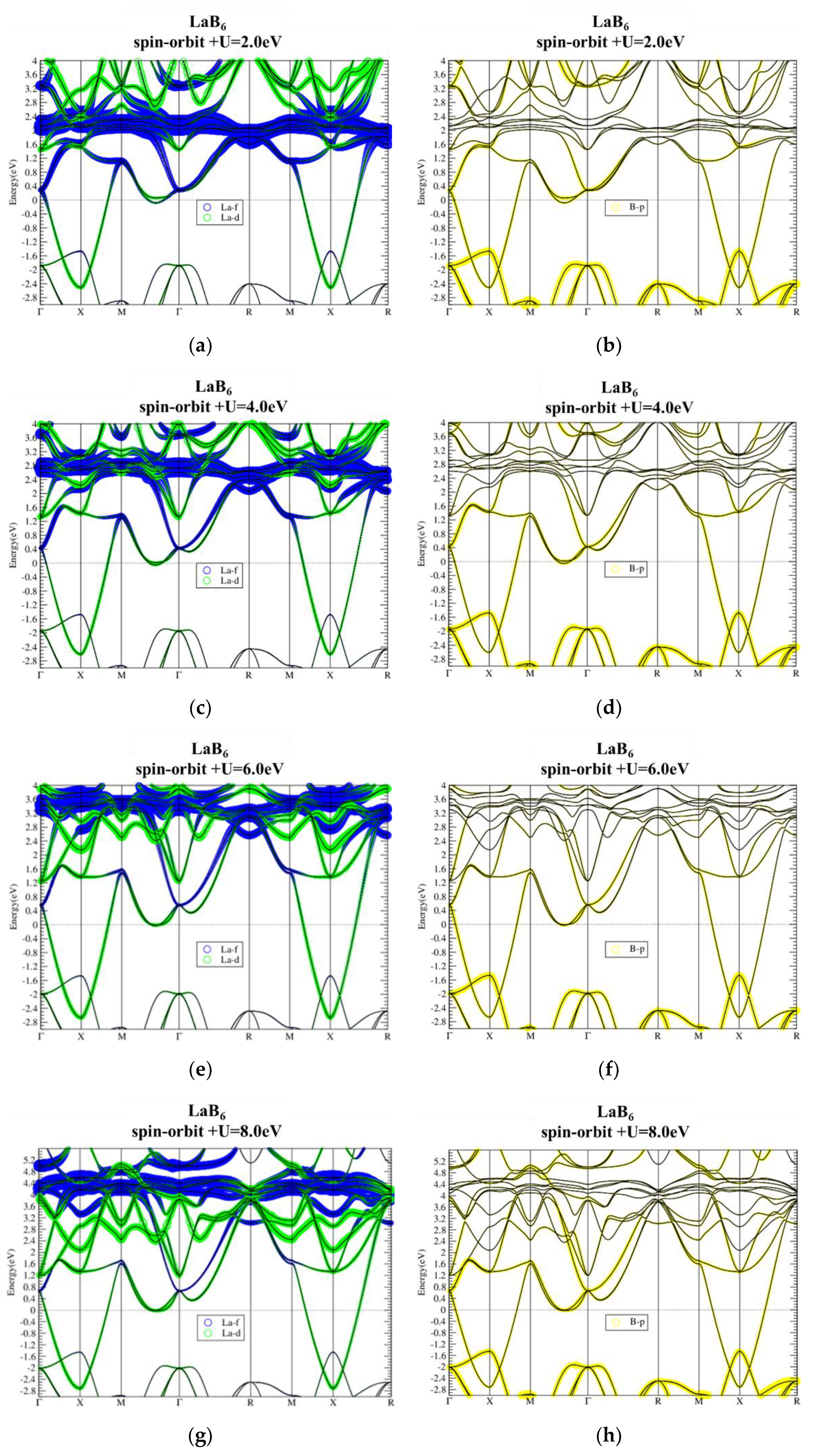
Figure 2a,b show the PBE band structures of LaB6 without and with SOI, respectively. The atom-orbital decomposition demonstrates that the valence bands below −1.5 eV are mainly composed of B-p orbital, while the conduction La-f bands (blue curves) are located mainly from 0.5 eV to 2.5 eV above the Fermi level (Ef). In between, there is a dispersive band composed of La-d orbital connecting the valence and conduction bands, resulting in an overall semimetal character. This in-gap La-d band also gives an electron pocket at Ef along ΓM. A comparison of band structures without SOI (a) and with SOI (b) shows that the SOI in LaB6 is weak and has no significant effect on band structure. Consequently, the semimetal character remains as SOI is included. Without any continuous gap, LaB6 is therefore a topologically trivial normal metal. On the other hand, the band structures remain more or less the same when the on-site Coulomb repulsion U is taken into account for the strong correlation in f orbitals, as can be seen in Figure 3. This constitutes preassembly, owing to the empty f states that have no effect near Ef.
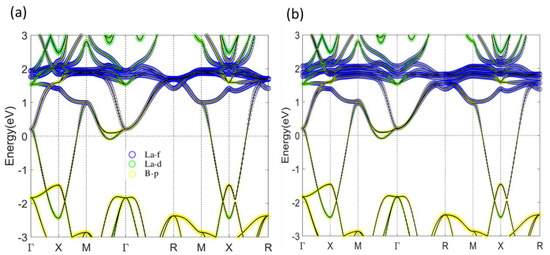
Figure 2.
Atom-orbital decomposed band structure of LaB6 calculated using Perdew–Burke–Ernzerhof (PBE) functional without spin–orbit interaction (SOI) (a) and with SOI (b). The size of blue, green and yellow circles indicates components from La-f, La-d and B-p orbitals, respectively.
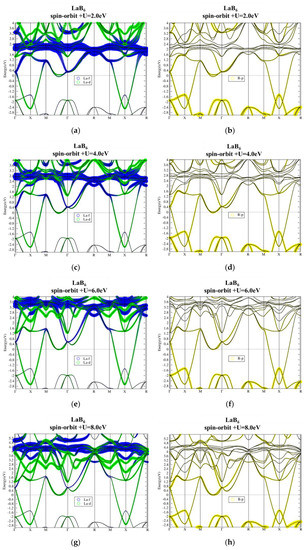
Figure 3.
Atom-orbital decomposed band structures of LaB6 with on-site U =2 eV (a,b), 4 eV (c,d), 6 eV (e,f), and 8 eV (g,h).
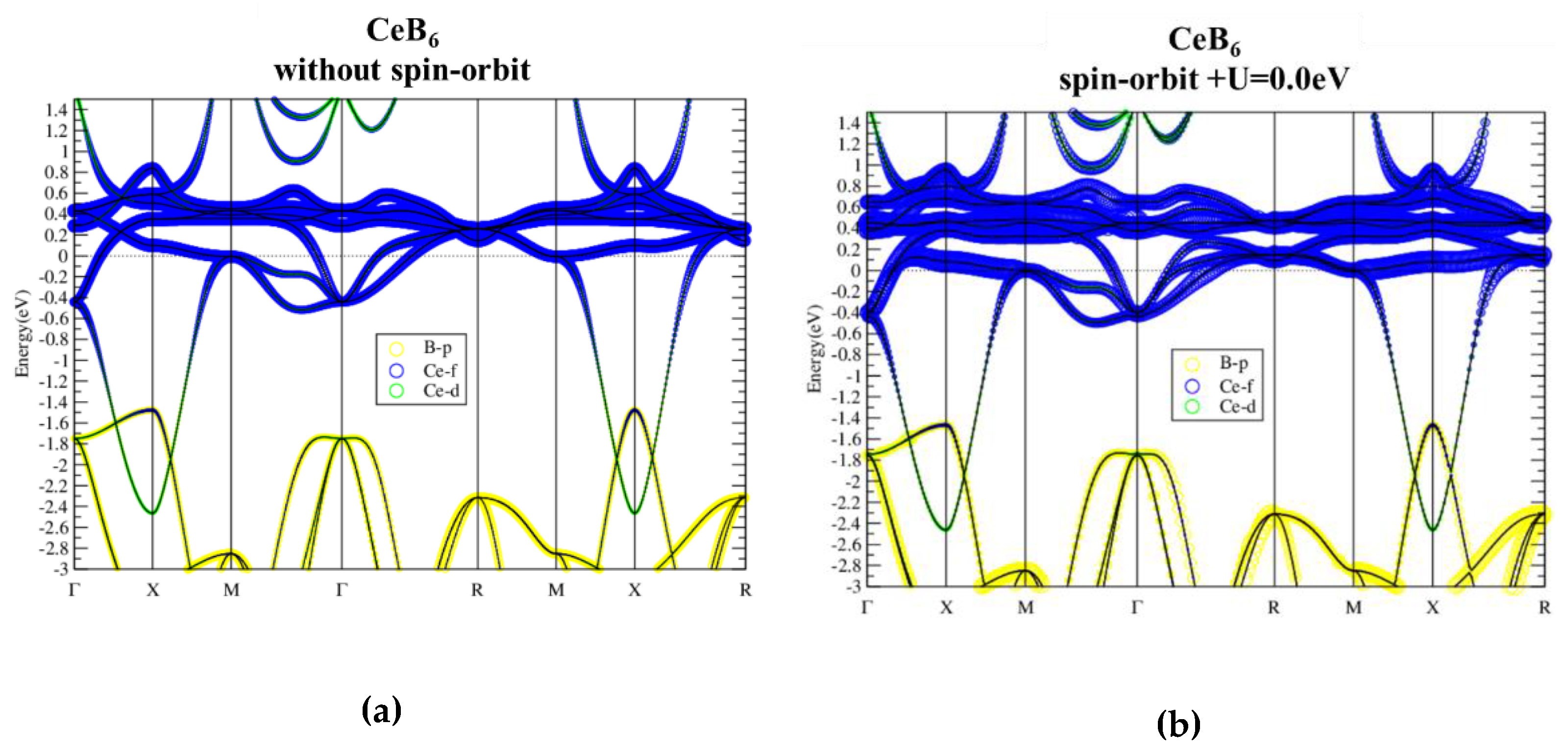
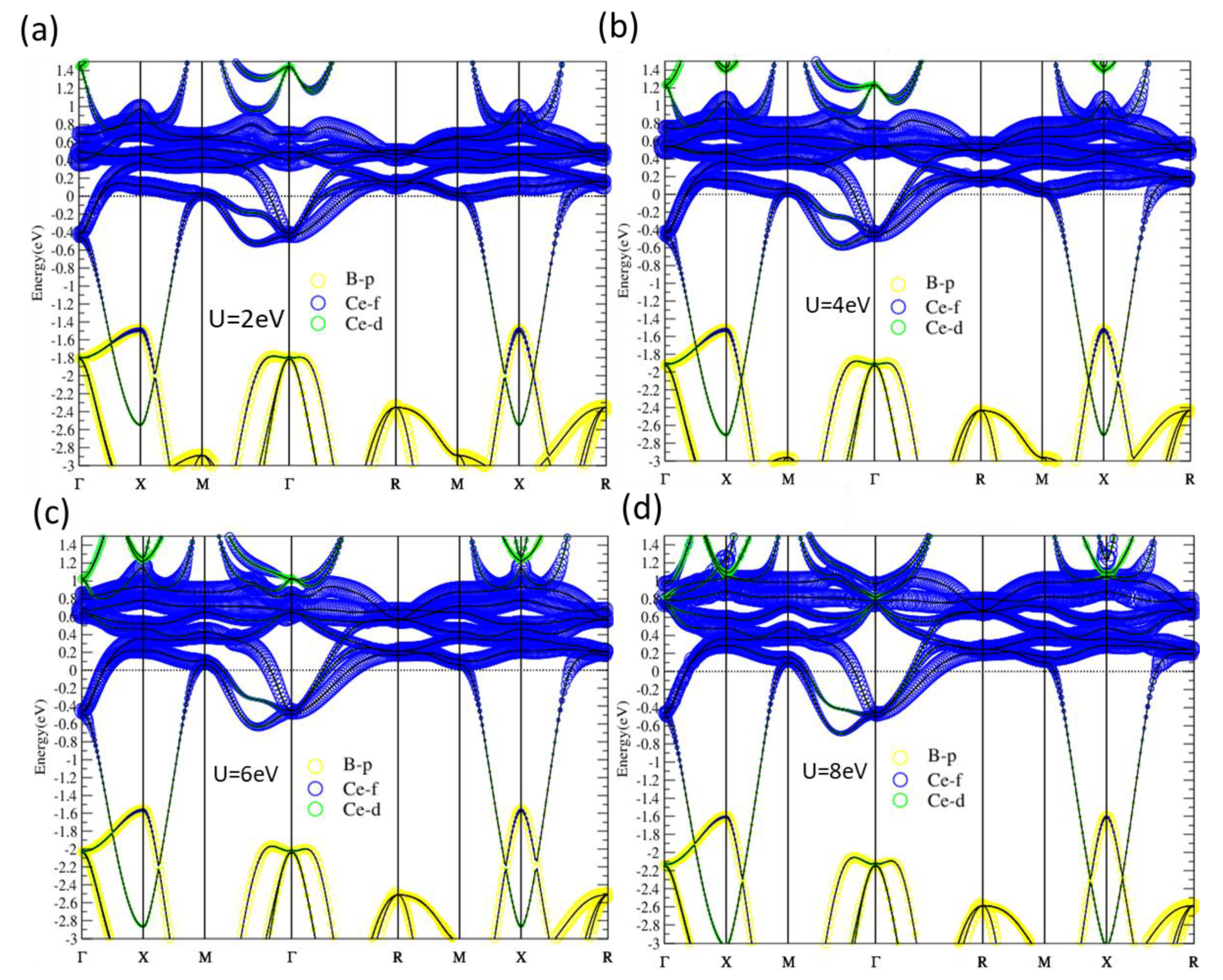
With one more electron than La, the Fermi level of CeB6 is thus raised up to the bottom of Ce-f bands, as shown in Figure 4. The flat Ce-f conduction bands are located around Ef from 0.6 eV below to 1.2 eV above Ef. As shown in Figure 5, for all the four cases with U = 2, 4, 6, 8 eV studied, there are no significant changes in band structures. Similar to LaB6, CeB6 is also insensitive to the on-site U values. Although the SOI is included in the calculations and the degeneracy at M is lifted by SOI, there is no continuous gap in all cases, leading to topologically trivial normal metal ground state for CeB6.
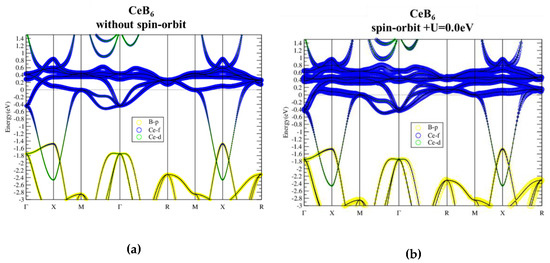
Figure 4.
Band structure of CeB6 without (a) and with (b) spin–orbit interaction.
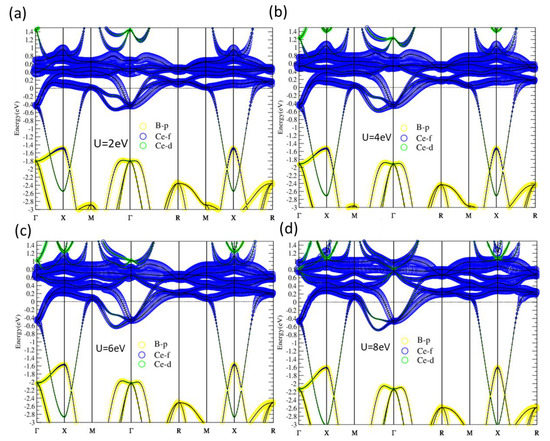
Figure 5.
(a–d) CeB6 band structures given from PBE + SOI + U with U = 2, 4, 6, 8 eV, respectively. The sizes of blue, green and yellow circles indicate components from Ce-f, Ce-d and B-p orbitals, respectively.
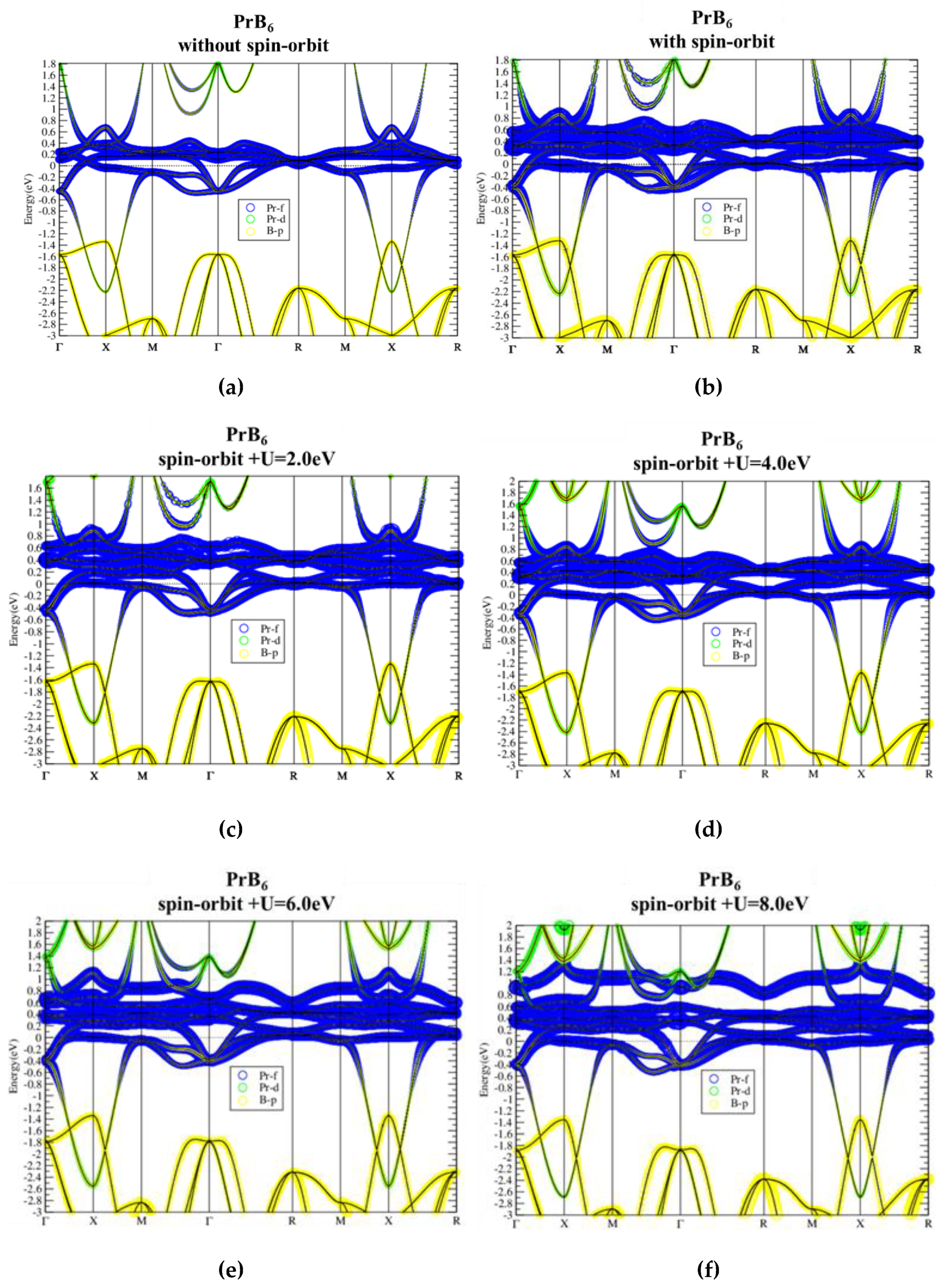
Elementary Pr has three electrons occupying the f-orbitals in the ground state. Therefore, in PrB6 the Pr-f conduction band is occupied by one more f electron than CeB6 through the rigid-band shift, as shown in Figure 6. The band dispersions remain similar with different on-site U values. However, because the Fermi level is raised to the middle of the Pr-f conduction band, on-site U affects the bandwidth more significantly than that in the previous two species. With U = 8.0 eV, the f bandwidth is enhanced by about 0.5 eV. On the other hand, gapless ground state remains in PrB6 even when the SOI is taken into consideration. Consequently, the same as LaB6 and CeB6, PrB6 is also a topologically trivial normal metal.
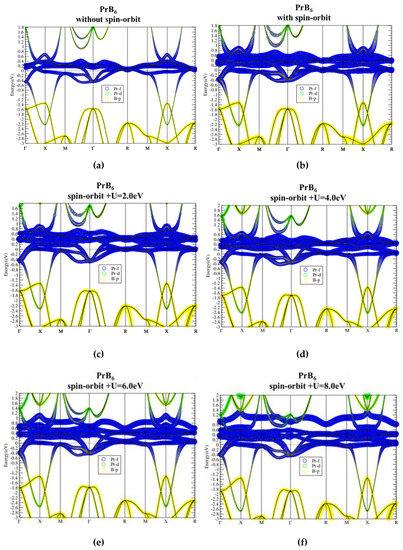
Figure 6.
PrB6 band structure without (a) and with (b) spin–orbit interaction (noted in the figures), and with spin–orbit interaction plus on-site U = 2, 4, 6, 8 eV (c–f, respectively) as noted in the figures.
3.2. Topologically Nontrivial Kondo Insulator SmB6, PmB6, NdB6 and EuB6
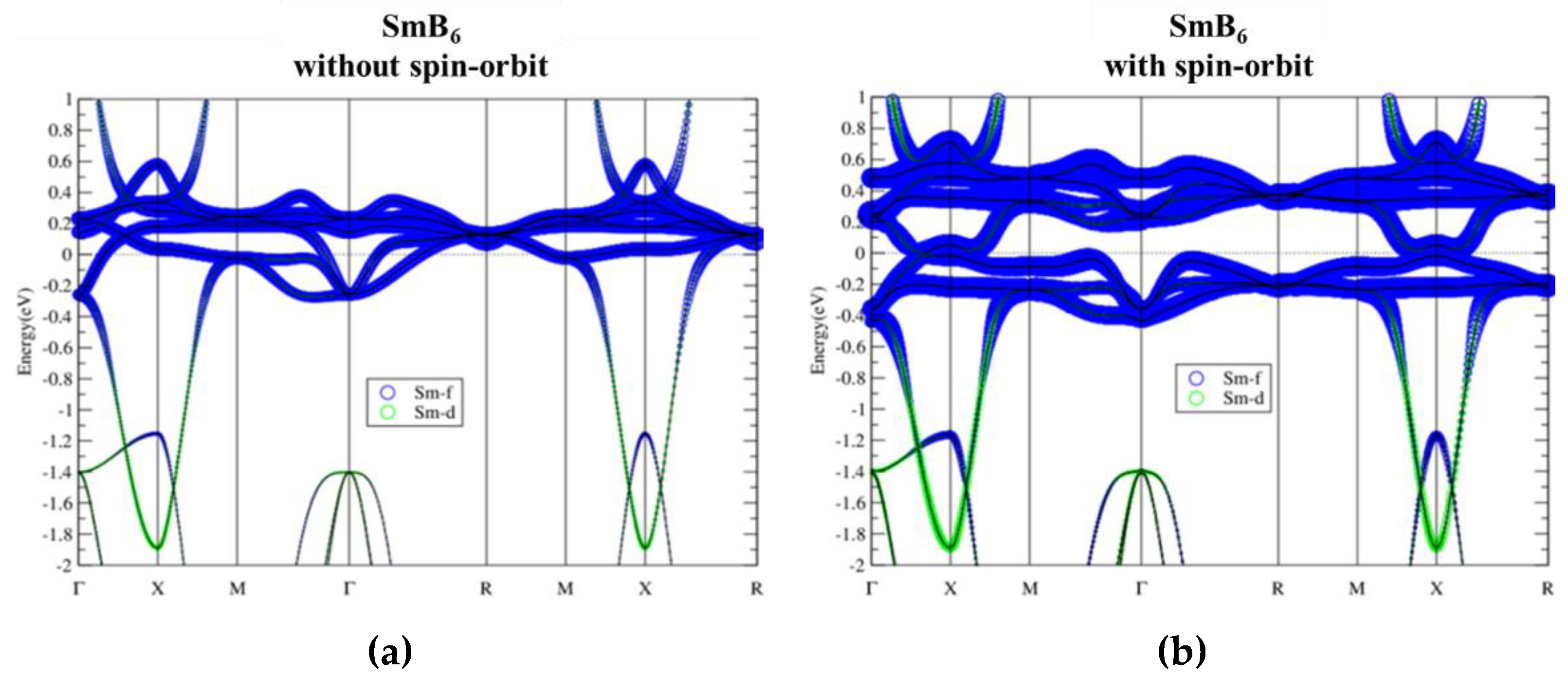
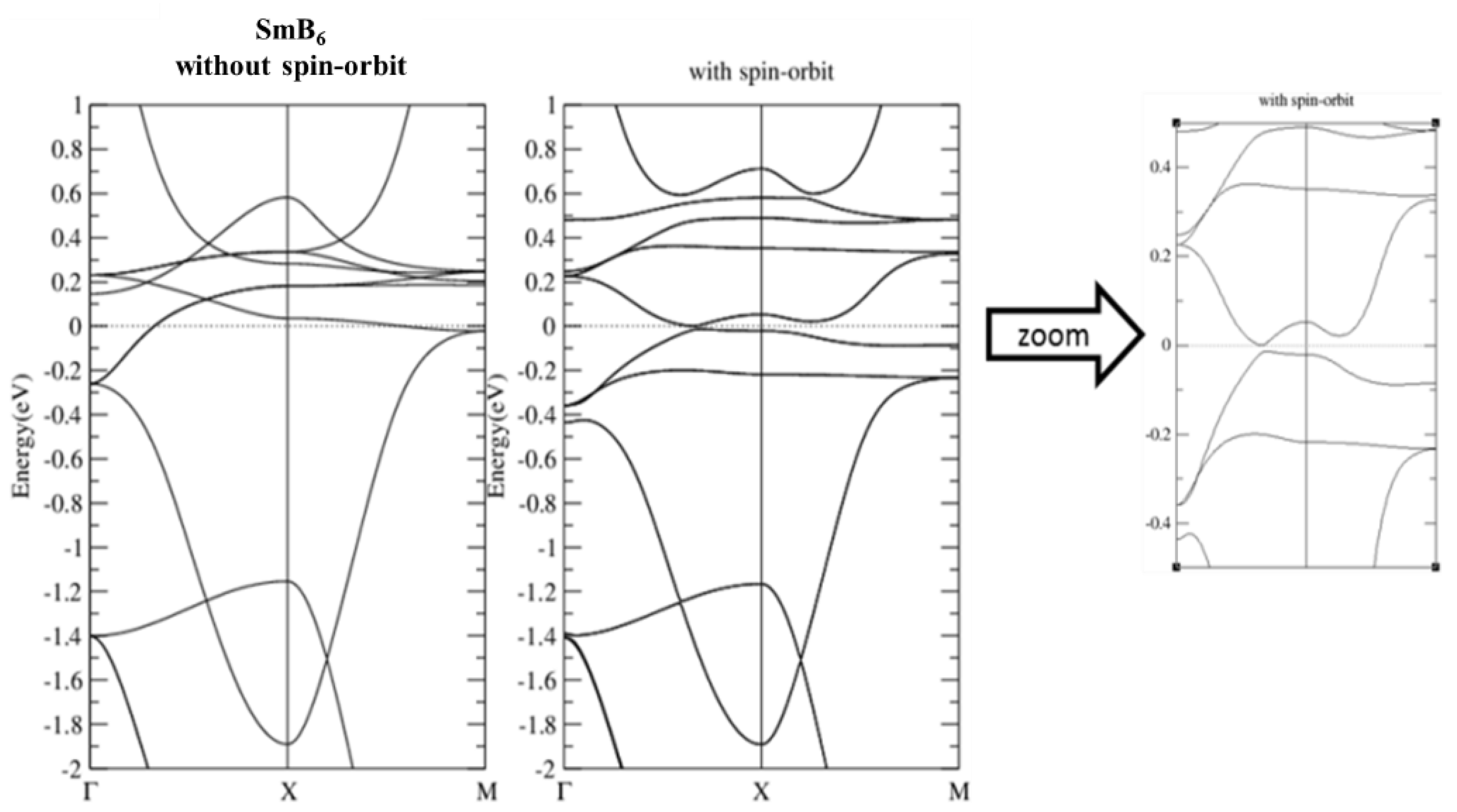
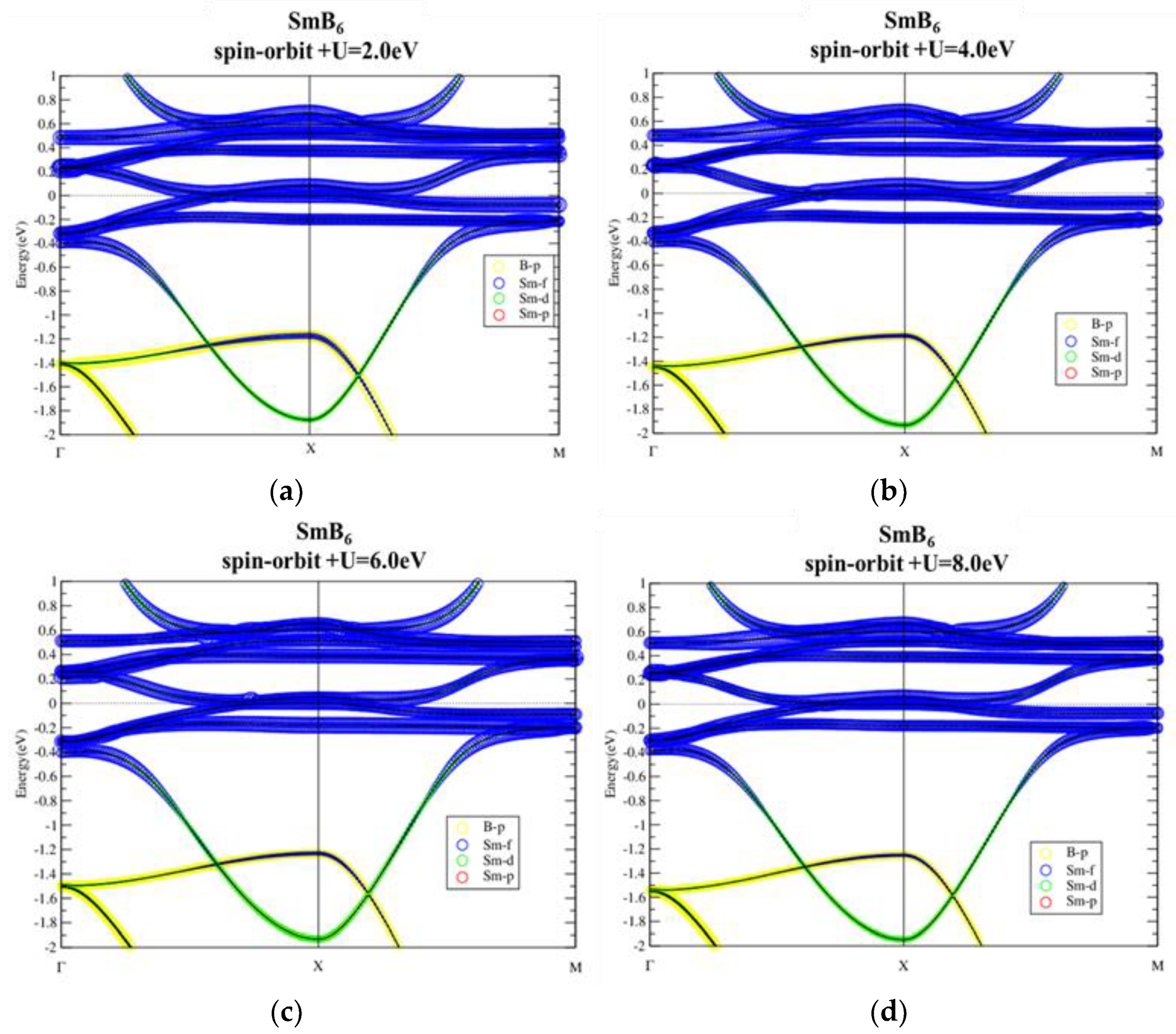
Figure 7 shows our calculated band structures of the well-known topological Kondo insulator. The relatively flat La-f bands locate around Ef, with a much more dispersive La-d band crossing all these f bands. The spin–orbit interaction splits the f bands and opens up a continuous energy gap (see Figure 8) with band inversion between Sm-f/d characters flipping around the SOI-induced gap. These results agree well with those presented in previous works [1]. Band structures of SmB6 with SOI and on-site U ranging from 2 to 8 eV are shown in Figure 9. There are no significant changes in band structures due to all the different U values used. Similar to previous study, the SOI-induced band gap and the band inversion behavior remain, indicating the robust topological phase against strong correlations in SmB6.
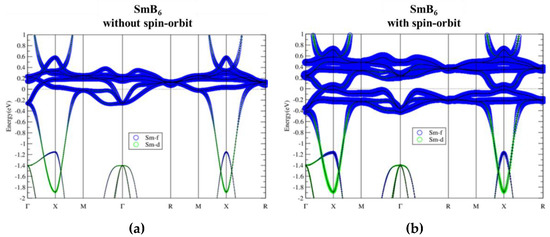
Figure 7.
Band structures of SmB6 without (a) and with (b) spin-orbit interaction projected by f and d electrons of Sm.
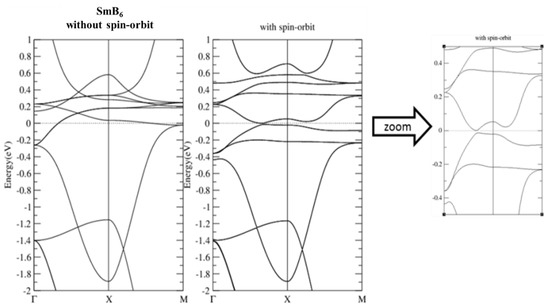
Figure 8.
Band structure of SmB6 without and with spin-orbit coupling. The right panel is the zoom-in view of the middle panel around Ef.
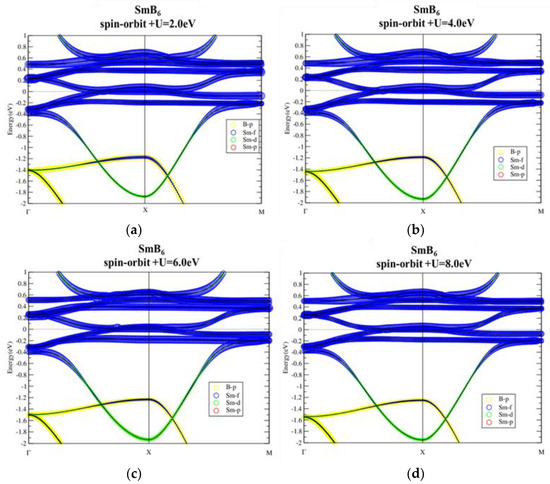
Figure 9.
Band structures of SmB6 with spin–orbit interaction using on-site U = 2.0, 4.0, 6.0, and 8.0 eV (a–d, respectively) projected by f and d electrons of Sm.
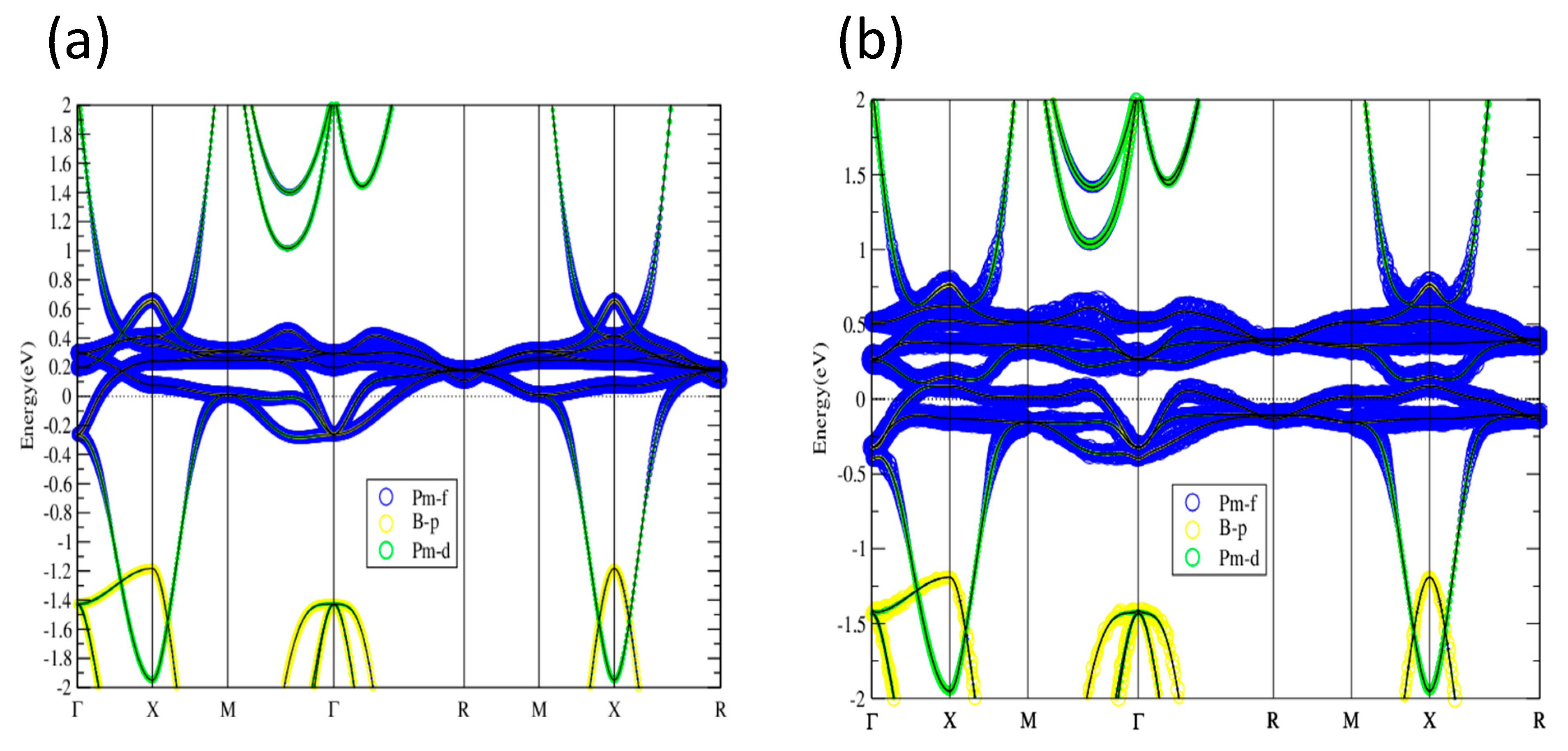
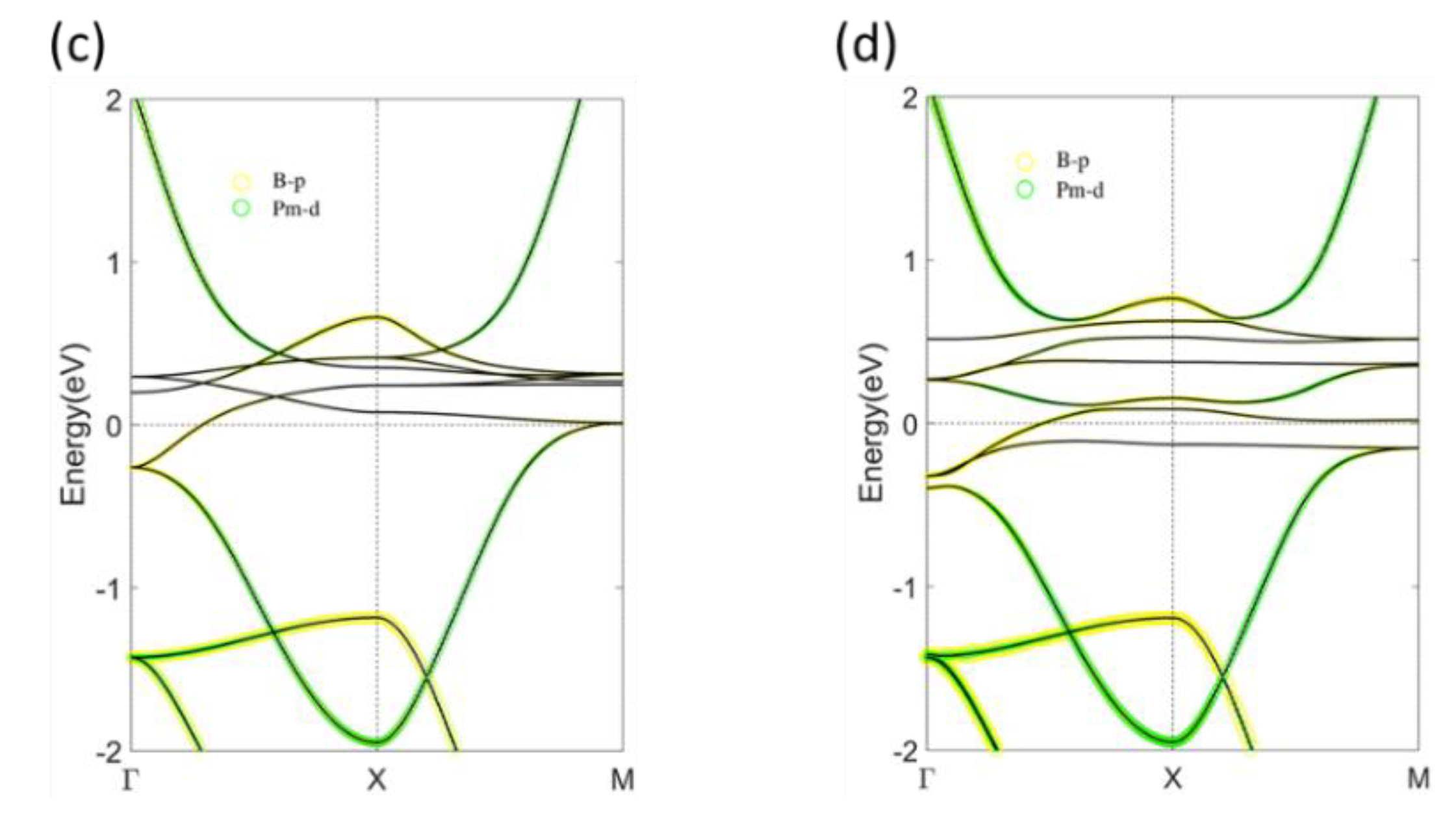
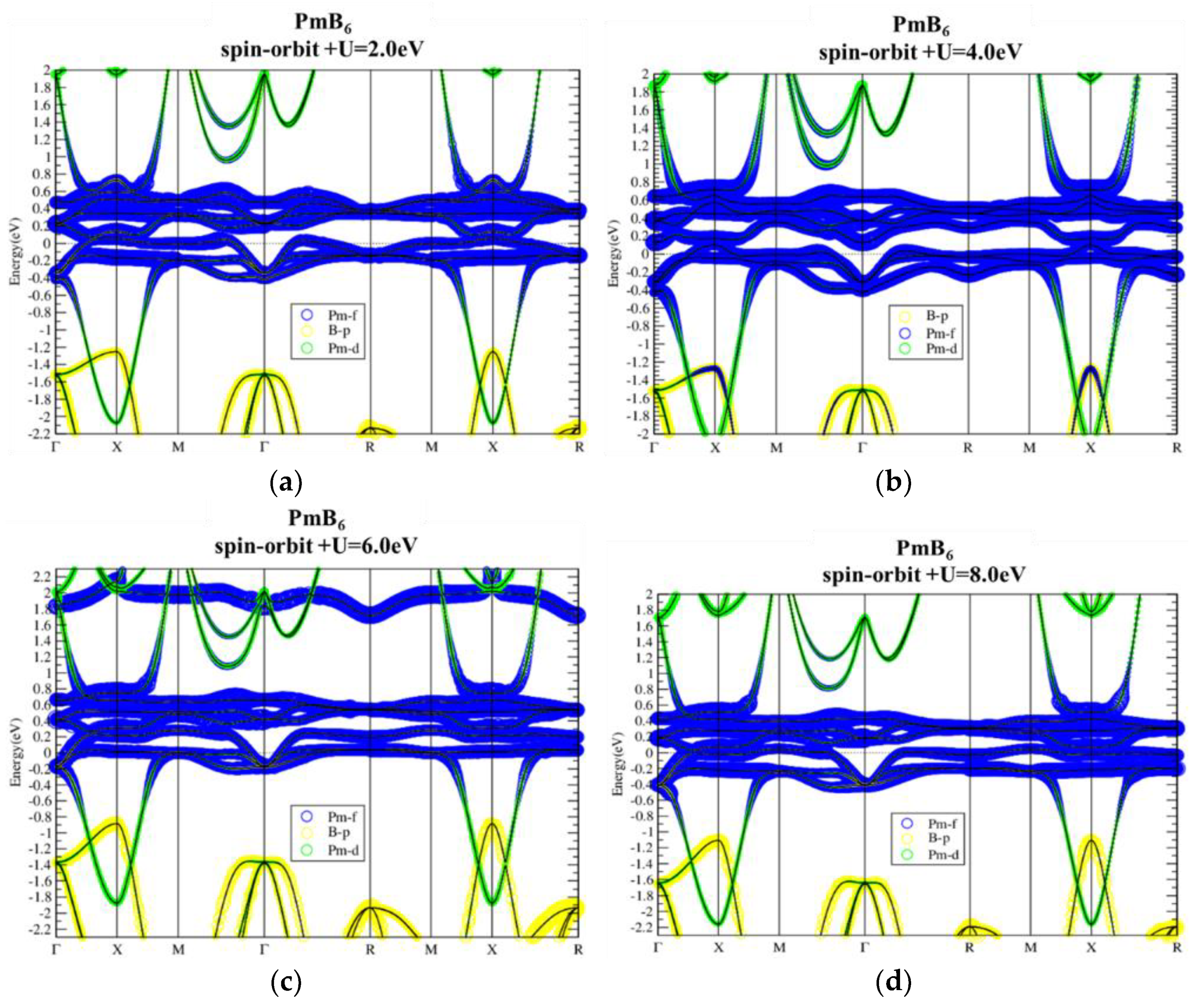
In comparison with the well-known topological Kondo insulator SmB6, the overall band dispersion of PmB6 as shown in Figure 10 is similar to those of SmB6 (Figure 7, Figure 8 and Figure 9). Since PmB6 has one less valence electron than SmB6, the Fermi level of PmB6 is relatively lower than that of SmB6. With SOI taken into consideration, PmB6 opens up a continuous gap around Ef, as shown in Figure 10b,d. In addition, there is a band inversion around X point with B-p and Pm-d components exchanged near Ef. Therefore, PmB6 can host topological nontrivial state, giving rise to the topological Kondo insulator similar to SmB6. The electronic structure of PmB6 around Ef is not sensitive to various U values, as shown in Figure 11. On-site U only affects the highest empty f-band without influencing the overall topological properties, indicating the topological phase is robust in PmB6 against strong correlations.
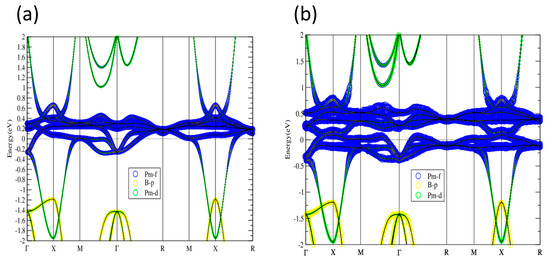
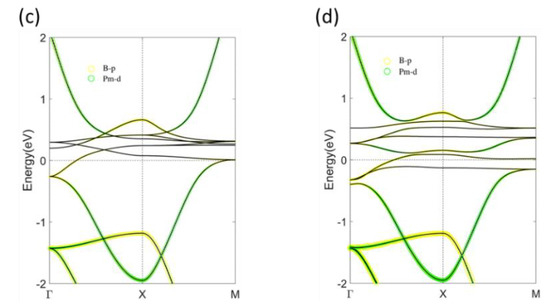
Figure 10.
PBE band structure of PmB6 without SOI (a) and with SOI (b). The size of blue, green and yellow circles show contributions from Pm-f, Pm-d and B-p orbitals, respectively. (c) Zoom-in of (a). (d) Zoom-in of (b). (c,d) demonstrate SOI-induced band inversion and gap opening.
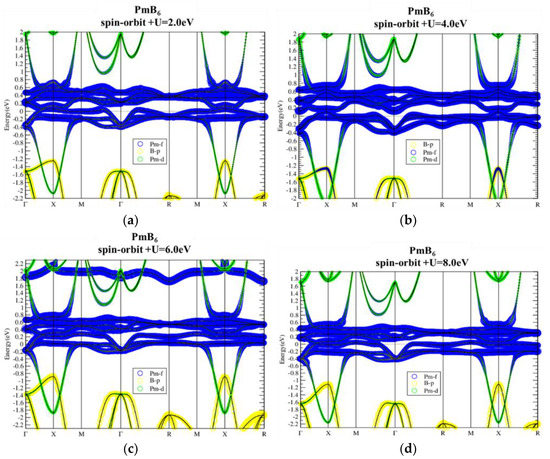
Figure 11.
Band structures of PmB6 with SOI and U = 2, 4, 6, 8 eV (a–d, respectively). As U is tuned larger, the highest f band is lifted but the band property is not changed near the Fermi level.
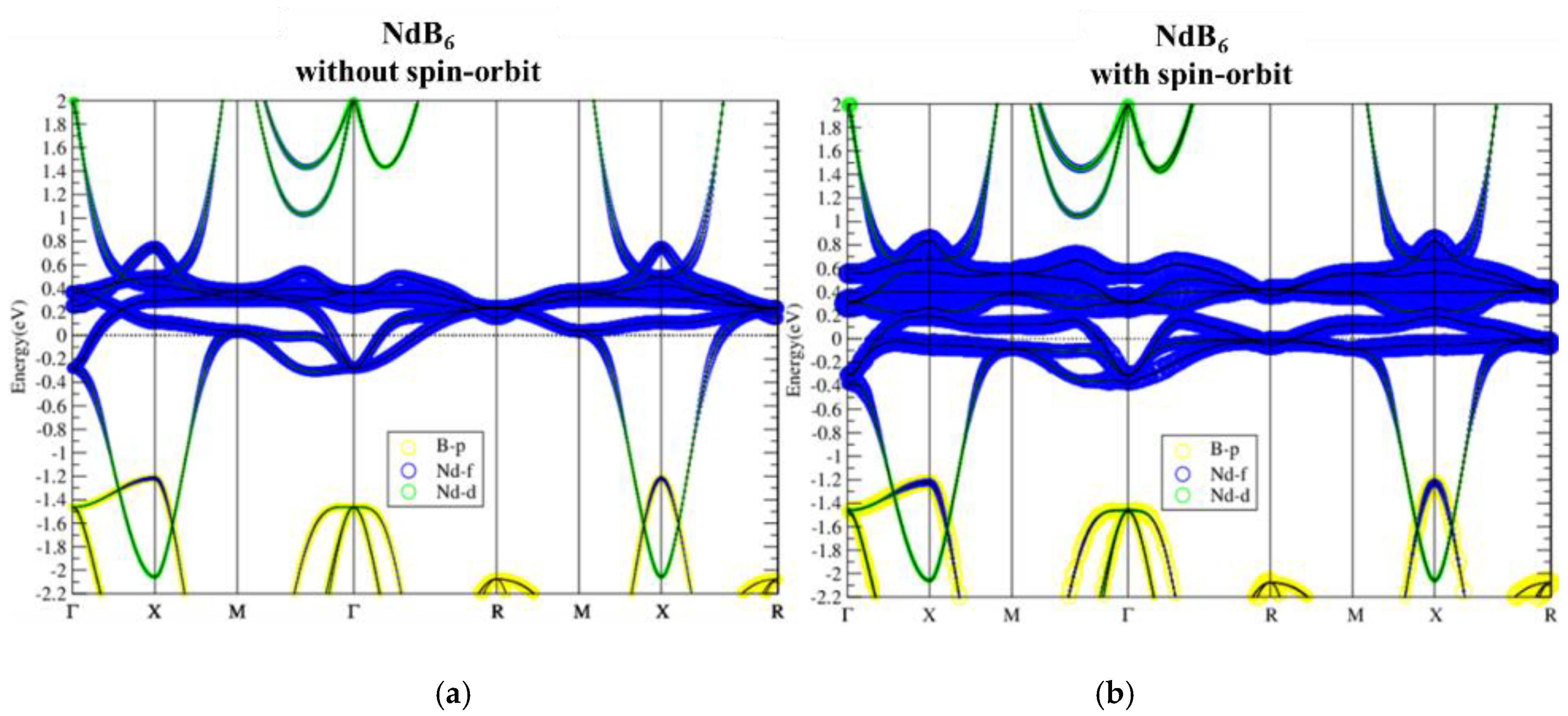
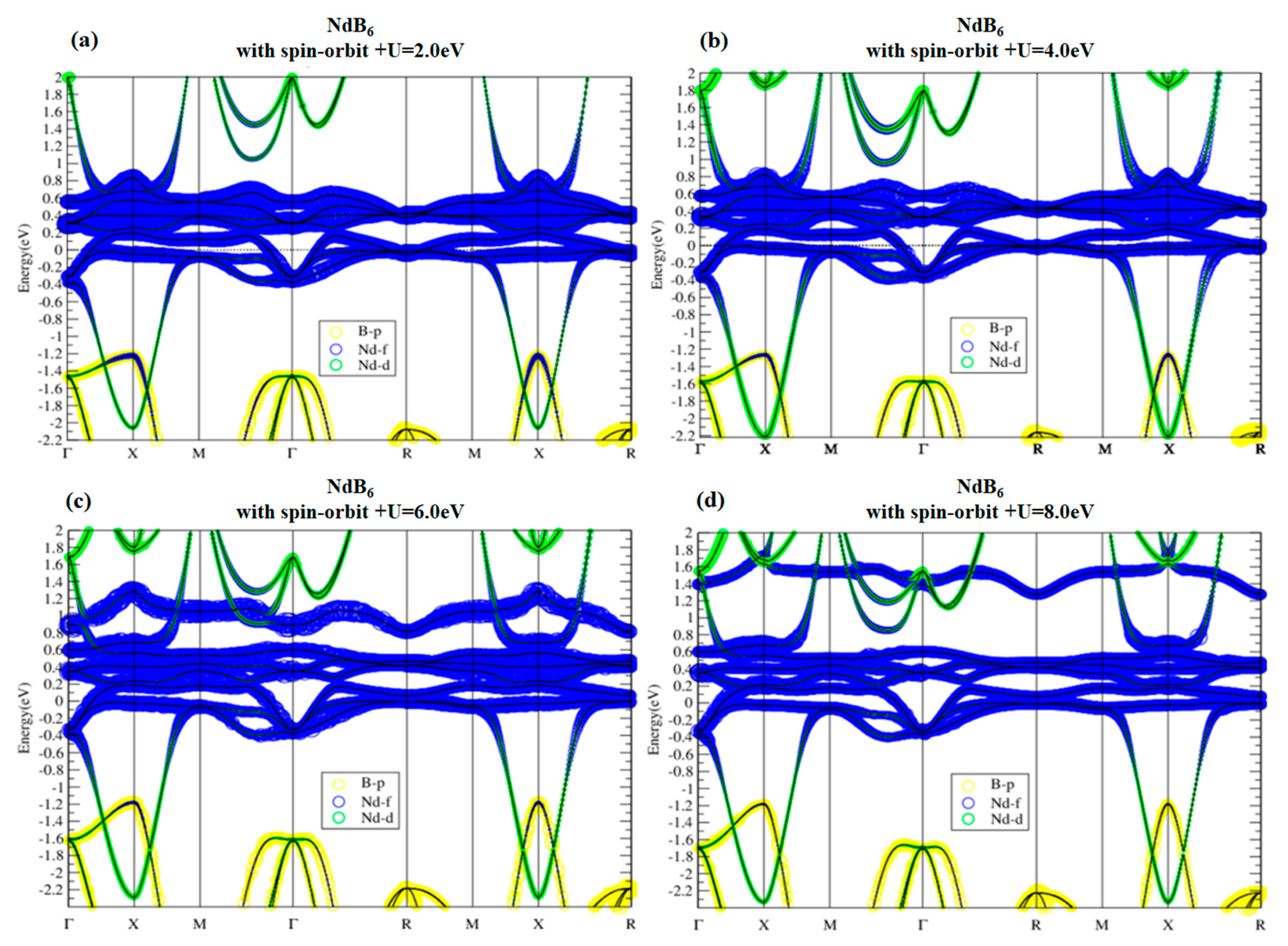
Band structures of NdB6 as shown in Figure 12 also demonstrate topologically nontrivial phase. The SOI not only opens up a continuous energy gap around Ef but also gives rise to band inversion around X point. Similar to PmB6, the electronic structure and topological behavior of NdB6 near the Fermi level are insensitive to on-site U value, as can be seen in Figure 13. Only the highest unoccupied f band is noticeably modified by U, which is irrelevant to its topology. Consequently, NdB6 is also a topological Kondo insulator.
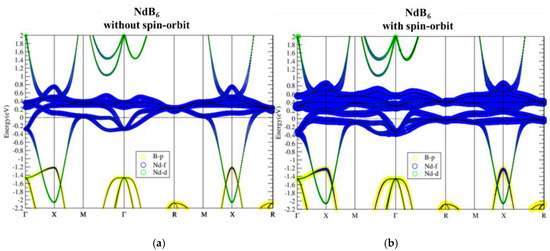
Figure 12.
Band structures of NdB6 without (a) and with (b) spin-orbit interaction.
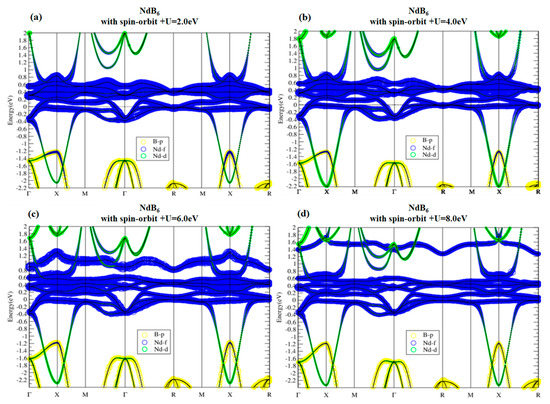
Figure 13.
Band structures of NdB6 with SOI using U = 2, 4, 6, and 8 eV (a–d, respectively). As U is tuned larger, the highest f band is lifted but the band property is not changed near the Fermi level.
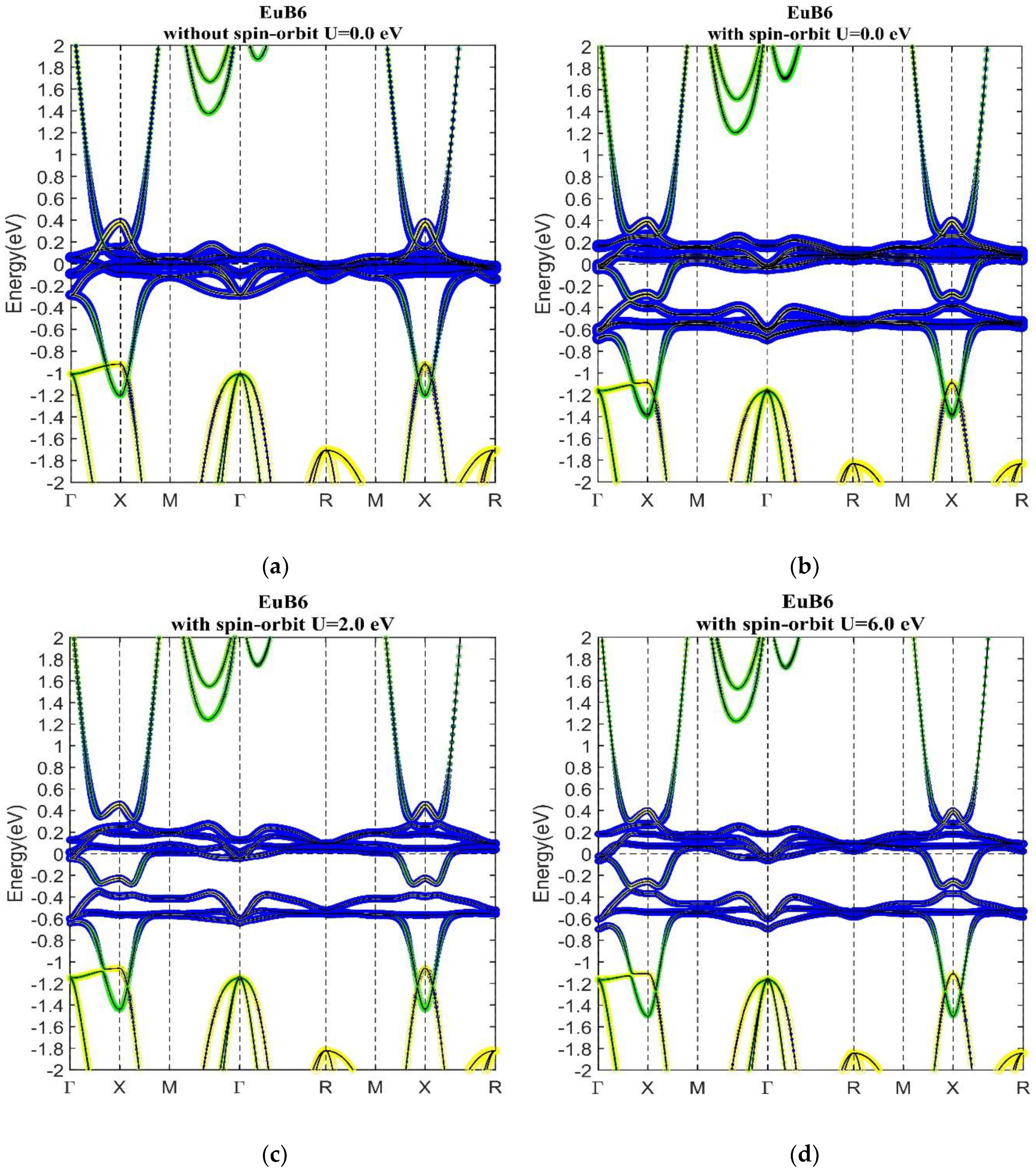
Figure 14 shows PBE (U = 0 eV) band structures of EuB6 without and with SOI as well as PBE + U band structures with U = 2 eV and 6 eV. As can be seen in Figure 14a, the f bands are located at Ef with a localized flat band character. In the periodic table, Eu is the neighbor of Sm with one more electron. The additional electron raises the Fermi level of EuB6 near the half-filling metallic regime. When SOI is included, the f bands separate themselves into two groups with an SOI-induced continuous gap in between. Furthermore, band inversion emerges around the high symmetry point X. As a result, EuB6 exhibits nontrivial topological phase similar to SmB6. The band structure of EuB6 is not sensitive to U, as shown in Figure 14b–d, with U = 0–6 eV, leading EuB6 to robust topological Kondo insulator against strong correlations.
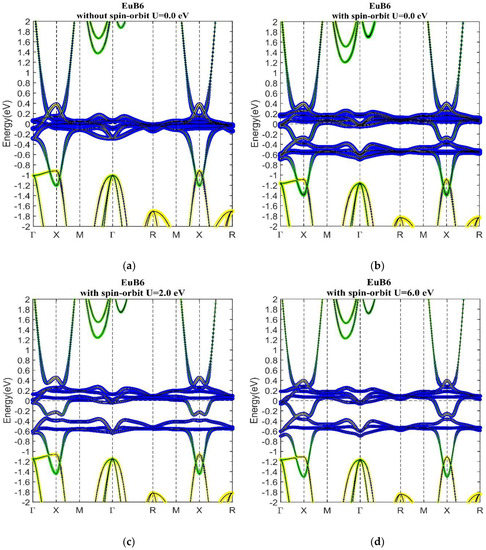
Figure 14.
PBE band structure of EuB6 without SOI (a) and with SOI (b). SOI opens up an energy gap around Ef and induces band inversion around X point. PBE + U band structure of EuB6 with on-site U = 2.0 eV (c) and U = 6.0 eV (d). Similar to SmB6, the Hubbard U does not change the band structure noticeably.
4. Conclusions
We have systematically analyzed the electronic structures of rare-earth hexaborides to investigate their topological properties and examine the robustness of the topological phase against strong correlations by varying the Coulomb repulsion U. SmB6 is a topological Kondo insulator due to the hybridization gap, and it will not experience topological phase transition by tuning the Coulomb interaction. YbB6, which has a hybridization gap, on the contrary, will experience a topology phase transition from a topological Kondo insulator to a topological insulator, and finally become a trivial insulator. Our results of SmB6 and YbB6 are in good agreement with previous results [1]. Our study also shows that PmB6, NdB6, EuB6 and SmB6 exhibit SOI-induced continuous gaps with band inversion, revealing nontrivial topological properties. On the other hand, the weaker SOI in relatively lighter. Lanthanides La, Ce and Pr fail to open up a continuous gap in LaB6, CeB6 and PrB6. Thus LaB6, CeB6 and PrB6 are topologically trivial normal metals with correlated conduction electrons.
Author Contributions
S.-H.H. performed first-principles calculations and wrote the manuscript. H.-T.J. conducted the project and reviewed the manuscript. All authors have read and agreed to the published version of the manuscript.
Funding
This research received no external funding.
Acknowledgments
This work was funded by the Ministry of Science and Technology, Taiwan (grant number MOST 106-2112-M-007-012-MY3). The authors also thank support from NCHC, CINCNTU, AS-iMATE-109-13 and CQT-NTHU-MOE, Taiwan.
Conflicts of Interest
There are no conflicts of interest to declare.
References
- Chang, T.-R.; Das, T.; Chen, P.-J.; Neupane, M.; Xu, S.-Y.; Hasan, M.Z.; Lin, H.; Jeng, H.-T.; Bansil, A. Two distinct topological phases in the mixed-valence compound YbB6 and its differences from SmB6. Phys. Rev. B 2015, 91, 155151. [Google Scholar] [CrossRef]
- Weng, H.; Dai, X.; Fang, Z. Topological semimetals predicted from first-principles calculations. J. Phys. Condens. Matter 2016, 28, 303001. [Google Scholar] [CrossRef] [PubMed]
- Kane, C.L.; Mele, E.J. Z2 topological order and the quantum spin hall effect. Phys. Rev. Lett. 2005, 95, 146802. [Google Scholar] [CrossRef] [PubMed]
- Hasan, M.Z.; Kane, C.L. Colloquim: Topological insulators. Rev. Mod. Phys. 2010, 82, 3045. [Google Scholar] [CrossRef]
- Moore, J.E. The birth of topological insulators. Nature 2010, 464, 194–198. [Google Scholar] [CrossRef]
- Qi, X.-L.; Zhang, S.-C. Topological insulators and superconductors. Rev. Mod. Phys. 2011, 83, 1057–1110. [Google Scholar] [CrossRef]
- Fu, L.; Kane, C.L. Topological insulators with inversion symmetry. Phys. Rev. B 2007, 76, 045302. [Google Scholar] [CrossRef]
- Schell, G.; Winter, H.; Rietschel, H.; Gompf, F. Electronic structure and superconductivity in metal hexaborides. Phys. Rev. B 1982, 25, 1589–1599. [Google Scholar] [CrossRef]
- Demishev, S.V.; Semeno, A.; Bogach, A.; Paderno, Y.; Shitsevalova, N.; Sluchanko, N. Antiferro-quadrupole resonance in CeB6. Phys. B Condens. Matter 2006, 378–380, 602–603. [Google Scholar] [CrossRef][Green Version]
- Barman, C.K.; Singh, P.; Johnson, D.D.; Alam, A. Revealing the nature of antiferroquadrupolar ordering in cerium hexaboride: CeB6. Phys. Rev. Lett. 2019, 122, 076401. [Google Scholar] [CrossRef]
- Morin, P.; Kunii, S.; Kasuya, T. Quadrupolar properties and magnetic phase diagrams in PrB6 hexaboride compound. J. Magn. Magn. Mater. 1991, 96, 145–154. [Google Scholar] [CrossRef]
- Matthias, B.T.; Geballe, T.H.; Andres, K.; Corenzwit, E.; Hull, G.W.; Maita, J.P. Superconductivity and antiferromagnetism in boron-rich lattices. Science 1968, 159, 530. [Google Scholar] [CrossRef] [PubMed]
- Wolgast, S.; Kurdak, Ç.; Sun, K.; Allen, J.W.; Kim, D.-J.; Fisk, Z. Low-temperature surface conduction in the Kondo insulator SmB6. Phys. Rev. B 2013, 88, 180405. [Google Scholar] [CrossRef]
- Zhang, X.; Butch, N.; Syers, P.; Ziemak, S.; Greene, R.L.; Paglione, J. Hybridization, inter-ion correlation, and surface states in the kondo insulator SmB6. Phys. Rev. X 2013, 3, 011011. [Google Scholar] [CrossRef]
- Booth, C.H.; Sarrao, J.L.; Hundley, M.F.; Cornelius, A.L.; Kwei, G.H.; Bianchi, A.; Fisk, Z.; Lawrence, J.M. Local and average crystal structure and displacements of La11B6 and EuB6 as a function of temperature. Phys. Rev. B 2001, 63, 224302. [Google Scholar] [CrossRef]
- Pickard, C.J.; Winkler, B.; Chen, R.K.; Payne, M.C.; Lee, M.H.; Lin, J.S.; White, J.A.; Milman, V.; Vanderbilt, D. Structural properties of lanthanide and actinide compounds within the plane wave pseudopotential approach. Phys. Rev. Lett. 2000, 85, 5122. [Google Scholar] [CrossRef] [PubMed]
- Degiorgi, L.; Felder, E.; Ott, H.R.; Sarrao, J.L.; Fisk, Z. Low-temperature anomalies and ferromagnetism of EuB6. Phys. Rev. Lett. 1997, 79, 5134–5137. [Google Scholar] [CrossRef]
- Süllow, S.; Prasad, I.; Aronson, M.C.; Bogdanovich, S.; Sarrao, J.L.; Fisk, Z. Metallization and magnetic order inEuB6. Phys. Rev. B 2000, 62, 11626–11632. [Google Scholar] [CrossRef]
- Kunii, S.; Takeuchi, K.; Oguro, I.; Sugiyama, K.; Ohya, A.; Yamada, M.; Koyoshi, Y.; Date, M.; Kasuya, T. Electronic and magnetic properties of GdB6. J. Magn. Magn. Mater. 1985, 52, 275–278. [Google Scholar] [CrossRef]
- Weng, H.; Zhao, J.; Wang, Z.; Fang, Z.; Dai, X. Topological crystalline kondo insulator in mixed valence ytterbium borides. Phys. Rev. Lett. 2014, 112, 016403. [Google Scholar] [CrossRef]
- Xia, M.; Jiang, J.; Ye, Z.R.; Wang, Y.H.; Zhang, Y.; Chen, S.D.; Niu, X.H.; Xu, D.F.; Chen, F.; Chen, X.H.; et al. Angle-resolved photoemission spectroscopy study on the surface states of the correlated topological insulator YbB6. Sci. Rep. 2014, 4, srep05999. [Google Scholar] [CrossRef] [PubMed]
- Walker, H.C.; McEwen, K.A.; McMorrow, D.F.; Bleckmann, M.; Park, J.-G.; Lee, S.; Iga, F.; Mannix, D. X-ray resonant scattering study of the structural and magnetic transitions in PrB6. Phys. Rev. B 2009, 79, 054402. [Google Scholar] [CrossRef]
- Allen, A. Phase Diagrams 6-V: Materials Science and Technology; Elsevier: Amsterdam, The Netherlands, 2012. [Google Scholar]
- Kresse, G.; Hafner, J. Ab initio molecular-dynamics simulation of the liquid-metal-amorphous-semiconductor transition in germanium. Phys. Rev. B 1994, 49, 14251. [Google Scholar] [CrossRef] [PubMed]
- Kresse, G.; Furthmüller, J. Efficient iterative schemes for ab initio total-energy calculations using a plane-wave basis set. Phys. Rev. B 1996, 54, 11169–11186. [Google Scholar] [CrossRef]
- Blöchl, P.E. Projector augmented-wave method. Phys. Rev. B 1994, 50, 17953. [Google Scholar] [CrossRef]
- Perdew, J.P.; Burke, K.; Ernzerhof, M. Generalized gradient approximation made simple. Phys. Rev. Lett. 1996, 77, 3865–3868. [Google Scholar] [CrossRef] [PubMed]
- MacKinnon, I.D.; Alarco, J.A.; Talbot, P.C. Metal hexaborides with Sc, Ti or Mn. Model. Numer. Simul. Mater. Sci. 2013, 3, 158–169. [Google Scholar] [CrossRef][Green Version]
- Blomberg, M.; Merisalo, M.; Korsukova, M.; Gurin, V. Single-crystal X-ray diffraction study of NdB6, EuB6 and YbB6. J. Alloys Compd. 1995, 217, 123–127. [Google Scholar] [CrossRef]
© 2020 by the authors. Licensee MDPI, Basel, Switzerland. This article is an open access article distributed under the terms and conditions of the Creative Commons Attribution (CC BY) license (http://creativecommons.org/licenses/by/4.0/).