


Abstract
Wastes are the sustainable sources of raw materials for the synthesis of new adsorbent materials. This study has as objectives the advanced capitalization of fly ash, by sulphuric acid activation methods, and testing of synthesized materials for heavy metals removal. Based on the previous studies, the synthesis parameters were 1/3 s/L ratio, 80 °C temperature and 10% diluted sulphuric acid, which permitted the synthesis of an eco-friendly adsorbent. The prepared adsorbent was characterized through SEM, EDX, FTIR, XRD and BET methods. Adsorption studies were carried out for the removal of Cd2+ ions, recognized as ions dangerous for the environment. The effects of adsorbent dose, contact time and metal ion concentrations were studied. The data were tested in terms of Langmuir and Freundlich isotherm and it was found that the Langmuir isotherm fitted the adsorption with a maximum adsorption capacity of 28.09 mg/g. Kinetic data were evaluated with the pseudo-first-order model, the pseudo-second-order model and the intraparticle diffusion model. The kinetics of cadmium adsorption into eco-friendly material was described with the pseudo-second-order model, which indicated the chemisorption mechanism.
1. Introduction
The presence of different pollutants in water that are characterized by their non-biodegradable nature can affect the environment and humans’ health [1,2,3]. Due to pollutants, heavy metals occur in a significant number of places; this type of pollutant represents one of the biggest environmental problems [4,5]. Consequently, a sustainable solution must be found in order to solve this problem. Out of all possible removal methods, adsorption is one of the most applied techniques for treating contaminated waters due to some advantageous criteria, such as high performance, low cost, easy operation, wide pH range, etc. [6,7]. Out of all the available adsorbents, activated carbon and zeolites can be used; for low cost adsorbents, however, fly ash, modified ash, agricultural wastes, etc., are considered [7,8,9].
As a result of coal combustion, fly ash is found in large quantities and it has been reported that this fact causes serious environmental problems [10,11]; therefore, it must be addressed [12,13]. Fly ash is rich in aluminosilicate and includes polymeric minerals and inorganic oxide material [14,15]. The use of ash as an adsorbent for the retention of heavy metals is a widely studied field [16,17,18,19]. To increase the adsorption capacity, activation of the material surface by using acid or base chemical treatment is recommended. Studies have shown that the modification of ash can be done in different ways [16,20,21,22,23]. By applying one of these methods, various zeolitic structures are obtained: Analcime (A), Chabazite (Cha), Cancrinite (Can), NaP1, Na-Y, Sodalite (S), Fau (Faujasite) [11,24].
The new materials obtained by modification have been continuously investigated in recent decades regarding the treatment of wastewater [8,17,20,25,26,27,28]. The literature presents different adsorbents based on modified fly ash for cadmium adsorption [25]. Unfortunately, there is no data available regarding the adsorption of Cd2+ ions into acid activated fly ash. Therefore, a detailed study regarding the utilization of this material by evaluating the adsorption process is necessary.
The research was performed in May–June 2020 at The National Institute of Research and Development for Technical Physics, Romania. It is the continuation of the experiments where the adsorption capacity of modified fly ash with sodium hydroxide for the removal of Cd2+ ions was tested [25]. In this study, for the first time, fly ash treated with H2SO4 was used for adsorption of Cd2+ ions from aqueous solutions. The equilibrium data were modeled using Langmuir and Freundlich isotherm models; the kinetics data were designed based on the pseudo-first order, pseudo-second order and intraparticle diffusion models. A characterization of synthesized adsorbent is also included in this paper.
2. Materials and Methods
2.1. Materials
The fly ash was supplied by CET II Holboca, a thermo-electric power plant from Iasi, North Romania. The fly ash was a priori characterized and the properties have been published in previous papers [29]. Of the properties studied in this research, the important ones are: Particle size 0.01–100 μm; chemical composition: SiO2—58.62%; Al2O3—16.98%; Fe2O3—8.78%; CaO—8.41%; MgO—1.29%; and other components also up to 0.5% [29].
The chemical reagents were analytical grade and were used as received from Sigma Aldrich.
Cd2+ was the heavy metal studied in this research. It is recognized as one of the most toxic heavy metals that enter into water due to various activities, so its removal is required [25].
An aqueous solution of cadmium nitrate was prepared by dissolving a quantity of Cd(NO3)2 4H2O into 1 L of water in order to obtain an initial solution of 1000 mg/L. The working solutions of 50–320 mg/L were prepared by diluting the stock solution of Cd(NO3)2 4H2O (1000 mg/L).
For synthesized material, SEM and EDAX analyses were carried out using Vega Tescan LMH II (Brno–Kohoutovice, Czech Republic) and Bruker EDAX with XFlash detector (Brno, Czech Republic), FTIR analysis was realized with the Bruker Vertex 60 device (Ettlingen, Germany), specific surface area was calculated with the BET method using low-temperature nitrogen adsorption/desorption data obtained via Quantachrome instruments, the Nova 2200e model (Graz, Austria), and X-ray diffraction (XRD) patterns were recorded using an Advance D8-Bruker X-ray diffractometer with Cu-Kα radiation (Malvern, United Kingdom).
2.2. Adsorbent Synthesis
The fly ash, without any processing, was mixed with the sulfuric acid solution. The acid quantity was determined by the stoichiometry of reactions between the iron, aluminum and calcium oxides, assuring a 5–10% excess. A quantity of 200 g of fly ash and 500 mL of 10% sulfuric acid solution was added to the reactor [30], the mixture was stirred mechanically at 200 rot/min, 80 °C, and the curing time was 2 h. After that time, the FA/H2SO4 was cooled at ambient temperature for 18 h to ensure the crystallization of the new products and was filtered and dried at 70 °C until the weight was constant. The prepared solid was stored in a drying vessel and used as FA/H2SO4.
2.3. Experimental Procedure
The adsorption experiments for the evaluation of the material adsorption capacities, including the study of the influence of adsorbent dose, initial concentration, and contact time, were performed as follows:
FA/H2SO4 dose influence: Different quantities of adsorbent (8–20 g/L) were added to 25 mL of Cd2+ concentration of 70 mg/L at pH 5.0 ± 0.1, room temperature and contact time 24 h (for reaching equilibrium), with intermittent stirring;
Initial concentration influence: A dose of 8 g/L of adsorbent was added to 25 mL of Cd2+ concentration (50–320 mg/L), pH 5.0 ± 0.1, room temperature, and contact time 24 h, with intermittent stirring;
Contact time influence: A dose of 8 g/L of adsorbent was added to 25 mL of Cd2+ concentration of 70 mg/L, pH 5.0 ± 0.1, temperature 24.6 °C, contact time 5–120 min, with intermittent stirring.
The Cd2+ concentration in the supernatant solution was measured using the UV-visible spectrophotometry method at 576 nm (Perkin Elmer Lambda 35 UV/VIS spectrophotometer–Llantrisant, United Kingdom). All the results were carried out in triplicate.
The amount of equilibrium adsorption capacity was evaluated according to the equation [31]:
where and are the initial and equilibrium Cd2+ concentrations (mg/L), is the amount of Cd2+ adsorbed onto FA/H2SO4 (mg/g), V is the volume of solution (L) and m is the quantity of FA/H2SO4 (g).
The adsorption capacity at different time intervals (5–120 min) was calculated with Equation (2):
where is Cd2+ concentrations at different time intervals (mg/L), is the amount of Cd2+ adsorbed onto FA/H2SO4 at time intervals = 5–120 min, V is the volume of solution (L), and m is the quantity of FA/H2SO4 (g).
3. Results
3.1. Characterization of Adsorbent
The characterization of the FA/H2SO4 adsorbent was performed by SEM, EDX, FTIR, XRD and BET points of view. Moreover, SEM, EDX, FTIR and XRD analyses for FA/H2SO4 after Cd2+ adsorption, noted as FA/H2SO4+Cd2+, were included.
3.1.1. SEM Analysis
Figure 1 shows SEM analyses for FA/H2SO4 and for FA/H2SO4+Cd2+. SEM analysis (Figure 1a) indicates that the surface of FA/H2SO4 material contains spherical shapes with different sizes and smooth surfaces, similar to unmodified fly ash [4,24,32].
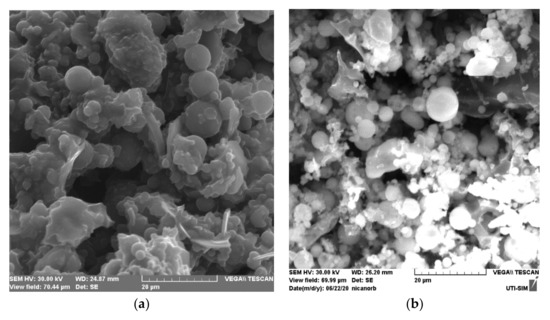
Figure 1.
SEM images for FA/H2SO4 (a) and FA/H2SO4+Cd2+ (b), at a resolution of 20 µm.
The white patches that can be seen in Figure 1b can be explained by the presence of Cd2+ on the surface of FA/H2SO4 material. Moreover, this fact could be observed in the case of U(VI) uptake onto the adsorbent based on ash [16].
It can be observed that the widths of FA were decomposed into small particles. This is a result of sulphuric acid activation, which can destroy the whole structure of FA by the reaction of acid with the alkali and oxide compounds (CaO, MgO, Al2O3, Fe2O3, etc.). In light of Figure 1b, it can be observed that FA/H2SO4 has a relative quantity of the smaller particle sizes.
3.1.2. EDX Analysis
Furthermore, EDX analysis for FA/H2SO4 was recorded in order to establish the elemental composition. The results are presented in Figure 2a and Table 1.
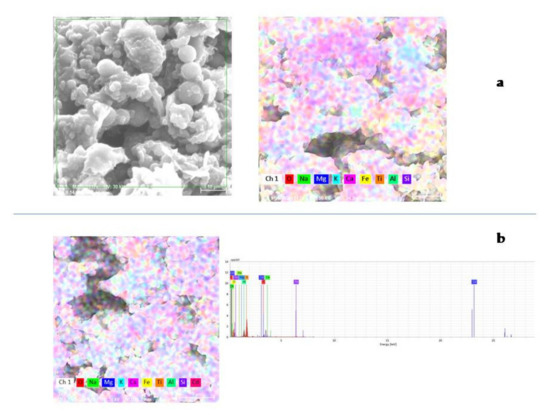
Figure 2.
Elemental analysis by EDX for FA/H2SO4 (a); FA/H2SO4+Cd2+ (b).

Table 1.
Elemental composition of FA/H2SO4.
EDX analysis of FA/H2SO4 reveals the peaks for O, Si and Al elements and smaller peaks for elements such as Ca, Fe, K, Mg, Na and Ti.
Moreover, the EDX spectrum of the FA/H2SO4+Cd2+ sample is presented in Figure 2b and Table 2. The adsorption of Cd2+ was confirmed by the peak of Cd in the EDX spectrum.
Table 2.
Elemental composition of FA/H2SO4+Cd2+.
3.1.3. FTIR Analysis
FTIR analysis was employed to establish the functional groups that could provide information concerning the structure of the adsorbent. In Figure 3 the FTIR spectra for FA/H2SO4 and FA/H2SO4+Cd2+ can be seen.
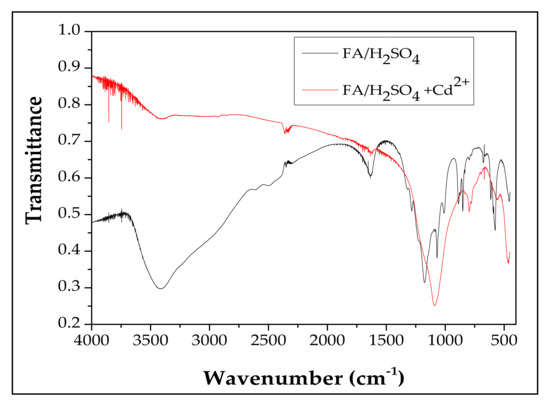
Figure 3.
FTIR spectra of FA/H2SO4 and FA/H2SO4 + Cd2+.
Regarding the FA/H2SO4 sample, the new bands found at 1629 cm−1, 888 cm−1 and 848 cm−1 in comparison with unmodified fly ash [29] can be explained by the presence of S-O on the unmodified fly ash surface. Based on the results, it can be concluded that the synthesis was successfully done.
On the other hand, after Cd2+ adsorption there was a shift in the bands between 1700 cm−1 and 400 cm−1, which proves the adsorption process of Cd2+ on the FA/H2SO4 sample [33,34].
3.1.4. XRD Analysis
Figure 4 represents the comparison of XRD patterns between FA/H2SO4 and FA/H2SO4+Cd2+.
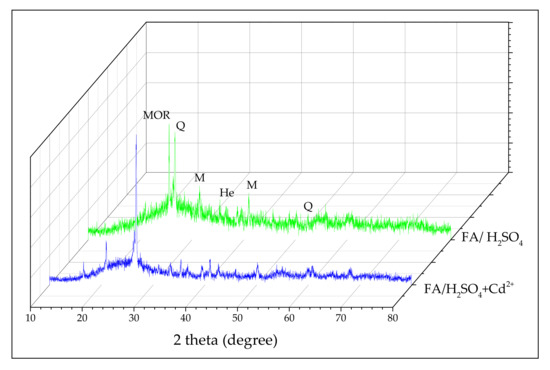
Figure 4.
X-ray diffraction patterns of FA/H2SO4 and FA/H2SO4 +Cd2+.
One significant observation is that the results of XRD analysis revealed that quartz (Q) presents the highest intensity—mullite (M) and hematite (He); the mainly crystalline phases of the unmodified fly ash [26] can also be identified in FA/H2SO4. Additionally, FA/H2SO4 shows a prominent peak at 2 theta = 25.63° that can be attributed to modernite (MOR)[Na8(H2O)24] [Si40Al8O96] [35,36]. In the case of FA/H2SO4+Cd2+ the peaks can be observed in minor intensity. On the other hand X-ray diffraction patterns indicate that a large part of the amorphous silica is present in the tested samples.
3.1.5. BET Analysis
The N2 adsorption–desorption isotherm is shown in Figure 5.
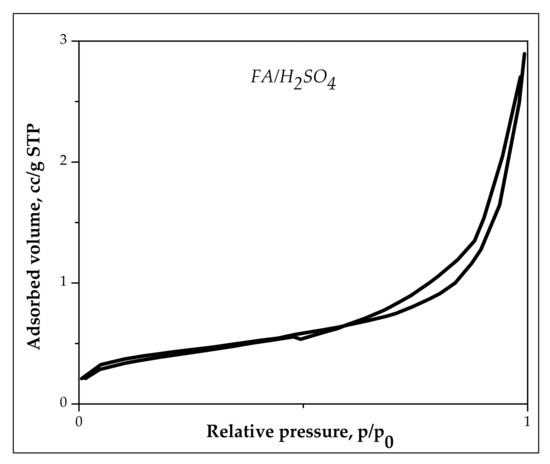
Figure 5.
Nitrogen adsorption isotherm at 77 K on FA/H2SO4.
The BET results shows that the specific surface area of FA/H2SO4 is 1.53 times higher compared with FA [8]; the specific area for FA/H2SO4 is 10.71 m2/g. In addition, the modification of chemical components (alkali substance, metallic oxides) by acid activation increases the pore volume and decreases the average pore diameter. The total pore volume was 0.068 cm3/g for FA/H2SO4, a comparative increase compared to 0.042 cm3/g for raw fly ash. The diameters of the pores were smaller than 18.7 nm.
All physical and chemical changes of FA are the essential features of the sulphuric acid-based activation of FA/H2SO4. To determine whether a material can be proposed as an adsorbent for the retention of heavy metals and also for establishing the optimal adsorption experimental conditions, at least two parameters should be evaluated.
3.2. Effect of FA/H2SO4 Dose in Cd2+ Adsorption
Studies have proved that the recommended pH for the removal of Cd2+ must be below 6.5, because at a higher pH value the precipitation of Cd(OH)2 in solution can occur [25,37].
Adsorbent dose should be a parameter studied in the adsorption technique of different pollutants from wastewaters since it has an important role in terms of process economy [38,39]. Determining the optimal dose of the adsorbent was carried out by increasing the FA/H2SO4 dose from 0.2 g/25 mL to 0.5 g/25 mL at an initial concentration of 70 mg/L. The effect of the adsorbent dose through adsorption capacity is presented in Figure 6.
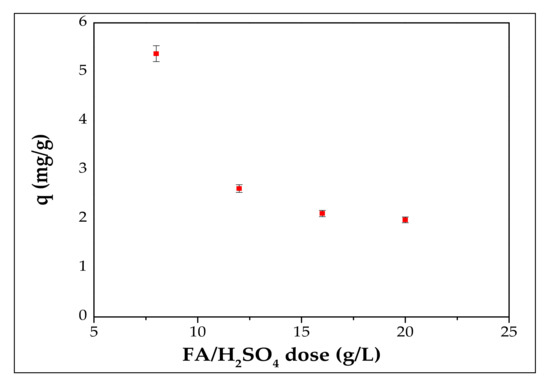
Figure 6.
Effect of FA/H2SO4 dose in Cd2+ adsorption.
Furthermore, the effect of adsorbent dose on the adsorption capacity indicated that, as the adsorbent dose increases from 8 to 20 g/L, the adsorption capacity decreases from 5.37 mg/g to 1.98 mg/g. It was found that these results are consistent with the published literature [34]. The explanation could be that at higher adsorbent dose, aggregation of particles takes place. Therefore, for all further experiments adsorbent dose was fixed at 8 g/L solution.
3.3. Effect of Initial Concentration and Adsorption Isotherm
For the optimization of this parameter, different concentrations of Cd2+ (50–320 mg/L) were applied and the results are presented in Figure 7.
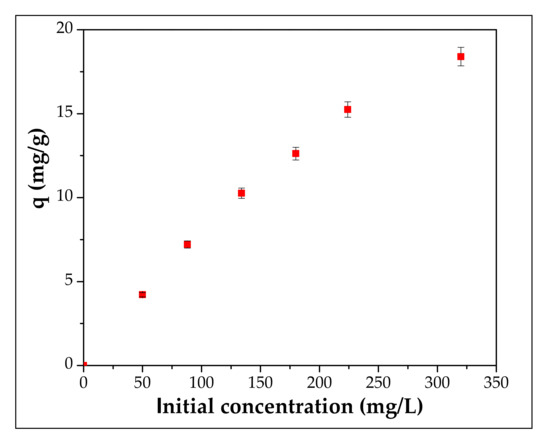
Figure 7.
Effect of initial concentration on the adsorption of Cd2+ onto adsorbent.
It is obvious that the initial concentration has an impact on the adsorption capacity; thus, at low concentrations small adsorption capacity values are obtained, and as the concentration increases, the adsorption capacity also increases. For example, at an initial Cd2+ concentration of 50 mg/L the adsorption capacity is equal with 4.22 mg/g, while at 320 mg/L initial Cd2+ concentration, the adsorption capacity increased by approximately 78%. Experimental results at Cd2+ concentration range of 50–320 mg/L were explained based on Langmuir and Freundlich adsorption isotherm model points of view and the corresponding parameters were obtained accordingly.
A plot of Ce/q vs. Ce (Langmuir) and lnqe vs. lnCe (Freundlich) enables the determining of the coefficients (Figure 8 and Figure 9 and Table 3).
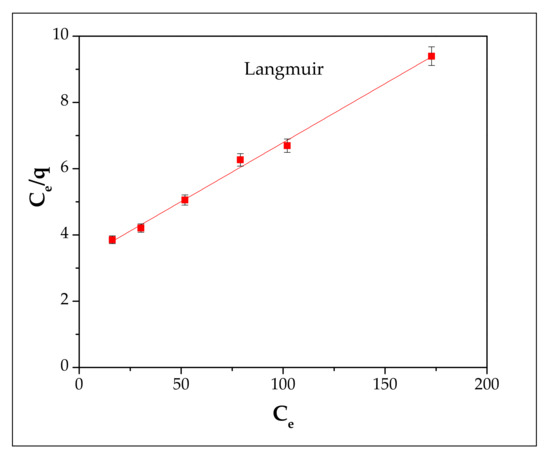
Figure 8.
Langmuir isotherm plot of Cd2+ adsorption on FA/H2SO4.
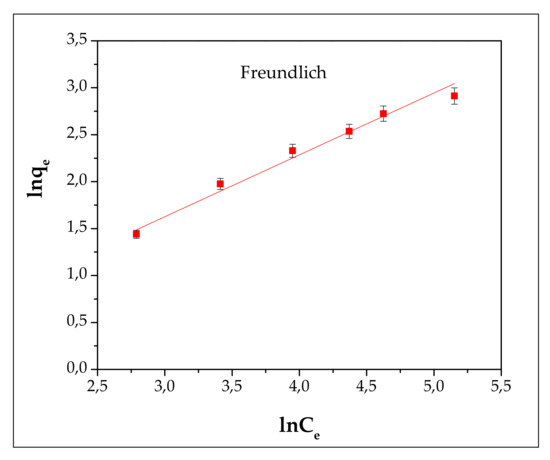
Figure 9.
Freundlich isotherm plot of Cd2+ adsorption on FA/H2SO4.
Table 3.
Adsorption isotherm parameters of Cd2+ onto FA/H2SO4.
According to the R2 value of the Langmuir (0.9956) and Freundlich (0.9806) isotherms, it can be highlighted that the Langmuir model is suitable for describing the adsorption process of Cd2+ onto FA/H2SO4.
3.4. Effect of Contact Time and Kinetic Models
It is very common in the literature that the adsorption takes place in two stages: (a) An initial stage that includes the fast adsorption in the first minutes from the beginning of the adsorption process and (b) a final stage that include the slow adsorption.
The adsorption capacity was investigated as a function of contact time at 70 mg/L initial Cd2+ concentration, pH 5.0 and an adsorbent dose of 8 g/L. The kinetic of adsorption of Cd2+ was carried out by withdrawing and analyzing the samples until the adsorption capacities became closer. The results are presented in Figure 10.
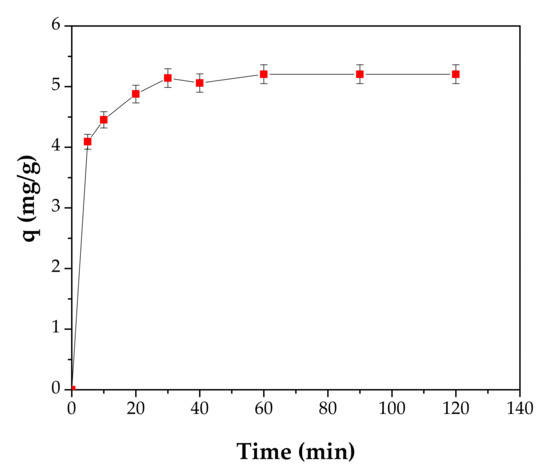
Figure 10.
Effect of contact time on Cd2+ adsorption, C0 70 mg/L, pH 5 and 8 g/L adsorbent dose.
From Figure 10 it can be noted that the adsorption capacity increased quickly from 4.09 to 5.2 mg/g as the contact time increased from 5 to 60 min. By increasing the contact time to 120 min, a plateau is obtained. This fact could be explained as follows: The increase of the contact time determines the filling of the pores and thus the rate becomes slower.
It might be concluded that a contact time of 60 min could be considered sufficient for 60% adsorption under the experimental conditions.
Three kinetic models, the pseudo-first-order model, pseudo-second-order model and intraparticle diffusion model have been developed in order to describe the adsorption kinetic process of Cd2+ onto material, see Figure 11, Figure 12 and Figure 13 and Table 4. A detailed presentation for each model can be consulted in the literature [24,40,41].

Figure 11.
Pseudo-first-order kinetics.
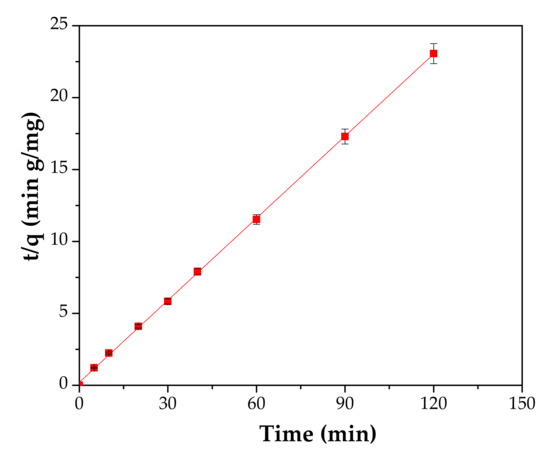
Figure 12.
Pseudo-second-order kinetics.
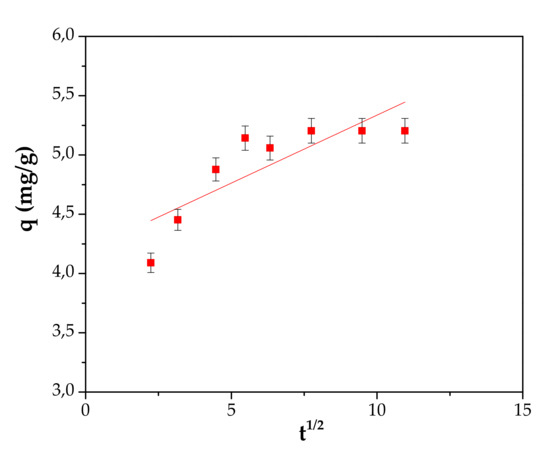
Figure 13.
Intraparticle difussion model.
Table 4.
Kinetic parameters of Cd2+ adsorption onto the FA/H2SO4 sample.
The linearized form of the pseudo-first-order model is presented as follows:
The linearized form of the pseudo-second-order model is:
The intraparticle diffusion model is based on Equation (5):
where is the amount of Cd2+ adsorbed at equilibrium (mg/g), is the amount of Cd2+ adsorbed at time t (mg/g), and are the reaction rate constants of the pseudo-first order (1/min) and pseudo-second order (g/mg·min); is the intraparticle diffusion rate constant.
For this study, the pseudo-second-order model describes the adsorption of Cd2+ onto the adsorbent, with a coefficient regression, R2, of 0.9999. The experimental value of 5.2 mg/g is in agreement with the value of 5.28 mg/g calculated from the pseudo-second-model and the constant has a value of 0.1308 g/mg·min.
The results obtained in this study show that this adsorbent can successfully treat the waters contaminated with Cd2+ ions (Table 5).
Table 5.
Comparison of maximum Cd2+ adsorption capacities (qmax) of different adsorbents reported in literature.
4. Conclusions
This study confirmed that the FA/H2SO4 material could remove Cd2+ ions from an aqueous solution with the following main observations:
- The adsorbent dose had an effect on the adsorption process: A higher dose led to a decrease in adsorption capacity.
- Moreover, it was found that the adsorption process is dependent on the initial concentration.
- The adsorption equilibrium was reached after 60 min of contact time.
- The data fitted in the Langmuir model with a maximum adsorption capacity of 28.09 mg/g. The adsorption process could be explained through a pseudo-second-order kinetic model. This suggests the dominance of chemisorption and monolayer adsorption.
- The adsorption study demonstrated that the material is an effective adsorbent for the removal of cadmium ions from aqueous solutions.
The use of this type of adsorbent could solve the associated environmental and health effects.
Author Contributions
Conceptualization, M.H. and G.B.; methodology, N.L. and G.C.; formal analysis, H.C.; investigation, G.B., T.R., M.P. and D.V.B.; writing—original draft preparation, G.B.; writing—review and editing, D.V.B., M.H.; visualization, N.L.; supervision, G.C. and M.H. All authors have read and agreed to the published version of the manuscript.
Funding
This research was funded by the UEFISCDI Agency trough Project PN-III-P1-1.2-PCCDI-2017-0152 (Contract No. 75PCCDI/2018).
Conflicts of Interest
The authors declare no conflict of interest.
References
- Baby, R.; Hussein, M.Z. Ecofriendly approach for treatment of heavy-metal-contaminated water using activated carbon of kernel shell of oil Palm. Materials 2020, 13, 2627. [Google Scholar] [CrossRef]
- Huang, X.; Zhao, H.; Zhang, G.; Li, J.; Yang, Y.; Ji, P. Potential of removing Cd (II) and Pb (II) from contaminated water using a newly modified fly ash. Chemosphere 2020, 242, 125148. [Google Scholar] [CrossRef]
- Roman, T.; Asavei, R.L.; Karkalos, N.E.; Roman, C.; Virlan, C.; Cimpoesu, N.; Istrate, B.; Zaharia, M.; Markopoulos, A.P.; Kordatos, K.; et al. Synthesis and adsorption properties of nanocrystalline ferrites for kinetic modeling development. Int. J. Appl. Ceram. Technol. 2019, 16, 693–705. [Google Scholar] [CrossRef]
- Favier, L.; Harja, M. TiO2/fly ash nanocomposite for photodegradation of persistent organic pollutant. In Handbook of Nanomaterials and Nanocomposites for Energy and Environmental Applications; Kharissova, O., Martínez, L., Kharisov, B., Eds.; Springer: Basel, Switzerland, 2020. [Google Scholar] [CrossRef]
- Harja, M.; Ciobanu, G. Ecofriendly nano-adsorbents for pollutant removal from wastewaters. In Handbook of Nanomaterials and Nanocomposites for Energy and Environmental Applications; Kharissova, O., Martínez, L., Kharisov, B., Eds.; Springer: Basel, Switzerland, 2020. [Google Scholar]
- Kokkinos, E.; Chousein, C.; Simeonidis, K.; Coles, S.; Zouboulis, A.; Mitrakas, M. Improvement of manganese feroxyhyte’s surface charge with exchangeable Ca ions to maximize Cd and Pb uptake from water. Materials 2020, 13, 1762. [Google Scholar] [CrossRef] [PubMed]
- Zhang, Y.; Wang, Q.; Li, R.; Lou, Z.; Li, Y. A novel phenolic foam-derived magnetic carbon foam treated as adsorbent for rhodamine B: Characterization and adsorption kinetics. Crystals 2020, 10, 159. [Google Scholar] [CrossRef]
- Noli, F.; Buema, G.; Misaelides, P.; Harja, M. New materials synthesized from ash under moderate conditions for removal of toxic and radioactive metals. J. Radioanal. Nucl. Chem. 2015, 303, 2303–2311. [Google Scholar] [CrossRef]
- Wang, Y.; Han, P.; Lu, Y.; Xiao, L.; Du, Y.; Liu, X.; Ye, S. Removal of arsenic and heavy metals from arsenic-containing acid wastewater with iron salt and lime. Environ. Eng. Manag. J. 2019, 18, 2655–2662. [Google Scholar] [CrossRef]
- Liu, S.; Yang, C.; Liu, W.; Yi, L.; Qin, W. A novel approach to preparing ultra-lightweight ceramsite with a large amount of fly ash. Front. Environ. Sci. Eng. 2020, 14, 62–73. [Google Scholar] [CrossRef]
- Harja, M.; Cimpeanu, S.M.; Dirja, M.; Bucur, D. Synthesis of zeolites from fly ash and their use as soil amendment. In Zeolites—Useful Minerals; IntechOpen: London, UK, 2016. [Google Scholar]
- Pivák, A.; Pavlíková, M.; Záleská, M.; Lojka, M.; Jankovský, O.; Pavlík, Z. Magnesium oxychloride cement composites with silica filler and coal fly ash admixture. Materials 2020, 13, 2537. [Google Scholar] [CrossRef]
- Risdanareni, P.; Villagran, Y.; Schollbach, K.; Wang, J.; De Belie, N. Properties of alkali activated lightweight aggregate generated from sidoarjo volcanic mud (lusi), fly ash, and municipal solid waste incineration bottom ash. Materials 2020, 13, 2528. [Google Scholar] [CrossRef]
- Lei, T.; Li, S.J.; Jiang, F.; Ren, Z.X.; Wang, L.L.; Yang, X.J.; Tang, L.H.; Wang, S.X. Adsorption of cadmium ions from an aqueous solution on a highly stable dopamine-modified magnetic nano adsorbent. Nanoscale Res. Lett. 2019, 14, 352. [Google Scholar] [CrossRef] [PubMed]
- Supelano, G.I.; Cuaspud, J.G.; Moreno-Aldana, L.C.; Ortiz, C.; Trujillo, C.A.; Palacio, C.A. Synthesis of magnetic zeolites from recycled fly ash for adsorption of methylene blue. Fuel 2020, 263, 116800. [Google Scholar] [CrossRef]
- Buema, G.; Noli, F.; Misaelides, P.; Sutiman, D.M.; Cretescu, I.; Harja, M. Uranium removal from aqueous solutions by raw and modified thermal power plant ash. J. Radioanal. Nucl. Chem. 2014, 299, 381–386. [Google Scholar] [CrossRef]
- Noli, F.; Kapnisti, M.; Buema, G.; Harja, M. Retention of barium and europium radionuclides from aqueous solutions on ash-based sorbents by application of radiochemical techniques. Appl. Radiat. Isot. 2016, 116, 102–109. [Google Scholar] [CrossRef] [PubMed]
- Li, X.; Ye, J.; Liu, Z.; Qiu, Y.; Li, L.; Mao, S.; Wang, X.; Zhang, Q. Microwave digestion and alkali fusion assisted hydrothermal synthesis of zeolite from coal fly ash for enhanced adsorption of Cd(II) in aqueous solution. J. Cent. South Univ. 2018, 25, 9–20. [Google Scholar] [CrossRef]
- Zhang, Y.; Zhou, L.; Chen, L.; Guo, Y.; Guo, F.; Wu, J.; Dai, B. Synthesis of zeolite Na-P1 from coal fly ash produced by gasification and its application as adsorbent for removal of Cr(VI) from water. Front. Chem. Sci. Eng. 2020. [Google Scholar] [CrossRef]
- Noli, F.; Buema, G.; Misaelides, P.; Harja, M. Retention of cesium from aqueous solutions using synthetic zeolites produced from power plant ash. J. Radioanal. Nucl. Chem. 2016, 309, 589–596. [Google Scholar] [CrossRef]
- Mor, S.; Chhavi, M.K.; Sushil, K.K.; Ravindra, K. Assessment of hydrothermally modified fly ash for the treatment of methylene blue dye in the textile industry wastewater. Environ. Dev. Sustain. 2018, 20, 625–639. [Google Scholar] [CrossRef]
- Styszko, K.; Szczurowski, J.; Czuma, N.; Makowska, D.; Kistler, M.; Uruski, L. Adsorptive removal of pharmaceuticals and personal care products from aqueous solutions by chemically treated fly ash. Int. J. Environ. Sci. Technol. 2018, 15, 493–506. [Google Scholar] [CrossRef]
- Ileri, B.; SanliyukselYucel, D. Metal removal from acid mine lake using ultrasound-assisted modified fly ash at different frequencies. Environ. Monit. Assess. 2020, 192, 185. [Google Scholar] [CrossRef]
- Harja, M.; Buema, G.; Sutiman, D.M.; Munteanu, C.; Bucur, D. Low cost adsorbents obtained from ash for copper removal. Korean J. Chem. Eng. 2012, 29, 1735–1744. [Google Scholar] [CrossRef]
- Harja, M.; Buema, G.; Bulgariu, L.; Bulgariu, D.; Sutiman, D.M.; Ciobanu, G. Removal of cadmium(II) from aqueous solution by adsorption onto modified algae and ash. Korean J. Chem. Eng. 2015, 32, 1804–1811. [Google Scholar] [CrossRef]
- Harja, M.; Buema, G.; Sutiman, D.M.; Cretescu, I. Removal of heavy metal ions from aqueous solutions using low-cost sorbents obtained from ash. Chem. Pap. 2013, 67, 497–508. [Google Scholar] [CrossRef]
- Nguyen, T.C.; Loganathan, P.; Nguyen, T.V.; Kandasamy, J.; Naidu, R.; Vigneswaran, S. Adsorptive removal of five heavy metals from water using blast furnace slag and fly ash. Environ. Sci. Pollut. Res. 2018, 25, 20430–20438. [Google Scholar] [CrossRef] [PubMed]
- Zhao, H.; Huang, X.; Zhang, G.; Li, J.; He, Z.; Ji, P.; Zhao, J. Possibility of removing cadmium pollution from the environment using a newly synthesized material coal fly ash. Environ. Sci. Pollut. Res. 2020, 27, 4997–5008. [Google Scholar] [CrossRef]
- Harja, M.; Bărbuţă, M.; Rusu, L.; Apostolescu, N. Utilization of coal fly ash from power plants I. Ash characterization. Environ. Eng. Manag. J. 2008, 7, 289–294. [Google Scholar] [CrossRef]
- Forminte (Litu), L.; Ciobanu, G.; Buema, G.; Lupu, N.; Chiriac, H.; Gomez de Castro, C.; Harja, M. New materials synthesized by sulfuric acid attack over power plant fly ash. Rev. Chim 2020, 71, 48–58. [Google Scholar] [CrossRef]
- Buema, G.; Lupu, N.; Chiriac, H.; Ciobanu, G.; Kotova, O.; Harja, M. Modeling of solid-fluid non-catalytic processes for nickel ion removal. Rev. Chim. 2020, 71, 4–15. [Google Scholar] [CrossRef]
- Harja, M.; Barbuta, M.; Gavrilescu, M. Study of morphology for geopolymer materials obtained from fly ash. Environ. Eng. Manag. J. 2009, 8, 1021–1027. [Google Scholar] [CrossRef]
- Ma, L.; Wei, Q.; Chen, Y.; Song, Q.; Sun, C.; Wang, Z.; Wu, G. Removal of cadmium from aqueous solutions using industrial coal fly ash-nZVI. R. Soc. Open Sci. 2018, 5, 171051. [Google Scholar] [CrossRef]
- Jorfi, S.; Shooshtarian, M.R.; Pourfadakari, S. Decontamination of cadmium from aqueous solutions using zeolite decorated by Fe3O4 nanoparticles: Adsorption modeling and thermodynamic studies. Int. J. Environ. Sci. Technol. 2020, 17, 273–286. [Google Scholar] [CrossRef]
- Treacy, M.M.; Higgins, J.B. Collection of Simulated XRD Powder Patterns for Zeolites, 5th ed.; Elsevier: Amsterdam, The Netherlands, 2007. [Google Scholar]
- Wang, N.; Hao, L.; Chen, J.; Zhao, Q.; Xu, H. Adsorptive removal of organics from aqueous phase by acid-activated coal fly ash: Preparation, adsorption, and Fenton regenerative valorization of “spent” adsorbent. Environ. Sci. Pollut. Res. 2018, 25, 12481–12490. [Google Scholar] [CrossRef] [PubMed]
- Sukpreabprom, H.; Arqueropanyo, O.; Naksata, W.; Sooksamiti, P.; Janhom, S. Single and binary adsorption of Cd (II) and Zn (II) ions from aqueous solutions onto bottom ash. Korean J. Chem. Eng. 2015, 32, 896–902. [Google Scholar] [CrossRef]
- Gorzin, F.; Abadi, M.B.R. Adsorption of Cr(VI) from aqueous solution by adsorbent prepared from paper mill sludge: Kinetics and thermodynamics studies. Adsorp. Sci. Technol. 2018, 36, 149–169. [Google Scholar] [CrossRef]
- Yusuff, A.S.; Popoola, L.T.; Babatunde, E.O. Adsorption of cadmium ion from aqueous solutions by copper-based metal organic framework: Equilibrium modeling and kinetic studies. Appl. Water Sci. 2019, 9, 106. [Google Scholar] [CrossRef]
- Zhang, Y.; Lou, Z.; Wang, C.; Wang, W.; Cai, J. Synthesis of porous Fe/C bio-char adsorbent for rhodamine B from waste wood: Characterization, kinetics and thermodynamics. Processes 2019, 7, 150. [Google Scholar] [CrossRef]
- Wang, Z.; Li, J.; Zhang, G.; Zhi, Y.; Yang, D.; Lai, X.; Ren, T. Characterization of acid-aged biochar and its ammonium adsorption in an aqueous solution. Materials 2020, 13, 2270. [Google Scholar] [CrossRef]
- Merrikhpour, H.; Jalali, M. Comparative and competitive adsorption of cadmium, copper, nickel, and lead ions by Iranian natural zeolite. Clean Technol. Environ. Policy 2013, 15, 303–316. [Google Scholar] [CrossRef]
- Olabemiwo, F.A.; Tawabini, B.S.; Patel, F.; Oyehan, T.A.; Mazen Khaled, M.; Laoui, T. Cadmium removal from contaminated water using polyelectrolyte-coated industrial waste fly ash. Bioinorg. Chem. Appl. 2017, 7298351. [Google Scholar] [CrossRef]
- Deng, Y.; Huang, S.; Laird, D.A.; Wang, X.; Dong, C. Quantitative mechanisms of cadmium adsorption on rice straw- and swine manure-derived biochars. Environ. Sci. Pollut. Res. 2018, 25, 32418–32432. [Google Scholar] [CrossRef]
- Gorimbo, J.; Taenzana, B.; Muleja, A.A.; Kuvarega, A.T.; Jewell, L.L. Adsorption of cadmium, nickel and lead ions: Equilibrium, kinetic and selectivity studies on modified clinoptilolites from the USA and RSA. Environ. Sci. Pollut. Res. 2018, 25, 30962–30978. [Google Scholar] [CrossRef] [PubMed]
- Yusof, M.S.M.; Othman, M.H.D.; Mustafa, A.; Rahman, M.A.; Jaafar, J.; Ismail, A.F. Feasibility study of cadmium adsorption by palm oil fuel ash (POFA)-based low-cost hollow fibre zeolitic membrane. Environ. Sci. Pollut. Res. 2018, 25, 21644–21655. [Google Scholar] [CrossRef] [PubMed]
- Zhao, D.; Liu, P.; Wang, F.; Hu, C.; Hu, S. Versatile surface modification of ceramsite via honeycomb calcium-aluminum-silicate-hydrate and its functionalization by 3-thiocyanatopropyltriethoxysilane for enhanced cadmium (II) removal. J. Wuhan Univ. Technol. Mater. Sci. Ed. 2020, 35, 71–80. [Google Scholar] [CrossRef]
© 2020 by the authors. Licensee MDPI, Basel, Switzerland. This article is an open access article distributed under the terms and conditions of the Creative Commons Attribution (CC BY) license (http://creativecommons.org/licenses/by/4.0/).