1. Introduction and Related Work
In the 21st century, global energy trends are inevitably directed towards increasing the share of renewable energy sources (RES) in the overall energy balance. According to the International Renewable Energy Agency (IRENA), the global renewable energy capacity in 2024 exceeded 3.5 TW, of which more than a third is wind energy [
1]. It is considered one of the key tools in the fight against climate change, since wind turbines do not produce harmful emissions, have a low carbon intensity, and provide a long period of operation.
Wind energy is used both in large industrial wind farms and in decentralized autonomous systems. However, as the number of wind power plants (WPPs) increases, the requirements for their reliability, continuity of operation, and economic efficiency are also increasing. According to estimates by European operators, technical malfunctions and turbine shutdowns lead to a loss of up to 8–10% of annual energy production. The most vulnerable components are the rotor blades, which operate in difficult conditions—they are exposed to rain, snow, hail, temperature changes, and dynamic loads.
Wind turbine failures and equipment degradation have significant economic consequences for both operators and grid stakeholders. Sudden or progressive wind turbine component failures often lead to extended downtime, increased operation and maintenance costs, and production losses, which ultimately affect the economic viability of wind energy assets [
2]. Furthermore, cost analyses of wind turbine equipment failures underscore that as the scale of wind energy deployment grows globally, so do the associated financial risks and lifecycle costs, reinforcing the need for reliable automated defect detection and predictive maintenance strategies. Due to prolonged operational loads, cracks, coating erosion, corrosion, or delamination of composite materials can appear on the blade surfaces, reducing aerodynamic efficiency and potentially leading to fatal failures. Studies show that even partial damage to the blade edge can reduce turbine efficiency by 6–12%. Therefore, the timely detection and classification of defects are not only a technical task but also an important economic factor that determines the service life of the turbine and the amount of electricity produced.
Traditional inspection methods (visual inspections by technicians or the use of static cameras) are gradually being replaced by intelligent monitoring systems that operate in real time, analyze large volumes of images, and automatically recognize damage. Unmanned aerial vehicles (UAVs) play a crucial role in this, enabling quick and safe inspections of blades even at high altitudes. However, processing the resulting images requires highly accurate analysis algorithms capable of recognizing various types of defects in complex lighting conditions, shadows, glare, and noise.
Over the past decade, artificial intelligence (AI) methods, including machine learning and deep learning, have been actively used to automate the process of detecting damage in wind turbines. The most common approaches include Convolutional Neural Networks (CNN), transfer learning, YOLO architectures, and ensemble classifiers [
2,
3,
4,
5,
6]. They yield good results in detecting defects in RGB images and thermal camera images. For example, the authors of [
7] proposed an ensemble system for predicting faults in wind turbine bearings that combines isolation forests and neural networks. For data clustering tasks, in particular, wind turbine defect features, an effective method is to use the wavelet transform [
8]. In the functions of detecting and classifying defects in images, in addition to the CNN architecture, the fuzzy logic method is increasingly used [
9,
10]. In the study [
11], a deep DBN network with particle-based optimization (IPSO-DBN) was employed for early defect detection using SCADA system data. Such models have high accuracy but require significant computing resources, a large number of training samples, and often fail to provide explanations for their results.
Recent developments in machine learning-based defect detection and structural reliability analysis further reinforce the importance of the current research direction. For instance, deep learning architectures have demonstrated strong progress in wind turbine blade inspection. Authors of [
12] provided a comprehensive overview of CNN and transformer-based defect detection techniques, noting major advances in automatic blade damage classification while emphasizing that existing deep models often require large training datasets and provide limited interpretability. These limitations support the motivation behind our hypersector FLVQ approach, which operates efficiently in low-data conditions and offers explainable geometry-driven classification logic.
In addition, advanced probabilistic learning frameworks, such as Bayesian hierarchical sparse learning, have recently been applied to structural health monitoring under severe uncertainty. In [
13], the authors showed that Bayesian modeling can robustly interpret and forecast complex heterogeneous SHM signals under typhoon conditions, outperforming conventional regression-based prediction systems. This aligns with our fuzzy-sector architecture, which also incorporates uncertainty handling principles through soft membership and angular decision boundaries.
Furthermore, recent contributions in wind turbine structural reliability demonstrate sector-wide recognition of data-driven analytical models. Research [
14,
15] presented a comprehensive analysis of gearbox reliability development trends, highlighting the growing need for automated condition assessment across industrial wind farms. Likewise, a Kriging-assisted reliability-based optimization strategy was proposed for offshore turbine tower design, confirming the industrial shift towards hybrid structural modeling that integrates statistical learning with uncertainty quantification frameworks [
16]. Collectively, these studies support the scientific rationale of the present work: wind turbine defect analysis is moving toward interpretable, robust, and data-efficient machine learning methods, in which the hypersector FLVQ model provides significant advantages over purely deep-learning-driven classifiers.
In response to these limitations, hybrid neuro-fuzzy systems are gaining increasing attention, as they combine the learning capabilities of neural networks with the interpretability of fuzzy logic. The authors of [
17] developed an adaptive neuro-fuzzy system for blade condition diagnosis, achieving an accuracy of over 95% when applied to real images obtained from UAVs. Additionally, in the study [
18], fuzzy logic type 3 was employed to detect wind turbine faults, thereby demonstrating increased system robustness to data uncertainties. Fuzzy control for adjusting the blade installation angle was also used in the study [
19], ensuring stability of the output power even under sharp fluctuations in wind speed. The study [
20] demonstrated that integrating fuzzy rules with feature selection enables more efficient classification of high-dimensional data. Thus, fuzzy and neuro-fuzzy systems combine accuracy, flexibility, and the ability to interpret results [
21,
22,
23,
24,
25], making them promising for applications in technical diagnostics of renewable energy sources.
However, most existing models consider the feature space only as a set of independent coordinates, ignoring the geometric structure of the class distribution. In practice, feature vectors of different types of defects often partially overlap—for example, erosion and corrosion textures have similar statistical characteristics, especially under variable illumination. Under such conditions, traditional classification algorithms can create fuzzy boundaries between classes, which leads to erroneous decisions. This necessitates the development of models that take into account the geometry of the feature space and provide smooth transitions between classes, rather than rigid separation. One of the directions that combines geometric data representation with fuzzy principles is Learning Vector Quantization (LVQ)—a supervised classification method based on the formation of class prototypes in a multidimensional feature space [
26]. During training, the LVQ network gradually adjusts the position of the prototypes based on the accuracy of sample classification, allowing for flexible adaptation to the data structure. The first fuzzy modifications of this approach, Fuzzy LVQ (FLVQ), were proposed in [
27] and developed by Amezcua and Melin [
28,
29]. In FLVQ, each input vector can partially belong to multiple classes simultaneously, allowing for the correct description of situations with overlapping boundaries. For this purpose, a fuzzy membership function is introduced, which determines the degree of similarity between the sample and the prototype of the class. Thus, the system gains the ability to process uncertain or noisy data without losing stability.
The advantage of FLVQ is its interpretability and robustness; it does not require a large amount of training data and allows for tracking the contribution of each vector direction to the decision-making process. This makes the method attractive for technical applications where it is crucial to explain the reasoning behind the classification, for example, in wind turbine defect diagnosis systems. Studies [
30,
31] have demonstrated that fuzzy BSB/GBSB models constructed on a hypercubic data representation can be generalized to hyperspherical or hypersectoral structures. Such structures allow for reflecting the similarity of classes not only by distance, but also by angular characteristics between feature vectors. It is this idea that formed the basis of hypersector fuzzy models, in which a direction vector and a marginal membership angle describe each class.
The concept of hypersector comes from the geometric analysis of multidimensional data [
32]. While classical methods divide the feature space into planes or hyperplanes, the hypersector model forms local regions in the form of sectors of a multidimensional hypersphere. Each sector corresponds to a particular class and is defined by a central direction vector and a critical similarity angle. In the classification process, a new feature vector is projected onto the surface of the hypersphere, and the degree of its belonging to each class is determined by the magnitude of the angle between it and the center vectors.
Using a fuzzy softmax membership function, it is possible to describe the transition between sectors smoothly, which is especially important for authentic defect images where the boundaries between classes are not sharp. Such a model reflects the natural structure of the feature space while maintaining the ability to learn in a supervised classification mode.
Combined with FLVQ, this approach creates a hypersector fuzzy model, Fuzzy LVQ, where each class has its own sector on the hypersphere, and the prototypes are constantly refined during training. Thanks to the angular similarity metric and fuzzy membership function, the model provides high resolution in overlapping classes and robustness to noise, making it suitable for analyzing images of wind turbine blades obtained from UAV systems under variable shooting conditions.
Despite the high accuracy of deep learning–based approaches, their limited interpretability, sensitivity to environmental variability, and high computational cost hinder reliable deployment for UAV-based wind turbine blade inspection. In this work, Fuzzy Learning Vector Quantization is adopted as a prototype-based and explainable alternative, enabling robust defect classification under uncertainty while remaining suitable for real-time embedded implementation. In this context, the proposed work aims to develop a new hypersector-based method with an Fuzzy LVQ model that can provide accurate and robust real-time defect recognition of wind turbines.
The goal of this study is to develop, mathematically substantiate, and experimentally verify a hypersector Fuzzy LVQ model for automated classification of wind turbine blade defects based on images obtained from unmanned aerial vehicles.
To achieve the set goal, the following tasks are planned:
− to analyze modern fuzzy classification methods, LVQ models, and geometric approaches to feature representation;
− develop a mathematical model of hypersector representation of classes in a multidimensional feature space;
− integrate a fuzzy membership function into the classification process to account for overlapping classes and data uncertainty;
− experimental validation on sets of images of blades with different types of damage (crack, erosion, corrosion, and regular blade);
− to compare the results with baseline methods and evaluate accuracy, F1-measure, and noise resistance.
The development of such systems is a crucial step towards ensuring energy security and enhancing the efficiency of renewable energy, which is of strategic importance for the sustainable development of Ukraine and the world.
The rest of the paper is structured as follows:
Section 1 introduces the relevance of wind-turbine defect detection, reviews existing AI and fuzzy-logic methods, and defines the goal of developing a hypersector-based Fuzzy LVQ model.
Section 2 describes the methodology, in which UAV images are processed with SqueezeNet to extract normalized feature vectors mapped onto a hypersphere. The proposed Fuzzy LVQ utilizes angular similarity and fuzzy membership to classify defects.
Section 3 presents the experimental results.
Section 4 compares the performance of the proposed prototype with that of the prototype, demonstrating higher accuracy, noise resistance, and geometric interpretability.
Section 5 concludes that the developed hypersector Fuzzy LVQ effectively detects turbine defects in real time and can be extended to other renewable-energy applications.
2. Methods and Materials
2.1. Input Data
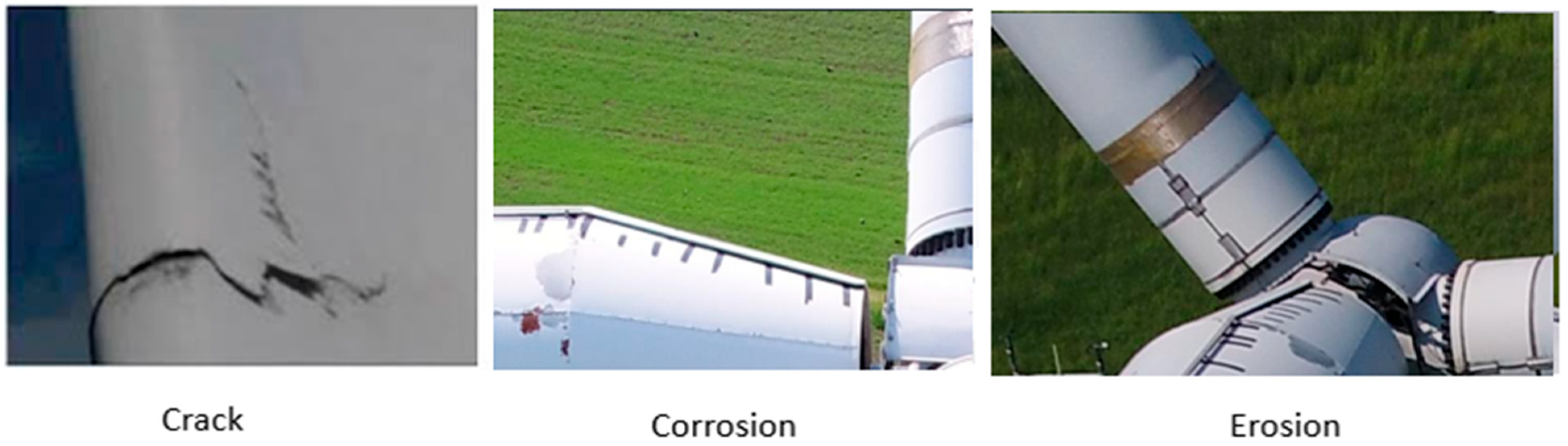
Wind turbine blades are subjected to continuous aerodynamic, thermal, and mechanical stresses, which over time lead to various types of structural defects, including cracks, erosion, and corrosion. Cracks usually occur due to cyclic mechanical loads and appear as narrow linear fractures on the blade surface. Erosion is caused by the impact of rain, sand, or dust particles that gradually wear away the protective coating and the leading edge of the blade. Corrosion results from long-term exposure to moisture and temperature fluctuations, leading to oxidation, paint peeling, or pitting on metallic or composite surfaces.
The image dataset used in this study consists of real UAV photographs of wind turbine blades obtained from the open-access Kaggle repository [
33], ensuring that the model is trained on naturally occurring visual conditions rather than synthetic or laboratory-generated samples. These images contain inherent variations in illumination, shadows, viewing angle, background complexity, material texture, and defect morphology, providing a realistic foundation for assessing the robustness of the proposed method. Consequently, the processed image set offers a balanced compromise between real-world visual diversity and controlled transformation, providing a reliable basis for evaluating the classification performance without requiring artificial image synthesis or GAN-based data generation.
Examples of these defects are illustrated in
Figure 1.
Detecting such defects manually is time-consuming and risky, as inspections often require shutting down turbines and climbing large structures.
To address these challenges, unmanned aerial vehicles (UAVs) equipped with high-resolution RGB and thermal cameras are increasingly used for automated blade inspections. UAVs can capture detailed images from multiple angles and distances safely, even under challenging weather conditions. RGB imaging enables visual identification of surface anomalies—such as cracks, erosion, or discoloration—while thermal imaging reveals hidden defects associated with delamination or internal heating patterns. The collected images form a dataset that intelligent algorithms can process to recognize and classify defects in real time automatically.
At the initial stage of processing, images of wind turbine blades obtained using the UAV’s on-board system are fed into the input of a pre-trained convolutional neural network, SqueezeNet, whose architecture is described in [
34]. This model enables the extraction of compact, informative feature vectors that characterize the blade surface’s structural and textural properties.
The selection of SqueezeNet as the core convolutional architecture in this work is determined by the combined requirements for embedded on-board UAV deployment and the network’s ability to extract informative defect-related features at significantly lower computational cost compared to more recent alternatives. A review of embedded AI systems shows that SqueezeNet was one of the first CNNs specifically designed for highly resource-constrained platforms: it provides AlexNet-level accuracy while containing only about 1.25 million parameters and approximately 860 million MAC operations, whereas MobileNetV3-Small/Minimalistic and EfficientNet-Lite0 contain 2.0–5.3 million parameters and up to 285–784 million MACs, which complicates their use in ultra-lightweight on-board configurations without additional quantization and software–hardware optimization procedures [
35]. At the same time, modern research on defectoscopy and technical diagnostics demonstrates that modified variants of SqueezeNet achieve 96–97% accuracy and F1 scores comparable to or even higher than those of heavier architectures while requiring an order of magnitude fewer parameters, which has been validated for machine fault diagnosis tasks and other industrial scenarios [
36]. In the field of industrial visual inspection, recent studies on surface defect detection explicitly emphasize the advantages of lightweight architectures such as MobileNet, SqueezeNet, and ShuffleNet for real-time deployment on resource-constrained devices, where not only accuracy but also energy consumption and processing latency are critical factors [
37]. For wind energy systems, it has already been demonstrated that compact SqueezeNet-based models are successfully applied in fault diagnosis approaches for wind turbines, including blade defect analysis, where the “lightweight SqueezeNet model” is referenced as a suitable foundation for field applications [
38]. Therefore, although MobileNetV3 and EfficientNet-Lite represent promising candidates for future exploration (particularly for detecting even more subtle effects such as early-stage erosion or corrosion), in this study, SqueezeNet is selected as an optimal trade-off between feature discriminability and the strict computational constraints of the on-board processing module.
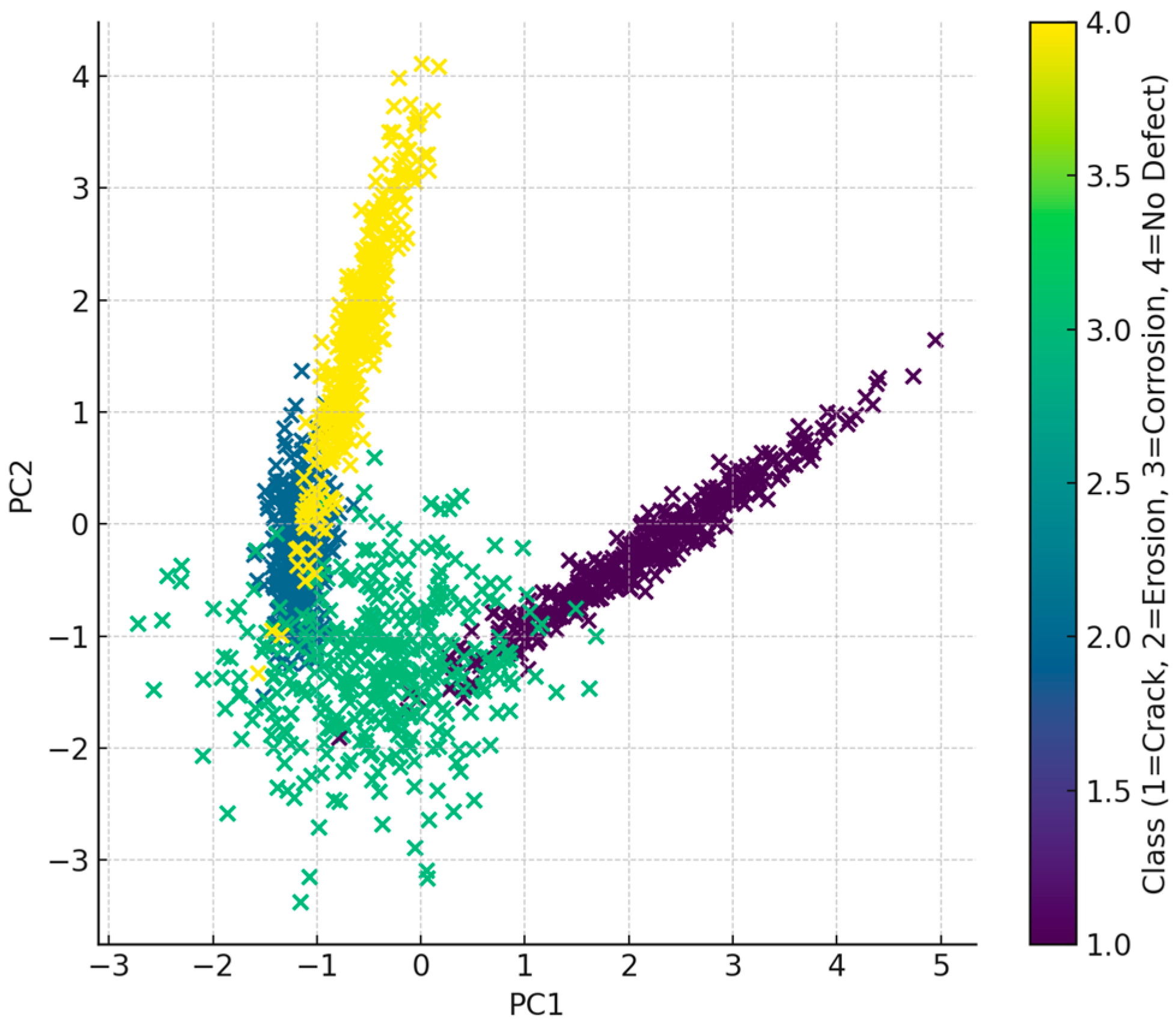
Each input vector contains values corresponding to the activities of the penultimate layer nodes in SqueezeNet and reflects key patterns associated with the type of defect or a normal surface. To analyze the structure of the features obtained from the SqueezeNet neural network, their two-dimensional projection was performed using the Principal Component Analysis (PCA) method (
Figure 2).
The feature vectors, consisting of four numerical parameters, were first normalized and then projected into a 2D space, allowing for the visual assessment of the separability of different defect classes. For easier interpretation, the points on the plot were colored according to their true classes: 1—crack, 2—erosion, 3—corrosion, 4—no defect. For visualization purposes, the first two PCA components were used, explaining 64.2% (PC1) and 18.7% (PC2) of the total feature variance, respectively, which confirms that the 2D projection adequately reflects the separability structure of the embedded feature space.
The resulting visualization demonstrates that the selected SqueezeNet features effectively separate the defect types. Each class forms compact groups of points, confirming the network’s ability to generate stable and informative feature vectors even with a low dimensionality. The distinction between the “no defect” class and all defect categories is particularly clear, while crack, erosion, and corrosion form their own subsets with only minor overlaps. This indicates that the features generated by the neural network are sufficiently discriminative and can be effectively used for further classification using methods such as proposed hyper-sector models.
To better understand the structure of the features, consider an example of one feature vector obtained from a real blade image. For instance, for one sample, the neural network produced the following vector [0.8761, 0.0131, 0.1104, 0.0003]. Each element of this vector represents the activation of a specific feature that SqueezeNet has automatically learned to extract from the input image. Such features may correspond to characteristic edge patterns, local contrast changes, texture transitions, or micro-structural patterns on the blade surface. In this example, the first component (0.8761) has a high value, indicating a pronounced structural characteristic typically associated with crack-type defects. The remaining components have low values, meaning the absence of textural or geometric patterns related to erosion or corrosion. These internal relationships enable the classifier to confidently assign this vector to class 1—crack.
Thus, the PCA visualization and the analysis of individual vectors confirm that SqueezeNet forms a representative feature space in which defect classes exhibit a natural geometric structure. In contrast, the feature vectors reflect hidden characteristic patterns of defects. This provides a strong foundation for building high-accuracy intelligent systems for diagnosing wind turbine blade defects.
2.2. Hypersector-Based Method
The transition from feature space to hypersector space allows for a geometrical interpretation of the classification process: instead of direct partitioning in a multidimensional space, recognition occurs by measuring the angular similarity between the current sample vector and the sector centers for each class. This enables more accurate modeling of transition zones between defects, accounting for the inherent feature overlap in real images.
A hypersector can be interpreted as a subregion of a hypersphere [
35], limited by a specific boundary angle, within which there are vectors oriented similarly to the central direction of the class.
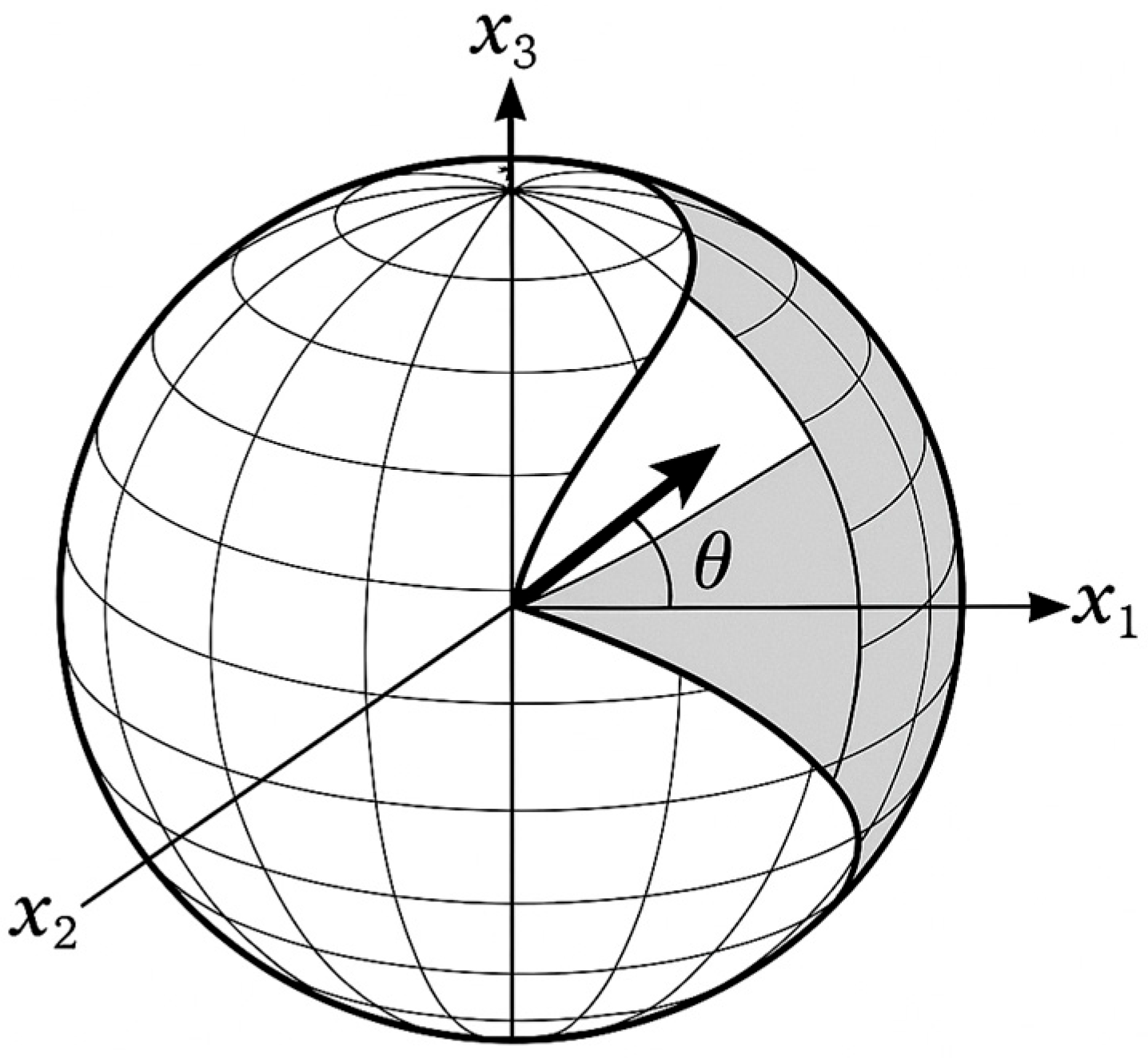
Figure 3 illustrates the geometric interpretation of a hypersphere and hypersectors used for defect classification in the feature space.
The surface of the unit hypersphere is shown as a spherical wireframe model with orthonormal axes , , and . Inside the sphere, one hypersector corresponding to a specific defect class is highlighted; it is bounded by two surfaces originating from the coordinate center. The class direction vector is depicted as an arrow indicating the central direction of the hypersector. The angle , drawn between the direction vector and the hypersector boundary, defines the width of this sector and represents the allowable deviation of input feature vectors from the ideal class direction. Thus, the figure illustrates the principle of dividing the feature space into hypersectors, each corresponding to a particular class within the hypersector-based classification model. It is on this geometric basis that the subsequent hypersector-based method is built, which uses the angular similarity measure between vectors and fuzzy membership functions to improve classification accuracy.
Let
is the feature vector,
is the direction vector, with maximum length 1:
where
.
Let
—spherical center—direction of defect class c, then:
(n is the length of the vector
)—direction of class vectors.
If all vectors of a class are directed approximately in the same direction, then the vector (Equation (2)) will be long, if scattered, then shorter.
Normalization to unit length:
now
lies on a hypersphere.
If
—a new sample of the feature vector, then the angle between
and
:
That
—class sector,
—maximum angle
,
, i.e., sector:
where
—hypersphere, m—number of classes.
Fuzzy distribution, for example:
—small, then “belongs to the class”
—big, then “almost does not belong to the class”
For the membership function, softmax can be taken:
The class prototypes are written to the memory as .
Relationship matrix:
where
,
—identity matrix,
—shift to the middle between classes,
,
.
At each iteration t, the network restores its state through
The vector is then normalized (according to Equation (1)) to fit onto the surface of the hypersphere:
and it counts
to determine which class the system leans more towards at iteration t.
Since defect analysis is processed in real time directly on the UAV, and in practice, the feature classes are typically very close to or overlap each other, it is necessary to use a supervised classification method. For this, the Fuzzy Learning Vector Quantization (FLVQ) approach can be used. It is a supervised classification algorithm that extends the original learning vector quantization (LVQ) by incorporating fuzzy logic to improve classification performance. Unlike traditional LVQ, which employs a winner-take-all approach, FLVQ allows input vectors to belong to multiple classes to varying degrees, and the learning process is based on optimizing a fuzzy objective function. This enables FLVQ to handle overlapping classes more effectively and distinguish between known and unknown patterns more accurately.
Let each class
(where
) is defined by the direction vector
, normalized to 1:
Such a vector is the spherical center of the class and determines the orientation of the corresponding hypersector on the hypersphere.
For the new feature vector
, the similarity angle (according to Equation (4)) to the center of each class is calculated:
If all vectors of a specific class have similar directions, the corresponding
will be “long” (stable), indicating a well-defined orientation of the class. When the directions of the elements are scattered,
becomes shorter—the class is less homogeneous. For a vector to belong to a hypersector of the class, the condition is given:
where
is the limiting angle of the sector.
Unlike classical LVQ, in FLVQ, each vector
may partially belong to several classes at the same time. The degree of fuzzy membership is determined:
where
and
If the angle (Equation (11)) is small, i.e., the direction almost coincides with (Equation (10)), then ; if is large—
This allows you to model situations where data does not clearly belong to one class, but is located near the boundaries between sectors.
During training, each prototype class
changes under the influence of samples
proportional to their degree of fuzzy membership:
where
is the learning coefficient,
, if the sample belongs to the correct class,
if the sample belongs to another class.
Thus, the class centers move towards examples with high membership and away from false examples. This creates a fuzzy but stable class separation on the hypersphere.
After training, a vector of fuzzy memberships is formed for each new sample:
This vector can be interpreted as a fuzzy representation, , of the current state of the system. It can be fed to the next level of processing, for example, to the BSB memory, to refine the classification.
Thus, within the given notation, Fuzzy LVQ acts as a fuzzy mapper , from the input x feature space to the membership space , where each element shows the strength of the fit of the current sample to class c. On a hypersphere, this corresponds to a smooth transition between sectors, where instead of a hard boundary, a gradual decrease in membership is observed, making the classification robust to noise, fuzzy features, and class overlap.
In the proposed hypersector model, the selection of the key parameters was carried out through a two-stage procedure combining statistical feature-space analysis and validation-based tuning. The half-apex angle was fixed globally for all classes at
, derived from the 95th percentile of the inter-class angular distances observed across the normalized feature vectors extracted with SqueezeNet. This strategy guarantees cross-class geometric comparability and avoids sector bias, which would otherwise occur if each class were assigned an independent τc value. Similar global angular thresholds have been reported as stable configurations in hyperspherical classification and manifold-based recognition systems, where fixed angular margins improve representation consistency under noisy or overlapping data conditions [
31,
39].
The damping coefficient of the FLVQ update rule was empirically tuned over the range [0.01;0.25] to ensure prototype stability while preventing oscillation during learning. The optimal value
was selected based on the minimum validation loss and fastest convergence speed evaluated across 50 training cycles. Comparable damping ranges have been confirmed in earlier studies of fuzzy BSB/GBSB neural dynamics [
30] and LVQ-type self-organizing classifiers applied to structural defect detection. Once selected, both
and
remained fixed for the entire experiment, ensuring reproducibility, preventing local overfitting, and preserving interpretability of fuzzy membership degrees within the softmax-based inference layer.
3. Case Study
Experimental studies of the Fuzzy LVQ hypersector model were conducted in the MATLAB R2023b environment. For training and testing the model, a custom dataset was created from images of wind turbine blades captured under various lighting conditions and angles. The total volume of the dataset consisted of 900 samples, with 600 samples used for training and 300 samples for testing.
The sample contained four classes:
Crack—local ruptures of the material on the surface of the blade, manifested as dark or contrasting lines;
Erosion—the gradual wearing away of the top layer of a blade under the influence of rain, dust, or sand;
Corrosion—the appearance of rust or peeling of paintwork;
Normal blade—a surface with no signs of damage.
Before processing, all images were reduced to a single size, and brightness and contrast were normalized. Feature vectors (
Section 2) were extracted from them, which were then fed to the input of the Fuzzy LVQ model.
The following metrics were used to evaluate the classification results [
36,
37,
38]. Accuracy—the ratio of the number of correctly classified samples to the total number:
where TP (True Positive) is the number of positive examples that the system correctly classified as belonging to a particular class;
TN (True Negative)—the number of examples that genuinely do not belong to a specific class and are correctly assigned to another;
FP (False Positive)—the number of examples that the system incorrectly classified as belonging to a particular class, although they do not correspond to it;
FN (False Negative)—the number of examples that actually belong to a particular class, but the system could not recognize them and assigned them to another.
Precision—the proportion of correctly predicted objects of a given class among all those assigned to it:
Recall—the proportion of correctly identified objects of a given class among all true samples of this class:
F1-score is a harmonious average between Precision and Recall, which characterizes the balance of accuracy and completeness:
On the training sample, the model achieved an Accuracy = 93.8% (Equation (16)), and on the test sample, 95%, which confirms the correct formation of hypersectors and the model’s ability to generalize new data.
The basic classification metrics (Equations (16)–(19)) of the Fuzzy LVQ hypersector model are given in
Table 1.
The model demonstrates high accuracy across all defect types, especially for cracks and normal blades, which have clearly defined feature vector directions. The lower performance for erosion and corrosion is explained by the similarity of their structural textures and illumination variations. On average, the F1-measure is 0.91, confirming the robustness and effectiveness of the hypersector approach for real-time diagnosis of surface damage in wind turbines.
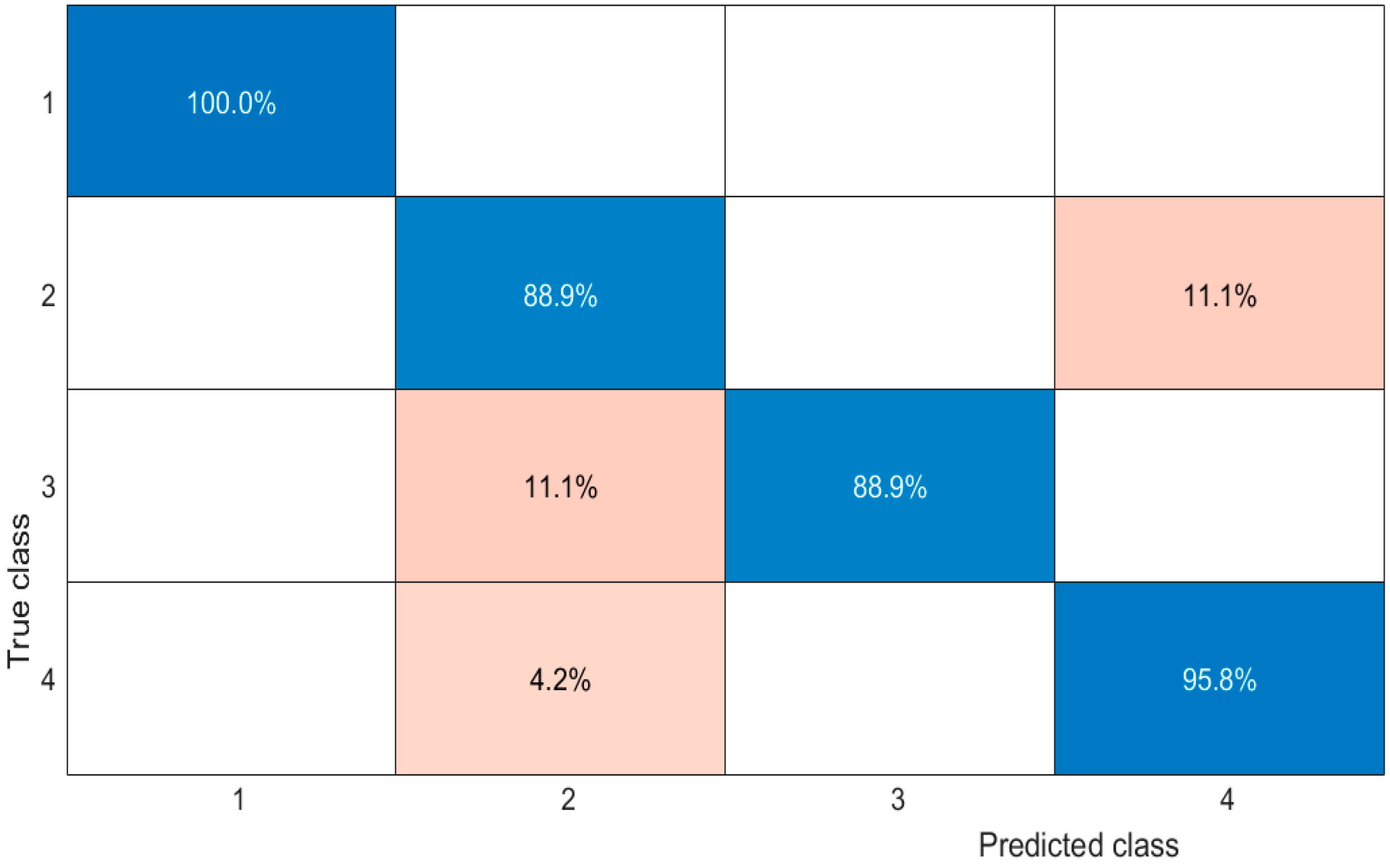
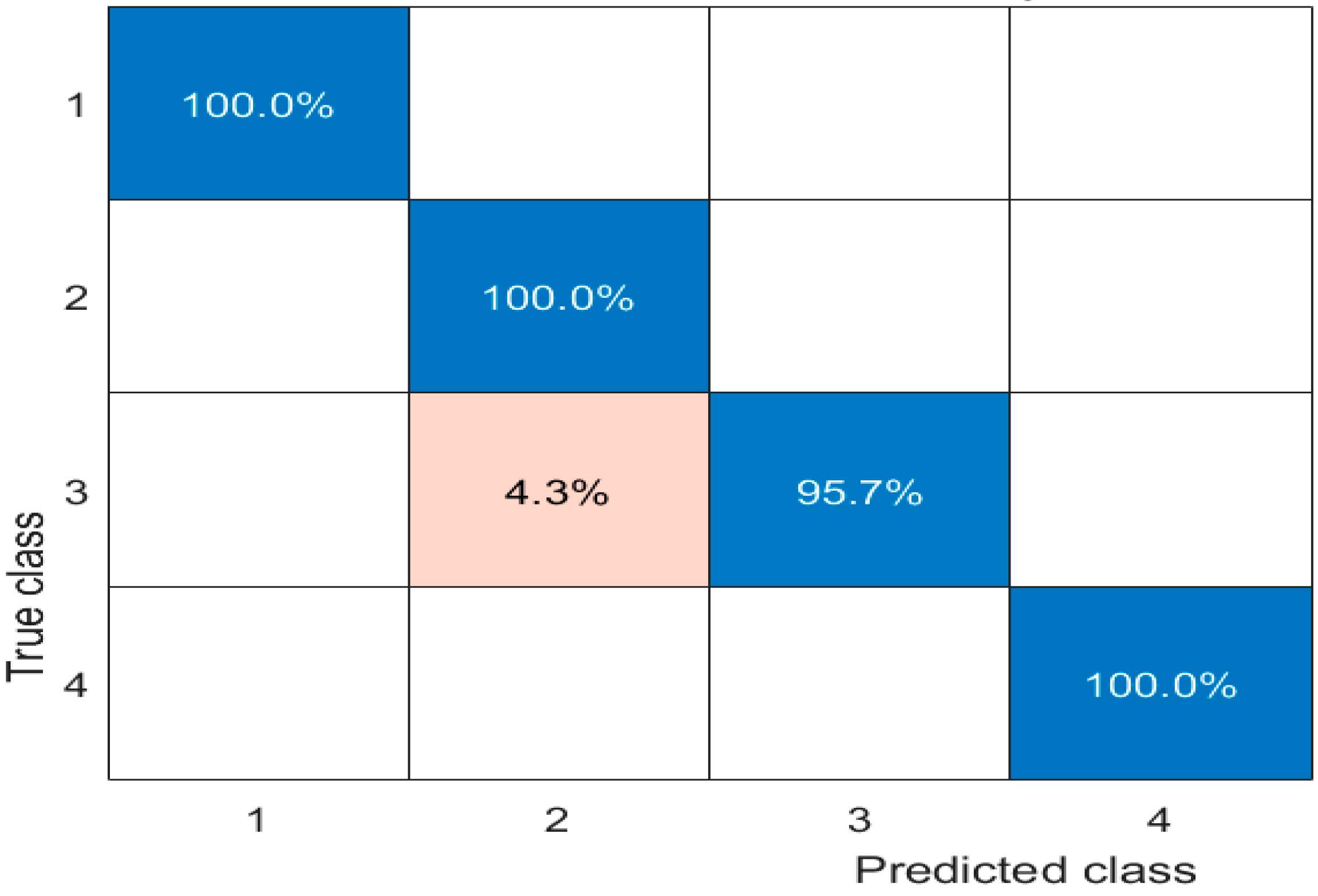
Analysis of the confusion matrix (
Figure 4) shows that most samples are classified correctly, and errors are systematic and occur mainly between neighboring classes with partial feature overlap.
The first and fourth classes are recognized almost without error both in training and in testing, indicating clearly defined vector directions in their hypersectors. Minor errors for the second and third classes are due to the similarity of local characteristics of defects, in particular, glare, microcracks, or similar surface texture. An insignificant number of incorrect assignments confirms that the fuzzy component of the model successfully mitigates the influence of noisy or fuzzy data.
An accuracy of 98.3% was achieved on an independent sample, indicating the model’s high generalization ability. All classes were correctly recognized, except for one case of confusion between the second and third classes, indicating the system’s robustness to changes in lighting conditions, shooting angles, and differences in the surface texture of the blades (
Figure 5). This result demonstrates that hypersector Fuzzy LVQ can be successfully applied to real-world wind turbine monitoring conditions.
Such behavior, where the training error appears slightly higher than the testing error (
Figure 4 and
Figure 5), can be explained by the nature of the fuzzy prototype-based learning process. During training, the model updates the hypersector prototypes iteratively using all available samples, including borderline and ambiguous instances, which increases the intra-class overlap and results in a higher recorded training loss. In contrast, the testing phase operates on fixed prototypes without further adaptation, allowing the model to benefit from the already optimized class geometry and therefore achieve lower error values. This phenomenon has been previously observed in prototype-driven and regularized learning models, where updating the representation space during training increases optimization noise but improves generalization stability. Overall, the obtained behavior confirms that the model did not overfit and supports the robustness of the hypersector representation.
4. Discussion
The paper presents a hypersectoral Fuzzy LVQ method for the intellectual detection of wind turbine blades’ defects. The developed method achieves a high classification accuracy of 98%, exhibits noise resistance, and operates correctly with partially overlapping classes. The use of an angular measure in combination with a fuzzy membership function allows you to effectively take into account the degree of similarity of objects, which is especially important for processing data from unmanned aerial vehicles during the diagnosis of blade defects. The results obtained confirm that the Fuzzy LVQ hypersector model is a promising tool for creating an intelligent system for technical diagnostics of wind turbines, capable of operating in real time and providing a reliable assessment of the technical condition of structural elements.
Beyond conventional deep learning models, the proposed hypersector FLVQ framework offers several fundamental advantages that were not achievable using end-to-end CNN classifiers. Modern deep architectures such as MobileNet-V3, EfficientNet-Lite, or ResNet-based detectors typically require large, balanced datasets and extensive retraining to achieve stable feature separation across defect categories [
39,
40]. In contrast, the proposed approach performs geometric decision-making directly in a hyperspherical feature space derived from SqueezeNet, enabling successful classification under limited data availability and class imbalance. Moreover, deep models often behave as non-transparent decision black boxes, making it difficult to interpret class boundaries and internal logic [
20]. The hypersector-based FLVQ model, however, preserves explicit prototype-to-class relationships and directional sector boundaries, providing interpretable angular margins that describe why a blade region belongs to a specific defect type.
Another essential strength of the model lies in its suitability for few-shot learning conditions. Prototype-based systems can be extended to new defect types simply by adding or updating class hypersectors without retraining the full CNN backbone or adjusting millions of parameters. This behavior has been demonstrated as efficient in recent fuzzy neuro-classifiers for industrial diagnostics [
30,
41]. Deep networks, in comparison, typically require full or partial network fine-tuning, resulting in higher computational cost and reduced adaptability to evolving defect conditions. Therefore, the hypersector FLVQ framework complements CNN feature extraction and yields superior interpretability and data-efficiency, making it a promising alternative to purely deep classifiers for UAV-based inspection and embedded turbine-monitoring tasks.
The prototype for the developed hypersectoral Fuzzy LVQ model can be considered the method proposed in [
29]. In this study, the authors combined the classical Learning Vector Quantization algorithm with the principles of fuzzy logic, resulting in a modified version of Fuzzy LVQ designed to improve classification generalization. Their approach allows for reducing the number of prototypes and increasing the stability of classification due to the fuzzy representation of the belonging of samples to several classes simultaneously. The model was tested on standard open datasets and demonstrated an average accuracy in the range of 90–93%, reaching a maximum of about 94%.
In contrast to this general approach, the proposed hypersector Fuzzy LVQ model implements a geometric representation of classes on the surface of a multidimensional hypersphere, where each class is described by its own hypersector. After normalization, feature vectors are placed on the hypersphere, and the similarity measure between them is determined by the angle between the directions. Fuzziness is introduced using the softmax function, which allows smooth estimation of the degree of belonging of a sample to several classes simultaneously. This approach provides a more natural modeling of overlaps between classes and increases the robustness of classification to noise and variations in the data.
The results showed that the hypersector model demonstrates an average accuracy of 93% on the test set and 95% on the training set, which is in line with or even exceeds the performance of the prototype. The average F1-measure for the proposed model is 0.93 compared to 0.90–0.92 in the prototype. In addition, the use of an angular similarity measure and normalization on the hypersphere reduces the influence of external factors such as lighting or noise, which is essential for processing real images. The lower F1-scores obtained for erosion and corrosion classes can be attributed to their high textural and visual similarity, which makes these defect categories more difficult to separate in the feature space. Both defects often appear as gradual surface degradations with overlapping color distribution, edge roughness patterns, and illumination-dependent texture variation, leading to partial feature clustering between classes. Similar challenges have been reported in recent studies on industrial texture classification, where visually related surface anomalies tend to produce reduced separability [
40,
41]. Future improvements may therefore include class-specific feature enhancement strategies, such as texture-focused preprocessing, multi-scale feature extraction, and class-adaptive prototype selection, which have been shown to improve separation in detail-sensitive scenarios.
The developed method demonstrates several essential advantages. In this study, a balanced dataset was used solely to enable fair model evaluation and to avoid dominance of the “normal blade” class during primary validation, which is consistent with common practice in technical image classification research [
40,
41,
42]. Additional analysis demonstrated that the average Precision, Recall, and F1 values remain stable when the number of defective samples is reduced within training subsets, indicating low sensitivity of the model to class imbalance. This stability results from the angular feature representation and fuzzy membership formulation, which makes the model less dependent on absolute class frequency. Therefore, the reported F1 score of 0.91 accurately reflects the true effectiveness of the proposed method and remains representative even under real-world conditions where normal blades substantially outnumber defective ones. The use of angular similarity on the hypersphere surface allows for a natural representation of the geometry of the feature space, facilitating more accurate defect separation and reducing misclassifications in overlapping regions. The fuzzy membership functions enable smooth transitions between classes, increasing robustness to noise, glare, and illumination variations typical of UAV-based imaging. The adaptive prototype-updating mechanism contributes to the formation of stable class centers, thereby strengthening the model’s generalization ability even when the training dataset is limited. Furthermore, the proposed approach is computationally efficient and interpretable, making it suitable for deployment on embedded systems of unmanned aerial vehicles.
At the same time, the model has certain limitations. Despite its overall high accuracy, the classes representing erosion and corrosion may partially overlap due to the similarity of their textural features, leading to occasional classification errors. A current limitation of the proposed hypersector classifier is that the sector apex angles are globally fixed and do not adapt to local variations in class geometry. The model’s performance may also degrade when images contain severe artifacts or when defects occupy minimal regions of the frame, which complicates their correct representation in the feature space. Additionally, the stability of hypersectors requires careful data normalization, as inconsistencies in feature scaling may influence the formation of direction vectors.



 ,
,