


1. Missing Citation
In the original publication [1], Ref. [2] was not cited. The citation has now been inserted in 2. Method, 2.1. IEC Three-Ratio Method, and should read:
“The IEC Three-Ratio Method is based on the dissolved gas analysis and the characteristic gas method. The five gases involved in this method are C2H2, C2H4, CH4, H2, and C2H6, which are characterized in the form of ratios (C2H2/C2H4, CH4/H2, and C2H4/C2H6) to identify faults [24].”
Additionally, in the original publication [1], Ref. [3] was not cited. The citation has now been inserted in 3. Establishment of the Experiment, 3.2. Data Acquisition and Preprocessing, and should read:
“For a better test of the practical performance of the fault diagnosis model, it is necessary to consider the influence of the transformer capacity, ambient temperature and humidity, and other actual operating transformers itself and external conditions. Therefore, in this paper, the volume fractions of dissolved gases (C2H2, C2H4, CH4, H2, and C2H6) in oil of real power transformers were collected as sample data for the experiment using smart sensors at Jiangxi Power Company (PSC) in 2019. The normal operating temperature is 25 °C, and the set humidity is 50% [29].”
2. Error in Table 5
In the original publication [1], there was a mistake in “Table 5. Results of the first set of comparative experiments” as published. The mistake was in the last column—IEC. The previous experimental data are incorrect because the set ratio range is not applicable. The corrected “Table 5. Results of the first set of comparative experiment” appears below.

Table 5.
Results of the first set of comparative experiments.
Table 5.
Results of the first set of comparative experiments.
| Fault Type | Accuracy (%) | |||
|---|---|---|---|---|
| IGWO-PNN | GWO-PNN | PNN | IEC | |
| LT (<150 °C) | 98.84 | 98.84 | 100.00 | 0.28 |
| LT (150–300 °C) | 100.00 | 92.34 | 100.00 | 100.00 |
| PD | 100.00 | 100.00 | 41.67 | 100.00 |
| AD | 100.00 | 94.74 | 94.74 | 100.00 |
| Average | 99.71 | 96.47 | 84.10 | 75.07 |
3. Error in Figure 6c
In the original publication, there was a mistake in Figure 6c as published. It was misplaced during typesetting. The corrected Figure 6 appears below.
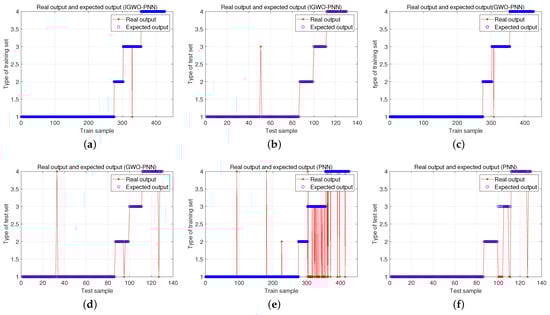
Figure 6.
Comparison of the diagnosis results of the first set of comparative experiments. (a,c,e) represent the results of train sample classification for different methods, respectively. (b,d,f) are the results of test sample classification for different methods, respectively.
4. Error in Figure 11h
In the original publication [1], there was a mistake in Figure 11h as published. It was misplaced during typesetting. The corrected Figure 11 appears below.
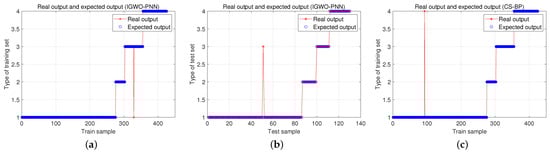
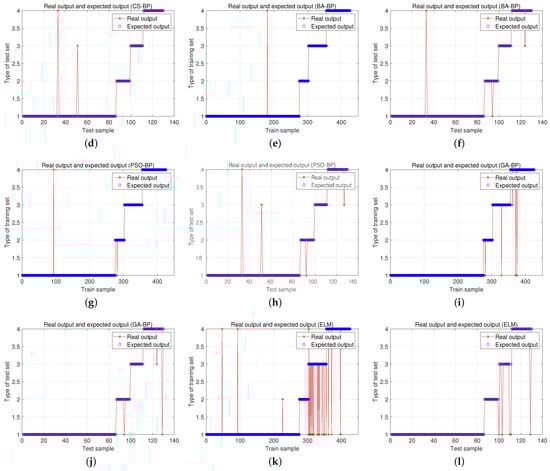
Figure 11.
Comparison of the diagnosis results of the third set of comparative experiments. (a,c,e,g,i,k) represent the results of train sample classification for different methods, respectively. (b,d,f,h,j,l) are the results of test sample classification for different methods, respectively.
The authors state that the scientific conclusions are unaffected. This correction was approved by the Academic Editor. The original publication has also been updated.
References
- Zhou, Y.; Yang, X.; Tao, L.; Yang, L. Transformer Fault Diagnosis Model Based on Improved Gray Wolf Optimizer and Probabilistic Neural Network. Energies 2021, 14, 3029. [Google Scholar] [CrossRef]
- Yang, X.; Chen, W.; Li, A.; Yang, C.; Xie, Z.; Dong, H. BA-PNN-based methods for power transformer fault diagnosis. Adv. Eng. Inform. 2019, 39, 178–185. [Google Scholar] [CrossRef]
- Yang, X.; Chen, W.; Li, A.; Yang, C. A Hybrid machine-learning method for oil-immersed power transformer fault diagnosis. IEEJ Trans. Electr. Electron. Eng. 2020, 15, 501–507. [Google Scholar] [CrossRef]
Disclaimer/Publisher’s Note: The statements, opinions and data contained in all publications are solely those of the individual author(s) and contributor(s) and not of MDPI and/or the editor(s). MDPI and/or the editor(s) disclaim responsibility for any injury to people or property resulting from any ideas, methods, instructions or products referred to in the content. |
© 2023 by the authors. Licensee MDPI, Basel, Switzerland. This article is an open access article distributed under the terms and conditions of the Creative Commons Attribution (CC BY) license (https://creativecommons.org/licenses/by/4.0/).