


Abstract
Many challenges are faced in the process of urban sustainable development, including the continuous growth in energy demand and rapid increase in CO2 and air pollutant emissions. This study focuses on the costs of measures to address these issues and establishes a multi-objective comprehensive assessment model for energy saving, CO2, and pollutant emission (MCEE). Taking Guangzhou as an example, the sustainable development measures are divided into three categories, energy-saving, demand-optimization, and environmental-protection. Five scenarios are set to quantitatively evaluate the costs when these measures are implemented alone or coordinately for the period 2015–2035. Conclusions are as follows: (1) Measures of energy-saving and demand-optimization have the best synergistic effect on energy saving and emission reduction. The synergistic benefits include an 80% and 84% increase in energy savings and CO2 reductions, respectively, and more than 50% increase in pollutant reductions. (2) Measures of demand-optimization and energy-saving have the best synergistic effect on cost saving, which reduces the unit technical improvement costs of energy saving and CO2 reduction by 49.5% and 54.9%, respectively, and the unit end-of-pipe costs of four pollutants by 59.15%, 54.43%, 61.15%, and 51.96, respectively. (3) Environmental-protection measures have remarkable synergistic effects in reducing the cost of health loss and labor loss. At the price of a 5% increase in technical improvement cost and 9% in end-of-pipe treatment cost, health loss, labor loss, and total social cost will be reduced by 18%, 19%, and 3%, respectively. The above conclusions provide support for cities of the same type to coordinate various measures, reduce resistance and barriers to their implementation, compensate for the market deficiency of high costs of some measures, and achieve the goal of sustainable development.
1. Introduction
Urbanization is the result of a game between humans and nature, and sustainable urban development is the long-term equilibrium of this game. Over half of the world’s population is currently living in urban areas [1,2]. Cities are the world’s largest consumers of energy, as well as the major emitters of greenhouse gas and air pollutant emissions [3,4,5,6]. Sustainable Cities are listed by the United Nations as the eleventh Sustainable Development Goal (Sustainable Cities and Communities—SDG 11). Energy shortages, greenhouse gas emissions, and air pollutant emissions caused by rapid urban development are three of the main concerns for sustainable urban development [7,8,9].
The issues of energy, climate change, and air pollution are often dealt with separately, and each has its own typical response. Energy is a major driver of urban development. Energy-saving measures, such as improving energy saving, reducing energy waste, and developing new sources of energy, are considered effective ways to address energy shortages. Excessive greenhouse gas emissions are an important cause of global warming, and demand-optimization measures, such as promoting low-carbon production and lifestyle, reducing the demand for production and living, and reducing fossil fuel combustion, are considered effective ways to reduce greenhouse gas emissions. Excessive emissions of air pollutants have serious impacts on the ecological environment, human health, and social welfare. Popularizing environmental-protection measures and improving the efficiency of end-of-pipe pollutant solution/treatment are considered to be effective ways to reduce air pollutant emissions.
Energy saving, carbon reduction, and air pollutant reduction measures have proven themselves in practice to achieve single category of goals, but they are not nearly enough for the overall achievement of the Sustainable Development Goals. There is a lot of literature that has recognized the link between these measures [10]. Reducing energy consumption from fossil fuels, improving the efficiency of combustion systems, and shifting energy from fossil to non-fossil fuels, for example, may help to reduce climate pollutants and improve air quality [11,12], widespread promotion of renewable energy, significant electrification, and increased share of biofuels; widespread wind power and solar energy can effectively reduce greenhouse gas emissions and air pollutant emissions [13,14,15], and sustained renewable energy policies can help promote energy security [16]. Forty-five and two tenths percent of the waste heat from the incineration plant in the Tokyo metropolitan area can cover 13.8% of the industrial heat consumption, reducing CO2 emissions by 2200 kiloton per year [17]. Energy saving measures in the cement industry have co-benefits in terms of air pollutant reduction [18], reducing CO2 emissions by 38%, SO2 by 23%, NOX by 33%, and PM by 26% in some Chinese provinces [19]. Promoting public transport and subsidy policies can reduce carbon emissions from passenger transport, which reduces pollution losses and improves human health [20,21].
Measures to address climate change have been shown to generate considerable co-benefits and synergies. Reductions in greenhouse gas emissions generally reduce emissions of co-emitted air pollutants, with co-benefits for air quality and human health [22,23]. China’s carbon-neutral target-driven low-carbon policies will contribute significantly to reductions in concentrations, such as PM2.5 [24]. The U.S. Regional Greenhouse Gas Initiative (RGGI) program reduces sulfur dioxide (SO2) emissions and associated damages in the policy area, in addition to achieving its CO2 reduction targets [25]. Climate change adaptation strategies have synergistic effects with enhancing agricultural sustainability, environmental protection, and biodiversity conservation policies [26,27,28,29].
Air pollutant reduction measures also have a variety of synergistic effects. Nam et al. [30] found that achieving China’s SO2 and NOX emission control targets reduced CO2 emissions by much more than expected, and that SO2 control measures also had a significant effect on CO2 reductions [31]. The environmental policies driven by “Beautiful China 2035” may contributes significantly to CO2 emission reductions [24]. Strict air quality policies and measures can reduce significant CO2 emissions [32]. Combining air pollution control policies with universal energy policies can further reduce the health impacts of air pollution [33].
Literature has begun to focus further on the resources and costs that measures required as a result of increasing energy scarcity, diminishing space for greenhouse gas emissions (2-degree temperature target) and increasingly demanding environmental targets. Using just 45.2% of the waste heat from waste incineration facilities in the Tokyo metropolitan area could save JPY 63 billion (US$600 million) per year [17]. Most energy efficiency technologies in the thermal power and cement sectors will yield significant co-benefits, but the technologies are costly [34]. Carbon reduction co-benefits have reduced the cost of energy saving measures in the steel industry from CNY 1924.76 per GJ to CNY 1658.37 per GJ [35], and the full energy saving benefits (i.e., energy saving, CO2 reduction, and health benefits) in the cement sector will be 1.3–3.6 times the cost of the measure [36]. Deep decarbonization measures will significantly reduce the loss of GDP from the National Determined Contributions [37]. The loss of environmental damage due to NOX and SO2 were US$1006 per ton and US$902 per ton, respectively. Carbon taxes and carbon emissions trading markets can reduce the abatement costs and health costs of society [38,39,40]. The global average co-benefit of policy measures to reduce carbon is US$50–380 per ton of CO2 [22]. The cost of achieving and maintaining China’s 12th Five-Year Plan pollution targets would be quite high [30]. SO2 taxation is effective in controlling air pollution and improving the energy consumption mix with no significant negative impact on economic performance [41]. Electricity subsidy policies in the promotion of Evs have good environmental and cost benefits [21,42].
As a synthesis of the above literature, it is clear that there is a large body of literature that focuses on the co-benefits of achieving the goals of energy saving, CO2 reduction, and pollutant management, and the synergies of related measures in achieving these goals, and a portion of literature that focuses on the costs associated with the implementation of related measures. However, only a small body of literature focuses on the synergies in terms of costs when these measures are implemented in tandem, especially in the city level. With so many sustainability issues in cities and limited resources and costs available for management decisions, fully exploiting the cost synergies of these measures and making limited resources and policies work efficiently to achieve more policy goals is an important part of enhancing sustainable urban development.
As there are clear regional differences in sustainable development issues, different cities face different urgencies in energy saving, CO2 reduction, and pollutant reduction targets, depending on population size, stage of development, level of industry, energy structure, etc., different types of cities have varied policy resources and cost tolerance levels, and sustainable development pathways may be completely different. Therefore, possible co-benefits and synergies between policies need to be studied at the city level.
Based on the above background, this paper focuses on the synergistic effects of energy saving, CO2 reduction, and pollutant reduction measures in sustainable urban development, and Guangzhou, one of the fastest growing cities in China and the core city of the Guangdong-Hong Kong-Macao Greater Bay Area, is taken as an example. The city proposed to control the amount of energy consumption at 62.84 million tons of standard coal, reduce the CO2 emission intensity per unit of GDP by 23% compared with 2015, and lower the annual concentration of fine particle matter (PM2.5) to 30 micrograms per cubic meter in the 13th Five-Year-Plan period. Guangzhou is under pressure to meet the cost of the transition and has the suitable case conditions.
Some of the methods and insights gained from this analysis will contribute to the literature. Such contributions include the following. (1) In this study, an integrated model related to sustainable urban development was developed to simulate energy consumption, CO2 emissions, and air pollutant emissions in cities, as well as the technical improvement and end-of-pipe treatment costs of implementing related measures. (2) A soft-link module was developed to simulate the health costs and labor loss costs of air pollutant impacts. (3) Costs of measures for energy saving, CO2 reduction, and pollutant reduction in the case city are studied, and the cost synergies of each measure are assessed. (4) Recommendations for the implementation of the measures and the authorities’ response strategies are presented. This paper fills a gap in research on the synergies in costs of achieving multiple sustainable development goals at the city level, as well as provides synergistic solutions for cost control in sustainable development in Guangzhou. The structure of this paper is as follows: The second section introduces research methodology, the third section describes the scenario and data, the fourth section is the discussion of the results, and the fifth section proposes conclusions and recommendations.
2. Methodology
The model adopted in this paper is the multi-objective comprehensive assessment model for energy consumption, CO2, and pollutant emission, referred to as MCEE. MCEE is based on the ExSS model developed by the National Institute for Environmental Studies in Japan [43]. The ExSS model is a bottom-up economic and energy system model that is primarily applied to energy demand and greenhouse gas emission scenario analysis. However, it is a static, regional model that lacks the ability to simulate in the time dimension and does not take into account cross-regional energy sources, as well as air pollutants, in the accounting boundary. In addition, the model lacks an accounting module for the cost of measures.
In order to meet the needs of our multi-objective cost synergy research, we made several key extensions to the ExSS model. These extensions consist of two steps. Improvements in version 1.0 includes the following. (1) The energy demand module and CO2 module are improved so that the modules could calculate the cross-regional energy demand and its emissions, and the energy balance analysis function is added. (2) A pollutant module is added that is uses to calculate SO2, NOX, non-methane volatile organic compounds (NMVOC), and particulate matter 2.5 (PM2.5) caused by fossil fuel combustion. (3) Energy technologies and pollutant removal technologies are added into the module. In addition, improvements in version 2.0 include the following: (4) the addition of costing modules for energy technologies and end-of-pipe treatment of pollutants, and (5) the health impact assessment models and soft linking of macroeconomic impact assessment models.
Finally, the MCEE model, version 2.0, implements a year-by-year simulation function for energy consumption, CO2 emissions, and air pollutant emissions, as well as simulation functions for technology improvement costs, end-of-pipe treatment costs, and health costs. In addition, the MCEE model is simulated under the General Algebraic Modelling System (GAMS). In addition, the MCEE model contains 18 sectors, which correspond to the 42 sectors in the Statistical Yearbook as shown in (Appendix A, Table A1 and Table A2).
2.1. Model Parameters and Equilibrium Equations
The structure of the MCEE model is shown in Figure 1. The model contains modules on energy, CO2, air pollutants, costs, and economic impacts. The main inputs include input-output data, population, energy balance sheet data, level of technology, level of pollution removal, and choice of measures. The main outputs include energy demand, CO2 emissions, pollutant emissions, technology improvement costs, and end-of-pipe treatment costs.
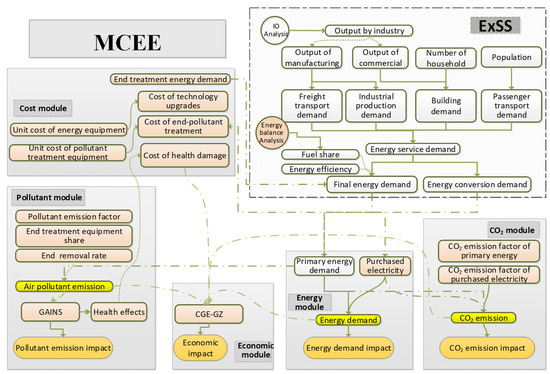
Figure 1.
The structure of the MCEE model.
A brief data flow of the model is shown in Figure 2. The main processes include economic and social activity levels based on population and input-output analysis and the establishment of energy structure and energy efficiency based on energy balance analysis, in addition to energy demand based on social activity, energy structure and energy efficiency. The inter-accounting relationships of the algorithms and formulas for the main processes are shown below.
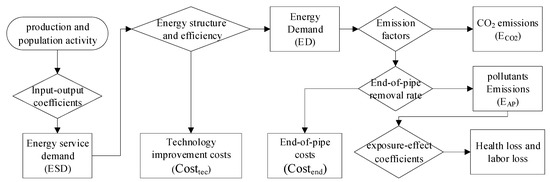
Figure 2.
A brief data flow of the MCEE model.
The energy service demand (ESD) is calculated with reference to the ExSS model [43].
The energy demand (ED) accounting includes the following elements. Based on the energy service demand, energy technology, energy efficiency, and other factors of the sector, the energy demand of the sector is calculated. Electricity transferred in (out) and the energy for end-of-pipe treatment are added to the accounting compared to the ExSS model, as shown in Equation (1).
where
- : energy service demand by industry (ten thousand tce equivalent),
- : proportion of energy by industry and equipment type (%),
- : energy efficiency by industry, equipment, and energy type (%),
- : primary energy demand of the power conversion sector (ten thousand tce),
- : demand for electricity transferred in and out (ten thousand tce), and
- : energy demand for pollutant treatment of the end-pipe equipment (ten thousand tce).
The CO2 emission accounting (ECO2) includes the following elements. Based on the energy demand activity level and the CO2 emission factors from the Intergovernmental Panel on Climate Change emission factor database [44], the accounting process is shown in Equation (2).
where
- : CO2 emission factors by energy type (tCO2/tce),
- : local average emission factor (tCO2/kWh),
- : electricity conversion factors (tce/10MWh), and
- : CO2 emission factor of the imported electricity (tCO2/kWh).
The air pollutant emission (AP) accounting includes the following elements. Based on the energy demand activity level, the air pollutants emission factor from the Intergovernmental Panel on Climate Change emission factor database [45], and the removal rates for end-of-pipe equipment [46], the air pollutant emissions are calculated as shown in Equation (3).
where
- : factors of air pollutant emissions by energy type (t/tce),
- : removal rate of air pollutants by industry and equipment types (%),
- : factors of air pollutant emission in the power generation industry (t/tce), and
- : removal rate of air pollutants emissions in the power generation industry (%).
Technology improvement costs are based on the demand for energy services in the sub-sector, the number of new equipment added to the previous year in the sub-sector, and the unit cost of the baseline technology and the advanced technology for energy services form AIM_enduse [47]. In addition, the technology improvement costs are calculated as shown in Equation (4).
where
- : energy service demand by equipment by industry in the accounting year (tce equivalent),
- : proportion of equipment type by industry in the accounting year (%),
- : proportion of equipment types by industry in the previous year of the accounting year (%), and
- : cost per unit of technical improvement in energy service equipment demand by equipment type by industry (CNY/tce equivalent).
The cost of end-of-pipe treatment is based on energy demand by sector, the unit cost of baseline end-of-pipe treatment technology, and advanced end-of-pipe treatment technology, and the end-of-pipe treatment costing process is shown in Equation (5).
where
- : energy demand by equipment by industry in the accounting year (tce),
- : proportion of equipment type by industry in the accounting year (%), and
- : end-of-pipe treatment cost per unit of energy consumption by industry and equipment type (CNY/tce).
In addition, the MCEE model obtains pollutant concentration data through a data soft-link to the GAINS model, which allows further construction of a health loss module that uses exposure-effect coefficients to obtain the number of prematurely deaths based on age-specific mortality rates, yielding the number of cases of each relevant disease due to PM2.5 pollution. In turn, the time lost from work and health costs are estimated.
2.2. Cost Synergy Assessment Method
2.2.1. Unit Abatement Cost
The unit abatement cost, expressed as , refers to the amount of additional cost per unit reduction in energy consumption (CO2 emissions, pollutant emissions) over the study period for the different measures (scenarios) compared to the baseline scenario. The , calculation is shown in Equation (6).
where x refers to e, c, or p, representing energy demand, CO2 emissions, or pollutant emissions, respectively.
- refers to the additional incremental cost, under measure x (CNY).
- means the base demand or emissions of x under the baseline scenario (ton).
- refers to the demand or emissions of x under the x scenario (ton).
2.2.2. Cost Synergy Index
The percentage reduction in cost of two or more measures implemented in combination compared to measures implemented separately to accomplish the same task, expressed as I, as shown in Equation (7).
where
- n: number of measures of separate types.
- : the unit cost of the i measure when implemented alone (CNY/ton).
- : unit cost for the implementation of a combination of n measures (CNY/ton).
3. Scenario and Data
3.1. Scenario Hypothesis
In order to assess the various synergies among the measures for the three domains of the gaming with nature, a baseline scenario, three independent measure scenarios, namely the energy-saving scenario, the demand-optimization scenario, and the environmental-protection scenario, and two combined scenarios, namely the energy-saving and low-carbon scenario and the blue-sky scenario, are developed in this paper. The detailed designs of the scenarios are shown in Table 1.

Table 1.
Scenario design.
3.1.1. BAU Scenario
Led by the “new normal economic development” mode and the objectives of “Beautiful China 2035”, according to the existing policies and technical level, with reference to the overall plan of Guangzhou (2017–2035), the population will reach 20 million, and the GDP will reach 6.6 trillion, CNY in 2035 [48]. Referring to the energy-saving target (the incremental energy consumption was less than 5.95 million tce) of the 13th FYP of Guangzhou Energy Development [49], the CO2 emission reduction intensity target per unit of GDP (19.5% and 23%) and the pollutant reduction target (PM2.5 concentration reduced to 30 μg/m3) of the 12th FYP and the 13th FYP of Guangzhou [50,51,52,53,54], parameters were calibrated for each time nodes in the BAU scenario. Except for special instructions, the scene parameters change linearly between time nodes, as shown in Table 2.
Table 2.
BAU scenario parameters.
3.1.2. Energy-Saving Scenario
With the aim of building a clean and efficient energy system, the ES scenario builds on the BAU scenario with the following series of energy saving measures.
The ES scenario has the following assumptions about the energy structure of power generation. The share of coal-fired power will gradually be replaced by the natural gas-fired power, which will all be retired by 2030. The efficiency of natural gas-fired power will increase from 38% in 2015 to 42% in 2035, while the efficiency of coal-fired power will remain at 36%, until they are retired. The share of wind, solar, and biomass power will increase significantly to reduce the share of imported electricity. The power generation structure is shown in Table 3.
Table 3.
The energy structure of the power generation sector.
The ES scenario includes the following assumptions about restructuring measures for industrial energy consumption. The energy restructuring and energy efficiency optimization are achieved by adjusting the proportion of baseline and advanced equipment in industry. Energy efficiency improvements are achieved by replacing existing equipment with advanced equipment, as shown in Appendix B and Table A3. In summary, compared to 2015, coal will not be visible in the energy mix of all sectors in 2035, with a significantly lower share of oil consumption and a significantly higher share of natural gas and clean electricity. Energy efficiency will increase in all sectors to varying degrees (15–45%).
The ES scenario has the following assumptions in the transportation sector: the optimization of the energy consumption structure in transport, the implementation of an electrification strategy for passenger transport, and the implementation of oil to electricity (clean energy) for freight transport. See Appendix B and Table A4 for details.
The ES scenario has the following assumptions for buildings sector: a 20% increase in the proportion of energy consumption electrified rate in residential and commercial buildings and a 25–35% increase in energy efficiency levels.
3.1.3. Demand-Optimization Scenario
With the objective of building a low carbon industrial production and social life system, the DO scenario builds on the BAU scenario with the following series of demand optimization measures.
DO scenario has the following assumptions for optimizing the industrial structure: the share of the primary sector remaining stable, the secondary sector shifting to the tertiary sector (by 0.4% annually), and a shift within the secondary sector from energy-intensive industries to advanced manufacturing industry, with the industrial structure adjusted to 1%:17%:82% in 2035 (for the BAU scenario is 1%:25%:74%).
The traffic structure assumptions of the DO scenario are as follows: the optimization will result in a 5% and 7% reduction in per capital demand for intra-city and inter-city travel services, respectively, and a 25% and 15% reduction in unit output value demand for intra-city freight services and inter-city freight services, respectively, as well as reducing average travel and transport distances and adopting lower carbon travel and freight modes; the main parameters are shown in Appendix B and Table A5.
The DO scenario assumes the following: the average number of urban and rural households will be 2.4 and 2.7 persons, respectively, by 2035. Compared to the base year, the living space per person will increase by only 5–15%, with the demand for building space per unit of output value decreased by 10% and 20% in the commercial and service sectors, respectively.
3.1.4. Environmental-Protection Scenario
In order to build an end-of-pipe pollutant treatment system with wide coverage and high removal rates, the EP scenario builds on the BAU scenario with the following measures.
The EP scenario assumes the following: by 2035, 100% of industrial emission sources will be covered by end-of-pipe equipment, the proportion of new equipment will increase from 50% of the BAU scenario to 90% of the EP scenario, and the removal rate of new equipment will increase by a further 10–50% compared with baseline equipment (depending on the type of equipment).
3.1.5. Energy-Saving and Low-Carbon Scenario
The ES&LC scenario is constructed based on the BAU scenario. A combination of energy-saving measures and demand optimization measures is adopted to assess the synergistic effects of the combined implementation of both types of the measures.
3.1.6. Blue-Sky Scenario
The BS scenario is constructed based on the BAU scenario, with the objective of “Beautiful China 2035”. A combination of energy-saving, demand optimization, and environmental protection measures are adopted to evaluate the synergistic effects of all the measures.
3.2. Data Acquisition and Model Calibration
3.2.1. Key Data, Energy Balance Sheet, and Input-Output Table
As the Guangzhou Bureau of Statistics did not release an official energy balance sheet and input-output table for 2015, two preparations are performed in this study. Based on the basic data obtained from the survey [55], the 2015 energy balance sheet of Guangzhou was constructed using the method of the total volume control (Appendix B and Table A6). Based on the input-output table of 42 departments in Guangdong Province in 2015 [56,57], the input-output table of Guangzhou City in 2015 was obtained using the algorithm known as the GRAS method in the literature [58] (Appendix B and Table A7).
3.2.2. Calibration of the Energy Consumption, CO2 Emissions and Pollutant Emissions in the Base Year
In this paper, the sectoral data of the Guangzhou Statistical Yearbook 2016 was used to calibrate the energy consumption. The MCEE’s CO2 emissions were calibrated using the 2015 Guangzhou Municipal Greenhouse Gas Emission Inventory obtained from the survey. The air pollutant emission model of Guangzhou City in 2015 was used to calibrate the air pollutant emission data to ensure that the model conformed to the actual situation in Guangzhou.
4. Results and Discussion
4.1. Analysis on the Target Completion
Taking BAU scenario as reference, the cumulative amounts of energy saving, CO2 emission reduction, and pollutant reduction in each scenario from 2015 to 2035 are as shown in Table 4.
Table 4.
The cumulative amounts of energy saving and emission reduction.
Compared with the BAU scenario, measures of energy saving are more efficient than the other two types of measures in reducing energy demand, CO2 emission, and SO2, NOX, and NMVOC pollutants during the study. Measures of demand optimization are equivalent to the ES scenario in energy conservation, with 23% CO2 emission reduction and 15–63% four types of pollutants reduction. The EP scenario performs well in the reduction of pollutants, especially in the decline of PM2.5, but energy consumption and CO2 emission will increase by 7% and 5%, respectively.
Measures of energy saving and demand optimization are significantly synergistic in energy saving and emission reduction. The combination of these two types of measures is able to reduce energy demand and CO2 emission by 80% and 84%, respectively, with synergistic effect on the reduction of four types of air pollutants, and the synergistic effect of measures, such as energy saving and demand optimization on the reduction of air pollutants, is also confirmed in this literature [12,18]. The BS scenario strengthens the end-of-pipe treatment facilities based on the ES&LC scenario, which further reduces emissions of air pollutants with the reductions of NOX and PM2.5 increased by 40% and 60%, respectively, but the reduction of NMVOC emission is limited, and the reduction amounts of energy consumption and carbon emission slightly decreases by 3.8% and 1%, respectively.
4.2. Technology Improvement and End-of-Pipe Treatment Costs
In terms of technical improvement cost, the overall technical improvement cost of demand optimization measures is relatively low at the level of 4 to 6 billion CNY, while the cost of energy saving measures is higher and increases significantly over time, possibly exceeding 14 billion CNY by 2035. There is a synergistic effect in the cost when measures of energy saving and carbon reduction are combined, with the annual technical improvement cost at 4 to 8 billion CNY, which is slightly higher than that of demand optimization measures and significantly lower than that of energy saving measures, as shown in Figure 3.
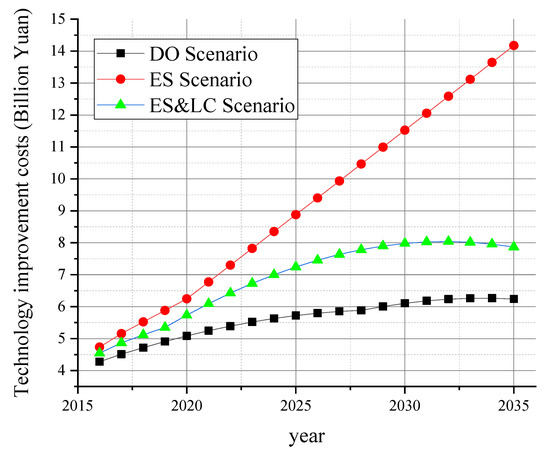
Figure 3.
Technology improvement costs of the DO ES and ES&LC scenarios.
Environmental protection measures have poor synergy with energy saving and carbon reduction measures in terms of technical improvement cost. The BS scenario, which strengthens environmental protection based on energy saving and carbon reduction measures, has significantly increased technical improvement cost, 100 to 500 million CNY higher than that of the ES&LC scenario per year, during the study, as shown in Figure 4.
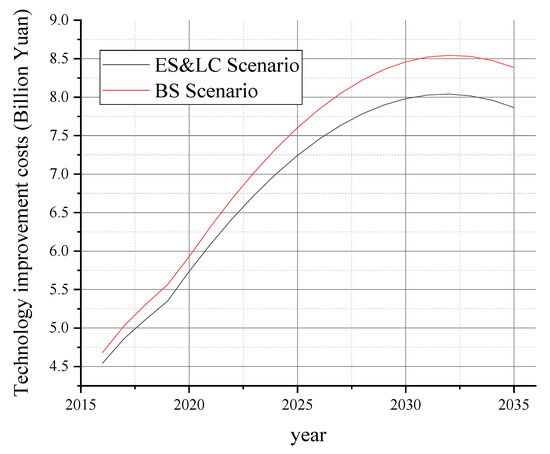
Figure 4.
Technology improvement costs of the ES&LC and BS scenarios.
There is a very significant synergistic effect in terms of end treatment cost between demand optimization measures and energy saving measures. During the study period, the cumulative cost of demand optimization measures is close to that of energy saving measures, but its time distribution is more stable. The annual end-of-pipe cost remains between 360 and 430 million CNY. The end-of-pipe cost of energy saving measures is relatively lower in the early stage but increases sharply later and reaches 500 million CNY by 2035. The coordinated implementation of these two types of measures in ES&LC scenario leads to remarkable synergistic effect in terms of end-of-pipe cost. The annual end-of-pipe cost is between 330 and 370 million CNY, which is lower than that of the ES scenario and the DO scenario during the whole period, as shown in Figure 5.
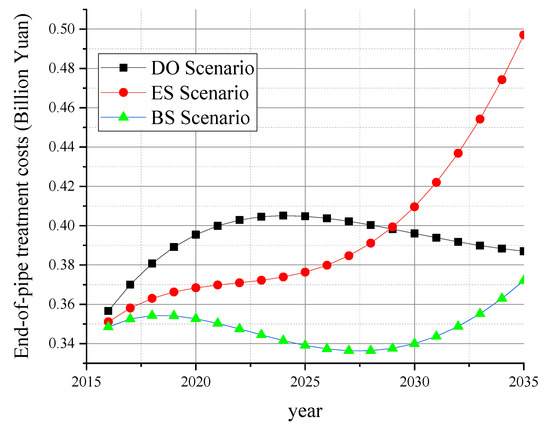
Figure 5.
End-of-pipe costs of the DO ES and BS scenarios.
There is a modest synergistic effect of environmental protection measures in terms of end-of-pipe cost. The annual end-of-pipe cost of EP scenario is 0 to 130 million CNY higher than that of the BAU scenario, with an increase of 23.32% per year. The annual end-of-pipe cost of BS scenario is 0 to 160 million CNY higher than that of the ES&LC scenario, with an increase of 41.92% per year (see Figure 6). It is more difficult to strengthen end facilities in the ES&LC scenario with a good basis than in the BAU scenario. In terms of time scale, the later the environmental protection measures are implemented, the higher their costs will be, implying the growing non-synergy between environmental protection measures and other measures with the development of technology.
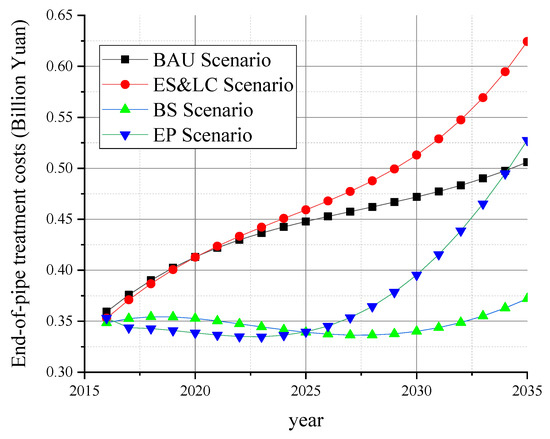
Figure 6.
End-of-pipe costs of the BAU EP ES&LC and BS scenarios.
4.3. Health Cost and Labor Loss
During 2015 to 2035, the health costs of air pollutants in the ES scenario, DO scenario, EP scenario, ES&LC scenario, and BS scenario are 4.62 billion CNY, 5.02 billion CNY, 4.24 billion CNY, 3.85 billion CNY, and 3.16 billion CNY, respectively, resulting in labor losses of 89.42 billion CNY, 97.46 billion CNY, 81.86 billion CNY, 74.30 billion CNY, and 60.46 billion CNY, respectively. The extra health and labor losses will be greatly reduced as the reduction of air pollutant emissions, as shown in Table 5.
Table 5.
Cumulative costs of the five scenarios for 2015 to 2035.
If the costs of health and labor loss are included in the total social cost, the cumulative cost in twenty years will reach 185.9 and 163.5 billion CNY in the BAU and EP scenarios, respectively, with labor loss as the largest cost at the proportion over 50%. Compared with the BAU scenario, the end treatment cost increases by 6% in the EP scenario will lead to the decrease of health and labor loss cost by 21.9% and 22.7%, respectively. The cumulative costs of the ES scenario and the DO scenario for twenty years are 286.53 and 222.20 billion CNY, respectively, with the technical improvement cost as the largest cost at the proportion about 65% and 50%, respectively. The technical improvement cost of the DO scenario is lower than that of the ES scenario. In the ES&LC scenario, not only are energy consumption and CO2 emission decreased significantly, but the treatment costs of the four types of pollutants are also decreased by 12–25%, respectively, compared with those in the ES scenario. Compared with the DO scenario, the sum of increased technical and end-of-pipe costs is almost equal to the sum of reduced health and labor loss costs, manifesting a significant synergistic effect. The cumulative cost of the BS scenario in twenty years is 216 billion CNY. On the basis of the ES&LC scenario, technical improvement cost and end treatment cost are further increased by 5% and 9%, respectively, with health loss and labor loss reduced by 18% and 19%, respectively, and total cost by 3%. Taking health cost and labor cost into consideration, the environmental protection measures have a synergistic effect to some extent in terms of total cost (see Figure 7). The literature suggests that, under a stringent carbon reduction scenario, monetized health co-benefits in Sichuan Province, China, will amount to US$23 billion in 2035 at a cost of US$1.7 billion [59].
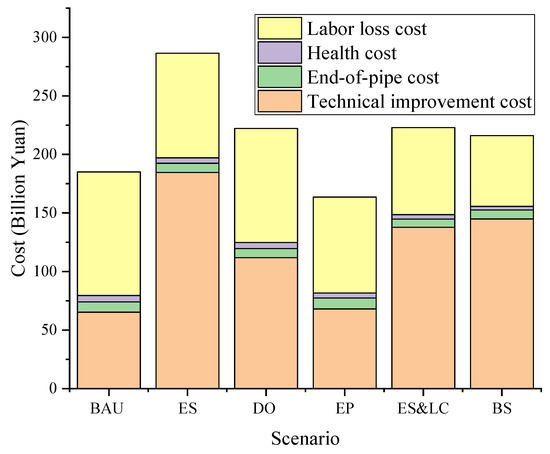
Figure 7.
Cumulative costs from year 2015 to 2035.
4.4. Synergistic Effect of Cost among Measures
There is a significant synergistic effect between energy saving measures and demand optimization measures in unit amount of energy saving, carbon reduction, or pollutant reduction cost. As shown in Table 6. The technical improvement costs of unit energy saving and unit carbon reduction are 476 and 256 CNY/ton, respectively, in the DO scenario, 745 and 317 CNY/ton, respectively, in the ES scenario, and 308 and 129 CNY/ton, respectively, in the ES&LC scenario, and the carbon reduction cost of the ES&LC scenario (129 CNY/ton) is closer to the reasonable carbon price range (60–120 CNY/ton) estimated by literature for carbon trading system in the Guangdong-Hong Kong-Macao Greater Bay Area [60]. which is lower than the global average co-benefits cost (50–380 US$/ton) estimated in literature [22]. Technical improvement cost can be saved by 49.5% compared to the ES scenario when the same amount of energy saving is achieved, and by 54.9% compared to the DO scenario when the same amount of carbon reduction is achieved. In the BS scenario, which strengthens environmental protection measures, these two types of unit cost are increased by 9% and 6%, indicating the non-synergy between environmental protection measures and other measures in terms of technical improvement cost.
Table 6.
Technical improvement costs of unit carbon reduction in main scenarios.
There are synergistic effects among the three types of measures in the target of pollutant reduction. For the reduction of four pollutants (SO2, NOX, NMVOC, and PM2.5), as shown in Table 7, the end-of-pipe treatment cost the front-end demand optimization measures 75.0, 148.0, 161.2, and 3435.0 thousand CNY/ton, respectively, energy saving measures 30.0, 89.2, 59.3, and 2986.6 thousand CNY/ton, respectively, and environmental protection measures 103.6, 115.5, 319.4, and 3135.6 thousand CNY/ton. Demand optimization measures and energy saving measures improving from the sources have lower end treatment cost than the environmental protection measures at the end. The unit costs of the four types of pollutants decrease by 59.15%, 54.43%, 61.15%, and 51.96%, respectively. Compared with the ES&LC scenario, the BS scenario has a lower unit end-of-pipe cost of three pollutants with a slight increase in the unit end-of-pipe cost of NMVOC, indicating a synergistic effect of environmental protection measures in terms of unit end-of-pipe cost.
Table 7.
Unit end-of-pipe treatment costs of energy saving and emission reduction.
5. Conclusions and Recommendations
5.1. Conclusions
Among the three types of measures, measures of energy saving have best effects of energy conservation and emission reduction (of CO2 and pollutants). Demand optimization measures and energy saving measures have a significant synergistic effect when achieving the policy targets, the coordinated implementation of which will increase the energy saving and CO2 reduction by 80% and 84%, respectively, along with the reduction of four types of pollutants, by over 50%. Measures of environmental protection can further increase the reduction of pollutants but will lead to an increase in energy consumption and CO2 emissions.
The coordinated implementation of demand optimization and energy saving measures can not only greatly improve the completion of the policy targets but also greatly reduce the costs. It will reduce the unit costs of energy saving and CO2 reduction by 49.5% and 54.9%, respectively, and the unit costs of SO2, NOX, NMVOC, and PM2.5 by 59.15%, 54.43%, 61.15%, and 51.96%, respectively. The implementation of environmental protection measures will lead to the increase in the unit technical improvement costs of energy saving and CO2 reduction, along with the decrease in the end-of-pipe treatment costs of pollutants except NMVOC.
Among the three types of measures, demand optimization measures have the lowest technical improvement cost of unit energy saving and CO2 emission reduction amount, while energy saving measures have the lowest end-of-pipe cost of unit pollutant reduction, manifesting that energy saving measures are not cost-optimal measure to reduce energy demand and environmental protection measures are not cost-optimal to reduce pollutant emissions. The coordinated implementation of demand optimization and energy saving measures can lead to the best synergistic effect in terms of technical improvement cost, and, in addition to environmental measures, the best synergistic effect in terms of end-of-pipe cost can be achieved.
Environmental protection measures have a significant synergistic effect in terms of health cost and labor loss cost. Environmental protection measures can reduce health loss, labor loss and total social cost by 18%, 19%, and 3%, respectively, at the price of increase in technical improvement cost and end-of-pipe treatment cost by 5% and 9%, respectively, with a synergistic effect on total social cost.
5.2. Recommendations
The government should be mindful of the interactions between policies, have quantitative ex ante assessments and follow the principles of Evidence-Based Policy Making when formulating policies.
In addition to the traditional approach of optimizing the policy measures themselves to achieve a reduction in implementation costs, the approach of exploiting synergies between multiple types of measures offers an additional option for reducing the implementation costs of measures. When managers are faced with multiple policy objectives, they should consider synergies between multiple policies in order to reduce the implementation costs of individual measures, as well as the overall policy costs, and to reduce resistance and barriers to measure implementation.
The scope of performance assessment of urban development goals should shift from the traditional single goal orientation of GDP to a multi-goal orientation of economic development, social welfare, and human health, as the expanded scope of performance assessment will make non-cost-competitive public good-oriented measures cost feasible and compensate for the high market prices and deficiencies of some technological measures, thus adding weight to the implementation of sustainable urban development policies, and maintaining a long-term equilibrium for the game between human and nature in the urban context.
5.3. Limitations and Future Work
Regarding research limitations, firstly, only the costs of technological improvements and the costs of end-of-pipe governance have been selected for this study. In reality, urban sustainability measures involve a much wider range of costs and economic impacts, such as finance, taxation, and consumption. Future research could be extended to the economic impacts of the whole society. Secondly, this paper only focuses on the health costs associated with the effects of PM2.5 and ignores the potential health costs of other pollutants; future work will need to consider the combined impacts of multiple pollutants. Both of these points may lead to an underestimation of the amount of cost saving, thereby underestimating the cost synergies, but will not affect the overall judgement of cost synergies. In terms of modeling tools, the MCEE model currently only considers CO2 and air pollutant emissions from combustion, and future work will need to expand the accounting boundary to include CO2 emissions from industrial processes, pollutant emissions from non-combustion sources, etc.
Author Contributions
Y.X.: Methodology, Model development, Writing–original draft. P.W.: Model development. Y.D.: Writing–review. L.Y.: editing. S.R.: Model development & Data collection. D.Z.: Conceptualization, Supervision. All authors have read and agreed to the published version of the manuscript.
Funding
This research was funded by [Energy Foundation China] grant number [G-1811-28738], [National Natural Science Foundation of China] grant number [71603248], [Science and Technology Planning Project of Guangdong Province] grant number [2017A050501060], [JSPS KAKENHI] grant number [19K23530], and [JSPS KAKENHI] grant number [21K14276].
Institutional Review Board Statement
Not applicable.
Conflicts of Interest
The authors declare that they have no known competing financial interests or personal relationships that could have appeared to influence the work reported in this paper.
Appendix A
Table A1.
Correspondence between model sectors and statistical yearbook sectors.
Table A1.
Correspondence between model sectors and statistical yearbook sectors.
| Code | Model Sectors | Statistical Yearbook Sectors |
|---|---|---|
| ARG | Agriculture | Service in Support of Agriculture |
| EXT | Extractive Industries | Mining and Washing of Coal |
| Extraction of Petroleum and Natural Gas | ||
| Mining and Processing of Ferrous Metal Ores | ||
| Mining and Processing of Non-metal Ores | ||
| FAT | Food and tobacco | Food and tobacco manufacturing, Alcoholic beverages |
| TEX | Textile | Textiles |
| Textile, clothing, footwear, hats, leather and down and their products | ||
| WAF | Wood processing and furniture | Woodworking products and furniture manufacturing |
| PAP | Paper printing, cultural and educational sports goods | Paper, printing and sporting goods manufacturing |
| PET | Petroleum, coking products and processed nuclear fuel products | Processing of Petroleum, coking and processingof Nuclear Fuel |
| CHE | chemical industry | Chemical products manufacturing |
| NON | Nonmetal manufacturing | Non-metallic mineral products manufacturing |
| FMP | Ferrous metal processing manufacturing | Metal Smelting and Rolling Products Manufacturing |
| Manufacture of Metal Products | ||
| GEM | General Equipment Manufacturing | Manufacture of general purpose machinery |
| Manufacture of Special Purpose Machinery | ||
| TEM | Transportation Equipment Manufacturing | Transport equipment manufacturing |
| OMI | Other manufacturing industries | Manufacture of Electrical Machinery and Equipment |
| Manufacture of Computers, Communication, and Other Electronic Equipment | ||
| Manufacture of Measuring Instrument | ||
| Other Manufactures | ||
| Utilization of Waste Resources | ||
| Metal products, machinery and equipment repair | ||
| POW | Power, heat, gas and water supply industries | Production and Supply of Electric Power andHeat Power |
| Production and Supply of Gas | ||
| Production and Supply of Water | ||
| CON | Construction industry | Construction |
| WAR | Wholesale and retail trade | Wholesale and retail trade |
| TRA | Transportation | Transport, storage and postal services |
| SER | Service industry | Accommodation and catering industry |
| Information transmission, software and information technology services | ||
| Finance | ||
| Real Estate | ||
| Leasing and Business Services | ||
| Scientific research and technical services | ||
| Water, Environment and Utilities Management | ||
| Residential services, repairs and other services | ||
| Education | ||
| Health and social work | ||
| Culture, sports and recreation | ||
| Public administration, social security and social organizations |
Table A2.
Other sectors in the model.
Table A2.
Other sectors in the model.
| Code | Sections |
|---|---|
| HHD1 | Household of towns |
| HHD2 | Household of country |
| PTS | Passenger transport |
| FTS | Freight transport |
Appendix B
Table A3.
Equipment adjustments for the non-metallic mining and processing industries.
Table A3.
Equipment adjustments for the non-metallic mining and processing industries.
| Types of Energy Services | Equipment Type | Energy Varieties | 2015 Annual Proportion | 2035 Annual Proportion | Efficiency Improvement (2035/2015) |
|---|---|---|---|---|---|
| Direct heating service | Existing heating equipment 1 | Coal | 100% | ||
| Advanced heating equipment 1 | Coal | 26% | |||
| Existing heating equipment 2 | Electricity | 55% | |||
| Advanced heating equipment 2 | Electricity | 45% | 11% | ||
| Steam or hot water service | Existing steam equipment 1 | Coal | 86% | ||
| Advanced steam equipment 1 | Coal | 35% | |||
| Existing steam equipment 2 | Oil | 11% | 5% | ||
| Advanced steam equipment 2 | Oil | 13% | 35% | ||
| Existing steam equipment 3 | Gas | 3% | 10% | ||
| Advanced steam equipment 3 | Gas | 71% | 41% | ||
| Motor services | Existing power motor | Electricity | 100% | 40% | |
| Advanced power motor | Electricity | 60% | 11% | ||
| Other energy services | Other existing equipment 1 | Electricity | 83% | 40% | |
| Advanced other equipment 1 | Electricity | 43% | 11% | ||
| Other existing equipment 2 | Other energy | 17% | 7% | ||
| Advanced other equipment 2 | Other energy | 10% | 33% |
Table A4.
Energy structure adjustments in the transportation sector.
Table A4.
Energy structure adjustments in the transportation sector.
| Transportation Energy Structure Adjustment | 2015 Year | 2035 Year | |
|---|---|---|---|
| Passenger transport | Oil | 95% | 70.7% |
| Gas | 2% | 1% | |
| Electric | 3% | 27.3% | |
| Other | / | 1% | |
| Freight transport | Oil | 99.6% | 60.7% |
| Gas | / | / | |
| Electric | 0.4% | 10.3% | |
| Other | / | 29.1% | |
Table A5.
Traffic mode scenario setting.
Table A5.
Traffic mode scenario setting.
| Year 2015 | Year 2035 | ||||
|---|---|---|---|---|---|
| Traffic Area | Traffic Type | Average Travel Distance (km) | Proportion of Travel Mode (%) | Average Travel Distance (km) | Proportion of Travel Mode (%) |
| Urban passenger transport | Private car | 8.10 | 21 | 6.80 | 16 |
| Taxi | 5.50 | 4.5 | 4.68 | 1.5 | |
| Bus | 4.20 | 17.3 | 3.40 | 18.8 | |
| Metro | 7.03 | 16.6 | 5.99 | 20.6 | |
| Two rounds | 2.10 | 4.9 | 1.75 | 2.9 | |
| Shipping | 0.90 | 0.1 | 0.76 | 0.6 | |
| Walk | 1.10 | 26.5 | 0.94 | 28.5 | |
| Cycling | 5.01 | 9 | 4.25 | 11 | |
| Intercity passenger transport | Highway | 101.1 | 80.2 | 96.05 | 60.2 |
| Railway | 330.4 | 12.9 | 313.86 | 27.9 | |
| Waterway | 68.5 | 0.3 | 65.04 | 2.3 | |
| Aviation | 1923.1 | 6.6 | 1826.99 | 9.6 | |
| City freight | Road | 30.5 | 100 | 22.50 | 100 |
| Intercity freight | Road | 88.32 | 71.8 | 70.66 | 59.8 |
| Railway | 369.00 | 4.8 | 295.20 | 11.9 | |
| Waterway | 3467.49 | 23.2 | 2773.99 | 28 | |
| Air cargo | 4422.66 | 0.1 | 3538.12 | 0.2 | |
Table A6.
Guangzhou Energy Balance Sheet 2015 (Unit: 104 tce) (data from the author’s survey and research).
Table A6.
Guangzhou Energy Balance Sheet 2015 (Unit: 104 tce) (data from the author’s survey and research).
| Coal | Oil | Gas | Electricity | Other Energy | Total Energy Consumption | |
|---|---|---|---|---|---|---|
| Agricultural | 1.1 | 17.9 | 0.0 | 19.3 | 2.9 | 41.2 |
| ARG | 1.1 | 17.9 | 0.0 | 19.3 | 2.9 | 41.2 |
| Industrial | 1121.9 | 606.0 | 224.1 | 411.4 | 207.1 | 2570.5 |
| EXT | 0.0 | 0.0 | 0.0 | 0.0 | 0.0 | 0.09 |
| FAT | 26.3 | 32.61 | 11.2 | 51.6 | 22.9 | 161.24 |
| TEX | 66.8 | 24.59 | 6.9 | 110.0 | 14.1 | 251.61 |
| WAF | 0.1 | 5.33 | 1.6 | 20.6 | 3.3 | 30.92 |
| PAP | 29.6 | 13.62 | 3.7 | 46.7 | 7.6 | 110.63 |
| PET | 40.1 | 204.44 | 4.9 | 47.3 | 10.1 | 307.12 |
| CHE | 27.4 | 58.12 | 17.5 | 146.2 | 36.0 | 308.92 |
| NON | 24.6 | 3.97 | 0.9 | 41.5 | 1.9 | 82.13 |
| FMP | 7.8 | 14.26 | 3.3 | 113.2 | 6.8 | 146.97 |
| GEM | 0.0 | 20.46 | 5.6 | 75.4 | 11.5 | 112.93 |
| TEM | 0.0 | 76.32 | 28.3 | 114.0 | 58.2 | 276.81 |
| OMI | 0.0 | 70.78 | 16.8 | 255.3 | 34.6 | 377.57 |
| POW | 0.0 | 0.00 | 0.0 | 289.5 | 0.0 | 289.46 |
| CON | 1.1 | 81.48 | 0.0 | 31.6 | 0.0 | 114.25 |
| Services | 3.8 | 1441.1 | 54.0 | 683.8 | 0.0 | 2182.7 |
| WAR | 0.3 | 1214.8 | 15.0 | 64.3 | 0.0 | 1294.4 |
| TRA | 3.3 | 176.8 | 37.3 | 228.3 | 0.0 | 445.7 |
| SER | 0.2 | 49.5 | 1.7 | 391.2 | 0.0 | 442.6 |
| Resident consumption | 0.3 | 326.3 | 39.6 | 528.3 | 0.0 | 894.5 |
| HHD1 | 0.2 | 239.8 | 29.1 | 388.2 | 0.0 | 657.4 |
| HHD2 | 0.1 | 86.5 | 10.5 | 140.0 | 0.0 | 237.1 |
| Total energy consumption | 1127.0 | 2391.3 | 317.7 | 1642.8 | 210.0 | 5688.9 |
Table A7.
Guangzhou input-output Table 2015 (Unit: 104 Yuan) (data from the author’s survey and research).
Table A7.
Guangzhou input-output Table 2015 (Unit: 104 Yuan) (data from the author’s survey and research).
| Code | Output | ||||||||||
| Code | - | ARG | EXT | FAT | TEX | WAF | PAP | PET | CHE | NON | FMP |
| Input | ARG | 336,294 | 2 | 1,262,161 | 103,815 | 74,432 | 9012 | 16 | 207,315 | 43 | 147 |
| EXT | 2971 | 2374 | 9156 | 13,601 | 422 | 41,755 | 882,948 | 89,381 | 80,381 | 275,039 | |
| FAT | 627,371 | 24 | 4,523,381 | 71,753 | 9069 | 34,472 | 182 | 257,039 | 827 | 6741 | |
| TEX | 2005 | 54 | 11,548 | 3,513,513 | 89,000 | 86,331 | 3570 | 115,396 | 7082 | 50,803 | |
| WAF | 1177 | 5 | 7287 | 1644 | 557,478 | 31,087 | 556 | 5271 | 13,070 | 48,819 | |
| PAP | 8046 | 13 | 178,104 | 58,650 | 29,097 | 942,595 | 2351 | 224,736 | 26,704 | 87,387 | |
| PET | 45,950 | 525 | 6309 | 6958 | 13,263 | 14,368 | 783,957 | 347,881 | 25,680 | 108,489 | |
| CHE | 307,910 | 2870 | 360,194 | 829,777 | 114,138 | 629,701 | 441,377 | 11,756,376 | 164,292 | 757,646 | |
| NON | 637 | 9 | 19,423 | 698 | 19,214 | 3618 | 332 | 21,619 | 182,500 | 30,686 | |
| FMP | 1815 | 61 | 107,902 | 28,851 | 133,585 | 555,827 | 1123 | 297,234 | 27,475 | 5,778,074 | |
| GEM | 23,642 | 564 | 45,704 | 55,531 | 6793 | 26,505 | 3701 | 442,204 | 10,567 | 106,136 | |
| TEM | 11,217 | 4 | 948 | 1408 | 252 | 663 | 154 | 1918 | 647 | 7131 | |
| OMI | 2456 | 639 | 8473 | 27,869 | 6778 | 355,271 | 1406 | 387,351 | 9131 | 646,875 | |
| POW | 63,811 | 1819 | 177,830 | 234,977 | 53,295 | 156,057 | 79,780 | 706,043 | 195,872 | 981,871 | |
| CON | 175 | 0 | 1515 | 4054 | 291 | 2158 | 1469 | 4914 | 59 | 2337 | |
| TRA | 38,417 | 3497 | 378,605 | 223,552 | 80,120 | 165,408 | 129,618 | 839,402 | 101,979 | 551,941 | |
| WAR | 128,258 | 2052 | 3,067,761 | 1,903,552 | 254,146 | 1,006,689 | 854,252 | 4,427,993 | 590,569 | 700,497 | |
| SER | 73,207 | 2785 | 563,980 | 394,350 | 101,616 | 223,368 | 64,140 | 1,182,243 | 70,367 | 711,017 | |
| TII | 1,675,358 | 17,296 | 10,730,281 | 7,474,552 | 1,542,988 | 4,284,886 | 3,250,933 | 21,314,316 | 1,507,244 | 10,851,637 | |
| Value added | wage | 2,389,833 | 1461 | 1,640,327 | 1,941,852 | 389,605 | 959,719 | 159,203 | 3,286,737 | 179,374 | 722,182 |
| tax | 0 | 1561 | 1,575,215 | 363,927 | 116,114 | 207,537 | 1,541,959 | 1,536,187 | 70,193 | 211,417 | |
| cap | 69,371 | 1508 | 253,242 | 210,649 | 41,583 | 128,087 | 124,294 | 684,008 | 51,790 | 163,828 | |
| ops | 0 | 1975 | 1,329,875 | 432,180 | 139,355 | 299,821 | 290,328 | 2,027,513 | 93,046 | 330,814 | |
| TVA | 2,459,204 | 6504 | 4,798,659 | 2,948,608 | 686,657 | 1,595,164 | 2,115,785 | 7,534,445 | 394,404 | 1,428,241 | |
| Total Input | TI | 4,134,562 | 23,801 | 15,528,941 | 10,423,160 | 2,229,645 | 5,880,050 | 5,366,718 | 28,848,761 | 1,901,648 | 12,279,878 |
| Code | Output | ||||||||||
| Code | - | GEM | TEM | OMI | POW | CON | TRA | WAR | SER | TIU | |
| Input | ARG | 523 | 39,550 | 481 | 212 | 104,157 | 862 | 402,651 | 808,612 | 3,350,285 | |
| EXT | 4675 | 1937 | 19,483 | 1,443,140 | 199,831 | 86 | 46,463 | 1686 | 3,115,330 | ||
| FAT | 3464 | 4148 | 11,312 | 4934 | 10,334 | 217,972 | 268,397 | 3,247,437 | 9,298,858 | ||
| TEX | 30,667 | 135,673 | 32,261 | 30,388 | 127,978 | 190,843 | 576,491 | 245,781 | 5,249,382 | ||
| WAF | 10,223 | 29,282 | 36,451 | 1798 | 357,653 | 13,555 | 93,832 | 100,360 | 1,309,549 | ||
| PAP | 45,830 | 95,918 | 265,043 | 8774 | 44,269 | 102,769 | 460,332 | 1,856,782 | 4,437,397 | ||
| PET | 11,875 | 23,344 | 25,491 | 53,434 | 95,607 | 1,701,007 | 327,694 | 1,535,632 | 5,127,463 | ||
| CHE | 471,860 | 1,177,308 | 1,522,084 | 248,639 | 1,825,356 | 58,749 | 64,989 | 3,650,309 | 24,383,576 | ||
| NON | 18,745 | 25,895 | 223,238 | 141 | 1,724,108 | 4324 | 50,465 | 26,433 | 2,352,086 | ||
| FMP | 805,369 | 1,242,555 | 2,365,465 | 5665 | 2,770,255 | 23,715 | 89,533 | 570,707 | 14,805,212 | ||
| GEM | 1,817,521 | 786,674 | 1,115,975 | 12,158 | 510,960 | 100,832 | 52,033 | 388,115 | 5,505,616 | ||
| TEM | 84,776 | 26,215,437 | 98,621 | 860 | 16,379 | 1,036,452 | 10,301 | 120,459 | 27,607,626 | ||
| OMI | 1,326,194 | 1,115,772 | 19,091,805 | 82,949 | 1,066,693 | 2,298,407 | 2,152,057 | 3,229,234 | 31,809,362 | ||
| POW | 237,346 | 313,786 | 594,601 | 6,974,029 | 418,097 | 1,379,553 | 2,178,897 | 2,255,670 | 17,003,334 | ||
| CON | 1434 | 4946 | 29,715 | 38,027 | 765,792 | 18,822 | 174,867 | 208,893 | 1,259,469 | ||
| TRA | 274,932 | 958,372 | 884,680 | 467,816 | 857,742 | 6,719,633 | 12,898,510 | 2,796,450 | 28,370,674 | ||
| WAR | 1,121,197 | 3,275,186 | 4,416,927 | 189,357 | 6,838,984 | 1,944,111 | 24,983,315 | 5,507,306 | 61,212,152 | ||
| SER | 430,100 | 1,407,413 | 1,169,868 | 1,078,877 | 1,652,164 | 4,221,153 | 32,160,315 | 22,114,515 | 67,621,479 | ||
| TII | 6,696,732 | 36,853,196 | 31,903,499 | 10,641,197 | 19,386,361 | 20,032,847 | 76,991,142 | 48,664,382 | 313,818,848 | ||
| Value added | wage | 1,358,985 | 5,178,521 | 4,439,302 | 3,025,580 | 3,265,851 | 5,476,093 | 11,320,456 | 35,842,924 | 81,578,005 | |
| tax | 295,918 | 2,195,966 | 959,950 | 1,581,209 | 815,630 | 1,268,278 | 8,745,871 | 9,591,879 | 31,078,812 | ||
| cap | 183,451 | 1,251,042 | 509,477 | 1,698,954 | 398,419 | 2,523,860 | 1,216,466 | 10,617,883 | 20,127,914 | ||
| ops | 557,856 | 3,553,415 | 1,335,064 | 2,223,182 | 1,031,826 | 3,283,690 | 5,690,297 | 25,599,168 | 48,219,405 | ||
| TVA | 2,396,211 | 12,178,945 | 7,243,794 | 8,528,925 | 5,511,726 | 12,551,921 | 26,973,090 | 81,651,854 | 181,004,136 | ||
| Total Input | TI | 9,092,943 | 49,032,141 | 39,147,293 | 19,170,122 | 24,898,087 | 32,584,768 | 103,964,232 | 130,316,236 | 494,822,984 | |
| Code | Finally Using | Transfer and Import | Total Output | ||||||||
| Code | - | pc | gc | TC | fix | ex | OF | TFU | im | IF | GO |
| Input | ARG | 3,194,368 | 29,321 | 3,223,689 | 29,162 | 47,272 | 14,950 | 6,665,357 | −1,610,930 | −919,866 | 4,134,562 |
| EXT | 944 | 0 | 944 | 26,962 | 12,408 | 286,790 | 3,442,434 | −1,793,257 | −1,625,377 | 23,801 | |
| FAT | 5,243,119 | 0 | 5,243,119 | 127,438 | 812,607 | 881,686 | 16,363,708 | −262,504 | −572,264 | 15,528,941 | |
| TEX | 2,335,981 | 0 | 2,335,981 | 69,449 | 3,153,332 | 961,357 | 11,769,501 | −456,305 | −890,036 | 10,423,160 | |
| WAF | 240,745 | 0 | 240,745 | 380,166 | 614,780 | 393,829 | 2,939,069 | −314,027 | −395,397 | 2,229,645 | |
| PAP | 672,303 | 0 | 672,303 | 104,673 | 1,307,900 | 806,565 | 7,328,839 | −919,853 | −528,936 | 5,880,050 | |
| PET | 764,645 | 0 | 764,645 | 91,057 | 147,688 | 531,854 | 6,662,706 | −358,599 | −937,389 | 5,366,718 | |
| CHE | 1,090,229 | 0 | 1,090,229 | 253,677 | 3,298,690 | 1,962,437 | 30,988,609 | −547,962 | −1,591,886 | 28,848,761 | |
| NON | 10,988 | 0 | 10,988 | 38,602 | 3828 | 539,096 | 2,944,600 | −763,729 | −279,223 | 1,901,648 | |
| FMP | 258,038 | 0 | 258,038 | 694,237 | 1,336,893 | 1,250,830 | 18,345,210 | −1,791,100 | −4,274,232 | 12,279,878 | |
| GEM | 31,110 | 0 | 31,110 | 3,027,091 | 1,607,492 | 749,165 | 10,920,475 | −808,815 | −1,018,718 | 9,092,943 | |
| TEM | 5,979,880 | 0 | 5,979,880 | 9,805,785 | 4,840,423 | 1,368,696 | 49,602,410 | −87,173 | −483,096 | 49,032,141 | |
| OMI | 1,500,999 | 0 | 1,500,999 | 4,763,292 | 11,594,965 | 3,513,055 | 53,181,673 | −11,011,298 | −3,023,082 | 39,147,293 | |
| POW | 2,424,739 | 0 | 2,424,739 | 4671 | 169,239 | 136,912 | 19,738,895 | −16,444 | −552,329 | 19,170,122 | |
| CON | 276,574 | 0 | 276,574 | 27,978,394 | 23,294 | 0 | 29,537,732 | −880,704 | −3,758,941 | 24,898,087 | |
| TRA | 1,804,739 | 990,047 | 2,794,786 | 276,019 | 1,712,083 | 100,536 | 33,254,098 | −471,714 | −197,616 | 32,584,768 | |
| WAR | 14,484,415 | 0 | 14,484,415 | 7,125,967 | 20,077,549 | 1,296,099 | 104,196,182 | −17,655 | −214,296 | 103,964,232 | |
| SER | 29,009,172 | 22,565,409 | 51,574,581 | 9,493,017 | 1,935,482 | 391,875 | 131,016,434 | −700,198 | 0 | 130,316,236 | |
| TII | 69,322,988 | 23,584,777 | 92,907,765 | 64,289,660 | 52,695,925 | 15,185,734 | 538,897,932 | −22,812,266 | −21,262,682 | 494,822,984 | |
References
- United Nations. United Nations Department of Economic and Social Afairs World Urbanization Prospects: The 2014 Revision: Highlights; United Nations: New York, NY, USA, 2015. [Google Scholar]
- World Urbanization Prospects—Population Division—United Nations. Available online: https://population.un.org/wup/Download/ (accessed on 28 January 2022).
- Wang, H.; Lu, X.; Deng, Y.; Sun, Y.; Nielsen, C.P.; Liu, Y.; Zhu, G.; Bu, M.; Bi, J.; McElroy, M.B. China’s CO2 peak before 2030 implied from characteristics and growth of cities. Nat. Sustain. 2019, 2, 748–754. [Google Scholar] [CrossRef]
- Gurney, K.R.; Romero-Lankao, P.; Seto, K.C.; Hutyra, L.R.; Duren, R.; Kennedy, C.; Grimm, N.B.; Ehleringer, J.R.; Marcotullio, P.; Hughes, S.; et al. Climate change: Track urban emissions on a human scale. Nature 2015, 525, 179–181. [Google Scholar] [CrossRef] [PubMed]
- Duren, R.M.; Miller, C.E. Measuring the carbon emissions of megacities. Nat. Clim. Chang. 2012, 2, 560–562. [Google Scholar] [CrossRef]
- Revi, A.; Satterthwaite, D.E.; Aragón-Durand, F.; Corfee-Morlot, D.; Kiunsi, R.B.R.; Pelling, M.; Roberts, D.C.; Solecki, W. Urban areas. In Climate Change 2014: Impacts, Adaptation, and Vulnerability. Part A: Global and Sectoral Aspects. Contribution of Working Group II to the Fifth Assessment Report of the Intergovernmental Panel on Climate Change; Cambridge University Press: Cambridge, UK, 2014; pp. 535–612. [Google Scholar]
- Doherty, M.; Klima, K.; Hellmann, J.J. Climate change in the urban environment: Advancing, measuring and achieving resiliency. Environ. Sci. Policy 2016, 66, 310–313. [Google Scholar] [CrossRef]
- Wang, C.; Wang, Z.H. Projecting population growth as a dynamic measure of regional urban warming. Sustain. Cities Soc. 2017, 32, 357–365. [Google Scholar] [CrossRef]
- Wang, S.; Gao, S.; Li, S.; Feng, K. Strategizing the relation between urbanization and air pollution: Empirical evidence from global countries. J. Clean. Prod. 2020, 243, 118615. [Google Scholar] [CrossRef]
- Ürge-Vorsatz, D.; Kelemen, A.; Tirado-Herrero, S.; Thomas, S.; Thema, J.; Mzavanadze, N.; Hauptstock, D.; Suerkemper, F.; Teubler, J.; Gupta, M.; et al. Measuring multiple impacts of low-carbon energy options in a green economy context. Appl. Energy 2016, 179, 1409–1426. [Google Scholar] [CrossRef]
- Thambiran, T.; Diab, R.D. Air quality and climate change co-benefits for the industrial sector in Durban, South Africa. Energy Policy 2011, 39, 6658–6666. [Google Scholar] [CrossRef][Green Version]
- Hanaoka, T.; Masui, T. Exploring the 2 °C target scenarios by considering climate benefits and health benefits—Role of biomass and CCS. Energy Procedia 2017, 114, 2618–2630. [Google Scholar] [CrossRef]
- Hanaoka, T.; Masui, T. Exploring effective short-lived climate pollutant mitigation scenarios by considering synergies and trade-offs of combinations of air pollutant measures and low carbon measures towards the level of the 2 C target in Asia Environ. Environ. Pollut. 2020, 261, 113650. [Google Scholar] [CrossRef] [PubMed]
- Yang, J. Environment and alimate change CO- benefits analysis of wind power generation. Energy Procedia 2016, 88, 76–81. [Google Scholar] [CrossRef]
- Bisaga, I.; Parikh, P.; Tomei, J.; Seng, L. Mapping synergies and trade-offs between energy and the sustainable development goals: A case study of off-grid solar energy in Rwanda. Energy Policy 2021, 149, 112028. [Google Scholar] [CrossRef]
- Wang, B.; Wang, Q.; Wei, Y.; Li, Z. Role of renewable energy in China’s energy security and climate change mitigation: An index decomposition analysis. Renew. Sustain. Energy Rev. 2018, 90, 187–194. [Google Scholar] [CrossRef]
- Dou, Y.; Ohnishi, S.; Fujii, M.; Togawa, T.; Fujita, T. Feasibility of developing heat exchange network between incineration facilities and industries in cities: Case of Tokyo Metropolitan Area. J. Clean. Prod. 2018, 170, 548–558. [Google Scholar] [CrossRef]
- Hasanbeigi, A.; Lobscheid, A.; Lu, H.; Price, L.; Dai, Y. Science of the Total Environment Quantifying the co-bene fi ts of energy-ef fi ciency policies: A case study of the cement industry in Shandong Province, China. Sci. Total Environ. 2013, 458–460, 624–636. [Google Scholar] [CrossRef]
- Zhang, S.; Worrell, E.; Crijns-Graus, W. Mapping and modeling multiple benefits of energy efficiency and emission mitigation in China’s cement industry at the provincial level. Appl. Energy 2015, 155, 35–58. [Google Scholar] [CrossRef]
- Aggarwal, P.; Jain, S. Energy demand and CO2 emissions from urban on-road transport in Delhi: Current and future projections under various policy measures. J. Clean. Prod. 2016, 128, 48–61. [Google Scholar] [CrossRef]
- Jia, S.; Liu, X.; Yan, G. Environmental, economic and health cobenefits of the combination strategy for alleviating traffic and emission pressure. Energy Reports 2020, 6, 3334–3345. [Google Scholar] [CrossRef]
- West, J.; Zhang, Y.; Smith, S.; Silva, R.; Bowden, J.; Naik, V.; Li, Y.; Gilfillan, D.; Adelman, Z.; Fry, M. Cobenefits of global and domestic greenhouse gas emissions for air quality and human health. Lancet 2017, 389, S23. [Google Scholar] [CrossRef]
- Klausbruckner, C.; Annegarn, H.; Henneman, L.R.F.; Rafaj, P. Environmental Science & Policy A policy review of synergies and trade-offs in South African climate change mitigation and air pollution control strategies. Environ. Sci. Policy 2016, 57, 70–78. [Google Scholar] [CrossRef]
- Shi, X.; Zheng, Y.; Lei, Y.; Xue, W.; Yan, G.; Liu, X.; Cai, B.; Tong, D.; Wang, J. Science of the Total Environment Air quality bene fi ts of achieving carbon neutrality in China. Sci. Total Environ. 2021, 795, 148784. [Google Scholar] [CrossRef] [PubMed]
- Chan, N.W.; Morrow, J.W. Unintended consequences of cap-and-trade? Evidence from the Regional Greenhouse Gas Initiative. Energy Econ. 2019, 80, 411–422. [Google Scholar] [CrossRef]
- Princess, D.; Karanja, S.; Hartunian, E. Regional Sustainability Trade-offs and synergies of climate change adaptation strategies among smallholder farmers in sub-Saharan Africa: A systematic review. Reg. Sustain. 2021, 2, 130–143. [Google Scholar] [CrossRef]
- Shrestha, S.; Dhakal, S. An assessment of potential synergies and trade-o ff s between climate mitigation and adaptation policies of Nepal. J. Environ. Manag. 2019, 235, 535–545. [Google Scholar] [CrossRef] [PubMed]
- Duguma, L.A.; Wambugu, S.W.; Minang, P.A. ScienceDirect A systematic analysis of enabling conditions for synergy between climate change mitigation and adaptation measures in developing countries. Environ. Sci. Policy 2014, 42, 138–148. [Google Scholar] [CrossRef]
- Yue, H.U.; Ye, C.; Shu-hong, W.U. ScienceDirect Synergy between the Convention on Biological Diversity and the UNFCCC in China. Adv. Clim. Chang. Res. 2021, 12, 287–295. [Google Scholar] [CrossRef]
- Nam, K.; Waugh, C.J.; Paltsev, S.; Reilly, J.M.; Karplus, V.J. Carbon co-benefits of tighter SO 2 and NO x regulations in China. Glob. Environ. Chang. 2013, 23, 1648–1661. [Google Scholar] [CrossRef]
- Li, X.; Qiao, Y.; Shi, L. The aggregate effect of air pollution regulation on CO2 mitigation in China’s manufacturing industry: An econometric analysis. J. Clean. Prod. 2017, 142, 976–984. [Google Scholar] [CrossRef]
- Liu, F.; Klimont, Z.; Zhang, Q.; Cofala, J.; Zhao, L.; Huo, H.; Nguyen, B.; Schöpp, W.; Sander, R.; Zheng, B.; et al. Integrating mitigation of air pollutants and greenhouse gases in Chinese cities: Development of GAINS-City model for Beijing. J. Clean. Prod. 2013, 58, 25–33. [Google Scholar] [CrossRef]
- Van Vliet, O.; Krey, V.; Mccollum, D.; Pachauri, S.; Nagai, Y.; Rao, S.; Riahi, K. Synergies in the Asian energy system: Climate change, energy security, energy access and air pollution. Energy Econ. 2012, 34, S470–S480. [Google Scholar] [CrossRef]
- Zhang, S.; Worrell, E.; Crijns-Graus, W.; Krol, M.; de Bruine, M.; Geng, G.; Wagner, F.; Cofala, J. Modeling energy efficiency to improve air quality and health effects of China’s cement industry. Appl. Energy 2016, 184, 574–593. [Google Scholar] [CrossRef]
- Wang, X.; Zhang, Q.; Xu, L.; Tong, Y.; Jia, X.; Tian, H. Water-energy-carbon nexus assessment of China’s iron and steel industry: Case study from plant level. J. Clean. Prod. 2020, 253, 119910. [Google Scholar] [CrossRef]
- Zhang, S.; Xie, Y.; Sander, R.; Yue, H.; Shu, Y. Potentials of energy efficiency improvement and energy—Emission—ealth nexus in Jing-Jin-Ji’s cement industry. J. Clean. Prod. 2021, 278, 123335. [Google Scholar] [CrossRef]
- Yang, X.; Pang, J.; Teng, F.; Gong, R.; Springer, C. The environmental co-benefit and economic impact of China’s low-carbon pathways: Evidence from linking bottom-up and top-down models. Renew. Sustain. Energy Rev. 2021, 136, 110438. [Google Scholar] [CrossRef]
- Hájek, M.; Zimmermannová, J.; Helman, K.; Rozenský, L. Analysis of carbon tax efficiency in energy industries of selected EU countries. Energy Policy 2019, 134, 110955. [Google Scholar] [CrossRef]
- Chang, S.; Yang, X.; Zheng, H.; Wang, S.; Zhang, X. Air quality and health co-benefits of China’s national emission trading system. Appl. Energy 2020, 261, 114226. [Google Scholar] [CrossRef]
- Li, J. Towards a low-carbon future in China’s building sector-A review of energy and climate models forecast. Energy Policy 2008, 36, 1736–1747. [Google Scholar] [CrossRef]
- Wei, W.; Li, P.; Wang, H.; Song, M. Quantifying the effects of air pollution control policies: A case of Shanxi province in China. Atmos. Pollut. Res. 2018, 9, 429–438. [Google Scholar] [CrossRef]
- Alimujiang, A.; Jiang, P. Synergy and co-benefits of reducing CO2 and air pollutant emissions by promoting electric vehicles—A case of Shanghai. Energy Sustain. Dev. 2020, 55, 181–189. [Google Scholar] [CrossRef]
- Gomi, K.; Shimada, K.; Matsuoka, Y. A low-carbon scenario creation method for a local-scale economy and its application in Kyoto city. Energy Policy 2010, 38, 4783–4796. [Google Scholar] [CrossRef]
- IPCC EFDB—Basic Search. Available online: https://www.ipcc-nggip.iges.or.jp/EFDB/find_ef.php?reset= (accessed on 26 December 2021).
- IPCC EFDB. Available online: https://www.ipcc-nggip.iges.or.jp/EFDB/main.php (accessed on 27 June 2021).
- International Institute for Applied Systems Analysis (IIASA). GAINS Model. Available online: https://gains.iiasa.ac.at/models/ (accessed on 27 June 2021).
- Kainuma, M.; Matsuoka, Y.; Morita, T. AIM/end-use model and its application to forecast Japanese carbon dioxide emissions. Eur. J. Oper. Res. 2000, 122, 416–425. [Google Scholar] [CrossRef]
- Guangzhou Municipal People’s Government. The Overall Plan of Guangzhou (2017–2035). Available online: http://www.gd.gov.cn/gdywdt/dsdt/content/post_83084.html (accessed on 29 January 2022).
- Guangzhou Municipal People’s Government. The 13th Five-Year Plan of Guangzhou Energy Development (2016–2020); Guangzhou Municipal People’s Government: Guangzhou, China, 2016.
- Guangzhou Municipal People’s Government. Guangzhou Environmental Air Quality Standard Planning, 2016–2025; Guangzhou Municipal People’s Government: Guangzhou, China, 2017.
- Guangzhou Municipal People’s Government. The 13th Five-Year Plan for the National Economic and Social Development of Guangzhou (2016–2020); Guangzhou Municipal People’s Government: Guangzhou, China, 2016.
- Guangzhou Municipal People’s Government. Guangzhou Ecological Civilization Construction Planning Outline, 2016–2020; Guangzhou Municipal People’s Government: Guangzhou, China, 2016.
- Guangzhou Municipal People’s Government. The 12th Five-Year Plan for the National Economic and Social Development of Guangzhou (2011–2015). Available online: http://www.gz.gov.cn/zwgk/ghjh/fzgh/content/mpost_4759434.html (accessed on 27 June 2021).
- Guangzhou Municipal People’s Government. Thirteenth Five-Year Plan for Energy Conservation and Carbon Reduction in Guangzhou; Guangzhou Municipal People’s Government: Guangzhou, China, 2017.
- Guangzhou Bureau of Statistics. Guangzhou Statistical Yearbook 2016. Available online: http://112.94.72.17/portal/queryInfo/statisticsYearbook/index (accessed on 27 June 2021).
- Guangdong Provincial Bureau of Statistics. Input-Output Table of Guangdong Province. Available online: http://stats.gd.gov.cn/trcc/ (accessed on 27 June 2021).
- Guangdong Provincial Bureau of Statistics. Input-Output Table of 42 Departments in Guangdong Province in 2015. Available online: http://stats.gd.gov.cn/cgmjjhs/content/post_1426038.html (accessed on 27 June 2021).
- Temurshoev, U.; Miller, R.E.; Bouwmeester, M.C. A Note on the Gras Method. Econ. Syst. Res. 2013, 25, 361–367. [Google Scholar] [CrossRef]
- Zhang, S.; Wu, Y.; Liu, X.; Qian, J.; Chen, J.; Han, L.; Dai, H. Co-benefits of deep carbon reduction on air quality and health improvement in Sichuan Province of China. Environ. Res. Lett. 2021, 16, 095011. [Google Scholar] [CrossRef]
- Luo, Y.; Wang, W.; Zhao, D. The impacts of carbon emission trading mechanism on the power transition pathway -taking Guangdong-Hong Kong-Macao Greater Bay Area as an example. J. Clean. Prod. 2022, 330, 129894. [Google Scholar] [CrossRef]
Publisher’s Note: MDPI stays neutral with regard to jurisdictional claims in published maps and institutional affiliations. |
© 2022 by the authors. Licensee MDPI, Basel, Switzerland. This article is an open access article distributed under the terms and conditions of the Creative Commons Attribution (CC BY) license (https://creativecommons.org/licenses/by/4.0/).