


Abstract
Subsurface interaction between critically stressed seismogenic faults and anthropogenic fluid injection activities has caused several earthquakes of concern over the last decade. Proactive detection of the reverse and strike-slip faults inherent in the Alberta Basin is difficult, while identification of faults likely to become seismogenic is even more challenging. We present a conceptual framework to evaluate the seismogenic potential of undetected faults, within the stratigraphic sequence of interest, during the site-selection stage of fluid injection projects. This method uses the geomechanical properties of formations present at sites of interest and their current state of stress to evaluate whether hosted faults are likely to be brittle or ductile since the hazard posed by faults in brittle-state formations is generally significantly higher than that of faults in ductile-state formations. We used data from approximately 3100 multi-stress triaxial tests to calculate the Mogi brittle–ductile state line for 51 major injection and confining formations in the Alberta Basin and in situ stress and pore pressure data from approximately 1200 diagnostic fracture-injection tests to assess the last-known brittle–ductile state of each formation. Analysis of these data shows that the major injection formations assessed in the Alberta Basin were in a ductile state, with some confining (caprock) formations in a brittle state at the time of the stress measurements. Once current site-specific in situ stress data are available, our method enables site-specific assessment of the current brittle–ductile state of geologic formations within the zone of influence of large-volume fluid-injection projects and an evaluation of the associated potential for fault seismogenesis.
1. Introduction
The presence of proximal geologic faults is a key hazard to many types of infrastructure projects, including major infrastructure projects located on the ground surface (e.g., water retention dams), in the subsurface (e.g., tunnels) and those that utilize the subsurface (e.g., subsurface fluid disposal, energy storage, geothermal projects). Critically stressed faults are of particular importance in infrastructure hazard assessments since small changes in subsurface stresses or pore pressure can trigger fault reactivation, resulting in ground displacement, earthquakes and out-of-zone migration of subsurface fluids.
However, critically stressed faults appear to be pervasive, even in seismically quiescent intraplate continental regions [1], and intraplate earthquakes can pose a non-negligible infrastructure hazard in such regions because of a paucity of seismic-resistant infrastructure in these historically aseismic locations [2]. Fault hazard assessment in such regions is challenging because of the lack of a fundamental scientific framework to understand seismogenesis, inadequate historical seismic records and the paradox between low strain accrual and sudden moment (energy) release of a stick–slip nature [3]. Fault hazard assessments conducted for fluid injection projects located in such regions usually focus on the identification and avoidance of (known) faults or the curtailment of injected fluid volumes/pressures to limit induced seismicity occurrence in cases where (usually unknown) critically stressed faults have been intercepted or previously triggered [4].
Within the Alberta Basin, vertical and thrust faults are common [5,6], with brittle slip along these types of faults responsible for the major induced seismic events that have occurred to date [7,8]. In the Precambrian basement that underlies the Alberta Basin, extensive fracturing has been postulated to exist mostly at the sub-seismic scale, consisting of deeper brittle fault detachments and offsets overlain by the broad zones of folded and fractured sedimentary strata [9]. Detection of such types of faults (i.e., reverse and vertical to sub-vertical strike-slip faults) using conventional seismic methods is difficult because of low offsets and limited extent (i.e., below the seismic resolution limit) [10]. Most of the anthropogenic induced seismicity that has occurred to date in the USA and Canada has been caused by the inadvertent interception and triggering of such previously undetected/unmapped faults [11,12]. Fluid-injection-project fault hazard assessments that rely solely on identification and avoidance of known faults may therefore possess some inherent uncertainty regarding future induced seismicity generation potential. The availability of a screening method to assess fault seismicity-hazard potential at the site selection stage of fluid injection projects can therefore be a useful hazard mitigation tool.
Over the last decade, there has been increasing evidence that geological/geomechanical factors largely control induced seismicity hazard (i.e., felt induced seismicity), but the controlling factors have been unclear [13,14]. Pore pressure increase, for instance, has often been cited as a primary factor in induced seismicity generation [15]. However, recent research noted that only 10% of an extensive fault trace triggered in the Dallas–Fort Worth Basin was actually seismogenic (with seismicity occurring at relatively low levels of pore pressure increase), while approximately 90% of this fault trace was not seismogenic at all levels of pore pressure increase [16]. Additionally, in this case the pore pressure increase required to trigger faults proximal to disposal operations was much higher (ΔP = 0.34 MPa) than that required to trigger distal faults (ΔP = 0.04 MPa) [16]. While the importance of geomechanical features in fault seismogenesis has been recognized [17], there has been limited progress in identifying the main causal factors for fault seismogenicity. The increasing use of machine learning tools to analyze large datasets in this field has resulted in the creation of new lumped parameters (e.g., geologic susceptibility, integrated geological index, combined geomechanical index, etc. [18,19,20]), which have been proposed to account for the combined seismogenic influence of all geologic/geomechanical features. While such methods can be useful in hindcast analyses, there is an important need to identify specific geomechanical parameters that control fault seismogenic slip in order to enable site-specific data collection and induced seismicity risk assessment prior to the construction/operation of fluid-injection projects.
The upper 10–15 km of the continental crust hosts most of the crustal displacement and seismogenic faults, with the seismogenicity of this zone generally attributed to (brittle) fracture and/or stick–slip displacement in brittle rock and fault sequences [21,22,23]. The lower crust is considered ductile, with its rock sequences displaying plastic/viscous behavior, and faults in this zone are aseismic [21,22]. In faults that extend over the brittle–ductile zones, progressive displacement within the ductile zone can result in strain accumulation within the brittle zone and subsequent seismogenic shear across the entire fault system [24]. Earthquake seismic hazard is generally associated with stick–slip displacement within brittle faults, while slip/displacement of ductile faults is generally aseismic and poses negligible seismic hazard [25]. Relatively small changes in confining stress can cause sedimentary rock sequences to transition from a (brittle) seismogenic state (i.e., unstable, stick–slip) to a (ductile) aseismic state and vice versa, with this mechanism postulated to primarily account for earthquake activity in deep sedimentary sequences [26].
While mature fault zones are generally weak, fault and host-rock deformation mechanisms and rheology can vary considerably over short distances (i.e., inside or outside the localized deformation zone) and timescales (earthquake recurrence cycles), since these depend on thermodynamic conditions, rock properties and mechanical state [27]. Variations in material composition along a fault can also determine if fault displacement is seismogenic (i.e., if fault movement is seismic or aseismic) even within fault sections considered brittle [27,28,29]. Ductile fault host rock behavior is possible at depths of less than 5 km under conditions of high differential stress [30], pore pressure [30], confining pressure [31], porosity [32] and clay content [33]. Ductile rock sequences are likely to host ductile faults since the fault is expected to display the rheological behavior of the host material, and consequently, slip along such fault is expected to be aseismic. Conversely, brittle rock sequences are likely to host brittle faults, with slip along such faults anticipated to be brittle.
In some cases (physical/chemical), alteration of the rocks in the fault zone may alter the behavior of the fault shear-zone, either increasing [34] or decreasing [35] its brittleness relative to the host rock formation. For instance, higher dolomite mineral content in a carbonate formation increases formation and shear zone brittleness [36], with previous research linking the occurrence of some fluid-injection-induced seismic events to specific dolomitized regions of deep (high confining stress and pore pressure) Devonian platform carbonates present throughout the Alberta Basin [37]. While these extensive, highly fractured (low clay content, low-porosity) carbonate formations are important hydrocarbon and fluid disposal reservoirs [38], under certain conditions, these deep (often brittle) carbonates can be nucleation sites for significant earthquakes [39]. Therefore, the ability to assess (at the site screening stage) the seismogenic potential of carbonate formations within the zone of influence of large-scale fluid injection projects in this basin could help mitigate future fluid-injection project seismic risk.
Prior work indicated that the location of fluid-injection-induced earthquakes in Alberta is primarily influenced by geologic factors [18,40]. This research assesses the relative brittleness and the brittle–ductile limits of most of the major injection formations and confining sequences (caprock and underburden) in the Alberta Basin, using the Mogi relationship and rock mechanical properties obtained from multi-stress triaxial testing. We subsequently present and demonstrate the use of a conceptual framework to evaluate the in situ brittle–ductile state of each formation with reference to its Mogi line, using available in situ stress and formation pore pressure measurements. Our results indicate that, at the time of the in situ stress and pore pressure measurements, the major injection formations assessed were in the ductile state, with some caprock formations in the brittle state. However, the in situ stress data available for most of the deep (carbonate-rich) formations in seismogenic regions are likely outdated since they predate recent localized high-volume fluid injection trends occurring in this basin [4], and changes in fluid injection/extraction are known to alter the stress condition in rocks [41]. Our analysis indicates that one such formation (the Belloy) that was historically depleted and close to its brittle state has experienced notable induced seismic events triggered by recent industrial-scale fluid disposal activities. Our conceptual framework could be useful, in conjunction with contemporaneous site-specific (in situ stress and pore pressure) data, to evaluate the seismogenic potential of future industrial-scale fluid injection project sites in carbonate-rich stratigraphic sequences in this basin.
2. Materials and Methods
The extensive history of oil and gas development in the Alberta Basin, combined with the province’s policies on data collection and open data access, resulted in the creation of one of the world’s most comprehensive collections of publicly available geoscience data. This includes operational data such as fluid production and injection volumes, formation pressures and well logs, as well as geological, geomechanical, chemical and other types of laboratory analyses. The Alberta Energy Regulator maintains lists of data types and availability on its website (https://www.aer.ca/providing-information/data-and-reports/activity-and-data (last accessed 16 September 2022)), with the data catalog for tests conducted on almost all core samples collected in the Alberta Basin located at https://static.aer.ca/prd/documents/sts/GOS-REPS.xlsb (last accessed 16 September 2022). Submission of all laboratory core-test data for all cores collected is a component of regulatory requirements in the province and, therefore, mandatory for operators in Alberta. However, there is currently no standard submission format for the different types of laboratory core tests conducted, and consequently, significant variability exists in the type and format of data provided. A significant amount of data curation and interpretation was required to compile the database used for regional analyses across the basin.
2.1. Identification of Major Injection Formations in the Alberta Basin
Injection fluid operational data were used to identify all wells in Alberta that have injected any volume of fluid into the subsurface over the period from January 1960–December 2021, along with the type and volume (at surface conditions) of fluid injected and the injection stratigraphic zone (i.e., target receiving formation). This analysis showed that approximately 33,000 wells injected approximately 25 cubic kilometers (km3) of water, 692 km3 of gas and 3.35 km3 of cold-water-equivalent steam (all measured at surface conditions) into the subsurface in Alberta during this period. We then grouped these wells according to the lithology and geologic age (era and period) of the injection formation and calculated the proportion of the total basin-wide volume of each type of fluid injected into each lithological group in each geologic age. We present the results of this analysis in Section 3.
2.2. Determination of the Mogi Brittle–Ductile State Limits for Major Formations and Confining Sequences in the Alberta Basin
The AER’s core and drill cutting material sampling database (as of December 2021) contained approximately 600 individual reports (in secure pdf format) that included laboratory core triaxial tests. However, only a third of these reports contained the results of multistage triaxial tests; the remainder consisted of single-stage triaxial tests. Additionally, many reports contained the results of multiple core triaxial tests conducted on samples from different stratigraphic horizons within the same well. Figure 1a below shows the triaxial core-sample well locations, the type of triaxial test data available and the location density of fluid injection wells across the basin. Figure 1b shows the relative locations of known significant fluid-injection-induced seismic events that have occurred in the Alberta Basin to date.
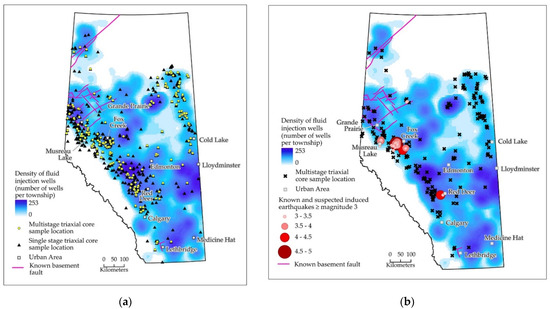
Figure 1.
(a) Location of (approximately 600) triaxial core samples (triangles), (approximately 200) multistage triaxial samples (circles) and density of approximately 33,000 wells reporting some fluid injection over the period 1960–2021. (b) Location of known and suspected significant fluid-injection-induced earthquakes that have occurred in the Alberta Basin to date. Known regional basement faults are indicated by red lines.
The multistage triaxial data were contained in individual reports, each corresponding to a single well (or an individual sample in some cases). Manual data extraction, processing and data entry were required to aggregate the data and enable further analysis. Additionally, while each core-test laboratory report contained the unique well identifier (UWI) for each source well and the core sampling intervals, in some cases, the originating formation details were missing. This necessitated a geological review of the corresponding well logs for approximately 40% of the multistage triaxial core sample wells to identify the geologic formations and lithologies corresponding to each of the core samples tested. Additionally, in approximately 30% of the laboratory reports, only raw triaxial data were available; in such cases, processing and interpretation of the data were required to obtain the required formation geomechanical parameters. By using these data, we compiled approximately 3000 multistage triaxial tests corresponding to most of the major lithological sequences in the Alberta Basin (Table 1).

Table 1.
Summary of the number of multistage triaxial tests used in this analysis and the source lithologies.
Table 1 shows that approximately 91% of the multistage triaxial tests available were conducted in low permeability (calcareous shale, calcareous sandstone or shaly limestone) lithologies, generally with the objective of measuring geomechanical properties important for hydraulic fracturing design (for tight oil exploitation) or caprock characterization (for thermal oil exploitation) in cases of shallow shale formations. The other major category of multistage triaxial tests data available was collected for the purposes of subsurface salt cavern design, and the wells drilled for these purposes provided geomechanical data for multiple adjacent formations in each area of interest. This information was then used to build an Excel database containing the core-sample originating formation, core depth and laboratory-measured parameters for each sample, including confining stress (σ3), failure stress (σ1), unconfined compressive strength (Co), Young’s modulus (E), Poisson’s ratio (υ), porosity (n), cohesion (c), angle of internal friction (φ) and Biot’s coefficient (α). All the reports examined stated that the laboratory triaxial tests were conducted under drained conditions.
This database was then used to determine confining stress at the brittle–ductile transition (σ3*) and to calculate the empirical Mogi ductility parameter (d) for each formation in accordance with the methods provided by Walton, 2021 [42]. First, the confining stress at the brittle–ductile transition (σ3*) for each formation was determined by reviewing the stress–strain curves of each of the (approximately 3000 triaxial tests), using the method shown in Figure 2 below.
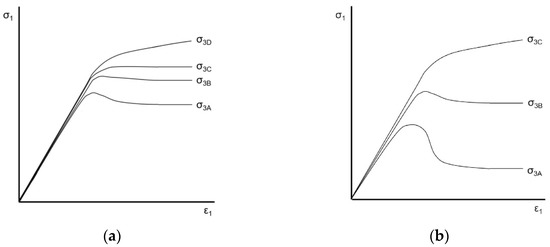
Figure 2.
Illustration showing how multistage triaxial stress–strain curves were used to determine the principal and confining stresses at the brittle–ductile transition (σ3*) for each formation (a) Multistage triaxial test result with good confining stress resolution; σ3* = σ3C (b) Multistage triaxial test result with poor confining stress resolution; σ3B < σ3* < σ3C. Modified from Walton, 2021, and used with permission.
The empirical Mogi ductility parameter (d) was then calculated using Equation (1):
where σ1 and σ3* are the principal and confining stresses, respectively, at the Mogi brittle–ductile transition limit.
d = (σ1 − σ3*)/σ3*,
While the empirical Mogi ductility parameter (d) provides a useful index for the relative brittleness of rocks, it is highly dependent on the strength of the rock [42]. Walton (2021) notes that it is necessary to normalize the ductility parameter by the unconfined compressive strength (Co) of the rock to obtain a normalized ductility parameter (termed d*) that is independent of the unconfined compressive strength of the rock. This modified ductility parameter includes both rock strength (i.e., Co) and material parameters (d), is directly comparable to existing brittleness indices, and can be used to quantitatively compare the brittleness of different rock formations [42]. Walton (2021) also notes that the d* evaluated based on the stress–strain curves in the ductile regime can be considered an inherent material property, directly comparable to the modified Hoek–Brown material constant (m), which is extensively used in the geotechnical/geomechanical fields [43].
By using our Excel database, we then calculated the average unconfined compressive strength of each rock formation and then calculated the modified ductility parameter (d*) in accordance with Equation (2):
where Co is the average measured unconfined compressive strength of the corresponding rock formation (in MPa). We present the results of this analysis in Section 3.
d* = d/Co,
2.3. Determination of the Brittle–Ductile State Parameter and Brittle–Ductile Stress Index for Each Major Injection Formation and Confining Sequence in the Alberta Basin
The standard Mogi ductility parameter (d) provides the confining stress limit at which the transition from brittle fracture to ductile flow can be expected to occur [44] in each of the 51 formations assessed in the Alberta Basin, while the modified d* provides a quantitative measure of the relative brittleness of the formations assessed. However, in order to determine whether a formation is likely to be in a brittle or ductile state at its initial in situ stress regime, it is necessary to evaluate the relationship between its initial in situ stress state and its Mogi state limit. Such an evaluation also can provide an indication of whether sections of geologic faults contained within such formations are likely to be in a brittle or ductile state since hosted faults are likely to reflect the Mogi state of the host formation (especially in the low-porosity, low-clay content formations such as the deep carbonates of the Alberta Basin). Therefore, an evaluation of the brittle/ductile state of a formation can help provide an indication of the probability of the existence of brittle faults within rock sequences and consequently an indication of potential seismic hazards.
We devised a method based on the principles of the critical state concept applied to rock [45] to evaluate the in situ stress state of a formation relative to its Mogi line (considered the critical state line for rocks in this case). We used this concept, shown in Figure 3 below, to derive two associated parameters, called the Brittle–Ductile State Parameter (χ) and the Brittle–Ductile Stress Index (IBD), shown in Equations (3) to (6). These two parameters can be used to assess whether a formation, at its current in situ stress state, may be in the brittle or ductile regime in relation to its Mogi state limit and, by extension, whether it is likely to host brittle (potentially seismogenic) faults.
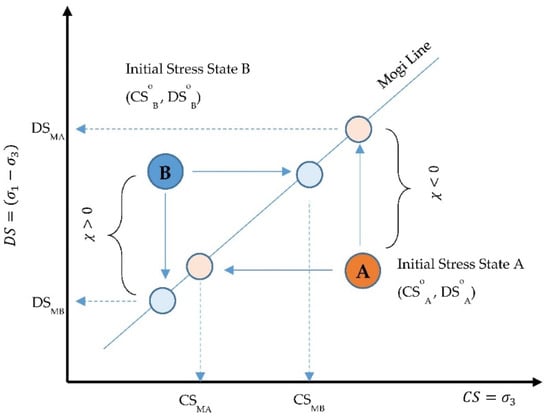
Figure 3.
Concept and method used to derive the Brittle–Ductile State Parameter (χ) and the Brittle–Ductile Stress Index (IBD). DS = Deviator stress; CS = Confining Stress; A and B are formations at initial confining and deviator stress states (CS0, DS0).
In Figure 3, Formation A at an initial confining stress CS0A and deviator stress DS0A is in the ductile regime with respect to its Mogi line. Since the Mogi line relationship (i.e., the ductility parameter d, which is the gradient of the Mogi line in Figure 3) is known, Equation (1) above can be used to calculate the equivalent confining (CSMA) and deviator (DSMA) stresses at the Mogi line for the initial stress state (CS0A, DS0A) of Formation A in accordance with the following relationships:
DSMA = (σ1 − σ3)MA = d * σ30A,
CSMA = σ3MA = σ1A/(d + 1),
The calculated in situ equivalent confining (CSMA) and deviator (DSMA) stresses at the Mogi line for Formation A can then be used to calculate the Brittle–Ductile State Parameter (χ) and the Brittle–Ductile Stress Index (IBD) for Formation A according to the relationships provided in Equations (5) and (6):
where χ is the Brittle–Ductile State Parameter, which provides a measure of the distance to the Mogi line under conditions of constant confining stress, while IBD provides a measure of the distance to the Mogi line under conditions of constant deviator stress.
χ = (σ1 − σ3)0A − (σ1 − σ3)MA,
IBD = (σ30A/σ3MA),
Similarly, the Brittle–Ductile State Parameter (χ) and the Brittle–Ductile Stress Index (IBD) can be calculated for Formation B’s initial stress state shown in Figure 3, using Equations (3) to (6). A negative χ value indicates that the formation is in the ductile regime (based on its initial stress state), whereas a positive χ value indicates that the formation is in the brittle regime (based on its initial stress state). Values of IBD of one or below indicate that the initial stress state of the formation is within range of the brittle–ductile transition state, while (IBD) values of greater than one indicate that the initial stress state of the formation is further away from the brittle–ductile transition state.
2.4. Estimation of the In Situ Stress State of Each Major Injection and Confining Formation in the Alberta Basin
An extensive database of in situ vertical and minimum horizontal stress measurements exists for various formations of interest to the hydrocarbons, disposal and cavern storage industries in Alberta. Density logs are routinely collected to meet operational and regulatory requirements in the hydrocarbon industry, and integration of these logs to the depth of interest provides a reliable estimate of the vertical stress (gradient) at the target zone [46]. Mini-fracture tests (also referred to as minifrac, diagnostic fracture injection tests or DFITs) required for operational (e.g., fracture design [47]) and regulatory (e.g., AER’s Directive 40 [48]) requirements typically provide reliable estimates of the magnitude of the in situ minimum horizontal stress [49]. Formation pressure tests are routinely conducted to meet operational and regulatory requirements and can provide reliable estimates of the formation pore pressure (gradients) for most formations in the Alberta Basin [4]. Additional sources of minifrac, vertical stress and pore pressure data include the published reports listed in the Data Availability section.
While comprehensive vertical, minimum horizontal stress and pore-pressure data are publicly available for many formations in the Alberta Basin, these data are widely distributed across many different sources, such as regulatory, industry, academic and scientific publications. We consolidated the vertical, minimum horizontal stress and pore pressure data contained in the publications listed in the Data Availability section into a single Excel database and then used this database to compute the complete stress state of the individual formations using the methods described below. In approximately 30% of the cases, UWIs were provided, but the corresponding formations were not listed. In such cases, geological interpretation of the specific well logs was required to identify each corresponding formation for the in situ stress/pore pressure measurements. Additionally, data vintages varied widely, with relatively recent data available for formations of interest to the tight (e.g., the Montney and Duvernay) and thermal (e.g., Clearwater caprock, McMurray reservoir) hydrocarbons industries, while data for other (e.g., deep carbonate) formations were collected up to several decades ago.
Determination of the Brittle–Ductile State Parameter (χ) and the Brittle–Ductile Stress Index (IBD) requires the full stress tensor (i.e., σ1, σ2 and σ3). The frictional limits theorem can be used to estimate the upper limit of the magnitude of the maximum horizontal stress (i.e., σ1) under (critically stressed) reverse and strike-slip faulting conditions, which are responsible for the occurrence of felt-induced seismicity in the Alberta Basin [50]. This theorem assumes that the maximum horizontal stress is horizontal and is limited by the frictional strength of faults within the rock mass, as shown in Equations (7) and (8) below [51,52]:
where μ is the coefficient of internal friction and Pp is the formation pore pressure. The coefficient of internal friction is the tangent of the angle of internal friction of the formation core sample (i.e., tan (φ)) and is calculated from the formation core triaxial test database, while formation pore pressure and minimum stress measurements (which can be either horizontal or vertical) are available from the in situ test database compiled above. Therefore, assuming that geologic faults are present and in a critically stressed state, the complete in situ stress state of each formation can be estimated using Equations (7) and (8), in conjunction with the measured in situ stress (i.e., vertical stress, minimum horizontal stress and pore pressure) and the triaxial test database. Critically stressed faults appear to be prevalent across all continental regions [1], and direct/indirect triggering of such faults has been the main causal factor for fluid-injection-induced seismicity in this basin [53].
σ1 max = f(μ) * (σ3 − Pp) + Pp,
f(μ) = [(1+ μ2)1/2 + μ]2,
Ranges of minimum horizontal stress and pore pressure (gradient) measurements were available for individual formations, depending on the characteristics of the lithology, location, measurement method and vintage of the data. The minimum and maximum stress and pore pressure measurements for each formation were used to create a low and a high range of minimum horizontal stress, vertical stress and formation pore pressure for the corresponding depth range of each formation. The combinations of low and high σ3, σv and Pp values were then used to calculate the corresponding maximum horizontal stress for each scenario, resulting in a minimum and maximum value for each of σ1, σ2, σ3 and Pp at the corresponding formation depth. Only reverse (σv = σ3) and strike-slip (σv = σ2) stress regimes have been considered in this analysis since only these cases have been linked to the occurrence of felt-induced seismicity in the Alberta Basin [8,50,54,55,56].
This approach resulted in four possible combinations of confining stress (CS = σ3) and deviator stress (DS = σ1 − σ3) that could be used to calculate the Brittle–Ductile State Parameter (χ) and the Brittle–Ductile Stress Index (IBD). These are (i) a high CS-high DS (HCS-HDS), (ii) a high CS-low DS (HCS-LDS), (iii) a low CS-high DS (LCS-HDS) and (iv) a low CS-low DS (LCS-LDS). The use of the LCS-HDS combination minimizes both the Brittle–Ductile State Parameter (χ) and the Brittle–Ductile Stress Index (IBD) for each formation, and this combination was used as the default (conservative case) analysis scenario. This scenario is also consistent with the observations of previous work, which noted that low confining stress (and high deviator stress) in deep carbonate formations is associated with an increased probability of induced seismicity occurrence in the Alberta Basin [18].
3. Results
In the sub-sections below, we used the data analyzed to identify the geologic formations most utilized for fluid injection in the Alberta Basin. We also presented the (calculated) modified Mogi ductility (d*) parameter to evaluate the relative brittleness/ductility of these formations and to identify the most brittle and most ductile injection and confining formations in this basin. We then used our Brittle–Ductile State (χ) and Brittle–Ductile Stress Index (IBD) parameters and the measured in situ stress reported in the existing literature to evaluate the brittleness of the major injection formations at the time of in situ data collection.
3.1. Major Injection Formations in the Alberta Basin
Table 2 below presents the summary of major injection formations identified in the Alberta Basin and the relative proportion of fluid volumes (measured at surface conditions) injected into each type of formation.
Table 2.
Geologic formations receiving the largest volumes of injected fluids in the Alberta Basin and the relative proportion of fluid volumes (measured at surface conditions) injected over the period January 1960 to December 2021. Steam injected is reported in cold-water equivalent volumes at surface conditions.
Table 2 shows that approximately 94% of the water, 88% of the gases and 100% of the steam that have been injected into the Alberta Basin over the past six decades were injected into 27 major formations. Most of these fluids were injected into three Lower Cretaceous sandstones and nine Devonian carbonate hydrocarbon reservoirs that were extensively exploited, resulting in significant historical formation pressure depletion [4]. These formations are located at intermediate depths, generally sandwiched between extensive regional low permeability (confining) formations, and possess the geologic characteristics required to isolate injected fluid from both the ground surface and the Precambrian basement. These carbonate-rich formations, along with their confining geologic units (generally low permeability shales or mudstones), form the focus of the subsequent geomechanical data analyses provided in this study.
Notably, Table 2 does not account for the geographic extent of the listed formations and consequently for differences in the geographic distribution of the injection fluid volumes. For instance, the Cretaceous, Devonian and Triassic formations listed are geographically extensive, present in most of the Alberta Basin, and the fluid volumes injected are correspondingly geographically distributed [4]. Conversely, the (regional) Permian (e.g., Belloy) and Carboniferous carbonate (e.g., Debolt) formations have a limited geographic distribution with injection volumes concentrated in specific areas. Despite the apparent marginal contribution at a basin scale, at a regional scale these formations support large volumes of industrial-scale fluid injection activities, especially over the last decade (Figure 4).
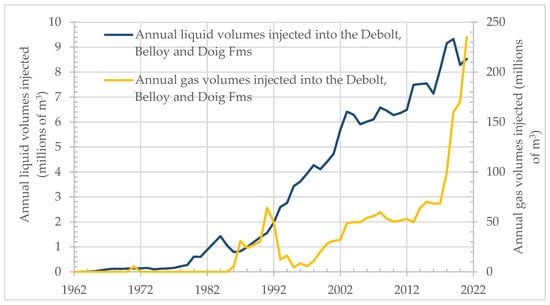
Figure 4.
Annual fluid volumes (measured at surface conditions) injected into three regional (i.e., limited geographic extent) formations in the Alberta Basin.
As shown in Figure 4, fluid injection into some of these regional disposal formations has increased notably over the last decade, as the hydrocarbon industry in Alberta and the types of subsurface activities conducted in its subsurface have evolved. Significant future increase in fluid injection volumes in these regional formations is expected over the next decade to support energy transition and net zero energy objectives [4], which has the potential to considerably alter the stress and pore pressure states of these formations.
3.2. Determination of the Mogi Brittle–Ductile State Limits and Relative Brittleness of Major Injection and Confining Formations in the Alberta Basin
Table 3 below presents the summary of the laboratory-measured geomechanical properties used to calculate the empirical (d) and modified (d*) Mogi ductility parameters.
Table 3.
Summary of laboratory triaxial test data, empirical and modified Mogi ductility parameter for major injection and confining formations in the Alberta Basin.
The empirical Mogi ductility parameter (d) for formations in the Alberta Basin (Table 3) indicates that most of the 51 formations evaluated are relatively ductile, which (in combination with extensive basin-wide pressure depletion [4]) may help to explain the relative success of sustained historical high-volume fluid injection in this basin [57]. Approximately 72% of the empirical ductility values in Table 3 are significantly higher than the typical ranges reported for similar types of rocks in the existing literature (e.g., Walton, 2021). Walton (2021) noted that silicate rocks tend to have d values in the range of 0.9–4.1, while the d values of carbonate-based rocks range from 3.5 to 10.7 (in the case of marble). The higher d values of rocks in the Alberta Basin are likely a function of the high carbonate content, porosity and heterogeneity of its lithological sequences compared to those reported in the literature. For instance, the limestone/dolomite content of the Alberta Basin sandstone core samples presented in Table 3 ranged from 5% to more than 30%, whereas the Berea sandstone samples referenced in the published literature [42] only contained up to 2% dolomite [58] (i.e., far less than that of the Alberta Basin sandstones). Additionally, carbonate presence was pervasive in all core sample results examined, with limestone/dolomite content ranging from 5% to above 80%. Secondary porosity is also likely a significant contributing factor to the higher d values in the Alberta Basin since the degree of faulting and fracturing is directly correlated to the ductility of (dolomitic) rocks under conditions of high confining pressure [59]. The injection formations listed above are all depleted hydrocarbon reservoirs, which have elevated secondary porosity and pervasive dolomitic mineral content (in the core samples tested, as shown in Table 3). Geological heterogeneity in the Alberta Basin is also high, with most of the core samples contained in Table 3 consisting of layered, interbedded lithological sequences and mixed clastic rock types, which is unique compared to the (relatively homogeneous) samples tested and results reported in the existing literature in this field.
Analysis of the d* values in Table 3 shows that the Upper Clearwater, Lea Park and shallow Wilrich shales appear to be the most ductile, whereas the lower Clearwater and the Joli Fou appear to be the most brittle of the confining sequences in the Mesozoic era. Examination of the d* values for Mesozoic-era formations also suggests that the Nordegg, Belloy, Deep Wilrich and Falher appear to be the most brittle injection formations in this era, while the most ductile injection formations of this era appear to be the Wabiskaw/McMurray, Doig, Cardium and Nikanassin. Examination of the d* values of formations in the Paleozoic era indicates that the Majeau Lake, Exshaw, Duvernay Innisfail and Keg River appear to be the most brittle injection formations, whereas the Slave Point, Duvernay Willesden Green, Basal Sandstone Unit, and Basal Red Beds appear to be the most ductile formations of this era.
An analysis of the current Brittle–Ductile State Parameter and the Brittle–Ductile Stress Index (using the current site-specific in situ stress conditions relative to the respective Mogi line) is required to assess the probability that such formations within the area of interest of a fluid injection project could be brittle/ductile under the current in situ stress conditions. Such an analysis would involve collecting current in situ stress and pore pressure data from lithological sequences at sites of interest and then calculating the Brittle–Ductile State Parameter (χ) and the Brittle–Ductile Stress Index (IBD) to assess the site-specific brittle–ductile state of the stratigraphic sequences at each site. We use the historical stress and pore pressure data available for formations in the Alberta Basin in the section below to calculate the last-known brittle–ductile state of each formation in order to demonstrate the utility of our conceptual framework.
3.3. Determination of the Brittle–Ductile State Parameter and Brittle–Ductile Stress Index for Major Injection Formation and Confining Sequences in the Alberta Basin
Table 4 below shows the calculated historical Brittle–Ductile State Parameter (χ) and the Brittle–Ductile Stress Index (IBD) for major injection and confining formations in the Alberta Basin. Since the χ and IBD provided below are based on the formation stress state at the time of the in situ and pore-pressure data collection (using the LCS-HDS scenario), the formation regime provided in Table 4 below is only applicable for the geographic location and period in which the minifrac data were collected. Regional changes in the net fluid balance have been occurring in specific formations and regions in this basin over the last decade, and such activity can alter formation stresses. Therefore, current site-specific in situ stress data are required to assess the current brittle–ductile state of stratigraphic sequences, and site-specific multi-stress triaxial core analyses are required to account for site-specific geological heterogeneities that may exist within the project area of interest. Additionally, this list does not include formations for which insufficient in situ stress and pore pressure data were available at the time of this analysis.
Table 4.
Assessment of the Brittle–Ductile State (χ) and Brittle–Ductile Stress Index (IBD) of major formations in the Alberta Basin (at the time of in situ stress and pore pressure data measurements and under the LCS-HDS scenario).
Table 4 indicates that only 4 (Lea Park, Upper Clearwater, Wabiskaw and McMurray) of the 41 major injection and confining formations assessed in the Alberta Basin appeared to be in the brittle regime, while all others were in a ductile regime (under an LCS-HDS scenario) at the time of data collection. This is somewhat expected since brittleness has been previously reported in the Clearwater shales [60] and shaly sections of the Wabiskaw Formation [61], whereas brittle behavior is typical of the locked sands of the McMurray Formation [62,63]. However, this analysis also suggests that some major injection/confining formations, such as the Belloy, Doig, Muskwa, Majeau Lake, Duvernay Innisfail, Shallow and Deep Wilrich, Joli Fou and Fish Scales, could be close to a brittle state (at the time of the in situ stress and pore pressure measurements). Additionally, this analysis indicates that the Duvernay Willesden Green could be considerably more ductile than the Kaybob and Duvernay Innisfail, which offers additional insights into the relative seismic quiescence [64] of the former and the seismogenicity [40] of the latter formation sequences when subjected to high volume fluid injection.
As shown in Table 4, the vintage of the in situ stress measurements used in this assessment varies significantly, ranging from data collected in the late 1970s up to 2019. Most of the earlier data were collected for basin-wide stress and acid-gas storage studies, whereas most of the recent in situ stress and pore pressure data available was obtained from low permeability formations (collected for hydraulic fracturing design or thermal caprock characterization purposes). Over this period, extensive fluid extraction and injection activities occurred in this basin, with large-scale fluid extraction resulting in regional formation depletion in most areas and, in some areas, large-scale injection resulting in local formation pore pressure increase [4]. Large-scale fluid injection can lead to formation pore pressure (and temperature) changes, cause formation deformation, and substantially alter total formation stresses in every direction [65]. Therefore, an assessment of the current brittle/ductile state of a formation using our method described above requires an assessment of the current in situ stress state of the formations of interest. Consequently, while our assessments in Table 4 provide the brittle–ductile state of the formations at the time of (in situ stress) data collection, continuous and evolving injection and production activity occurring within this basin are likely to have altered the stress state in these formations. However, current site-specific (in situ stress, pore pressure, geological and geomechanical) data collection is typically required to support the project design, risk assessment and regulatory application process for fluid injection projects. The use of our method, in conjunction with such site-specific and recent data, can provide an assessment of the current brittle–ductile state of the formations of interest and the potential for seismic/aseismic slip in hosted faults.
4. Discussion
Aseismic creep has been postulated to be the main process driving natural earthquake swarms in shallow strike-slip faults globally, with interconnected vertically stacked creep and dynamic rupture (brittle failure) processes responsible for seismogenicity in some major faults such as the San Andreas [66]. Most of the world’s seismicity in sedimentary cover occurs in carbonate sequences, driven by fault creep and rupture, which transitions from slow, stable (ductile) slip to rapid unstable (stick; brittle) slip at confining stresses above in situ conditions typically present at depths of 3–5 km (i.e., temperatures above 65 °C and confining stresses above 60 MPa) [67]. This range of in situ conditions is analogous to those that exist in deep carbonaceous injection/confining formations of interest in the Alberta Basin (Table 4), in which our proposed methods are anticipated to be applicable.
Shallow strike-slip faults are prevalent in the Alberta Basin, and swarm-type seismicity is characteristic of some of the major Alberta events triggered by fluid injection [68]. Aseismic creep in ductile formations triggering brittle faults within carbonate sequences has been postulated to be the main driver of fluid-injection-induced seismicity in this and other basins [33]. Current models for assessing and managing induced seismic risk may be inadequate in such cases since large events have been observed to occur outside the pressure influence zone and on faults considered not optimally oriented for slip (as in the case of the 12 January 2016, Mw 4.1 Fox Creek earthquake [7]). The faults on which the seismicity occurred in the Fox Creek case extended across most of the stratigraphic sequences, whereas the larger seismogenic events all occurred in the overlying (carbonate) Leduc Formation, while fault slip within the Kaybob Duvernay (shale injection) Formation was largely aseismic [69]. Aseismic slip has also been noted as a viable mechanism to explain the occurrence of recent far-field fluid-injection-induced seismic events in both Alberta and British Columbia, with aseismic slip occurring within the Montney and concurrent seismogenic slip in the underlying (carbonate) Belloy/Debolt formations [70,71].
Our analysis shows that (for an LCS-HDS stress scenario) the overlying Leduc (carbonate) Formation is more brittle (χ = −296 MPa, IBD = 2.8) than the underlying Kaybob Duvernay (shale) Formation (χ = −457 MPa, IBD = 4.2), and consequently more likely to host seismogenic fault slip (Table 4) within this stratigraphic sequence. In the case of seismic events triggered by hydraulic fracturing in Alberta and British Columbia, virtually all of the large induced seismic events triggered by injection into the (deep) Montney Formation (χ = −484 MPa, IBD = 5.3) were actually located in the underlying Belloy (χ = −34 MPa, IBD = 1.2) and Debolt (no data available) formations. Meanwhile, virtually all of the large induced seismic events triggered by stimulation activity in the Kaybob Duvernay (χ = −457 MPa, IBD = 4.2) were located in the overlying Leduc Formation (χ = −296 MPa, IBD = 2.8) [72]. Conversely, large-scale fluid injection occurring in the shallow Montney (i.e., outside of the zone of influence of the Belloy/Debolt) was observed to trigger (aseismic) slip equivalent to a Magnitude 5.0 earthquake, which resulted in measurable surface displacement but no detectable seismicity [71]. Our analysis indicates that such a response could be expected since both the Montney and Kaybob Duvernay are more ductile than the Belloy and Wabamun (under an LCS-HDS scenario; no data were available for the Debolt Formation; Table 4). Table 5 below shows that the major fluid-injection-induced seismic events that have occurred to date in Alberta and British Columbia have occurred in the most brittle (underlying/overlying) formation(s) in the stratigraphic sequence adjacent to the fluid injection zone.
Table 5.
Summary of recent significant induced earthquake sequences in Alberta and British Columbia.
Therefore, aseismic slip increasing the stress in and triggering brittle failure in faults hosted in more brittle formations adjacent to the injection zone may be a likely contributing mechanism in the cases outlined above. Our analysis provides a method to identify the relative brittleness of injection and confining formations and to assess the potential for brittle failure to occur by computing and comparing the Brittle–Ductile State Parameter (χ) and Brittle–Ductile Stress Index (IBD) in each formation in the stratigraphic sequence of interest. While our method requires current site-specific in situ stress and pore pressure data for each major stratigraphic sequence in the zone of influence of injection projects, such measurements are routinely collected as a part of injection project design regulatory requirements in Alberta. Table 6 shows the four major formations closest and furthest from the brittle state at the time of the in situ stress and pore pressure measurements, which may help guide data collection and hazard assessments for fluid injection projects proposed in these formations.
Table 6.
Alberta Basin injection and confining formations closest and furthest from the brittle state in situ (based on available historical in situ stress state and pore pressure measurements).
In the absence of current in situ stress and pore pressure data, the relative brittleness (d*) of the formation sequences in the fluid-injection project area of interest could provide a screening-level indicator of the formations that are likely to be the most brittle in a stratigraphic sequence of interest. Table 7 provides the four most brittle and the four most ductile of the 51 (injection and confining) formations assessed in the Alberta Basin (based on d*; i.e., rock strength and material properties).
Table 7.
Four most brittle and most ductile major injection and confining formations in the Alberta Basin, based on rock mechanical properties.
Triaxial core testing is considered a reasonable method of replicating stresses at reservoir conditions [77], but recovered core samples can be biased towards stronger and more competent zones within a stratigraphic sequence. Such more competent units are also more likely to be major stress-bearing members [78], display higher deviator stresses (i.e., high σ1 and low σ3), dominate the failure behavior of the rock unit and hosted faults and have been associated with an increased probability of fluid-injection-induced seismicity in the Alberta Basin [18]. However, while our analyses provides a regional-scale perspective of the brittle–ductile state of the stronger (more competent) formations within this basin, site-specific analyses of the stratigraphic sequences present would be required to account for project-scale geological heterogeneities. Additionally, the possibility exists that fault zones within dolomite layers may be even more brittle than the surrounding host rock since embrittlement and localization of brittle deformation of the fault core and the shear zone was previously noted [34]. This represents an area for future research.
Assessment of the potential for fluid injection projects to trigger seismicity has relied on the identification and avoidance of faults within the zone of influence [4]. However, assessment of the probability of aseismic slip within (more ductile) injection formations loading fault sections and triggering seismogenic slip in far-field, more brittle formations may be an important complement to the hazard assessment process for fluid injection projects. This complementary assessment may be especially important in the Alberta Basin since the types (strike-slip and reverse) of faults prevalent in this basin can be challenging to detect during the site selection process.
5. Conclusions
We provided an assessment of the relative brittleness/ductility of 51 of the major injection and confining formations in the Alberta Basin, as well as a method to assess the likelihood of a formation being in the brittle or ductile regime, using the current state of in situ stress and pore pressure.
This analysis indicates that approximately 72% of the formations had ductility significantly higher than typical ranges reported for similar-type rocks in the existing literature. The high ductility of the formations assessed, in conjunction with extensive historical pressure depletion, could be a contributing factor in the success of sustained historical high-volume fluid injection in this basin. However, some of the most brittle formations in the stratigraphic sequences assessed include extensively used injection formations such as the Belloy, Deep Wilrich, Falher, Majeau Lake, Exshaw, Duvernay Innisfail and Keg River, and notable confining formations such as the Lower Clearwater and the Joli Fou shales. Increasing utilization of some of these injection formations (such as the Belloy and Doig) may require closer examination of their current/future brittle–ductile state to mitigate the potential for future seismogenesis.
Our analyses show that the Lea Park, Clearwater, Wabiskaw and McMurray formations were in a brittle state, and the Belloy, Doig, Muskwa, Majeau Lake, Duvernay Innisfail, Shallow and Deep Wilrich, Joli Fou and Fish Scales formations were close to the brittle state at the time the in situ stress data were collected. Almost all of the induced seismic events triggered by large-scale fluid injection into the (ductile-state) Montney formation in British Columbia occurred in the underlying (close to brittle state) Belloy and Debolt formations.
The data and method presented could be used to assess the potential for (sub)vertical fault sections to be aseismic/seismogenic by evaluating the relative brittleness/ductility and the in situ brittle/ductile state of host formations in the stratigraphic sequence of interest. Such information may be valuable during site selection for large-scale fluid injection projects by providing insight into the far-field seismogenic potential of unknown/undetected fault sections. Increasingly, it is recognized that near-field aseismic fault slip triggering far-field seismic fault slip is an important driving process for injection-induced seismicity both in the Alberta Basin (e.g., [33]) and globally (e.g., [79,80]).
Author Contributions
Conceptualization, M.S. and R.C.; methodology, M.S., R.C. and M.D.; software, M.S. and J.F.C.; validation, R.C., J.F.C. and M.D.; formal analysis, M.S.; investigation, M.S.; resources, H.C.; data curation, M.S. and J.F.C.; writing—original draft preparation, M.S.; writing—review and editing, R.C., M.D. and H.C.; visualization, M.S.; supervision, R.C. and H.C.; project administration, M.S. All authors have read and agreed to the published version of the manuscript.
Funding
This research received no external funding.
Data Availability Statement
In situ stress measurements are available from: (i) The Alberta Government’s OpenData link, located at https://open.alberta.ca/opendata/gda-dig_2016_0040. (ii) Chapter 29 of the Atlas of the Western Canadian Sedimentary Basin, located at https://ags.aer.ca/atlas-the-western-canada-sedimentary-basin/chapter-29-situ-stress. (iii) AER/AGS Report 97 https://static.ags.aer.ca/files/document/REP/REP_97.pdf. (iv) AER/AGS Special Reports 090, 091, 092, 093, 094 & 095, all located at https://ags.aer.ca/products/all-publications. (v) AGS Digital Data 2018-0013, located at https://ags.aer.ca/publication/dig-2018-0013. (vi) Published reports and articles including [56,81,82,83,84,85,86,87,88,89,90,91,92,93,94,95,96,97,98,99,100,101]. Core-sample triaxial testing lab reports are available on request from the AER’s data request catalog, located at https://static.aer.ca/prd/documents/sts/GOS-REPS.xlsb. Fluid-volume injection data are available from the geoSCOUTTM database located at www.geologic.com. All geoSCOUT date is © 2022. All hyperlinks were last accessed 4 July 2022.
Acknowledgments
The authors would like to acknowledge the Alberta Energy Regulator and the Alberta Geologic Survey for access to data, as well as the Alberta Department of Energy, the University of Alberta, and the University of Waterloo for the support provided over the course of this study. The authors would also like to thank the anonymous reviewers who helped to improve the quality of this paper.
Conflicts of Interest
The authors declare no conflict of interest.
References
- Townend, J.; Zoback, M.D. How faulting keeps the crust strong. Geology 2000, 28, 399–402. [Google Scholar] [CrossRef]
- Morell, K.D.; Styron, R.; Stirling, M.; Griffin, J.; Archuleta, R.; Onur, T. Seismic Hazard Analyses from Geologic and Geomorphic Data: Current and Future Challenges. Tectonics 2020, 39, e2018TC005365. [Google Scholar] [CrossRef]
- Hough, S.E. Intraplate seismic hazard: Evidence for distributed strain and implications for seismic hazard. Intraplate Earthq. 2012, 303–327. [Google Scholar] [CrossRef]
- Samaroo, M.; Chalaturnyk, R.; Dusseault, M.; Jackson, R.; Buhlmann, A.; Custers, H. An Assessment of the Net Fluid Balance in the Alberta Basin. Energies 2022, 15, 1081. [Google Scholar] [CrossRef]
- Ross, G.M.; Eaton, D.W. Basement reactivation in the Alberta Basin: Observational constraints and mechanical rationale. Bull. Can. Pet. Geol. 1999, 47, 391–411. [Google Scholar] [CrossRef]
- Dietrich, J.R. Seismic stratigraphy and structure of the lower Paleozoic, Central Alberta Lithoprobe Transect. Bull. Can. Pet. Geol. 1999, 47, 362–374. [Google Scholar]
- Eyre, T.S.; Eaton, D.W.; Zecevic, M.; D’Amico, D.; Kolos, D. Microseismicity reveals fault activation before Mw 4.1 hydraulic-fracturing induced earthquake. Geophys. J. Int. 2019, 218, 534–546. [Google Scholar] [CrossRef]
- Schultz, R.; Wang, R. Newly emerging cases of hydraulic fracturing induced seismicity in the Duvernay East Shale Basin. Tectonophysics 2020, 779, 228393. [Google Scholar] [CrossRef]
- Hope, J.; Eaton, D.W.; Ross, G.M. Lithoprobe seismic transect of the Alberta Basin: Compilation and overview. Bull. Can. Pet. Geol. 1999, 47, 331–345. [Google Scholar]
- Schulte, B.W.M.; Lyatsky, H.; Bridge, D. Methods of fault detection with geophysical data and surface geology. Can. J. Explor. Geophys. 2019, 44, 1–23. Available online: https://csegrecorder.com/articles/view/methods-of-fault-detection-with-geophysical-data-and-surface-geology (accessed on 16 September 2022).
- Bao, X.; Eaton, D.W. Fault activation by hydraulic fracturing in western Canada. Science 2016, 354, 1406–1409. [Google Scholar] [CrossRef]
- Skoumal, R.J.; Ole Kaven, J.; Walter, J.I. Characterizing seismogenic fault structures in Oklahoma using a relocated template-matched catalog. Seismol. Res. Lett. 2019, 90, 1535–1543. [Google Scholar] [CrossRef]
- Shah, A.K.; Keller, G.R. Geologic influence on induced seismicity: Constraints from potential field data in Oklahoma. Geophys. Res. Lett. 2017, 44, 152–161. [Google Scholar] [CrossRef]
- Schultz, R.; Skoumal, R.J.; Brudzinski, M.R.; Eaton, D.; Baptie, B.; Ellsworth, W. Hydraulic fracturing-induced seismicity. Rev. Geophys. 2020, 58, 1–43. [Google Scholar] [CrossRef]
- McGarr, A.; Barbour, A.J. Wastewater Disposal and the Earthquake Sequences during 2016 Near Fairview, Pawnee, and Cushing, Oklahoma. Geophys. Res. Lett. 2017, 44, 9330–9336. [Google Scholar] [CrossRef]
- Hennings, P.H.; Nicot, J.P.; Gao, R.S.; DeShon, H.R.; Lund Snee, J.E.; Morris, A.P.; Brudzinski, M.R.; Horne, E.A.; Breton, C. Pore Pressure Threshold and Fault Slip Potential for Induced Earthquakes in the Dallas-Fort Worth Area of North Central Texas. Geophys. Res. Lett. 2021, 48, 1–9. [Google Scholar] [CrossRef]
- Fan, Z.; Eichhubl, P.; Gale, J.F.W. Geomechanical analysis of fluid injection and seismic fault slip for the Mw 4.8 Timpson, Texas, earthquake sequence. J. Geophys. Res. Solid Earth 2016, 121, 3076–3095. [Google Scholar] [CrossRef]
- Pawley, S.; Schultz, R.; Playter, T.; Corlett, H.; Shipman, T.; Lyster, S.; Hauck, T. The Geological Susceptibility of Induced Earthquakes in the Duvernay Play. Geophys. Res. Lett. 2018, 45, 1786–1793. [Google Scholar] [CrossRef]
- Hincks, T.; Aspinall, W.; Cooke, R.; Gernon, T. Oklahoma’s induced seismicity strongly linked to wastewater injection depth. Science 2018, 7911, 1–46. [Google Scholar] [CrossRef]
- Hui, G.; Chen, S.; Chen, Z.; Gu, F.; Ghoroori, M.; Mirza, M.A. Comprehensive Characterization and Mitigation of Hydraulic Fracturing-Induced Seismicity in Fox Creek, Alberta. SPE J. 2021, 26, 2736–2747. [Google Scholar] [CrossRef]
- Sibson, R.H. Earthquake faulting as a structural process. J. Struct. Geol. 1989, 11, 1–14. [Google Scholar] [CrossRef]
- Zhamaletdinov, A.A. On the Nature of the Brittle-Ductile Transition Zone in the Earth’s Crust (Review); Springer International Publishing: Berlin/Heidelberg, Germany, 2019; Volume 2. [Google Scholar]
- Brace, W.F.; Byerlee, J.D. Stick-Slip as a Mechanism for Earthquakes. Science 1966, 153, 990. [Google Scholar] [CrossRef]
- Scholz, C.H. Earthquakes and friction laws. Nature 1998, 391, 37–42. [Google Scholar] [CrossRef]
- Scholz, C.H. Brittle Tectonics: A Non-linear Dynamical System. In Encyclopedia of Complexity and Systems Science; Myers, R., Ed.; Springer: Berlin/Heidelberg, Germany, 2009; Volume 1, pp. 657–674. [Google Scholar]
- Byerlee, J.D.; Brace, W.F. High Pressure Mechanical Instability in Rocks. Science 1969, 164, 713–716. [Google Scholar] [CrossRef]
- Bürgmann, R.; Dresen, G. Rheology of the lower crust and upper mantle: Evidence from rock mechanics, geodesy, and field observations. Annu. Rev. Earth Planet. Sci. 2008, 36, 531–567. [Google Scholar] [CrossRef]
- Jolivet, R.; Simons, M.; Agram, P.S.; Duputel, Z.; Shen, Z.K. Aseismic slip and seismogenic coupling along the central San Andreas Fault. Geophys. Res. Lett. 2015, 42, 297–306. [Google Scholar] [CrossRef]
- Abdelmeguid, M.; Elbanna, A. Sequences of seismic and aseismic slip on bimaterial faults show dominant rupture asymmetry and potential for elevated seismic hazard. Earth Planet. Sci. Lett. 2021, 593, 117648. [Google Scholar] [CrossRef]
- Hirth, G.; Beeler, N.M. The role of fluid pressure on frictional behavior at the base of the seismogenic zone. Geology 2015, 43, 223–226. [Google Scholar] [CrossRef]
- Aubry, J.; Passelègue, F.X.; Escartín, J.; Gasc, J.; Deldicque, D.; Schubnel, A. Fault Stability Across the Seismogenic Zone. J. Geophys. Res. Solid Earth 2020, 125, 1–21. [Google Scholar] [CrossRef]
- Vajdova, V.; Zhu, W.; Natalie Chen, T.M.; Wong, T.F. Micromechanics of brittle faulting and cataclastic flow in Tavel limestone. J. Struct. Geol. 2010, 32, 1158–1169. [Google Scholar] [CrossRef]
- Eyre, T.S.; Eaton, D.W.; Garagash, D.I.; Zecevic, M.; Venieri, M.; Weir, R.; Lawton, D.C. The role of aseismic slip in hydraulic fracturing–induced seismicity. Sci. Adv. 2019, 5, 1–11. [Google Scholar] [CrossRef]
- De Paola, N.; Collettini, C.; Faulkner, D.R.; Trippetta, F. Fault zone architecture and deformation processes within evaporitic rocks in the upper crust. Tectonics 2008, 27, 1–21. [Google Scholar] [CrossRef]
- Brantut, N.; Schubnel, A.; Rouzaud, J.N.; Brunet, F.; Shimamoto, T. High-velocity frictional properties of a clay-bearing fault gouge and implications for earthquake mechanics. J. Geophys. Res. Solid Earth 2008, 113, 1–18. [Google Scholar] [CrossRef]
- Mews, K.S.; Alhubail, M.M.; Barati, R.G. A Review of Brittleness Index Correlations for Unconventional Tight and Ultra-Tight Reservoirs. Geosciences 2019, 9, 319. [Google Scholar] [CrossRef]
- Schultz, R.; Corlett, H.; Haug, K.; Kocon, K.; Maccormack, K.; Stern, V.; Shipman, T. Linking fossil reefs with earthquakes: Geologic insight to where induced seismicity occurs in Alberta. Geophys. Res. Lett. 2016, 43, 2534–2542. [Google Scholar] [CrossRef]
- Ehrenberg, S.N.; Nadeau, P.H. Sandstone vs. carbonate petroleum reservoirs: A global perspective on porosity-depth and porosity-permeability relationships. Am. Assoc. Pet. Geol. Bull. 2005, 89, 435–445. [Google Scholar] [CrossRef]
- Kurzawski, R.M.; Stipp, M.; Niemeijer, A.R.; Spiers, C.J.; Behrmann, J.H. Earthquake nucleation in weak subducted carbonates. Nat. Geosci. 2016, 9, 717–722. [Google Scholar] [CrossRef]
- Schultz, R.; Atkinson, G.; Eaton, D.W.; Gu, Y.J.; Kao, H. Hydraulic fracturing volume is associated with induced earthquake productivity in the Duvernay play. Science 2018, 359, 304–308. [Google Scholar] [CrossRef] [PubMed]
- McGarr, A.; Simpson, D.; Seeber, L. 40 Case histories of induced and triggered seismicity. In International Geophysics, 81st ed.; Lee, W.H.K., International Association of Seismology and Physics of the Earth’s Interior, Committee on Education, International Association for Earthquake Engineering, Eds.; Academic Press: Cambridge, MA, USA, 2002; Volume 81, pp. 647–661. [Google Scholar]
- Walton, G. A New Perspective on the Brittle–Ductile Transition of Rocks. Rock Mech. Rock Eng. 2021, 54, 5993–6006. [Google Scholar] [CrossRef]
- Hajiabdolmajid, V.; Kaiser, P.K.; Martin, C.D. Modeling brittle failure of rock. Int. J. Rock Mech. Min. Sci. 2002, 34, 227–244. [Google Scholar] [CrossRef]
- Mogi, K. Pressure dependence of rock strength and transition from brittle fracture to ductile flow. Bull. Earthq. Res. Inst. 1966, 44, 215–232. Available online: https://repository.dl.itc.u-tokyo.ac.jp/record/33594/file_preview/ji0441012.pdf (accessed on 16 September 2022).
- Gerogiannopoulos, N.G.; Brown, E.T. The critical state concept applied to rock. Int. J. Rock Mech. Min. Sci. 1978, 15, 1–10. [Google Scholar] [CrossRef]
- Hawkes, C.D.; Bachu, S.; Haug, K.; Thompson, A.W. Analysis of in-situ stress regime in the Alberta Basin, Canada, for performance assessment of CO2 geological sequestration sites. In Proceedings of the Fourth Annual Conference on Carbon Capture and Sequestration DOE/NETL, Alexandria, VA, USA, 2–5 May 2005; pp. 2–5. [Google Scholar]
- Mclellan, P.J. In-Situ stress prediction and measurement by hydraulic fracturing, Wapiti, Alberta. J. Can. Pet. Technol. 1988, 27, 85–96. [Google Scholar] [CrossRef]
- Alberta Energy Regulator. Directive 040: Pressure and Deliverability Testing Oil and Gas Wells; Alberta Energy Regulator: Edmonton, AB, Canada, 2020; Available online: https://static.aer.ca/prd/documents/directives/Directive040.pdf (accessed on 16 September 2022).
- Bell, J.S.; Grasby, S.E. The stress regime of the Western Canadian Sedimentary Basin. Geofluids 2012, 12, 150–165. [Google Scholar] [CrossRef]
- Schultz, R.; Wang, R.; Gu, Y.J.; Haug, K.; Atkinson, G. A seismological overview of the induced earthquakes in the Duvernay play near Fox Creek, Alberta. J. Geophys. Res. Solid Earth 2017, 122, 492–505. [Google Scholar] [CrossRef]
- Bailey, A.; Tenthorey, E.; Ayling, B. Characterising the present-day stress regime of the Georgina Basin. Aust. J. Earth Sci. 2017, 64, 121–136. [Google Scholar] [CrossRef]
- Brudy, M.; Zoback, M.D.; Fuchs, K.; Rummel, F.; Baumgärtner, J. Estimation of the complete stress tensor to 8 km depth in the KTB scientific drill holes: Implications for crustal strength. J. Geophys. Res. B Solid Earth 1997, 102, 18453–18475. [Google Scholar] [CrossRef]
- van der Baan, M.; Calixto, F. Human-induced seismicity and large-scale hydrocarbon production in the USA and Canada. Geochem. Geophys. Geosystems 2017, 18, 2467–2485. [Google Scholar] [CrossRef]
- Shen, L.W.; Schmitt, D.R.; Schultz, R. Frictional Stabilities on Induced Earthquake Fault Planes at Fox Creek, Alberta: A Pore Fluid Pressure Dilemma. Geophys. Res. Lett. 2019, 46, 8753–8762. [Google Scholar] [CrossRef]
- Zhang, H.; Eaton, D.W.; Rodriguez, G.; Jia, S.Q. Source-mechanism analysis and stress inversion for hydraulic-fracturing-induced event sequences near fox Creek, Alberta. Bull. Seismol. Soc. Am. 2019, 109, 636–651. [Google Scholar] [CrossRef]
- Shen, L.W.; Schmitt, D.R.; Wang, R.; Hauck, T.E. States of In Situ Stress in the Duvernay East Shale Basin and Willesden Green of Alberta, Canada: Variable In Situ Stress States Effect Fault Stability. J. Geophys. Res. Solid Earth 2021, 126, e2020JB021221. [Google Scholar] [CrossRef]
- Ferguson, G. Deep injection of waste water in the Western Canada Sedimentary Basin. Groundwater 2015, 53, 187–194. [Google Scholar] [CrossRef]
- Menendez, B.; Zhu, W.; Wong, T.-F. Micromechanics of brittle faulting and cataclastic flow in Berea sandstone. J. Struct. Geol. 1996, 18, 1–16. [Google Scholar] [CrossRef]
- Austin, N.J.; Kennedy, L.A.; Logan, J.M.; Rodway, R. Textural controls on the brittle deformation of dolomite: The transition from brittle faulting to cataclastic flow. Geol. Soc. Spec. Publ. 2005, 243, 51–66. [Google Scholar] [CrossRef]
- Imperial Oil Resources Ventures Ltd. Application for Cold Lake Solvent Assisted SAGD Project Expansion: Attachment 2 Cold Lake Expansion Project Fracture Characterization; Imperial Oil Resources Ventures Ltd.: Edmonton, AB, Canada, 2016; Available online: https://open.alberta.ca/dataset/8a060768-ed57-47d4-aea3-0fb8577b646e/resource/72cc92f0-ebb9-4848-8e8d-b169ac04b0c2/download/vol1-attachment2.pdf (accessed on 16 September 2022).
- Hein, F.J.; Fairgrieve, B.; Dolby, G. Heavy-oil and Oil-sand Petroleum Systems in Alberta and Beyond. In AAPG Studies in Geology; American Association of Petroleum Geologists: Tulsa, OK, USA, 2012; pp. 207–249. [Google Scholar]
- Dusseault, M.B.; Morgenstern, N.R. Locked sands. Q. J. Eng. Geol. 1979, 12, 117–131. [Google Scholar] [CrossRef]
- Abdelaziz, T.S.; Martin, C.D.; Chalaturnyk, R.J. Characterization of locked sand from northeastern Alberta. Geotech. Test. J. 2008, 31, 480–489. [Google Scholar] [CrossRef]
- Mckean, S.H.; Priest, J.A.; Eaton, D.W. A geomechanical comparison of the Duvernay and the Montney. In Proceedings of the GeoConvention, Calgary, AB, Canada, 7–11 May 2018; pp. 1–5. [Google Scholar]
- Kim, S.; Hosseini, S.A. Study on the ratio of pore-pressure/stress changes during fluid injection and its implications for CO2 geologic storage. J. Pet. Sci. Eng. 2017, 149, 138–150. [Google Scholar] [CrossRef]
- Roland, E.; McGuire, J.J. Earthquake swarms on transform faults. Geophys. J. Int. 2009, 178, 1677–1690. [Google Scholar] [CrossRef]
- Passelègue, F.X.; Aubry, J.; Nicolas, A.; Fondriest, M.; Deldicque, D.; Schubnel, A.; Di Toro, G. From fault creep to slow and fast earthquakes in carbonates. Geology 2019, 47, 744–748. [Google Scholar] [CrossRef]
- Eyre, T.S.; Zecevic, M.; Salvage, R.O.; Eaton, D.W. A long-lived swarm of hydraulic fracturing-induced seismicity provides evidence for aseismic slip. Bull. Seismol. Soc. Am. 2020, 110, 2205–2215. [Google Scholar] [CrossRef]
- Igonin, N.; Verdon, J.P.; Eaton, D.W. Seismic Anisotropy Reveals Stress Changes around a Fault as It Is Activated by Hydraulic Fracturing. Seismol. Res. Lett. 2022, 93, 1737–1752. [Google Scholar] [CrossRef]
- Yu, H.; Harrington, R.M.; Kao, H.; Liu, Y.; Wang, B. Fluid-injection-induced earthquakes characterized by hybrid-frequency waveforms manifest the transition from aseismic to seismic slip. Nat. Commun. 2021, 12, 6862. [Google Scholar] [CrossRef]
- Eyre, T.S.; Samsonov, S.; Feng, W.; Kao, H.; Eaton, D.W. InSAR data reveal that the largest hydraulic fracturing-induced earthquake in Canada, to date, is a slow-slip event. Sci. Rep. 2022, 12, 2043. [Google Scholar] [CrossRef]
- Riazi, N.; Eaton, D.W.; Aklilu, A.; Poulin, A. Application of focal-time analysis for improved induced seismicity depth control: A case study from the Montney Formation, British Columbia, Canada. Geophysics 2020, 85, KS185–KS196. [Google Scholar] [CrossRef]
- Li, T.; Gu, J.; Wang, J.; Wang, R.; Yusifbayov, J.; Canales, M.; Shipman, T. Earthquakes Induced by Wastewater Disposal near Musreau Lake, Alberta, 2018–2020. Seismol. Res. Lett. 2022, 93, 727–738. [Google Scholar] [CrossRef]
- Schultz, R.; Mei, S.; Pană, D.; Stern, V.; Gu, Y.J.; Kim, A.; Eato, D. The Cardston earthquake swarm and hydraulic fracturing of the Exshaw formation (Alberta Bakken play). Bull. Seismol. Soc. Am. 2015, 105, 2871–2884. [Google Scholar] [CrossRef]
- Schultz, R.; Stern, V.; Gu, Y.J. An investigation of seismicity clustered near the Cordel Field, west central Alberta, and its relation to a nearby disposal well. J. Geophys. Res. Solid Earth 2014, 119, 3410–3423. [Google Scholar] [CrossRef]
- Salvage, R.O.; Eaton, D.W. The Influence of a Transitional Stress Regime on the Source Characteristics of Induced Seismicity and Fault Activation: Evidence from the 30 November 2018 Fort St. John ML 4. 5 Induced Earthquake Sequence. Bull. Seismol. Soc. Am. 2022, 112, 1336–1355. [Google Scholar] [CrossRef]
- Fjaer, E.; Holt, R.M.; Horsrud, P.; Raaen, A.M.; Risnes, R. Petroleum Related Rock Mechanics, 2nd ed.; Elsevier: Amsterdam, The Netherlands, 2008; Volume 9. [Google Scholar]
- Roche, V.; Van Der Baan, M. The role of lithological layering and pore pressure on fluid-induced microseismicity. J. Geophys. Res. Solid Earth 2015, 120, 923–943. [Google Scholar] [CrossRef]
- Bhattacharya, P.; Viesca, R.C. Fluid-induced aseismic fault slip outpaces pore-fluid migration. Science 2019, 364, 464–468. [Google Scholar] [CrossRef]
- Cappa, F.; Guglielmi, Y.; Nussbaum, C.; Birkholzer, J. On the Relationship between Fault Permeability Increases, Induced Stress Perturbation, and the Growth of Aseismic Slip during Fluid Injection. Geophys. Res. Lett. 2018, 45, 11012–11020. [Google Scholar] [CrossRef]
- Hui, G.; Chen, S.; Chen, Z.; Gu, F. Integration of geophysics, geomechanics and hydrodynamics to characterize induced seismicity triggered by hydraulic fracturing in the Duvernay reservoir near Fox Creek, Alberta. In Proceedings of the 53rd U.S. Rock Mechanics/Geomechanics Symposium, New York, NY, USA, 23–26 June 2019; pp. 1–6. [Google Scholar]
- Han, H.; Yin, S.; Chen, Z.; Dusseault, M.B. Estimate of in-situ stress and geomechanical parameters for Duvernay Formation based on borehole deformation data. J. Pet. Sci. Eng. 2021, 196, 107994. [Google Scholar] [CrossRef]
- Shen, L.W.; Schmitt, D.R.; Haug, K. Quantitative constraints to the complete state of stress from the combined borehole and focal mechanism inversions: Fox Creek, Alberta. Tectonophysics 2019, 764, 110–123. [Google Scholar] [CrossRef]
- Carmen, C.; Talinga, D.A. Overburden characterization with formation pore pressure and anisotropic stress field estimation in the Athabasca Basin, Canada. Interpretation 2019, 7, 761–771. [Google Scholar] [CrossRef]
- Kry, P.R.; Gronseth, J.M. In-Situ Stresses and Hydraulic Fracturing in the Deep Basin. J. Can. Pet. Technol. 1983, 22, 31–35. [Google Scholar] [CrossRef]
- Bell, J.S.; Bachu, S. In Situ stress magnitude and orientation estimates for Cretaceous coal-bearing strata beneath the plains area of central and southern Alberta. Bull. Can. Pet. Geol. 2003, 51, 1–28. [Google Scholar] [CrossRef]
- Bachu, S.; Brydie, J.; Hauck, T.; Lakeman, B.; Palombi, D.; Stoakes, F.; Wendte, J.; Lawton, D.; Darvish, M.P.; Hawkes, C.; et al. The Heartland Area Redwater CO2 storage project (HARP): Results of Phase I site characterization. Energy Procedia 2011, 4, 4559–4566. [Google Scholar] [CrossRef]
- Keneti, S.A.R.; Wong, R.C.K. Investigation of anisotropic behavior of Montney shale under indirect tensile strength test. In Proceedings of the Canadian Unconventional Resources and International Petroleum Conference, Calgary, AB, Canada, 19–21 October 2010; Society of Petroleum Engineers. OnePetro: Richardson, TX, USA, 2010; Volume 4, pp. 2583–2591. [Google Scholar] [CrossRef]
- Contreras, O.; Hareland, G.; Aguilera, R. Pore pressure modelling and stress-faulting-regime determination of the Montney shale in the Western Canada Sedimentary Basin. J. Can. Pet. Technol. 2013, 52, 349–359. [Google Scholar] [CrossRef]
- Jimenez, B.L.; Yu, G.; Aguilera, R.; Settari, A. Calibration of well logs with mini-frac data for estimating the minimum horizontal stress in the tight-gas Monteith formation of the Western Canada Sedimentary Basin: A case study. SPE Prod. Oper. 2015, 30, 110–120. [Google Scholar] [CrossRef]
- Cui, A.; Glover, K.; Wust, R. Elastic and plastic mechanical properties of liquid-rich unconventional shales and their implications for hydraulic fracturing and proppant embedment: A case study of the Nordegg Member in Alberta, Canada. In Proceedings of the 48th U.S. Rock Mechanics/Geomechanics Symposium, Minneapolis, MN, USA, 1–4 June 2014; Volume 2, pp. 822–833. [Google Scholar]
- Roney, D.; Quirk, D.; Ziarani, A.S.; Burke, L. Integration of microseismic data, tracer information, and fracture modeling into the development of fractured horizontal wells in the Slave Point Formation. Soc. Pet. Eng. SPE Can. Unconv. Resour. Conf. 2014, 1, 480–497. [Google Scholar] [CrossRef]
- Statoil Hydro. Application for Approval of Kai Kos Dehseh Project—SIR Round 3; Statoil Hydro: Edmonton, AB, Canada, 2009; Available online: https://open.alberta.ca/dataset/7017ad9b-f8da-4ca2-b2be-2f6a073d58f2/resource/02292fca-2bec-4823-ad2d-00104bd09c99/download/kkd-sir-round-3.pdf (accessed on 16 September 2022).
- Alberta Innovates. Technology Futures Appendix D: Geomechancal Analyis of the Effects of CO2 Injection in the Leduc (D3-A) and Nisku (D-2) Reservoirs in the Clive Field; Alberta Innovates: Edmonton, AB, Canada, 2019; Available online: https://open.alberta.ca/dataset/90f61413-0ef1-45a4-9e1c-6bff7c23fd7e/resource/17d13263-5527-4f56-bed9-112fe1353241/download/energy-actl-enhance-energy-clive-leduc-field-mmv-plan-appendices-2019-07.pdf (accessed on 16 September 2022).
- Canadian Discovery Ltd. Characterization of the Belloy and Debolt Water Disposal Zones in the Montney Play Fairway, Northeastern BC; Canadian Discovery Ltd.: Victoria, BC, Canada, 2015; Available online: https://www.geosciencebc.com/geoscience-bc-releases-study-results-identifying-water-disposal-zones-in-northeast-bc/ (accessed on 16 September 2022).
- Goodarzi, S.; Settari, A.; Ghaderi, S.M.; Hawkes, C.; Leonenko, Y.; Leonenko, Y. The effect of site characterization data on injection capacity and cap rock integrity modeling during carbon dioxide storage in the Nisku saline aquifer at the Wabamun Lake area, Canada. Environ. Geosci. 2020, 27, 49–65. [Google Scholar] [CrossRef]
- Costin, S.; Smith, R.; Yuan, Y.; Andjelkovic, D.; Garcia Rosas, G. In-Situ Stresses in Colorado Group, AB, Calculated from Open-Hole Mini-Fracs and FMI Logs. In Proceedings of the SPE Annual Technical Conference and Exhibition, Calgary, AB, Canada, 30 September–2 October 2019; SPE-196037-MS. SPE: Calgary, AB, Canada, 2019; pp. 1–25. [Google Scholar]
- Morin, M.L. Natural and Drilling Induced Fractures in the Grosmont Formation, Alberta: Implications for the State of Stress. Master’s Thesis, University of Alberta, Edmonton, AB, Canada, 2017. [Google Scholar]
- Imperial Oil Resources Ventures Ltd. Application for Approval of the Aspen Project: Volume 1; Imperial Oil Resources Ventures Ltd.: Edmonton, AB, Canada, 2013; Available online: https://static1.squarespace.com/static/52abb9b9e4b0cb06a591754d/t/5dd7383c761fa94d312c8ccb/1574385753225/xVol1-Project-Description+%28Geology%29.pdf (accessed on 16 September 2022).
- Prosper Petroleum Ltd. Application for Approval of the Rigel Oil Sands Project; Prosper Petroleum Ltd.: Edmonton, AB, Canada, 2013; Available online: https://prosperpetroleum.com/wp-content/uploads/2015/06/Rigel-Oil-Sands-Project-ApplicationB.compressed.pdf (accessed on 16 September 2022).
- Liu, J.G.; Xu, B.; Sun, L.; Li, B.; Wei, G.J. In Situ stress field in the Athabasca oil sands deposits: Field measurement, stress-field modeling, and engineering implications. J. Pet. Sci. Eng. 2022, 215, 110671. [Google Scholar] [CrossRef]
Publisher’s Note: MDPI stays neutral with regard to jurisdictional claims in published maps and institutional affiliations. |
© 2022 by the authors. Licensee MDPI, Basel, Switzerland. This article is an open access article distributed under the terms and conditions of the Creative Commons Attribution (CC BY) license (https://creativecommons.org/licenses/by/4.0/).