


Abstract
Sustainable transportation has a significant impact on factors related to urban development and economic development. Therefore, much research is being undertaken to select the best strategies to manage sustainable transportation. Transportation requires a carefully designed method to manage the development of mobility modes in terms of the pollution they produce or the use of renewable energy sources. However, due to numerous preferences of decision-makers and data uncertainty problems, it is challenging to select the optimal strategy. In this paper, we focus on creating a framework for determining the best strategy for sustainable transportation management. For this purpose, T-spherical fuzzy graphs will be used, which, together with the combination of Laplacian Energy, can accurately represent decision-makers’ preferences in an uncertain environment. Due to the lack of limitations of T-spherical fuzzy graphs and its numerous membership functions, decision-makers can decide which factor seems most important for selecting the optimal sustainable transportation strategy. Additionally, due to the applicability, the SFS TOPSIS approach has been used in this approach. The obtained results demonstrate the high performance of the proposed approach and the applicability of the approach in management and sustainable transport problems.
1. Introduction
With the increase in global urbanization, the strategies previously pursued related to transportation are starting to become ineffective. Transport is vital to human life primarily because it provides many essential services. Transportation can facilitate mobility, and it also enables economic growth [1]. Transportation modes significantly impact the quality of life of people who use them for daily activities such as commuting and traveling. Therefore, in addition to public transport, they use private means through which they gain some independence.
One of the most crucial transportation issues is sustainable transportation. The issue of sustainable transportation mainly deals with the need to reduce the negative changes in the climate associated with transportation [2]. In order to reduce the pollutants from the burning of fuel for transportation means, there is a great emphasis associated with the development of green sustainable transportation. The topic of green transport includes the disposal of charging of green vehicles (e.g., electric buses, electric cars, electric bicycles) or the choice of energy source for the means of transport (e.g., electricity, hydrogen) [3]. Sustainable transport also relates to choosing the right connections, which are implemented when upgrading, changing, and building missing connections [1]. It involves systems oriented to the disposition of cost and travel time, as well as the integration of high-speed mass transit systems [4,5]. In addition, one of the goals of sustainable transport is to pursue urban modernization related to the idea of an intelligent city [6]. Therefore, research is being conducted on intelligent transportation systems through which technologies related to management, telecommunications, and information technology can be integrated [7].
Decision-making problems related to sustainable urban transportation are an essential aspect addressed by many researchers due to continuous chaotic urbanization, urban sprawl, increased use of transportation networks, and air pollution [8,9]. Based on historical data, there will be a high demand for sustainable transportation systems in future years. Furthermore, demand for transport related to the delivery of goods and services as well as transport related to the movement of passengers is constantly increasing [10], which leads to the need for designing systems responsible for choosing appropriate strategies related to their development.
Sustainable transportation is a frequently discussed topic due to its significant impact on the environment and human life. Bamwesigye and Hlavackova conducted a discussion and analysis of sustainable transport [11]. Their work presented accurate case comparisons of sustainable transportation in the Netherlands, Germany, Kenya, and Uganda. Zhao et al. conducted an extensive review of literature related to the field of sustainable transportation from 2000 to 2019 [12]. This review identified nine popular research topics and four significant knowledge gaps related to sustainable transportation. Badassa et al. reviewed the literature on sustainable transportation infrastructure from a bibliometric and visualization perspective from 2000 to 2019 [13]. In their work, they identified contemporary paradigms, key research areas and connections between research fields related to sustainable transportation infrastructure. Stephenson et al. researched sustainable transport in New Zealand [14]. Their main focus was on the future of sustainable transportation, where they reviewed factors in the policy environment with experts.
Approaches related to sustainable transport are centered around the use of alternative modes of transport [15,16], the analysis of the links between transport and political–economic aspects [17], transport policy [18], formation of demand for transport, a balanced allocation of resources [19] and meeting the demand for freight transport [20]. Kębłowski et al. presented the theoretical and methodological framework of research on transportation [2]. In addition, they considered the influence of various factors such as political–economic embeddedness or power relations and regulatory framework. Sunio and Mateo-Babiano presented a paper on the study of the sustainable transportation system in Metro Manila [21]. This paper considered aspects of the impact of the COVID pandemic crisis through which there would be an opportunity to create resilient transportation systems.
Many studies on sustainable transportation are conducted with the support offered by Decision Support Systems (DSS), designed to solve complex decision-making problems. These systems are mainly based on Multi-Criteria Decision Analysis (MCDA) and Multi-Criteria Decision Making (MCDM) approaches. Due to the high popularity and the difficulty of selecting suitable methodologies for solving multi-criteria problems, MCDA/MCDM techniques are frequently being developed. The most widely used classical approaches for solving MCDA/MCDM problems are Technique for Order of Preference by Similarity to Ideal Solution (TOPSIS) [22,23], VIseKriterijumska Optimizacija I Kompromisno Resenje (VIKOR) [24,25], Preference Ranking Organization Method for Enrichment of Evaluations (PROMETHEE) [26], Elimination et Choix Traduisant la Realité (ELECTRE) [27], Analytic Hierarchy Process (AHP) [28], Analytic Network Process (ANP) [29], Multi-Objective Optimization Method by Ratio Analysis (MOORA) [30] and Multi-Attribute Utility Theory (MAUT) [31].
For evaluation, environmentally responsible transport practices (ERTP) were applied with the VIKOR method in the Indian freight transport industry [32]. To assess the public transport, the AHP procedure was used, where the most significant emphasis was placed on engine technologies and combustion characteristics [33]. The VIKOR approach and six other MCDA/MCDM approaches were used in selecting a placement for a road lane in Poland [34]. In evaluating the walkability of selected neighborhoods in the context of public transportation, the ANP method and TOPSIS [35]. To evaluate urban public transport vehicles in terms of economic and environmental criteria the ELECTRE technique was used [36].
New approaches are also gaining popularity in recent years, such as the Characteristic Object’s Method (COMET) [37,38], Stable Preference Ordering Towards Ideal Solution (SPOTIS) [39,40], Sequential Interactive Modelling for Urban Systems (SIMUS) [41], the Full Consistency Method (FUCOM) [42], the Best–Worst Method (BWM) [43], Combined Compromise Solution (COCOSO) [44], Additive Ratio Assessment (ARAS) [45], Multi-Attributive Border Approximation Area Comparison (MABAC) [46] or Potentially All Pairwise Rankings of all Possible Alternatives (PAPRIKA) [47]. These approaches extend classical assumptions about the distance from ideal solutions, compromise evaluation, linear programming or pairwise comparison. Many additionally provide solutions to common problems associated with the difficulty of mapping the decision-maker’s preferences or the phenomenon of reversed rankings.
Novel MCDA/MCDM approaches also find applications in problems related to sustainable transportation issues. Wątróbski et al. used the COMET method to solve a problem related to the sustainable transportation of atomic saltpeter [48]. Pamucar et al. used the FUCOM method with a combination of the MABAC approach [49] for the alternative fuel vehicle problem. Kumar et al. used the BWM approach to determine the significance of the criteria in the battery electric vehicle problem [50]. Zagorskas and Turskis studied retrofitting bicycle networks using the ARAS method [51].
Although we can solve some problems using basic MCDA/MCDM approaches, many problems are related to uncertainty, possibly due to either internal or external factors [52]. The primary sources of uncertainty are contradiction, randomness and partiality of the extracted information [53]. This is also why MCDA/MCDM approaches use tools designed to handle uncertainty. The most popular tool is fuzzy sets, which are used because of their ease in identifying uncertainty. Fuzzy sets (FSs) represent uncertainty using a membership function whose values are from the interval [0, 1].
Due to the possibility of modeling only a particular set membership in fuzzy sets, many generalizations have been made, represented by the Table 1. Atanassov introduced intuitionistic fuzzy sets (IFSs), which additionally considered the degree of the non-membership function for any element in the fuzzy set [54,55]. Because IFSs may not model certain decision situations, Yager introduced Pythagorean fuzzy sets (PyFSs) [56]. Pythagorean fuzzy sets allow for the relaxation of the dependence between the degree of membership and non-membership, which is one of the main contributions of the IFS extension. Another extension of IFS is Fermatean fuzzy sets (FFSs), which Senpati and Yager introduced [57]. They make it possible to present a more extensive set of custom membership degrees. Another extension of IFSs is picture fuzzy sets (PFSs), through which three degrees of membership, i.e., positive, neutral and negative, can be specified. This concept comes from observations on human decision-making, where many response options are formulated as yes, abstain, no and refuse [58]. One generalization of fuzzy sets is neutrosophic fuzzy sets (NFSs), which is challenging to apply to scientific and engineering work due to the mapping of philosophical points of view [59].

Table 1.
Overview of fuzzy set generalizations.
This paper will focus on an extension of spherical fuzzy sets (SFSs), namely T-spherical fuzzy sets. SFSs have been introduced by considering the limitations of the PFS domain [66]. Due to the possibility of more accurate identification, they are widely used in work related to pattern recognition [67], the manufacturing domain [68], medical diagnostics [66,69], economics [70], management [64,71] and energy [72]. T-spherical fuzzy sets (TSFSs) have been proposed as a generalization of SFSs, free from the constraints of [67]. Due to their flexibility, TSFSs are continuously developed. A new divergence measure for TSFSs, based on the advantages of Jensen–Shannon divergence, was proposed by Wu et al. [73]. Ullah et al. proposed new correlation coefficients for T-spherical fuzzy sets due to the inapplicability of the correlations derived from IFSs and PFSs [74]. Wu et al. designed nine similarity measures of the T-spherical fuzzy set considering all membership degrees included in TSFSs according to the cosine function [75]. Ali et al. proposed a novel concept of complex T-spherical fuzzy sets (CTSFSs) and their operational laws [76].
1.1. Challenges and Motivation
Based on the overhead review, it can be concluded that the T-spherical fuzzy set tool is a flexible and rapidly developing approach to dealing with uncertainty. This approach was designed recently and therefore needs to be verified with empirical examples. TSFSs are also often used to reflect uncertainty in decision problems. Therefore, combinations of this tool with MCDA/MCDM methods are continuously being developed. Due to the difficulty of choosing the proper MCDA/MCDM techniques, further work on their development should be carried out. Moreover, a frequently addressed issue in TSFSs is the aggregation of expert knowledge. Many numerous aggregation operators need to be continuously investigated.
Given the above constraints associated with T-spherical fuzzy sets, the motivation of this study is as follows:
- There is a lack of comparative analysis between the obtained results from TSFSs in some works;
- Particular works are focused around a single function that aggregates expert knowledge;
- Works considering TSFSs in sustainable transport problems are missing;
- Not many works consider MCDA/MCDM methods in combination with TSFSs.
1.2. Contribution and Novelties
This paper focuses on using the Laplacian Energy of T-spherical fuzzy graphs approach in a sustainable transportation problem. Laplacian Energy is used to determine decision weights based on decision-makers’ preferences. Three decision-makers were involved in the whole process and presented their strategies using T-spherical fuzzy graphs. Then, using the net degree approach, the strategies were evaluated. An additional aspect addressed in the paper is the use of SFS TOPSIS in evaluating the aggregated preferences of the decision-makers. These preferences were also aggregated with four functions, which were compared using Spearman’s weighted correlation coefficient.
1.3. Framework of This Study
The rest of the paper is organized as follows. Section 2 presents the fundamental concepts related to spherical fuzzy sets. Section 3 presents the assumptions concerning Energy/Laplacian Energy of TSF-directed graph. The TOPSIS method and its main assumptions are presented in Section 4. Section 5 presents a case study on sustainable transportation with a comparative analysis. Finally, Section 6 presents conclusions and future research directions.
2. Preliminaries
Here, some fundamental and basic concepts in connection with Pythagorean fuzzy graph and energy are presented.
Definition 1
([66]). A spherical fuzzy set S in U (universe of discourse) is given by
where , and denote the degree of membership, degree of neutral membership (abstain) and degree of non-membership, respectively, and for every satisfying the condition
The degree of refusal for any spherical fuzzy set S and is given by
Definition 2
([66]). A T-spherical fuzzy set S in U (universe of discourse) is given by
where , and denote the degree of membership, degree of neutral membership (abstain) and degree of non-membership, respectively, and for every satisfying the condition
The degree of refusal for any T-spherical fuzzy set S and is given by
- In the case where , the T-spherical fuzzy set goes to the spherical fuzzy set.
- If , then the T-spherical fuzzy set becomes picture fuzzy set.
- If and , then the T-spherical fuzzy set becomes Pythagorean fuzzy set.
- If and , then the T-spherical fuzzy set becomes to intuitionistic fuzzy set.
Definition 3
([77]). An intuitionistic fuzzy graph on U, denoted by , where P is an intuitionistic fuzzy set on U and Q is an intuitionistic fuzzy relation in such that
satisfying the constraint condition
The set P is called the intuitionistic fuzzy vertex set of the graph and Q is called the intuitionistic fuzzy edge set of the graph .
Definition 4
([78]). Consider a Pythagorean fuzzy graph on U, denoted by , where M is a Pythagorean fuzzy set on U and N is a Pythagorean fuzzy relation in such that
satisfying the constraint condition . The set M is called the Pythagorean fuzzy vertex set of the graph and N is called the Pythagorean fuzzy edge set of the graph .
Definition 5
([79]). Let be a graph and be its adjacency matrix with eigenvalues . Then the energy of the graph is the sum of the absolute eigenvalues of , i.e., .
Definition 6
([80]). Let be an intuitionistic fuzzy graph and be its adjacency matrix. Consider as the eigenvalues of and as the eigenvalues of . Then the energy of the intuitionistic fuzzy graph is given by
Definition 7
([81]). Let U be a universal set. A T-spherical fuzzy graph on U, denoted by , where S is a TSFS on U with and R is a T-spherical fuzzy relation in such that
and satisfying the condition
Here, S and R are the T-spherical fuzzy vertex set and the T-spherical fuzzy edge set of the T-spherical fuzzy graph G, respectively.
Definition 8
([82]). The adjacency matrix of the graph is a square matrix defined as
Here, are the membership, neutral membership (abstain) and non-membership components, respectively.
Definition 9.
Thespectrumof of the T-spherical fuzzy graph is given by , where Θ, Φ and Ψ are the set of the eigenvalues of matrices
and
respectively.
Definition 10.
Theenergy of the T-spherical fuzzy graph is defined as
Definition 11
([82]). Let be a T-spherical fuzzy graph on m vertices. The degree matrix of is an diagonal matrix defined as:
Definition 12
([82]). Let be a TSF graph on m vertices. The Laplacian matrix of a T-spherical fuzzy graph is defined as where are degree and adjacency matrix of the TSF graph , respectively.
Definition 13
([82]). The spectrum of the Laplacian matrix of the T-spherical fuzzy graph is given by {}, where Δ, Υ and Ω are the set of the eigenvalues of , and , respectively.
Definition 14
([82]). The Laplacian Energy of the TSF graph , denoted by , is defined as
where
3. Energy/Laplacian Energy of TSF-Directed Graph
In case of the directed graph, of a T-spherical fuzzy directed graph may not be necessarily symmetric. Therefore, the eigenvalues of the adjacency matrix can be complex numbers. This section generalizes the concept of energy/Laplacian Energy for T-spherical fuzzy directed graphs.
Therefore, the eigenvalues of the adjacency matrix can be complex numbers
Definition 15.
Thespectrumof the adjacency matrix of the T-spherical fuzzy directed graph is given by , where Θ, Φ and Ψ are the set of the eigenvalues of , and , respectively.
Definition 16.
Theenergy of the T-spherical fuzzy directed graph is given as:
where , and represent the real part of the eigenvalues , and , respectively.
Definition 17.
Let be a TSF graph on m vertices. The out-degree matrix of is an diagonal matrix defined as:
Definition 18.
Let be a TSF-directed graph on m vertices. The Laplacian matrix of a TSF-directed , denoted by is defined as
where are the out degree matrix and adjacency matrix of the TSF-directed graph , respectively.
Definition 19.
The spectrum of the Laplacian matrix of the TSF-directed graph is given by , where Δ, Υ and Ω are the set of the eigenvalues of , and , respectively.
Definition 20.
The Laplacian Energy of the TSF-directed graph denoted by is defined as
where
To illustrate the proposed definitions, we consider the following example of a T-spherical directed fuzzy graph.
4. Spherical Fuzzy TOPSIS
The Technique for Order of Preference by Similarity to Ideal Solution (TOPSIS) is a popular approach related to multi-criteria decision-making. Its central premise is based on evaluating alternatives concerning their distance from ideal solutions. The direct distance metric considered in this technique is the Euclidean distance [23,83]. However, research shows the possibility of using other metrics as well. Due to its simplicity, it has numerous extensions to handle uncertainty with fuzzy sets and their generalizations [84,85]. Since this thesis mainly focuses on SFS and, more specifically, TSFS, below are the steps to TOPSIS in the SFS environment. The main concept of SFS TOPSIS is presented in [65], from where its steps are derived.
- Step 1.
- Create a spherical fuzzy set decision matrix based on Equation (1) with dimensionality , where m is the number of alternatives and n is the number of criteria.
- Step 2.
- Create a scoring matrix based on the SFS decision matrix using Equation (2).
- Step 3.
- Determine the ideal solutions of the decision matrix using scoring matrix. A positive ideal solution (PIS) is a solution that achieves the most significant point values from the given criteria (3). On the other hand, as a negative ideal solution (NIS), the solution that achieves the least point values from the given criteria is selected (4).
- Step 4.
- Step 5.
- Determine the revised closeness ratio proposed using Equation (11), which Zhang and Xu proposed in [86]. The alternative with the highest score is defined as the best alternative.
5. Selecting a Reliable Strategy for Sustainable Urban Transport
5.1. Study Case
This section focuses on the study case of the proposed energy/Laplacian Energy of the TSF-directed graph in a real-world problem related to selecting a reliable strategy for sustainable urban transport. As mentioned in the introduction, many European cities have a complex problem with air pollution. Therefore, it is essential to select the most reliable strategy out of the possibilities that quickly reduces pollution and provides appropriate urban transport. Each strategy considered is a mix of basic steps to improve air quality. However, some of them are more or less efficient in terms of time or restrict the possibility of moving around the city. It is, therefore, necessary to identify the most balanced strategy [87].
The preference relation is one of the most utilized techniques to obtain the ranking of the alternatives in which the decision-makers provide their preference concerning the available alternatives/criteria. If the information presented in the preference relation is in the form of TSFNs, then the concept of the TSF preference relation may be reframed analogously as follows:
Definition 21
([81]). A T-spherical fuzzy preference relation on the universal set is given by the matrix , where for all , we have . For convenience, let , where represents the degree to which the object is preferred over the object , represents the degree to which the decision-maker is confused as to whether to prefer the object or and represents the degree to which the object is not preferred to the object and
representing the degree of refusal, with the conditions:
Consider the problem of selecting the most reliable strategy for sustainable urban transport, which is formulated supposing that it is based on a comprehensive analysis and survey conducted by the authorities agencies; let there be four possible strategies for sustainable urban transport in the city.
To conduct the evaluation process based on the opinion of three experts who have been independently deputed. Based on the their experience, the expert’s comparative opinions were marked in the form T-spherical fuzzy numbers. Further, T-spherical fuzzy preference relations in the form of matrices were constructed as the initial step for the strategy selection. In view of the proposed energy/Laplacian Energy of TSF-directed graphs with preference relations, we provide an algorithm for solving the above-stated site-selection problem whose flowchart is given below in Figure 1:
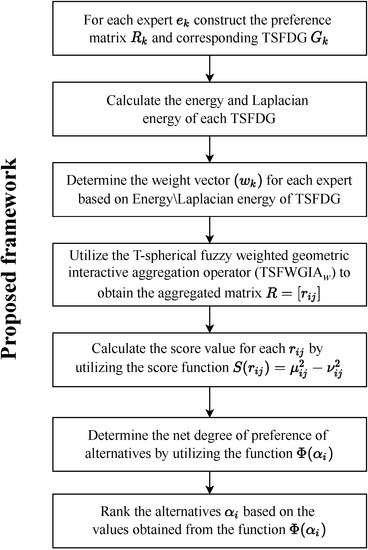
Figure 1.
Flow chart of algorithm for alternatives selection process.
Procedural Steps of the Algorithm:
- -
- Step 1: The experts compare the involved factors with themselves and present the initial information for computing in the form of TSF preference relations, represented in the form of matrices given by Figure 2 and as follows:and
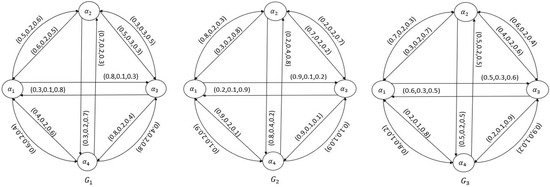 Figure 2. T-spherical fuzzy directed graphs.
 - -
- Step 2: The T-spherical fuzzy directed graph corresponding to the given by is presented below:
- -
- Step 3: The energy of each T-spherical fuzzy directed graph is given by
- -
- Step 4: The weight vector for each expert can be calculated by usingThe weight vectors so obtained are listed below:
- -
- Step 5: In this step, we use the following T-spherical fuzzy weighted geometric interactive aggregation operator recently given by Garg et al. [88],We aggregate the three T-spherical fuzzy preference relations and given in step 1 into a single preference relation , which is obtained as:
- -
- Step 6: We compute the score values by utilizing the score functionand tabulate them in the following matrix:
- -
- Step 7: Determine the net degree of preference of alternatives by utilizing the function [89] given byWe obtain
- -
- Step 8: On the basis of the highest value of the net degree, finally we choose the optimal alternative by ranking all the , i.e,Hence, we conclude that the strategy is the most reliable for sustainable urban transport for the proposed methodology and algorithm.
Remark 1.
In step 4, we replace the concept of energy by the concept of Laplacian Energy for the evaluation of weights. In this case, we use the following formula for the calculation of weights:
All the computations can similarly by performed for the evaluation process.
5.2. Comparative Analysis
This section presents a comparative analysis of selected approaches in evaluating sustainable transport strategies. Three additionally selected aggregation functions and the SFS TOPSIS method were used for comparison purposes. The matrices used for aggregation were and the weights , which were determined in the previous section in Step 4. The following approaches aggregated the matrices:
- Mahmood et al. (2019) T-spherical fuzzy weighted geometric (T-SFWG) operator [66]:
- Ullah et al. (2019) T-spherical fuzzy weighted averaging (T-SFWA) operator [90]:
- Ullah et al. (2020) T-spherical Fuzzy Hamacher-Weighted Averaging (T-SFHWA) operator [91]:
After performing matrix aggregation, the resulting matrices were evaluated using the net degree approach and SFS TOPSIS. The obtained evaluations are presented in Table 2. The most significant ratings were obtained for all considered approaches by alternative . In the case of the net degree approach, the obtained evaluations at all considered aggregation functions differ slightly and give the same ranking. However, for the SFS TOPSIS approach, the evaluations of alternatives – differ.
Table 2.
Obtained evaluations of alternatives – for the net degree approach and SFS TOPSIS for the considered aggregation functions.
Table 3 shows the rankings for the net degree and SFS TOPSIS approaches under different aggregation functions. In the case of alternative , first place is obtained in all rankings. The obtained rankings for the net degree approach at different aggregation functions gave the same ranking of the alternatives, which is the same as the results from SFS TOPSIS for the aggregation functions and . Alternative received the second-highest ranking for the SFS TOPSIS approach at aggregation functions , and . In contrast, for the approach, alternative received the last-place ranking. Referring to alternative for SFS TOPSIS at aggregation functions , and , it obtained the last place. However, it obtained the second-to-last place for the aggregation functions .
Table 3.
Obtained rankings of – alternatives for the net degree method and SFS TOPSIS for the considered aggregation functions.
Figure 3 presents the Spearman weighted correlation values between the resulting rankings. Most of the obtained rankings have a very high correlation among themselves. The obtained correlation values are in the range [0.52, 1]. The rankings’ minor similarity is between the ranking obtained from the SFS TOPSIS approach with the aggregation function and the SFS TOPSIS approach with the aggregation function . The obtained correlation value for this case is 0.52. The highest correlation between the rankings was observed for the net degree, SFS TOPSIS and SFS TOPSIS approaches.
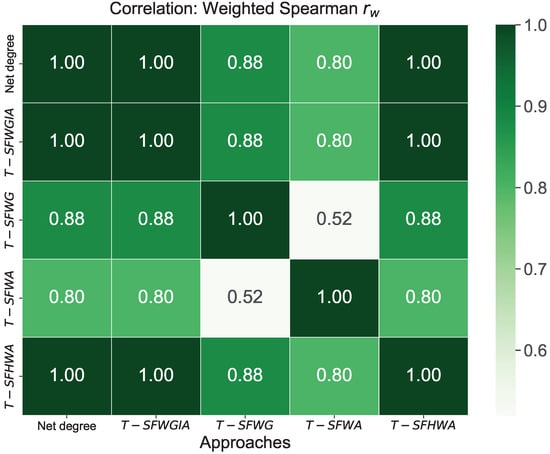
Figure 3.
Heat map for the weighted Spearman correlation coefficient of the considered approaches.
6. Conclusions and Future Works
In this paper, a study related to the evaluation of strategies for sustainable transport was conducted. Due to the current uncertainty related to decision-makers’ preferences, it was decided to use Spherical fuzzy sets. The study uses the Laplacian Energy of the TSF-directed graph, and a comparative analysis was conducted using two methods for evaluating alternative strategies and four functions aggregating T-SFS decision matrices.
The results obtained from the studied approach prove its applicability in real problems related to sustainable transport. The ease of expressing the decision-makers’ preferences through the TSF-directed graph provides credible and reliable results. Other directed graphs such as IFS or PyFS do not consider the degree of refusal and do not allow it. From the study results, it can be concluded that the T-SFS decision matrix aggregation functions used did the job. In addition, the aspect of benchmarking that was addressed shows results consistent with the MCDA/MCDM approach. Due to the studied issue of sustainable transportation, the proposed framework fulfills its purpose in this field and can be effectively applied to management problems.
Future research directions should include methods for objective significance determination expressed by metrics such as entropy or standard deviation. Moreover, sensitivity analysis should be applied so that different paths can be taken to improve the approach. Another research direction could be applying the approach to problems related to smart cities. Moreover, the integration of the existing MCDA/MCDM approaches with the Laplacian Energy of the TSF-directed graph should be considered.
Author Contributions
Conceptualization, P.D., B.K., A.G., A.S., J.W. (Jarosław Wątróbski), T.K., J.W. (Jakub Więckowski) and W.S.; methodology, P.D., B.K., A.G., A.S., J.W. (Jarosław Wątróbski), T.K., J.W. (Jakub Więckowski) and W.S.; software, P.D., B.K. and A.G.; validation, P.D., B.K. and W.S.; formal analysis, B.K. and W.S.; investigation, P.D., B.K. and W.S.; resources, P.D., B.K., A.S. and J.W. (Jakub Więckowski); data curation, B.K., A.G., A.S., J.W. (Jarosław Wątróbski), T.K. and J.W. (Jakub Więckowski); writing—original draft preparation, P.D., B.K., A.G., A.S., J.W. (Jarosław Wątróbski), T.K., J.W. (Jakub Więckowski) and W.S.; writing—review and editing, B.K. and W.S.; supervision, B.K., A.G., T.K. and W.S.; project administration, W.S.; funding acquisition, W.S. All authors have read and agreed to the published version of the manuscript.
Funding
The work was supported by the National Science Centre 2018/29/B/HS4/02725 and 2021/41/B/HS4/01296 (B.K., A.S. and W.S.).
Institutional Review Board Statement
Not applicable.
Informed Consent Statement
Not applicable.
Data Availability Statement
Not applicable.
Acknowledgments
The authors would like to thank the editor and the anonymous reviewers, whose insightful comments and constructive suggestions helped us to significantly improve the quality of this paper.
Conflicts of Interest
The authors declare no conflict of interest.
Abbreviations
The following abbreviations are used in this manuscript:
| AHP | Analytic Hierarchy Process |
| ANP | Analytic Network Process |
| ARAS | Additive Ratio ASsessment |
| BWM | Best-Worst Method |
| COCOSO | COmbined COmpromise SOlution |
| COMET | Characteristic Object’s Method |
| CTSFS | Complex T-spherical fuzzy sets |
| DSS | Decision Support Systems |
| ELECTRE | Elimination et Choix Traduisant la Realité |
| ERTP | Environmentally Responsible Transport Practices |
| FFS | Fermatean Fuzzy Sets |
| FS | Fuzzy Sets |
| FUCOM | Full Consistency Method |
| IFS | Intuitionistic Fuzzy Sets |
| MABAC | Multi-Attributive Border Approximation area Comparison |
| MAUT | Multi-Attribute Utility Theory |
| MCDA | Multi-Criteria Decision Analysis |
| MCDM | Multi-Criteria Decision Making |
| MOORA | Multi-Objective Optimization Method by Ratio Analysis |
| NFS | Neutrosophic Fuzzy Sets |
| PAPRIKA | Potentially All Pairwise RanKings of all possible Alternative |
| PFS | Picture Fuzzy Sets |
| PROMETHEE | Preference Ranking Organization Method for Enrichment of Evaluations |
| PyFS | Pythagorean Fuzzy Sets |
| SIMUS | Sequential Interactive Modelling for Urban Systems |
| SFS | Spherical Fuzzy Sets |
| SPOTIS | Stable Preference Ordering Towards Ideal Solution |
| TOPSIS | Technique for Order of Preference by Similarity to Ideal Solution |
| T-SFHWA | T-spherical Fuzzy Hamacher-Weighted Averaging |
| TSFSs | T-spherical Fuzzy Sets |
| T-SFWA | T-spherical fuzzy weighted averaging |
| T-SFWG | T-spherical fuzzy weighted geometric |
| VIKOR | VIseKriterijumska Optimizacija I Kompromisno Resenje |
References
- Mouratidis, A. Smooth integration of transport infrastructure into urban space. J. Infrastruct. Policy Dev. 2021, 5, 1379. [Google Scholar] [CrossRef]
- Kębłowski, W.; Dobruszkes, F.; Boussauw, K. Moving past sustainable transport studies: Towards a critical perspective on urban transport. Transp. Res. Part Policy Pract. 2022, 159, 74–83. [Google Scholar] [CrossRef]
- Abdelwahed, A.; van den Berg, P.L.; Brandt, T.; Ketter, W.; Mulder, J. A Boost for Urban Sustainability: Optimizing Electric Transit Bus Networks in Rotterdam. INFORMS J. Appl. Anal. 2021, 51, 391–407. [Google Scholar] [CrossRef]
- Hassan, S.A.; Hamzani, I.N.S.; Sabli, A.R.; Sukor, N.S.A. Bus rapid transit system introduction in Johor Bahru: A simulation-based assessment. Sustainability 2021, 13, 4437. [Google Scholar] [CrossRef]
- Bhattarai, D.K.; Shahi, P.B. Integrated Multi-Modal Transportation System: A Sustainable Approach for Urban Transport in Kathmandu. IOSR J. Mech. Civ. Eng. 2021, 18, 47–59. [Google Scholar]
- Bielińska-Dusza, E.; Hamerska, M.; Żak, A. Sustainable Mobility and the Smart City: A Vision of the City of the Future: The Case Study of Cracow (Poland). Energies 2021, 14, 7936. [Google Scholar] [CrossRef]
- Drop, N.; Garlińska, D. Evaluation of Intelligent Transport Systems Used in Urban Agglomerations and Intercity Roads by Professional Truck Drivers. Sustainability 2021, 13, 2935. [Google Scholar] [CrossRef]
- Pojani, D.; Stead, D. Sustainable urban transport in the developing world: Beyond megacities. Sustainability 2015, 7, 7784–7805. [Google Scholar] [CrossRef] [Green Version]
- Cassiano, D.R.; Bertoncini, B.V.; de Oliveira, L.K. A Conceptual Model Based on the Activity System and Transportation System for Sustainable Urban Freight Transport. Sustainability 2021, 13, 5642. [Google Scholar] [CrossRef]
- Pietrzak, K.; Pietrzak, O. Environmental effects of electromobility in a sustainable urban public transport. Sustainability 2020, 12, 1052. [Google Scholar] [CrossRef] [Green Version]
- Bamwesigye, D.; Hlavackova, P. Analysis of sustainable transport for smart cities. Sustainability 2019, 11, 2140. [Google Scholar] [CrossRef] [Green Version]
- Zhao, X.; Ke, Y.; Zuo, J.; Xiong, W.; Wu, P. Evaluation of sustainable transport research in 2000–2019. J. Clean. Prod. 2020, 256, 120404. [Google Scholar] [CrossRef]
- Badassa, B.B.; Sun, B.; Qiao, L. Sustainable transport infrastructure and economic returns: A bibliometric and visualization analysis. Sustainability 2020, 12, 2033. [Google Scholar] [CrossRef] [Green Version]
- Stephenson, J.; Spector, S.; Hopkins, D.; McCarthy, A. Deep interventions for a sustainable transport future. Transp. Res. Part D Transp. Environ. 2018, 61, 356–372. [Google Scholar] [CrossRef]
- Bartle, C.; Chatterjee, K. Employer perceptions of the business benefits of sustainable transport: A case study of peri-urban employment areas in South West England. Transp. Res. Part Policy Pract. 2019, 126, 297–313. [Google Scholar] [CrossRef]
- Mugion, R.G.; Toni, M.; Raharjo, H.; Di Pietro, L.; Sebathu, S.P. Does the service quality of urban public transport enhance sustainable mobility? J. Clean. Prod. 2018, 174, 1566–1587. [Google Scholar] [CrossRef]
- Kębłowski, W.; Van Criekingen, M.; Bassens, D. Moving past the sustainable perspectives on transport: An attempt to mobilise critical urban transport studies with the right to the city. Transp. Policy 2019, 81, 24–34. [Google Scholar] [CrossRef]
- Diao, M. Towards sustainable urban transport in Singapore: Policy instruments and mobility trends. Transp. Policy 2019, 81, 320–330. [Google Scholar] [CrossRef]
- Nedeliaková, E.; Stasiak-Betlejewska, R. Transport management in Polish cities in the context of the European sustainable transport concept. Transp. Res. Procedia 2019, 40, 1150–1157. [Google Scholar] [CrossRef]
- Li, S.; Lang, M.; Yu, X.; Zhang, M.; Jiang, M.; Tsai, S.; Wang, C.K.; Bian, F. A sustainable transport competitiveness analysis of the China railway express in the context of the Belt and Road Initiative. Sustainability 2019, 11, 2896. [Google Scholar] [CrossRef] [Green Version]
- Sunio, V.; Mateo-Babiano, I. Pandemics as ‘windows of opportunity’: Transitioning towards more sustainable and resilient transport systems. Transp. Policy 2022, 116, 175–187. [Google Scholar] [CrossRef]
- Pamučar, D.S.; Božanić, D.I.; Kurtov, D.V. Fuzzification of the Saaty’s scale and a presentation of the hybrid fuzzy AHP-TOPSIS model: An example of the selection of a brigade artillery group firing position in a defensive operation. Vojnotehnički glasnik 2016, 64, 966–986. [Google Scholar] [CrossRef]
- Kizielewicz, B.; Więckowski, J.; Wątrobski, J. A study of different distance metrics in the TOPSIS method. In Intelligent Decision Technologies; Springer: Berlin/Heidelberg, Germany, 2021; pp. 275–284. [Google Scholar]
- Titiyal, R.; Bhattacharya, S.; Thakkar, J.J. The distribution strategy selection for an e-tailer using a hybrid DANP VIKOR MCDM model. Benchmarking Int. J. 2019 26, 395–433. [CrossRef]
- Hashemi, A.; Dowlatshahi, M.B.; Nezamabadi-pour, H. VMFS: A VIKOR-based multi-target feature selection. Expert Syst. Appl. 2021, 182, 115224. [Google Scholar] [CrossRef]
- Blouchoutzi, A.; Manou, D.; Papathanasiou, J. A PROMETHEE MCDM application in social inclusion: The case of foreign-born population in the EU. Systems 2021, 9, 45. [Google Scholar] [CrossRef]
- Yu, X.; Zhang, S.; Liao, X.; Qi, X. ELECTRE methods in prioritized MCDM environment. Inf. Sci. 2018, 424, 301–316. [Google Scholar] [CrossRef]
- Hazza, M.A.; Abdelwahed, A.; Ali, M.Y.; Sidek, A.B.A. An Integrated Approach for Supplier Evaluation and Selection using the Delphi Method and Analytic Hierarchy Process (AHP): A New Framework. Int. J. Technol. 2022, 13, 16–25. [Google Scholar] [CrossRef]
- Kheybari, S.; Rezaie, F.M.; Farazmand, H. Analytic network process: An overview of applications. Appl. Math. Comput. 2020, 367, 124780. [Google Scholar] [CrossRef]
- Raju, S.S.; Murali, G.B.; Patnaik, P.K. Ranking of Al-CSA composite by MCDM approach using AHP–TOPSIS and MOORA methods. J. Reinf. Plast. Compos. 2020, 39, 721–732. [Google Scholar] [CrossRef]
- Akpan, U.; Morimoto, R. An application of Multi-Attribute Utility Theory (MAUT) to the prioritization of rural roads to improve rural accessibility in Nigeria. Socio-Econ. Plan. Sci. 2022, 82, 101256. [Google Scholar] [CrossRef]
- Kumar, A. Transition management theory-based policy framework for analyzing environmentally responsible freight transport practices. J. Clean. Prod. 2021, 294, 126209. [Google Scholar] [CrossRef]
- Rivero Gutiérrez, L.; De Vicente Oliva, M.A.; Romero-Ania, A. Managing Sustainable Urban Public Transport Systems: An AHP Multicriteria Decision Model. Sustainability 2021, 13, 4614. [Google Scholar] [CrossRef]
- Broniewicz, E.; Ogrodnik, K. A comparative evaluation of multi-criteria analysis methods for sustainable transport. Energies 2021, 14, 5100. [Google Scholar] [CrossRef]
- Roozkhosh, F.; Molavi, M.; Salaripour, A. Comparison of walkability in different urban districts using space syntax. J. Archit. Urban. 2020, 44, 1–10. [Google Scholar] [CrossRef] [Green Version]
- Romero-Ania, A.; Rivero Gutiérrez, L.; De Vicente Oliva, M.A. Multiple criteria decision analysis of sustainable urban public transport systems. Mathematics 2021, 9, 1844. [Google Scholar] [CrossRef]
- Faizi, S.; Sałabun, W.; Ullah, S.; Rashid, T.; Więckowski, J. A new method to support decision-making in an uncertain environment based on normalized interval-valued triangular fuzzy numbers and comet technique. Symmetry 2020, 12, 516. [Google Scholar] [CrossRef] [Green Version]
- Kizielewicz, B.; Sałabun, W. A new approach to identifying a multi-criteria decision model based on stochastic optimization techniques. Symmetry 2020, 12, 1551. [Google Scholar] [CrossRef]
- Dezert, J.; Tchamova, A.; Han, D.; Tacnet, J.M. The SPOTIS rank reversal free method for multi-criteria decision-making support. In Proceedings of the 2020 IEEE 23rd International Conference on Information Fusion (FUSION), Rustenburg, South Africa, 6–9 July 2020; pp. 1–8. [Google Scholar]
- Shekhovtsov, A.; Kizielewicz, B.; Sałabun, W. New rank-reversal free approach to handle interval data in mcda problems. In Proceedings of the International Conference on Computational Science, Kraków, Poland, 16–18 June 2021; Springer: Berlin/Heidelberg, Germany, 2021; pp. 458–472. [Google Scholar]
- Stoilova, S.; Munier, N. Analysis of policies of railway operators using SWOT criteria and the SIMUS method: A case for the Bulgarian railway network. Sustainability 2021, 13, 6948. [Google Scholar] [CrossRef]
- Pamucar, D.; Ecer, F. Prioritizing the weights of the evaluation criteria under fuzziness: The fuzzy full consistency method–FUCOM-F. Facta Univ. Ser. Mech. Eng. 2020, 18, 419–437. [Google Scholar] [CrossRef]
- Liang, F.; Brunelli, M.; Rezaei, J. Consistency issues in the best worst method: Measurements and thresholds. Omega 2020, 96, 102175. [Google Scholar] [CrossRef]
- Yazdani, M.; Wen, Z.; Liao, H.; Banaitis, A.; Turskis, Z. A grey combined compromise solution (CoCoSo-G) method for supplier selection in construction management. J. Civ. Eng. Manag. 2019, 25, 858–874. [Google Scholar] [CrossRef] [Green Version]
- Heidary Dahooie, J.; Kazimieras Zavadskas, E.; Abolhasani, M.; Vanaki, A.; Turskis, Z. A novel approach for evaluation of projects using an interval–valued fuzzy additive ratio assessment (ARAS) method: A case study of oil and gas well drilling projects. Symmetry 2018, 10, 45. [Google Scholar] [CrossRef] [Green Version]
- Liu, P.; Pan, Q.; Xu, H. Multi-attributive border approximation area comparison (MABAC) method based on normal q-rung orthopair fuzzy environment. J. Intell. Fuzzy Syst. 2021, 40, 9085–9111. [Google Scholar] [CrossRef]
- Alismaili, S.; Li, M.; Shen, J. Cloud computing adoption decision modelling for SMEs: From the PAPRIKA perspective. In Frontier Computing; Springer: Berlin/Heidelberg, Germany, 2016; pp. 597–615. [Google Scholar]
- Wątróbski, J.; Sałabun, W.; Karczmarczyk, A.; Wolski, W. Sustainable decision-making using the COMET method: An empirical study of the ammonium nitrate transport management. In Proceedings of the 2017 Federated Conference on Computer Science and Information Systems (FedCSIS), Prague, Czech Republic, 3–6 September 2017; pp. 949–958. [Google Scholar]
- Pamucar, D.; Ecer, F.; Deveci, M. Assessment of alternative fuel vehicles for sustainable road transportation of United States using integrated fuzzy FUCOM and neutrosophic fuzzy MARCOS methodology. Sci. Total Environ. 2021, 788, 147763. [Google Scholar] [CrossRef] [PubMed]
- Kumar, P.; Singh, R.K.; Paul, J.; Sinha, O. Analyzing challenges for sustainable supply chain of electric vehicle batteries using a hybrid approach of Delphi and Best-Worst Method. Resour. Conserv. Recycl. 2021, 175, 105879. [Google Scholar] [CrossRef]
- Zagorskas, J.; Turskis, Z. Setting priority list for construction works of bicycle path segments based on Eckenrode rating and ARAS-F decision support method integrated in GIS. Transport 2020, 35, 179–192. [Google Scholar] [CrossRef]
- Stewart, T.J. Dealing with uncertainties in MCDA. In Multiple Criteria Decision Analysis: State of the Art Surveys; Springer: Berlin/Heidelberg, Germany, 2005; pp. 445–466. [Google Scholar]
- Pelissari, R.; Oliveira, M.C.; Abackerli, A.J.; Ben-Amor, S.; Assumpção, M.R.P. Techniques to model uncertain input data of multi-criteria decision-making problems: A literature review. Int. Trans. Oper. Res. 2021, 28, 523–559. [Google Scholar] [CrossRef]
- Atanassov, K.T. Intuitionistic fuzzy sets. In Intuitionistic Fuzzy Sets; Springer: Berlin/Heidelberg, Germany, 1999; pp. 1–137. [Google Scholar]
- Krawczak, M.; Szkatuła, G. On matching of intuitionistic fuzzy sets. Inf. Sci. 2020, 517, 254–274. [Google Scholar] [CrossRef]
- Peng, X.; Selvachandran, G. Pythagorean fuzzy set: State of the art and future directions. Artif. Intell. Rev. 2019, 52, 1873–1927. [Google Scholar] [CrossRef]
- Senapati, T.; Yager, R.R. Fermatean fuzzy sets. J. Ambient. Intell. Humaniz. Comput. 2020, 11, 663–674. [Google Scholar] [CrossRef]
- Dutta, P.; Ganju, S. Some aspects of picture fuzzy set. Trans. Razmadze Math. Inst. 2018, 172, 164–175. [Google Scholar] [CrossRef]
- Das, S.; Roy, B.K.; Kar, M.B.; Kar, S.; Pamučar, D. Neutrosophic fuzzy set and its application in decision making. J. Ambient. Intell. Humaniz. Comput. 2020, 11, 5017–5029. [Google Scholar] [CrossRef]
- Zadeh, L.A. Fuzzy sets. In Fuzzy Sets, Fuzzy Logic, and Fuzzy Systems: Selected Papers by Lotfi A Zadeh; World Scientific: Singapore, 1996; pp. 394–432. [Google Scholar]
- Yager, R.R. Pythagorean fuzzy subsets. In Proceedings of the 2013 Joint IFSA World Congress and NAFIPS Annual Meeting (IFSA/NAFIPS), Edmonton, AB, Canada, 24–28 June 2013; pp. 57–61. [Google Scholar]
- Cuong, B.C.; Kreinovich, V. Picture fuzzy sets-a new concept for computational intelligence problems. In Proceedings of the 2013 Third World Congress on Information and Communication Technologies (WICT 2013), Hanoi, Vietnam, 15–18 December 2013; pp. 1–6. [Google Scholar]
- Smarandache, F. A unifying field in Logics: Neutrosophic Logic. In Philosophy; American Research Press: Santa Fe, NM, USA, 1999; pp. 1–141. [Google Scholar]
- Kutlu Gündoğdu, F.; Kahraman, C. A novel VIKOR method using spherical fuzzy sets and its application to warehouse site selection. J. Intell. Fuzzy Syst. 2019, 37, 1197–1211. [Google Scholar] [CrossRef]
- Kutlu Gündoğdu, F.; Kahraman, C. Spherical fuzzy sets and spherical fuzzy TOPSIS method. J. Intell. Fuzzy Syst. 2019, 36, 337–352. [Google Scholar] [CrossRef]
- Mahmood, T.; Ullah, K.; Khan, Q.; Jan, N. An approach toward decision-making and medical diagnosis problems using the concept of spherical fuzzy sets. Neural Comput. Appl. 2019, 31, 7041–7053. [Google Scholar] [CrossRef]
- Ullah, K.; Mahmood, T.; Jan, N. Similarity measures for T-spherical fuzzy sets with applications in pattern recognition. Symmetry 2018, 10, 193. [Google Scholar] [CrossRef] [Green Version]
- Mathew, M.; Chakrabortty, R.K.; Ryan, M.J. A novel approach integrating AHP and TOPSIS under spherical fuzzy sets for advanced manufacturing system selection. Eng. Appl. Artif. Intell. 2020, 96, 103988. [Google Scholar] [CrossRef]
- Riaz, M.; Saba, M.; Khokhar, M.A.; Aslam, M. Novel concepts of m-polar spherical fuzzy sets and new correlation measures with application to pattern recognition and medical diagnosis. AIMS Math. 2021, 6, 11346–11379. [Google Scholar] [CrossRef]
- Hamal, S.; Senvar, O. A novel integrated AHP and MULTIMOORA method with interval-valued spherical fuzzy sets and single-valued spherical fuzzy sets to prioritize financial ratios for financial accounting fraud detection. J. Intell. Fuzzy Syst. 2022, 42, 1–28. [Google Scholar] [CrossRef]
- Ghoushchi, S.J.; Bonab, S.R.; Ghiaci, A.M.; Haseli, G.; Tomaskova, H.; Hajiaghaei-Keshteli, M. Landfill site selection for medical waste using an integrated SWARA-WASPAS framework based on spherical fuzzy set. Sustainability 2021, 13, 13950. [Google Scholar] [CrossRef]
- Zeng, S.; Garg, H.; Munir, M.; Mahmood, T.; Hussain, A. A multi-attribute decision making process with immediate probabilistic interactive averaging aggregation operators of T-spherical fuzzy sets and its application in the selection of solar cells. Energies 2019, 12, 4436. [Google Scholar] [CrossRef] [Green Version]
- Wu, M.Q.; Chen, T.Y.; Fan, J.P. Divergence measure of T-spherical fuzzy sets and its applications in pattern recognition. IEEE Access 2019, 8, 10208–10221. [Google Scholar] [CrossRef]
- Ullah, K.; Garg, H.; Mahmood, T.; Jan, N.; Ali, Z. Correlation coefficients for T-spherical fuzzy sets and their applications in clustering and multi-attribute decision making. Soft Comput. 2020, 24, 1647–1659. [Google Scholar] [CrossRef]
- Wu, M.Q.; Chen, T.Y.; Fan, J.P. Similarity measures of T-spherical fuzzy sets based on the cosine function and their applications in pattern recognition. IEEE Access 2020, 8, 98181–98192. [Google Scholar] [CrossRef]
- Ali, Z.; Mahmood, T.; Yang, M.S. Complex T-spherical fuzzy aggregation operators with application to multi-attribute decision making. Symmetry 2020, 12, 1311. [Google Scholar] [CrossRef]
- Parvathi, R.; Karunambigai, M. Intuitionistic fuzzy graphs. In Computational Intelligence, Theory and Applications; Springer: Berlin/Heidelberg, Germany, 2006; pp. 139–150. [Google Scholar]
- Naz, S.; Ashraf, S.; Akram, M. A novel approach to decision-making with Pythagorean fuzzy information. Mathematics 2018, 6, 95. [Google Scholar] [CrossRef] [Green Version]
- Goldberg, F. Graph energy estimates via the Chebyshev functional. arXiv 2014, arXiv:1407.7430. [Google Scholar]
- Praba, B.; Chandrasekaran, V.; Deepa, G. Energy of an intuitionistic fuzzy graph. Ital. J. Pure Appl. Math. 2014, 32, 431–444. [Google Scholar]
- Guleria, A.; Bajaj, R.K. T-spherical fuzzy graphs: Operations and applications in various selection processes. Arab. J. Sci. Eng. 2020, 45, 2177–2193. [Google Scholar] [CrossRef]
- Poonia, M.; Bajaj, R.K. On Laplacian Energy of picture fuzzy graphs in site selection problem. J. Intell. Fuzzy Syst. 2021, 41, 481–498. [Google Scholar] [CrossRef]
- Chang, C.H.; Lin, J.J.; Lin, J.H.; Chiang, M.C. Domestic open-end equity mutual fund performance evaluation using extended TOPSIS method with different distance approaches. Expert Syst. Appl. 2010, 37, 4642–4649. [Google Scholar] [CrossRef]
- Hung, C.C.; Chen, L.H. A fuzzy TOPSIS decision making model with entropy weight under intuitionistic fuzzy environment. In Proceedings of the International Multiconference of Engineers and Computer Scientists, Hong Kong, China, 18–20 March 2009; Volume 1, pp. 13–16. [Google Scholar]
- Kizielewicz, B.; Bączkiewicz, A. Comparison of Fuzzy TOPSIS, Fuzzy VIKOR, Fuzzy WASPAS and Fuzzy MMOORA methods in the housing selection problem. Procedia Comput. Sci. 2021, 192, 4578–4591. [Google Scholar] [CrossRef]
- Zhang, X.; Xu, Z. Extension of TOPSIS to multiple criteria decision making with Pythagorean fuzzy sets. Int. J. Intell. Syst. 2014, 29, 1061–1078. [Google Scholar] [CrossRef]
- Shekhovtsov, A.; Więckowski, J.; Kizielewicz, B.; Sałabun, W. Towards Reliable Decision-Making in the green urban transport domain. Facta Univ. Ser. Mech. Eng. 2021. Available online: http://casopisi.junis.ni.ac.rs/index.php/FUMechEng/article/view/7407 (accessed on 1 September 2021).
- Garg, H.; Munir, M.; Ullah, K.; Mahmood, T.; Jan, N. Algorithm for T-spherical fuzzy multi-attribute decision making based on improved interactive aggregation operators. Symmetry 2018, 10, 670. [Google Scholar] [CrossRef] [Green Version]
- Wang, Y.M.; Fan, Z.P. Fuzzy preference relations: Aggregation and weight determination. Comput. Ind. Eng. 2007, 53, 163–172. [Google Scholar] [CrossRef]
- Ullah, K.; Mahmood, T.; Jan, N.; Ahmad, Z. Policy decision making based on some averaging aggregation operators of T-spherical fuzzy sets; a multi-attribute decision making approach. Ann. Optim. Theory Pract. 2020, 3, 69–92. [Google Scholar]
- Ullah, K.; Mahmood, T.; Garg, H. Evaluation of the performance of search and rescue robots using T-spherical fuzzy Hamacher aggregation operators. Int. J. Fuzzy Syst. 2020, 22, 570–582. [Google Scholar] [CrossRef]
Publisher’s Note: MDPI stays neutral with regard to jurisdictional claims in published maps and institutional affiliations. |
© 2022 by the authors. Licensee MDPI, Basel, Switzerland. This article is an open access article distributed under the terms and conditions of the Creative Commons Attribution (CC BY) license (https://creativecommons.org/licenses/by/4.0/).