Abstract
In 2017, China made an ambitious statement of high-quality development (HQD) with which to realize the goals of sustainability proposed by the United Nations. Our paper sheds new light on how the corporate high-quality development is affected by the responsibility system for environmental protection targets using a sample of energy-intensive firms from 2003 to 2018. We calculate the indexes for corporate high-quality development using entropy weighting for the five dimensions: efficiency, innovation, openness, greenness, and social responsibility. Then, we develop a difference-in-differences model to reveal that the responsibility system for environmental protection targets significantly dampens high-quality development of corporations, as the estimated coefficient is −0.0420 with a t-statistic of −2.9384. In contrast with private firms, the high-quality development of state-owned firms shows no significant correlation with environmental policy constraints. The efficiency of capital allocation by corporations mediates the effects of responsibility for environmental protection targets on high-quality development. Our study suggests several policy implications: first, understand the connotation of a high-quality development system, and formulate diversified regulatory policies. Second, the responsibility system for environmental protection targets in China should be implemented steadily within the firm’s abilities. Next, the high-quality development of private firms should generate great attention. Finally, corporate internal governance should be designed to improve high-quality development.
1. Introduction
The question of how to promote high-quality development of corporations has aroused great attention from the Chinese government. High-quality development refers to the new concept of “innovation, coordination, greenness, openness, and sharing” put forward by the Party Central Committee with General Secretary Xi Jinping. The aim is to improve supply quantity and quality, to meet the needs of consumption upgrades, to drive innovation, and to promote efficient, balanced, and sustainable development [1]. High-quality development of corporations is not only driven by incentive policies, but also affected by constraints, among which environmental regulations are particularly critical.
On the one hand, the setting of environmental regulations may increase the expenditure on pollution-controlling equipment, which crowds out productive investment and decreases productivity/financial performance [2,3,4]. This weakens the level of high-quality development. On the other hand, environmental regulation may motivate firms to innovate, which leads to the coordination between environment and economy [5,6,7]. For these contradictory viewpoints, investigating the effects of environmental regulation on high-quality development of corporations not only contributes to the strategy of carbon neutrality and peak carbon emissions, but also improves the firm’s competitiveness and its high-quality development.
Previous studies can be grouped into the following: the first is the connotation and features of high-quality development, such as innovation, coordination, greenness, openness, and sharing [8], economic development path and economic structure with strong dynamic characteristics, economic development strategies and economic structure and drivers [9,10], and technological progress and worker quality [11].
The second is a measure of high-quality development. High-quality development indicators are generally constructed to cover dimensions, such as innovation and green development. For example, Wei and Li measured the level of China’s high-quality economic development, which included the dimensions of economic structure, innovation drive, resource allocation, market mechanism, regional coordination, product services, infrastructure, ecological civilization, and economic outcomes. Similar cases were included in the studies by Li et al. [12] and Huang et al. [13].
The third focuses on the drivers of high-quality development, including ecological and environmental policies [14,15], technological innovation [16,17,18], and the degree of openness [19,20,21,22,23].
The fourth is the relationship between environmental regulations and corporate technological innovation (or productivity) based on theories of neoclassical tradition or innovation compensation. The former theory posits that the production cost increased by environmental governance has a crowding-out effect on a firm’s technological innovation, that is, environmental regulations reduce technical efficiency (or technological innovation) [24,25,26,27,28] or weaken corporate performance [4,29,30]. Innovation compensation emphasizes that regulated firms can improve their resource allocation and technological progress [31,32]. The literature on Mainland China [33,34,35,36,37], Taiwan [38], and India [39] confirm the innovation compensation hypothesis. However, there are few studies that prove the uncertainty effect of environmental regulation on technological innovation or firm profitability [40,41].
To summarize, although a number of studies have provided valuable investigations into the connotation, measurement, and drivers of high-quality development, and the micro effects of environmental regulation, relatively little is known about the relationship between environment regulation and high-quality development of corporations. In particular, environmental regulation may show the greatest effects on energy-intensive firms with the features of high energy consumption and severe pollution, although the existing literature lacks analysis of this specific type of firm. For these reasons, we calculated the indexes of high-quality development of corporations using entropy weighting for the five dimensions of efficiency, innovation, openness, greenness, and social responsibility. Then, using the responsibility system for environmental protection targets (RSEPT) as a measure of environmental regulation, we have developed a difference-in-differences model to reveal its dampening effect on corporate high-quality development.
Our study contributes to several strands. It extends the study of high-quality development. Previous studies that related to high-quality development mainly covered the macro/medium scope, but we focused on corporate high-quality development by synthesizing it into a single indictor.
Our study also contributes to the effect of environmental regulations by considering the RSEPT. Different from the previous studies that focused on the socio-economic development, structural transformation, firm technological innovation, and production efficiency affected by environmental regulation, our paper, for the first time, considers the effect of RSEPT, which is one of the specific, key forms of environmental regulation.
Finally, we propose that environmental regulation for energy-intensive firms under the background of carbon neutrality should be prudent and orderly. Most prior studies suggested that environmental regulation promoted a firm’s economic development through technological innovation, but our paper fails to prove the positive role of environmental regulation on energy-intensive firms. Therefore, environmental regulation policies should be implemented cautiously and orderly instead of radically.
The remainder of this paper is organized as follows. Section 2 outlines institutional background and research hypotheses. Section 3 introduces the methodology and variables. Section 4 investigates the effects of RSEPT on the high-quality development of energy-intensive firms. This section also examines the mediating mechanism from the perspective of efficiency of capital allocation. Section 5 and Section 6 show the robustness tests and discussion, respectively. Section 7 provides a conclusion and policy implications.
2. Institutional Background and Research Hypotheses
2.1. Institutional Background
In China, environmental issues have aroused great concern since the end of the 1980s, as the first Law of the People’s Republic of China on Environmental Protection was formally promulgated in 1989. Following both the successive promulgation of “China’s 21st Century Agenda” and “the Ninth Five-Year Plan (1996–2000) for National Economic and Social Development and the Long-range” in 1994 and 1996, respectively, and General Secretary Hu Jintao’s comments on the relationship between economic development and environmental protection in 2003, China has moved from a strategy of sustainable development to a scientific outlook on development. Before 2006, although China had implemented a number of environmental pollution control policies, such as the “Regulations on the Environmental Management of Construction Projects” (1998), “The Atmospheric Pollution Prevention and Control Law of the People’s Republic of China” (2000), “The Law of the People’s Republic of China on Environmental Impact Assessment” (2003), and “Interim Measures on Cleaner Production Audits” (2004), the policy which caused the transition from environmental objectives with soft constraints to ones with hard constraints was RSEPT.
At the end of December 2005, The State Council developed the policy of “Environmental Performance Assessment”. In March 2006, “The 11th Five-Year Plan for National Economic and Social Development of the People’s Republic of China” proposed for the first time that environmental indicators, such as pollutant emissions and energy consumption per unit of GDP, should be included in the assessment process for political promotion of local government officials. Subsequently, a series of national institutions also issued specific assessment documents, and the leaders of each province signed responsibility documents for environmental protection targets. Local governments further required the key polluting firms in each city, district, and county under its jurisdiction to report pollution data on time and to make them public regularly. The reported data and assessment results served as one of the important criteria for political promotion or dismissal of leaders.
For the first time, China put forward the concept of high-quality development at the 19th National Congress of the Communist Party of China, and followed it up with the enactment of successive policies, such as “Opinions on Promoting the High-quality Development of National High-tech Industrial Development Zone” (2020), Several Policies to Promote the High-quality Development of Integrated Circuit Industry and Software Industry in the New Period” (2020), “Policies and Measures for High-quality Development Promoting the Private Economy” (2021), “Promoting High-quality Development of Digital Culture Industry” (2021), and other policies to provide support for high-quality development. However, current policies focus on high-quality development at the macro/industrial level. The definition and evaluation of high-quality indicators for firms that were originally defined in “Corporate High-quality Evaluation Indicators” was not enacted until 2021.
2.2. Research Hypothesis
The relationship between environmental regulation and corporate high-quality development can be expressed using the theories titled “cost effect” and “innovation compensation effect”. According to the cost effect theory, environmental regulation policies limit emission standards or emissions of pollutants. To meet the technological standards, firms increase the innovation costs in upgrading environment protection equipment. Additionally, firms raise the innovation costs due to environmental taxes, or additional sewage charges levied by the governments. If the firm has limited capital, the increased investment in environmental protection will cause a “crowding out” effect on technological innovation and input of production factors, which leads to a decline in that firm’s income [42]. Environmental regulation policies may also restrict both the production and scope of operation of energy-intensive firms, thus reducing production efficiency and market share [43]. Some studies show that environmental regulation has a stronger dampening effect on imports and exports of energy-intensive firms [44]. In terms of corporate social responsibility, the environmental governance cost of energy-intensive firms is higher than that of other types of firms, which may lead to lowered profits and reduced wages for workers [45]. Moreover, although energy-intensive firms may disclose more accounting information under environmental regulation pressure, they may also adopt negative earnings management to avoid paying taxes or for other reasons. Energy-intensive firms will attract sympathy from the government due to these poor management operating conditions [46,47]. Due to this, environmental regulations may cause firms to reduce their contribution to social responsibility, which would affect their high-quality development.
The innovation compensation theory states that, although firms are forced to bear more costs due to environmental constraints, they may also be stimulated to innovate. The innovations will increase productivity and profitability of firms, which offsets the costs caused by environmental regulation [6]. The innovation compensation theory, which is supported by a number of empirical studies, is also known as the “Porter Hypothesis”. Environmental regulations stipulate specific standards for pollutant discharge that encourage a firms’ self-supervision. Firms seek a better market share [48] and export international competitiveness [49] by improving their own technical standards. Finally, in terms of corporate social responsibility to the employees, environmental regulations cause contradictory effects on employee wages. The formulation of short-term environmental regulation policies may reduce employee wages due to a firm’s motivation to reduce costs, but long-term environmental regulation policies promote green development and provide people with more employment opportunities [50]. In terms of corporate social responsibility to the government, environmental regulations stimulate energy-intensive firms to adopt more transparent disclosure of their environmental information, which reduce the motivation to avoid corporate taxes [51]. The policies that enable firms to adopt initiatives to assume their social responsibility to pay taxes contributes to corporate high-quality development.
Motivated by the reasons given above, we propose our first competing hypotheses:
Hypothesis 1 (H1a).
The RSEPT promotes high-quality development of energy-intensive firms.
Hypothesis 1 (H1b).
The RSEPT dampens high-quality development of energy-intensive firms.
As one of the main initiatives of environmental regulation, RSEPT may affect the efficiency of capital allocation by corporations. Some studies have documented the environmental laws and regulations that significantly restrain excessive management of capital by firms [52]. Through “green cleaning” behavior, firms can enjoy low loan interest rates for environmental governance, reduce pollution control costs, and, therefore, allocate firms’ internal resources more rationally [53]. However, the contradictory viewpoint suggests that the positive externality of environmental protection can hardly bring direct benefits to the capital allocation of firms. While implementing environmental regulation policies, the collection of environmental taxes and related fines and the setting of energy consumption standards may cause a crisis of confidence between consumers and investors. This will lead to tight commercial credit and financing difficulties [54], further distorting the efficiency of capital allocation [55]. According to Jiang and Li [56], local officials may deliberately change their environmental governance decisions so that firms can benefit from their own political interests. To achieve “short-term performance”, the government may invest in projects that benefit officials rather than consumers, which easily result in excessive investment, redundant construction, and overcapacity. Combining environmental assessment with the promotions assessment of officials reduces the efficiency of capital allocation and further dampens corporate high-quality development.
Hence, we propose the following hypothesis:
Hypothesis 2 (H2).
The efficiency of corporate capital allocation mediates the effects of RSPET on high-quality development of energy-intensive firms.
3. Data and Methodology
3.1. Data and Samples
Data related to RSEPT and corporate high-quality development are obtained from the 2003 to 2018 China Stock Market & Accounting Research (CSMAR). As RSEPT was first introduced in 2006, we define 2006–2018 as the period of implementation of environmental regulation policies. We exclude both the special treatment and particular transfer firms, as well as firms with a significant amount of missing data. To ensure the accuracy of the collected data, we match the data to the Wind database.
3.2. Difference-in-Differences (DID) Framework
The difference-in-differences (DID) model mainly divides exogenous policy shock samples into two groups: the treatment group and the control group. One group is affected by the policy, while the other group is not affected. By comparing the changes D1 and D2 between the treatment group and the control group, the effect of the policy shock DID = D1−D2, that is, the net effect of policy implementation.
The basic equation of the DID model is:
where shows the observable result of individual at time .
In the formula, is the time dummy variable, which takes the value of 1 and 0 before and after the policy is implemented, respectively. shows the group dummy variable. If the firms are in the treatment group of six energy-intensive industries, we take the value of 1, otherwise, 0. The cross term indicates the policy variable, the coefficient is the net effect of policy implementation, and εit shows the random disturbance term.
For the experimental group, = 1,
The implementation of RSEPT targets mainly at the energy-intensive firms, which can be classified into six types of the chemical raw materials and chemical products manufacturing industry, ferrous metal smelting, and rolling processing, etc. By contrast, other types of firms are less affected by RSEPT. Therefore, our examination of the effect of RSEPT can be regarded as a policy experiment in which energy-intensive firms were considered the treatment group. The rest of the firms were considered the control group. Owing to the non-random assignment of treatment status, special care must be taken to estimate the causal effect of RSEPT on corporate high-quality development. We implement an approach on the basis of a DID estimator that compares the change in high-quality development before and after RSEPT implementation to changes in high-quality development over the same time period in control groups. Referring to the studies of Wen [57], Wang [58], and Wu [59], we build a generalized difference-in-differences (DID) framework as follows:
where i denotes the firm, denotes the year, denotes the year lagging by one period, and is the firm’s high-quality development. is a dummy variable that equals 1 if the firm is an energy-intensive firm, and 0 otherwise. is a year dummy variable. RSEPT equals 1 in the year of implementation (2006) and 0 if the year is after or before the year of policy implementation. is a difference-in-differences estimation item. is a control variable group. and are firm and time fixed effects, respectively. is the error term.
3.3. Variables
3.3.1. Corporate High-Quality Development
Referring to the “Corporate High-quality Evaluation Indicators” (2021) issued by the China Enterprise Reform and Development Research Institute, we measure the total index of China’s high-quality development along five dimensions: efficiency, innovation, openness, greenness development, and social responsibility. We identify the final high-quality indicators based on the availability of data (Table 1).
Table 1.
Three levels of Indicators.
For secondary indicators of benefit development, we use return on assets (ROA), operating income growth rate, and debt to asset ratio to measure profitability, growth capacity, and operational capacity of firms, respectively. For secondary indicators of innovation-driven development, the proportion of R&D expenditure to total revenue and the proportion of R&D personnel to total employees are employed to measure innovative capital and innovative talents, respectively. For secondary indicators of market development, market share and proportion of export volume in total sales are selected to measure market performance and opening performance, respectively. For secondary indicators of green development, we use waste gas emission per 10,000-yuan output value and energy consumption per unit income to measure environmental emissions and energy efficiency, respectively. For indicators of social responsibility, the growth rate of employee compensation payable and asset tax rate are used to measure employee rights and tax level, respectively.
The entropy weight method in our paper uses the variation of indicators to illustrate the involved information. It will, to some extent, overcome subjective arbitrariness and make the indicator weights more efficient [60,61]. The specific steps are shown as follows:
- (1)
- First, this paper constructs a data matrix.
- (2)
- Second, we normalize the matrix using the following two formulas.
Positive indicator normalization formula:
Negative index normalization formula:
- (3)
- Next, we calculate the proportion of the project index under the year according to the following formula:
- (4)
- Then, we estimate the entropy value of the indicator:
Additionally, , 0 ≤ ≤ 1.
- (5)
- After that, the entropy weight of the indicator is calculated:
- (6)
- Finally, the weights of all indicators are obtained:
The weights for the indicators are shown in Table 2.
Table 2.
Entropy weight value.
3.3.2. Control Variables
Drawing on the references of Si et al. [62] and Zhou and Qiu [48], we select firm asset size (SIZE), age (AGE), Tobin’s Q (Q), leverage ratio (LEV), fixed asset share (FIXS), and the Herfindahl index (H) as control variables (Table 3). The maximum and minimum values of high-quality development are 0.9700 and 0.0908, respectively, with a difference of 10 times (Table 4). The value of high-quality development has an average of 0.3729, suggesting an uneven value of corporate high-quality development. In addition, the values of other control variables vary across the firms significantly.
Table 3.
Variables and definitions.
Table 4.
Descriptive statistics.
4. Empirical Results
4.1. Correlation Analysis
Except for the strong correlations between Tobin’s Q and corporate debt ratio, and correlations between Tobin’s Q and return on assets, correlations among other control variables are generally below 0.5 (Table 5). This suggests trivial multicollinearity problems.
Table 5.
Correlation matrix.
4.2. Univariate Difference-in-Differences Results
We first implement the univariate difference-in-differences for empirical testing. “Before” indicates the period prior to the introduction of RSEPT (2003–2005), and “After” denotes the period after the introduction of RSEPT (2006–2018). The univariate difference-in-differences method is used to examine whether the two groups of firms exhibited systematic differences in high-quality development before and after the introduction of the policy.
For other industries, the high-quality development has an average value of 0.0532 before the introduction of the environmental regulation policy, but this average value is −0.1719 after implementation (Table 6). Similarly, the high-quality development index of energy-intensive firms also decreases significantly after environmental regulation policy implementation, with a decline of 0.3426. All these differences are significant at the 1% level. Overall, when compared with the control group, in the treatment group the responsibility system of environmental protection targets leads to a significant decrease in the index of high-quality development of energy-intensive firms, with the effect of the policy −0.1175.
Table 6.
Univariate difference-in-differences estimation results.
4.3. Difference-in-Differences Estimation Results
To more clearly identify the effect of environmental regulation policy on corporate high-quality development, we introduce control variables of firm size (size), age (age), and other variables for firm characteristics. We also include firm and time fixed effects in our specifications (Table 7).
Table 7.
Difference-in-differences estimation results.
In Columns (1) and (2), RSEPT has significant and negative effects on high-quality development of energy-intensive firms. Specifically, in Column (2), the estimated coefficient is −0.0420, which is significant at the 1% level. Except for firm size and the concentration of the top five shareholders, the coefficients of firm age, debt ratio, fixed asset ratio, and the Herfindahl index remain negative and significant at the 1% level.
To summarize, the high-quality development of energy-intensive firms is correlated negatively with RSEPT, which supports hypothesis 1b.
4.4. Cross-Sectional Analysis
The firms in the treatment group are located in several regions. The effect of RSEPT may be conditional on the level of regional economic development and a firm’s ownership. For these reasons, we conduct cross-sectional analysis by classifying the regions into eastern, central, and western China and by classifying the firms into state-owned and private ones (see Table 8). The results indicate that RSEPT has a negative impact on the high-quality development of energy-intensive firms in each region of China, with a 1% significance level. However, the coefficient of RSEPT in the central and western regions is −0.0942, which is smaller than −0.0746 in the eastern regions; there is a more pronounced dampening effect in the central and western regions. We attributed this to the following reasons: the energy-intensive firms in the eastern region have superior production technology and better economic conditions to alleviate the negative impact of environmental regulations.
Table 8.
Cross-sectional analysis.
In terms of firm ownership, our empirical results show that RSEPT has no effect on high-quality development of state-owned firms, but for private firms, this effect is pronounced, with a coefficient of −0.0949 at the 1% significant level. A possible reason is that the state-owned firms are endowed with superiority of financing capacity compared with private firms. In the face of similar environmental regulatory policies, state-owned firms are insensitive to external market information. Additionally, state-owned firms undertake more social responsibility, which entails high environmental protection expenditure. By contrast, the private firms pursue maximum profits. The introduction of environmental regulation policy became a “rigid constraint” for them. The private firms should react to the policy and adjust their operations in a timely manner. That is, private firms are more sensitive to RSEPT.
4.5. Mediating Effects of Capital Allocation Efficiency
We conducted a formal mediation analysis to help disentangle the underlying mechanisms for the effects of this environmental regulation policy. Motivated by the studies of Farza et al. [63], Liu et al. [64], and Geng and Cui [65], we used capital allocation efficiency as a mediating variable and developed the “investment–investment opportunity” sensitivity model to examine this mechanism. To this end, we estimate the following equation:
where is the firm’s investment level. The firm’s investment level = (cash paid for the purchase of fixed assets, intangible assets, and other long-term assets—cash recovered from the disposal of fixed assets, intangible assets, and other long-term assets)/total assets at the end of the period. is the rate of return on assets with a lag period, which measures the firm’s investment opportunities; the rest of the variables are defined as above. The coefficient of measure the effect of RSEPT on corporate investment efficiency.
The coefficient of in Column (1) is −0.32, significant at the 1% level (Table 9). This indicates a dampening effect of RSEPT on capital allocation efficiency. In Column (2), with the inclusion of control variables, the interaction term is correlated negatively with at the 1% significant level, supporting hypothesis H2.
Table 9.
Mediating effect.
5. Robustness Test
5.1. Parallel Trend Test
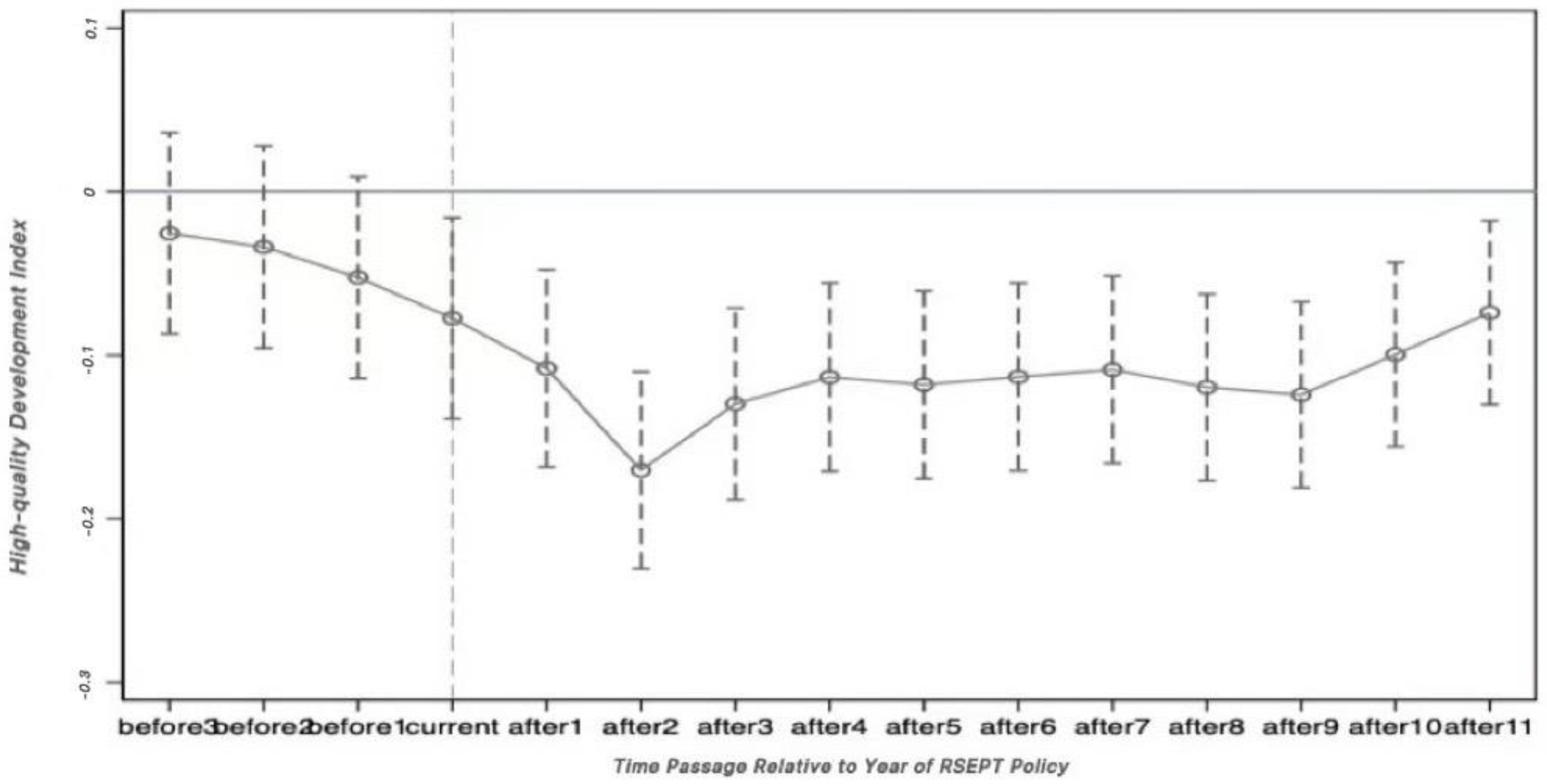
A requirement of an unbiased DID estimation is the parallel trend assumption, (i.e., treatment and control groups should have a similar trend in corporate high-quality development before introduction of the RSEPT). To this end, we conducted a parallel test by drawing on the study of Jacobson et al. [66]. We looked at the treatment effect of 1–3 years before introduction of the environmental regulations (Figure 1). The results demonstrate that the coefficients of TREAT × TIME from 2003 to 2005 are indistinguishable from zero and, therefore, the parallel trend assumption holds. Following 2006, the treatment effect is negative and statistically significant for each year.
Figure 1.
Parallel trend test.
5.2. Placebo Test
We performed a placebo test to ensure that our baseline results were not driven by chance. First, the DID regression model was built on the assumption that other concurrent policy shocks do not cause the effect of RSEPT on corporate high-quality development. To test this possibility, we conducted a placebo test by arbitrarily setting the 2-year prior to policy implementation, 2005 and 2004, and we estimated a similar baseline regression (Table 10).
Table 10.
Placebo test.
We find that RSEPT does not have a significant effect on corporate high-quality development when setting the event years to 2004 and 2005. This highlights that the timing of policy intervention is random and stable.
As the findings may have been caused by unobservable factors at the industry level instead of the implementation of the environmental regulation policy, we also performed a placebo test for the treatment group. By random sampling 200 times, we obtained the results in Column (3) of Table 10. The environmental regulation policy has no significant effect for any of these 200 random samples. Thus, the placebo test provides evidence that no other unknown factors are correlated significantly with high-quality development of energy-intensive firms.
5.3. DID after Propensity Score Matching
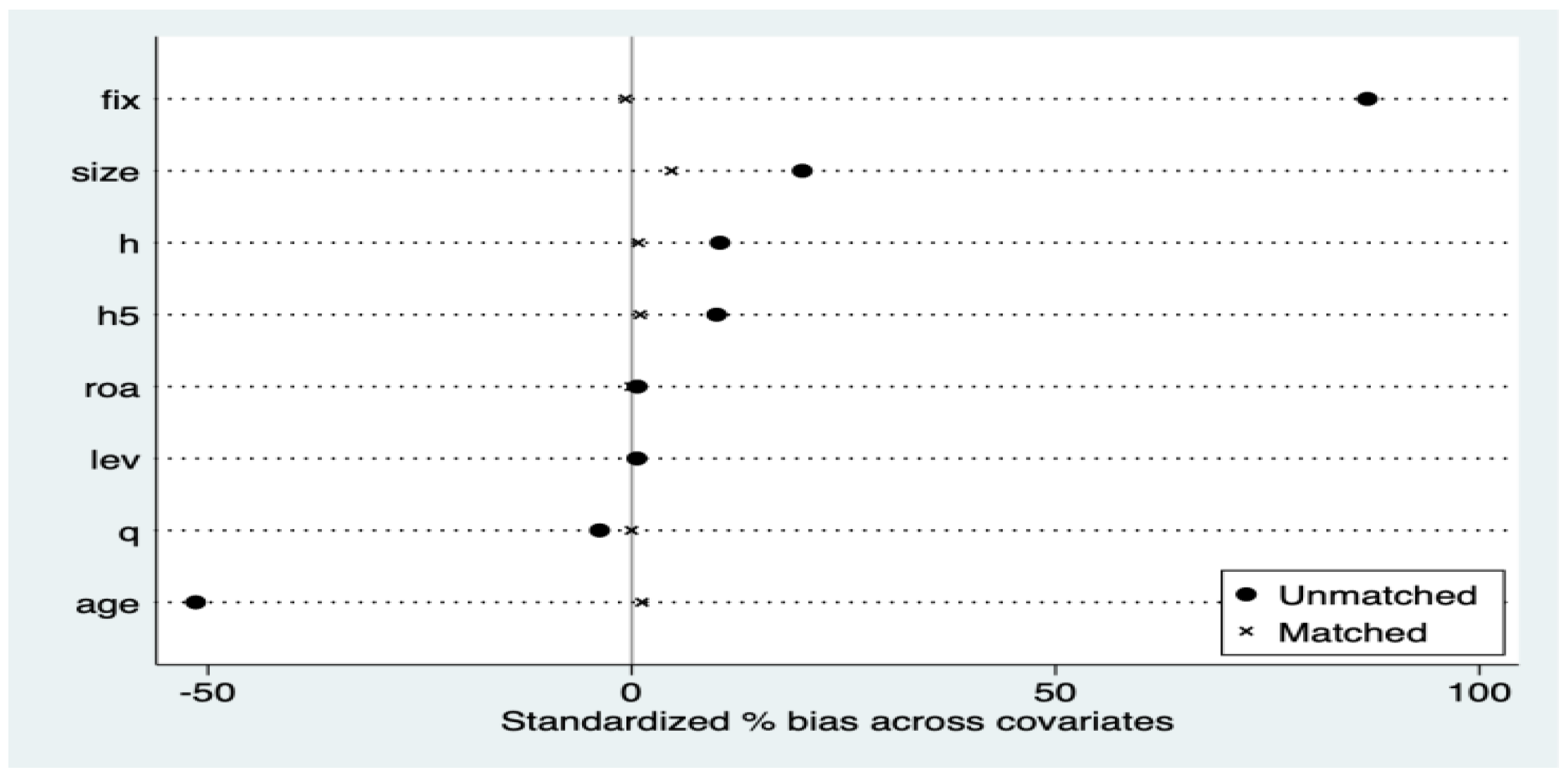
To eliminate unobservable group differences between the treatment and control groups that do not vary over time, we used the PSM-DID approach for the robustness test. We employed a logit model to estimate propensity scores, using 1:1 nearest-neighbor matching with no replacement. The samples are allowed to be concatenated when matching (Figure 2). The results suggest significant and negative effects of RSEPT on the high-quality development of treatment groups. The results in these robustness checks are consistent with those of our baseline models (see Table 11).
Figure 2.
DID after propensity score matching.
Table 11.
Propensity score matching.
5.4. Removal of Other Policy Distractions
In 2013, the State Council issued the Sustainable Development Plan for Resource-based Cities, and it approved the National Plan for the Adjustment and Transformation of Old Industrial Bases (2013–2020). Resource-based cities have faced drastic industrial restructuring and upgrading within the past few years compared with non-resource-based cities, and many environmental regulatory instruments may have affected the high-quality development of firms in detrimental ways [67]. To exclude the interference of these similar policies, we removed the data from 2013 to 2018. The regression results in Table 12 show that the coefficient of interaction term is negative and significant at the 1% level, which suggests the robustness of results after excluding other policy disturbances.
Table 12.
Removal of other policy disruptions.
6. Discussion
Our findings reveal that RSEPT dampens corporate high-quality development, which is consistent with the studies of Levinson et al. [4,29,30,68]. This can contribute to the reasons of “cost effect”, that is, RSEPT crowds out productive investment with an increase in expenditure on pollution-controlling equipment. Compared with state-owned firms, RSEPT has a more pronounced effect on the high-quality development of private firms. In China, state-owned firms benefit from preferential policies of loan and tax, while the private firms face hard budget constraints. Therefore, RSEPT levied on the private firms may impede their high-quality development.
RSEPT exerts the negative effect on the high-quality development through the channel of corporate capital allocation. The banks will focus more on the environmental protection due to RSEPT. This implies that the banks’ loans will be more sensitive to environment factors [69]. Then, the credit constraints lead to a difficulty of capital acquisitions for the firms, which impedes the corporate high-quality development.
7. Conclusions and Policy Recommendations
We provide a new insight into the relationship between the corporate high-quality development and RSEPT using a sample of energy-intensive firms from 2003 to 2018. We first calculate the indexes for corporate high-quality development using entropy weighting for the five dimensions of efficiency, innovation, openness, greenness, and social responsibility. Then, we develop a difference-in-differences model to reveal that RSEPT dampens high-quality development of corporations, as the estimated coefficient is −0.0420 with a t-statistic of −2.9384. This effect is significant in the year of policy implementation and is more pronounced in the subsequent two years. In contrast with negative and significant effect of private firms (t = −5.6514), the high-quality development of state-owned firms shows no correlation with environmental policy constraints. RSEPT inhibits the corporate high-quality development by reducing the capital allocation efficiency, with the coefficient of −0.32 (t = −3.8183).
Our findings in this study point to the following policy implications:
First, we need to understand the connotation of a high-quality development system and to formulate diversified regulatory policies. The level of energy-intensive firms’ high-quality development index in China is relatively low, and the number of firms with high-quality development values greater than the average accounted for only 34.7% of the total sample. Therefore, to better enhance the high-quality development of energy-intensive firms, the government should focus on policies that address issues of innovation, coordination, greenness, openness, and sharing.
Second, RSEPT should not be implemented aggressively. Given that RSEPT dampens corporate high-quality development, the goals of carbon peaking and carbon neutrality should be executed steadily while balancing corporate sustainability. This probably contributes to the reasons that strict policy standards or the hush implementation process may cause a reduction in yields or even suspension of production. The electricity brownout events that occurred recently in northeast China underlay the results of excessively stringent environmental regulation policies. To weaken this negative impact, the government can further supplement other incentives policies, such as credit and tax incentives, to relieve some of the pressures caused by the environmental policy.
Third, the policies may also target the high-quality development of private energy-intensive firms. Private firms have encountered ownership discrimination and tight budget constraints in China and, for private firms compared with state-owned firms, this may underlay the more pronounced negative effects of regulatory policies on corporate high-quality development. Therefore, we should investigate the high-quality index scores and address the drawbacks in a timely fashion.
Fourth, corporate internal governance should be designed to improve high-quality development. Corporate governance includes strategies such as protecting the stakeholder’s interests, information disclosure of major issues, and strengthening the supervision of the executives. Under the constraints of environmental regulations, these strategies can be implemented to promote high-quality development by efficient resource allocation.
In the future, we aim to examine the effects of RSEPT by classifying the energy-intensive industries into six sub-industries. Moreover, China has formulated a strategy of carbon peak and carbon neutralization, thus forming a new environmental regulation policy. Therefore, we will introduce the scenario analysis to simulate the effects of new kinetic factors on the high-quality development of firms under the “Dual Carbon” strategy.

Author Contributions
Z.C.: Conceptualization, Methodology, Data curation, Software, and Writing—editing. H.Z.: Conceptualization and Writing—original draft and review. Z.H.: Data curation, Investigation, and Validation. D.Z.: Supervision. B.J.: Writing—review and editing. All authors have read and agreed to the published version of the manuscript.
Funding
This work was supported by the National Social Science Fund [no. 19BGL185], Clean Energy Branch of Huaneng International Power Jiangsu Energy Development Co., Ltd. [no. HN-49A0-202100016-PWQT00015], and Postgraduate Research & Practice Innovation Program of Jiangsu Province [no. KYCX21_1038].
Institutional Review Board Statement
Not applicable.
Informed Consent Statement
Not applicable.
Data Availability Statement
Data related to the responsibility system for environmental protection targets and corporate high-quality development is obtained from China Stock Market & Accounting Research (CSMAR).
Acknowledgments
We would like to thank Jingrui Tian for their valuable suggestions.
Conflicts of Interest
The authors declare no conflict of interest.
References
- Jiang, C.Y. Focusing on the five points to improve the quality of industrial development. Shandong Econ. Strateg. Res. 2020, 6, 46–47. (In Chinese) [Google Scholar]
- Jaffe, A.B.; Peterson, S.R.; Portney, P.R.; Stavins, R.N. Environmental regulation and the competitiveness of U.S. manufacturing: What does the evidence tell us? J. Econ. Lit. 1995, 33, 132–163. [Google Scholar] [CrossRef]
- Brännlund, R.; Lundgren, T. Environmental policy and profitability: Evidence from Swedish industry. Environ. Econ. Policy Stud. 2010, 12, 59–78. [Google Scholar] [CrossRef]
- Albrizio, S.; Kozluk, T.; Zipperer, V. Environmental policies and productivity growth: Evidence across industries and firms. J. Environ. Econ. Manag. 2017, 81, 209–226. [Google Scholar] [CrossRef]
- Porter, M.E. America’s green strategy. Sci. Am. 1991, 264, 168. [Google Scholar] [CrossRef]
- Porter, M.E.; van der Linde, C. Green and competitive: Ending the stalemate. Harv. Bus. Rev. 1995, 73, 120–134. [Google Scholar] [CrossRef]
- Chen, S.Y. Energy conservation and emission reduction and the win-win development of Chinese industry: 2009–2019. Econ. Res. J. 2010, 45, 129–143. (In Chinese) [Google Scholar]
- Liu, Z.B. Strengthen the real economy to promote high-quality development. Rev. Ind. Econ. 2018, 2, 5–9. (In Chinese) [Google Scholar] [CrossRef]
- Bei, J. Study on the “high-quality development” economics. China Polit. Econ. 2018, 4, 5–18. [Google Scholar] [CrossRef]
- Zhang, J.; Zhang, N.; Bai, S. Assessing the carbon emission changing for sustainability and high-quality economic development. Environ. Technol. Innov. 2021, 22, e101464. [Google Scholar] [CrossRef]
- Sun, Y.; Ma, A.; Su, H.; Su, S.; Chen, F.; Wang, W.; Weng, M. Does the establishment of development zones really improve industrial land use efficiency? Implications for China’s high-quality development policy. Land Use Policy 2020, 90, 104265. [Google Scholar] [CrossRef]
- Li, J.C.; Shi, L.M.; Xu, A.T. Discussion on high quality development indicator system. Stat. Res. 2019, 1, 4–14. (In Chinese) [Google Scholar]
- Huang, X.; Cai, B.; Li, Y. Evaluation index system and measurement of high-quality development in China. Rev. De Cercet. Si Interv. Soc. 2020, 68, 163–178. [Google Scholar] [CrossRef]
- Dong, S.K.; Li, H.J.; Li, Y.Y. Social-ecological impact evaluation on eco-environmental policies associated western china development. Procedia Environ. Sci. 2010, 2, 1361–1367. [Google Scholar] [CrossRef][Green Version]
- Fan, Y.; Fang, C.; Zhang, Q. Coupling coordinated development between social economy and ecological environment in Chinese provincial capital cities-assessment and policy implications. J. Clean. Prod. 2019, 229, 289–298. [Google Scholar] [CrossRef]
- Coe, D.T.; Helpman, E. International R&D spillovers. Eur. Econ. Rev. 1995, 39, 859–887. [Google Scholar] [CrossRef]
- Jin, X.; Ou, C.; Li, Y. TFP technology importing and R&D input. Stud. Sci. Sci. 2006, 24, 702–705. (In Chinese) [Google Scholar]
- Wu, M.; Zhao, M.; Wu, Z. Evaluation of development level and economic contribution ratio of science and technology innovation in eastern China. Technol. Soc. 2019, 59, 101194. [Google Scholar] [CrossRef]
- Hale, G.; Long, C. Are there productivity spillovers from foreign direct investment in china? Pacific Econ. Rev. 2011, 16, 135–153. [Google Scholar] [CrossRef]
- Chen, Z.; Ge, Y.; Lai, H. Foreign direct investment and wage inequality: Evidence from China. World Dev. 2011, 39, 1322–1332. [Google Scholar] [CrossRef]
- Mitze, T. Measuring Regional Spillovers in Long- and Short-Run Models of Total Factor Productivity, Trade, and FDI. Int. Reg. Sci. Rev. 2014, 37, 365–388. [Google Scholar] [CrossRef]
- Moralles, H.F.; Moreno, R. FDI productivity spillovers and absorptive capacity in Brazilian firms: A threshold regression analysis. Int. Rev. Econ. Financ. 2020, 70, 257–272. [Google Scholar] [CrossRef]
- Jahanger, A. Influence of FDI characteristics on high-quality development of China’s economy. Environ. Sci. Pollut. Res. 2021, 28, 18977–18988. [Google Scholar] [CrossRef] [PubMed]
- Gray, W.B.; Shadbegian, R.J. Plant vintage, technology, and environmental regulation. J. Environ. Econ. Manag. 2003, 46, 384–402. [Google Scholar] [CrossRef]
- Wagner, M. On the relationship between environmental management, environmental innovation and patenting: Evidence from German manufacturing firms. Res. Policy 2007, 36, 1587–1602. [Google Scholar] [CrossRef]
- Chintrakarn, P. Environmental regulation and U.S. states’ technical inefficiency. Econ. Lett. 2008, 100, 363–365. [Google Scholar] [CrossRef]
- Ramanathan, R.; Black, A.; Nath, P.; Muyldermans, L. Impact of environmental regulations on innovation and performance in the UK industrial sector. Manag. Decis. 2010, 48, 1493–1513. [Google Scholar] [CrossRef]
- Kneller, R.; Manderson, E. Environmental regulations and innovation activity in UK manufacturing industries. Resour. Energy Econ. 2012, 34, 211–235. [Google Scholar] [CrossRef]
- Levinson, A.; Taylor, M.S. Unmasking the pollution haven effect. Int. Econ. Rev. (Philadelphia) 2008, 49, 223–254. [Google Scholar] [CrossRef]
- Ambec, S.; Cohen, M.A.; Elgie, S.; Lanoie, P. The porter hypothesis at 20: Can environmental regulation enhance innovation and competitiveness? Rev. Environ. Econ. Policy 2013, 7, 2–22. [Google Scholar] [CrossRef]
- Domazlicky, B.R.; Weber, W.L. Does environmental protection lead to slower productivity growth in the chemical industry? Environ. Resour. Econ. 2004, 28, 301–324. [Google Scholar] [CrossRef]
- Peuckert, J. What shapes the impact of environmental regulation on competitiveness? Evidence from Executive Opinion Surveys. Environ. Innov. Soc. Transit. 2014, 10, 77–94. [Google Scholar] [CrossRef]
- Wang, J.; Zhao, T.; Zhang, X. Environmental assessment and investment strategies of provincial industrial sector in China—Analysis based on DEA model. Environ. Impact Assess. Rev. 2016, 60, 156–168. [Google Scholar] [CrossRef]
- Shao, S.; Luan, R.; Yang, Z.; Li, C. Does directed technological change get greener: Empirical evidence from Shanghai’s industrial green development transformation. Ecol. Indic. 2016, 69, 758–770. [Google Scholar] [CrossRef]
- Zhou, Y.; Zhu, S.; He, C. How do environmental regulations affect industrial dynamics? Evidence from China’s pollution-intensive industries. Habitat Int. 2017, 60, 10–18. [Google Scholar] [CrossRef]
- Cai, X.; Zhu, B.; Zhang, H.; Li, L.; Xie, M. Can direct environmental regulation promote green technology innovation in heavily polluting industries? Evidence from Chinese listed companies. Sci. Total Environ. 2020, 746, 140810. [Google Scholar] [CrossRef]
- Ma, H.D.; Li, L.X. Could environmental regulation promote the technological innovation of China’s emerging marine enterprises? Based on the moderating effect of government grants. Environ. Res. 2021, 202, 111682. [Google Scholar] [CrossRef]
- Yang, C.H.; Tseng, Y.H.; Chen, C.P. Environmental regulations, induced R&D, and productivity: Evidence from Taiwan’s manufacturing industries. Resour. Energy Econ. 2012, 34, 514–532. [Google Scholar] [CrossRef]
- Chakraborty, P.; Chatterjee, C. Does environmental regulation indirectly induce upstream innovation? New evidence from India. Res. Policy 2017, 46, 939–955. [Google Scholar] [CrossRef]
- Lanoie, P.; Patry, M.; Lajeunesse, R. Environmental regulation and productivity: Testing the porter hypothesis. J. Product. Anal. 2008, 30, 121–128. [Google Scholar] [CrossRef]
- Rassier, D.G.; Earnhart, D. Effects of environmental regulation on actual and expected profitability. Ecol. Econ. 2015, 112, 129–140. [Google Scholar] [CrossRef]
- Jaffe, A.B.; Palmer, K. Environmental regulation and innovation: A panel data study. Rev. Econ. Stat. 1997, 79, 610–619. [Google Scholar] [CrossRef]
- Lee, M. Environmental regulations and market power: The case of the Korean manufacturing industries. Ecol. Econ. 2008, 68, 205–209. [Google Scholar] [CrossRef]
- Shi, X.; Xu, Z. Environmental regulation and firm exports: Evidence from the eleventh Five-Year Plan in China. J. Environ. Econ. Manag. 2018, 89, 187–200. [Google Scholar] [CrossRef]
- Ashford, N.A.; Hall, R.P.; Ashford, R.H. The crisis in employment and consumer demand: Reconciliation with environmental sustainability. Environ. Innov. Soc. Transit. 2012, 2, 1–22. [Google Scholar] [CrossRef]
- Wu, H.; Li, Y.; Hao, Y.; Ren, S.; Zhang, P. Environmental decentralization, local government competition, and regional green development: Evidence from China. Sci. Total Environ. 2020, 708, 135085. [Google Scholar] [CrossRef]
- Geng, Y.; Liu, W.; Li, K.; Chen, H. Environmental regulation and corporate tax avoidance: A quasi-natural experiment based on the eleventh Five-Year Plan in China. Energy Econ. 2021, 99, 105312. [Google Scholar] [CrossRef]
- Zhou, D.; Qiu, Y.; Wang, M. Does environmental regulation promote enterprise profitability? Evidence from the implementation of China’s newly revised Environmental Protection Law. Econ. Model. 2021, 102, 105585. [Google Scholar] [CrossRef]
- Larson, B.A.; Nicolaides, E.; Al Zu’bi, B.; Sukkar, N.; Laraki, K.; Matoussi, M.S.; Zaim, K.; Chouchani, C. The impact of environmental regulations on exports: Case study results from Cyprus, Jordan, Morocco, Syria, Tunisia, and Turkey. World Dev. 2002, 30, 1057–1072. [Google Scholar] [CrossRef][Green Version]
- Kunapatarawong, R.; Martínez-Ros, E. Towards green growth: How does green innovation affect employment? Res. Policy 2016, 45, 1218–1232. [Google Scholar] [CrossRef]
- Chen, X.; Li, W.; Chen, Z.; Huang, J. Environmental regulation and real earnings management—Evidence from the SO2 emissions trading system in China. Financ. Res. Lett. 2021, 46, 102418. [Google Scholar] [CrossRef]
- Li, M.; Dong, L.; Luan, J.; Wang, P. Do environmental regulations affect investors? Evidence from China’s action plan for air pollution prevention. J. Clean. Prod. 2020, 244, 118817. [Google Scholar] [CrossRef]
- Xiao, H.; Wang, K.M. Does environmental labeling exacerbate heavily polluting firms’ financial constraints? Evidence from China. China J. Account. Res. 2020, 13, 147–174. [Google Scholar] [CrossRef]
- Ye, L.; Fang, Y. Evolutionary game analysis on firms and banks’ behavioral strategies: Impact of environmental governance on interest rate setting. Environ. Impact Assess. Rev. 2021, 86, 106501. [Google Scholar] [CrossRef]
- Tombe, T.; Winter, J. Environmental policy and misallocation: The productivity effect of intensity standards. J. Environ. Econ. Manag. 2015, 72, 137–163. [Google Scholar] [CrossRef]
- Jiang, S.S.; Li, J.M. Do political promotion incentive and fiscal incentive of local governments matter for the marine environmental pollution? Evidence from China’s coastal areas. Mar. Policy 2021, 128, 104505. [Google Scholar] [CrossRef]
- Wen, S.; Jia, Z.; Chen, X. Can low-carbon city pilot policies significantly improve carbon emission efficiency? Empirical evidence from China. J. Clean. Prod. 2022, 346, 131131. [Google Scholar] [CrossRef]
- Wang, H.; Chen, Z.; Wu, X.; Nie, X. Can a carbon trading system promote the transformation of a low-carbon economy under the framework of the porter hypothesis?—Empirical analysis based on the PSM-DID method. Energy Policy 2019, 129, 930–938. [Google Scholar] [CrossRef]
- Wu, W.; Huang, M.; Lv, H.; Wang, W.W.; Zhang, M. Does the air pollution joint prevention and control policy possess the Porter effect in China-evidence from two perspectives. Environ. Impact Assess. Rev. 2021, 91, 106678. [Google Scholar] [CrossRef]
- Zou, Z.H.; Yi, Y.; Sun, J.N. Entropy method for determination of weight of evaluating indicators in fuzzy synthetic evaluation for water quality assessment. J. Environ. Sci. 2006, 18, 1020–1023. [Google Scholar] [CrossRef]
- Zhe, W.; Xigang, X.; Feng, Y. An abnormal phenomenon in entropy weight method in the dynamic evaluation of water quality index. Ecol. Indic. 2021, 131, 108137. [Google Scholar] [CrossRef]
- Si, D.K.; Li, X.L.; Huang, S. Financial deregulation and operational risks of energy enterprise: The shock of liberalization of bank lending rate in China. Energy Econ. 2021, 93, 105047. [Google Scholar] [CrossRef]
- Farza, K.; Ftiti, Z.; Hlioui, Z.; Louhichi, W.; Omri, A. Does it pay to go green? The environmental innovation effect on corporate financial performance. J. Environ. Manag. 2021, 300, 113695. [Google Scholar] [CrossRef]
- Liu, T.; Song, Y.; Xing, X.; Zhu, Y.; Qu, Z. Bridging production factors allocation and environmental performance of China’s heavy-polluting energy firms: The moderation effect of financing and internationalization. Energy 2021, 222, e119943. [Google Scholar] [CrossRef]
- Geng, C.; Cui, Z. Analysis of spatial heterogeneity and driving factors of capital allocation efficiency in energy conservation and environmental protection industry under environmental regulation. Energy Policy 2020, 137, 111081. [Google Scholar] [CrossRef]
- Jacobson, L.S.; Lalonde, R.J.; Sullivan, D.G. Earnings losses of displaced workers. Am. Econ. Rev. 1993, 83, 685–709. [Google Scholar] [CrossRef]
- Wang, Q.; Liu, M.; Tian, S.; Yuan, X.; Ma, Q.; Hao, H. Evaluation and improvement path of ecosystem health for resource-based city: A case study in China. Ecol. Indic. 2021, 128, 107852. [Google Scholar] [CrossRef]
- Zhao, X.; Sun, B. The influence of Chinese environmental regulation on corporation innovation and competitiveness. J. Clean. Prod. 2016, 12, 1528–1536. [Google Scholar] [CrossRef]
- Li, Y.; Wang, Z.; Hu, Y. The impact of environmental information disclosure types on loan costs of heterogeneous Enterprises—An Empirical Study Based on Listed Companies in heavy pollution industries in Shandong Province. Friends Account. 2022, 7, 67–74. (In Chinese) [Google Scholar]
Publisher’s Note: MDPI stays neutral with regard to jurisdictional claims in published maps and institutional affiliations. |
© 2022 by the authors. Licensee MDPI, Basel, Switzerland. This article is an open access article distributed under the terms and conditions of the Creative Commons Attribution (CC BY) license (https://creativecommons.org/licenses/by/4.0/).