


Abstract
Energy crisis and environmental pollution have become global problems, and the increasing use of energy has caused climate change. Electric vehicle (EV) is regarded as the future of the automotive industry, because of the lesser impact on the environment than traditional vehicles. In recent years, electric vehicles have developed rapidly. However, the development of charging points and service cannot adapt to the development trend of EV. In urban areas, the distribution characteristics of street lighting and charging points are similar. Therefore, the street lighting pole with EV charging is proposed. However, due to the capacity limit of public grid, the single hybrid pole is only suitable for slow charging. This paper proposes hybrid poles group based on renewable energy, street lighting, and EV charging, which can realize fast charging and slow charging based on DC micro-grid with help of energy storage device. For studying the suitable number in a group of smart hybrid pole, the efficiency model of smart hybrid poles group is proposed. The efficiency model indicates that the group approach has better performance than the single pole, which provides a theoretical basis for practical construction.
1. Introduction
Nowadays, energy crisis and environment pollution have become the global problem, and the increasing use of energy caused climate change. However, the renewable energy, clean energy, other distributed generation such as solar-based photovoltaic (PV) and wind generation, the use of light-emitting diode (LED) lighting [1,2,3], and new transport electric vehicle (EV) [4,5,6,7,8,9,10,11,12], positively contribute to the reduction of the carbon footprint of electricity generation.
EV is considered as the future of automotive industry, which not only promotes energy-efficiency, but also reduces emission of greenhouse gases [13,14]. In recent years, EV has been quickly developed. In fact, automakers, including Germany-based BMW and Audi, Japan-based Toyota and Nissan, the US-based General Motors and Tesla, and China-based BYD and ROEWE, launched a series of new-energy vehicle models, which marks the initial popularity of new-energy vehicles. As expected, China has a rapidly growing market of new-energy vehicles. In 2016, 517,000 new-energy vehicles were produced, and 507,000 new-energy vehicles were sold in China, with the growth of 52% and 53%, respectively, compared to the last year.
However, the development of EV charging points and services cannot match the growing trend of EV in China. EV charging points increased with the growth of 12% compared to 2015. Until June 2016, Chinese total public charging poles are 81,000 and private charging poles are 55,000. The ratio of car to pole is about 8:1, so it is less than the theoretical ratio of 1:1~1.2. Currently, it needs to build more charging poles [6]. In 2020, 435 thousand charging points will be built in Beijing to satisfy the requirement for 600 thousand EV. Moreover, the lack of an adequate publicly accessible charging infrastructure is considered to be a major obstacle to the growth of European market [15].
Charging facilities generally include private points and charging station. In recent years, it has been suggested that EV charging points can be integrated with the existing street lighting network, because the distribution characteristic of street lighting in the urban area is similar with the distribution characteristic of charging points. Therefore, the street lighting pole with EV charging system is presented [16]. Smith et al. introduced the concept of a DC Lighting and Charging network to increase the power transfer capability of the lighting cables in order to enable charging of EVs at a higher energy efficiency than AC [16]. In addition, BMW and Ubitricity company, respectively, have deployed a street-light charging solution [17,18], which contribute to a greener city. However, this single street-light charging pole is only suitable for EV slow charging because the power of public grid for a single pole is not enough for EV fast charging.
For handling the incompatibility between fast charging and the power limit, the hybrid poles group method with renewable energy, street lighting, and EV charging systems are proposed based on DC micro-grid in this paper. The energy storage devices in hybrid poles group can collaboratively work with the help of DC micro-gird and provide enough electric power for fast charging.
The remainder of the paper is organized as follows: Section 2 presents the architecture of street lighting system. For the application of fast charging and the efficiency promotion, the architecture of smart hybrid poles group method is proposed in Section 3. In Section 4, the efficiency model of smart hybrid poles group method under the condition of different probability distributions is proposed for studying the suitable number in a group of smart hybrid pole. Finally, concluding remarks are offered in Section 5.
2. The Architecture Change of Street Lighting System
Street lighting is important for urban night scenery, because it can improve the appearance and the attractiveness of the city [19,20]. A well-designed lighting system can ensure adequate comfort, improve the quality of life and avoid excessive illumination [21]. It contributes to crime prevention, property safety, night location, and obstacle avoidance [22]. Besides, LED as DC lighting is introduced to street lighting system for energy saving.
The architecture of street lighting system is presented in Figure 1. In this system, traditional alternating current (AC) street lighting can be supported by AC power directly. However, DC lighting is required to be linked by an AC/DC converter [23,24].
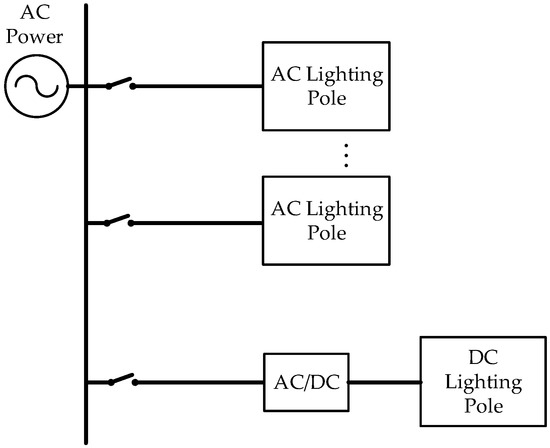
Figure 1.
The architecture of street lighting system.
Urban lighting power consumption usually accounts for a certain proportion of the urban financial expenditure [25]. Nowadays, public lighting (mainly street lighting) accounts for 3% of total electricity consumption in the world [26]. For reducing the electricity expenditure of street lighting, the renewable energy, such as solar energy and wind energy, are introduced into street lighting system. The architecture of a street lighting pole with renewable energy is presented in Figure 2. For promoting the efficiency of system, a DC bus is necessary to reduce the loss in energy conversion. Furthermore, the energy storage device can ensure the voltage stability and operate in island mode. In this system, both AC and DC lighting can be considered.
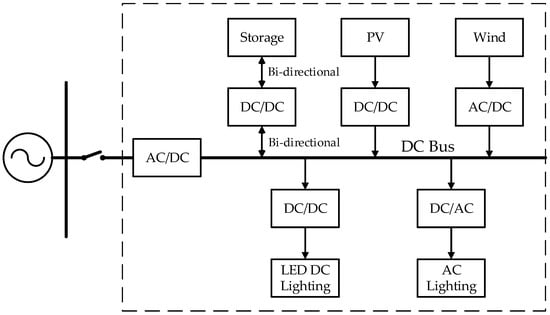
Figure 2.
The architecture of a street lighting pole with renewable energy.
3. The Proposed Group Approach of Smart Hybrid Poles
In this section, the group approach of smart hybrid poles was proposed. It is known that EV charging points cannot match the growing trend of EV. An important reason for the low development of EV charging points is the unreasonable distribution of the charging stations. There are a large number of charging stations in urban area and few charging stations in rural areas. In addition, centralized charging points will create enormous electrical power load on power distribution system, which requires the capacity expansion of transformer and more investment.
Compared with charging stations, the street lighting poles as an important part of urban infrastructure have the advantage of widespread distributions, and it is more convenient for EV owners to find nearby street lighting pole with EV charging. This hybrid pole can serve people who work or live in this block. Besides, the problem of insufficient transformer capacity can be effectively handled.
3.1. The Architecture of a Smart Hybrid Pole
The proposed hybrid pole is shown in Figure 3. This hybrid pole is integrated with renewable energy, street lighting, and EV charging. On the one hand, it can provide LED lighting for urban roads with high efficiency. On the other hand, it can support DC charging service for EVs and the information of charging is easy to be supervisory controlled. This hybrid pole system utilizes public electrical power and distributed energy such as wind power and solar energy. The improved compatibility between DC devices and DC power resource reduces and simplifies the power conversion links, thereby reducing the power conversion losses and increasing the component-level reliability [27]. The hybrid pole can operate in grid-connected mode and island mode, and the stability of DC bus voltage can be supported by the storage device. As the DC voltage is tightly controlled, the DC micro-grid is more tolerant against disturbances on the AC side. In addition, harmonics and power frequency variations disappear in the DC context, which exist in the AC context.
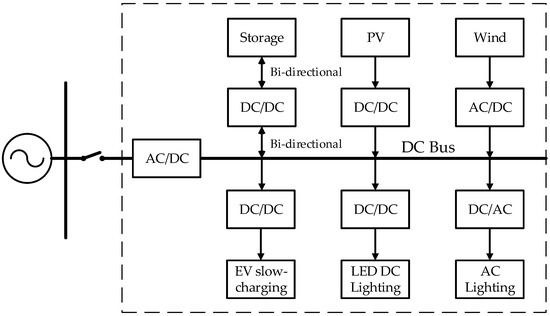
Figure 3.
The smart hybrid pole with renewable energy, street lighting, and electric vehicle (EV) charging. LED: light-emitting diode.
However, it should be noted that the single hybrid pole provides only EV slow charging, because fast charging brings large electric current and creates voltage loss in distant cable.
3.2. The Architecture of Smart Hybrid Poles Group and Mangement System
The hybrid poles group are integrated by use of DC micro-grid [28,29], as shown in Figure 4. In this micro-grid system, smart hybrid poles are connected by DC bus. In this case, EV can get power from AC grid and storage devices, so theoretically, it is suitable for EV fast charging if the power control is reasonable.
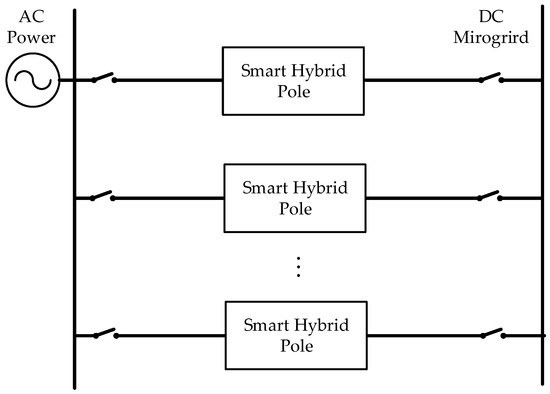
Figure 4.
The integrated hybrid poles group by DC micro-grid.
Compared to single hybrid pole, smart hybrid poles group can provide fast charging service and other benefits as follows:
- The micro-grid system is flexible. The smart hybrid poles can operate in grid-connected mode and island mode;
- The system has more safety and reliability. With the connection of DC micro-grid, the power can be dispatched between hybrid poles, so the DC bus voltage is in stable condition;
- It has more economical efficiency for consumer. Every smart hybrid pole with storage can be management by DC micro-grid, so it can reduce its operational expenses in accordance with peak-valley price.
Additionally, hybrid poles can also serve as the backup power for traffic lights, as shown in Figure 5. When the power grid malfunctions, the storage battery in hybrid pole can provide emergency electrical power for traffic signal, which avoids traffic disturbance.
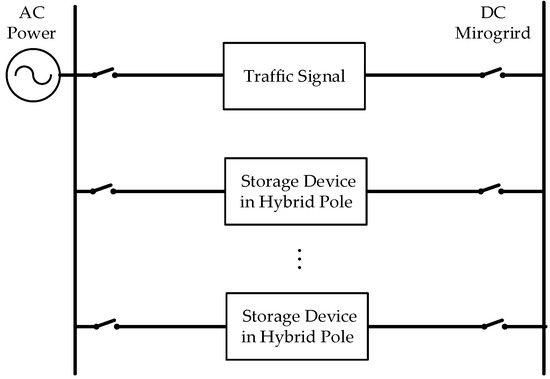
Figure 5.
The backup power for traffic signal.
3.3. The Capacity Model of Energy Storage Device in Hybrid Poles Group
The capacity of energy storage device is mainly determined by the following two factors. The first one is that it is necessary to fully charge the energy storage device when the hybrid pole is idle; and the last one is that when the hybrid pole provides a charging service, the stored energy should be discharged to EV as far as possible.
Supposing that the rated slow charging power is a kW, the rated fast charging power is kW, which is n times more than the rated slow charging power. Besides, supposing that the group of x hybrid poles provides t-hour charging service per day and they are idle for (24, t) hours per day.
When , the hybrid poles group can provide t-hour fast charging service for EV per day. The fast charging power is from public grid and energy storage device under the control of management system. There is kW power from public grid and kW power from storage device. Therefore, the total capacity of energy storage device in group should be kWh.
When , the hybrid poles group is idle for (24 − t) hours per day, and energy storage device need to be charged. Since the power of each hybrid pole from the public grid is limited to kW, the capacity of the energy storage device in-group should be kWh.
When , the hybrid pole can provide fast charging service for hours, and the maximum energy can be stored in the storage device in the remaining (24 − t) hours. Therefore, the maximum total capacity of the energy storage device in-group should be kWh.
The total capacity of the energy storage device in a group can be divided into each pole at average. Therefore, the capacity of the energy storage device per pole C is as follows:
Supposing that the power of slow charging is 7 kW, ratio n of fast charging to slow charging is 4, the functional image of capacity of the energy storage device per pole C is shown in Figure 6. The maximum capacity of the energy storage device per pole Cmax is 31.5 kWh under the condition that time of charging service t is 6 h per day and the number of hybrid pole x is 4, 8, 12, or more.
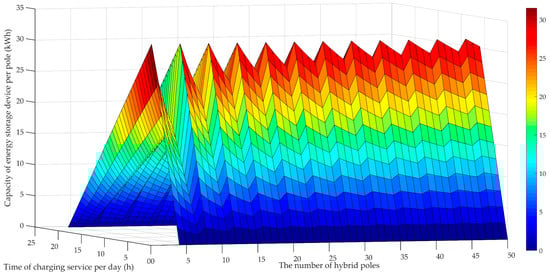
Figure 6.
The functional image of capacity of the energy storage device per pole.
Moreover, storage device should not only store renewable energy from PV panel and micro wind turbine, but also provide lighting for street at night. According the paper in Reference [30], the power of PV panel is 215 W, the rated power of wind turbine is 1444 W, the power of LED lighting is 60 W, and the redundancy capacity per pole should be 1.92 kWh. The total capacity of the energy storage device per pole should be 33.42 kWh.
In addition, the recycled EV batteries can be used as energy storage device of hybrid pole, which is important not only for the treatment of waste but also for the recovery of useful resources.
3.4. The Management System of Smart Hybrid Poles Group
In order to control system operation and maintain stability, a powerful management system is extremely essential. A cloud management system as shown in Figure 7 is proposed for hybrid poles group. In this cloud management system, the terminal control system, the metering system and the client application are combined to cloud intelligence management platform for collecting big data, scheduling, remote monitoring, and other functions. Besides, the cloud management system controls the charging and discharging of storage units judging by time-of-use electricity price.
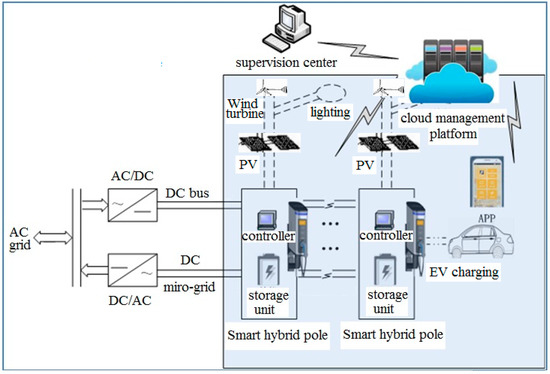
Figure 7.
The cloud management system of smart hybrid poles group.
In addition, battery management system (BMS) and power conversion system (PCS) can control each pole. BMS can obtain information about the capacity, voltage, current, temperature, state of charge (SOC), and expected life of battery. Besides, PCS can control the charging and discharging process and ensures the safe operation of battery.
4. The Efficiency Model of Smart Hybrid Poles Group Approach
The C-rate is defined as the charging or discharging current divided by the battery’s capacity to store an electrical charge. For example, when the 14-kWh battery is undergoing charging at 7 kW within two h, the C-rate is 0.5C or C/2.
The power of LED street lighting is usually less than 0.25 kW [30,31,32], and the power of slow charging for EV is 7 kW (220 V × 32 A, which is equivalent to the C-rate of 0.1C~0.45C) or more. Therefore, the power of the EV charging poles should be primary part of the capacity of the hybrid poles group.
For studying the suitable number in a group of smart hybrid pole, the efficiency model of smart hybrid poles group is proposed in this section.
Supposing that the rated slow charging power is a kW, and the rated fast charging power is kW, which is n times more than the rated slow charging power; the number of poles in a group is x (). Taking x = 4 as an example, the total power of traditional poles in five cases is shown in Table 1, and the total power of hybrid poles in five cases is shown in Table 2.

Table 1.
The total power of 4 traditional poles in 5 cases.
Table 2.
The total power of 4 hybrid poles in 5 cases.
Table 1 is changed to the following 5 × 4 matrix:
Table 2 is changed to the 5 × 4 matrix as follow:
Extending to each x and n, there should be (x + 1) cases in traditional poles and hybrid poles, as shown in the following (x + 1) × x matrixes:
4.1. Under the Condition of Uniform Distribution
Supposing that the probability of each case is equal, when x = 4, the average power of four traditional poles is 2a kW, and the average power per pole is 0.5a kW. Table 3 shows average power of 4 traditional poles under the condition of uniform distribution.
Table 3.
Average power of 4 traditional poles under the condition of uniform distribution.
The probability of uniform distribution Ex in matrix form under x = 4 is:
Supposing that the matrix Mx under x = 4 is for the accumulation of cases:
The average power per traditional pole under x = 4 is:
Extending to each x, probability Ex, matrix Mx and the average power per traditional pole are:
If the poles can provide the serves of fast and slow charging, x smart hybrid poles will maximally at the same time support poles with fast charging, (where means that is rounded down). In the case of x = 4 and n = 4, as shown in Table 4, the average power of 4 hybrid poles is 2.6a kW, and the average power per hybrid pole is 0.65a kW. So, the expectation value of each hybrid pole power with slow and fast charging is more than with only slow charging, which means efficiency promotion.
Table 4.
Average power of 4 hybrid poles under the condition of uniform distribution.
The average power per hybrid pole under x = 4 and n = 4 is:
Extending to each x and n, the average power per hybrid pole is:
In the actual project, hybrid poles have fixed power of fast and slow charging, so n is constant. Taking 7 kW slow charging power and 28 kW fast charging power (which is equivalent to the C-rate of 0.4C~1.8C) as an example, is shown in Figure 8.
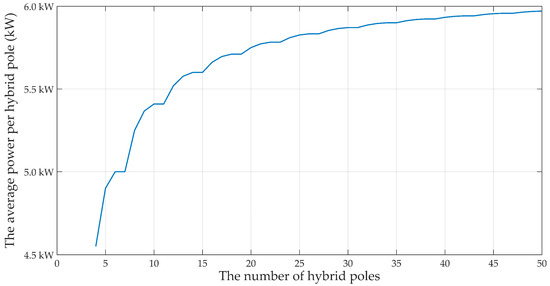
Figure 8.
The functional image of average power per hybrid pole under uniform distribution.
The efficiency promotion α of hybrid poles relative to traditional poles is following formula, as shown in Figure 9.
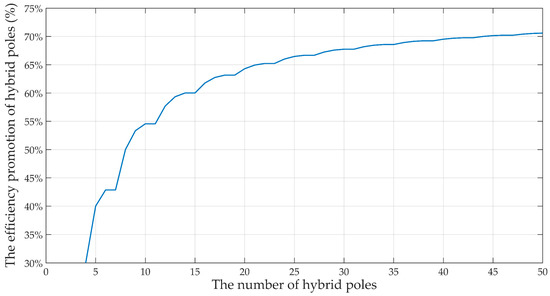
Figure 9.
The functional image of the efficiency promotion of hybrid poles relative to traditional poles under uniform distribution.
4.2. Under the Condition of Binomial Distribution
Supposing that the probability of each case satisfies binomial distribution, when the number of hybrid poles x = 4 and the parking possibility of each parking spot p = 40%, the average power of 4 traditional poles is 1.6a kW, and the average power per traditional pole is 0.4a kW. Table 5 shows average power of 4 traditional poles under the condition of binomial distribution.
Table 5.
Average power of 4 traditional poles under the condition of binomial distribution.
Extending to each x and p, according to the properties of the binomial distribution, the probability of binomial distribution Ex,p is:
Ex,p is in matrix form:
The average power per traditional pole is:
As shown in Table 6, in the case of x = 4, n = 4 and p = 40%, the average power of four hybrid poles is 2.6368a kW, and the average power per hybrid pole is 0.6592a kW
Table 6.
Average power of 4 hybrid poles under the condition of binomial distribution.
Extending to each x, n and p, the average power per hybrid pole is:
Supposing 7 kW and 28 kW as slow and fast charging power respectively, is shown in Figure 10.
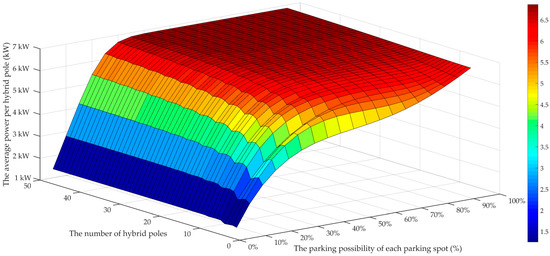
Figure 10.
The functional image of average power per hybrid pole under binomial distribution.
The efficiency promotion α of hybrid poles relative to traditional poles is in following formula, as shown in Figure 11.
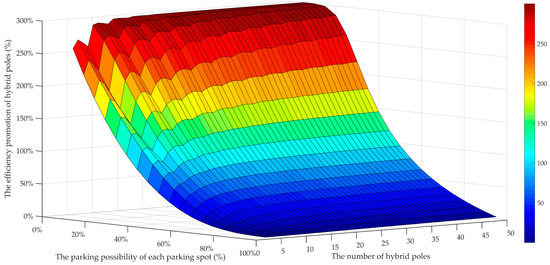
Figure 11.
The functional image of the promotion of hybrid poles relative to traditional poles under binomial distribution.
4.3. The Loss of Voltage
In actual situation, the optimum number of smart hybrid poles also depends on the voltage loss of electrical system and actual road lighting planning. In general, the maximum permissible voltage loss rate β is 10% in 220 V single-phase circuit and 7% in 380 V three-phase circuit. The maximum permissible voltage loss ΔUmax is:
where U is the rated working voltage.
The total current of x poles ΣI is:
where ΣP is the total power of x poles, and P is the power of a pole.
The voltage loss in cable should be less than the maximum permissible voltage loss. According to Ohm’s law, the following formula can be obtained.
where R is the resistance of cable, ρ is the resistivity of cable, L is the total length of cable and S is the sectional area of cable.
The total length of cable L is:
where d is the distance between two adjacent poles.
Based on the above formula, the value range of x can be shown in following formula:
Supposing that U = 220 V, β = 10%, S = 240 mm2, P = 7 kW, ρ = 1.75 × 10⁻⁸ Ω·m (copper cable) and d = 15 m, the value range of x is:
If U is 110 V (in USA, Canada, etc.) and the other condition is invariant, the value range of x is:
In USA and Canada, the maximal number of hybrid poles in a group is only 13. Additionally, the maximal number of hybrid poles group increases with the growth of voltage. Therefore, this group method in the 220 V system can support more hybrid poles than in 110 V system.
4.4. The Results and Discussion
On the basis of the above analysis, the efficiency model of hybrid poles group is presented. The main results and discussion can be summed up as follows:
- This group method can support fast charging under power limit of public grid and has better performance than the single pole.
- According to Figure 11, the proposed hybrid poles group is conducive to the place with the lower parking probability. If the hybrid poles group is built in the parking lot with high parking probability, the hybrid poles group has inapparent efficiency promotion.
- Taking 7 kW slow charging as an example, under the limit of permissible voltage loss, the number of hybrid poles should not more than 25 in 220 V system and 13 in 110 V system, respectively. Therefore, this group method in the 220 V system can support more hybrid poles than in the 110 V system. In addition, the minimum number of poles in a group is n. Therefore, the permissible number of hybrid poles in a group should more than n and less than 25 in 220 V system, and more than n and less 13 in the 110 V system, respectively.
5. Conclusions
The street lighting poles as an important part of urban infrastructure have the advantage of widespread distributions. The single hybrid pole as decentralized charging point can support charging service for circumjacent EV owners. However, the single pole support only slow charging under the power limit of public grid. In this paper, a group method of smart hybrid poles with renewable energy, street lighting, and EV charging is proposed to support EV fast charging service. The main conclusions are summarized as follows:
- The framework of hybrid poles group is proposed. The proposed group can support EV fast charging service, because EV can obtain power from AC public grid and storage devices under the control of management system. The proposed group can operate in grid-connected mode or island mode and the stability of DC bus voltage can be stable with the help of energy storage devices. For ensuring the functions of fast charging, the relationship among maximum capacity of energy storage devices per pole, the number of poles, service time of charging, and power of fast and slow charging is presented.
- The efficiency model of smart hybrid poles group is proposed under the condition of uniform distribution and binomial distribution, respectively. The model indicates that the group method has better performance than the single pole. The proposed group is conducive to the place with the lower parking probability rather than high parking probability.
- The group method in the 220 V system can support more hybrid poles than in 110 V system. Considering the voltage loss, the permissible number of hybrid poles in a group should more than n and less than 25 in the 220 V system, and more than n and less 13 in the 110 V system, respectively. In accordance with the functional image of efficiency model, the efficiency promotion increases with the quantity growth of poles and it initially increases rapidly, and then rises slowly.
In next research, we will focus on further experiments and verify the actual performance of hybrid poles group. In addition, the type and capacity of battery for the hybrid poles group are also in our research directions.
Author Contributions
Methodology, J.Y., Y.Z. and L.L.; Writing—Original Draft Preparation, Y.Z.; Funding Acquisition, J.Y. and Y.Z.; Writing—Review & Editing, Z.Y.; Visualization, Z.Y.; Data curation, Z.Y.; Formal analysis, Z.Y.
Funding
This research was funded by the National 13th Five-year Plan Key Project of Ministry of Science and Technology of China, grant number 2017YFB0903404, Fundamental Research Funds for the Central Universities, grant number 102472015118, China Postdoctoral Science Foundation funded project, grant number 2018M632162 and Open Projects Fund of Key Laboratory of Shanghai Urban Renewal and Spatial Optimization Technology, grant number 201810101.
Conflicts of Interest
The authors declare no conflict of interest.
Nomenclature
| Abbreviations | Description |
| AC | Alternating Current |
| BMS | Battery Management System |
| BMW | Bavarian Motor Works |
| BYD | Build Your Dream Company Limited |
| DC | Direct Current |
| EV | Electric Vehicle |
| LED | Light Emitting Diode |
| PCS | Power Conversion System |
| PV | Photovoltaic |
| SOC | State of Charge |
| List of symbols | Description |
| A(x + 1) × x | The power matrix of x traditional poles in (x + 1) cases (kW) |
| a | Power of EV slow charging (kW) |
| α | Efficiency promotion of hybrid poles relative to traditional poles (%) |
| B(x + 1) × x | The power matrix of x hybrid poles in (x + 1) cases (kW) |
| β | Maximum permissible voltage loss rate (%) |
| C | Capacity of energy storage device per pole (kWh) |
| Cmax | Maximum capacity of energy storage device per pole (kWh) |
| d | Distance between two adjacent poles (m) |
| Ex | The probability matrix of x hybrid poles under uniform distribution |
| Ex,p | The probability matrix of x hybrid poles under binomial distribution |
| f (x,a) | The average power per traditional pole under uniform distribution (kW) |
| f (x,n,a) | The average power per hybrid pole under uniform distribution (kW) |
| g (x,p,a) | The average power per traditional pole under binomial distribution (kW) |
| g (x,p,n,a) | The average power per hybrid pole under binomial distribution (kW) |
| ΣI | Total current of x poles (A) |
| L | Total length of cable (m) |
| Mx | The matrix for the accumulation of cases |
| n | Ratio of fast charging to slow charging |
| P | Power of a pole (kW) |
| ΣP | Total power of x poles (kW) |
| p | The parking possibility of each parking spot (%) |
| ρ | Resistivity of cable (Ω·m) |
| R | Resistance of cable (Ω) |
| S | Sectional area of cable (mm2) |
| t | Time of charging service per day (h) |
| U | The working voltage (V) |
| ΔUmax | The maximum permissible voltage loss (V) |
| x | The number of poles |
References
- Liu, J.; Zhang, W.; Chu, X.; Liu, Y. Fuzzy logic controller for energy savings in a smart LED lighting system considering lighting comfort and daylight. Energy Build. 2016, 127, 95–104. [Google Scholar] [CrossRef]
- Chew, I.; Kalavally, V.; Oo, N.W.; Parkkinen, J. Design of an energy-saving controller for an intelligent LED lighting system. Energy Build. 2016, 120. [Google Scholar] [CrossRef]
- Kim, S.H.; Kim, I.T.; Choi, A.S.; Sung, M.K. Evaluation of optimized PV power generation and electrical lighting energy savings from the PV blind-integrated daylight responsive dimming system using led lighting. Sol. Energy 2014, 107, 746–757. [Google Scholar] [CrossRef]
- Honarmand, M.; Zakariazadeh, A.; Jadid, S. Integrated scheduling of renewable generation and electric vehicles parking lot in a smart microgrid. Energy Convers. Manag. 2014, 86, 745–755. [Google Scholar] [CrossRef]
- Kam, M.V.D.; Sark, W.V. Smart charging of electric vehicles with photovoltaic power and vehicle-to-grid technology in a microgrid; a case study. Appl. Energy 2015, 152, 20–30. [Google Scholar] [CrossRef]
- Wang, Y.; Wang, B.; Chu, C.C.; Pota, H.; Gadh, R. Energy management for a commercial building microgrid with stationary and mobile battery storage. Energy Build. 2016, 116, 141–150. [Google Scholar] [CrossRef]
- Panchal, S.; Mathewson, S.; Fraser, R.; Culham, R.; Fowler, M. Measurement of Temperature Gradient (dT/dy) and Temperature Response (dT/dt) of a Prismatic Lithium-ion Pouch Cell with LiFePO4 Cathode Material. SAE Tech. Pap. 2017, 1, 1207. [Google Scholar] [CrossRef]
- Panchal, S.; Dincer, I.; Agelin-Chaab, M.; Fraser, R.; Fowler, M. Experimental investigation and simulation of temperature distributions in a 16Ah-LiMnNiCoO2 battery during rapid discharge rates. Heat Mass Transf. 2017, 53, 937–946. [Google Scholar] [CrossRef]
- Guo, S.; Xiong, R.; Wang, K.; Sun, F. A novel echelon internal heating strategy of cold batteries for all-climate electric vehicles application. Appl. Energy 2018, 219, 256–263. [Google Scholar] [CrossRef]
- Xia, Q.; Wang, Z.; Ren, Y.; Sun, B.; Yang, D.; Feng, Q. A reliability design method for a lithium-ion battery pack considering the thermal disequilibrium in electric vehicles. J. Power Sources 2018, 386, 10–20. [Google Scholar] [CrossRef]
- Ianniciello, L.; Biwolé, P.H.; Achard, P. Electric vehicles batteries thermal management systems employing phase change materials. J. Power Sources 2018, 378, 383–403. [Google Scholar] [CrossRef]
- Yuksel, T.; Litster, S.; Viswanathan, V.; Michalek, J.J. Plug-in hybrid electric vehicle LiFePO4 battery life implications of thermal management, driving conditions, and regional climate. J. Power Sources 2017, 338, 49–64. [Google Scholar] [CrossRef]
- Datta, M.; Senjyu, T. Fuzzy Control of Distributed PV Inverters/Energy Storage Systems/Electric Vehicles for Frequency Regulation in a Large Power System. IEEE Trans. Smart Grid 2013, 4, 479–488. [Google Scholar] [CrossRef]
- Kempton, W.; Tomić, J. Vehicle-to-grid power implementation: From stabilizing the grid to supporting large-scale renewable energy. J. Power Sources 2005, 144, 280–294. [Google Scholar] [CrossRef]
- Kleiner, F.; Brokate, J.; Blaser, F.; Friedrich, H.E. Quantitative analysis of the public charging-point evolution: A demand-driven spatial modeling approach. Transp. Res. Part D Transp. Environ. 2018, 62, 212–224. [Google Scholar] [CrossRef]
- Smith, K.A.; Galloway, S.J.; Emhemed, A.; Burt, G.M. Feasibility of Direct Current street lighting & integrated electric vehicle charging points. In Proceedings of the 6th Hybrid and Electric Vehicles Conference, London, UK, 2–3 November 2016. [Google Scholar]
- BMW’s New Street Lights Will Charge Your Electric Car. Available online: https://www.engadget.com/2014/11/10/bmw-ev-charging-street-lights/ (accessed on 10 November 2014).
- Intelligent Residential On-Street Charging for Local Authorities. Available online: https://www.ubitricity.co.uk/b2b-local-authorities/ (accessed on 1 December 2018).
- Beccali, M.; Bonomolo, M.; Leccese, F.; Lista, D.; Salvadori, G. On the impact of safety requirements, energy prices and investment costs in street lighting refurbishment design. Energy 2018, 165, 739–759. [Google Scholar] [CrossRef]
- Seshadri, K. City beautification at night. Illum. Eng. Inst. Jpn. 1997, 81, 139–140. [Google Scholar] [CrossRef]
- Beccali, M.; Bonomolo, M.; Galatioto, A.; Pulvirenti, E. Smart lighting in a historic context: A case study. Manag. Environ. Qual. Int. J. 2017, 28, 282–298. [Google Scholar] [CrossRef]
- Peña-García, A.; Hurtado, A.; Aguilar-Luzón, M.C. Impact of public lighting on pedestrians’ perception of safety and well-being. Saf. Sci. 2015, 78, 142–148. [Google Scholar] [CrossRef]
- Jagadeesh, Y.; Akilesh, S.; Karthik, S.; Prasanth. Intelligent Street Lights. Procedia Technol. 2015, 21, 547–551. [Google Scholar] [CrossRef]
- Sperber, A.N.; Elmore, A.C.; Crow, M.L.; Cawlfield, J.D. Performance evaluation of energy efficient lighting associated with renewable energy applications. Renew. Energy 2012, 44, 423–430. [Google Scholar] [CrossRef]
- Radulovic, D.; Skok, S.; Kirincic, V. Energy efficiency public lighting management in the cities. Energy 2011, 36, 1908–1915. [Google Scholar] [CrossRef]
- Lobão, J.A.; Devezas, T.; Catalão, J.P.S. Energy efficiency of lighting installations: Software application and experimental validation. Energy Rep. 2015, 1, 110–115. [Google Scholar] [CrossRef]
- Broeck, G.V.D.; Stuyts, J.; Driesen, J. A critical review of power quality standards and definitions applied to DC microgrids. Appl. Energy 2018, 229, 281–288. [Google Scholar] [CrossRef]
- Zhang, Y.M.; Ding, B.; Fu, W.D.; Liu, Q. Electrical Energy Conservation Based on DC Distribution and DC microgrid. Trans. China Electrotech. Soc. 2015, 30, 389–397. (In Chinese) [Google Scholar] [CrossRef]
- Zhang, Y.; Yan, Z.; Li, L.; Yao, J. A Hybrid Building Power Distribution System in Consideration of Supply and Demand-Side: A Short Overview and a Case Study. Energies 2018, 11, 3082. [Google Scholar] [CrossRef]
- Ricci, R.; Vitali, D.; Montelpare, S. An innovative wind-solar hybrid street light: Development and early testing of a prototype. Int. J. Low-Carbon Technol. 2015, 10, 420–429. [Google Scholar] [CrossRef]
- Schmid, G.; Chen, S.L.; Yang, T.H.; Huang, Z.L. Numerical analysis of a vertical double-pipe single-flow heat exchanger applied in an active cooling system for high-power LED street lights. Appl. Energy 2017, 195, 426–438. [Google Scholar] [CrossRef]
- Yoomak, S.; Jettanasen, C.; Ngaopitakkul, A.; Bunjongjit, S.; Leelajindakrairerk, M. Comparative study of lighting quality and power quality for LED and HPS luminaires in a roadway lighting system. Energy Build. 2018, 159, 542–557. [Google Scholar] [CrossRef]
© 2018 by the authors. Licensee MDPI, Basel, Switzerland. This article is an open access article distributed under the terms and conditions of the Creative Commons Attribution (CC BY) license (http://creativecommons.org/licenses/by/4.0/).