1. Introduction
In a cellular network system, base stations (BSs) are the main components that enable devices connected to the system to communicate with each other. In recent years, the existing BSs of such systems have been subjected to larger and larger burdens due to the ever growing number of mobile users and the corresponding increases in network data demands [
1], particularly in areas of high population density such as major cities. Among network operators, the standard response to such growing demands has simply been the deployment of more BSs, but such an approach is both expensive and lacking in energy efficiency. As a result, the operators themselves are faced with growing pressure to keep infrastructure costs and power usage at sustainable levels while still providing satisfactory services to users. One potential means of reducing the resulting tension between costs (both financial and energy-related) and user satisfaction would be improving the transmission efficiency of such network systems. In fact, a number of potential solutions aimed at increasing the efficiency of BS-based transmissions have been proposed in our own recent research [
2,
3,
4,
5,
6,
7,
8], including the utilization of multiple-component-carrier technology [
2,
3,
4,
5] or two-layer macrocell—small cell architectures [
6,
7,
8] to reduce the aforementioned costs and raise overall system performance. It is important to note, however, that both power and bandwidth resources are consumed when data is transferred, via both uplinking and downlinking, through BSs to end users. Furthermore, with global warming and the greenhouse effect becoming increasingly serious problems, developing innovative technologies that can utilize energy more efficiently is crucial.
With that aim in mind, various researchers have engaged in a range of efforts to enhance or even replace the connection paradigm typically employed by cellular networks by making changes to the design that determines how devices are connected. Among the novel paradigms introduced in recent years is that known as the device-to-device (D2D) communication technique; this approach is widely thought to hold significant potential, as it could allow for emerging 5th-generation (5G) cellular network systems to offer a superior transmission mode (with a corresponding wireless interface) for the devices that use them [
9,
10]. In the D2D mode, the transmitter sends data directly to the receiver without using the BS, and can therefore replace the cellular mode over short transmission distances. In this manner, network congestion is reduced since the data flow does not take up the bandwidth of the BS [
11]. More specifically, by not using the two links (that is, an uplink and downlink) required to deliver data via the cellular mode, the D2D mode, which instead uses just one link to deliver data directly from its source to the destination, lessens the use of bandwidth resources as well as overall power consumption. At the same time, as information and communications technologies (ICTs) continue to be developed further, the presence and utilization of both licensed and unlicensed bands in D2D-assisted cellular network systems will be of substantial relevance to emerging 5G cellular network systems. Nonetheless, there has been, thus far, a lack of research consisting of truly comprehensive investigations into how energy-efficient transmission can be achieved via the effective use of licensed and unlicensed bands. (Please note that, for the sake of clarity, the term “cellular transmission” is used throughout the remainder of this paper to refer to transmission via the cellular mode, while the term “D2D transmission” is used to refer to transmission via the D2D mode.).
Considering the various issues described above, the present study was conducted in order to fill the aforementioned research gap by expanding upon the existing research into D2D communications, in part by investigating potential means of easing the existing limits on delivered frequency bands for D2D transmissions. Furthermore, it is hoped that a lower level of power consumption by users and a higher transmission rate can be achieved. At the same time, the study also aimed to achieve a lower number of connection interruptions for users. As such, two key terms are defined, namely, the “power-to-throughput ratio” (PTR) and the “blocking-to-throughput ratio” (BTR), which served as the paper’s basis for the design of the core technology and the indicators for testing and evaluating system performance. More specifically, the PTR is defined as the average ratio, of the consumed output power level to the transmission rate, of all the pairs in the system, while the BTR is defined as the ratio of the number of blocked pairs to the average transmission rate (of all the pairs in the system). As indicated by the two definitions, a smaller value is better for both types of ratios, with the PTR and BTR values also being able to reflect energy efficiency and connection efficiency. Accordingly, the particular aims of the present study consisted of using a more efficient transmission method in order to significantly enhance the PTR while also ensuring that all users are still provided with satisfactory transmission rates by keeping the BTR as low as possible. The following points summarize the paper’s primary contributions:
Taking a system-level perspective, this study utilizes novel link mode and bandwidth configurations in order to make more effective use of licensed and unlicensed bands, allowing in turn for the proposal of a new transmission algorithm for D2D-assisted cellular network systems that is more energy-efficient than existing algorithms. Meanwhile, the direction of this research is consistent with the ongoing trend of development in the ICT industry.
By combining both efficient transmission mode selection and flexible link mode selection, the proposed algorithm results in substantially enhanced system performance (compared with conventional algorithms) in D2D-assisted cellular network systems in terms of the PTR and BTR values for such systems.
The remaining sections of this paper are as follows. A review of the related existing literature is provided in
Section 2.
Section 3 provides a description of the problem under consideration, including the relevance of novel system configurations. Within the context of that problem,
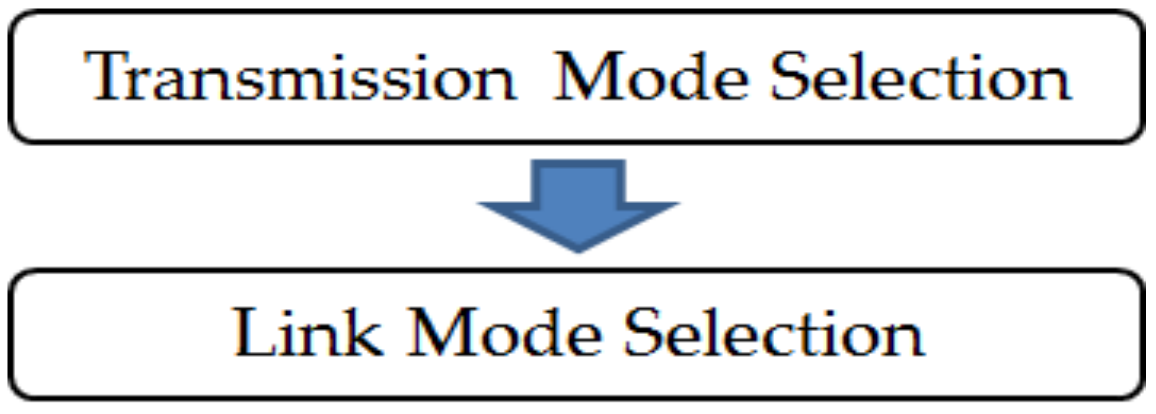
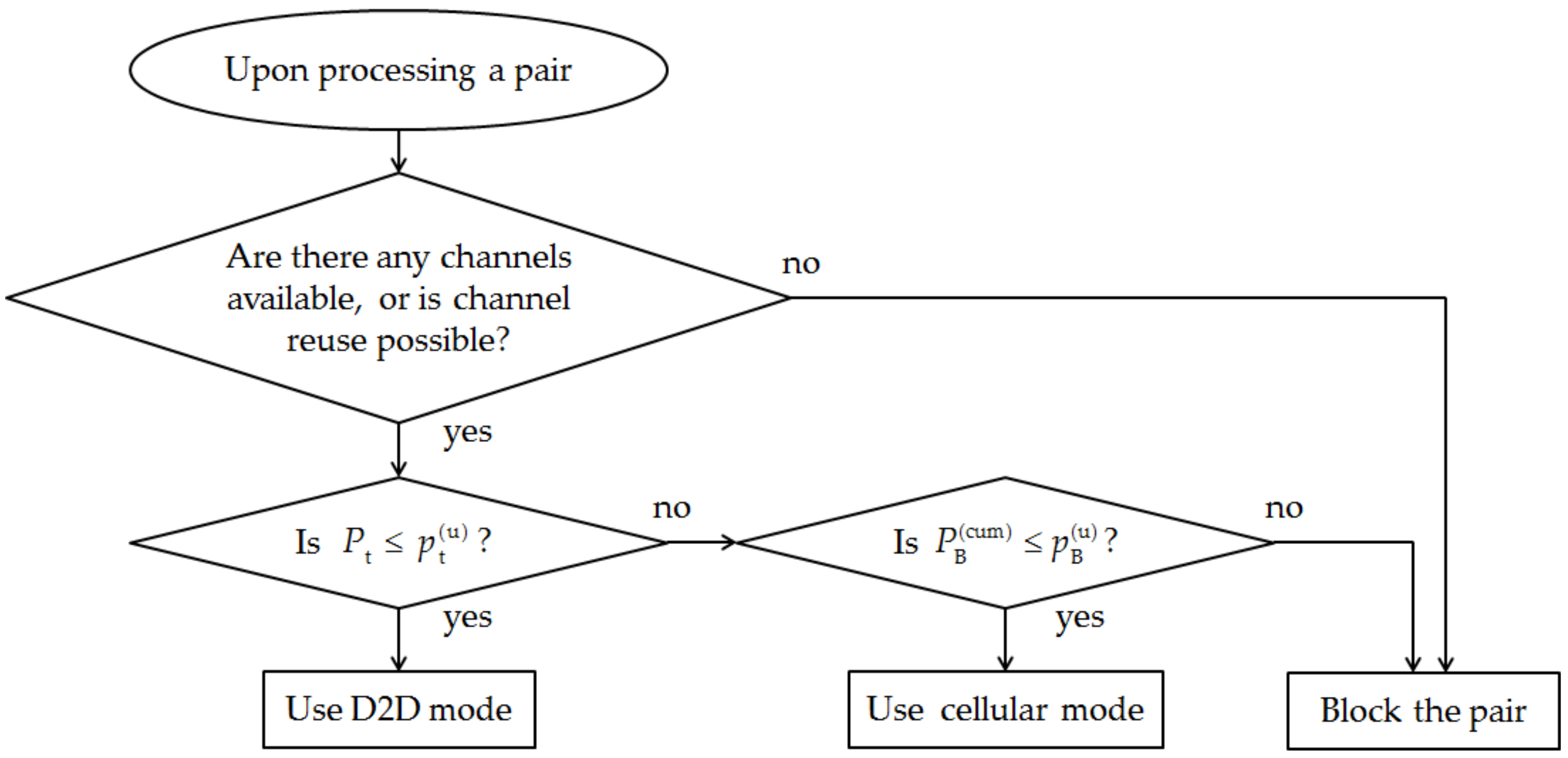
Section 4 provides a description of how transmission mode selection and link mode selection are performed in the proposed algorithm in order to achieve the aforementioned aims, while complete simulation results for the proposed algorithm and a discussion of those results are provided in
Section 5. Finally, the key conclusions of the study are presented and discussed in
Section 6.
2. Related Work
Based on which kinds of frequency bands (namely, licensed bands and unlicensed bands) have been used for D2D transmission in past studies, D2D transmission can be divided into the following four categories: (1) D2D transmission using only licensed bands (such as that described in [
11,
12,
13,
14,
15,
16,
17,
18,
19,
20,
21,
22,
23,
24]); (2) D2D transmission using only unlicensed bands (such as that described in [
11,
24,
25,
26,
27,
28,
29,
30,
31]); (3) D2D transmission using either licensed or unlicensed bands in a selective manner (such as that described in [
32,
33]); and (4) D2D transmission using both the licensed and unlicensed bands simultaneously (such as that described in [
34]). Regarding the first two categories, Asadi et al. [
11] presented a D2D communication survey and overview showing that the traffic loads and transmission delays encountered by BSs can be effectively ameliorated by D2D connections, with such connections simultaneously having the effects of increased system throughput and improved energy usage efficiency (which result, in turn, in reductions in the total amount of power expended by a network). At present, there is a greater quantity of well-established results for the first two categories as compared to the third and fourth categories; hence, considerably more can be done to advance research in the latter two categories.
One possible means of substantially lowering the effects of interference, according to research by Doppler et al. [
12], would be the imposition of limitations on the distance and transmission power used by D2D pairs. Meanwhile, Janis et al. [
13] and Zulhasnine et al. [
14] also proposed resource allocation schemes by which interference levels could potentially be reduced, although both schemes are limited by the fact that they can only be utilized for D2D pairs themselves. More recently, a number of other relevant studies have also been produced, including those by Feng et al. [
15] and Wen et al. [
16], that presented yet more resource allocation schemes that could potentially be of benefit. At the same time, it is important to note that, while various D2D communication studies have been produced, system throughput has been the main focus for much of that previous research. Furthermore, because the battery energy available to mobile devices is typically limited, and because the conservation of power is increasingly viewed as being of key importance in the design of network schemes and mobile devices, efficient energy usage and a range of related subjects have also received growing levels of research attention. For instance, Wang et al. [
17], in a study regarding uniformly distributed D2D networks, suggested that one possible method for achieving energy-efficient resource allocation would be the use of reverse iterative combinatorial auction games, while the aforementioned research conducted by Wen et al. [
16] explored how D2D cluster energy efficiency might be improved. The opportunistic switching of communication modes is another method that still other studies have considered as a possible means of addressing the same issue [
18,
19], whereas a more recent study by Chung and Lin [
20] proposed a transmission algorithm aimed at minimizing the overall consumption of power while simultaneously ensuring that transmission rate requirements would be maintained for all users. Meanwhile, an investigation into how changes in energy efficiency affect spectrum efficiency, and vice versa, in D2D-assisted cellular networks was conducted by Gao et al. [
21], while various other recent studies have explored new techniques for potentially enhancing system performance in D2D communication. For example, a device caching approach for the facilitation of content exchange through millimeter-wave D2D communication was proposed by Giatsoglou et al. [
22], while Chen et al. [
23] proposed a framework aimed at using D2D communications to leverage any massive crowd of devices at a network’s edge in order to provide collaborative task execution in an energy-efficient manner. It is important to note, meanwhile, that all of these D2D-related studies looked at transmission over licensed bands.
That said, because at least two wireless interfaces are used by the majority of newer mobile devices when operating, the subject of D2D transmission over unlicensed bands has recently become a subject of increasing interest among researchers. For example, Asadi and Mancuso [
25] published research in which a protocol focusing on the topic of implementation was proposed, while Golrezaei et al. [
26] proposed the use of localized D2D transmissions as one means by which the throughput of video files transmitted via cellular communication systems could potentially be increased. A year earlier, in 2013, a study utilizing a device-focused methodology to investigate the development, design, and experimental evaluation of a delay-bounded energy-conscious bandwidth allocation scheme for heterogeneous wireless networks was published by Dimitriou et al. [
27]. Also in 2013, a study by Mastorakis et al. [
28] proposed an energy-efficient routing scheme as a potential option for increasing the data transmission reliability and energy efficiency of communication devices with heterogeneous radio spectrum availability. Subsequently, in 2014, this study by Mastorakis et al. [
28] was expanded upon still further, in research by Bourdena et al. [
29]. At the same time, channel access issues are raised whenever multiple devices are attempting to make D2D transmissions over unlicensed bands, especially for situations in which all the devices in question share the same goal in terms of content dissemination. Such situations underscore the necessity of identifying effective schemes for medium access control (MAC), and, in fact, several recent studies have sought to address the relevant issues. For example, two game theoretic MAC schemes for rapid and energy-efficient content dissemination were proposed by Antonopoulos et al. [
30], while a network coding-based MAC approach for D2D data exchange was introduced by Datsika et al. [
31]. In still another recent study, meanwhile, Datsika et al. [
24] provided an overview of D2D communication and MAC design challenges related to social behaviors and energy consumption issues.
One important consideration affecting the completion of D2D transmissions via the use of either licensed bands only or unlicensed bands only is that both approaches carry different benefits and drawbacks in terms of the resulting spectral efficiency, implementation complexity, and interference control (see [
11] for more detail). As such, if only one approach or the other is used exclusively, then the overall performance of the system in question will suffer. With that in mind, Asadi et al. [
32,
33] investigated the selective use of both licensed and unlicensed bands in two of their recent studies. Specifically, in order to make better use of the potential of using both approaches, they suggested a heuristic solution called “Floating Band D2D” aimed at addressing how networks can use the selection of the licensed and unlicensed bands in an effective manner. In other words, the solution was aimed at facilitating a network in making appropriate use of either licensed or unlicensed bands for a given D2D transmission of data. In a more recent study by Chung [
34], meanwhile, the simultaneous and full use of both licensed and unlicensed bands for D2D transmission was considered, and the corresponding goal of better optimizing the average transmission rate of users was effectively achieved. The studies by Asadi et al. [
32,
33] and the study by Chung [
34] each offer their own advantages: with the former approach, a suitable frequency band is selected for D2D transmission, and even though a system’s bandwidth is not fully utilized with this approach, it allows for more resources to be saved for other purposes. As for the latter approach, it fully utilizes a system’s bandwidth for D2D transmission and thus raises transmission rates. However, this advantage is of no actual value if a user does not require high transmission rates. These facts imply that a lack of complete flexibility in the utilization of both types of bands causes some continuing limitations in terms of overall system performance. Furthermore, in the aforementioned study by Chung [
34], no consideration was given to the transmission rates required by individual users; that is, the approach proposed in Chung’s study did not ensure that the respective transmission rate requirements of all users could be met. As such, some users may thus obtain transmission rates that are lower than their respective requirements. In that sense, the present study aimed to investigate and potentially facilitate solutions to a still unsolved challenge, that is, how to efficiently use both power and radio resources in D2D-assisted cellular network systems utilizing both licensed and unlicensed bands.
Finally, it is important to note that, in a realistic cellular network scenario, other considerations that are not covered in this work may also have to be made when assessing the energy efficiency of mobile device connections. For instance, the security services used by mobile devices may have an impact on energy efficiency as well. Thus, given that the present work focused primarily on the investigation of networking activity itself in order to determine how transmission performance might be optimized via the efficient utilization of both licensed and unlicensed bands, future studies could expand on its findings by considering other factors, such as the use of security services by mobile devices. In fact, the explosive popularity of mobile devices has brought with it ever increasing worries about their security, but it must be acknowledged that enhanced security likely comes at a cost of increased power consumption [
35]. The relevant factors in this relationship between security and energy use have been explored in a number of recent studies. For example, an application called “Smart Text Compression and Encryption for Short Message Service (STCESMS)”, which was based on the Android operating system, was presented by Pizzolante et al. [
36]; the application was designed to compress and/or encrypt data for transmission via (Short Message Service) SMS while utilizing, as appropriate, a number of strategies influenced by delivery cost or energy consumption objectives. In another study from the same year, Castiglione et al. [
37] sought to provide a sturdy and reliable data transfer service that would also minimize the overall battery consumption of heterogeneous mobile terminals; to that end, they presented the architecture of a framework that could enable secure and reliable end-to-end data transfers between such devices, while also describing and modeling the power demands of said framework. Subsequently, the same authors [
38] presented a related study in which they introduced a model for the analysis of energy consumption associated with secure communications among multi-mode terminals. While considering both the relevant interconnection and secure data exchange issues, the model was intended to aid in the development of adaptive strategies for energy-efficient secure communications by providing descriptions of the energy consumption of mobile terminals in the context of dynamic network scenarios.
3. Problem Description
3.1. System Model
Consider a network system environment consisting of
device pairs (with each pair being comprised of a transmitting device and a receiving device) and a single BS.
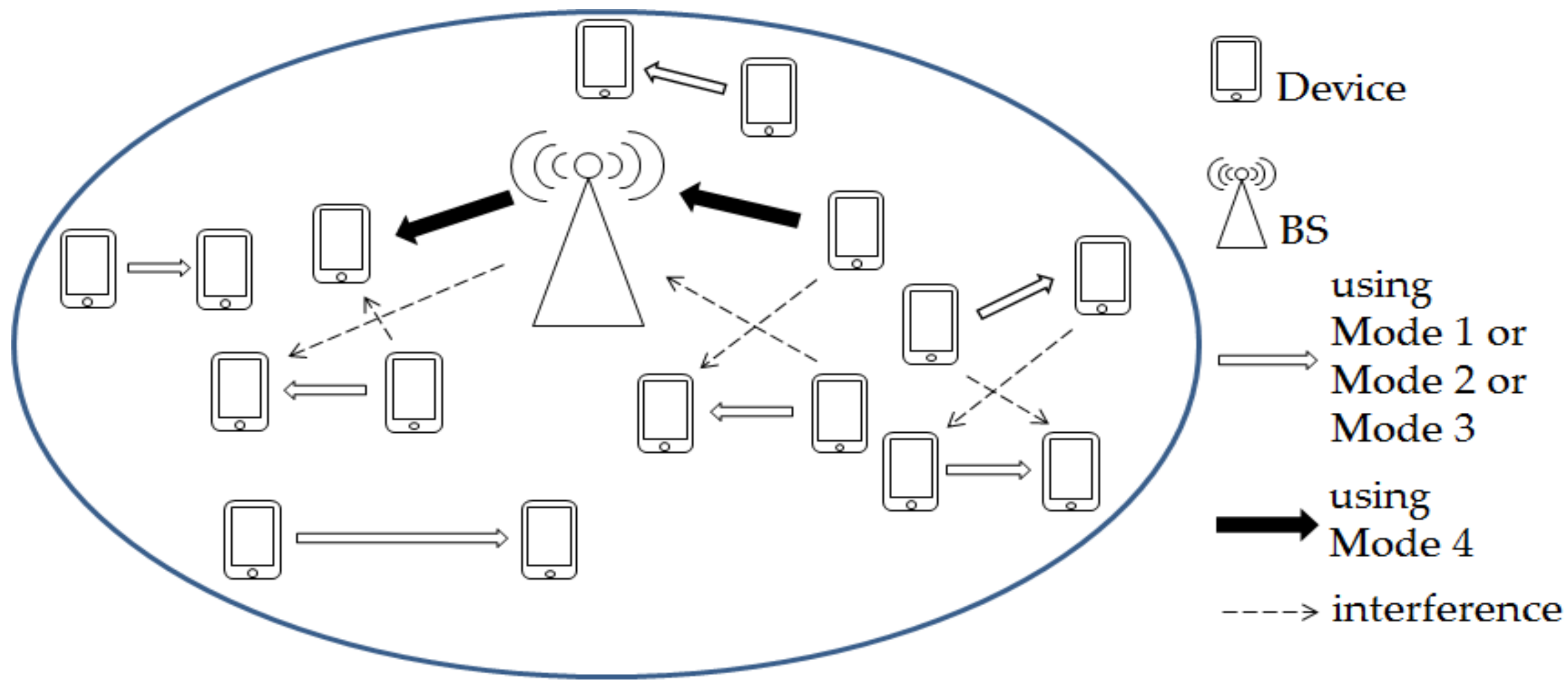
Figure 1 consists of an illustration of the system model under consideration.
A licensed band with bandwidth equal to and an unlicensed band with bandwidth equal to constitute the frequency bands used in the model. It is assumed that, in this system, each device is able to operate in two transmission modes, namely, the D2D mode and the cellular mode, which each have their corresponding wireless interfaces. With respect to the traffic in the system, the arrival pattern of said traffic is assumed to be backlogged on a constant basis. Meanwhile, the device pairs themselves are all arranged and processed in order of priority, and are thus numbered from 1 to . The BS of the system controls the power output of the transmitter, in addition to having the capacity to set the bandwidth for each device pair. Furthermore, the decision of whether or not the channels between the pairs should be reused when the capacity of a given frequency band is full is also made by the BS.
3.2. Link Mode Configuration
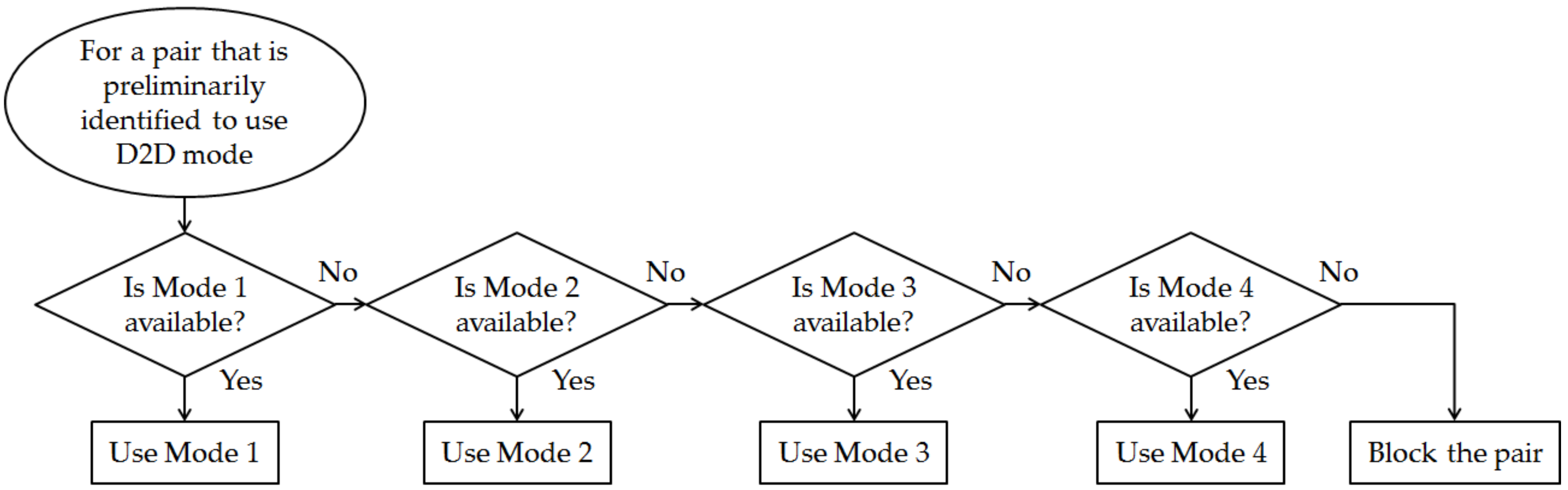
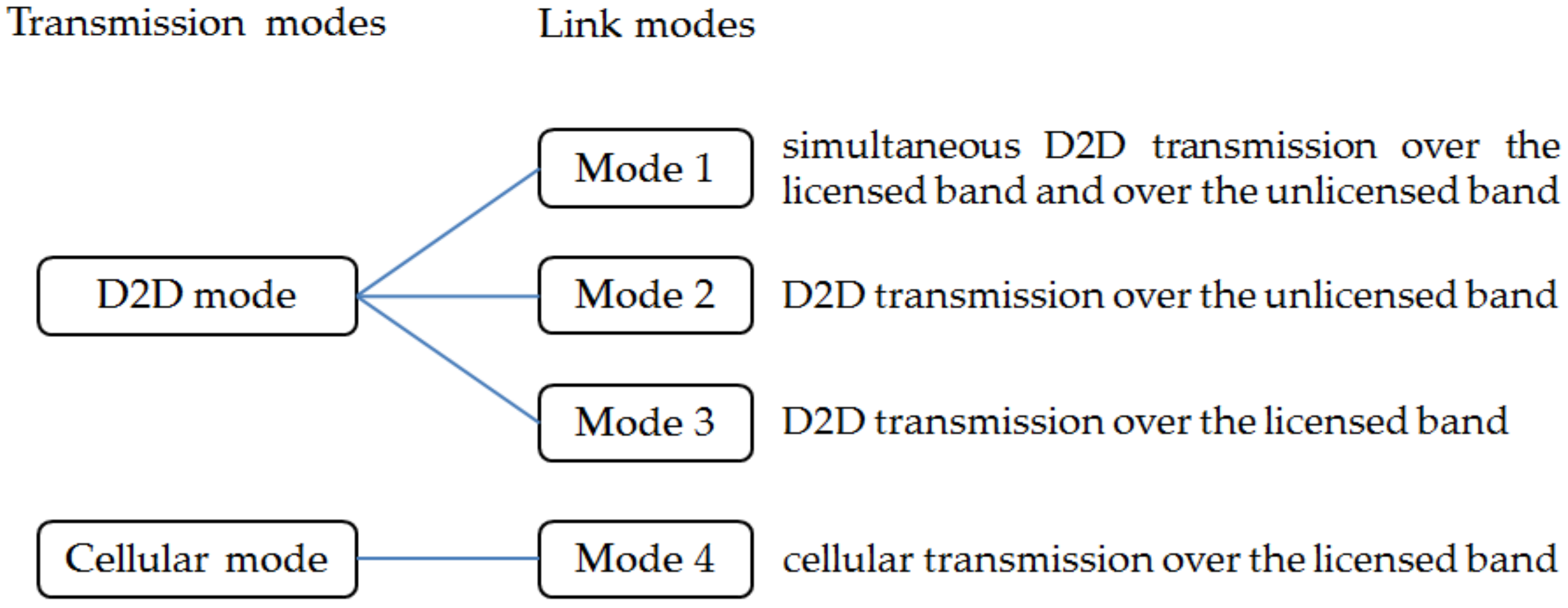
In this work, the D2D transmission mode can use both the licensed and unlicensed bands, while the cellular transmission mode can only use the licensed band. As a result, the system is able to utilize four link mode combinations, which are as follows: Mode 1: simultaneous D2D transmission over the licensed band and over the unlicensed band; Mode 2: D2D transmission over the unlicensed band; Mode 3: D2D transmission over the licensed band; Mode 4: cellular transmission over the licensed band. With respect to the relationship between the transmission and link modes, D2D transmission can be used in Mode 1, Mode 2, and Mode 3, while cellular transmission can only be used in Mode 4. This relationship is illustrated in
Figure 2.
3.3. Bandwidth Configuration
Let
denote the minimum necessary transmission rate for pair
i. Meanwhile, the required bandwidth for pair
i to achieve
, termed
, can, with reference to the well-known Shannon capacity formula [
39], be calculated as follows:
where
denotes the minimum signal power the receiver can accept and
denotes the white Gaussian noise power. The licensed band and the unlicensed band are divided into
and
parts, respectively, and the bandwidth for each channel in the corresponding bands are referred to as
and
. Note that the relationships between
and
and between
and
are expressed as
and
. For pair
i, the number of required channels can then be calculated as follows:
in the event that the licensed band is used, and as follows:
in the event that the unlicensed band is used. In the case of Mode 1 transmission, it is important to note that the numbers of channels utilized are the same for both the licensed and unlicensed bands.
Define the number of surplus channels in the system as
, the value of which can be determined as follows:
where
represents the set of pairs currently receiving data. Meanwhile, define the number of channels required by the current requesting user as
. As such, if
, then it is possible to utilize the surplus channels in question. On the other hand, in the event that
, then that means that there are not enough surplus channels, which means, in turn, that the spectrum usage rate must be enhanced to decrease the number of blocked connections by using channel reuse. That said, it should also be noted that for each individual channel, it is assumed that the channel can only be reused for one pair. Furthermore, in this context, the reuse of channels is only applied for D2D transmissions.
The specific manner in which the utilization of channel reuse takes place is detailed as follows. First, the term
is used to denote the number of channels that are needed so that a given user can engage in channel reuse; the value of
can be determined as follows:
Next, define
and
, respectively, as the interference power and the maximum tolerable interference power at the receiver. Therefore, it is only feasible for channel reuse to occur if
is less than
.
The issue of interference must be taken into account for a situation in which one pair is currently utilizing a channel as another pair then seeks to reuse that channel. In cases of this sort, should it not be possible to satisfy any of minimum transmission rate requirements, then the channel in question will not be made open to reuse by the second pair, and so that pair will thus continue its search for a channel that is capable of meeting the conditions needed for channel reuse. Meanwhile, the order in which such a search is undertaken depends on the numbering of the device pairs, with the search starting with the pair with the lowest number and going to higher numbers from there as necessary. Furthermore, in the event that all the pairs are checked and no available channel is found, then the connection being attempted by the pair in question will be blocked.
3.4. Problem Formulation and Goal
Taking the novel configurations and system model set-up described above into account, we then investigate the question of how to minimize the PTR while also ensuring that satisfactory transmission rates are maintained for all users.
Specifically, define as the available transmission rate set (ATRS) for user i, which contains all the rates of transmission that are allowed to be allocated; this term also includes, of course, the value 0. Given the assumptions of the system model, the ATRSs of the various users are associated with the link mode configuration and the bandwidth configuration of the system model. In other words, these configurations determine the values of , i = 1, 2, …, . For each ATRS, it can then be stated, with no loss of generality, that only a single element must be selected. It should also be noted that the rates obtained for different ATRSs consist of distinct and different items, even in the event that they have the same values. In other words, the intersection of the different ATRSs constitutes an empty set.
Selecting an element from the set represents an assignment action, that is, the allocation to a specific user of a particular rate. In this regard, the indicator is used to indicate whether or not the element has been selected. Specifically, if = 0, the element has not been selected; otherwise, that is, if the element has been selected, = 1. Therefore, a particular rate of transmission and corresponding usage of power will be generated by each assignment action. In the event that the element is chosen, the terms and are then used to denote the generated transmission rate and the power consumed, respectively, for user i.
Accordingly, the objective in terms of optimization is to choose elements, at each scheduling instant and, given the adjustable configurations of access for the system, from the set
in order to achieve the minimum PTR. At the same time, this choosing of elements is subject to various conditions, including the constraints of the minimum transmission rate requirements, the given rates in
, and the assumptions of the system model. In mathematical terms, the optimization problem in question can be formulated as follows:
subject to
That being said, given that the capacitated facility location problem, which is known to be non-deterministic polynomial-time (NP)-hard [
40], is part of the basic structure of the problem in question, it should be noted that the above optimization formulation is itself NP-hard. In other words, the formulation, in numerical terms, is regarded as being highly intractable with respect to achieving optimal solutions, and, as such, it cannot be effectively utilized to meet any practical needs. Thus, rather than attempting to actually solve this highly complicated problem directly, we instead sought in the present study to establish an efficient means of addressing it, such that network operators could thereby be provided with a realistic approach to use in practical contexts. To that end, the following section presents a simple yet effective algorithm for energy-efficient transmission that could potentially be used to address this NP-hard problem efficiently.