

Heart failure has become a real cardiovascular epidemic with falling incidence rates of coronary artery disease, decreasing mortality of acute myocardial infarction and with an aging population with long-standing hypertension and/or diabetes. Both heart failure with reduced (HFrEF) as well as heart failure with preserved ejection fraction (HFpEF) have, therefore, increased in prevalence and incidence substantially and are today among the most frequent causes for a hospitalization in developed countries. The management of heart failure patients has become increasingly complex and today involves clinical skills in a complex pharmacotherapy approach with diuretics as well as digitalis, titration of ACE-inhibitors, betablockers and mineralocorticoid receptor antagonists. Furthermore, in patients with reduced ejection fraction and left bundle branch block, implantation of a biventricular pacemaker and/or ICD today is standard of care. For more severe stages of heart failure, left ventricular assist devices either as bridge to transplant or destination therapy as well as heart transplantation become new options. Similarly, the diagnosis of heart failure has made enormous progress by the introduction of various imaging modalities and biomarkers. Thus, to master all diagnostic and therapeutic options currently available for patients with heart failure, a new medical sub-specialty is required.
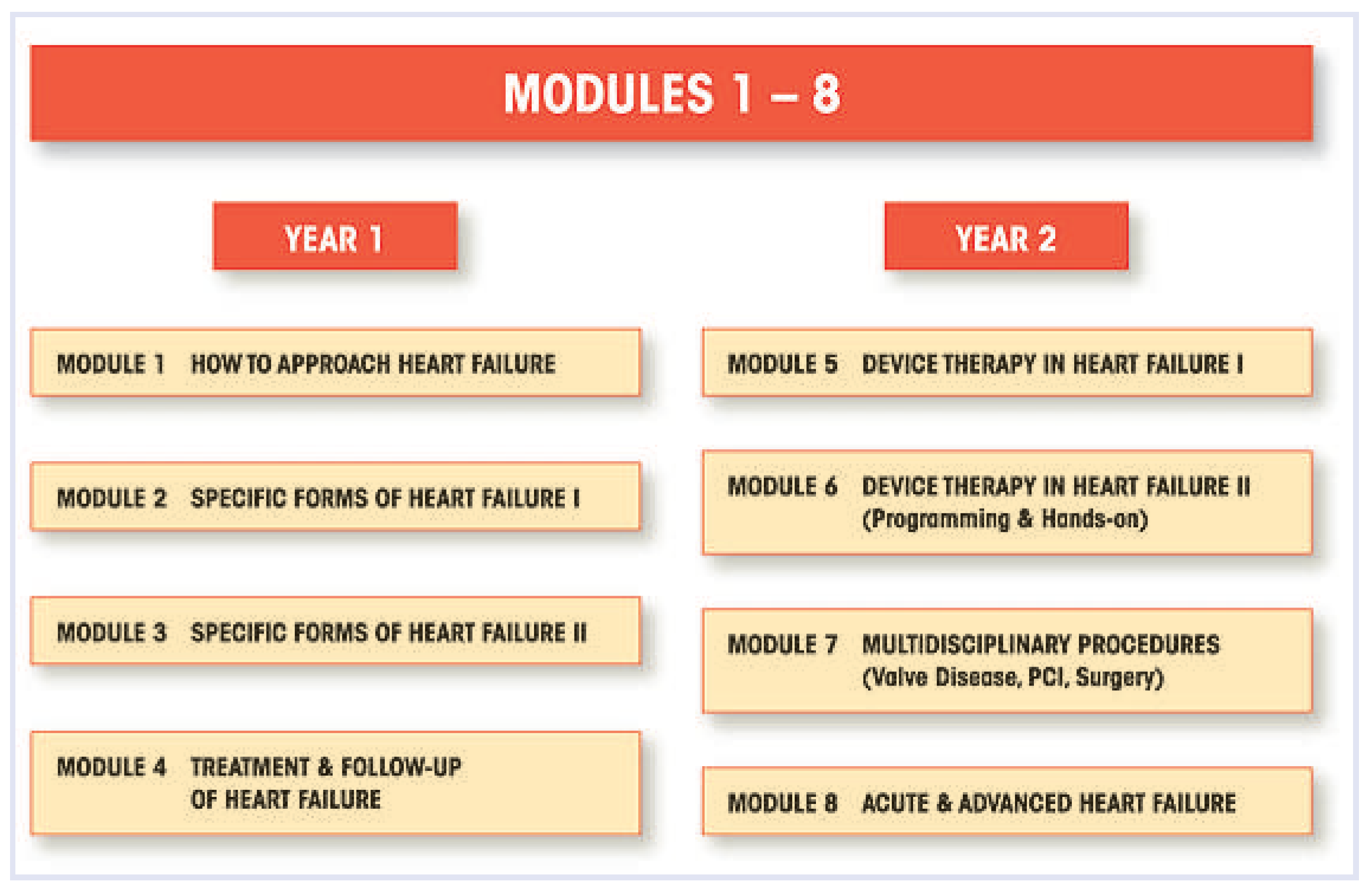
The European Society of Cardiology Heart Failure Association has published a core curriculum for heart failure physicians recently (1). The document led by Theresa McDonagh from the King’s College in London together with the board of the ESC Heart Failure Association including Stefan Anker, Gerasimos Filippatos and Burkert Pieske has become the basis for the first ESC Academy Postgraduate Course devoted to heart failure. This course organised by the Zurich Heart House is sponsored by the ESC Academy and the ESC Heart Failure Association and accredited at the University of Zurich and provides a comprehensive education over a 2 year period with 8 modules of 2.5 days each plus self-study for the participants. If exams are appropriately passed, the participants receive a Certificate of Advanced Studies in Heart Failure according to the Bologna system of the University of Zurich. The first course cycle, although only briefly announced, is becoming a real success. Indeed, more than 130 cardiologists have applied to participate. The selection committee eventually selected 59 of them from 32 countries around the world (Figure 1). The program of the course is structured in 8 modules with specific topics, each chaired by an advisory board member (Table 1). Unlike congresses, this is a practical course with a few front lectures by internationally recognized heart failure specialists (Figure 2) but more importantly interactive case seminars, imaging sessions, ECG tutorials, live transmissions of diagnostic and interventional procedures and hands-on echo courses (Figure 3). This specific structure of the course makes it very practice-oriented providing not only knowledge but also clinical skills in diagnostic and therapeutic techniques. The first module was held from January 30 – February 1, 2014 with Theresa McDonagh as the anchor woman devoted to “Assessing the Heart Failure Patient”. The organisers were proud to be able to attract the best speakers in the field including, besides the local faculty, John Cleland from London, Christian Müller from Basel, Martin Cowie from London, Luc Pierard from Liège, Bogdan Popescu from Bucharest, Peter Søgaard from Aalborg and colleagues from neighbouring disciplines such as pulmonology (Konrad Bloch from Zurich). The course was held in an excellent interactive atmosphere and promises to become a success as other modules are organised in the future. The next module on different forms of heart failure, led by Karl Swedberg, will be held from April 3-5, 2014 again in Zurich.
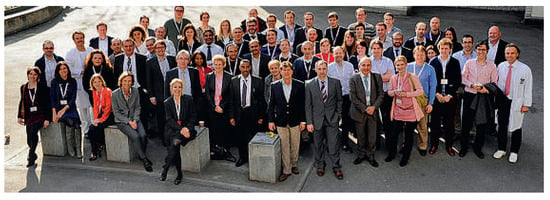
Figure 1.
59 course participants from 31 countries of the first module of the Postgraduate Course on Heart Failure at the University Hospital Zurich on January 30 to February 1, 2014.

Table 1.
The program of the course is structured in 8 modules with specific topics.
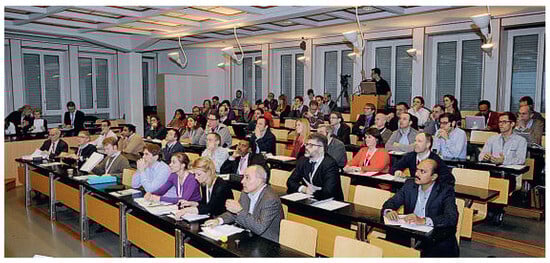
Figure 2.
Auditorium during a lecture block with participants of the first module of the Postgraduate Course on Heart Failure.
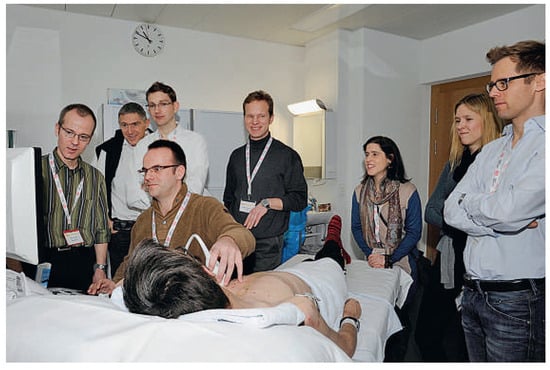
Figure 3.
Hands-on echo session with a group of participants led by Prof. Felix C. Tanner from the University Heart Center Zurich (left).
Postgraduate Course in Heart Failure
Advisory Board
Stefan Anker, Berlin; Jeroen J. Bax, Leiden; Gerasimos Filippatos, Athens; Gerhard Hindricks, Leipzig; Michel Komajda, Paris; Aldo Maggioni, Milan; Theresa Mc Donagh, London; Burkert Pieske, Graz; Fausto Pinto, Lisbon; Piotr Ponikowski, Wroclaw; Karl B. Swedberg, Gothenburg; Alec Vahanian, Paris; Panos Vardas, Heraklion.
Reference
- McDonagh, T.A.; Gardner, R.S.; Lainscak, M.; Nielsen, O.W.; Parissis, J.; Filippatos, G.; Anker, S.D. Heart Failure Association of the European Society of Cardiology Specialist Heart Failure Curriculum. Eur J of Heart Fail. 2014, 16, 151–162. [Google Scholar] [CrossRef] [PubMed]
© 2014 by the author. Attribution - Non-Commercial - NoDerivatives 4.0.